"Being an Account of the Risks and Adventures of Sidi Ahamadou, Sheikh of the Azjar Marauders of the Great Sahara." (continued 3)
Reading edition
No. I decided not to go, and sat watching her receding figure cross the market-place where slaves were sold even within recent years, and disappear in the shadow of the mosque.
In an hour I had forgotten the mysterious Fathma and her troubles, and returned to Tunis.
Next afternoon, as I entered my temporary abode in the Kasbah-Kasneh, my slave handed me a note. As I tore it open it emitted an odour of geranium, the favourite perfume of the harem. Having read the three long lines of sprawly Arabic characters it contained, I placed the missive in my pocket and turned away. If I valued my life, I was to meet Khadidja that evening. Was that a threat, or a warning? During the remainder of that day I lounged outside the cafés and pondered deeply. For hours I ruminated over absinthe and mazagran, cassis and bock; and, after much consideration, I at length resolved to keep the appointment, and ascertain the extent of the mysterious danger of which she wrote.
At the appointed hour I awaited her at a secluded spot outside the Bab Alewa. The clock of the Mosque of Sidi Mahrez, close by, struck solemnly, and as the last sound died away I heard the frou-frou of feminine garments, as a shrouded figure advanced to meet me.
“Ah, so thou hast kept thine appointment, O Touareg!” she exclaimed, stretching forth to me a soft white hand. “Thou thinkest, because I believe in the One, and in Mahomet his Prophet, that I am unworthy thy regard; that I am not to be trusted, eh?” Then she laughed lightly, adding, “Come, let us hasten. I want to have serious speech with thee upon a matter that affecteth us both.”
Without replying, I walked on beside her, wondering whether she were ugly or beautiful. Crossing a deserted garden, we passed out to where two asses were tethered, and, mounting them, rode away into the darkness. I remember that we went through several villages, and at length came to a larger place built upon the low cliffs, where a number of spacious flat-roofed houses overlooked the sea.
Suddenly she dismounted before a low arched door in one of the great square, inartistic, whitewashed residences, and placed her fingers upon her lips indicative of silence. Taking a key that was suspended around her neck, she unlocked the door and led me into a dark passage so thickly carpeted that my feet fell noiselessly as she guided me onward. Once I caught a glimpse of a spacious patio, rendered cool by a plashing fountain and green with many leaves; then through two small chambers we passed, until we came to a closed door, which she opened, and I found myself in a spacious, dimly illumined apartment, decorated in quaint Arabesques of dark crimson and dull gold. Everything was rich and luxurious. The air was heavy with sensuous odours rising in a thin blue column from the gold perfuming-pan. On the floor lay costly Arab rugs, and a couple of lion skins were thrown down on each side of the centre mat. A derbouka, and a ginkri, fashioned from a tortoise-shell, lay thrown aside, while from a magnificent hanging-lamp of gold a soft, mellow light was diffused, though scarcely sufficient to show the heavy draperies that concealed the walls.
“Best thee a moment, and I will return,” my mysterious veiled guide said; and then, drawing aside some of the silken hangings, she disappeared through a door that had been hidden.
With hands behind me, I slowly wandered round, wondering what apartment of the house this was, when some half-finished embroidery that had apparently been tossed hurriedly aside upon a coffee stool of inlaid pearl and silver caught my eye. That told me the truth. My heart gave a sudden bound. I was in the harem!
A French novel lay open on one of the little tables. I took it up, and, as I stood in wonderment, a movement behind me caused me to turn, and then I beheld the most beautiful woman I had ever gazed upon. She was not more than twenty-two, with a complexion fresh as a Frenchwoman’s, features that were perfect, pretty lips parted in a glad smile, and a dress that was the most gorgeous I had ever seen. The ugly haick had been replaced by a rlila of palest leaf-green brocaded silk, beneath which showed a rose-pink velvet vest; and, in the place of the baggy trousers, she wore the serroual, of silken gauze. Her tiny bare feet were thrust into slippers of rose velvet; on her head was set jauntily a little crimson skull-cap embroidered with seed-pearls; and her fouta, or sash, was of tricolour-striped silk, richly ornamented with gold. Upon her bare arms and ankles diamonds flashed and sparkled with a thousand fires, and her bangles jingled as she moved. She dazzled and fascinated me.
With an apology for having left me, she sank slowly among her cushions with graceful abandon, at the same time losing one of her slippers, and motioning me to a seat near her.
“Thou thinkest it strange,” she said; “perhaps even thou art angry, that I have brought thee hither alone unto this gilded cage. But I must speak with thee, O Man of the Desert—to warn thee;” and her dimpled chin rested upon her dainty palm as she, with seriousness, looked straight into my eyes.
“To warn me! Of what?”
“Thou art threatened,” she answered slowly. “Thou wilt, perhaps, remember that a month ago thou wert in Kabylia, and left Fort National for Tizi Ouzou. Thou hadst the careless indifference that thy free life giveth, and, no doubt, thou wert prepared to meet Eblis himself if he promised an adventure. On that occasion with whom didst thou travel?”
“I journeyed in company of a wealthy man of thy people, who was returning from the wine market.”
“True, O friend,” she replied. “A week ago thou didst describe that journey to a Frank of the Moniteur de l’Algérie, and ridiculed thy companion. See here!” and stretching forth her hand, she took up a paper containing an interview in which I had treated the journey in a comic vein, and had denounced in no measured terms the bigotry of my fellow-traveller.
“Thou art a Veiled Man; and that man,” she continued, “hath sworn upon the book of Everlasting Will to kill thee!”
“How dost thou know this, O thou whose face is rivalled only by the sun?” I asked quickly.
“Because—because the man thou hast ridiculed is my husband!” she replied, rising, and adding wildly, “Because I overheard the villainous scheme that he hath planned with his brother to take thy life, and at the risk of mine own honour I determined to save thee. Allah alone knoweth how terrible is my life alone in this place with my servants, bound to a fierce, brutal man who loveth me not, and upon whose brow the Câfer hath set seal.”
“Is thy husband neglectful, then?” I asked, noticing the poignant sorrow that in that moment seemed to have crushed her.
“Alas! yes. Whithersoever I go the curse of Sajin seemeth upon me,” she sighed, passing her slim, bejewelled hand slowly across her white forehead. Tears welled in her brilliant eyes, as she added in a broken voice, “I am lost—lost to all; soulless, uncared for, unloved.”
She hesitated a moment thoughtfully, glancing first at her own bejewelled hands find then at mine. With a quick movement she drew from one of her fingers a curious ring of silver, around which were Arabic characters in gold.
“See!” she cried, as if a sudden thought had occurred to her. “Take this, and wear it. It is my talisman, and as long as it is upon thy finger no harm can befall thee. It beareth the stamp of ‘La Belle,’ and will preserve thee in health and guard thee in the hour of tribulation.”
She took my hand in hers, and drawing my own ring from my finger, replaced it by her strange-looking talisman, afterwards slipping my own ring upon her hand. A sob escaped her. “We have exchanged rings!” she exclaimed brokenly, looking up into my face with tear-stained, world-weary eyes. Then, clutching her bare breast as if to still the throbbing of her heart, she cried, “When—when thou art far away, thou wilt, peradventure, sometimes gaze upon mine, and remember that a service was once rendered thee by a poor, unhappy woman—thou wilt recollect that her name is Fathma Khadidja—that—that—ah! forgive me, for I am mad! mad!”
Raising my hand to her warm lips, she kissed it passionately with all the fire and ardour of the Child of the Sun. Then, releasing me, she tottered back, panting, and sank upon her silken divan, with her face buried in her hands, sobbing as if her heart would break.
“Cama tafâkal kathalika tolâ ki,” I said, quoting at random from the Korân. “Come, come,” I added sympathetically, sinking down beside her, tenderly stroking her long, silky tresses. “Despair not. The One Worthy of Praise knoweth how thou sufferest, and will give unto thee strength in the hour of thy need, and bring thee into the shadow of the great lote tree.”
“Ah! Thy mouth uttereth pearls of wisdom,” she cried wildly. “But I have touched thee, a Touareg, and am accursed by Allah. I care nought for the future, for already am I forsaken, already have I tasted of the bitter fruit of Al-Zakkum, and am doomed to the torture of Al-Hâwiyat, the place prepared for the evil-doers.” Then, raising her face to mine, with an intense look of passionate love, she said in a soft, sibilant whisper, “Once only! Kiss me once! Then thou mayest go, and never shall we meet—never!”
Her beautiful head fell upon my shoulder, and her hair—soft as spun silk—strayed across my face. For a moment her lips met mine in a hot, passionate kiss, a caress enough to make any man’s head reel.
“I love thee,” she whispered, in low, half-frightened tones, as she clung to me, and would not allow me to release myself. “Unseen by thee, I have watched thee many moons, and to-night have I brought thee hither to tell thee—to confess to thee my secret.”
I tried to draw my lingering lips from hers, but with the fire of passion gleaming in her brilliant eyes she gripped me with a force I should not have supposed her capable of.
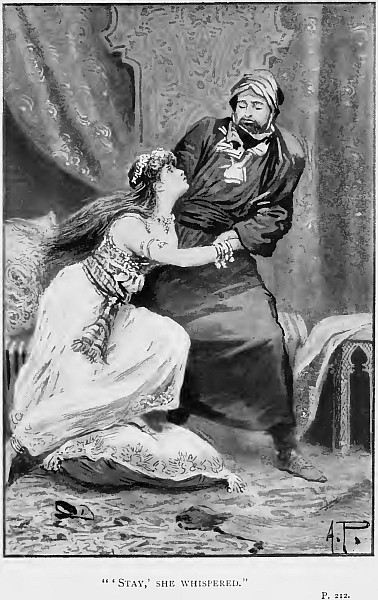
“Stay,” she whispered. “Without thee the canker-worm of love eateth away my heart.”
But I tore myself from her and left.
Next day my business of selling sheep took me to the Haras Fortress, away behind the hills of Ahmar, and the voices of the muddenin were already calling the faithful for the maghrib when I re-entered the Kasbah. Kasneh, my slave, was playing damma in the courtyard, but rose quietly, saluted, and told me that he had taken to my room a small package which had been left by the negro servant that had brought the letter on the previous day.
Could it, I wondered, be a present from Khadidja? Rushing in, I found on my table a small box, packed in white paper and secured with black seals. Eagerly I tore away the wrappings and opened it.
As I did so a shriek of horror escaped me. I fell back awe-stricken at the sight presented. Inside a satin-lined bracelet-case, bearing the name of a Paris jeweller, on a piece of pale-blue velvet, there was stretched a human finger that had been roughly hacked off at the joint! It lay stiff, white, and cold, with the blood coagulated where the blunt knife had jagged the flesh. The finger was a woman’s—slim, well-formed, with the nail stained by henna. It was loaded with costly rings, which scintillated in the golden ray of sunset that strayed into the room, and fell across them. As I looked, breathless in amazement, I saw among the ornaments my own ring!
A scrap of paper that fluttered to the ground bore the words, scrawled in Arabic character, “From the husband of Fathma Khadidja!”
That same night I strode furiously along the seashore, watching the glimmering lights in the distance. In fear and trepidation, I took the hideous souvenir of love, and, when far from the city, cast it away from me into the dark rolling waters.
Perhaps there, deep in its lonely hiding-place, it met the white, dead thing of which it had once formed part—the body of the matchless daughter of the sun whose wondrous hair enmeshed me, whose full, red lips held me like a magnet, shackling me to the inevitable. Who can tell?
Truly, in that brief hour when I lounged at her side, I was at the dreaded Bab-el-Hâwiyat.
Chapter Eight.
The Queen of the Silent Kingdom.
I entered the Silent Kingdom six years ago.
Praise be to Allah, whom the weight of a pearl upon the earth does not escape. May prayer and salvation be with the master of the first and last, our Lord Mahommed. Of a verity have I been blessed with blessings abundant, and enveloped by the cloak of his protection.
We had left the shore of Lake Tsâd after pillaging a great caravan from the north, and were moving westward across the stern, sterile desert in the direction of Gao, or Kou-kou, as it is popularly known among us, where we could dispose of our stolen merchandise. For months we had travelled across that immensity of sands where the very birds lose themselves, our camels often stumbling upon some skull, tibia, or even an entire skeleton, the remains of bygone generations of travellers who had perished on those lonely wastes. The sun blazed fiercely in the flaming sky, the skin cracked, the lips were parched. All the water we had was warm and impure, and even that was insufficient to quench our thirst. A scaly viper occasionally crossed our route, and at long intervals the swift flight of an antelope was seen. For days, months, nothing had rejoiced our eyes save the deceitful vision of the mirage, and one evening I decided upon a three days’ halt for rest.
On the previous day our eyes had been gladdened by the sight of a small well, where we filled our water-skins, therefore we were enabled to take our case; although being in an entirely unfamiliar country, the watchfulness of our sentries was never for a single instant relinquished. We were travelling with the sun only as our guide, therefore knew not into what territory we had entered, save that it was as barren and inhospitable a region as it had ever been our lot to encounter,—a shadowless land of solitude, abandonment, and misery.
In our raid upon the caravan near Lake Tsâd a bundle of papers had come into our possession, and these had been handed to me; but travelling constantly, I had not had time or inclination to examine them. That night, however, alone in my tent, I untied them and spread them out. Most of them, including a kind of diary, were written in the language of the Roumis, and as some bore the image of the Liberty of the Franks, I concluded that they must have belonged to some French officer in the northern region of the Desert, who had probably perished in an attempt to penetrate south.
One paper, however, the last I took up, was written in my own tongue, and I read it eagerly. It was an official letter, dated from Paris, urging its recipient to secure, if possible, during his explorations, the Fatassi of Koti, as the French Government were extremely anxious to obtain possession of it, and by that letter offered to pay any sheikh or tribesman almost any sum in exchange for it.
I put the letter down, smiled, and resumed my pipe. The hapless explorer, whoever he was, had probably died, and certainly his hopes would never be realised, for the Fatassi of the learned Koti was the phantom book of the Soudan. There was not a clansman in the whole of the Great Desert who did not know all about that priceless volume, yet no one had ever seen it. It had been lost to the world for ages.
Mohaman Koti, or Koutou, the great marabout, lived in Timbuktu in the year 850 of the Hegira, and was the most esteemed and even tyrannical councillor of our ancestor, its powerful king. His authority is said to have originated in the following manner. The king one day distributed some dried dates to his court, and Koti, who had recently arrived, was overlooked. Shortly afterwards the learned councillor assembled a number of people and dispensed fresh dates among them. This miracle—for we have no dates in that region of the far south—having reached the king’s ears, he discerned that upon Koti was set the divine seal, and from that moment gave him all his confidence. A few years later, according to Tarik è Sudan, Koti edited a history of the Kingdoms of Ganata, Songhoi, and Timbuktu, the only history written of those once all-powerful centres of civilisation, and in addition he dealt with the concerns of many peoples and many men. Families, since grown rich and powerful, and the chiefs of various countries, were shown to be with very humble origins, sometimes being the offspring of slaves. But while the book was being written, news was conveyed to the King of Timbuktu that the Songhois had revolted, and had combined with the great nation of Mossi to attack and capture his capital; therefore, in order to save his great store of treasure, he at once had it made up into single camel-loads, taken out of the city, and secreted in various distant spots on the confines of his empire. It was necessary, of course, to keep a strict and minute description of each spot where the wealth of the capital was concealed, in order that it might be recovered after the war; therefore Koti was ordered to inscribe in his book instructions how to unearth the great store of gold and gems, the spoils of war during four centuries. This, according to a legend completely borne out by our Tarik, he did, and the precious manuscript was given into the king’s own keeping. Ere one moon, however, the learned historian died suddenly at Tindirma, where a little white mosquelike house marks his grave till this day. The war was fought, proving, alas! disastrous to the king, who was compelled to fly, but, strangely enough the Tarik maintains silence regarding his subsequent adventures, or of what became of the precious Fatassi. Legend has it that the king was treacherously poisoned by a slave, as rulers were apt to be in those turbulent days; but by whatever means the once-powerful monarch met with his death, the fact remains that the priceless volume and guide to the enormous treasure of ancient Timbuktu was lost to all. For more than four centuries the recovery of the Fatassi has been the dream of poor and rich alike. The scholar coveted it because it would shed so much light upon the obscure past of these vast regions; the camel-driver, the merchant, and the prince alike desired to possess it for the information it was known to contain regarding the long-lost wealth.
It was because of the latter that the government of the Franks desired to obtain it. But theirs, like my own, was but a vain desire.
A whole moon passed, and still we pressed forward towards Gao, ever in the crimson track of the setting sun. One night, however, when the camp was asleep, the guards raised the alarm, but so suddenly were we attacked that we scarce had time to defend ourselves from a column of French Spahis who had swept down upon us. It was a mad, terrible rush. Although our tribesmen fought valiantly and well, it was impossible to withstand the frightful hail of bullets poured forth upon us by a gun they carried which spat forth lead in deadly hail. Our men, seeing the havoc wrought by this new weapon, turned and fled. Fortunately the poison-wind had sprung up, and its clouds of sand cannot be faced by the men of the north; therefore we were enabled to escape, although unfortunately compelled to leave the greater part of the stolen camels and merchandise in their possession.
As, in the confusion, I sprang upon a horse and rode through the blinding sandstorm for my life, I heard the thud of the horses’ hoofs of my pursuers. From the noise there must have been a score of men, anxious, no doubt, to secure the marauding chief feared by all the caravans. But swift as the wind itself, I rode on alone the greater part of that hot, stifling night, until, pulling up, dismounting, and placing my ear to the ground, I could, detect no sound of pursuit. In the glimmering twilight, as night gave place to day, I saw before me a huge, dark rock, shaped like a camel’s hump, rising from the sand, and, riding onward, I there tethered my horse beneath it, and flung myself down to snatch an hour’s sleep ere the sun rose, intending then to go forth again and rejoin my scattered people.
How long mine eyes were closed Allah alone knoweth; but when I opened them I found myself lying on a panther’s skin in a darkened chamber, filled with the music of running water. The place was cooled by the stream, and in the dim recesses of the room I could distinguish rich divans. Suspended from the roof was a fine Moorish lamp of chased gold, which shed a soft, yellow light, and from a perfuming-pan was diffused the sweet odour of attar of rose. The light was soft and restful, and in wonder I rubbed my eyes and gazed about me.
“Allah give thee peace, O stranger!” a thin squeaking voice exclaimed. And glancing quickly behind me, I beheld a wizen-faced man, small of stature, dressed in a robe of bright blue silk, and so bent by age that his white beard almost swept the ground. Notwithstanding his venerable appearance, however, his face was dark and forbidding, and his small, black piercing eyes, that time had not dimmed, had a glint of evil in them. Instinctively, ere we had spoken a dozen words, I mistrusted him.
“To whose hospitality do I owe the rest and repose I have enjoyed?” I inquired, slowly rising to my feet and stretching my cramped limbs.
“My name,” the old man croaked, “is Ibn Batouba. I discovered thee sleeping in the sun outside this my dwelling-place, and brought thee in, for the rays had smitten thee with a grievous sickness, and thou wert on the point of death. Thou hast remained here twelve days.”
“Twelve days!” I cried, with incredulity, at the same moment feeling my head reeling. “Then to thee I owe my life?”
The hideous old man in blue grinned with satisfaction, regarding me with a strange, covert glance.
By this time my eyes had grown accustomed to the semi-darkness, and I saw that the chamber was a natural one—a kind of arched cavern, the floor of which had been levelled, and a channel formed for the cool spring that bubbled forth and rippled away into gloomy depths.
“This thy dwelling is beneath the surface of the earth,” I observed, glancing around me. “Why dwellest thou here in secret?”
“The true Arab answereth not the question of Ahamadou, Sheikh of the Azjar Touaregs,” he replied, with a sneering accentuation on the final word. “Allah hath sent thee as my guest; partake of all that I have, but seek no explanation of who or of what I am.”
He evidently recognised me, and his strange words puzzled me. First, I had no idea that such a luxurious abode could exist in the centre of that inhospitable region; secondly, the very fact pointed to the conclusion that in my flight I had approached near to a town; but thirdly, I had already proof positive that my strange host, the man who declared he had saved my life, lied to me. At the well where we had halted on the day before the fight, I had plucked a sprig of jasmine, and placed a tiny piece behind my ear, beneath the black nicab around my head. This I recollected, and, taking it in my hand, found it still limp and undried. By that alone I knew I had not been there many hours, and that his story was untrue.
I suggested that I should be reluctantly compelled to leave; but he at once became profuse in his hospitality.
“No, not yet,” he urged. “I am alone, save for my slaves, and thy companionship is pleasant. Remain, and I will show thee over this my hidden dwelling-place. It may interest thee.” And taking down a torch, he lit it and led the way across a tiny bridge that spanned the running water, and opening a door in the rock, conducted me through several intricate passages, narrow and dark, until we came to a series of caverns of various sizes, each hung with rich silken hangings, and the floors covered by the most beautiful carpets from the East. Over each a great golden lamp of filigree shed a soft light, showing how rich and costly were the antique tables of inlaid pearl and silver, and how wide and soft were the divans. In each the thin blue smoke, curling upward from the golden perfuming-pan, gave forth an intoxicating fragrance, and in one I noticed lying discarded a pair of tiny green slippers, embroidered with seed-pearls, and a ginkra, one of those little two-stringed guitars fashioned from a tortoise-shell, both betraying the presence of a woman.
When we had passed through half a dozen similar chambers in the solid rock, the old man, croaking as he went, stopped suddenly at the further end of the last and most gorgeous of all his subterranean domain, and with a grim expression on his evil countenance, said—
“And this is the Bab-el-Hâwiyat—the dreaded Gate of Evil, whence none return.” I started, and drew back. Throughout the Desert there has been for all ages a legend that somewhere there exists the entrance to the dreaded kingdom of darkness where Eblis reigneth. He opened wide the small door; but there was only darkness impenetrable, and an odour of damp earth. Holding his torch aloft, he crossed the threshold, and bade me peer in. Then I distinguished, a few spans from where he stood, a great yawning chasm opening to the very bowels of the earth.
“Hearken!” he cried in his squeaking, uncanny voice, at the same time returning into the room and snatching up from one of the coffee-stools a large metal dish, which an instant later he hurled into the dark abyss.
I listened to ascertain its depth. But no sound came back. I shuddered, for I knew it was unfathomable.
As he faced me in closing the door I detected in his keen eyes a strange exultant look, and was seized by a sudden desire to ascend once again to the light of day. True, I could have crushed the life out of him as easily as I could crush a spider in my fingers, while in my belt was my jambiyah that had a score of times tasted the life-blood of mine enemies, yet he had not harmed me, and to kill one’s host is forbidden by Al-Korân. Therefore I stayed my hand.
As we retraced our steps he poured upon me nauseating adulations, declaring me to be the most valiant sheikh in the Great Desert, and using the most extravagant simile of which the Arabic tongue is capable, a fact which in itself filled me with increasing suspicion. Suddenly, however, as we reached the chamber where flowed the cooling spring, the truth was made plain. As he opened the door two officers of the French, in linen garments and white helmets, who had apparently been lying in wait, pounced upon me, uttering loud cries of triumph.
The old white-bearded recluse—may Allah burn his vitals—had betrayed me. He had held me, and sent word to the Franks to come and capture their prize—Ahamadou, the chieftain of the Azjar. But in an instant I, upon whose head a price was set, drew my blade and defended myself, slashing vigorously right and left, succeeding at last in escaping down the dark winding passage through which we had just passed. Forward I dashed through room after room, upsetting some of the tables in my mad rush, while behind me were the white-faced officers with drawn swords, determined to take me alive or dead. Well I knew how desperate they were, and in that instant believed myself lost. Yet, determined to sell my life dearly, it flashed across my mind that rather than suffer the ignominy of being taken in chains to Algiers, the infidel city, and there tried by the tribunal as others had been, I would cast myself into the fathomless pit.
I sprang towards the small, low door, but at first could not open it. In a few moments the crafty Ibn Batouba, with the Franks, gained the spot; but I had already unlocked the door and flung it open. Then, just as they put out their hands to seize me, I swung aside, lifted my knife, and struck my evil-faced betrayer full to the heart.
With a piercing shriek he fell forward over the door lintel, and his lifeless body rolled into the awful chasm, while at the same instant I gave a bound, and with a cry of defiance, leaped down into the darkness after him.
I felt myself rushing through air, the wind whistling in my ears as deep down I went like a stone in the impenetrable gloom. Those moments seemed hours, until of a sudden a blow on the back knocked me half-insensible, and I found myself a second later wallowing in a bed of thick, soft dust. Instantly it occurred to me that because this carpet of dust deadened the sound of things pitched into the chasm, the belief had naturally arisen that it was unfathomable. I rose, but sank up to the knees in the soft sand, which, stirred by my fall, half-choked me. Far above, looking distant like a star, I saw the light of a torch. My infidel pursuers were peering into the fearsome place in chagrin that I had evaded them. The air, however, was hot and foul, and I knew that to save my life I must be moving; therefore, with both hands outstretched, I groped about, amazed to discover the great extent of this natural cleft in the earth, formed undoubtedly by some earthquake in a remote age.
Once I stumbled, and bending, felt at my feet the still warm body of my betrayer—may Eblis rend him. I drew my jambiyah from his breast, and replaced it in its sheath. Then, tearing from his body the silken gauze which formed his girdle, I fashioned a torch, igniting it after some difficulty with my steel. Around me was only an appalling darkness, and I feared to test the extent of the place by shouting, lest my pursuers above should hear. So forward I toiled in a straight line, floundering at every step in the dust of ages, until the cleft narrowed and became tunnel-like with a hard floor. I stooped to feel it, and was astounded to discover that the rock had been worn smooth and hollow by the tramp of many feet.
Besides, the air had become distinctly fresher, and this fact renewed courage within me. At first I felt myself doomed to die like a fox in a trap; but with hope reawakened there might, after all, I thought, be some outlet.
Of a sudden, however, there arose before me a colossal female figure seated on a kind of stool, with features so hideous and repulsive that I drew back with an involuntary cry. It was a score times as high as myself, and as I hold my torch above my head to examine it, I saw it was of some white, semi-transparent stone of a kind I had never before beheld. The robes were coloured scarlet and bright blue, and the face and hands were tinted to resemble life. One hand was outstretched. On the brow was a chaplet of wonderful pearls, and on the colossal fingers, each as thick as my own wrist, were massive golden rings which sparkled with gems. But the sinister grinning countenance was indeed that of a high-priestess of Eblis.
In amazement I held my breath and gazed about me. Around the sides of the cavern were ranged many other smaller female figures, seated like the central one, and the face of each bore a hideous, repulsive grin, as if in mockery of my misfortunes. Before the great central colossus was a small triangular stone altar, upon which was some object. I crossed, and glancing at it found to my dismay that it was a beautiful and very ancient illuminated manuscript of our holy Korân. But through it had been thrust a poignard, now red with rust, and it had been torn, slashed, and otherwise defiled.
The truth then dawned upon me that this noisome place into which I had plunged was actually the abode of the ancient and accursed sect who worshipped Eblis as their god.
As I gazed wonderingly about me, I saw everywhere evidence that for ages no foot of man had entered that dark silent chamber. The dust of centuries lay smooth and untrodden.
Again I passed beneath the ponderous feet of the gigantic statue, when suddenly my eyes were attracted by an inscription in Kufic, the ancient language of the marabouts, traced in geometrical design upon the hem of the idol’s garment. My torch had burned dim, so I lit another, and by its flickering rays succeeded in deciphering the following words:—
“Lo! I am Azour, wife of Eblis, and Queen of all Things Beneath the Earth. To me, all bow, for I hold its riches in the hollow of my hand.”
I glanced up quickly, and there, far above, I distinguished that in the idol’s open palm there lay some object which the fickle flame of my torch could not reveal. But consumed by curiosity, I at once resolved to clamber up and ascertain what riches lay there. With extreme difficulty, and holding my flambeau in my left hand, I managed at length to reach the platform formed by the knees of the figure, and then scrambled up the breast and along the outstretched arm. But on mounting the latter, I was dismayed to discover that the object for which I had toiled was neither gold, silver, nor gems, but merely a brown and mouldy parchment scroll. Standing at last upon the open hand, I bent and picked it up; but in an instant I recognised that my find was of priceless value. Ere I had read three lines of the beautifully formed but sadly faded Arabic characters, I knew that it was none other than the long-sought manuscript of the Fatassi, the mysterious phantom book of the Soudan.
I placed my treasure beneath my dissa, and at once proceeded to descend, eager to discover some means of escape from that gloomy cavern, peopled by its hideous ghosts of a pagan past. In frantic haste I sought means of exit; but not until several hours had elapsed did I succeed in entering a burrow which, leading out into a barren ravine in the desert, had once, no doubt, been used as entrance to the secret temple of those who believed not in the One Merciful, but in Eblis and Azour.
After travelling many days, I succeeded in rejoining my people at a spot four marches from Gao, bearing concealed in my dissa the priceless history of my ancestors, with the minute plans for the recovery of their hidden treasure. At this moment the Fatassi, traced by the hand of Koti, so long coveted by the Franks, is in my possession; though only to two of my headmen have I imparted the secret that I have recovered it.
To seek to unearth the ancient treasure at present would be worse than useless, for our conquerors would at once despoil us. But when the great Jehad is at last fought, and more peaceful days dawn in the Soudan, then will the secret treasure-houses be opened and the Azjar become a power in the land, because of the inexhaustible riches left to them by their valiant ancestors for the re-establishment of their lost kingdom. Until then, they possess themselves in patience, and trust in the One.
To thee, O Reader of this my Tarik of toil and tumult, peace.
Chapter Nine.
The Father of the Hundred slaves.
Ahamadou, squatting upon his haunches before our camp fire, calmly smoking his long pipe, related to me the following story, declaring it to be a true incident. All wanderers in the Great Desert, be they Arabs or Touaregs, are born story-tellers, therefore I reproduce the narrative as he told it. It must be remembered that the Azjars were, at one period—not so very long ago—slavers who made many raids in the primeval forests south of Lake Tsâd, and that Ahamadou himself profited very considerably by that illegitimate trade. It was rumoured down at “the coast” that the leaders of these Touareg raiders were not Africans, and this story appears to substantiate a statement which was, at the time, ridiculed at the Colonial Office in London.
“Get up, you lazy devil. Stir yourself. We’re in a complete hole!”
“Hole? hole? Ah, your English tongue is indeed extraordinaire! A hole is a place in the ground, n’est ce pas?”
“Yes, and you’ll have a hole in the ground all to yourself, my dear Pierre, if you don’t bustle up a bit.”
Pierre Dubois, the man addressed, a bronzed, grey-bearded, stout, small-eyed Belgian of fifty, was lying tranquilly on his back on a pile of soft rugs, like an Oriental potentate, smoking his shisha, or travelling pipe, and being fanned by an extremely ugly negress. Dubois was the name he had adopted after leaving the Congo hurriedly, carrying with him a goodly sum belonging to the Belgian Government, in whose employ he had been for ten years. A native of Liège, he was one of the pioneers of that so-called Central African civilisation of trade, gin, and the whip; but after lining his pockets well, and making good his escape through the boundless virgin forests of “darkest Africa,” he had started as a trader in that most marketable of all commodities—black ivory.
Pierre Dubois and Henry Snape, his partner, were slave-raiders. They dressed as Arabs, and lived as Arabs.
Outside in the blazing noon, beneath the scanty shade of a few palms and mimosa scrub which surrounded that desert watering-place known as Akdul, a number of their heavily-armed followers were lying stretched upon the sand, sleeping soundly after their two-bow prayer to Allah, while here and there alone sat one of their number on his haunches, wrapped in his white burnouse, hugging his knees, his rifle at his side, keeping watch. They were a forbidding, evil-looking lot these Songhoi Touaregs, pirates of the forests and the desert, each with his black litham wrapped around his face concealing his features, a complete arsenal of weapons in his girdle, a string of charms sewn in little bags of yellow leather around his neck, and, strapped beneath his left arm, a short cross-kilted sword, keen-edged as a razor.
Beyond, lying in the full sun glare, were sixty or seventy wretched, woolly-haired negroes, men and women, chained together and guarded by a dozen of the veiled men. Throughout Northern and Central Africa the very name of the Songhoi was synonymous with all that was fierce, cruel, and relentless, for they lived by robbing the desert caravans or capturing slaves in the boundless virgin forests between the Niger and the Congo, being essentially a nomadic race, and having no other home than their tents in the Sahara, that limitless wilderness of rock and sand. Of all the slavers of Central Africa these “veiled men” were the worst, for they attacked and burned villages, placed the unfortunate blacks to torture to compel them to reveal the hiding-places of their store of ivory, and afterwards took them prisoners, and sold them in the great central slave-market at El Obeïd, away in Kordofan.
Among the natives of the Upper Congo and the Aruwimi, even the hordes of that notorious king of slavers, Tippu-Tib,—so called by the negroes because the guns of his men created a noise, from which they have named him phonetically,—were more tolerated than the fierce Songhoi bands, with their black veils, which none ever removed, sleeping or waking; for the track of the latter through the forest or grass-land was always marked by murder, devastation, and wanton cruelty.
Dubois, when in the service of King Leopold, had been active in endeavouring to put down the trade, but seeing how lucrative it was, and finding Snape, an English adventurer, ready to join him, he had collected a following of the fiercest Touaregs he could gather, and as he paid all well for their services, while on their part they were proud to be led by a white man in whom they had once lived in fear, their trade had, for a long time, been a most lucrative one. They were the terror of the whole region from Stanley Falls to Tanganyika. A dozen times they had been north to El Obeïd with ivory of both varieties, white and black, and on each occasion the profits had been far beyond their expectations. The trade is still easy enough in the Congo State, and slaves are captured without very much difficulty. The great risk, however, is to transport them by the route they had been following for the past two months, as, in order to reach the central market, they had to pass through that portion of British territory where a very watchful eye is kept, and where the notorious Arab raider Kilonga-Longa met his fate only a few months before.
But Dubois and Snape had run the gauntlet many times, and were absolutely fearless. On the present raid through the country of Emin and Junker, they had made their captures in the Moubouttou, within the Belgian sphere of influence, with the complicity of the Belgian agent at Sanga, whom they, of course, bribed with a goodly present of ivory; then, marching through the great Forest of Eternal Night, due northward to Zayadin, they had passed through the Dinka country to Fatik, which, being only two days’ march from the Bahr-el-Guebel upon which the British have posts, is a dangerous point. Nevertheless, they had pushed forward night and day, and were now in the centre of that great, sunburnt desert, the Wilderness of Nouer, which stretches northward for three hundred miles to El Obeïd.
Dubois grumbled loudly at the Englishman for interrupting his meditations, saying—
“Go and sleep, mon cher. You’ll be getting fever if you worry too much.”
“Worry!” echoed Snape. “There’s danger, I tell you. Surely you’re not a confounded fool, man?”
“Ah,” answered his partner, quite calmly, “is there not always danger here, in Africa? You have a wonderful imagination, my dear Henri, I quite admit; but do allow me to finish my sleep. Then let us talk of this extraordinary hole, whatever it may be.”
“Idiot!” ejaculated the Englishman, hitching up his flowing white burnouse. He was a tall, good-looking fellow of forty, whose career, however, had been a singularly eventful one. Since he left Balliol he had met with a good many adventures in various lands, most of them being to his discredit. He had been a born gambler, and had drifted from the London clubs to the tables at Monte Carlo, and thence, by a very crooked channel, to that sink of the world, Africa, where chance had brought him in contact with the scoundrel and arch-slaver Dubois. They were a well-matched pair. At college Snape had taken honours for Arabic, therefore his knowledge of that language now served him in good stead. He was one of those men who could never run straight, even though he had often tried. He was a born outsider.
“Why idiot?” inquired his partner lazily. The old negress waved the fan backwards and forwards, understanding not a word of the conversation between the headman and the great white Sheikh, who, on account of his raiding, the Touaregs had named The Father of the Hundred Slaves.
“Well, I’m not the sort of fellow to let the grass grow under my feet when there’s any danger,” snapped Snape. “You remember what Zafar said yesterday.”
“He’s like yourself, mon cher,—always apprehensive of some horrible calamity,” muttered the Belgian, blowing a cloud of smoke from his lips.
“This time, I tell you, it’s no mere imagination,” the Englishman went on. “Last night, after the dua, I left secretly, so as not to arouse any misgivings, and rode due east until the dawn, when I discovered, encamped among the aghrad, a whole troop of Soudanese soldiers. I got near enough to ascertain that the officers were Englishmen.”
“Well?”
“They’ve got word somehow that we are passing through,” he said. “And now, if you don’t stir yourself, you’ll never see Brussels again—you understand?”
“I have no wish to see Bruxelles, mon cher,” the elder man replied, quite undisturbed. “If I did, it would only be to see the inside of a prison. No; I prefer Africa to the pleasures of the miniature Paris. Here, if one has a little ivory, one is a king. Life is very pleasant.”
“I admit that,” his companion said. “But do, for Heaven’s sake, get up and let us decide what to do. There’s danger, and we can’t afford to be trapped, especially with all those niggers tied in a string. The evidence is a bit too strong against us, and the officers are English. There’s no bribing them, you know.”
The Belgian stirred himself lazily at last, and asked—
“Are they at a well?”
“No. They are without water.”
“Then as this is the only well for about a hundred miles, they’ll arrive here to-day—eh?”
“Of course. That’s why I came straight to warn you. There’s no time to be lost. Let’s strike camp and get away. It’s skip or fight.”
“If we skeep—I suppose you mean march—ah! your English language!—then they will skeep in pretty quick time after us. They’ve got wind of our presence in the vicinity, therefore why not remain and fight?”
“Fight my own people?” cried Snape. “No, I’m damned if I do!”
“Why not?” asked the Belgian, with gesticulation. “Our Touaregs will slice them into mincemeat. Besides, at long range they’re as good shots, and better, than those Soudanese, all fez and swagger.”
“No,” the Englishman argued. “Let’s fly now, while there’s time. In two days we shall be in the Nioukour, and they’ll never find us in the mountains. We hid there quite snugly once before, you recollect.”
“Muhala,” said the Belgian, turning to the old negress, “go. Call Yakub, and remain outside.”
The hideous old woman went forth into the sun glare, and in a few moments an old thin-faced Touareg entered, making a low salaam.
“Now, Yakub,” exclaimed the Belgian in Arabic, “answer me. Of what did our caravan consist when we left the Aruwimi?”
“Three hundred and thirty-three slaves, and twenty-nine tusks,” answered the villainous-looking old fellow.
“And now?”
“Seventy-three blacks and twenty-nine tusks.”
“Then two hundred and sixty have died?”
“Yea, O master,” he responded. “The new lash of elephant hide has killed many, and the black death has been responsible for the remainder. Five are suffering from it now, and never a day passes ere one or more is not attacked. I have feared that none will live to sight the mosques of El Obeïd.”
“In short, Yakub, they are a diseased lot—eh? You think they’re worthless?”
“Only two women are left, O master, and both were seized by the black death yesterday.”
“In that case,” observed the Belgian, turning to his partner, “the whole batch are not worth transporting. The game is not, as you English say, worth the lamp.”
“Then what’s your suggestion?” asked Snape.
“Well, as you are so much in fear of these confounded English, we must, I suppose, act.”
“How?”
“It is quite simple. We just abandon the whole lot, and save ourselves and the ivory.”
“Very well,” his companion agreed. “I’m open to any move except fighting against the English.”
“Bah! You are full of scruples, mon cher Henri,” he laughed. “I have none—none. And I am happy—perfectly happy.” He was silent a moment, as though reflecting deeply.
“But,” he added, “I do wish we could teach these interfering English a lesson. It would do them good. They try to rule Africa nowadays. Ah! if we could—if we could!” And there was a strange glint of evil in his eyes.
An hour later Dubois and Snape, at the head of their formidable troop of brigandish horsemen, were riding at full speed across the desert due west, towards the far distant forest of Dyonkor, it having been decided to skirt this, and then travel south for a fresh raid in Congo territory.
As for the poor wretches bound together, and dying of thirst and disease, they were still secured to the palm trunks and abandoned to their fate, tortured by being within sight of the well, yet unable to slake the frightful thirst consuming them. Dwellers in the damp, gloomy forest, where the sunlight never penetrates, the intense heat of the desert struck them down one after another, sending them insane or killing them outright.
Time after time Snape turned in his high Arab saddle, glancing back apprehensively to see if they were followed. But his partner only laughed sarcastically, saying—“You still fear your friends the English? Ah! you have the heart of the chicken. All is quite unnecessary. We have made them a present of the whole lot, and I hope they will appreciate our kindness. Now we shall take it easy, and hope for better fortune with the next batch. I fancy that the new lash must be too hard. The women can’t stand it, so it seems.”
“A little less whipping and a little more water would keep ’em in better condition,” Snape observed. “Yakub is eternally lashing them for some imaginary laziness or offence.”
“Yes, it’s all due to that new lash,” the Belgian admitted. “It must be used with less frequency on the next lot.”
“It’s a revolting punishment. Twenty blows kill a strong nigger,” his companion declared. “The thing ought to be thrown away.”
“Ah, yes,” sneered his companion. “You would, if you had your own way, keep women to brash the flies off them, and carry feather-beds for them to sleep on. You always forget that you are not dealing with civilised beings. They’re mere niggers.”
“Well, we’re not of the most civilised type, you and I, if the unwelcome truth be told,” the Englishman responded. “If we are trapped there’ll be a howl in Europe.”
“But I, for one, don’t mean to be caught,” laughed the Belgian gaily, with perfect confidence of his security. And they both rode side by side, the troop of white-burnoused Pirates of the Desert thundering on behind, raising a cloud of dust which, in that clear atmosphere, could be seen many miles away.
On, on they sped over the burning sand, riding easily at a hand gallop, without a halt, the black-veiled raiders laughing and chaffing, chattering, pushing forward, even in the blood-red track of the dying day.
Night fell quickly, as it does in that region. The slavers encamped in a sandy hollow beneath the rocks, and Dubois, ordering the tent to be pitched, sat smoking with his partner after the dish of dakkwa (pounded Guinea-corn with dates) which old Muhala had prepared. They were alone.
“To camp like this before we reach the forest is, to my mind, simply inviting capture,” Snape grumbled. “The military detachment is evidently out in search of us, and the little lot we’ve abandoned will point out to them the direction we’ve taken. Then they’ll follow and overtake us.”
“Oh no, they won’t,” answered the Belgian, with a serene smile.
“What makes you so sure?”
“Remember that, coming up from the river, they must have been at least six days without water; therefore they’ll halt at Akdul to drink and fill their water-skins before pushing forward.”
“Well?” inquired Snape.
The crafty Belgian looked curiously into the face of his companion, and smiled grimly.
“Well, if they halt there,” he said, “they won’t trouble us any more.”
“I don’t understand.”
“I doctored the water before we left. That’s why I didn’t leave the blacks loose to drink it.”
“What!” gasped the Englishman wildly, starting to his feet. “You’ve actually poisoned the well?”
The Belgian nodded and laughed, without removing his shisha from his lips.
“You scoundrel! You fiend!” the Englishman shouted, his face white with passion. “I’ve done some shabby tricks in my time, but, by Heaven! I’d rather have given myself up than have assented to the wholesale murder of my own people like that!”
A sarcastic smile crossed the Belgian’s sinister features.
“Excitement is entirely unnecessary, mon cher Henri,” he said, calmly. “It may, you know, bring on a touch of fever. Besides, by this time there isn’t many of them, white or black, left to tell the tale. Yakub, whom I left behind to watch, has just come in to report that they arrived an hour after we had left, released the slaves, and watered freely, enjoying themselves immensely. Before he started to return, fully fifty were dead or dying, including all the white officers. But why trouble further? We’ve saved ourselves.”
“Trouble!” roared Snape, his eyes flashing with a fierce fire of indignation, “Get up, you infernal scoundrel, or I’ll shoot you as you lie! You’re an outlaw; so am I. Trouble! Why, one of those white officers was Jack Myddleton, my brother, and,” he added in a harsh tone—“and I’m going to avenge his death!” Instantly Dubois saw his partner’s intention, and sprang to his feet, revolver in hand.
Two reports sounded almost simultaneously, but only one man fell. It was the Belgian, who, with an imprecation on his lips, dropped back with a bullet through his temple, and in a few seconds expired.
At dawn Muhala discovered her master dead, and his companion missing. Search was at once made for the Englishman, who was found lying dead upon the sand half a mile from the camp.
He had committed suicide.
Around the well of Akdul the caravans that water there in crossing the arid wilderness still see quantities of bones of horses and of men. Long ago the vultures have stripped them, and they now lie bleaching in the sun, a mute record of a coward’s treachery, of the revolting vengeance of The Father of the Hundred Slaves.
Chapter Ten.
The Mystery of Afo.
In the mystic haze of the slowly dying day, mounted on a méheri, or swift camel, I carried my long rifle high above my head, and rode speedily over the great silent wilderness of treacherous, ever-shifting sand. Once I drew rein to listen, turning my eyes to the left, where the distant serrated crests of the mountains of Nanagamma loomed forth like giant shadows; but as nothing broke the appalling stillness, I, a mere tribesman then, sped forward again, reaching a small oasis, where I made my camel kneel, and then dismounted.
As I strode towards the lonely shrine of Sidi Okbar—a small doomed building constructed of sun-dried mud, under which reposed the remains of one of our most venerated marabouts—I fear my burnouse was brown, ragged, and travel-stained; the haick that surrounded my face was torn and soiled, and upon my feet were rough, heavy slippers, sadly the worse for wear. The latter, however, I kicked off on approaching the shrine; then, kneeling close to the sun-blanched wall, cast sand upon myself, kissed the earth, and, drawing my palms down my face, repeated the Testification. In fervent supplication I bowed repeatedly, and, raising my voice until it sounded distinct on the still air, invoked the blessing of Allah.
“O Merciful! O beneficent Grantor of Requests!” I cried; “O King of the day of Faith, guide us, ere to-morrow’s sun hath run its course, into the path that is straight, and leadeth unto the kasbah of our enemies of Abea. Strengthen our arms, lead us in times of darkness and in the hours of day, destroy our enemies, and let them writhe in Al-Hâwiyat, the place prepared for infidels, where their meat shall be venomous serpents, and they shall slake their thirst with boiling pitch.”
Startled suddenly by a strange sound, I listened with bated breath. The thought occurred to me that my words might have been overheard by some spy, and instinctively my hand drew from my belt my jambiyah, the long, crooked dagger that I always carried. Again a noise like a deep-drawn sigh broke the silence, and I sprang to my feet and rushed round to the opposite side of the building, just in time to see a fluttering white robe disappearing in the gloom. Quick as lightning I sprang towards it, and in twenty paces had overtaken the eavesdropper, who, with a slight scream, fell to earth beneath my heavy hand.
“Rise!” I cried, roughly dragging the figure to its feet. “Thou son of Eblis!” Next second, however, I discovered that the fugitive was a woman, veiled, enshrouded in her haick, and wearing those baggy white trousers that render the Arab females hideous when out of doors.
“Thou hast overheard my orison,” I cried, raising my knife. “Speak! speak! or of a verity will I strike!”
But the mysterious woman uttered no word, and in a frenzy of desperation I tore the veil from her face.
Aghast I stood; the knife fell from my lingers. The countenance revealed was amazingly beautiful, so charming, indeed, that instantly I became entranced by its loveliness, and stood speechless and abashed.
She was not more than eighteen, and her features were regular, with a fair complexion, a pair of brilliant dark eyes set well apart under browns blackened by kohl, and a forehead half-hidden by strings of golden sequins that tinkled musically each time she moved. Upon her head was set jauntily a little scarlet chachia, trimmed heavily with seed-pearls, while her neck was encircled by strings of roughly-cut jacinths and turquoises, and in the folds of her silken haick there clung the subtle perfumes of the harem.
Slowly she lifted her fine eyes, still wet with tears, to mine, and, with her breast rising and falling quickly, trembled before me, fearing my wrath.
“Loosen thy tongue’s strings!” I cried at last, grasping her slim white wrist with my rough, hard hand. “Thou art from Afo, the City in the Sky, and thou hast gained knowledge of our intended attack?”
“Thy lips, O stranger, speak the truth,” she faltered.
“Why art thou here, and alone, so far from thine home on the crest of yonder peak?” I inquired, gazing at her in wonderment.
“I came hither for the same purpose as thyself,” she answered seriously, looking straight into my face,—“to crave Allah’s blessing.”
“Art thou a dweller in the house of grief?” I asked. “Tell me why thou didst venture here alone.”
She hesitated, toying nervously with the jewelled perfume-bottle suspended at her breast; then she answered, “I—I am betrothed to a man I hate. The Merciful Giver of Blessings alone can rescue me from a fate that is worse than death—a marriage without love.”
“And who is forcing thee into this hateful union? If it is thy father, tell me his name?”
“Yes, it is my father. His name is Abd el Jelíl ben Séf e’ Nasr, Sultan of Abea.”
“The Sultan!” I cried in amazement. “Then thou art Kheira!” I added, for the extraordinary beauty of the only daughter of the Sultan of Abea was proverbial throughout the Great Desert, from Lake Tsâd, even to the Atlas.
“Yes,” she replied. “And from thy speech and dress I know thou art of the Azjar, our deadliest enemies.”
“True,” I answered. “To-morrow my tribe, to the number of ten thousand, now lying concealed in the valley called Deforou, will swarm upon thine impregnable city and—”
“Ten thousand?” she gasped, pale and agitated. “And thou wilt kill my father, and reduce our people to slavery. Ah, no!” she added imploringly. “Save us, O stranger! Our fighting men went south one moon ago to collect the taxes at Dehagada, therefore we are unprotected. What can I do—how can I act to save my father?”
“Dost thou desire to save him, even though he would force upon thee this odious marriage?”
“I do,” she cried. “I—I will save the City in the Sky at the cost of mine own life.”
“To whom art thou betrothed,” I asked, tenderly taking her hand.
“To the Agha Hassan è Rawi, who dwelleth at Zongra, beyond the Nanagamma. He is threescore years and ten, and ’tis said he treateth his wives with inhuman cruelty. One of his slaves told me so.”
I stood silent and thoughtful. Though I was a member of a tribe who existed wholly upon loot obtained from the caravans and towns we attacked, yet so earnestly did the Sultan’s daughter appeal, that all thought of preserving the secret of our intended attack by murdering her disappeared, and I found myself deeply in love. Mine was a poor chance, however, I told myself. The proud Sultan of Abea would never consent to a brigand as a son-in-law, even if she looked upon me with favour.
“To-night, O Daughter of the Sun, we meet as friends; to-morrow as enemies,” I said. “Our spies have reported that thy city remaineth undefended, and, alas! there is a blood-feud between my people and thine; therefore, when the hosts of the Azjar enter with fire and sword, few, I fear, will be spared. Wilt thou not remain here with my tribesmen, and escape?”
“No,” she answered proudly. “I am a woman of Afo, and I will return unto my people, even though I fall before to-morrow’s sundown under thy merciless swords.”
As she spoke, one hand rested upon her supple hip, and with the other she pointed to the high, shadowy peak whereon stood the great white stronghold known to the Kanouri people as The City in the Sky.
“But thou, who art like a sun among the stars, knowest our plans, and it is my duty to kill thee,” I said, hitching my burnouse about my shoulders.
“I am in thine hands. If thou stainest them with my blood, thou wilt ever have upon thy conscience the remembrance that thou hast taken the life of one who was innocent of intrigue. If thou givest me freedom, I shall have at least one brief hour of felicity with my people before—before—”
And she sighed, without concluding the sentence.
“Thou, a fresh rose from the fountain-head of life, art in fear of a double fate,—the downfall of to-morrow, and the marriage feast next moon. Let not thy mind be troubled, for I stretch not forth the tongue to blame,” I said at last, endeavouring to smile. “In Ahamadou, of the tribe Azjar, thou hast a devoted friend, and one who may peradventure assist thee in a manner thou hast not dreamed. Therefore mount thine horse and return with all speed to Afo—not, however, before thou hast given me some little souvenir of this strange meeting.”
“Thou slakest my thirst with the beverage of kindness!” she cried in joy. “I knew when first I saw thee that thou wert my friend.”
“Friend?—nay, lover,” I answered gallantly, as, taking her tiny hand again, I pressed her henna-stained nails softly to my lips. She blushed and tried to draw away, but I held her firmly until she withdrew one of her gold bangles from her wrist, and, with a smile, placed it upon mine.
“Behold!” she exclaimed with a merry, rippling laugh, “it is thy badge of servitude to me!”
“I am a slave of the most handsome mistress in the world,” I said happily. Then, urging her to warn the Sultan of the intentions of the Azjar, I kissed her once tenderly upon the lips, lifted her into the saddle of her gaily caparisoned horse, and then she twisted her torn veil about her face, and, giving me “Peace,” sped away swift as an arrow into the darkness, bearing intelligence that would cause the utmost sensation in the mountain fastness.
“I love her,” I murmured, when the sound of her horse’s hoofs had died away. “But how can I save her? To-morrow, when we enter Afo and loot the Palace, she will be secured as slave. No!” I cried, “she shall never fall into Nikále’s brutal hands—never while I have breath!”
The sound of whispering caused me to fix my gaze upon a dark shadow thrown by some ethel-bushes, and next second, half a dozen of my fellow tribesmen advanced.
“So, dog of a spy! thou hast betrayed us!” cried a voice, which in a moment I was startled to recognise as that of my enemy Mohammed El Sfaski.
“Yes,” the others shouted with one accord; “we watched the son of offal speaking with the woman, and we overheard him telling her to warn the Sultan!”
“Follow her on the wings of haste!” cried El Sfaski. “Kill her, for death alone will place the seal of muteness upon the lips of such a jade.” And in a few seconds two black-veiled figures vaulted into their saddles and tore past in the direction Kheira had disappeared.
“Speak!” thundered El Sfaski, who, with the others, had now surrounded me. “Knowest thou the punishment of traitors?”
“Yes,” I answered, hoarsely.
“Who is the woman whose blackness and deceit hath captivated thee?”
Three rapid shots sounded in the distance. The men had evidently overtaken and murdered the daughter of the Sultan!
I held my breath.
“I—I refuse to give thee answer,” I said, resolutely.
“By Allah! thou art a traitor to our lord and to our tribe, and of a verity thou hast also the eye of perfection. Therefore shalt thou die!” Then, turning to the others, he added—
“We have no time to bandy words with this accursed son of the Evil One. Tie him to yon tree, and let the vultures feast upon their carrion.”
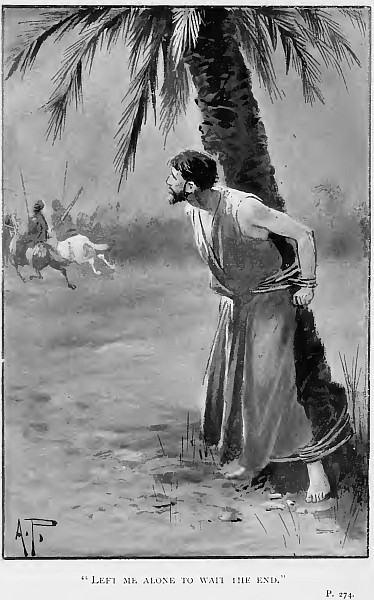
With loud imprecations the men seized me, tore off my haick and burnouse, and bound me securely to a palm trunk in such a position that I could only see the great expanse of barren sand. Then, with that refinement of cruelty of which the nomadic Azjar are past-masters, they smeared my face, hands, and feet with date-juice, to attract the ants and other insects; and, after jeering at me and condemning me to everlasting perdition and sempiternal culpability, they remounted their horses, and, laughing heartily, left me alone to wait the end.
Through the long, silent night, with arms and legs bound so tightly that I could not move them, I remained, wondering what terrible fate had befallen the beautiful girl who had overheard my orison. My two clansmen had not returned. I knew the men were splendid riders, therefore it was more than probable that they had very quickly overtaken her. Utterly hopeless, well knowing that to the blazing sun and the agonies of being half-devoured by insects I must very soon succumb, I waited, my ears on the alert to catch every sound.
In the sky a saffron streak showed on the edge of the sandy plain, heralding the sun’s coming. I watched it gradually spread, knowing that each moment brought me nearer to an end of agony. I lifted my voice in supplication to Allah, and showered voluble curses upon the expedition about to be attempted by my tribe. The pale, handsome face of Kheira was ever before me, haunting me like a half-remembered dream, its beauty fascinating me, and even causing me to forget the horror of those hours of dawn.
Saffron changed to rose, and rose to gold, until the sun shone out, lighting up the trackless waste. The flies, awakened, began to torment me, and I knew that the merciless rays beating down upon my uncovered head would quickly produce the dreaded delirium of madness. The furnace heat of sunshine grew intense as noon approached, and I was compelled to keep my eyes closed to avoid the blinding glare.
Suddenly a noise fell upon my ear. At first it sounded like a low, distant rumbling; but soon my practised ears detected that it was the rattle of musketry and the din of tom-toms.
The City in the Sky was being attacked! My tribesmen had arranged to deliver the assault at noon, but what puzzled me was a sullen booming at frequent intervals. It was the sound of cannon, and showed plainly that Afo was being defended!
From where I was I could see nothing of it. Indeed, the base of the mountain was eight miles distant, and the city, perched upon its summit, could only be approached from the opposite side by a path that was almost inaccessible. Yet hour after hour the rapid firing continued, and it was evident a most desperate battle was being fought. This puzzled me, for had not Kheira said that the city was totally undefended? Still, the tumult of battle served to prevent me from lapsing into unconsciousness; and not until the sun sank in a brilliant, blood-red blaze did the firing cease. Then all grew silent again. The hot poison-wind from the desert caused the feathery heads of the palms to wave like funeral plumes, and night crept on. The horrible torture of the insects, the action of the sun upon my brain, the hunger, the thirst, and the constant strain of the nerves, proved too much; and I slept, haunted by spectral horrors, and a constant dread of the inevitable—that half-consciousness precursory of death.
So passed the second night, until the sun reappeared; but mine eyes opened not. The heat of the blazing noon caused me no concern, neither did the two great grey vultures that were hovering over me; for it was not until I heard voices in the vicinity that I gazed around.
One voice, louder than the others, was uttering thanks to Allah. I listened; then, summoning all my strength that remained, I cried aloud, in the name of the One Merciful, for assistance.
There were sounds of hurrying footsteps, voices raised in surprise, a woman’s scream, and then objects, grotesquely distorted, whirled around me, and I knew no more.
When I again opened my weary, fevered eyes, I was amazed to find myself lying upon a soft, silken divan in a magnificent apartment, with slaves watching, ready to minister to my wants. I took a cooling draught from a crystal goblet handed to me, then raised myself, and inquired where I was. The slaves made no reply, but, bowing low, left. Then in a few moments the frou-frou of silk startled me, and next second I leaped to my feet, and, with a cry of joy, clasped Kheira in my arms.
In her gorgeous harem dress of pale rose silk, with golden bejewelled girdle, she looked bewitching, though around her eyes were dark rings that betrayed the anxiety of the past few days. As our lips met in hot, passionate kisses, she was followed by a tall, stately, dark-bearded man of matchless bearing, whose robe was of amaranth silk, and who wore in his head-dress a magnificent diamond aigrette. Kheira saw him, and withdrawing herself from my embrace, introduced me to her father, the Sultan of Abea.
“To thee I owe my life and my kingdom,” said the potentate, giving me “Peace,” and wringing my hand warmly. “Kheira hath related unto me the mercy thou didst show towards her; and it was thy word of warning that enabled us to repel and defeat the Azjar.”
“Then thou, didst escape, O signet of the sphere of elegance!” I cried, turning to the Sultan’s daughter.
“Yes; though I was hard pressed by two of thine horsemen, I took the secret path, and thus were they baffled.”
“The Director of Fate apprised our fighting men of our danger,” said the Sultan; “and they returned on the same night. The breeze of grace blew; the sun of the favour of Allah shone. The news brought by Kheira was quickly acted upon, and the defences of the city so strengthened, that when at noon the assault was delivered, our cannon swept thy tribesmen from the pass like grains of sand before the sirocco. For six hours they fought; but their attempts to storm the city gate were futile, and the handful of survivors were compelled to retire, leaving nearly five hundred prisoners, including your Sheikh himself, in our hands.”
“And how was I rescued?” I inquired, after briefly explaining how my conversation with Kheira had been overheard.
“On the day following the fight, we went unto the shrine of Sidi Okbar to render thanks to Allah, and there found thee dying of heat and thirst. Thou didst sacrifice thy life to save our ruler and his city, therefore we brought thee hither,” she said.
Then, taking my hands, the Sultan added, “Thou hast the verdure of the meadows of life. May Allah preserve thee, and grant unto thee long years of perfect peace, and an eternal rose-garden of happiness. Wipe off the rust of ennui and fatigue from the speculum of thy mind, and follow me; for a feast is already prepared for the celebration of this victory.”
And we passed onward through the private pavilions—bewildering in their magnificence of marble and gold, and green with many leaves—to the Great Hall of the Divan, where, standing under the royal baldachin of yellow silk brocade, the Sultan of Abea rejoiced me with his favours, proclaiming me, Ahamadou, tribes man of the Azjar, the Saviour of the City in the Sky.
No Touareg has ever contracted marriage with an Arab; therefore, after tarrying in Afo for many moons, I made peace with my people and returned unto them, for the wild life of the limitless sands was more congenial to me than the ease and perfumes of palaces and the favours of kings.
Chapter Eleven.
The Throne of the Great Torture.
Far south, beyond the Atlas Mountains, beyond that great, limitless plain of the Talidat where nothing meets the aching eye but a dreary waste of red-brown, drifting sand, one experiences some curious phases of a life comparatively unknown, and little understood in European civilisation. There, life to-day is the same as it was ten centuries ago—the same as it will ever be: free and charming in its simplicity, yet with many terrors ever present, and sun-bleached bones ever reminding the lonely traveller that a pricked water-skin means the end of all things.
The Veiled Man — by William Le Queux
On a journey alone from Biskra to Mourzouk, in Fezzan, I foolishly disregarded the injunctions of my fellow tribesmen, and was rendered extremely uncomfortable by the astounding discovery that the camel caravan I had joined in Zaouia Timassanin, and with which I had been travelling for twenty days, belonged to the Kel-Izhaban, a tribe of marauders and outlaws with whom we had had for years a fierce blood-feud, and whose depredations and relentless butchery of their weaker neighbours caused them to be held in awe from Morocco across to Tripoli, and from Biskra to Lake Tsâd. In addition, I ascertained that the Sheikh, known to me as Sidi El-Adil, or “The Just,” was really none other than Abdul-Melik, like myself, a pirate of the desert, against whom the French Government had sent three expeditions, and upon whose head a price had been set.
With bronzed, aquiline features, long grey beard, and keen, deep-set eyes; tall, erect, agile, and of commanding presence, he was a splendid specimen of the true-bred Arab of the plains. Though he expressed intense hatred for the Infidel, and invoked curses most terrible upon the horsemen of the Roumis in general, and those of the Azjar in particular, he, nevertheless, treated me with haughty courtesy, and extended to me the hand of friendship. As, at the head of our cavalcade of two hundred armed horsemen and a long string of camels, he rode day by day across the parched wilderness, interspersed by small sand-hills and naked ledges of rock, speckled with ethel-bushes half overwhelmed by sand, he was truly an imposing figure. His burnouse was of finest white wool, embroidered heavily with silk; the haick surrounding his face was of spotless china-silk, and around his head was wound many yards of brown camel’s hair. The saddle upon which he sat was of crimson velvet, embroidered with gold and set with precious stones, and stirrups and spurs of massive silver completed the trappings of his splendid coal-black horse, which he managed with rare perfection and skill. On my white Ku-hai-lan stallion, I usually rode at his side, chatting to him in his own tongue, while two hundred of his people, erect in their saddles, and with their long-barrelled rifles slung behind, were ready to instantly execute his slightest wish.
The days were breathless and blazing. Scorched by the sun, and half-suffocated by the sand-laden wind, our way lay through a wilderness that Nature had forsaken. At night, however, when the outlaws of the desert had cast sand upon their feet and prayed their maghrib, and we had encamped under the palms of the oasis, eaten our dates and kouss-kouss, and slaked our thirst from our water-skins, then commenced the real luxury of the day—the luxury of idleness—as, reclining on a mat in front of the Sheikh’s tent, with coffee and a cigarette, the great Abdul-Melik would relate with slow distinctness stories of past encounters between his people and the hated Christians.
While sentries with loaded rifles kept a vigilant look-out lest we should be surprised by the ever-watchful Spahis or Chasseurs, half—a—dozen Arabs would squat in a semicircle before the great Sheikh, and, twanging upon their queer little banjos fashioned from tortoise-shells over which skin is stretched, would chant weirdly, in a strange staccato, Arab songs of love and war. At that hour a coolness falls over everything, intense silence reigns, the sky above grows a deeper and deeper blue, and the palms and talha trees look mysterious in the half-light. Soon the stars shine out like diamond points, and it grows darker and darker, until the chill night-breeze of the desert stirs the feathery heads of the date-palms. Then the lawless nomads, my companions, would wrap their burnouses closely about them, scoop out a hole in the warm sand, and there repose until the first flush of dawn.
About five weeks after I had inadvertently thrown in my lot with the Kel-Izhaban, and after penetrating a region that, as far as I am aware, has never been explored by Europeans—for it remains a blank upon the most recent map issued by the French Dépôt de la Guerre—we were one evening, at a spot evidently pre-arranged, joined by a body of three hundred horsemen, who armed themselves with the rifles they obtained from our camel’s packs, and then, leaving the camels in charge of half-a-dozen men in a rocky valley called the Anzoua, we all continued our way in high spirits, jesting, laughing, and singing snatches of songs. Throughout that night, and during the following day, we rode at the same steady pace, with only brief halts that were absolutely necessary. On the second night darkness fell swiftly, but the moon rose, and under its bright mystic light we sped forward, until suddenly the gaunt man, in a dirty, ragged burnouse, who acted as our guide, shouted, and we pulled up quickly. Then, in the moonlight, I could just distinguish among the trees of the little oasis a few low, white houses, of what I subsequently learned was the little desert village of Tilouat, inhabited by the Kel-Emoghri, and distant ten leagues from the town of Idelès.
Abdul-Melik shouted an order, clear and distinct, whereupon the horsemen spread themselves out in two long lines, and with their guns carried across their saddles, the first line crept slowly and silently forward. By this movement I knew that we were about to attack the village, and held my own rifle ready for purposes of self-defence. Sitting in the second line, I advanced with the others, and the breathless moments that followed were full of excitement.
Suddenly a shot startled us, and at the same moment a muttered curse fell from the Sheikh’s lips as he saw that our presence had been detected, for the shot had been fired in the village as a sound of warning. Almost instantly it was apparent that we had been betrayed, for a great body of horsemen galloped out to meet us, and in a few moments I found myself lying behind my horse pouring forth volley after volley from my rifle.
The fusillade was deafening, and for fully half an hour it was kept up. About twenty of our men had been killed or wounded, when suddenly the first line rose with loud shouts as if they were one man, and, mounting, rode straight at their opponents, while we followed at headlong speed upon our enemies almost ere they had time to realise our intention. The mêlée was awful. Swords, rifles, and keen, crooked jambiyahs were used with terrible effect, but very soon all resistance was at an end, and the work of looting the village commenced.
Half demented by excitement and success, my companions entered the houses, shot down the women with relentless cruelty, tore from them what little jewellery they possessed, and plundered, wrecked, and burned their homes out of sheer delight in destruction. I stood watching the terrible scene, but unable to avert the great calamity that had fallen so swiftly upon the peaceful little place. The fiendishness of our enemies had, alas! not been exaggerated. Abdul-Melik laughed gleefully, uttering some words as he rode past me swift as the wind. But I heeded him not; I loathed, despised, and hated him.
While dawn spread in rosy streaks, the work of plunder still proceeded, but when the sun shone forth, only the smoke-blackened walls of Tilouat remained standing. The plunder was quickly packed upon our horses, and soon afterwards we rode off, carrying with us twenty men and women who had been captured, all of whom would eventually find their way into the great slave-market, far away at Mourzouk.
At sundown, five days afterwards, we descended into a rocky valley, and suddenly came upon a wonderful mass of scattered ruins, of amazing magnitude and extent, which Abdul-Melik told me were the remains of a forgotten city called Tihodayen, and as we approached, I saw by the massive walls of hewn stone, the fallen columns half embedded in the sand, and by an inscription over an arched door, that they were relics of the Roman occupation. When we dismounted, I found that the ruined city gave shelter to the outlaws, and was their habitual hiding-place.
An hour later, reclining on mats under the wall of what had once been a great palace, the outlaw Sheikh and myself ate our evening meal of saubusaj, beryseh, and luzinyeh, and drank copiously of dushab, that luscious date-syrup which is so acceptable after the heat and burden of the Saharan day, while my companions feasted and made merry, for it appeared that they kept stores of food concealed there.
On commencing to smoke, Abdul-Melik ordered that the captives should be brought before him, and when, a few minutes later, they were ushered into his presence, they, with one exception, fell upon their knees, grovelled, and cried aloud for mercy. The single captive who begged no favour was a young, dark-haired girl of exquisite beauty, with black, piercing eyes, pretty, dimpled cheeks, and a complexion of almost European fairness. She wore a zouave of crimson velvet heavily embroidered with gold, a heavy golden girdle confined her waist, and her wide trousers were of palest rose-pink silk, while her tiny feet were thrust into velvet slippers of green embroidered with gold thread. But her dress had been torn in the fierce struggle with her pitiless captors, and as she stood, erect and defiant, with her hands secured behind her with a leathern thong, she cast at us a glance full of withering scorn.
The Sheikh raised his hand to command silence, but as her fellow-captives continued wailing, he ordered the removal of all but this girl, who apparently set him at defiance. Turning his keen eyes upon her, he noted how extremely handsome she was, and while she returned his gaze unflinchingly, her beauty held me in fascination. In all my journeys in the Land of the Sun I had never before seen such an absolutely perfect face.
“Who art thou?” demanded the dreaded chief, roughly. “What is thy name?”
“I am called Khadidja Fathma, daughter of Ali Ben Ushshâmi, cadi of Idelès,” she answered, in a firm, defiant tone.
“Ali Ben Ushshâmi!” echoed Abdul-Melik, knitting his brows fiercely. “Thou art his daughter; the daughter of the accursed son of offal who endeavoured to betray me into the hands of the Roumis,” he cried, exultantly. “I have kindled the lights of knowledge at the flambeau of prophecy, and I vowed that I would ere many moons seek vengeance.”
“I have anticipated this thy wrath ever since thine horde of cowardly ruffians laid hands upon me,” she answered, with a contemptuous toss of her pretty head. “But the daughter of the cadi of Idelès craveth not mercy from a servant of Eblis.”
“Darest thou insult me, wench?” he cried, pale with passion, and starting up as if to strike her. “Thou art the child of the man who would have given me into the hands of the Spahis for the sake of the two bags of gold offered for my head. I will return his good offices by sending him to-morrow a present he will perhaps appreciate, the present of thine own hands. He will then be convinced that Abdul-Melik knoweth how to repay those who seek to injure him.”
“Dost thou intend to strike off my hands?” she gasped, pale as death, nevertheless making a strenuous effort to remain calm.
“At sunrise the vultures will feast upon thee, and thine hands will be on their way to Idelès,” he answered, with a sinister smile playing about his hard mouth.
“Malec hath already set his curse upon thee,” she said, “and by each murder thou committest so thou createst for thyself a fresh torture in Al-Hâwiyat, where thy food will be offal and thou wilt slake thy thirst with boiling pitch. True, I have fallen captive into thine hands, having journeyed to Tilouat to see my father’s mother who was dying; but thinkest thou that I fear thee? No!” she added with flashing eyes. “Though the people dread thee as the great and powerful Chief, I despise thee and all thy miserable parasites. If thou smitest off mine hands, it is but the same punishment as thou hast meted out to others of my sex. Thou art, after all, a mere coward who maketh war upon women.”
“Silence, jade!” he cried, in a tumult of passion, and, turning to the men beside him, commanded: “Take her away, secure her alone till dawn, and then let her hands be struck off and brought to me.”
Roughly the men dragged her away, but ere she went she cast at us a look of haughty scornfulness, and, shrugging her shoulders, treated this terrible mandate with ineffable disdain.
“The jade’s hands shall be sent to her father, the Cadi, as a souvenir of the interest he taketh in my welfare,” the Sheikh muttered aloud. “Her tongue will never again utter rebuke or insult. Verily, Allah hath delivered her into my hands a weapon to use against mine enemies.”
I uttered eager words of intercession, pointing out the cruelty of taking her young life, but he only laughed derisively, and I was compelled to sit beside him while the other captives were questioned and inspected.
That night I sought repose in a shed that had been erected in a portion of the ruins, but found sleep impossible. The defiantly beautiful face of the young girl who was to die at dawn kept recurring to me with tantalising vividness, and at length I rose, determined if possible to save her. Noiselessly I crept out, my footsteps muffled by the sand, saddled one of Abdul-Melik’s own horses, and without attracting the notice of either sentry on duty at each end of the encampment, I entered the ruin where, confined to an iron ring in the masonry by a leathern band, she crouched silent and thoughtful.
“Fi amâni-illah!” I whispered, as I approached. “I come to have speech with thee, and assist thee to escape.”
“Art thou a friend?” she inquired, struggling to her feet and peering at me in the gloom.
“Yes, one who is determined that the outlaw’s command shall never be executed,” and taking the jambiyah from my girdle, I severed the thongs that confined her hands and ankles, and next second she was free.
Briefly I explained how I had saddled a fleet horse and placed a saddle-bag with food upon it.
“If I get safely away I shall owe my life to you,” she said, with intense gratitude, pressing my hand for an instant to her quivering lips. “I know this place, and ere two moons can have risen I can travel through the rocky defile and be at my father’s house in Idelès. Tell me thy name, so that my father may know who was his daughter’s liberator.”
I told her, and in the same hasty breath asked for some souvenir.
“Alas! I have nothing,” she answered; “nothing but a strange ornament which my father’s mother gave to me immediately before she died, an hour previous to the attack being made upon the village,” and placing her hand deep into the breast of her dress she drew forth a rough disc of copper, about the size of a crown piece, with a hole in it, as if it had been strung upon a thread.
“When she gave it to me she told me it had been in her possession for years, that it was a talisman against terror, and that some curious legend was attached to it, the nature of which I do not now recollect. There is strange writing upon it in some foreign tongue of the Roumis that no one has been able to decipher.”
I looked, but unable to detect anything in the darkness, I assured her that its possession would always remind me of her, and slipped it into the pocket of my gandoura.
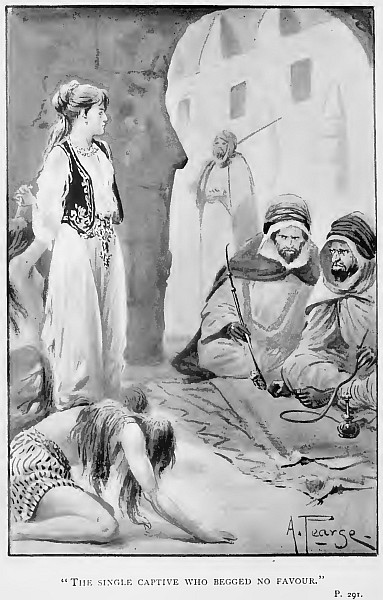
Then together we crept along under the shadow of the wall, and, gaining the spot where the horse stood in readiness, I held her for a second while she kissed my hand, uttering a fervent word of thanks, and afterwards assisted her into the saddle. Then a moment later, with a whispered “Allah iselemeck!” she sped away, with her unbound hair flying behind her, and was instantly lost in the darkness.
On realising that she had gone I was seized with regret, but feeling that at least I had saved her from a horrible doom, I returned to my little shed and, wrapping myself in my burnouse, slept soundly until the sun had risen high in the heavens.
Opening my eyes, I at once remembered Khadidja’s quaint souvenir, and on examining it, was astonished to find both obverse and reverse of the roughly fashioned disc covered with an inscription in English crudely engraved, or rather scratched, apparently with the point of a knife. Investigating it closely I was enabled, after some difficulty, for I have only an elementary knowledge of the tongue of the Roumis, to read the following surprising words:—
“This record I leave for the person into whose hands it may fall, for I am starving. Whosoever reads this let him hasten to Zemnou, in the Zelaf Desert, two days from the well of El Ameïma, and from the Bab-el-Oued pace twenty steps westward outside the city wall, and under the second bastion let him dig. There will he be rewarded. John Edward Chatteris, held captive in the Kasbah of Borku by order of the Sultan ’Othmân, Sunday, June 13, 1843.”
Chatteris! Instantly it occurred to me that a celebrated English explorer, archaeologist, and member of the Royal Geographical Society of that name, had years ago been lost, and his fate had remained a complete mystery. Inquiries for news of him had been circulated throughout the great Desert among the wandering tribes, with an offer of a reward. This, then, was a message inscribed, with apparent difficulty within the impregnable citadel of the warrior Sultan of Borku, whose little mountain kingdom was situate five hundred miles south of Mourzouk, between the Tibesti Mountains and Lake Tsâd; a secret that for half a century had been in the keeping of those who could not decipher it.
What might not be buried at the spot indicated by this curious relic of the great traveller? My curiosity was excited to the utmost. Impatient to investigate the truth, but compelled, nevertheless, to remain patient until such time as I could escape from my undesirable companions, I concealed the disc and rose to join Abdul-Melik at his morning meal.
Khadidja’s escape caused the old outlaw intense chagrin, and his anger knew no bounds, but luckily no suspicion fell upon me, and having remained with them during two whole moons I succeeded one day, when we were near the town of Rhat, in evading them and getting away. As quickly as possible I returned to In Salah, where I exhibited the metal disc with its strange inscription to our three headmen, who became at once interested in it, announcing their intention to accompany me next day to investigate the truth of the engraved record.
With an escort of twenty of our men, all well mounted and armed, we rode out of In Salah at dawn, and for nine days continued our journey across the desert due eastward, first taking the caravan route to Tarz Oulli, beyond the French boundary, and continuing through the rocky region of the Ihéhaonen and across the Djedid Oasis, until one evening, at the maghrib hour, the high white walls and three tall minarets of the desert city of Zemnou came within view. It was unsafe to take our men nearer, therefore we returned and bivouacked until darkness set in. Then, dressed in the haick and burnouse of the Arab of the plain, the three headmen with myself, carrying spades concealed beneath our flowing drapery, approached the town and crept under the shadow of the walls, until we reached the Bab-el-Oued, or principal gate. Guarded by strong watch-towers on either side, the gate was closed, and silently we crept, anxious and breathless, on over the sand westward until we had counted twenty paces and reached the second bastion.