“SPIRIT PHOTOGRAPHY,” WITH REMARKS ON FLUORESCENCE.[3]
Reading edition
“SPIRIT PHOTOGRAPHY,” WITH REMARKS ON FLUORESCENCE.[3]
By J. Traill Taylor.
The presence of smoke may be considered as implying the existence of flame. Spirit photography, so called, has of late been asserting its existence in such a manner and to such an extent as to warrant competent men making an investigation, conducted under stringent test conditions, into the circumstances under which such photographs are produced, and exposing the fraud, should it prove to be such, instead of pooh-poohing it as insensate because we do not understand how it can be otherwise—a position that scarcely commends itself as intelligent or philosophical. If in what follows I call it “spirit photography” instead of psychic photography, it is only in deference to a nomenclature that extensively prevails, and not as offering a surmise from any knowledge of my own as to what is matter and what spirit, or the distinction between mind, spirit, and matter, for in truth I don’t know. I approach the subject merely as a photographer.
Before I proceed, a few words on the origin of spirit photography may not be out of place. In March, 1861, W. H. Mumler, the principal engraver in the employ of Bigelow Bros. & Kennard, the leading jewellers of Boston, when whiling away an idle hour as an amateur photographer, had a form other than that of any one present developed on his collodion plate. He surmised that it arose from an image having been previously on the plate, and its having been imperfectly cleaned off. Subjected to a more thorough cleaning, the form again appeared more strongly marked than before, and he could offer no other explanation than the one given. It got noised abroad through the press that a spirit had been photographed, and although Mumler strove to suppress the misrepresentation, as he regarded it, yet he eventually succumbed to popular demand, and took two hours a day from his regular work, devoting them to photography. This he had to extend to the whole of each day, entirely discarding his regular profession. Many men of eminence sat to him, most of whom he did not know at the time. He seems to have encouraged his sitters in the adoption of such test conditions as they deemed satisfactory. The figures that usually appeared on the plate with the sitters were, if I rightly infer, those on whom the sitters’ minds had been set. That eminent portrait photographer, Mr. Wm. Black, of Boston, so well known all over the world as the inventor of the acid nitrate bath, undertook to investigate the bonâ fides of Mumler’s methods. Through a friend who had just previously sat and obtained a figure, Black offered fifty dollars if Mumler would operate in his presence and obtain a picture. Invited to come, the acute Black critically examined camera, plate, dipper, and bath, and had his eye on the plate from the moment its preparation began until it was sensitised and locked in the dark slide, removing it himself from the camera, and carrying it into the dark room, where, on development, a figure of a man was seen leaning on B.’s shoulder. Black was wonder-stricken, and got away the negative, no charge whatever having been made. Mumler now claimed publicly to be a spirit-portrait photographer, and as such he eventually opened a studio in New York, having previously satisfied Silver, Gurney, and other photographers as to the genuineness of his claims, never hesitating to operate in their galleries if required, and with their apparatus and chemicals. Mumler was arrested in New York; whether on the ground of witchcraft or of endeavouring to obtain money under false pretences, I am at present uncertain, but his trial was the sensation of the day, and numerous witnesses were examined. He was honourably acquitted.
In this country, several who are amateur photographers have investigated this subject with more or less success. These include some F.R.S.’s, scientists, artists, and others. I question whether any have so persistently done so as the late Mr. John Beattie, of Clifton, and his friend, Dr. Thompson. Mr. Beattie was a skilled professional photographer of the highest eminence who, some time prior to his death, had adopted the views of the spiritualistic school. The figures he obtained on his plates were much blurred in outline, some being misty in the extreme. I possess some two or three dozen of these, taken by or in the presence of, Mr. Beattie, whose intelligence, honesty, and powers of observation no one would venture to doubt. Many such photographs are claimed to have been produced by Hudson, a professional photographer, formerly of the Holloway Road, and I submit for examination a work by the late Miss Houghton, containing fifty-four of Hudson’s spirit photographs.
There are many ways by which, assuming the genuineness of only one of all spirit photographs hitherto produced, the spurious article may be made even better than any alleged real ones I have yet seen. A plate secretly impressed previous or subsequent to being placed in the camera fulfils the condition; so does one at the back of which is placed a phosphorescent tablet in the dark slide. Pressure on the surface, such as by that of a Woodbury relief film, also causes a developable image; in short, trickery in a whole variety of forms may, and has been, impressed into the service.
The higher department of fluorescence may with success be employed. Here is something to which believers in the visibility of spirit forms to a camera are quite welcome. At the time, and àpropos of the Mumler trial in New York, I wrote that a good many absurd things have been said pro and con on the subject; but a writer in the latter category, who asserted that anything that is visible to the eye of the camera, and thus capable of being depicted by photography, must therefore necessarily be visible to the human eye, was surely ignorant of that important branch of physics popularly known as fluorescence. Many things are capable of being photographed which to the physical eye are utterly invisible. Why, for that matter, a room (visually dark) may be full of the ultra-violet rays of the spectrum, and a photograph may be taken in that dark light. Objects in a room so lighted would be plainly visible to the lens of the camera—at any rate, they could be reproduced on the sensitive plate, while, at the same time, not an atom of luminousness could be perceived in the room by any person possessing ordinary or normal vision. Hence the photographing of an invisible image, whether it be of a spirit or a lump of matter is not scientifically impossible. If it reflect only the ultra-violet rays of the spectrum, it will be easily photographed, although quite invisible to the sharpest eye.
Again, Cromwell F. Varley, F.R.S., well known as one of the most eminent of electricians, says (Electric, June, 1871), when passing a current of electricity through a vacuum tube, the results of which were indicated by touches of light about the poles:—“In one instance, although the experiment was carried on in a dark room, this light was so feeble that it could not be seen, and the operators doubted if the current were passing. But photography was at work, and in thirty minutes a very good picture was produced of what had taken place. This,” he says, “is a remarkable fact; indeed, it borders on the wonderful, that a phenomenon invisible to the human eye should have been, so to speak, seen by the photographic lens, and a record thereof kept by chemical agency. It is highly suggestive, and we may anticipate that it will be turned to good account by practical philosophers.”
Some very striking phenomena in photographing the invisible may be produced by the agency of fluorescence. Figures depicted upon a background by one or other of certain substances I shall presently name, although invisible to the eye, may become visible to the camera. Of these, the best known, although not the most effective, is disulphate of quinine. Such a solution, although to the eye it is colourless like water, is to the camera as black as ink. Fill three phials respectively with water, quinine, and common writing ink, and you have two whites and one black; but photograph them, and you have two blacks and one white. The camera has reduced the transparent quinine solution to the colour of the ink. Those of you who may care to experiment in this direction, please take notice that the quinine must be acidulated with sulphuric acid, and that hydrochloric acid, even a small trace, will destroy this property. Among other substances that are fluorescent, or that change the refrangibility of rays of light, are mineral uranite, certain salts of uranium, canary glass, alcoholic solution of chlorophyll, æsculine, tincture of stramonium seeds, and of turmeric. There are others known to be still better, but my experiments in this direction are yet too incomplete to warrant my even indicating them.
Let me for a moment enter the realm of speculation, and assume that there are really spirits invisible to the eye but visible to the camera and to certain persons called seers or clairvoyants only. Might we not suggest that there is some fluorescent compound in the eyes of such persons not present in those whose eyes are normal, and that it is to this they owe their seeing powers? Some of you may probably be aware that Dr. Bence Jones and other philosophers have actually established the fact of such fluorescent substances being found in some eyes. May this throw any light upon the recognised fact of certain animals being able to see in the dark?
When the subject of fluorescence is more thoroughly investigated (it is a discovery of Sir D. Brewster, who was followed by Herschel and Professor Stokes, and is as yet but of yesterday), we may hope for a vast accession to our knowledge of subjects as yet very slightly understood.
At the Bradford meeting of the British Association for the Advancement of Science, in 1873, Dr. Gladstone, F.R.S., demonstrated before the Mathematical and Physical Section what I have said respecting invisible drawings on white cards having produced bold and clear photographs when no eye could see the drawings themselves, and I brought away back to London these photographs, and, for aught I know, may have them still.
To prevent this disquisition from being too dry, I will here introduce a fanciful sketch I wrote àpropos of Dr. Gladstone’s demonstration at the time mentioned:—
A mischievous young lady of scientific proclivities who attended the meeting of the British Association, and who was addicted to practical joking, listened attentively to Dr. Gladstone’s observations upon the properties of quinine referred to, and having carefully noted the discussion that followed, reasoned within herself thus: If solution of quinine can make invisible marks upon paper, which will come out black in a photograph, it ought to do the same when applied to the skin. So she procured some of this solution, and upon her fair brow she painted with it a death’s head and cross-bones. These, of course, were invisible to human vision. Thus prepared, she went to a photographer to have her portrait taken. All went right until the operator went an to develop the plate, when she soon heard an altercation between the photographer and the attendant boy, in which it was evident that the latter was being charged with having coated an old or dirty plate.
A second negative was taken, with this result, that the operator, after bestowing a puzzled, affrighted look at the lady, rushed downstairs to the principal of the establishment. Both returned to the dark room, and a third negative was taken, when it became evident that intense excitement was being produced in the dark room. After an excuse to the lady about there being electricity in the atmosphere, which had affected the chemicals, she was requested to sit once more.
Scarcely had the plate been developed, when both photographer and assistant rushed out from the dark room, pale and excited, and explained that on the brow of the sitter in each negative was emblazoned the insignia of the King of Terrors. The negatives were produced leaving no doubt of the fact. What was to be done?
The sitter hinted something about not being disposed to be made a fool of by one who she was satisfied was a spirit photographer, and that she, for one, would not allow herself to become the victim of such absurdity. This upset the equanimity of the photographer, who expressed his earnest conviction that she was an emissary and personal friend of the common enemy of mankind.
“I shall look in again to-morrow,” said the lady, in her sweetest tones, “if you promise not to play any of your silly ghost tricks upon me.”
“Not for ten thousand worlds,” said the artist, “shall you ever set foot within my studio again!”
“Oh,” she laughingly rejoined, “I shall drop in through the roof and visit you some day when you are disengaged;” and with that she departed.
“I knew it!” gasped the photographer. “I felt a sulphurous odour the moment I came near her. Send immediately for my friend, the Rev. ——, and get him to offer prayer, and free the studio from the evil influences remaining after a visitation from one whose feet, although clad in boots, would, if examined, be found to be cloven.”
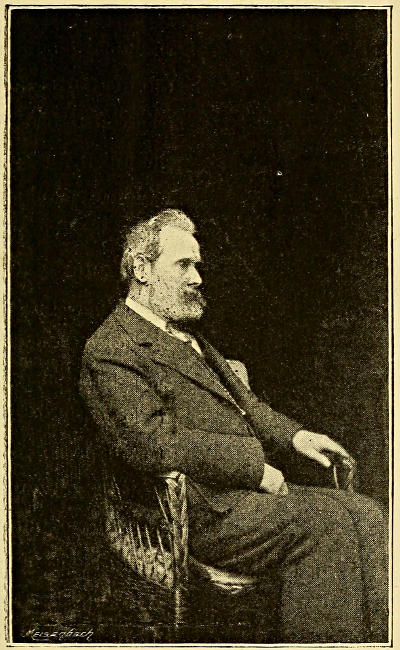
David Duguid.
For several years I have experienced a strong desire to ascertain by personal investigation the amount of truth in the ever-recurring allegation that figures other than those visually present in the room appeared on a sensitive plate. The difficulty was to get hold of a suitable person known as a sensitive or “medium.” What a medium is, or how physically or mentally constituted to be different from other mortals, I am unable to say. He or she may not be a photographer, but must be present on each occasion of trial. Some may be mediums without their being aware of it. Like the chemical principle known as catalysis, they merely act by their presence. Such a one is Mr. D. of Glasgow, in whose presence psychic photographs have long been alleged to be obtained. He was lately in London on a visit, and a mutual friend got him to consent to extend his stay in order that I might try to get a psychic photograph under test conditions. To this he willingly agreed. My conditions were exceedingly simple, were courteously expressed to the host, and entirely acquiesced in. They were, that I for the nonce would assume them all to be tricksters, and, to guard against fraud, should use my own camera and unopened packages of dry plates purchased from dealers of repute, and that I should be excused from allowing a plate to go out of my own hand till after development, unless I felt otherwise disposed; but that, as I was to treat them as under suspicion, so must they treat me, and that every act I performed must be in presence of two witnesses, nay, that I would set a watch upon my own camera in the guise of a duplicate one of the same focus—in other words, I would use a binocular stereoscopic camera and dictate all the conditions of operation. All this I was told was what they very strongly wished me to do, as they desired to know the truth and that only. There were present, during one or other of the evenings when the trials were made, representatives of various schools of thought, including a clergyman of the Church of England; a practitioner of the healing art who is a fellow of two learned societies; a gentleman who graduated in the Hall of Science in the days of the late Charles Bradlaugh; two extremely hard-headed Glasgow merchants, gentlemen of commercial eminence and probity; our host, his wife, the medium, and myself. Dr. G. was the first sitter, and, for a reason known to myself, I used a monocular camera. I myself took the plate out of a packet just previously ripped up under the surveillance of my two detectives. I placed the slide in my pocket and exposed it by magnesium ribbon which I held in my own hand, keeping one eye, as it were, on the sitter and the other on the camera. There was no background. I myself took the plate from the dark slide, and, under the eyes of the two detectives, placed it in the developing dish. Between the camera and the sitter a female figure was developed, rather in a more pronounced form than that of the sitter. The lens was a portrait one of short focus; the figure being somewhat in front of the sitter, was proportionately larger in dimensions. I submit this picture (see opposite). It is, as you see, a lady. I do not recognise her or any of the other figures I obtained as being like any one I know, and from my point of view, that of a mere investigator and experimentalist, not caring whether the psychic subject were embodied or disembodied.
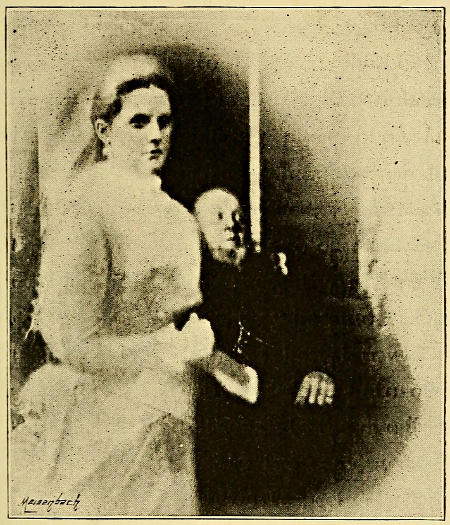
Photograph of a Psychic Lady.
Many experiments of like nature followed; on some plates were abnormal appearances, on others none. All this time Mr. D., the medium, during the exposure of the plates, was quite inactive. After one trial, which had proved successful, I asked him how he felt and what he had been thinking of during the exposure. He replied that his thoughts had been mainly concentrated upon his chances of securing a corner seat in a smoking carriage that night from Euston to Glasgow.
If the precautions I took during all of the several experiments, such as those recorded, are by any of you thought to have been imperfect or incomplete, I pray of you to point them out. In some of them I relaxed my conditions to the extent of getting one of those present to lift out from the dark slide the exposed plate and transfer it to the developing dish held by myself, or to lift a plate from the manufacturer’s package into the dark slide held in my own hand, this being done under my own eye, which was upon it all the time; but this did not seem to interfere with the average on-going of the experiments.
The psychic figures behaved badly. Some were in focus, others not so; some were lighted from the right, while the sitter was so from the left; some were comely, as the dame I shall show on the screen, others not so; some monopolised the major portion of the plate, quite obliterating the material sitters; others were as if an atrociously badly vignetted portrait, or one cut oval out of a photograph by a can-opener, or equally badly clipped out, were held up behind the sitter. But here is the point: not one of these figures which came out so strongly in the negative was visible in any form or shape to me during the time of exposure in the camera, and I vouch in the strongest manner for the fact that no one whatever had an opportunity of tampering with any plate anterior to its being placed in the dark slide or immediately preceding development. Pictorially they are vile, but how came they there?
Now, all this time, I imagine you are wondering how the stereoscopic camera was behaving itself as such. It is due to the psychic entities to say that whatever was produced on one half of the stereoscopic plates was reproduced on the other, alike good or bad in definition. But on a careful examination of one which was rather better than the other, and which is now about to be projected on the lantern screen for your examination (see page 35), I deduce this fact, that the impressing of the spirit form was not consentaneous with that of the sitter. This I consider an important discovery. I carefully examined one in the stereoscope, and found that, while the two sitters were stereoscopic per se, the psychic figure was absolutely flat. I also found that the psychic figure was at least a millimetre higher up in one than the other. Now, as both had been simultaneously exposed, it follows to demonstration that, although both were correctly placed vertically in relation to the particular sitter behind whom the figure appeared, and not so horizontally, this figure had not only not been impressed on the plate simultaneously with the two gentlemen forming the group, but had not been formed by the lens at all, and that, therefore the psychic image might be produced without a camera. I think this is a fair deduction. But still the question obtrudes, How came these figures there? I again assert that the plates were not tampered with by either myself or any one present. Are they crystallisations of thought? Have lens and light really nothing to do with their formation? The whole subject was mysterious enough on the hypothesis of an invisible spirit, whether a thought projection or an actual spirit, being really there in the vicinity of the sitter, but it is now a thousand times more so. There are plenty of Tycho Brahes capable of supplying details of observations, but who is to be the Kepler that will from such observations evolve a law by which they can be satisfactorily explained?
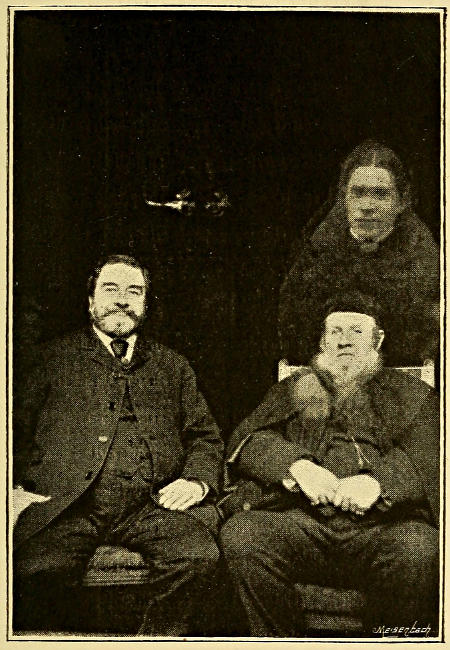
Abnormal Portrait of Lady
In the foregoing I have confined myself as closely as possible to narrating how I conducted a photographic experiment open to every one to make, avoiding stating any hypothesis or belief of my own on the subject generally, and it only now remains to exhibit the results, bad and fraudulent-looking as they are, on the screen.
REMARKS BY MEMBERS AND VISITORS.
Having finished the reading of his paper, Mr. Taylor exhibited by the aid of the lantern, slides from some of the negatives he had obtained. A series of “Spirit Photographs,” the work of Mr. Hudson, formerly of Holloway Road, and some French photographers, were also shown by Mr. Maltby, a visitor, who was introduced by Mr. Taylor.
Messrs. Downey, P. Everitt, W. E. Debenham, F. A. Bridge, A. Cowan, A. Haddon, J. S. Teape, A. Mackie, and others took part in the meeting, but their remarks, for the most part, were characteristic of unacquaintance with the subject.
Mr. A. Glendinning explained that it had originally been intended to have had the photographs taken in the studio of a West-end photographer, but that gentleman had withdrawn his consent owing to his religious views, expressing the opinion that such experiments were dangerous, if not wicked. The experiments were therefore made in the drawing-room of a house in Dalston.
Mr. W. E. Debenham asked if it would be possible to repeat the experiments in the presence of the same medium and two members of the London and Provincial Photographic Association.
[This question was answered at a later period of the meeting, when the suggestion was made by the Chairman.]
Mr. Glendinning said he had been interested in the subject of psychic photography for twenty-eight years, and he asked permission from the Chairman to make a few remarks. This being readily and courteously granted, he said, “Do the members of this Society, who are now present, believe that Mr. Taylor is competent for the investigation which he recently undertook? I do not mean, are you prepared to endorse his statements regarding the results of his recent experiments? I do not mean merely, do you consider Mr. Taylor an honest investigator? There are many honest men who would not be considered qualified to watch with sufficient care and accuracy experiments in photographic manipulations. There are others who are honest and upright, and who are skilful in the ordinary routine of photographic work, who may possess very little knowledge of chemistry or of optics, in their relation to practical photography. Others, again, may be honest men, skilful manipulators, and adepts in chemistry and in optics, but too opinionative to conduct such experiments as those under consideration. Well, then, gentlemen, looking at the matter all round, I put it to you this way. My own belief, my strong conviction, is this, that Mr. Taylor is well qualified in every respect for the very important and, I would add, the very solemn task which he undertook. A man with an open mind, prepared to—
‘Accept the truth where’er ’tis found, On Christian or on heathen ground?’
possessed of shrewdness, tact, an eye like a hawk’s, watchful and ready to detect the slightest attempt at trickery or fraud, with an integrity of purpose and an independent outspokenness which would lead him fearlessly to expose and denounce those who would so far forget themselves as to trifle with the most sacred feelings of our nature, by attempting to palm off as abnormal and strange that which is but a miserable counterfeit of a grand reality. Gentlemen, do you uphold me in my view that Mr. Taylor was the right man for the experiments to which reference has been made? (Applause and expressions of approval.) I thank you for this expression of your opinion. I do not wish to corner you; I do not wish to trap you into a seeming acquiescence with views which you have not considered. My desire is to be perfectly frank; but there are reasons, into which I need not enter now, why I have put before you the statements and the question to which you have responded. Well, supposing for the moment that Mr. Taylor’s report of his experiments is an accurate statement, that portraits have appeared on his plates, and have been printed from his plates, which cannot be accounted for by any known agency, it seems to me to be a fair conclusion to arrive at, that there were other persons present at those experiments besides the ladies and gentlemen who could be seen with the normal vision; that these unseen visitors were exhibiting an active and intelligent interest in the matter, and that they were aiding by their co-operation to produce the abnormal images which appeared on the plates. Call these unseen visitors by the name which may commend itself to you as most fairly descriptive; call them spooks, or ghosts, or astrals, or elementals, or even, if you prefer to do so, call them devils. I call them spirit friends—ex-carnated human beings—that is what they profess to be, and that is what, in an experience of such matters extending over a good many years, I have always had good reason to believe them to be. Therefore I transfer the name from the principal operators to the pictures themselves, and I call the latter spirit photographs. Likewise, because the abnormal portraits, so far as they have been recognised, are portraits of persons who have cast off the earthly tabernacle, I claim that the name spirit photographs, or photographs of spirits, is as near as we can get to accuracy in the present state of our knowledge.”
Mr. F. A. Bridge said they were bound to believe Mr. Taylor’s statement; but, as practical photographers, though the pictures shown might be spirit photographs, he thought they gave them the idea of cut-out prints, but as to who cut them out he did not know and did not care. He, however, did not for one moment wish to impute any complicity or dishonesty to Mr. Glendinning in connexion with the experiments, for that gentleman appeared (as he had said) merely to have been desirous of arriving at the truth.
Mr. Debenham quite agreed with Mr. Bridge as to Mr. Glendinning’s bonâ fides in the matter. He would propose, if possible, a committee be formed to be present at some similar séance.
A Member stated that Mr. Taylor’s experiments had been vitiated to some extent by his not having the whole of the conditions under his own control (a remark to which Mr. Taylor does not seem to have thought it necessary to reply, as he had already distinctly stated that the whole of the conditions were subject to his entire control).
Professor A. Haddon observed that if spirits gave out ultra-violet rays, it would be advisable to use lenses made of quartz, as they would have a far better way of rendering such subjects on the plate than with ordinary lenses, which cut off ultra-violet. Again, had different eyes different powers as regards the taking in and cutting out of different rays? Mr. Friese Greene had shown how it was possible to allow an impression to be made on the retina, and then to be transferred to a plate. Most probably only certain people possessed this power, for it was curious no one had repeated the experiment with success.
Mr. T. Shorter said he had had some experience of the subject, and in many instances such portraits had been distinctly recognised as those of relatives and friends, and it was not by any means a peculiar experience. The late Mr. Beattie, of Clifton, obtained portraits of this kind through Mr. Hudson, to whom he went in a very sceptical spirit. Hudson allowed him to go through all the manipulations himself; Mr. Beattie took his own plates, and inverted them before they were exposed. On one picture, after it was taken he recognised the portrait of his own brother. He (Mr. Shorter) knew of a good many instances of a similar kind. For instance, he said, Dr. Alfred Russel Wallace had had no hesitation in recognising portraits so obtained. Of course there were many taken in this way that could not be identified; but, on the other hand, there were many that could. He could quote forty instances where people could identify them.
A Member explained how a collection of portraits of deceased persons can be made by professional photographers. He stated his firm sometimes receive such portraits to copy, and at times when they deliver the copies they pretend that the original pictures are lost or injured; so the customers have nothing to compare the copies with. This brought forth the rebuke from Mr. Maltby (a visitor) that the conduct of the firm might be “smart,” but could not be considered honest.
Mr. Arthur Maltby said the spirit forms which are photographed were created from the aura that escapes from sensitive subjects. Some years ago a gentleman went to a photographer to have a portrait taken, and, instead of his portrait appearing, as he expected, that of a man who had been abroad for many years, and of whom he knew nothing, appeared on the plate. Some weeks afterwards a telegram came announcing that the man, whose spirit photograph had appeared on the plate, was shot. Again, during the last Austrian war, an officer who had never been photographed in his regimentals appeared to a brother officer as a photographed spirit. On one occasion the figure of a small child appeared in the centre of a picture. The child had been dead nearly fifty years, but was recognised after that lapse of time. He suggested that a photograph could be taken to prove that fluid rays pass from a sensitive, like photographic rays of light. This aura, which was the material emanating from all parts of the body, was collected to form the portraits of those who wished to prove the immortality of the soul.
Mr. J. Weir Brown (the chairman) said that although the pictures shown that night by Mr. Maltby might be recognised as spirit photographs, they had only to do with Mr. Traill Taylor’s experiments,[4] and he was bound to say that some of the examples shown bore evidence of being patchwork on the plates, and not similar to those that were shown by Mr. Maltby. Mr. Taylor’s results were very mysterious; and, although Mr. Taylor himself was very watchful, there was nothing to lead them to any conclusion on the matter, so that it must remain a mystery. He suggested that Mr. Glendinning should provide an occasion, if he could, for the London and Provincial Photographic Association to send a small committee to take part in similar experiments, and he was sure that they would only send fair-minded men to represent them.[5]
Mr. Glendinning, in reply, said he would be willing to use his influence to get such experiments carried on in the presence of the same medium later in the year. (Hear, hear.) He said that his friend, the medium, had so much confidence in Mr. Traill Taylor, that probably he would carefully consider Mr. Taylor’s suggestions in the matter.
Mr. Taylor asked why they should expect Mr. Glendinning, who is not a member of the society, to be at the trouble for them. He suggested that the society appoint a committee to investigate the subject, and advertise for the services of a suitable medium with whom to try experiments.
Portrait obtained without Exposure in the Camera.[6]
Towards the close of the proceedings, Mr. Glendinning handed to the chairman, and to some of the members sitting near him, a print of a psychic portrait from a negative obtained without the plate being exposed in the camera, or to light of any kind excepting that given by a nightlight in a dark lantern to develop by. The experiment was made in consequence of a conversation with Mr. Taylor (after his experiments were concluded), and about an hour before the medium left for his return journey.
An Ilford dry plate had been taken by Mr. Glendinning from a new packet, put in clean paper, and held by the medium, in the dark room, between the palms of his hands; Mr. Glendinning placed his hands above and below those of the medium; he then took the plate and placed it in his developing tray, when a full-length figure appeared, clear and distinct, although without artistic effect. The negative was in Mr. Taylor’s possession at the meeting.
The proceedings closed with a vote of thanks to Mr. Taylor for his paper.
Note.—With regard to one or more of the psychic portraits taken by Mr. Taylor on his own plates, in which he found that the psychic image had not been formed by the lens at all, and with regard to the important discovery made by Mr. Glendinning, in a later experiment with his friend, the medium, it would be a mistake to conclude that the psychic images on photographic plates are always produced in this way. There are many spirit photographs, regarding which all the evidence is in favour of the theory that they are produced by the agency of the camera at the same time as the sitters. With respect to one of the pictures taken by Mr. Taylor, and shown by him on the lantern screen, the sitter, after Mr. Taylor left the room to develop the plate, stated to those present that there ought to be on the plate a spirit form to his right and nearer the camera than himself, as he felt “drapery like a robe of silky crape pass him at the right side when the photograph was being taken.” When Mr. Taylor appeared with the developed picture, it showed a full-length female form, with a white robe, but no drapery about the head or shoulders. The sitter further stated that, during the exposure of the plate, his mind was occupied in calculating some sums in arithmetic, so that the psychic form could not be considered to be a photographic representation of his thoughts.