"A Tale of Adventure in Southern Africa" (continued 2)
Reading edition
Dismounting again, the brothers set about stripping the leeuw of its pelt; an operation which cost them but a few minutes’ time, both being used to such work. Then with the skin thrown over the saddle, they continued on toward the timber, Piet leading his horse as before.
In another half-hour, or so, they were near enough the camp-ground to make out the figures of the men and animals that occupied it; to see something, moreover, which filled them with surprise, even amazement. There was commotion in the laager and around it, people rushing excitedly hither and thither; horses and oxen being caught up and led hurriedly from point to point. Borne on the still air also they could hear voices, shouts, uttered in alarm as the tone testified.
In wonder at what it all meant, the brothers pushed faster forward. Piet, no longer so tender with his halting steed, forced the animal into a trot, himself running alongside. And when within nearer view their wonder was no less, instead greater, and now with fear added. For they saw the waggons drawn out upon the open veldt, with the oxen in long line attached to the trek-touws, while the horses were all under saddle and bridled. Clearly the camp was being broken up, and about to be abandoned. But for what reason? Had the Matabele turned hostile, and was a party of them threatening attack? But no, it could not be that. If attacked, the laager would be the best place for resistance; far safer than with the waggons on trek. What then could be causing a movement so unexpected—so inexplicable? The two youths were in a very maze of mystification. But not much longer were they left in it. When within half a mile of the camp, a horseman came riding in all haste towards them—Hendrik Rynwald.
“What is it?” hailed they, soon as he was within hearing.
To receive for answer, “The tsetse! The tsetse!”
Chapter Thirteen.
Attacked by “Tsetse.”
In all likelihood few of my readers need telling what is the tsetse, Dr Livingstone and other travellers having given full account of this scourge of Southern Africa.
An insect, little bigger than the common fly of England, but whose sting is deadly as the bite of rattle-snake or cobra-di-capello; fortunately not to man himself, but to man’s best friends in the animal world—dogs, horses, cattle, and sheep (Note 1). So when Andries Rynwald called out the name of the venomous creature, Piet Van Dorn and his brother had instant and clear comprehension why the camp was being so abruptly abandoned. The tsetse had made its appearance there; in flight lay the sole chance of saving the stock, and even this might be too late.
Only within the hour had the danger been discovered, by the presence of the insect becoming known. On the days before, and up till nigh noon of this one, nothing had been seen of it after most careful search. As a customary precaution they had looked for it all around the mowana. Had it been observed, no camp would have been established there, much less a laager; not even the shortest halt made. But confident of the place being uninfested, the wearied travellers had joyfully out-spanned with the intention of taking a long spell of rest. Then, the alarm caused by the buffaloes over, they had breathed freely again, and were enjoying themselves more than ever; for that danger, so far from resulting in damage, had proved a profit to them. The daily provisioning of such a large party called for a goodly quantity of meat, more than was always obtainable by the chase. On the Karoo, just crossed, wild animals were so scarce and shy, that with all the skill of their hunters the larder had run low. And no longer having their sheep to depend upon, the buffaloes coming that way, with so many killed, had been a bit of rare good luck, seeming almost providential.
Nor did they fail to make the best of it; these animals having been skinned and butchered; the choicest of their beef cut into thin strips, and hung over riems stretched between the trees for conversion into bultong (Note 2). There they were still hanging, like strings of sausages; the red meat fast becoming a mahogany colour as the hot sun shone down upon it, and drew out its juices.
The naacht-maal of the evening before had been a rich repast. The ant-hill kitchen-range, again called into requisition, had sent up its appetising odour, with buffalo steaks frizzling in the pans, and tongues, the tit-bits, simmering in the pots. The same for the morgen-maal of this the next day, which, withal, had been far from cheerful. Quite the reverse to the relatives of Piet Van Dorn, as to most of the camp people, the missing youth being a general favourite. Anxiety on his account, keen throughout all the night and morning hours, had reached its keenest when Andries Rynwald was seen coming back at a gallop, and alone. He seemed the bearer of bad tidings, while in reality those he brought were of the best, relieving every one on the instant of his arrival. Indeed, before it, as from afar off he had shouted, to ears acutely listening, “Piet’s safe!” soon to follow the joy-giving announcement with account of why the brothers lagged behind.
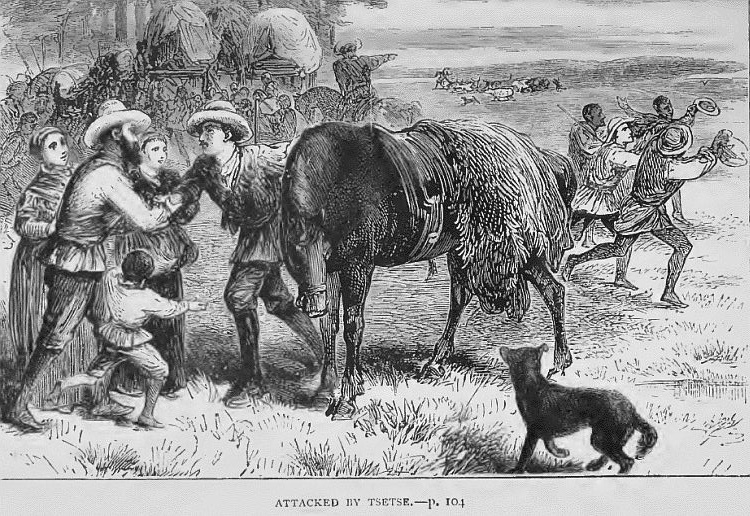
Again was there gladness in the camp, greater than ever, as it always is when the lost are found. But, alas! it was not of long continuance. Scarce had the returned searcher dropped down from his saddle, when those who gathered clusteringly about him and his horse became conscious of a sound, which caused one and all to start and cry out. It was but as the buzz of a blue-bottle, but with sharper intonation and intermittent. In short, they knew it to be the “tzip” of the tsetse; at the same instant catching sight of the insect itself, its brown colour, with yellow-banded abdomen, rendering it easily recognisable. With its long wings in whirring play, it was flitting about over the horse’s body, as if in search of a spot to settle on.
Eager hands were stretched forth to seize hold of, or crush it. They supposed it to have come along with the horse, and so the only one of its kind there. But their efforts were idle; with the sun high and hot, the tsetse becomes exceedingly active, and as difficult to be caught as a bombylins or dragon-fly. Darting from point to point, it eluded all their attempts; in fine, retreating from its persecutors with a bizz that seemed to say, “Catch me if you can.”
It flew off towards some of the trek oxen that chanced to be near, and several of the men followed in hopes of being able to kill it there. But their surprise was light compared with their alarm, when, on getting up to the oxen, they saw not one tsetse but a score of them; ay, there might be hundreds or thousands for aught they could tell. The pestilent insects were flitting about everywhere, and it was evident not only the trek oxen, but the milk cows and horses were being assailed by them. The dogs, too, as could be told by their rushing around and biting their own bodies; some closing their jaws with a snap, like the shutting of a snuff-box lid, in their efforts to seize the creatures that were torturing them.
It was now that the camp rang with that cry which had caused consternation in many another, and broken many another up.
“Tsetse—tsetse!” called out half a score voices in chorus. “Gott en himmel! They’re swarming all around!”
Then followed a scene of wildest excitement; that rushing to and fro observed by Piet Van Dorn and his brother as they came within sight, and heard the racket of shouts which had so mystified them.
They understood it all now, before Rynwald came up to them; who, after some hurried words of explanation little needed, reined his horse round, and the three rode together to the camp.
On arrival there, Piet Van Dorn was embraced by loving, affectionate arms, and had kisses showered on his cheeks. Even a sly one got he from his sweetheart, in a shadowed spot under the trees. But not much was made of the spoils he had brought back. Just then the Vee-Boers had other fish to fry—a great danger to get rid of—which he, as all the rest, was called upon to combat.
Quickly dismounting, he lent a hand of help in the lading of the waggons, which soon after-packed in a hurried, higgledy-piggledy fashion—were ready for the route.
Note 1. “The tsetse” (Glossinia morsitans). Although the sting of this insect is fatal to the domesticated quadrupeds above named, the mule and ass are not injured by it. Neither are any of the wild animals that inhabit the districts infested by it—a circumstance seeming strange and inexplicable.
Note 2. The “bultong” of the South Africans is meat cured in a similar fashion to the tasaio of the Mexicans, and charqui of South America, commonly know as “jerked beef.” The process is of great service in countries where salt is a scarce commodity, or does not exist.
Chapter Fourteen.
Crossing a “Drift.”
As yet the alarmed emigrants had not decided on the direction to be taken. Up stream was that which led to the district of country they were treking to. But to keep on the river’s banks, wooded as these were, might be to continue in the infested region, and they would nothing gain by changing their place of encampment. At rest, or moving, their animals would become victims to the insects’ venom all the same. So before starting, a consultation was held to determine the route. Hurried it was, and without unanimity of opinion. Jan Van Dorn, leader of the party, believed the tsetse had been brought thither by the buffaloes, and was not anywhere else than just around that spot. There was much probability in this view, regarding the behaviour of these animals in their mad rush and routing. Not that they need have feared the insect; as, unlike with domesticated cattle, its sting is never fatal to them. But it annoys, and often sets them on the run. Despite this likelihood, the other two baases, Blom and Rynwald, differed with Van Dorn. In their belief there was tsetse all along the stream, up and down, and their best way would be to trek off from it inland—anywhere.
While they were still undecided, the Gordian knot was cut by their guide, Smutz. The nimble Hottentot had climbed, monkey-like, into the highest branches of the mowana, where he commanded a far view of the surrounding country; and from this elevated position had descried a place of probable safety. It was a range of high hills running parallel with the river; a dry, rocky ridge without any sign of timber on it, and therefore unlikely to be infested with the fly so much feared.
Shouting down his discovery, it brought their deliberations to an abrupt end, with a resolve to make straight for the hills. In any case it would be but the loss of a day or two’s time, with the toil of some twenty miles’ extra travel, the ridge appearing to be about ten or twelve miles off. But what of that, so long as it saved their stock from destruction? And, without further delay, the word went round for starting; the oxen were whipped up, and the waggons moved off, leaving the laager, late full of busy life, a deserted, desolate spot.
The river had still to be crossed, as they were on its southern side, and the range of hills lay north. But about this they anticipated no difficulty; having examined the drift on the day before, and found it easily fordable. When the attempt came to be made, however, it did not prove so easy. The rain-deluge of the preceding night, which half drowned Piet Van Dorn among the ant-hills, had swept all over the country, and the stream was now in freshet to full channel.
There were ways of getting the people across, the animals, too. But the waggons must wait for the subsidence of the waters. Luckily, this had commenced, and, as they could see, was going on rapidly. Many South African rivers rise to highest flood, to fall again within a few hours, and such an one this appeared to be. With glad eyes they saw it go down by inches, as though the water were filtering into the earth underneath, as well as running off down stream.
Confident it would soon be at its normal level, they did not think of outspanning. Instead, the oxen were kept attached to dissel-boom (Note 1), and trek-touw; only the horsemen dismounting to make things more trim for the passage across.
In an incredibly short space of time the water was low enough to attempt it; and then arose a chorus of shouts, with cracking of whips, as drivers, achter-shambok men, and forelopers, urged the oxen down the sloping bank into the stream’s bed. Not less was the fracas while the fording was being made, every moment of it a continuance of encouraging cries, and whip-cracks loud as pistol shots, till the three huge vehicles were dragged out on the northern shore, high, but not dry; instead, dripping wet up to their boxes.
The fording had been effected without serious accident, though accompanied by one of a comical character, in which Andries Blom was the conspicuous figure. This ill-starred youth, now more than ever jealous of Piet Van Dorn, while crossing the drift, rode close to the waggon that carried Katharina Rynwald. With the hope of re-establishing himself in her good graces, he was making great show of solicitude for her safety, as also display of his horsemanship. This is a set-off against Piet’s late pitch out of the saddle, which had become known, and his own account of it credited by all, save Andries himself. The latter, however, affected disbelief in it, insinuating that it was a simple downright “throw,” no hyena-hole, nor any other having aught to do with it. While wading his horse alongside the waggon, he had sneeringly said as much to Katharina, to get for his pains a look of reproachful scorn. Stung by it, and the jealousy that tortured him, he became reckless, spurring his horse angrily in front. But the animal, angered too, commenced pitching about, and tripping on the loose, slippery stones in the stream’s bed, went head over, not only sousing its rider, but flinging him from the saddle. As the two struggled out upon the bank, paces apart, the laughter that from all sides saluted him was bitter as though it came from the throats of fiends; all the more that a sweet silvery voice took part in it, which he knew to be Katharina’s.
But the merriment at his discomfiture was of short duration. Just then, all were oppressed with an apprehension of the tsetse having already done its deadly work, and that the fatal result would declare itself later on. It was not that, however, which brought their hilarity to an end, abrupt as though a bombshell had burst in their midst. This came from a shout sent from the opposite side of the stream—that they had just left—a cry of alarm. Looking across, they saw one of the Caffres, who had lingered behind at the laager to pick up odds and ends, coming at full run down to the drift, as he ran, excitedly exclaiming, “Olifants! olifants!” (Elephants.)
What was there in this announcement to alarm them? Instead, a professional hunter would have hailed it with delight, thinking of ivory and the gain to be got from it. So might they, but for a spectacle which on the instant after they had under their eyes. Looking back upon the open list, late traversed by them, they beheld a band of elephants, nigh a hundred in number, in all likelihood the same met on their midnight march across the Karoo. But whether they, or others, the danger was all the same and imminent. The huge pachyderms were coming over the veldt and in their usual fashion, single file, making straight for the drift, and likely to cross there. These sagacious animals know all the waters within any district frequented by them—the springs, vleys, and streams, with their fording places. The herd was advancing as if along an oft-trodden track, and the apprehension of the Vee-Boers—a very fear—was not without sufficient cause. Should the elephants continue on over the stream, it would be sure destruction to everything that chanced in their way. The rush of the buffaloes, lately dreaded, were as nothing to it. It was now that the head baas, Jan Van Dorn himself, assumed authoritative command, and gave display of his intelligence; calling to the forelopers to lead off, with the drivers and jambok men to whip up after. The waggons were instantly switched to one side, and clear of the track, which the elephants, left unmolested, would be likely to take. The driven cattle, too, were hurried out of the way, the people at the same time seeking safety in concealment.
But the old jägers had no intention of leaving the olifants unmolested; instead, he meant to make slaughter among them, and from their tusks get some compensation for the loss sustained by that wholesale poisoning of sheep.
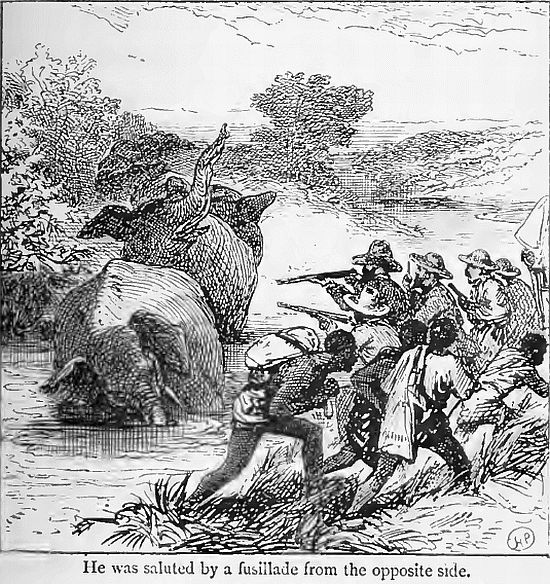
He had barely time to arrange his battery—all the available guns belonging to the party—as the leading elephant, a grand old tusker, with ears big as carriage umbrellas, entered the open list in the timber, the rest still following in file. Though going only in a walk, it was with a stride that carried them along fast as most other animals in full run, and in a few seconds after the tusker stood on the stream’s bank; then with a flourish of trumpets, and a whirl of his flexible trunk, struck straight down into the water.
But never to go out of it again alive, on his own legs. Scarce had he wetted his huge hooves, when he was saluted by a fusillade from the opposite side that not only tumbled himself over, but five or six of his fellows following immediately behind, some of them wounded, some killed outright. The rest of the herd took instant affright and wheeling round, went off in wild rush, no longer aligned, but in scattered confusion, breaking through the bushes in every direction.
When the waggons were again drawn back upon track, and moved off inland, in addition to their usual loading, they carried several hundred pounds weight of valuable ivory.
Note 1. The “dissel-boom” of a waggon is the pole to which the hind oxen are attached, the others in front drawing by the trek-touw.
Chapter Fifteen.
A Camp full of Carcasses.
Another encampment of the Vee-Boers, their three waggons as before, forming its substantial centre. In almost everything else it is different from that under the baobab, being situated in a kloof (Note 1) between two rocky ridges, which, trending towards one another, meet and form a sort of cul-de-sac. The valley’s bottom is of some breadth, grass—covered but treeless, save some stunted bushes scattered thinly over it, with here and there a tall camel-thorn, from which hang the purse-like pensile nests of a colony of weaver birds. The ridges are of basalt, and along their slopes lie huge boulders, some square-shaped and big as houses; other similar blocks being strewn about on the level below. Just over the camp, and shadowing it from the sun, is a high kop (Note 2), on whose ledges cling aloes, euphorbias, and other plants, characteristic of desert vegetation; for all is barrenness, above and around, the bottom land alone showing any sign of fertility. This last is due to a spring, which, issuing from the cliff’s base, trickles down the valley, to be caught in a little pool, some hundred paces below. Being a permanent fontein, it afforded sufficient water for all the animals when they wanted it. But few of them want it now; most being dead, whilst those that survive are in death’s throes, without hope of recovery. The fatal work begun by the tulp, is being finished by the tsetse; good as finished already—and the migrating graziers will soon be without stock of any kind, horse, ox, or cow. Even their dogs are dead or dying.
This wholesale fatality, as they have since ascertained, was brought about by the buffaloes; some of the people, sent back to the river higher up, having there found no signs of the venomous insect. They had gone with a view to continuing the journey; but before a fresh start could be made, the too well-known symptoms of tsetse-sickness had declared themselves, and all thoughts of treking further were relinquished.
For the first forty-eight hours the effect of the poison had not been perceptible, and there was a hope of the animals escaping. A hope which had to be abandoned when they began to water at the eyes, and run at the nostrils, their hair standing on end as in the midst of an arctic winter, while they were under the hottest of tropical suns. Soon after came swelling of the jaws, scouring, with consequent emaciation, weakness to staggering; some actually going mad, as with hydrophobia, and having to be shot. All would have been shot ere this, but for a lingering, half-despairing belief that some might still get over it.
This is now gone; many of them have been buried; and of those above ground, the dying lie mingled with the dead, groaning and moaning piteously.
When at length comes the conviction that all are doomed, the fiat goes forth to put the suffering creatures out of pain. The guns are again brought into requisition; a brisk, though reluctant, fusillade follows, and the camp is left without a living quadruped.
For a time there was silence, profound and solemn as that which succeeds the firing over a soldier’s grave. Every one sate despondent, or stood in listless attitude, ignorant of what was next to be done. They but knew that to remain there would be out of the question, while treking away with their waggons was no longer possible. These huge vehicles, now teamless, with their white canvas covers, were as ships becalmed in mid-ocean; all sails set, but not a breath of wind to blow them on. And the migrating Boers themselves might be likened to shipwrecked sailors—castaways on a desert shore—for not much better was their situation. Around they saw the ruin of their hopes, the wreck of their fortunes, but nothing of what lay before them, or beyond.
Under such circumstances no wonder at their being sad and despondent.
But if silent, not so was the scene around. Throughout the kloof were noises enough, and more than enough, since all were disagreeable to their ears. Skulking among the rocks and bushes, the jackal gave out its long—drawn, lugubrious whine, in concert with the wild, hysterical laughter of the hyena; while from the ledges above came the hoarse wah-wah of baboons, as though these quadrumana were afflicted with colds, and all the time clearing their throats.
Along the cliff’s crest were perched vultures of various species, sunning themselves, with wings outstretched, now and then uttering harsh croaks as they contemplated the rich banquet below, soon to be ready for their beaks. (Note 3.) Eagles, soaring high in air, meant partaking of it also, as betokened by their necks craned downwards, and screams of eager concupiscence.
An interval having elapsed, and the necessity for action forcing itself upon his mind, the head baas, Jan Van Dorn, summoned his two associates into council, for deliberation on what should be done.
A flat-topped stone near the centre of the camp offered a convenient seat, and, sitting down upon it—all three pipe in mouth—the leader thus delivered himself—
“Brothers! we’re in a bad way now; it couldn’t well be worse.”
“Ya—ya, that is true,” responded the others in a breath, Blom adding—
“Nach Mynheer Jan, it couldn’t possibly be worse.”
“Then what ought we to do, think you?”
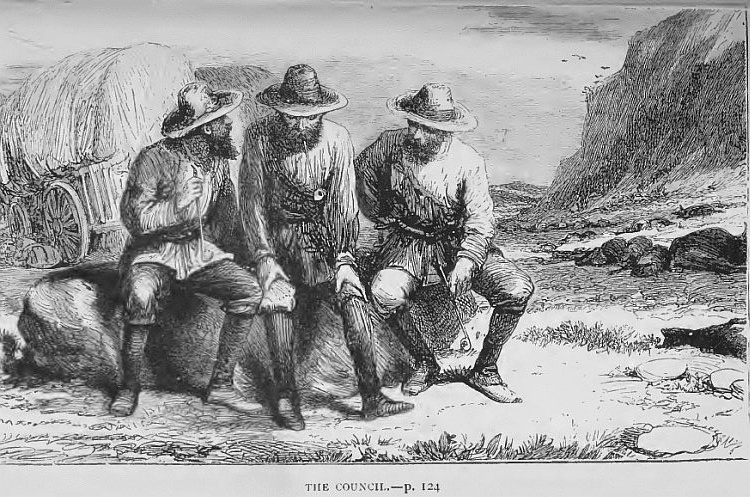
To which merely formal question Van Dorn received no answer, the other two tacitly puffing away at their pipes in expectation that he would tell them. Accustomed to this sort of deference the old jäger no longer held back, but proceeded to unburden himself, saying—
“Well, brothers; the first thing we must do is to look out for our lives—our very lives. And it’s the only thing we can do now. To keep on to the place we were making for, even though sure of reaching it, wouldn’t help us a bit. Without our cattle we’d be no better off there than here; and now that our horses and dogs are gone too, there’s but small chance for us subsisting by the chase. Once our ammunition gave out, we’d be just as Bosjesmen, have to live on roots and reptiles. That’s not the life for a Vee-Boer, nor the diet either.”
“Gott der himmel, no!” was the deprecatory exclamation of Blom, sent forth between two puffs of smoke.
“So,” continued Van Dorn, “I see no hope for us but return to the Transvaal.”
“Neither I. Nor I,” assented the associate baases, Rynwald adding interrogatively—
“But, Mynheer Jan, how are we to get back there?”
This was just the trouble that stared all in the face, and had been in their thoughts ever since the tsetse-sickness first made its appearance among the stock. For in their thoughts, also, was the Karoo they had lately crossed with so much difficulty and danger. This when they had all the means of transport, waggons to carry their women, children, provisions, and other effects, with horses to ride upon. What would be the recrossing it without these, and afoot? Impossible, as Van Dorn well knew; and so declared, saying—
“Overland, brothers, we never could get back. We are more than three hundred miles from Zoutpansberg, the nearest settlement of our people, as you know. Some of us might hold out to reach it, but not all; only the strongest. The weak ones, our dear ones, would many of them perish by the way. Need I say more?”
“No—no!” promptly responded Rynwald, thinking of a wife and only daughter, the fair Katharina. “That’s enough, Mynheer Jan. We mustn’t attempt to go back over the Karoo; it would be our ruin, as you say.”
“Then how are we to go?” demanded Blom. “What other way?”
“By water,” answered the head baas. “We must make down the river, and on to the sea.”
“What river are you speaking of?”
“The Limpopo. The stream we’ve just left should run into it, not a great way below; and the Limpopo itself empties somewhere to the northward of Delagoa Bay. I have heard there is a Portugese settlement, a small port near its mouth, where whalers and coasting vessels occasionally call. If we can reach that, ’twill give us a chance to get down the coast to Port Natal, and then over the Drakenbergs back home.”
“That would be a long voyage,” suggested Blom, “full of all sorts of dangers, too.”
“In time not near so long as by land, and not half as many dangers either—if we have luck.”
“Ay, if we have luck. But suppose we haven’t?”
“We must take the chances, Mynheer Hans; all the more as there’s no help for it. But I’m sure it’s our best way.”
“So I,” seconded Rynwald.
“But,” said Blom, less objecting than to get a clearer comprehension of what their chief intended, “you don’t propose our descending the river afoot—tramping along the banks, do you?”
“Certainly not! That would be a trudge to take time, indeed; harder than crossing the Kalahari (Note 4) itself. We’ll sail down to the sea.”
“But what about boats? We have none.”
“We must do without them—build rafts, which in a way will be better than boats.”
“Oh! that’s your idea, Mynheer Jan. I suppose it’s a good one, and for the best. Well, I’m willing too. So let us make it a water journey.”
The other two having already pronounced in favour of this, the consultation came to a close by Van Dorn saying—
“And, brothers; the sooner we start the better. We can gain nothing by staying longer in this tainted spot; but may lose something—our health, likely, if not our very lives.”
Note 1. “Kloof,” the Boer’s designation of a valley of the ravine order.
Note 2. The “kop” is a cliff-like promontory overhanging a valley or plain, nearly synonymous with the American “bluff.” It is, doubtless, the Dutch radix of our word cape.
Note 3. There are no less than seven distinct species of vultures inhabiting South Africa; while the species of eagles are still more numerous.
Note 4. “Kalahari,” the name of the great South African desert, or Karoo, which extends north from the Orange River, and west of the Transvaal, for hundreds of miles. Its borders, and some parts of its interior, are inhabited by Bushmen and Bechuanas.
Chapter Sixteen.
A Carnival of the Carnivora.
Needless to say that Van Dorn’s last words, pointing to the urgency of immediate departure, were convincing to his associate baases, had they stood in need of conviction. But neither did; they, as he, being but too glad to get away from a scene where they had suffered so much loss, to say nothing of the misery. The spectacle now under their eyes was itself sufficiently disagreeable, seeming a very charnel-house. Scores of carcasses lay in and around the camp; and, as the hot sun continued to burn down upon them, the effluvia was every moment becoming more offensive, and would soon be unbearable. True, they could be buried as those first dying had been. But, for days past, an understanding prevailed that the encampment was to be changed, time and place alone remaining undetermined. The former had now come, and the latter been also resolved upon; no new ground, but one familiar to them—in short, that they had so lately and hurriedly abandoned.
They need have no fear of re-occupying it, nor had they. Tsetses might be swarming there thick as midges in midsummer; but nothing cared they now. The only hurt these insects could hereafter do was by their presence to remind them of the damage already done, recalling dissipated hopes and expectations. So far as the accursed fly was concerned, however, it was no longer thought of; and all were full of eagerness to be back under the mowana. They had pleasant remembrance of the hours spent beneath its shade, so different from that of the kop, which but gave them shadow when the sun had either not reached, or passed meridian. Besides, on the river’s banks grew trees of many kinds, affording edible fruits, some even delicious. No wonder, then, at the general joy, when it became known they were to move back to the river.
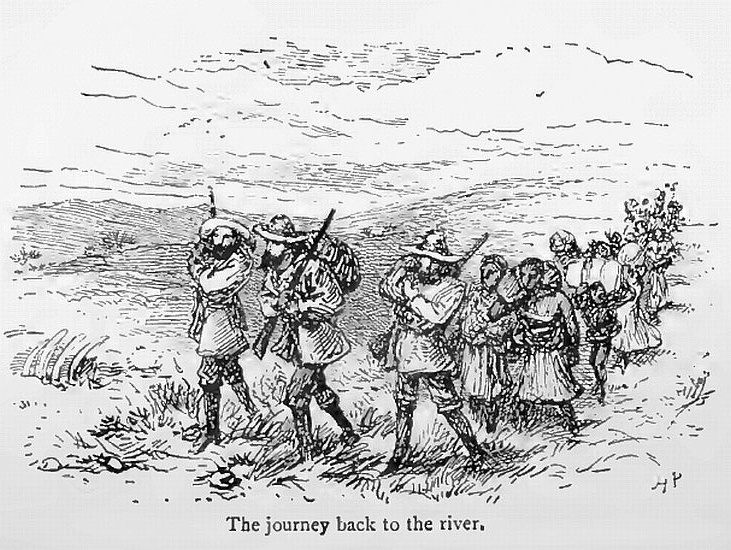
The prospect inspired every one, as it were, with new life; and when the moving commenced, as on the instant it did, all hastened to lend hand of help. For there was much work to be done, big burdens to be carried in the transference of their effects from camp to camp. And it would take more than one trip ere completed.
The women and children were marched off first, even these carrying loads proportioned to their strength. And with them went the first batch of regular carriers, to be followed by another, soon as the packages were made ready for transport; then another, and so on—all to return again. Thus down the ten miles of slope between mountain range and river passed a continuous stream of men bearing burdens, like ants on return to their hills; the same men soon after going back upward, unweighted, and with light elastic step. Only the downward journey was accomplished on the first day, as it was late ere they had commenced it. But on the second they made the “round trip,” and more; three times traversing the space between the camps.
Not all were of the last party that returned to the hills, only a certain number needing to go thither now. Most of the effects intended for removal had been got down on the second day, the waggons alone remaining in the kloof. Of course these cumbrous vehicles, of no use now, would be left behind; but not their tilts. These, sure to prove of good service afterwards, were to be fetched away, and it was chiefly for them the carriers had come back. The party consisted of half-a-dozen young Boers, with about twice the number of Caffres and Hottentots, Piet Van Dorn having charge of it.
The sun had set ere they re-entered the old camp; and as all were fagged out by the incessant toil of the two days, their thoughts alone dwelt upon rest and sleep. The return journey, their last, was to be made on the following morning, and there was no necessity for further work that night. So they at once betook them to their respective sleeping-places; the young white men climbing into the waggons, their native attendants, wrapped in karosses (Note 1) laying themselves along the ground underneath.
Soon all were buried in a profound slumber; the dismantled camp around them silent as a cemetery. But it was a silence of short duration. Scarce had they become unconscious, ere getting awakened by sounds which robbed them of the power of sleep, if not its desire. For their ears were saluted with the cries of wild beasts, coming from every side, and of so many kinds, it seemed as if all the predatory species of Africa were assembled within the kloof. In point of fact, most were there, attracted from far and near by the scent of the dead animals, whose carcasses were now far gone in decomposition. On previous nights there had been something of the same, though never such a racket as now. Then fires had been kept burning to frighten the beasts off; but this night being warm, and the last they were to spend on that spot—tired, too,—the young men had neglected taking such precaution; imprudently, as all saw, when startled out of their sleep by the roar of a lion, multiplied in loud reverberation along the adjacent cliffs. It was but the prelude of a horrible chorus quick succeeding, in which could be distinguished the angry “gurr” of the leopard, the spiteful snarl of the cheetah, and the cat-like miaulling of the serval. Hyenas of different species alternatively howled, chattered, and laughed, while jackals contributed their snappish bark to the fear-inspiring din.
Fear-inspiring it was to those freshly awakened; all the more when, after rubbing their eyes, they looked off, to see a sight which made their flesh creep, and blood run cold. No wonder. Over the camp-ground were lions, leopards, and the other sorts, thick as sheep in a pen, in all attitudes, and every variety of action; some tugging and tearing at the carcasses, others in dispute about pieces already severed: still others rushing to and fro in quest of a stray morsel. The moon shining in full effulgence rendered them distinguishable, almost as by daylight; while on the still calm air within the kloof, the roaring, growling, yelping, and howling, all repeated in echo from the cliffs, combined to make a very Pandemonium.
Fortunate for those who listened that the tilts were still upon the waggons, with end curtains of strong stuff to draw close—in part designed for just such a danger. In a trice everybody was inside them—white, black, and yellow—the flaps pulled to, and all made safe as might be. Still the situation was one of greatest peril. What if, after eating the dead animals, the devourers should turn their attention to the living men, and make a burst through the canvas? The stroke of lion’s paw, or leopard’s either, would tear that screen to sheds as though it were but tissue-paper, and they, concealing themselves under it, well knew this. But they knew also, that if left unmolested, more likely the fierce brutes, having filled their bellies, would retire from the ground, and give no further trouble.
For a time they were so left; but not long. The position was too ticklish and irksome for continued endurance. The young Boers, deprived of their rest, and kept in such a stretch of apprehension, soon began to chafe at it, till their impatience became anger, rendering them reckless. Besides there was one always eager to distinguish himself as a hunter, and never might such opportunity occur again. This was Piet Van Dorn, who at length casting all prudence aside, proposed opening fire on the enemy. Being chief of the party, and with controlling power, his proposal was unanimously agreed to; and, in less than five minutes after, the brutes making such noise over the camp-ground, heard other noises that were new to them—the cracking of guns—at the same time saw puffs of smoke, with jets of flame, darting out from the white covers of the waggons.
Surprise, with some fear, hushed the wild beasts into a momentary silence; the cowardly canidae—hyenas and jackals—scampering off at the first fire. But the fiercer and more courageous felines kept their ground, till a second volley had been sent into their midst; then only moving away with sullen reluctance, some even staying to receive a third discharge from the death-dealing guns. But of those that thus stayed, not many got off afterwards. The clear moonlight afforded a fine chance for sure aim, and the young Boers—all best marksmen—made deadly play with their roers, scarce missing a shot.
In fine, the camp was cleared of its fierce four-footed invaders, save those that had fallen. And of these could be counted a goodly array; four lions, with two lionesses, three leopards, and a couple of cheetahs!
Their pelts, stripped off the next morning, added to the weight requiring transport. But the young jägers could make light of this additional lading, in anticipation of the triumph such spoils would secure them.
Note 1. “Kaross.” A wrap of blanket size and shape, made of the skins of wild animals stitched together; they are worn by most of the uncivilised natives of South Africa. Various sorts of skins are used in their manufacture; those of the leopard and cheetah, or hunting-leopard, forming the distinctive garb of a chief.
Chapter Seventeen.
Water-Horses.
Over a week has elapsed, and the Vee-Boers are still in their old camp under the baobab. Its appearance is much the same as during their former occupation of it—that is, the portion inside the laager-fence. For though the waggons are absent, their arched covers, supported on short uprights, stand just as they stood, now doing service as tents. They are the sleeping-places of the women and children, also giving shelter to such household gods as need the protection of a roof.
To speak of a Vee-Boer having household gods may seem a misnomer, since he never has a house. Still there are certain Penates he carries about; the most cherished being a black-letter Bible, large as a volume of the “Encyclopedia Britannica,” in thick leather binding, with brass clasps. This ponderous tome goes with him, wander where he will; for the South African Dutchman is strong in the protestation of religion, whatever his practice of it.
There had been one such Bible in each of the three waggons—the respective belongings of the families, Van Dorn, Blom, and Rynwald—and, it need scarce be said, that these sacred volumes were not left behind in the kloof.
Outside, on the veldt, all is different. The groups of grazing stock are no more seen there—not a single head; while close to the laager’s edge appears a new feature, a “hartebeest house” (Note 1) late erected. It is for the young whites of the party; the native employés contenting themselves with such coigns of shelter as are afforded by the trunks of the mowanas. In these, some have ingeniously hewn out cavities, large enough to give them lodgment, others having in like manner utilised the adjacent ant-hills.
All this bespeaks prolonged residence there, and not far off is a spectacle, showing the reason; telling also they have not been idle in the interval. Down on the river’s bank by the drift is a scene of greatest activity, where some scores of logs have been collected, and are being made ready for the timbers of rafts. They are the trunks of koker-booms, (Note 2) each about eleven feet in length, with a diameter of three. Their top-knots of bayonetlike leaves having been lopped off, they are now in process of desiccation, by huge fires that have been kindled around them. When the sap is drawn out, they will be light as cork wood, just the material required for raft-building.
Jan Van Dorn himself superintends this quaint naval architecture, by good luck having skilled assistants. As it chances, among the native employés are two Macobas (Note 3) of Lake Ngami—fugitive from the tyranny of King Letchoulatebe—who understand all about the various kinds of craft used in South African inland navigation, and under their hands the rafts will be properly constructed.
Nor is this the only industry in progress. On the other side of the camp, out upon the open veldt, a number of the young Boers are busy too, their work being the conversion of fresh meat into bultong. Strips of it hang over riems extended between the trees, where these stand thinly, so as not to shadow it from the sun. It was the same on a former occasion, but the meat is not the same. Then it was buffalo-beef, which has been all lost. For at the time of their hurried abandonment of the place, it was not thought sufficiently cured to be taken along, and it was their intention to return for it. Unluckily, left hanging too low, the hyenas and jackals had dragged it down, and devoured it to the last scrap. The sausage-like strings now replacing it, are the flesh of elands, and other large antelopes, the carcass of a giraffe having contributed to the stock. While the raft-builders had been busy with axe and bill-hook, the hunters were alike industrious in the chase, and have already laid in a good store of provisions for the proposed voyage. It may be a long one—how long they cannot tell—and in descending the rivers they might not easily find subsistence for such a numerous party. At all events, the precaution is a wise one, and fortune has favoured them in it, by guiding many wild animals toward the drift; some on their way to drink, others intending to cross over. They have enough meat now to last them for weeks—even months—once it becomes bultong; and, to insure its becoming this of the best, light fires are kept underneath it, whose gentle heat, with the smoke, assists in the curing process.
Nor are the voyagers to be dependent on an exclusively meat diet. There are yet left them several bags of meal, both of maize and Caffre-corn (Note 4); while, as already said, the trees standing near bear a variety of edible fruits and nuts, some of which are being added to the intended “ship’s stores.” Collecting these is the task of the youngsters; so all, young and old, have something or other to do. And they are doing it with all their might and will. For even the youngest now know that their situation is one of uncertainty and peril; dangers on the spot, with other dangers ahead, the avoidance of which calls for every exertion.
Another week has passed, showing much progress made. In short, the rafts are finished, and afloat on the water. There are three of them, corresponding to the three families who make up the migrant party. It was not for this, however, that a trio was constructed; but because of the stream being too shoal and narrow to admit of a raft large enough to carry all. That is a thing to be thought of when they reach the great river below.
Each of the three built has a breadth of beam of some ten to twelve feet, in correspondence with the length of the koker-booms; whose trunks, laid side by side, have been firmly lashed together by lianas—the Baavian-touw (Note 5). Lengthwise, the rafts are nearly four times as much, from stem to stern being about forty feet. On what might be called the quarter-deck of each, one of the waggon-tilts has been placed on supporting stanchions, and is the cabin. On the fore, also, is a sort of shed or round house, roofed over with reeds and palm leaves, for the accommodation of the crew. A huge pile occupies the main deck, leaving a narrow passage or gangway on either side, for the polemen and rowers. Over it are spread the skins of wild animals lately killed, now utilised as tarpaulings, to give protection to a variety of effects—in short, the general cargo. Amidships, on each raft, is a little platform of clay, raised some eight or ten inches above the timber’s level. That is the hearth, intended for culinary purposes. In fine, upon the extreme stern, abaft the cabin of bamboos and canvas, a long broad-bladed oar, balanced on a pivot, is to do the rudder-work.
At length everything being in readiness for embarking, it was begun without further delay. Nor was there any in the carrying it out; for, as with the camp in the kloof, all were now eager to move away from this one. True, the place had been of some service to them; nevertheless was it fraught with most unpleasant memories. It was there the tsetse first assailed their stock to its final and total destruction, not only beggaring them, but putting their lives in peril. So, almost as hurriedly as the inhabitants of a burning house flee from the fire, did they make for the rafts when these were ready to receive them.
The embarkation was accomplished in good order, and without accident. The cables, which were the old trek-touws of the abandoned waggons, being hauled in, and the huge structures, one after another, shoved out to mid-stream, they went gliding gently down.
But they were not the only craft to take departure from that landing-place; a score of others accompanying them, of a quaintly curious kind—being water-horses. Each consisted of a single trunk of koker-boom, with a peg of about fifteen inches in length fastened firmly to it, and standing upright near the fore. Lying flat along the log, face downwards, rode a naked native—Caffre or Hottentot—with one hand holding the peg, the other acting partly as an outrigger for balance, and partly for propulsion. The legs, too, astraddle, and trailing in the water behind, helped the onward movement, as in swimming; so that the water-horses could be put to a speed far beyond that of the cumbrous rafts. Around these their riders darted in high glee, laughing, shouting, and splashing one another, as a flock of ducks fresh entered upon a pond.
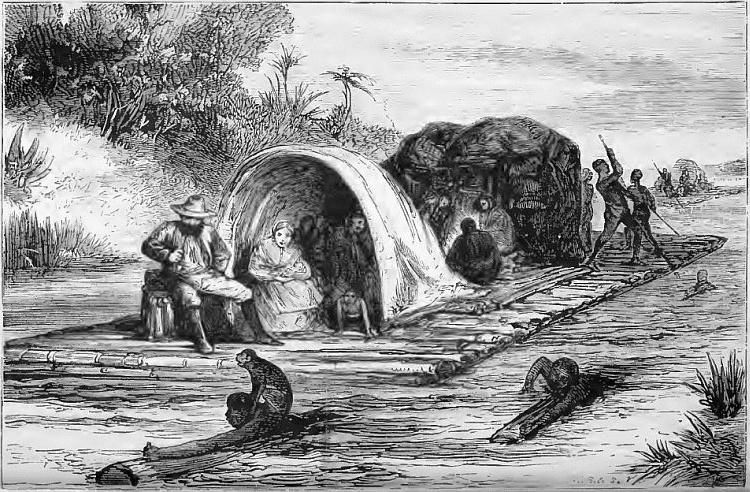
The purpose of this aquatic cavalry was twofold; in part meant as a ready means of communication with the banks, and partly to avoid overcrowding the rafts. Moreover, many of the natives, used to such navigation, rather liked it; especially that now, under a broiling sun, it enabled then to dip their bodies at will, and keep them comfortably cool.
The “water-horse,” as described, is often brought into requisition by the Caffres and other South African natives. They are found of great service in the crossing of wide rivers, especially when cattle and sheep have to be got over. Then the water-horsemen guide the animals, and swimming alongside assist the weaker ones and young calves.
Thus joyously the rafters began their voyage, at its outset to be treated to a laughable spectacle, as when crossing in flight from the tsetse. Though they had lost all their quadrupeds, there was still a creature with them of the animal kind—if a monkey may be so classed. It was the pet of Katharine Rynwald, but also favoured the Hottentot guide, Smutz, who, for its young mistress’s sake, had been accustomed to show it kindness. As the odd flotilla moved off, Smutz bestrode one of the water-horses, and shooting past the foremost raft, on which sate the young girl with the monkey in her lap, the latter made a long outward leap, alighting upon his back; then fixing itself firm and square on his shoulders, there squatted composedly. The two facing in the same direction, with the round, bullet-like cranium of the Hottentot, surmounted by that of the monkey, it was as if some water Cerberus, or double-headed hydra, were conducting the squadron down stream.
But the incident was too comical to be looked upon as an evil omen; instead, it elicited peals of laughter, with applauding shouts; all inclined to regard it as the forecast of a prosperous voyage.
Note 1. The “Hartebeest-house” is a hut of rude construction, the usual materials being reeds and grass with a plastering of mud. The name is derived from a fancied resemblance to the form of the antelope so called. Hartebeest-houses are common throughout Southern Africa, not inhabited by natives, but the poorer class of colonists, especially Vee-Boers when not on the move.
Note 2. The “Koker-boom” is a species of aloe with a short thick trunk. When well dried the wood is even lighter than cork.
Note 3. The “Macobas” are the boatmen of Lake Ngami. They have affinity with the Bechuanas; but are of a race and class apart. They are also of darker complexion.
Note 4. Both Indian corn (maize) and Caffre-corn (Sorghum Caffrorum) are cultivated in Southern Africa, and the meal of both is in common use among the Boers of the Transvaal. The Caffres also grow large quantities of another species of Sorghum (S. Saccharatum) for the sake of its stem; which they chew, as the negroes of America do sugar-cane, its juice being equally as sweet.
Note 5. The “Baavian-touw” (Anglice, “baboon-rope”) is a species of climbing plant, or liana, with long stems and heart-shaped leaves. By the Boers it is employed as cordage, and for many purposes, this primitive sort of rope being often convenient, where no other is obtainable.
Chapter Eighteen.
A River Run Out.
The stream on which the Vee-Boers had embarked was unknown to all of them. Even their guide was unacquainted with it, though he had once accompanied a party of English hunters to a point farther north than where they now where. By its general direction it should run into the Limpopo, which river they had crossed some days before, on their trek northward. But where it joined the latter, and how far below, as also the character of the stream itself, were questions undetermined.
Nor knew they much more of the Limpopo. Van Dorn had been on it farther down, at the place where Smutz and the hunting party passed over; but neither he nor the Hottentot had followed its course for any great distance. They were acquainted with but ten or fifteen miles of its course, beyond which all was terra incognita to them, or, as the baas in his Dutch vernacular expressed it, “verder onbekend.”
Thus they had entered on a voyage, whose termination hinged on many uncertainties, and might be prolonged by many delays, to say nought of the dangers.
For the first day, however, all went well. The buoyant koker-booms acted admirably, keeping the decks, with all lading on them, high and dry. The current, too, while smooth, was sufficiently rapid to give them good way, without requiring the use of either pole or paddle. All that needed doing was to keep in mid-stream, on account of its narrowness, and that was of easy accomplishment with the powerful stern oars working on their pivots. Large as were the rafts, and heavily laden, so light were their timbers, that when swirl or side current threatened to bring them against the bank, the weakest man on board might be safely entrusted with the steering. Craft of no kind could have been more obedient to the rudder, a matter of much pride and boast to the Macobas, who had the credit of their construction.
But, indeed, all the people were in the most exuberant of spirits. Moving on without any physical exertion—a smooth gliding motion, as on skates or in a sleigh—was of itself a pleasure, which the continuous changing of the scenery, with many sights new to them, intensified to very delight. It was as though they were out on a holiday excursion, or yachting trip, and for the time they thought not of dangers that might be before them, while alike oblivious of the perils they had late passed through.
The enjoyment was general throughout all the day; the water-cavalry skirmishing around with much shouting and laughter. There was racing also, with bets made by the young Boers, each laying on his favourite.
In these aquatic contests the Caffres were mostly victorious, though Smutz ably upheld the honour of the Hottentot race. The Macobas took no part in them, being on board the rafts, and occupied with their navigation.
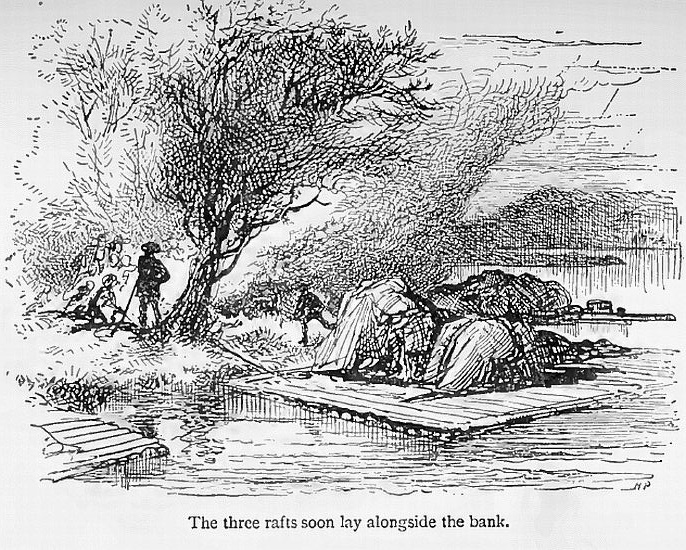
As evening approached the “horse play” came to an end, for now there was work to be done: the rafts to be brought up to the bank, and made fast to moorings. To keep drifting on in the dark would be madness itself, as who could tell what was below? There might be rapids, or worse danger still—a waterfall. Jan Van Dorn was too cautious to run any such risk; so, as the twilight began to fling its purple mantle over stream and bordering woodlands, he called out the command to draw in, pointing to the spot that appeared best for a landing-place. This was in a bend where the current was sluggish, and the banks of slight elevation; for to beach such unwieldy craft in a swift-running stream is not only a difficulty but a danger. In the present case it was accomplished without accident; and the three soon lay alongside the bank, each cabled to a tree, with a gangway plank run out, over which all swarmed ashore, women, children, and men. Water-travelling was a novelty to them; and, though not yet irksome, the return to land was welcome by way of relaxation.
Supper was eaten on shore, though not there cooked, as the culinary arrangement on the rafts was of a superior order, better than any improvised affair of the gipsy kind. But what mattered it where the repast was prepared, so long as it was enjoyable, and enjoyed? which it was by our voyagers, one and all of them. For one and all were now hungry, having that day eaten the morgen-maal at a much earlier hour than usual. It was the last cooked in the ant-hill kitchen-range; since when long time had passed, and with the fresh, breezy air of the river their appetites were sharpened to keenness.
Soon as the meal was over all retired to rest, some on board, others preferring to seek repose on shore, under the trees. It was warm enough anywhere, and more than enough, the heat not only being a discomfort of itself, but subjecting them to torture from mosquitoes.
These troublesome insects were in swarms—myriads—and made it all but a sleepless night to many. Even the Caffres, notwithstanding their greased and ochre-coated skins, suffered the same, every now and then one or other taking a plunge into the river by way of soothing the irritation.
Joyously all hailed the return of daylight, which chased the persecutors away. And they were merry again over the morgen-maal, which they ate before leaving the landing-place. Nor was their hilarity less, after they had parted from moorings, and were once more in mid-stream, moving onwards. The delight of yesterday’s downward glide, with its many pleasant incidents, led them to anticipate the same all along.
A disappointment it proved, as with most other matters of too sanguine expectation. For a few miles farther the current carried them smoothly as on the day before, and they made good way. But then things began to change, the stream becoming wider with a slower flow. This, they could see, was constantly decreasing, and at length ended in complete stagnation, as though the water were dammed up below.
Now, for the first time, had they to take to oars and poling, the poles serving best in such shallow water. For they found it to be less than a fathom’s depth, and still getting shallower as they pushed onward. But they had not much farther onward to go, nor could they. Another mile or so and the rafts, all three, became grounded. Just what Jan Van Dorn had been for some time apprehending—the river was run out!
Chapter Nineteen.
A Congregation of Crocodiles.
Yes; the river had run out, or, to speak more correctly, run in, underground. Its channel was there extending on ahead of them, a belt of silver-white sand, hollow in the centre, and with a bordering of brown, withered reeds. But no water in it; not a drop, nor the sign of such, far as they could see, though commanding a view of it to more than a mile’s distance. For they were looking down an Omaramba, a river’s bed, in which water flows only in the season of inundation, at other times sinking into the earth, to filter away underneath. To the Vee-Boers the thing was neither strange nor new. In their migrations they had met the like before, and ofttimes; for a stream periodically dried up is no rare phenomenon in Southern Africa, nor indeed in other parts of the world. The same occurs in Asia, notably in Australia, as also in both divisions of the American continent. Nor is it unknown in the eastern countries of Europe, by the Black and Caspian Seas.
To our voyagers, then, it was less a surprise than vexation—indeed, bitter disappointment. All the time spent in the construction of the rafts, all their labour lost, to say nought of the helpless, hopeless situation they were now placed in!
But was it so helpless or hopeless? That remained to be seen; fortunately so, else they might have despaired indeed. They did not yet, nor could they, till the question had answer—
“How far does the dried-up channel extend?”
To determine this was, of course, the next step, with little else thought of, till it was determined. An exploring party, with Smutz to conduct it, was at once landed from the rafts, and set off down the sandy strip. Going in all haste they were soon lost to view among the reeds and bushes at its lower end. Then their reappearance was looked for with eagerness, gradually becoming anxiety as time passed. For the longer they were out of sight, the greater should be the distance to running water again, if such were to be found at all.
They were gone above two hours, which looked bad. But on return, as they drew near, an expression was visible on their faces, which betokened the contrary. The report they brought was that the stream, with abundance of water, issued forth again about five miles below.
This was as favourable as Jan Van Dorn had expected, and, in concert with the other baases, he had conceived a plan, now to be acted on. The rafts were to be taken apart, and, with their lading, transported overland piecemeal. Their lading had been already put ashore, as river, or no river, they could be of no further service there. But they would be below, as much as ever, and it was only a question of portage.
The work was at once set about, the huge structures dismembered, beam by beam, and dragged out on the dry strand. Then a stream of carriers commenced moving along the track where water had once streamed, each with a koker-boom log on his shoulders, that seemed as though it would crush him under its weight. With their naked, bronzed bodies, they looked like so many Atlases bearing worlds, though, in reality, their loads were of the lightest.
Down the omaramba went they, and up again, to and fro, till the last beam had been transported from water to water, with oars, poles, ropes, and all the other paraphernalia, the cargoes being conveyed in like manner. It took time though; all the remainder of that day, and the forenoon of the following, while another day and a half were consumed in the reconstruction of the rafts. An easy task it was, compared with the original building of them, the place of everything being now known, deck-timbers with their attachments, steering gear, the fixing of the cabins and sheds, even to the stowage of the goods and chattels.
On the morning of the fourth day, all was ready for re-embarking, which commenced as soon as breakfast had been eaten. Then off again started the flotilla, water-horses, and everything as before. But not as before carried along by the current, since there was none.
Nor in its absence did the rafters see anything amiss. The place of their re-embarkation was at the inner and upper end of a narrow leit, which widened abruptly below. Once down there, they would find the stream flowing, and get into its current. So supposed they, while pulling and poling on.
Soon, however, to be undeceived, and sadly. After passing the point where the leit terminated, they still found no flow; instead, the water stagnant as in a tan-pit. It stretched before them in a sheet of smooth, unrippled surface, nearly a mile in length, with a width of two or three hundred yards, again narrowing at the lower end, where it entered among trees. On each side it was bordered by a ribbon of sandy beach, which would have been white, but for an array of dark forms that lay thickly over it, giving it a mottled or striated appearance. The sun had not yet dissipated the film which hung over the water, and, seen through this, they might have been mistaken for trunks of trees, stranded when the stream was in flood.
But the Vee-Boers knew better; knew them to be living creatures—the most repulsive of all in the world of animated nature—for they were crocodiles. Of different sizes were they: from ten or twelve feet in length to twice as long; the larger ones having bodies thick as an ordinary barrel; their bulk, too, exaggerated by the magnifying effect of the mist.
There would have been nothing in that, nor their presence there, to cause surprise, but for their numbers. All along the stream, crocodiles had been observed at intervals, basking on the banks, sometimes three or four together. But here were so many hundreds, the strip of beach on both shores literally black with them. They were in all attitudes, some lying flat and at full stretch, others with heads erect and jaws wide apart; still others holding the tail high in air with a turn back towards the body, or laid in crescent curve along the surface of the sand. But all motionless, the only movement observable among them being made by birds of the insect—eating species, a number of which sate perched on their shoulders, every now and then flittering off to catch flies that swarmed around the reptiles, alighting on their foul, ill-odoured skins.
Although an astounding and fear-inspiring spectacle, they upon the rafts were, in a manner, prepared for it. On the nights preceding they had heard loud noises below, as the bellowing of a hundred bulls, knowing them to be caused by crocodiles, and only wondering that there were so many in one place. Now seeing the reptiles themselves their wonder was undiminished, with no clearer comprehension of why they were thus congregated.
Nor learnt they the reason till later on, no time being then allowed them to think of it; for scarce had the rafts emerged from the narrow leit when the birds, sighting them, rose up into the air, uttering shrill cries of alarm.
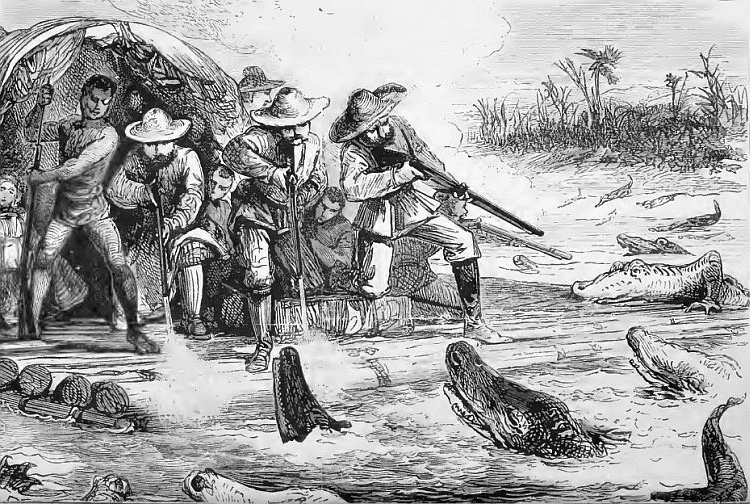
On the saurians the effect was instantaneous. Hitherto motionless, and many of them asleep, all became at once active; their activity displayed by a quick uprising on their short, thick legs, and a hurried crawl for the water. It was their place of safety, as instinct admonished them, and the rafters supposed they were but retreating from an enemy yet unknown to them. Soon to be undeceived, and find it was no retreat, but an intended attack, themselves the object of it! For although the crocodiles on plunging in, went under, and were for a time out of sight, they came to the surface again, now nearer the rafts, a line on either side of them. In threatening attitude too, heads raised on high, jaws opening and closing with a snap, grunting and roaring, while, with their powerful muscular tails in violent vibration, they whipped the water into foam.
There was consternation, with quick scampering among the riders of the water-horses, who had been gaily skirmishing about, as was usual with them at the start off. Never did sailors bathing beside a becalmed ship make quicker on board at the cry “Shark!” than made they to get upon the rafts.
With loud cries of alarm, one and all together darted towards these, and swarmed up, leaving the koker-logs to bob about below, or drift away wherever the surge might carry them. Nor were the rafters themselves without fear, but rushed affrightedly about, the women and children shrieking in chorus. Even some of the men felt dismay at the fierce bearing of the crocodiles, an incident altogether unexpected and new to them. Its very novelty made it the more alarming, from its cause being a mystery. But there was no time to speculate upon causes; the reptiles were still advancing in menace, and steps needed taking to repel them.
Fire was at once opened on them, broadsides from both beams, and the firing kept up, hot and fast as the guns could be loaded again. Shot after shot, and volley after volley was poured upon them, till the rafts became shrouded in smoke, and the water around red with the blood of the dead and wounded reptiles, that for a time seemed insensible to fear. But at length it got the better of them; and, seeing nigh a dozen of their number writhing in death throes, at last all turned tail, going down to the bottom and staying there.
Continuing to ply poles and oars, the rafters reached the lower end of the water sheet without encountering another crocodile, or even seeing one. There to get explanation of what had so puzzled them, by finding the river again run out!
Chapter Twenty.
The Karl-Kop.
So was it; the water, once more gone underground, sank into the sand, just as above. Even worse than above, as regarded navigation, for an exploring party sent forward, returned to report the channel dry to a distance of at least ten miles, twice as far as before.
This made still more intelligible the great congregation of crocodiles. They were the denizens of nigh twenty miles of the stream’s length, driven, by a long-continued drought, into such close companionship. Crowded together, as frogs in a pond, they had devoured every fish, every living thing dammed up along with them in the sheet of stagnant water, and were famishing. Hence their hostility and fearlessness of man, due as much to hunger, as to any natural ferocity.
But the Vee-Boers thought no more about them now. Enough was there to occupy their minds in this second obstruction that had arisen, and which vexed them more than the first, their leader far more—to him a very chagrin—as he reflected on his want of forethought. He should not have been satisfied with such a short, careless reconnaissance, but examined the omaramba to the farthest end, wherever that might be. Resolved to act with more prudence in this second exploration, he had taken charge of it himself, nor turned back, till assured of the stream’s re-issue and onward flow without any other interruption.
This assurance had been obtained by discovering that the sandy tract they were traversing was but a belt of some ten or twelve leagues in breadth, beyond which the nature of the country was different, the surface-soil being firm and clayey. Rivers running over a bed of clay do not go underground, and there was no fear of a third obstruction, at least of that special kind. These facts were not all ascertained in a few hours, nor yet in a single day. Two, and part of a third, were spent in the exploration.
While it was in progress, those left behind had remained inactive, as there was nothing for them to do. Should there be no more stream, there could be no further navigation, and again taking the rafts to pieces would be so much labour lost. In this uncertainty, even their lading was left undisturbed; only such chattels carried on shore as were needed for a camp of temporary occupation. Nor did any of the people, white or coloured, elect to sleep on land, having by this time discovered the be a better place. Upon it they were less exposed to the torture of mosquitoes, to avoid which, the rafts were each night drawn out to some distance from the beach, and there brought to anchor. So shoal was it all round, they had no difficulty in communicating with the shore whenever desirable.
It was an interval of great anxiety, full of doubts and apprehensions. Not all dulness, however, as the monotony of their life was now and then varied by episodes of a curious kind—scenes and incidents of nature, such as may be witnessed only in her wild, untrodden domain. One which occurred on the evening after their arrival was of this character—indeed, so strange as to test the reader’s credulity. Yet is it here chronicled as a fact, on the authority of trustworthy witnesses, the adventurers themselves.
It had got to be near sunset; the people all on shore, and seated at the nacht-maal, when a swishing and crackling among the trees close by, admonished them of some large quadruped making its way towards the water. It might be buffalo, rhinoceros, or hippopotamus; but, judging from the volume of sound, more likely an elephant. And an elephant it was, as was soon seen; one of the largest size, and a Karl-kop, in other words, a tuskless bull. Alone was he, which proclaimed him an outcast from elephantine society—an Ishmaelite in his own land.
All this indicated danger, as they watching him well knew. For the solitary male elephant is vicious beyond conception, being absolutely insane, or musty as it is termed in India.
He was approaching the water, presumably to quench his thirst, and in a few more strides stood upon its edge, not fifty yards from the spot where the people were sitting, luckily behind some bushes that screened them from his sight. They were not all seated now, however, as several of the young Boers had sprung upon their feet, and were hastening to get hold of their guns. Some already had them in hand, but delayed opening fire, a word from baas Rynwald restraining them. A caution it was in view of the risk to be run. For, should they fail to kill the bull at once, and only wound and infuriate him, then would they all be at his mercy. Besides, he was only a Karl-kop, an aged one, and not worth powder and ball. These admonitions were spoken in a whisper, nor was there any noise made otherwise, lest the elephant should hear and strike off in retreat, or, what was just as likely, charge into their midst. But the caution was acted upon, and not a shot fired; instead, silence preserved by one and all, so profound that the rustling of a leaf might have been heard from afar. There was not a breath of air stirring at the time, and the water was still and smooth as a mirror.
By this the old bull had entered it, and they now saw that something besides thirst had brought him thither. He drank, too, till satisfied, his first performance. After which, wading a stride or two farther in, he proceeded to give himself a shower-bath, drawing the water into his trunk, and blowing it out again upwards, so that it fell over his back in spray as from a whale-spout. For some five minutes had he been thus sprinkling himself, when he was seen all at once to start, pluck his proboscis out of the water, and, uttering a cry as of rage and pain, wheel back towards the beach.
What the cause of this unexpected demonstration was, the spectators could not tell. Amid the eddies he had raised, with floating froth and bubbles, nothing was observable to explain it. And the Karl-kop himself seemed equally ignorant of it, for, on reaching dry land, he faced round again, and stood regarding the spot he had so abruptly abandoned with a puzzled, mystified air.
Only for a few seconds stood he thus, when his little eyes began to sparkle with a peculiar intelligence, his ears giving indication of the same by a satisfied flap or two, as much as to say, “Now I know what did it.” Then, as if determined to have his bath out, he strode back into the water, till nearly knee-deep, and once more plunged his proboscis underneath. But his design was all different, as the spectators were soon made aware by seeing a ripple on the surface of the water, a moving furrow as from the dorsal fin of a shark, but which they knew to be caused by a crocodile. And a crocodile it was; one of small size, not over six or seven feet in length. But surely the same that had made a snap at the elephant’s trunk, inflicting a wound which, though slight, was enough to account for that angry scream, with the action accompanying.
Many tales have been told of the sagacity of elephants, and many instances recorded, truthful too. But, perhaps, never one affording better proof of it, and certainly none stranger, than that the Vee-Boers were witnesses of there and then. Standing still, with trunk partly submerged, the great pachyderm kept the long, flexible feeler in constant, but gentle oscillation, playing its tip horizontally from side to side, as an angler his fly, or mock-minnow.
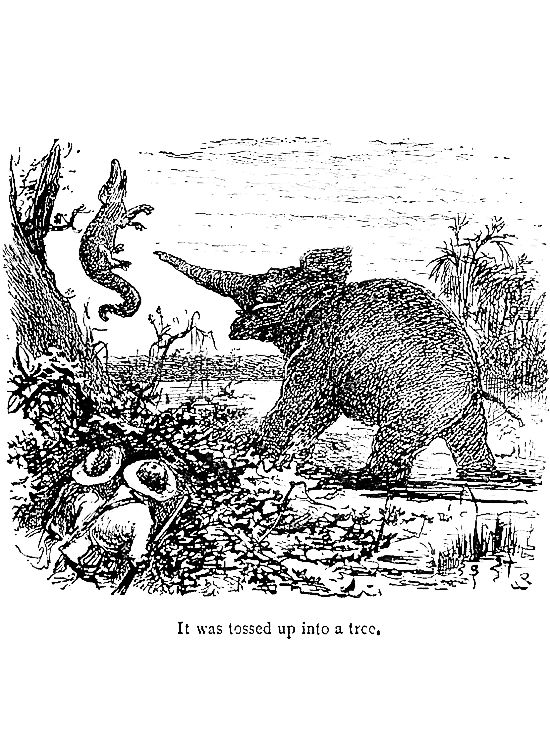
The bait took almost instantly. Scarce a minute had elapsed, ere the crocodile, drawing close up, under the surface, cautiously, made a second attempt to seize it. This time to get seized itself, and jerked out of the water, as if it had been but a sprat. Then the elephant again facing shoreward, strode out, still holding it in his trunk with octopus-like clasp, more than one lap of the gristly tube being around it. High in air was the reptile raised, to be hoisted yet higher, as soon as the Karl-kop set foot on land.
For it was tossed up into a tree, and fell in a fork between two branches, elastic boughs, that, closing upon it, held it as in a vice, despite all its writhings and wrigglings!
The spectators affirm that the elephant flung it into that particular crotch, with a foreknowledge of the result, though I myself rather think that the deposition was a thing of chance.
From that high eminence the ugly creature never came down, though a bullet, afterwards sent into it in mercy, brought its struggles to an end.
But before this, the Karl-kop had been permitted so depart in peace, without a shot fired at him, young Boers and all now desirous that he should go unscathed. Recalling the scare which the crocodiles had given them, they looked upon him in the light of an ally and avenger. So that without seeing, or having any suspicion of the danger so near him, he went away back upon the same spoor, to continue his lonely life and wanderings.
Chapter Twenty One.
Afloat on the Limpopo.
A broad river coursing eastward for the Indian Ocean, nearly in the latitude of the Tropic of Capricorn. Drifting down it is a large raft, with many people upon it, and that which, seen from a distance, might be taken for three trek-waggons. On nearer view, however, these are discovered to be but waggon—tilts, supported on upright posts instead of wheels. Needless to say, they are the same which have been all along sheltering our party of migrating Boers, and the river the Limpopo; while the large raft is a composite structure of the three small ones lashed and braced together, with some additional timbers to give it greater size and strength. The original beams of koker-boom had been carried across the second portage, put together as before, and brought on down the branch stream, without encountering any other interruption. On reaching its mouth, however, it was deemed better to continue the voyage with the three united in one, and the union has been made. In the new arrangement the waggon-tilts still hold position on the quarter-deck, side by side and parallel to one another; while only one of the steering-oars—the central one—is retained. The sheds are also re-erected on the fore-deck, with the cargo collected into one pile, and instead of three fire-hearths, a single one now serves for all. With the thermometer often at 100 degrees in the shade it is not there for warmth, but culinary needs.
There are still a half-score of the water-horses attached, but now in tow astern, and with no one bestriding them. Nor have they been much ridden since that great crocodile scare; all along the branch stream, thence downward, the reptiles being in such numbers, and so fiercely disposed, as to make it unsafe. The horses, however, have been retained to meet certain emergencies, as when quick communication with the banks may be necessary or desirable. But there is now another tender attached, of quite a different kind; a canoe full twenty feet in length, with a beam’s breadth of about five, capable of holding a crew of eight or ten. It is of the “dug-out” pattern, hollowed from a single trunk, the handicraft of the Imacobas.
All this occupied time, more than a fortnight having been spent in the work of remodelling and reconstruction, the scene of operations being inside the embouchure of the tributary. During that period the people were, of course, compelled to live on land, and there passing sleepless nights, through the torment of mosquitoes, they are glad to get out upon the bosom of the broad river, where but few of these persecutors will follow them (Note 1).
As the re-embarkation has been just effected, they are as yet uncertain how the new craft will behave. But with the buoyant koker-booms holding it high in the water, its gives promise of good “floating” qualities, which has put all on board into the best of spirits. Besides, they are again experiencing that exquisite sense of pleasure derived from motion without toil, with the added delight of ever-changing scenes. The tract of country they are now traversing is different from any they have yet passed over; a vast level plain, with no mountain, not even a hill, visible on either side; treeless to a far distance, the only vegetation near being tall grass and reeds, with here and there on the higher stretches of bank a thin scattering of bushes, chiefly acacias. At a different period of the year, most of the land in sight would be under water—inundated. Even now portions of it are marsh, though it is the season of drought, and the river at its lowest. Yet is there no lack of animal life, birds especially abounding; birds of largest size and endless variety of species. Standing balanced on one leg, or leisurely winging through the air, can be seen the “Wattled” and “Blue” cranes; while on some bit of smooth sand beach may be witnessed that curious spectacle, “Caffre” cranes (Note 2), dancing a quadrille, with wings extended and waving about, as the gauzy skirts of ladies in a ball-room. Not far off, but solitary, is the great “Goliath heron,” as also the white egret, two kinds of flamingoes, and storks of several species; among these the gigantic “Adjutant” (Note 3), whose beak, like a pick-axe when pointed upward with neck at full stretch, will reach to the height of a man’s head. Affrighted from their watery rest, flocks of wild geese and ducks fly to and fro; while the ostriches and great “Kori” bustards go stalking over the plain, or, approaching the river’s bank, stand gazing at the raft, half in wonder, half alarmed. High in the heaven’s above are vultures of various kinds; also eagles, kites, and others of the falcon tribe, each soaring in its own curve, with eyes on the qui vive for quarry below.
Nor are quadrupeds scarce; instead plenteous, both in number and species. Here and there a hippopotamus appears swimming about in the river, or but for a moment showing its clumsy head, with thick truncated muzzle above the surface as it rises to breathe; then going under again to leave a large eddy with floating froth and bubbles. Now and then a rhinoceros comes crashing through the reeds by the river’s edge on its way to drink, while troops of quaggas, zebras, and antelopes, the last varied in size and sort, roam over the veldt beyond.
But the spectacle most interesting of all was one afforded by the largest of quadrupeds—the elephant itself; a sight so rare as to well deserve being called wonderful; and so the old jäger, Jan Van Dorn, pronounced it—even he never having witnessed the like before.
During the time they were engaged in raft-building, they had observed elephants on the opposite side of the great river; not a single herd, but straggling bands all moving in the same direction—downward. Day after day they had noticed this stream of the great pachyderms, supposing them to be the same animals that had returned up in the night, and were thus journeying to and fro for food, or water.
Now they had evidence to the contrary, and in less than an hour after embarking. As they passed down, with eyes scanning the plain on both sides of the river, they arrived opposite a wide expanse of wet marsh, or savanna, extending away from the right bank. On this was a herd of elephants, a multitude so vast as to seem all of the elephant kind inhabiting South Africa. The ground was thick covered and black with them for miles upon miles, the whole drove certainly numbering not less than a thousand head! They were up to their bellies browsing on a green sedge—that grew luxuriantly in the wet marshy soil—no doubt the cause of their being so congregated.
To the young Boers it was a sight not less tantalising than strange, and their elders had a difficulty in restraining them. One and all were for bringing the raft in to the bank, landing, and making slaughter among the pachyderms. But the old jäger in command would not listen to this; knowing as he did, that the first shot fired would send the herd helter-skelter, even should they stand to receive a first shot.
Besides, he urged another and more convincing objection. To stalk such game on that ground, bare of trees and other protecting cover, would be attended with the greatest danger. Instead of retreating, just as likely might they charge upon the stalkers, and put them to flight, with scarce a chance of escape.
In fine, the elephants were let alone, though not without sore reluctance on the part of the young hunters. Even the baases disliked it; for it seemed almost as the leaving behind some thousands of pounds of ivory, with as many hundreds of pounds sterling. But it had to be done; the uncertainty, with peril attendant, determining the sacrifice.
And there was still another factor which just then interfered. The raft, hitherto gliding smoothly on at a fair rate of speed, had been found to be gradually slowing, and was now scarce making way at all. The cause was clear enough. Up to this point, or rather down to it, they had been carried along on the current of the inflowing stream, which here came to an end amid the more sluggish waters of the great river.
By Jan Van Dorn this new and unexpected impediment was looked upon with something more than vexation—indeed alarm—the wiser ones sharing it. Before them were long leagues of river navigation; how many they could not tell, or what time it might take to reach the sea. But they knew there was also a rainy season before them, during which the low-lying coast-land becomes a hotbed of malarial fever, almost always fatal to white men. No wonder then at their dreading delay.
It seemed a poor alternative, taking to oars; but they had hopes of again getting into a current farther down, and so took to them. Poling they did not think of now; as, despite the river being at its lowest, it was too deep for that. But there were oars in plenty, with men to man them; so out went they, to be worked with a will.
Notwithstanding, their progress was unsatisfactory, the cumbrous structure refusing to move at a speed of much more than a mile to the hour. And as still further discouragement a long reach of the river—leagues of it—stretched before them, straight as a canal, and to all appearance as stagnant. But this, at first dispiriting, after a little became suggestive. If in directness of course the stream resembled a canal, either of its banks—smooth, firm, and level as they were—might be likened to a tow-path.
Why should they not try towing? Just the idea that occurred to baas Van Dorn; to be acted upon without an instant’s delay. Quick as it could be done, the old waggon trek-trouws were spliced together, one end made fast to the raft, and the other carried ashore, with a score of Hottentots and Caffres to do the towing. Which commenced amid a chorus of encouraging cries; and soon the huge, heavy craft, with constantly increasing speed, was “walking the water like a thing of life.”
Note 1. If a wide river, mosquitoes are rarely found far from the bank. Along the water’s edge is their favourite haunt, especially where wooded.
Note 2. The “Wattled” crane (Grus carunculata). The “Blue” crane of the South African colonists is that better known to naturalists as the Stanley crane (Anthropoides Stanleyanus). The “Caffre” crane is the beautiful species with coronetted head (Balearica Regulorum); called also “Crowned” crane, and sometimes “Balearic” from its being an inhabitant of the Balearic Isles.
Note 3. The Adjutant, or, as more commonly called, “Adjutant bird” (Ciconia Argali), belongs to the family of storks, of which South Africa possesses no less than seven distinct species. The species of Ardeinae or Herons, are there even much more numerous, there being fifteen of them including true herons, egrets, and bitterns.
Chapter Twenty Two.
Legs Easily Broken.
The towers had advanced but a very short way when an incident arose, illustrating a strange ornithological fact—indeed, so strange as to seem apocryphal. While pulling onward with shouts and laughter, they saw before them two large birds, which all knew to be Slangvreters (Note 1),—easily recognisable as such by their slender bodies, thick aquiline beaks, and long stilt-like legs. But still more, by the spike of plumelets growing out of their crowns with a backward slant; which, from a fancied resemblance to the old-fashioned quill-pen stuck behind the ear of clerk or scrivener, has earned for them the more common title of “Secretary birds.” When first observed, they were out on the open veldt serpent-hunting. One had even seized a large green snake, borne it aloft into the air, and was in the act of dashing it to the ground, where the other, with outstretched neck and vibrating wings, was waiting to pounce upon it. They were but a little out of the way of the towers, who expected to see them drop the snake, and retreat further, or carry it away. They did drop the snake, but instead of making off, drew nearer with a rush, half running, half flying; nor stopped they till close up, and direct on the path the towing party must take. Not to remain at rest there, but with continued fluttering around a mimosa-bush that grew upon the bank—all the while screaming affrightedly.
There was no mystery about their behaviour, strange as it appeared. Its cause was declared by cries, a sort of guttural rattling, which came responsive out of the mimosa, where a nest was now descried with young in it. It was an immense cluster of sticks loosely put together, through which the long legs of the two young secretaries—for there was but a pair—hung dangling down. By this the towers were beside it, and a scramble ensued to get hold of the chicks, the old birds having at length despairingly forsaken them, though still tarrying near. But the youngsters were not to be caught so easily. Nearly full-fledged and grown, before hand could be laid on either, they bolted out of the nest, and struck off in run over the veldt, flapping their wings to assist them. Half a dozen of the men followed, eagerly bent on capture. For the slangvreter is a favourite pet with the South African Dutch; often tamed and kept as a protector of the poultry-yard. But notwithstanding the swiftness of some of their pursuers, the young secretaries, running like ostriches, would doubtless have escaped, but for an accident depriving them of the use of their limbs. Traversing the line of their retreat was a fissure in the ground, and into it both tumbled head foremost, from their eyes being all on the pursuers behind. It was a dry rain-gulch, so shallow, it seemed as though the birds might easily have got out again, and continued on. So could they, and would, had their legs but held good, which they did not. Instead the young secretaries lay struggling at the bottom of the gulch; and when taken up, it was found that one had both legs broken, the other a leg and a wing!
Their captors thought little of this, knowing it a thing of common occurrence, and that the legs of young slangvreters are so brittle as often to snap in twain—even from a fall on level ground, if the birds be alarmed, and started suddenly into a run.
The captives were taken on board the raft; but, as it was known that their broken limbs could not be set again, they were humanely killed, to save them from a lingering death. But compassion had to undergo a still greater trial, at sight and hearing of the parent birds, as they flew frantically around the now untenanted nest, uttering shrill plaintive cries. But the Caffres and Hottentots, callous to pity, made light of their anguished demonstrations; and, hoisting the tow-rope over the mimosa-bush, once more bent themselves along it, and treked on, mirthful and boisterous as ever.
They had not proceeded much farther, however, before encountering another incident, of a less pleasant nature, as though meant to rebuke and punish them for their unfeeling behaviour. With the sun high up in a cloudless sky, the atmosphere had become hot as the inside of a glass-house; so sultry as soon to put an end to their merry caperings. Instead of jumping about, and playing tricks on one another, they were now contented to move soberly and slowly along—even letting the tow-rope drag the ground. The thick hawser of raw hide was no light weight in itself, to say nothing of the huge thing that needed pulling along.
Jan Van Dorn, with others upon the raft, began to chafe at the slow progress they were making; the baas at length calling out to them to mend their pace. As he spoke commandingly, expecting obedience, what was his surprise to see them drop the tow-rope as if it had been a bar of red-hot iron, and at the same time recommence capering about! But their antics were now of a different kind, both legs and arms in violent agitation, as though one and all had become suddenly afflicted with the malady of Saint Vitus! Their voices, moreover, had quite a different tone; no more in jest or laughter, but cries and exclamations betokening pain. So shouting, and wildly gesticulating, some ran out on the open veldt, others to and fro along the bank. But most of them made a rush down to the river, and plunging in, swam off for the raft. Not till they were close up to it, did the cause of their debandade become known to those on board; then by their seeing over the head of each swimmer a swarm of insects easily recognisable as bees. Each had his own escort of them; the bees infuriated, and spitefully buzzing, as at intervals they darted down to inflict their stings. All was understood now. The trailing hawser had caught upon a hive, to make wholesale ruin of it; and the incensed insects were taking revenge for the destruction of their honeyed store.
As the swimmers came on, it was seen that the Caffres, protected by their thick lanigerous mops, suffered least; while the Hottentots, with scantier covering of wool, had to keep constantly ducking their heads under water.
All this was highly provocative of mirth to the people on the raft, and most of them were now in convulsions of laughter. But not long to continue it; scarce a minute more, till they had convulsions of another and very different kind. For soon as the retreating towers climbed upon deck, the bees, forsaking them, attacked every one indiscriminately—white, black, and yellow all the same. The shouts and gesticulations, heard and seen hitherto, were nothing to compare with the racket that arose now. Women shrieked as they rushed in under the canvas tilts, tugging their children after, all in wild hullabaloo; while the young Boers leaped about, arms up and buffeting the air, as so many Don Quixotes fighting imaginary windmills. Even the trio of grave, phlegmatic baases were forced to take part in the grotesque saltatorial performance!
Nor was it so soon over, but kept up for nigh twenty minutes’ time; till the last bee got killed, or driven from the raft. But before this could be done, scarce anybody escaped without a sting; some of the towers first attacked having eyes “bunged up,” and features so swollen as to be well-nigh obliterated. Neither was this the worst, or at least the whole of it. For in addition to the physical pain, there was a mental one. They had heard of a species of bee, inhabiting that very part of Africa, whose sting is poisonous, resulting in certain death. No wonder at their apprehensions being keen, even to torture. Nor did they get over them, with full confidence restored, for days after; not till the swelling had gone down, and all suspicious symptoms disappeared.