"The Vast Abyss" (continued 7)
Reading edition
“Sit down, my boy,” he said in a low voice.
Sam felt relieved, and he drew forward a chair.
“Sam, my boy,” continued James Brandon, “I’m in terrible trouble.”
“What about, father—money?” James Brandon nodded.
“I’ve been too hasty, my boy. I was very ill, and I did what I should not have done in calmer moments.”
There was a pause, and Sam waited, wondering what was to come next.
“You remember my sending for your cousin to come up?”
“Yes, father; you sent me away on business,” said Sam, in rather a sneering tone, “so as to get me out of the way, but I heard all about it afterwards.”
“All about it?” said his father, with an anxious look.
“I suppose so,” replied Sam carelessly.
“No, my boy, you did not,” said his father, leaning forward and taking his son by the coat as he spoke in a very low voice. “The fact is, Sam, while I was ill and low-spirited I got a number of curious fancies into my head—half-delirious, I suppose—about some deeds and documents left in my charge by your aunt, Tom Blount’s mother, when she died.”
“Yes?” said Sam, growing interested now.
“I fancied somehow, my boy, that it was my duty to give those deeds up to your cousin; and though I fought against it for some time, the idea grew too strong for me, and I felt that I must send for him and give them over into his charge.”
“Were they his by rights, father?” said Sam sharply.
“They were given into my charge, my boy,” replied his father evasively, “and I behaved very weakly and foolishly in giving them up to your cousin.”
“Then you did give them up to Tom that day?”
“Yes, Sam, and it is a very troublesome matter. I tell you, I did not know what I was about then, and it will affect you very seriously by and by, if I don’t get them back.”
“You mean in money matters, father?” said Sam sharply.
“Yes; affect me now heavily, and you by and by.”
“Get them back then at once,” said Sam—the young lawyer giving the elder advice.
“Yes, Sam, my boy, that’s what I want to do, but how?”
“Write and tell young Tom to bring them up.”
James Brandon shook his head.
“No use—no use, my boy. I must have said a great many foolish things to the lad that day.”
“But you must get the papers or whatever they are back again, father,” cried Sam, who was now growing excited. “You’ll have to go down there yourself.”
“Impossible; but I have made up my mind to send you to try and get them.”
“And suppose I did, father?”
“Suppose you did? Why then, my boy, I could—I mean we could laugh at them, treat anything that was said with contempt. Do you hear? With contempt.”
“Stop a bit,” said Sam quietly. “You always told me to be cautious in business matters, and that I was to keep one foot down firmly till I found a safe place for the other.”
“Of course, my lad, of course.”
“Well, suppose I go down to that country bumpkin’s place?”
“Yes, if you went down you would find out where the papers were kept,” said James Brandon eagerly.
“And if I did?”
“You could bring them away. The boy’s too stupid to take very great care of them.”
“But suppose he has given them to Uncle Richard?”
“Pish! what then? Your uncle would only pitch them into a drawer, and go away to forget them, and dream about the moon. You could go down on a visit, find out where they are, and bring them away.”
“I say, dad,” said Sam, with a sneer, “isn’t that very much like stealing?”
“No, no, no, no,” cried his father quickly; “only getting back some documents left in my charge—papers which I gave up during a severe illness, when I did not know what I was about. You understand?”
“Oh yes, father, I understand, but it looks ugly.”
“It would look uglier for you to be left almost without a penny, Sam, and your cousin to be well off.”
“Ye-es,” said Sam quietly, as he stood with his brows knit; “that would be ugly, dad.”
“Then you will go?”
“Perhaps. That depends. Not as you propose. They’d miss the papers, and I should get the credit of having taken them.”
James Brandon stared at his son in surprise, forgetting the fact that he had been training and moulding him for years to become a self-satisfied, selfish man, with only one idea, that of taking care of himself, no matter who suffered.
“He’s growing a sharp one,” thought the father, half gratified, half annoyed. Then aloud—
“Oh no, Sam, I don’t think that.”
“You don’t want to think that, father,” said Sam, drawing himself up importantly.
“Oh yes, my boy,” said James Brandon. “I don’t want to get you into trouble.”
“No, father, of course not; it would be getting you into a scrape as well. Look here, suppose I slip down and get the deeds without being seen—without any one being a bit the wiser?”
James Brandon shook his head.
“Oh, I don’t want the job,” said Sam coolly.
His father was silent for a few moments, and Sam took out a knife, threw himself back in his chair, and began to trim his nails.
“But look here, Sam,” said James Brandon at last, and he seemed to be in a nervous, excited state. “It is of vital importance to me that I should have those papers.”
“Then if I were you I should go down and get them, father,” said Sam coolly.
“But that is impossible, my boy. Come, you will do that for me?”
“I don’t see why I should,” replied Sam; “you don’t make things very pleasant for me.”
“But I will, my boy, I will do anything you like; and don’t you understand how important it is for you?”
“Yes, I begin to see,” said Sam coolly. “You’ve got yourself into a scrape, father, over some of young Tom Blount’s affairs, and you want to make cat’s-paws of me.”
“No, sir,” cried his father angrily.
“Oh, but you do.”
“I do want you to help me get those—those—”
“Chestnuts,” said Sam, with a grin.
“Well, call them that if you like, my boy,” said his father, trying to be jocose, but looking ghastly pale the while, and with the perspiration standing in tiny drops upon his forehead. “But you must help me, Sam. The money will all be yours by and by.”
Sam sat back staring straight before him in silence for a few minutes, while his father watched him intently.
“Well, I don’t want you to get into trouble, father,” he said at last. “You don’t open out to me frankly, but I can see as far into a millstone as most people. I’m not quite a fool.”
“No, my boy, no,” said James Brandon eagerly. “I’m delighted to find what a sharp man of business you are growing.”
“But you never made yourself hoarse by telling me so, dad,” said Sam, with a grin.
“Because I did not want to make you conceited, my dear boy,” cried the father. “Then you will help me?”
“The money’s no temptation to me, father,” said Sam loftily.
“But it will be very useful to you by and by, my boy. Surely you don’t want that ill-conditioned cub to inherit it.”
“Of course I don’t,” said Sam. “There, all right, I’ll go and get them for you somehow, but if there’s any rumpus afterward you’ll have to stand the racket, for I shan’t. I shall say you sent me.”
“Of course, my boy, of course. But you are too clever to make any mistake over the business, and—and you are beginning to be a great help to me, Sam. The time’s getting on now towards when we must begin to think of your being a junior partner. Only about three or four years, Sam.—Then you will go down at once?”
“You leave that to me,” said Sam importantly. “But I must have some money.”
“Yes, my boy, of course. Half-a-sovereign will be plenty, I suppose?”
“No, you don’t,” said Sam, with a look full of contempt at the shrunken, degraded man before him, who was receiving the punishment already of his misdeeds, and suffering more keenly than from any which could have been inflicted by the law.
“But how much do you want, my boy?” he faltered—“fifteen shillings?”
“I want two pounds,” said Sam coolly, “to pay my expenses. Perhaps I shall have to give some blackguard half-a-sovereign to get the papers for me, and if I come back with them all right, you’ll have to give me five pounds.”
“Five pounds!” gasped his father.
“Yes, dad; and if you make so much fuss about it I shan’t go unless you give me ten pounds.”
James Brandon looked in a ghastly way, which made his sickly face seem agonised, and he slowly drew out his purse and handed his son the money.
“When will you start?” he said.
“Now, directly,” said Sam, rising from his chair; and his father’s countenance brightened.
“Hah!” he exclaimed, “that’s very prompt and business-like of you, Sam. You’ll be careful though.” And he whispered some instructions.
“You leave me alone for that, dad,” said Sam. “I know what I’m about.”
As he spoke he rose quickly from his chair, gave his father a short nod, and opened the door, to find himself face to face with Pringle, whose hand was raised.
“Oh!” cried the clerk, starting. “Beg pardon, sir, I was just going to knock.”
“What is it?” cried James Brandon angrily, and turning pale in dread lest the clerk should have heard anything which had passed.
“These deeds, sir—finished the copying,” said the man quietly, and with a look of surprise that his employer should have asked him what he wanted.
“Oh yes; put them down,” said Brandon hastily.
“What shall I go on with next?”
“The letters I told you about last night.”
“Cert’ny, sir, of course,” said Pringle; and he hurried out of the room, leaving father and son staring at each other across the table.
“Think he heard, Sam?” said James Brandon, looking more ghastly than ever.
“No, not he. Couldn’t have heard more than a word or two. He daren’t listen.”
“Think not, Sam?”
“Sure of it, dad. There, I’ll be off now.”
“Yes, do; and pray be careful. One moment, Sam: your uncle is not out with you?”
“Which means he is with you,” said Sam, smiling.
“Yes, my boy, a little. We don’t quite agree about—about a little matter; but he would be friendly to you. So don’t you think you had better go down as a visitor?”
“No, father, I don’t,” said Sam shortly; and he went out at once.
“Gov’nor must have made a terrible mess of it, or he wouldn’t be in such a stew,” said Sam to himself, as he went thoughtfully away, and came to the conclusion that the best thing he could do would be to have a mouthful of something.
The mouthful took the form of a good dinner at a restaurant, and over this he sat thinking out his proceedings in a very cool, matter-of-fact way, till he thought it was time to make a commencement, when he summoned the waiter, and asked for the railway time-table. Then, after picking out a suitable train, he paid his bill with one of his father’s sovereigns, called a cab, and had himself driven to the terminus, where he took his ticket for the station beyond Furzebrough Road, and soon after was on his way down into the wild part of Surrey.
Chapter Forty Three.
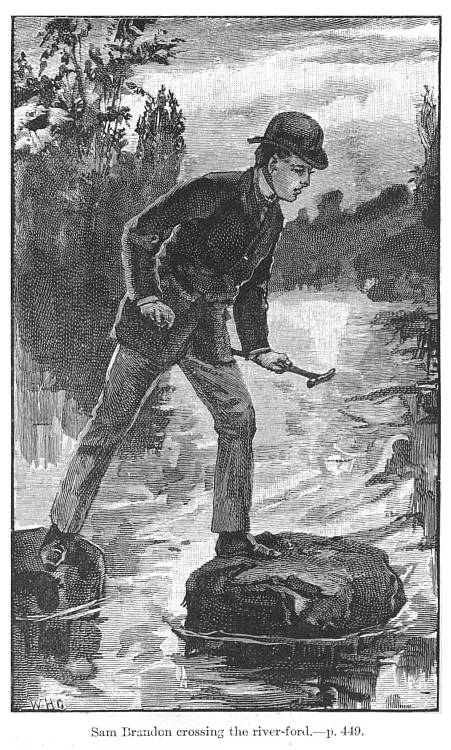
Sam Brandon timed himself so accurately that he was crossing the little river-ford just as it was so dark that he could hardly make out the stepping-stones. But he got over quite dry, and after a short walk on the level, began to mount the sandy hill which formed part of the way entering Furzebrough at the top end, and led him by the fork in the road down one side of which his father had steered the bath-chair, and plunged into the soft sand of the great pit.
It was a soft, silent time, and the place seemed to be terribly lonely to one accustomed to the gas-lamps of London streets. The shadows under the hedges were so deep that they appeared likely to hide lurkers who might suddenly leap out to rob, perhaps murder, for with all his outward show in bravado, Sam Brandon felt extremely uneasy consequent about the mission which had brought him down there, and he at once decided that it would be better to walk in the middle of the road.
Five minutes later he had to take the path again, for he met a horse and cart, the driver shouting a friendly good-night, to which Sam responded with a stifled cry of alarm, for he had nearly run against a man who suddenly appeared in the darkness, but proved to be quite an inoffensive personage bound for home.
Then as the crown of the hill was reached, there was the great gloomy fir-wood, whose columns stood up quite close to the road, and under whose shade Sam had to make his way toward the village, thinking deeply the while, that after all his task was not so easy as it seemed before he came down into the country.
“No fear of being seen though,” he thought, as he went on, continually on the look-out for danger to himself, but seeing none, hearing none, till he was in the deepest part of the sandy lane, with the side of the fir-wood on his right, a hedge-topped bank on the left.
It was darker now than ever; and as it was early yet for the work he had in hand, he had slackened speed, and finally stopped short, hesitating about going on.
“What a horrible, cut-throat-looking place!” he muttered, as he tried to pierce the gloom which hid the beautifully—draped sand-banks dotted with ferns, and made lovely by flowers at all times of the year. “Any one might be in hiding there, ready to spring out.”
He had hardly thought this when he uttered a cry of horror, swung round, and ran as hard as he could back toward the crown of the hill, for all at once there was a peculiar sound, like the magnified hiss of some large serpent, and, looking up, he could dimly see against the starlit sky a gigantic head with curling horns, whose owner was evidently gazing down upon him where he stood in the middle of the lane twenty feet below.
Sam Brandon must have run five hundred yards back before want of breath compelled a slackening of speed, and his panic fear gave place to common-sense.
“What a fool I am!” he said to himself, with wonderful accuracy; “it must have been some precious old cow.”
This thought brought him quite to a stand, and after a little consideration, he felt so certain of the cause of his alarm that he turned and continued his route again toward the village, reaching the dark part, hesitating for a few moments before going on, and now hearing up to the left and over the dimly-seen hedgerow the regular crop, crop, crop of some animal grazing upon the crisp dew-wet grass.
“If anybody had told me,” he muttered, “that I could have been scared by a jolly old cow, I should have kicked him. How absurd!”
He walked on now firmly enough, till, in spite of the darkness, the road became more familiar, and in due time he could see the lights at Heatherleigh, and looking up to his right against the starry sky, the top of the great mill.
It was too soon, he felt, and turning back, pretty well strung up now to what was rapidly assuming the aspect of a desperate venture, he walked on till the golden sand looked light upon his left, and showed a way into the wood. Here he turned off, walked cautiously in amongst the tall columns for a few yards, and then sat down on the fir-needles, listened to find that all was still, and taking out cigarette-case and match-box he struck a light and began to smoke, sheltering the bright burning end of the little roll of tobacco, and trying as he rested to improve his plans.
For he was hot and tired. He had found the station beyond Furzebrough quite seven miles from the village, and being a perfectly fresh route to him, it had seemed twice as far; while the fact that he wished to keep his visit a profound secret forced him to refrain from asking questions as to the way, after being instructed by the station-master at the first.
It was restful and pleasant there on the soft natural couch of sand and fir-needles, and after a time Sam’s head began to bow and nod, and then, just as he was dropping off fast asleep, the cigarette, which he had been puffing at mechanically, dropped from his lips and fell in his lap.
In a few minutes the fume which had been rising changed its odour from burning vegetable to smouldering animal, and Sam leaped up with a yell of pain, to hastily clap his hands to a bright little round hole upon the leg of his trousers, where the woollen material had caught fire and burned through to his skin.
“Hang the stupid thing!” he grumbled, as he squeezed the cloth and put out the tiny glowing spark. “Must have dropped off. Looked nice if I’d slept all night in this idiotic place. Too soon yet, but I mustn’t go to sleep again.”
To avoid this he began to walk up and down among the trees, but carefully kept close to the road, for he grasped the fact that it would be very easy to go astray in a fir-wood at night.
Now as the dark hours are those when certain animals which live in the shade of trees choose for their rambles abroad, it so happened that one of these creatures was awake, had left its hole, and was prowling about on mischief bent, when the yell Sam Brandon uttered rose on the night air.
The first effect was to cause the prowler to start off and run; the second caused curiosity, and made the said prowler begin to crawl cautiously toward the spot from whence the cry arose, and in and out among the tree-trunks, till the shadowy figure of Sam could be seen going to and fro to avoid more sleep.
Then, as the prowler lay near at hand upon his chest watching, there came a time when Sam went down upon his knees in the densest spot near, to shelter himself from observation while he lit a fresh cigarette.
Now it so happened that the darkest spot was close to where the prowler lay without being able to escape, as it would have caused a noise, and consequent betrayal.
Then after selecting a cigarette by touch, and opening his match-box, Sam struck a little wax taper, began to light his cigarette, and naturally held the flame so near his face that, as he knelt there, it was well illumined for the benefit of the prowler, who crouched close and stared hard, expecting moment by moment to be seen.
But Sam saw nothing for the glare, while the prowler recognised his features, and lay still and waited close by the smoker till nearly another hour had elapsed, when Sam drew a long deep breath and said softly—
“Now for it.”
For it meant money, freedom from all domination, and, as the lad thought very unwisely, a general sense of independence of father and the whole world; though in carrying out this act he was riveting, so to speak, moral fetters round his wrists.
He had had hard work to string himself up to his task, but now he showed plenty of determination, and going back into the lane, he walked rapidly toward Heatherleigh, passing nobody on his way.
Upon reaching the bottom of the garden he hesitated for a few moments, peering over the hedge at the house; then seeking the palings, and looking over them at a spot where the trees were rather open, and, lastly, making his way to the gate, where he satisfied himself that there were only two lights visible there—in the servants’ part of the house, and in the little dining-room.
Apparently contented, he walked back to where the yard wall turned off at right angles, and following this for a few yards, he climbed over and made his way like a dark shadow close up to the mill, where he stood listening and looking sharply round.
All was still, and in spite of the glittering stars, it was very dark close up to the tall brick building—so black, in fact, that unless close up, there was not the slightest probability of his being seen even by any one upon the watch.
Satisfied of this, he went softly to the door, took hold of the handle, and tried it, pressing hard at the same time, in expectation that it might yield, as people were so careless about locking up in the country. But he was soon convinced that the door was securely fastened, and he moved now to one of the workshop windows and tried it, with no result. Then he gave it a sharp shake, but there was no suggestion of its yielding, and he at once went right round to the other side and tried the window there.
The result was the same, and he uttered a low ejaculation indicative of his vexation on finding everything so secure.
“More ways than one of killing a cat,” he said softly, and taking a large screw-driver from his pocket, he was in the act of thrusting its wedgelike flat point in beneath the framework of the casement when there was a step behind him, and as he turned sharply, it was to face a tall, thin, rough-looking figure, very indistinctly seen as it stood close to him, and the word “Halloo!” was whispered hoarsely almost in his ear.
For a few moments Sam was paralysed. Then he recovered himself, and stepping back he raised the screw-driver, as if it had been a short Roman sword.
“You hit me,” said the shadowy figure, “and I’ll let you have this hedgestake right on the head.”
“Who are you? What are you doing here?” said Sam, in a subdued voice.
“And who are you, and what are you a-doin’ of here?” was the retort. “You give me any of your mouth, and I’ll go and ring the old man’s bell.”
Sam had met his match, and stood thinking what course he should pursue when his interrupter continued—
“I know: you’re come because the old man arn’t at home. Think I don’t know yer?”
“Hush! hold your tongue!” said Sam, and for the moment he felt disposed to run for it; but there was the fact that, dark as it was, he had been recognised, and if he had any doubt it was dispelled by his companion saying with a faint laugh—
“Got any more o’ them pears?”
“No,” said Sam shortly; and recovering himself a little, “What do you want?”
“To see what you’re a-going to do,” was the reply.
“But you’ve no business here, sir,” said Sam haughtily.
“More have you. I arn’t a fool. I see you trying to break open the winders with that thing.”
“It’s a lie; you didn’t.”
“Oh yes, I did. I know; I can see in the dark. What are you after?”
Sam was silent, and the disposition was on him strongly now to strike the fellow down.
He dismissed the thought again, feeling how useless it would be to make him an enemy, and the other course now offered itself to him.
“You don’t want to know what I’m after,” he said, with a faint laugh. “It’s only for a bit of fun.”
“Not it. People don’t break in at windows for fun. You give me something, or I’ll go and tell.”
Sam’s heart leaped with satisfaction at this. Money, then, would buy the young scoundrel off, and he hastily took out a coin, and held it out so as to silence his enemy; but at the same time he felt that there was nothing to be done now but get back to town with his mission unfulfilled.
To his great delight the coin was snatched and pocketed, but he did not feel so well satisfied the next moment.
“That’s on’y a shillin’. Give’s another.”
A second was held out and taken.
“Now I wants another,” said Pete, and upon this being given, he demanded a fourth, and then a fifth.
Pete was satisfied now, and he said with a low chuckle—
“If any o’ these is bad ’uns, I shall go and tell.”
“But they’re not, they’re all good,” whispered Sam. “Now be off.”
“Shee-arn’t! I’m goin’ to stop and see what you do. But you can’t get in like that. The winders has all got noo fasteners. I could get in if I liked.”
“How?” said Sam, in spite of himself.
“Think I’m goin’ to tell you for this,” said Pete. “You give me another, and I’ll show you how to get in. I see you come in the wood and smoke over yonder.”
“And you’ve been watching me ever since?”
“Course I have. What do you want to get?”
Sam made no answer, for he was trying to arrange his thoughts, and make out what was the best thing to do. Then all at once Pete broke out with—
“You ain’t half a chap. I could soon get in there if I wanted.”
“Could you? How?”
“I’ve been in the mill lots o’ times,” said Pete evasively, “’fore they took the stones out, and since old Dicky Brandon pulled the sails off.”
“Tell me how you managed it,” said Sam, after a glance round; for, mingled with his uneasy feeling about being betrayed by the great lad before him, he began to feel desperate, and as if he must succeed now he had gone so far. He was convinced in his own mind that the most likely place to find the documents he sought would be in his uncle’s study, and to him the first floor of the old mill was that study. Tom had told him as much, and that the old walnut-wood bureau was the depository where their uncle kept his papers.
“People in the country are such idiots,” he said to himself; “they never think of having strongrooms or iron safes. He has locked the papers up there as sure as a gun.”
It was with a certainty of this being the case that he had come down, and now that there was nothing between him and the prize but a window and this spying lad, the position was irritating to a degree.
Sam thrust his hand into his pocket, where it came in contact with half-a-sovereign and some silver, and he began to think that of these he could perhaps after all make a key. The only question was how to begin.
Pete had uttered a low sniggering laugh on hearing Sam’s last question, and now feeling that he must either act or give up; the latter repeated his inquiry.
“I used to have some bantams,” replied the young scoundrel. “Bantams like wheat and barley.”
“And you used to come and steal some for them?” said Sam sharply.
“Oh, did I? Who said anything about stealing? I didn’t eat the barley; the bantams did.”
“But you stole it all the same,” said Sam, who felt now that he had a handle to take hold of.
“Oh, did I? So are you,” snarled Pete. “You’ve come to steal something, or you wouldn’t be here in the dark.”
“Never you mind about that,” said Sam quickly. “Look here; you tell me the way to get in, and I’ll give you another shilling.”
Pete thrust his dirty face close to Sam’s.
“Give us hold then.”
“No; you show me the way first.”
“Shee-arn’t! Give us the shillin’ first.”
“I don’t believe you know a way.”
“Oh, don’t I! You give me the shillin’, and you’ll see.”
Sam hesitated, but there was no time to lose. It seemed to be his only policy to make friends with this young ruffian, and he finally took a shilling out of his pocket, the action being grasped at once by the lad in spite of the darkness.
“No games,” said Sam. “If I give you the shilling, will you tell me fairly?”
“Course I will.”
“There; now tell me.”
Pete took the shilling handed, made believe to spit upon it, and thrust it into his pocket.
“Winders is fastened up tight now.”
“What, those up higher too?”
“Yes; all on ’em.”
“Then how am I to get in?”
Pete laughed softly, and Sam grew angry.
“I thought so,” he whispered. “You don’t know.”
“Oh, don’t I just?” said Pete, with his sniggering laugh. “I said I’d tell yer, and I will.”
“Quick then. How?”
“There’s a kind o’ door up atop as opens right over and lies on its back. It’s got a bolt to it, but you can shove yer hand under when yer gets up inside them little palings and push it back. Then yer can open the door and get in.”
“How do you know?” said Sam sharply.
“How do I know? ’Cause I’ve done it.”
“But up there? How did you get up?”
“Ladder,” said the lad laconically.
“What, is there a ladder here?”
“No,” said Pete.
“Bah!” ejaculated Sam. “What’s the good of telling me that, then?”
Pete chuckled now with satisfaction, as if he enjoyed his companion’s trouble.
“I know where there’s a ladder,” he said.
“One we could get?”
“You couldn’t. I could.”
“Get it for me, then, there’s a good fellow.”
“Ha, ha! Oh, I say; arn’t you getting jolly civil!”
“Hush!” whispered Sam excitedly. “Don’t make that noise. Some one will hear.”
“Yah! There’s no one to hear! The old man’s gone out, and old Mother Fidler’s fast asleep, and snoring by this time.”
“But there’s he,” whispered Sam.
“What, young Tom Blount? Yah! Not him: he won’t come.”
“Where’s the ladder?” whispered Sam, in agony.
“Don’t I tell yer, yer couldn’t get it if yer did know!”
“Then will you get it for me?”
“Give’s another shillin’, and I will.”
“Oh!” groaned Sam. “I’ve given you too much now.”
“All right. I don’t want the ladder. I arn’t going to fetch that and carry it ever so far for nothin’.”
“But is it long enough?”
“Yes; just reaches up to them railings outside the top door. Yer can’t get in without.”
“If I give you another shilling—the last, mind—will you fetch me a ladder?”
“Course I will.”
“All right then; make haste.”
“Give us the shillin’ first.”
“Then you won’t fetch the ladder.”
“Oh yes, I will—honour bright.”
Sam unwillingly produced another shilling.
“There, that’s the last I’m going to give you,” he whispered. “Now, then, fetch the ladder quickly.”
Chapter Forty Four.
He uttered his low, sniggering, malicious laugh again, and without a word went off towards the back, disappearing into the darkness, and then, unseen by Sam, crawling over the wall like some great dark slug, leaving the London boy alone with his thoughts, as he kept close up to the mill, and gazed toward the cottage, dreading moment by moment an interruption from that direction.
His thoughts were not pleasant company. For there he was upon his uncle’s property, feeling that not only had he come down there in the character of a thief, but circumstances had forced him into taking for confederate about as low-typed and blackguardly a young scoundrel as there was for twenty miles round. He had been forced to bribe the fellow heavily for him, and in addition to place himself entirely at his mercy, so that in the future, if he was successful in getting the papers, this scoundrel would be always coming upon him for money, and getting it by threats.
“I can’t help it,” muttered Sam; “it’s the gov’nor’s fault, and he’ll have to pay for it all. He sent me, and—pooh, it isn’t stealing. It’s all in the family, and I’ve a better right to have what there is than young Tom Blount.”
Sam tried to think of other things, but two matters had it all their own way—the dread of being caught, and the coming of Pete with the ladder.
But the time wore on, and neither event seemed likely to happen. He grew hotter and hotter; every now and then he felt a peculiar nervous attack in one leg, which made his right knee tremble violently, and again and again he was on the point of rushing off, leaping the wall, and making for the open country, when at last he heard some faint noise coming out of the darkness.
Once he felt that all was over, and there was nothing left for him to do but flee. For there were heavy steps in the lane coming nearer and nearer, till they stopped opposite the gate, and Sam’s heart throbbed like the beating of a soft mallet.
“Policeman!” he thought, and he would have turned to run, but his feet felt as if glued to the ground, and the agony he suffered was intense.
Just as he was at the worst point, there was a scratching sound, a gleam of light, the smell of tobacco, and directly after the steps were heard again, to pass on and die out in the distance.
“‘Conscience makes cowards of us all,’” Sam might have said, but he did not know the words; and so he only wiped his forehead, and began to think of how he could get back to town, for it was perfectly evident that Pete had got all he could out of him, and, so far from returning with a ladder, in all probability he had invented the whole story, and there was no ladder anywhere nearer than in the rascal’s imagination.
The moments passed on like minutes, and Sam felt as if an hour must have passed.
“It’s of no use,” he said to himself; “he has been too sharp for me, and I shall have to come down as the dad said, and take my chance. I can do no more.”
He sighed in his misery and dread, for he knew that there was an all-night walk before him, till he could take one of the earliest morning trains somewhere on the road. But it had to be done, and he went from out of the deep black shadow of the mill to the wall where he came over, and was in the act of raising himself up, when his neck was caught as if in a fork, and he was thrown down on to his back. Then, as he struggled up, he grasped the fact that Pete must have been coming back, and thrust the top of the ladder over first, sending the ends on each side of his neck.
“Don’t do that, mate,” came to him in a sharp whisper from the wall. “Ketch hold and steady it while I run it to you.”
Sam caught hold of the ladder eagerly, forgetting the pain in satisfaction, and the next minute the bottom round rested on the top of the wall. Then Pete crept over, slug fashion, and lifted the end off and set it down.
“There y’are,” he said.
“What a while you’ve been,” whispered Sam.
“Oh, have I! Juss you go and fetch it yerself, and see how quick you’d be. It was worth two shillin’ to go for that; there, hyste it up and in with you.”
“Hoist the ladder by myself?”
“Yes, it’s easy enough. Bottom’s heavy and top’s light. Shall I do it?”
“Yes, quickly.”
“’Nother shillin’. I arn’t going to have nothing to do with it, and so I tell yer, without.”
“I wish you wouldn’t speak so loudly,” whispered Sam impatiently.
“Yah! go on! nobody can’t hear us. Where’s that shillin’?”
“I told you I wouldn’t give you any more,” said Sam, stoutly now, “and I won’t.”
Pete chuckled.
“All right; I’ll hyste the ladder, only mind you telled me to—it was your doing.”
“Yes, my doing,” said Sam, who was full of nervous impatience. “Be smart; here, I’ll help.”
“I can do it,” said Pete, and with two or three sharp jerks he raised the ladder right on end, and then, after working it round two or three times, let the light narrow end down against the railing, just in front of the long shutter on the rounded roof.
“Will it bear me?” whispered Sam nervously.
“Bear a dozen on yer. Up you goes, and I’ll keep watch. If young Tom Ugly Blount comes, shall I give him one over the head?”
“Yes,” whispered Sam, as he began to mount.
“Shove yer hand under the door, and yer can feel the bolt directly. You can open it. Look alive.”
Sam mounted round by round, wondering whether the thin ladder would bear his weight or collapse and let him down, as a punishment for the degrading crime he was about to commit; and the higher he went, and the ladder vibrated more easily, the more nervous he grew. Twice he stopped breathless and full of dread.
“Is it safe?” he whispered.
“Yes; up with yer.”
Then he grasped the railing, stepped over into the little gallery, and, stooping down, soon found that he could unbolt the shutter.
The next minute he was inside, and descending at once into the laboratory, he took the screw-driver from his pocket, and had no difficulty in prizing open the drawers, the wood bending enough to set free the catch. A match gave him sufficient light, and when he paused before the right drawer, in which were several carefully-sealed-up papers and envelopes, he hesitated, wondering which would be the documents he wished to secure.
Helped by so feeble a light, it was hard work to tell, and at last he came to the conclusion that it would be best to make sure; and to this end he gathered all together, and thrust them, to the number of eight or nine, into his breast-pocket and buttoned his jacket.
“Hurrah!” he muttered. “Safe. Now for home.”
He had hardly conceived this thought, when a sound overhead caught his ear, and he felt for the moment that Pete had come to see what he was doing. The next minute he was in full flight, pursued by Tom, as we have seen, and at last reached the ground, thanks to the help of Pete, who, after lying in hiding while the ladder was lowered, hurriedly raised it again.
Just as Tom was half-way down Pete gave the ladder a wrench, hoisted one leg, and sent it sidewise. Then—
“This way,” he whispered, catching Sam’s hand, guiding him to the corner of the yard, and as soon as they were over leading the way at a steady dog-trot.
“You keep alongside me,” he said; “I’ll show yer a near cut. Where do you want to go?”
“I want to get on the main road two or three miles away,” whispered Sam.
“All right. Did you get it?”
“Yes, but don’t talk.”
“Shall if I like,” growled Pete. “I say, look here. I arn’t seen you ter-night, and I don’t know nothin’ about that ladder. Let ’em think it was Tom Ugly Blount. But I say, you’ll give me another shillin’?”
“I’ll give you two,” panted Sam, “if you’ll promise never to blab.”
“You’re a good ’un,” said Pete, laughing softly. “Won’t ketch me talking. Hand over; and if you come down again I’ll help yer any night. I hates that there t’other chap, but I likes you.”
“Thankye,” said Sam, who gave the lad a couple of shillings more, when, as good as his word, Pete guided him to the road a good three miles on his way.
“Good-night, mate,” the lad said, holding out his hand.
“Mate!” thought Sam in disgust, as he felt constrained to shake hands.
“I say, I know: you’re going on to London.”
“Am I? you don’t know,” said Sam hurriedly. “But I say, are you going home to bed now?”
“No,” said Pete, with a chuckle; “I’m going back to my roost in the wood. Good-night, matey.”
“Good-night,” said Sam; and he started off at a rapid rate along the hard road, feeling the papers tightly buttoned up in his pocket, where they soon grew hot, and as if they were going to burn his chest. “Oh, what a terrible walk,” he muttered; “and that fellow will know I’m making for London. Don’t matter,” he said directly after; “he won’t tell tales, and if he comes up, ferrets us out, and wants more money, the gov’nor ’ll have to pay.”
Pete went back to his sandy hole, and in an hour was fast asleep, while Sam was plodding steadily on toward the great city, growing more and more weary as the hours passed, and longing to lie down and sleep, but dreading to do this for fear of some policeman or tramp coming upon him, when he felt that the result would be the same—the papers he had gone through so much to obtain would be found, and perhaps pass entirely from his hands.
Chapter Forty Five.
Sam Brandon was more asleep than awake when he made his way into Westhall Station, and took a ticket for town. He had taken nearly an hour to get over the last mile, after struggling hard during the first part of the night to get as far as possible away from Furzebrough, haunted as he was by the belief that the theft would be discovered before many minutes had passed, and that he would be pitched upon as the criminal. For though the struggle had been in the dark, and he had not spoken a word, he felt sure that Tom must have known him, and that some one would start very soon in pursuit. Hence, with his brain full of handcuffs, prison cells, magistrates, and other accessories of the law, he had toiled on through the night until utterly exhausted.
The early morning train soon came gliding into the station, and Sam took his place, trying in vain to look careless and indifferent, and as if he were occupied over his ordinary affairs; but it could not be done. He looked dusty as to his boots and trousers; there was a bloodshot appearance in his eyes; his cheeks were hollow, and his lips feverish and cracked.
Then the other passengers kept on staring at him, and the more so because he looked uneasily at them. In fact, as one passenger said to himself, he looked “as if he been up to no good.”
The drowsy sensation which had made him feel as if walking in a dream had now completely passed away, and though he rested his head in a corner, and, after buttoning up his jacket tightly, tried to sleep, he could not lose consciousness, but sat there with every joint aching, and a miserable feeling of weariness in his back, listening to the rattle of the train, which kept up what sounded like some weird tune, always beginning and never ending.
There came minutes when he felt as if he were going to be seriously ill, for his head throbbed, and there was a burning sensation at the back of his eyes, while the events of the past night seemed as if they had happened a long time back.
Once when the train stopped—though stop it did at every station—Sam closed his eyes tightly and shammed sleep, feeling convinced that when the carriage door was opened, he would hear a rough voice ordering him to get out, consequent upon his description having been telegraphed all along the line; and then the door was opened and banged to again after a man had spoken in a rough voice, but only said jocularly—
“Got room for a little ’un?”
He then squeezed in close to Sam, and proved to be a huge fellow of about twenty stone.
Every one in the compartment laughed but Sam, who went through the same agony again and again, till the tickets were taken at Vauxhall, when the collector looked so much like a detective that the mental suffering was worse than ever.
Waterloo at last. He was parched with fever; his throat felt dry, and there was hot coffee waiting at the buffet, such as would relieve the faintness from which he suffered; but he dared not stop to partake of it. He hurried out of the great station, and walked fast across the bridge, and only began to feel more safe when he was amongst the crowd going and coming in the busy streets.
At last, after dodging in and out in all directions to baffle pursuit, he jumped into a cab to be taken home, but began to feel the next moment that if he were pursued it would be known where he had taken refuge.
Taken altogether, Sam Brandon began to taste very bitterly the agonies of those who break out of straight paths, never having realised till then how thorny the wrong course was, and how deep the pits and chasms in the way.
The cabman looked at him peculiarly when he got in, but that was nothing to the grin which overspread his face when the lad alighted and went up to the front door; while upon his summons being answered, the maid saluted him with the expressive words—“Oh, lor!”
“Is my father down yet?” asked Sam.
“No, sir, and it’s lucky for you as he ain’t. My! he would kick up a fuss, if he see you such a sight after being out all night.”
“Bah!” ejaculated Sam, and he ran up-stairs to his room.
“Bah! indeed,” cried the indignant girl; “serve you right if I was to tell master what time you come home. But I won’t.”
And there was no need. For Sam had hardly shut himself in before there was a hand upon the lock of the door, and his father entered in his dressing-gown, looking haggard and pale, consequent upon a sleepless, anxious night.
He closed and locked the door, before turning excitedly to his son.
“Well?” he whispered in a husky voice.
“Got back,” said Sam laconically.
“Yes; and you have not succeeded?” cried James Brandon.
Sam was silent.
“I say, you have not succeeded?”
“I heard what you said, father,” replied Sam surlily.
“I knew it would be so,” cried his father. “It’s all because you would be so rash, and ready to believe that you know everything. Now if you had gone down as I advised, on a visit, everything would have been as easy as a glove. You could have stayed there two or three days with your cousin now your uncle is in London.”
“Oh, then you knew Uncle Richard was in London?”
“Of course I did, or I shouldn’t have let you go, sir. And then you could have come back with what we wanted decently, and not come crawling into the house as if you had been found out committing a theft, and the detectives were after you.”
Sam gave a sudden jump and glanced at the door, but laughed it off directly with a sneer.
“Don’t be absurd, father,” he said. “Of course I only went on a very honest mission—for you.”
It was James Brandon’s turn to wince now, and as he saw his son’s sneering laugh he turned upon him angrily.
“It’s my own fault,” he cried, “for trusting such an idiot. I might have known what would be the consequences; but I thought you were growing up into a man whom I could trust with important business.”
“Legal business,” said Sam sneeringly.
“Yes, sir, legal business,” cried James Brandon. “You’re worse than your cousin.”
“Ever so much,” retorted Sam. “Well, dad, have you done?”
“Yes, sir, I have done—done with you too. You might have saved me thousands, instead of—”
“How do you know I haven’t?” said Sam sourly.
His father’s mouth opened, and a curious change came over his countenance.
“Why, Sam, my boy!” he panted. “You don’t mean to say—”
“That the idiot has been of some use to you? Yes, I do. There, when you’ve done rowing me let’s get the business over, for I’m sick of it. I want to go to bed.”
“Then—then—you’ve—you’ve—” stammered James Brandon.
“Succeeded?—of course I have,” said Sam coolly, as he lay back in a chair, heavy-eyed, nervous, and utterly exhausted by his night’s work. “If I wasn’t so tired I should have something more to say.”
“My dear boy!” cried James Brandon effusively; and his son uttered a low, unpleasant laugh. “Sam, you have the—the papers?”
“Yes.”
“Quick then—give them to me.”
Sam thrust his hand into the breast-pocket of his closely-buttoned coat, and glancing in sidewise, he drew out a folded paper.
“That it?” he said coolly, as he handed it to his father, watching him keenly the while.
“That? Absurd!” said James Brandon, taking it and tossing it back. “The agreement for letting a house. You don’t mean to say—”
Sam interrupted him.
“Try that then,” he said.
But again his father tossed the paper away with an angry ejaculation, while his face grew more haggard and anxious-looking.
“That’s it then,” said Tom. “I had to grab them in a hurry, and get away.”
“That is not the packet,” cried his father. “There were four deeds tied up with green silk ribbon. I explained to you exactly what they were like. Surely you had more common-sense than to think these things were what I wanted!”
“Don’t I tell you I had to take them in a hurry?” said Sam, smiling at his father’s anxious face, as he kept one hand still in his breast, and now with a triumphant air flourished out a great cartridge paper envelope. “There,” he cried; “will that do then?”
“No, no, no,” said James Brandon angrily; “four deeds tied up with green silk ribbon, I tell you;” and he waved the thick envelope aside, but Sam still held it out.
“Don’t you be in such a hurry, gov’nor,” he cried. “That’s the packet, only perhaps the old man put the deeds in the envelope. Look inside.”
Sam’s father snatched the packet from his son’s hand, dragged out its contents, which were tied together with green ribbon indeed, and proved to be written in a round legal hand; but as he read the endorsements one by one, he threw them contemptuously down with a groan.
“What, ain’t those right?” cried the lad, speaking anxiously now.
“Right? No,” cried his father. “There, I see you are playing with me. Where is the right packet?”
“Right? The right packet? I made sure that was it. I opened that old bureau of his, and these deeds and things were all together.”
“Oh, Sam! Sam!” groaned his father.
“It was quite dark, you know, and I had to work by feel till I got the drawers open, and then I lit a match or two, so as to make sure which was the packet I wanted. There were the four things together tied up with green silk ribbon, and I had no time to read them even if I’d wanted to; but I felt so sure it was not necessary.”
“It was madness. You ought to have looked carefully,” said James Brandon.
“Yes; that sounds all right, but it’s a wonder I got them. I only just had time to stuff them into my pocket when he came, and then—”
“He came! Who came?” cried James Brandon.
“Tom; and a pretty fight I had for it before I could get away.”
“Then he caught you steal—caught you seeking for those papers?” cried James Brandon wildly.
“Of course he did; I told you so.”
“Then it’s all over. He has told your uncle by this time.”
“Not he. How could he know? Didn’t I tell you it was dark as pitch?”
“What? Then you think he does not know who it was?” cried James Brandon, with the air of a man catching at a straw to save himself.
“Sure of it,” said Sam coolly, as he opened one of the papers and began reading—“‘Instructions for grinding and polishing specula.’”
He opened another.
“‘The various modes of mounting telescopes.’”
Throwing this down, he took up a third paper, and read—
“‘Elutriation as applied to Emery and other Powders.’”
Lastly he took up the fourth, and read half to himself—
“‘The method practised by Monsieur Foucault in silvering the surfaces of glass specula.’ I seem to have dipped into the wrong drawer, dad,” he said coolly.
James Brandon groaned.
“I made so sure that I had got the right things. They do look like legal papers, don’t they?”
Sam’s father made no reply, but began walking up and down the room.
“What does he mean by tying up his stupid recipes like that!” said Sam angrily.
“Exposed yourself to all that risk, and for nothing,” cried James Brandon.
“Don’t say ‘yourself,’ dad,” cried Sam softly. “It was your doing; you sent me.”
James Brandon was silent for a time.
“You are sure he did not know you?” he said at last.
“Of course I am. Don’t I tell you it was dark as pitch?”
“Then how do you know it was Tom who came?”
“Who else was likely to come?”
“Of course—of course,” murmured James Brandon; “who indeed?”
“Besides, that other chap was outside, and helped me with the ladder.”
James Brandon gave quite a jump.
“That other chap?” he cried. “You don’t mean to say any one else saw you?”
“Yes, a fellow I saw when I was down there before; he came and caught me trying to get in.”
James Brandon threw out his hands, and walked up and down his son’s bedroom gesticulating.
“It’s all over,” he cried wildly; “it’s all over. I’m a ruined man. My position as a solicitor gone; my character destroyed; the money I had saved swept away; and all through the stupidity of my own son.”
Sam sat back watching his father curiously, as he paced about the place, addressing, as it seemed to him, the walls, the windows, and at times the pieces of furniture. He repeated the same things over and over again as he bemoaned his ill-fortune, and the way in which his plans had been brought to naught. Reproach after reproach was piled upon Sam, but the father did not glance at his son, who still watched him, but with eyes that grew fixed and dull-looking, till all at once the lids began to fall, opened up again, fell lower, opened again, and then went right down, and were not raised.
For Sam was utterly exhausted by his many hours’ exertions, and his father’s monotonous, droning voice, as he went on bemoaning his fate, after irritating him for a time, and making him ready to make retorts, gradually began to have a soothing effect, making him feel drowsy; then more drowsy, and at last, when James Brandon paused before the chair in which the lad lay back, and gazed full in his face, saying—
“What I want to know, sir, is, how you could be such an obstinate idiot as to persist in going your own way, after all my strong, carefully-thought-out advice?—what I want to know, I say, is—why, he’s asleep!”
James Brandon was quite right—his son had dropped off into a deep, dreamless sleep, and it is probable that if he had shouted in his ear instead of speaking in a subdued, hurried voice, he would not have succeeded in awaking him to the sense of anything he said.
Chapter Forty Six.
Uncle Richard came back late the second night after the robbery, tired out, and glad to go to bed, so that nothing was said respecting the events at the observatory till the next morning at breakfast.
“Hah! no place like home, Mrs Fidler,” he exclaimed. “London hotels are all very well, but I’m always glad to get back to Heatherleigh.”
“It does me good to hear you say so, sir,” said the housekeeper, “for I’m always afraid, sir, that when you come back from the grand places you’ve been at you’ll be dissatisfied.”
“No fear of that, Mrs Fidler,” said Uncle Richard merrily. “Well, Tom, my lad, I need not ask how you are; you look quite hardy.”
“There, Mrs Fidler,” said Tom, “you hear that?”
“Yes, my dear, I hear that,” said the housekeeper, compressing her lips; “but you can’t deceive me. You know you were ill.”
“I know you wanted to dose me with prune tea,” cried Tom hastily; and he made a grimace.
“Well, sir, who are you that you are not to be dosed with prune tea?” said Uncle Richard, with a mock-serious look. “Mrs Fidler has on more than one occasion tried to play the doctor’s part with me.”
“And I’m sure, sir, I meant it for the best,” said the housekeeper, drawing herself up.
“Of course you did, Mrs Fidler,” said Uncle Richard. Then, to change the conversation—“Well, Tom, how about the plane mirror; have you got one perfect yet?”
“Perfect, uncle?” said Tom, smiling. “I’m afraid not.”
“So am I, my lad; but have you made one as perfect as possible?”
“Yes, uncle, I’ve done that,” said Tom, who, ever since he rose that morning, had been in a state of mental perturbation, eager to tell his uncle about the breaking into the mill, but fully determined not to say a word—for several reasons—until they were alone.
“Well, let’s hear what you did.”
“Exactly as you told me, uncle. I took the three pieces of thick plate-glass, and ground them together, changing their positions over and over again, and ended by polishing them one over the other till I think they are as flat as they can possibly be.”
“That remains to be proved, Tom—in the telescope. One of the three ought to be good enough for us; but we shall see.”
Then the breakfast went on, with Uncle Richard spending a good deal of time over his letters; and at last Mrs Fidler rose and left the room, while Tom felt his cheeks grow warm with excitement.
The time had come for speaking about the robbery, and the question was how to begin. For the boy felt that he had been left in charge of the observatory, and that his uncle might fancy that he had neglected something in the way of securing the place. How then to begin?
While he was mentally seeking for the words connected with the first plunge, the difficulty was solved, the announcement coming out quite naturally, just as Tom felt that he must plunge at once into the story of how he had—in his ignorance—become once more poor.
“What was the matter with you, my boy?” said Uncle Richard, suddenly dropping the letter he was reading, and looking searchingly at his nephew.
“Matter, uncle?”
“Yes, when Mrs Fidler wanted to physic you. There must have been something wrong or she would not have noticed it. Too much fruit?”
“Oh no, uncle,” cried Tom eagerly. “She saw how dull and tired I looked after that night in the mill.”
“What? you never were so foolish as to stop up all night at work over those plane mirrors?”
“Oh no, uncle,” cried Tom, who was now well started; and he plunged at once into his narration, from the looking out of the window to his return to bed.
“Tut—tut—tut!” ejaculated Uncle Richard, frowning, and looking very grimly at his nephew, who, as soon as he had run down, changed from a state of eager excitement to one of depression, and felt quite chilled by the reception his news had met with.
“You don’t think I ought to have done more, do you, uncle?” he faltered.
“More? Goodness gracious, boy, what more could you have done? You behaved very pluckily, but it was a great risk to run. Then you have not made it known?”
“No, uncle. David knows, of course, but I gave him strict orders not to say a word.”
“And he has not spoken?”
“No, uncle, I think not.”
“Good! But you have not spoken to Mr Maxted?”
“No, uncle. I thought you ought to be the first to hear.”
“Quite right, Tom. I am glad that in so serious a matter you kept your own counsel. I don’t think David would speak. Eh? Yes, Mrs Fidler, we have quite done. Come along, Tom. We’ll go over into the workshop.”
Uncle Richard led the way, gazing keenly up at the little gallery as they crossed the mill-yard.
“Tut—tut—tut!” he ejaculated. “Why, Tom, you might have broken your neck.”
He said no more till they were up in the laboratory, where he examined the bureau, frowning heavily the while, and noting how easily, by the insertion of a flat iron tool, the woodwork could be heaved up, so as to allow the locked drawers to be wrenched open; and there were the marks of chisel or screw-driver plainly showing where they had indented the wood.
Then they went up into the observatory, and the great shutter was examined.
“Hah! I see you have locked the stable door, Tom,” exclaimed Uncle Richard.
“Stable door, uncle?”
“Yes, now the steed is stolen. That shutter did not close securely. Any one could pass a hand beneath, and then slip the bolt.”
“Yes, uncle; and so I put a screw in there to hold it fast till you came back.”
“Quite right. I’ll have it done properly. We’ll secure it with a piece of sheet-iron at the bottom. Come along down.”
They went back into the laboratory below. Uncle Richard making a few remarks about the trap-door, and the struggle at the steps, asking a few questions too about the chase up and down, and round the workshop, before he settled himself in an easy-chair, leaving Tom standing by the table.
“Nice fellow you are, sir,” he said severely; “I left you in charge for a few days, and you get up an affair like this ready for me when I come back.”
“Uncle!” cried Tom indignantly.
Uncle Richard’s countenance relaxed.
“Sit down, Tom,” he said, “and let’s talk like business men. That’s right. You did well in keeping the matter perfectly private; but now let’s have everything open and clear as the day. This was nothing more nor less than a burglary, and you surprised the burglar or burglars. Which was it, singular or plural?”
“I only saw—I mean felt—one, uncle,” said Tom uneasily; “but there must have been two.”
“Why?”
“Because there must have been some one outside to lift the ladder up again.”
“After you had laid it down. Of course.”
“And I heard a whispering too.”
“Must have been at least two then, Tom. Well, that’s something. Now then for the next. You had a regular struggle with the burglar—a big strong fellow of course, or he would not have got the better of you.”
“Oh no,” said Tom quickly; “not very big or strong. I held my own with him pretty well, but he had the best of it.”
“You could not see his face?”
“No, uncle.”
“But you formed an idea of who it was?” Tom was silent.
“Some one who must have known the place, eh?”
“Yes, uncle, I think he must have known the place.”
“Such a fellow as our amiable young poaching friend, Pete Warboys, eh?”
“David says he is sure that it was Pete.”
“Why does he say that?”
“Because Pete would know where the ladder was kept, and get it into the yard.”
“To be sure; no one more likely,” said Uncle Richard, watching his nephew keenly, and then opening and shutting two or three of the drawers as if waiting for Tom to go on speaking.
But Tom remained silent.
“But you don’t think it was Pete Warboys, eh?”
Tom still remained silent, and his uncle drew out the drawer in which the deeds had been placed.
“Come, my boy, I must cross-examine you,” continued Uncle Richard. “Out with it. There is always to be perfect confidence between us two.”
“Yes, uncle,” cried Tom passionately, “but don’t make me speak. It is only a suspicion, and I may be wrong.”
“I’ll tell you if you are, Tom, my boy. You heard what I said—there must be perfect confidence between us two. When that ceases, which I think will never be, you and I will part.”
“But it seems so hard, so brutal to say such a thing when perhaps it is all imagination, and due perhaps to one’s not liking some one else.”
“True, Tom,” said Uncle Richard gravely; “but we must have out the truth. Come, I’ll help you, for I’m afraid I think as you do—you fancy it was your cousin Sam?”
Tom nodded quickly.
“Why?”
Tom tightened his lips as if saying, “I won’t speak,” but his uncle’s eyes were searching him, and in a slow, faltering way he said—
“I don’t think Pete Warboys would break in here to steal valuable papers, uncle.”
“No; it hardly seems likely, Tom. Go on.”
“And—and I thought—must I go on, uncle?”
“Yes, boy, to the bitter end,” said his uncle sternly.
“I thought, uncle, that as Uncle James had given me those papers, which made me rich instead of him, my cousin Sam had felt disappointed, and come down here at night, asked Pete Warboys to help him—”
“But he did not know Pete Warboys.”
“Only a little, uncle; he had seen him. He might have asked him to get him the ladder.”
“Might, Tom; but that looks doubtful. Well?”
“And then, as I could not find out that anything else was stolen—or taken,” said Tom, correcting himself, “except those papers, I thought that it must have been Cousin Sam.”
“Nothing else stolen but those papers?—you mean the packet you saw me put in the drawer here?”
“Yes, uncle, in the big envelope. There was nothing else taken but them, and some of the other papers.”
“Sure, Tom?”
“Yes, quite sure, uncle; and this made me think that nobody else was likely to take them—nobody else would care to do such a thing. But, uncle—”
“Yes.”
“I don’t think I mind much. I never expected to have any money, except what I could earn for myself; and if it was Sam—”
“What, who came and broke open this bureau like any burglar would?”
“Yes, uncle,” said Tom sadly; “if you too really think it was Sam.”
“Stop a moment, boy. Had your cousin any notion as to what was kept in that bureau?”
“I’m afraid so, uncle. When he came down here, and I took him about and showed him the place, I remember he asked me what was kept there, and I said you kept your valuable papers there.”
“Humph!” ejaculated Uncle Richard.
“But if you do think it could have been Sam—”
“Stop again, sir,” cried Uncle Richard; “are you keeping anything back? Are you sure that you did not recognise him by some word, or when you were near the window? Did you not get a glimpse of his face?”
“No, uncle,” said Tom firmly. “I never once had the slightest idea as to whom it could be, till I began to think about it after the struggle, and he had got away. Then I’m afraid I made sure it was he.”
“Humph!”
“But if you think it was he, uncle—”
“I do think it was, Tom. I feel sure of it, my boy.”
“But you won’t punish him, uncle?”
“I have punished him, Tom.”
“What, you knew, and you have done this?” cried Tom excitedly, as he sprang from his seat, and caught his uncle by the arm.
“I have punished him, Tom, and most severely.”
“Uncle! I’d sooner have given up the money a dozen times over. I wish I’d never known of it. Think what it means. Why, a magistrate would treat him like a thief.”
“Well, he is a thief,” said Uncle Richard sternly.
“Yes; but oughtn’t we to hide it from the world, uncle? He is only a boy, and it will spoil his whole life. I’d give the money, I say, a dozen times over sooner than he should be punished. Boys are stupid and thoughtless, uncle; they often do things in haste that they would not do if they considered first, and such a little thing sometimes means so much afterwards.”
“Was this a little thing, Tom?”
“No, uncle,” cried Tom piteously; “but it would be so horrible. He is my own cousin.”
“Yes, Tom, and my own brother’s son.”
“Yes, uncle; and he never liked me, and I never liked him, but I can’t stand by and let you punish him without saying a word.”
“Then you mean to tell me, Tom, that you would let him go scot free, sooner than have him punished for trying to take again what is your heritage?”
“Yes, uncle, I would,” cried Tom excitedly, “every penny, sooner than he and my aunt and uncle should come to disgrace.”
“But they behaved badly to you, sir.”
“Perhaps I deserved some of it, uncle.”
“Then you must have been a bad one, Tom.”
“Yes, uncle, I’m afraid so. But you will let him off? Perhaps he’ll repent and send the papers back.”
“The same way as foxes do with the farmers’ chickens,” said Uncle Richard, smiling.
“Uncle, it is too serious to laugh at,” cried Tom indignantly. “Sam Brandon is your own nephew.”
“Yes, Tom, and all you say is in vain. I have punished him severely for a cruel, cowardly robbery.”
“But you’ll do no more, uncle?” cried Tom. “Humph! Well, no, I think I may say that I shall do no more. Possibly I shall never see him again.”
“Ah, I don’t mind that, uncle,” cried Tom anxiously. “But tell me—how—what you have done. I would not speak to anybody, and kept it all so quiet till you came, uncle, because of that. You—you haven’t put it in the hands of the police?”
“How could I, my boy, when I knew nothing of the robbery until you told me this morning?”
“But you said you had punished him, uncle.”
“So I have—cruelly.”
“I don’t understand you,” said Tom, with his brow puckered-up, and some of the old ideas about his uncle’s sanity creeping back into his mind.
“I suppose not, Tom; but I have punished your cousin all the same—unconsciously of course.”
“I wish you’d tell me what you mean, uncle,” said Tom, with his face one mass of puckers and wrinkles.
“I will, Tom. No; I would never be the man to bring the law to bear on my own brother or nephew, though on your account I should have taken pretty stern measures to enforce restitution of any papers that had been stolen; but I have, without knowing it, allowed your cousin alone, or perhaps incited, to come down here in my absence, and cunningly attempt to get those deeds back into his or his father’s possession.”
“Oh, uncle! you don’t think—”
“Silence. I don’t want to think or surmise, Tom. I only want for you and me to be left alone to our own devices, and you keep interrupting me when I want to explain.”
Tom made a deprecating gesture.
“Unconsciously, I say, I have punished your cousin, for he came down here and stole some worthless papers.”
“No, uncle,” said Tom sadly; “the deeds are gone.”
“Yes, my boy,” said Uncle Richard; “on second thoughts I felt that it was my duty to place them in a safe depository, and I took them up to London when I went, and saw them locked up in the deed-box with my other valuable papers, and then placed in the strong-room at my lawyer’s, where they are out of every would-be scoundrel’s reach.”
“Uncle!” cried Tom excitedly.
“Well, Tom?”
“I am glad.”
“That the papers are safe?”
“Bother the old papers!” cried Tom; “that you have punished him like that.”
Then the lad burst into a fit of peculiar laughter, and became calm the moment after.
“Come on, uncle,” he cried; “I want to show you the three plane mirrors that I’ve ground.”
“Beauties, Tom,” said Uncle Richard a few minutes later. “Tom, my lad, you’re my dear sister’s son, and the queerest boy I ever met.”
“Am I, uncle?” said Tom dryly.
“Yes, my lad.”
“You don’t mind?”
“Not a bit, Tom. I’m glad.”
“Then hooray! let’s get to work. I want to see the moon with the new plane mirror.”
“Moon, bah! You’re lunatic enough as it is, boy.”
Tom gave his uncle a comical look, and then shyly held out his hand, which was gripped in a clasp which made him wince.
Chapter Forty Seven.
There was a heavy post one morning at breakfast, and as Mrs Fidler glanced at the letters, she screwed up her face and turned her eyes upon Tom, to shake her head as much as to say, “What work, what work!”
For to write a letter was a terrible effort to Mrs Fidler. She could write a beautifully clear hand, as the names of the contents of her jampots bore witness, but, as she confided to Tom, it was “such a job to find the next word to set down.”
One of the letters was so big and legal-looking in its broad blue envelope, whose ragged edges told that it was lined with linen, that it took Tom’s eye at once; but Uncle Richard merely slit it open, peered inside, and laid it beside his plate till the meal was at an end.
“I’m going up into the laboratory, Tom,” he said then, and left the room.
“That means he’d like me to go too,” thought Tom, and in a minute or two he followed, and caught sight of Pete at the end of the lane watching him, with his dog at his heels, but only to turn off and walk away.
“Does that mean mischief?” thought Tom, as he went into the mill, and he shook his head as he felt that Pete was a hopeless case.
To his surprise, on entering the laboratory, where Uncle Richard was seated before the bureau with the great letter before him, he was saluted with—
“I see there’s your protégé Pete Warboys banging about again. He is always watching this place, or waiting for you to go and play with him.”
“You mean fight with him, uncle,” said Tom dryly.
“Well, that does seem more in your way. Mr Maxted says you’re winning him over, but I doubt it.”
“Yes, uncle, so do I,” said Tom, smiling.
“I feel in doubt,” continued Uncle Richard, “whether I ought not to have tried to prove whether it was really he who helped to break in here. But there: I only want to be left in peace, and a month’s imprisonment would do him harm, and bring out matters I want forgotten. Ever seen these before?”
He drew some legal-looking documents from the big envelope and held them out.
“The other papers that were stolen from that drawer, uncle?”
“Yes,” said Uncle Richard, looking very stern as he took them back and threw them into the receptacle, which he then locked up, and pocketed his keys. “Which is it, Tom—repentance, or because they are of no use to the thief?”
“Let’s hope it is the first, uncle,” replied Tom gravely, and his uncle uttered a long, deep-toned—
“Hah!” Then, “Come along, and let’s think of something pleasanter, my boy.”
They went up into the observatory, where the new diagonal mirror Tom had ground and silvered was fitted into the telescope; and that night being gloriously clear, the new addition was tested, and proved to be almost perfect.
“As nearly perfect as we shall get it, Tom,” said Uncle Richard; and then till quite late a glorious evening was spent, searching the dark depths of space for twin stars, Tom having a goodly share of the observations; and when he was not using the glass making shift with the star-finder, and listening the while to his uncle’s comments upon that which he saw.
The telescope was directed at the double star Castor; which, with Pollux, was glittering brightly in the black-looking sky, when Uncle Richard made way for the boy to take his place.
“Wonderfully clear, uncle.”
“But do you notice anything particular?”
“Yes; I was going to say, it’s like it is sometimes when the moon is low-down; the air seems to be all in a quiver.”
“That is so, Tom. People don’t, as a rule, think that they can see the atmosphere, but you can see it to-night all in motion. I think it means wind.”
“Wind blowing hard a very long way up?”
“Yes, I think so.”
“Oh!” ejaculated Tom.
“What’s the matter?”
“It was so sudden. A cloud has swept right across.”
Uncle Richard stepped up to the opening, and looked out into the night.
“Yes,” he said, “we may shut up for the night; there’s a dense black curtain of clouds drawing across the sky. Come and look. Ah! how brilliant!”
Tom started. He had just taken his eye from the great glass, when the interior of the observatory was lit up for an instant by a flash of lightning, and as soon as his dazzled eyes mastered the intense darkness which followed, he joined his uncle, and looked out of the great shutter opening, to see the singular sight, of one-half of the heavens brilliantly illuminated with the countless orbs, while the Milky Way was clearly defined; the other of an inky blackness, moving steadily, cutting off star after star, till two-thirds of the sky was darkened, and in half-an-hour, when the shutter was drawn over and fastened, not a star was to be seen.
“We are going to have a wild night, Tom, I think,” said Uncle Richard; and as he spoke there was a rumbling noise amongst the woodwork overhead, caused by a passing blast. “There, let’s go in.”
Coffee was waiting when they went in, after leaving all safe, and very welcome, for they were both shivering. Soon after bed was sought, and Tom dropped into a deep sleep, from which he was roused by a rattling at his door, while some one else seemed to be shaking his window. Then there was a rumble like thunder in the chimney, and the beating at the door.
“Tom! wake up, lad!”
“Yes! All right!” cried the boy, springing out of bed. “Anything the matter, uncle?”
“Yes. Terrible storm. The big shutter has been torn open, and is beating about on the top of the mill.”
“All right; I’ll go and fasten it,” cried Tom, beginning to dress rapidly, and waking up more and more to the fact that a wild storm was raging. Every now and then, after a great deal of shrieking and howling, as if the wind was forcing itself through crack and cranny, there came a loud heavy bass booming sound, as a vast wave of air broke upon the house, making the windows seem to be on the point of falling in, while the slates upon the roof clattered and the chimneys shook.
“My word, it blows!” muttered Tom, as he buttoned up his jacket tightly, and hurried down-stairs, to find that there were lights in the kitchen and dining-room, while in the hall stood Mrs Fidler, in a wonderful costume of dressing-gown, shawl, and night-cap.
“What a storm, my dear!” she said.
“You up?”
“Oh yes, my dear; it was impossible to lie. I’ve lit the kitchen fire, for poor cook is in hysterics, and Maria is sobbing and crying—quite helpless.”
“How silly!” muttered Tom. “Where’s uncle?”
“Here I am. Ready?”
For Uncle Richard appeared with a ready-lit lantern and the keys.
“We shall have to go out by the front door, Tom; the wind’s worse on the other side of the house.”
“I’m ready, uncle.”
“Pray take care, sir,” said Mrs Fidler. “If one of the sails of that mill is blown off—oh, dear, dear, what am I thinking about?”
“What indeed, Mrs Fidler! Be ready to close the door after us, for the wind has tremendous force.—Come along, Tom.”
He led the way, opened the door, and the wind rushed in, banging others, setting pictures swinging, whisking a couple of hats off their pegs, and rushing up into the house with a roar.
Mrs Fidler strove to close the door as they passed out, but failed, and Tom had to help, holding on by the handle, and dragging the door to.
Outside, the evergreens were beaten down, and the loose strands of the different creepers were flogging wall and trellis-work in a way which forbode destruction to both tree and trellis. Twice over Tom had to turn his back to get his breath, and in the darkness he could see the ornamental conifers of the garden bent over like grass; while from a short distance away, where the pine-wood commenced, there was a tremendous roar, as of breakers during a storm. Fir-trees in a soft breeze murmur like the sea; in a gale the resemblance is startling.
Half-way to the yard gate Tom was caught by a sudden blast, buffeted, and, staggering hard, had again to turn his back before he could get his breath; while as the gate was reached, another blast caught the lantern, swung it against the post, the glass was broken, and puff, the light went out.
“We must go back,” said Uncle Richard, with his lips close to Tom’s ear.
“No, all right; there’s a box of matches in the table-drawer up-stairs.”
They pushed on, Tom closing the gate, which was nearly torn from his hand, while, as they ascended to the mill, the wind came with redoubled violence, and they had quite a struggle to get, to the door.
“It is terrible,” panted Uncle Richard, as soon as they were inside with the door closed, and the wind shrieking and roaring around the tall building as if seeking to sweep it away.
They mounted in profound darkness to the laboratory, where the matches were found, and all the time the trap-door overhead was being lifted a few inches every minute, and fell with a clap, while the shrieking of the wind, and the rattling and banging of the woodwork in the observatory, sounded ominous of danger to the work of many, many months.
“Time we came, Tom,” said Uncle Richard grimly, as the lantern was lit, and the broken pane replaced by the covers torn from an old book just about the size.
“Yes, quite,” replied Tom. “Come on.”
He stepped quickly to the ladder-like stairs, sprang up, threw open the trap-door, and was about to enter the room, when the trap-door was flung back upon him violently.
“Hurt?” shouted Uncle Richard.
“Yes; not much,” cried Tom, and thrusting the trap-door open again, he forced it back, and, aware now of the danger, held it firmly as he got up; and then, while his uncle followed with the light, closing it again directly and securing it with a bolt.
Tom’s heart beat as the dim light of the lantern was thrown upon the great telescope, for fear that it should have met with injury, but to his great delight the top was directed right away from the open shutter, which now gave evidence of its loose state by yielding to the pressure of the wind, and giving a tremendous bang.
“Now, Tom, how are we to stop that?” shouted Uncle Richard, for the roar through the opening, mingled with hissing and shrieking, was deafening.
“Don’t know,” yelled the boy, as he crept to the opening and found that the wind had wrenched it open, and turned it right over upon the roof. “Must do something,” he shouted again, as he drew in his head.
“If we don’t the wind will end by lifting off this roof, and destroying my glass.”
“Cord’s broke,” said Tom in a momentary lull of the wind. Then the roar began again, and the building quivered, while the shutter was lifted and beaten down again with a bang.
Then, from somewhere out in the darkness, came a tremendous roaring crash, apparently very near.
“What’s that?” cried Tom; “house blown down?”
“One of the big elms on the green for certain. Hark!”
Tom was hearkening, for directly after there was another crash, and another.
“No doubt about it,” said Uncle Richard. “One has struck the other, and the great elms have gone down like skittles.”
“There goes another,” cried Tom, as there was a fresh crash, which sounded louder than either of those which preceded it. “But I don’t want our observatory to go, uncle. You put the light down on the other side, where it’ll be sheltered from the wind, and I’ll get out into the gallery and try if I can drag the shutter over, and then we must nail it in its place.”
“Impossible, my lad. You could not stand out there without being blown off.”
“But I must, uncle.—If the wind comes in—”
Whoo!
A tremendous squall struck the place, the shutter banged, the wooden dome roof rattled, and in the midst of the deafening din the wind drove in upon them with such force that they felt as if in the open air, and believed for the time that the round wooden top had been lifted off to go sailing away.
“That was a rum one, uncle,” cried Tom breathlessly. “Now then, I must go, before another comes.”
“No, no, my lad; life is of more consequence than observatories; it is not safe for you to go.”
“But I shall be all right if you hold me tightly,” cried Tom. “Come on.”
Uncle Richard gave way, and took a firm grip of the boy’s jacket as he climbed out through the shutter opening into the little gallery, where he reached over to get to the far edge of the shutter, to draw it to him, but the next moment he had crouched down and held on for dear life.
For, as if the storm had pounced upon him to tear him off the high building and sweep him away, down came the wind with a savage roar, and when for a few moments there was a slight lull, Tom yielded to the drag put on him by his uncle, and half climbed, half allowed himself to be lifted into the observatory.
“I never thought the wind could be so strong,” he panted breathlessly.
“It is terrible to-night. I must go myself.”
“You—uncle? Why, the place would hardly bear a man of your weight, and I couldn’t hold you up if you slipped.”
“Could you reach the edge of the shutter?”
“No, uncle, not by far enough.”
“That was as far as I could reach, too. We must give it up and risk everything.”
Tom gave his uncle a droll look, the light from the lantern shining dimly on his face.
“We can’t give it up, uncle. I’ll try again when the wind is not so strong.”
“But you could not reach, boy, and I dare not loose my hold even for a minute.”
“’Tis awkward,” shouted Tom; “but we must do something. Stop a minute: I know. Rope.”
“Yes, of course, the new strong rope in the bottom of the tool-chest.”
Tom took the lantern, and as his uncle held up the trap-door, the boy went down, to return in two or three minutes with a small coil of thin, thoroughly trustworthy new rope, and a hammer and some strong nails; and as soon as the lantern and trap-door were secured, he began to knot the rope round his waist.
“I don’t like letting you go, Tom,” said Uncle Richard, with his lips to the boy’s ear.
“And I don’t like to go, uncle; but this knot can’t slip, and you won’t loose me.”
“No; you may depend upon that, my lad.”
“Very well, then: look here. I’ve brought the hammer and some nails. We can’t fasten the shutter safely here, it would only break away again.”
“Then it is of no use, boy; we must let the place take its chance.”
“We won’t, uncle,” screamed Tom, to make himself heard. “Look here: I know. Where I touched the nearest corner of the shutter it’s broken-away, so I shall get out in the gallery, turn it over into its place, and nail it down from outside.”
“Are you mad?” cried Uncle Richard. “How are you going to get in?”
“Shan’t get in. You’ll let me down outside.”
“Absurd, boy! The rope would be shut in the door, even if I would harbour such a wild scheme for a moment.”
“No, it wouldn’t,” shouted Tom; “the rope would run through the broken-away corner.”
“Nonsense, it is impossible. The place must go.”
Whoo! came the wind again; and once more it seemed as if the roof was to be lifted off like a gigantic umbrella, and carried far away by the storm.
“I must go and do it,” cried Tom.
“No, no, no!” shouted Uncle Richard. “Let’s go down—we may be hurt.”
“Uncle, the telescope!—all our work! Oh, I can’t come away.”
“But it is risking your life, boy.”
“’Tisn’t, uncle,” cried Tom desperately. “You can hold me tightly with the rope. I should put some nails in my pocket—so, and stick the hammer handle down inside my jacket—so, and then climb out quickly while you held tightly by the rope, and—Just like this, uncle.”
And before he could be checked, Tom stepped to the opening, and with the rapidity born of habit lifted himself out, and then holding on by the sill, lowered his legs into the little gallery.
Uncle Richard darted forward to seize him, but another terrific blast struck the mill, pinning Tom against the woodwork, and literally driving his uncle back from the opening, while the telescope swung round upon its pivot, and various objects were blown to the far side.
For the full space of a minute it seemed as if the dome-like roof must be torn off, while, to add to the confusion and horror, the lantern was blown over and went out, leaving them in utter darkness.
At last, when the strength of the squall was partly spent, Uncle Richard, as he held on by the rope, shouted to Tom to come back; but in his excitement the boy heard nothing. He gave a fierce drag at the rope, crept sidewise beneath the shutter, and exerting all his strength tried to turn it over upon its hinges. But each effort was in vain, for the wind pressed it down.
“I can’t do it—I can’t do it,” he panted, as, pressing his feet against the rail of the gallery, he heaved and heaved with all his might, but only succeeded in getting his arms underneath a little.
Then the rope was dragged fiercely, and his uncle’s voice came through the opening overhead and to his left, but only in a confused murmur, though he felt what must be said; and in despair he was dragging out his hands, for the wind roared louder than ever, pressing him down against the structure with tremendous force. But all at once his hands were set free, for the slight raising of the shutter had been sufficient for the wind to get beneath, and with a rush it was swept by his face, just grazing his chin. There was a tremendous clap, and it was closed, while the boy thought of nothing but holding on as the wind once again pressed him against the building.
And now for a few moments he lost nerve, and clung desperately, feeling as if he must be plucked from his feeble hold and dashed down into the yard. Hammer and nails were forgotten, and he pressed his forehead against the woodwork, while the confusion caused by the roaring of the wind seemed to increase.
Then it was as if a great nerve communicating with safety had been touched, for he felt the rope jerked along sidewise, till it was in the jagged opening at the bottom left-hand corner of the broken shutter.
The feeling was electric, and sent a thrill through the boy.
“I’m all right, I can’t fall,” he muttered; and dragging out the hammer by its head, he felt for the first nail, then ran his hand up the side of the shutter for some distance, judged what would be a fair position for the nail, tapped it in a little way, and then began to drive with vigorous strokes, sometimes missing in the darkness, but nearly always getting good blows on the nail-head, and at last feeling that it was well home.
All this while he felt himself held tightly to the woodwork by the strain upon the cord, and the pressure of the wind:
Getting out another nail, he drove that in a foot lower, close to his chest; another minute, and a third nail was driven home, the exertion and excitement of doing something effectual driving away all thought of danger.
Then jerking the rope a little so as to get more freedom he stood well up, reached as high as possible, and drove in several more nails, and reached over to the other edge of the shutter, where he drove in a couple between the hinges, in case they should be wrenched.
“That must be safe now,” he said to himself, as he lowered himself down to a kneeling position in the gallery, the rope being tightened as he did so, yielding at first, but drawing as if it were made of indiarubber instead of the best hemp.
And now once more Tom felt a sensation of shrinking, for the time had come for his descent, which seemed very easy to talk about in the observatory, but very difficult to perform with the wind blowing a hurricane, and all around him a darkness so thick that it was like that of old—a darkness to be felt.
“But the telescope’s right,” thought Tom, “and the roofs safe;” and getting his lips to the broken opening, he yelled out, doubtful whether his words would be heard in the midst of that bewildering noise—“All right, uncle; lower away!”
He had thrust the hammer back inside his jacket, and now gave the rope a snatch, feeling it yield gently and steadily, as he rose and tried the knot with both hands, but had to thrust them out again to save himself from being dashed against the building, so fierce a squall once more struck him from behind.
The next instant he was once more pinned against the place, and held by the rope as well. This gave him renewed confidence.
“Uncle is on the look-out,” he muttered; and as soon as the worst pressure of the wind was over, he once more shouted through the opening, and losing no time, laid hold of the rail with both hands, resting his chest upon it, raised his legs horizontally, allowed them to drop down, and hung by his arms and the cord; then, as the rope gave, by his hands, and the next minute by the rope, which glided over the rail slowly, and then stopped short, leaving him swinging with his face level with the flooring, and swinging to and fro.