The Michigan State Appraisals.
Reading edition
Organization.
The State Legislature of Michigan, at the session of 1899, passed an act creating a Board of State Tax Commissioners and outlining and prescribing their duties. This act authorized the board to "inquire into and ascertain the value of the property of corporations paying specific taxes under any of the laws of this State."
The object of this valuation was to determine the rate at which the corporations were paying taxes, to the end that necessary laws should be passed so that all taxable properties in the State might be taxed uniformly.
On September 1st, 1900, the Board of Tax Commissioners appointed Professor Mortimer E. Cooley Appraiser of Properties. Immediately thereafter the general organization was mapped out along the following lines of division of labor and responsibility:
1.—Administration.—All matters of general policy in regard to the conduct of the work, all matters relating to negotiations and conferences with officials of corporations, all transactions with the State Tax Commission, the Governor, or the Board of State Auditors, and the entire direction of all relations with the public through newspapers and other channels, were retained by the appraiser, who was the final arbiter on all matters referred to him regarding the details of the work.
2.—Civil Engineering.—The appraisal of all property which in the course of construction would fall under the supervision of the civil engineering department of a road, including land, roadway, bridges, and structures, was in charge of the writer.
3.—Mechanical Engineering.—The appraisal of all motive power, rolling stock, and property which in the course of construction would fall under the supervision of the mechanical engineer, including power and electric plants, shop tools and machinery, water stations, etc., was in charge of Mr. Theodore H. Hinchman, Jr., of Detroit, Mich.
In the matter of the final assembling of figures, computation of percentage values, and compilation of final results, Mr. Hinchman and the writer worked together with joint general supervision.
4.—Telegraphs.—The inspection and appraisal of all telegraph properties was under charge of Mr. William S. Conant, of Detroit, Mich.
215.—Telephones.—The appraisal of all telephone properties was directed by Mr. William J. Rice, of New York.
6.—Vessel Properties.—All vessels belonging to companies whose property was involved by the appraisal were inspected and appraised by Herbert C. Sadler, Professor of Naval Architecture and Marine Engineering at the University of Michigan.
In the following narrative, no special mention is made of the work executed under the direction of Messrs. Conant, Rice, and Sadler, because they really had charge of independent appraisals which were conducted on lines similar to those adopted in the railroad appraisal, and their methods were not different from those of the latter; hence any description of their work would be in a large measure repetition. This omission is in no wise to be construed as any reflection on the importance or high character of their work.
The organization as just outlined, while necessarily touching and overlapping at points, was generally defined so clearly that there was no duplication of work. Each head of department was responsible for the work of his special division, and directed the laying out and execution of the work done by his men.
The first task, after deciding on the general organization, was to determine the general methods to be adopted and the manner of getting the necessary detailed information. The magnitude of the work was appalling. There were seventy-eight different incorporated companies, owning some 10,000 miles of railroad, scattered over 54,000 sq. miles of territory. In addition, there were a number of small unincorporated railroads, telegraph, telephone, plank road, and other corporations, many of which had no records, no complete inventory, and no department organized so that the information could be readily secured. It was determined:
(1) To make or secure a complete detailed inventory of every piece or parcel of property belonging to each company;
(2) To examine each separate thing, place on it an estimate of cost of reproduction and depreciation;
(3) To prepare, as a basis for the final figure of value, an estimate of the present value, being the cost of reproduction less the depreciation.
Having determined on a detailed physical inventory and appraisal, the next step was to outline the work so as to secure absolute uniformity. 22The difficulties which confronted the appraiser at this period were many, chief among which were:
(a) Lack of Complete Understanding on the Part of the State Officials.—The Governor and Board of Tax Commissioners rendered every possible assistance, but the Board of State Auditors was not at first fully committed to the work, and the uncertainty as to whether or not bills would be paid, delayed seriously the employment of men and the full commencement of work for 3 or 4 weeks after the first organization was made.
(b) The Attitude of the Railroad Corporation Managers.—While this was not actively hostile, it was a serious cause of delay, as they could not foresee what effect the work might have on the interests in their charge, and, while not refusing access to their records, they delayed and held back information; in fact, a long time elapsed before all the companies opened their records to the appraiser and his staff.
(c) The Confused Condition of the Records. Many small corporations had absolutely nothing in the way of records of buildings, bridges, land, or other properties. Others had very complete records in certain departments and very imperfect ones in others; still others had records which had every appearance of being complete, but they were not up-to-date.
Facing an appraisal of this magnitude, with a time limit of only 4 months for the entire work, with delays at the outset which seriously hampered the organization for 2 or 3 weeks, the appraiser was compelled to occupy this time in preparing the blank forms to be used on the work, and in conducting correspondence with the men who were to make up the working force, investigating their references, etc.
The blank forms, Figs. 1 to 10, were the result of a series of conferences between the members of the staff. By this time it was quite evident that no great amount of help could be hoped for from the corporations. Had it been possible to secure access to the records of such railroad companies as the Michigan Central or the Lake Shore and Michigan Southern before the final drafts of the forms were prepared, the writer believes that several might have been simplified and many improvements could have been made. However, this was not possible, and the forms were prepared and printed before access to any railroad office had been granted.
23
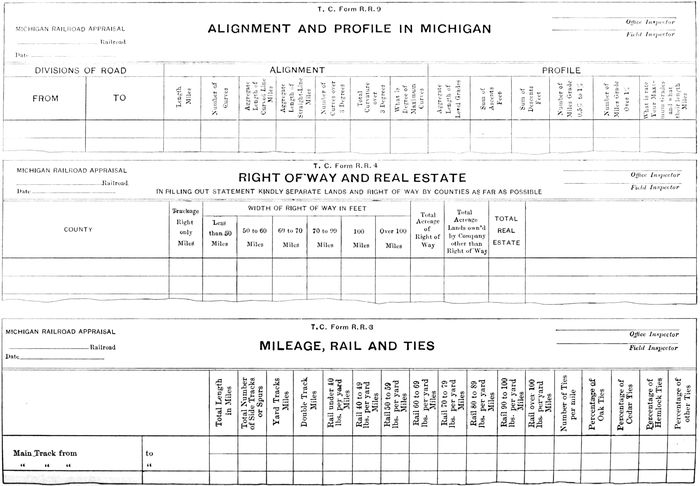
Fig. 1.
24
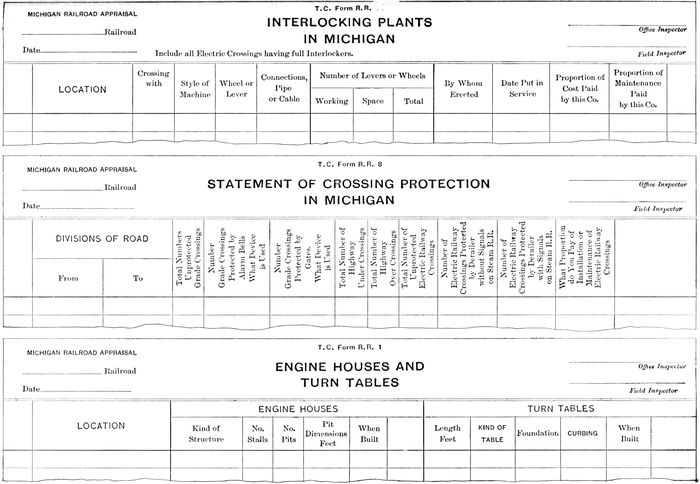
Fig. 2.
25
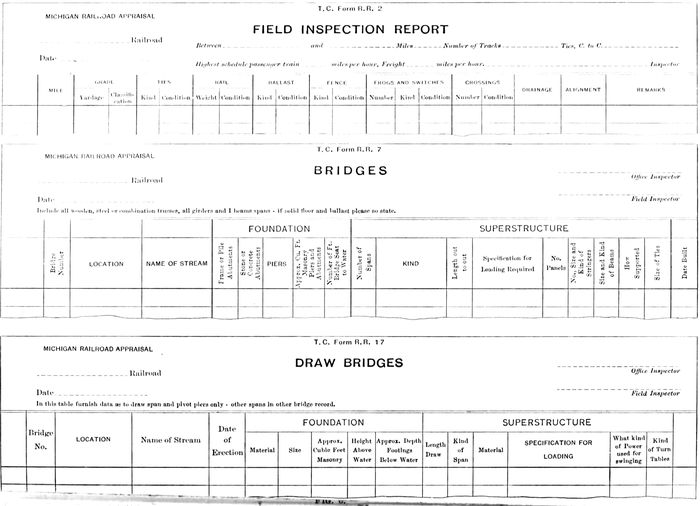
Fig. 3.
26
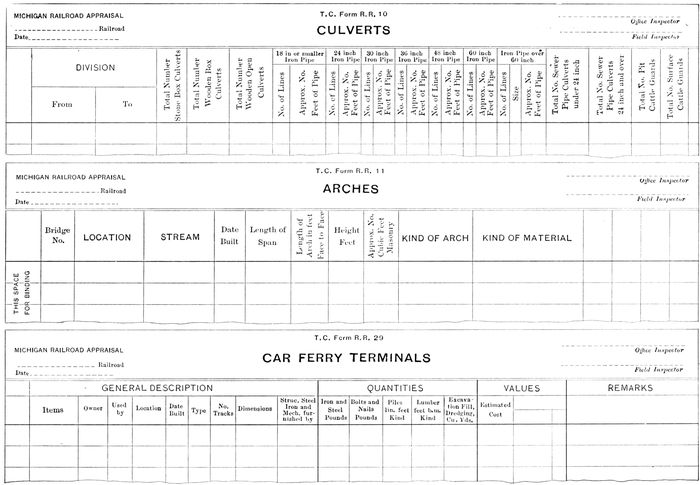
Fig. 4.
27
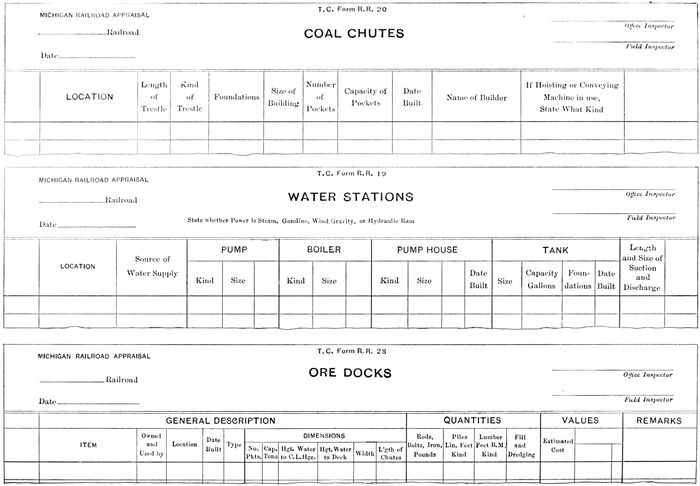
Fig. 5.
28
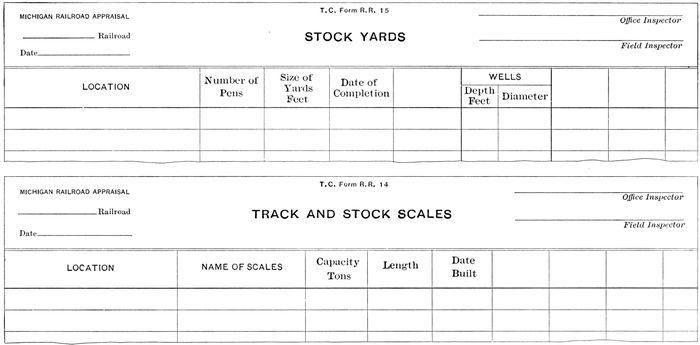
Fig. 6.
29
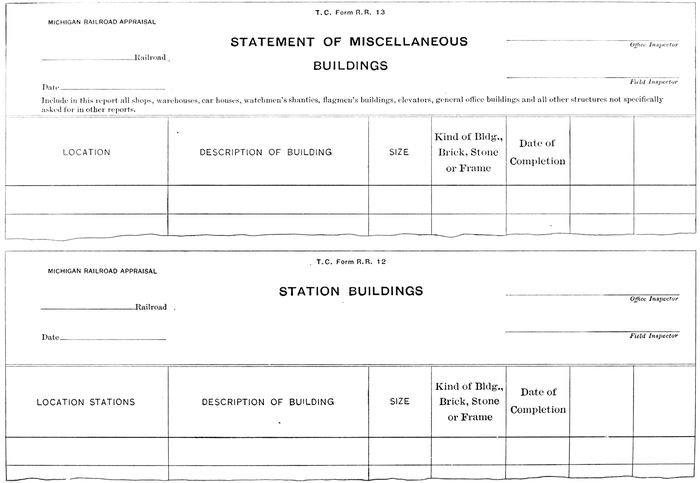
Fig. 7.
30
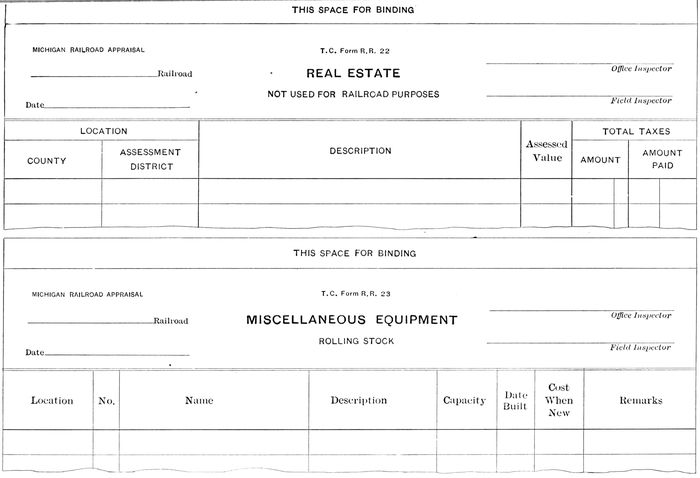
Fig. 8.
31
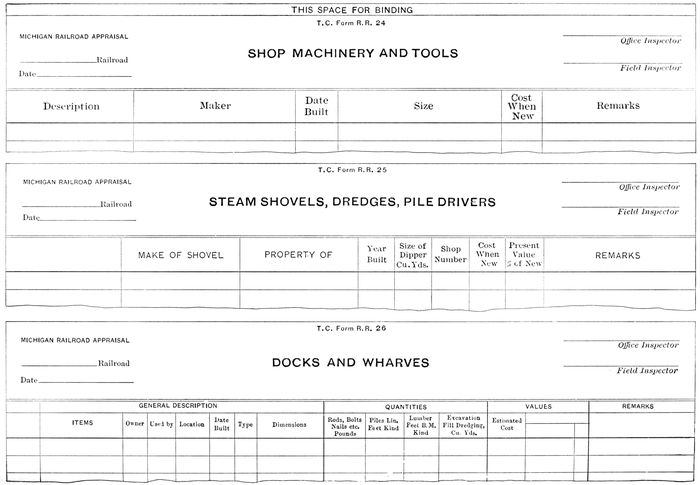
Fig. 9.
32
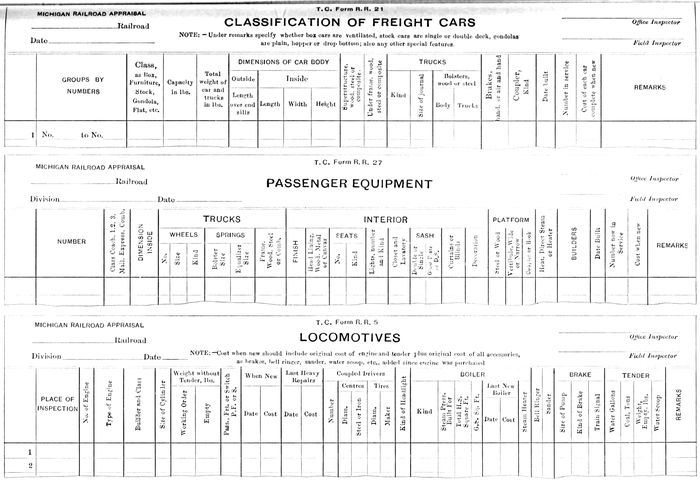
Fig. 10.
33That a few changes were made in 1904 was to have been expected; that these forms were almost in their entirety made a basis for the similar work of the Wisconsin appraiser, some three years later, was in the nature of a high compliment and goes far toward answering the criticisms of this part of the work, generally to the effect that the forms call for much more information than could possibly be used, and that they show lack of care in arrangement.
It may be said here, properly, that the uncertainty as to the final attitude of the companies made it essential that the appraiser prepare, if need be, to make his inventory by personal inspection in the field. Indeed, this was done in the case of several roads, and, while most of the companies finally accorded every courtesy, either giving the appraiser access to their records, or furnishing the information desired, it is not probable that the shortness of the time limit would have enabled the appraiser to secure any sort of result had a modified plan been adopted.
The law provided no requirement that the companies should furnish any information. In order to secure the data, it would have been necessary to employ a large number of men, and this would have been such a serious expense to the companies that refusal to comply would probably have followed such a request. Many of the companies had no men in their service able to prepare the required data; and, finally, eight or ten men after having worked in the files of companies owning reasonably full records, were much better able to take off the desired data intelligently from the records of other companies than men unfamiliar with the needs of the appraiser and with no prior experience. Then, too, the work secured was that of one body of technical men, all experienced in different phases of railway work, and thus was uniform and consistent. Had seventy-five or eighty different men or sets of men prepared these inventories, there would certainly have been a great variation in their worth and reliability.
It must be kept clearly in mind that lack of time was the main feature which kept the appraiser from considering any such plan of co-operation with the railroads as was adopted later in Wisconsin and Minnesota, and that no distrust of the railroads, or lack of desire to co-operate, had anything to do with the appraiser's decision to use the method which was adopted.
Shortly after the preparation of the blanks, access was granted to 34the records of the Ann Arbor Railroad, and almost immediately thereafter several other companies opened their files to the appraiser; the State Board of Auditors determined to pay the bills, as approved by the appraiser; and the initial difficulties were so far removed that it was possible to carry out, without any further delays, the plan of organization which had been perfected.
The personnel of the staff was considered to be of the greatest importance, and, in the selection of men, the requirements desired were: experience in the construction and operation of railroads, thorough technical training, high standing in the Profession, as shown by membership in the American Societies of Civil or Mechanical Engineers, or of other Societies of high standing, and high moral character. Politics, residence in the State, or local influence, had absolutely no weight in the selection of any of the men. In a number of cases men were secured who had for some years occupied the position of Chief Engineer of important lines. In a very large number of cases men who were engaged on this work have since its completion held the position of Chief or Principal Assistant Engineer of important railroads, and practically all of them returned to railway service. Dozens of these men are well known, and their work deserves that full credit should be given to each, but it is impossible to do so within the limits of this paper.
The minor positions, such as assistants in the field and in the computing and compiling rooms, were assigned to younger men, generally with some railroad experience, and in many cases they were graduates of technical schools, Cornell, Yale, Rensselaer, Michigan, Ohio State, and other schools having representatives.
The writer believes that no more harmonious or loyal organization was ever gathered together before, or has been since. Men who had held Chief Engineer-ships trudged miles in the wilds of Michigan on foot, inspecting and inventorying property, and came into the office and worked long hours at the computing tables with the utmost cheerfulness and camaraderie. There was complete harmony, absolute loyalty, and as perfect a spirit of unselfish devotion to the work as the writer has ever seen in any organization.
The fact that such a staff of engineers, of wide experience in railroad construction and maintenance, had been assembled, made it feasible to carry out a plan of the appraiser which proved to be of 35great value. At frequent intervals, during the progress of the work, conferences were held which were attended by all the heads of departments and by many of the older and more experienced engineers. Matters of policy, details, general principles, and rules and methods for conducting the appraisal, were fully discussed, and stenographic records were made of the discussion and conclusions. These conferences covered practically every question that arose; they were of such a nature as to draw out the opinions of the men fully and freely; and their effect was to eliminate the error due to individual judgment, and harmonize and unify the methods and results of the appraisal.
Special emphasis has been laid on the organization of the staff, because the criticism has been made that this work was lacking in care, was hurriedly done, and was unreliable. The work must be judged by its results, but the criticism that it did not receive proper care is absolutely unjustified in fact. The men engaged were of the highest type of experienced, technically educated, and highly qualified engineers; they entered the work unreservedly, and gave the best there was in them. The Michigan appraisal was not a one-man job; it was the work of many men, and all are entitled to credit.
That some men in an organization such as this, gathered from all over the United States, should prove to be lacking, and should fail to hold their place with their fellows, was to have been expected. That the number of such men should not exceed half a dozen was remarkable. In fact, almost every such case was found when the first notes were returned to the office, and in only two or three instances was it necessary to send a second man to do work which had been once covered. In several cases men were sent over certain sections which had been inspected by some one else, with a view of getting an idea of the personal judgment of the different men, but in such cases the results were astonishingly close, and created the greatest confidence in the figures of depreciation which were being received.
Looking back on this work, after the lapse of 10 years, after having fully reviewed it twice, and examined all records, after having heard the men engaged on it testify in court, and knowing the record of these men since the completion of the work, the writer believes himself fully justified in stating that, no matter what opinion may be held as to the accuracy, reliability, or value of the result, no charge of carelessness, 36neglect, undue haste, or lack of consideration can be sustained as against the staff.
To strengthen the work further, to eliminate the element of personal error, to guard against the danger of dulled perceptions due to constant application to the work, and to forestall, if possible, every point of objection to methods, a Board of Review was chosen by Appraiser Cooley to whom were referred:
(a) The methods of inventory and valuation, as determined by the staff;
(b) All points on which special discussion or difference of opinion were noted in the working conferences;
(c) Questions as to elements of value in the physical property which were in themselves not tangible or capable of inventory; and finally,
(d) The results of the whole work.
The members of this board were chosen on account of pre-eminent standing in the Profession, and on account of experience and prominence in railway engineering. The board was composed of four men, as follows:
Chairman, Octave Chanute, Past-President, Am. Soc. C. E., former Consulting Engineer, Atchison, Topeka, and Santa Fe Railway, but at the time not engaged in active railway work.
George W. Vaughn, M. Am. Soc. C. E., Engineer in charge of Track Elevation in Chicago.
Charles E. Greene, M. Am. Soc. C. E., Dean of the School of Engineering, University of Michigan.
Charles Hansel, M. Am. Soc. C. E., former Engineer, Wabash Railroad, former Chief Engineer, Illinois Railway and Warehouse Commission, and at that time General Manager of the National Switch and Signal Company.
These gentlemen were not engaged in any detailed work on the appraisal; they came to the work for one week each month with minds entirely clear of all confusion raised by issues of detail, and were thus enabled to pass as a court upon all matters laid before them. Their association was of inestimable value in giving confidence to the members of the staff. The many years of railway service of Messrs. Chanute and Vaughn, and their unquestioned ability in that 37special field of engineering, gave the stamp of finality to points decided by them. The special knowledge of Mr. Hansel in the field of signal engineering, and his known ability as an expert in organization and administration, were of the greatest value. The service of Professor Greene was that of the analyst and logician; his clear and judicial mind enabled him to formulate the final arguments in many cases under consideration.
The writer wishes to make it perfectly clear that he has not attempted to minimize the work of Professor Cooley by stating the exact relation of the many engineers on the staff to this work, but to bring out and emphasize the fact that no one man, or no two or three men, were responsible for any single part, but that the whole represents the best efforts of sixty or seventy experienced men working to secure a fair, honest, unprejudiced, engineering estimate along such lines as would eliminate, as far as possible, all errors of individual judgment.
It has never been claimed for the work that it was perfect, or that it was entirely free from errors. It has been and is claimed for it that it probably represents as close and conservative an estimate of cost of reproduction and depreciation as it would be possible for any set of men to make under the conditions then existing.
Professor Cooley was in constant touch with the work, knew its every detail, passed upon and approved every rule and order, presided at every conference, and nothing more than his activity, optimism, and constant watchful care and tireless energy kept the force at work day and night and brought about the prompt completion of the details. His recognized high standing, his remarkable ability as an executive and organizer, and his powers of diplomacy, more than anything else, brought about the final acquiescence of the railroad managers and kept up the confidence of the State authorities; his personality pervades the entire work. After giving all due credit to the staff, and they were entitled to much credit, the real honor must go to Professor Cooley. It was his conception, his plan, and the brunt of the battle was his.
Office and Field Methods.
The preliminaries of the organization having been completed, and the forms prepared, a portion of the working force was brought on 38the ground, and the work was actively commenced. It was subdivided into four parts:
(1) Office inspection, or inventory;
(2) Field inspection;
(3) Computation;
(4) Compilation for the permanent record.
The men chosen as field inspectors were old and experienced railroad engineers. As far as possible, they were assigned for a short period to office inspection, then they were sent into the field, after which they worked at the computation of values; so that each man was engaged on many different phases of the work, and handled the notes of many of his fellows, and no one man made up one complete appraisal, except as specially noted.
Making the Inventories.—Office inspection, or the preparation of inventories, was assigned to parties usually of one or two experienced men with from two to four younger engineers as assistants in the computing-room. These men went to the general offices of the railroad companies and made a complete examination of maps, profiles, bridge and building records, records of motive power, rolling stock, etc. In short, they prepared, as far as it was possible to do so, a complete inventory of every building, structure, or piece of property owned by the road; they took off complete abstracts of real estate and right-of-way records; they noted principal yards and terminals, and secured maps of such as were most complex, or furnished lists of such maps and records as were most essential for the field men, and they made as complete a report as possible of the corporate history of the road and the general condition of its engineering records. No effort whatever was made to examine or audit the financial books of any company, or to secure from such books any data as to cost of property; the work was entirely limited to the listing of physical property.
Most of the railroad companies co-operated, and gave access to their records; one or two filled in the forms; a number had practically no records, and only one or two companies withheld information. Requests for blue prints of large yards and terminals, and of plans of standard structures were generally granted cheerfully, and, although there was no such spirit of co-operation as was shown later by the Wisconsin roads, much labor was saved by the data furnished.
39The result of the office inspection was the filing of inventories, which were generally quite complete, the securing of maps and plans, the gathering of data as to prevailing prices of labor and material, and the securing of some very valuable cost data as to special structures and classes of structures. All inventories were made up for roads, or for divisions of roads, with each class of property listed separately, for example, station buildings, interlocking plants, bridges, etc., so that, if necessary, any special class of inspection might be assigned to one man, while to others could be assigned the remainder of the work on that particular road or division.
Office Inspection as a Check on Field Work.—The office inspection furnished many valuable data for checking the judgment of the field men. For example, the number of cubic yards of excavation and embankment on probably the greater part of the mileage had to be secured by the field inspectors, either because the records had not been kept or the changes of line and grade had been so extensive as to destroy their reliability. Every field inspector, therefore, made his own estimate of the yardage of pay earth. The office inspection reports, however, gave reliable data (from profiles or original contract estimate files) of the actual yardage on possibly 2000 or 3000 miles of line, so widely scattered that it constituted a check on the work of a majority of the field men.
This work of office inspection disclosed the following points, which will be practically common to all large valuation jobs:
(a) There was no uniformity of method in the keeping of records of permanent way and structures;
(b) There was a vast amount of carelessness in keeping records up to date, even on the larger roads;
(c) The smaller roads, not only had little or nothing in the way of records, but had in many cases no department with employees qualified to make or keep such records;
(d) The purchase of new equipment, the construction of new buildings and bridges, and the destruction, sale, or removal of old property, create a condition of continuous change which is seldom recorded by either operating or accounting officials, and makes book inventories derived from the roads of very doubtful value for use in an appraisal.
40Field Inspection.—The decision had been reached, after careful discussion, not to permit the field inspectors to place a money value on any structure, but to examine it, make a full description of it in all particulars, and assign to it a percentage which should represent the present value, or the depreciation from a similar new structure rated at 100 per cent.
The field inspectors were furnished with the records of the office inspection covering the district assigned. They were given notebooks, tape lines, and various blanks for reporting progress and recording original estimates in the field. Provision was made for inspection by the field men, either by the use of hand-cars, gasoline inspection cars, or velocipede cars, although, with one or two of the roads, no satisfactory arrangement could be made, and the men were compelled to go on foot. A careful inspection of every structure was made. If any correction to the office inspection record was necessary, it was made; if the structure was new, it was carefully measured and described, and everything noted which would be of service in estimating its value. Side-tracks were measured, and the weight and type of rail noted. All culverts and bridges were examined, described, and their condition noted. Estimates were made of excavation and embankment, clearing and grubbing, etc. (based on the standing timber at the time of the examination), and careful estimates were made of classifications of material. The records of the field inspector generally contained only the description and the percentage, but, occasionally, when apparently valuable information as to cost of any particular structure was available it was noted, as was special information of local matters affecting the value of any part of the work.
It was the plan (carried out with but few exceptions) to complete the record with the field inspector so that from his notes a full and accurate descriptive inventory might be made. There were a few exceptions to the general method of field inspection work as outlined, which were:
Special Work on the Chicago and Northwestern Railway.—The Chicago and Northwestern Railway had no records of any sort, all construction papers having been destroyed by fire. This company organized and placed in the field four complete engineering parties, each under one of its own engineers, and with each party was sent one field inspector. The line was carefully surveyed and cross-sectioned, 41and complete records of every building and structure were made, side-tracks were measured, and data taken for rail and ballast charts, etc. All work was done in the presence of the field inspector, and he was given copies of all notes. He placed his own percentage of depreciation on everything. The estimates, made up independently by the Chicago and Northwestern engineers and the appraisal staff, using in the latter case the same unit prices as applied elsewhere in the Upper Peninsula, varied less than 2 per cent.
Special Valuations.—Certain special structures, such as ore docks and ore and coal handling machinery, were of such a character as to require expert appraisal. These were examined in the field, appraised, and valued by G. H. Hutchinson, M. Am. Soc. C. E., whose special training and experience in such work had qualified him perhaps better than any other man. Interlocking and signaling plants were specially appraised by the late Elliot F. Moore, who for 10 years had been Engineer of the Michigan Railroad Commission, and whose intimate personal knowledge of almost every plant in the State specially qualified him for this work.
Some of the bridges were of such a character as to require expert knowledge, and this inspection was assigned to William Dunbar Jenkins, M. Am. Soc. C. E., a man of ripe experience and sound judgment. The larger and more elaborate station buildings were examined and appraised, and values finally placed by Mr. F. G. Susemihl, Chief Architect of the Michigan Central System, whose special work in railway buildings made him thoroughly familiar with these values.
Work equipment and special equipment were appraised by Mr. G. L. Lewis, who had been connected with the Marion Steam Shovel Company for many years.
Except for these special assignments, all the field inspection was handled in accordance with the appraiser's plan.
As stated previously, in only two or three cases was it necessary to re-inspect, and, while several sections were intentionally gone over a second time, without letting the field inspector know who had done the work previously, or what his percentages had been, the result of all these checks was to justify the figures in the earlier inspection and to strengthen confidence in the work.
42The field inspection of the Mechanical Department involved examining and placing a percentage value on each locomotive, passenger car, and piece of special equipment, and on all shop machinery. Inasmuch as several points of special interest are involved in this inspection, it will be discussed at more length in the section of the paper relating to the methods of work of the Mechanical Department.
Computation.—After the completion of the field inspection, all notes were placed in the hands of the computing force. This organization consisted of two classes of men, engineers brought in from field inspection, and younger engineers. All computations were made independently by two men, and all work was checked carefully.
Every man in the computing room was furnished a large bound blank-book, in which he was required to make all his notes and computations, no figures of any sort being made on loose paper. The name of each man was placed on his notebook, and each set of field and office inspection notes worked upon by him was signed with his initials. It was easy to trace the work of every man, and in the subsequent trial of the Tax Cases, every man in the service returned, and, not only testified as to his office and field inspection, but was able to turn to and identify all the computations made by him, and produce his original figures and memoranda.
Very soon it became evident that such a volume of reports, notebooks, memoranda, maps, plans, pamphlets, and other data was being accumulated that, unless a special system was developed for filing and handling in the office, the confusion would be serious and costly.
Filing in Office.—The system of filing and record keeping had the merit of being simple and inexpensive. There was borne in mind, in devising this plan, the necessity of keeping all papers connected with one division of any road together, the need for reducing to a minimum the labor of filing and indexing, the constant use of papers, and their frequent withdrawal from the files, making it necessary that they could be at once located when they were not in the files.
The vault in the appraisers' office was arranged so that large manilla envelopes, each of sufficient size to hold all the reports, notes, maps, etc., of each road or division, could be filed vertically. Each road was given a number; if there were several divisions, each division was given a letter, as "15-A," "15-B," etc., and each division was filed separately.
43Every report, book, map, or other paper was stamped with its road or division number and letter, and given a sheet number. In this manner every paper was identified, and could be at once placed. A record was kept in a book, describing every paper filed in each envelope.
In issuing papers for work, the entire file was taken and kept together at all times.
One man had charge of the filing and recording, and no one else was permitted to enter the vault. When a file was withdrawn, a receipt was taken, and was put in the place of this file; and when the papers were restored to the vault the receipt was destroyed.
The system proved adequate, and was much less cumbersome than a more elaborate system of card indexing of separate papers could possibly have been.
The net result of office and field inspection had been an inventory based on the railroad records, checked by a man in the field, with a percentage representing the field inspector's judgment as to depreciation, together with a considerable number of special data as to original cost, etc. It was now necessary to place figures of estimated cost of reproduction and depreciation in terms of money.
The State of Michigan is made up of two peninsulas, widely separated, with radically different conditions prevailing as to certain items of the cost of construction.
Computation Tables.—This appraisal involved seventy-eight incorporated and forty-seven unincorporated railroads. It was necessary to adopt such a system as would apply uniform methods and prices to all like property. Accordingly, the field inspectors were assembled, and, after conference, it was determined to prepare a set of tables, covering all classes of railway construction, material, and structures, values being computed for 100% value, and for each 10% depreciation. These tables covered different weights, sizes, and types of structures and material, and were all computed on the basis of the agreed estimated cost.
Unit Prices.—The unit prices were the result of a most careful study and discussion. For many items, such as clearing, grubbing, earthwork, masonry, etc., the price was fixed by agreement during the discussion at a figure which represented the fair average cost of this particular item during the 5-year period preceding the appraisal.
44For rails and rail structures, an average price was secured from market quotations for a period of 10 years, a price was determined as the value of scrap, and the percentage of depreciation was applied to the wearing value of the rail. The unit price was $28; the agreed scrap value was $12, leaving $16 as the wearing value of the rail. If an inspector reported rail at 90%, or at 30%, this percentage was taken from the $16 wearing value and to this was added the scrap value. The tables were arranged so that, for any weight of rail and any percentage, the cost of reproduction and the present value could be taken from the tables in dollars per mile. The same was true of bolts, spikes, angle-bars, fish-plates, and frogs and switches.
In the case of material such as ties, where no scrap value could be attached, the percentage was applied directly to the first cost.
In the case of bridges, the tables gave weights per foot and per span for various lengths, types of structures, and loadings, and only the cost of reproduction was estimated.
Estimated costs per cubic foot were deduced for buildings of various standard railroad types and per square foot for depot platforms. These figures were obtained by reducing to this basis the cost of a large number of buildings of known cost, by comparison with data obtained from railroad companies and from a number of engineers who had kept such records, and by consultation with architects. These building tables did not apply to the more elaborate and costly structures, all of which were appraised specially.
Ballasting, track laying, and surfacing were divided into three and four classes, in order to cover the different general types of railroads, and prices per mile were fixed. On Upper Peninsula roads ballasting was estimated at a higher price than on Lower Peninsula roads, while ties and timber construction were estimated at a lower figure.
In addition to these prices, secured by averaging several years' quotations, or by agreement of experienced construction engineers, many valuable figures were obtained from manufacturers of locomotives, cars, mechanical equipment, and bridges; and in several cases access was given to the mechanical cost data of the larger roads. Specifications for locomotives, cars, and shop tools were sent out to builders with a request that they give average prices for a period of years.
45From all this mass of data the unit prices for the valuation were determined. For locomotives, values were plotted for engines of different weights, in order to establish a curve, and curves representing deterioration, scrap value, and major repairs were also plotted, so as to ascertain diagrammatically the value of an engine of given weight and stated condition.
The tables and diagrams proved of incalculable benefit in reducing the work, and in securing that absolute uniformity of method necessary to give the appraisal standing.
It may not be amiss to state here that in such a work no set of unit prices could possibly be adopted which would not work some apparent injustice. A number of Michigan lumber roads were of the cheapest possible type of construction, and any unit price applied to ties or timber, which would be at all reasonable for such roads as the Michigan Central, Grand Rapids and Indiana, Pere Marquette, and others, would be far in excess of the actual money paid out by these little roads. A few individual instances of such apparent discrepancy were cause of complaint and criticism, but, on analysis, very generally, these did not appear to be anything but a disagreement with book values, in which ties cut off the right of way were treated as having no cost; or in some similar item certain local conditions may have made the first cost so low as to amount to a donation of property. Conceding the propriety of the objections, the reason for making the appraisal was to furnish information on which the legislature might determine whether the State should go from a specific to an ad valorem basis, and in view of this purpose the objections became unimportant, as they applied to but a few miles of road.
Classification.—All work of computation was classified in strict accordance with the Interstate Commerce Commission's classification of construction accounts, to which were added one or two classifications not recognized by that Commission, and final summaries were returned on sheets similar to those illustrated by Figs. 1 to 10.
In computing, the staff made use of all data of every nature which was before them, checked the judgment of the field inspector wherever any reliable data were furnished, took into account age, special notes, or costs, and, in case of any serious discrepancy in his percentage, reported to the head of the department for either a re-inspection or for a conference with the appraiser and inspector. In this department 46every possible safeguard was thrown around the work to insure its absolute mathematical correctness, and to guard against errors in the personal equation.
Compilation.—After the calculations were checked and completed they passed to the compilers, who arranged and classified them, and prepared the form of the final report. This consisted of a detailed list of every piece of property and every structure, with a short description and specification, and a statement of estimated cost of reproduction and present value. The division is made by roads, by divisions of roads, and by counties. This was done after the completion of all other work, and the disbanding of the organization, a small force being retained by the State to compile and put in permanent form all the papers of the appraisal. This work was done under the direction of Messrs. James Walker and O. C. Le Suer in consultation with Professor Cooley.
The final compilations were typewritten on large sheets and bound, and constitute the final record of the physical valuation. After the completion of the 1900 appraisal, all papers connected with the work of the computing office were arranged in proper order and bound.
Special Problems of the Mechanical Department.
The Civil Engineering section dealt wholly with fixed property located entirely within the State; and the work offered no special difficulties in the way of assignment of values. It is true that, when the question of terminal values was under discussion, the Wisconsin and Michigan Railroad offered a very pretty example, in that the revenue-producing half of its mileage lay in Michigan, while its shops, yards, docks, and car ferries, comprising the great bulk of its physical property, were in Wisconsin. This instance merely emphasized the fact that no State valuation of an interstate property can settle finally and definitely all the questions that arise.
Assignment of Value to States.—The Mechanical Department was compelled to handle the valuation of moving property, and to assign values as between the States on such a basis as would be fair to all parties. The Courts have been inclined to view the distribution of values between territorial units on the track-mileage basis as being a fair one. The study of the problem in Michigan indicates that 47while this method, perhaps, is just in most cases, it will not hold in all. Assignment was made upon several bases, as follows:
(a) Main-line mileage;
(b) Total track-mileage;
(c) Car- and locomotive-mileage of equipment operating in Michigan;
(d) Car- and locomotive-mileage, entire equipment;
(e) Freight-car mileage of the entire system.
The results secured by these different methods show, in many cases, very little difference; all are close, and no injustice is worked by any method, while, in other cases, the figures are widely divergent.
The Lake Shore and Michigan Southern Railway owns a high-class main line between Chicago and Buffalo, and for part of the way there are two lines several miles apart; the entire line is double-tracked, and there is much third track. None of this line is located in Michigan, except some 80 miles of single-track main line of the Michigan Division between Toledo and Elkhart. The company, however, has several hundred miles of branch line in Michigan, which comprises most of the branch-line mileage of its system. These lines, generally, are far inferior to its main line.
Any apportionment of its equipment between States on the basis of either line-mileage, total track-mileage, or locomotive- and equipment-mileage of total equipment will result in the assignment to Michigan of a value far in excess of a proper or fair amount. An apportionment of locomotive and passenger-car equipment on the basis of equipment-mileage or equipment operating in the State, and for freight cars on the basis of car-mileage of total equipment, was found to be most fair.
In making the assignment of values, this study was made for all interstate roads, and such basis used as was apparently most fair in each case, the department making a special effort not to assign to Michigan undue values or those which could not be sustained.
Freight Car Inspection.—One of the most perplexing problems which was faced by the Mechanical Department was the proper and satisfactory inspection and valuation of freight equipment. The freight cars owned by the companies were scattered over the United States and Canada, and the inspection of any considerable percentage of those owned by any company was, of course, an impossibility. 48The fact that these cars had been purchased in series, so that there were considerable numbers in a group, all of the same age, and built according to the same specifications, made possible a valuation by groups. The acceptance, however, of any arbitrary percentage of depreciation by years, or the acceptance of the rules of depreciation of the Master Car Builders Association, without making independent investigation with a view of establishing the correctness of the rule, appeared to be unwise.
The several companies submitted carefully prepared statements of equipment. These statements were compared with the equipment register and the reports to the Commissioner of Railroads. The prices used were those of the rules of interchange of the Master Car Builders Association wherever applicable.
Prices were furnished by the leading manufacturers, and in many cases were secured from the books of the railroad company.
In order to determine the condition of the equipment, the inspectors of the department personally examined 32,000 freight cars in Michigan and adjoining States. Their reports were separated, classified, and analyzed by groups, with the result that the inspection fully confirmed and justified the use of the rule for depreciation of the Master Car Builders Association, which was therefore applied. In the 1902 appraisal this rule was accepted without any inspection or further study of the problem.
The criticism of this part of the work by the appraiser of the State of Washington is wholly unjustified, as the work was necessary in order to qualify in Court and defend the rule adopted, and the actual cost of the work was small.
Locomotives.—The inventory of locomotive equipment was secured from the companies, and checked against reports and the equipment register. Personal inspection was made of every locomotive in the State, then a complete description was prepared, and the percentage of depreciation assigned. Curves of depreciation had been computed and plotted, and the figures of the inspectors were compared carefully with the curve in order to eliminate possible errors.
Vessels.—Professor Sadler's appraisal of vessels involved a personal examination of every vessel. This survey included:
(a) The hull of the vessel and general equipment;
(b) The machinery and boilers.
49An independent estimate of the cost of reproduction and depreciation was made, and, wherever possible, this was checked by comparison with the detailed original cost. In case of material difference, various shipbuilders were consulted, and independent estimates of cost were secured. In every case these latter estimates were confirmatory of the estimated cost of reproduction, which figures were used throughout the appraisal.
Overhead Charges.
There are certain expenses connected inseparably with the construction of any public work, which, on the completion of that work, are not capable of physical identification, but which, nevertheless, belong to and must be a part of the cost of the physical property. These expenses are legitimate; and, as long as the property is operated, a very large part, if not all, of the entire expense remains in the present value of the property as a "going concern."
Appraiser Cooley and his staff took up the discussion of these items and disposed of those which were carried into the valuation by the placing of a percentage. These items are:
Engineering.—This covered all the cost of preliminary and location surveys, design, and supervision of construction of the work, and all expenses connected therewith. This was covered by a charge of 4% of the cost of reproducing the permanent way and structure, but not the equipment.
Legal Expense.—This item is inseparable from the construction work, and was fixed at one-half of 1% of the cost of the same items as affected by the engineering charge.
Organization Expense.—This covered the cost of promotion, financing, and general supervision of construction, together with general office expense. These items were covered by an application of 1½% of the cost of the above items.
Interest.—This item is intended to cover interest on money during the period of construction. The length of time taken to build would, of course, be variable. It was assumed that 3% on the entire cost of construction and equipment would be conservative, and this figure was used.
Discount on Bonds.—This was not included, for the reason that it was considered, not as a proper capital charge, but rather as an adjustment of the interest rate to the existing market 50condition, and as chargeable to interest account and not capital.
The discussion among members of the staff indicated such a wide range of opinion as to the proper percentages to apply, that the final determination of the rates was passed upon by the Board of Review. There can be no question as to the propriety of these items as proper elements in the first cost of construction of a new railroad. On the theory that the cost of reproduction of the physical property should include every item of expense which would enter into the cost of reproducing the property as it existed on the date of the appraisal, they are proper terms to include in the appraisal. As to whether the fixed rates were high enough in every case, is an open question.
The Charge of Ten Per Cent. for Contingencies.—Perhaps no single feature of the Michigan appraisal of physical property has been so generally criticised as the charge of 10% of the entire estimated cost, including all the percentage charges, to cover "contingencies."
At the time the first appraisal was made, the writer was not at all satisfied that such an item, in such amount, should be included. The reasons advanced were so strong that it was done, and the writer's subsequent work has fully convinced him that it was proper and justifiable, because:
(a) The conditions under which this particular inventory and appraisal were made, as to time and lack of co-operation of the companies, made it practically certain that some items of value were missed in the appraisal, such as station and miscellaneous equipment, frogs, switches, track structures, buildings owned by the companies and occupied by others, etc.
(b) That there were many and large elements of physical cost not ascertainable by a physical inspection, such as deep foundations, many thousands of yards of earth in swamps and sink holes (a very general condition of roads in the Southern Peninsula), concealed classification due to growth of grass or washing of banks, and many other cases of work actually done, invisible after a lapse of years. The writer knows of many such instances on property which was in his charge many years ago; in several cases there were expenditures of from 0,000 to $50,000 which are now entirely invisible to an engineer passing over the line.
51(c) The failure on the part of railroad companies to keep anything like a complete history of construction operations, and the changes of operating officials from year to year, cause the loss of record of practically all the expense due to extra hazard and risk which the construction engineer provides for by his "contingencies."
(d) The inclusion in operating expense, every year, of sums which are properly construction, and which, if added to unit prices of construction work, would cause the cry that such unit prices were too high. For instance, the appraisal estimate on earth was 17 cents per cu. yd., with no allowance for overhaul. Very much of the grade in the State had actual costs far in excess of this figure, and practically every road spends a large sum annually for the first four or five years, which is charged to operation but is in reality a part of the cost of completing the roadbed.
(e) No account was taken of appreciation of any of the elements entering into a road. There is no doubt that roadbed, for example, does appreciate, due to ballasting and track work. These items go far toward accounting for the contingencies item on an old road such as the Michigan Central.
(f) There is a considerable amount of cost, which cannot be taken out of capital, where facilities are abandoned or line or grade changed. These changes are common to all growing roads; they are due to the demands for greater traffic; they are necessary to the welfare of the community served; they are often made at points where no charge of defective design will apply. They might be termed expenses due to the development of the State, and, in the development of the railroad business, they were absolutely necessary for its present standard of efficiency. They are incapable of exact and definite determination, and must of necessity be included as contingent expenses.
In the case of a new road, where the exact cost is ascertainable, the records have been fully kept, the original plans are on file, and the history is fresh in the minds of the officials, it will be readily admitted that a charge for contingencies in large amount would not be justifiable; but, in the case of the Michigan Central Railroad, a line more 52than 50 years old, which has changed, rebuilt, and added largely to its property; in the case of the Pere Marquette Railroad, made up of the union of a dozen lesser properties, without any complete history; in the case of dozens of little lines, without maps, profiles, or records, some such allowance is fully justified and proper.
The experience of the writer, in the years that have passed since these appraisals, leads him to the opinion that the difficulty of estimating values on an old property are such that in many cases an appraiser might add, with perfect propriety, even more than 10% for the contingency item.
In computing overhead charges, no allowance was made for working capital, and no addition to the physical valuation was made to cover any such element as "going concern" value.
Right-of-Way Values.
Land values were the subject of a great deal of discussion during the appraisal of 1900, but subsequent investigations as to actual railroad purchases resulted in quite radical changes in some of the figures in the later valuations. In view of the fact that many criticisms of these values have been made by railway attorneys, special emphasis is here given to the subject. The conclusions reached in Michigan in 1902 agree so closely with the conclusions of Taylor in Wisconsin and Morgan in Minnesota that it is thought advisable to give a rather full account of the methods used in both appraisals, and the line of reasoning which brought about the changes made in 1902.
The 1900 appraisals methods were as follows: Work in Detroit, Grand Rapids, Saginaw, Bay City, and some other large cities was assigned to special appraisers, who visited the cities, examined critically all the property, conferred with leading real estate men and experts in values, and placed an estimate per acre or per square foot. This part of the work was done with great care, and was substantially unchanged in the later appraisals.
In all other land valuations, in cities and villages, and country right of way, a personal examination was out of the question without making a very large and expensive addition to the staff, as the field engineers generally were not familiar with realty values, and could not take the time to make the large number of inquiries. The appraiser did not see his way clear to organize a special department, therefore 53the matter was turned over to a sub-department of the Civil Engineering Section, the work of which may be briefly outlined, as follows:
Lands were classified as:
(1) Farm land,
(2) Barren land,
(3) Villages having a population of less than 500,
(4) Villages from 500 to 3,000,
(5) Cities having less than 10,000,
(6) Cities having more than 10,000.
The percentage of waste land was fixed as a result of interviews with roadmasters, superintendents, and other officials and employees of the roads, by reports from field inspectors and others.
Letters of inquiry were sent to real estate men and bankers in every county in the State (some 500 being communicated with), as to land values in the town or county of each. The responses, which were numerous and indicated considerable care in preparation, were classified, and on these data, supplemented by as much personal inspection as it was possible for a few men to give in a limited time, the values of the various classes of land were determined by a system of averages. The naked land values were then taken, and to them were added, as follows:
South of a line east and west through Saginaw, 125% plus a fixed charge varying from $8.50 per acre downward was added to the so-called naked land values for farm land. No waste land values were considered in this district. North of this east and west line: Farm land, 100% and a fixed charge of $3 per acre and upward; waste land, 200% plus a fixed charge of $3 per acre; for all village lands, 125% plus $8.50, fixed charge; for all city lands, 100% plus $8.50, fixed charge.
The fixed charges were intended to cover the expense of acquiring abstracts, recording deeds, etc. Slightly different figures were made for the Upper Peninsula.
The result of this work was a set of very low figures in many counties, the average price per acre hardly reaching the going price of improved farm lands. There was so little time to review these figures after they were in shape that they were used in 1900, although the appraiser was convinced that they were generally too low.
54In the appraisal of 1902 a very careful study of real estate values was made. The offices of Registers of Deeds in ten or twelve counties were visited, a careful abstract of all railway transfers for a period of 10 years was taken off, the acreage determined, the average price per acre for different classes of land computed, and then a very careful study of transfers of adjacent improved and unimproved lands was made. As a result, material increases were made in the farm land values, waste land values were eliminated, the 1900 valuation, made by special appraisers in large cities, was practically unchanged, while very radical changes in the way of equalization of values of lands in villages and small cities were made.
Inasmuch as the 1902 valuation was at issue in the Courts, the writer believes he is justified in discussing at some length the deduction of the staff on the conclusion of the 1902 preliminary studies, which led to the final adoption of the new figures.
One would fall into error if country values for farm purposes were conflicted with country values for railroad purposes. There is, undoubtedly, a close relationship between the two classes of values; this the writer has endeavored to discover, and it is indicated in Tables 2 to 6. The use to which land is put can and does change its value. Farm land in a certain township may be worth $50 per acre for farming, but the discovery of oil would affect values, as far as oil purposes are concerned. The presence of a vein of coal would give a distinct value for mining purposes. Farm prices would not govern values for any special use, such as oil drilling, mining, or railroad operation.
In the case of city business property, farm prices cannot be applied, as the use to which the land is put and the buildings placed on it give it a greatly increased earning power, and hence increased value. Thus, with a railroad right of way, the continuity of the strip of land, the severance of lands crossed by it, the greater earning power it derives from the construction placed on it, in short, the uses to which it is put, give it a value far in excess of adjoining lands. An excellent proof of this is found in the fact that many thousands of miles of right of way have been bought by promoters and either sold to a company, which built the lines, or used in financing the road. In no case has the selling price been based on farm values.
It is not contended that railroad land values do not bear a direct relation to land values for other purposes, as those things which tend to 55increase general values usually make the construction of a railroad profitable, and the better and more fully developed the country, the greater is the need for transportation facilities and the higher the prices of land for all purposes. This is shown in the figures submitted herewith.
For purposes of appraisal, therefore, in 1902 the average value, as derived from the 1900 appraisal, was taken, and, by comparison with actual purchases, an attempt was made to ascertain the relation existing between the appraisal figures of 1900 and the usual purchase price for railroad properties, as determined by actual transfers. In making these figures the appraiser was forced to the following conclusions:
(1) That the naked land value is not a proper one to use in country lands, but that the going value of country lands with all improvements should be used as a basis for computing the added increment due to railway use;
(2) That a classification of farm land and waste land should not be made, except as a basis for arriving at the relative differences in quality of land in different sections of a county;
(3) That the added value for railroad purposes is due to the three elements:
(a) Continuity,
(b) Severance or damages,
(c) Changed earning power,
all of which the farmer or owner has cognizance of in making his price;
(4) That in making up land values, account should be taken of:
(a) The cost of acquiring the land, or expense,
(b) The cost of the land itself.
The reasons are:
I.—In making a price on a 40-acre farm, the owner does not make two prices, one on land and one on improvements. He arrives at a flat price per acre for the entire farm, and usually asks more per acre for a part than the whole. A man who valued his land at $100 per acre, with improvements, would hardly sell 5 acres from a corner of his land, even for residence purposes, at naked land prices.
The 1900 appraisal was based on naked land prices, as estimated by a number of citizens of each county, and this flat rate was used in 56making figures for the so-called "Market Value of Right-of-Way." It is fair to assume that a railroad company can purchase large tracts of land for gravel pits, or a narrow strip adjoining and widening its existing right of way, at about market prices, as the elements of severance, abutting damages, etc., are absent. Prices for this class of land ought to be, and usually are, lower than those paid for a new right of way.
TABLE 2.—Country Land.—Additional Strip for Widening Right of Way, Gravel Pits, Etc.
County. Description: Road and purpose. Average per acre, 1900 appraisal. Average per acre, transfer.
Jackson Michigan Central. Widening right of way $84.47 $156.08
Kalamazoo Michigan Central. Additional right of way near Augusta 89.41 140.00
Kalamazoo Grand Trunk Western. Additional strip for double tracking 94.59 120.50
Cass Michigan Central. Gravel pit 84.97 94.15
Cass Grand Trunk Western. Additional strip for double-tracking 71.79 203.53
Berrien Michigan Central. Additional right of way 109.40 113.66
Washtenaw Michigan Central. Additional right of way 49.35 130.68
Washtenaw Ann Arbor. Additional right of way 88.60 116.12
Ionia Pere Marquette. Gravel pit 77.50 125.00
Actual purchases are averaged from recent transfers, and represent consideration paid owners, but not cost of acquiring.
The 1900 appraisal averages show country land after fixed charges and percentages are added.
The tables given herewith are summarized from a very large mass of information introduced as evidence in a suit of Michigan Central Railroad et al. vs. Powers (The Michigan Tax Cases), and are selected as average examples of conditions throughout the Southern Peninsula.
It is evident from the figures in Table 2 that no such naked land values as those used in 1900 were considered by the farmers in placing values on their lands, as the sales covered in that table do not involve any large element of damages. All transfers are of a strip a rod or more in width adjoining an existing right of way.
II.—It is true that in some sections of Michigan there are large tracts of barren or low-priced land. In 1900 barren land prices were used, and were much lower than farm land; in the poorer parts of the State large percentages of barren land were used. This fact brought the average per acre of country land, as applied in the appraisal, very low in many of the counties, and justified the appraiser in using the average country price of 1900 as the base price for a re-valuation. Generally, the 1900 appraisal averages for country lands were fair indices of the difference in actual value in different parts of the State.
57In the 1900 appraisal, the Michigan Central was credited with having, in Jackson County, 309.1 acres of farm land (naked value, $38, average rate $93.30), and 34.35 acres of barren land at $5 per acre. The field inspectors reported that part of the district between Parma and Albion, in the vicinity of Bath Mills, was waste or barren land. The Jackson and Battle Creek Traction Company parallels and adjoins the Michigan Central Railroad right of way from Parma to Bath Mills. An investigation of records of deeds showed that they bought 25.02 acres of land in this district at $65.79 per acre, and that the average price of all their land in the county was $239.52 per acre.
While there was a marked difference in the rates of different grades of country land, no one would be justified in putting any land south of a line drawn from Saginaw to Muskegon at prices as low as $2 to $10 per acre. An average based on the 1900 classification of lands would probably eliminate all waste land classifications, without doing any injustice.
TABLE 3.—Average Values per Acre of Country Lands, of the 1900 Appraisal, of the Jackson, Lansing and Saginaw Railroad, After All the Percentages and Fixed Charges were Added.
County. Price.
Jackson $75.71
Ingham 74.90
Clinton 42.38
Shiawassee 67.18
Saginaw 40.80
Bay 38.69
Arenac 32.47
Ogemaw 8.69
Roscommon 10.74
Crawford 8.41
Otsego 15.62
Montmorency 12.38
Cheboygan 17.13
Table 3 illustrates quite clearly the extremely low figures applied in many counties in the 1900 appraisal, and also represents quite well the relative difference in value in the different counties.
That the 1900 rate varies about as the purchase price, is shown by the fact that the Pere Marquette Railroad built a line in Montcalm County, buying 155.3 acres at an average price of $135.19 per acre, while the 1900 appraisal showed an average of $29 on the 918 acres appraised. The purchase price was 4.66 times the 1900 appraisal.
In Calhoun County, the Grand Trunk Railroad bought 63.2 acres at $491.13 per acre, while the 1900 appraisal was $61.44 on all the country land in the county, or only one-eighth of the actual purchase price.
58III.—There can be no doubt that a railroad right of way costs much more than an equal acreage of farm lands. The writer has always been inclined to hold the view that an ordinary right of way through good farming country would cost from two to three times farm prices, no matter how much care is used in the acquisition of the land. In recent years the price of right of way has been greatly increased. The Newton and Northwestern Railroad right of way, in Iowa, cost $267 per acre, on a line 80 miles long. This is nearly all country land, about 1 mile in the outskirts of Boone (population 12,000), and about ½ mile in Newton (population 6,500), being the only city land to increase the average. The Rock Island System and the Chicago Great Western paid higher country prices in the same territory. This line is in such country as Southern Michigan, and land is held at from $65 to $100 per acre.
The Toledo Urban and Interurban right of way, in Lucas County, Ohio, was bought by the writer in 1901 at an average net price of $329.21 per acre. The average assessed valuation is $55 per acre. The going value of farm lands will range from $100 to $225; probably a fair average is $135 per acre. The prices paid by Michigan railroads are fully sustained by these personal experiences.
The figures in Table 4 show that the actual average price paid for new right of way is greater than the average of the 1900 appraisal, after the 125% and fixed charges are added, by from 230 to 726 per cent.
The argument that a change of line costs more than a new line is not sustained by Table 4. In Jackson County, the Michigan Central Railroad changed its line at an average cost of $165.67 per acre. The Jackson and Battle Creek, a new line, parallel with and adjoining the Michigan Central, paid $239.53; the Jackson and Suburban, a new electric line, paid $293.34, and the "Ypsi-Ann" Electric paid $393.74. All the new lines in Monroe County are higher than any changes of line in similar country. The Ann Arbor change in Washtenaw County, located by the writer, is at one point 3 miles from the old right of way, and only at the two ends of the 7-mile line does it run on farms owned by parties crossed by the old road; therefore, to all intents and purposes, it is a new line.
The naked land values used in 1900, being clearly too low, were of no use and were dropped. The so-called market price of right of way as given in 1900 was misleading.
59TABLE 4.—Comparison of Country Land Values.
The actual purchases are averaged from recent transfers, and represent consideration paid to land owners, but not the cost of acquiring.
The 1900 appraisal averages show all country land after fixed charges and percentages were added, per rule of 1900.
County. Railroad. 1900 Appraisal, average per acre. Railroad. Actual transfer, average per acre.
Jackson Michigan Central. Air Line $71.36 Michigan Central Air Line. New Line $165.67
Michigan Central. 88.47 Jackson and Battle Creek. Average entire county 239.53
Michigan Central. Waste land 5.00 Jackson and Battle Creek. Wasteland 65.79
Michigan Central. First-class farm 93.30 Jackson and Battle Creek. First-class farm 298.51
Jackson, Lansing and Saginaw. Average country values 75.72 Jackson and Suburban. 293.34
Detroit, Ypsilanti and Ann Arbor 393.74
Monroe Flint and Pere Marquette. 93.30 Flint and Pere Marquette. Monroe to Toledo 215.21
Michigan Central. 93.30 Toledo and Monroe. Electric 461.13
Lake Shore and Michigan Southern. 93.30 Detroit and Toledo Shore Line. (Duffy) 214.38
Detroit and Toledo Shore Line. (Burt) 262.49
Kalamazoo Michigan Central. 89.41 Michigan Central. Kalamazoo to Mattawan 236.22
Van Buren Michigan Central. 66.54 Michigan Central. Kalamazoo to Mattawan 196.00
Cass Michigan Central. 84.97 Michigan Central. Cut-off near Pokagon 260.61
Michigan Central. Wasteland 10.00 Michigan Central. Waste on cut-off 60.00
Genesee Grand Trunk Western. 98.10 Grand Trunk Western. Improved line 337.56
Genesee Pere Marquette. 80.81 Flint and Pere Marquette. Change of line 234.00
Montcalm Pere Marquette. 29.00 Pere Marquette-Greenville-Stanton. 135.81
Calhoun Grand Trunk Western. 61.44 Grand Trunk Western. Change of line west of Battle Creek 491.13
Calhoun Michigan Central. 74.38 Jackson and Battle Creek. Electric 218.74
Tuscoia Michigan Central. 60.75 Michigan Central. Caro-Owendale 73.04
St. Clair Pere Marquette. 43.18 Rapid. Anchorville-Marine City 287.05
Washtenaw Ann Arbor. 38.60 Ann Arbor. Change of line near Ann Arbor 285.50
Ionia Pere Marquette. 77.50 Pere Marquette. Lowell-Belding 112.30
Manistee Ann Arbor. 25.40 Ann Arbor. Change line near Harlan 47.33
Osceola Pere Marquette. 40.03 Pere Marquette. Change line near Evart 57.93
Having shown that there is an increase in cost of railroad over farm land, the question arises: Is it legitimate? If it is a proper item of cost, has it a place in the present value column?
60In building a new railroad, engineers prepare their estimates of cost, including grading, rail and fastenings, ties, bridges, and, among other items, right of way. Their clients provide funds to build the line, and furnish, among other items, cash for the right of way. The right-of-way account in no wise differs from that of any other item of physical cost. The right of way, with all its hold-ups, items for damages, court costs, legal expenses, bills for personal services and expenses in securing it, abstracts and recording of deeds, is just as much an element of physical cost as the rails. The cost of acquiring the right of way is as proper an element as charges for inspecting the rails, freight charges on them, the loading and unloading, or any other charges that enter into the cost of rails delivered to the track-laying contractor.
Should the cost of reproduction of right of way be carried to the present value column? Clearly, yes. If a road is unfortunate enough to buy its rails when they are at a price of $60 per ton, the full price is charged to capital account; and when the line is sold to some large corporation, no reduction is made, even though the price of rails be much less at the time, but the selling price is based on the construction account as a whole.
The same is true of the right of way. In no case which has come under the writer's notice has a new company, or a set of promoters disposing of a new line or a new right of way, ever consented to deal except on the basis of construction account, plus promoters' profit. The cost of a right of way is increased on account of continuity. A farmer is justified in increasing his price per acre by reason of the fact that the road must have a continuous line, regardless of how it affects the individual. He must rearrange his fields, replant his orchard, change his fences, ditches, and tile lines, and re-adjust his entire property to accommodate the necessity of the road. He must also take into account severance or damages. He is compelled to cross the line at an inconvenient place, open and close two gates in every lane or at every crossing, drive his cattle back and forth to water, haul his produce over a short heavy grade across the track, and he must not interfere with the railroad. He is in constant danger of loss of property from fire or from accident, and he is in personal danger every time he passes from his own land on one side of the railroad to his own land on the other side. Every one who has bought right of way knows these arguments, 61and is aware that the farmer knows them and charges extra on account of them.
The law provides that, in condemnation, the jury shall take into account two elements, the value of the land, and damages. The railroad pays them, and very promptly charges the entire cost to the right-of-way account. No one will question the propriety of the farmer taking them into account in fixing his price. The value of continuity to the railroad can hardly be measured in dollars and cents.
A fair illustration of continuity may be found in coal lands. A promoter will secure option on a large acreage. As long as his holdings are disconnected and widely separated they are of no more value than adjoining lands, but let him close options on a large block of land all in one body, and immediately he can add from 100 to 200% to the value of his land for mining purposes. This added percentage is due to continuity.
The conditions surrounding the purchase of railway lands in Michigan have changed materially in the past few years. In a new country, without means of transportation, land values are low, and, in order to open new markets, land owners can afford to donate the right of way. Undoubtedly, a very large percentage of the total right of way on the older lines was either donated or bought at very low prices. As a community grows and develops, acquires new industries, and receives new improvements, property values increase; and, along with a general appreciation of other values, those of railroad property must increase. It would certainly be true that the present value of the site of the Majestic Building, in Detroit, is not the same as it was in 1850; the argument that its actual cost in 1850 was, say, $200, would not be any justification for such a value to-day. Equally is it true that the value of property owned by the Michigan Central Railroad is not to be measured by the price paid for it 50 years ago. The greater business, and the larger income derived from that business, make the Detroit of to-day a much more valuable terminal for the road than the Detroit of 50 years ago.
The same argument will apply to any city which has grown up after the construction of railroads. The original right of way was farm land and may have been a donation, but the change from farm to city certainly increases the value of the railroad land just in proportion as the surrounding land increases.
62The same reasoning is properly applicable to lands which decrease in value. Where a railroad buys right of way to gain access to valuable timber lands, and, after the removal of the timber, the land is too poor to support a population, the present value should depreciate in the same ratio as the surrounding land, and immediately on its abandonment as a right of way it would cease to have a railroad value.
In an appraisal, it appears to be fair to base the cost of reproduction on the cost of building a new line on the location of the road under appraisal, all other means of transportation remaining as they are to-day, so as to secure as nearly as possible the conditions that would be encountered by a new company building a new line on this location.
The argument was made in 1900, and reiterated frequently, that railroad companies secure many donations. It may safely be said that, in a developed country, such as in the south half of the Lower Peninsula, the donations are of little account. Few donations were found in an examination of records of deeds covering 10 years; and in some cases the conditions were so burdensome that it may be said that the gift land was the most expensive. A condition for a cattle-pass costing from $400 to $600, a side-track costing from $1 to $1.50 per ft., and other like specifications are found; and in many deeds where a liberal consideration is named conditions which add greatly to the cost are not infrequent.
The recent new lines in Southern Michigan secured but few donations, although all considerations of $1 and other good and valuable considerations were classed as donations unless the contrary was susceptible of proof. In the case of the Ann Arbor Railroad, in Washtenaw County, the $1 consideration represents a higher price than the average, this being known by the writer, as he bought it. The same is true of the Detroit and Toledo Shore Line, in Monroe County. In making an appraisal, no deductions should be made for donations, if there are any, as the fact that land is donated does not indicate absence of value; nor should an addition be made to the appraisal value on account of the fact that a road has been held up and compelled to pay exorbitant prices in certain localities.
In some counties the base values of land in villages and small towns were given at ridiculously low prices in 1900; some are as low as from $50 to $100 per acre in towns of from 1,000 to 3,000 population. When one stops to consider that a lot 4 by 8 rods contains ⅕ acre, and 63that such lots in a town of considerable size range from $50 to $300 each, it is readily seen that from $250 to $1,500 per acre are not excessive figures. The figures for an adjoining county were often very high, and village values were put up to substantially full value. The result of adding percentages in 1900 was to magnify discrepancies, and little villages of from 200 to 500 population in one county were appraised at a higher rate than towns of from 2,000 to 5,000 in the next.
In 1902 the appraiser undertook to equalize all such discrepancies, and found that no hard-and-fast rule would apply. A comparison of village values, as determined by actual purchase, with the 1900 appraisal, is given in Table 5.
The 1900 appraisal for city lands, outside of Detroit and Grand Rapids, was generally very conservative or low. In some cases the figures were extremely low.
TABLE 5.—Average Price per Acre for Village Land.
Actual purchases are averaged from recent transfers. The 1900 appraisal averages are averages of prices as applied after all percentages and fixed charges are added.
County. Name of road. Name of village. Appraisal, 1900. Average per acre. Actual transfer. Average per acre.
Jackson Michigan Central Parma $177.25 $1,166.65
Van Buren Michigan Central Mattawan 571.00 2,439.04
Tuscola Michigan Central Caro 571.00 733.42
Oakland Pere Marquette Clyde 346.00 333.00
Oakland Pere Marquette Milford 571.00 1,136.37
Genesee Pere Marquette Grand Blanc 121.00 327.87
Kent Pere Marquette Lowell 571.00 1,552.26
Ionia Pere Marquette Belding 1,000.00 967.77
Washtenaw Michigan Central Dexter 571.00 718.75
Washtenaw Michigan Central Delphi 233.50 2,383.34
Cass Grand Trunk Western Cassopolis 458.50 1,600.00
Cass Grand Trunk Western Edwardsburg 222.25 466.67
The conclusion reached by the appraiser in 1902 was that, for railroad purposes, right of way is worth what it costs to produce it. It would be just as consistent to claim that a railroad has a misfortune in having a river to cross, and that no value should be placed on the bridge which spans it, as to claim that right of way, which costs three times farm-land values, should not be valued at a higher figure than farm land.
64TABLE 6.—Comparison of Valuation Figures with Actual Considerations—Comparison of Immediately Adjoining Properties, Grand Rapids, Michigan.
The prices are per square foot or per acre.
Location. Size of lots. Michigan Central appraisal. Pere Marquette appraisal. Actual transfer.
ft. deep per sq. ft. per sq. ft.
Fulton to Island Street 50 by 100 $2.00 $1.40
Island to Oakes Street 50 by 100 2.00 1.22
Oakes to Cherry Street 2.00 1.33
Cherry Street Frontage 130 deep $1.23 1.23
Cherry to Williams Street 50 by 130 1.55
Williams Street Frontage 130 deep 0.92 0.54
Williams to Bartlett Street 0.76
Bartlett Street Frontage 130 deep 0.77 0.46
Bartlett to Goodrich Street 0.625
Goodrich Street Frontage 130 deep 0.62 0.38
Goodrich Street to Wealthy Avenue 0.395
Prescott to First Street 0.25 0.54
First to Second Street 0.25 0.16
per acre. per acre.
Land on Hall Street 1,500 1,359 3.75
North side of Hall Street 1,000 per acre.
Hall to Stevens Street 1,500 800 1,351.11
On Crofton Street 400 400.00
The problem of an appraiser is to determine, with the best evidence at hand, what land is fairly worth for railroad purposes at the time of appraisal. He must take into account the railway-purpose increment, if he is consistent in his appraisal.
Non-Physical Values.
The foregoing narrative account of the general field and office handling of the Michigan appraisal of physical property, while not touching on matters of principle of valuation, except as to land values, is submitted as describing briefly the machinery of the appraisal. A number of very important issues were raised which have to do with the theory of valuation. These are worthy of discussion at length, in the subsequent consideration of the method of determination of a fair value, but are not here referred to. Within any short limits it is impossible to give a comprehensive description in detail of all the work of the Michigan appraisal. Several articles descriptive of this work have been written, giving quite full extracts from the 65various sets of rules which were promulgated, and describing some phases of the work in much more detail than is here attempted.
The physical valuation, as represented by two figures—the cost of reproduction of the physical property, and its present value—was submitted to the Board of State Tax Commissioners as the work of Professor Cooley, and in most of the literature descriptive of it, it has been termed the "Cooley Appraisal."
After the completion of Professor Cooley's work, his figures were submitted to Professor Henry C. Adams, who had been making a study of the income accounts of the various companies, and to whom had been assigned the duty of determining the non-physical or franchise values of the properties.
Professor Adams has described[5] very fully the plan adopted for this work, and this plan has been commented on so fully that any lengthy description is deemed unnecessary. It appears to be perfectly proper, however, to correct certain misstatements regarding this work.
When it was first determined to make the appraisal, Professor Cooley—not Professor Adams—was requested to take charge. The assignment to Professor Adams of the non-physical valuation was made after the physical valuation was well under way.
The use of a negative or subtractive non-physical value was considered, and advised by Professor Adams. The work was not undertaken with a view of "increasing the assessments," but to put the Tax Commission in possession of a figure which would represent the business value of the property as well as the physical value.
Professor Adams held that the non-physical element of value was not a simple commercial element, but included:
{to be a corporation,
The franchise {to use public property,
The possession of traffic not exposed to competition,
The possession of traffic through connections,
The benefit of economies due to density of traffic,
The value due to organization and vitality of industries served.
He also held that, as nothing visible or tangible gave support to this value, it must be determined on the basis of information secured from the income accounts of the company.
66Without going into any complete description of Professor Adams' method, it may be said that he made an analysis of the income accounts, and, after providing for operating expenses and taxes, he deducted, as an annuity properly chargeable to capital, a certain percentage of the appraised value of the physical properties. Any remainder was capitalized to give the true value of the immaterial element, or the business value.
In the rates of capitalization and annuity used in 1902, there were certain changes, making them differ from those used in 1900, and certain changes in the detail of analysis of income accounts and methods of determining the rates of interest which are entirely immaterial to the present narrative. The work was of great importance as being the first exposition of this method of obtaining non-physical values. It was a fair, logical, and business-like attempt to determine those elements which give a well-designed, economically-built, or advantageously-located property a greater value as a money-earning concern than the actual capital invested, or than the actual value remaining in its physical property.
It will be seen that, in the case of a property in which the surplus earnings depend on excessive rates for service, it will fail as a method of determining a value for use as a basis of rate-making; and it fails, in the form in which it was used in 1900 and 1902, to bring out those negative or subtractive elements which may be determined from the income accounts, in the case of properties which do not earn a fair return on the investment. This, however, was due to the fact that the taxation laws of Michigan made no provision for any reduction of value because property was idle or non-productive, and any such deduction in the case of corporation property would place it on a different basis from other property. Professor Adams and his associates, therefore, applied only positive values, where any such were found, although advocating the use of negative values.
The writer has seen no criticism of Professor Adams' work which is not apparently incited by, either the direct interest of corporations in lowering valuations for taxation, or by an effort to confuse the subject of valuation so as to discredit the work in the eyes of taxing authorities. Any person competent to discuss the matter, who has given Professor Adams' method careful thought, will be forced to the conclusion that this was a long step in the direction of the final solution of these important and perplexing elements of value.
67
History and Results of the Michigan Appraisal.
Based on the valuation of 1900, the Board of State Tax Commissioners was enabled to comply with the statute in reporting to the Legislature. New laws were passed, sundry suits were brought, and, finally, the case of the Michigan Central Railroad vs. Perry F. Powers, Auditor-General, and a number of other cases in behalf of other roads, were brought to trial before the United States Court for the Western District of Michigan.
This Michigan Central case was a suit to restrain the collection of taxes based on the new assessment, the railroads claiming that their property was assessed at full value, while general properties of the State were assessed at a considerably lower percentage than full value. This suit was essentially a valuation of the railroad properties as of April, 1902. This work was done along the same line as the former valuation, by a portion of the same staff. The old work was brought down to date, and certain special studies were made, which resulted in a change of right-of-way valuation, as has been related.
In the trial of the case of Michigan Central Railroad vs. Powers, the two valuations were fully testified to by all the men engaged, and the record relative to the appraisal fills several volumes.
Subsequently, in 1906, Professor Cooley was engaged by the Attorney-General, and, re-assembling the staff, brought the work down to date as of April, 1906.
There has been no permanent force engaged on the work in Michigan, and the re-appraisals have only been made as actual necessity demanded.
Market Value of Stocks and Bonds.—During the progress of the appraisal of 1900 an independent force of men was engaged in studying the market values of stocks and bonds of Michigan roads with a view to securing information on every possible line that would aid the appraiser in reaching proper conclusions, or enable him to check his figures. These figures were used only as a check, and no report of the details of this work was submitted.
Error in Published Reports as to Michigan Work.—In several articles descriptive of the Michigan work, one quite serious misstatement of fact has inadvertently been made. The writer is not quite sure how or where the wrong impression originated, but it has been noted in several articles and editorials.
68Substantially, all accounts are similar to that of Professor Taylor,[6] which is:
"In looking over the notes and results of the work done in Michigan, it was noticed that Mr. Cooley's engineers, car-men and other experts went over the property of each railway company and enumerated and valued the same, and then the railway company generally had its own men perform the same work in order to check up the appraisal made by the State authorities. Thus, this expensive work was unnecessarily duplicated."
Undoubtedly this statement was made in good faith, and has gained currency by not having been corrected, but it is not the fact.
The Chicago and Northwestern Railway took immediate steps to make surveys and secure data, as has been described, and made a complete appraisal, using the Michigan forms. The result of this appraisal was:
Chicago and Northwestern, present value $8,551,530
State appraisal, present value 8,281,090
In this case the railroad had no records, and the work was of value to them, not only as a check on the work of the State, but also as giving them complete records of permanent way. It was not done independently of, and after, the State work, but was organized so that the field work of both railroad company and State was done at the same time.
No other complete work of valuation was done by the railroad companies. During the trial of the cases, no contrary or different valuations were set up. No special attack was made on the work, except to select here and there some specific example of a building which was appraised at a higher figure than cost, perhaps half a dozen in all, and to introduce expert evidence, particularly on land and right-of-way values. Aside from the money expended on the litigation, there were no expenditures by the roads in checking up the work. On the contrary, a number of managers, at their own expense, had typewritten copies of the final report as to their own lines made, in order to file in their records.
It is a fact that only one of the seventy-eight roads made a complete appraisal, covering 387.8 miles of main line, and none of the other roads or mileage went to any considerable expense.
69The Cost of the Work.—No complete statement of the total cost of the work of valuation in Michigan has ever been issued as a public document. The cost of the work, including salaries of appraiser, engineers, assistants, clerks, all expenses of the Board of Review, all expenses connected with Professor Adams' non-physical appraisal, also all office rent, stationery, supplies, telegraph, telephone, and railroad expenses, printing and binding—in short every dollar chargeable to the Michigan railroad appraisal of 1900—footed up to $70,604.21.
The exact mileage of roads in the State was:
Main track 7,082.35 miles.
Second track 164.83 "
Branches 730.92 "
Spurs and sidings 2,904.70 "
_________ ______
Total 10,882.80 miles.
Average cost per main-line mile $9.97
" " " total-track " 6.50
The exact figures of cost of the subsequent work of appraisal, or the costs of the litigation, are not available to the writer. In a general way, it may be said that the cost to the State of the railroad tax cases was not far from $75,000, and that the expenses of the second and third appraisals were less than $50,000, so that, to date, the entire cost to the State of Michigan is less than $200,000 for the three appraisals and the litigation growing out of them.
Some information as to details of costs may not be out of place. All employees were paid a salary and required to provide their own subsistence. Salaries ranged from $250 to $500 per month for experienced men, from $125 to $250 for men with only a few years of experience, and from $75 to $125 for assistants and clerks.
All traveling expenses (except hotel and subsistence) were paid, the State issuing mileage books to all employees, and receiving a complete check on the movements of every man through the mileage bureau. The telegraph and long-distance telephone were used almost exclusively in communication between the office and the men in the field, all bills being paid by the State. All expenses of inspection by hand-car, velocipede-car, etc., were paid by the State, except as the roadmasters made trips with the inspectors.
70The unvarying policy of the appraiser was to reimburse the companies for all extra expenses incurred on account of the work, and to accept no transportation or favors from any company.
TABLE 7.—Grand Summary of Railroad Appraisal of 1900 as to Seventy-eight Incorporated Railroads.
Physical Appraisal.
Item No. Subject. Cost of reproduction. Present value.
1 Engineering, 4% on items 2 to 25, inclusive, and on item 33 $5,386,772 $5,386,772
2 Right of way and station grounds 27,745,313 27,745,313
3 Real estate 863,337 863,337
4 Grading 21,699,995 21,693,024
5 Tunnels 1,148,070 1,093,445
6 Bridges, trestles, and culverts 8,027,119 6,337,819
7 Ties (cross- and switch-ties) 11,139,924 6,148,748
8 Rails 28,703,012 21,865,994
9 Track fastenings 3,845,030 2,987,982
10 Frogs, switches, and crossings 1,469,781 1,040,120
11 Ballast 3,723,558 3,723,558
12 Track laying and surfacing 6,555,638 6,400,972
13 Fencing 2,763,595 1,627,790
14 Crossings, cattle guards, and signs 607,542 428,474
15 Interlocking and signal apparatus 501,883 448,686
16 Telegraph (30) telephones 258,985 134,797
17 Station buildings and fixtures 4,108,736 3,111,103
18 Shops, round-houses, and turn-tables 2,157,228 1,467,569
19 Shop machinery and tools 1,107,910 882,634
20 Water stations 725,670 522,135
21 Fuel stations 303,289 201,461
22 Grain elevators 1,336,794 1,609,043
23 Warehouses 258,646 183,910
24 Docks and wharfs 5,531,919 3,831,934
25 Miscellaneous structures 1,234,345 856,253
26 Locomotives 9,021,517 5,092,053
27 Passenger equipment 3,197,473 2,277,271
28 Freight equipment 19,734,240 13,690,587
29 Miscellaneous equipment 702,940 423,689
31 Ferries and steamships 1,725,000 1,095,500
32 Electric plants 93,061 89,898
33 Terminals. Included in Items 1 to 32
34 Legal expenses, 0.5% on items 2 to 25, inclusive, and on item 33 673,349 673,349
35 Interest, 3% on items 1 to 34, inclusive 5,290,549 5,290,549
36 Miscellaneous expenses Organization, 1.5% on items 1 to 34, inclusive 2,645,277 2,645,277
Contingencies, 10% on items 1 to 34, inclusive 18,428,759 15,127,110
Total Cost of Construction and Equipment. $202,716,262 $166,398,156
37 Stores and supplies 1,474,829 1,474,829
Average per main-line mile 28,263 23,495
" " total-track mile 18,627 15,290
Total Value of Non-Physical Element (H. C. Adams) 35,814,043
The Result of the Michigan Work.—Any undertaking must be judged by its results. The Attorney-General's report for 1906, on pages 21 and 23, states:
71"These cases are among the most important in the history of the State. They constitute the last step in subjecting railroad property in Michigan to taxation on the same basis and at the same rate as other property is taxed, and secure practical uniformity and equality of taxation between railroad and other property.
"As a result of these cases the various railroad corporations paid in taxes $4,787,478.15, and as penalty thereon $1,158,321.18, a total amount of $5,945,799.43 for the years 1902, 1903 and 1904. The 1905 tax being paid soon after the decision of the Supreme Court, nothing was paid under the former law (specific tax on earnings) and, of course, there was no penalty on the 1905 taxes as they were paid before May 1, 1906."