VIII THE MANKILLER
Reading edition
All this happened in the Bad Year, which was not so many months ago. The outfit issued daily from their camps--riding bog, skinning cattle and driving in the helpless to the home pastures to be fed on oil-cake and alfalfa. The cows were walking skeletons, wild of eye, ready to wheel in impotent anger on their rescuers; or sinking weakly to the ground at the least urging, never to rise again. Every creek was dry. Springs that were held eternal became slimy mudholes and a trap. A well-grown man could easily step across the San Pedro, oozing sluggishly past mauled carcasses.
Wherever one rode he found bones of hapless creatures, or starved cows stretched flat on their sides, waiting for death to end their sufferings. And the flies settled in sickening, heaving clusters. Each mire held its victim. Wobbly-legged calves wandered over the range, crying for mothers that could never come. And the sun blazed down out of a pale sky.
Even the saving mesquite in the draws and on the ridges was failing as sustenance; of grass there was none. The country lay bleak and gasping from Tombstone to the border. Not even a desert cow, accustomed to slake her water hunger by chewing cactus, could have long survived such blighting months. How we prayed for rain!
Manuel Salazar gave heed to the comet where he lay on his tarp, and crossed himself to avert the death-curse which was come upon the land. This weird luminary portended dire events and Manuel began, like a prudent man, to take thought of his religion. There might be nothing in religion, as Chico contended; but a man never knows, and it is the part of wisdom to be on the safe side.
Then, one evening, when the mountains were taking on their blue sheen and the beauty of these vast stretches smote one with a feeling akin to pain, Archie Smith rode up to headquarters and tossed a human hand on the porch.
“Found it in the far corner of the Zacaton Bottom,” he said.
Jim Floyd recognized it at once by the triangular scar on the palm. The hand had been gnawed off cleanly at the wrist. Floyd wrapped the gruesome thing in a sack, wishful to give it decent interment when opportunity should offer.
“It’s ol’ man Greer’s,” he said. “You remember ol’ man Greer? He used to dig postholes for the Lazy L. Where’s the rest of him, Smith?”
“I aim to go and see. Ki-yotes eat him up, don’t you reckon, Jim?”
“It sure looks that way. Pore ol’ Greer--he could dig postholes right quick,” the boss answered.
What Archie found of the digger of postholes established nothing of the manner of death. Both arms were gone and wolves had dragged the body; hence, there was no real argument against the theory that old man Greer, who indulged a taste for tequila, had sustained a fall from his horse and had perished miserably within sight of the ranch. Yet Archie found this hard to believe. Wolves do not crush in the skull of a man, and it was the cowboy’s conviction that anyone could fall off Hardtimes, the digger’s mount, twice or thrice a day with no other injury than the blow to his pride.
Two days later Manuel Salazar brought in Greer’s horse, shockingly gaunt and worried, and swelled as to the head. But what interested the outfit, when the saddle and bridle had been removed from Hardtimes, were long, parallel wales along neck and flank. Archie pronounced them to be the marks of a horse’s teeth.
“That don’t show anything. He wandered off and got into a fight with another horse,” Floyd asserted. “Yes, sir; it’s like that he done just that.”
After which he dismissed the unfortunate Greer from his mind. The outfit shook its head and expressed sorrow for the lonely digger, but opined that his fate surely went to show how injurious steady application to tequila could be, more especially in cruel weather. The Mexicans, and the nesters in outlying parts, were not satisfied with the explanation put forward. They discussed the mystery during protracted pauses in work and in the dark of the night. When two men met on a trail and halted to pass the time of day, old man Greer was the subject of talk. There were rumors of a snug fortune the digger had amassed and buried--sixty-six thousand dollars in gold, it was. Joe Toole, who made a nice, comfortable living by systematic theft of calves from the cattle company, did not hesitate to hint that Greer had died a victim to its professional gun-fighter for reasons best known to the rich corporation; but, then, Joe was prejudiced. Soon the death grew to a murder, and no man not of white blood would ride the Zacaton Bottom after nightfall.
Tommy Floyd talked of these and other matters to his father as the boss was feeding Apache.
“Pshaw!” Floyd said contemptuously. “Don’t you put no stock in them stories, Tommy, boy. Some people in this here country can smell a skunk when they sight a dead tree.”
“But what do you guess killed him, Dad?”
“I don’t know, son. I sure wish I did,” was the troubled reply.
He punched Apache in the ribs to make him move over. The huge jack laid back his ears and his tail whisked threateningly, but he gave place with an awkward flop, and Floyd laughed. Others might fear Apache, but he knew there was not the least particle of viciousness lurking in that hammerlike head. Of all the ranch possessions--blooded horses, thoroughbred Herefords and cowponies--he liked the jack best. It pandered to his vanity that others should avoid the monster, or approach him in diffidence, with suspicion and anxiety; and, in truth, Apache’s appearance was sufficiently appalling. Great as was his blue-gray bulk, it was dwarfed by the ponderous head; his knees were large and bulbous, and when he opened his mouth to bray, laying bare the powerful teeth, Apache was a spectacle to scare the intrepid. Horses would run at sight of him; an entire pasture would squeal with fear and flee on his approach. Yet there was not a gentler animal to handle in the million acres of the company’s range.
Toward the fag-end of a day Tommy was eating panocha on the steps of the porch, a favorite diversion with him. While removing some particles thereof from his cheek, in the region of his ear, he espied his father riding homeward from the Zacaton Bottom. Something in the way the boss swayed in the saddle brought Tommy’s head up alertly. Floyd was clinging to the horn and the reins trailed on the ground. The boy threw his crust away and ran to meet him. A dozen yards from the house the horse stopped, as though he knew that the end of the journey had come for his master.
“That black devil, Tommy!” his father gasped, and lurched outward and to the ground.
Two of the boys came running and bore Floyd to his bed. That he had contrived to ride home filled them with wonder at his endurance and fortitude--nearly the whole of his right side was torn away, one arm swung limply, and there were ragged cuts on the head. Tommy hovered near, crying to him to open his eyes.
The boss never regained consciousness, and died at midnight.
A Mexican doctor was summoned from a border village--his American competitor was off in the Dragoons, assisting at an increase to the population. After a minute examination the man of medicine announced that five ribs were broken. It was his opinion that Señor Floyd had met with an accident, from the effects of which he had passed away. Nobody was inclined to dispute this finding.
“Something done tromped him,” Dan Harkey asserted. “It’s like one of them bulls got into the Bottom and went for him when he got down to drink.”
“No,” said Archie positively; “a bull couldn’t have tore him up that way. It looks to me like teeth done that.”
Then Tommy awoke from the benumbed state in which he had moved since the tragedy and repeated his father’s dying words. They were very simple of interpretation. A black man had drifted into the country from eastern Texas, and lived, an outcast, on a place not fifteen miles from headquarters. It was well known that Floyd had had trouble with him, being possessed of an aggressive contempt for negroes, and twice had made threats to run the newcomer off.
“A nigrah could easy have beat him up thataway,” Dan declared. “A nigrah could do most anything. Yes, sir; he beat him to death--that’s what he done. It’s like he used that old hoe of his’n.”
Word of the killing flew over the land in the marvelous fashion news is carried in the cow-country. Within twelve hours men knew of it in the most remote cañons of the Huachucas, and a party of nine set forth from headquarters. But somebody had carried warning, for the lonely hut was untenanted and the door swung loose on its rawhide hinges.
They buried Floyd on top of a hill where the wind had a free sweep, and piled a few stones atop. Tommy fashioned a cross out of two rough boards; and the boss sleeps there to-day. The sheriff was deeply stirred and had notices posted throughout the territory.
$250 REWARD
For the arrest, dead or alive, of the man who brutally murdered James Floyd, boss of the Tumbling K, sixteen miles from here, some time yesterday evening. This man is supposed to be a negro; about forty years of age; black; about six feet in height and weighing close to two hundred pounds. Has a razor scar above the left ear.
He has in his possession a .35 caliber autoloading rifle, No. 5096, and a .32-30 pistol. He may be riding a sorrel horse with a roached mane, branded 93 on left hip.
This crime is one of the most dastardly in the criminal annals of the Territory, and I earnestly urge every officer and other person receiving this circular to do everything in his power to effect the capture of this human fiend.
The above reward is only a preliminary reward, which may be increased later to one thousand dollars, when the governor, with whom the matter will be taken up, is heard from.
Wire me if any suspect is arrested, or if any information is obtained whatever concerning this negro, at my expense.
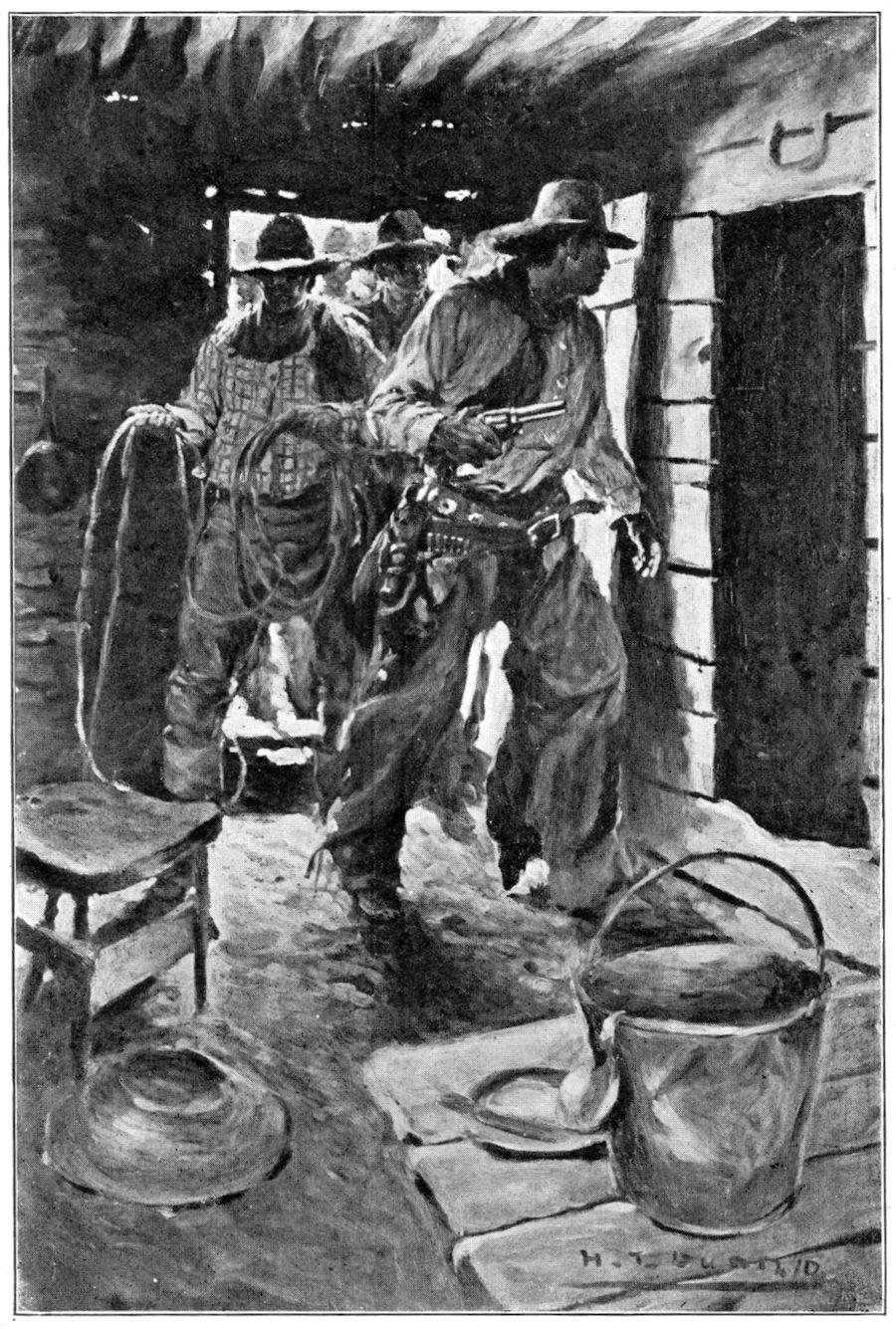
“The lonely hut was untenanted”
Two months passed, and nothing was heard or seen of the black man. The rains held off. North and east the ranges were deluged. A blight appeared to have fallen upon the Tumbling K. The land grew a shade grayer, the dust spurts whirled in gleeful, savage dance, and the cattle gave up the effort of living and lay down to die. All that the boys could do was to distribute salt and feed and work frantically to maintain the water supply. The emaciated brutes would eat of the oil-cake and hay, and sweat profusely on the nose, then stiffen out and expire with a sigh. Those that clung to life carried swollen under-jaws from the strain of tearing at the short grass.
“Poor bastard!” Archie grunted, tailing up a cow he had already helped to her feet three times. “It fair makes a man sick at the stummick to see ’em. Here, you doggone ol’ she-devil! Why don’t you try for to help yourself? Up you come! That’s it; try to hook me.”
It was no use. He shot her where she lay, and skinned her. Then, with the wet hide dragging at the end of a rope and her calf thrown over the fork of the saddle, he set out for headquarters. The orphan was a lusty youngster, and Archie made him many promises, accompanied by many strange oaths.
“Li’l’ dogy,” he said, “I’ll find a mammy for you to-night if I have to tie up the old milch cow. Do you think you can suck a milch cow, dogy? Sure you can. Man alive, feel of him kick! He’s a stout rascal. You’ll be a fine steer some day, dogy.”
On a black-dark night flames leaped above the rim of the mountain, and the Tumbling K were roused from bed to go forth with wet sacks, and rage in their hearts, for the scum of humanity who would fire a range. Twenty-six hours in the saddle and six more fighting the leaping, treacherous enemy; then two hours of sweating sleep on saddle-blankets beside their hobbled horses, and back a score of miles on desperate trails for fresh mounts--three separate times they beat out the blaze with sacks and back-firing. Once more, rising heavy-lidded and dripping from the stupor of utter exhaustion, they saw it licking hungrily through the Gap. No unlucky cigarette-stub thrown amid parched grass, no abandoned campfire, had done this. It was the deliberate work of an enemy.
Orders came to move the cattle down into the valley, lest they perish to the last horn, to the last torn hoof.
“It’ll take you three days to move ’em ten miles,” the manager said; “but never mind. Ease ’em. Ease ’em careful. The man who yells at a cow, or pushes her along, gets his time right there. The only real way to handle cattle is to let ’em do what they want and work ’em as you can. Think that over, boys.”
Manuel Salazar remembered this warning as he moved his tired horse at a snail’s pace behind a bunch of sick ones in the Zacaton Bottom. Manuel made twenty dollars a month with consummate ease, working only seven days in the week and only thirteen hours a day; and he would not throw his job away lightly. Therefore he permitted the gaunt cows to straggle as pleased them, humming to himself while they nibbled at tufts here and there. If one turned its head to look at him it fell from sheer weakness; therefore he held aloof. So the sad procession crept along.
It was in Manuel’s mind to save a mile by moving the bunch through the horse pasture. He put them through the gate with no trouble and was dreamily planning how he might steal back a hair rope Chico had stolen from him, when the quirt slipped out of his fingers. The vaquero got down to pick it from the ground.
“Hi! Hi!” he yelled in panic, and ducked just in time.
A black shape towered above him, striking with forefeet, reaching for the nimble Manuel with its teeth. Its mouth yawned agape; Salazar swore he could have rammed a lard bucket into it. The vaquero swerved from under the deadly hoofs and hit out blindly with the quirt. The stallion screamed his rage for the first time and lunged at him, head swinging low, the lips flicking back from the ferocious teeth. Manuel seized a stone, put to his hand by the blessed saints, and hurled it with precision, striking the horse on the nose. Midnight blared from pain and shook his royal mane in fury, but the shock stayed him and Salazar gained his horse.
“Now,” he yelled, pulling his gun and maneuvering his mount that he might be ready to flee, “come on, you! You want to fight? That’s music to me.”
But Midnight did not want to fight. He had employed craft in stealing upon the man, and now he moved off sulkily, the whites of his eyes rolled back, a thin stream of blood trickling from his muzzle. Salazar longed to shoot holes through his shiny black hide, but contented himself with abuse instead. Was not the stallion worth five thousand dollars? Who was he--Manuel, a poor vaquero--to be considered in the same thought with so noble a beast?
“Tommy,” he said as he unsaddled at headquarters, “I’ve found who killed your pore father. Yes, and old man Greer, too. Don’t look so pale, Tommy.”
Tommy stalked into the manager’s office next forenoon, a very solemn and very determined, if a short and somewhat dirty figure. He was white under his freckles, and he talked through his teeth, jerkily, his eyes fixed unwaveringly on the manager’s face.
“Midnight!” the manager exclaimed. “Nonsense! Why, he wouldn’t harm a fly. That horse would never kill a man. He’s worth five thousand dollars. Since we got him from Kentucky, two years ago, a woman could handle him, Tommy, boy. Salazar must have been teasing him. You’ll have to look somewhere else, Tommy.”
“You mean you ain’t going to do nothing, Mr. Chalmers?” Tommy asked in a dry voice.
“Of course not. Midnight? Impossible. Why, that horse is worth five thousand dollars. He couldn’t have done it.”
Tommy went back home very slowly. That night he sat beside Manuel’s candle and cleaned and oiled a sawed-off .25-30 rifle, inherited from the man who slept on the hill. Salazar smoked lazily and watched him through drooping lids. The boy finished his task and leaned forward on the stool, staring at the tiny flame, the weapon across his knees.
Of what avail to shoot Midnight? Of course it would be easy. Tommy had acquired some degree of skill by blowing the heads off chickens whenever any were desired for the dinner-table, and he felt assured that at two hundred yards he could pick off the stallion with one pressure of his finger. It would be mere child’s work to distinguish Midnight from the mares, even on the murkiest night. But, after all--had the stallion done the killing? He had only Manuel’s experience and suspicions to go on. Moreover, if he took punishment into his own hands they might throw him into a jail. Midnight was worth five thousand dollars: assuredly Mr. Chalmers would cast Tommy out into the world to shift for himself. He put the rifle back under his bunk.
Very discreetly Tommy entered the horse pasture at sunup--he had been unable to sleep for scheming--and made his way down the mile-long fence toward the corner where the mares usually grazed at that hour. He had a six-shooter in his pocket for an emergency, but he hoped that he would not use it. Midnight sighted him and stood rigid a full minute, twenty paces in advance of the mares, gazing at the boy. He was a regal animal; Tommy thought he had never seen so glorious a horse. Then the stallion advanced with mincing steps, his head bobbing, the ears laid back. He sidled nearer, without haste, whinnying softly. The boy waited until he was a dozen feet distant, then threw himself flat and rolled under the barbed-wire fence. With a rending scream Midnight reared and plunged for him, his forefeet battering the ground where Tommy had fallen. He tore at the earth in discomfiture and wrath, and raved up and down on the other side of the fence, his nostrils flaring, his eyes a glare of demoniacal hate. Tommy surveyed him in deathly quiet.
The dark came warm, with puffs of hot wind, so that the Tumbling K men reviled the discomfort joyously, since it presaged rain. So long as the cold nights endured there could be no relief. Tommy slipped from the bunkhouse for a breath of air, though it was past bedtime and they had told him to turn in.
“Apache!” he called in a low tone, gliding into the stall.
The jack cocked his monstrous ears and listened, knowing well the voice. Tommy put a halter over his head and opened the stall door. It was gnawed and scarred by Apache’s teeth and hoofs, and the boy wrenched it from the hinges and laid it aslant on the ground.
“You done bust your way out, Apache,” he whispered. “You hear me, you ol’ devil?”
He led him out into the corral and thence into the lane, talking softly as they went. Apache raised his nose and sniffed of the wind. When they reached the horse pasture the boy tore out the strands of wire at a spot near the corner of the fence.
“You was fond of my Dad, wasn’t you, Apache?” Tommy quavered, working with nervous fingers to unbuckle the halter. “Then go to it.”
The jack required no bidding. He wrenched free and stepped carefully over the wire into Midnight’s domain. Apache never did anything in ill-judged haste. A blur, two hundred yards off, attracted him and he headed toward it eagerly. A moment, and he stopped; then went forward with caution.
Midnight had seen him coming. He trotted out from his band of mares and halted expectantly. Next instant he had recognized Apache for what he was, and shrilled a challenge. The jack brayed like a fiend and went forward slowly to meet him.
Now, a capable jack can whip any stallion that ever breathed. It is really an education to watch a jack like the mighty Apache fight. There exists the same difference between the methods of a stallion and a jack as between those of a nervous amateur boxer and the seasoned champion. A jack has no fear that anyone can detect, and is practically insensible to pain. One can see at a glance what an advantage this gives him over an opponent with any lingering predilection for longevity.
Also, a jack never fights for glory, never fights for the gallery. His sole object is to win. Wherefore, no idle and frivolous prancing about for him--no swift rush in, a blind striking with hoofs, a tearing with the teeth, then out again. A jack is not constructed that way. Fighting is a business--a serious, albeit a pleasurable, business; and he attends to that side of it with passionate singleness of purpose. He will watch his opportunity with the alert coolness of the professional, wasting not an ounce of energy. When the opening comes he goes to it like the stroke of a rattler, gets his grip and shuts his eyes and hangs on. There is considerable of the bulldog in a jack, and if he is to be gotten off at all, one must pry him off with a crowbar; in fact, next to a Shetland stallion, which is the darlingest little fighter that ever tore at an enemy’s ribs, nothing more instructive can be witnessed than a full-sized jack in a fair field and no interruptions.
Apache had fought before--many, many times. Therefore he made for the foe with circumspection, his head jerking sideways, his tail tucked, ears laid flat on his neck, and his feet barely touching the ground, so lightly did his tense muscles carry him. One evil eye measured the giant horse with venomous composure.
Vastly different was Midnight’s attack. The stallion had pluck to spare, but his temper was overhasty and his skill slight. Rage forever clouded his judgment in encounter. He had learned only one plan of battle and that was to rush and bear down his opponent. There was his rival. He would kill him. Midnight’s was a simple creed.
His harsh scream rent the night silence, and the fight was on. Another horse would have circled so formidable an adversary in an endeavor to create an opening, but the black’s temper was too imperious for delay. Straight was his rush. He bore down on the jack at the top of his speed, his wonderful, supple body a-quiver with eagerness and anger.
Then Apache did a remarkable thing--a thing almost human in ingenuity. What Apache didn’t know about fighting is best forgotten. Swerving ever so slightly as the black came, he lunged to meet him, crashing shoulder to shoulder with all the strength of his tough sinews behind the impact. Hit sideways, taken off his balance, the force of Midnight’s own charge contributed to his overthrow. Down he tumbled, scrambling with his feet as he fell. Before his body touched the ground, the jack whirled and lashed with both heels into his sides. With the same appalling speed, Apache drove for the throat of his prostrate enemy, secured his grip and shut his eyes, wrenching frenziedly from side to side and upward.
It is well not to tell further what Apache did to the mankiller. A jack has about as much sense of mercy as he has of fear, and he has never been taught any rules of warfare. When he gets his enemy where his enemy would like to get him, he does his utmost to obliterate him from the face of the earth. So it was that next day the Tumbling K men were barely able to recognize the Kentucky stallion in the torn, broken, black pulp they found in the horse pasture.
All night long Apache brayed and screeched. The noise of his triumph would set a soul to quaking. It pierced Manuel’s dreams and he muttered in his sleep a prayer for protection from the Evil One. The jack pranced around and around his victim, and up and down the pasture, wild with the joy of battle, magnificent in his superb strength and the pride of victory. Toward dawn he abandoned the carcass and drove off the terror-stricken mares as the just spoils of the conqueror.
Big white clouds boiled up back of the mountains that afternoon, with a stiff wind from the southeast behind them; and at sunset the heavens opened of their blessed treasure. Manuel and Tommy lay in the bunkhouse listening to the thunder of rain on the sod roof. A burro came to the door and poked his patient head inside, seeking warmth and a friendly dry spot.
“Come in!” cried Manuel cheerily. “Take a chair. Tommy, give him your bed. Ain’t that music, though? Hark! Oh, the cattle! Can’t you see them soaking in it, boy?”
A yellow mongrel ousted the doubtful burro from the doorway and began nosing about for a place to rest his uneasy rump. The roof was leaking in strong, hearty streams, and Salazar sprawled on his back, letting the water run on to his chest. He was smiling placidly. Tommy snuggled into the blankets and pictured to himself a new land of much grass, and clear-eyed, contented cows and high-tailed calves.
“The curse is lifted,” Manuel observed piously. “Yes, sir. The dear God sent the jack to kill that stallion. How else could it be? What do you think, Tommy, boy?”
“I reckon so,” said Tommy.