My shipmates—Tom Tubbs the boatswain—Sight a suspicious craft—Alter our course to avoid her—Chased—A heavy squall—A thick mist—We hope to escape—The stranger reappears—Night comes on and we low sight of her—Once more the stranger is seen in hot chase—Opens fire—Desperate fight—We attempt to rake the enemy—He frustrates it—The enemy hoists the pirate flag—Boards us—Our crew overcome—The captain and boatswain, Harry and I, fight desperately—Captain Trunnion appears—Spares our lives—Dreadful state of the deck—Tom, Harry, and I taken on board the “Vulture”—Captain Magor ordered to navigate the “Arrow” into the Sherbro—The vessels part company. (continued 3)
Reading edition
“Do you think we could help some of them?” I said to Aboh, pointing to the wounded men.
“No good,” he said, and made a sign that they would soon be dead. I went up to three or four, and was convinced from the nature of their hurts that I could do nothing for them; indeed, the spirits of most of them fled while I stood by. Aboh then, seizing my arm, hurried me away.
I found Charley and Harry very anxious about me, for hearing the firing, they supposed that I must have been in the thick of it, and by my not coming back they thought that I was either killed or taken prisoner.
“One thing is certain, we must not remain here a moment longer. The negroes will very likely pass this way, and either kill us all or carry us off into captivity,” observed Charley. “I have heard that the black people in this part of the country are among the most savage of the African tribes, and that some—the Fans—are cannibals. I don’t know to what tribe Aboh belongs, but I hope he is not a Fan.”
“Maybe he is, and intends to deliver us to his countrymen, to serve as a feast given to celebrate his safe return to the bosom of his family,” said Tom, in a tone half in joke half in earnest.
“He has hitherto shown only good feelings, and we will trust him, at all events,” said Charley.
He made signs to Aboh that we wished to move on, and being anxious to find water, we begged that he would lead us to it as soon as possible. He nodded, and pointed to the east. We were too thirsty to hesitate about going in that direction, although we should thus be led farther than we wished from the coast.
We accordingly once more set off, Aboh hurrying us along as fast as we could make our way through the thick forest, stopping at first every now and then to listen as the sound of distant firing was heard, and then apparently to ascertain whether any of the blacks were coming towards us. Aboh’s object was evidently to avoid both parties. It was most likely that the slaves whom he had deserted would murder him for having left them, while the people of the other tribe were probably hereditary enemies of his, and would without ceremony have put him to death. We were by this time very hungry as well as thirsty, but our thirst prevented us from eating, and we urged Aboh to endeavour to find water without delay. He merely pointed eastward, and nodded his head as before.
“Well, keep moving, my black angel; whatever you do, keep moving, and lead us to the water,” said Tubbs, patting him on the back.
We marched chiefly under the shade of the forest trees, where we found it tolerably cool; at the same time, as Tom observed—“In the opening the sun was hot enough to roast an ox.”
At last I felt that I could go on no longer. I threw myself down at the roots of a large tree. Harry, who was marching with me, while the rest were ahead, endeavoured to rouse me up.
“No, no,” I said; “go on. If you find water, bring me some, though I doubt if I shall be alive by that time;” and I spoke as I felt.
“Nonsense!” cried Harry. “You are the last person of the party I should have expected to give in. I’ll stay by you until you are rested, and then we will hurry on after our friends.”
“Perhaps we shall lose them if we are separated,” I answered.
The thought made me arouse myself, and rising to my feet, I staggered on. Harry shouted to Charley and Tom, and they came back to give me their assistance. We had not gone far after this, when Aboh shouted out—
“Dere water, water!”
We caught sight of a bright gleam shining through the trees. Though we were in Africa, we knew that it was no mirage, which only appears on dry and sandy deserts. We all hurried on, knowing that our burning thirst would soon be relieved. As we drew nearer, we saw a lake stretching out before us, on the banks of which appeared numberless birds. There were long-legged storks, cranes, pelicans, pink-winged flamingoes, ibises, and similar waterfowl of various descriptions. As we appeared, those nearest to us took to flight, the beautiful flamingoes rising in the air with their long legs stretched out behind them. One thought, however, occupied our minds. How to get to the water, for we feared that we should find muddy banks, which might prove impassable. Aboh’s quick eye, however, detected a small inlet into which a rivulet fell. He led us down to a hard, gravelly bank, where the water ran as clear as that of an English trout-stream.
We did not stop to consider whether alligators lurked beneath the lilies which floated on the surface, or huge snakes were concealed near at hand waiting for their prey, but kneeling down, we plunged in our heads, and drank huge draughts of the cooling liquid. Cooling it was to us, although probably it would have been thought somewhat tepid in a colder climate. In an instant I was revived, and my companions felt the same sensations.
We could now sit down and enjoy a few mouthfuls of the food we had brought from the wreck, which we took to stay our appetites. We intended, before many minutes were over, to have some of the waterfowl flying round us cooking before the fire. Charley and Harry, being tolerable shots, agreed at once to try and knock over a sufficient number for our wants, while Tom and I collected sticks for a fire. Aboh, seeing them set off, started by himself in an opposite direction.
“We’re not likely to starve on our journey, Mr Westerton, if we are fortunate enough to fall in with as many birds as we see around us just now,” said Tom.
“I am afraid that we cannot expect always to camp on the borders of a lake or river,” I answered. “It will be plenty one day, and starvation the next. However, if we are prudent, I hope that we shall get along without much suffering. There are probably wildfowl to be found, and then we may fall in with friendly tribes, of whom we can purchase food. At all events, don’t let us expect misfortunes until they come.”
“That’s what I never have done, and never intend to do,” answered Tom. “I’ve always held that there’s ‘a sweet little cherub who sits up aloft, to take care of the life of poor Jack;’ and although that may sound like a heathen song, there’s truth in it notwithstanding.”
We were talking thus while engaged in collecting sticks, cutting some with our axes, and picking up others, until we had made a large pile, sufficient, Tom averred, to roast an ox, when we saw our friends coming back, each loaded with half a dozen ducks. Directly afterwards Aboh appeared, carrying a still greater number, which he gave us to understand that he had captured by swimming out into the lake, his head concealed by a cap of rushes, towards a flock floating unsuspicious of danger near the margin, and that, getting close to them, he had pulled them down under water by the legs. As the slight repast we had eaten had only just taken off the edge of our appetites, we eagerly plucked a bird apiece, and had them spitted in a few minutes before the fire.
“If we only had some pepper and salt, we should do well,” said Harry.
“Here they are, sir,” said Tom, producing from his knapsack a bag of each.
“We are greatly indebted to you, Mr Tubbs, for your forethought,” observed Charley; “but remember, we must husband these treasures, for it may be a long time before we are able to replenish them.”
By the time we had finished our repast, the sun had sunk behind the trees of the forest we had passed through, and as we could not go farther that night, we agreed to camp where we were. It was important to keep up the fire, as we might otherwise receive an unwelcome visit from a lion, elephant, or leopard, or perhaps from a huge species of ape, numbers of which we had reason to suspect were in the neighbourhood, though we had not as yet seen any. It was, of course, settled that we should keep watch, each one of us taking it in turns. Not knowing how far Aboh might be trusted, we did not ask him. Before sitting down we collected a further supply of fuel, and cut down some boughs, with which we constructed a rude arbour to shelter our heads and bodies from the night dew, although it would have been of little service in case of a fall of tropical rain. Tom suggested that, as Charley was leader, he ought not to keep watch.
“No, no,” said Charley. “I will share with you all in that respect;” and he offered to keep the first watch. Harry took the second, Tom the third, and I the morning watch.
Tom called me, saying that he had been listening to the mutterings and roars of lions, the occasional cries of deer as they were pounced on by some savage beasts, and the shrieks and other strange noises of night birds. “But you mustn’t mind that, sir,” he said; “you’ll soon get accustomed to them. If you see anything suspicious, don’t mind rousing me up, although you may not wish to awaken the whole party.”
I promised to do this, and began to walk about in front of the fire. However, feeling very tired, I sat down, placing my rifle by my side. While thus seated, I confess that, unexpectedly, my eyes closed. It appeared to me but for a moment, although when I opened them daylight had broken, and a bright gleam cast from the orange-tinted sky was thrown over the lake. I was about to spring to my feet and stoop to pick up my rifle, when I found it had gone. On looking round, I saw Aboh holding it in his hand and moving cautiously away from the camp, while he presented it at some object of which he had caught sight a little distance off, and on which his eye was intently fixed. He did not appear to hear me as I followed, when what was my horror to see an enormous serpent, its neck rising in the air, its mouth extended as if about to spring. Aboh stepped behind a small tree, which afforded him some protection, and resting the barrel of the rifle against the trunk, fixed his eye on the creature. It seemed to me about to make its fatal spring, when he, and perhaps my companions and I as well, might have been destroyed. The serpent rose in the air, Aboh fired, its head instantly dropped, although the body continued to writhe and twist along the ground.
The report aroused the rest of the party, who sprang to their feet. They looked greatly astonished when they found it was Aboh and not I who had fired. This, I may say, was the first of many dangers we escaped from the huge monsters of that region. On measuring the snake, we found it full thirty feet in length, with a girth as large as the body of a stout man. Indeed, we agreed that the creature could have swallowed any of us, or all of us in succession, had he been so disposed.
“Good eat,” said Aboh, as he cut off the creature’s head.
While we cooked the ducks, he roasted a piece of the snake’s flesh at the fire, and ate it in preference to them.
We had now to decide what course to pursue, whether to take the eastern or western side of the lake. Charley was disposed to think that we should find the western very marshy, for, looking in that direction, the ground appeared to be covered with tall reeds, while the distance round the eastern side would evidently be much longer. On consulting Aboh, he gave the preference to the eastern side, intimating that the people we had seen, who had attacked the slaves, resided between the lake and the sea, and that probably they would not allow us to pass through their territory without depriving us of everything we possessed, even should we escape with our lives.
“If you’ll take my advice, gentlemen, before we start, you’ll make some hats to keep the sun off your heads; it won’t take us long, and depend upon it, we shall find it very hot along the borders of the lake. Mr Westerton, I daresay, knows how to make a straw hat as well as I do.”
Charley said he did, and he and Tom quickly procured a quantity of dried palm-leaves, which, splitting up, they formed into wide rough plaits. Harry and I imitated their example. In a few minutes they had enough plaited to form a hat, when, with some large thorns for needles, and fibre for thread, they stitched the plaiting together as quickly as they made it Harry and I were longer about our task, for we managed to make only one hat while they put together two, but in less than an hour we were each provided with a very fair straw hat. Some handkerchiefs, which we had brought from on board served to line them, and make them more impervious to the sun.
Our task completed, strapping our knapsacks on our backs and shouldering our rifles, we commenced our march along the shores of the lake.
Chapter Eight.
Our march westward along the shores of the lake—Tom and the crocodile—Charge of elephants—A narrow escape for Charley—Anxiety on Tom’s account—Besieged in a tree—We have recourse to stratagem and recover our rifles—Aboh’s daring—Renewed attack—The enemy repulsed—Search for our companion, whom we find severely injured—We camp—Danger from crocodiles—Cooking the elephant-meat—Aboh’s skill—Strange noises heard at night—We are compelled to halt—An African forest giant—Tom recovering from the accident slowly—Charley proposes to build a canoe.
According to Aboh’s advice we proceeded eastward, with the lake on one side and the vast trees of the forest rising up to an immense height on our right. Frequently the indentations in the shores of the lake compelled us to keep away from the water, when we trudged on completely surrounded by trees. Even at mid-day it was dark and gloomy, not a ray of the sun penetrating to the ground which we trod. Sometimes the silence was profound, when suddenly it was broken by the shrill scream of a parrot, or the chatter of a monkey as he caught sight of us from his leafy covert.
We saw no other animals, though we discovered elephant tracks and other marks on the ground. Aboh, on examining them, said that they were made by leopards, those savage animals abounding in the forest through which we were passing. On the shore of the lake, however, we caught sight of numerous crocodiles, some poking their ugly snouts above the surface of the water, others basking on sandbanks, or on the points projecting out into the water.
Once, as we were keeping along the shore, the head of a huge monster rose not ten feet from us. Aboh shouted, “Run, massa, run.” His warning came only just in time. Charley, who was farthest from the water, instantly brought his rifle to his shoulder as he saw the crocodile making a dash at Tom, who was nearest to him. Aboh shouted and shrieked to scare the creature. Its jaws were within a foot of Tom’s legs, when Charley, knowing that our companion’s life depended upon the correctness of his aim pulled the trigger and the ball entered the monster’s head through the eye. Tom gave a desperate leap on one side, the crocodile still moved on, and I fancied that Charley must have missed. Harry and I, imitating Tom’s example, sprang out of its way. It had not run five yards on dry ground, however, before it stopped, then rolling on its side, began to kick violently. Harry quickly had his rifle ready, and firing down its throat, put an end to its struggles. Aboh proposed cutting some slices out of its body for dinner, but we declined joining him in the repast, as we hoped to catch as many birds and monkeys as we might require. The narrow escape we had had taught us that we must in future avoid marching close to the water, and that it would be prudent to keep a bright look-out when near the shores of the lake not to run the risk of being snapped up by a crocodile.
We were disappointed in consequence of this at not being able to sleep securely, as we had expected, close down to the water, so that we might have only one side of our camp to defend. From the experience we had obtained we now saw that we should run a greater chance of being carried off by crocodiles than even by lions or leopards.
We had marched on for about an hour after the occurrence I have described, when finding that we could cut off a point by proceeding straight on, we had of necessity to leave the shore of the lake, the water of which we had hitherto always had in sight. We had made good some distance, often having to cut away the creepers which impeded our path, and were expecting soon again to catch sight of the water, when loud trumpeting sounds reached our ears.
We stopped to listen, and were soon convinced that the sounds we heard were uttered by elephants, and, moreover, that they were for some cause or other excited by rage. However, as the animals were, we judged, still at some distance on our right hand, we agreed to continue our course, hoping that they would not discover us. In case they should do so, and we should have to defend ourselves, we put bullets into our rifles. The evening was approaching, and it was necessary to look out for a spot sufficiently open to enable us to light the fire, and at the same time not in too dangerous proximity to the lake. That we might have a better chance of finding the spot we were in search of, we separated, Tubbs and Charley going on ahead, while Harry, Aboh, and I searched round on either side of where we then were. We found that we were at no great distance from the lake, the shining water of which we saw between the trees.
“Here’s a spot just suitable for us,” cried Harry, “but we shall have to cut down the grass that the fire may not spread, otherwise we may create a blaze which would prove very inconvenient.”
Just as he spoke the trumpeting sounds we had before heard again reached our ears, but very much nearer. Aboh stopped in an attitude of listening. Presently there came a noise as of the crashing of branches and the tramping of heavy feet on the ground. “Elephant come dis way,” exclaimed Aboh; “run, massa, run;” and he set off in the direction of the lake, pointing to a large tree at no great distance from us.
Harry and I followed his example, hoping that Charley and Tubbs would hear the sounds in time to make their escape. The trumpeting and crashing sounds drew nearer. Presently we caught sight of several huge trunks lifted in the air, with gleaming tusks below them, and the huge heads of the savage monsters among the leaves.
“Here, massa, here, get up!” exclaimed Aboh, reaching the foot of the tree.
As he spoke, seizing a bough, he swung himself up with the agility of a monkey onto a lower branch. I cast my eye behind me, when what was my horror to see Charley coming along with three or four elephants dashing at full speed not thirty yards behind him. It seemed scarcely possible that he could reach a place of safety before he was overtaken. All my thoughts were now turned on Charley, and I regretted that I had not managed to hand my rifle to Aboh before climbing up myself. Charley had dropped his, and came bounding along, the elephants, however, gaining on him. He saw us, and made towards the tree. Aboh and I stooped down to catch his hands and help him up. He was within twenty yards of us, when his foot caught in one of the treacherous vines which crept in snakelike coils over the ground and hung from numberless branches, and he fell. He was instantly, however, again on his feet, and came rushing on as before; but the delay had enabled the leading elephant to gain on him. We shrieked and shouted to encourage him, or perhaps impelled to do so by our fears. He reached the foot of the tree. In another instant the elephant would have seized him with its trunk or trampled him under its feet. Had he not possessed unusual activity his destruction would have been certain. He grasped the bough nearest him. Aboh sprang down and got him by one hand. I seized him by the other. The elephant’s trunk was already touching his leg, which would the next moment have been encircled in its fatal embrace. We tugged and hauled; the animal caught his shoe, which happily gave way, and Charley was out of its reach. We now breathed more freely, for the tree was far too stout to enable the elephants to tear it down. The beast which had so nearly caught Charley stood trumpeting with rage beneath our feet, lifting up his trunk in a vain attempt to reach us.
We, as may be supposed, climbed higher up, so as to be well out of his way. In a few seconds the remainder of the herd came up, surrounding the tree and all trumpeting together. It was a sound sufficient to make our hearts quail. Had we possessed our rifles, we might have quickly put an end to the animals, mighty as they seemed. Fortunately, in their rage they did not discover them, as they were concealed in the tall grass and leaves between the roots. We dreaded, however, every instant that their feet would come down and crush them, when they, in all probability, would have been rendered perfectly useless.
Our thoughts were now turned towards Tom. Charley said that he had lost sight of him just before he saw the elephants, but that he trusted he had sought safety in a tree as we had done. We shouted out, hoping that he would hear us; but the trumpeting of the elephants drowned our voices. However, although we did not get any answer, we still hoped that he might have escaped.
“I wish that I had not lost my rifle,” said Charley, “although I think I should be able to find it again if the beasts did not trample upon it, and I don’t think they did, for I threw it as far from me as I could into a thick bush.”
“If you hadn’t thrown it away, both you and it would have been crushed to pieces,” answered Harry. “I think it is fortunate that you had presence of mind to get rid of it. But, I say, I wonder whether these beasts are going to lay siege to us all night. I’m getting very hungry. If they don’t go away we shall be starved.”
“Perhaps the best thing we can do is to climb up higher and hide ourselves, and then, when they don’t see us, their rage may abate, and they will go away,” I remarked. “They are not likely to remain here all night, and will probably go to the lake to drink, and give us time, at all events, to get down and recover our rifles.”
“What does Aboh think about the matter?” asked Charley.
I inquired of the black, making the usual signs by means of which we carried on a conversation with him, and using such simple words as he was likely to understand. He evidently comprehended what I said, and highly approved of our plan of hiding ourselves, setting the example by climbing up and concealing himself from the elephants below. We three did the same, though I managed still to watch them by peeping through the leaves of the bough on which I had perched myself. The creatures in a short time ceased their trumpeting, but still remained walking slowly round and round the tree, looking up in a sagacious fashion to ascertain what had become of us. At last they appeared either to forget us, or to fancy that we were birds, and had flown away. The biggest elephant, which had so nearly caught Charley, then led the way down to the lake, the rest following him. It was with infinite satisfaction that we saw them go.
“Now, quick, quick! let us get our rifles, at all events, before they come back,” whispered Charley.
Aboh, seeing me about to descend, made a sign that he would go himself, and, with wonderful agility, he slipped down the tree, while Charley descended to the lowest bough to reach the rifles as he handed them up. I followed, keeping a little above my brother, that I might pass them on to Harry. I felt very thankful when Aboh handed up my rifle to Charley, who giving it to me, I passed it on to Harry. Aboh then, again slipping down, handed up Harry’s. To our infinite relief neither of them were injured, though the feet of the elephants must have trampled the ground on either side.
“Him go get massa officer’s rifle,” said Aboh, who was delighted to make use of some of the words with which he was best acquainted; and without waiting to obtain our sanction, he darted off in the direction from which Charley came.
“See if you can find Tom anywhere,” I shouted.
Aboh turned and made a sign to us to be silent, pointing at the same time towards the lake, where the elephants were drinking. I regretted having cried out, lest my voice should have attracted the creatures’ attention, and might cause them to return and look for us. Although Aboh probably thought that Tom was concealed somewhere in the neighbourhood, yet, knowing the importance of silence, he did not cry out to ascertain his position.
We watched him anxiously, for we feared that at any moment the elephants might come back before he could discover the rifle, which might take some time to find. We saw him hunting about, but Charley said that he thought the spot where he had thrown it away was much farther off. At length he was altogether hidden from our sight by the thick foliage.
“Harry, do you climb up and keep a look-out for the elephants, and Dick and I will stand by to help up Aboh when he comes back. If you see the beasts coming, send a shot into the head of the leader; if you don’t kill him, it will probably bring him to a standstill or turn him aside, and give the black more time to climb up the tree,” said Charley.
“Ay, ay!” answered Harry, taking his rifle; “I’ll do my best to stop the brutes coming this way, at all events.”
Charley and I waited on the lower branches, my brother being beneath me, watching for the return of Aboh. At last we saw him coming along with Charley’s rifle in his hand. At the same instant Harry shouted out—
“Here come the elephants with their trunks turned up, but they are walking leisurely along, as if they had forgotten all about us.”
“Don’t fire, then, unless they come close to the tree,” answered Charley, while he made signs to Aboh to hasten his steps, pointing as he did so towards the lake. Aboh sprang forward, but the quick ears and quick sight of the elephants had detected him, and sticking out their trunks, they begun trumpeting and moving rapidly forward. I scarcely thought it possible that Aboh could escape them. Just then we heard the report of Harry’s rifle over our heads. A shriek of rage escaped the leading elephant, and he had, we concluded, been hit. At the same moment Aboh stopped, and levelling his rifle, fired. The ball struck the animal, which, however, still came on, although at a slower pace than before, and Aboh, grasping the rifle, darted up the tree holding it above his head, so that Charley could stoop down and seize it by the barrel. Handing it to me, he was able to assist Aboh, who nimbly scrambled up.
We all then retreated to our former resting-places, out of the reach of the elephants’ trunks. The whole herd came on, the leader bleeding but still trumpeting furiously. We, however, had him in our power, and felt pretty sure that his trumpetings would soon be over. My weapon was still loaded, Charley asked me to let him have it, as he was in a better position for firing than I was. I handed it to him, and as the elephants came near he took aim at the leader, waiting until in his circuit round the tree his head presented a fair mark. He fired, the huge monster immediately sank down, and almost without a struggle was dead. We could not resist joining Aboh in the loud shout of triumph he raised as we saw our enemy destroyed. On the fall of their leader, the other elephants became alarmed, and uttering a few trumpetings, more of fear than anger, rushed off together into the forest, crushing down the shrubs and young trees as they went, making a good pathway towards the southward, which would have saved us much trouble to have followed had we wished to go in that direction. We now, feeling sure that they would not return, descended. Our first care on reaching the ground was to reload our rifles.
“I wish that we could carry off the tusks,” said Harry. “I’m sure they would be worth no small number of dollars if they were safe on board.”
“It is very certain that we cannot get them down to the sea at present, and probably before we can return to fetch them some other hunters will have carried them off,” observed Charley.
While we were discussing the subject, Aboh had got out his knife and was working away at one of the animal’s feet, which he succeeded in cleverly amputating.
“Him good eat,” said the black pointing to the foot he had just cut off.
Although we certainly could not agree with him, we did not contradict his assertion. He then cut some slices out of the back, which had not a more attractive appearance than the foot. The black, however, seemed to think that we had now an ample supply of food. We should have camped on the spot, as the shades of evening were already coming on, had we not been anxious to discover Tom.
“We must find him before nightfall,” I observed; “for even although the creatures may not have killed him, he may be injured and unable to rejoin us.”
“Certainly, unless he has got to a considerable distance, he must have heard our shouts,” remarked Harry.
Charley agreed with us, and we accordingly proceeded in the direction of the spot where Charley had left our companion. As we went on we shouted out his name, while we looked carefully on either side, dreading at any moment to discover his mangled remains. Aboh hunted about with great care, but for some distance the ground was so trampled by the elephants’ feet, and the trees and shrubs so torn, that any footsteps of a human being must effectually have been obliterated. Presently, however, we crossed the path formed by the herd as they had made their way towards us, and all traces of them ceased. A short time afterwards we saw Aboh examining the ground, then he pointed ahead and went on at a rapid rate, we following his footsteps. Again he stopped, and stooping down picked up a rifle. We recognised it as Tom’s. What had become of its owner? Still Aboh went on.
By this time the forest was so shrouded in the gloom of approaching night that we could with difficulty see anything before us. Again Aboh stopped and cried out, “Him here! him here!” We hurried forward. There was our poor friend stretched on the ground, his leg caught in a vine below a tall tree with branches coming close to the ground. The dreadful thought seized me that he was dead.
“Tom, Mr Tubbs, speak to me,” I cried out I heard a groan. At all events, he was alive. Stooping down, I rested his head on my knee. Charley and Harry quickly came up. We soon released poor Tom’s foot. On examining it, we feared that it was dislocated, or at all events severely sprained, and that probably he had fainted from the pain. Having water in our flasks, we poured some down his throat. By wetting his hands and chafing his arms we in a short time brought him to. He looked round him, evidently very much astonished.
“Where am I, mates? What has happened?” he asked at length. “I was dreaming that a shark or a tiger or some beast or other had bitten off my foot.”
“Not so bad as that,” said Charley, “although you have hurt it considerably, I fear.”
“Ah, now I recollect all about it. I was afraid, Mr Westerton, that you were caught by the elephants, and I was expecting to share the same fate. As I could not help you, I thought the wisest thing I could do was to run for my life. I confess it, I never was in such a fright before. I somehow dropped my gun, and then, just as I was about to climb up into that tree overhead, I found myself caught with a round turn about my leg, and down I came. The honest truth is, I don’t remember anything more of what happened after that.”
It would have been unjust to blame poor Tom for the very natural panic which had seized him on finding himself alone in the forest, and, as he supposed, with his companions killed. He had acted as most people would have done under similar circumstances, and endeavoured to save his life. We fortunately found not far off just such an open space as we were searching for. Our first business was to light a fire in the centre of it, after having cut away the surrounding grass.
“We must keep up a good blare, or we may have some unwelcome visits from wild beasts,” said Charley. “It will be necessary to keep an eye towards the lake, or one of those horrid crocodiles may be crawling up in search of some supper when the odour of the roasted elephant-meat reaches his nose.”
While Charley and I attended to poor Tom, Harry and Aboh made up the fire as proposed. We had brought an iron saucepan, with which Aboh intimated that he would go down to the lake to get some water, making a sign to Harry to accompany him with his gun.
“If big ting come out of de water, fire at him head,” he said, showing that he was fully alive to the danger of approaching the lake, especially of an evening, when the crocodiles are more active than at other times during the day.
We kept the fire blazing up brightly, so that it might scare any wild beasts prowling round about us. However, not trusting to that alone, Charley and I kept our rifles by our sides and our eyes about us, lest a lion or leopard might spring upon us unawares. Having got off Tom’s boot and sock, we examined his ankle. It looked blue and swollen, and when we touched it he complained that it pained him much. Still, as far as we could judge, no bone was broken.
“The only thing I can think of is to bind it up in a wet handkerchief,” observed Charley; “the inflammation may thus be allayed.”
While we were speaking we heard a shot from Harry’s gun, showing that we must not expect to obtain even a saucepan of water without trouble. Shortly afterwards Aboh returned with the water. Charley asked for some of it, and saturating a handkerchief, which he fortunately had in his pocket, he bound up Tom’s ankle. Harry told us that scarcely had Aboh dipped the saucepan into the water, than a crocodile poked its ugly head above the surface and made a dash at him.
“I was too quick, however, and firing, hit the creature in the throat, when it slid off again into deep water,” he added, “whether killed or not I cannot say, as it sank immediately.”
“You have done so well that we must get you to make another trip as soon as we have eaten our soup, which, I suppose, Aboh intends to make out of the elephant-meat, for I doubt if it will be palatable cooked in any other way,” said Charley.
We found that the black had brought several stones from the shores of the lake. He now, having placed them in the fire, dug a hole near at hand, into which he scraped some of the ashes, and then put in the stones with the elephant’s foot on the top of them. Above this having placed some thick leaves, he quickly filled up the hole.
“Him soon good eat,” he said.
Harry had in the meantime cut up some pieces of elephant-meat, which he put into the saucepan. Having placed it on the fire, he stuck some other slices on forked sticks as close as they could be placed to the flames.
“We shall have the opportunity of trying the comparative excellencies of three styles of cooking,” he observed, laughing.
“I have no great faith in Aboh’s mode of proceeding,” remarked Charley.
“Nor have I, except to produce any especially excellent soup,” said Harry.
Our patience was to be severely exercised. We were all so hungry that Charley consented to serve out a small piece of biscuit to each of us, just to stay our appetites; but that produced a very transient effect. At first I saw him tightening his waist-belt; then I had to tighten mine, as Harry did his. Poor Tom was suffering too much pain to care about eating, and Aboh was well accustomed to endure long hours of fasting.
“When is that mess of yours likely to be ready?” Charley and I kept crying out to Harry.
“I think that it is done to a turn now,” said Harry, and he produced five pieces of black-looking stuff.
“A very long turn,” said Charley as he took his share. “Why, it’s as hard and dry as shoe-leather, and quite as tough, I suspect.”
“Chew it, man, chew it,” answered Charley, laughing; “it’s better than that in the soup.”
We all cut off little bits, hunger making us in no way particular; but it was a difficult business to get down a mouthful. At last I took to scraping it with my knife, by which means I was able to swallow more than I otherwise could have done.
We next tried the soup. The warm liquid could at all events be swallowed, and it appeared to do good to poor Tom, to whom we gave several cupfuls. The meat, however, was scarcely an improvement upon the steaks. Aboh had been watching us all the time while he munched his share without showing a sign of dissatisfaction.
“As we shall want some more water for poor Tom’s foot, I wish you would go down, Harry, to the lake and fill the saucepan,” said Charley.
“I will go with Aboh willingly enough, provided he carries a torch, for otherwise the chances are that we shall not get off as easily as we did before,” answered Harry.
Aboh understood what was proposed, and taking a brand from the fire in one hand, and the saucepan in the other, he set off, Harry accompanying him with his rifle ready for instant use. Charley and I, in the meantime, got up and examined the forest around us. Strange noises were issuing from it; but our ears being unaccustomed to the sounds of an African wilderness, we could not distinguish either the animals or birds which produced them. Here and there we picked up sticks, which we carried to the heap prepared for keeping up the fire during the night. I was stooping down, expecting to take up a thin stick, when I saw it glide away. I had nearly caught hold of a snake by the body. It might have been harmless, but if venomous, I should have probably been fatally bitten. I sprang back, as may be supposed, and was very cautious after this to feel with the pole I carried in my hand before I picked up any other sticks. In a short time Harry and Aboh came back with the saucepan of water, from which we filled our mugs, for the tough elephant-meat made us thirsty. We were all suffering from hunger, and as we expected to find Aboh’s dish as unpalatable as ours, we had made up our minds to lie down, if not exactly supperless, as hungry almost as before.
“Now, massa, him ’tink foot ready,” said Aboh, and without more ado, he opened the hole and produced the foot hot and steaming. Just taking off the top, as if it had been a piece of piecrust, what was our surprise and very great satisfaction to find the interior full of a rich glutinous substance. We eagerly hooked it out with our knives, and it was pronounced excellent jelly, although somewhat strong tasted. The single foot contained more than we altogether could eat, although Aboh got through twice as much as either of the rest of us. We regretted that we had not brought along more of the elephant’s feet.
Instead of going supperless to bed, we thus had a more ample meal than we had eaten since we landed. As it was important that Tom should have a night’s rest, Charley, Harry, and I agreed to keep watch in turns. We did not ask Aboh, though he would, we felt sure, have proved trustworthy. I had the middle watch. As I walked round and round the camp, my ears were saluted by distant mutterings and the occasional roar of lions, the trumpetings of elephants, or the shrill agonised cry of some hapless deer on which a stealthy leopard had pounced, the shrieks of night birds, the chirp of insects, and the croaking of frogs. Every moment I expected to see some monster shove its nose out amid the dark foliage; but if any came near, the fire prevented them from springing on us. I occasionally stooped down and wetted Tom’s bandage, so that his leg was kept cool all the night. Charging Harry to do the same, I at length lay down, and in a moment was fast asleep. Next morning we found Tom better, but utterly unable to proceed. We, therefore, had to make up our minds to camp for another day at least, unless we could manage to find a canoe in which to cross the lake. Harry and I, as soon as we were on foot, took our guns, accompanied by Aboh, in search of game for breakfast. We soon came upon a number of ducks, and were fortunate in killing half a dozen in three shots, two being brought to the ground each time we fired. We did not forget the crocodiles, nor did Aboh, who was very wary when picking up the birds. As we made our way through the forest, I was especially struck by the variety and luxuriance of the trees and shrubs, the number of vines which hung from the branches in wreaths and festoons, the length of the leaves, some rising from the ground, others forming crowns on the summits of tall trees, surmounted by flowers of bright red or yellow or blue.
“Dere, massa, what you ’tink dat?” said Aboh, throwing himself on the ground as if to contemplate at his ease the magnificent tree before which we stood. “Him ’board ship worth many tusks.”
“What tree is it?” I asked.
It was certainly one of the finest and most graceful trees we had yet met with in the African forest. Its leaves were long, sharp-pointed, and dark green, hanging in large clusters. Its bark was also a dark green and very smooth. The trunk rose straight and clean to the height of sixty feet or more, from whence large leafy branches projected to a considerable distance. Aboh pointed to his own skin and then laughed.
“He means that it’s an ebony tree, and so I’m sure it is,” said Harry. “It is one of those articles we were to have procured.”
On examining the tree we found that it was hollow, and Aboh made us understand that the branches also were hollow. On cutting through the bark we came to some white wood, which at first puzzled us. We expected to have found it black, but Aboh made signs that we were to cut deeper into it, and we thus ascertained that the white wood was simply sap wood, and that farther in the wood was perfectly black. We found several others of the same description growing around; and we agreed that if we could fall in with some friendly natives, we would advise them to cut the trees down, and should any navigable river exist running out of the lake, to convey them to its mouth, where they could be embarked. We, however, had to hurry back to cook our ducks for breakfast. We continued keeping our poor companion’s ankle constantly wetted, but, to our disappointment, even the next day he was unable to do more than stand up. The moment he attempted to walk, the pain returned, and we had to make up our minds for a longer stay. Charley proposed that we should cut down a tree and scoop out a canoe in which to cross the lake. When he explained his intentions, however, to Aboh, the black replied that it would take us several weeks, if not months, to construct a canoe, and that we should get round the lake much faster by land.
“That may be the case,” said Charley; “but suppose Tom’s ankle is broken, or so injured that he is unable to walk, we shall have no alternative. We cannot leave him behind us in this wild forest, and we must try to find a village of friendly natives, where he can remain until he is recovered.”
“I’m sorry to keep you back, gentlemen, and if it was a matter of life or death, I’d say go on and leave me behind, but it would be a terrible thing if that were necessary; so I would rather say, let us build a canoe, or, if we cannot, a raft on which we can cross the lake. I don’t think it would take as long as Aboh supposes, if we could find a soft tree. He doesn’t know what our sharp axes can do; besides, we can clear out the inside with fire. Even if I hadn’t sprained my ankle, I again say, provided that we can find the right tree, let us build a canoe.”
Charley agreed with Tubbs, and Harry and I had no strong opinion the other way. We told Aboh we wished he would hunt about to find a big tree of soft wood.
Aboh agreed to do as we wished, at the same time he shook his head, saying, “Too long, too long.”
“No, no,” answered Tom; “we will build a handsome short craft with plenty of beam, so that we may turn her about in any of the narrow streams through which we may have to make our way.”
Chapter Nine.
Determined to overcome our difficulty, we decide on building a canoe, when unlooked-for help arrives, and Aboh finds a relative—A pleasant breakfast—Tom taken across the lake by the blacks—We prepare a present of game for the king—Looking out for the return of the canoe—The crocodile and its victim—We camp for the night—An unwelcome visitor—A fortunate shot—The leopard’s skin—Return of the canoe—We embark—Storm on the lake—Safe again with Tom Tubbs—A native doctor declares the king bewitched—We change the bowl of poison—Presented to King Quagomolo—The test of the “poison-cup” applied—The king’s quick recovery celebrated with rejoicings—Tom having perfectly recovered, we determine to recommence our journey—The king finds means to delay and detain us—I save the king’s child from a crocodile—Prisoners.
The very evening on which we had determined to form a canoe, we commenced our search for a tree suitable for the purpose. In vain, however, we hunted in the neighbourhood of the lake. Aboh pointed to the south. “Find him dere,” he said.
We were, however, unwilling to go to a distance from our companion, for we knew not to what dangers he might be exposed should he be left alone, even although he was able to sit up and handle his rifle, and might perhaps have hobbled to a short distance. Still he would have to do that at the risk of again injuring his ankle.
“I will remain with him if you and Charley like to set off with Aboh as a guide,” said Harry. “If you can find a tree at no great distance, you can cut it down and shape it where it falls, so that it will not give us much trouble to transport it to the lake.”
“More than you suspect, unless we can find a level path down to the water,” observed Charley.
Though I agreed with my brother, we notwithstanding made up our minds to start early the following morning, and should we find a tree suitable for a canoe within a mile or so, to cut it down; but if not, to give up the undertaking. We had cooked overnight some waterfowl for provisions, and Aboh, I should have said, had found some fruits, which were highly acceptable. We rose at daybreak, summoned by Harry, who had kept the morning watch, and at once set off, having determined not to wait for breakfast, as we wished to have the whole day before us. Charley and I directed our course to the shore of the lake, to which we had discovered a path, formed probably by elephants, leading directly to the water.
Just as we were approaching the lake, we caught sight through the bushes of a canoe paddled by a single rower skimming lightly over the surface towards us. Wishing to open a communication with the man in the canoe in order to obtain information from him as to the best course we could take to get to the northward, or perhaps to induce him to ferry us across, we hid behind the bushes. The stranger, by his movements, appeared not to be aware that any one was in the neighbourhood, and came on without hesitation to the shore, close to the spot where we were hid.
Aboh had remained behind to assist Tom in gathering sticks and lighting the fire, while Harry had settled to come a short distance with us. The black had on no other garment but the usual white cloth, showing that he belonged to one of the wild tribes to the west. He ran his canoe right up on the bank, and then without hesitation stepped out, carrying a spear in one hand, a quiver of arrows on his back, and a bow in the other. We allowed him to advance some distance, until suddenly he came in sight of Tom and Aboh engaged in making up the fire. Immediately stopping, he was about to fix an arrow in his bow, when Charley and I showed ourselves. On seeing us he retreated a few paces, and then fell to the ground overcome by terror. Charley and I, wishing to reassure him, advanced as Harry came up to him.
The black, seizing his foot, placed it on his neck in token of submission. So sudden was the movement that Harry, who could not prevent him from doing this, was nearly upset, and would have been so had not he supported himself by his rifle. On this I turned round and shouted to Aboh to come and interpret for us. As Aboh approached, Charley and I stooped down and lifted up the negro, who was still trembling with alarm, though we endeavoured by the tone of our voices and our gestures to reassure him.
“Come, Aboh, come; let him know that we are friends,” cried my brother.
Aboh hurried up. As he got near he stopped, gazing with astonished looks at the stranger, uttering a few words unintelligible to us. The stranger answered in the same language. Soon they began to speak more rapidly, stepping towards each other; then suddenly with loud exclamations of delight they sprang forward, and throwing themselves into each other’s arms, burst out into tears.
“Brodder! him brodder!” shouted out Aboh, turning round to us to signify that he had found a relative.
This was indeed satisfactory, as the stranger would be able to render us all the assistance we required. His canoe, however, was but a small one, and certainly would not convey all the party across the lake.
“We shall still have to build one, unless our friend here can find us another,” said Charley. “I think a better plan would be to get Aboh and his brother to ferry Tom across the lake while we march round and find our way to his village.”
On explaining our proposal to Aboh, he had a long palaver with his brother. The result was not satisfactory.
“Bad man dere,” he said, pointing to the eastern end of the lake.
“What do you advise, then?” asked Charley.
“Stay here; Shimbo him go and bring back big canoe,” was the answer. When we suggested that Aboh and Shimbo should take Tom across, they at once agreed to do so, Aboh observing that Shimbo’s canoe would easily carry three people, but that it would require two canoes of similar size to paddle us all across. Tom had no objection to accompany the blacks, and we were anxious that he should get under shelter as soon as possible. We ourselves proposed remaining where we were and hunting, so that we might carry a good supply of game with us as a present to our friends’ tribe.
Instead, therefore, of starting off to look for a tree to make a canoe as we had intended, we all repaired to the fire which Tom had been blowing into a blaze, and soon had a number of wildfowl roasting before it. As soon as he saw our pot on the fire, Shimbo ran off to his canoe and brought back some plantains, which he set to work to peel; he then carefully washed them, and cutting them in several pieces, put them into the saucepan. Then he half filled it with water and covered it over with leaves, on the top of which he placed the banana peelings. The vegetables were boiled by the time the ducks were roasted. He also roasted a few ground-nuts, both of which were very acceptable to us after not having tasted vegetables for so long a time. We thought the boiled plantains were rather insipid, until Shimbo produced a bag full of cayenne pepper, with which he sprinkled them as he hooked them out of the pot, and placed them on some broad leaves to serve as plates. Altogether, we had not had so satisfactory a meal for some time. We told Aboh that we hoped to have plenty of game for his friends, and urged him to come back as soon as possible. Tom looked rather grave as we lifted him into the canoe. Perhaps he was not so confident as we were that he would receive a friendly reception.
While watching the canoe as she skimmed over the calm surface of the lake urged by Aboh’s and Shimbo’s paddles, we could just see the blue outline of the opposite shore, with here and there what we supposed to be tall trees rising above those of the usual forest growth, but they might be hills or hillocks, so wide was the lake. It would evidently have taken us many a day’s march to get round the way we proposed. Then we might have been stopped by the bad people of whom Aboh spoke.
Our meditations on the subject were interrupted by the appearance of the snout of a crocodile, who, swimming by, had taken a fancy to have one of us for his lunch. We shouted loudly; he beat a retreat, looking out, while passing slowly on, for any unwary duck or other wildfowl floating calmly on the smooth water.
“We must keep our promise and get as many birds as we can,” said Charley; “so come along. It will be as well, however, not to separate, for we may fall in with a lion or leopard, or a herd of elephants. We ought to be ready to support each other.”
Harry and I of course agreed to this. We were very successful, and in the course of a couple of hours had shot three dozen ducks. Our difficulty, however, was to preserve them. Even though we hung them up on the boughs of trees, the ants would manage to get at them, or birds of prey were likely to carry them off, or, unless they were placed at a considerable distance from the ground, a leopard or other wild animal might do so; while it was necessary to look out for a shady spot, or they would have become uneatable before the following day. We accordingly set to work and made some baskets of vines, interwoven with thick leaves, which would protect them from all other creatures with the exception of the ants. This occupied us two hours or more, and we agreed that it would be useless to expend a further amount of powder. We then cooked a duck apiece, and the remainder of the roots and nuts which Shimbo had left us.
After dinner we went down to the lake to look out for the canoes, thinking that by this time Aboh might be returning; but none were to be seen as far as our eyes could reach over the surface of the water. We, therefore, walked along under the shade of the trees, though at a safe distance to avoid danger from the sudden rush of a crocodile. After we had gone some way, we caught sight of a beautiful deer gazing into the waters of the lake, apparently admiring itself, and occasionally stooping down to draw up a mouthful. Retiring behind the trees, we advanced cautiously, hoping to get a shot, and to add the creature to our larder. I was ahead, and having got well within distance, had just raised my rifle, and was on the point of drawing my trigger, when I was startled by seeing a huge crocodile literally leap out of the water, and then, like a flash of lightning, spring back again, holding the unfortunate deer struggling violently in its tremendous jaws. I fired, but my bullet glanced off the side of the scaly monster, which disappeared with its victim. It was much the same to the deer whether it was eaten by us or the crocodile, but we were greatly disappointed at losing it. However, the occurrence made us look out more carefully for deer, as we might hope to catch one or two, and venison we calculated would be highly prized by our friends. Besides which, we ourselves were getting somewhat tired of duck every day.
As we thought it very likely that another deer would come down during the afternoon to drink at the lake, we formed a screen of boughs, which served as a favourable look-out. While two of us kept watch for the deer, the third guarded the rear of our ambush lest a wild beast might carry off one of us for his supper, instead of our supping off deer as we hoped to do. It was very fortunate that we took these precautions. We had not occupied our posts more than a quarter of an hour when Harry, who was on the look-out, whispered—
“There’s a creature crawling along not a hundred yards off.”
Charley took a glance round. “It’s a leopard, and it evidently sees us; we must be ready to fire,” he whispered.
“But if we do, we shall frighten the deer; so don’t pull a trigger unless it comes nearer,” I observed.
The leopard slowly crept by, being apparently itself in search of prey. It soon disappeared, and although we kept a bright look-out, it did not return. After this we waited patiently for nearly an hour, when we saw a small herd of deer coming down the glade. So anxious were we, that we scarcely dared breathe lest we should alarm them. I remembered the leopard, and thought that it might possibly be on the look-out for the deer, and might put them to flight before they could come within shot. On they trotted, however, as if thoughtless of danger. We allowed the leader to reach the water. Charley signed to me to point out the one at which I intended to aim. We each selected one.
The cracks of our three rifles were heard almost at the same moment. Two of the deer fell killed. The third, at which Harry had aimed, attempted to escape, while the rest, looking about them with a startled glance, bounded off. Scarcely, however, had the leader gone a dozen yards than a leopard sprang out, and seizing the creature in its powerful jaws, carried it off through the forest.
“Load, quickly, load,” cried Charley.
We did so, and then rushed out to secure the deer we had killed, fearing that another leopard might have a feast off it. We were not, however, molested, and with infinite satisfaction we dragged the animals one by one up to the neighbourhood of our camp, where we commenced cutting them up, although, I must confess, we were not expert in that part of the huntsman’s art. By the time we had finished our task, and hung up the deer as near to our fire as possible, the sun had sunk below the horizon.
We again went down to the lake, and were much disappointed at not seeing the canoe Aboh had promised to bring us. As it was not likely, therefore, that he would arrive that night, we made up our minds to camp at the same spot as before. There was no time to lose, and so, collecting firewood, we prepared to pass the night. It might seem an easy task to get a supply of sticks, but it was a dangerous one. Not only did we run the risk of disturbing some venomous snake, but were nearly certain to find scorpions almost as deadly among the dried wood. Our plan, therefore, was to scrape together the sticks with a long staff, and turn them over before attempting to bind them up into faggots for conveying to the camp. I had not long been thus employed, when a big scorpion crept out from a mass of bark; I laid my stick, which it bit severely, on its back, striking its sting into the wood before I crushed it to death. Having collected a sufficient amount of fuel to last for the night, we put up a lean-to, under which we could shelter ourselves from the night dew, though it would afford but a slight protection against any hungry animal which might venture near, as leopards and lions might occasionally do. We filled our saucepan with water, and made every preparation for the night, not forgetting to cook as much venison as we could possibly eat. Having taken a plentiful supper we were about to lie down, when Charley said that he would first take a look round the camp. Not far off was the huge trunk of a fallen tree, over which bushes had already begun to grow. I saw Charley suddenly sink down behind it, and as I was following him, he made a sign to me to creep along under its shelter. I did so, and presently caught sight of a huge animal advancing in a stealthy fashion along the open ground. I at once knew it to be a leopard. Charley put up his hand, signing me to be cautious. The leopard approached, attracted, I have no doubt, by the smell of the venison, or by the remainder of the carcasses of the deer, which were not far off.
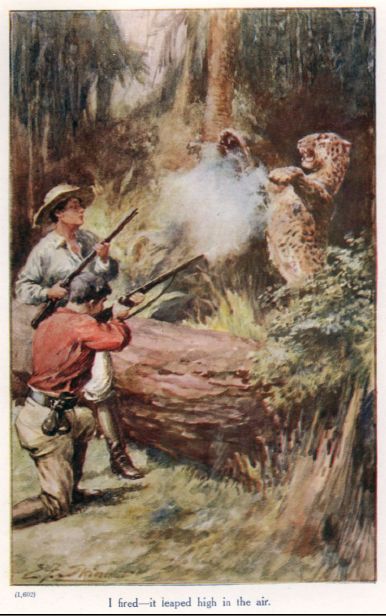
Whether or not it was the same leopard we had seen in the afternoon, I could not tell. The creature moved on in its cat-like fashion, looking cautiously around. Charley and I kept ourselves well concealed, still it apparently suspected that an enemy was near. It got directly in front of us. If Charley missed I must, I knew, take care to bring it down, for if not, it would make nothing of a bound over the tree, and would carry one of us off. Charley levelled his rifle; a sharp crack was heard ringing through the night air, answered by the chattering of numberless monkeys and the shrieks of flocks of parrots and other birds. The smoke for a moment prevented me seeing the leopard; the next instant, what was my horror to observe it approaching. In another instant it would have been upon us. I fired; it leapt high in the air, and rolled over close to the trunk of the tree.
“Well done, Dick!” cried Charley. “I hit it, but my bullet missed the vital part.”
The leopard was perfectly dead. We easily found the two bullet-holes. Charley’s bullet had struck the edge of a bone, and been slightly deflected. Had he been alone, the result might have been fatal to him. How thankful I felt that he had escaped! It was a lesson to us never to go out hunting singly, and we agreed that we would keep to that rule.
The leopard had fallen just under the bough of a tree, and as we were anxious to preserve its skin, and yet did not wish to spend time in flaying the animal that night, we resolved to try and hoist it up to the bough, where it would remain safe till the morning. We accordingly cut a number of vines which grew near, and under Charley’s directions formed a series of tackles, by means of which we succeeded, all hoisting together, in lifting it several feet off the ground. This done, we returned to our camp. While we had been thus engaged, we had run the risk, I suspect, of being attacked by another wild beast, either a leopard or lion, as when I was on watch I heard the mutterings of the last-named savage brutes in the distance. As I walked up and down in front of our fire while my brother and Harry were asleep, I watched the body of the leopard swinging in the air a few feet off, and kept my gun on the cock ready to fire should a lion approach, as I thought would very likely be the case, although I had no particular wish to have another battle that night. However, it so happened that we were left at rest. At early dawn we let down the carcase, and at once flayed it. Our object in doing so was to present the skin to the chief of the village we expected to visit, as we guessed it would be highly prized; besides which, the fact that we had killed the creature being known, would raise us in the estimation of the people. Having hung up the skin to dry, Harry and I went down to the lake, hoping to see the canoe of our friend, but we were again disappointed. Charley had, in the meantime, been preparing breakfast, roasting some more ducks, and the remainder of the ground-nuts left us by Shimbo. After this, we employed our time in scraping the inside of the leopard’s skin, which gave us enough to do; we then made a sort of lye from the ashes of our fire, which would have, we hoped, some effect in preserving the skin, though we were aware that the process we adopted was very rude and imperfect. As several hours had passed since Tubbs and the two blacks had left us, we became somewhat anxious about them. If the natives had proved treacherous, Tom would very likely be put to death or kept a prisoner, and we should see nothing more of him. About noon, Harry and I had gone down to the lake to get a saucepan of water, when we remarked a tiny speck on the broad shining expanse of the lake, where nothing previously had been visible.
“Hurrah! that must be the canoe at last,” he exclaimed.
I was of the same opinion. “If Charley were to have a look at it, he would be more certain about the matter,” I observed; and running back, I called my brother.
“Yes, there’s no doubt about it; that must be the canoe,” he said, after he had watched it attentively.
We now hoped that we should at length get away from the spot where we had spent so much time. After watching for several minutes, though it was still at a great distance, and appeared to be approaching very slowly, we could distinctly make out the canoe. We had gone back to eat our dinners, as we had become hungry, when Harry said that he would go down to the lake to see if the canoe was near the shore. Just as he reached the water, we heard him cry out, “Here they are! here they are!” Charley and I ran down to join him. The next minute Aboh and Shimbo, with two other blacks, stepped out of a good-sized canoe, capable of carrying us three in addition. It was formed very much like the one we had intended to make out of the trunk of a tree. Aboh seemed as delighted to see us as if he had been away for several weeks. Why he had not returned sooner, we could not exactly make out, but we understood that the king of the village, Quagomolo, was very ill, and as the only large canoes belonged to him, Aboh could not see him to obtain the one he wished for. Our friends had brought a supply of plantains and several other things—manioc, sugar-cane, and squashes. There were provisions enough for us and themselves for several days. Before commencing the return voyage, they insisted we should cook them and have a feast.
“We have already had our dinner,” said Charley.
“Bery good! but we,—we empty stomach. No good go sea without eat,” answered Aboh.
By which he let us understand that he and his companions required food, and were not entirely disinterested in pressing us to have a feast on the provisions they had brought. On seeing the deer and the ducks we had shot, their eyes brightened. Aboh and Shimbo were both very good cooks, and immediately set to work to dress both the venison and the vegetables. Their only regret was, that we had not some rum to give them, the taste of which they had acquired from the white traders who occasionally came up to their village. I should have said that Aboh gave us a good report of Tom, who was being well treated by the inhabitants of the village, by whom we also expected to be received in a friendly manner. Aboh and Shimbo were so long in preparing the viands, that by the time they announced that all were sufficiently cooked, we were perfectly ready to fall to. We enjoyed our meal, and as soon as it was over, Charley proposed that we should start without delay.
The ducks and the venison were carried down to the canoe, as well as the leopard skin. By the time we had taken our seats, it appeared to us greatly overloaded; still our black friends were unwilling to leave any provisions behind. Aboh, pointing to the leopard skin, exclaimed, “King, him like much;” so that we hoped our gift would be acceptable to his sable majesty. The day was pretty well advanced, but we hoped to get across the lake before nightfall. All being ready, our black crew seizing their paddles, the canoe began to glide across the lake. Charley took a fifth paddle with which to steer, but he soon found that the blacks could manage the canoe perfectly well without his assistance. The heat was so great on the water that we were all thankful to avoid any unnecessary exertion. The blacks as they paddled sang a low monotonous song, more like a dirge. What it was about we could not tell. By looking back we saw that we had got some distance from the land, although we appeared not to have approached nearer the opposite shore, which still remained as indistinct as before. After some time the blacks ceased their song, and I saw them gazing round at the sky, the appearance of which was rapidly changing. The sun suddenly disappeared behind a dark bank of cloud coming up from the west, and a leaden hue overspread the hitherto sparkling water, at the same time that a strong wind began to blow. This soon broke the hitherto tranquil lake into hissing wavelets, which continually toppled over into the canoe. Aboh, turning round, handed to each of us a bason formed from a gourd, and made signs that we should bale out the water as it came in. He and his companions then redoubled their efforts. I caught a glimpse of his countenance as he turned round; it showed that he was far from satisfied with the appearance of the weather. I asked Charley what he thought about the matter.
“I’m afraid that we are going to have a gale; and if so, a nasty sea will get up, and we shall be obliged to heave our cargo overboard, although we will not do so until it becomes absolutely necessary.”
Every instant the wind increased, and the blacks paddled harder and harder. At present it was on our beam, although, should it come ahead, we should make but little progress, or perhaps be compelled to run back to the place we had left. Notwithstanding the threatening aspect of the weather, Aboh and his companions seemed determined to continue their course. The water kept tumbling on board, but we continued baling it out as fast as we could.
“I’m afraid that we must heave the birds and venison overboard,” said Charley.
I made Aboh understand what we proposed doing.
“No, no,” was the answer; “dat all right.”
He and his companions paddled on bravely for another half hour. By this time it had become perfectly dark, and we could not discover the land ahead, but the black fellows seemed to guide their course by instinct, for I could see no welcoming beacon on the shore. To our satisfaction the wind did not increase, though the canoe tumbled about a good deal, and not for a moment were we able to cease baling. The blacks paddled on bravely through the pitchy darkness. Suddenly a flash of lightning burst from the clouds, followed by a tremendous roar of thunder. I could see the flame dancing along over the water, mercifully avoiding our canoe, leaving all in darkness beyond. The blacks for a moment ceased paddling.
“Go on, go on,” I cried out to Aboh; “this is no time to stop; the sooner we reach the shore the sooner we shall be in safety.”
Aboh repeated what I had said to his companions, and, thus encouraged, all hands paddled away as before. As no land was in sight, I could not make out how they managed to steer a straight course, but they seemed perfectly satisfied that they were going right. Probably they were guided by the wind on one side. Had it shifted, they would have been thrown out. This I greatly feared would be the case; and after all, might we be paddling up the lake instead of across it. Charley got out his pocket compass, but the wind prevented us striking a light, and it was consequently of no use. He kept it before him, however, in case another flash of lightning should enable him to see it. He had not long to wait. A vivid flash darted directly across the canoe.
“Hurrah!” he exclaimed; “we are all right; we are steering due north.”
We had no longer, after this, any doubt about the judgment of our African friends. The thunder rolled, the lightning flashed, and we continued to bale away as the water washed into the canoe. For some moments the lightning ceased, and we hoped the storm was over; but we were mistaken. Another flash darted from the sky, more vivid than its predecessors, with a loud hissing, crackling sound.
“Hurrah! I caught sight of some trees and a hut,” exclaimed Charley.
He was not mistaken, in less than a quarter of an hour after this, the canoe ran alongside the bank in a little bay, and our crew, jumping out, welcomed us on shore.
Their loud shouts brought a number of people out of the neighbouring huts, who quickly unloaded the canoe; while we were conducted by Aboh and Shimbo to a hut which they said was prepared for our reception. Within we found Tom seated on a couch formed of bamboos.
“Glad to see you, gentlemen, that I am,” he exclaimed. “To say the truth, I had begun to fear that you would never come at all, as I have had some doubts about the intentions of our friends here. They were very kind, howsomever, for they fed me well and tried their skill at doctoring my foot, but I cannot say that they have done it any good; so I hope, Mr Westerton, that you will again take me in hand.”
We were thankful to find that Tom was in such good spirits. Charley, on looking at his foot, said he hoped, as the swelling had greatly gone down, that in a few days it would be as strong as ever. As it was so late at night, we expected to go supperless to bed, but we had not been long in the hut when a bevy of damsels arrived carrying baskets on their heads, containing cooked provisions enough, including some of our venison, to feed a dozen people. We were not sorry to partake of them, as we had become very hungry; but as we had had but little rest the previous night, we begged our entertainers to leave us in quiet, which they did not appear disposed to do. At length Aboh and Shimbo making their appearance, at our request turned all our guests out and allowed us to sleep in quiet.
Next morning we were awakened by great shouting, and on inquiring the cause, ascertained that a famous doctor had come to cure the king, Quagomolo, of his disease, though what that was we could not ascertain. We went out to see this important personage, who presented a most fantastic appearance. His head was adorned with feathers, birds’ beaks, and claws of leopards, hyenas, and other savage brutes; half his body was painted red, the other half white, while his face was daubed with streaks of alternate black, white, and red. Round his neck he wore numerous chains and charms, which tinkled and rattled as he moved about.
After having paraded himself through the village to be admired by the inhabitants, he was introduced to the hut of the king, whom he had not yet seen. Finding no one to stop us, we shortly afterwards followed, when we saw the doctor seated on a low stool before a large earthenware pot, into which he was looking intently. This done, having seized a lighted torch smouldering by his side, he whirled it about his head till it burst into a flame. He then waved it over the pot, muttering some mysterious words. He continued this and similar performances for so long a time that we were getting weary of witnessing them, when suddenly a person rose from a couch at the further end of the room, whom we rightly supposed to be King Quagomolo.
“Sit down, your majesty, sit down,” exclaimed the doctor. “I’ll soon say what’s the matter with you.”
The king obeyed. Again the doctor waved his torch and gazed into the pot, and then declared that his majesty was bewitched.
“Who are the people who have bewitched me?” asked the king in a trembling voice.
“They are some men and women in your own kingdom, and not far off from this,” answered the doctor in a deep bass voice which could be heard outside the hut, where a number of persons were collected.
There was a general howl of alarm, for no one could tell who would be fixed on. The king, on hearing this, announced that the persons implicated must drink the poisoned water, usually given on such occasions. So we learned from Aboh, who had crept into the hut and squatted down beside us.
“We must try to defeat the old rascal,” whispered Charley. “Show us where the poison is to be concocted?”
The doctor had now a drum brought him by an attendant, on which he began to beat vehemently, when the king again sank down on his couch. We on this quietly made our exit, and, led by Aboh, entered another hut, where, by the light of a single torch, some old women were concocting the mysterious beverage. We watched them until they had finished, when, leaving the bowl covered up by a piece of matting, they crept out one by one, holding up their hands, taking long, slow strides, and looking truly like witches themselves, and, as Harry observed, “Very bad specimens too.”
As soon as they were gone, finding a jug of pure water near at hand, Charley poured out the mixture into a corner, and filled up the bowl again with the harmless liquid. Fortunately, we found a basketful of what was evidently colouring matter, and having mixed some of it in the water, we covered the bowl up again and left the hut. We then went back to our hut. Finding that the king, in spite of the lateness of the hour, was ready to receive us, taking our two black friends, Aboh to act as interpreter, we carried with us the leopard skin, some venison, and three strings of beads of various colours. His majesty was a tall, ungainly looking man, with as hideous a countenance as can well be imagined. His appearance was not improved by the glare of the torchlight and the terror under which he was suffering. Having presented the leopard skin and venison, Charley, who acted as spokesman, threw the string of beads round his neck.
“Tell him,” he said to Aboh, “that those are powerful charms, and will quickly restore him to health.”
After a short palaver we begged leave to retire, assuring his majesty that he would be quite well in the morning, and that we were very sure that none of his subjects had bewitched him, as would then be proved.
“If we succeed we shall have performed a very good work,” said Charley, laughing, as we returned to our hut.
Next morning the whole tribe was collected, and the accused persons brought forward. The bowl was handed round among them. No one to whom it was offered dared refuse to drink from it, although the distortions of their countenances showed the alarm under which they laboured. The king, who had been brought out to witness the ceremony on a litter, sat by watching them, and expecting, perhaps, to see some of them drop down dead.
To our surprise three or four of them appeared greatly agitated, writhing about and making hideous faces, but we felt very sure that this was the result of imagination; and even these soon recovered, while the rest remained standing, and doing their best to smile and convince the king and their friends of their innocence. The effect on King Quagomolo was almost instantaneous, and before evening he declared himself perfectly recovered. To prove this, he summoned his liege subjects to attend a dance in honour of the event. No great preparations were required, and that very evening was fixed for the event. The king’s wives, of whom he had no small number, and all the dames and damsels from far and wide, came trooping in, and arranged themselves in the large open space in the centre of the village. The men sat on the opposite side, with a line of musicians in front. These were mostly drummers, who beat their huge tom-toms with right good will, making the most fearful and deafening din. Others had brass kettles, and others hollow pieces of wood, which assisted greatly in the uproar; while at the same time both men and women sang, shouted, and shrieked, until we, who stood at a little distance off, could scarcely hear each other’s voices. The barbarous overture being brought to a conclusion, the king, who had been seated amongst his wives, rose, and springing into the centre of the circle, began snapping his fingers, twisting and turning in all sorts of attitudes, leaping from the ground, kicking up one leg, then another, and throwing his arms round until it appeared that he would swing them off.
“Here am I, my friends,” he shouted. “Once I was ill, now I am well; and if our white friends here will stay with us, I never expect to be ill again.”
He danced and shouted until we thought he would have dropped. Presently he managed to spring back, exhibiting the utmost agility to the last, until he sat down again in the midst of his better halves, who had been amongst the most demonstrative of his applauders. Several of his chiefs then followed his example, but took good care not to surpass the king either in the time they danced or the activity they displayed. Before they sat down, several women sprang up, who, not being influenced by the same motives as the courtiers, contrived to twist and turn themselves in a way which was neither creditable to their modesty, nor pleasant to look at. We had good reason to be satisfied with this commencement of our intercourse with King Quagomolo. He presented us with abundance of food, and the hut built for our accommodation was clean and comfortable.
In a short time, by careful treatment, Tom’s ankle completely regained its strength, and he declared himself ready to continue the journey to the northward. We arranged, therefore, to start immediately, but we calculated without our host. When we told Aboh of our intentions, and asked him to accompany us, he made a long face, and shaking his head, said, “King no let go, want fight;” by which we understood that Quagomolo intended to detain us in order that we might assist him in some predatory excursion he was meditating against a neighbouring tribe, we having firearms in good order, while he and his people had among them only a few old muskets, many of which were destitute of locks, and could only be fired by means of matches applied to the touch-holes. On obtaining this information, we agreed that it would not be wise to show any mistrust of the king, but quietly to take our departure, with or without his leave, whenever it might suit us to do so.
As we were well treated, we were in no hurry to get away, besides which we had abundance of sport in the neighbourhood, and seldom went out without bringing back eight or ten brace of ducks and other wildfowl. However, at length we thought it time to tell the king that we must be going.
We took the opportunity when he was in a good humour, having just quaffed a few bowls of a sort of palm-wine of which he was especially fond.
“Stay, my dear friends, stay a few days longer, and you shall go forth with honour, and each of you shall take a wife with you and a hundred attendants.”
Charley assured his majesty that we must decline the wives, and that our own rifles were the best attendants we desired, with the exception of one or two intelligent men to act as guides.
“You shall have your will, you shall have your will,” answered the king, “but stay one day longer, just one day.”
We accordingly, hoping to have no obstruction offered to our departure, agreed to stay, but when the evening arrived the king sent a messenger to say he wished to see us.
“What, my friends,” he began as we entered his hut—“do you want to go and leave me all forlorn, stay another day, stay another day.”
Such was the tenor of his address which Aboh translated to us.
“Tell him that to-morrow we must go,” said Charley.
The king smiled benignantly, so Harry declared, although he appeared to me to make a very hideous grimace.
The next day, early in the morning, we all four loaded our muskets, and asked Aboh if he was ready to accompany us.
“King, he give him leave, him go at once,” he answered.
No sooner did we quit our hut than we saw all the men of the village, fully armed, collected at the outlets, evidently resolved to stop us by force. Although we might have fought our way through them, we could not have done so without bloodshed. Again we resolved to make a virtue of necessity, and remain until we could find a favourable opportunity of escaping.
Several days passed by, and every morning, when we were prepared to set out, we found the village guarded as before. When, however, we left our packs behind us, we were allowed to ramble at perfect freedom. Besides Aboh and Shimbo we found a party always ready to accompany us and act as beaters.
Not wishing it to be supposed that we intended to leave that morning, we quietly returned to our hut, and undoing our knapsacks again went out, simply with our rifles in our hands, as if we intended to have a little shooting before breakfast. We had not gone far when we saw a woman near the shore of the lake apparently hunting about and calling out to some one in tones of distress.
“Who is she? and what is it all about?” I asked Aboh.
“She king’s wife. Go bathe, lose piccaninny.”
We hurried on until we met the poor woman. She then explained that while she was bathing in a sheltered pool she had left her little boy on the bank of the lake to play about and amuse himself, but when she came out of the water she could nowhere find him. Of course it at once occurred to us that a crocodile must have carried him off, but Aboh averred that if such was the case the mother would have heard him cry out. He might have slipped into the water and have been drowned, but that he might possibly be hiding from her, for the sake of playing a trick.
“In that case she will soon find him, I hope,” I observed.
Scarcely had I spoken than I saw a huge crocodile crawling out of the bank not twenty yards from us. The next instant, stooping down its head, it lifted up a little black boy by one of his legs.
At the sight the mother shrieked out, “My son, my son!”
The fate of the child seemed certain. As the huge creature turned to run, I saw that its neck was exposed. Fortunately, having loaded my rifle with ball, I fired. By a miracle it seemed, the crocodile let the child drop, and after making a faint attempt to recover it, gave a few convulsive struggles, and rolled off the bank perfectly dead, for we could see it lying on its back in shallow water.
The poor mother rushed forward and picked up the little boy, who, although fearfully bitten about the leg, was still alive. It had not before uttered a sound, but now it began to cry as it saw the blood streaming from the wounded limb. As far as I could judge, no vital part had been touched, and I told Aboh to say to the mother, that if she would let us doctor it we would do so, as I had hopes of its recovery. Having washed it then and there in cold water, we stopped the blood, bound up the wounds, and gave it to the mother to carry back. Quagomolo was, we found, especially fond of the child. It was six or seven years old, and, being in a healthy condition, by the evening appeared no worse. At the end of three days, as lock-jaw had not set in, and the wounds looked healthy, we assured the king of our belief that his son would in time get well. Quagomolo and his wife both appeared very grateful.
“Whatever you shall ask you shall have,” he said; “half my kingdom, half of my wives, or half of my children, or half of my people for slaves.”
“Tell his majesty that we are much obliged to him,” answered Charley; “but the only favour we ask is the loan of a couple of his faithful subjects, and permission to proceed on our journey to the northward, where we expect to fall in with some of our countrymen. We are friends to Africa and the Africans, and wish to do the people all the good we can, but that if he keeps us here, our plans will be defeated.”
The king replied “that he would consider the matter, but that perhaps he knew what was for our good as well as we did ourselves, and that if we wished to benefit the Africans we should remain and exercise our skill on him and his people.”
This answer was anything but satisfactory. We had accordingly, as before, to shrug our shoulders and submit for the present, not intending, however, much longer to comply with the fancies of the sable monarch.