Chapter VI · THE PORT SIDE: WOMEN AND CHILDREN FIRST
Reading edition
Foreword
THE previous chapters, describing my personal experience on board the Titanic and remarkable escape from death in the icy waters of the middle Atlantic, were written some months ago. In the interim I have received the pamphlets, printed in convenient form, containing the hearings of both the American and British Courts of Inquiry, and have given them considerable study.
These official sources of information have added materially to my store of knowledge concerning the shipwreck, and corroborate to a marked degree the description from my personal viewpoint, all the salient points of which were written before our arrival in New York, and on the S. S. Carpathia, under circumstances which will be related in a future chapter.
During the same interval, by correspondence with survivors and by reading all available printed matter in books, magazine articles and newspapers, I have become still more conversant with the story of this, the greatest of maritime disasters, which caused more excitement in our country than any other single event that has occurred in its history within a generation.
The adopted standard by which I propose to measure the truth of all statements in this book is the evidence obtained from these Courts of Inquiry, after it has been subjected to careful and impartial analysis. All accounts of the disaster, from newspapers and individual sources, for which no basis can be found after submission to this refining process, will find no place or mention herein. In the discussion of points of historical interest or of individual conduct, where such are matters of public record, I shall endeavor to present them fairly before the reader, who can pass thereon his or her own opinion after a study of the testimony bearing on both sides of any controversy. In connection with such discussion where the reflections cast upon individuals in the sworn testimony of witnesses have already gained publicity, I claim immunity from any real or imaginary animadversions which may be provoked by my impartial reference thereto.
I have already recorded my personal observation of how strictly the rule of human nature, “Women and Children First,” was enforced on the port side of the great steamship, whence no man escaped alive who made his station on this quarter and bade good-bye to wife, mother or sister.
I have done my best, during the limited time allowed, to exhaust all the above-defined sources of information, in an effort to preserve as complete a list as possible of those comrades of mine who, from first to last, on this port side of the ship, helped to preserve order and discipline, upholding the courage of women and children, until all the boats had left the Titanic, and who then sank with the ship when she went down.
I shall now present the record and story of each lifeboat, on both port and starboard sides of the ship, giving so far as I have been able to obtain them the names of persons loaded aboard each boat, passengers and crew; those picked up out of the water; the stowaways found concealed beneath the thwarts, and those men who, without orders, jumped from the deck into boats being lowered, injuring the occupants and endangering the lives of women and children. At the same time will be described the conditions existing when each boat was loaded and lowered, and whatever incidents occurred in the transfer of passengers to the rescuing steamer Carpathia.
The general testimony of record, covering the conduct which was exhibited on the port side of the ship, is contained in the careful statements of that splendid officer, Charles H. Lightoller, before the United States Senate Committee: (Am. Inq., p. 88.)
Senator Smith: From what you have said, you discriminated entirely in the interest of the passengers—first women and children—in filling these lifeboats?
Mr. Lightoller: Yes, sir.
Senator Smith: Why did you do that? Because of the captain’s orders, or because of the rule of the sea?
Mr. Lightoller: The rule of human nature.
And also in his testimony before the British Inquiry (p. 71):
“I asked the captain on the Boat Deck, ‘Shall I get women and children in the boats?’ The captain replied, ‘Yes, and lower away.’ I was carrying out his orders. I am speaking of the port side of the ship. I was running the port side only. All the boats on this side were lowered except the last, which was stowed on top of the officers’ quarters. This was the surf boat—the Engelhardt boat (A). We had not time to launch it, nor yet to open it.”
(Br. Inq.) “I had no difficulty in filling the boat. The people were perfectly ready and quiet. There was no jostling or pushing or crowding whatever. The men all refrained from asserting their strength and from crowding back the women and children. They could not have stood quieter if they had been in church.”
And referring to the last boats that left the ship (Br. Inq., p. 83):
“When we were lowering the women, there were any amount of Americans standing near who gave me every assistance they could.”
The crow’s nest on the foremast was just about level with the water when the bridge was submerged. The people left on the ship, or that part which was not submerged, did not make any demonstration. There was not a sign of any lamentation.
On the port side on deck I can say, as far as my own observations went, from my own endeavor and that of others to obtain women, there were none left on the deck.
My testimony on the same point before the United States Senate Committee (Am. Inq., p. 992) was as follows:
“I want to say that there was nothing but the most heroic conduct on the part of all men and women at that time where I was at the bow on the port side. There was no man who asked to get in a boat with the single exception that I have already mentioned. (Referring to Col. Astor’s request to go aboard to protect his wife. Am. Inq., p. 991.) No women even sobbed or wrung their hands, and everything appeared perfectly orderly. Lightoller was splendid in his conduct with the crew, and the crew did their duty. It seemed to me it was a little bit more difficult than it should have been to launch the boats alongside the ship. I do not know the cause of that. I know I had to use my muscle as best I could in trying to push those boats so as to get them over the gunwale. I refer to these in a general way as to its being difficult in trying to lift them and push them over. (As was the case with the Engelhardt “D.”) The crew, at first, sort of resented my working with them, but they were very glad when I worked with them later on. Every opportunity I got to help, I helped.”
How these statements are corroborated by the testimony of others is recorded in the detailed description of each boat that left the ship on the port side as follows:
BOAT NO. 6.[6]
No male passengers.
Passengers: Miss Bowerman, Mrs. J. J. Brown, Mrs. Candee, Mrs. Cavendish and her maid (Miss Barber), Mrs. Meyer, Miss Norton, Mrs. Rothschild, Mrs. L. P. Smith, Mrs. Stone and her maid (Miss Icard).
Ordered in to supply lack of crew: Major A. G. Peuchen.
Said good-bye to wives and sank with ship: Messrs. Cavendish, Meyer, Rothschild and L. P. Smith.
Crew: Hitchens, Q. M. (in charge). Seaman Fleet. (One fireman transferred from No. 16 to row.) Also a boy with injured arm whom Captain Smith had ordered in.
Total: 28. (Br. Inq.)
INCIDENTS
Lightoller’s testimony (Am. Inq., p. 79):
I was calling for seamen and one of the seamen jumped out of the boat and started to lower away. The boat was half way down when a woman called out that there was only one man in it. I had only two seamen and could not part with them, and was in rather a fix to know what to do when a passenger called out: “If you like, I will go.” This was a first-class passenger, Major Peuchen, of Toronto. I said: “Are you a seaman?” and he said: “I am a yachtsman.” I said: “If you are sailor enough to get out on that fall—that is a difficult thing to get to over the ship’s side, eight feet away, and means a long swing, on a dark night—if you are sailor enough to get out there, you can go down”; and he proved he was, by going down.
F. Fleet, L. O. (Am. Inq., p. 363) and (Br. Inq.):
Witness says there were twenty-three women, Major Peuchen and Seamen Hitchens and himself. As he left the deck he heard Mr. Lightoller shouting: “Any more women?” No. 6 and one other cut adrift after reaching the Carpathia.
Major Arthur Godfrey Peuchen, Manufacturing Chemist, Toronto, Canada, and Major of Toronto’s crack regiment, The Queen’s Own Rifles (Am. Inq., p. 334), testified:
I was standing on the Boat Deck, port side, near the second officer and the captain. One of them said: “We must get these masts and sails out of these boats; you might give us a hand.” I jumped in, and with a knife cut the lashings of the mast and sail and moved the mast out of the boat. Only women were allowed in, and the men had to stand back. This was the order, and the second officer stood there and carried it out to the limit. He allowed no men, except sailors who were manning the boat. I did not see one single male passenger get in or attempt to get in. I never saw such perfect order. The discipline was perfect. I did not see a cowardly act by any man.
When I first came on this upper deck there were about 100 stokers coming up with their dunnage bags and they seemed to crowd this whole deck in front of the boats. One of the officers, I don’t know which one, a very powerful man, came along and drove these men right off this deck like a lot of sheep. They did not put up any resistance. I admired him for it. Later, there were counted 20 women, one quartermaster, one sailor and one stowaway, before I was ordered in.
In getting into the boat I went aft and said to the quartermaster: “What do you want me to do?” “Get down and put that plug in,” he answered. I made a dive down for the plug. The ladies were all sitting pretty well aft and I could not see at all. It was dark down there. I felt with my hands and then said it would be better for him to do it and me do his work. I said, “Now, you get down and put in the plug and I will undo the shackles,” that is, take the blocks off, so he dropped the blocks and got down to fix the plug, and then he came back to assist me saying, “Hurry up.” He said: “This boat is going to founder.” I thought he meant our lifeboat was going to founder, but he meant the large boat, and that we were to hurry up and get away from it, so we got the rudder in and he told me to go forward and take an oar. I did so, and got an oar on the port side. Sailor Fleet was on my left on the starboard side. The quartermaster told us to row as hard as we could to get away from the suction. We got a short distance away when an Italian, a stowaway, made his appearance. He had a broken wrist or arm, and was of no use to row. He was stowed away under the boat where we could not see him.
Toward morning we tied up to another boat (No. 16) for fifteen minutes. We said to those in the other boat: “Surely you can spare us one man if you have so many.” One man, a fireman, was accordingly transferred, who assisted in rowing on the starboard side. The women helped with the oars, and very pluckily too.[7]
We were to the weather of the Carpathia, and so she stayed there until we all came down on her. I looked at my watch and it was something after eight o’clock.
Mrs. Candee’s account of her experience is as follows:
She last saw Mr. Kent in the companionway between Decks A and B. He took charge of an ivory miniature of her mother, etc., which afterwards were found on his body when brought into Halifax. He appeared at the time to hesitate accepting her valuables, seeming to have a premonition of his fate.
She witnessed the same incident described by Major Peuchen, when a group of firemen came up on deck and were ordered by the officer to return below. She, however, gives praise to these men. They obeyed like soldiers, and without a murmur or a protest, though they knew better than anyone else on the ship that they were going straight to their death. No boats had been lowered when these firemen first appeared upon the Boat Deck, and it would have been an easy matter for them to have “rushed” the boats.
Her stateroom steward also gave an exhibition of courage. After he had tied on her life preserver and had locked her room as a precaution against looters, which she believed was done all through the deck, she said to this brave man: “It is time for you to look out for yourself,” to which the steward replied, “Oh, plenty of time for that, Madam, plenty of time for that.” He was lost.
As she got into boat No. 6, it being dark and not seeing where she stepped, her foot encountered the oars lying lengthwise in the boat and her ankle was thus twisted and broken.
Just before her boat was lowered away a man’s voice said: “Captain, we have no seaman.” Captain Smith then seized a boy by the arm and said: “Here’s one.” The boy went into the boat as ordered by the captain, but afterwards he was found to be disabled. She does not think he was an Italian.
Her impression is that there were other boats in the water which had been lowered before hers. There was a French woman about fifty years of age in the boat who was constantly calling for her son. Mrs. Candee sat near her. After arrival on the Carpathia this French woman became hysterical.
Notwithstanding Hitchens’ statements, she says that there was absolutely no upset feeling on the women’s part at any time, even when the boat, as it was being lowered, on several occasions hung at a dangerous angle—sometimes bow up and sometimes stern up. The lowering process seemed to be done by jerks. She herself called out to the men lowering the boat and gave instructions: otherwise they would have been swamped.
The Italian boy who was in the boat was not a stowaway, he was ordered in by the captain as already related. Neither did he refuse to row. When he tried to do so, it was futile, because of an injury to his arm or wrist.
Through the courtesy of another fellow passenger, Mrs. J. J. Brown, of Denver, Colorado, I am able to give her experiences in boat No. 6, told in a delightful, graphic manner; so much so that I would like to insert it all did not space prevent:
In telling of the people she conversed with, that Sunday evening, she refers to an exceedingly intellectual and much-travelled acquaintance, Mrs. Bucknell, whose husband had founded the Bucknell University of Philadelphia; also to another passenger from the same city, Dr. Brewe, who had done much in scientific research. During her conversation with Mrs. Bucknell, the latter reiterated a statement previously made on the tender at Cherbourg while waiting for the Titanic. She said she feared boarding the ship because she had evil forebodings that something might happen. Mrs. Brown laughed at her premonitions and shortly afterwards sought her quarters.
Instead of retiring to slumber, Mrs. Brown was absorbed in reading and gave little thought to the crash at her window overhead which threw her to the floor. Picking herself up she proceeded to see what the steamer had struck; but thinking nothing serious had occurred, though realizing that the engines had stopped immediately after the crash and the boat was at a standstill, she picked up her book and began reading again. Finally she saw her curtains moving while she was reading, but no one was visible. She again looked out and saw a man whose face was blanched, his eyes protruding, wearing the look of a haunted creature. He was gasping for breath and in an undertone gasped, “Get your life preserver.” He was one of the buyers for Gimbel Bros., of Paris and New York.
She got down her life preserver, snatched up her furs and hurriedly mounted the stairs to A Deck, where she found passengers putting on lifebelts like hers. Mrs. Bucknell approached and whispered, “Didn’t I tell you something was going to happen?” She found the lifeboats lowered from the falls and made flush with the deck. Madame de Villiers appeared from below in a nightdress and evening slippers, with no stockings. She wore a long woollen motorcoat. Touching Mrs. Brown’s arm, in a terrified voice she said she was going below for her money and valuables. After much persuasion Mrs. Brown prevailed upon her not to do so, but to get into the boat. She hesitated and became very much excited, but was finally prevailed upon to enter the lifeboat. Mrs. Brown was walking away, eager to see what was being done elsewhere. Suddenly she saw a shadow and a few seconds later someone seized her, saying: “You are going, too,” and she was dropped fully four feet into the lowering lifeboat. There was but one man in charge of the boat. As it was lowered by jerks by an officer above, she discovered that a great gush of water was spouting through the porthole from D Deck, and the lifeboat was in grave danger of being submerged. She immediately grasped an oar and held the lifeboat away from the ship.
When the sea was reached, smooth as glass, she looked up and saw the benign, resigned countenance, the venerable white hair and the Chesterfieldian bearing of the beloved Captain Smith with whom she had crossed twice before, and only three months previous on the Olympic. He peered down upon those in the boat, like a solicitous father, and directed them to row to the light in the distance—all boats keeping together.
Because of the fewness of men in the boat she found it necessary for someone to bend to the oars. She placed her oar in an oarlock and asked a young woman nearby to hold one while she placed the other on the further side. To Mrs. Brown’s surprise, the young lady (who must have been Miss Norton, spoken of elsewhere), immediately began to row like a galley slave, every stroke counting. Together they managed to pull away from the steamer.
By this time E and C Decks were completely submerged. Those ladies who had husbands, sons or fathers on the doomed steamer buried their heads on the shoulders of those near them and moaned and groaned. Mrs. Brown’s eyes were glued on the fast-disappearing ship. Suddenly there was a rift in the water, the sea opened up and the surface foamed like giant arms and spread around the ship and the vessel disappeared from sight, and not a sound was heard.
Then follows Mrs. Brown’s account of the conduct of the quartermaster in the boat which will be found under the heading presently given, and it will be noticed that her statements correspond with those of all others in the boat.
The dawn disclosed the awful situation. There were fields of ice on which, like points on the landscape, rested innumerable pyramids of ice. Seemingly a half hour later, the sun, like a ball of molten lead, appeared in the background. The hand of nature portrayed a scenic effect beyond the ken of the human mind. The heretofore smooth sea became choppy and retarded their progress. All the while the people in boat No. 6 saw the other small lifeboats being hauled aboard the Carpathia. By the time their boat reached the Carpathia a heavy sea was running, and, No. 6 boat being among the last to approach, it was found difficult to get close to the ship. Three or four unsuccessful attempts were made. Each time they were dashed against the keel, and bounded off like a rubber ball. A rope was then thrown down, which was spliced in four at the bottom, and a Jacob’s ladder was made. Catching hold, they were hoisted up, where a dozen of the crew and officers and doctors were waiting. They were caught and handled as tenderly as though they were children.
HITCHENS’ CONDUCT
Major Peuchen (Am. Inq., p. 334) continued:
There was an officers’ call, sort of a whistle, calling us to come back to the boat. The quartermaster told us to stop rowing. We all thought we ought to go back to the ship, but the quartermaster said “No, we are not going back to the boat; it is our lives now, not theirs.” It was the women who rebelled against this action. I asked him to assist us in rowing and let some of the women steer the boat, as it was a perfectly calm night and no skill was required. He refused, and told me he was in command of that boat and that I was to row.
He imagined he saw a light. I have done a great deal of yachting in my life. I have owned a yacht for six years. I saw a reflection. He thought it was a boat of some kind; probably it might be a buoy, and he called out to the next boat asking them if they knew any buoys were around there. This struck me as being perfectly absurd.
I heard what seemed to be one, two, three rumbling sounds; then the lights of the ship went out. Then the terrible cries and calls for help—moaning and crying. It affected all the women in our boat whose husbands were among those in the water. This went on for some time, gradually getting fainter and fainter. At first it was horrible to listen to. We must have been five-eighths of a mile away when this took place. There were only two of us rowing a very heavy boat with a good many people in it, and I do not think we covered very much ground. Some of the women in the boat urged the quartermaster to return. He said there was no use going back,—that there were only a “lot of stiffs there.” The women resented it very much.
Seaman Fleet (Am. Inq., p. 363):
All the women asked us to pull to the place where the Titanic went down, but the quartermaster, who was at the tiller all the time, would not allow it. They asked him, but he would not hear of it.
Mrs. Candee continues:
Hitchens was cowardly and almost crazed with fear all the time. After we left the ship he thought he heard the captain say: “Come alongside,” and was for turning back until reminded by the passengers that the captain’s final orders were: “Keep boats together and row away from the ship.” She heard this order given.
After that he constantly reminded us who were at the oars that if we did not make better speed with our rowing we would all be sucked under the water by the foundering of the ship. This he repeated whenever our muscles flagged.
Directly the Titanic had foundered a discussion arose as to whether we should return. Hitchens said our boat would immediately be swamped if we went into the confusion. The reason for this was that our boat was not manned with enough oars.
Then after the sinking of the Titanic Hitchens reminded us frequently that we were hundreds of miles from land, without water, without food, without protection against cold, and if a storm should come up that we would be helpless. Therefore, we faced death by starvation or by drowning. He said we did not even know the direction in which we were rowing. I corrected him by pointing to the north star immediately over our bow.
When our boat came alongside No. 16, Hitchens immediately ordered the boats lashed together. He resigned the helm and settled down to rest. When the Carpathia hove in sight he ordered that we drift. Addressing the people in both boats Mrs. Candee said: “Where those lights are lies our salvation; shall we not go towards them?” The reply was a murmur of approval and immediate recourse to the oars.
Hitchens was requested to assist in the toilsome rowing. Women tried to taunt and provoke him into activity. When it was suggested that he permit the injured boy to take the tiller and that Hitchens should row, he declined, and in every case he refused labor. He spoke with such uncivility to one of the ladies that a man’s voice was heard in rebuke: “You are speaking to a lady,” to which he replied: “I know whom I am speaking to, and I am commanding this boat.”
When asked if the Carpathia would come and pick us up he replied: “No, she is not going to pick us up; she is to pick up bodies.” This when said to wives and mothers of the dead men was needlessly brutal.
When we neared the Carpathia he refused to go round on the smooth side because it necessitated keeping longer in the rough sea, so we made a difficult landing.
In Mrs. Brown’s account of her experience she relates the following about the conduct of the quartermaster in charge of the boat in which she was:
He, Quartermaster Hitchens, was at the rudder and standing much higher than we were, shivering like an aspen. As they rowed away from the ship he burst out in a frightened voice and warned them of the fate that awaited them, saying that the task in rowing away from the sinking ship was futile, as she was so large that in sinking she would draw everything for miles around down with her suction, and, if they escaped that, the boilers would burst and rip up the bottom of the sea, tearing the icebergs asunder and completely submerging them. They were truly doomed either way. He dwelt upon the dire fate awaiting them, describing the accident that happened to the S. S. New York when the Titanic left the docks at Southampton.
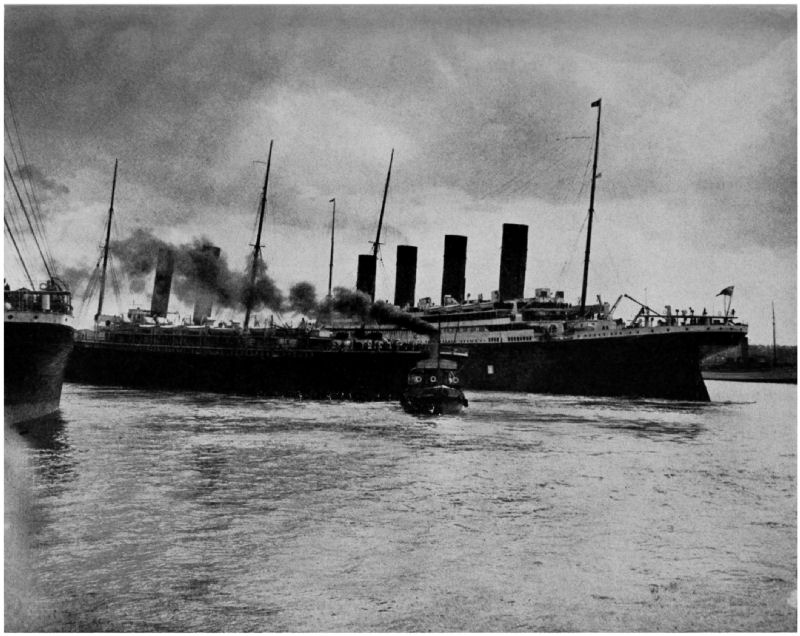
Photograph by Brown Bros., New York
THE TITANIC NARROWLY ESCAPES COLLISION AT SOUTHAMPTON
After the ship had sunk and none of the calamities that were predicted by the terrified quartermaster were experienced, he was asked to return and pick up those in the water. Again the people in the boat were admonished and told how the frantic drowning victims would grapple the sides of the boat and capsize it. He not yielding to the entreaties, those at the oars pulled away vigorously towards a faintly glimmering light on the horizon. After three hours of pulling the light grew fainter, and then completely disappeared. Then this quartermaster, who stood on his pinnacle trembling, with an attitude like some one preaching to the multitude, fanning the air with his hands, recommenced his tirade of awful forebodings, telling those in the boat that they were likely to drift for days, all the while reminding them that they were surrounded by icebergs, as he pointed to a pyramid of ice looming up in the distance, possibly seventy feet high. He forcibly impressed upon them that there was no water in the casks in the lifeboats, and no bread, no compass and no chart. No one answered him. All seemed to be stricken dumb. One of the ladies in the boat had had the presence of mind to procure her silver brandy flask. As she held it in her hand the silver glittered and he being attracted to it implored her to give it to him, saying that he was frozen. She refused the brandy, but removed her steamer blanket and placed it around his shoulders, while another lady wrapped a second blanket around his waist and limbs, he looking “as snug as a bug in a rug.”
The quartermaster was then asked to relieve one or the other of those struggling at the oars, as someone else could manage the rudder while he rowed. He flatly refused and continued to lampoon them, shouting: “Here, you fellow on the starboard side, your oar is not being put in the water at the right angle.” No one made any protest to his outbursts, as he broke the monotony, but they continued to pull at the oars with no goal in sight. Presently he raised his voice and shouted to another lifeboat to pull near and lash alongside, commanding some of the other ladies to take the light and signal to the other lifeboats. His command was immediately obeyed. He also gave another command to drop the oars and lay to. Some time later, after more shouts, a lifeboat hove to and obeyed his orders to throw a rope, and was tied alongside. On the cross-seat of that boat stood a man in white pajamas, looking like a snow man in that icy region. His teeth were chattering and he appeared quite numb. Seeing his predicament, Mrs. Brown told him he had better get to rowing and keep his blood in circulation. But the suggestion met with a forcible protest from the quartermaster in charge. Mrs. Brown and her companions at the oars, after their exercise, felt the blasts from the ice-fields and demanded that they should be allowed to row to keep warm.
Over into their boat jumped a half-frozen stoker, black and covered with dust. As he was dressed in thin jumpers, she picked up a large sable stole which she had dropped into the boat and wrapped it around his limbs from his waist down and tied the tails around his ankles. She handed him an oar and told the pajama man to cut loose. A howl arose from the quartermaster in charge. He moved to prevent it, and Mrs. Brown told him if he did he would be thrown overboard. Someone laid a hand on her shoulder to stay her threats, but she knew it would not be necessary to push him over, for had she only moved in the quartermaster’s direction, he would have tumbled into the sea, so paralyzed was he with fright. By this time he had worked himself up to a pitch of sheer despair, fearing that a scramble of any kind would remove the plug from the bottom of the boat. He then became very impertinent, and our fur-enveloped stoker in as broad a cockney as one hears in the Haymarket shouted: “Oi sy, don’t you know you are talkin’ to a lidy?” For the time being the seaman was silenced and we resumed our task at the oars. Two other ladies came to the rescue.
While glancing around watching the edge of the horizon, the beautifully modulated voice of the young Englishwoman at the oar (Miss Norton) exclaimed, “There is a flash of lightning.” “It is a falling star,” replied our pessimistic seaman. As it became brighter he was then convinced that it was a ship. However, the distance, as we rowed, seemed interminable. We saw the ship was anchored. Again the declaration was made that we, regardless of what our quartermaster said, would row toward her, and the young Englishwoman from the Thames got to work, accompanying her strokes with cheerful words to the wilted occupants of the boat.
Mrs. Brown finishes the quartermaster in her final account of him. On entering the dining-room on the Carpathia, she saw him in one corner—this brave and heroic seaman! A cluster of people were around him as he wildly gesticulated, trying to impress upon them what difficulty he had in maintaining discipline among the occupants of his boat; but on seeing Mrs. Brown and a few others of the boat nearby he did not tarry long, but made a hasty retreat.
R. Hitchens, Q. M. (Am. Inq., p. 451. Br. Inq.) explains his conduct:
I was put in charge of No. 6 by the Second Officer, Mr. Lightoller. We lowered away from the ship. I told them in the boat somebody would have to pull. There was no use stopping alongside the ship, which was gradually going by the head. We were in a dangerous place, so I told them to man the oars—ladies and all. “All of you do your best.” I relieved one of the young ladies with an oar and told her to take the tiller. She immediately let the boat come athwart, and the ladies in the boat got very nervous; so I took the tiller back again and told them to manage the best way they could. The lady I refer to, Mrs. Meyer, was rather vexed with me in the boat and I spoke rather straight to her. She accused me of wrapping myself up in the blankets in the boat, using bad language and drinking all the whisky, which I deny, sir. I was standing to attention, exposed, steering the boat all night, which is a very cold billet. I would rather be pulling the boat than be steering, but I saw no one there to steer, so I thought, being in charge of the boat, it was the best way to steer myself, especially when I saw the ladies get very nervous.
I do not remember that the women urged me to go toward the Titanic. I did not row toward the scene of the Titanic because the suction of the ship would draw the boat, with all its occupants, under water. I did not know which way to go back to the Titanic. I was looking at all the other boats. We were looking at each other’s lights. After the lights disappeared and went out, we did hear cries of distress—a lot of crying, moaning and screaming, for two or three minutes. We made fast to another boat—that of the master-at-arms. It was No. 16. I had thirty-eight women in my boat. I counted them, sir. One seaman, Fleet; the Canadian Major, who testified here yesterday, myself and the Italian boy.
We got down to the Carpathia and I saw every lady and everybody out of the boat, and I saw them carefully hoisted on board the Carpathia, and I was the last man to leave the boat.
BOAT NO. 8.[8]
No male passengers in this boat.
Passengers: Mrs. Bucknell and her maid (Albina Bazzani); Miss Cherry, Mrs. Kenyon, Miss Leader, Mrs. Pears, Mrs. Penasco and her maid (Mlle. Olivia); Countess Rothes and her maid (Miss Maloney); Mrs. Swift, Mrs. Taussig, Miss Taussig, Mrs. White and her maid (Amelia Bessetti); Mrs. Wick, Miss Wick, Miss Young and Mrs. Straus’ maid (Ellen Bird).
Women: 24.
Said good-bye to wives and sank with the ship: Messrs. Kenyon, Pears, Penasco, Taussig and Wick.
Crew: Seaman T. Jones, Stewards Crawford and Hart, and a cook.
Total: 28.
INCIDENTS
T. Jones, seaman (Am. Inq., p. 570).
The captain asked me if the plug was in the boat and I answered, “Yes, sir.” “All right,” he said, “any more ladies?” He shouted twice again, “Any more ladies?”
I pulled for the light, but I found that I could not get to it; so I stood by for a while. I wanted to return to the ship, but the ladies were frightened. In all, I had thirty-five ladies and three stewards, Crawford, Hart and another. There were no men who offered to get in the boat. I did not see any children, and very few women when we left the ship. There was one old lady there and an old gentleman, her husband. She wanted him to enter the boat with her but he backed away. She never said anything; if she did, we could not hear it, because the steam was blowing so and making such a noise.[9]
Senator Newlands: Can you give me the names of any passengers on this boat?
Witness: One lady—she had a lot to say and I put her to steering the boat.
Senator Newlands: What was her name?
Witness: Lady Rothes; she was a countess, or something.
A. Crawford, steward (Am. Inq., pp. 111, 827, 842).
After we struck I went out and saw the iceberg, a large black object, much higher than B Deck, passing along the starboard side. We filled No. 8 with women. Captain Smith and a steward lowered the forward falls. Captain Smith told me to get in. He gave orders to row for the light and to land the people there and come back to the ship. The Countess Rothes was at the tiller all night. There were two lights not further than ten miles—stationary masthead lights. Everybody saw them—all the ladies in the boat. They asked if we were drawing nearer to the steamer, but we could not seem to make any headway, and near daybreak we saw another steamer coming up, which proved to be the Carpathia, and then we turned around and came back. We were the furthest boat away. I am sure it was a steamer, because a sailing vessel would not have had two masthead lights.
Mrs. J. Stuart White (Am. Inq., p. 1008).
Senator Smith: Did you see anything after the accident bearing on the discipline of the officers or crew, or their conduct which you desire to speak of?
Mrs. White: Before we cut loose from the ship these stewards took out cigarettes and lighted them. On an occasion like that! That is one thing I saw. All of these men escaped under the pretence of being oarsmen. The man who rowed near me took his oar and rowed all over the boat in every direction. I said to him: “Why don’t you put the oar in the oarlock?” He said: “Do you put it in that hole?” I said: “Certainly.” He said: “I never had an oar in my hand before.” I spoke to the other man and he said: “I have never had an oar in my hand before, but I think I can row.” These were the men we were put to sea with, that night—with all those magnificent fellows left on board who would have been such a protection to us—those were the kind of men with whom we were put to sea that night! There were twenty-two women and four men in my boat. None of the men seemed to understand the management of a boat except one who was at the end of our boat and gave the orders. The officer who put us in the boat gave strict orders to make for the light opposite, land passengers and then get back just as soon as possible. That was the light everybody saw in the distance. I saw it distinctly. It was ten miles away, but we rowed, and rowed, and rowed, and then we all decided that it was impossible for us to get to it, and the thing to do was to go back and see what we could do for the others. We had only twenty-two in our boat. We turned and went back and lingered around for a long time. We could not locate the other boats except by hearing them. The only way to look was by my electric light. I had an electric cane with an electric light in it. The lamp in the boat was worth absolutely nothing. There was no excitement whatever on the ship. Nobody seemed frightened. Nobody was panic-stricken. There was a lot of pathos when husbands and wives kissed each other good-bye.
We were the second boat (No. 8) that got away from the ship and we saw nothing that happened after that. We were not near enough. We heard the yells of the passengers as they went down, but we saw none of the harrowing part of it. The women in our boat all rowed—every one of them. Miss Young rowed every minute. The men (the stewards) did not know the first thing about it and could not row. Mrs. Swift rowed all the way to the Carpathia. Countess Rothes stood at the tiller. Where would we have been if it had not been for the women, with such men as were put in charge of the boat? Our head seaman was giving orders and these men knew nothing about a boat. They would say: “If you don’t stop talking through that hole in your face there will be one less in the boat.” We were in the hands of men of that kind. I settled two or three fights between them and quieted them down. Imagine getting right out there and taking out a pipe and smoking it, which was most dangerous. We had woollen rugs all around us. There was another thing which I thought a disgraceful point. The men were asked when they got in if they could row. Imagine asking men who are supposed to be at the head of lifeboats if they can row!
Senator Smith: There were no male passengers in your boat?
Mrs. White: Not one. I never saw a finer body of men in my life than the men passengers on this ship—athletes and men of sense—and if they had been permitted to enter these lifeboats with their families, the boats would have been properly manned and many more lives saved, instead of allowing stewards to get in the boats and save their lives under the pretence that they could row when they knew nothing about it.
BOAT NO. 10.[10]
No male passengers in this boat.
Passengers: First cabin, Miss Andrews, Miss Longley, Mrs. Hogeboom. Second cabin, Mrs. Parrish, Mrs. Shelley. 41 women, 7 children.
Crew: Seamen: Buley (in charge), Evans; Fireman Rice; Stewards Burke and one other.
Stowaway: 1 Japanese.
Jumped from A Deck into boat being lowered: 1 Armenian.
Total: 55.
INCIDENTS
Edward J. Buley, A. B. (Am. Inq., p. 604).
Chief Officer Wilde said: “See if you can find another seaman to give you a hand, and jump in.” I found Evans, my mate, the able-bodied seaman, and we both got in the boat.
Much of Seaman Buley’s and of Steward Burke’s testimony is a repetition of that of Seaman Evans, so I cite the latter only:
F. O. Evans, A. B. (Am. Inq., p. 675).
I went up (on the Boat Deck) with the remainder of the crew and uncovered all of the port boats. Then to the starboard side and lowered the boats there with the assistance of the Boatswain of the ship, A. Nichol. I went next (after No. 12) to No. 10. Mr. Murdoch was standing there. I lowered the boat with the assistance of a steward. The chief officer said: “Get into that boat.” I got into the bows. A young ship’s baker (J. Joughin) was getting the children and chucking them into the boat. Mr. Murdoch and the baker made the women jump across into the boat about two feet and a half. “He threw them on to the women and he was catching children by their dresses and chucking them in.” One woman in a black dress slipped and fell. She seemed nervous and did not like to jump at first. When she did jump she did not go far enough, but fell between the ship and the boat. She was pulled in by some men on the deck below, went up to the Boat Deck again, took another jump, and landed safely in the boat. There were none of the children hurt. The only accident was with this woman. The only man passenger was a foreigner, up forward. He, as the boat was being lowered, jumped from A Deck into the boat—deliberately jumped across and saved himself.
When we got to the water it was impossible to get to the tripper underneath the thwart on account of women being packed so tight. We had to lift the fall up off the hook by hand to release the spring to get the block and fall away from it. We pushed off from the ship and rowed away about 200 yards. We tied up to three other boats. We gave the man our painter and made fast to No. 12. We stopped there about an hour, and Officer Lowe came over with his boat No. 14 and said: “You seamen will have to distribute these passengers among these boats. Tie them together and come into my boat to go over to the wreckage and pick up anyone that is alive there.”
Witness testified that the larger lifeboats would hold sixty people.
Senator Smith: Do you wish to be understood that each lifeboat like Nos. 12 and 14 and 10 could be filled to its fullest capacity and lowered to the water with safety?
Mr. Evans: Yes, because we did it then, sir.
Senator Smith: That is a pretty good answer.
Mr. Evans: It was my first experience in seeing a boat loaded like that, sir.
The stern of the ship, after plunging forward, remained floating in a perpendicular position about four or five minutes.
W. Burke, dining-room steward (Am. Inq., p. 822).
I went to my station and found that my boat, No. 1, had gone. Then to the port side and assisted with No. 8 boat and saw her lowered. Then I passed to No. 10. The officer said, “Get right in there,” and pushed me toward the boat, and I got in. When there were no women to be had around the deck the officer gave the order for the boat to be lowered.
After the two seamen (Buley and Evans) were transferred to boat No. 14, some of the women forward said to me: “There are two men down here in the bottom of the boat.” I got hold of them and pulled one out. He apparently was a Japanese and could not speak English. I put him at an oar. The other appeared to be an Italian. I tried to speak to him but he said: “Armenian.” I also put him at an oar. I afterwards made fast to an officer’s boat—I think it was Mr. Lightoller’s (i. e., No. 12).
Mrs. Imanita Shelley’s affidavit (Am. Inq., p. 1146).
Mrs. Shelley with her mother, Mrs. L. D. Parrish, were second cabin passengers. Mrs. Shelley had been sick and it was with difficulty that she reached the deck, where she was assisted to a chair. After some time a sailor ran to her and implored her to get in the lifeboat that was then being launched—one of the last on the ship. Pushing her mother toward the sailor, Mrs. Shelley made for the davits where the boat hung.
There was a space of between four or five feet between the edge of the deck and the suspended boat. The sailor picked up Mrs. Parrish and threw her bodily into the boat. Mrs. Shelley jumped and landed safely. There were a fireman and a ship’s baker among the crew at the time of launching. The boat was filled with women and children, as many as could get in without overcrowding. There was trouble with the tackle and the ropes had to be cut.
Just as they reached the water, a crazed Italian jumped from the deck into the lifeboat, landing on Mrs. Parrish, severely bruising her right side and leg.
Orders had been given to keep in sight of the ship’s boat which had been sent out ahead to look for help. Throughout the entire period, from the time of the collision and taking to the boats, the ship’s crew behaved in an ideal manner. Not a man tried to get into a boat unless ordered to, and many were seen to strip off their clothing and wrap it around the women and children, who came up half-clad from their beds. Mrs. Shelley says that no crew could have behaved in a more perfect manner.
J. Joughin, head baker (Br. Inq.)
Chief Officer Wilde shouted to the stewards to keep the men passengers back, but there was no necessity for the order as they were keeping back. The order was splendid. The stewards, firemen and sailors got in line and passed the ladies in; and then we had difficulty to find ladies to go into the boat. No distinction at all as to class was made. I saw a number of third-class women with their bags, which they would not let go.
The boat was let down and the women were forcibly drawn into it. The boat was a yard and a half from the ship’s side. There was a slight list and we had to drop them in. The officer ordered two sailors and a steward to get in.
BOAT NO. 12.[11]
No male passengers in this boat.
Passengers: Miss Phillips. Women and children, 40.
Bade good-bye to his daughter and sank with the ship: Mr. Phillips.
Crew: Seamen Poigndestre (in charge), F. Clench. Later, Lucas and two firemen were transferred from boat “D.”
Jumped from deck below as boat was lowered: 1 Frenchman.
Total: 43.
Transfers were made to this boat first from Engelhardt “D” and second, from Engelhardt upset boat “B,” so that it reached the Carpathia’s side with seventy, or more.
INCIDENTS
F. Clench, A. B. (Am. Inq., p. 636).
The second officer and myself stood on the gunwale and helped load women and children. The chief officer passed them along to us and we filled three boats, No. 12 first. In each there were about forty or fifty people. After finishing No. 16 boat, I went back to No. 12. “How many men (crew) have you in this boat?” the chief officer said, and I said, “Only one, sir.” He looked up and said: “Jump into that boat,” and that made a complement of two seamen. An able seaman was in charge of this boat. (Poigndestre.) We had instructions to keep our eye on No. 14 and keep together.
There was only one male passenger in our boat, and that was a Frenchman who jumped in and we could not find him. He got under the thwart, mixed up with the women, just as we dropped into the water before the boat was lowered and without our knowledge. Officer Lowe transferred some of his people into our boat and others, making close on to sixty, and pretty full up. When Mr. Lowe was gone I heard shouts. I looked around and saw a boat in the way that appeared to be like a funnel; we thought it was the top of a funnel. (It was Engelhardt overturned boat “B.”) There were about twenty on this, and we took off approximately ten, making seventy in my boat.
John Poigndestre, A. B. (Br. Inq., p. 82).
Lightoller ordered us to lay off and stand by close to the ship. Boat “D” and three lifeboats made fast to No. 12. Stood off about 100 yards after ship sank. Not enough sailors to help pick up swimmers. No light. Transfer of about a dozen women passengers from No. 14 to No. 12. About 150 yards off when Titanic sank. No compass.
BOAT NO. 14.[12]
No male passengers in this boat.
Passengers: Mrs. Compton, Miss Compton, Mrs. Minahan, Miss Minahan, Mrs. Collyer, Miss Collyer.
Picked up out of sea: W. F. Hoyt (who died), Steward J. Stewart, and a plucky Japanese.
Women: 50.
Volunteer when crew was short: C. Williams.
Crew: Fifth Officer Lowe, Seaman Scarrot, 2 firemen, Stewards Crowe and Morris.
Stowaway: 1 Italian.
Bade good-bye and sank with ship: Dr. Minahan, Mr. Compton, Mr. Collyer.
Total: 60.
INCIDENTS
H. G. Lowe, Fifth Officer (Am. Inq., p. 116).
Nos. 12, 14 and 16 were down about the same time. I told Mr. Moody that three boats had gone away and that an officer ought to go with them. He said: “You go.” There was difficulty in lowering when I got near the water. I dropped her about five feet, because I was not going to take the chance of being dropped down upon by somebody. While I was on the Boat Deck, two men tried to jump into the boat. I chased them out.
We filled boats 14 and 16 with women and children. Moody filled No. 16 and I filled No. 14. Lightoller was there part of the time. They were all women and children, barring one passenger, who was an Italian, and he sneaked in dressed like a woman. He had a shawl over his head. There was another passenger, a chap by the name of C. Williams, whom I took for rowing. He gave me his name and address (referring to book), “C. Williams, Racket Champion of the World, 2 Drury Road, Harrow-on-the-Hill, Middlesex, England.”
As I was being lowered, I expected every moment that my boat would be doubled up under my feet. I had overcrowded her, but I knew that I had to take a certain amount of risk. I thought if one additional body was to fall into that boat, that slight additional weight might part the hooks, or carry away something; so as we were coming down past the open decks, I saw a lot of Latin people all along the ship’s rails. They were glaring more or less like wild beasts, ready to spring. That is why I yelled out to “look out,” and let go, bang! right along the ship’s side. There was a space I should say of about three feet between the side of the boat and the ship’s side, and as I went down I fired these shots without any intention of hurting anybody and with the positive knowledge that I did not hurt anybody. I fired, I think, three times.
Later, 150 yards away, I herded five boats together. I was in No. 14; then I had 10, 12, collapsible “D” and one other boat (No. 4), and made them tie up. I waited until the yells and shrieks had subsided for the people to thin out, and then I deemed it safe for me to go amongst the wreckage; so I transferred all my passengers, somewhere about fifty-three, from my boat and equally distributed them among my other four boats. Then I asked for volunteers to go with me to the wreck, and it was at this time that I found the Italian. He came aft and had a shawl over his head, and I suppose he had skirts. Anyhow, I pulled the shawl off his face and saw he was a man. He was in a great hurry to get into the other boat and I got hold of him and pitched him in.
Senator Smith: Pitched him in?
Mr. Lowe: Yes; because he was not worth being handled better.
Senator Smith: You pitched him in among the women?
Mr. Lowe: No, sir; in the forepart of the lifeboat in which I transferred my passengers.
Senator Smith: Did you use some pretty emphatic language when you did this?
Mr. Lowe: No, sir; I did not say a word to him.
Then I went off and rowed to the wreckage and around the wreckage and picked up four people alive. I do not know who these live persons were. They never came near me afterwards either to say this or that or the other. But one died, Mr. W. F. Hoyt, of New York. After we got him in the boat we took his collar off so as to give him more chance to breathe, but unfortunately, he died. He was too far gone when we picked him up. I then left the wreck. I went right around, and, strange to say, I did not see a single female body around the wreckage. I did not have a light in my boat. Then I could see the Carpathia coming up and I thought: “Well, I am the fastest boat of the lot,” as I was sailing, you see. I was going through the water four or five knots, bowling along very nicely.
By and by, I noticed a collapsible boat, Engelhardt “D.” It looked rather sorry, so I thought: “Well, I will go down and pick her up and make sure of her.” This was Quartermaster Bright’s boat. Mrs. H. B. Harris, of New York, was in it. She had a broken arm. I had taken this first collapsible (“D”) in tow and I noticed that there was another collapsible (“A”) in a worse plight than this one that I had in tow. I got to her just in time and took off, I suppose, about twenty men and one lady. I left three male bodies in it. I may have been a bit hard-hearted in doing this. I thought: “I am not here to worry about bodies; I am here to save life and not bother about bodies.” The people on the raft told me these had been dead for some time. I do not know whether any one endeavored to find anything on their persons that would identify them, because they were all up to their ankles in water when I took them off.
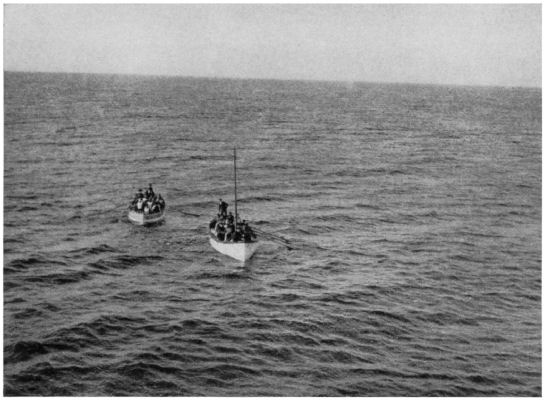
FIFTH OFFICER LOWE TOWING THE CANVAS COLLAPSIBLE
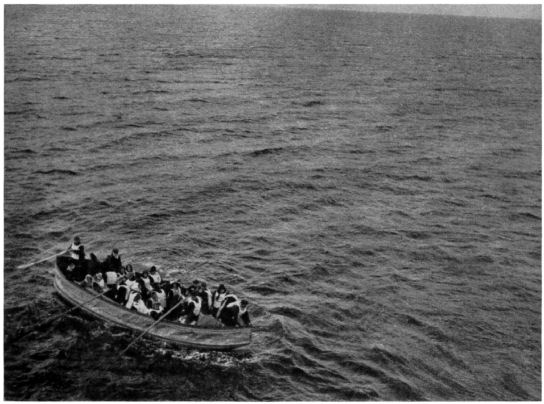
THE CANVAS COLLAPSIBLE
Joseph Scarrot, A. B. (Br. Inq., pp. 29, 30): I myself took charge of No. 14 as the only sailorman there. The Chief Officer ordered women and children to be taken in. Some men came and tried to rush the boat. They were foreigners and could not understand the orders I gave them, but I managed to keep them away. I had to use some persuasion with a boat tiller. One man jumped in twice and I had to throw him out the third time. I got all the women and children into the boat. There were fifty-four women and four children—one of them a baby in arms. There were myself, two firemen, three or four stewards and Mr. Lowe, who got into the boat. I told him the trouble I had with the men and he brought out his revolver and fired two shots and said: “If there is any more trouble I will fire at them.” The shots fired were fired between the boat and the ship’s side. The after fall got twisted and we dropped the boat by the releasing gear and got clear of the ship. There were four men rowing. There was a man in the boat who we thought was a sailor, but he was not. He was a window cleaner. The Titanic was then about fifty yards off, and we lay there with the other boats. Mr. Lowe was at the helm. We went in the direction of the cries and came among hundreds of dead bodies and life belts. We got one man, who died shortly after he got into the boat. One of the stewards tried to restore him, but without avail. There was another man who was calling for help, but among the bodies and wreckage it was too late for us to reach him. It took half an hour to get to that man. Cannot say exactly, but think we got about twenty off of the Engelhardt boat (“A”).
E. J. Buley, A. B. (Am. Inq., p. 605):
(After his transfer from No. 10 to No. 14.) Then, with Lowe in his boat No. 14, I went back to where the Titanic sank and picked up the remaining live bodies. We got four; all the others were dead. We turned over several to see if they were alive. It looked as if none of them were drowned. They looked as if frozen. The life belts they had on were that much (indicating) out of the water, and their heads lay back with their faces on the water. They were head and shoulders out of water, with their heads thrown back. In the morning, after we had picked up all that were alive, there was a collapsible boat (“A”) swamped, which we saw with a lot of people up to their knees in water. We sailed over to them. We then picked up another boat (“D”) and took her in tow. I think we were about the seventh or eighth boat alongside the Carpathia.
F. O. Evans, A. B. (Am. Inq., p. 677):
So from No. 10 we got into his (Lowe’s) boat, No. 14, and went straight over towards the wreckage with eight or nine men and picked up four persons alive, one of whom died on the way to the Carpathia. Another picked up was named J. Stewart, a steward. You could not hardly count the number of dead bodies. I was afraid to look over the sides because it might break my nerves down. We saw no other people in the water or heard their cries, other than these four picked up. The officer said: “Hoist a sail forward.” I did so and made sail in the direction of the collapsible boat “A” about a mile and a half away, which had been swamped. There were in it one woman and about ten or eleven men. Then we picked up another collapsible boat (“D”) and took her in tow to the Carpathia. There were then about twenty-five people in our boat No. 14, including the one who died.
One of the ladies there passed over a flask of whisky to the people who were all wet through. She asked if anybody needed the spirits, and these people were all soaking wet and nearly perished and they passed it around among these men and women. It took about twenty minutes after we sighted the Carpathia to get alongside of her. We saw five or six icebergs—some of them tremendous, about the height of the Titanic—and field ice. After we got on the Carpathia we saw, at a rough estimate, a twenty-five mile floe, sir, flat like the floor.
F. Crowe, steward (Am. Inq., p. 615):
I assisted in handing the women and children into boat No. 12, and was asked if I could take an oar. I said: “Yes,” and was told to man the boat, I believe, by Mr. Murdoch. After getting the women and children in we lowered down to within four or five feet of the water, and then the block and tackle got twisted in some way, causing us to have to cut the ropes to allow the boat to get into the water. This officer, Lowe, told us to do this. He was in the boat with us. I stood by the lever—the lever releasing the blocks from the hooks in the boat. He told me to wait, to get away and cut the line to raise the lever, thereby causing the hooks to open and allow the boat to drop in the water.
There was some shooting that occurred at the time the boat was lowered. There were various men passengers, probably Italians or some foreign nationality other than English or American, who attempted to “rush” the boats. The officers threatened to shoot any man who put his foot into the boat. An officer fired a revolver, but either downward or upward, not shooting at any one of the passengers at all and not injuring anybody. He fired perfectly clear upward and downward and stopped the rush. There was no disorder after that. One woman cried, but that was all. There was no panic or anything in the boat.
After getting into the water I pushed out to the other boats. In No. 14 there were fifty-seven women and children and about six men, including one officer, and I may have been seven. I am not quite sure. I know how many, because when we got out a distance the officer asked me how many people were in the boat.
When the boat was released and fell I think she must have sprung a leak. A lady stated that there was some water coming up over her ankles. Two men and this lady assisted in bailing it out with bails that were kept in the boat for that purpose. We transferred our people to other boats so as to return to the wreck and see if we could pick up anybody else. Returning to the wreck, we heard various cries and endeavored to get among them, and we were successful in doing so, and picked up one body that was floating around in the water. It was that of a man and he expired shortly afterwards. Going further into the wreckage we came across a steward (J. Stewart) and got him into the boat. He was very cold and his hands were kind of stiff. He recovered by the time that we got back to the Carpathia.
A Japanese or Chinese young fellow that we picked up on top of some wreckage, which may have been a sideboard or a table that was floating around, also survived.[13] We stopped (in the wreckage) until daybreak, and we saw in the distance an Engelhardt collapsible boat (“A”) with a crew of men in it. We went over to the boat and found twenty men and one woman; also three dead bodies, which we left. Returning under sail we took another collapsible boat in tow (boat “D”) containing fully sixty people, women and children.
I did not see the iceberg that struck the ship. When it came daylight and we could see, there were two or three bergs around, and one man pointed out that that must have been the berg, and another man pointed out another berg. Really, I do not think anybody knew which one struck the ship.
Mrs. Charlotte Collyer, third-class passenger, in The Semi-Monthly Magazine, May, 1912:
A little further on we saw a floating door that must have been torn loose when the ship went down. Lying upon it, face downward, was a small Japanese. He had lashed himself with a rope to his frail raft, using the broken hinges to make the knots secure. As far as we could see, he was dead. The sea washed over him every time the door bobbed up and down, and he was frozen stiff. He did not answer when he was hailed, and the officer hesitated about trying to save him.
“What’s the use?” said Mr. Lowe. “He’s dead, likely, and if he isn’t there’s others better worth saving than a Jap!”
He had actually turned our boat around, but he changed his mind and went back. The Japanese was hauled on board, and one of the women rubbed his chest, while others chafed his hands and feet. In less time than it takes to tell, he opened his eyes. He spoke to us in his own tongue; then, seeing that we did not understand, he struggled to his feet, stretched his arms above his head, stamped his feet and in five minutes or so had almost recovered his strength. One of the sailors near to him was so tired that he could hardly pull his oar. The Japanese bustled over, pushed him from his seat, took his oar and worked like a hero until we were finally picked up. I saw Mr. Lowe watching him in open-mouthed surprise.
“By Jove!” muttered the officer, “I’m ashamed of what I said about the little blighter. I’d save the likes o’ him six times over if I got the chance.”
Miss Minahan’s affidavit (Am. Inq., p. 1109):
After the Titanic went down the cries were horrible. Some of the women implored Officer Lowe of No. 10 to divide his passengers among the three other boats and go back to rescue them. His first answer to these requests was: “You ought to be d—— glad you are here and have got your own life.” After some time he was persuaded to do as he was asked. As I came up to him to be transferred to the other boat, he said: “Jump, G—d d—n you, jump.” I had shown no hesitancy and was waiting until my turn. He had been so blasphemous during the hours we were in his boat that the women in my end of the boat all thought he was under the influence of liquor. (Testimony elsewhere shows that Officer Lowe is a teetotaler.) Then he took all the men who had rowed No. 14, together with the men from other boats, and went back to the scene of the wreck. We were left with a steward and a stoker to row our boat, which was crowded. The steward did his best, but the stoker refused at first to row, but finally helped two men who were the only ones pulling on that side. It was just four o’clock when we sighted the Carpathia, and we were three hours getting to her. On the Carpathia we were treated with every kindness and given every comfort possible.
The above affidavit being of record shows Officer Lowe in an unfortunate, bad light. There is no doubt of it that he was intemperate in his language only. In all other respects he was a first-class officer, as proven by what he accomplished. But I am glad that I have the account of another lady passenger in the same boat, which is a tribute to what he did. I met Officer Lowe in Washington the time that both of us were summoned before the U. S. Court of Inquiry, and I am quite sure that the only point against him is that he was a little hasty in speech in the accomplishment of his work.
Miss Compton, who lost her brother, I had the pleasure of meeting on the Carpathia. She is still a sufferer from injuries received in the wreck, and yet has been very kind in sending me an account of her experience, from which I cite the following:
As she stood on the rail to step into boat No. 14 it was impossible to see whether she would step into the boat or into the water. She was pushed into the boat with such violence that she found herself on her hands and knees, but fortunately landed on a coil of rope. This seemed to be the general experience of the women. All the passengers entered the lifeboat at the same point and were told to move along to make place for those who followed. This was difficult, as the thwarts were so high that it was difficult to climb over them, encumbered as the ladies were with lifebelts. It was a case of throwing one’s self over rather than climbing over.
Miss Compton from her place in the stern of the lifeboat overheard the conversation between Officer Lowe and another officer, which the former gave in his testimony.
Just before the boat was lowered a man jumped in. He was immediately hauled out. Mr. Lowe then pulled his revolver and said: “If anyone else tries that this is what he will get.” He then fired his revolver in the air.
She mentions the same difficulties, elsewhere recorded, about the difficulties in lowering the boat, first the stern very high, and then the bow; also how the ropes were cut and No. 14 struck the water hard. At this time the count showed 58 in the boat, and a later one made the number 60. A child near her answered in neither of the counts.
“Mr. Lowe’s manly bearing,” she says, “gave us all confidence. As I look back now he seems to me to personify the best traditions of the British sailor. He asked us all to try and find a lantern, but none was to be found. Mr. Lowe had with him, however, an electric light which he flashed from time to time. Almost at once the boat began to leak and in a few moments the women in the forward part of the boat were standing in water. There was nothing to bail with and I believe the men used their hats.
“Officer Lowe insisted on having the mast put up. He crawled forward and in a few moments the mast was raised and ready. He said this was necessary as no doubt with dawn there would be a breeze. He returned to his place and asked the stewards and firemen, who were acting as crew, if they had any matches, and insisted on having them passed to him. He then asked if they had any tobacco and said: ‘Keep it in your pockets, for tobacco makes you thirsty.’ Mr. Lowe wished to remain near the ship that he might have a chance to help someone after she sank. Some of the women protested and he replied: ‘I don’t like to leave her, but if you feel that way about it we will pull away a little distance.’”
Miss Compton’s account corroborates other information about boat No. 14, which we have elsewhere. She was among the number transferred to Engelhardt boat “D.” “I now found myself,” she said, “in the stern of a collapsible boat. In spite of Mr. Lowe’s warning the four small boats began to separate, each going its own way. Soon it seemed as though our boat was the only one on the sea. We went through a great deal of wreckage. The men who were supposed to be rowing—one was a fireman—made no effort to keep away from it. They were all the time looking towards the horizon. With daylight we saw the Carpathia, and not so very long afterwards Officer Lowe, sailing towards us, for, as he had predicted, quite a strong breeze had sprung up. We caught the rope which he threw us from the stern of his boat. Someone in ours succeeded in catching it and we were taken in tow to the Carpathia.”
BOAT NO. 16.[14]
No male passengers.
Passengers: Fifty women and children—second and third-class.
Crew: Master-at-arms Bailey in charge. Seaman Archer, Steward Andrews, Stewardess Leather, and two others.
Total: 56.
INCIDENTS
E. Archer, A. B. (Am. Inq., p. 645):
I assisted in getting Nos. 12, 14 and 16 out—getting the falls and everything ready and passengers into No. 14. Then I went to No. 16. I saw that the plug was in tight. I never saw any man get in, only my mate. I heard the officer give orders to lower the boat and to allow nobody in it, having fifty passengers and only my mate and myself. The master-at-arms came down after us; he was the coxswain and took charge. When we were loading the boat there was no effort on the part of others to crowd into it; no confusion at all. No individual men, or others were repelled from getting in; everything was quiet and steady. One of the lady passengers suggested going back to see if there were any people in the water we could get, but I never heard any more of it after that. There was one lady in the boat, a stewardess (Mrs. Leather) who tried to assist in rowing. I told her it was not necessary, but she said she would like to do it to keep herself warm. There was one fireman found in the boat after we got clear. I do not know how he came there. He was transferred to another boat (No. 6) to help row.
C. E. Andrews, steward (Am. Inq., p. 623):
Besides these six men I should think there were about fifty passengers.
There was no effort on the part of the steerage men to get into our boat. I was told by the officer to allow none in it. When the officer started to fill the boat with passengers and the men to man it, there were no individuals who tried to get in, or that he permitted to get in. There was no confusion whatever. The officer asked me if I could take an oar. I said I could.
BOAT NO. 2.[15]
Only one old man, third-class, a foreigner in this boat.
Passengers: Miss Allen (now Mrs. J. B. Mennell), Mrs. Appleton, Mrs. Cornell, Mrs. Douglas and maid (Miss Le Roy), Miss Madill, Mrs. Robert and maid (Amelia Kenchen). One old man, third-class, foreigner, and family: Brahim Youssef, Hanne Youssef, and children Marian and Georges. The rest second and third-class.
Bade good-bye to wife and sank with ship: Mr. Douglas.
Crew: Fourth Officer Boxhall, Seamen Osman and Steward Johnston, cook.
Total: 25.
INCIDENTS
J. G. Boxhall, Fourth Officer (Am. Inq., p. 240, and Br. Inq.):
I was sent away in Emergency boat 2, the last boat but one on the port side. There was one of the lifeboats (No. 4) lowered away a few minutes after I left. That was the next lifeboat to me aft. Engelhardt boat “D” was being got ready. There was no anxiety of people to get into these boats. There were four men in this boat—a sailorman (Osman), a steward (Johnston), a cook and myself, and one male passenger who did not Speak English—a middle-aged man with a black beard. He had his wife there and some children. When the order was given to lower the boat, which seemed to be pretty full, it was about twenty minutes to half an hour before the ship sank. Someone shouted through a megaphone: “Some of the boats come back and come around to the starboard side.” All rowed except this male passenger. I handled one oar and a lady assisted me. She asked to do it. I got around to the starboard side intending to go alongside. I reckoned I could take about three more people off the ship with safety; and when about 22 yards off there was a little suction, as the boat seemed to be drawn closer, and I thought it would be dangerous to go nearer the ship. I suggested going back (after ship sank) to the sailorman in the boat, but decided it was unwise to do so. There was a lady there, Mrs. Douglas, whom I asked to steer the boat according to my orders. She assisted me greatly in it. They told me on board the Carpathia afterwards that it was about ten minutes after four when we went alongside.
After we left the Titanic I showed green lights most of the time. When within two or three ship lengths of the Carpathia, it was just breaking daylight, and I saw her engines were stopped. She had stopped within half a mile or a quarter of a mile of an iceberg. There were several other bergs, and I could see field ice as far as I could see. The bergs looked white in the sun, though when I first saw them at daylight they looked black. This was the first time I had seen field ice on the Grand Banks. I estimate about 25 in my boat.
F. Osman, A. B. (Am. Inq., p. 538):
All of us went up and cleared away the boats. After that we loaded all the boats there were. I went away in No. 2, the fourth from the last to leave the ship. Boxhall was in command. Murdoch directed the loading. All passengers were women and children, except one man, a third-class passenger, his wife and two children. After I got in the boat the officer found a bunch of rockets which was put in the boat by mistake for a box of biscuits. The officer fired some off, and the Carpathia came to us first and picked us up half an hour before anybody else. Not until morning did we see an iceberg about 100 feet out of the water with one big point sticking on one side of it, apparently dark, like dirty ice, 100 yards away. I knew that was the one we struck. It looked as if there was a piece broken off.
There was no panic at all. There was no suction whatever. When we were in the boat I shoved off from the ship and I said to the officer: “See if you can get alongside to see if you can get some more hands—squeeze some more hands in”; so the women started to get nervous after I said that, and the officer said: “All right.” The women disagreed to that. We pulled around to the starboard side of the ship and found that we could not get to the starboard side because it was listing too far. We pulled astern again that way, and after we lay astern we lay on our oars and saw the ship go down. It seemed to me as if all the engines and everything that was in the after part slid down into the forward part. We did not go back to the place where the ship had sunk because the women were all nervous, and we pulled around as far as we could get from it so that the women would not see and cause a panic. We got as close as we would dare to. We could not have taken any more hands into the boat. It was impossible. We might have gotten one in; that is all. There was no panic amongst the steerage passengers when we started manning the boats. I saw several people come up from the steerage and go straight up to the Boat Deck, and the men stood back while the women and children got into the boats—steerage passengers as well as others.
Senator Burton: So in your judgment it was safer to have gone on the boat than to have stayed on the Titanic?
Witness: Oh, yes, sir.
Senator Burton: That was when you left?
Witness: Yes, sir.
Senator Burton: What did you think when the first boat was launched?
Witness: I did not think she was going down then.
J. Johnston, steward (Br. Inq.):
Crew: Boxhall and four men, including perhaps McCullough. (None such on list.) Boxhall said: “Shall we go back in the direction of cries of distress?” which were a half or three-quarters of a mile off. Ladies said: “No.” Officer Boxhall signalled the Carpathia with lamp. Soon after launching the swish of the water was heard against the icebergs. In the morning Carpathia on the edge of ice-field about 200 yards off.
Mrs. Walter D. Douglas’s affidavit (Am. Inq., p. 1100):
Mr. Boxhall had difficulty in getting the boat loose and called for a knife. We finally were launched. Mrs. Appleton and a man from the steerage faced me. Mrs. Appleton’s sister, Mrs. Cornell, was back of me and on the side of her the officer. I think there were eighteen or twenty in the boat. There were many who did not speak English. The rowing was very difficult, for no one knew how. We tried to steer under Mr. Boxhall’s orders, and he put an old lantern, with very little oil in it, on a pole, which I held up for some time. Mrs. Appleton and some other women had been rowing, and did row all the time. Mr. Boxhall had put into the Emergency boat a tin box of green lights like rockets. These he sent off at intervals, and very quickly we saw the lights of the Carpathia, whose captain said he saw our green lights ten miles away and steered directly towards us, so we were the first boat to arrive at the Carpathia. When we pulled alongside, Mr. Boxhall called out: “Slow down your engines and take us aboard. I have only one seaman.”
Mrs. J. B. Mennell (née Allen):
My aunt, Mrs. Robert’s maid, came to the door and asked if she could speak to me. I went into the corridor and she said: “Miss Allen, the baggage room is full of water.” I replied she needn’t worry, that the water-tight compartments would be shut and it would be all right for her to go back to her cabin. She went back and returned to us immediately to say her cabin, which was forward on Deck E, was flooded.
We were on the Boat Deck some minutes before being ordered into the lifeboat. Neither my aunt, Mrs. Robert, my cousin, Miss Madill, nor myself ever saw or heard the band. As we stood there we saw a line of men file by and get into the boat—some sixteen or eighteen stokers. An officer[16] came along and shouted to them: “Get out, you damned cowards; I’d like to see everyone of you overboard.” They all got out and the officer said: “Women and children into this boat,” and we got in and were lowered.
With the exception of two very harrowing leave-takings, we saw nothing but perfect order and quiet on board the Titanic. We were rowed round the stern to the starboard side and away from the ship, as our boat was a small one and Boxhall feared the suction. Mrs. Cornell helped to row all the time.
As the Titanic plunged deeper and deeper we could see her stern rising higher and higher until her lights began to go out. As the last lights on the stern went out we saw her plunge distinctively, bow first and intact. Then the screams began and seemed to last eternally. We rowed back, after the Titanic was under water, toward the place where she had gone down, but we saw no one in the water, nor were we near enough to any other lifeboats to see them. When Boxhall lit his first light the screams grew louder and then died down.
We could hear the lapping of the water on the icebergs, but saw none, even when Boxhall lit his green lights, which he did at regular intervals, till we sighted the Carpathia. Our boat was the first one picked up by the Carpathia. I happened to be the first one up the ladder, as the others seemed afraid to start up, and when the officer who received me asked where the Titanic was, I told him she had gone down.
Capt. A. H. Rostron, of the Carpathia (Am. Inq., p. 22):
We picked up the first boat, which was in charge of an officer who I saw was not under full control of his boat. He sang out that he had only one seaman in the boat, so I had to manœuvre the ship to get as close to the boat as possible, as I knew well it would be difficult to do the pulling. By the time we had the first boat’s people it was breaking day, and then I could see the remaining boats all around within an area of about four miles. I also saw icebergs all around me. There were about twenty icebergs that would be anywhere from about 150 to 200 feet high, and numerous smaller bergs; also numerous ones we call “growlers” anywhere from 10 to 12 feet high and 10 to 15 feet long, above the water.
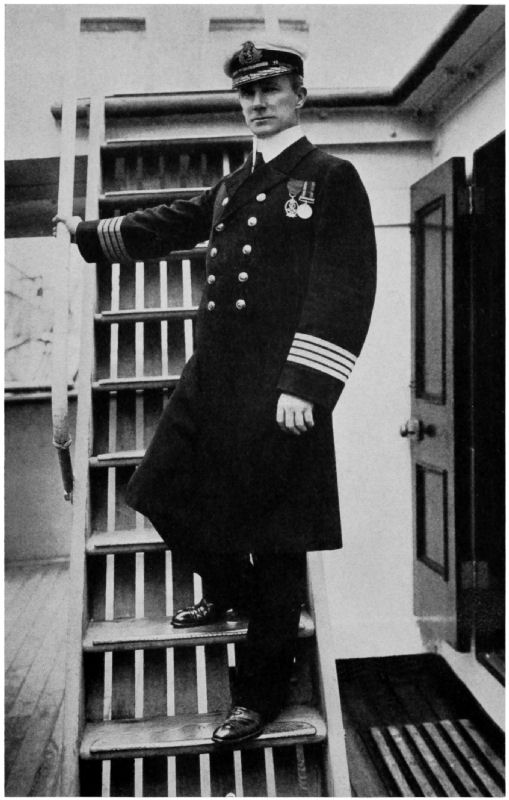
CAPTAIN ROSTRON OF S. S. “CARPATHIA”
BOAT NO. 4.[17]
No male passengers in this boat.
Passengers: Mrs. Astor and maid (Miss Bidois), Miss Bowen, Mrs. Carter and maid (Miss Serepeca), Mrs. Clark, Mrs. Cummings, Miss Eustis, Mrs. Ryerson and children, Miss S. R., Miss E. and Master J. B. and maid (Chandowson), Mrs. Stephenson, Mrs. Thayer and maid, Mrs. Widener and maid.
Women and children: 36. (Br. Rpt.)
Crew: Perkis, Q. M., in charge. Seamen: McCarthy, Hemmings,* Lyons;† Storekeeper Foley and Assistant Storekeeper Prentice;* Firemen: Smith and Dillon;* Greasers: Granger and Scott;* Stewards: Cunningham,* Siebert.†
* Picked up from sea. † Picked up from sea but died in boat.
Bade good-bye to wives and sank with ship: Messrs. Astor, Clark, Cummings, Ryerson, Thayer, Widener and his son Harry.
Stowaway: One Frenchman.
Total: 40. (Br. Rpt.)
INCIDENTS
C. H. Lightoller, Second Officer (Am. Inq., p. 81):
Previous to putting out Engelhardt Boat “D,” Lightoller says, referring to boat No. 4: “We had previously lowered a boat from A Deck, one deck down below. That was through my fault. It was the first boat I had lowered. I was intending to put the passengers in from A Deck. On lowering the boat I found that the windows were closed; so I sent someone down to open the windows and carried on with the other boats, but decided it was not worth while lowering them down—that I could manage just as well from the Boat Deck. When I came forward from the other boats I loaded that boat from A Deck by getting the women out through the windows. My idea in filling the boats there was because there was a wire hawser running along the side of the ship for coaling purposes and it was handy to tie the boat in to hold it so that nobody could drop between the side of the boat and the ship. No. 4 was the fifth boat or the sixth lowered on the port side.”[18]
W. J. Perkis, Quartermaster (Am. Inq., p. 581):
I lowered No. 4 into the water and left that boat and walked aft; and I came back and a man that was in the boat, one of the seamen, sang out to me: “We need another hand down here,” so I slid down the lifeline there from the davit into the boat. I took charge of the boat after I got in, with two sailormen besides myself. There were forty-two, including all hands. We picked up eight people afterwards swimming with life-preservers when about a ship’s length away from the ship. No. 4 was the last big boat on the port side to leave the ship. Two that were picked up died in the boat—a seaman (Lyons) and a steward (Siebert). All the others were passengers. After we picked up the men I could not hear any more cries anywhere. The discipline on board the ship was excellent. Every man knew his station and took it. There was no excitement whatever among the officers or crew, the firemen or stewards. They conducted themselves the same as they would if it were a minor, everyday occurrence.
Senator Perkins (addressing Perkis, Symons and Hogg:)
All three of you seem to be pretty capable young men and have had a great deal of experience at sea, and yet you have never been wrecked?
Mr. Perkis: Yes, sir.
Senator Perkins: Is there any other one of you who has been in a shipwreck?
Mr. Hogg: I have been in a collision, Senator, but with no loss of life.
Senator Perkins: Unless you have something more to state that you think will throw light on this subject, that will be all, and we thank you for what you have said.
Mr. Hogg: That is all I have to say except this: I think the women ought to have a gold medal on their breasts. God bless them. I will always raise my hat to a woman after what I saw.
Senator Perkins: What countrywomen were they?
Mr. Hogg: They were American women I had in mind. They were all Americans.
Senator Perkins: Did they man the oars? Did they take the oars and pull?
Mr. Hogg: Yes, sir; I took an oar all the time myself and also steered. Then I got one lady to steer; then another to assist me with an oar. She rowed to keep herself warm.
Senator Perkins: One of you stated that his boat picked up eight people, and the other that he did not pick up any. Could you not have picked up just as well as this other man?
Mr. Hogg: I wanted to assist in picking up people, but I had an order from somebody in the boat (No. 7)—I do not know who it was—not to take in any more; that we had done our best.
Senator Perkins: I merely ask the question because of the natural thought that if one boat picked up eight persons the other boat may have been able to do so.—You did not get any orders, Mr. Symons (boat No. 1), not to pick up any more people?
Mr. Symons: No, sir; there were no more around about where I was.
Senator Perkins: As I understand, one of the boats had more packed into it than the other. As I understand it, Mr. Symons pulled away from the ship and then when he came back there they picked up all the people that were around?
Mr. Symons made no reply.
S. S. Hemming, A. B. (Am. Inq.):
Everything was black over the starboard side. I could not see any boats. I went over to the port side and saw a boat off the port quarter and I went along the port side and got up the after boat davits and slid down the fall and swam to the boat about 200 yards. When I reached the boat I tried to get hold of the grab-line on the bows. I pulled my head above the gunwale, and I said: “Give us a hand, Jack.” Foley was in the boat; I saw him standing up. He said: “Is that you, Sam?” I said: “Yes” to him and the women and children pulled me in the boat.
After the ship sank we pulled back and picked up seven of the crew including a seaman, Lyons, a fireman, Dillon, and two stewards, Cunningham and Siebert. We made for the light of another lifeboat and kept in company with her. Then day broke and we saw two more lifeboats. We pulled toward them and we all made fast by the painter. Then we helped with boat No. 12 to take off the people on an overturned boat (“B”). From this boat (“B”) we took about four or five, and the balance went into the other boat. There were about twenty altogether on this boat (“B”).
A. Cunningham, Steward (Am. Inq., p. 794):
I first learned of the very serious character of the collision from my own knowledge when I saw the water on the post-office deck. I waited on the ship until all the boats had gone, and then threw myself into the water. This was about 2 o’clock. I was in the water about half an hour before the ship sank. I swam clear of the ship about three-quarters of a mile. I was afraid of the suction. My mate, Siebert, left the ship with me. I heard a lifeboat and called to it and went toward it. I found Quartermaster Perkis in charge. Hemmings, the sailor, Foley (storekeeper) and a fireman (Dillon) were in this boat. I never saw any male passengers in the boat. We picked up Prentice, assistant storekeeper. I think No. 4 was the nearest to the scene of the accident because it picked up more persons in the water. About 7.30 we got aboard the Carpathia. When we sighted her she might have been four or five miles away.
R. P. Dillon, trimmer (Br. Inq.):
I went down with the ship and sank about two fathoms. Swam about twenty minutes in the water and was picked up by No. 4. About 1,000 others in the water in my estimation. Saw no women. Recovered consciousness and found Sailor Lyons and another lying on top of me dead.