METEMPSYCHOSIS.
Reading edition
Since the ghost was produced at the Polytechnic years ago, the author has visited America, and seen not only the chief cities of the United States of America, but also those of patriotic Canada; and about ten years ago, paying a casual visit to Messrs. Walker, the eminent organ builders, he enquired of Mr. James Walker what he had done with a model shown him during the height of the popularity of the ghost, by which an empty glass goblet, or one full of water, was gradually filled with, or changed into, wine (or coloured water resembling it), thus unwittingly and apparently embodying or putting into an illustrated form the miracle of the conversion of water into wine.
I was too busy and too well paid at the time to think of a new illusion, but I praised it much, and said if not confined to too small stage limits, it was certainly as good, if not better, than the ghost illusion.
The time had now arrived when the London world was ready for something new (as commercial men would say) in the ghost line, and although Mr. James Walker, with the modesty of a truly scientific man, disclaimed the merit due to his invention, he did at last, at my request, throw himself, with the author, heart and soul into the production of the new illusion, which we called Metempsychosis. We now took out a patent for the new optical wonder, and having thus secured the invention from that piracy and robbery which too often dog the otherwise successful steps of inventors, causing nearly every patent to be called by the legal fraternity a damnosa hereditas, we looked about for a good place—hall or theatre—where the illusion could be started. None better could be thought of than the old Royal Polytechnic, where we offered at a moderate sum per week to produce it, paying for every stick, decoration, or engraved looking-glass ourselves. But it appeared that the funds of the institution were so reduced—it was supposed, by the immense expenditure on armies, warlike material, and ladies’ legs required to produce a work emulating friend Barnum’s gigantic “Nero,” and called, with an alarming stretch of imagination, the “Siege of Troy,” or “Destruction of Troy”—that the directors were unable to guarantee the weekly salary Mr. James Walker and myself demanded. Luckily for us, a percentage on the gross receipts was suggested, and brought in a great deal more money to our exchequer than the modest weekly salary would have given us. The public came in goodly numbers to see the new optical wonder, and all went well as long as the author remained in London and could devote his time and energies to the daily exhibition; but the time was now drawing rapidly near when, according to contract, he must leave for Australia.
Professor Pepper has invariably told his numerous patrons that, although obliged to keep secret for a reasonable time all optical illusions that he produced, he would ultimately tell the public all about it.
The metempsychosic era at the Polytechnic in 1879 was marked by the production of various stories, which were nicely edited and corrected by a lady of well-balanced, tasteful, and poetic mind—viz., by Miss Walker, the sister of the author’s very able coadjutor.
The entertainment opened with a vacant stage, disclosing a sort of inner apartment about twelve feet square, tastefully upholstered, and closed by a curtain which could be lowered at pleasure, without interfering with the great roller and white curtain upon which Dissolving Views were shown. The author’s adopted son, for he never had any children of his own, was now seen walking through the inner apartment to the foot-lights, where he bowed and, addressing the audience, had hardly got as far as the words, “Ladies and Gentlemen,—I am sorry to inform you that something has detained Professor Pepper—” when my voice was heard crying out: “Stop, stop; I am here!” and, appearing out of nothing and without the aid of trap doors or descent by the help of the copper wires, the author stood in the midst, and bowed his acknowledgments for the hearty greeting kindly given him by his audience. The entertainment now proceeded, and, after apologising for the gloom he was about to cast upon the meeting by the harassing story he was about to relate, finally stated that his subject would be those “fearful bags of mystery” called “sausages,” remarking incidentally that though, thanks to Government analysts, many persons had heard of the examination and analyses of this dietetic refresher of the inner man, no one probably had ever seen sausages put together again, as it were, and formed into the very animal from which they were originally educed. A large white dish of sausages was now produced. They were placed in a wire basket, such as pot-plants are suspended in from windows and verandahs, and hung up in the inner chamber. About one minute elapsed; the sausages were gone, and out of the basket came the author’s dear little sagacious white poodle, with his blue ribbon and little bells, wagging his tail, barking at the audience, and coming down to lick the hand of his master. The poor little creature was accidentally poisoned by eating bits of meat the rats had dropped whilst scuttling to their holes to die of the too rapid poison prepared by the author for those pests of domesticated people.
Then the metamorphoses proceeded. Oranges were changed into pots of marmalade, and given away to the boys, and a chest of tea was converted into a tray carrying a steaming teapot, sugar, milk, cups of tea, and handed by the attendants to the ladies in the reserved seats only—such is the blighting influence of cash, which caused the one-shilling people to be neglected and the eighteenpenny-reserved-seat folks to have their teas. The ghost of Banquo in “Macbeth,” and the ditto in “Hamlet” followed, with the curious change of a deserted piano into one at which played and sang a living member of the fair sex, attended by a gentleman in faultless black coat and white tie, who turned over her music; and this Part. I wound up with the change of a gentleman into a lady, who walked down to the foot-lights, sang a song, and then vanished into “thin air.”
But all these changes could only happen in the smaller inner apartment, the actors might walk anywhere else at pleasure, and out of the charmed circle Walker could not change to Pepper, or the latter refer to the living beings when they faded out of sight as regular “Walkers.”
So much for what was done, and now the anxious reader is getting impatient, and if a lady is doubtless curious (the poor men never are so) to know how it was all done, and as the illusion has apparently left the domain of optical science and is now relegated to the conjuring profession, the author has no hesitation in fulfilling his long-ago promise made to the public to let, as Mr. Cremer, jun., says in his most amusing book on “Conjuring,” the cat out of the bag.
Before the illusion can please the eyes, the proper apparatus for producing it must be constructed; and the key to the result consists in the use, not of clear plate glass employed in the ghost illusion, but of engraved silvered glass.
Ordinary looking-glass, such as is used for common mirrors or looking-glasses, is usually made by attaching an amalgam of tin-foil and quicksilver to one side of a clean sheet of plate or other glass.
Glass prepared in this way cannot be successfully engraved, and when the chisel or other tool is drawn with pressure across it, is liable to chip; and instead of clear, sharp engraved lines being obtained, they are ragged, and, in most cases, large patches of the amalgam are torn off.
This is not the case when glass really silvered by successful chemical processes is used, and when pure metallic silver is precipitated on to the surface of the best and flattest plate glass. When Mr. Walker and myself commenced our experiments in March, 1879, the so-called “Patent Silvered Glass” was expensive and confined to moderate-sized pieces of plate glass. Our first care, therefore, was to construct a table that could be brought by screws to a perfect level, and one that would carry a plate of glass at least twelve feet six long by six feet eight wide. Such a plate being most carefully cleaned, and quite free from grease, was placed upon the table, and levelled by means of spirit levels, just as a plate of glass used for the old collodion process would be levelled, in order that the fluid should not run off at one edge, leaving the other comparatively dry; and now came the knotty point—Which was the best silvering process to use? On consulting the best records of this art, we found valuable information in the English Mechanic, Vol. xxi., No. 542.
The reader will find the following process very successful if minutely carried out in all its technical details—
To Silver Glass.
Prepare two solutions.
1. Argentic nitrate is dissolved in distilled water, and ammonia added to the solution till the precipitate first thrown down is almost entirely re-dissolved. The solution is filtered and diluted, so that 100 cc. contain one gramme of argentic nitrate.
N.B.—100 cc. are equal to rather more than 3½ fluid ounces.
2. Two grammes of argentic nitrate are dissolved in a little distilled water, and poured into a litre of boiling distilled water. 1·66 gramme of Rochelle salt is added, and the mixture boiled for a short time, till the precipitate contained in it becomes grey; it is then filtered hot.
The glass, having been thoroughly cleaned with (1) nitric acid, (2) water, (3) caustic potash, (4) water, (5) alcohol, and lastly distilled water, is to be placed in a clean glass or porcelain vessel, the side to be silvered being placed uppermost. Equal quantities of the two solutions are then to be mixed and poured in, so as to cover the glass. This should be done while the glass is still wet with distilled water.
In about an hour the silvering will be completed. Then pour off the exhausted liquid, carefully remove glass, wash in clean water, rub off silver where deposited where not required, allow to dry, and varnish silvered side with any thin varnish which does not contract much in drying.
The time required for the operation depends on temperature.
If the solutions be warmed to about 30°C., the silver is deposited in a few minutes; but it is safer to use them cold.
The inside of test tubes, bulbs, &c., are silvered by putting the solutions into them, no second vessel being then required.
Throughout the whole operation the most scrupulous cleanliness is the grand essential.
100 cc. are equal to rather more than 3½ fluid ounces.
1 gramme = 15·432 grains.
1 litre = 35¼ fluid ounces.
The plate of glass being thus carefully silvered is allowed to dry thoroughly, and is finally varnished with a good thick varnish, containing plenty of red lead, so that the back surface of the silver mirror has a smooth and red appearance, while the varnish protects the delicate film of metallic silver.
An ordinary photographic picture on glass is really represented by precipitated metallic silver, but the metal in this case is in minute particles, which do not shine or reflect light.
The silvered plate glass is now engraved in the following simple manner. Being placed in a support or rack against the wall, and quite upright, a chisel—or rather, a series of chisels—are drawn across the surface in straight lines, and perpendicular, by the use of a large T-square. Every time the chisel is drawn with pressure across the varnished back of the glass a portion of the silver is removed, leaving a straight line quite clear or transparent, and, in fact, laying bare the surface of the plate glass.
The lines were ruled in three degrees of comparison: thick, thicker, thickest; and considerable skill and experience—which no description can teach—were required to get these correctly engraved.
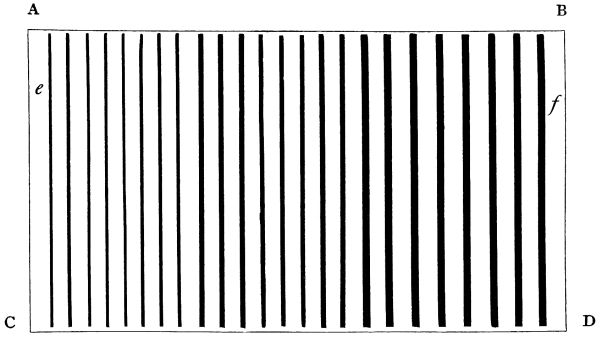
a b c d, the Plate Glass; e straight lines engraved on silvered side and gradually increasing in thickness from e to f.
The engraved silver glass plate moved through a groove in the woodwork at the top of the chamber, and was supported below on a beautiful carriage, the wheels of which were covered with vulcanised indiarubber rings, and moved on a tramway below the floor of the room, perpendicularly. The glass could be made to slide at an angle of forty-five degrees, and as it always made a rumbling noise while moving, the music of the band concealed that defect. The ground plan of the apartment is shown on the opposite page.
Some idea of the cost of making a full-sized apparatus, with hangings and curtains and engraved glass, may be gathered from the fact that the author’s outfit for Australia with a certain number of dresses cost £327 12s. 1d. Whilst the author was travelling through Australia Mr. James Walker, with his great inventive genius, made a further improvement, by which the concealed figure at k was done away with, and the whole apartment thrown open to the public gaze. This was done to illustrate a clever sketch written by Mr. Burnand called “Curried Prawns.”
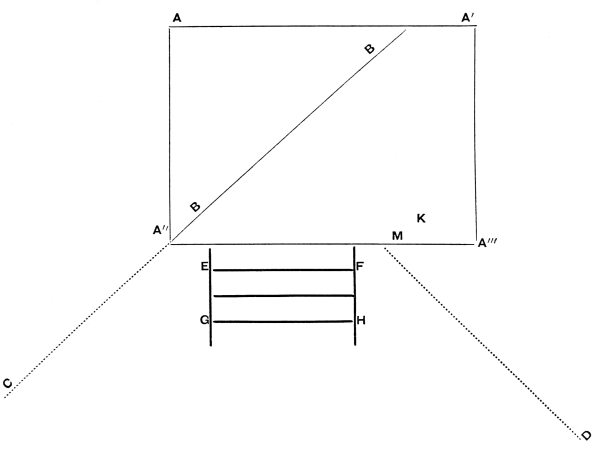
Ground plan of chamber.
a a′ a″ a‴, floor of the apartment; B B, groove at an angle of 45°, in which the glass moved; a″ to c groove continued outside of the apartment used when the glass was moved away; e f g h, short flight of three or four steps, as the room must stand some distance from the floor to allow of carriage moving on tramway.
N.B.—The groove a to c was concealed from the audience by handsome curtains, which were repeated at the same angle on the other side, from m to d.
K.—Place where the objects to be reflected in the looking-glass were placed, but quite concealed from the audience with a door, closed when the exhibition was going on.
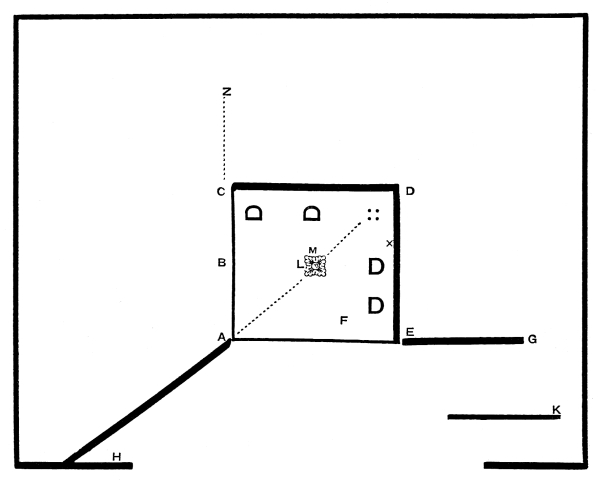
a c d e are the outside of the room, 12 feet square, engraved glass running from h a to a d. The wing e g is placed square; this is an immense advantage, as it renders unnecessary any counterpart at c n, and as, of course, it cannot be seen, the light from the foot-lights on e g is not seen by reflection at c n. When the wing e g was at the same angle as h a, this was always a weak point in the illusion, as when the glass crossed, the reflection of e g, unless very dimly illuminated, always shewed. Now it does not matter when e g is placed as in drawing. The frontage to the audience, instead of being from a f, is now extended to e—i.e. 12 feet—consequently the return sides f e and c b can be removed. This plan, of course, precludes the use of “trick” chairs, baskets, &c. &c.; but it has a good many other advantages in its favour, for with a “sociable” in the middle of the room made in two exact halves, these halves trick or cover one another when the glass is pushed across, and of course this movement is not seen by the audience; then any person or persons can be made to appear gradually, sitting or standing, at l or m, right in the middle of the wide open room. Mr. Walker tried this effect at the Polytechnic Institution, and it was capital—the ensemble is more imposing. This plan of shewing the illusion is the plan for the stage, as the necessity for darkening the stage in front is nearly wholly avoided. The back of the side-wing i k can be painted black, so that its reflection shall not be seen. In lieu of the gas-jets, as now arranged, there is a gas-lamp; this is placed on a pedestal or small table. The shadow of the “sociable” to a great extent covers or hides the path along which the glass travels. Mr. Walker says: “I thought out this way for Mr. Irving’s necessities, but I did not hear anything from him; and it has come in well for Mr. Burnand’s sketch, which has been produced.” In this sketch, a gentleman afflicted with dyspepsia through eating “curried prawns” (the name of the piece), calling on some friends, where he has promised to help them in some amateur theatricals, looks at the different costumes of Mephistopheles, Faust and Marguerite, and throws them carelessly on the seat at m, walks down the steps (which we shall double in width) the glass now crosses, and, whilst in a fit of melancholy, he wonders if Mephistopheles will appear. Sure enough, he does. Mephistopheles then comes down in front, and with incantations makes, successively or together; Faust and Marguerite appear; they then disappear in the same manner.
The author’s friends and the public all know how steadily he has opposed the so-called Spiritual deceptions, which generally are not a half nor a quarter as clever as the tricks of a first-rate conjuror.
Punch instructs us what to do at a Spiritual séance, which, if done, would certainly astonish the person performing the part of the materialised spirit. Punch writes—“How to behave at a Spiritual séance.—Always try to hit the happy Medium.”
The author thought the time had now arrived when a new generation who knew not the ghost might be interested in its revival, and with that idea the authorities at the present Polytechnic concurred, so that by the time these pages are read it is hoped the ghost will be in full career once more, and if the author only receives a tenth part of the great patronage he received in 1863 he will be amply repaid for all his exertions in reproducing the ghost illusion. And he desires thankfully to acknowledge the very kind help he has received from Robert Mitchell, Esq., the Secretary and Manager of the numerous classes and useful lectures now so well conducted at Mr. Quintin Hogg’s Polytechnic.
The author hopes to show “something new” at the Polytechnic; and a lady in miniature, as it were from Liliput, dances on a silver waiter held out by the author; and the great man Napoleon I., for whom, like Alexander the Great, the world was too small, stands in the palm of the hand of the author.
If “duffers,” &c., did not exist, the illusion would be explained to the public; but ten years need not elapse before they know all.
FINIS.
Printed by Cassell & Company, Limited, La Belle Sauvage, London, E.C.