Front matter
Arthur Hornblow translation
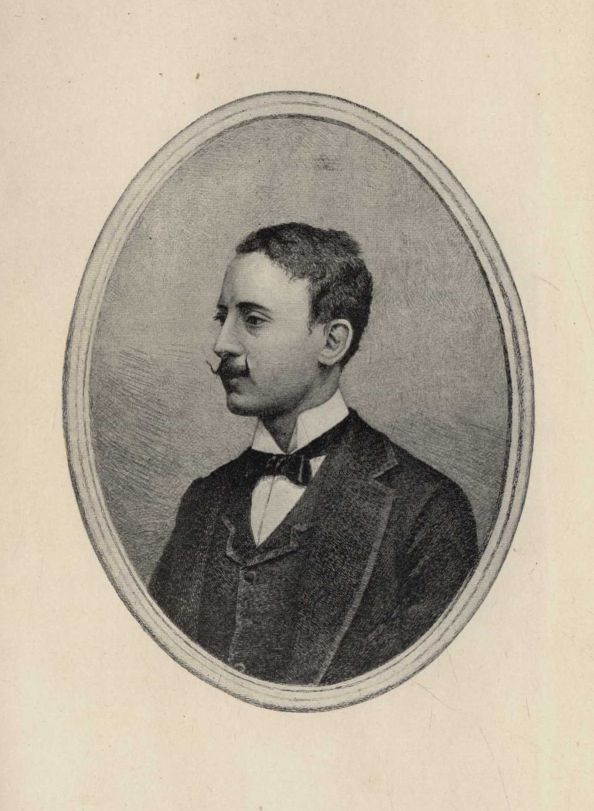
Gabriele D'Annunzio
THE ROMANCES OF THE ROSE
THE TRIUMPH OF DEATH
BY
GABRIELE D'ANNUNZIO
TRANSLATED BY ARTHUR HORNBLOW
WITH A RECENT PORTRAIT OF THE AUTHOR
Nec sine te nec tecum vivere possum.—OVID.
FIFTH EDITION.
NEW YORK GEORGE H. RICHMOND & CO. 1897
COPYRIGHT, 1896, BY GEORGE H. RICHMOND & CO.
CONTENTS.
THE PAST
THE PATERNAL ROOF
THE HERMITAGE
THE NEW LIFE
TEMPUS DESTRUENDI
THE INVINCIBLE
I.
THE PAST.
CHAPTER I.
When she perceived a group of men leaning against the parapet and looking down into the street below, Hippolyte stopped and exclaimed: "What has happened?"
With a slight gesture, betraying fear, she placed her hand involuntarily on George's arm as if to restrain him.
After watching the men a moment George said: "Someone must have leaped from off the terrace." Then he added: "Shall we turn back?"
She hesitated a few moments, wavering between curiosity and fear, and then replied: "No. Let's see what it is."
They advanced along the parapet as far as the end of the walk.
Unconsciously, Hippolyte accelerated her pace towards the small crowd that had gathered.
On this March afternoon the Pincio was almost deserted. Occasional sounds died away in the gray and heavy atmosphere.
"That's what it is," said George. "Someone has killed himself."
They stopped close to the crowd. All the spectators had their gaze intently fixed upon the pavement below. Most of them were workmen without occupation. Their faces, each different, expressed neither compassion nor sorrow, and the immobility of the gaze imparted a sort of bestial dulness to their eyes.
A young lad came up, eager to see; but scarcely had he ensconced himself in a position satisfactory to himself than he was hailed by one of the bystanders, in an indefinable tone of jubilation and pleasantry, as if delighted that no new arrival could enjoy the spectacle. "You're too late," he cried; "they've taken him away."
"Where to?"
"To the Santa Maria del Popolo."
"Dead?"
"Yes, dead."
Another individual, emaciated and of a greenish complexion, with a large woollen muffler around his neck, leaned half over; then, removing a pipe from his mouth, he shouted: "What's that on the ground?"
His mouth was distorted on one side, seamed as if by a burn, and convulsed as if by an endless flow of bitter saliva. His voice was so deep that it sounded as if it emerged from a cavern.
"What's that on the ground?" he repeated.
Down in the street below, a wagon-driver was squatting close to the foot of the wall. So as to hear his answer the better, the spectators became quiet and motionless. On the pavement could be seen a little blackish mud.
"It's blood," replied the wagon-driver without rising.
And with the point of a stick he continued his search in the bloody mire.
"Anything else?" asked the man with the pipe.
The wagon-driver rose. On the end of his stick he held something extended that could not be identified from above.
"Hair."
"What color?"
"Blond."
The precipice formed by the high walls lent a strange resonance to the voices.
"Let us go, George!" pleaded Hippolyte.
Disturbed and pale, she shook her lover's arm, as he leaned against the parapet near the group, fascinated by the horror of the scene.
They silently left the tragic spot. Both were preoccupied with painful thoughts of this death, and sadness was visible on their features.
"Happy are the dead!" exclaimed George at last. "They have no more doubts."
"That's true," replied his companion.
The weary tones in which both spoke seemed to indicate boundless discouragement.
She bent her head and added, with a bitterness mixed with regret: "Poor love!"
"What love?" asked George, preoccupied.
"Ours."
"Do you feel that it is growing cold?"
"In me, no," replied Hippolyte significantly.
"But you think it is in me?" persisted George.
An ill-concealed irritation lent sharpness to his words. Fixing his gaze on her, he repeated: "But you think it is in me? Don't you?"
She remained silent, her head drooping still lower.
"You won't answer? You know you're not telling the truth."
There was a pause. Both felt an unspeakable desire to read the other's heart. Then he continued:
"That is how the agony of love begins. You are not as yet aware of it, but since your return I have studied you ceaselessly and I daily discover in you a new symptom."
"What symptom?"
"A bad symptom, Hippolyte." Then, in a burst of mental agony, he exclaimed: "Oh, how horrible it is to love and yet not lose one's keenness of perception!"
She shook her head with a gesture of anger, and her face darkened. Once more, as on many previous occasions, hostility had risen between the two lovers. Each felt hurt by the injustice of suspicion, and secretly rebelled with that restrained anger which breaks out, from time to time, in brutal and irrevocable words, grave accusations and absurd recriminations. An indescribable fury seized them to torture themselves, to rend and martyrize their hearts.
Hippolyte became gloomy and silent. Her brows were knit in a frown and her lips were tightly pressed together. George regarded her with an irritating smile.
"Yes, that's how it will begin," he repeated, still smiling his disagreeable smile and fixing her with his keen glance. "You find at the bottom of your soul an inquietude, a sort of vague impatience which you cannot repress. When near me, you feel an instinctive repugnance arise in your breast against me—a repugnance which you cannot subdue. And then you become taciturn, you're obliged to make an enormous effort to speak to me at all; you misunderstand everything I say, and, perhaps unconsciously, you speak crossly even about the most trivial things."
She did not interrupt him even by so much as a gesture. Hurt by this indifference on her part, he continued to reproach her, spurred on to torment his companion not only by his sudden fit of temper, but also by a certain disinterested taste for investigation rendered the keener and the more literary by culture. He always tried to express himself with the accuracy and demonstrative precision which the works of the analysts had taught him; but, in the monologues, the formulas by which he interpreted his inner inquiry exaggerated and modified the mental condition under observation, while, in the dialogues, the preoccupation caused by being perspicacious often obscured the sincerity of his emotion and led him to err as to the secret motives which he claimed to discover in others. His brain, encumbered by a mass of psychological observations, personal or gathered from books, ended by confounding and confusing everything both as regarded himself and others.
He continued:
"Mind you, I make no reproach. I know it is not your fault. Every human soul has but a fixed quantity of sensitiveness for passion. It is inevitable that this quantity is exhausted in time and that no power can prevent the cessation of passion. Now, you have already loved me for a long time—almost two years! It will be the second anniversary of our love on the second of April. Had you thought of it?"
She nodded. He repeated, as if to himself: "Two years!"
They approached a bench and sat down. Hippolyte sank down with a weary sigh, as if overcome by an enervating weakness. The heavy black coach of a prelate passed by on the road below, the wheels rattling on the uneven cobblestones. The faint sound of a bugle came from the Flaminian Road, and then once more silence regained possession of the surrounding groves. A few drops of rain fell.
"Our second anniversary will be dismal," he went on, without pity for his moody companion. "But we must celebrate it all the same. I have a fondness for bitter fruits."
Hippolyte revealed her sorrow by a painful smile, and with unexpected gentleness said: "Why all these unkind words?"
She looked long and searchingly into George's eyes. A second time an inexpressible desire to read each other's hearts seized them. She knew well the horrible malady from which her lover suffered; she knew well the obscure cause of all his acrimony. To induce him to talk so he might unburden his heart, she added:
"What ails you?"
The tenderness of her tone, for which he was unprepared, threw him into some confusion. At this accent he knew that she understood him and pitied him; and he felt a great pity for himself swell in his bosom. A profound emotion stirred his whole being.
"What ails you?" repeated Hippolyte, touching his hand as though to sensually augment the power of her tenderness.
"What ails me?" he echoed. "I love!"
The aggressiveness had died away. In thus expressing his incurable weakness, he commiserated with himself on his own malady. The vague rancor which had ravaged his soul appeared to be dissipated. He recognized the injustice of all resentment against this woman because he recognized a superior order of fatal necessities. No, no human creature caused his misery. It arose from the very essence of life. He had to complain, not of the woman he loved, but of Love itself. Love, towards which his whole being reached out with invincible impetuosity, was, he thought, the greatest of human sorrows. And, until death possibly, he was condemned to this supreme misfortune.
As he remained silent and thoughtful, Hippolyte asked:
"Then do you think, George, that I don't love you?"
"I believe that you love me now," he answered. "But can you prove to me that to-morrow, or in a month, or in a year, you will still be happy to be mine? Can you prove to me that to-day, even at this very moment, you are wholly mine? How much of you do I possess?"
"Everything," murmured Hippolyte.
"No," he went on, "nothing, or almost nothing. And I do not possess what I should like to possess. You are a perfect stranger to me. Like every other human being, you conceal within yourself a world which is impenetrable to me and to which no depth of passion can give me access. Of your sensations, your sentiments, your thoughts, I know but a small part. Speech is at best an imperfect sign. The soul is incommunicable. You cannot show me your soul. Even in our most ecstatic moments we are two, always two—separate, strangers, lonely at heart. I kiss your brow, and beneath that brow there exists possibly a thought that is not of me. I speak to you and what I say perhaps awakens in you memories of other days, and not of my love. A man passes, looks at you, and in your heart this slight fact gives rise to an emotion which I am unable to detect. And I never know what reflections of your past life may flash upon you even when you show most affection for me. Ah, I am so afraid of that past life of yours! I am by your side; I feel a delicious happiness invade my being, a happiness which at certain moments results from your presence alone. I caress you, I speak to you, I listen to you, I abandon myself entirely. All at once, a thought chills me. If, without being aware of it, I had evoked in your memory the phantom of a former sensation, melancholy relic of by-gone days? Never can I describe my anguish. This ardor, which induces in me the illusory feeling of I know not what communion between you and me, dies out all at once. You escape me, you steal away, you become inaccessible. And I remain alone in frightful solitude. Ten, twenty months of intimacy, are all as nothing. You seem to me as much a stranger as before your love for me began. And I—I cease to caress you, I no longer speak, I retire within myself, I avoid all external manifestation, I dread that the slightest shock should raise from the bottom of your soul the obscure dregs deposited there by irrevocable life. And then there fall on us those long silences full of anguish, in which the energies of the heart are uselessly and miserably consumed. I ask you: 'Of what are you thinking?' And you reply: 'Of what are you thinking?' I am ignorant of your thoughts and you are ignorant of mine. Every moment the distance between us widens, until finally it becomes abysmal."
"But," objected Hippolyte, "I experience no such feelings. I give you more of myself than ever. I think my love is stronger."
This affirmation of superiority wounded anew the invalid.
"You think too much," she continued. "You pay too much attention to your thoughts. Possibly I have less attraction for you than your thoughts, because your thoughts are always different, always new, while now I have nothing that is new to offer you. In the beginning of our love you were less reflective and more spontaneous. You had not yet developed a taste for the bitter things in life; you were more lavish with your kisses than with your words. If, as you say, speech is an imperfect sign, it is not well to abuse it. And you do abuse it and in an almost always cruel manner."
Then, after an interval of silence, prompted to speak by something he said, she yielded to the temptation to express herself:
"Only cadavers are dissected."
But scarcely had she spoken than she regretted it. Her remark struck her as being vulgar, unfeminine, and acrimonious. She was sorry she had not preserved that gentle and indulgent tone which had moved her lover so strongly a few moments before. Once more she had failed in her resolution to be to him the most patient and tender of nurses.
"You see," she said repentantly, "it is you who spoil me."
He gave a faint smile. Both understood that in this quarrel their love only had been wounded.
The prelate's carriage repassed, the two black, long-tailed horses going at a trot. In the atmosphere which the haze of twilight rendered more and more livid, the trees assumed the appearance of spectres. Leaden-looking clouds darkened the height of the Palatine and the Vatican. A ray of light, yellow as sulphur, straight as a sword, lightly touched Mount Mario behind the pointed tops of the cypress-trees.
"Does she still love me?" George thought to himself. "Why is she so easily irritated? It may be that she feels that I speak the truth, or, at least, what will soon be the truth. Irritation is a symptom. But am I not conscious of a constant dull irritation in myself also? I know well the cause of my irritation. I am jealous. Of what? Of everything. Of the objects reflected in her eyes."
He looked at her. "She is very beautiful to-day. She is pale. It would please me to see her always depressed, always ill. When her color returns it seems to me as if it were no longer she. When she laughs I cannot repress a vague hostility, almost anger, at her laugh. Not always, though."
His thoughts died away in the shade of the twilight. He noticed suddenly how much the appearance of the evening reminded him of his beloved. From beneath the pallor of her dark face a light, violet-colored effusion shone through; and the narrow ribbon, of an exquisite shade of yellow, which she wore about her throat disclosed the brown marks of two beauty spots.
"She is very beautiful," he mused. "The expression of her face is nearly always profound, expressive, passionate. Therein rests the secret of her charm. Her beauty never tires me; it constantly suggests new dreams. What are the elements of this beauty? I cannot say. Materially, she is not beautiful. Sometimes, when I look at her, I am painfully surprised by a disillusion. That is because I then see only her physical characteristics; her face is not transfigured, illumined by the power of spiritual expression. She possesses, however, three divine elements of beauty: the brow, the eyes, and the mouth. Yes, divine."
Her laugh came to his mind.
"What did she tell me yesterday? I have forgotten what it was, some humorous incident that had happened at Milan during her visit to her sister's. 'How we laughed!' So then, even when away from me, she can laugh, be happy! Yet all her letters, which I have treasured, are full of sorrow, of tears, of hopeless regrets."
He felt as if he had received a wound, and then a great restlessness came upon him, as if he were cognisant of a serious and irreparable fact not entirely clear to him. The ordinary phenomena of sentimental exaggeration manifested themselves in him by means of associated images. This simple laugh was transformed in his imagination into an incessant hilarity, ever-present, daily, hourly, during the entire period of her absence. Hippolyte had led a gay, commonplace existence, with people unknown to him, among the companions of her brother-in-law, in a circle of stupid admirers. Her sad letters were only lies. He remembered a passage in one letter: "Life here is insupportable; friends weary us constantly and do not leave us a single peaceful hour. You know how cordial the Milanese are." In his imagination arose a vision of Hippolyte surrounded by a crowd of common clerks, advocates, and tradesmen. She smiled on them all, giving her hand to all, listening to witless conversations, making stupid answers, sinking herself to the same ordinary level.
And then there fell upon his heart all the weight of the misery he had endured for the past two years at the thought of the existence his mistress led and the unknown world in which she passed the time not spent with him.
"What does she do? Whom does she see? To whom does she speak? What is her behavior towards people who visit her, in whose life she is a factor?" Ever-recurring, unanswerable questions!
He thought, with anguish:
"Each one of these persons takes something from her, and consequently takes something from me. I shall never know what influence these people have over her, the emotions and thoughts they arouse in her. Hippolyte's beauty is full of seductive power, the kind of beauty which torments men and arouses in them the passion of desire. Among that odious crowd, she must have been frequently desired. A man's desire is discernible in his look and the look is free, and the woman is without defence against the look of the man who desires her. What can be the impression of a woman who perceives that she is desired? She certainly cannot remain impassive. It must produce in her a feeling of disquietude, certainly some kind of emotion, if only one of repugnance and disgust. And thus the first man who comes along has the power to disturb the woman who loves me! In what, then, consists my possession of her?"
He suffered keenly because the physical pictures bore out his mental reasoning.
"I love Hippolyte; I love her with a passion which I should judge to be everlasting, did I not know that all human passion must cease at some time. I love her, and I cannot imagine keener voluptuous delights than those she gives me. More than once, however, at the sight of some passing woman, I have been seized with a sudden desire; more than once has the flash of a pair of feminine eyes thrown me into a melancholy train of thought; more than once I have dreamed of meeting some woman—a woman perceived in a drawing-room, or the mistress of a friend. What can be her way of loving? Of what does its voluptuous secret consist? And for some time this woman has haunted my mind, not, indeed, to the exclusion of all other thoughts, but at intervals and persistently. Such phantasies suddenly present themselves to my imagination even when I hold Hippolyte in my arms. Why should she not have been seized by desire upon sight of some passing man? Had I the gift of reading her soul and saw it traversed by such a desire, if but for a moment, I should, without the slightest doubt, consider my mistress sullied by an indelible stain and it seems to me that I should die of grief. This material proof I can never have, because the soul of my mistress is invisible and impalpable; this, however, does not prevent the soul from being as much or even more exposed to profanation than the body may be. But the analogy enlightens me; the possibility is certain. Perhaps at this very moment my mistress is cognisant of a recent stain upon her conscience and sees this stain expand beneath her contemplation."
Stunned by his pain, he started violently.
"What ails you—of what are you thinking?" asked Hippolyte gently.
"Of you," he replied.
"Good or bad?"
"Bad."
She gave a sigh and then said: "Shall we go?"
"Yes—let us go."
They rose and regained the road by which they had come. Slowly and with tearful accents Hippolyte murmured: "What a sad evening, O my love!"
And she stopped as if to recall and live over again the sorrows scattered through the day that was about to close. Around them, now, the Pincio was deserted, full of silence, full of violet shadows in which the busts on their pedestals took on the appearance of funereal monuments. Below, the city was covered with ashes. A few drops of rain were falling.
"Where shall we go to-night? What are you going to do?" she asked.
He replied dejectedly: "What I shall do? I do not know."
They suffered, both of them, as they stood side by side; and they thought with terror of a greater agony which awaited them, well known and far more cruel—the horrible torture with which their nocturnal imaginations would rend their defenceless souls.
"If you like, I will remain with you to-night," said Hippolyte timidly.
Devoured by a secret rancor and spurred on by a furious desire to be spiteful and resentful, George replied: "No."
But his heart protested. "Stay far from her to-night? You cannot. No, you cannot." And in spite of his blind, hostile impulses, the conviction of this impossibility, the sure knowledge of this absolute impossibility, gave him a kind of internal thrill, a strange thrill of exalted pride at being controlled by such a great passion. He repeated to himself: "I could not stay away from her to-night; no, I could not." And he felt the indefinable sensation of being dominated by an unknown power. A tragic breath passed over his being. "George!" cried Hippolyte, frightened and clinging to his arm.
He started. He recognized the spot where they had stopped to look at the bloody stain left by the suicide. "Are you afraid?" he asked.
"A little," she replied, still holding his arm.
He disengaged himself from this restraint and, approaching the parapet, leaned over. Darkness had already enshrouded the street below; but he believed he could still distinguish the blackish spot on the cobblestones, because he still had the recent picture before his mind. The deepening twilight seemed to suggest and create a phantom corpse, the indefinite and bloody form of a blond young man. "Who was this man? Why did he kill himself?" In this phantom he seemed to recognize his own form. Rapid, incoherent thoughts coursed through his brain. He saw, as by a lightning flash, his poor uncle Demetrius, his father's youngest brother, also a suicide—a face covered by a black pall resting on a white pillow, a slender, pale, yet virile hand, and a small silver vessel containing holy water suspended from the wall by three small chains which, every now and then, rattled as they were swung by the breeze. "Suppose I threw myself over? A leap forward, a rapid fall! Does one lose consciousness when falling through space?" He imagined the shock of the body against the stones, and he shuddered. Then he felt in all his limbs a violent, agonizing repulsion, mingled with a feeling of strange lassitude. In his imagination he conjured up the delights of the coming night: to be lulled gradually into a state of delicious languor; to awake with a superabundance of tenderness mysteriously accumulated during one's sleep. Fancies and ideas followed one another with extraordinary rapidity.
When he turned round, his eyes met those of Hippolyte. Her eyes were widely dilated and fixed upon him, and he believed he could read in their depths things which increased his pain. He passed his arm beneath that of his mistress with an affectionate gesture customary with him. And she pressed his arm firmly against her heart. Both felt a sudden desire to embrace, to dissolve one into the other, distractedly.
"All out! All out!"
The cry of the keepers resounded among the groves, disturbing the silence.
"All out!"
After the cry, the silence seemed heavier and more dismal than ever, and these few words, vociferated by men they could not see, gave the two lovers an insupportable shock. To show that they had heard and were preparing to leave, they hastened their step. But here and there, in the deserted paths, the voices obstinately repeated:
"All out!"
"Curse their cries!" exclaimed Hippolyte, with a gesture of impatience and exasperation, and increasing the rapidity of her pace.
The clock of the Trinita-de-Monti sounded the Angelus. Rome appeared, similar to an immense, grayish, formless cloud touching the earth. Already, in the neighboring houses, several windows were lit up, their lights enlarged by the fog. A few drops of rain were falling.
"You'll come to me to-night, won't you?" asked George.
"Yes, yes, I will come."
"Early?"
"About eleven."
"I should die if you did not come."
"I will come."
They gazed in each other's eyes, exchanging an intoxicating promise.
Overcome by his emotion, George murmured: "Am I forgiven?"
They looked at each other again, and their gaze was charged with caresses.
"Adored one!" he murmured.
"Addio!" she rejoined softly. "Think of me until eleven."
"Addio!"
They separated at the foot of the Via Gregoriana. She went down the Via Capo-le-Case. As long as he could see her going along the wet pavement, lit up by the reflection of the shop windows, his gaze followed her.
"Thus it is," he thought. "She leaves me; she enters a house of which I know nothing; she reënters upon her commonplace life, despoiled of all the ideality in which I have clothed her; she becomes another woman entirely. I no longer know her. The gross necessities of life occupy her, absorb her, and degrade her...."
A perfume of violets was carried to him from a florist's close by, and his heart swelled with confused aspirations.
"Ah! why is it not permitted us to conform our existence according to our dreams, and to live forever in ourselves alone?"
CHAPTER II.
At ten o'clock in the morning George was still buried in the profound and refreshing slumber which, in the young, follows a night of voluptuousness, when his servant entered to awaken him.
Turning in his bed, he cried ill-humoredly:
"I am at home to no one. Let me be."
But from the adjoining room he heard the importunate visitor's voice addressing him in beseeching accents:
"Excuse me, George; I must speak to you."
George recognized the voice of Alphonso Exili, and his annoyance was only the greater.
This Exili was a college chum, a man of mediocre intelligence, who, ruined by gambling and debauch, had become a parasite and adventurer.
He still appeared a handsome young man, in spite of his face devastated by vice; yet in his person and manners there was that indefinable cunning and ignobleness noticeable in persons reduced to living by their wits.
He entered, waited until the servant had retired, and assumed a distressed air. Then, swallowing half his words, he said: "Forgive me, George, if I have recourse once more to your kindness. I must pay a card debt. I want you to help me. It's a small sum. Only three hundred lira. Forgive me."
"What? You pay your card debts now?" said George. "I'm surprised."
He threw this insult at him with the most perfect sans-gêne. Not knowing how to break off all connection with the parasite, he treated him with contempt, just as one would use a stick to ward off a dirty animal.
Exili smiled.
"Come, don't be unkind," he pleaded, in supplicating tones, like a woman's. "You'll give me the three hundred lira, won't you? I will pay you back to-morrow, on my word of honor!"
George burst into laughter. He pulled the bell to summon the servant. The servant entered. "Get my bunch of keys out of those clothes there, on the sofa." The servant found the keys. "Open the second drawer. Give me the large card-case." The servant passed him the card-case. "Very well, you may go."
"Couldn't you let me have four hundred lira?" asked Exili, with a half-timid, half-convulsive smile when the servant had left the room.
"No, there's three hundred. It's the last time. Now go."
Instead of handing him the bills, George laid them on the edge of the bed. Exili smiled, took them, and placed them in his pocket; then, in an ambiguous tone, in which irony was mixed with adulation, he said: "You have a noble heart."
His gaze wandered around the chamber, and he added: "You have a delicious bedroom."
He seated himself on the sofa, poured out a small glass of liqueur, and refilled his cigar-case.
"Who is your present mistress?" he went on. "What's her name? I believe it's no longer the one you had last year."
"Go away, Exili. I want to sleep."
"What a splendid creature! She has the handsomest eyes in Rome. She's away, I suppose. I have not met her for several days. She must be out of town. She has a sister in Milan, I think."
He refilled his petit verre and swallowed its contents at a single gulp. Possibly he gossiped only in order to gain time enough to empty the bottle.
"She's separated from her husband, isn't she?" he continued. "I imagine that her finances must be at a very low ebb, and yet she is always most elegantly dressed. About two months ago I met her in the Via del Babuino. You know your probable successor. But no, you can't know him. It's Monti, the mercante di campagna, a great big fellow, with dirty blond hair. That very day I saw her he was close at her heels in the Via del Babuino. You know one can see at a glance when a man is following a woman. Monti has money, too."
He uttered these last words in a curious tone; an odious tone of envy and cupidity. Then he drank for the third time, noiselessly.
"Are you asleep, George?"
Instead of answering, George pretended to sleep. He had heard everything, but he feared that Exili might see his heart-beats through the bedclothes.
"George!"
He feigned to start like a man suddenly awakened.
"What! You are still here? Aren't you going?"
"I am going now—but look! A tortoise-shell pin!"
He stooped to pick it up from the carpet, examined it with curiosity, and laid it on the coverlid.
"Lucky fellow!" he exclaimed in the same ambiguous tone. "And now, ta-ta—a thousand thanks."
He extended his hand, but George kept his beneath the clothes. The chatterbox turned towards the door.
"Your cognac is exquisite. I'll take another petit verre."
He drank, and then went away. George, in his bed, could relish the poison at his leisure.
CHAPTER III.
The second anniversary fell on the second of April.
"This time," said Hippolyte, "we will celebrate it away from Rome. We must pass a great week of love; all by ourselves, no matter where, but not here."
"Do you remember the first anniversary," asked George, "that of last year?"
"Yes, I remember."
"It was a Sunday, Easter Sunday. And I came to your rooms at ten o'clock in the morning. And you wore that little English jacket that pleased me so. You had brought your prayer-book."
"Oh! that morning, I had not been to mass."
"You were in such a hurry."
"My departure from the house was like a flight," answered Hippolyte. "You know, on holy days, I could not call a moment my own. Yet, for all that, I found a way to remain with you until noon. And we had guests for lunch that day."
"Then, the rest of the day we could not see each other. It was a sad anniversary."
"Yes, it was," murmured Hippolyte.
"And that sun!"
"And that forest of flowers in your room," she laughed. "I, too, on that morning, had gone out for a moment; I bought up almost the entire flower market."
"You threw hands full of rose-leaves at me. You put a number of the leaves down my neck, in my sleeves. Do you remember?"
"Yes, I remember."
"And then, at the house, I found them all when I disrobed."
She smiled.
"And on my return my husband found leaves on my hat, in the folds of my dress."
"Yes, you told me."
"I did not go out again that day. I did not care to go out again. I thought, and rethought. Yes, it was a sad anniversary."
After an interval of silent revery, she spoke again.
"Did you believe, in your heart, that we should reach our second anniversary?"
"I—no," he replied.
"Nor I."
"What love!" thought George, "that which carries within itself the presentiment of its end." He then thought of the husband, without hate and even with a sort of compassionate benevolence. "Now she is free. Why, then, am I more uneasy now than formerly? The husband was a sort of guarantee for me; I looked on him as a guardian who shielded my mistress from all danger. Maybe these are illusions; because at that time, also, I suffered much. But the suffering which is passed seems always less severe than the present pain." Following his own reflections, he no longer listened to Hippolyte's words.
"Well," she said, "where shall we go? We must decide. To-morrow is the first of April. I have already said to my mother: 'You know, mamma, one of these days I am going on a short journey.' I must prepare her for my departure. Do not worry. I will invent a plausible pretext. Leave it to me."
She spoke gayly; she smiled. And in the smile which illuminated her closing remarks he believed he discovered the instinctive contentment which a woman feels when concocting some deception. The facility with which Hippolyte succeeded in deceiving her mother displeased him. He thought once more, and not without regret, of the marital vigilance. "Why suffer so cruelly on account of this liberty," he reflected, "when it is in the service of my pleasure? I do not know what I would give could I get away from my fixed idea, from my suspicions which do her injustice. I love her, and I wrong her; I love her, and I believe her capable of an unworthy action!"
"We must not go too far," she said. "You ought to know of some peaceful spot, secluded, full of trees, interesting. Not Tivoli, nor Frascati."
"Take the Baedeker—it's there on the table—and look."
"Let us look together."
She took the red book, knelt close to the couch on which he was seated, and with pretty gestures and infantile grace she began to turn over the pages. Every few moments she read a few lines in a low tone.
He sat watching her, fascinated by the finesse of the nape of her neck, from which the little brown curls mounted towards the crown of her head, twisted into a sort of coil. He looked at the two little brown spots, beauty spots, the Twins placed one by the side of the other on the whiteness of the velvety neck to which they gave an ineffable charm. He remarked that she wore no earrings. In fact, for two or three days she had not worn her sapphire earrings. "Has she sacrificed them on account of some money embarrassment? Who knows? She may be suffering silently from the cares of hard, daily necessities." He had to forcibly compel himself to consider seriously the thought which haunted him. This thought was as follows: "When she becomes tired of me (and that will not be very long), she will fall into the hands of the first comer who will offer her an easy life, and who, in exchange for sensual pleasure, will keep her from want. This man may even be the mercante of whom Exili spoke. Disgusted with petty miseries, she will triumph over the other disgust; she will adapt herself. It is even possible that she will not have to overcome any repugnance."
He remembered the mistress of one of her friends, the Countess Albertini. This woman, separated from her husband, left free without fortune, had descended progressively to lucrative amours, having enough cleverness to save appearances. He remembered a second example, which illustrated even more truly the possibility of what he feared. And confronted with this possibility, which emerged from the unfathomable future, he felt an inexpressible pain. Henceforth his apprehensions would give him no truce. Sooner or later, he was fated to witness the fall of the creature he had placed so high. Life was full of such forfeitures.
"I have found nothing," she said in a disappointed tone.
"Gubbio, Narni, Viterbo, Orvieto! Look at the map of Orvieto: the Monastery of Saint Peter, the Monastery of Saint Paul, the Monastery of Jesus, the Monastery of Saint Bernardin, the Monastery of Saint Louis, the Convent of Saint Dominique, the Convent of Saint Francis, the Convent of the Servants of Mary."
She read in a sing-song tone, as if she were reciting a litany. All at once she began to laugh, threw back her head, and offered her beautiful forehead to the lips of her lover. She was in one of those moments of expanding kindness which gave her the air of a young girl.
"What a number of monasteries! How many convents! It must be a strange place. Shall we go to Orvieto?"
George experienced a sensation as if his soul had been overwhelmed by a sudden wave of freshness. He abandoned himself with gratitude to this comforting sign. And, as he pressed his lips to Hippolyte's brow, he gathered there the souvenir of the city of the Guelphs, of the deserted city which is silent in mute adoration of its marvellous Duomo.
"Orvieto! were you never there? Imagine to yourself, at the top of a rock of tufa, overlooking a melancholy valley, a city so perfectly silent as to seem without inhabitants; shutters closed; gray lanes in which the grass grows; a capuchin monk crossing a public square; a bishop descending from a black carriage in front of some hospital, with a decrepit domestic at the carriage-door; a tower against a white and rainy sky; a clock slowly tolling the hours; and all at once, at the bottom of a street, a miracle—the Duomo."
"What peace!" murmured Hippolyte, rather dreamily, as if she had before her eyes the vision of this silent city.
"I have seen Orvieto in February," he went on, "when the weather was like to-day, uncertain—a few drops of rain; a few beams of sunshine. I stayed there one day, and I was sorry to leave. I brought away with me a feeling of nostalgia for that peace. Oh! what peace! I had no other companion than myself, and I indulged in this dream: 'To have a mistress, or, to express it better, a sister-lover, who would be full of devotion; and to come here, to live here for a month, a long April month, a rather rainy April, ashen but mild, with showers of sunshine; to pass hours and hours in, or before, or about the cathedral; to gather roses in the convents' gardens; to visit the houses of the sisters to get preserves; to drink delicious perfumed liqueurs from small Etruscan cups; to love a great deal, and sleep a great deal in a soft bed all veiled in virginal white.'"
This dream made Hippolyte smile with happiness. Putting on an innocent expression, she said: "I am pious, you know. Will you take me to Orvieto?"
And huddling at her lover's feet, she took both his hands in hers. An immense joy invaded her whole being; she had already a foretaste of the promised repose, idleness, melancholy.
"Tell me again."
He kissed her forehead, lingering over it with chaste emotion. Then for a long time he regarded her caressingly.
"Your forehead is so beautiful," he said, with a little thrill.
At that moment the real Hippolyte corresponded with the ideal Hippolyte which lived in his heart. He beheld her beautiful, tender, submissive, breathing a noble and sweet poesy. According to the motto he had invested her with, she was grave and suave—gravis dum suavis.
"Tell me again," she murmured.
A soft light entered from the balcony. From time to time the windows rattled gently under the breeze; and the raindrops pattered almost noiselessly on the panes.
CHAPTER IV.
"Since we have already enjoyed in imagination the essence of pleasure, since we have tasted all that our sensations and sentiments could experience of what is rarest and most delicate, I would advise that we renounce the experience of reality. Don't let us go to Orvieto." And he chose another place: Albano-Laziale.
George was not acquainted with Albano, nor Ariccia, nor the Lake of Nemi. Hippolyte, during her infancy, had been taken to Albano to the house of an aunt, now dead. For him this trip would have the charm of the unknown, and for her it would evoke the souvenir of days long distant. Does it not seem as if a new vision of beauty renews and purifies love? Do not the memories of the virginal age embalm the heart with a perfume always fresh and soothing?
They decided to leave on the second of April, at noon, by train. Both were punctual at the rendezvous at the station, and when they found themselves amidst the crowd they felt a restless joy penetrate their souls.
"Shan't we be seen? Tell me, shan't we be seen?" asked Hippolyte, half-laughing and half-trembling, and imagining that all eyes were fixed on her. "How much longer before we start? Dio Mio! How afraid I am!"
They hoped to have a compartment to themselves; but, to their great regret, they were forced to resign themselves to having three travelling companions. George saluted a gentleman and lady.
"Who is that?" asked Hippolyte, leaning towards her lover's ear.
"I will tell you."
She examined the couple with curiosity. The gentleman was an old man with a long, venerable beard, a broad, bald, yellowish head, marked in the centre by a deep depression, a sort of enormous and deformed navel, like the imprint which would be caused by a large finger pressed into a soft substance. The lady, wrapped in a Persian shawl, showed, under a bonnet fashioned like a lamp-shade, an emaciated and meditative face; and in her dress as in her physiognomy could be found something of the English caricatures of the blue-stocking. The watery eyes of the elderly man had, however, a singular vivacity; they seemed illumined by an internal fire, like those of an ecstatic. He had acknowledged George's bow by a very amiable smile.
Hippolyte racked her memory. Where could she have met these two persons? She could not succeed in refreshing her memory, but she had a confused feeling that these strange old people had been involved in one of her love-dreams.
"Who is it? Tell me," she repeated in a whisper.
"The Martlets—Mr. Martlet and his wife. They will bring us good luck. Do you know where we first met them?"
"No; but I am sure that I have seen them somewhere."
"It was in the chapel in the Via Belsiana, on April the 2d, when I first knew you."
"Ah! yes. I remember!"
Her eyes lighted up; the coincidence seemed marvellous to her. She examined anew the two old people, and felt a kind of emotion.
"What a good augury!"
A delicious melancholy came over her. She leaned her head against the back of the seat, and thought once more of bygone days. She saw again the little church in the Via Belsiana, mysterious, shrouded in a bluish penumbra; the gallery, which had a curve like a balcony; the posy of young girls chanting in the choir. Below, the group of musicians with their string instruments, standing in front of white-pine pulpits. Roundabout, in the stalls of oak, the seated auditors, few in number, almost all gray or bald. The chapel-master beat the time. A pious perfume of incense and violets mingled with the music of Sebastian Bach.
Overcome by the suavity of her recollections, she leaned over more towards her lover, and murmured: "Are you thinking of the old days too?"
She would have liked to be able to communicate her emotions, in order to prove to him that she had forgotten nothing, not even the slightest circumstance of that solemn event. He, with a furtive gesture, sought Hippolyte's hand beneath the large folds of their travelling rug, and kept it slightly pressed in his own. Both felt in their souls a thrill which recalled to them certain delicate sensations of the first days of their love. And they remained in this attitude, pensive, somewhat exalted, somewhat lethargic from the warmth, soothed by the even and continuous movement of the train, at times seeing a green-clad landscape in the haze through the carriage windows. The sky was clouded; it was raining. Mr. Martlet dozed in a corner; Mrs. Martlet was reading a review-the Lyceum. The third traveller slept soundly, his cap down over his eyes.
"If the choir missed the tempo, Mr. Martlet beat time with energy, like the chapel-master. At a certain moment, all the old men beat time, as if moved by the spirit of the music. There was in the air an evaporated perfume of incense and violets." George abandoned himself with delight to the capricious workings of his memory. "Could I have dreamed of a stranger or more poetic prelude to my love? It seems like a recollection of some romantic tale; yet, on the contrary, it is a souvenir of my actual life. I constantly retain the smallest details of it before the eyes of my soul. The poetry of this beginning shed, later on, the shadow of a dream over my entire love." In the drowsiness of a light torpor, he dwelt on certain confused images which exerted a species of musical fascination over his mind. "A few grains of incense—a little bouquet of violets!"
"Look how Mr. Martlet sleeps!" said Hippolyte in a whisper. "As peacefully as an infant."
Then she added, smiling: "You, too, are sleepy, are you not? It is still raining. What a strange languor! My eyelids feel so heavy."
Her eyes half-shut, she looked at him from between her long eyelashes.
George thought to himself: "Her eyelashes pleased me at once. She was in the centre of the chapel, seated on a high-backed bench. Her profile was delineated in the light streaming from the window. When the clouds outside cleared away, the light suddenly grew stronger. She made a slight movement, and in the light I saw the real length of her eyelashes—a prodigious length."
"Tell me," said Hippolyte, "will it be long before we arrive?"
The shrill whistle of the locomotive announced the proximity of a station.
"I'll wager," she added, "that we have gone beyond our station."
"Oh! no."
"Very well, inquire."
"Segni-Paliano," cried a hoarse voice on the platform.
George, somewhat startled, stretched out his head, and asked: "Is this Albano?"
"No, sir, this is Segni-Paliano," answered the man with a smile. "Are you going to Albano? Then you should have alighted at Cecchina."
Hippolyte burst into such a loud peal of laughter that Mr. and Mrs. Martlet looked at her with amazement. George immediately joined in the contagious hilarity.
"What shall we do?"
"First of all, we must get out of this train."
George handed their hand-bags to a porter, while Hippolyte continued to laugh—her fresh, hearty laugh—amused at this misadventure, which she considered capital fun. Mr. Martlet looked startled at this outburst of youth, which seemed to him like a wave of sunshine, but he smiled with benevolent condescension and bowed to Hippolyte, who at heart felt a vague regret at leaving the train.
"Poor Mr. Martlet!" she said, half in earnest, half in jest, as she watched the train moving away through the bleak and deserted country. "I am sorry to part with him. Who knows if I shall ever meet him again."
Then, turning towards George, she added, "What now?"
A railway employee gave them information.
"The train for Cecchina passes here at half-past four."
"We can manage, then," continued Hippolyte. "It is now half-past two. Now, from this moment, I declare that I will assume the management of this journey. You will simply permit yourself to be conducted. Come, my little George. Keep close to me, and take good care that you don't lose yourself."
She spoke to him as to a baby, in jest. They both felt full of gayety.
"Where is Segni? Where is Paliano?"
No village could be seen in the neighborhood. The low hills spread their uncertain verdure beneath a gray sky. Near the road, a single little tree, knotted and gnarled, swayed in the humid atmosphere.
As it still poured, the two wanderers sought shelter at the station, in a small room, with a chimney-piece without a fire. On a wall hung an old map in tatters, its surface a network of black lines. On another wall hung a square of pasteboard advertising an elixir. Opposite to the chimney, which had not even the memory of a fire, a couch, covered with a waxed cloth, was losing its species of stuffing by a thousand wounds.
"Look!" cried Hippolyte, who was reading the Baedeker. "At Segni there is the Gaetanino Hostelry."
This designation made them laugh.
"Suppose we smoke a cigarette?" said George. "It is three o'clock. It was at this time that I entered the church, two years ago."
And, once more, the memory of the great day occupied his mind. During several minutes they smoked without speaking, listening to the rain, which had increased in force. Through the drenched window-panes they saw the frail little tree, twisting and bending under the squall.
"My love is of older date than yours," said George. "It was born before that day."
She protested.
He, fascinated by the profound charm of the days irrevocably passed, continued tenderly: "I can see you again as you passed the first time. What an ineffaceable impression! It was towards evening, when the lights begin to be lit, when waves of azure fall on the streets.
"I was alone before the windows of Alinari. I was looking at the figures, but distinguished them with difficulty. It was an indefinable sensation—some lassitude, much sadness, with I know not what vague desire for ideality. That evening I had an ardent thirst for poetry, elevation, refined and spiritual things. Was it a presentiment?"
He made a long pause; but Hippolyte said nothing, waiting for him to continue, engrossed in the exquisite pleasure of listening to him among the light smoke of the cigarettes, which seemed to envelop the veiled memories in still another veil.
"It was in February. I was paying a visit to Orvieto at that very time. I even believe that if I was then at Alinari's, it was to ask him for a photograph of the reliquary. And you passed! Since then, on two or three other occasions—two or three, not more—I have seen you as pale, that singular pallor. You cannot imagine, Hippolyte, how pale you were. Never have I seen its equal. I thought: 'How can that woman keep up? She cannot have a single drop of blood in her veins.' It was a supernatural pallor, which in the flood of azure falling from the sky to the pavement gave you the appearance of a creature without a body. I paid no attention to the man who accompanied you; I did not wish to follow you; I did not receive even as much as a look from you. I recall another detail. You stopped a few steps farther on, because a lamp-lighter blocked the pavement. Ah! I still see in the air the scintillation of the small flame at the summit of the staff; I see the sudden lighting of the gas which bathed you in light."
Hippolyte smiled, but somewhat sadly, with that sadness which oppresses the heart of women when they regard their portraits taken in former days.
"Yes, I was pale," she said. "I had only quitted my bed a few weeks before, after a three months' illness. I had been at death's door."
A gust of rain dashed against the window-panes. The little tree could be seen bending and twisting under the wind in an almost circular movement, as if some hand were attempting to uproot it. For several minutes they both watched the fury of the elements, which, in the bleakness, nakedness, and inert torpor of the surrounding country, took on a strange appearance of conscious life. Hippolyte felt almost compassion. The imaginary suffering of the tree placed them face to face with their own sufferings. They mentally considered the great solitude which lay all around the station, a miserable hut before which passed from time to time a train-load of divers travellers, each of whom carried in his own bosom a different inquietude. Sad images rapidly succeeded one another in their thoughts, suggested by the same things they had seen an hour before with joyous eyes. And when the images faded away, when their consciences, ceasing to be impressed, returned to themselves again, they both found, at the bottom of their being, a unique and inexpressible anguish—a regret for days irrevocably lost.
Their love had behind it a long past. It dragged behind it, through the years, an immense and obscure net, full of dead things.
"What's the matter?" asked Hippolyte, her voice slightly changed.
"What's the matter with you?" asked George, looking fixedly at her.
Neither replied to the question. They remained silent, and renewed their gaze through the windows. The heavens seemed to smile tearfully. A faint glimmer lit up a hillock, bathed it in a fugitive golden glow, died away. Other sun-rays tried to pierce the moisture-laden cloud-banks, then disappeared.
"Hippolyte Sanzio!" said George, pronouncing the name slowly, as if to enjoy its charm. "How my heart beat when I finally learned that was your name! How many things have I seen and felt in that name! It was the name of one of my sisters, who is dead. That beautiful name was familiar to me. With profound emotion, I immediately thought, 'Oh! if my lips could only resume their dear custom.' That day, from morning until night, the recollections of my dead sister mingled exquisitely with my secret dream. I did not go in search of you; I forbade myself such pursuit; I would never be importunate; yet, at heart, I had an inexplicable confidence. I was sure that, sooner or later, you would know me and love me. What delicious sensations were mine! I lived outside of the reality; my soul fed only on music and exalting books. One day it happened that I saw you at a concert given by Gian Sgambati; but I saw you only just as you were about to leave the hall. You gave me a glance. Another time, again, you looked at me—maybe you remember? It was when we met at the entrance to the Via del Babuino, opposite the Piale Library."
"Yes, I remember."
"You had a little girl with you."
"Yes; Cecilia—one of my nieces."
"I stopped on the sidewalk—so as to allow you to pass. I noticed that we were both of the same height. You were less pale than usual. A momentary feeling of pride flashed through me."
"You had guessed correctly," said Hippolyte.
"You remember? It was towards the end of March. I waited with growing confidence. I lived from day to day absorbed in thoughts of the great passion which I felt approaching. As I had seen you twice with a small bouquet of violets, I filled all my house with violets. Oh! that beginning of spring I shall never forget! And the morning slumbers, so light, so transparent! And those slow, dreamy awakenings, in which, while my eyes were becoming used to the light, my mind still delayed before resuming the sentiment of reality! I recall that certain childish artifices sufficed to throw me into a species of illusionary intoxication. I remember, one day, at a concert, while listening to a Beethoven sonata, in which a frequent and periodic return of a sublime and passionate phrase recurred, I exalted myself almost to a state of madness by the interior repetition of a poetical phrase in which your name occurred."
Hippolyte smiled; but, hearing him speak with an evident preference for all the first manifestations of his love, at the bottom of her heart she felt displeased. Did those days seem sweeter to him than the present—were those distant recollections his dearest recollections?
George went on: "All the disdain which I have for a commonplace existence would never have sufficed to inspire me with the dream of an asylum as fantastic and mysterious as the abandoned oratory of the Via Belsiana. Do you recall it? The door at the head of the steps, opening on the street, was shut, and had been for years perhaps. One passed through a side alley which reeked of wine, and in which there was the red sign of a cabaret, with a large cork. Do you remember it? The entrance was at the rear, and one had to pass through a sacristy scarcely large enough to hold a priest and sacristan. It was the entrance to the sanctuary of Wisdom. What curious-looking old men, and women, on all sides, in the worm-eaten stalls! Where had Alexander Memmi been, to procure his audience? Doubtless you did not know, dear one, that you personified Beauty in this council of the music-mad. Mr. Martlet, you see, is one of the most confirmed Buddhists of our epoch; and his wife has written a book on the Philosophy of Music. The lady seated near you was Margherita Traube Boll, a celebrated doctor who is carrying on her defunct husband's investigations into the visual functions. The necromancer, in the long greenish cloak, who entered on tiptoe, was a Jew—a German physician, Dr. Fleichl, a superb pianist, a fanatic on Bach. The priest seated beneath the cross was Count Castracane, an immortal botanist. Another botanist, a bacteriologist, a microscopist, named Cuboni, was sitting in front of him. And there was also Jacopo Moleschott, that unforgettable old man, frank, enormous; also Blaserna, the collaborator of Helmholtz in the theory of sound; and Mr. Davys, a philosophical painter, a Preraphaelite plunged into Brahmanism. The others, less numerous, were all superior people, rare minds given to the highest speculations of modern science, cold investigators of life and passionate adorers of dreams."
He interrupted himself in order to conjure up the picture, and then went on:
"These savants listened to the music with religious enthusiasm; one assumed an inspired attitude; others made unconscious gestures, in imitation of the chapel-master; others, in low tones, joined in chant with the choir. The choir, of men and women, occupied the rostrum, the painted wood of which still showed traces of gilding. In front the young girls formed a group, with their partitions kept on a level with their faces. Below, on the roughly made stands of the violinists, burned candles, spots of gold on a dark blue background. Here and there their small flames were reflected by the varnished body of an instrument, put a luminous point on the tip of a bow. Alexander Memmi, somewhat stiff, bald, with a short black beard and gold spectacles, kept time with severe and sober gestures. At the close of every piece a murmur arose in the chapel, and laughs, badly suppressed, descended from the gallery, amidst the rustling of music-pages being turned. When the sky brightened, the candle-flames grew pale; and a cross very high up, which had figured in former years in solemn processions, a cross all ornamented with golden olives and foliage, seemed as if detached from the wall, in a burst of light. The white and bald heads of the auditors shone on the oaken backs. Then all at once, by a new change in the sky, the shadow again began to creep among these things, like a light mist. A scarcely perceptible wave of some subtle odor—incense or benzoin?—invaded the nave.
"On the single altar, in glass vases, two bouquets of violets, somewhat faded, exhaled the breath of spring; and this double-fading perfume was like the poesy of dreams which the music evoked in the souls of the old men, while close by, in quite different souls, there developed another dream: like an aurora on melting snows."
It pleased him to reconstruct this scene, to render it poetical—to warm it again with lyric breath.
"Is it not preposterous, unbelievable?" he cried. "At Rome, in the city of intellectual inertia, a master of music, a Buddhist who has published two volumes of essays on the philosophy of Schopenhauer, indulges in the luxury of having a mass by Sebastian Bach executed for his own pleasure, in a mysterious chapel before an audience of great music-mad savants, whose daughters sing in the chorus. Is it not a page from Hoffmann? On an afternoon of a somewhat gray but warm spring—these old philosophers quit their laboratories, where they have obstinately striven to wrest from life one of its secrets; and they assemble in a hidden oratory in order to satisfy, almost to intoxication, the passion that has drawn together their hearts, to leave their earthly bodies, and live ideally in dreams. And, in the midst of this old men's gathering, an exquisite musical idyll unfolds between the cousin of the Buddhist and the friend of the Buddhist, ideally speaking. And when the mass is finished, the Buddhist, suspecting nothing, presents the future lover to the divine Hippolyte Sanzio."
He began to laugh, and then arose. "I have made, it seems to me, a commemoration according to rule."
For an instant Hippolyte remained somewhat absorbed, then she said: "Do you remember, it was on a Saturday, the eve of Palm Sunday?"
She also arose, approached George, and kissed his cheek.
"Shall we go now? It is no longer raining."
They went out and strolled along the wet pavement, which reflected the subdued sunlight. The cold air made them shiver. Roundabout, the undulating hills were covered with verdure and furrowed with luminous streaks; here an there large pools of water reflected the pale image of a sky whose deep azure spread out between the flaky clouds. The little tree, dripping with rain, was illumined at intervals.
"That little tree will remain as one of our remembrances," said Hippolyte, stopping to look at it. "It is so lonely, so lonely."
The bell announced the approach of the train, it was a quarter past four. A railway employee offered to get their tickets. "When shall we arrive at Albano?" George asked.
"About seven o'clock."
"It will be night," said Hippolyte.
As she felt rather cold, she took George's arm; and she was pleased to think that they would arrive at a strange hotel this chilly evening, and that they would dine alone before a bright fire.
George perceived that she trembled, and asked: "Do you wish to go in again?"
"No," she replied. "You see, the sun's coming out. I shall warm up."
An indefinable desire for intimacy had seized her. She pressed closely to him, became suddenly caressing, and her voice, look, contact, gestures—and all her being—were full of seduction. She wished to shed over the loved one the most feminine of her charms; she wished to intoxicate him, to dazzle him with a display of present happiness capable of eclipsing the reflection of bygone happiness. She wished to appear to him more amiable, more adorable, more desirable than ever before. A fear assailed her—an atrocious fear—that he might regret the woman of long ago, sigh for the vanished delights, believe that then only had he attained the height of intoxication. "His recollections," she thought, "have filled my soul with so much melancholy! I have restrained my tears with difficulty. And he too, perhaps, is sad at heart. How heavily the past hangs over our love! Perhaps he is tired of me? Perhaps he is unaware of this weariness, and does not avow it to himself, willing to live under the illusion? But he is perhaps incapable now of finding any happiness in me. If I am still dear to him, it is perhaps only because he recognizes in me an object for his dear sorrows. Alas! I too, when with him, taste true happiness only at rare intervals; I suffer too, and yet I love him, and I love my suffering, and my only desire is to please him, and I cannot imagine life without this love. Why then are we so sad, since we love one another?"
She leaned heavily on her lover's arm, gazing at him with eyes to which the shadow of her thoughts imparted an expression of profound tenderness.
"Two years ago, about the same hour, we left the chapel together; and he spoke to me of things in no way connected with love, in a voice which moved my heart, which touched my soul as if with a caress of the lips; and this ideal caress I enjoyed like a long kiss. I trembled, I trembled incessantly, because I felt an unknown feeling born in me. Oh! it was a divine hour! We have reached our second anniversary to-day, and we still love one another. Just now he spoke; and if his voice affected me differently than it used to do, it still moves me to the bottom of my soul. We have before us a delightful evening. Why regret the days that are gone? Our liberty, our present intimacy, are they not worth the incertitude and hesitations of that time? Even our memories, so numerous, do they not add a new charm to our love? I love him—I give myself up to him entirely; in the presence of his desire I no longer know modesty. In two years he has transformed me; he has made of me another woman; he has given me new senses, a new soul, a new intelligence. I am creation. He can intoxicate himself through me as he would through one of his own thoughts. I belong entirely to him, now and forever."
Then, passionately pressing her form against his, she asked, "Are you not happy?"
The tone in which she spoke moved him; and, as if suddenly enveloped by a warm breath, he experienced a thrill of real happiness.
"Yes, I am happy," he answered.
And when the locomotive whistle was heard, their hearts had the same palpitation.
At last they were alone in their compartment. She closed all the windows, waited until the train was again in motion; they fell into each other's arms, kissed each other, and repeated all the caressing names which their tenderness of the last two years had used.
Then they sat still, side by side, a vague smile on their lips and in their eyes, and with the sensation that, little by little, the rapid coursing of their blood was abating. Through the windows they watched the monotonous country as it rushed by and disappeared into the violet-colored fog.
"Rest your head on my knees, and lie down," said Hippolyte.
He laid his head on her knee. She said: "The wind has disarranged your mustache." With her finger-tips she raised several of the light hairs which had fallen on his mouth. He kissed her finger-tips. She passed her hand through his hair. She said: "You, too, have very long eyelashes."
To admire his lashes, she closed his eyes. Then she caressed his brow and temples; she made him kiss once more each one of her fingers, one after the other, her head bent over George. And from beneath, George saw her mouth open with infinite slowness, saw unfold the snowy whiteness of her teeth. She closed her mouth, then again slowly opened it, with an almost insensible movement—like a flower with two petals; and a pearly whiteness shone from within. This delightful sport threw them into a state of languor; they forgot everything—they were happy. The monotonous motion of the train soothed them. In low tones they exchanged terms of adoration.
"This is our first journey together," she said, smiling. "It is the first time we are alone in a train."
She took delight in repeating that this was a new experience for them.
George, who had already felt the spur of desire, became more animated. He raised himself up, he kissed her on the neck, just on the Twins; he whispered something in her ear. An inexpressible light lit up Hippolyte's eyes, but she answered with vivacity: "No, no, we must be good until this evening. We must wait."
Once more she saw a vision of the silent hotel, of the furnished chamber, of the large bed hidden beneath a white mosquito curtain.
"At this season of the year," she said, in order to distract her lover's attention, "there will scarcely be anyone at Albano. How nice it will be, all alone in an empty hotel. We shall be taken for a young couple."
She wrapped herself in her mantle with a thrill, and leaned against George's shoulder.
"It is cold to-day, isn't it? When we arrive we'll light a big fire, and we'll take a cup of tea."
For them it was an acute pleasure to imagine the approaching intoxication. They spoke in low tones, communicating the ardor of their blood, exchanging burning promises. But, as they talked of future voluptuousness, their present desire grew, became irresistible. They lapsed into silence, they united their lips; they heard nothing more but the tumultuous beating of their arteries.
* * * * *
Afterwards, it seemed to them both as if a veil had been torn from before their eyes, that an internal mist was being dissipated—that the enchantment was broken. The fire in the imaginary chamber went out; the bed seemed icy, and the silence of the empty hotel became heavy. Hippolyte leaned her head against the back of the seat, watching the vast, monotonous country disappearing in the darkness.
At her side, George had again fallen beneath the empire of his perfidious thoughts. A horrible vision tortured him, against which it was impossible for him to contend, because he saw it with the eyes of his soul, those eyes, pupil-less, that no force of will can shut.
"Of what are you thinking?" asked Hippolyte, uneasy.
"Of you."
He thought of her, of her wedding-trip—of the ways in which the newly married generally act. "Without the least doubt, she found herself alone with her husband just as she is now with me. And it is perhaps this remembrance which causes her sadness." He thought also of the rapid adventures between two stations, of the sudden disquietude caused by a look—of the seizures of sensuality during the suffocating length of an afternoon during the dog-days. "What horror! What horror!" He started violently, a particular kind of start that Hippolyte knew too well to be a sure symptom of the malady which afflicted her lover. She took his hand in hers and asked:
"Are you in pain?"
He nodded, looking at her with an unhappy smile. But she had not the courage to push her questioning further, because she feared a bitter and heart-breaking answer. She preferred to remain silent; but she kissed him on his forehead—a long kiss, as usual, in the hope of unloosening the tangle of cruel reflections.
"Here we are at Cecchina!" she cried with relief, as she heard the whistle announcing their arrival. "Quick—quick, love, we must get down."
In order to amuse him, she affected gayety. She lowered the window and looked out.
"The evening is cold, but beautiful. Make haste, love. This is our anniversary. We must be happy."
The sound of her strong and tender voice drove away his gloominess. On alighting in the fresh air, he felt himself restored to serenity.
A sky, limpid as a diamond, curved like a vault over the country drenched with water. In the transparent atmosphere there still flitted beams of crepuscular light. The stars came out one by one, as if shaken on the staffs of invisible lamp-bearers.
"We must be happy." George heard internally the echo of Hippolyte's remark; and his soul swelled with indefinite aspirations. On this solemn and pure night the quiet chamber, the flaming hearth, the bed with its white-gauze draperies, appeared to him to be elements too humble for happiness. "It is our anniversary—we must be happy." Of what had he thought—what was he doing, at this same hour two years ago? He had wandered aimlessly through the streets, pressed on by an instinctive desire to seek more deserted spots, yet attracted nevertheless towards the populous quarters, where his pride and joy seemed to grow by contrast with the common life; where the ambient noises of the city sounded in his ears only like a distant murmur.
CHAPTER V.
The old hotel of Ludovico Togni, with the walls of its long vestibule done in stucco and painted to imitate marble, with its landing-places with green doors, decorated all over with commemorative stones, gave an immediate impression of quasi-conventional peace. All the furniture had an aspect of being heirlooms. The beds, the chairs, the sofas, the couches, the chests of drawers, had the style of another age, now fallen into disuse. The delicately colored ceilings, bright yellow and sky-blue, were decorated at their centres with garlands of roses or other usual symbols, such as a lyre, a torch, or a quiver. On the paper-hangings and woollen carpet the bouquets of flowers had faded, and had become almost invisible; the window curtains, white and modest, hung from poles from which the gilt had worn off; the rococo mirrors, while reflecting these antique images in a dull mist, imparted to them that air of melancholy, and almost of unreality, which solitary pools sometimes give at their edges.
"How pleased I am to be here!" cried Hippolyte, penetrated by the charm of this peaceful spot. "I wish I could stay here forever."
And she drew herself up in the great armchair, her head leaning against the back, which was decorated with a crescent, a modest crochet-work in white cotton.
She thought once more of her dead aunt Jane and of her distant infancy.
"Poor aunt!" she said; "she had, I recall, a house like this—a house in which, for a century, the furniture had not been moved from its place. I always recollect her unhappiness when I broke one of those glass globes beneath which artificial flowers are preserved, you know. I remember she cried over it. Poor old aunt! I can see her black-lace cap, with her white curls which hung down her cheeks."
She spoke slowly, pausing from time to time, her gaze fixed on the fire which flamed in the fireplace; and, every now and then, so as to smile at George, she raised her eyes, which were somewhat downcast and surrounded by dark violet rings; while from the street arose the monotonous and regular noise of pavers beating the pavement.
"In the house, I can recall, there was a large hay-loft with two or three windows, where we kept the pigeons. You reached the loft by means of a small, straight stairway, against the wall of which hung, heaven knows since when, skins of hares, hairless and dried, stretched from two ends of crossed reeds. Every day I carried food to the pigeons. As soon as they heard me coming, they clustered around the door. When I entered, it was a veritable assault. Then I would sit on the floor and scatter the barley all around me. The pigeons surrounded me; they were all white, and I watched them pecking up their food. The sound of a flute stole in from a neighboring house; always the same air at the same hour. This music seemed delicious to me. I listened, my head raised to the window, my mouth wide open, as if to drink in the notes which showered. From time to time a belated pigeon arrived, beating her wings on my head, and filling my hair with white feathers. And the invisible flute went on playing. The air still rings in my ears; I could hum it. That is how I acquired a passion for music, in a dovecote, when a child."
And she repeated mentally the air of the ancient flute of Albano; she enjoyed its sweetness with a melancholy comparable to that of the wife who, after many years, discovers a forgotten sugar-plum at the bottom of her wedding-box. There was an interval of silence. A bell sounded in the corridor of the peaceful residence.
"I remember. A lame turtle-dove hopped into the room; and it was one of my aunt's greatest favorites.
"One day a little girl of the neighborhood came to play with me—a pretty little blond girl named Clarisse. My aunt was confined to bed by a cold. We amused ourselves on the terrace, to the great damage of the vases of pinks. The turtle-dove appeared on the sill, looked at us without suspicion, and squatted down in a corner to enjoy the sunshine. Scarcely had Clarisse perceived it, however, when she started forward to seize it. The poor little creature tried to escape by hopping away, but it limped so comically that we could not control our laughter. Clarisse caught it; she was a cruel child. From laughing, we were both as drunk. The turtle-dove trembled with fear in our hands.
"Clarisse plucked one of its feathers; then (I shudder still when I think of it) she plucked the dove almost entirely, before my eyes, with peals of laughter which made me laugh too. One could have believed that she was intoxicated. The poor creature, despoiled of its feathers, bleeding, escaped into the house as soon as it was liberated. We started to pursue it, but, almost at the same moment, we heard the tinkle of the bell, and the calls of my aunt who was coughing in her bed. Clarisse escaped rapidly by the stairway; I hid myself behind the curtains. The turtle-dove died that same night. My aunt sent me to Rome, convinced that I was guilty of this barbarity. Alas! I never saw Aunt Jane again. How I have wept! My remorse will last forever."
She spoke slowly, pausing from time to time, fixing her dilated eyes on the flaming hearth, which almost magnetized her, which began to overcome her with a hypnotic torpor, while from the street arose the monotonous and regular noise of pavers beating the pavement.
CHAPTER VI.
One day the lovers came back from Lake Nemi somewhat fatigued. They had dined at the Cesarini Villa, beneath showy camellias in bloom. Alone, with the emotion felt only by him who contemplates the most secret of secret things, they had contemplated the Mirror of Diana, as cold, as impenetrable to the view as the deep blue of a glacier.
As usual, they ordered tea. Hippolyte, who was looking for something in a valise, turned suddenly towards George, showing him a packet tied with a ribbon.
"You see, these are your letters. They never leave me."
George, with visible satisfaction, cried: "All? have you kept all?"
"Yes, all. I have even the notes—even the telegrams. The only one missing is the little note which I threw into the fire to prevent its falling into my husband's hands. But I saved the burnt fragments; you can still read a few words."
"Let me see, will you?" said George.
But, with a jealous movement, she hid the package. Then, as George advanced towards her with a smile, she fled into the adjoining room.
"No, no; you shall see nothing. I won't let you."
She refused, partly in jest, partly too because, having always guarded them preciously as a hidden treasure, with pride and fear, it was repugnant to her to show them even to him who had written them.
"Let me see them, I beg of you. I am so curious to reread my letters of two years ago. What did I write you?"
"Words of fire."
"Please let me see them."
She finally consented, laughing, vanquished by her friend's persuasive caresses.
"Let us wait at least until the tea is brought; then we will reread them together. Shall I light a fire for you?"
"No," he replied, "it is almost hot to-day."
It was a cloudless day, with silvery reflections diffused through the inert atmosphere. The waning day was softened in its passage through the gauze curtains. Fragrant violets, gathered at the Villa Cesarini, had already perfumed the entire chamber. Someone knocked at the door.
"Here is Pancrazio," said Hippolyte.
The worthy domestic, Pancrazio, brought in his inexhaustible tea, and his inextinguishable smile. He placed the tea-things on the table, promised something good for dinner, and withdrew with light and elastic steps. All bald as he was, he preserved a juvenile air. Extraordinarily obliging, he had, like certain Japanese gods, eyes that were laughing, long, narrow, and somewhat oblique.
"Pancrazio is more amusing than his tea," said George.
In fact, the tea had no aroma, but the accessories lent it a strange taste. The sugar-bowl and cups had a form and capacity never before seen; the tea-service was decorated with the history of an amorous pastoral; the plate, garnished with small slices of lemon, bore on its centre a rhymed enigma, done in black letters.
Hippolyte poured out the tea, and the cups steamed like censers. Then she untied the package! The letters appeared, properly classified, divided into small bundles.
"What a quantity!" cried George.
"There are not so many; only two hundred and ninety-four. And in two years, dear one, there are seven hundred and thirty days."
They both smiled, sat down side by side near a table, and began to read. In the presence of these documents of his love, George felt come over him a strange emotion—an emotion delicate yet strong. The first letters perplexed him.
Such or such an extreme state of mind, of which the letters bore the imprint, at first seemed to him incomprehensible. The lyric flight of such and such a phrase filled him almost with stupor. The violence and tumult of his early passion caused in him a sort of terror, by contrast with the calm which possessed him now, in this modest and quiet house.
One of the letters said: "How my heart sighed for you that night! A gloomy anguish overwhelmed me, even during the short intervals of slumber; and I reopened my eyes in order to escape the phantoms which rose from the depths of my soul. I have now but one thought—only one thought, which tortures me—that you might go far away from me. Never, no, never, has this possibility pierced my soul with a more maddening pain and terror. At this moment I have the certitude, the positive, clear, evident certitude, that without you life for me is an impossibility. When I think that I might lose you, the day becomes suddenly dark—the sunlight becomes odious to me, the earth appears to me like a bottomless tomb, I enter a state of death." Another letter, written after Hippolyte's departure, read: "I make an enormous effort to hold my pen. I have no more energy, no will. I succumb to such discouragement that the only sensation which remains to me of my external existence is an insupportable loathing of life. The day is gray, suffocating, heavy as lead; a day to kill in, so to speak. The hours pass with inexorable slowness, and my misery grows, second by second, always more horrible and more savage. It seems to me that at the bottom of my being are pools of stagnant water, dead, and deadly. Is this a physical or moral suffering? I do not know. I live on, stupid and inert beneath a burden which crushes me, without killing me." Another letter read: "At last, to-day, at four o'clock, when almost hopeless, I have received your reply. I have read and reread it a thousand times, to find between your words the inexpressible—what you could not express—your soul's secret, something more alive and sweeter than the words written on the soulless paper. I am possessed with a terrible desire for you."
So the love-letters cried and groaned, on the table covered with a table-cloth, and loaded with rustic cups in which an innocent infusion peacefully steamed.
"You remember," said Hippolyte. "It was the first time that I left Rome, and only for fifteen days."
George was absorbed in the memories of his mad infatuation; he sought to revive it within him, and to understand it. But the environing comfort was unfavorable for internal effort.
The sensation of this comfort imprisoned his soul, enveloping it loosely. The veiled sunlight, the hot drink, the perfume of the violets, the contact of Hippolyte, benumbed him. "Am I, then, so far from the ardor of former days?" he thought. "No, because during her last absence my anguish was not less cruel." But he did not succeed in filling the interval between the I of long ago and the I of to-day.
In spite of all, he could no longer identify himself with the same man of whom those written phrases attested such consternation and despair; he felt that these effusions of his love had become strangers to him, and he also felt all the emptiness of the words. These letters resembled the epitaphs which one reads in cemeteries. Just as the epitaphs give a coarse, false idea of the dead, so these letters represented inaccurately the divers conditions of the soul through which his love had passed. He knew well the singular fever which seizes a lover when writing a love-letter. In the heat of this fever, all the different waves of sentiment are agitated and mixed in a confused turmoil. The lover does not know precisely what he wishes to express, and he is embarrassed by the material insufficiency of the terms of endearment; so he gives up trying to describe his internal passion such as it is, and attempts to express its intensity by the exaggeration of the phrases and by the employment of vulgar rhetorical effects. This is the reason why all amorous correspondences resemble each other, and why the language of the most exalted passion is almost as poor as jargon.
"In these letters," thought George, "all is violence, excess, convulsion. But where are my delicate feelings? Where my exquisite and complex melancholies? Where my profound and sinuous sorrows, in which my soul went astray as in an inextricable labyrinth?" He now had the regret to perceive that his letters lacked the rarest qualities of his mind—those which he had always cultivated with the greatest care. In the course of his reading, he began to skip the long passages of pure eloquence, and sought instead the indication of particulars—the details of events that had occurred—the allusions to memorable episodes.
He found in one letter: "Towards six o'clock I entered mechanically the usual place, the Morteo Garden, where I had seen you so many evenings. The thirty-five minutes that preceded the exact hour of your departure were a torture for me. You left, yes, you left without my having been able to bid you good-by, to cover your face with kisses, to repeat to you once more, 'Don't forget! don't forget!' Towards eleven o'clock a kind of instinct made me turn round. Your husband entered with his friend, and the lady who usually accompanies them. Without any doubt, they had come back from seeing you home. I had then such a cruel spasm of pain that I was soon forced to rise and go out. The presence of these three persons, who spoke and laughed as on other evenings, as if nothing new had happened, exasperated me. Their presence was for me the visible and indubitable proof that you were gone, irremissibly gone."
He thought over more of the summer evenings, when he had seen Hippolyte seated at a table, between her husband and a captain of infantry, opposite to a little, insignificant woman. He did not know any of these three persons, but he suffered at each of their gestures, at each of their attitudes, and at all that was vulgar in their appearance; and in imagination he pictured to himself the imbecility of the talk to which his refined mistress appeared to pay sustained attention.
In another letter he found: "I am in doubt. To-day I feel hostile towards you; I am filled with a dull anger."
"That," said Hippolyte, "was the time when I was at Rimini: August and September—what tempestuous months they were! Do you remember when you finally arrived on the Don Juan?"
"Here is a letter written on board ship: 'To-day at two o'clock we have anchored at Ancona, having sailed from Porto San Giorgio. Your prayers and wishes have sent us a favorable wind. Marvellous sailing, which I will recount to you. At the break of day we shall again make the offing. The Don Juan is the king of coasters. Your flag floats from the mast-head. Addio—maybe till to-morrow. September 2d.'"
"We saw one another again; but what days of suffering! Do you remember? We were watched incessantly. Oh, that good sister! Do you recall our visit to the Temple of the Malatestas? Do you remember our pilgrimage to the Church of San Giuliano, the evening before your departure?"
"Here is another from Venice."
They read it together, with equal palpitation.
"Since the ninth, I am at Venice, sadder than ever. Venice stupefies me. The most radiant of dreams does not equal in magnificence this dream of marble which emerges from the waves and blossoms in an illusionary sky. I am dying of melancholy and desire. Why are you not here? Oh! if you had come! If you had only executed your former project! Maybe we should have been able to steal one hour from espionage; and in the treasury of our souvenirs we should have counted one more, the most divine amongst them all." On another leaf they read again: "I have a strange thought, which, from time to time, pierces my soul like a lightning flash, and disturbs my whole being; a foolish thought—a dream. I think that you could come here, suddenly, alone, to be entirely mine!" Further on again: "The beauty of Venice is the natural frame of your beauty. The colors of your complexion, so rich and warm—all pale amber and dull gold, in which are mixed possibly several shades of drooping rose—are the ideal colors which harmonize the most happily with the Venetian air. I do not know how Catherine Cornaro, Queen of Cyprus, looked; but, I do not know why, I imagine she resembled you."
"You see," said Hippolyte, "it was a continual seduction, refined and irresistible. I suffered more than you can imagine. Instead of sleeping, I passed nights in seeking a means of going out alone, without awakening the suspicions of my guests. I was a prodigy of cleverness. I no longer know what I did. When I found myself alone with you in the gondola, on the Grand Canal, that September dawn, I did not believe that it was real. Do you recollect? I burst into sobs, unable to say a word to you."
"But I—I was waiting for you. I was sure that you would come, at any cost."
"And that was the first of our great imprudences."
"It is true."
"What does it matter?" murmured the young woman. "Was it not better so? Was it not better so, now that I belong to you entirely? For my part, I regret nothing."
George kissed her on the temple. She spoke for a long time of this episode, which was one of the most pleasant and extraordinary among their souvenirs. They lived over again, minute by minute, the two days of their secret stay at the Hotel Danieli—two days of oblivion, supreme intoxication, in which it seemed as if they had both lost all notion of the world, and all consciousness of their previous being.
Those days had marked the commencement of Hippolyte's ruin. The letters which followed alluded to her first trials. "When I think that I am the initial cause of your sufferings and of all your domestic troubles, an inexpressible remorse torments me; and in order to obtain pardon for the ill of which I am the cause, I want you to know the entire depth of my passion. Do you know my passion? Are you sure that my love will be able to repay you for your long anguish? Are you sure of it—certain—deeply convinced of it?" The ardor went on increasing page by page. Then, from April to July, there was an obscure interval without documents. It was during these four months that the catastrophe happened. The husband, too weak, not having found any means of conquering Hippolyte's open and obstinate rebellion, had, so to say, taken flight, and left behind him very much involved business affairs, in which he had sunk the greater part of his fortune. Hippolyte had sought refuge with her mother, then with her sister at Caronno, in a country-house. And then a terrible malady from which she had already suffered in her infancy—a nervous malady analogous to epilepsy—seized upon her. The letters dated in August spoke of it: "No, you could never conceive the fright that my mind is in. What tortures me above all is the implacable lucidity of my imaginary vision. I see you writhing—I see your face become distorted and pallid—I see your eyes roll hopelessly beneath their lids; I see your hands shrivelled and shrunk, and between your fingers the curl of torn-out hair; and, whatever effort I make, I cannot succeed in dispelling the terrible vision. And then, I hear you call me; I have actually in my ears the sound of your voice—a hoarse and lamentable sound—the voice of a person who calls for help without the hope of being helped." A little way further on: "You write me: 'If this illness should seize me when I am in your arms! No, no, I will not see you again! I do not wish to see you again!' Were you mad when you wrote that? Did you think of what you wrote? It is as if you had taken my life, as if I could no longer breathe. Quick, another letter! Tell me you will recover, that you still hope, that you want to see me again. You must recover. Do you hear, Hippolyte? You must recover."
During the convalescence, the letters were gentle and playful. "I send you a flower gathered on the sands. It is a species of wild lily, marvellous when growing, and of an odor so penetrating that I often find at the bottom of the chalice an insect in a swoon of intoxication. The whole coast is covered with these passionate lilies, which, beneath the torrid sun, on the broiling sand, flower in one minute, and only live a few hours. See how charming this flower is, even when dead! See how delicate it is, and fine, and feminine!"