Volume 2 / Part 2 — CHAPTER I (continued 2)
Reading edition
Such was the thirst for blood, and to such a pitch had the fury of the passions reached at the beginning of the empire that Romans were no longer satisfied with small fights by single pairs. They began to demand regular battles and a larger flow of blood. And to please the populace, Julius Cæsar celebrated his triumph by a real battle in the circus. On each side were arrayed 500 foot soldiers, 300 cavalrymen, and 20 elephants bearing soldiers in towers upon their backs. This was no mimic fray, but an actual battle in which blood was shed and men were killed. To vary the entertainment, Cæsar also arranged a sea fight. He caused a lake to be dug out on Mars Field, and placed battleships upon it which represented Tyrian and Egyptian fleets. These he caused to be manned by a thousand soldiers and 2,000 oarsmen. A bloody fight then ensued between men who had no other motive in killing each other than to furnish a Roman holiday. Augustus also arranged a sea fight upon an artificial lake where 3,000 men were engaged. But both these battles were eclipsed by the great sea fight which the emperor Claudius caused to be fought on Lake Fucinus, in the presence of a great multitude that lined the shore. Nineteen thousand men engaged in the bloody struggle. On an eminence overlooking the lake, the Empress Agrippina, in gorgeous costume, sat by the side of the emperor and watched the battle.
Announcement of gladiatorial fights in the amphitheater was made by posters on the walls of the city. In these advertisements, the number and names of the fighters were announced. On the day of the performance a solemn procession of gladiators, walking in couples, passed through the streets to the arena. The arrangements of the building and the manner of the fights were so ordered as to arouse to the highest pitch of excitement the passions and expectations of the spectators. The citizens were required to wear the white toga. The lower rows of seats were occupied by senators, in whose midst were the boxes occupied by the imperial family. The equestrian order occupied places immediately above the senators. The citizens were seated next after the equestrians, and in the top-most rows, on benches, were gathered the Roman rabble. An immense party-colored awning, stretched above the multitude, reflected into the arena its variegated hues. Strains of music filled the air while preparations for the combat were being made. The atmosphere of the amphitheater was kept cool and fragrant by frequent sprays of perfume. The regular combat was preceded by a mock fight with blunt weapons. Then followed arrangements for the life-and-death struggle. The manager of the games finally gave the command, and the fight was on. When one of the gladiators was wounded, the words "hoc habet" were shouted. The wounded man fell to the earth, dropped his weapon, and, holding up his forefinger, begged his life from the people. If mercy was refused him, he was compelled to renew the combat or to submit to the death stroke of his antagonist. Attendants were at hand with hot irons to apply to the victim to see that death was not simulated. If life was not extinct, the fallen gladiator was dragged out to the dead room, and there dispatched. Servants then ran into the arena and scattered sand over the blood-drenched ground. Other fighters standing in readiness, immediately rushed in to renew the contest. Thus the fight went on until the Roman populace was glutted with butchery and blood.
Gladiators were chosen from the strongest and most athletic among slaves and condemned criminals. Thracians, Gauls, and Germans were captured and enslaved for the purpose of being sacrificed in the arena. They were trained with the greatest care in gladiatorial schools. The most famous of these institutions was at Capua in Italy. It was here that Spartacus, a young Thracian, of noble ancestry, excited an insurrection that soon spread throughout all Italy and threatened the destruction of Rome. Addressing himself to seventy of his fellow-gladiators, Spartacus is said to have made a bitter and impassioned speech in which he proposed that, if they must die, they should die fighting their enemies and not themselves; that, if they were to engage in bloody battles, these battles should be fought under the open sky in behalf of life and liberty, and not in the amphitheater to furnish pastime and entertainment to their masters and oppressors. The speech had its effect. The band of fighters broke out of Capua, and took refuge in the crater of Mount Vesuvius (73 B.C.). Spartacus became the leader, with Crixus and œnomaus, two Celtic gladiators, as lieutenants. Their ranks soon swelled to the proportions of an army, through accessions of slaves and desperadoes from the neighborhood of the volcano. During two years, they terrorized all Italy, defeated two consuls, and burned many cities. Crixus was defeated and killed at Mount Gargarus in Apulia by the prætor Arrius. Spartacus compelled three hundred Roman prisoners, whom he had captured, to fight as gladiators, following Roman custom, at the grave of his fallen comrade and lieutenant. Finally, he himself was slain, sword in hand, having killed two centurions before he fell. With the death of their leaders, the insurgents either surrendered or fled. Those who were captured were crucified. It is said that the entire way from Capua to Rome was marked by crosses on which their bodies were suspended, to the number of ten thousand.[172]
Throughout Italy were amphitheaters for gladiatorial games. But the largest and most celebrated of all was the Coliseum at Rome. Its ruins are still standing. It was originally called the Flavian Amphitheater. This vast building was begun A.D. 72, upon the site of the reservoir of Nero, by the emperor Vespasian, who built as far as the third row of arches, the last two rows being finished by Titus after his return from the conquest of Jerusalem. It is said that twelve thousand captive Jews were employed in this work, as the Hebrews were employed in building the Pyramids of Egypt, and that the external walls alone cost nearly four millions of dollars. It consists of four stories: the first, Doric; the second, Ionic; the third and fourth, Corinthian. Its circumference is nearly two thousand feet; its length, six hundred and twenty feet; and its width, five hundred and thirteen. The entrance for the emperor was between two arches facing the Esquiline, where there was no cornice. The arena was surrounded by a wall sufficiently high to protect the spectators from the wild beasts, which were introduced by subterranean passages, closed by huge gates from the side. The Amphitheater is said to have been capable of seating eighty-seven thousand people, and was inaugurated by gladiatorial games that lasted one hundred days, and in which five thousand beasts were slain. The emperor Commodus himself fought in the Coliseum, and killed both gladiators and wild beasts. He insisted on calling himself Hercules, was dressed in a lion's skin, and had his hair sprinkled with gold dust.
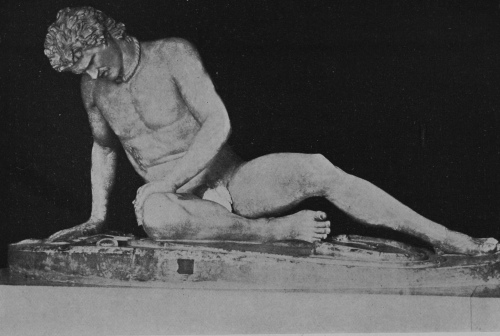
THE DYING GLADIATOR (ANTIQUE SCULPTURE)
An oriental monk, Talemachus, was so horrified at the sight of the gladiatorial games, that he rushed into the midst of the arena, and besought the spectators to have them stopped. Instead of listening to him, they put him to death.
The first martyrdom in the Coliseum was that of St. Ignatius, said to have been the child especially blessed by our Savior, the disciple of John, and the companion of Polycarp, who was sent to Rome from Antioch when he was bishop. When brought into the arena, St. Ignatius knelt down and exclaimed: "Romans who are here present, know that I have not been brought into this place for any crime, but in order that by this means I may merit the fruition of the glory of God, for love of whom I have been made a prisoner. I am as the grain of the field and must be ground by the teeth of the lions that I may become bread fit for His table." The lions were then let loose, and devoured him, except the larger bones which the Christians collected during the night.
The spot where the Christian martyrs suffered was for a long time marked by a tall cross devoutly kissed by the faithful. The Pulpit of the Coliseum was used for the stormy sermons of Gavazzi, who called the people to arms from thence in the Revolution of March, 1848.
Græco-Roman Social Depravity, Born of Religion and Traceable to the Gods.—The modern mind identifies true religion with perfect purity of heart and with boundless love. "Do unto others as you would have others do unto you" is the leading aphorism of both the Hebrew and Christian faiths. The Sermon on the Mount is the chart of the soul on the sea of life; and its beatitudes are the glorifications of the virtues of meekness, mercy, and peace. To the mind imbued with the divine precepts of the Savior, it seems incredible that religion should have ever been the direct source of crime and sin. It is, nevertheless, a well-established fact that the Roman and Greek mythologies were the potent causes of political corruption and social impurity in both Italy and Greece. Nothing better illustrates this truth than the abominable practice that found its inspiration and excuse in the myth of the rape of Ganymede. The guilty passion of Zeus for the beautiful boy whom he, himself, in the form of an eagle, had snatched up from earth and carried away to Olympus to devote to shameful and unnatural uses, was the foundation, in Greece, of the most loathsome habit that ever disgraced the conduct of men. Passionate fondness for beautiful boys, called paiderastia in Greek, termed sodomy in modern criminal law, was the curse and infamy of both Roman and Grecian life. This unnatural vice was not confined to the vulgar and degenerate. Men of letters, poets, statesmen and philosophers, debased themselves with this form of pollution. It was even legalized by the laws of Crete and Sparta. Polybius tells us that many Romans paid as much as a talent ($1,000) for a beautifully formed youth. This strange perversion of the sexual instincts was marked by all the tenderness and sweetness of a modern courtship or a honeymoon. The victim of this degrading and disgusting passion treated the beautiful boy with all the delicacy and feeling generally paid a newly wedded wife. Kisses and caresses were at times showered upon him. At other times, he became an object of insane jealousy.
An obscene couplet in Suetonius attributes this filthy habit to Julius Cæsar in the matter of an abominable relationship with the King of Bithynia.[173] "So strong was the influence of the prevalent epidemic on Plato, that he had lost all sense of the love of women, and in his descriptions of Eros, divine as well as human, his thoughts were centered only in his boy passion. The result in Greece confessedly was that the inclination for a woman was looked upon as low and dishonorable, while that for a youth was the only one worthy of a man of education."[174]
A moment's reflection will convince the most skeptical of the progress of morality and the advance of civilization. That which philosophers and emperors not only approved but practiced in the palmiest days of the commonwealths of Greece and Rome, is to-day penalized; and the person guilty of the offense is socially ostracized and branded with infamy and contempt.
The above is only one of many illustrations of the demoralizing influence of the myths. The Greeks looked to the gods as models of behavior, and could see nothing wrong in paiderastia, since both Zeus and Apollo had practiced it. Nearly every crime committed by the Greeks and Romans was sought to be excused on the ground that the gods had done the same thing. Euthyphro justified mistreatment of his own father on the ground that Zeus had chased Cronos, his father, from the skies.
Homer was not only the Bible, but the schoolbook of Grecian boys and girls throughout the world; and their minds were saturated at an early age with the escapades of the gods and goddesses as told by the immortal bard. Plato, in the "Republic," deprecates the influence of the Homeric myths upon the youth of Greece, when he says: "They are likely to have a bad effect on those who hear them; for everybody will begin to excuse his own vices when he is convinced that similar wickednesses are always being perpetrated by the kindred of the gods." And Seneca thus condemns the moral effect of the myth of Zeus and Alcmene: "What else is this appeal to the precedent of the gods for, but to inflame our lusts, and to furnish a free license and excuse for the corrupt act under shelter of its divine prototype?" "This," says the same author in another treatise, "has led to no other result than to deprive sin of its shame in man's eyes, when he saw that the gods were no better than himself."
We have seen that, in the matter of the multiplicity of the gods, there were deities of the baser as well as of the better passions, and of criminal as well as virtuous propensities. Pausanias tells us that in his day, on the road to Pellene, there were statues of Hermes Dolios (the cheat), and that the worshipers of this god believed that he was always ready to help them in their intrigues and adventures. The same writer also tells us that young maidens of Trœzene dedicated their girdles to Athene Apaturia, the deceiver, for having cunningly betrayed Æthra into the hands of Neptune. The festivals of Bacchus were far-famed in ancient times for the drunken debauches and degrading ceremonies that accompanied them. The Attic feasts of Pan were celebrated with every circumstance of low buffoonery. The solemnities of the Aphrodisia were akin to the bacchanalian orgies in all the features of inebriety and lust. The name of the goddess of love and beauty was blazoned across the portal of more than one Greek and Roman brothel. The Aphrodite-Lamia at Athens and the Aphrodite-Stratonikis at Smyrna were the favorite resorts of the most famous courtesans of antiquity. Venus was the recognized goddess of the harlots. A thousand of them guarded her temple at Corinth; and, when an altar was erected to her at the Colline gate in Rome, in the year 183 A.U.C., they celebrated a great feast in her honor, and dedicated chaplets of myrtle and roses, as a means of obtaining her favor as the guardian divinity of their calling.
What more could be expected, then, of the morality of the Greeks and Romans, when we consider the nature of their religion and the character of their gods? Jupiter and Apollo were notorious rakes and libertines; Venus and Flora were brazen-faced courtesans; Harmonia was a Phrygian dancer, who had been seduced by Cadmus; Hercules was a gladiator; Pan was a buffoon; Bacchus was a drunkard, and Mercury was a highway robber. And not only in the poems of Homer and Hesiod did the Greek and Roman youth learn these things, but from the plays of the theaters and from plastic art as well. If we except the gladiatorial fights in the amphitheaters, nothing was more cruel and unchaste than Greek and Roman tragedy and comedy. At the time of Christ, the tastes and appetites of the multitude had grown so fierce and depraved that ordinary spectacles were regarded as commonplace and insipid. Lifelike realities were demanded from the actors on the stage; and accordingly, the hero who played the rôle of the robber chief, Laureolus, was actually crucified before the spectators, and was then torn to pieces by a hungry bear. The burning of Hercules on Mount Œta and the emasculation of Atys were sought to be realized on the stage by the actual burning and emasculation of condemned criminals. Lustful as well as cruel appetites were inflamed and fed by theatrical representations of the intrigues and adventures of the gods and goddesses. Pantomimes and mimic dances, with flute accompaniment, were employed to reproduce the amours and passionate devotions of the inhabitants of Olympus. The guilty loves of Aphrodite with Mars and Adonis, the adventures of Jupiter and Apollo with the wives and daughters of mortals, were the plays most frequently presented and most wildly applauded. And the ignorant rabble were not the only witnesses of these spectacles. "The sacerdotal colleges and authorities," says Arnobius, "flamens, and augurs, and chaste vestals, all have seats at these public amusements. There are seated the collective people and senate, consuls and consulars, while Venus, the mother of the Roman race, is danced to the life, and in shameless mimicry is represented as reveling through all the phases of meretricious lust. The great mother, too, is danced; the Dindymene of Pessinus, in spite of her age, surrendering herself to disgusting passion in the embraces of a cowherd. The supreme ruler of the world is himself brought in, without respect to his name or majesty, to play the part of an adulterer, masking himself in order to deceive chaste wives, and take the place of their husbands in the nuptial bed."[175]
Not only gladiatorial games and theatrical shows, but painting and sculpture as well, served to corrupt and demoralize Roman and Greek manners. Nor is there any prudery in this statement. The masterpieces of the Greek artists have been the astonishment and despair of all succeeding ages; and the triumphs of modern art have been but poor imitations of the models of the first masters. But it is, nevertheless, true that the embodiment in marble of certain obscene myths was destructive of ancient morals. The paintings in the temples and houses of the cities of Greece and Italy were a constant menace to the mental purity of those who gazed upon them. The statue of Ganymede at the side of Zeus was a perpetual reminder to the youth of Athens of the originator of the loathsome custom of paiderastia. The paintings of Leda and the swan, of the courtship of Dionysus and Ariadne, of the naked Aphrodite ensnared and caught in the net with Ares that adorned the walls and ceilings of Greek and Roman homes, were not too well calculated to inspire pure and virtuous thoughts in the minds and hearts of tender youths and modest maidens who looked upon and contemplated them. At Athens, especially, was the corrupting influence of painting and plastic art most deeply felt. "At every step," says Döllinger, "which a Greek or Roman took, he was surrounded by images of his gods and memorials of their mythic history. Not the temples only, but streets and public squares, house walls, domestic implements and drinking vessels, were all covered and incrusted with ornaments of the kind. His eye could rest nowhere, not a piece of money could he take into his hand without confronting a god. And in this way, through the magical omnipresence of plastic art, the memory of his gods had sunk into his soul indelibly, grown up with every operation of his intellect, and inseparably blended with every picture of his imagination."[176]
It can thus be easily imagined how close the connection between the social depravity and the religion of the Greeks and Romans. What was right in the conduct of the gods, men could not deem sinful in their own behavior. Indeed, lewd and lascivious acts were frequently proclaimed not only right, but sacred, because they had been both sanctioned and committed by the gods themselves. "As impurity," says Döllinger, "formed a part of religion, people had no scruples in using the temple and its adjoining buildings for the satisfaction of their lust. The construction of many of the temples and the prevalent gloom favored this. 'It is a matter of general notoriety,' Tertullian says, 'that the temples are the very places where adulteries were arranged, and procuresses pursue their victims between the altars.' In the chambers of the priests and ministers of the temple, impurity was committed amid clouds of incense; and this, Minucius adds, more frequently than in the privileged haunts of this sin. The sanctuaries and priests of Isis at Rome were specially notorious in this respect. 'As this Isis was the concubine of Jove herself, she also makes prostitutes of others,' Ovid said. Still more shameful sin was practiced in the temples of the Pessinuntine mother of the gods, where men prostituted themselves and made a boast of their shame afterwards."[177]
The Bacchanalian Orgies.—The most interesting passage of ancient literature dealing with social life in its relation to religious observances, is an extract from Livy, the most elegant of Roman historians. This passage describes the bacchanalian orgies, and gives exquisite touches to certain phases of ancient Roman social life. Its insertion here entire is excused on the ground of its direct bearing upon the subject matter of this chapter:
A Greek of mean condition came, first, into Etruria; not with one of the many trades which his nation, of all others the most skilful in the cultivation of the mind and body, has introduced among us, but a low operator in sacrifices, and a soothsayer; nor was he one who, by open religious rites, and by publicly professing his calling and teaching, imbued the minds of his followers with terror, but a priest of secret and nocturnal rites. These mysterious rites were, at first, imparted to a few, but afterwards communicated to great numbers, both men and women. To their religious performances were added the pleasures of wine and feasting, to allure a greater number of proselytes. When wine, lascivious discourse, night, and the intercourse of the sexes had extinguished every sentiment of modesty, then debaucheries of every kind began to be practiced, as every person found at hand that sort of enjoyment to which he was disposed by the passion predominant in his nature. Nor were they confined to one species of vice—the promiscuous intercourse of free-born men and women, but from this store-house of villany proceeded false witnesses, counterfeit seals, false evidences, and pretended discoveries. From the same place, too, proceeded poison and secret murders, so that in some cases, even the bodies could not be found for burial. Many of their audacious deeds were brought about by treachery, but most of them by force; it served to conceal the violence, that on account of the loud shouting, and the noise of drums and cymbals, none of the cries uttered by the persons suffering violation or murder could be heard abroad.
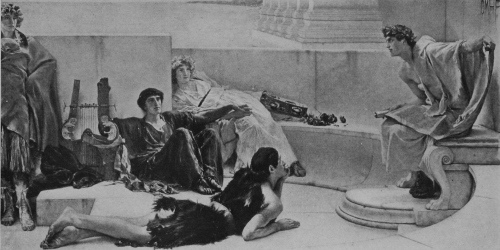
READING FROM HOMER (ALMA-TADEMA)
The infection of this mischief, like that from the contagion of disease, spread from Etruria to Rome; where, the size of the city affording greater room for such evils, and more means of concealment, cloaked it at first; but information of it was at length brought to the consul, Postumius, principally in the following manner. Publius Æbutius, whose father had held equestrian rank in the army, was left an orphan, and his guardians dying, he was educated under the eye of his mother Duronia, and his stepfather Titus Sempronius Rutilus. Duronia was entirely devoted to her husband; and Sempronius, having managed the guardianship in such a manner that he could not give an account of the property, wished that his ward should be either made away with, or bound to compliance with his will by some strong tie. The Bacchanalian rites were the only way to effect the ruin of the youth. His mother told him, that, "During his sickness, she had made a vow for him, that if he should recover, she would initiate him among the Bacchanalians; that being, through the kindness of the gods, bound by this vow, she wished now to fulfil it; that it was necessary he should preserve chastity for ten days, and on the tenth, after he should have supped and washed himself, she would conduct him into the place of worship." There was a freedwoman called Hispala Fecenia, a noted courtesan, but deserving of a better lot than the mode of life to which she had been accustomed when very young, and a slave, and by which she had maintained herself since her manumission. As they lived in the same neighborhood, an intimacy subsisted between her and Æbutius, which was far from being injurious either to the young man's character or property; for he had been loved and wooed by her unsolicited; and as his friends supplied his wants illiberally, he was supported by the generosity of this woman; nay, to such a length did she go under the influence of her affection, that, on the death of her patron, because she was under the protection of no one, having petitioned the tribunes and prætors for a guardian, when she was making her will, she constituted Æbutius her sole heir.
As such pledges of mutual love subsisted, and as neither kept anything secret from the other, the young man jokingly bid her not be surprised if he separated himself from her for a few nights, as, "on account of a religious duty, to discharge a vow made for his health, he intended to be initiated among the Bacchanalians." On hearing this, the woman, greatly alarmed, cried out, "May the gods will more favorably!" affirming that "It would be better, both for him and her, to lose their lives than that he should do such a thing:" she then imprecated curses, vengeance, and destruction on the head of those who advised him to such a step. The young man, surprised both at her expressions and at the violence of her alarm, bid her refrain from curses, for "it was his mother who ordered him to do so, with the approbation of his stepfather." "Then," said she, "your stepfather (for perhaps it is not allowable to censure your mother), is in haste to destroy, by that act, your chastity, your character, your hopes and your life." To him, now surprised by such language, and inquiring what was the matter, she said, (after imploring the favor and pardon of the gods and goddesses, if, compelled by her regard for him, she disclosed what ought not to be revealed), that "when in service, she had gone into that place of worship, as an attendant on her mistress, but that, since she had obtained her liberty, she had never once gone near it: that she knew it to be the receptacle of all kinds of debaucheries; that it was well known that, for two years past, no one older than twenty had been initiated there. When any person was introduced he was delivered as a victim to the priests, who led him away to a place resounding with shouts, the sound of music, and the beating of cymbals and drums, lest his cries while suffering violation, should be heard abroad." She then entreated and besought him to put an end to that matter in some way or other, and not to plunge himself into a situation, where he must first suffer, and afterwards commit, everything that was abominable. Nor did she quit him until the young man gave her his promise to keep himself clear of those rites.
When he came home, and his mother made mention of such things pertaining to the ceremony as were to be performed on that day, and on the several following days, he told her that he would not perform any of them, nor did he intend to be initiated. His stepfather was present at this discourse. Immediately the woman observed that "he could not deprive himself of the company of Hispala for ten nights; that he was so fascinated by the caresses and baneful influence of that serpent, that he retained no respect for his mother or stepfather, or even the gods themselves." His mother on one side and his stepfather on the other loading him with reproaches, drove him out of the house, assisted by four slaves. The youth on this repaired to his aunt Æbutia, told her the reason of his being turned out by his mother, and the next day, by her advice, gave information of the affair to the consul Postumius, without any witnesses of the interview. The consul dismissed him, with an order to come again on the third day following. In the meantime, he inquired of his mother-in-law, Sulpicia, a woman of respectable character, "whether she knew an old matron called Æbutia, who lived on the Aventine hill?" When she had answered that "she knew her well, and that Æbutia was a woman of virtue, and of the ancient purity of morals;" he said that he required a conference with her, and that a messenger should be sent for her to come. Æbutia, on receiving the message, came to Sulpicia's house, and the consul, soon after, coming in, as if by accident, introduced a conversation about Æbutius, her brother's son. The tears of the woman burst forth, and she began to lament the unhappy lot of the youth: who after being robbed of his property by persons whom it least of all became, was then residing with her, being driven out of doors by his mother, because, being a good youth (may the gods be propitious to him), he refused to be initiated in ceremonies devoted to lewdness, as report goes.
The consul thinking that he had made sufficient inquiries concerning Æbutius, and that his testimony was unquestionable, having dismissed Æbutia, requested his mother-in-law to send again to the Aventine, and bring from that quarter Hispala, a freedwoman, not unknown in that neighborhood; for there were some queries which he wished to make of her. Hispala being alarmed because she was being sent for by a woman of such high rank and respectable character, and being ignorant of the cause, after she saw the lictors in the porch, the multitude attending to the consul and the consul himself, was very near fainting. The consul led her into the retired part of the house, and, in the presence of his mother-in-law, told her, that she need not be uneasy, if she could resolve to speak the truth. She might receive a promise of protection either from Sulpicia, a matron of such dignified character, or from himself. That she ought to tell him, what was accustomed to be done at the Bacchanalia, in the nocturnal orgies in the grove of Stimula. When the woman heard this, such terror and trembling of all her limbs seized her, that for a long time she was unable to speak; but recovering at length she said, that "when she was very young, and a slave, she had been initiated, together with her mistress; but for several years past, since she had obtained her liberty, she knew nothing of what was done there." The consul commended her so far, as not having denied that she was initiated, but charged her to explain all the rest with the same sincerity; and told her, affirming that she knew nothing further, that "there would not be the same tenderness or pardon extended to her, if she should be convicted by another person, and one who had made a voluntary confession; that there was such a person, who had heard the whole from her, and had given him a full account of it."
The woman, now thinking without a doubt that it must certainly be Æbutius who had discovered the secret, threw herself at Sulpicia's feet, and at first began to beseech her, "not to let the private conversation of a freedwoman with her lover be turned not only into a serious business, but even capital charge;" declaring that "she had spoken of such things merely to frighten him, and not because she knew anything of the kind." On this Postumius, growing angry, said "she seemed to imagine that then too she was wrangling with her gallant Æbutius, and not that she was speaking in the house of a most respectable matron, and to a consul." Sulpicia raised her, terrified, from the ground, and while she encouraged her to speak out, at the same time pacified her son-in-law's anger. At length she took courage, and, having censured severely the perfidy of Æbutius, because he had made such a return for the extraordinary kindness shown to him in that very instance, she declared that "she stood in great dread of the gods, whose secret mysteries she was to divulge; and in much greater dread of the men implicated, who would tear her asunder with their hands if she became an informer. Therefore she entreated this favor of Sulpicia, and likewise of the consul, that they would send her away some place out of Italy, where she might pass the remainder of her life in safety." The consul desired her to be of good spirits, and said that it should be his care that she might live securely in Rome.
Hispala then gave a full account of the origin of the mysteries. "At first," she said, "those rites were performed by women. No man used to be admitted. They had three stated days in the year on which such persons were initiated among the Bacchanalians, in the daytime. The matrons used to be appointed priestesses, in rotation. Paculla Minia, a Campanian, when priestess, made an alteration in every particular as if by the direction of the gods. For she first introduced men, who were her own sons, Minucius and Herrenius, both surnamed Cerrinius; changed the time of celebration, from day to night; and, instead of three days in the year, appointed five days of initiation in each month. From the time that the rites were thus made common, and men were intermixed with women, and the licentious freedom of the night was added, there was nothing wicked, nothing flagitious, that had not been practiced among them. There were more frequent pollution of men, with each other, than with women. If any were less patient in submitting to dishonor, or more averse to the commission of vice, they were sacrificed as victims. To think nothing unlawful, was the grand maxim of their religion. The men, as if bereft of reason, uttered predictions, with frantic contortions of their bodies; the women, in the habit of Bacchantes, with their hair dishevelled, and carrying blazing torches, ran down to the Tiber; where, dipping their torches in the water, they drew them up again with the flame unextinguished, being composed of native sulphur and charcoal. They said that those men were carried off by the gods, whom the machines laid hold of and dragged from their view into secret caves. These were such as refused to take the oath of the society or to associate in their crimes, or to submit to defilement. Their number was exceedingly great now, almost a second state in themselves and among them were many men and women of noble families. During the last two years it had been a rule, that no person above the age of twenty should be initiated, for they sought for people of such age as made them more liable to suffer deception and personal abuse." When she had completed her information, she again fell at the consul's knees, and repeated the same entreaties, that he might send her out of the country. The consul requested his mother-in-law to clear some part of the house, into which Hispala might remove; accordingly an apartment was assigned her in the upper part of it, of which the stairs, opening into the street, were stopped up, and the entrance made from the inner court. Thither all Fecenia's effects were immediately removed, and her domestics sent for. Æbutius, also, was ordered to remove to the house of one of the consul's clients.
When both the informers were by these means in his power, Postumius represented the affair to the senate, laying before them the whole circumstance, in due order; the information given to him at first, and the discoveries gained by his inquiries afterwards. Great consternation seized on the senators; not only on the public account, lest such conspiracies and nightly meetings might be productive of secret treachery and mischief, but, likewise, on account of their own particular families, lest some of their relations might be involved in this infamous affair. The senate voted, however, that thanks should be given to the consul because he had investigated the matter with singular diligence, and without exciting any alarm. They then commit to the consuls the holding an inquiry, out of the common course, concerning the Bacchanals and their nocturnal orgies. They ordered them to take care that the informers, Æbutius and Fecenia, might suffer no injury on that account; and to invite other informers in the matter, by offering rewards. They ordered that the officials in those rites, whether men or women, should be sought for, not only at Rome, but also throughout all the market towns and places of assembly, and be delivered over to the power of the consuls; and also that proclamation should be made in the city of Rome, and published through all Italy, that "no persons initiated in the Bacchanalian rites should presume to come together or assemble on account of those rites, or to perform any such kind of worship;" and above all, that search should be made for those who had assembled or conspired for personal abuse, or for any other flagitious practices. The senate passed these decrees. The consuls directed the curule ædiles to make strict inquiry after all the priests of those mysteries, and to keep such as they could apprehend in custody until their trial; they at the same time charged the plebeian ædiles to take care that no religious ceremonies should be performed in private. To the capital triumvirs the task was assigned to post watches in proper places in the city, and to use vigilance in preventing any meetings by night. In order likewise to guard against fires, five assistants were joined to the triumvirs, so that each might have the charge of the buildings in his own separate district, on this side the Tiber.
After despatching these officers to their several employments, the consuls mounted the rostrum; and, having summoned an assembly of the people, one of the consuls, when he had finished the solemn form of prayer which the magistrates are accustomed to pronounce before they address the people, proceeded thus: "Romans, to no former assembly was this solemn supplication to the gods more suitable or even more necessary: as it serves to remind you, that these are the deities whom your forefathers pointed out as the objects of your worship, veneration and prayers: and not those which infatuated men's minds with corrupt and foreign modes of religion, and drove them, as if goaded by the furies, to every lust and every vice. I am at a loss to know what I should conceal, or how far I ought to speak out; for I dread lest, if I leave you ignorant of any particular, I should give room for carelessness, or if I disclose the whole, that I should too much awaken your fears. Whatever I shall say, be assured that it is less than the magnitude and atrociousness of the affair would justify: exertions will be used by us that it may be sufficient to set us properly on our guard. That the Bacchanalian rites have subsisted for some time past in every country in Italy, and are at present performed in many parts of this city also, I am sure you must have been informed, not only by report, but by the nightly noises and the horrid yells that resound through the whole city; but still you are ignorant of the nature of that business. Part of you think it is some kind of worship of the gods; others, some excusable sport and amusement, and that whatever it may be, it concerns but a few. As regards the number if I tell you that there are many thousands, that you would be immediately terrified to excess is a necessary consequence; unless I further acquaint you who and what sort of persons they are. First, then, a great part of them are women, and this was the source of the evil; the rest are males, but nearly resembling women; actors and pathics in the vilest lewdness; night revellers, driven frantic by wine, noise of instruments, and clamors. The conspiracy, as yet, has no strength; but it has abundant means of acquiring strength, for they are becoming more numerous every day. Your ancestors would not allow that you should ever assemble casually without some good reason; that is, either when the standard was erected on the Janiculum, and the army led out on occasion of elections; or when the tribunes proclaimed a meeting of the commons, or some of the magistrates summoned you to it. And they judged it necessary, that wherever a multitude was, there should be a lawful governor of that multitude present. Of what kind do you suppose are the meetings of these people? In the first place, held in the night, and in the next, composed promiscuously of men and women. If you knew at what ages the males are initiated, you would feel not only pity, but also shame for them. Romans, can you think youths initiated, under such oaths as theirs, are fit to be made soldiers? That arms should be intrusted with wretches brought out of that temple of obscenity? Shall these, contaminated with their own foul debaucheries and those of others, be champions for the chastity of your wives and children?
"But the mischief were less, if they were only effeminated by their practices; or that the disgrace would chiefly affect themselves; if they refrained their hands from outrage, and their thoughts from fraud. But never was there in the state an evil of so great magnitude, or one that extended to so many persons or so many acts of wickedness. Whatever deeds of villany have, during late years been committed through lust; whatever through fraud; whatever through violence; they have all, be assured, proceeded from that association alone. They have not yet perpetrated all the crimes for which they combine. The impious assembly at present confines itself to outrages on private citizens; because it has not yet acquired force sufficient to crush the commonwealth: but the evil increases and spreads daily; it is already too great for the private ranks of life to contain it, and aims its views at the body of the state. Unless you take timely precautions, Romans, their nightly assembly may become as large as this, held in open day and legally summoned by a consul. Now they one by one dread you collected together in the assembly; presently, when you shall have separated and retired to your several dwellings, in town and country, they will again come together, and will hold a consultation on the means of their own safety, and, at the same time, of your destruction. Thus united, they will cause terror to every one of you. Each of you therefore, ought to pray that his kindred may have behaved with wisdom and prudence; and if lust, if madness, has dragged any of them into that abyss, to consider such a person as the relation of those with whom he has conspired for every disgraceful and reckless act, and not as one of your own. I am not secure, lest some even of yourselves may have erred through mistake; for nothing is more deceptive in appearance than false religion. When the authority of the gods is held out as a pretext to cover vice, fear enters our minds, lest in punishing the crimes of men, we may violate some divine right connected therewith. Numberless decisions of the pontiffs, decrees of the senate, and even answers of the aruspices, free you from religious scruples of this character. How often in the ages of our fathers was it given in charge to the magistrates, to prohibit the performances of any foreign religious rites; to banish strolling sacrificers and soothsayers from the Forum, the circus and the city; to search for and burn books of divination; and to abolish every mode of sacrificing that was not conformable to the Roman practice! For they, completely versed in every divine and human law, maintained that nothing tended so strongly to the subversion of religion as sacrifice, when we offered it not after the institutions of our forefathers, but after foreign customs. Thus much I thought necessary to mention to you beforehand, that no vain scruple might disturb your minds when you should see us demolishing the places resorted to by the Bacchanalians, and dispersing their impious assemblies. We shall do all these things with the favor and approbation of the gods; who, because they were indignant that their divinity was dishonored by those people's lust and crimes, have drawn forth their proceedings from hidden darkness into the open light; and who have directed them to be exposed, not that they may escape with impunity, but in order that they may be punished and suppressed. The senate have committed to me and my colleague, an inquisition extraordinary concerning that affair. What is requisite to be done by ourselves, in person, we will do with energy. The charge of posting watches through the city, during the night, we have committed to the inferior magistrates; and, for your parts, it is incumbent on you to execute vigorously whatever duties are assigned you, and in the several places where each will be placed, to perform whatever orders you shall receive, and to use your best endeavors that no danger or tumult may arise from the treachery of the party involved in the guilt."
They then ordered the decrees of the senate to be read, and published a reward for any discoverer who should bring any of the guilty before them, or give information against any of the absent, adding, that "if any person accused should fly, they would limit a certain day upon which, if he did not answer when summoned, he would be condemned in his absence; and if anyone should be charged who was out of Italy, they would not allow him any longer time, if he should wish to come and make his defence." They then issued an edict, that "no person whatever should presume to buy or sell anything for the purpose of leaving the country; or to receive or conceal, or by any means aid the fugitives." On the assembly being dismissed, great terror spread throughout the city; nor was it confined merely within the walls, or to the Roman territory, for everywhere throughout the whole of Italy alarm began to be felt—when the letters from the guest-friends were received—concerning the decree of the senate, and what passed in the assembly and the edict of the consuls. During the night, which succeeded the day in which the affair was made public, great numbers attempting to fly, were seized and bought back by the triumvirs, who had posted guards at all the gates; and informations were lodged against many, some of whom, both men and women, put themselves to death. Above seven thousand men and women are said to have taken the oath of the association. But it appeared that the heads of the conspiracy were the two Catinii, Marcus and Caius, Roman plebeians; Lucius Opiturnius, a Faliscian; and Minius Cerrinius, a Campanian: that from these proceeded all their criminal practices, and that these were the chief priests and founders of the sect. Care was taken that they should be apprehended as soon as possible. They were brought before the consuls, and confessing their guilt, caused no delay to the ends of justice.
But so great were the numbers that fled from the city, that because the lawsuits and property of many persons were going to ruin, the prætors, Titius Mænius and Marcus Licinius were obliged, under the direction of the senate, to adjourn their courts for thirty days until the inquiries should be finished by the consuls. The same deserted state of the law courts, since the persons against whom charges were brought did not appear to answer, nor could be found in Rome, necessitated the consuls to make a circuit of the country towns, and there to make their inquisitions and hold the trials. Those who, as it appeared, had been only initiated, and had made after the priest, and in the most solemn form, the prescribed imprecations, in which the accursed conspiracy for the perpetration of every crime and lust was contained, but who had not themselves committed, or compelled others to commit, any of those acts to which they were bound by the oath—all such they left in prison. But those who had forcibly committed personal defilements or murders, or were stained with the guilt of false evidence, counterfeit seals, forged wills, or other frauds, all these they punished with death. A greater number were executed than thrown into prison; indeed the multitude of men and women who suffered in both ways, was very considerable. The consuls delivered the women who were condemned to their relations, or to those under whose guardianship they were, that they might inflict the punishment in private; but if there did not appear any proper person of the kind to execute the sentence, the punishment was inflicted in public. A charge was then given to demolish all the places where the Bacchanalians had held their meetings; first, in Rome, and then throughout all Italy; excepting those wherein should be found some ancient altar, or consecrated statue. With regard to the future, the senate passed a decree, "that no Bacchanalian rites should be celebrated in Rome or in Italy:" and ordering that, "in case any person should believe some such kind of worship incumbent upon him, and necessary; and that he could not, without offence to religion, and incurring guilt, omit it, he should represent this to the city prætor, and the prætor should lay the business before the senate. If permission were granted by the senate, when not less than one hundred members were present, then he might perform those rites, provided that no more than five persons should be present at the sacrifice, and that they should have no common stock of money, nor any president of the ceremonies, nor priest."
Another decree connected with this was then made, on a motion of the consul, Quintus Marcius, that "the business respecting the persons who had served the consuls as informers should be proposed to the senate in its original form, when Spurius Postumius should have finished his inquiries, and returned to Rome." They voted that Minus Cerrinius, the Campanian, should be sent to Ardea, to be kept in custody there; and that a caution should be given to the magistrates of that city, to guard him with more than ordinary care, so as to prevent not only his escaping, but his having an opportunity of committing suicide.
Spurius Postumius some time after came to Rome and on his proposing the question, concerning the reward to be given to Publius Æbutius and Hispala Fecenia, because the Bacchanalian ceremonies were discovered by their exertions, the senate passed a vote, that "the city quæstors should give to each of them, out of the public treasury, one hundred thousand asses; and that the consuls should desire the plebeian tribunes to propose to the commons as soon as convenient, that the campaigns of Publius Æbutius should be considered as served, that he should not become a soldier against his wishes, nor should any censor assign him a horse at the public charge." They voted also, that "Hispala Fecenia should enjoy the privileges of alienating her property by gift or deed; of marrying out of her rank, and of choosing a guardian, as if a husband had conferred them by will; that she should be at liberty to wed a man of honorable birth, and that there should be no disgrace or ignominy to him who should marry her; and that the consuls and prætors then in office, and their successors, should take care that no injury should be offered to that woman, and that she might live in safety. That the senate wishes, and thought proper, that all these things should be so ordered."—All these particulars were proposed to the commons, and executed, according to the vote of the senate; and full permission was given to the consuls to determine respecting the impunity and rewards of the other informers.[178]
The bacchanalian orgies were first suppressed nearly two hundred years before Christ. The above extract from Livy reminds us that at that time the Romans were still strong and virtuous, and that a proposal of their Consul to eradicate a vicious evil that threatened the existence of both domestic life and the State, met with warm approval and hearty support from both the Senate and the people. But the insidious infection was never completely eradicated; and the work of the "Greek from Etruria" bore bitter fruit in the centuries that followed. And when we consider that not only bacchanalian orgies, but Greek literature, painting, sculpture, tragedy and comedy, were the chief causes of the pollution of Roman morals and the destruction of the Roman State, should we be surprised that Juvenal, in an outburst of patriotic wrath, should have declaimed against "a Grecian capital in Italy";[179] and that he should have hurled withering scorn at
The flattering, cringing, treacherous, artful race, Of fluent tongue and never-blushing face, A Protean tribe, one knows not what to call, That shifts to every form, and shines in all.
And, when we consider the state of the Roman world at the time of Christ, should we be surprised that St. Paul should have described Romans as "Being filled with all unrighteousness, fornication, wickedness, covetousness, maliciousness; full of envy, murder, debate, deceit, malignity; whisperers, backbiters, haters of God, despiteful, proud, boasters, inventors of evil things, disobedient to parents, without understanding, covenant-breakers, without natural affection, implacable, unmerciful"?[180]
Suffice it to say, in closing the chapter on Græco-Roman paganism, that, at the beginning of the Christian era, the Roman empire had reached the limit of physical expansion. Roman military glory had culminated in the sublime achievements of Pompey and of Cæsar. Mountains, seas, and deserts, beyond which all was barbarous and desolate, were the natural barriers of Roman dominion. Roman arms could go no farther; and Roman ambition could be no longer gratified by conquest. The Roman religion had fallen into decay and contempt; and the Roman conscience was paralyzed and benumbed. Disgusted with this world, the average Roman did not believe in any other, and was utterly without hope of future happiness. A gloomy despondency filled the hearts of men and drove them into black despair. When approaching death, they wore no look of triumph, expressed no belief in immortality, but simply requested of those whom they were leaving behind, to scatter flowers on their graves, or to bewail their early end. An epigram of the Anthology is this: "Let us drink and be merry; for we shall have no more of kissing and dancing in the kingdom of Proserpine: soon shall we fall asleep to wake no more." The same sentiments are expressed in epitaphs on Roman sepulchral monuments of the period. One of them reads thus: "What I have eaten and drunk, that I take with me; what I have left behind me, that have I forfeited." This is the language of another: "Reader, enjoy thy life; for after death there is neither laughter nor play, nor any kind of enjoyment." Still another: "Friend, I advise, mix thee a goblet of wine, and drink, crowning thy head with flowers. Earth and fire consume all that remains after death." And, finally, one of them assures us that Greek mythology is false: "Pilgrim, stay thee, listen and learn. In Hades there is no ferryboat, nor ferryman Charon; no Æacus or Cerberus;—once dead, and we are all alike."[181]
Matthew Arnold has very graphically described the disgusting, sickening, overwhelming despair of the Roman people at the birth of Christ.
Ah! carry back thy ken, What, some two thousand years! Survey The world as it was then. Like ours it looked, in outward air, Its head was clear and true; Sumptuous its clothing, rich its fare; No pause its action knew. Stout was its arm, each thew and bone Seem'd puissant and alive— But ah! its heart, its heart was stone And so it could not thrive. On that hard pagan world disgust And secret loathing fell; Deep weariness and sated lust Made human life a hell. In his goodly hall with haggard eyes, The Roman noble lay; He drove abroad in furious guise Along the Appian Way. He made a feast, drank fierce and fast, And crowned his hair with flowers; No easier, nor no quicker passed The impracticable hours.[182]
But the "darkest hour is just before the dawn," and "the fulness of the time was come." Already the first faint glimmers of the breaking of a grander and better day were perceptible to the senses of the noblest and finest of Roman intellects. Already Cicero had pictured a glorious millennium that would follow if perfect virtue should ever enter into the flesh and come to dwell among men.[183] Already Virgil, deriving inspiration from the Erythræan Sibylline prophecies, had sung of the advent of a heaven-born child, whose coming would restore the Golden Age, and establish enduring peace and happiness on the earth.[184] Already a debauched, degraded and degenerate world was crying in the anguish of its soul: "I know that my Redeemer liveth!" And, even before the Baptist began to preach in the wilderness, the ways had been made straight for the coming of the Nazarene.