Volume 1 / Part 3 — THE BRIEF (continued 2)
Reading edition
Again, such a law would have been no protection to the chief priests and to Judas against the operation of this Mosaic injunction. If such a rule of procedure could be justified upon any ground, it would require disinterested men acting from honorable motives, in promoting the maintenance of law and order. Officers of the law have sometimes, as pretended accomplices, acted in concert with criminals in order to secure and furnish evidence against them. But they were officers of the law, and the courts have held that their evidence was not accomplice testimony requiring corroboration. It is very clear that Judas was not such a disinterested witness, acting in the interest of public justice. He was a fugitive from the Last Supper of his Master, a talebearer within the meaning of the provision in Leviticus; and his employment by the Sanhedrin was a violation of a fundamental provision in the Mosaic Code.
The third illegality in the arrest of Jesus was that His capture was not the result of a legal mandate from a court whose intentions were to conduct a legal trial for the purpose of reaching a righteous judgment. "This arrest," says Rosadi, "effected in the night between Thursday and Friday, the last day of the life of Jesus, on Nisan 14, according to the Hebrew calendar, was the execution of an illegal and factious resolution of the Sanhedrin. There was no idea of apprehending a citizen in order to try him upon a charge which after sincere and regular judgment might be found just or unfounded; the intention was simply to seize a man and do away with him. The arrest was not a preventive measure such as might lawfully precede trial and condemnation; it was an executive act, accomplished in view of a sentence to be pronounced without legal justification."
POINT II
THE PRIVATE EXAMINATION OF JESUS BEFORE ANNAS (OR CAIAPHAS) WAS ILLEGAL
LAW
"Now the Jewish law prohibited all proceedings by night."—Dupin, "Jesus Devant Caïphe et Pilate."
"Be not a sole judge, for there is no sole judge but One."—Mishna, Pirke Aboth IV. 8.
"A principle perpetually reproduced in the Hebrew scriptures relates to the two conditions of publicity and liberty. An accused man was never subjected to private or secret examination, lest, in his perplexity, he furnish damaging testimony against himself."—Salvador, "Institutions de Moïse," pp. 365, 366.
FACT AND ARGUMENT
The private examination before Annas (or Caiaphas) was illegal for the following reasons: (1) The examination was conducted at night in violation of Hebrew law; (2) no judge or magistrate, sitting alone, could interrogate an accused judicially or sit in judgment upon his legal rights; (3) private preliminary examinations of accused persons were not allowed by Hebrew law.
The general order of events following the arrest in the garden was this: (1) Jesus was first taken to the house of Annas; (2) after a brief delay He was sent by Annas to Caiaphas, the high priest, in whose palace the Sanhedrin, or a part thereof, had already assembled; (3) He was then brought before this body, tried and condemned; (4) He remained, during the rest of the night, in the high priest's palace, exposed to the insults and outrages of His keepers; and was finally and formally sentenced to death by the Sanhedrin which reconvened at the break of day.
That Jesus was privately examined before His regular trial by the Sanhedrin is quite clear. But whether this preliminary examination took place before Annas or Caiaphas is not certainly known. John alone records the private interrogation of Jesus and he alone refers to Annas in a way to connect him with it. This Evangelist mentions that they "led him away to Annas first."[235] Matthew says that after the arrest of Jesus, they "led him away to Caiaphas the high priest,"[236] without mentioning the name of Annas. Mark tells us that "they led Jesus away to the high priest";[237] but he does not mention either Annas or Caiaphas. Luke records that they "took him, and led him, and brought him into the high priest's house,"[238] without telling us the name of the high priest.
"The high priest then asked Jesus of his disciples and of his doctrine."[239] This was the beginning of the examination. But who was the examiner—Annas or Caiaphas? At first view we are inclined to declare that Caiaphas is meant, because he was undoubtedly high priest in that year. But Annas is also designated as high priest by Luke in several places.[240] In Acts iv. 6 he mentions Caiaphas without an official title, but calls Annas high priest. It is therefore not known to whom John refers when he says that the "high priest asked Jesus of his disciples and of his doctrine." For a lengthy discussion of this point, the reader is referred to Andrews's "Life of Our Lord," pp. 505-510.
But it is absolutely immaterial, from a legal point of view, whether it was Annas or Caiaphas who examined Jesus, as the proceedings would be illegal in either case. For whether it was the one or the other, neither had the right to sit alone as judge; neither had the right to conduct any judicial proceeding at night; neither had the right to institute a secret preliminary examination by day or night.
Attention has been called to the matter as involving a question of historical rather than of legal consequence. A knowledge of the true facts of the case might, however, throw light upon the order and connection of the proceedings which followed the same night. For if the private examination recorded by John was had before Annas, it was doubtless separated by a certain interval of place and time from the later proceedings before Caiaphas. Then it is reasonable to suppose that the examination of witnesses, the confession and condemnation which took place at the regular trial before the Sanhedrin over which Caiaphas presided, happened later in the night, or even toward morning, and were of the nature of a regular public trial. If, on the other hand, Annas sent Jesus without delay to Caiaphas, who examined Him, it is reasonable to conclude that witnesses were at once produced, and that the adjuration and condemnation immediately followed. If such were the case, a considerable interval of time must have intervened between these proceedings and the meeting of the Sanhedrin which was had in the morning to confirm the judgment which had been pronounced at the night session. But these considerations are really foreign to the question of legal errors involved, which we come now to discuss.
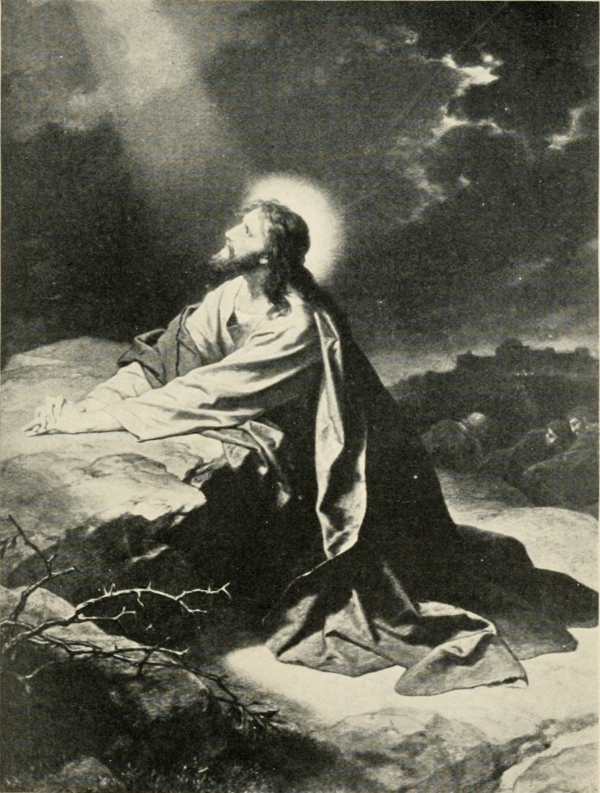
JESUS IN GETHSEMANE (HOFFMAN)
In the first place, the private examination of Jesus, whether by Annas or Caiaphas, took place at night; and we have learned from Dupin that all proceedings at night in capital cases were forbidden.
In the second place, no judge or magistrate, sitting alone, could interrogate an accused person judicially or sit in judgment upon his legal rights. We have seen in Part II of this volume that the Hebrew system of courts and judges provided no single magistrates who, sitting alone, could adjudicate causes. The lowest Hebrew court consisted of three judges, sometimes called the Court of Three. The next highest tribunal was the Minor Sanhedrin of three-and-twenty members. The supreme tribunal of the Jews was the Great Sanhedrin of seventy-one members. There was no such thing among the ancient Hebrews as a court with a single judge. "Be not a sole judge, for there is no sole judge but One," is one of the most famous aphorisms of the Pirke Aboth. The reason of this rule is founded not only in a religious exaction born of the jealousy of Jehovah, but in the principle of publicity which provides for the accused, in the very number of judges, a public hearing. The same principle is suggested by the number of witnesses required by both the Mishna and Mosaic Code for the conviction of a prisoner. At least "two or three witnesses" were required to appear publicly and give testimony against the accused, else a conviction could not follow.
Again, preliminary examinations of accused persons were not allowed by Hebrew law. In the American states and in some other countries, a man suspected of crime and against whom an information or complaint has been lodged, is frequently taken before an examining magistrate to determine whether he should be discharged, admitted to bail, or sent to prison to await the action of a Grand Jury. At such hearing, the prisoner is usually notified that he is at liberty to make a statement regarding the charge against him; that he need not do so unless he desires; but that if he does, his testimony may be subsequently used against him at the regular trial of the case. But such proceedings, according to Salvador, were forbidden by ancient Hebrew law. The preliminary examination, therefore, by Annas or Caiaphas was illegal. The reason of the rule, as above stated, was to protect the prisoner against furnishing evidence that might be used against him at the regular trial of his case. The private examination of Jesus illustrates the justice of the rule and the necessity of its existence, for it was undoubtedly the purpose of Annas or Caiaphas to gather material in advance to lay before the regularly assembled Sanhedrin and thereby expedite the proceedings at the expense of justice.
If it be contended that the leading of Jesus to Annas first, which St. John alone relates, was merely intended to give the aged Sanhedrist an opportunity to see the prisoner who had been causing such commotion in the land for several years; and that there was no examination of Jesus before Annas—the interrogation by the high priest concerning the disciples and the doctrine of Jesus being construed to refer to an examination by Caiaphas, and being identical with the night trial referred to by Matthew and Mark—reply may be made that, under any construction of the case, there was at least an illegal appearance before Annas, as mere vulgar curiosity to see a celebrated prisoner was no excuse for the violation of the spirit if not the letter of the law. It is inconceivable, however, to suppose that Annas did not actually interrogate Jesus concerning His disciples, His doctrine, and His personal pretensions. To suppose that he demanded to see Jesus for no other reason than to get an impression of His looks, is to insult common sense. If Annas examined the prisoner, though only slightly, concerning matters affecting the charges against Him that might endanger His life or liberty, he had violated a very important rule of Hebrew criminal procedure. The question of the amount of examination of the accused is immaterial.
It is not known whether Annas at this time sat in the Great Sanhedrin as a judge. He had been deposed from the high priesthood nearly twenty years before by the procurator Valerius Gratus, for imposing and executing capital sentences. But he was, nevertheless, still all-powerful in the great Council of the Jews. Edersheim says that though "deprived of the Pontificate, he still continued to preside over the Sanhedrin."[241] Andrews is of the opinion that "he did in fact hold some high official position, and this probably in connection with the Sanhedrin, perhaps as occasional president."[242] Basing his criticism upon the words in Luke, "Annas and Caiaphus being the high priests,"[243] Dr. Plummer believes "that between them they discharged the duties, or that each of them in different senses was regarded high priest, Annas de jure, and Caiaphas de facto."[244] This is a mere supposition, however, since there is no historical evidence that Annas was restored to the pontificate after his deposition by Valerius Gratus, A.D. 14.[245] The phrase, "Annas and Caiaphas being high priests," refers to the fifteenth year of the reign of Tiberius Cæsar, which was A.D. 26.
After all, it is here again an historical more than a legal question, whether Annas was an official or not at the time of the appearance of Jesus before him. In either case his preliminary examination of the Christ was illegal. If he was a member of the Sanhedrin, the law forbade him to hold an informal preliminary examination at night. He certainly could not do this while sitting alone. If he was not a magistrate, as Dupin very properly contends, this fact only added to the seriousness of the illegality of subjecting a prisoner to the whimsical examination of a private citizen.
Whether a member of the Sanhedrin or not, Annas was at the time of Christ and had been for many years its dominating spirit. He himself had been high priest. Caiaphas was his son-in-law, and was succeeded in the high priesthood by four sons of Annas. The writer does not believe that Annas had any legal connection with the Sanhedrin, but, like many American political bosses, exercised more authority than the man that held the office. He was simply the political tool of the Roman masters of Judea, and the members of the Sanhedrin were simply figureheads under his control.
Again, the private examination of Jesus was marked by an act of brutality which Hebrew jurisprudence did not tolerate. This was not enumerated above as an error, because it was not probably a violation of any specific rule of law. But it was an outrage upon the Hebrew sense of justice and humanity which in its normal state was very pure and lofty.
"The high priest then asked Jesus of his disciples and of his doctrine. Jesus answered him, I spake openly to the world; I ever taught in the Synagogue, and in the Temple, whither the Jews always resort; and in secret have I said nothing. Why askest thou me? ask them which heard me, what I have said unto them: behold, they know what I said." In this reply Jesus planted Himself squarely upon His legal rights as a Jewish citizen. "It was in every word the voice of pure Hebrew justice, founded upon the broad principle of their judicial procedure and recalling an unjust judge to the first duty of his great office."
"And when he had thus spoken, one of the officers which stood by struck Jesus with the palm of his hand, saying, Answerest thou the high priest so?" Again the Nazarene appealed for protection to the procedure designed to safeguard the rights of the Hebrew prisoner. "Jesus answered him, If I have spoken evil, bear witness of the evil: but if well, why smitest thou me?"[246]
We have seen that, under Hebrew law, the witnesses were the accusers, and their testimony was at once the indictment and the evidence. We have also seen that a Hebrew prisoner could not be compelled to testify against himself, and that his uncorroborated confession could not be made the basis of a conviction. "Why askest thou me? ask them that heard me, what I have said unto them." This was equivalent to asking: Do you demand that I incriminate myself when our law forbids such a thing? Why not call witnesses as the law requires? If I am an evil-doer, bear witness of the evil, that is, let witnesses testify to the wrongdoing, that I may be legally convicted. If I am not guilty of a crime, why am I thus maltreated?
Is it possible to imagine a more pointed and pathetic appeal for justice and for the protection of the law against illegality and brutal treatment? This appeal for the production of legal testimony was not without its effect. Witnesses were soon forthcoming—not truthful witnesses, indeed—but witnesses nevertheless. And with the coming of these witnesses began the formal trial of the Christ, and a formal trial, under Hebrew law, could be commenced only by witnesses.
POINT III
THE INDICTMENT AGAINST JESUS WAS, IN FORM, ILLEGAL
LAW
"The entire criminal procedure of the Mosaic Code rests upon four rules: certainty in the indictment; publicity in the discussion; full freedom granted to the accused; and assurance against all dangers or errors of testimony."—Salvador, "Institutions de Moïse," p. 365.
"The Sanhedrin did not and could not originate charges; it only investigated those brought before it."—Edersheim, "Life and Times of Jesus the Messiah," vol. i. p. 309.
"The evidence of the leading witnesses constituted the charge. There was no other charge: no more formal indictment. Until they spoke, and spoke in the public assembly, the prisoner was scarcely an accused man. When they spoke, and the evidence of the two agreed together, it formed the legal charge, libel, or indictment, as well as the evidence for its truth."—Innes, "The Trial of Jesus Christ," p. 41.
"The only prosecutors known to Talmudic criminal jurisprudence are the witnesses to the crime. Their duty is to bring the matter to the cognizance of the court, and to bear witness against the criminal. In capital cases, they are the legal executioners also. Of an official accuser or prosecutor there is nowhere any trace in the laws of the ancient Hebrews."—Mendelsohn, "The Criminal Jurisprudence of the Ancient Hebrews," p. 110.
FACT AND ARGUMENT
The Gospel records disclose two distinct elements of illegality in the indictment against Jesus: (1) The accusation, at the trial, was twofold, vague, and indefinite, which Mosaic law forbade; (2) it was made, in part, by Caiaphas, the high priest, who was one of the judges of Jesus; while Hebrew law forbade any but leading witnesses to present the charge.
A thorough understanding of Point III depends upon keeping clearly in mind certain well-defined elementary principles of law. In the first place, it should be remembered that in most modern jurisdictions an indictment is simply an accusation, carries with it no presumption of guilt, and has no evidentiary force. Its only function is to bring the charge against the prisoner before the court and jury, and to notify the accused of the nature of the accusation against him. But not so under the ancient Hebrew scheme of justice. Under that system there was no such body as the modern Grand Jury, and no committee of the Sanhedrin exercised similar accusatory functions. The leading witnesses, and they alone, presented charges. It follows then, of necessity, that the ancient Hebrew indictment, unlike the modern indictment, carried with it a certain presumption of guilt and had certain evidentiary force. This could not be otherwise, since the testimony of the leading witnesses was at once the indictment and the evidence offered to prove it.
Again, in the very nature of things an indictment should, and under any enlightened system of jurisprudence, does clearly advise the accused of the exact nature of the charge against him. Under no other conditions would it be possible for a prisoner to prepare his defense. Most modern codes have sought to promote clearness and certainty in indictments by requiring the charging of only one crime in one indictment, and in language so clear and simple that the nature of the offense charged may be easily understood.
Now Salvador says that "certainty in the indictment" was one of the cardinal rules upon which rested the entire criminal procedure of the Mosaic Code. Was this rule observed in framing the accusation against Jesus at the night trial before the Sanhedrin? If so, the Gospel records do not disclose the fact. It is very certain, indeed, that the learned of no age of the world since the crucifixion have been able to agree among themselves as to the exact nature of the indictment against the Christ. This subject was too exhaustively discussed in the beginning of the Brief to warrant lengthy treatment here. Suffice it to say that the record of the night trial before Caiaphas discloses two distinct charges: the charge of sedition—the threat to destroy a national institution and to seduce the people from their ancient allegiance, in the matter of the destruction of the Temple; and the charge of blasphemy preferred by Caiaphas himself in the adjuration which he administered to Jesus. When the false witnesses failed to agree, their contradictory testimony was rejected and the charge of sedition was abandoned. And before Jesus had time to answer the question concerning sedition, another distinct charge, that of blasphemy, was made in almost the same breath.[247] Did this procedure tend to promote "certainty in the indictment"? Did it not result in the complete destruction of all clearness and certainty? Are we not justified in supposing that the silence of Jesus in the presence of His accusers was at least partially attributable to His failure to comprehend the exact nature of the charges against Him?
Again, the accusation was, in part, by Caiaphas, the high priest, who was also one of the judges of Jesus;[248] while Hebrew law forbade any but leading witnesses to present the charge. Edersheim tells us that "the Sanhedrin did not and could not originate charges; it only investigated those brought before it." If the Sanhedrin as a whole could not originate charges, because its members were judges, neither could any individual Sanhedrist do so. When the witnesses "agreed not together" in the matter of the charge of sedition, this accusation was abandoned. Caiaphas then deliberately assumed the rôle of accuser, in violation of the law, and charged Jesus, in the form of an adjuration, with blasphemy, in claiming to be "the Christ, the Son of God." Confession and condemnation then followed. Only leading witnesses could prefer criminal charges under Hebrew law. Caiaphas, being a judge, could not possibly be a witness; and could not, therefore, be an accuser. Therefore, the indictment against Jesus was illegally presented.
The writer believes that the above is a correct interpretation of the nature and number of the charges brought against the Christ, and that the legal aspects of the case are as above stated. But candor and impartiality require consideration of another view. Several excellent writers have contended that there were, in fact, not two charges preferred against Jesus but only one under different forms. These writers contend that Caiaphas and his colleagues understood that Jesus claimed supernatural power and identity with God when He declared that He was able to destroy the Temple and to build it again in three days,[249] and that the question of the high priest, "I adjure thee by the living God, that thou tell us whether thou be the Christ, the Son of God," flowed naturally from and had direct reference to the charge of being able to destroy the Temple. The advocates of this view appeal to the language of the original auditors to sustain their contention. "Forty-and-six years was this temple in building, and wilt thou rear it again in three days?" It is insisted that these words convey the idea that those who heard Jesus understood Him to mean that He had supernatural power. There is certainly much force in the contention but it fails to meet other difficulties. In the first place, it is not clear that a threat to destroy the Temple implied a claim to supernatural power; in which case there would be no connection between the first charge and that in which it was suggested that Jesus had claimed to be the Christ, the Son of God. In the second place, the contention that the two charges are substantially the same ignores the language of Mark, "But neither so did their witness agree together,"[250] which was certainly not injected by the author of the second Gospel as a matter of mere caprice or pastime. This language, legally interpreted, means that the testimony of the false witnesses, being contradictory, was thrown aside, and that the charge concerning the destruction of the Temple was abandoned. This is the opinion of Signor Rosadi and is very weighty.
Those writers who maintain that there was only one charge, that of blasphemy, under different forms, rely upon the passage in Matthew, "I am able to destroy the temple of God and to build it again in three days," and interpret it as a claim to supernatural power in the light of the language used by those who heard it: "Forty-and-six years was this temple in building, and wilt thou rear it again in three days?" Those who hold the opposite view, that there were two distinct charges, rely upon the passage in Mark, "I will destroy this temple that is made with hands, and within three days I will build another made without hands," and interpret it in the light of a similar accusation against Stephen a few months afterwards: "For we have heard him say, that this Jesus of Nazareth shall destroy this place, and shall change the customs which Moses delivered us."[251] This second interpretation, which we believe to be the better, establishes the existence at the trial of Christ of two distinct charges: that of sedition, based upon a threat to assault existing institutions; and that of blasphemy, founded upon the claim of equality with God. And, in the light of this interpretation, the illegality in the form of the indictment against Jesus has been urged.
If the first construction be the true one, then the error alleged in Point III is not well founded, since the accusation was presented by witnesses, as the law required; unless it could be successfully urged that the witnesses, being false witnesses, were no more competent to accuse a prisoner than to convict him upon their false testimony. In such a case the substance as well as the form of the indictment would be worthless, and the whole case would fall, through failure not only of competent testimony to convict but also of a legal indictment under which to prosecute.
Neither the Mishna nor the Gemara mentions written indictments among the ancient Hebrews. "The Jewish Encyclopedia" says that accusations were probably in writing, but that it is not certain.[252] A passage in Salvador seems to indicate that they were in writing. "The papers in the case," he says, "were read, and the accusing witnesses were then called." "The papers" were probably none other than the indictment. But of this we are not sure, and cannot, therefore, predicate the allegation of an error upon it. From the whole context of the Scriptures, however, we are led to believe that only oral charges were preferred against Jesus.
POINT IV
THE PROCEEDINGS OF THE SANHEDRIN AGAINST JESUS WERE ILLEGAL BECAUSE THEY WERE CONDUCTED AT NIGHT
LAW
"Let a capital offence be tried during the day, but suspend it at night."—Mishna, Sanhedrin IV. 1.
"Criminal cases can be acted upon by the various courts during day time only, by the Lesser Synhedrions from the close of the morning service till noon, and by the Great Synhedrion till evening."—Mendelsohn, "Criminal Jurisprudence of the Ancient Hebrews," p. 112.
"The reason why the trial of a capital offense could not be held at night is because, as oral tradition says, the examination of such a charge is like the diagnosing of a wound—in either case a more thorough and searching examination can be made by daylight."—Maimonides, Sanhedrin III.
FACT AND ARGUMENT
Hebrew jurisprudence positively forbade the trial of a capital case at night. The infraction of this rule involves the question of jurisdiction. A court without jurisdiction can pronounce no valid verdict or judgment. A court has no jurisdiction if it convenes and acts at a time forbidden by law.
One is naturally disposed to deride the reason assigned by Maimonides for the existence of the law against criminal proceedings at night. But it should not be forgotten that in the olden days surgery had no such aids as are at hand to-day. Modern surgical apparatus had not been invented and electric lights and the Roentgen Rays were unknown. In the light of this explanation of the great Jewish philosopher the curious inquirer after the real meaning of things naturally asks why the Areopagus of Athens always held its sessions in the night and in the dark.[253]
We have seen that Jesus was arrested in Gethsemane about midnight and that His first ecclesiastical trial took place between two and three o'clock in the morning.[254] St. Luke tells us that there was a daybreak meeting,[255] which was evidently intended to give a semblance of legality and regularity to that rule of Hebrew law that required two trials of the case.
The exact time of the beginning of the night session of the Sanhedrin is not known. It is generally supposed that the arrest took place in the garden between midnight and one o'clock. The journey to the house of Annas must have required some little time. Where this house was located nobody knows. According to one tradition Annas owned a house on the Mount of Olives close to the booths or bazaars under the "Two Cedars." Stapfer believes that Jesus was taken to that place. According to another tradition the house of Annas was located on the "Hill of Evil Counsel." Barclay believes that this was the place to which Jesus was conducted. But the tradition which is most generally accepted is that which places the palace of Annas on Mount Zion near the palace of Caiaphas. It is believed by many that these two men, who were related, Annas being the father-in-law of Caiaphas, occupied different apartments in the same place. But these questions are mere matters of conjecture and have no real bearing upon the present discussion, except to show, in a general way, the length of time probably required to conduct Jesus from Gethsemane to Annas; from Annas to Caiaphas, if the latter was the one who privately examined Jesus; and thence to the meeting of the Sanhedrin. It is reasonable to suppose that at least two hours were thus consumed, which would bring Jesus to the palace of Caiaphas between two and three o'clock, if the arrest in the garden took place between twelve and one o'clock. But here, again, a difference of one or two hours would not affect the merit of the proposition stated in Point IV. For it is beyond dispute that the first trial before the Sanhedrin was had at night, which was forbidden by law.
The question has been frequently asked: Why did the Sanhedrin meet at night in violation of law? The answer to this is referable to the treachery of Judas, to the fact that he "sought opportunity to betray him unto them in the absence of the multitude," and to the thought of the Master: "But this is your hour, and the power of God." Luke tells us that the members of the Sanhedrin "feared the people."[256] Mark informs us that they had resolved not to attempt the arrest and execution of Jesus at the time of the Passover, "lest there be an uproar of the people."[257]
Jesus had taught daily in the Temple, and had furnished ample opportunity for a legal arrest with a view to a legal trial. But His enemies did not desire this. "The chief priests and scribes sought how they might take him by craft, and put him to death."[258] The arrival of Judas from the scene of the Last Supper with a proposition of immediate betrayal of the Christ was a glad surprise to Caiaphas and his friends. Immediate and decisive action was necessary. Not only the arrest but the trial and execution of Jesus must be accomplished with secrecy and dispatch. The greatest festival of the Jews had just commenced. Pilgrims to the feast were arriving from all parts of the Jewish kingdom. The friends and followers of Jesus were among them. His enemies had witnessed the remarkable demonstration in His honor which marked His entrance into Jerusalem only a few days before. It is not strange, then, that they "feared the people" in the matter of the summary and illegal proceedings which they had resolved to institute against Him. They knew that the daylight trial, under proper legal forms, with the friends of Jesus as witnesses, would upset their plans by resulting in His acquittal. They resolved, therefore, to act at once, even at the expense of all forms of justice. And it will be seen that this determination to arrest and try Jesus at night, in violation of law, became the parent of nearly every legal outrage that was committed against Him. The selection of the midnight hour for such a purpose resulted not merely in a technical infraction of law, but rendered it impossible to do justice either formally or substantially under rules of Hebrew criminal procedure.
POINT V
THE PROCEEDINGS OF THE SANHEDRIN AGAINST JESUS WERE ILLEGAL BECAUSE THE COURT CONVENED BEFORE THE OFFERING OF THE MORNING SACRIFICE
LAW
"The Sanhedrin sat from the close of the morning sacrifice to the time of the evening sacrifice."—Talmud, Jerus., Sanhedrin I. fol. 19.
"No session of the court could take place before the offering of the morning sacrifice."—MM. Lémann, "Jesus Before the Sanhedrin," p. 109.
"Since the morning sacrifice was offered at the dawn of day, it was hardly possible for the Sanhedrin to assemble until the hour after that time."—Mishna, "Tamid, or of the Perpetual Sacrifice," C. III.
FACT AND ARGUMENT
The fact that the Sanhedrin convened before the offering of the morning sacrifice constitutes the fifth illegality. This error is alleged upon the authority of MM. Lémann, who, in their admirable little work entitled "Jesus Before the Sanhedrin," have called attention to it. It is very difficult, however, to determine whether this was a mere irregularity, or was what modern jurists would call a material error. From one point of view it seems to be merely a repetition of the rule forbidding the Sanhedrin to meet at night. The morning sacrifice was offered at the break of day and lasted about an hour. A session of the court before the morning sacrifice would, therefore, have been a meeting at night, which would have been an infringement of the law. But this was probably not the real reason of the rule. Its true meaning is doubtless to be found in the close connection that existed between the Hebrew law and the Hebrew religion. The constitution of the Hebrew Commonwealth was an emanation of the mind of Jehovah, the Temple in which the court met was His residence on earth, and the judges who formed the Great Sanhedrin were the administrators of His will. It is most reasonable, then, to suppose that an invocation, in sacrifice and prayer, of His guidance and authority would be the first step in any judicial proceedings conducted in His name.
It is historically true that a session of the Sanhedrin in the palmiest days of the Jewish Commonwealth was characterized by all the religious solemnity of a service in the synagogue or the Temple. It is entirely probable, therefore, that the morning sacrifice was made by law an indispensable prerequisite to the assembling of the supreme tribunal of the Jews for the transaction of any serious business. On any other supposition the rules of law cited above would have no meaning. We have reason to believe, then, that the offering of the morning sacrifice was a condition precedent to the attachment of jurisdiction, and without jurisdiction the court had no authority to act. That the morning sacrifice was offered each day, whether the court assembled or not, as a religious requirement, does not alter the principle of law above enunciated.
But it may be asked: How do we know that the morning sacrifice was not offered? The answer is that the whole context of the Scriptures relating to the trial shows that it could not have been offered. Furthermore, a simple and specific reason is that the time prescribed by law for conducting the morning service was between the dawn of day and sunrise. Then, if the court convened between two and three o'clock in the morning, it is very certain that the sacrifice had not been offered. It is true that there was a morning session of the Sanhedrin. But this was held simply to confirm the action of the night session at which Jesus had been condemned. In other words, the real trial was at night and was held before the performance of the religious ceremony, which was, in all probability, a prerequisite to the attachment of jurisdiction.
POINT VI
THE PROCEEDINGS AGAINST JESUS WERE ILLEGAL BECAUSE THEY WERE CONDUCTED ON THE DAY PRECEDING A JEWISH SABBATH; ALSO ON THE FIRST DAY OF THE FEAST OF UNLEAVENED BREAD AND THE EVE OF THE PASSOVER
LAW
"Court must not be held on the Sabbath, or any holy day."—"Betza, or of the Egg," Chap. V. No. 2.
"They shall not judge on the eve of the Sabbath, nor on that of any festival."—Mishna, Sanhedrin IV. 1.
"No court of justice in Israel was permitted to hold sessions on the Sabbath or any of the seven Biblical holidays. In cases of capital crime, no trial could be commenced on Friday or the day previous to any holiday, because it was not lawful either to adjourn such cases longer than over night, or to continue them on the Sabbath or holiday."—Rabbi Wise, "Martyrdom of Jesus," p. 67.
FACT AND ARGUMENT
No Hebrew court could lawfully meet on a Sabbath or a feast day, or on a day preceding a Sabbath or a feast day.
Concerning the Sabbath day provision Maimonides offers the following reason for the rule: "As it is required to execute the criminal immediately after the passing of the sentence, it would sometimes happen that the kindling of a fire would be necessary, as in the case of one condemned to be burned; and this act would be a violation of the law of the Sabbath, for it is written 'Ye shall kindle no fire in your habitations on the Sabbath day.'"[259] (Exodus xxxv. 3.)
Under modern practice, sessions of court may be adjourned from day to day, or, if need be, from week to week. But under the Hebrew system of criminal procedure the court could not adjourn for a longer time than a single night. Its proceedings were, so to speak, continuous until final judgment. As the law forbade sessions of court on Sabbath and feast days, it became necessary to provide that courts should not convene on the day preceding a Sabbath or a feast day, in order to avoid either an illegal adjournment or an infringement of the rule relating to the Sabbath and feast days.
Now Jesus was tried by the Sanhedrin on both a feast day and a day preceding the Sabbath. And, at this point, a clear conception of the ancient Jewish mode of reckoning time should be had. The Jewish day of twenty-four hours began at one sunset and ended with the next. But this interval was not divided into twenty-four parts or hours of equal and invariable length. Their day proper was an integral part of time and was reckoned from sunrise to sunset. Their night proper was likewise a distinct division of time and was measured from sunset to sunrise. An hour of time, according to modern reckoning, is invariably sixty minutes. But the ancient Jewish hour was not a fixed measure of time. It varied in length as each successive day and night varied in theirs at different seasons of the year. Neither did the Jews begin their days and nights as we do. Our day of twenty-four hours always begins at midnight. Their day of twenty-four hours always began at one sunset and ended with the next.
Now Jesus was tried by the Sanhedrin on the 14th Nisan, according to the Jewish calendar; or between the evening of Thursday, April 6th, and the afternoon of Friday, April 7th, A.D. 30, according to our calendar. The 14th Nisan began at sunset on April 6th and lasted until sunset on April 7th. This was a single Jewish day, and within this time Jesus was tried and executed. According to our calendar, the trial and execution of Jesus took place on Friday, April 7th. This was the day preceding the Jewish Sabbath, which came on Saturday, according to our reckoning. And on a day preceding the Sabbath no Jewish court could lawfully convene. This is the first error suggested under Point VI.
Again, it is beyond dispute that the Feast of Unleavened Bread had begun and that the Passover was at hand when Jesus was tried by the Sanhedrin.[260] This was in violation of a specific provision of Hebrew law, and constitutes the second error alleged under Point VI.
There seems to be some conflict among the authorities as to whether Jesus was tried on the first day of the celebration of the feast of the Passover or on the day preceding. But the question is immaterial from a legal point of view, as the law forbade a trial either on a feast day or on the day preceding, for reasons above stated.
This violation of the law relating to the Sabbaths and feast days, like that relating to night sessions of the Sanhedrin, resulted in still other errors. It is necessary to mention only one of these at this point. The proceedings of the Sanhedrin were recorded by two scribes or clerks. Their records were to be used on the second day of the trial in reviewing the proceedings of the first. But Hebrew law forbade any writing on a Sabbath or a holy day. How was it possible, then, to keep a record of the proceedings, if Jesus was tried on a Sabbath and also on a feast day, without violating a rule of law? If no minutes of the meeting were kept, a most glaring irregularity is apparent.
POINT VII
THE TRIAL OF JESUS WAS ILLEGAL BECAUSE IT WAS CONCLUDED WITHIN ONE DAY
LAW
"A criminal case resulting in the acquittal of the accused may terminate the same day on which the trial began. But if a sentence of death is to be pronounced, it can not be concluded before the following day."—Mishna, Sanhedrin IV. 1.
FACT AND ARGUMENT
Care and conservatism, precaution and delay, were the characteristic features of the criminal procedure of the ancient Hebrews. The principal aphorism of the Pirke Aboth is this: "Be cautious and slow in judgment, send forth many disciples, and make a fence around the law."[261] The length and seriousness of their deliberations in criminal proceedings of a capital nature were due to their supreme regard for human life. "Man's life belongs to God, and only according to the law of God may it be disposed of." "Whosoever preserves one worthy life is as meritorious as if he had preserved the world." These and similar maxims guided and controlled Hebrew judges in every capital trial. Their horror of death as the result of a judicial decree is shown by the celebrated saying: "The Sanhedrin which so often as once in seven years condemns a man to death, is a slaughter-house."[262]
To assure due deliberation and reflection in a case where a human life was at stake, Hebrew law required that the trial should last at least two days, in case of the conviction of the accused. In case of an acquittal the trial might terminate within a single day. Before condemnation could be finally decreed a night had to intervene, during which time the judges could sleep, fast, meditate, and pray. At the close of the first day's trial they left the judgment hall and walked homeward, arm in arm, discussing the merits of the case. At sunset they began to make calls upon each other, again reviewing among themselves the facts in evidence. They then retired to their homes for further meditation. During the intervening night they abstained from eating heavy food and from drinking wine. They carefully avoided doing anything that would incapacitate them for correct thinking. On the following day they returned to the judgment hall and retried the case. The second trial was in the nature of a review and was intended to detect errors, if there were any, in the first trial.[263] It was not until the afternoon of this day that a final decree could be made and that a capital sentence could follow.
Now the Gospel record very clearly discloses the fact that Jesus was arrested, tried, and executed within the limits of a single day. Neither the exact hour of His arrest, nor of His trial, nor of His execution is known. But it is positively certain that all took place between sunset, the beginning of Nisan 14, and sunset, the beginning of Nisan 15. This was the interval of a single Jewish day, Nisan 14. And within such an interval of time it was illegal to finally condemn a man to death under Hebrew law. Even Stapfer, who contends that the trial was legal and that forms of law were generally observed, admits this error. He asserts that the precipitate conduct of the members of the Sanhedrin was not only opposed to the spirit of Hebrew conservatism in the matter of criminal procedure but was a breach of a specific provision of the criminal code.[264]
It is true that there were two distinct trials: one between 2 and 3 A.M., Friday, April 7th, which is recorded by Matthew[265] and Mark,[266] and a second about daybreak of the same day, recorded by Matthew,[267] Mark,[268] and Luke.[269] But both these trials were had within one day—indeed, within six hours of each other. The judges did not try the case and then retire to their homes for sleep, prayer, and meditation until the following day, as the law required. Even if they had done so, they would not have avoided an illegal procedure, inasmuch as the trial had been illegally begun on a feast day and the eve of the Sabbath, and it would have been impossible to avoid the error alleged in Point VII. For if they had deferred the sentencing and execution of Jesus until the following day it would still have been illegal, since the next day was both a Sabbath and a holy day (the Passover).
Several writers who contend that there was a regular trial of Jesus assert that the morning meeting of the Sanhedrin was intended to give a semblance of legality and regularity to that rule of Hebrew law which required at least two trials. But it will readily be seen that this was a subterfuge and evasion, since both trials were had on the same day, whereas the law required them to be held on different days.
POINT VIII
THE SENTENCE OF CONDEMNATION PRONOUNCED AGAINST JESUS BY THE SANHEDRIN WAS ILLEGAL BECAUSE IT WAS FOUNDED UPON HIS UNCORROBORATED CONFESSION
LAW
"We have it as a fundamental principle of our jurisprudence that no one can bring an accusation against himself. Should a man make confession of guilt before a legally constituted tribunal, such confession is not to be used against him unless properly attested by two other witnesses."—Maimonides, Sanhedrin IV. 2.
"Not only is self-condemnation never extorted from the defendant by means of torture, but no attempt is ever made to lead him on to self-incrimination. Moreover, a voluntary confession on his part is not admitted in evidence, and therefore not competent to convict him, unless a legal number of witnesses minutely corroborate his self-accusation."—Mendelsohn, "Criminal Jurisprudence of the Ancient Hebrews," p. 133.
FACT AND ARGUMENT
More than one system of jurisprudence has refused to permit a conviction for crime to rest upon an uncorroborated confession. But it remained for the ancient Hebrews to discover the peculiar reason for the rule, that the witness who confessed was "his own relative"; and relatives were not competent witnesses under Hebrew law. Modern Jewish writers, however, have assigned other reasons for the rule. Rabbi Wise says: "Self-accusation in cases of capital crime was worthless. For if not guilty he accuses himself of a falsehood; if guilty he is a wicked man, and no wicked man, according to Hebrew law, is permitted to testify, especially not in penal cases."[270] Mendelsohn says that "the reason assigned for this enactment is the wish to avoid the possibility of permitting judicial homicide on self-accusing lunatics, or on persons who, in desperation, wish to cut short their earthly existence, and to effect this falsely accuse themselves of some capital crime."[271]
Modern jurists have assigned still other reasons for the rule as it has existed in modern law.[272] Men have been known to confess that they were guilty of one crime to avoid punishment for another. Morbid and vulgar sentimentality, such as love of newspaper notoriety, have induced persons of inferior intelligence, who were innocent, to assume responsibility for criminal acts.
But whatever the reason of the rule, Jesus was condemned to death upon His uncorroborated confession, in violation of Hebrew law.
"For many bare false witness against him, but their witness agreed not together. And there arose certain, and bare false witness against him, saying, We heard him say, I will destroy this temple that is made with hands, and within three days I will build another made without hands. But neither so did their witness agree together. And the high priest stood up in the midst, and asked Jesus, saying, Answerest thou nothing? what is it which these witness against thee? But he held his peace, and answered nothing. Again the high priest asked him, and said unto him, Art thou the Christ, the Son of the Blessed? And Jesus said, I am: and ye shall see the Son of Man sitting on the right hand of power, and coming in the clouds of Heaven. Then the high priest rent his clothes, and saith, What need we any further witnesses? ye have heard the blasphemy: what think ye? And they all condemned him to be guilty of death. And some began to spit on him, and to cover his face, and to buffet him, and to say unto him, Prophesy."[273]
It will be seen from a perusal of this report of the trial that it was sought to condemn Jesus first on the charge of sedition, that is, that He had threatened the destruction of the Temple and thereby endeavored to seduce the people from their national allegiance. "But their witness agreed not together"; and under Hebrew law they were required to reject contradictory testimony and discharge the prisoner, if the state was unable to prove its case. This is what should have been done at this point in the trial of Jesus. But, instead, the judges, in their total disregard at law, turned to the accused and said: "Answerest thou nothing? what is it which these witness against thee?" "But he held his peace, and answered nothing." By remaining silent, Jesus only exercised the ordinary privilege of a Jewish prisoner to refuse to incriminate himself. The modern rule that the accused cannot be made to testify against himself, unless he first voluntarily takes the witness stand in his own behalf, was substantially true among the ancient Hebrews. But here we find Caiaphas insisting that Jesus incriminate Himself. And he continues to insist in the matter of the second charge, that of blasphemy. "And the high priest asked him, and said unto him, Art thou the Christ, the Son of the Blessed?" That question was illegal, because it involved an irregular mode of criminal procedure, and because it asked for a confession of guilt to be made the basis of a conviction. The false witnesses had failed to agree and had evidently been rejected and dismissed. The judges were then without witnesses to formulate a charge and furnish proof of its truth. They were thus forced to the despicable and illegal method of asking the accused to condemn Himself, when they knew that no confession could be made the basis of a conviction. They were also guilty of the illegality of formulating a charge without witnesses. We have seen that only leading witnesses could present an indictment, but here the judges became the accusers, in violation of law.
In answer to the high priest's question, Jesus, feeling that He could not afford at such an hour and in such a place to longer conceal His Messiahship, answered boldly and emphatically: "I am."[274] "And they all condemned him to be guilty of death." It will thus be seen that upon His own confession and not upon the testimony of at least two competent witnesses agreeing in all essential details, as the law required, was the Nazarene condemned to death.
If it be argued, as it has been, that the two charges of threatening to destroy the Temple and of pretending to be the "Christ, the Son of God," were in fact but different phases of the same charge of blasphemy, and that the two witnesses were the corroborators of the confession of Jesus, then reply must be made that the witnesses were not competent, being false witnesses, nor was their testimony legally corroborated, because it was false and contradictory.
Again, it was the rule of Hebrew law that both witnesses had to testify to all the essential elements of a complete crime. One could not furnish one link, and another another link, in order to construct a chain of evidence. Each had to testify to all the essential elements necessary to constitute the legal definition of a crime. But the false witnesses did not do this. Under any view of the case, then, the testimony of these witnesses was wholly worthless, and the confession of Jesus was the solitary and illegal basis of His conviction.
The failure of the Sanhedrin to secure sufficient and competent evidence to convict Jesus must not be regarded as accidental, or as attributable to the hour and to the surroundings. The popularity of the Nazarene, outside the narrow circle of the Temple authorities, was immense. The friendship of Nicodemus and Joseph of Arimathea is proof that He had standing even in the Sanhedrin itself. It was therefore difficult to find witnesses who were willing to testify against Him. Besides, the acts of His ministry, while in no sense cowardly or hypocritical, had been, in general, very cautious and diplomatic. He seems to have retired, at times, into the desert or the wilderness to avoid disagreeable and even dangerous complications with the civil and ecclesiastical authorities.[275] Jesus was in no sense a politician, but He was not lacking in mother wit and practical resources. He saw through the designs of Herod Antipas, who wished to get Him out of his dominions. It will be remembered that certain Pharisees, pretending friendship for Him, warned Him to flee from Galilee to avoid being killed by Herod. The courage and manliness of Jesus are shown by the fact that He remained in His native province, and even sent a contemptuous message to the Tetrarch, whom He styled "that fox."[276]
At other times, Christ was compelled to defend Himself against the swarm of spies that hovered over His pathway through Samaria, along the Jordan, and around the Sea of Galilee. In His discussions with His enemies who sought to entrap Him, He displayed consummate skill in debate. His pithy sayings and incomparable illustrations usually left His questioners defenseless and chagrined. Oftentimes in these encounters He proclaimed eternal and universal truths which other nations and later ages were to develop and enjoy. When, holding in His hand a penny with Cæsar's image upon it, He said, "Render therefore unto Cæsar the things which are Cæsar's, and unto God the things that are God's," he foretold and stamped with approval the immortal principle that was to be embodied in the American constitution and to remain the cornerstone of the American Commonwealth; a truth repeated by Roger Williams when in the forests of Rhode Island he declared that the magistrate should rule in civil matters only and that man was answerable for his religious faith to God alone. This declaration of the Nazarene is the spiritual and intellectual basis of the sublime doctrine of civil liberty and religious freedom that finds its highest expression in that separation of the Church and State which enables men of different creeds and different parties to live side by side as patriots and religionists and as comrades, though antagonists.
The replies of Jesus to those who came to "entangle him in his talk" usually left them disconcerted and defeated, and little disposed to renew their attacks upon Him.[277] The efforts of the Pharisees to entrap Him seem to have resulted in failure everywhere and at all times. And at the trial the Sanhedrin found itself in possession of a prisoner but with no competent evidence to establish His guilt. It was least of all prepared to convict Him of the crime of blasphemy as founded upon the claim of Messiahship, for Jesus had been exceedingly cautious, during His ministry, in declaring Himself to be the Messiah. Except in the presence of the woman of Samaria, who came to draw water from the well, there is no recorded instance of an avowal of His Messiahship outside the immediate circle of the disciples.[278] He forbade the devils whom He had cast out, and that recognized Him, to proclaim His Messiahship.[279] When the Jews said to Him, "How long dost thou make us doubt? if thou be the Christ, tell us plainly," Jesus simply referred them to His works, and made no further answer that could be used as testimony against Him.[280] He revealed Himself to His followers as the Messiah, and permitted them to confess Him as such, but forbade them to make the matter public. "Then charged he his disciples that they should tell no man that he was Jesus, the Christ."[281]
It will thus be seen that probably no two witnesses who were legally competent to testify could have been secured to condemn Jesus upon the charge preferred at the trial. In their desperation, then, the members of the Sanhedrin were compelled to employ false testimony and a confession which was equally illegal.
POINT IX
THE CONDEMNATION OF JESUS WAS ILLEGAL BECAUSE THE VERDICT OF THE SANHEDRIN WAS UNANIMOUS
LAW
"A simultaneous and unanimous verdict of guilt rendered on the day of the trial has the effect of an acquittal."—Mendelsohn, "Criminal Jurisprudence of the Ancient Hebrews," p. 141.
"If none of the judges defend the culprit, i.e., all pronounce him guilty, having no defender in the court, the verdict of guilty was invalid and the sentence of death could not be executed."—Rabbi Wise, "Martyrdom of Jesus," p. 74.
FACT AND ARGUMENT
Few stranger rules can be found in the jurisprudence of the world than that provision of Hebrew law which forbade a conviction to rest upon the unanimous vote of the judges. A comparison instantaneously and almost inevitably arises in the mind between the Saxon and Hebrew requirement in the matter of unanimity in the verdict. The finest form of mind of antiquity, with the possible exception of the Greek and Roman, was the Hebrew. One of the finest types of intellect of the modern world is that of the Anglo-Saxon. The Hebrew organized the Sanhedrin, and, under God, endowed it with judicial and spiritual attributes. The Anglo-Saxon, on the shores of the German Ocean, originated the modern jury and invested it with its distinctive legal traits. With the Anglo-Saxon jury a unanimous verdict is necessary to convict, but with the Hebrew Sanhedrin unanimity was fatal, and resulted in an acquittal. A great modern writer[282] has declared that law is the perfection of reason. But when we contemplate the differences in Hebrew and Saxon laws we are inclined to ask, in seeking the degree of perfection, whose law and whose reason?
But, after all, the Jewish rule is not so unreasonable as it first appears, when we come to consider the reason of its origin. In the first place, as we have seen in Part II, there were no lawyers or advocates, in the modern sense, among the ancient Hebrews. The judges were his defenders. Now if the verdict was unanimous in favor of condemnation it was evident that the prisoner had had no friend or defender in court. To the Jewish mind this was almost equivalent to mob violence. It argued conspiracy, at least. The element of mercy, which was required to enter into every Hebrew verdict, was absent in such a case.
Again, this rule of unanimity was only another form or statement of the requirement that the court defer final action, in case of conviction, to the next day in order that time for deliberation and reflection might intervene. In other words, Hebrew law forbade precipitancy in capital proceedings. And what could be more precipitate than an instantaneous and unanimous verdict? "But where all suddenly agree on conviction, does it not seem," asks a modern Jewish writer, "that the convict is a victim of conspiracy and that the verdict is not the result of sober reason and calm deliberation?"
But how did they convict under Hebrew law? By a majority vote of at least two. A majority of one would acquit. A majority of two, or any majority less than unanimity, would convict.[283] If the accused had one friend in court, the verdict of condemnation would stand, since the element of mercy was present and the spirit of conspiracy or mob violence was absent. Seventy-one constituted the membership of the Great Sanhedrin. If all the members were present and voted, at least thirty-seven were required to convict. Thirty-six would acquit. If a bare quorum, twenty-three members, was present, at least thirteen were required to convict. Twelve would acquit.
This rule seems ridiculous and absurd, when viewed in the light of a brutal and undeniable crime. If the facts constituting such a crime had been proved against a Jewish prisoner beyond any possibility of doubt, if such facts were apparent to everybody, still it seems that the rule above stated required that the defendant have at least one advocate and one vote among the judges; else, the verdict was invalid and could not stand. Such a procedure could be justified on no other ground than that exceptional cases should not be permitted to destroy a rule of action that in its general operation had been found to be both generous and just.
Now the condemnation of Jesus was illegal because the verdict of the Sanhedrin was unanimous. We learn this from Mark, who says: "Then the high priest rent his clothes and saith, What need we any further witnesses? ye have heard the blasphemy: what think ye? And they all condemned him to be guilty of death."[284] If they all condemned Him, the verdict was unanimous and therefore illegal. The other Evangelists do not tell us that the verdict was unanimous; neither do they deny it. Mark's testimony stands alone and uncontradicted; therefore we must assume that it is true.
Rabbi Wise[285] and Signor Rosadi[286] call attention to the fact that the verdict was unanimous. The former seeks to ridicule Mark as an authority because a unanimous verdict was illegal under Hebrew law, and the distinguished Hebrew writer does not conceive that Hebrew judges could have made such a mistake. Such argument, reduced to ultimate analysis, means, according to Rabbi Wise, that there were certain rules of Hebrew law that could not be and were never violated.
In this connection, it has been frequently asked: Was the entire Sanhedrin present at the night trial of Jesus? Were Nicodemus and Joseph of Arimathea present? If they were present, did they vote against Jesus? These questions can be answered only in the light of the authorities. Only two of the Gospel writers, Matthew and Mark, tell us of the night trial. Both declare that "all the council" were present.[287] The "council" (concilium) is the Vulgate, the Latin New Testament designation of the Great Sanhedrin. Then, if all the "council" were present, the Great Sanhedrin were all present.
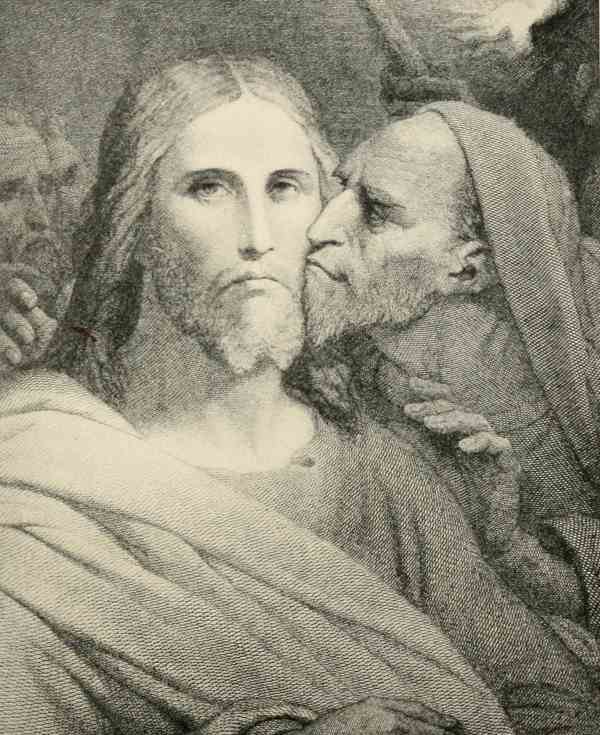
THE BETRAYING KISS (SCHEFFER)
Concerning the number of judges at the second or daybreak meeting of the Sanhedrin, both Matthew and Mark again declare that the full membership was present. Matthew says: "When the morning was come, all the chief priests and elders of the people took counsel against Jesus to put him to death."[288] Mark says: "And straightway in the morning the chief priests held a consultation with the elders and scribes and the whole council, and bound Jesus, and carried him away, and delivered him to Pilate."[289] It should be remembered that neither Luke nor John contradicts even remotely the statements of Matthew and Mark concerning the full attendance of the members of the Sanhedrin at either the night or morning trial. The first and second Gospel writers therefore corroborate each other, and the presumption of the law is that each told the truth.
And yet most commentators and writers seem to be of the opinion that all the members of the Sanhedrin were not present at the night trial of Jesus. They insist that both Matthew and Mark were employing a figure of speech, synecdoche, when they said that "all the council" were present. But these same writers seem to think that these same Evangelists were in earnest and speaking literally when they declared that "all the chief priests and elders" and the "whole council" were present at the morning trial. We shall not attempt to settle the question but will leave it to the reader to draw his own inferences. Suffice it to say that as far as the rule stated in connection with Point IX is concerned, it was immaterial whether the full council was present at either meeting. The rule against unanimity applied to a bare quorum or to any number less than the full Sanhedrin. It was the unanimity itself, of however few members, that carried with it the spirit and suggestion of mob violence and conspiracy against which Hebrew law protested.
The question of the number of members that were present at the different meetings of the Sanhedrin has been discussed in the light of history, and as bearing upon the conduct of Nicodemus and Joseph of Arimathea, who were friends of Jesus. Nicodemus was certainly a member of the Great Sanhedrin. This we learn from two passages of New Testament scripture.[290] It is also believed that Joseph of Arimathea was a member from a mere suggestion in another passage.[291] Did these friends of the Christ vote against Him? If they were members of the court; if Matthew and Mark wrote literally when they said that "all the council" were present; and if Mark wrote literally and truthfully when he said that "they all condemned him to be guilty of death"; then it naturally and inevitably follows that both Nicodemus and Joseph voted against Jesus.
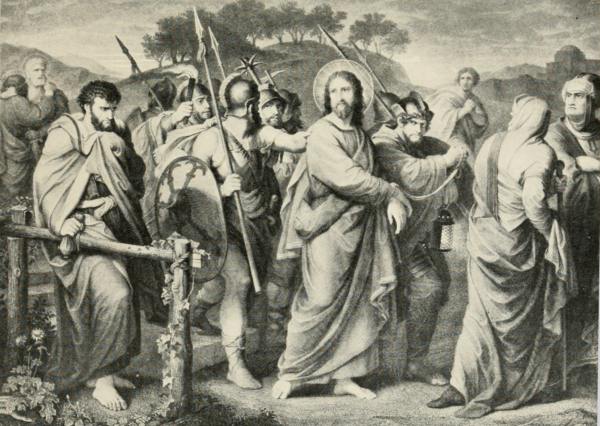
THE ARREST OF JESUS (HOFFMAN)
A number of arguments have been offered against this contention. In the first place, it is said that at a previous meeting of the Sanhedrin Nicodemus defended Jesus by asking his fellow-judges this question: "Doth our law judge any man before it hear him and know what he doeth?"[292] It is asserted that there is no good reason to believe that Nicodemus defended Jesus at this meeting and turned against Him at a subsequent one, that there is a presumption of a continuance of fidelity. But is this good reasoning? Did not Peter cut off the ear of the high priest's servant, Malchus, in defense of Jesus at midnight, in the garden, and then within three hours afterwards deny that he knew Jesus? There is no good reason to believe that Nicodemus was braver or more constant than Peter, for the former seems to have been either ashamed or afraid to express his affection for the Master during the daytime, but preferred to do it at night.[293]
Concerning the part taken by Nicodemus in the final proceedings, Rosadi says: "The verdict was unanimous. The members of the Sanhedrin who were secretly favorable to the Accused were either absent or else they voted against him. Nicodemus was amongst the absentees, or amongst those that voted against him. At all events, he did not raise his voice against the pronouncement expressed by acclamation."
If Joseph of Arimathea was a member of the Great Sanhedrin, it seems that he "had not consented to the counsel and the deed of them."[294] But it is impossible to tell certainly to which one of the three meetings of the Sanhedrin, held within the six months preceding the crucifixion, this language refers. The defense of Jesus offered by Nicodemus was certainly not at the final meeting which condemned Jesus. It may be that the reference to the protest of Joseph of Arimathea also referred to a prior meeting. Its connection in Luke seems to make it refer to the last trial, but this is not certain. Neither is it certain that Joseph was a member of the Great Sanhedrin, and his failure to consent, if he were not a member, would not disturb the contention made in Point IX of the Brief. Even if he were a member, his failure to consent would not destroy the contention, since ancient Hebrew judges, like modern American jurors, could have first protested against their action and then have voted with them. The polling of the jury, under modern law, has reference, among other things, to this state of affairs.
But we may admit that both Nicodemus and Joseph of Arimathea, as well as many others, were absent, as Rosadi suggests, and still contend that the verdict against Jesus was illegal because it was unanimous, as Mark assures us, since the number of judges present was immaterial, provided there was a quorum of at least twenty-three and their verdict was unanimous against the accused. According to the second Gospel writer, there seems to be no doubt that this was the case in the judgment pronounced against Jesus.
POINT X
THE PROCEEDINGS AGAINST JESUS WERE ILLEGAL IN THAT: (1) THE SENTENCE OF CONDEMNATION WAS PRONOUNCED IN A PLACE FORBIDDEN BY LAW; (2) THE HIGH PRIEST RENT HIS CLOTHES; (3) THE BALLOTING WAS IRREGULAR
LAW
"After leaving the hall Gazith no sentence of death can be passed upon anyone soever."—Talmud, Bab., Abodah Zarah, or of Idolatry, Chap. I. fol. 8.
"A sentence of death can be pronounced only so long as the Sanhedrin holds its sessions in the appointed place."—Maimonides, Sanhedrin XIV.
"And he that is the high priest among his brethren, upon whose head the anointing oil was poured, and that is consecrated to put on the garments, shall not uncover his head, nor rend his clothes."—Leviticus xxi. 10.
"And Moses said unto Aaron, and unto Eleazar, and unto Ithamar, his sons, Uncover not your heads, neither rend your clothes; lest ye die, and lest wrath come upon all the people."—Leviticus x. 6.
"Let the judges each in his turn absolve or condemn."—Mishna, Sanhedrin XV. 5.
"The members of the Sanhedrin were seated in the form of a semicircle at the extremity of which a secretary was placed, whose business it was to record the votes. One of these secretaries recorded the votes in favor of the accused, the other those against him."—Mishna, Sanhedrin IV. 3.
"In ordinary cases the judges voted according to seniority, the oldest commencing; in a capital trial, the reverse order was followed. That the younger members of the Sanhedrin should not be influenced by the views or arguments of their more mature, more experienced colleagues, the junior judge was in these cases always the first to pronounce for or against a conviction."—Benny, "Criminal Code of the Jews," pp. 73, 74.
FACT AND ARGUMENT
In the trial of capital cases, the Great Sanhedrin was required to meet in an apartment of the National Temple at Jerusalem, known as the Hall of Hewn Stones (Lishkhath haggazith). Outside of this hall no capital trial could be conducted and no capital sentence could be pronounced.[295] This place was selected in obedience to Mosaic injunction: "Thou shalt do according to the tenor of the sentence, which they may point out to thee from the place which the Lord shall choose."[296] The Rabbis argued that the Great Council could not try a capital case or pronounce a death sentence, unless it met and remained in the place chosen by God, which, they contended, should be an apartment of the Great Temple. The Lishkhath haggazith was chosen, and continued for many years to be the meeting place of the supreme tribunal.
But Jesus was not tried or condemned to death in the Hall of Hewn Stones, as Hebrew law required. It is clearly evident, from the Gospels, that He was tried and sentenced in the palace of Caiaphas, probably on Mount Zion. It is contended by the Jews, however, that soon after the Roman conquest of Judea the Great Sanhedrin removed from the sacred place to Bethany, and from there to other places, as occasion required. And there is a Jewish tradition that the court returned to the accustomed place on the occasion of the trial and condemnation of Jesus.[297]
In opposition to this, Edersheim says: "There is truly not a tittle of evidence for the assumption of commentators that Christ was led from the palace of Caiaphas into the Council Chamber (Lishkhath haggazith). The whole proceedings took place in the former, and from it Christ was brought to Pilate."[298] St. John emphatically declares: "Then led they Jesus from Caiaphas into the hall of judgment."[299] This Hall of Judgment was the Prætorium of Pilate.
The first irregularity, then, noted under Point X is that Jesus was tried and condemned in the palace of Caiaphas instead of the Hall of Hewn Stones, the regular legal meeting place of the Great Sanhedrin.
The second error noted under Point X is that which relates to the rending of garments by the high priest. "An ordinary Israelite could, as an emblem of bereavement, tear his garments, but to the high priest it was forbidden, because his vestments, being made after the express orders of God, were figurative of his office."[300]
When Jesus confessed that He was Christ the Son of God, Caiaphas seems to have lost his balance and to have committed errors with all the rapidity of speech. "Then the high priest rent his clothes, and saith, What need we any further witnesses? ye have heard the blasphemy: what think ye? And they all condemned him to be guilty of death."[301] In this language and conduct of the son-in-law of Annas there were several irregularities in procedure. The first was the rending of garments reported by Matthew and Mark, which act was forbidden by the provisions of the Mosaic Code, recorded in Leviticus and cited above.
But it is only fair to state the dissenting opinion on this point. In the times of Christ it seems to have been the custom among the Jews to rend the garments as a sign of horror and execration, whenever blasphemous language was heard. Edersheim states the rule: "They all heard it—and, as the law directed, when blasphemy was spoken, the high priest rent both his outer and inner garment, with a rent that might never be repaired."[302] The law here referred to, however, is the Rabbinic or Talmudic and not the Mosaic law. It should be remembered that the Mosaic Code was the constitution or fundamental law of the ancient Hebrews. The Talmudic law embodied in the Mishna was, in a sense, a mere commentary upon the Mosaic law. We have seen in Chapter I of Part II of this volume that the traditional law was based upon, derived from, and inspired by the written law contained in the Pentateuch. It is true that the Talmud, while professing subordination to the Pentateuch, finally virtually superseded it as an administrative code. But the doctors never repealed a Mosaic injunction, since it was an emanation of the mind of Jehovah and could not be abrogated by human intelligence. When an ancient ordinance ceased to be of practical value the Jewish legists simply declared that it had fallen into desuetude. And whenever a new law was proclaimed to meet an emergency in the life of the Hebrew people the Rabbins declared that it was derived from and inspired by some decree which God had handed down to Moses for the benefit of the nation. In other words, the Mosaic Code was Israel's divine constitution which was to serve as a standard for all future legislation. And as the Jewish lawmakers were not permitted to repeal a Mosaic ordinance, neither were they allowed to establish a rule in contravention of it. Now the Pentateuch forbade the rending of garments. Then did the Talmudists have a right to declare that the law might be changed or broken in the case of blasphemy? That they did is denied by many writers.
But admitting the validity of the Talmudic rule, it is nevertheless beyond dispute that the high priest was forbidden to rend his clothes on Sabbaths and holidays. And as Jesus was condemned on both a Sabbath and a festival day, the high priest's action in rending his clothes on that day was illegal.[303]
Again, the proceedings against Jesus were illegal because the balloting was irregular. This is the third error noted under Point X.
The Hebrew law required that each judge, when his time came to vote upon the guilt or innocence of the accused, should rise in his place, declare his vote, and state his reasons for so voting. In capital cases the youngest judge was required to vote first, in order that he might not be unduly influenced by the example of his seniors in age and authority. The balloting continued in this manner from the youngest member to the high priest, who was generally among the oldest. Two scribes—according to some writers, three—were present to record the votes and to note the reasons stated. These records were to be used on the second day of the trial in comparing the arguments of the judges on that day with those offered on the first day. Judges who had voted for acquittal on the first day could not change their votes on the second day. Those who had voted for conviction on the first day might change their votes on the second day, by assigning good reasons. Those who had voted for conviction on the first day could not vote for conviction on the second day, if the reasons assigned on the second day were radically different from those assigned on the first day.[304] It will thus be seen how very essential were the records of the scribes and how important it was that they should be correctly kept. Hence the necessity, according to Benny, of a third scribe whose notes might be used to correct any discrepancies in the reports of the other two.
Now are we justified in assuming that this was the method employed in counting votes at the trial of Jesus? The law will not permit us to presume errors. We must rather assume that this was the method employed, unless the Gospel record indicates, either by plain statement or by reasonable construction, that it was not the method used.
In this connection, let us review the language of the Scriptures. "Ye have heard the blasphemy: what think ye? And they all condemned him to be guilty of death." Is it not clearly evident, from this passage, that the balloting was not done singly, the youngest voting first, as Hebrew law required? Can it not be seen at a glance that the judges voted en masse? If they did, was it possible for the scribes to record the votes and make a note of the reasons assigned, as the law required? If these things were not done, were the proceedings regular?
According to Matthew, Caiaphas, before calling for the votes exclaimed: "He hath spoken blasphemy."[305] Instead of doing this should he not, under the law, have carefully concealed his opinion until the younger members of the court had voted? Is it not a matter of history that the opinion of the high priest was regarded as almost infallible authority among the ancient Hebrews? Did not this premature declaration of guilt on the part of the high priest rob the subordinate judges of freedom of suffrage?
The conduct of the case at the close, when the balloting took place, seems to justify the view of those writers who assert that there was no regular trial of Jesus, but rather the action of a mob.
POINT XI
THE MEMBERS OF THE GREAT SANHEDRIN WERE LEGALLY DISQUALIFIED TO TRY JESUS
LAW
"The robe of the unfairly elected judge is to be respected not more than the blanket of the ass."—Mendelsohn, "Hebrew Maxims and Rules," p. 182.
"As Moses sat in judgment without the expectation of material reward, so also must every judge act from a sense of duty only."—Mendelsohn, "Hebrew Maxims and Rules," p. 177.
"Nor must there be on the judicial bench either a relation, or a particular friend, or an enemy of either the accused or of the accuser."—Mendelsohn, "Criminal Jurisprudence of the Ancient Hebrews," p. 108.
"He (the Hebrew judge) was, in the first instance, to be modest, of good repute among his neighbors, and generally liked."—Benny, "Criminal Code of the Jews," p. 38.
"Nor under any circumstances, was a man known to be at enmity with the accused person permitted to occupy a position among his judges."—Benny, "Criminal Code of the Jews," p. 37.
FACT AND ARGUMENT
The Gospel records disclose the fact that the members of the Great Sanhedrin were legally disqualified to try Jesus. This disqualification was of two kinds: (1) A general disqualification, under Hebrew law, to act as judges in any case; (2) a special disqualification to sit in judgment upon the life of Jesus.
Among all the great systems of jurisprudence of the world the ancient Hebrew system was the most exacting in the matter of judicial fitness. In the palmiest days of the Hebrew Commonwealth the members of the Great Sanhedrin represented the most perfect mental, moral, and physical development of the Hebrew people. A man could not be a member of this court who had any serious mental, moral, or physical defect. He must have been "learned in the law," both written and unwritten. He must have had judicial experience; that is, he must have filled three offices of gradually increasing dignity, beginning with one of the local courts and passing successively through two magistracies at Jerusalem. He must have been an accomplished linguist; that is, he must have been thoroughly familiar with the languages of the surrounding nations. He must have been modest, popular, of good appearance, and free from haughtiness. He must have been pious, strong, and courageous. And above all, he must have been friendly in his attitude toward the accused.[306]
These were the qualifications of Israel's judges before Roman politics had corrupted them. But at the time of Christ they had grown to be time-serving, degenerate, and corrupt. Judea was then passing through a period of religious and political revolution. At such a time in any state, as all history teaches us, the worst elements of society generally get the upper hand and control the political currents of the day. Many members of the Sanhedrin had themselves been guilty of criminal acts in both public and private life. Many of them held office by purchase—they had bought their seats. They were thus unfitted to be judges in any case; especially in one involving the great question of life and death.
In order to show the general disqualification, under the test of Hebrew law, of the members of the Great Sanhedrin, at the time of Christ, to exercise judicial functions, it is necessary to quote only Jewish authorities. In "The Martyrdom of Jesus," Rabbi Wise says: "The chief priests, under the iron rule of Pilate and his wicked master, Sejan, were the tools of the Roman soldiers who held Judea and Samaria in subjection. Like the high priest, they were appointed to and removed from office by the Roman governor of the country, either directly or indirectly. They purchased their commissions for high prices and, like almost all Roman appointees, used them for mercenary purposes. They were considered wicked men by the ancient writers and must have stood very low in the estimation of the people over whom they tyrannized. The patriots must have looked upon them as hirelings of the foreign despot whose rule was abhorred. Although there was, here and there, a good, pious and patriotic man among them, he was an exception. As a general thing, and under the rule of Pilate, especially, they were the corrupt tools of a military despotism which Rome imposed upon enslaved Palestine."
Again, the Talmud, in which we never look for slurs upon the Hebrew people, where slurs are not deserved, contains this bitter denunciation of the high-priestly families of the times of Christ: "What a plague is the family of Simon Bœthus; cursed be their lances! What a plague is the family of Ananos; cursed be their hissing of vipers! What a plague is the family of Cantharus; cursed be their pens! What a plague is the family of Ismael ben Phabi; cursed be their fists! They are high priests themselves, their sons are treasurers, their sons-in-law are commanders, and their servants strike the people with staves."
In like manner the Talmud, in withering rebuke and sarcasm, again declares that "The porch of the sanctuary cried out four times. The first time, Depart from here, descendants of Eli; ye pollute the Temple of the Eternal! The second time, Let Issachar ben Keifar Barchi depart from here, who polluted himself and profaneth the victims consecrated to God! The third time, Widen yourselves, ye gates of the sanctuary and let Israel ben Phabi, the wilful, enter that he may discharge the functions of the priesthood! Yet another cry was heard, Widen yourselves, ye gates, and let Ananias ben Nebedeus, the gourmand, enter, that he may glut himself on the victims."[307]
It should be borne in mind that the high-priestly families so scathingly dealt with by the Talmud were the controlling spirits in the Great Sanhedrin at the time of Christ. Were they legally qualified, then, under the ancient and honorable tests of Hebrew law, to be members of the highest court in the land? If they bought their offices and used them for mercenary purposes, as Wise asserts, were they worthy of the great exemplar, Moses, who "sat in judgment without the expectation of material reward"? If they thus secured their places and prostituted them to selfish purposes, were their robes to be respected any more than the blanket of the ass?
The ancient Hebrew judges, in the days of Israel's purity and glory, submitted their claims to judicial preferment to the suffrage of a loving and confiding people.[308] They climbed the rungs of the judicial ladder by slow and painful degrees. Integrity and ability marked each advance toward the top. Was this the process of promotion in the case of Caiaphas and his fellow-judges? Did their bought and corrupted places not brand them with the anathema of the law?
We come now to consider the special disqualifications of members of the Sanhedrin to sit in judgment upon the life of Jesus. The reasons for these disqualifications were two: (1) The members of this court were, in the language of Jost, "burning enemies" of Jesus, and were therefore disqualified, under Hebrew law, to act as His judges; (2) they had determined upon His guilt, and had sentenced Him to death before the trial began; and had thus outraged not only a specific provision of Hebrew law but also a principle of universal justice.
The various causes of the hatred of the members of the Sanhedrin for Jesus are too numerous and profound to admit of exhaustive treatment here. A thorough analysis of these causes would necessitate a review of the life of Christ from the manger to the sepulcher. A few reasons will suffice.
But at this point a distinction should be made between that personal hatred which disqualifies and the hatred and loathing of the crime that do not disqualify. Every just and righteous judge should loathe and hate the crime itself; and a certain amount of loathing and dislike for the criminal is most natural and almost inevitable. But no judge is qualified to sit in judgment upon the rights of life, liberty, or property of another whom he hates as the result of a personal grudge, born of personal experience with the prisoner at the bar. The hatred that disqualified the members of the Sanhedrin, under Hebrew law, was that kind of hatred that had been generated by personal interest and experience. The most merciless invective, barbed with incomparable wit, ridicule, and satire, had been daily hurled at them by Jesus with withering effect. With a touch more potent than that of Ithuriel's spear He had unmasked their wicked hypocrisy and had blazoned it to the skies. Every day of His active ministry, which lasted about three years, had been spent in denouncing their shameless practices and their guilty lives. The Scribes and Pharisees were proud, haughty, and conceited beyond description. They believed implicitly in the infallibility of their authority and in the perfection of their souls. How galling, then, to such men must have been this declaration of an obscure and lowly Nazarene: "Verily, I say unto you, That the publicans and the harlots go into the kingdom of God before you."[309] What impetuous invective this: "Woe unto you, scribes and Pharisees, hypocrites! for ye devour widows' houses, and for a pretense make long prayer: therefore ye shall receive the greater damnation. Woe unto you, scribes and Pharisees, hypocrites! for ye compass sea and land to make one proselyte, and when he is made, ye make him twofold more the child of hell than yourselves."[310] We can well imagine how these fiery darts pierced and tore the vanity of a haughty and contemptuous priesthood.
Consider for a moment the difference in the spheres of Jesus and of His enemies. He, an obscure prophet from Nazareth in Galilee; they, the leaders of Israel and the guardians of the Temple at Jerusalem. He, the single advocate of the New Dispensation; they, the manifold upholders of the Old. He, without earthly authority in the propagation of His faith; they, clothed with the sanction of the law and the prestige of a mighty past. Imagine, then, if you can, the intensity of the hatred engendered by the language and the conduct of Jesus.
That we may fully appreciate the tension of the situation let us cast a single glance at the character of the Scribes. Edersheim has written these wonderfully graphic lines about them:
He pushes to the front, the crowd respectfully giving way, and eagerly hanging on his utterances, as those of a recognized authority. He has been solemnly ordained by the laying on of hands; and is the Rabbi, "my great one," Master, amplitudo. Indeed, his hyper-ingenuity in questioning has become a proverb. There is not measure of his dignity, nor yet limit to his importance. He is the "lawyer," the "well-plastered pit," filled with the water of knowledge, "out of which not a drop can escape," in opposition to the "weeds of untilled soil" of ignorance. He is the divine aristocrat, among the vulgar herd of rude and profane "country people," who "know not the law," and are "cursed." Each scribe outweighed all the common people, who must accordingly pay him every honor.... Such was to be the respect paid to their sayings that they were to be absolutely believed, even if they were to declare that to be at the right hand which was at the left, or vice-versa.[311]
What could, then, be more terrific than the hatred of such a character for an unlettered Galilean who descended from the mountains of His native province to rebuke and instruct the "divine aristocrats" in religious matters and heavenly affairs? Imagine his rage and chagrin when he heard these words: "Woe unto you, scribes and Pharisees, hypocrites! for ye are like unto whited sepulchres, which indeed appear beautiful outward, but are within full of dead men's bones, and all uncleanness.... Woe unto you, scribes and Pharisees, hypocrites! because ye build the tombs of the prophets, and garnish the sepulchres of the righteous, And say, If we had been in the days of our fathers, we would not have been partakers with them in the blood of the prophets. Wherefore ye be witnesses unto yourselves, that ye are the children of them which killed the prophets. Fill ye up then the measure of your fathers. Ye serpents, ye generation of vipers, how can ye escape the damnation of hell?"[312]
"His exquisite irony," says Renan, "His stinging remarks, always went to the heart. They were everlasting stings, and have remained festering in the wound. This Nessus-shirt of ridicule which the Jew, son of the Pharisees, has dragged in tatters after him during eighteen centuries, was woven by Jesus with a divine skill. Masterpieces of fine raillery, their features are written in lines of fire upon the flesh of the hypocrite and the false devotee. Incomparable traits worthy of a Son of God! A god alone knows how to kill in this way. Socrates and Molière only grazed the skin. The former carried fire and rage to the very marrow."[313]
Are we not now justified in asserting, with Jost, that the members of the Sanhedrin, who were none other than the Scribes and Pharisees above described by Jesus, were the "burning enemies" of the prisoner at the bar? If they were, were they legally qualified to be His judges?
But it may be argued that their hatred was simply a form of righteous indignation provoked by His repeated assaults upon the national religion and the national institutions; that it was their duty as guardians of both to both hate and try Him; and that they would have been derelict in duty if they had not done so. But it is apparent from the record and is evident to any fair-minded reader that the enmity of the judges toward Jesus was more personal than political, more a private than a public affair. In support of this contention, in addition to the withering language addressed to them, the matter of the purification of the Temple may be mentioned. It will be remembered how Jesus, with a scorpion lash, scourged the money-changers and traders from the Sanctuary. Now it is historically true that Annas and Caiaphas and their friends owned and controlled the stalls, booths, and bazaars connected with the Temple and from which flowed a most lucrative trade. The profits from the sale of lambs and doves, sold for sacrifice, alone were enormous. When Jesus threatened the destruction of this trade He assaulted the interests of Annas and his associates in the Sanhedrin in a vital place. This grievance was certainly not so religious as it was personal. The driving of the cattle from the stalls was probably more effective in compassing the destruction of the Christ than any miracle that He performed or any discourse that He delivered. But whatever the cause the fact is historic and indisputable that the Sanhedrists were enemies of Jesus, and therefore disqualified under Hebrew law to try Him.
A second reason for the special disqualification of the members of the Sanhedrin to sit as judges at the trial of Christ was the fact that they had determined upon His guilt and had sentenced Him to death before the trial began. This point needs no extensive argument or illustration. Under every enlightened system of justice the first great qualification of judges has been that they should be unbiased and unprejudiced. Judicial proceedings are murderous and no better than mob violence when judges and jurors enter upon the trial of the case with a determination to convict the accused, regardless of the testimony. The principles underlying this proposition are fundamental and self-evident.