Book 1 — XVI.—HOW THE COUNCIL DEPOSED QUEEN JANE; AND HOW SHE FLED FROM THE TOWER.
Reading edition
At length, the last morning which was to behold Jane queen dawned, and after an agitated and sleepless night, she addressed herself to her devotions, and endeavoured to prepare for the dangerous and difficult part she had to play. The Duke of Suffolk tried to persuade her to abdicate. But her husband, who, it has been already observed, inherited his father’s ambitious nature, besought her not to part with the crown.
“It has been dearly purchased,” he urged, “and must be boldly maintained. Let us meet the Council courageously, and we shall triumph.”
To this Jane assented. But it was evident from her manner she had but slight hopes.
At an early hour the lord mayor, the aldermen, and all the civic authorities who had been summoned, arrived. Cranmer and Ridley came soon after. The Council were then summoned, and by ten o’clock all were assembled, excepting the Earls of Pembroke and Arundel, Simon Renard, and De Noailles. As soon as Jane was seated beneath the state canopy, she ordered a pursuivant to summon them. Proclamation being made, a stir was heard at the lower end of the council-chamber, and the absentees presented themselves. All four advanced boldly towards the throne, and took their place among the Council. Jane then arose, and with great dignity and self-possession thus-addressed the assemblage:—
“My lords,” she said, “I have summoned you it may be for the last time, to deliberate on the course to be pursued to check the formidable tumults and rebellions that have been moved against me and my crown. Of that crown I cannot doubt I have lawful possession, since it was tendered me by your lordships, who have all sworn allegiance to me. Fully confiding, therefore, in your steadiness to my service, which neither with honour, safety, nor duty, you can now forsake, I look to you for support in this emergency.”
Here a murmur arose among the Council.
“What!” exclaimed Jane: “do you desert me at the hour of need? Do you refuse me your counsel and assistance?”
“We do,” replied several voices.
“Traitors!” exclaimed Lord Guilford Dudley: “you have passed your own sentence.”
“Not so, my lord,” replied Simon Renard. “It is you who have condemned yourself. Lady Jane Dudley,” he continued in a loud voice, “you who have wrongfully usurped the title and station of queen,—in your presence I proclaim Mary, sister to the late king Edward the Sixth, and daughter of Henry the Eighth of famous memory, Queen of England and Ireland, and very owner of the crown, government, and title of England and Ireland, and all things thereunto belonging.”
“God save Queen Mary!” cried the Council.
A few dissentient voices were raised. But the Earl of Pembroke drew his sword, and cried in a loud voice, “As heaven shall help me, I will strike that man dead who refuses to shout for Queen Mary.” And he threw his cap in the air.
“Hear me,” continued Renard, “and learn that resistance is in vain. I hereby proclaim a free pardon, in Queen Mary’s name, to all who shall freely acknowledge her,—excepting always the family of the Duke of Northumberland, who is a traitor, and upon whose head a price is set. I require your Grace,” he added to Suffolk, “to deliver up the keys of the Tower.”
“They are here,” replied the Duke, pointing to Magog who bore them.
“Do you yield, my lord?” cried Lord Guilford, passionately.
“It is useless to contend further,” replied Suffolk. “All is lost.”
“True,” replied Jane. “My lords, I resign the crown into your hands; and Heaven grant you may prove more faithful to Mary than you have been to me. In obedience to you, my lord,” she continued, addressing her husband, “I acted a violence on myself, and have been guilty of a grievous offence. But the present is my own act. And I willingly abdicate the throne to correct another’s fault, if so great a fault can be corrected by my resignation and sincere acknowledgment.”
“You shall not abdicate it, Jane,” cried Dudley, fiercely. “I will not yield. Stand by me, Cholmondeley, and these audacious traitors shall find I am still master here. Let those who are for Queen Jane surround the throne.”
As he spoke, he glanced round authoritatively, but no one stirred.
“Speak!” he cried, in accents of rage and disappointment. “Are ye all traitors? Is no one true to his allegiance?”
But no answer was returned.
“They are no traitors, my lord,” said Simon Renard. “They are loyal subjects of Queen Mary.”
“He speaks truly, my dear lord,” replied Jane. “It is useless to contend further. I am no longer queen.”
So saying, she descended from the throne.
“My lords,” she continued, addressing the Council, “you are now masters here. Have I your permission to retire?”
“You have, noble lady,” replied Pembroke. “But it grieves me to add, that you must perforce remain within the Tower till the pleasure of her Highness respecting you has been ascertained.”
“A prisoner!” exclaimed Jane, trembling. “And my husband, you will suffer him to accompany me?”
“It cannot be,” interposed Simon Renard, harshly; “Lord Guilford Dudley must be separately confined.”
“You cannot mean this cruelty, sir?” cried Jane, indignantly. “Do not sue for me, Jane,” rejoined Dudley. “I will not accept the smallest grace at his hands.”
“Guards!” cried Renard, “I command you, in Queen Mary’s name, to arrest Lord Guilford Dudley, and convey him to the Beauchamp Tower.”
The order was instantly obeyed. Jane then took a tender farewell of her husband, and accompanied by Cicely and Cholmondeley, and others of her attendants, was escorted to the palace.,
She had no sooner taken her departure, than letters were despatched by the Council to the Duke of Northumberland, commanding him instantly to disband his army. And the Earl of Arundel was commissioned to proceed with a force to arrest him.
“I have a brave fellow who shall accompany your lordship,” said Renard, motioning to Gilbert, who stood among his followers.
“Hark’ee, sirrah!” he added, “you have already approved your fidelity to Queen Mary. Approve it still further by the capture of the Duke, and, in the Queen’s name, I promise you a hundred pounds in lands to you and your heirs, and the degree of an esquire. And now, my lords, to publicly proclaim Queen Mary.”
With this the whole train departed from the Tower, and proceeded to Cheapside, where, by sound of trumpet, the new sovereign was proclaimed by the title of “Mary, Queen of England, France, and Ireland, Defender of the Faith.”
Shouts rent the air, and every manifestation of delight was exhibited. “Great was the triumph,” writes an eye-witness of the ceremony; “for my part, I never saw the like, and, by the report of others, the like was never seen. The number of caps that were thrown up at the proclamation was not to be told. The Earl of Pembroke threw away his cap full of angels. I saw myself money thrown out of the windows for joy. The bonfires were without number; and what with shouting and crying of the people, and ringing of bells, there could no man hear almost what another said—besides banquetting, and skipping the streets for joy.”
The proclamation over, the company proceeded to St. Paul’s, where Te Deum was solemnly sung. It is a curious illustration of the sudden change of feeling, that the Duke of Suffolk himself proclaimed Mary on Tower Hill.
The utmost confusion reigned throughout the Tower. Some few there were who regretted the change of sovereigns, but the majority were in favour of Mary. Northumberland in fact was so universally hated by all classes, and it was so notorious that the recent usurpation was contrived only for his own aggrandisement, that though Jane was pitied, no commiseration was felt for her husband or her ambitious father-in-law. Great rejoicings were held in the Tower-green, where an immense bonfire was lighted, and a whole ox roasted. Several casks of ale were also broached, and mead and other liquors were distributed to the warders and the troops. Of these good things the three gigantic warders and Xit partook; and Magog was so elated, that he plucked up courage to propose to Dame Placida, and, to the dwarf’s infinite dismay and mortification, was accepted. Lord Guilford Dudley witnessed these rejoicings from the windows of the Beauchamp Tower, in which he was confined; and as he glanced upon the citadel opposite his prison, now lighted up by the gleams of the fire, he could not help reflecting with bitterness what a change a few days had effected. The voices which only nine days ago had shouted for Jane, were now clamouring for Mary; and of the thousands which then would have obeyed his slightest nod, not one would acknowledge him now.
From a prince he had become a captive, and his palace was converted into a dungeon. Such were the agonizing thoughts of Northumberland’s ambitious son,—and such, or nearly such, were those of his unhappy consort, who, in her chamber in the palace was a prey to the bitterest reflection.
Attended only by Cholmondeley and Cicely, Jane consumed the evening in sad, but unavailing lamentations. About midnight, as she had composed her thoughts by applying herself to her wonted solace in affliction—study, she was aroused by a noise in the wall, and presently afterwards a masked door opened, and Gunnora Braose presented herself. Jane instantly rose, and demanded the cause of the intrusion. Gunnora laid her finger on her lips, and replied in a low tone, “I am come to liberate you.”
“I do not desire freedom,” replied Jane, “neither will I trust myself to you. I will abide here till my cousin Mary makes her entrance into the Tower, and I will then throw myself upon her mercy.”
“She will show you no mercy,” rejoined Gunnora. “Do not, I implore of you, expose yourself to the first outbreak of her jealous and vindictive nature. Queen Mary inherits her father’s inexorable disposition, and I am well assured if you tarry here, you will fall a victim to her displeasure. Do not neglect this opportunity, sweet lady. In a few hours it may be too late.”
“Accept her offer, gracious madam,” urged Cicely, “it may be your last chance of safety. You are here surrounded by enemies.”
“But how am I to escape from the fortress, if I accede to your wishes?” replied Jane.
“Follow me, and I will conduct you,” answered Gunnora. “I have possessed myself of the key of a subterranean passage which will convey you to the other side of the moat.”
“But my husband?” hesitated Jane.
“Do not think of him,” interrupted Gunnora, frowning. “He deserted you in the hour of danger. Let him perish on the scaffold with his false father.”
“Leave me, old woman,” said Jane authoritatively; “I will not go with you.”
“Do not heed her, my gracious mistress,” urged Cholmondeley, “your tarrying here cannot assist Lord Guilford, and will only aggravate his affliction. Besides, some means may be devised for his escape.”
“Pardon what I have said, dear lady,” said Gunnora. “Deadly as is the hatred I bear to the house of Northumberland, for your sweet sake I will forgive his son. Nay more, I will effect his deliverance. This I swear to you. Come with me, and once out of the Tower make what haste you can to Sion House, where your husband shall join you before the morning.”
“You promise more than you can accomplish,” said Jane.
“That remains to be seen, madam,” replied Gunuora: “but were it not that he is your husband, Lord Guilford Dudley should receive no help from me. Once more, will you trust me?”
“I will,” replied Jane.
Cholmondeley then seized a torch, and fastening the door of the chamber, on the outside of which a guard was stationed, assisted Jane through the masked door. Preceded by the old woman, who carried a lamp, they threaded a long narrow passage built in the thickness of the wall, and presently arrived at the head of a flight of stairs, which brought them to a long corridor arched and paved with stone. Traversing this, they struck into an avenue on the right, exactly resembling one of those which Cholmondeley had recently explored. Jane expressed her surprise at the vast extent of the passages she was threading, when Gunnora answered—“The whole of the Tower is undermined with secret passages and dungeons, but their existence is known only to few.’”
A few minutes’ rapid walking brought them to a stone staircase, which they mounted, traversed another gallery, and finally halted before a low gothic-arched door, which admitted them to the interior of the Bowyer Tower. Requesting Cholmondeley to assist her, Gunnora, with his help, speedily raised a trap-door of stone, and disclosed a flight of steps. While they were thus employed, a strange and unaccountable terror took possession of Jane. As she glanced timidly towards the doorway she had just quitted, she imagined she saw a figure watching her, and in the gloom almost fancied it was the same muffled object she had beheld in St. John’s Chapel. A superstitious terror kept her silent. As she looked more narrowly at the figure, she thought it bore an axe upon its shoulder, and she was about to point it out to her companions, when making a gesture of silence it disappeared. By this time the trap-door being raised, Cholmondeley descended the steps with the torch, while Gunnora holding back the flag, begged her to descend. But Jane did not move.
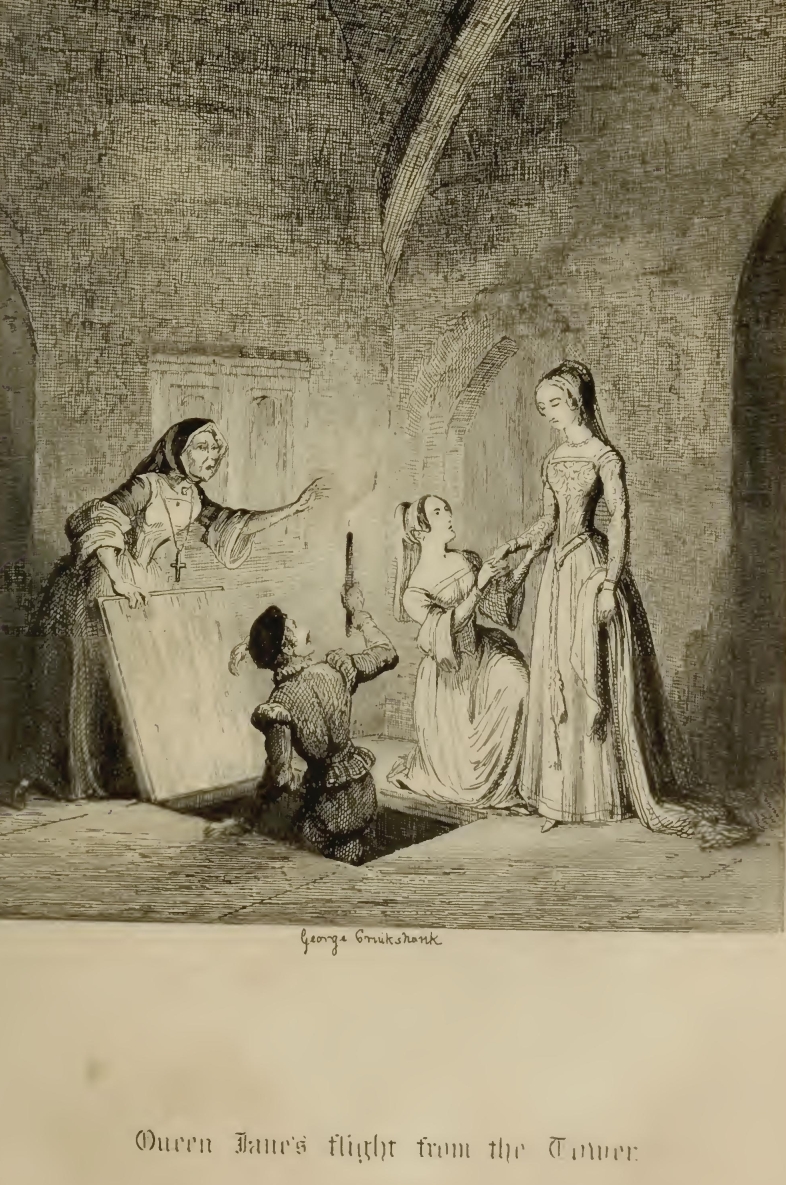

“Do not lose time,” cried the old woman, “we may be followed, and retaken.”
Still Jane hesitated. She cast another look towards the doorway, and the idea crossed her, that from that very outlet she should be led to execution. A deadly chill pervaded her frame,-and her feet seemed nailed to the ground. Seeing her irresolution, Cicely threw herself on her knees before her, and implored her to make an effort. Jane advanced a step, and then paused. After remaining a moment in deep abstraction, she turned to Cicely, and said,—.
“Child, I thank you for your zeal, but I feel it is useless. Though I may escape from the Tower, I cannot escape my fate.” Cicely, however, renewed her entreaties, and seconded by Chomondeley she at length prevailed. Pursuing the same course which Gunnora had taken on the night she was brought to the Tower by Simon Renard, they at length arrived at the shed at the further side of the moat.
“You are now safe,” said Gunnora. “Hasten to Sion House, and if my plan does not fail, your husband shall join you there before many hours have passed.”
So saying, she departed. Jane and her attendants crossed Tower Hill, from which she turned to gaze at the scene of her greatness, indistinctly visible in the gloom—and so agonizing were the thoughts occasioned by the sight that she burst into tears. As soon as she had recovered from her paroxysm of grief, they proceeded to the river side, where they fortunately procured a boat, and were rowed towards Sion House.