Front matter (continued 7)
Reading edition
"I must go, too," said Mary; "you will not forbid me now. Good heavens!" she cried aloud. "Now that they stand away from the gate I can see within. Oh, the poor prisoners! Oh, I cannot bear their sick faces! They are starving, sir! These must be the men who had the fever you told me of. I wish we had brought more wine and food to these poor fellows! Let us go in at once," she cried again, and was in a passion of pity and terror at the sight.
"Let us go in! Let us go in!" she begged. "Oh, you forget that they are my own countrymen! I cannot wait!"
The guard now returned with a message, and the alderman gave his bridle to the groom. Mary was afoot sooner than he, and had run to the gate, pushing her way among the idle sightseers to the heavy grating. They were calling from both sides of the gate to old Matthew, who was standing with the horses, to come up and give them what he had brought. Mary Hamilton felt as if she were among wolves: they did not listen; they did not wait to find what she had to say. "For love of God, give me a shilling for a little 'baccy, my lady," said one voice in her ear. "I 'll fetch them the 'baccy from the town, poor boys; they lack it most of anything, and he 'll drink the money!" protested an old beggar woman at her side. "Go in? They 'll let no ladies in!" and she gave a queer laugh. "And if you 're once in, all you 'll pray for is to be out again and forget the sight."
The governor was in his room, which had a small grated window toward the prison yard; but there was a curtain before it, and he looked up anxiously to see if this were close drawn as his early guests entered. This task of jailer was a terrible duty for any man, and he swore under his breath at Lord Mount Edgecumbe for interfering with what at best was an impossible piece of business. If he had seen to it that they had decent supplies for the prison, and hanged a score of their purveyors and contractors, now, or had blown the whole rotten place into the air with his fleet guns, 't were a better kindness!
The clerk stood waiting for orders.
"Show them in, then, these people," he grumbled, and made a feint of being busy with some papers as Miss Hamilton and her escort appeared. The governor saw at once that the honorable Mr. Davis was a man of consequence.
"My Lord Mount Edgecumbe writes me that you would make inquiries for a prisoner here," said the old soldier, less roughly because the second guest proved to be a lady and most fair to see. She looked very pale, and was watching him with angry eyes. As she had crossed the prison yard, she had seen fewer miseries because her tears had blinded her. There had been one imploring voice calling her by her own name. "Stop, Miss Hamilton, stop, for God's sake!" some one had cried; but the guard had kept the poor prisoners off, and an attendant hurried her along by force when she would gladly have lingered. The horror of it all was too much for her; it was the first time she had ever been in a jail.
"I am fearful of your sad disappointment, madam," said the governor of the prison. "You wished to see Lieutenant Roger Wallingford. I grieve to say"—He spoke kindly, but looked to ward Mary and stopped, and then, sighing heavily, turned his eyes toward Mr. Davis with a kind of relief.
"He is not dead, I hope, sir?" asked the old man, for Mary could not speak. "We have the order for his release."
"No, he is not dead to any certain knowledge," explained the governor, more slowly than before, "but he was one of a party that made their escape from this prison last night; 't was through one of their silly tunnels that they dig. They have some of them been shot down, and one, I hear, has just been taken and brought in alive; but Wallingford's name is not among any of these." He turned to some records, and then went to the grated window and looked out, but pulled the curtain across it impatiently as he came away. "You brought his pardon?" the governor then asked brusquely. "I should think he would be the last man for a pardon. Why, he was with Paul Jones, sir; but a very decent fellow, a gentleman, they tell me. I did not see him; I am not long here. This young lady had best go back to the inn," and he stole a look at Mary, who sat in despairing silence. A strange flush had replaced her first pallor. She had thought but a moment before that she should soon look again into Roger Wallingford's face and tell him that he was free. On the end of the governor's writing table lay the note that she had written with such a happy heart only the night before.
XXXVIII
FULL OF STRAYING STREETS
"Nona ne souffrons quo dans la mesure où nous co-opérons à nos souffrances."
"His age saw visions, though his youth dream'd dreams."
The town of Bristol was crowded with Loyalist refugees: some who had fled the colonies for honest love of their King, and some who believed that when the King's troops had put down the rebellion they should be well rewarded for holding to his cause. They were most of them cut off from what estates they may have had, and were begging for pensions from a government that seemed cruelly indifferent. Their sad faces fairly shadowed the Bristol streets, while many of them idled the day through, discussing their prospects with one another, and killing time that might have been lived to some profit. The disappointment of their hope was unexpected, and an England that showed them neither sympathy nor honor when they landed on her shores, glowing with self-sacrifice, was but a sad astonishment. England, their own mother country, seemed fallen into a querulous dotage, with her King's ministers so pompous in their stupid ignorance and self-consequence, and her best statesmen fighting hard to be heard. It was an age of gamester heroes and of reckless living; a poor page of English history was unfolded before their wistful eyes. These honest Loyalists were made to know the mortified feelings of country gentlefolk come unheralded to a city house that was busy with its splendors on a feast day, and impatient of what was inopportune. Worse than this, though Judge Curwen and other loyal Americans of his company were still hopeful of consideration, and of being warmly received by England as her own true children, they were oftener held guilty of the vexing behavior of their brothers, those rebels against English authority whom they had left behind. Something to Mary's wonder, Madam Wallingford would have few of them to friend. She was too great a person at home to consent even now to any social familiarity on the score of political sympathies. She was known to have brought much money, and it was made easy for her to share this with one and another distressed acquaintance or friend's friend; but while this was done with generosity, she showed herself more and more impatient of their arguments, even of those plaints which were always ready, and the story of such grievances as had led them into exile.
"I am too ill and sad to listen to these things," she said often, even to her friends the Pepperrells, who came from London to visit her. "I only know my country's troubles through my own sorrow." She begged them at last to find poor Roger's grave, so she might go there to pray for him; 't was all that she could do. "Oh no," she would say mournfully to those who looked for her assent to their own views of the great situation, "do not expect me to understand you. I am only a mother, and all my life is done!"
The Bristol streets were busy as Miss Hamilton came walking through the town, and the bells were ringing for a holiday. She was deep in anxious thought, and kept steadily on her way toward the abbey church, without even a glance at a tradesman's window or a look at the people she met. Life was filled with new anxieties. Since the day when they had left Plymouth they could find no trace of Roger Wallingford, beyond the certainty that he had made his escape with some fellow prisoners through a tunnel which they had been for many days digging under the prison wall. There had been a light near the opening in the field outside, and a guard set, but six men had gone out of the narrow hole and crawled away. It was a windy night, and the lantern light and shadows wavered on the ground and hid them. Two were shot and killed, but two were captured and brought back at once, while another was shot and got away, stumbling and falling often, and bleeding like a slaughtered creature, as the watch could see next morning by daylight. This poor fellow had escaped to the moors; there was a pool of blood in a place where he must have hidden for some hours among the furze bushes. There was so large a bounty paid for any escaped traitors and felons like these, who might be brought back alive to the Mill Prison, that the poor moorland folk back of Plymouth were ever on the quest. Roger Wallingford might have been that bleeding man. They would not dare to keep together; his companion might have left him dying or dead somewhere in the lonely waste country that stretched miles away above the prison. His fate was sure if he should be captured; he was not a man to yield his life too easily. There were some carefully worded notices posted,—broadsides which might easily reach the eyes of such fugitives if they ventured into any of the Devon towns near by; but they might well have starved to death by this time in the deserts of Dartmoor. One sailor beside the lieutenant had succeeded in making his escape.
Mary Hamilton had left her lady pale and in tears that morning, and all her affectionate solicitude had been in vain.
There was some relief in finding herself afoot in the fresh air. For the first time she wondered if they must yield all their hopes and think of going home. It must be so if they should come to know that Roger was really dead, and her heart stopped as if with a sudden shock. Alas, next moment she remembered that for poor Madam Wallingford there was no safe return; her son was not yet disproven of Tory crimes. If there were any chance of sailing, the poor lady was far too ill and feeble in these last days. The summer, the little that was left of it, looked long and dreary; the days were already growing short. There had not come a word from home since they sailed.
There was no longer much use in riding abroad on futile quests, and in these last days most persons had ceased to ask if there were any news of the lieutenant. Week after week had gone by, and his mother's proud courage was gone, while her bodily strength was fast failing. Lord Newburgh and Mr. Fairfax, even Lord Mount Edgecumbe himself, had shown very great kindness in so difficult a matter, and Mary never let them go away unthanked for any favors which it could only be a happiness for any man to bestow. The gift and spell of beauty were always hers, and a heart that was always ready to show both gratitude and affection. She might not speak these things, but she was instant in giving the sweetest recognition to the smallest service that she might discover.
The abbey church of St. Augustine was cool and dim as Mary Hamilton went in, with a drooping head and a heavy heart. Her courage had never before seemed so utterly to fail. She had passed two forlorn Royalists at the gatehouse who were talking of their pensions, and heard one of them say, "If I were safe home again I'd never leave it, principles or no principles!" and the words rang dull and heavy in her ears. She sat down on an old stone bench in the side aisle; the light came sifting down to the worn stone pavement, but she was in shadow, behind a great pillar that stood like a monstrous tree to hold the lofty roof. There was no one in sight. The lonely girl looked up at a familiar old Jacobean monument on the wall, with the primly ruffed father and mother kneeling side by side with clasped hands, and their children kneeling in a row behind them down to the very least, in a pious little succession. They were all together there in comfortable safety, and many ancient tablets covered the walls about them with the names and virtues of soldiers and sailors, priests and noblemen, and gallant gentlemen of Old England with their children and their good wives.
"They have all won through," whispered Mary to herself. "They have all fought the long battle and have carried care like me, and they have all won through. I shall not be a coward, either," and her young heart rose; but still the tears kept coming, and she sat bowed in the shadow and could not lift her head, which until lately had faced the sun like a flower. She sat there, at last, not thinking of her present troubles, but of home: of old Peggy and the young maids who often sang at their pleasant work; the great river at full tide, with its wooded shores and all its points and bays; the fishing weirs in the distance; the slow, swaying flight of the eagles and the straight course of the herons overhead. She thought of the large, quiet house facing southward, and its rows of elms, and the slender poplars going down the garden terraces; she even heard the drone of the river falls; she saw the house standing empty, all the wide doors shut to their old hospitality. A sense of awful distance fell upon her heart. The responsibility and hopelessness of her errand were too heavy on her young heart. She covered her face and bent still lower, but she could not stop her tears.
There came the sound of footsteps up the nave: it might be the old verger in his rusty gown, or some sightseer stopping here and there to read an inscription. Poor Mary's tears would have their way: to one of her deep nature weeping was sad enough in itself; to cry for sorrow's sake was no common sorrow. She was safe in her dim corner, and thought little of being seen; she was only a poor girl in sore trouble, with her head sunk in her hands, who could not in any way concern a stranger. The wandering footsteps stopped near by, instead of going on and entering the choir. She noticed, then, in a dull way, the light echo of their sound among the arches overhead.
"My God!" said a man's voice, as if in great dismay.
The speaker stepped quickly to Mary's side, and laid his hand gently on her shoulder. She looked up into the face of Captain Paul Jones of the Ranger.
XXXIX
MERCY AND MANLY COURAGE
"Look on his honour! That bears no stamp of time, no wrinkles on it; No sad demolishment nor death can reach it."
"O my dear better Angel and my star, My earthly sight needs yours, your heavenly, mine!"
The captain's eyes were full of tears; it was no sign that he lacked manliness. To find Miss Hamilton in England, to find her alone and in piteous despair, was the opportunity of his own heart. He could not but be startled into wondering silence; the event was too astonishing even for one so equal to emergencies; but he stood ready, with beating heart and sure sense of a man's abundant strength, to shelter her and to fight against the thing that troubled her, whatever it might be. Presently he seated himself by Mary's side, and took her hand in his and held it fast, still without speaking. She was the better for such friendliness, and yet wept the more for his very sympathy.
The captain waited until her passion of tears had spent itself. It was a pity she could not watch his compassionate face; all that was best and kindest in the man was there to see, with a grave look born of conflict and many grievous disappointments. To see Paul Jones now, one could not but believe him capable of the sternest self-command; he had at least the unassuming and quiet pride of a man who knows no master save himself. His eyes were full of womanly tenderness as he looked down at the pathetic bowed head beside him. Next moment they had a keen brightness as he caught sight of a tablet on the abbey wall to some Bristol hero long dead,—the gallant servant, through many perils by sea and land, of Anne his Queen: it was a record that the captain's heart could perfectly understand.
"Calm yourself now, my dearest girl," he said at last, with gentle authority. "I must not stay long beside you; I am always in danger here. I was not unknown in Bristol as a younger man."
Mary lifted her head; for a moment the sight of his face helped to put her own miseries quite out of mind. Her ready sympathy was quickly enough roused when she saw how Paul Jones had changed. He had grown much older; years might have passed instead of months since that last evening he had spent in America, when she had seen him go away with his men by moonlight down the river. Now more than ever he might easily win the admiration of a woman's heart! She had half forgotten the charm of his voice, the simple directness of his eyes and their strange light, with something in his behavior that men called arrogance and willful rivalry, and women recognized as a natural royalty and irresistible, compelling power. To men he was too imperious, to women all gentleness and courtesy.
"You are in disguise!" she exclaimed, amazed at his courage. "How do you dare, even you, to be here in Bristol in broad day?" and she found herself smiling, in spite of her unchecked tears. The captain held a rough woolen cap in his hand; he was dressed in that poor garb of the hungry Spanish sailor of Quiberon, which had so often done him good service.
"Tell me what has brought you here," he answered. "That is by far the greatest wonder. I am no fit figure to sit beside you, but 't is the hand of God that has brought us here together. Heaven forbid that you should ever shed such bitter tears again!" he said devoutly, and sat gazing at her like a man in a day dream.
"Sometimes God wills that we shall be sorry-hearted; but when He sends the comfort of a friend, God himself can do no more," answered the girl, and there fell a silence between them. There was a sparrow flying to and fro among the pillars, and chirping gayly under the high roof,—a tiny far-fallen note, and full of busy cheer. The late summer sunshine lay along the floor of that ancient house of God where Mary and the captain sat alone together, and there seemed to be no other soul in the place.
Her face was shining brighter and brighter; at last, at last she could know the truth, and hear what had happened at Whitehaven, and ask for help where help could be surely given.
"But why are you here? You must indeed be bold, my lord captain!" she ventured again, in something very like the old gay manner that he knew; yet she still looked very white, except for her tear-stained eyes. "There were new tales of your seafaring told in the town only yesterday. I believe they are expecting you in every corner of England at once, and every flock of their shipping is dreading a sight of the Sea Wolf."
"I do my own errands,—that is all," replied the captain soberly. "My poor Ranger is lying now in the port of Brest. I am much hampered by enemies, but I shall presently break their nets.... I was for a look at their shipping here, and how well they can defend it. There is a well-manned, able fish-boat out of Roscoff, on the Breton coast, which serves me well on these expeditions. I have a plan, later, for doing great mischief to their Baltic fleet. I had to bring the worst of my ship's company with me; 't is my only discomfort," said Paul Jones, with bitterness. "I have suffered far too much," and he sighed heavily and changed his tone. "I believe now that God's providence has brought me to your side; such happiness as this makes up for everything. You remember that I have been a sailor all my life," he continued, as if he could not trust himself to speak with true feeling. "I have been acquainted since childhood with these English ports."
"You did not know that I had come to Bristol?" said Mary. "Oh yes, we have been here these many weeks now," and she also sighed.
"How should I know?" asked Paul Jones impatiently. "I am overwhelmed by such an amazing discovery. I could burst into tears; I am near to being unmanned, though you do not suspect it. Think, dear, think what it is to me! I have no discretion, either, when I babble my most secret affairs aloud, and hardly know what I am saying. I must leave you in a few short moments. What has brought you here? Tell me the truth, and how I may safely manage to see you once again. If you were only in France, with my dear ladies there, they would love and cherish you with all their kind hearts! 'T is the Duchess of Chartres who has been my good angel since I came to France, and another most exquisite being whom I first met at her house,—a royal princess, too. Oh, I have much to tell you! Their generous friendship and perfect sympathy alone have kept me from sinking down. I have suffered unbelievable torture from the jealousy and ignorance of men who should have known their business better, and given me every aid."
"I am thankful you have such friends as these ladies," said Mary, with great sweetness. "I am sure that you have been a good friend to them. Some knowledge of your difficulties had reached us before we left home; but, as you know, intercourse is now much interrupted, and we were often uncertain of what had passed at such a distance. We hear nothing from home, either," she added mournfully. "We are in great distress of mind; you could see that I was not very cheerful.... I fear in my heart that poor Madam Wallingford will die."
"Madam Wallingford!" repeated the captain. "You cannot mean that she is here!" he exclaimed, with blank astonishment. His tone was full of reproach, and even resentment. "Poor lady! I own that I have had her in my thoughts, and could not but pity her natural distress," he added, with some restraint, and then burst forth into excited speech: "There is no need that they should make a tool of you,—you who are a Patriot and Hamilton's own sister! This is arrant foolishness!"
He sprang to his feet, and stood before Miss Hamilton, with his eyes fixed angrily upon her face. "If I could tell you everything! Oh, I am outdone with this!" he cried, with a gesture of contempt.
"Captain Paul Jones," she said, rising quickly to confront him, "I beg you to tell me everything. I cannot believe that Roger Wallingford is a traitor, and I love his mother almost as if she were my own. I came to England with her of my own wish and free will, and because it was my right to come. Will you tell me plainly what has happened, and why you do not take his part?"
The captain's quick change from such deep sympathy as he had shown for her tears to a complete scorn of their cause could only give a sad shock to Mary Hamilton's heart. He was no helper, after all. There came a dizzy bewilderment like a veil over her mind; it seemed as if she felt the final blow of Fate. She had not known how far she had spent her strength, or how her very homesickness had weakened her that day.
"I fear it is true enough that he betrayed us at Whitehaven," said Paul Jones slowly, and not unmindful of her piteous look. "I could not bring myself to doubt him at first; indeed, I was all for him. I believe that I trusted him above every man on board. I was his champion until I found he had been meddling with my papers,—my most secret dispatches, too; yes, I have proof of this! And since then some of the stolen pages have found their way into our enemies' hands. He has not only betrayed me, but his country too; and worst of all in men's eyes, he has sinned against the code of honor. Yet there is one thing I will and must remember: 't is never the meanest men who serve their chosen cause as spies. The pity is that where success may be illustrious, the business asks completest sacrifice, and failure is the blackest disgrace. 'Tis Wallingford's reward. I loved him once, and now I could stand at the gallows and see him hanged! Perhaps he would say that he acted from high motives,—'t is ever a spy's excuse; but I trusted him, and he would have ruined me."
"I do not believe that he is guilty," declared Mary Hamilton, with perfect calmness, though she had drawn back in horror as she heard the last words and saw such blazing anger in Paul Jones's eyes. "You must look elsewhere for your enemy," she insisted,—"for some other man whose character would not forbid such acts as these. If Roger Wallingford has broken his oath of allegiance, my faith in character is done; I have known him all my life, and I can answer for him. Believe me, there is some mistake." Her eyes did not fall; as the captain held them straight and answerable with his own she met the challenge of his look, and there came a beautiful glow of pity and gentleness upon her face.
The captain gave a long sigh.
"I am sure that you are mistaken," she said again, quietly, since he did not speak. "We are now in great trouble, and even despair, about Mr. Wallingford, and have been able to get no word from him. We have his pardon in hand; it would make you wonder if I told you how it came to us. Your lieutenant was left most cruelly wounded on the shore at Whitehaven, and was like to die on the long journey to Plymouth jail where they sent him. How he has lived through all his sufferings I do not know. I have seen the Mill Prison, myself; they would not even let us speak with those who knew him among our poor captives. The night before we reached the prison he had escaped; there were some men shot down who were of his party. We can get no trace of him at all. Whether he is dead on the great moors, or still alive and wandering in distress, no one can tell. This does not look as if he were a spy for England; it were easy to give himself up, and to prove such a simple thing, if only to be spared such misery. I am afraid that his mother will soon fade out of life, now that, after all these weeks, she believes him dead. She thought he would return with us, when she saw us ride away to Plymouth, and the disappointment was more than she could bear."
The bitter memory of that morning at the Mill Prison was like a sword in Mary's heart, and she stopped; she had spoken quickly, and was now trembling from head to foot. "I thought, when I saw your face, that you would know how to help us find him," she said sorrowfully, under her breath.
"If I have been wrong," exclaimed the captain, "if I have been wrong, I should give my life to make amends! But all the proofs were there. I even found a bit of one of my own papers among his effects,—'t was in a book he had been reading. But I hid the matter from every one on board; I could not bear they should know it. Dickson's word was their mainstay at first; but that counted worse than nothing to me, till there were other matters which fully upheld his account."
"Dickson has always been a man mistrusted and reproached," protested Miss Hamilton, with indignation. "There is a man for you whose character would not forbid such treachery! You must know, too, that he has a deep hatred for the Wallingfords, and would spare no pains to revenge himself."
The captain stood doubtful and dismayed. "I have gone over this sad matter by day and by night," he said; "I do not see where I could be mistaken. I went to the bottom of my evidence without regard to Dickson, and I found proof enough. I hate that man, and distrust him, yet I can find little fault with his service on the ship; and when I have been surest of catching him in a lie, he always proves to have told the exact truth, and wears a martyr's air, and is full of his cursed cant and talk of piety. Alas, I know not what can be done at this late day."
"Did you never think that Dickson could put many a proof like your bit of paper where your eyes alone could fall upon it?" asked Mary. "I remember well that he has tried more than once to cast blame upon others when he himself was the sinner. He has plenty of ability; 't is his bad use of it that one may always fear."
The captain moved restlessly, as if conscious of her accusation. "Many believed Wallingford to be a Tory on the ship," he answered. "They were jealous and suspicious of his presence; but Dickson, who has warped Simpson's honest mind against me, may also have set his energies to this. If we could only find Wallingford! If we could only hear his own story of that night! In all this time he should have sent some word to me, if he were innocent. If I were free, I'd soon know what they learned from him in the prison; he must have spoken openly with some of the Portsmouth men who are there. What can we do?" the speaker ended, in a different tone altogether, making a direct appeal to Mary. "If I have fallen a dupe to such a man as Dickson in this matter, I shall never recover from the shame. You would never forgive me. Alas, how can I ask the question that my heart prompts! You are most unhappy," said Paul Jones, with exquisite compassion. "Is it because of Wallingford alone? Oh, Mary, is there no hope for me? You have had my letters? You cannot but remember how we parted!"
She looked at him imploringly.
"Tell me," said the captain. "I must ask a question that is very hard for me. I believe that you love this unfortunate officer, and desire his safety beyond everything else. Is it not true?"
Mary waited only a moment before she spoke.
"Yes, it is true," she said then. "I know now that we have always belonged to each other."
"Alas for my own happiness!" said the captain, looking at her. "I thought when we parted that last night"— He groaned, his words faltering. "Oh, that I had only spoken! Glory has been a jealous mistress to me, and I dared not speak; I feared 't would cost me all her favor, if my thoughts were all for you. It seems a lifetime ago. I could throw my hope of glory down at your feet now, if it were any use. I can do nothing without love. Oh, Mary, must you tell me that it is too late?"
The captain's voice made poignant outcry to the listener's heart. The air seemed to quiver in strange waves, and the walls of the abbey seemed to sway unsteadily. The strong, determined soul before her was pleading for an impossible happiness. Even better than he could know, she knew that he lacked a woman's constant love and upholding, and that, with all his noble powers, his life tended toward ruin and disappointment. She stood there, white and wistful; her compassionate heart was shaken with pity for his loneliness.
There was a change on the man's dark face; he took one step toward her, and then was conscious of a strange separation between them. Mary did not move, she did not speak; she stood there as a ghost might stand by night to pity the troubles of men. She knew, with a woman's foresight, the difference it would make if she could only stand with love and patience by his side.
"There must be some one to love you as it is in your heart to love," she told him then. "God bless you and give you such a happiness! You are sure to find each other in this sad world. I know you will! I know you will!"
One of the great bells began to ring in the tower, and its vibrations jarred her strangely; she could hardly hinder herself now from a new outburst of tears, and could not think clearly any more, and was trembling with weakness.
"I must go home if I can," she whispered, but her voice was very low. "I cannot get home alone— No, no, I must not let you be so kind!"
He placed her gently on the stone bench, and she leaned back heavily with his arm about her, thankful for some protecting affection in her brief bewilderment. She could not but hear his pitying, endearing words as her faintness passed; the poor girl was so breathless and weak that she could only throw herself upon his mercy. There was even an unexpected comfort in his presence,—she had been so much alone with strangers; she forgot everything save that he was a friend of her happier days. And as for the captain, he had held her in his arms, she had turned to him with touching readiness in her distress; nothing could ever rob his heart of the remembrance.
He watched her with solicitude as her color came back, and lingered until he saw that she was herself again. They must part quickly, for he could not venture to be seen with her in the open streets.
"You have convinced me that I may have been wrong about Wallingford," he said impulsively. "I shall now do my best to aid you and to search the matter out. I shall see you again. Your happiness will always be very dear to me. I can but thank Heaven for our being here together, though I have only added something to your pain. Perhaps these troubles may not be far from their solution, and I shall see you soon in happier hours."
He kissed her hand and let it go; his old hope went with it; there must be a quick ending now. A man must always resent pity for himself, but his heart was full of most tender pity for this overburdened girl. There had been few moments of any sort of weakness in all the course of her long bravery,—he was sure enough of that,—and only loved her the more. She had been the first to show him some higher things: it was not alone her charm, but her character, her great power of affection, her perfect friendship, that would make him a nobler lover to his life's end.
She watched him as he went away down the nave toward the open door; the poverty of such disguise and the poor sailor's threadbare dress could not hide a familiar figure, but he was alert no more, and even drooped a little as he stood for one moment in the doorway. He did not once look back; there were people in the church now, and his eyes were bent upon the ground. Then he lifted his head with all the spirit that belonged to him, stepped out boldly from the shadow into the bright daylight beyond, and was gone.
The old verger crossed over to speak with Mary; he had learned to know her by sight, for she came often to the abbey church, and guessed that she might be one of the exiles from America.
"'T was some poor sailor begging, I misdoubt. There 's a sight o' beggars stranded in the town. I hope he would not make bold to vex you, my lady?" asked the dim-eyed old man, fumbling his snuffbox with trembling hands. "I fell asleep in the chapter room.
"'T was some one I had known at home," Miss Hamilton answered. "He is a good man." And she smiled a little as she spoke. It would be so easy to cause a consternation in the town. Her head was steady now, but she still sat where the captain left her.
"'T is a beautiful monyment,—that one," said the verger, pointing up to the kneeling figures in their prim ruffs. "'T is as beautiful a monyment as any here. I 've made bold to notice how you often sits here to view it. Some o' your Ameriky folks was obsarvin' as their forbears was all buried in this abbey in ancient times; 't would be sure to make the owd place a bit homely."
The bells were still chiming, and there were worshipers coming in. Mary Hamilton slipped away, lest she should meet some acquaintance; she felt herself shaken as if by a tempest. Paul Jones had gone into fresh danger when he left her side; his life was spent among risks and chances. She might have been gentler to him, and sent him away better comforted.
She walked slowly, and stood still once in the street, startled by the remembrance of her frank confession of love; the warm color rushed to her pale face. To have told the captain, when she had never told Roger himself, or his mother, or any but her own heart! Yet all her sorrows were lightened by these unconsidered words: the whole world might hear them now; they were no secret any more.
There were busy groups of people about the taverns and tobacco shops, as if some new excitement were in the air; it might be that there was news from America. As Mary passed, she heard one man shout to another that John Paul Jones, the pirate, had been seen the day before in Bristol itself. An old sailor, just landed from a long voyage at sea, had known him as he passed. There was word, too, that the Ranger had lately been sighted again off Plymouth, and had taken two prizes in the very teeth of the King's fleet.
XL
THE WATCHER'S LIGHT
"There's no deep valley but near some great hill."
Late that night Mary Hamilton sat by the window in her sleeping closet, a quaint little room that led from the stately chamber of Madam Wallingford. Past midnight, it was still warm out of doors, and the air strangely lifeless. It had been late before the maid went away and their dear charge had fallen asleep; so weak and querulous and full of despair had she been all the long day.
The night taper was flickering in its cup of oil, but the street outside was brighter than the great room. The waning moon was just rising, and the watcher leaned back wearily against the shutter, and saw the opposite roofs slowly growing less dim. There were tall trees near by in the garden, and a breeze, that Mary could not feel where she sat, was rustling among the poplar leaves and mulberries. She heard footsteps coming up the street, and the sound startled her as if she had been sitting at her window at home, where footsteps at that time of night might mean a messenger to the house.
The great town of Bristol lay fast asleep; it was only the watchman's tread that had startled the listener, and for a moment changed her weary thoughts. The old man went by with his clumsy lantern, but gave no cry nor told the hour until he was well into the distance.
There was much to think about at the end of this day, which had brought an unexpected addition to her heart's regret. The remembrance of Paul Jones, his insistence upon Wallingford's treachery, a sad mystery which now might never be solved, even the abruptness of the captain's own declaration of love, and a sense of unreality that came from her own miserable weakness,—all these things were new burdens for the mind. She could not but recognize the hero in this man of great distinction, as he had stood before her, and yet his melancholy exit, with the very poverty of his dress, had somehow added to the misery of the moment. It seemed to her now as if they had met each other, that morning, with no thoughts of victory, but in the very moment of defeat. Their hopes had been so high when last they talked together. Again there came to her mind the anxiety of that bright night when she had stood pleading with Roger Wallingford on the river shore, and had thrown down her challenge at his feet. How easy and even how happy it all seemed beside these dreadful days! How little she had known then! How little she had loved then! Life had been hardly more than a play beside this; it was more dramatic than real. She had felt a remote insincerity, in those old days, in even the passionate words of the two men, and a strange barrier, like a thin wall of glass, was always between her heart and theirs. Now, indeed, she was face to face with life, she was in the middle of the great battle; now she loved Roger Wallingford, and her whole heart was forever his, whether he was somewhere in the world alive, or whether he lay starved and dead among the furze and heather on the Devon moors. She saw his white face there, as if she came upon it in the shadows of her thoughts, and gave a quick cry, such was the intensity of her grief and passion; and the frail figure stirred under its coverlet in the great room beyond, with a pitiful low moan like the faint echo of her own despair.
The sad hour went by, and still this tired girl sat by the window, like a watcher who did not dare to forget herself in sleep. Her past life had never been so clearly spread before her, and all the pleasant old days were but a background for one straight figure: the manly, fast-growing boy whom she played with and rebuffed on equal terms; the eager-faced and boyish man whom she had begun to fear a little, and then to tease, lest she should admire too much. She remembered all his beautiful reticence and growing seriousness, the piety with which he served his widowed mother; the pleading voice, that last night of all, when she had been so slow to answer to his love. It was she herself now who could plead, and who must have patience! How hard she had been sometimes, how deaf and blind, how resistant and dull of heart! 'T was a girl's strange instinct to fly, to hide, to so defeat at first the dear pursuer of her heart's love!
Again there was a footstep in the street. It was not the old watchman coming, for presently she heard a man's voice singing a country tune that she had known at home. He came within sight and crossed the street, and stood over the way waiting in shadow; now he went on softly with the song. It was an old Portsmouth ballad that all the river knew; the very sound of it was like a message:—
"The mermaids they beneath the wave,
The mermaids they o'er my sailor's grave,
The mermaids they at the bottom of the sea,
Are weeping their salt tears for me.
"The morning star was shining still,
'T was daybreak over the eastern hill"—
He began the song again, but still more softly, and then stopped.
Mary kept silence; her heart began to beat very fast. She put her hand on the broad window-sill where the moonlight lay, and the singer saw it and came out into the street. She saw the Spanish sailor again. What had brought the captain to find her at this time of night?
She leaned out quickly. "I am here. Can I help you? Is there any news?" she whispered, as he stood close under the window, looking up. "You are putting yourself in danger," she warned him anxiously. "I heard the people saying that you have been seen in Bristol, this morning as I came home!"
"God be thanked that I have found you awake!" he answered eagerly, and the moon shone full upon his face, so that she could see it plain. "I feared that I should have to wait till daylight to see you. I knew no one to trust with my message, and I must run for open sea. I have learned something of our mystery at last. Go you to the inn at Old Passage to-morrow night,—do you hear me?—to the inn at Old Passage, and wait there till I come. Go at nightfall, and let yourself be unknown in the house, if you can. I think—I think we may have news from Wallingford."
She gave a little cry, and leaned far out of the window, speaking quickly in her excitement, and begging to hear more; but the captain had vanished to the shadows whence he came. Her heart was beating so fast and hard now that she could not hear his light footsteps as he hurried away, running back to the water-side down the echoing, paved street.
XLI
AN OFFERED OPPORTUNITY
"Neither man nor soldier. What ignorant and mad malicious traitors!"
"License, they mean, when they cry Liberty."
The Roscoff fishing smack lay in the Severn, above Avon mouth, and it was broad day when Captain Paul Jones came aboard again, having been rowed down the river by some young Breton sailors whom he had found asleep in the bottom of their boat. There would be natural suspicion of a humble French craft like theirs; but when they had been overhauled in those waters, a day or two before, the owner of the little vessel, a sedate person by the name of Dickson, professed himself to be an Englishman from the Island of Guernsey, with proper sailing papers and due reverence for King George the Third. His crew, being foreigners, could answer no decent Bristol questions, and they were allowed to top their boom for the fishing grounds unmolested, having only put into harbor for supplies.
The Roscoff lads looked at their true captain with mingled sleepiness and admiration as he took the steersman's place. He presently opened a large knotted bundle handkerchief, and gave them a share of the rich treat of tobacco and early apples within; then, seeing that they kept their right course, he made a pillow of his arm and fell sound asleep.
As they came under the vessel's side the barking of a little dog on board waked him again with a start. He looked weary enough as he stood to give his orders and watch his opportunity to leap from the boat, as they bobbed about in the choppy sea. All was quiet on deck in the bright sunlight; only the little French dog kept an anxious lookout. The captain gave orders to break out their anchor and be off down channel, and then turned toward the cabin, just as Dickson made his appearance, yawning, in the low companion way.
Dickson had found such life as this on the fisherman very dull, besides having a solid resentment of its enforced privations. None of the crew could speak English save Cooper and Hanscom, who had come to hate him, and would not speak to him at all except in the exercise of duty. He knew nothing of the Breton talk, and was a man very fond of idle and argumentative conversation. The captain had been ashore now for thirty-six long hours, and his offended colleague stood back, with a look of surly discontent and no words of welcome, to let the tyrant pass. The captain took a letter out of his pocket and gave it to him, with a quick but not unfriendly glance, as if half amused by Dickson's own expression of alarm as he turned the folded paper and looked at its unbroken seal. He mumbled something about a tailor's bill, and then insisted that the letter could not be meant for him. He did not seem to know what it would be safe to say.
"Come below; I wish to speak with you." The captain spoke impatiently, as usual, and had the air of a kingbird which dealt with a helpless crow. "We are in no danger of being overheard. I must speak with you before you read your letter. I have chanced upon some important information; I have a new plan on foot."
"Certainly, sir," replied Dickson, looking very sour-tempered, but putting a most complaisant alacrity into his voice.
"The news was given me by a man who succeeded in making his escape from the Mill Prison some months since, and who came to Bristol, where he had old acquaintances; he is now at work in a coppersmith's shop," explained the captain. "He has been able to help some of his shipmates since then, and, under the assumed character of an American Loyalist, has enjoyed the confidence of both parties. 'T will be a dangerous fellow to tamper with; I have heard something of him before. I doubt if he is very honest, but he turns many a good sound penny for himself. Lee believes that all his spies are as trusty as Ford and Thornton, but I can tell you that they are not." The captain's temper appeared to be rising, and Dickson winced a little. "I know of some things that go on unbeknownst to him, and so perhaps do you, Mr. Dickson; this man has advised me of some matters in Bristol this very night, about which I own myself to be curious. He says that there are two men out of the Mill Prison who may be expected in, and are hoping to get safe away to sea. It would be a pretty thing to add a pair of good American sailors to our number without the trouble of formal exchange. So I must again delay our sailing for France, and I shall leave you here to-night, while I go to inspect the fugitives. There are special reasons, too, why I wish to get news from the prison."
The captain seemed excited, and spoke with unusual frankness and civility. Though Dickson had begun to listen with uneasiness, he now expressed approval of such a plan, but ventured at the same time to give an officious warning that there might be danger of a plot among the Bristol Loyalists. They would make themselves very happy by securing such an enemy as John Paul Jones. But this proof of sagacity and unselfishness on Dickson's part the captain did not deign to notice.
"I shall pass the day in fishing, and toward night take another anchorage farther up the channel," he continued. "There are reasons why prudence forbids my going into the Avon again by boat, or being seen by day about the Bristol quays. I shall run farther up the Severn and land there, and ride across by Westbury, and over the downs into Bristol, and so return by daybreak. I have bespoken a horse to wait for me, and you will see that a boat is ready to take me off in the morning."
Dickson received these instructions with apparent interest and an unconscious sigh of relief. He understood that the captain's mind was deeply concerned in so innocent a matter; there was probably no reason for apprehension on his own part. The next moment his spirits fell, and his face took on that evil color which was the one sign of emotion and animosity that he was unable to conceal. There was likely to be direct news now from the Mill Prison; and the grievous nightmare that haunted Dickson's thoughts was the possible reappearance of Roger Wallingford.
Once or twice he swallowed hard, and tried to gather courage to speak, but the words would not come. The captain passed him with a scowl, and threw himself into the wretched bunk of the cabin to get some sleep.
"Captain Jones," and Dickson boldly followed him, "I have something important which I must say"—
"Will not you read your letter first?" inquired the captain, with unaccustomed politeness. "I am very much fatigued, as you might see. I want a little sleep, after these two nights."
"We are alone now, sir, and there is something that has lain very heavy on my mind." The man was fluent enough, once his voice had found utterance.
The captain, with neither an oath nor a growl, sat up in his berth, and listened with some successful mockery of respect, looking him straight in the face.
"That night,—you remember, sir, at Whitehaven? I have come to be troubled about that night. You may not recall the fact that so unimportant a person as I stood in any real danger on such an occasion of glory to you, but I was set upon by the town guard, and only escaped with my life. I returned to the Ranger in a suffering condition. You were a little overset by your disappointment, and by Mr. Wallingford's disappearance and your suspicions of his course. But in my encounter,—you know that it was not yet day,—and in the excitement of escaping from an armed guard, I fear that I fought hand to hand with Wallingford himself, taking him for a constable. He was the last of them to attack me, when I was unable to discriminate,—or he, either," added Dickson slyly, but with a look of great concern. "The thought has struck me that he might not have been disloyal to our cause, and was perhaps escaping to the boat, as I was, when we fell into such desperate combat in that dark lane. It would put me into an awful position, you can see, sir.... I may be possessed of too great a share of human frailty, but I have had more than my share of ill fortune. I have suffered from unjust suspicions, too, but this dreadful accident would place me"—
"You thought to save your life from an unknown enemy?" the captain interrupted him. "You struck one of your own party, by mischance, in the dark?" he suggested, without any apparent reproach in his voice.
"Exactly so, sir," said Dickson, taking heart, but looking very mournful.
"Yet you told us that Mr. Wallingford alarmed the guard?"
"I could suspect nothing else, sir, at the time; you heard my reasons when I returned."
"Never mind your return," urged Paul Jones, still without any tone of accusation. "'T was long after the gray of the morning, it was almost broad day, when I left the shore myself at Whitehaven, and a man might easily know one of his shipmates. 'T was a dark lane, you told me, however," and his eyes twinkled with the very least new brightness. "If we should ever see poor Wallingford again, you could settle all that between you. I can well understand your present concern. Do you think that you did the lieutenant any serious damage before you escaped? I recall the fact that you were badly mauled about the countenance."
"I fear that I struck him worst in the shoulder, sir," and Dickson shifted his position uneasily, and put one hand to the deck timber above to hold himself steady, now that they were rolling badly with the anchor off ground. "I know that I had my knife in my hand. He is a very strong fellow, and a terrible man to wrestle with,—I mean the man whom I struck, who may have been Wallingford. I thought he would kill me first."
"I wish you had bethought yourself to speak sooner," said the captain patiently. "'T is a thing for us to reflect upon deeply, but I can hear no more now. I must sleep, as you see, before I am fit for anything. Do not let the men disturb me; they may get down channel to their fishing. If they succeed as well as yesterday, we shall soon make the cost of this little adventure."
He spoke drowsily, and drew the rough blanket over his head to keep the light away.
Dickson mounted to the deck. If he had known how easy it would be to make things straight with the captain, how much suffering he might have spared himself! You must take him in the right mood, too. But the captain had an eye like a gimlet, that twisted into a man's head.
"Wallingford may never turn up, after all. I wish I had killed him while I was about it," said Dickson to himself uneasily. "It may be all a lie that he was sent to Plymouth; it would be such a distance!" There was something the matter with this world. To have an eye like Paul Jones's fixed upon you while you were trying to make a straight story was anything but an assistance or a pleasure.
The captain was shaking with laughter in the cabin as Dickson disappeared. "What a face he put on the smooth-spoken hypocrite! His race is run; he told me more than he needed," and Paul Jones's face grew stern, as he lay there looking at the planks above his head. "He 's at the bottom of the hill now, if he only knew it. When a man 's character is gone, his reputation is sure enough to follow;" and with this sage reflection the captain covered his head again carefully, and went to sleep.
Unaware of this final verdict, Dickson was comfortably reading his letter on the deck, and feeling certain that fortune had turned his way. His mind had been made up some days before to leave the Ranger as soon as he got back to France, even if he must feign illness to gain his discharge, or desert the ship, as others had done. He had already a good sum of money that had been paid him for information useful to the British government, and, to avoid future trouble, proposed to hide himself in the far South or in one of the West Indian Islands. "My poor wife would gain by the change of climate," said the scoundrel, pitying himself now for the loss of friendship and respect from which he felt himself begin to suffer, and for those very conditions which he had so carefully evolved.
He started as he read the brief page before him; the news of the letter was amazingly welcome. It was written by some one who knew his most intimate affairs. The chance had come to give up the last and best of those papers which he had stolen from the captain's desk. For this treasure he had asked a great price,—so great that Thornton would not pay it at Brest, and Ford's messenger had laughed him in the face. Now there was the promise of the money, the whole noble sum. Word of his being with Paul Jones had somehow reached Bristol. The crafty captain had been unwise, for once, in speaking with this make-believe coppersmith, and the play was up! The writer of the letter said that a safe agent would meet Mr. Dickson any night that week at seven o'clock, at the inn by Old Passage, to pay him his own price for certain papers or information. There was added a handsome offer for the body of Paul Jones, alive or dead, in case he should not be in custody before that time. The letter was sealed as other letters had been, with a device known among Thornton's errand runners.
"Old Passage!" repeated the happy Dickson. "I must now find where that place is; but they evidently know my present situation, and the inn is no doubt near!"
He stepped softly to the cabin hatchway, and looked down. The captain's face was turned aside, and he breathed heavily. The chart of that coast was within easy reach; Dickson took it from the chest where it lay, since it was an innocent thing to have in hand. There was all the shore of the Severn and the Bristol Channel, with the spot already marked nearest Westbury church where the captain was likely to land; and here beyond, at no great distance, was Old Passage, where a ferry crossed the Severn. He should have more than time enough for his own errand and a good evening ashore, while Paul Jones was riding into Bristol, perhaps to stay there against his will. For the slight trouble of ripping a few stitches in his waistcoat seams and taking out a slip of paper, Dickson would be rich enough at that day's end.
"Yes, I 'll go to the southward when I reach America, and start anew," he reflected. "I 've had it very hard, but now I can take my ease. This, with the rest of my savings, will make me snug."
He heard the captain move, and the planks of the berth creak in the stuffy cabin. They were running free before the east wind, and were almost at the fishing grounds.
XLII
THE PASSAGE INN
"The Runlet of Brandy was a loving Runlet and floated after us out of pure pity."
Just before nightfall, that same day, two travel-worn men came riding along a country road toward Old Passage, the ancient ferrying-place where travelers from the south and west of England might cross over into Wales. From an immemorial stream of travel and the wear of weather, the road-bed was worn, like a swift stream's channel, deep below the level of the country. One of the riders kept glancing timidly at the bushy banks above his head, as if he feared to see a soldier in the thicket peering down; his companion sat straight in his saddle, and took no notice of anything but his horse and the slippery road. It had been showery all the afternoon, and they were both spattered with mud from cap to stirrup.
As they came northward, side by side, to the top of a little hill, the anxious rider gave a sigh of relief, and his horse, which limped badly and bore the marks of having been on his knees, whinnied as if in sympathy. The wide gray waters of the Severn were spread to east and west; the headland before them fell off like a cliff. Below, to the westward, the land was edged by a long line of dike which walled the sea floods away from some low meadows that stretched far along the coast. Over the water were drifting low clouds of fog and rain, but there was a dull gleam of red on the western sky like a winter sunset, and the wind was blowing. At the road's end, just before them, was a group of gray stone buildings perched on the high headland above the Severn, like a monastery or place of military defense.
As the travelers rode up to the Passage Inn, the inn yard, with all its stables and outhouses, looked deserted; the sunset gust struck a last whip of rain at the tired men. The taller of the two called impatiently for a hostler before he got stiffly to the ground, and stamped his feet as he stood by his horse. It was a poor tired country nag, with a kind eye, that began to seek some fondling from her rider, as if she harbored no ill will in spite of hardships. The young man patted and stroked the poor creature, which presently dropped her head low, and steamed, as if it were winter weather, high into the cool air.
The small kitchen windows were dimly lighted; there was a fire burning within, but the whole place looked unfriendly, with its dark stone walls and heavily slated roof. The waters below were almost empty of shipping, as if there were a storm coming, but as the rider looked he saw a small craft creeping up close by the shore; she was like a French fishing boat, and had her sweeps out. The wind was dead against her out of the east, and her evident effort added to the desolateness of the whole scene. The impatient traveler shouted again, with a strong, honest voice that prevailed against both wind and weather, so that one of the stable doors was flung open and a man came out; far inside the dark place glowed an early lantern, and the horses turned their heads that way, eager for supper and warm bedding. There seemed to be plenty of room within; there was no sound of stamping hoofs, or a squeal from crowded horses that nipped their fellows to get more comfort for themselves. Business was evidently at a low ebb.
"Rub them down as if they were the best racers in England; give them the best feed you dare as soon as they cool,—full oats and scant hay and a handful of corn: they have served us well," said Wallingford, with great earnestness. "I shall look to them myself in an hour or two, and you shall have your own pay. The roan's knees need to be tight-bandaged. Come, Hammet, will you not alight?" he urged his comrade, who, through weariness or uncertainty, still sat, with drooping head and shoulders, on his poor horse. "Shake the mud off you. Here, I 'll help you, then, if your wound hurts again," as the man gave a groan in trying to dismount. "After the first wrench 't is easy enough. Come, you 'll be none the worse for your cropper into soft clay!" He laughed cheerfully as they crossed the yard toward a door to which the hostler pointed them.
The mistress of the inn, a sharp-looking, almost pretty woman, suddenly flung her door open, and came out on the step to bid them good-evening in a civil tone, and in the same breath, as she recognized their forlorn appearance, to bid them begone. Her house was like to be full, that night, of gentlefolk and others who had already bespoken lodging, and she had ceased to take in common wayfarers since trade was so meagre in these hard times, and she had been set upon by soldiers and fined for harboring a pack of rascals who had landed their run goods from France and housed them unbeknownst in her hay barn. They could see for themselves that she had taken down the tavern sign, and was no more bound to entertain them than any other decent widow woman would be along the road.
She railed away, uncontradicted; but there was a pleasant smile on Wallingford's handsome face that seemed to increase rather than diminish at her flow of words, until at last she smiled in return, though half against her will. The poor fellow looked pale and tired: he was some gentleman in distress; she had seen his like before.
"We must trouble you for supper and a fire," he said to the landlady. "I want some brandy at once for my comrade, and while you get supper we can take some sleep. We have been riding all day. There will be a gentleman to meet me here by and by out of Bristol," and he took advantage of her stepping aside a little to bow politely to her and make her precede him into the kitchen. There was a quiet authority in his behavior which could not but be admired; the good woman took notice that the face of her guest was white with fatigue, and even a little tremulous in spite of his calmness.
"If he 's a hunted man, I 'll hide him safe," she now said to herself. It was not the habit of Old Passage Inn to ask curious questions of its guests, or why they sometimes came at evening, and kept watch for boats that ran in from mid-channel and took them off by night. This looked like a gentleman, indeed, who would be as likely to leave two gold pieces on the table as one.
"I have supper to get for a couple o' thieves (by t' looks of 'em) that was here last night waiting for some one who did n't come,—a noisy lot, too; to-night they 'll get warning to go elsewhere," she said, in a loud tone. "I shall serve them first, and bid them begone. And I expect some gentlefolk, too. There 's a fire lit for 'em now in my best room; it was damp there, and they'd ill mix with t' rest. 'T is old Mr. Alderman Davis a-comin' out o' Bristol, one o' their great merchants, and like to be their next lord mayor, so folks says. He 's not been this way before these three years," she said, with importance.
"Let me know when he comes!" cried Wallingford eagerly, as he stood by the fireplace. There was a flush of color in his cheeks now, and he turned to his companion, who had sunk into a corner of the settle. "Thank God, Hammet," he exclaimed, "we 're safe! The end of all our troubles has come at last!"
The innkeeper saw that he was much moved; something about him had quickly touched her sympathy. She could not have told why she shared his evident gratitude, or why the inn should be his place of refuge, but if he were waiting for Mr. Davis, there was no fault to find.
"You 'll sleep a good pair of hours without knowing it, the two of you," she grumbled good-naturedly. "Throw off your muddy gear there, and be off out o' my way, now, an' I 'll do the best I can. Take the left-hand chamber at the stairhead; there's a couple o' beds. I 've two suppers to get before the tide turns to the ebb. The packet folks 'll soon be coming; an' those fellows that wait for their mate that's on a fishing smack,—I may want help with 'em, if they 're 's bad 's they look. Yes, I 'll call ye, sir, if Mr. Davis comes; but he may be kept, the weather is so bad."
Hammet had drunk the brandy thirstily, and was already cowering as if with an ague over the fire. Wallingford spoke to him twice before he moved. The landlady watched them curiously from the stair-foot, as they went up, to see that they found the right room.
"'T is one o' the nights when every strayaway in England is like to come clacking at my door," she said, not without satisfaction, as she made a desperate onset at her long evening's work.
"A pair o' runaways!" she muttered again; "but the tall lad can't help princeing it in his drover's clothes. I 'll tell the stable to deny they 're here, if any troopers come. I 'll help 'em safe off the land or into Bristol, whether Mr. Alderman Davis risks his old bones by night or not. A little more mercy in this world ain't goin' to hurt it!"
XLIII
THEY FOLLOW THE DIKE
"There's not a fibre in my trembling frame That does not vibrate when thy step draws near."
Early in the morning of that day, when Mr. John Davis had been returning from a brief visit to his counting-room, he was surprised at being run against by a disreputable looking fellow, who dashed out of a dirty alley, and disappeared again as quickly, after putting a letter into his hand. The alderman turned, irate, to look after this lawless person, and then marched on with offended dignity up the hill. When he had turned a safe corner he stopped, and, holding his stout cane under his arm, proceeded to unfold the paper. He had received threats before in this fashion, like all magistrates or town officials; some loose fellow warned off, or a smuggler heavily fined, would now and then make threats against the authorities.
The letter in his hand proved to be of another sort. It might be dingy without, but within the handwriting was that of a gentleman.
"Dear Sir," he read slowly, "my father's old friend and mine,—I ask your kind assistance in a time of great danger, and even distress. I shall not venture to Bristol before I have your permission. I am late from prison, where I was taken from an American frigate. At last I have found a chance to get to Chippenham market as a drover, and I hope to reach Old Passage Inn (where I was once in your company) early in the night on Friday. Could you come or send to meet me there, if it is safe? I know or guess your own principles, but for the sake of the past I think you will give what aid he needs to Roger W——, of Piscataqua, in New England. Your dear lady, my kinswoman, will not forget the boy to whom she was ever kind, nor will you, dear sir, I believe. I can tell you everything, if we may meet. What I most desire is to get to France, where I may join my ship. This goes by a safe hand."
The reader struck his cane to the sidewalk, and laughed aloud.
"What will little missy say to this?" he said, as he marched off. "I 'll hurry on to carry her the news!"
Miss Hamilton ran out to meet the smiling old man, as she saw him coming toward the house, and was full of pretty friendliness before he could speak.
"You were away before I was awake," she said, "and I have been watching for you this half hour past, sir. First, you must know that dear Madam Wallingford is better than for many days, and has been asking for you to visit her, if it please you. And I have a new plan for us. Some one has sent me word that there may be news out of the Mill Prison, if we can be at the inn at Passage to-night. I hope you will not say it is too far to ride," she pleaded; "you have often shown me the place when we rode beyond Clifton"—
Mr. Davis's news was old already; his face fell with disappointment.
"It was a poor sailor who brought me word," she continued, speaking more slowly, and watching him with anxiety. "Perhaps we shall hear from Roger. He may have been retaken, and some one brings us word from him, who has luckily escaped."
The old merchant looked at Mary shrewdly. "You had no message from Wallingford himself?" he asked.
"Oh no," said the girl wistfully; "that were to put a happy end to everything. But I do think that we may have news of him. If you had not come, I should have gone to find you, I was so impatient."
Mr. Davis seated himself in his chair, and took on the air of a magistrate, now that they were in the house. After all, Roger Wallingford could know nothing of his mother or Miss Hamilton, or of their being in England; there was no hint of them in the note.
"I suppose that we can make shift to ride to Passage," he said soberly. "It is not so far as many a day's ride that you and I have taken this year; but I think we may have rain again, from the look of the clouds, and I am always in danger of the gout in this late summer weather. Perhaps it will be only another wild-goose chase," he added gruffly, but with a twinkle in his eyes.
"If I could tell you who brought the news!" said Mary impulsively. "No, I must not risk his name, even with you, dear friend. But indeed I have great hope, and Madam is strangely better; somehow, my heart is very light!"
The old man looked up with a smile, as Mary stood before him. He had grown very fond of the child, and loved to see that the drawn look of pain and patience was gone now from her face.
"I wish that it were night already. When can we start?" she asked.
"Friday is no lucky day," insisted Mr. John Davis, "but we must do what we can. So Madam's heart is light, too? Well, all this may mean something," he said indulgently. "I must first see some of our town council who are coming to discuss important matters with me at a stated hour this afternoon, and then we can ride away. We have searched many an inn together, and every village knows us this west side of Dorset, but I believe we have never tried Old Passage before. Put on your thick riding gown with the little capes; I look for both rain and chill."
The weather looked dark and showery in the east; the clouds were gathering fast there and in the north, though the sun still fell on the long stretch of Dundry. It had been a bright day for Bristol, but now a dark, wet night was coming on. The towers of the abbey church and St. Mary Radcliffe stood like gray rocks in a lake of fog, and if he had been on any other errand, the alderman would have turned their horses on the height of Clifton, and gone back to his comfortable home. The pretty chimes in the old church at Westbury called after them the news that it was five o'clock, as they cantered and trotted on almost to the borders of the Severn itself, only to be stopped and driven to shelter by a heavy fall of rain. They were already belated, and Mr. Davis displeased himself with the thought that they were in for a night's absence, and in no very luxurious quarters. He had counted upon the waning moon to get them back, however late, to Bristol; but the roads were more and more heavy as they rode on. At last they found themselves close to the water-side, and made their two horses scramble up the high dike that bordered it, and so got a shorter way to Passage and a drier one than the highway they had left.
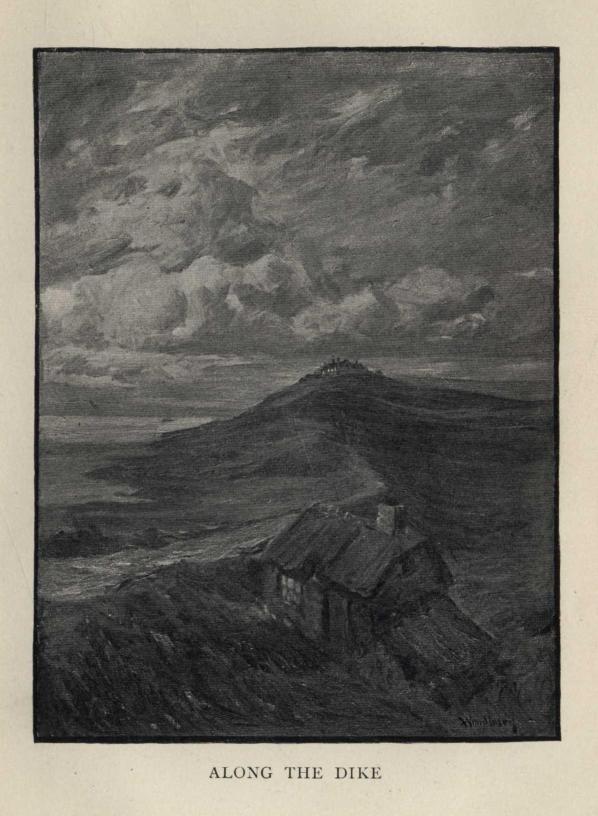
The great dike was like one of the dikes of Holland, with rich meadow farms behind it, which the high tides and spring floods had often drowned and spoiled in ancient days. The Severn looked gray and sullen, as they rode along beside it; there were but two or three poor fishing craft running in from sea, and a very dim gray outline of the Welsh hills beyond. There was no comfortable little haven anywhere in view in this great landscape and sea border; no sign of a town or even a fishing hamlet near the shore; only the long, curving line of the dike itself, and miles away, like a forsaken citadel, the Passage Inn stood high and lonely. The wind grew colder as they rode, and they rode in silence, each lamenting the other's discomfort, but clinging to the warm, unquenchable hope of happiness that comforted their hearts. There were two or three cottages of the dikekeepers wedged against the inner side of the embankment, each with a little gable window that looked seaward. One might lay his hand upon the low roofs in passing, and a stout bench against the wall offered a resting-place to those travelers who had trodden a smooth footpath on the top of the dike.
Now and then the horses must be made to leap a little bridge, and the darkness was fast gathering. Down at the cottage sides there were wallflowers on the window-sills, and in the last that they passed a candle was already lighted, and bright firelight twinkled cheerfully through the lattice. They met no one all the way, but once they were confronted by a quarrelsome, pushing herd of young cattle returning from the salt sea-pasturage outside. There was a last unexpected glow of red from the west, a dull gleam that lit the low-drifting clouds above the water, and shone back for a moment on the high windows of the inn itself, and brightened the cold gray walls. Then the night settled down, as if a great cloud covered the whole country with its wings.
Half an hour later Mr. John Davis dismounted with some difficulty, as other guests now in the inn had done before him, and said aloud that he was too old a man for such adventures, and one who ought to be at home before his own good fire. They were met at the door by the mistress of the inn, who had not looked for them quite so early, though she had had notice by the carrier out of Bristol of their coming. There was a loud buzz of voices in the inn kitchen; the place was no longer lonely, and an unexpected, second troop of noisy Welsh packmen and drovers were waiting outside for their suppers, before they took the evening packet at the turn of tide. The landlady had everything to do at once; one of her usual helpers was absent; she looked resentful and disturbed.
"I'd ought to be ready, sir, but I'm swamped with folks this night," she declared. "I fear there 'll be no packet leave, either; the wind 's down, and the last gust's blown. If the packet don't get in, she can't get out, tide or no tide to help her. I 've got your fire alight in the best room, but you 'll wait long for your suppers, I fear, sir. My kitchen 's no place for a lady."
"Tut, tut, my good lass!" said the alderman. "We 'll wait an' welcome. I know your best room,—'t is a snug enough place; and we 'll wait there till you 're free. Give me a mug of your good ale now, and some bread and cheese, and think no more of us. I expect to find a young man here, later on, to speak with me. There 's no one yet asking for me, I dare say? We are before our time."
ALONG THE DIKE
The busy woman shook her head and hurried away, banging the door behind her; and presently, as she crossed the kitchen, she remembered the young gentleman in the rough clothes upstairs, and then only thanked Heaven to know that he was sound asleep, and not clamoring for his supper on the instant, like all the rest.
"I 'll not wake him yet for a bit," she told herself; "then they can all sup together pleasant, him and the young lady."
Mr. Davis, after having warmed himself before the bright fire of coals, and looked carefully at the portrait of his Majesty King George the Third on the parlor wall, soon began to despair of the ale, and went out into the kitchen to take a look at things. There was nobody there to interest him much, and the air was stifling. Young Wallingford might possibly have been among this very company in some rough disguise, but he certainly was not; and presently the alderman returned, followed by a young maid, who carried a tray with the desired refreshments.
"There's a yellow-faced villain out there; a gallows bird, if ever I saw one!" he said, as he seated himself again by the fire.
Mary Hamilton stood by the window, to watch if the captain might be coming. It was already so dark that she could hardly see what might happen out of doors. She envied her companion the ease with which he had gone out to take a look at the men in the great kitchen; but Paul Jones would be sure to look for her when he came; there was nothing to do but to wait for him, if one could only find proper patience. The bleak inn parlor, scene of smugglers' feasts and runaway weddings, was brightened by the good fire. The alderman was soon comforted in both mind and body, and Mary, concealing her impatience as best she could, shared his preliminary evening meal, as she had done many a night, in many an inn, before. She had a persistent fear that Paul Jones or his messenger might come and go away again, and she grew very anxious as she sat thinking about him; but as she looked up and began to speak, she saw that the tired old man could not answer; he was sound asleep in his chair. The good ale had warmed and soothed him so that she had not the heart to wake him. She resigned herself to silence, but listened for footsteps, and to the ceaseless clink of glasses and loud clatter of voices in the room beyond. The outer door had a loud and painful creak, and for a long time she heard nobody open it, until some one came to give a loud shout for passengers who were intending to take the packet. Then there was a new racket of departure, and the sound of the landlady angrily pursuing some delinquent guest into the yard to claim her pay; but still Mr. Davis slept soundly. The poor woman would be getting her kitchen to rights now; presently it would be no harm to wake her companion, and see if their business might not be furthered. It was not late; they really had not been there much above an hour yet, only the time was very slow in passing; and as Mary watched Mr. John Davis asleep in his chair, his kind old face had a tired look that went to her affectionate heart. At last she heard a new footstep coming down the narrow stairway into the passage. She could not tell why, but there was a sudden thrill at her heart. There was a tumult in her breast, a sense of some great happiness that was very near to her; it was like some magnet that worked upon her very heart itself, and set her whole frame to quivering.
XLIV
THE ROAD'S END
"In sum, such a man as any enemy could not wish him worse than to be himself."
"I found him in a lonely place: Long nights he ruled my soul in sleep: Long days I thought upon his face."
After the packet went there were three men left in the kitchen, who sat by themselves at a small table. The low-storied, shadowy room was ill lighted by a sullen, slow-burning fire, much obscured by pots and kettles, and some tallow candles scattered on out-of-the-way shelves. The mistress of the place scolded over her heap of clattering crockery and heavy pewter in a far corner. The men at the table had finished their supper, and having called for more drink, were now arguing over it. Two of them wore coats that were well spattered with mud; the third was a man better dressed, who seemed above his company, but wore a plausible, persistent look on his sallow countenance. This was Dickson, who had been set ashore in a fishing boat, and was now industriously plying his new acquaintances with brandy, beside drinking with eagerness himself at every round of the bottle. He forced his hospitality upon the better looking of his two companions, who could not be made to charge his glass to any depth, or to empty it so quickly as his mate. Now and then they put their heads together to hear a tale which Dickson was telling, and once burst into a roar of incredulous laughter which made the landlady command them to keep silence.
She was busy now with trying to bring out of the confusion an orderly supper for her patient guests of the parlor, and sent disapproving glances toward the three men near the fire, as if she were ready to speed their going. They had drunk hard, but the sallow-faced man called for another bottle, and joked with the poor slatternly girl who went and came serving their table. They were so busy with their own affairs that they did not notice a man who slipped into the kitchen behind them, as the Welshmen went out. As the three drank a toast together he crossed to the fireside, and seated himself in the corner of the great settle, where the high back easily concealed his slight figure from their sight. Both the women saw him there, but he made them a warning gesture. He was not a yard away from Dickson.
The talk was freer than ever; the giver of the feast, in an unwonted outburst of generosity, flung a shilling on the flagged floor, and bade the poor maid scramble for it and keep it for herself. Then Dickson let his tongue run away with all his discretion. He began to brag to these business acquaintances of the clever ways in which he had gained his own ends on board the Ranger, and outwitted those who had too much confidence in themselves. He even bragged that Captain John Paul Jones was in his power, after a bold fashion that made his admiring audience open their heavy eyes.
"We 're safe enough here from that mistaken ferret," he insisted, after briefly describing the ease with which he had carried out their evening plans. "You might have been cooling your heels here waiting for me the whole week long, and I waiting for my money, too, but for such a turn of luck! If I did n't want to get to France, and get my discharge, and go back to America as quick as possible without suspicion, I'd tell you just where he landed, and put him into your hands like a cat in a bag, to be easy drowned!"
"He 's in Bristol to-night, if you must know," Dickson went on, after again refreshing himself with the brandy; "we set him ashore to ride there over Clifton Downs. Yes, I might have missed ye. He 's a bold devil, but to-night the three of us here could bag him easy. I 've put many a spoke in his wheel. There was a young fellow aboard us, too, that had done me a wrong at home that I never forgave; and that night at Whitehaven I 've already told ye of, when I fixed the candles, after I got these papers that you 've come for, I dropped some pieces of 'em, and things that was with 'em, in my pretty gentleman's locker. So good friends were parted after that, and the whole Whitehaven matter laid to his door. I could tell ye the whole story. His name's Wallingford, curse him, and they say he 's got a taste o' your Mill Prison by this time that's paid off all our old scores. I hope he 's dead and damned!"
"Who 's your man Wallingford? I 've heard the name myself. There 's a reward out for him; or did I hear he was pardoned?" asked one of the men.
"'T was a scurvy sort o' way to make him pay his debts. I'd rather ended it man fashion, if I had such a grudge," said the other listener, the man who had been drinking least.
Dickson's wits were now overcome by the brandy, hard-headed as he might boast himself. "If you knew all I had suffered at his hands!" he protested. "He robbed me of a good living at home, and made me fail in my plans. I was like to be a laughingstock!"
The two men shrugged their shoulders when he next pushed the bottle toward them, and said that they had had enough. "Come, now," said one of them, "let's finish our business! You have this document o' one Yankee privateersman called Paul Jones that our principal 's bound for to get. You 've set your own thieves' price on it, and we 're sent here to pay it. I 'm to see it first, to be sure there's no cheat, and then make a finish."
"The paper 's worth more than't was a month ago," said Dickson shrewdly. His face was paler than ever, and in strange contrast to the red faces of his companions. "The time is come pretty near for carrying out the North Sea scheme. He may have varied from this paper when he found the writing gone, but I know for a fact he has the cruise still in mind, and 't would be a hard blow to England."
"'T is all rot you should ask for more money," answered the first speaker doggedly. "We have no more money with us; 't is enough, too; the weight of it has gallded me with every jolt of the horse. Say, will you take it or leave it? Let me but have a look at the paper! I 've a sample of their cipher here to gauge it by. Come, work smart, I tell ye! You 'll be too drunk to deal with soon, and we must quick begone."
Dickson, swearing roundly at them, got some papers out of his pocket, and held one of them in his hand.
"Give me the money first!" he growled.
"Give us the paper," said the other; "'t is our honest right."
There was a heavy tramping in the room above, as if some one had risen from sleep, and there was a grumble of voices; a door was opened and shut, and steady footsteps came down the creaking stair and through the dark entry; a moment more, and the tall figure of a young man stood within the room.
"Well, then, and is my supper ready?" asked Wallingford, looking about him cheerfully, but a little dazed by the light.