Front matter
Reading edition
Author of “Hidden Blood,” “The Lovable Liar,” etc.
The little cow town of Calumet drowsed beneath a summer sun; a peaceful little village of false-fronted, unpainted, frame buildings, many hitch-racks, sparsely populated with nodding saddle horses, and little ambition to be anything but a cow town.
The streets were narrow, dusty; the sidewalks of warped boards clattered like unmusical xylophones beneath the tread of the booted cowboys, most of whom had draped themselves ungracefully in tilted chairs in front of the Ten Bar saloon.
It was shady in front of the Ten Bar, and there was always a possibility of somebody inviting them to have a drink. From the open door of the saloon came the cool odors of stale beer and the voices of a couple of seven-up players arguing over whether it was ethical or not for a man to turn three jacks in one game.
Two riders appeared at the north end of the street coming into town, their tired horses poking through the dust, shuffling wearily. The leading rider was well over six feet tall, bronzed and gaunt, his wrinkled shirt-tail flapping in the vagrant breeze, attesting to the fact that he had been long in the saddle and had hunched his shoulders many times.
The face beneath his big sombrero was thin, bony, heavily-lined. The nose was generous, the mouth wide, serious; the eyes set in a mass of grin wrinkles which belied the seriousness of the rest of his face.
The other cowboy was of medium build, bow-legged enough to fit a horse perfectly, and with a great breadth of shoulder. His face was as bronzed as that of his companion. Perhaps his features were a trifle more regular, just as serious, and his wide blue eyes with their innocent expression were out of accord with the rest of the man.
Their raiment was nondescript. The wind and dust of the dim trails had scoured and faded all the color from their shirts, their bat-winged chaps were worn and wrinkled, and their sombreros were flopping and shapeless.
Their arrival caused the siesta-loving cowboys to lift their weary heads and give a little heed to the new arrivals. One of the cowboys tilted forward, the front legs of his chair clattering to the sidewalk.
“I’ll be a derned liar, if it ain’t ‘Hashknife’ Hartley and ‘Sleepy’ Stevens!” he exclaimed. He got to his feet and leaned against a porch post.
“Yee-e-e-e-o-o-ow! Cowboys in town!” he yelped.
Hashknife Hartley’s lips twisted in a wide smile, as he swung his horse up to a hitch-rack, and threw one of his long legs in a sweeping curve, almost hitting Sleepy Stevens who had ridden in close beside him.
He whipped his tie rope around the top pole of the rack, jerked the knot tight, yawned widely and walked stiff-legged toward the Ten Bar saloon with Sleepy, the bow-legged one, following.
“Hyah, Hashknife,” greeted one of the cowboys, while the rest of them grinned widely and got to their feet.
“H’lo, Eddie, yuh old son of a gun! How are yuh, Omaha. By golly, if there ain’t ol’ Pep’mint!”
They shook hands violently with Hashknife and fell upon Sleepy, en masse, while he blinked at them vacantly and begged Hashknife to introduce him.
“They’re yore friends, Hashknife. Make me used to ’em.”
“Same old frozen-faced son of a gun, eh?” laughed one of the boys, slapping Sleepy on the back.
“My ——, yore etiquette is plumb homemade,” said Sleepy indignantly. “Oh, well, I’ll shake hands with yuh, but you’ll excuse me if I don’t call yuh by name. He-e-ey! What in —— do yuh think my hand is, anyway? Think it’s a fringed decoration I’m wearin’ on the end of my arm? Yo’re goshawful vociferous for strangers.”
Sleepy flexed his fingers and glared at them. Slowly a smile spread across his face as he looked at each in turn.
“I’ve met you boys somewheres, ain’t I?” he asked.
“We ain’t never been nowhere,” denied Peppermint Poole.
“No,” Sleepy shook his head slowly, “I’m wrong. Thought for a minute I knowed yuh, but yore faces looked kinda familiar. Lemme see.” Sleepy squinted thoughtfully for a moment. Then, “Aw, I know now. I seen some pictures in a Sheep-Dip ad, and they looked so much like you gents—you’ll pardon me, I’m sure.”
One of the cowboys made a dash at Sleepy, who eluded him and went in the saloon, followed by the rest of the crowd. Sleepy leaned on the far end of the bar while the rest of them stopped about midway.
“How long have you been away, Hashknife?” asked one of the boys, eying Sleepy, who was watching in the back-bar mirror for the first move.
“Six months,” Hashknife removed his sombrero and wiped his face. “We left here early in March.”
“I thought yuh did. Old man Sibley has been askin’ about yuh every time I seen him and wonderin’ if yuh was comin’ back.”
“What does he want?” asked Hashknife.
“I dunno, unless he’s got some mail for yuh. Why don’tcha ask yore friend to have a drink with us, Hashknife?”
“He ain’t no friend of mine.”
“Am I supposed to cry about it?” asked Sleepy seriously.
“He ain’t in love, is he?” asked one of the cowboys.
“Most always,” grinned Hashknife. “But this time he ain’t. Sleepy thinks it’s cute to act thataway. What’s new in this country?”
“Nothin’. Thinkin’ of stayin’ a while, Hashknife?”
“Not under the circumstances, Pep’mint. Well, here’s a swift death, gents.”
They drank deeply and clattered their glasses back on the bar, while Sleepy grabbed the bar bottle, lowered it an inch and told the bartender to take it out of Hashknife’s money.
Then he came up to the bar and shook hands seriously with each of the cowboys, telling each of them that he was glad to make their acquaintance. Amicable relationships being restored, Hashknife decided to visit the postmaster and see if any mail was waiting for him.
Letters seldom reached Hashknife and Sleepy because they were continually on the move. Only in rare cases did they spend more than a month in any one place; usually less. Both of them were top-hand cowboys, capable of taking entire charge of any cattle outfit, their services always in demand. Yet they drifted hither and yon, seeking what they might find on the other side of the hill.
They would solemnly swear that they were looking for a peaceful range where they might settle down and live out the rest of their days; a range where all men were living at peace with other men; where honesty prevailed and where a quick draw was unknown.
But fate and itching feet sent them into lands where there was little peace. Perhaps it was only the keen mind of Hashknife Hartley, the fighting ability of them both which brought peace to a troubled range.
They were fatalists, these two. To them all things were written in the Big Book, and they themselves only instruments of the moving finger that wrote their destiny.
“If there’s pneumonia written after yore name, it’s one cinch yuh won’t never get killed with a bullet.”
Thus Hashknife, accompanied by a violent nod of agreement from Sleepy. The belief gave them confidence and the feeling that being in the right somehow gave them a decided advantage against a criminal.
Neither of them could split a second on the draw. There was nothing uncanny about their ability to draw a six-gun, nor were they of the dead-shot variety. The West knew many gunmen who were swifter, more accurate than these two. Yet these two lived unscathed. In sporting parlance it might be said that these two men got the “breaks” of the game, but were able to make the breaks for themselves.
They left the Ten Bar saloon and crossed to the little postoffice, where they shook hands with the old postmaster.
“I ’lowed yuh’d come back,” he told them. “I’ve got a letter fer you, Hashknife. Darned thing came in April. Didn’t know where to catch yuh, so I kept it agin’ the day you’d come back t’ Calumet.”
“Must be pretty stale by this time,” smiled Hashknife as the old man handed him the letter.
He squinted at the postmark.
“Arapaho City, eh. Huh! Wonder who I know in Arapaho City?”
“Yuh might find out the answer inside,” murmured Sleepy. “It prob’ly wasn’t intended as a puzzle.”
Hashknife squinted sidewise at Sleepy, who registered innocence of any sarcasm. Hashknife drew out the letter and studied it closely. Several times he read it through before putting it back in the envelope.
“I reckon I better have a package of Durham, Mr. Sibley,” he said as he put the letter in his hip pocket and leaned on the counter where the postmaster kept his little stock of candy.
“Yuh better mix me up two-bits’ worth of candy, while yo’re at it. Them choc’lets look kinda faded, don’t they?”
“Don’t keep well in this climate, Hashknife. They’re jist as good as ever, but they look weak. Eat ’em in the dark and you’d never know they was mulatters.”
Hashknife paid for his tobacco and candy, and they wandered outside, where Hashknife reached in the bag, picked out a lopsided chocolate cream and offered it to Sleepy.
“What was in that letter?” demanded Sleepy. “Aw, to —— with that kind of candy!”
“That letter? Oh, yeah. Say, that was kinda queer. Read it.”
He handed the letter to Sleepy, sat down on the edge of the sidewalk and began making inroads on his bag of candy.
The letter was written on a piece of cheap tablet paper with a soft lead pencil, undated, unsigned. It read:
Sir: We know you are coming to run the HL ranch and you better not because you ain’t needed here and your helth will be in dainger if you come here as we have got you spoted. Take warning by this and stay away from around hear.
Sleepy folded up the letter and slid it in the envelope, after which he shoved the letter back in Hashknife’s pocket and helped himself from Hashknife’s bag of candy.
“Where’s Arapaho City?” he asked indifferently.
Hashknife shook his head. His mouth was too full of candy just then. In a little while he wiped the back of his hand across his mouth and got to his feet.
“I was kinda candy hungry,” he said slowly. “But it don’t take more ’n a ton of that kinda stuff to cure me. What do yuh think of that billy-doo, Sleepy?”
“I dunno. Darned thing was written back in April. Mebby it was somebody’s idea of a joke.”
“Mm-m-m-m. Let’s go down and talk with the sheriff.”
“Well, all right. Whatcha goin’ to do? Make a complaint?”
“He might know where Arapaho City is, Sleepy.”
“Oh, yeah. Well, I sure hope he don’t. You ain’t takin’ that letter serious-like, are yuh, cowboy?”
“Not too serious, pardner. But it don’t look like a joke. Who would take the trouble to warn me not to go to the HL ranch when I never even heard of it? I’m just curious.”
“They tell about a cat that got curious.”
“Askin’ won’t get anybody killed.”
“Not if yuh stop at askin’. But I know you, dang yuh.”
Hashknife grinned thoughtfully as he headed for the sheriff’s office. They knew Abe Gleason, the sheriff, and his greeting was not at all assumed.
“Come in, yuh darned pair of tumbleweeds!” he yelled, when the partners squinted in past the open door. “By golly, I’m shore pleased to see yuh both. How are yuh?”
They shook hands joyfully and the big sheriff grinned from ear to ear.
“Long time we no see yuh, Abe,” said Hashknife, tilting a chair back against the wall. “How’s crime in this country?”
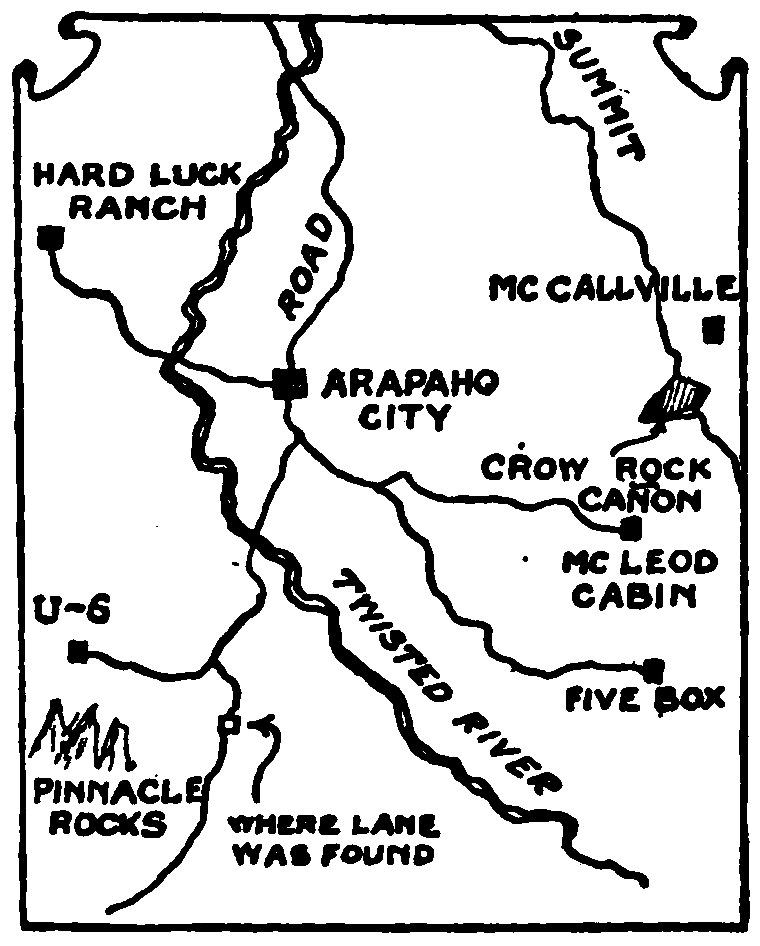
“Not a crime, Hashknife. We ain’t had an arrest nor a complaint for six months. Tell me what you’ve been doin’ since last March. By golly, yuh don’t look like you’d lost many meals.”
“We’ve been eatin’,” grinned Sleepy. “Crime is kinda playin’ out everywhere, Abe. Looks as if me and Hashknife will have to settle down at last.”
“It won’t hurt yuh none. By golly, from what I can hear, you two jiggers has made life easy for a lot of sheriffs in six months. Now, what’s on yore mind, Hashknife?”
Hashknife looked up from rolling a cigaret and squinted at the sheriff.
“Where’s Arapaho City, Abe?”
“Arapaho City? About ninety miles northwest of here. Up in the Twisted River country. It’s plumb away from everybody and everythin’, but she’s one good cattle country, they tell me. I ain’t never been up there, but that’s where she is, Hashknife.”
“Twisted River country, eh? Have you got a brand register, Abe?”
The sheriff produced the required article, and it did not take Hashknife long to find that the HL outfit was owned by Henry Ludden. It was a combined initial brand, the right side of the H making the main stem of the L.
“Has there been any trouble up in that country?” asked Hashknife, placing the book on the sheriff’s desk.
“Not that I know anythin’ about, Hashknife. We’re a long ways from Arapaho City. I don’t even know the sheriff of that county, but I know his name—Pete Darcey. You aimin’ to go up thataway?”
“If it’s a good cattle country, Abe. Me and Sleepy are on the lookout for a ranch. We’re tired of bein’ what yuh call tumbleweeds.”
“Well, I suppose a feller does kinda want somethin’ for himself after he gets old enough to have a little sense. But why dontcha buy somethin’ around here? We’ve got just as good range here as they have in Twisted River.”
“I reckon that’s all true,” nodded Hashknife seriously. “But I got a letter from a feller up in that country today and he kinda intimates that there’s somethin’ goin’ on up in that country, and a feller kinda likes to get in on the ground floor, Abe.”
“Oh, sure. Didn’t tell yuh what kind of a deal it was, did he?”
“No-o-o-o, he didn’t. But he said he’d be expectin’ me.”
Hashknife got to his feet and yawned widely.
“I reckon we’ll stable our broncs, Sleepy, and get us each a good sleep. See yuh later, Abe. We won’t leave until tomorrow.”
“By golly, you two are just like drops of quicksilver. Yuh won’t stay put nowhere.”
“I know it, Abe. But we’ve got to go. This feller is waitin’ for us.”
As they walked back toward the hitch-rack, Sleepy squinted at Hashknife and shook his head wearily.
“Goin’ to get in on the ground floor, eh? More likely get six feet under the ground. Feller waitin’ for yuh with a proposition. My ——, don’tcha realize that letter was written in April, and this is the latter part of August?”
“That’s all true, Sleepy. But some men do have the dangdest amount of patience.”
It was four days after Hashknife and Sleepy had entered Calumet that Hank Ludden rode through the Twisted River hills astride a rangy gray horse. He might have posed for a painting of an old Indian scout as he rode along, carrying a Winchester rifle in the crook of his left arm, peering keenly from beneath the brim of his floppy sombrero.
Ludden was a big man, but stooped with age. His long, gray locks straggled from under his hat and mingled with the heavy beard. His nose was slightly hooked and his keen gray eyes were almost hidden beneath jutting eyebrows, which were large enough to make a mustache for an ordinary man.
His arms were long and powerful and his gnarled, heavily veined hands showed great strength. He rode easily in the saddle, guiding his gray horse in and out among the clumps of greasewood and sage without visible effort.
He rode down through a sandy, dry watercourse, disturbing the siesta of several head of cattle, which had been drowsing in the shade of some cottonwoods, and drew up to squint at the brands.
After a few moments of inspection he rode on, heading for a rocky ridge which would give him a view of the surrounding country. The neutral colors of his faded clothes and the gray horse caused them to blend into the general scheme of the landscape, making them almost invisible at a short distance.
Ludden seemed to know where he was going. He rode almost to the top of the ridge, where he drew up and dismounted. The ride had evidently made him a trifle stiff, as he leaned his rifle against a rock and stretched his muscles.
He had dropped his reins, but now he studied the gray inquiringly.
“Goin’ to stay there, Ghost? If I had a rope I’d tie yuh. Know danged well you’d bust a rein, if I tied yuh with one. Oh well, I reckon yuh won’t go far.”
He picked up his rifle and went on up the slope, glancing back at the gray which was standing still, its ears forward, watching its master. Ludden had never been quite successful in teaching Ghost to stand still with only the dropped reins.
Ludden angled along the ridge, being quite careful not to expose himself on the skyline, and came in behind a granite outcropping. He did not know that the gray horse was picking its way along behind him, stepping occasionally on the reins, but wise enough to lift its foot from the rein before going ahead.
The old man crawled slowly to the top of the granite pile where he peered over the edge. Below him the hill sloped sharply, heavily covered with brush, down to an open swale or clearing which had once been the site of a ranch-house. One of the old buildings, or rather a part of it, was still standing at the far side of the clearing.
Almost in the center of the clearing was a tumble-down pole corral, and it was on this corral that Ludden fixed his eyes. Inside the enclosure were several head of young stock milling around, looking for an exit, while just outside the corral gate were two men bending over a red yearling while the third man stood a little apart, holding a tight rope on the animal. A few feet away a tiny fire blazed, almost smokeless in the thin air.
Ludden’s brows drew down over his eyes, and his gnarled fingers gripped the rifle tightly.
“—— yuh, I knowed I’d find yuh if I kept at it!” he gritted to himself. “It took me a long time and a lot of trips. I wish I could git down there among yuh.”
He scanned the hillside, looking for a possible chance to sneak up on them. They were at least two hundred yards away, and it was impossible for Ludden to identify them. Their horses were in the brush to the left of the corral, too well hidden for Ludden to distinguish their colors.
He began to realize that the odds were in favor of the rustlers. Even if he did sneak in on them, three men are hard to handle. He knew they would kill him with no more compunction than they would show a rattlesnake.
He studied them closely, trying to note some action, some mannerism which might enable him to identify them. But he was looking down at them, almost a bird’s-eye view, which made it more difficult for him.
One of the men walked over, placed some more wood on the fire and appeared to be examining the branding-iron. Ludden scanned the surrounding country, looking for more stock.
“They’re just startin’,” he told himself. “Iron ain’t quite ready yet for the first one, and there’s a dozen more in the corral. I’ll take it easy, and mebby I can drop down close enough to identify some of ’em.”
He eased back slightly and reached toward his hip pocket for his tobacco. Came the shrill nicker of a horse, and he whirled around to see Ghost standing full at the top of the ridge fifty feet away, reins dragging, as he bugled his call to the rustler’s horses.
“You —— fool!” Ludden’s angry snort was almost loud enough for the rustlers to hear.
They had heard the gray horse and could see against the skyline that the horse was carrying a saddle. Ludden turned and lifted his rifle. Two of the men had crawled swiftly through the corral fence, darted among the frightened cattle and were going out the other side before Ludden could see just what had become of them.
The third one was running past the left side of the corral, going toward the horses when Ludden fired.
The bullet struck just beyond the running man, and he jumped like a frightened rabbit.
As Ludden levered in another cartridge the two men sprang across the open space between corral and the brush, leaving the old man swearing bitterly and searching the brush with eager eyes, his finger caressing the trigger of his 30-30.
He knew that they could not mount their horses without exposing themselves above the brushtop. So he crouched in the rocks, waiting for their next move. He felt sure that the three men were down there in the brush, waiting for him to expose his hiding place.
He cursed the gray horse which still posed on the ridge and waited patiently. Ten minutes passed without any sign of the rustlers.
Ludden squinted back at the gray and noticed that it was watching far to the left of where the horses had been. Suddenly the old man realized what had been done. Instead of mounting their horses, the rustlers had led them away, keeping to an old trail where the brush grew high enough to mask their passing.
He sprang to his feet and ran up the ridge, passing the gray, which snorted and moved aside. On up the rocky ridge ran the old man, almost out of breath, swearing at himself for letting them outwit him. About a hundred and fifty yards up the ridge beyond the horse he stopped and dropped to one knee.
Three riders were traveling away from him, going out of another swale. It was evident that these men had led their horses over into this swale, knowing that the point of the hill had cut off the view of the man who had shot at them, and were mounted and making their getaway complete.
It was a long shot. Carefully the old man twisted up the peep-sight, estimating rapidly.
“Five hundred yards,” he muttered. “Rather be over than under. Movin’ target at five hundred.”
He cuddled the butt of the rifle against his cheek, took a quick aim and squeezed the trigger. The hills flung back the clattering echoes of the rifle shot, and the three riders flared out fan-wise. It was evident that the bullet struck close to them.
The rifle spoke again, and the left-hand rider was almost unseated when the bullet hummed off the ground under his horse’s nose.
“Shootin’ low,” muttered Ludden, adjusting his sight. “Make it six hundred.”
The riders were spreading farther apart now, and almost to the skyline of the low saddle in the hills. Ludden sprawled on the ground, resting the rifle across a stunted greasewood. This time he was more careful. The rider was bearing to the left. The ivory bead completely covered horse and rider at that distance.
Then he swung the bead slightly to the left, squeezing the trigger as he swung the sight. Quickly he lifted his head and peered across the wide swale.
For a moment he thought he had knocked the man out of his saddle. The horse whirled and stopped, while the man recovered, straightened up in his saddle and went on over the ridge. But he swayed in his saddle, humped over, until at that distance he looked like a pack on the horse instead of a human being.
“By ——, I got one of ’em!” exclaimed Ludden. He got to his feet and ran back to the gray horse which snorted wildly, but allowed the old man to catch him easily.
He mounted and sent the gray down the hill on a stiff gallop. It was dangerously steep and brushy, but Hank Ludden cared nothing for this. He fixed his eyes on the low saddle in the hills where that humpbacked rider had disappeared and let Ghost worry about the footing.
They crashed down through the heavy brush at the bottom, lurched over the bank of a washout and headed for the top of the swale. Ghost was a willing runner in spite of the fact that his rider was a heavy man.
Ludden kept a close watch on the skyline, thinking that the other two riders might ambush him at the crest of the hill, but there was no sign of them. He gained the top and drew rein, his eyes sweeping the hills ahead.
To the left and below him he could see part of the road which led toward Arapaho City. The gray was blowing heavily from the uphill run, and the old man eased himself in his saddle, wiping some blood off his face from the scratch of a greasewood limb.
Then he caught a glimpse of a rider, going slowly toward the road. Ludden lifted his rifle, but lowered it again. He had no way of being sure that this was one of the rustlers, as the brush obstructed his view.
“I can see him plain when he reaches the road,” he told himself. “Mebbe I better swing farther to the left.”
He turned his horse around, dropped below the skyline and galloped to the left, intending to come back to the crest about two hundred yards farther along the hill.
Hashknife and Sleepy had made no record time in covering the distance between Calumet and Arapaho City. It was a sparsely settled region they had traversed and the ranches were few and far between, but they carried enough food for their meager wants.
“That feller has been waitin’ since April,” said Hashknife, “so a few extra days won’t worry him none.”
And so they had dawdled through the hills, enjoying the sun, admiring the stars until they struck a dusty road, winding in and out of the hills. And near where they struck the road they also found a weatherbeaten sign, pointing north—
Arapaho City
And beneath the lettering some wag had written—
This is a quit-claim deed for
my share of the darned thing.
Hashknife laughed softly as they rode on.
“Sounds interestin’, Sleepy. That feller had a sense of humor and it was too much for him. Mebbe we’ll ride past here, headed the other way and leave two more quit-claim deeds for the next lucky men.”
“Be —— lucky to ride past,” said Sleepy. “I have a feelin’ that Arapaho City is a buzz-saw village.”
“Yore liver’s bad, Sleepy. This is a beautiful country. It ain’t reasonable to suppose that a man could live amid such beauty and harbor mean thoughts. Chirk up, cowboy. Who knows what is ahead of us? Mebby they’ll send us to the Legislature. Mebby they’ll—”
Hashknife drew up his horse, lifted himself in his stirrups and scanned the hills. Sleepy drew rein and squinted at Hashknife.
“What’s the matter?” he asked.
It came again—the far-away echo of a rifle shot.
“Nothin’ but a rifle shot,” observed Sleepy. “If they’re shootin’ at us, they’re sure doin’ it at long range. Probably somebody fussin’ with a coyote.”
As they moved forward again they heard the echo of another shot.
“Three times and out,” laughed Hashknife, scanning the hills. “Anyway, it sounds like we were entering civilization.”
They rode along the crooked, dusty highway where the brush grew close to the wagon ruts, down through a wide swale and into a straight stretch of road. About two hundred yards ahead they could see where the road turned abruptly to the right at the point of a hill.
To the left and ahead was the broken ridge with a low saddle and farther to the left were high pinnacles like spires of a great cathedral.
Suddenly a rider broke through the brush about a hundred yards ahead. The road was not over twelve feet wide from brush to brush and the sun was almost directly in the eyes of the two cowboys.
It was like a short flash of a motion picture. The horse lurched across the road, the rider falling flat in the dust; nothing left except a little dust cloud, plumped up from the sprawling figure of the man, and the man himself, whose raiment blended well with the yellowish-gray dust. The dust cloud disappeared and there was nothing except the man, a hardly visible something, lying across the road. The horse had disappeared so quickly that neither of the cowboys could have sworn to its color or size.
“Don’t that beat ——?” queried Hashknife vacantly.
“Anyway,” said Sleepy dryly, “it at least runs a dead-heat. Jist about what did happen, Hashknife?”
“I dunno. That danged sun was square in my eyes, but I think I seen a horse cross the road, drop its rider and keep on goin’.”
“I’m glad that’s what you seen, Hashknife, ’cause that was my impression. Mebby we better look a little closer, eh?”
They spurred their horses forward and were halfway to the prone figure when Hashknife’s sombrero was almost jerked from his head. Came the sharp crack of smokeless powder from the crest of the ridge and the two cowpunchers instinctively whirled their horses to the right, crashing them straight through the brush.
Nor did they pause to investigate. Sprawling low in their saddles, protecting their faces as best they might from the whipping branches, they rode at a headlong gallop, while bullets whispered around them as Hank Ludden frantically worked the lever of his rifle at the top of the ridge.
Luckily they struck down through a ravine before the old man could reload his rifle, and in a few minutes they were again on the road, but too far away for Ludden to see them.
“That’s what I’d call a —— of a reception,” panted Sleepy as they drew rein and looked back, picking the pieces of broken limbs from their torn shirts. Sleepy had a long streamer of clematis vine around his neck, which made him look as if he had been roped. He threw it aside and squinted at Hashknife who was examining the floppy brim of his sombrero which had been torn by the bullet.
From off to their right came the whang of another shot, and they instinctively dodged.
“Aw, —— such a business!” snorted Sleepy disgustedly. “Let’s pull out, cowboy. C’mon.”
“Yuh don’t have to coax me.” Hashknife roweled his horse and they headed down the road at a stiff gallop.
They did not know that Hank Ludden was hot on their trail. He had shot at Hashknife from the back of the gray horse, which shifted slightly as he pulled the trigger, thereby causing Hank to miss by scant inches.
Hank had seen the rider fall from the horse and had decided that at least one of the rustlers was down and out. But he was not satisfied with one; so he swung his horse down the hill, angling over to the road, trying to get another shot at the two who had escaped him again.
The road entered Arapaho City from the south, but Hashknife and Sleepy did not enter boldly. An old road which led past some old ranch buildings caught their fancy, and they circled the west side of the town, coming in at the north end where they dismounted at a little-used hitch-rack.
Casually they walked to the corner and surveyed the main street of Arapaho City. Beside them was the Pekin Café from which savory odors assailed their nostrils. On the opposite side of the street was the Arapaho Livery and Feed Stable in front of which was a huge water-trough, leaking badly and making a mud hole in the street.
Farther up the street, on the same side, was the blacksmith shop, postoffice and a number of saloons. On the opposite side were signs which proclaimed the Arapaho Hotel, Steve’s Chop House, Arapaho Stage Office, Twisted River Mercantile Co., Deschamps Drug Co., Sheriff’s Office.
The buildings and signs were weatherbeaten, gray with dust from the street which billowed from the passing teams or riding horses. At the south end of the town was a blasted old cottonwood, like a great, gnarled hand, the forefinger pointing skyward.
A few wagon teams were tied at the hitch-racks, and a scattering of saddle-horses nodded in the sun. A couple of mongrel dogs, as if by mutual consent, met in the middle of the street, circled each other, growling deeply, turned and went back to their respective shades as if the fighting game was hardly worth while under the circumstances.
Near the front of the Twisted River Mercantile Store a small boy labored at the handle of a creaking old pump to which was attached a hose. The nozzle of the hose was held by a big man who industriously sprinkled the street adjacent to the front of the store, doing a thorough job in spite of the fact that the motive power’s shirt had parted company with its pants and was in a fair way to complete exhaustion.
Hashknife and Sleepy grinned at each other and went into the Pekin Café where a little old Chinaman grinned at them from the kitchen door, bobbing his head violently.
He came up and motioned them to a table, after which he began in a sing-song voice:
“Losa beef, losa po’k, veala stew, libba-bacon, ham a’ egg—w’at yo’ like, eh? Yo’ like soup? Soup velly good t’day.”
“Ham and eggs,” said Hashknife, and Sleepy nodded to the Chinaman to bring him the same.
“Two ham a’ egg, eh? Yo’ want soup?”
“Is it compulsory?” asked Sleepy curiously.
“This time noodle.”
“No soup, Charley,” Sleepy grinned widely. “Too hot.”
“Velly good.”
As the Chinaman bustled away a man came in, glanced sharply at Hashknife and Sleepy and sat down near the door. He was a big man, slightly gray, with a heavily-lined face and sad-looking eyes. He wore a faded blue shirt, overalls and high-heeled boots. His belt sagged from the weight of his holstered gun, and the bottom of the holster was held down by a whang-leather string which circled the man’s leg.
The Chinaman came bustling in, deposited knives and forks on the table, and hurried over to the newcomer, who lifted his head and smiled slowly.
“Hello, She’iff,” said the Chinaman. “What yo’ like, eh? Got plenty good soup.”
“Ham and eggs, I reckon.”
“Yessah. Egg ve’y good today.”
He bustled away and Hashknife studied the profile of the big man—Pete Darcey, sheriff of Arapaho. As Hashknife studied the sheriff, he thought of the quit-claim notice on the old sign board—
“This is a quit-claim deed for my share of the darned thing.”
Perhaps the job of being sheriff of Arapaho had drawn the lines of sadness in this big man’s face, thought Hashknife. The sheriff’s hands were on the table—big, powerful hands, fit to grip the big gun which sagged at his hip.
The sheriff, after his first keen glance, had paid no attention to Hashknife and Sleepy, but seemed to stare gloomily toward the sun-baked street.
Some one was coming down the board sidewalk, his boots rattling heavily on the loose boards. The sheriff shifted his gaze to Hank Ludden, who flung the door open and stepped inside the place. He was breathing heavily, carrying his hat in his hand.
“A kid at the pump told me you was here, Sheriff,” he said, leaning his hands on the sheriff’s table as he recovered his breath. “I was at yore office.” He looked back at the open door, took a deep breath and turned to the sheriff.
“I connected with three rustlers at the old U6 ranch. They had a dozen yearlin’s in the corral and was warmin’ their first iron. My horse nickered and ruined things for me. They fogged out but—” Ludden paused for another deep breath—“I nailed one of ’em out in that low saddle east of the Pinnacle Rocks. He stuck to the saddle until he hit the road, and then dropped.
“The other two tried to pick him up, but I drove ’em away, and I think they headed for town. I had a dead bead on one of ’em, but my horse moved and ruined it for me.”
The sheriff got to his feet and headed for the door, followed by Hank Ludden, while Hashknife and Sleepy confined their attention to the Chinaman who was bringing in their order.
The Chinaman glanced quickly at the backs of the two men who were going out.
“Bring us each half of the sheriff’s order, Charley,” said Hashknife. “He ain’t got time to eat now, and we can sure eat an extra egg apiece.”
“Yessah, velly good. She’iff go way quick, eh?”
“Somethin’ about cattle rustlers, Charley.”
“O-o-oh. Lustle cows, eh? Other man Hank Ludden, yo’ sabe? Velly good man. I sabe him long time.”
“Cattleman?” asked Hashknife.
“Yessah. Plenty cow one time. Mebbe not so much now.”
“Uh-huh. Sell all his cows, eh?”
“No sell much. Plenty cow get lost, yo’ sabe. Long time cow get lost. No catchum lustler. Somebody name Hard Luck lanch. HL all same Hard Luck, yo’ sabe? Hoo-o-o! Egg fry too —— much!”
The Chinaman turned and galloped toward the kitchen while Hashknife and Sleepy squinted knowingly at each other and attacked their food.
“Had a dead bead on one of ’em, but the horse moved and spoiled it,” muttered Hashknife, quoting Hank Ludden’s statement softly. “I’ll have to buy that horse a bale of hay as a reward. So that’s the which of it, eh? By golly, we sure were lucky to save our scalps today, pardner.”
“And tomorrow is another day,” said Sleepy meaningly, as he tried to slide half an egg on the blade of his knife.
“That sheriff looks sad enough to do anythin’, and I don’t want to run up against Hank Ludden, movin’ horse or no movin’ horse. This country sure looks salty to me.”
The Chinaman came shuffling back, bearing the sheriff’s order which he placed on their table.
“Is the sheriff a pretty good man, Charley?” asked Hashknife. He thought there might be a chance to get some information from the Chinaman who seemed inclined to gossip.
“Yessah, velly good man. Be she’iff long time.”
“Uh-huh. Hank Ludden good man, too, eh?”
“Yessah.”
“Good friend to sheriff?”
“Mebbe. I do’ know. ‘Lucky’ Joe marry Ludden daughter.”
“Thasso? Who is Lucky Joe?”
“Dep’ty she’iff.”
“Been married long time, Charley?”
“Fo’ five month. Ludden not like, I guess. Yo’ want mo’ coffee?”
“Yeah, I’ll have some more,” said Sleepy. “You make good coffee, Charley.”
“Yessah. My name Pat Lee.”
“Irish?” queried Hashknife seriously.
“Yessah, all same Irish.”
He smiled blandly and headed for the kitchen.
“It’s a great country,” declared Hashknife. “They write a letter darin’ yuh to come, shoot at yuh when yuh arrive and name their Chinaman after an Irish saint.”
“If we had any sense, we’d pull out right away,” said Sleepy. “The only thing we can gain here is a tombstone.”
Hashknife grinned softly and shook his head.
“That’s for the Big Book to say, Sleepy. We don’t keep our own books, so we don’t know what our balance is. We’ve started in by eatin’ the sheriff’s meal. Who can say what will come next?”
When Hank Ludden and the sheriff left the restaurant they went straight to the sheriff’s office. The sheriff took a rifle from his gun rack and led the way to the livery stable where he kept his horses.
“No use takin’ anybody else, I reckon,” said the sheriff.
“Not much,” agreed Ludden. “Who were the two strangers in Pat’s place, Pete?”
“Never seen ’em before in my life,” replied the sheriff, lifting his saddle off a peg and throwing it on a roan horse which the stableman had led out to him. “They were eatin’ in there when I came in.”
He cinched his saddle and called to the stableman—
“Seen anythin’ of Joe this mornin’, Al?”
“Yeah. He said he was goin’ out to the Five Box.”
“Thanks.”
Hank Ludden scowled at the mention of Joe Lane’s name. He did not like Joe Lane, known as Lucky Joe, a rather handsome, devil-may-care sort of person, deputy to Pete Darcey.
Hank Ludden’s whole life had centered around his daughter Mary, and when Joe Lane came courting her, Hank lost no time in telling Joe that he was not eligible. Joe quietly informed Hank that he was not intending to marry him, and that his private opinions of his, Joe’s, worth were merely one-man ideas.
Mary Ludden was a tall, slender, wistful-eyed girl with a wealth of chestnut hair, a pleasing personality and a mind of her own. It is not at all unlikely that she could have had her pick of the young men of the Arapaho country, but she eloped with Lucky Joe Lane, and the world soured for Hank Ludden and “Armadillo” Jones, his partner.
Mary and Joe took up their residence in Arapaho City, and Hank Ludden ignored their existence.
Every one in the country knew about it. Many of the old-timers shook their heads and said it was only another mark against the Hard Luck ranch.
The first owner had been Jim Shafer who registered the Circle S brand. He was an experienced cattleman from Texas. Within a year he was thrown from a horse and instantly killed. His son, a wild-riding young man of twenty-five, took charge of the Circle S, carried on the business for a year, when he accidentally killed himself with a revolver.
Jim Shafer’s widow sold the ranch to a Robert Morgan, who changed the brand to the Bar M and proceeded to get himself killed in a runaway in the yard of the ranch-house. Title descended to his brother, who operated the ranch successfully for over a year, only to be killed by a bolt of lightning on the ranch-house porch.
It was then that Hank Ludden and Armadillo Jones bought out the place, putting in every cent they had, changing the brand to the HL. But the proverbial hard luck of the ranch still remained. Try as they might they could not make it pay.
Instead of an increase there was a decrease. Each roundup showed them a loss of many head of stock, and in spite of continual vigilance, their cattle vanished. The law had little appeal to either Hank or Armadillo. They had been partners for years—prospecting, mining, working with cattle.
The marriage of Hank Ludden had broken their partnership, but the death of Mrs. Ludden, shortly after Mary was born, brought them together again stronger than ever. Armadillo even claimed a fifty-fifty interest in Mary, and he disliked Joe Lane as much as Hank Ludden did.
The sheriff and Hank Ludden rode out of Arapaho City together. There were many curious people who had seen Hank Ludden gallop into town, and they wondered what had happened to cause him to come for the sheriff, knowing that Hank had little use for any one connected with the office.
“You didn’t look at this man, didja?” asked the sheriff as they galloped along the dusty road.
“Didn’t take time. I seen him fall and he’s there yet.”
The sheriff nodded grimly. The identity of this rustler might help to implicate the other two men. They swung around the right-hand turn at the point of the hill and came out on the straight piece of road. Hank Ludden raised in his stirrups and pointed up the road.
“There he is, Pete. Right where he fell.”
The dust-covered body was lying sprawled across the road just as it had fallen from the horse.
They reined their horses and dismounted. A soaring buzzard’s shadow crossed the yellow dust between them and the body, and the sheriff glanced upward, a scowl on his face. Then he strode forward, knelt in the dust and turned the man over.
Hank Ludden cried out sharply and stepped back, while the sheriff looked up at him wonderingly.
It was Lucky Joe Lane, Ludden’s son-in-law.
“Pete, it—it—,” Ludden’s hand shook as he removed his sombrero and wiped the cold perspiration from his brow.
“It can’t be,” he whispered. “Why, Joe Lane—”
“It’s Joe Lane,” said the sheriff softly. “My deputy, Hank.”
“Yeah, it’s Joe Lane,” huskily. “I—I don’t quite sabe it, Pete.”
The sheriff squinted down at the dusty face of the dead man for a long time, while Hank Ludden gripped his cartridge belt and stared into space. He had killed the husband of Mary. For the first time in his life he realized that she loved this man—this dust-covered person who sprawled in the dust, his sightless eyes half-closed, staring up at the blue sky. Hank remembered that Joe was so particular about his personal appearance, and it did not seem right for him to be sprawling in the dust.
The sheriff looked up and there was a suspicion of moisture about his eyes as he squinted at Hank Ludden and said—
“Hank, you ain’t lyin’ about this, are yuh?”
“Lyin’ about what, Pete?”
“About findin’ Joe with the rustlers. You ain’t—”
The old man shook his head slowly.
“He was one of ’em, Pete. Good ——, do yuh think, Pete, I didn’t like Joe. Mebbe I was just selfish, I dunno. But you know I wouldn’t murder a man. I—I didn’t recognize him.”
The sheriff nodded slowly.
“I know how yuh feel, Hank. It hurts me a lot, I’ll tell yuh. I liked Joe. Oh, why in —— do men do things like this, Hank? Joe didn’t have to steal cattle. He could live on his salary. He could have every cent I own if he wanted it.”
“Mebbe I didn’t treat him square,” whispered Hank. “Mebbe he wanted to git even with me, Pete.”
The sheriff shook his head.
“No, Joe wasn’t that kind of a person, Hank. He’s never said a word against yuh—not to me. Are yuh sure they was stealin’ your cattle?”
“No. But they were stealin’, Pete. Honest men don’t corral yearlin’ stock, build a brandin’ fire, and high-tail it out of the country when a horse nickers.”
“No, they don’t, Hank.” The sheriff grew thoughtful. “Shall I tell Mary about it? She’ll have to know about it, and you—”
“Go ahead and say it, Pete. I killed her husband.”
“I ain’t blamin’ yuh, Hank. It’s ——, but directions says take it. I thought as much of Joe as I would of my own boy, but I’m not blamin’ you. Things just worked out this way.”
“Others will blame me,” said Hank hoarsely. “They know I didn’t like Joe, and they’ll say things.”
“Bein’ human, they will,” nodded the sheriff. “I wish we’d brought a wagon. Mebbe we can kinda drape him across my saddle, and I’ll ride behind. I reckon that’s the best thing to do, Hank.”
Together they placed the body, face down across the saddle, and the sheriff mounted behind the saddle.
“Do yuh want me to go back with yuh, Pete?”
“Mebbe yuh better not, Hank. I’ll fix things up as well as I can.”
“Thank yuh, Pete,” Hank Ludden held out his hand. “So-long.”
Their hands met, gripped tightly, and the sheriff rode away, leaving Hank standing in the middle of the road, looking after him.
The sheriff jogged around the curve and Hank went to his horse which he mounted and rode off the road to the left, heading toward the low saddle in the hills. The shock of finding he had killed Joe Lane took all the fight out of the old man, and all he could think of was how would Mary take the news.
He could mentally picture Pete Darcey telling her that Joe was dead and that her father had killed him. He wondered if there wasn’t some way of telling her; some way of taking away the sting.
Could it have been an accident, he wondered. But he knew it was not. The three men were together, and it was merely a twist of fate which made Joe Lane the target instead of one of the others.
Ludden struck the trail where the rustlers had led their horses from near the corral, and came out into the clearing. The little branding fire had long since burned itself out, and the corral was empty. Not a yearling remained within the enclosure.
“Came back and turned ’em all loose,” muttered Ludden. “Not even ashes left of the brandin’ fire and no brandin’ iron.”
He searched all around the place, but was unable to find any evidence that any misbranding had been attempted. Down in his heart he was glad that the sheriff had not come to the corral with him. It would have looked bad for him. Even the spot in the dust where the one animal had been thrown had been trampled by the feet of the escaping yearlings.
Ludden mounted his horse, climbed the ridge from which he had first seen the rustlers and rode down across the hills toward the Hard Luck ranch, northwest of Arapaho City.
It was not a pretentious place, this Hard Luck ranch. The buildings had been placed on sort of a low mesa which jutted out into the wide mouth of a little valley like the prow of a battleship. A small, brush-lined stream wended its way around it.
Behind the small ranch-house the ground sloped sharply to the brush-covered hills. The ranch-house itself was originally a log building, but it had been added to until little of the original was left. The bunk-house was of logs, but the stables and sheds were of rough lumber, unpainted, scoured by age, the corrals of pole and lumber.
A huge live-oak tree shaded the front of the ranch-house and at the rear grew a clump of big sycamores.
Roses climbed over the old porch, uncared for since Mary had left the ranch, and on the window ledges were flower-pots, containing what had once been geraniums, but now merely wisps of dried substance, perished for want of moisture.
Armadillo Jones was sitting on his heels in the shade of the stable repairing a harness as Hank Ludden rode in past the corral and approached the stable.
Armadillo was a little man—thin, wiry, with a wrinkled, parchment-like face and a bristling, gray mustache. He was nearly bald, and when he lifted his eyebrows the wrinkles extended far above his original hair line.
Armadillo’s nose was large, almost too large for his face, and his keen, gray eyes were deeply set in a nest of hair-like wrinkles. His hands were long, bony, mahogany-tinted, and his legs, even in his squatting position, showed a decided tendency to bow.
One side of his face bulged from an enormous chew of tobacco which he shifted slowly, spat deliberately and nodded to Hank Ludden, while his eyes squinted keenly at his partner.
Ludden dropped his reins and squatted beside Armadillo. It seemed the natural thing for him to do. Armadillo examined the mended strap, tested it by hooking one foot in a loop and pulling heavily. Then he tossed it aside, spat wearily and leaned back against the stable wall.
“I found three rustlers at the old U6,” stated Ludden thickly. “I dropped one of ’em in the road on the other side of Pinnacle Rocks.”
“Didja?” Armadillo spat viciously. “Good! Who was he?”
“Joe Lane.”
“Oh, m’ ——! No!”
“Yeah.”
They didn’t look at each other. Armadillo’s jaws worked industriously and the long, lean fingers picked at the knees of his overalls, his eyes squinting painfully.
“Well,” he said slowly, “I ain’t a —— of a lot surprized. It’ll be tough on Mary.”
“Yeah, it’ll be tough on her, Armadillo.”
“—— tough!”
For several minutes neither of them spoke. Then Armadillo broke the silence.
“Speakin’ of things bein’ tough, Hank, I killed that old white leg’rn rooster for supper, but I’ll be danged if I think we can eat him. I’ve had him on to b’ile for five whole hours now and about all he’s done is to e-vaporate the water.”
“That’s all right, Armadillo. I ain’t got no appetite.”
“Appetite won’t make no difference to that bird. The man that eats him has got to be plumb vicious.”
“I reckon we better go to town,” said Ludden wearily. “Might as well face the music.”
“Yeah, we might as well,” Armadillo spat thoughtfully and got to his feet. “I dunno what the music will be though. It’s gettin’ to be a —— of a country, when a feller has to get a rustler’s name and address before shootin’ him, for fear he might belong to a prominent fambly.”
“He was Mary’s husband,” said Ludden softly.
“Good ——, don’t set there and tell me about it! Ain’t I been thinkin’ about it until m’ ears ring? Do yuh think I’m so —— ignorant that I don’t realize things like that? Hank, I dunno—” Armadillo’s voice softened. “It’s terrible. I s’pose the best thing to do is to throw that —— rooster away and eat supper in Arapaho City.”
While the sheriff rode back to Arapaho City with the body of his deputy sheriff and Hank Ludden went back to the Hard Luck ranch, trouble was brewing in another part of the Twisted River range, Scotty McLeod’s ranch.
It was a little ranch—just a two-room shack and a tumble-down stable, but within the fenced enclosure, bubbling from under a spreading sycamore, was a big spring which flowed water which did not freeze, even in the coldest weather.
It was not hot water, but cool enough to drink at any time, yet it was practically the same temperature all the year around. And it was located on what the Five Box outfit claimed as their range.
In other words, Scotty McLeod was a nester, a fighting Scot who defied the Five Box to put him off his little ranch. “Dutch” O’Day, owner of the Five Box, had tried in many ways to oust Scotty, but all his efforts had failed.
Not satisfied to hold the ranch and run his few head of stock, Scotty, angry at the Five Box, had secretly brought in a dozen sheep which he close-herded. To flaunt a dozen sheep in the face of the Five Box was like dangling a red rag in front of an angry bull.
Cowboys had taken long shots at the sheep in Scotty’s front yard, but without any casualties. Perhaps it was because they feared Scotty’s skill with a rifle that they did not come close enough for a good shot at the sheep.
But on this day Scotty had been to town, and in the meantime his sheep had managed to get out of the yard. Scotty noticed that about half of them had vanished when he returned; so he intended to fix the fence before cooking himself a meal, resolving to round up the lost sheep right away.
He was absorbed in the latest newspaper while his coffee-pot boiled over when he heard a noise at the door. Looking up, he beheld the face of Ben Corliss, foreman of the Five Box, a big, lean-faced man with a broken nose. Corliss carried a six-shooter in his right hand, with which he motioned to Scotty.
Corliss was a much bigger man than Scotty who was what might be termed undersized. Scotty’s hair was a flaming red and the color of his chin was almost the same tint, which exaggerated the blue of his eyes.
“What do ye want?” asked Scotty coldly.
“C’mere, nester,” Corliss motioned him outside. “Don’t make no fool break for a gun, McLeod.”
“I’m no fool!” snapped Scotty.
He followed Corliss out in the yard where he beheld his best sheep, now nothing more than an inanimate drag on the end of Corliss’ lariat rope.
“There’s four more back in the hills—dead,” said Corliss. “If you think you can turn sheep loose in these hills, you’ve got another think comin’.”
“They got away,” said Scotty simply. “I was in town.”
“Got away, eh?” Corliss backed to the carcass of the sheep and removed his rope which he coiled and threw over the horn of his saddle.
“You better imitate the sheep, McLeod. We’ve tolerated you about as long as we care to. Sabe? We need a reason to wipe you out, and yore sheep furnished it. Now, you high-tail it out of here before we come back.”
“Ye mean to come back, do ye?” Scotty smiled softly. “Well, I’ll try to meet ye with a gr-r-rin, Cor-r-r-lis.”
Scotty began burring his r’s, which indicated that he was getting angry.
“Yeah, we’ll be back,” snarled Corliss.
“I’ll tr-ry to be here.”
“Yuh will, eh? Fine. Walk down to the gate with me, McLeod. I’m not goin’ to take any chances on you pottin’ me with yore rifle from the house.”
He forced Scotty to go with him to the gate and stand there while he mounted his horse.
“Now you just try runnin’ back to the house,” laughed Corliss. “The rest of my outfit are settin’ out there in range of here, and they’ll make a sieve of yore shack in about a minute. So go slow, you sheep-lovin’ pup.”
Corliss touched the spurs to his horse and galloped away, while the little Scot ducked low and ran swiftly toward his doorway, zig-zagging his course. A moment later he knew that Corliss had not lied.
A bullet struck in the gravel just beyond him, throwing up a little spurt of dust and hitting the house a resounding thwack! Another struck near his feet, ricocheted and broke one of the shack windows.
But before another one could throw gravel in his face, he dived through the doorway, rolled across the floor and lifted his rifle from where it stood in a corner of the room.
Then he ran back, wriggled out through an open window and ran to the corner where a scraggly bush gave him a little cover. He could see Corliss riding along through some heavy cover, and just beyond him he could see two horses. A man got into a saddle and seemed to be waving an arm at Corliss.
But Corliss was riding into heavier brush now, and Scotty could not see him plainly. The other man had shifted his position, which rather confused Scotty, but as he squinted at the brushy hillside he could see a moving horse. He was not exactly sure as to the identity of the rider, nor whether there was a rider, but decided that at least he would make somebody move quickly.
Scotty did not look any farther. He lifted his 45-70 rifle, swung the muzzle against the corner of the house, caught a quick sight and squeezed the trigger.
The big rifle jerked violently and its crashing report was flung back by the hills, while a cloud of smoke drifted back into Scotty’s face.
He lowered the muzzle quickly. He could see a saddle horse, but there was no sign of the rider. The horse turned and ran over the brow of the hill. Farther to the left some one was shooting at the house, and Scotty could hear the bullets hitting the walls. He levered in another cartridge and waited for some one to expose himself.
The entrance of the sheriff with his dead deputy caused Arapaho City to wake up. Joe Lane had been a favorite in the town, and his demise was more or less of a shock to every one. The sheriff went straight to his office, where several men helped him place the body on a cot.
To all their questioning the sheriff turned a deaf ear until the coroner had been notified. Then he gave them this short statement:
“Hank Ludden caught him rustlin’ cattle and shot him. Hank didn’t know who he was. There was two other men with him, and they were operatin’ at the old U6 corral.”
Hashknife and Sleepy were in the crowd which grouped around the doorway of the sheriff’s office, and it seemed to Hashknife that no one believed the sheriff.
“Rustlin’ ——!” snorted a cattleman. “Good excuse.”
The sheriff looked sharply at the speaker, but did not reply. He had expected just such sentiment.
“Speakin’ of shootin’,” remarked a fat-faced cowboy, whose legs were too short for his barrel-like body. “I jist rode in from the Five Box, and I shore hears a —— of a lot of shootin’ goin’ on over toward that nester’s place. Sounded like Fo’th of July.”
“Prob’ly somebody takin’ pot-shots at the —— shepherd,” laughed another. “I hear he’s got twelve sheep. He’s sure due to grab a harp pretty soon.”
The coroner arrived, and the sheriff ushered him in, shutting the door against the rest of the crowd, which resented such practise and repaired to the nearest saloon to talk things over.
Hashknife and Sleepy lingered until the sheriff came out, which was about a minute after the rest of the crowd had vanished. He squinted at Hashknife and Sleepy, stopped as if waiting for them to ask a question, and then walked to his horse.
“You goin’ over to the nester’s place?” asked Hashknife.
The sheriff paused and looked at them. It was rather unusual for a stranger to interest himself in this way.
“Why?” he asked shortly.
“Thought we might ride along and talk with yuh.”
“Well—” The sheriff paused. “Talk about what?”
“Oh, cabbages and kings, mebbe.”
“Cabbages? What’s the joke, stranger?”
“No joke. Wait until we get our horses and we’ll ride out there with yuh. It might interest yuh to know that we was the two men that Hank Ludden missed, when his horse moved.”
“Ye-e-eah?” The sheriff’s mouth opened widely, and his right hand slipped from his hip, where it had been resting.
“He mistook us for the two rustlers,” explained Hashknife quickly.
The sheriff’s mouth resumed its normal expression and he nodded slowly.
“Go get yore horses,” he said.
And then he added as an afterthought when he realized where their horses were tied—
“Swing around the town and meet me outside, will yuh?”
They mounted and left Arapaho over the same route they had used in entering. A quarter of a mile from town they overtook the sheriff who spurred his horse to a gallop.
“We’ll talk later,” he yelled at them. “Prob’ly have more time later on.”
That arrangement was all right with Hashknife and Sleepy. They realized that here was a sheriff who knew the value of swift action, and they appreciated the fact that he could wait to hear what they had to say.
About a mile from town the road to the nester’s ranch turned sharply to the left, while the main road continued to the Five Box. There was no let-up in speed. The sheriff sat his horse well, scanning the country as he rode.
Suddenly he jerked his horse sharply, almost blocking the two men behind him.
“Didja hear that shot?” he asked.
It came again, the echoing bang of a rifle, and not so far away.
“C’mon!” The sheriff roweled his horse and they went pounding up the old road, heading for the sound of the guns.
“Mebbe some —— fool is target shootin’,” yelled the sheriff, “but we’ve got to find out.”
The road led down through a ravine, twisting in and out of the brush, came out into a little valley, studded here and there with oak clumps, sloping gently upward toward where the nester’s cabin was located.
The three riders drew rein and scanned the surrounding hills. To the right of them and up on the side of the steep hill a huge outcropping of granite jutted out. And, as they scanned the hills, from behind this granite dike came the whang of a high-power rifle.
The three men instinctively ducked their heads. Hashknife and Sleepy grinned foolishly at each other, while the sheriff whirled his horse and rode closer to the foot of the hill.
“Hey!” he yelled. “What in —— do yuh think yo’re doin’ up there?”
From among the rocks lifted the head and shoulders of a man. He peered down at them, wondering, no doubt, what it was all about.
“Spow-ee-e-e-e-e!”
A bullet ricocheted off the rock beside him, and he ducked like a rabbit, while from farther up the valley came the roar of a black-powder rifle cartridge.
“What in —— is goin’ on around here?” yelled the sheriff.
“Go up and muzzle that —— nester!” yelled the man behind the rock. “You dang near got me killed. Who in —— are you, anyway?”
“I’m the sheriff!”
“Oh, that’s different. This is Corliss, Pete. Go up and stop that —— nester, will yuh? He’s killed Oscar Naylor, and he’s got Moon down in a coyote hole across the cañon.”
“Yuh say he’s killed Naylor?”
“An hour ago, yeah. Look out for him, Pete. That —— fool can hit yore belt buckle at half a mile.”
No doubt this was a gross exaggeration of Scotty’s marksmanship, but showed what Ben Corliss thought of it after an hour of swapping lead with him.
The sheriff drew out a none too clean white handkerchief, grasped it by one corner and turned to Hashknife.
“You better stay here, gents. This nester might ’a’ gone crazy or color blind, and he sure can shoot.”
“Better all three go,” said Hashknife. “Take it slow, I’d say. Show him we ain’t tryin’ to rush him.”
“Good idea. C’mon.”
They went slowly up the road and soon came in sight of the little shack. The sheriff held up his flag of truce, waving it gently, while Hashknife and Sleepy rode one on each side of him, expecting any moment to have the nester fire upon them.
But nothing happened, and they dismounted at the gate. Several dead sheep were scattered around the yard, attesting to the fact that all the shots had not been fired at Scotty. Both front windows had been shot out.
“Hey! McLeod!” yelled the sheriff.
“And what would ye be wantin’, wavin’ your white rag and comin’ slow?”
Scotty had stepped out from the rear of the house and was looking them over.
“Oh, it’s the sher-r-riff, eh?”
“Yeah,” nodded the sheriff, walking toward Scotty.
“Did ye silence thim br-r-rave cowpunchers?” he asked, waving one hand in the general direction of his enemies.
“They’re all through, McLeod. What started all this?”
Scotty rubbed his nose thoughtfully.
“Me sheep, sheriff. Several of thim got away, and the Five Box outfit killed ’em. Ben Corliss came with one of ’em on a r-r-rope, and he warned me to leave. He forced me to accompany him to the gate, and when I started back, his cohorts star-r-rted shootin’ at me. I got in the house, took me gun and returned their fire. We’ve been at it over an hour now, so I guess there’s been no harm done.”
“Corliss says you killed Oscar Naylor.”
“I don’t know about that. We had it hot and heavy for a while. They’ve killed all me sheep, I think, and my house will leak like a sieve in the next rain.”
“Give me your gun, McLeod,” ordered the sheriff.
The Scot frowned slightly, but grinned as he handed the gun across.
“I’d as soon, sheriff. I shot me last cartridge a while ago.”
He glanced toward the gate and his face hardened. Corliss was walking toward him, rifle in hand.
“You dir-r-rty pup!” gritted Scotty.
Corliss paid no attention to him, but spoke directly to the sheriff.
“Moon just yelled that he had found Naylor, and he’s dead.”
The sheriff sighed deeply and looked at Corliss.
“What’s yore side of this, Ben?”
“Go ahead and lie,” said McLeod.
Corliss scowled and started toward Scotty, but the sheriff stepped between them and held out his hand to Corliss.
“Give me yore gun, Ben. Yore six-gun, too.”
Corliss handed over the two weapons, looking sharply at Hashknife and Sleepy, two men he had never seen before. The sheriff knew that Corliss was wondering who they were, but he was in no position to say.
“The nester’s sheep got loose,” explained Corliss. “You know how we feel about sheep, Pete. We stopped some of ’em and I roped one, which I brought down here with me. I told McLeod what I thought of a sheep-raising nester, and told him he better call it a day and pull out of here.
“I made him walk to the gate with me because I didn’t want him too close to his rifle when I was ridin’ away. As soon as I pulled out he ran into the house and started shootin’ at us. Naylor and Moon were up there on the hill, and he got Naylor the first shot. Anyway, Moon says he got him with the first shot.
“Naylor didn’t know that McLeod had run back for his gun, so he didn’t have a chance in the world. I wasn’t back to ’em when the shootin’ started, and he drove me off that side of the valley. That’s how I happened to be up there behind that granite cliff where yuh found me.”
The sheriff turned to McLeod.
“How about it, McLeod?”
“Par-r-rt true, par-r-rt lies, sheriff. They were shootin’ at me before I got back to the house. I was lucky to get in there alive. If Naylor didn’t know the shootin’ had started, he must have been deaf, because there were several shots fired before I got me gun, and there was more fired before I had any chance to take par-r-rt.”
“Yo’re a liar!” snapped Corliss.
“Drop that, Ben,” warned the sheriff. “This is no place to discuss it—not between you and McLeod.” He turned to McLeod. “I’m sorry, but I’ll have to arrest you, McLeod. I’m not sayin’ that you were not justified in what you have done, but a man has been killed, and that demands an investigation.”
“I suppose so,” nodded McLeod. “I’m not sorry, sheriff. They forced me to it, and if I killed a man, he had his chance the same as the rest of us. It was war-r-r, and no favors. Perhaps I’m sorry it was Naylor instead of Corliss, because I had no quarrel with Naylor.”
“You’ll hang just as high for Naylor as for me,” said Corliss angrily.
“But with less satisfaction,” replied Scotty coldly.
The sheriff turned to Corliss.
“You go back and help Moon bring Naylor’s body down to the road. We’ll saddle McLeod’s horse and meet yuh there.”
“All right, sheriff.”
Corliss turned and hurried back, while the four men went to McLeod’s little stable and let him saddle his own horse. Scotty did not complain, until the sheriff assured him that he would get a fair trial.
“Will I?” he asked coldly. “With a cattlemen’s jury?”
“The sheep were against yuh, pardner,” said Hashknife kindly. “That was yore mistake.”
“I’ll admit it,” said Scotty. “I’m bullheaded. Since I’ve been here I’ve fought to live. The Five Box is a big outfit for one nester to fight. I was whipped a long time ago, but I didn’t know it.
“I was a fool to bring the sheep. It was like takin’ a big roll of bills from your pocket, placin’ thim on the table behind your poker chips, tryin’ to frighten a gambler. I wanted to make the Five Box fightin’ mad,” Scotty laughed bitterly. “I think I made a big success of it, too.”
“And the witnesses are two to one,” reminded Hashknife.
“Aye, that’s true. But so was the shootin’.”
“And yuh never can tell,” agreed Hashknife smiling at Scotty’s optimism.
They led Scotty’s horse back to the other horses, where they all mounted and rode back down the little valley. Down near the spot where they had discovered Corliss, they found Corliss and Moon with the body of Oscar Naylor. Moon was a short, heavy-set cowboy, with a round face and an upturned, brown mustache.
There was a certain resemblance between the face of Jim Moon, nicknamed “Honey,” and that of the usual artists’ conception of the Man in the Moon. But Honey Moon was neither smiling nor beaming. He scowled heavily at Scotty McLeod and waited for the sheriff to speak.
The sheriff’s examination of Naylor was brief.
“Dead as ——,” he said coldly. “Rope him to his saddle and we’ll go to town.”
“Ain’t yuh goin’ to arrest that —— nester?” asked Honey Moon.
His voice was husky, high-pitched.
“Tub o’ lar-r-rd!” snorted Scotty.
“The nester is under arrest,” said the sheriff. “If you’ve got any remarks to make to my prisoner or about him, don’t let me hear ’em. I’ve taken charge of him, Honey, and it’s up to me to protect him. Sabe?”
“Oh, all right,” grudgingly.
Hashknife liked Pete Darcey for that remark. It showed that the sheriff was playing square with his prisoner.
“And I want you boys to pack a message to Dutch O’Day,” said the sheriff as they roped Naylor’s body to his horse.
“You tell O’Day that I’m holdin’ him responsible for anythin’ that might happen to McLeod’s few head of stock or to his little ranch while McLeod is in my charge.”
“You don’t think O’Day would bother his —— stuff, do yuh?” asked Corliss indignantly.
“No matter what I think, Corliss. You take the message.”
“Oh, I’ll tell him all right. But Dutch O’Day ain’t a man who—”
“I’m not askin’ for any pedigree, Corliss. I know O’Day as well as you do. I’m not makin’ him responsible for only his own acts. I’m includin’ the Five Box outfit.”
“Oh, all right. Do yuh want me and Honey to go to town with yuh, Pete?”
“Not unless yuh want to.”
“We better go,” advised Honey Moon. “Naylor was my bunkie, and I want to see that nester behind the bars.”
The sheriff tied-off his lash-rope, picked up the lead rope on Naylor’s horse and mounted his own animal. Corliss had been rolling a cigaret, his eyes squinting inquiringly at Hashknife and Sleepy.
“Pete, who are these two men?” he asked abruptly.
The sheriff looked at Hashknife and Sleepy, frowned slightly and rubbed the back of his hand across his chin. He knew no more about them than Corliss did.
Hashknife grinned slowly and shifted in his saddle.
“We’re the Smith brothers,” he said easily. “I’m the tallest, and he’s—” pointing at Sleepy—“the shortest.”
Hashknife said it so earnestly that every one took it for granted until Scotty McLeod’s sense of humor caused him to snort audibly. The sheriff turned his head and looked at his prisoner reprovingly.
“Friends of the nester, eh?” growled Corliss, who had misconstrued Scotty’s snort.
“Yuh never can tell,” said Hashknife seriously.
“Well, we better be movin’ along,” said the sheriff, and the cavalcade headed for Arapaho City.
Several times during the trip Hashknife caught Scotty McLeod looking at him, a grin on his lips. Scotty was evidently still amused at Hashknife’s self-introduction.
When almost to town Hashknife spurred in close to the sheriff and told him of seeing Joe Lane fall from his horse and of their narrow escape from Hank Ludden’s bullet. The sheriff listened closely, but made no comment.
“Do you know anybody around here?” he asked.
“Not a soul, Sheriff.”
“Lookin’ for work?”
“Nope. We might take jobs, but we’re never lookin’ for work.”
The sheriff grinned and shook his head.
“I dunno what you’ll be able to find around here, Smith. You sure showed up on a lively day. This is the most killin’ we’ve ever had in one day. I know I’ve got to appoint me another deputy, dang the luck.”
They rode in to the main street of Arapaho City and to the front of the sheriff’s office. The word spread quickly, and they had hardly dismounted when men came running from all directions to stare at the cavalcade and ask questions.
They crowded around the body of Naylor, questioning the two cowboys from the Five Box, while the sheriff took Scotty McLeod through his office and locked him in a cell at the rear.
But the crowd could get no satisfaction from questioning Corliss and Moon, so they surrounded the sheriff when he came out.
“Back up, you fellers!” snapped the sheriff. “Some of the Five Box outfit got smart with McLeod, tha’s all. Give me room to unlash that body, will yuh?”
“The nester killed Naylor?” asked one of them.
The sheriff did not reply, but busied himself with the ropes.
“Here comes Mrs. Lane,” said one of the crowd, as if warning them. The talking ceased, and several men stepped off the sidewalk, glancing quickly at the tall, slender girl who was hurrying toward them.
She was wearing a kitchen apron over her white dress, and there was a smudge of flour across her nose and cheek.
She stopped short when the crowd moved aside and she could see the body roped to the saddle. The sheriff turned and looked at her, but his glance strayed quickly away and around the crowd as if looking for some one to help him handle the situation.
The woman came closer, her eyes wide with apprehension. She stumbled over a warped board, stopped. A breeze blew a lock of hair across her eyes and she brushed it back with a trembling hand. A man swore softly and moved away, going slowly across the street. Two more followed his example, glad to get away.
“Pete, what—is—it?” Mrs. Lane spoke haltingly.
The sheriff looked at her. His lips twisted painfully.
“This is—is Naylor,” he said. “You knew Naylor, Mary.”
“Yes, I—I knew him.” Her voice was strained, hoarse with emotion as she came slowly forward to the edge of the sidewalk.
“I—I knew Naylor. You say that is Naylor? Somebody—” she tried to smile, choked—“somebody said it—it was Joe. But it wasn’t Joe. It was Naylor. Oh, I’m sorry it—it had to be anybody.”
“Yes’m.” The sheriff looked appealingly around. This was making it worse. Some one had told her that Joe was dead, and now the shock would be just double. She was trying to smile, and he was going to tell her the truth. He moved toward her, came to the edge of the sidewalk, his hands clenched tightly.
“Mary,” he whispered, “I’ve got to tell yuh the truth. I was intendin’ to come right to yuh, right after it happened, but this other deal came up and I didn’t have time. Joe got—”
The sheriff stopped and turned away. He could not bear to look at the expression of her face. She knew now. The smudge of white flour was not visible now. Her lips were compressed tightly and her eyes were staring vacantly into space.
Hashknife stepped to the sidewalk beside her. He expected her to faint. She interpreted his move and looked up at him.
“Thank you,” she whispered bravely. “I’m all right.”
“You’ve got nerve,” said Hashknife softly. “Keep hangin’ on to it, ma’am.”
“Where is Joe?” She turned to the sheriff, who was mopping his brow with a gaudy-colored handkerchief.
“They moved him down to the doctor’s home,” offered one of the men.
“Mary, you hadn’t better go down there,” advised the sheriff. “You wait until yuh kinda get over the shock.”
“Get over the shock?” Her lips trembled and she choked back a sob. “How did it happen? Who did it?”
“Good ——!” muttered one of the men hollowly.
And while the woman waited for some one to tell her, the crowd drifted across the street, singly and in groups, leaving only the sheriff, Hashknife and Sleepy to tell her.
It was too much for the sheriff, who turned to Hashknife.
“Yo’re a stranger here, Smith. For ——’s sake, take her away from here and tell her about it. If you’ll do this for me, I’ll never forget it.”
“But—but what is it all about?” asked Mary Lane blankly.
Hashknife touched her on the arm.
“If yuh want to walk down to the doctor’s office, I’ll go with yuh, ma’am. Mebby it’ll be easier for me to tell yuh all about it.”
Without any comment she walked with him, while the sheriff and Sleepy looked after them, thankful that Hashknife was game enough to accept the delicate task of explaining things to her.
“I think it was an accident.” Hashknife could think of no better way to break the news to her.
“You mean, he was accidentally—”
“Yes’m. Anyway, it looks thataway to me. Yore father was lookin’ for rustlers, they tell me, and he runs into three of ’em. Somehow they got away from him, and after—”
“My God!” Mary stopped and stared at Hashknife. “You mean that my father shot Joe?”
“Well, I tell yuh I think it was an accident. Yore dad seen this man ridin’ along and he—”
But there was no use in going farther, and he knew it.
“That’s why they wouldn’t tell me,” she said painfully. “All those men walked away, looking so queerly at me. My own father shot Joe. He thought Joe was a rustler, and they—”
She shuddered and Hashknife grasped her arm.
“No, I’m not going to faint,” she told him. “You are a stranger and you don’t know about things. They all know that my father disliked Joe. They’ll say that he killed him out of spite.”
“I don’t think your father would murder a man.”
Mary Lane looked at Hashknife, her eyes filled with horror and pain, but her lips were firm now.
“No, he wouldn’t murder,” she said slowly. “He thought Joe was a rustler, and Joe can’t prove he wasn’t.”
Hashknife shook his head. Two men were crossing the street from a hitch-rack, and Hashknife recognized one of them as Hank Ludden. The other was Armadillo Jones. Mary Lane saw them, and turned her head away.
They came to the edge of the sidewalk and stood together looking at Mary. Armadillo squinted at Hashknife, and there were tears in his eyes, or it might have been caused by the sun and the dust.
Mary looked up at Hashknife and said:
“I will go the rest of the way alone. Thank you for telling me, Mr. Smith.”
She turned and walked away, not even looking at the two men. They followed her with their eyes until she turned the corner, going past the old blasted cottonwood which pointed a crooked forefinger skyward as if promising a retribution.
“You shore raised ——,” declared Armadillo, slowly and distinctly. “Never even looked at us.”
“Can yuh blame her?” asked Ludden hoarsely.
“Well, my ——, I never shot any of her relations!” retorted Armadillo hotly. “Jist because we’re pardners, it ain’t my fault if yuh shoot somebody.”
Hank Ludden turned and walked slowly back toward the hitch-rack. Armadillo squinted at Hashknife and turned his head to watch Hank cross the street. After a moment he hitched up his belt, spat reflectively and followed Hank.
Hashknife went back to the sheriff’s office. They had placed the body of Naylor on a cot. The bullet had torn its way through the man’s body, making a wicked wound, but the sheriff was unable to say whether the man had died instantly or not.
“I seen Naylor fall,” said Moon, who had come back to the office after Hashknife and Mrs. Lane had walked away.
“I wasn’t far from him. We seen Corliss comin’ back, so we swung around, intendin’ to ride over the ridge, when all to once I hears the bullet hit Naylor.
“He didn’t say anythin’—jist fell off. I swung my horse around to go back to him, but that —— nester started heavin’ bullets so close to me that I unloaded off my bronc and dug myself in. My gosh, that jigger sure can shoot straight.”
Hashknife and Sleepy went outside, and in a few minutes the sheriff joined them.
“Goin’ to eat somethin’,” he told them. “C’mon and have a bite with me. Have a cup of coffee or anythin’. I want to hear how Mary Lane took the news.”
They walked down to the Pekin Café, where the Chinaman with the Irish name grinned at them and hastened to take their orders.
“I told the lady all about it,” said Hashknife. “Yuh can imagine how she’d take it, can’t yuh? But she didn’t scream nor faint, if that’s what yuh mean.”
“She’s got nerve,” mused the sheriff. “Mary loved Joe Lane. I ain’t never been married, but if I ever do, I hope my wife will like me as well as Mary liked Joe.”
The sheriff sighed deeply and drummed on the table with his big fingers.
“This has been a hard day for Arapaho City. Two dead men, a broken heart and a man in jail.”
“What will they do to the nester?” queried Sleepy.
“I dunno.” The sheriff squinted gloomily at the wall. “The sheep will hurt his chances with a jury.”
“Only twelve sheep,” said Hashknife.
“Numbers won’t matter, Smith. Sheep are hated in this country. If one of the Five Box had killed McLeod, it wouldn’t be worth my while to arrest them, because any jury in this county would turn ’em loose.
“I had to arrest McLeod. Perhaps he wasn’t to blame. I know those Five Box boys, and they’re wild as ——. But I had to do it, as much to save him as anythin’. They’d go back and kill him sure. This way there’s a chance for him to get off with manslaughter.”
“Yuh spoke about Dutch O’Day,” reminded Hashknife.
“Yeah. Dutch owns the Five Box outfit. He’s a wizened, little old Irishman, with temper of the devil. Several years ago he got both legs broke in a runaway. Wheels went over both legs below the knee.
“The bones were crushed pretty bad, I reckon. Anyway, they didn’t knit well. The doctor managed to save his legs, but little good it did him. He’ll never walk. All day long he sits on the porch of the Five Box ranch-house and curses everything and everybody. Got a big Chink cook who carries Dutch where he wants to go, and takes care of him. Dutch curses Long How, calls him How Long, but the Chink just grins.
“Once in a great while Dutch comes to town. It ain’t often. He thinks everybody is laughin’ at him, but they’re not, of course. Who would laugh at a cripple? His mind must be twisted a little over his trouble. He probably egged the boys into makin’ an attack on McLeod. Dutch has tried to force McLeod off that place, but didn’t quite make it. Dutch wants that spring for a winter waterhole.”
“Why didn’t he buy McLeod out?” asked Hashknife. “It would be worth it to the Five Box, I’d think.”
“Buy ——! Do you think Dutch O’Day would buy from a nester? Not that it wouldn’t be the square thing to do, Smith. But the principle of the thing would be all wrong. If McLeod goes to the penitentiary, the Five Box will take back that spring, but I think O’Day is wise enough to order hands off until the case is settled.”
“How many punchers does O’Day usually have?”
“Four. Oh, sometimes he puts on extra men. Corliss, Moon, Naylor and Dayne have been with him a long time. I dunno who he’ll get to take Naylor’s place.”
“What kind of a feller is this Corliss?”
“All right. He’s the foreman. You’ve got to credit him with havin’ patience. Anybody that’ll take orders from O’Day must have patience. He has to handle most of O’Day’s business because O’Day can’t get around. Corliss is all right. He’s a darned good cowman, knows his business. Today is the first time he’s ever got wild, and that was probably because he had orders from O’Day.”
“I’ve never seen that Five Box brand,” said Hashknife. “What does she look like, Sheriff?”
The sheriff took out the stub of a lead pencil and an envelope. He drew an oblong, three times as long as its width. Across this at right angles he drew another of the same proportions, which made a square center with the same size squares on each side. It might have been called a cross brand, except that all sides were of equal length.
“That’s the Five Box brand,” said the sheriff. “It was Dutch O’Day’s own idea. He said he was goin’ to have a brand that nobody could alter and get away with it.”
“It sure looks like he’d got it,” grinned Hashknife. “Most any rustler would balk at changin’ that darned thing. I’d like to meet Dutch O’Day, Sheriff.”
“The —— yuh would! Well, mebby you’ll get a chance. We’ll see that he comes in for McLeod’s hearin’, and you’ll probably hear him at his very best. He can hate louder and harder than any man on earth.”
“Any special person?” asked Sleepy.
“The one who just spoke to him last.”
Hashknife and Sleepy grinned and leaned back to let Pat put their orders on the table.
“Yo’ no like soup?” asked the Chinaman.
“Compulsory?” grinned Sleepy.
“Jus’ same noodle today. I hear somebody get kill, eh?”
“Joe Lane and Oscar Naylor,” said the sheriff. “Two dead men in town today, Pat.”
“Shoot each othah, She’iff?”
“No-o-o.”
“Whisky?”
“No-o-o.”
“Hm-m-m! Ve’y solly fo’ Joe Lane. Naylor owe me tlee dolla.”
The Chinaman shook his head sadly and shuffled back to the kitchen. He didn’t feel sorry for Naylor. He felt sorry for himself, and it would be difficult for another cowboy to get credit at the Pekin Café.
It was two days later that McLeod’s hearing was held, and in the meantime the “Smith brothers” had demonstrated to the poker-playing element of Arapaho City that they knew one card from another.
Corliss offered to take them on at the Five Box ranch, but they declined the jobs. It was all right with Corliss. He had told O’Day about them, and the old Irishman had told him to offer them the customary forty dollars a month.
About fifteen minutes before McLeod’s hearing was to take place, Dutch O’Day came to Arapaho City, driving a wild pair of buckskin horses to a buckboard, while beside him sat a big Chinaman, clinging with both hands to the seat.
O’Day drove up in front of the War Paint saloon, jerked the horses back on their haunches and swore at the Chinaman for being slow in getting around to their heads. Hashknife and Sleepy were in front of the saloon, and they were willing to agree with the sheriff’s description of O’Day.
He was thin to the point of emaciation, his bony shoulders threatened to tear holes in his colorless shirt, and there was not enough meat on his face to hide the contour of his skull. But his features were typically Irish, and Hashknife wondered if somewhere beneath that wormwood and gall there wasn’t a spark of humor and kindness.
“Tie thim up, ye —— heathen!” he shrilled at the Chinaman who was fussing with a rope.
He twisted his head and glared at Hashknife and Sleepy.
“Who th’ —— are ye starin’ at, ye saddle-slickin’ dummies?”
“You’d make anybody stare,” said Hashknife coldly. “I’ve been told that yo’re the meanest old —— in this country, but I think they’re wrong.”
“Ye do, eh?” O’Day leaned forward, his thin lips twisted in a snarl. “And jist why do ye think they’re wrong?”
“They didn’t cover enough territory, O’Day.”
“Oh!” O’Day leaned back and squinted at Hashknife, his face twisted with impotent wrath. “Ye don’t think they did, eh? By ——, if I was able to get out of this rig, I’d pay you out for that.”
“If you’d been able to get out of that rig, somebody would have killed you a year ago. You’ve gained a sweet reputation, O’Day. Just because yo’re a cripple you think you have the right to curse everybody, say what you please. But you haven’t. Yo’re just a little atom in the scheme of things. Hard luck has soured you, or you think it has, but down in yore soul is the wish that you could come back, that you could have the good will of every one, be a man among men in spite of yore condition.”
O’Day listened to Hashknife, his mouth half open, as if to interrupt. But he held his tongue. The Chinaman finished hitching the team and had come back to the wheel. O’Day shifted his eyes from Hashknife to the Chinaman, squinting at him closely. Then—
“Did ye get thim tied, How Long? Ye did? Thank ye kindly. Now, if ye are ready, How Long, ye may assist me across the way.”
The Chinaman looked curiously at O’Day. It was the first time that O’Day had ever spoken to him in that tone. It had always been with a curse. He leaned inside the buckboard, lifted O’Day easily and started across the street with him. And O’Day twisted his head, looked back at Hashknife and actually laughed.
“You see how easy it is, O’Day?” called Hashknife.
The smile snapped out like the turning out of an electric light.
“Go to ——, will ye?” snarled O’Day, and turned away to swear at How Long.
Hashknife shook his head, still smiling.
“I’m right, Sleepy. O’Day doesn’t hate the world. He hates O’Day. He sits at his ranch all the time, knowing that he has made every one dislike him, knowing that no man can speak a good word for him. He can’t get out and win back his friends. They won’t go to see him. The bitterness of his soul is against himself, and he takes it out on the world.”
“He’s sure a perfect cross between a polecat and a badger,” said Sleepy, who was very practical. “It’s too bad the wagon didn’t run across his neck.”
There were only three witnesses examined at the hearing, Moon, Corliss and McLeod. It was a case of two witnesses to one; two men who swore that McLeod opened fire on them without warning, and that it was either the first or second shot that killed Naylor.
McLeod told his story in a straightforward way, but the law accepted the Five Box version, and Scotty McLeod was bound over to the superior court, charged with murder.
Hashknife walked back with McLeod and the sheriff, and when McLeod was again locked in his cell, Hashknife asked him to go over his story again.
“But I’ve told the truth,” insisted McLeod. “I can’t tell ye any more than I have.”
“What’s the idea, Smith?” queried the sheriff.
“I believe McLeod’s story, tha’sall. I hate to see an innocent man sent up or hung. He has told his story. I’ve heard it twice, but I want to ask questions, if I may.”
“It’s all right with me,” said the sheriff. “I can’t make McLeod talk.”
“I’ll talk,” nodded the prisoner. “Ask the questions.”
“How did yore sheep get out?”
“Sure, I dunno that.”
“I do. I was out there yesterday. The dead sheep are in the corral, and there’s no way for a sheep to get out except through the gate.”