W.H.G. Kingston (continued 7)
Reading edition
He at length obtained the wished-for opportunity of visiting his brother at Gevreckler. Taking Tom with him, they landed at the nearest village on the shore, where they obtained horses. The scenery was picturesque, and sometimes exceedingly beautiful. They passed through a Turkish village at the base of some low hills. The village consisted of mud-walled and thatched houses built on either side of green lanes bordered by trees, with farmyards attached, and enormous whitewashed, dome-shaped clay ovens. The streets all led to a common centre, like a village green in England; here and there were wells, from which girls in Oriental costume were drawing water. They were perfectly ready to chat with the strangers had they understood each other’s language, but, as that was not the case, they laughed and smiled in friendly fashion. On the level ground vast cornfields appeared spread out, already yellow with ripeness, and here and there patches of tall guinea-grass of deepest green, the fields being intersected by low copses, and occasionally rows of trees of greater height, while to the west appeared numerous hills of graceful form covered by waving woods. Far in the south could be seen the blue outline of the Balkan range.
At length, mounting the last height, Jack and his companions reached the plateau of Gevreckler, when the white tents of the Guards and Highlanders appeared, extending far and wide before them. Here lay encamped the flower of England’s warriors; but, alas! Jack, as he rode through the camp, was struck by the pallid countenances and feeble gait of many of those he met, while from the canvas walls of a large tent came the cries of strong men in mortal agony. He inquired of a soldier near the cause of the cries.
“Some more fellows down with the cholera,” was the answer; “they’ve got the cramps, and they are precious hard to bear, I know; had them myself last night, but they passed off.” As the man spoke, his countenance was overspread by a deadly pallor; he sank on the ground, shrieking out. His cries attracted several of his comrades, who, lifting him up, carried him into the nearest hospital tent. A little farther on Jack came upon an open space, where groups were collected round a person acting as an auctioneer, who was disposing of uniforms, clothes, camp equipage, and even horses and various other articles which had belonged to officers and men just carried off by cholera. It could not fail to have a depressing effect; he almost dreaded to ask about his brother Sidney. Regaining his composure, he inquired the direction of his tent, and was relieved to hear that he had been seen a short time before alive and well.
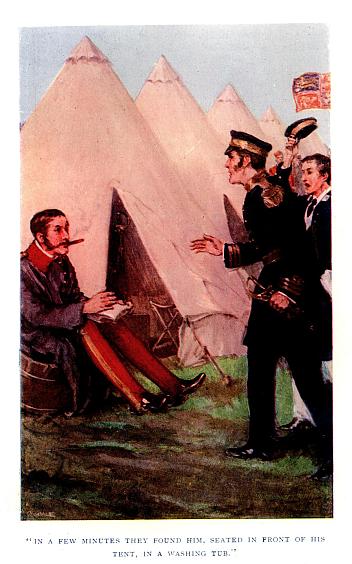
In a few minutes he found him, seated in front of his tent, in a washing-tub, which served as an arm-chair, with a book on his knee, and a cigar in his mouth. “What! Jack! Tom!” he exclaimed in a more animated tone than was his wont in England; “I am very glad to see you, for I little expected that you would be able to make your way out here. I can’t give you a very hospitable reception; but here’s a camp-stool for you, Jack; and bring yourself to an anchor on the top of my hat-box, Tom. Things don’t look as bright as we should wish, but we can keep up our spirits with the hopes of a change for the better. The Turks are tremendously hard pressed in Silistria, and we are expecting every hour to hear of the fall of the place; when we shall have the Russians down upon us. I turn out every morning in the belief that before the day is over we shall be ordered to march and meet the enemy; when the wind’s from the north we can hear their guns and those of the fortress thundering away at each other; and any day we can hear the sounds of mines exploding, and other music of glorious war,” and he smiled faintly; “I painted the pleasures of fighting in a very different light, and cannot say that the reality comes up to them. However, you must have some luncheon, and then we’ll ride towards the Schumla, where we can hear, though we can’t see, what is going forward.”
As soon as luncheon was over, Sidney ordered his horse, a sorry steed, not quite suitable for Rotten Row. He, with his two brothers, set out for the position of the second division. They had got but a short distance from the camp, when they passed a party of men carrying stretchers, on each of which was laid a human form, the rigid outline of the features and feet showing through the blanket shroud. The chaplain followed to read the funeral service; but few, except those required officially to attend, followed their comrades to their last resting-place. Farther on were two groups of men, six or eight in each, shovelling out the earth from some oblong holes. Silently they laboured; no smiles were on their countenances, no jokes passed between them; they themselves might soon be the occupants of similar resting-places. Tom shuddered. “I have been too much accustomed to scenes like these to take notice of them,” said Sidney; “we seldom pass a day without the loss of two or three men, and sometimes many more.”
They at length reached the height towards which they were riding, and, on dismounting from their steeds, they could hear the rolling thunder which came from far-off Silistria, one continued roar, as the garrison poured the fire of their guns on the persevering hosts of Russia.
“It seems to me as if every man in the Russian army must be blown to pieces by this time,” observed Tom.
“So they would if they were above ground,” answered Jack, “but they are in their trenches, and only occasionally do those iron missiles carry death in their track, except when an assault is being made, and then they sweep them down by hundreds.”
The despatches Jack had to convey not being ready, he was compelled to remain on shore till the following morning. All night long the low thunder of the siege was heard even more continuously than before. He awoke just at dawn, and listened; the wind came from the same quarter, but no longer was the booming sound of the cannon heard. “It is all over with the brave garrison of Silistria, I am afraid,” he observed to Sidney, who had joined him outside the tent.
“If it is, we shall soon have a brush with the Russians,” was the answer; “I heartily hope so, for active service will help to stop the fearful ravages of the cholera. Half a dozen of our poor fellows have died during the night, and the army will be decimated unless something is done to arrest the disease.” Just then the reveille sounded, and the camp was quickly astir. The news spread that Silistria had fallen. The hope that the time of inaction was over was expressed by everyone in the camp. The event detained Jack on shore much longer than he had expected. At length a Turkish horseman was seen spurring towards the camp of the allies. Officers and men hurried out to meet him, fully expecting to hear that the enemy were advancing. He pointed to the north, however, and an interpreter explained what had happened. He brought glorious news, of which his countrymen might well be proud. Prince Paskiewich, with his shattered hordes, had raised the siege, and was in full retreat from before the brave city he had in vain assailed for so many long weeks; but one of its gallant defenders, Butler, after exhibiting the most heroic bravery and skill, had fallen.
Soon afterwards another important victory was gained over the Russians by the Turks, led by General Cannon and several other English officers, in which also Lieutenant Glynn and Prince Leiningen, of the Britannia, commanding some gunboats, took an active part. This compelled the enemy to abandon the Principalities. Jack after this had to return to Constantinople, where Sir Edmund Lyons and Sir George Brown were busy in preparing rafts and chartering steamers for the embarkation of the artillery and cavalry.
On Jack’s return he again paid a visit to Murray on board the Briton. The cholera had been making sad ravages among her crew, as well as on board other ships of the fleet, but, strange to say, not an officer had been attacked. Hearing that Murray was below in the sick-bay, he sought him there, and found him, with two lieutenants, assisting the surgeons in attending to the sufferers, of whom there were at least thirty in various stages of the disease. Murray was standing by the hammock, and holding the hands of a poor fellow—a stout, thick-bearded man, whose countenance was of a livid hue.
“It’s hard to bear, sir, it’s hard to bear!” cried the sufferer, writhing in agony. “Shall I get over it, do you think, sir?” looking up in the commander’s face with an inquiring glance, such as a child might cast at its mother.
“I hope you may,” answered Alick; “but cheer up—many have been as bad as you are, and have recovered; hold on bravely.” The man seemed to grow calmer; again, however, there came over him a fearful paroxysm of pain. “Don’t leave me, sir, don’t leave me!” he exclaimed, as soon as he could speak. Alick, who was about to go on to another man, again held his hands, pouring some cordial down his mouth, which the doctor handed him. He was soon quiet, but it was the quiet of death; and the commander passed on to others who required his aid.
Thus he and the other officers went from hammock to hammock, endeavouring to soothe the pain of those to whom their services could be of any avail. The dead man was lifted out and quickly sewn up in his blanket, with a shot at his feet, to be launched overboard. Three were committed to the deep at the same time.
Such were the scenes going forward on board most of the ships in the squadron; the Britannia alone was destined to lose upwards of a hundred men. On board other ships the officers devoted themselves in the same way, and in many cases succeeded, where the medical men might have failed, in arresting the malady. It was now known that a descent on the Crimea was to be made; as, however, in the suffering state of the ships’ crews, it would be impossible to embark the troops, the admirals put to sea, in the hopes of arresting the progress of the cholera. It appeared not to have the desired effect, and many more lost the number of their mess; and fears began to be entertained that the enterprise must be abandoned, when suddenly the disease stopped; not a man more was attacked.
The ships sailed back into Cavarna Bay, and soon the operation of embarking the army commenced. The duty was under the charge of Sir Edmund Lyons. By the aid of the rafts he had constructed, which consisted of two boats lashed together with a platform on the top, he got on board the ships destined to carry them sixty pieces of field artillery and the complement of horses belonging to every gun. He then commenced embarking the cavalry, to the number of a thousand horses, and twenty-two thousand infantry, on board the numerous large transports waiting for their conveyance.
The officers of the fleet were engaged under him in superintending the operation. During some days a heavy swell set in, which put a stop to the business of embarking the cavalry. The weather again changing, however, the whole of the force was got on board without the loss of a man. Never before had so large a fleet anchored in those waters. There were hundreds of sailing transports, steamers innumerable, both men-of-war and merchantmen, while above all towered the tall masts of the line-of-battle ships. The French, having only their own infantry to embark, most of whom were taken on board their men-of-war, got through the process more rapidly than the English.
Men-of-war’s boats were pulling backwards and forwards, some carrying messages, others towing-off the rafts; while smaller craft of all sorts were moving about in every direction, bringing stores and provisions. It was hard work for all hands, but it was cheerfully and willingly performed.
Jack, having to pass near the French fleet, observed a boatful of Zouaves pulling off to a transport; the French steamer was approaching her; the crew of the Zouaves’ boat attempted to pass her bows, while those on board her were keeping a bad lookout. The consequences was that the steamer ran right into the Zouaves’ boat. The poor fellows, encumbered with their knapsacks and greatcoats, being utterly unable to swim, the larger number, uttering shrieks of despair, sank like shots before help, so near at hand, could be afforded them.
Unhappily the cholera lingered among the troops on board the transports, and every day several were launched into their ocean graves, as it was impossible to carry them on shore for burial. Under such circumstances it is usual to secure shot to the foot of the corpse in order to sink it rapidly to the bottom. In some instances shot of insufficient weight were used; for though the body at first sank, yet when decomposition set in and gases were generated, it again rose to the surface; and those on board the ships, as they looked over the side, were horrified at seeing the bodies of their late comrades floating about, bowing to them as if in mockery, moved by the undulations of the water.
One evening Billy Blueblazes was on duty at the gangway, with orders to report any boats coming alongside; as he was looking out in the dusk, he saw, as he thought, a man swimming and approaching the ship. He hailed, but there was no answer; still the figure came nearer and nearer, and presently touched the foot of the accommodation ladder. “What is it you want?” asked Billy; no answer was returned. As in duty bound, he went up to report the circumstance to the first lieutenant.
“There’s a Turk, or some fellow of that sort, has swum off to the ship, sir; but he won’t give his name, or say what he wants.”
Higson ordered Tim Nolan, who was acting as quartermaster, to go down and ascertain who the man was.
“Arrah, sir, it’s not a living being at all!” shouted Tim; “he’s one of the poor fellows who slipped his cable in the cholera on board the transports, and the sooner he’s made to go back where he come from the better, seeing he isn’t altogether pleasant company to living men.”
Higson was of Tim’s opinion, and, ordering a shot to be securely slung, he directed Tim to make it fast round the neck of the corpse; this was quickly done, and the unwelcome visitor disappeared beneath the surface.
Many other similar occurrences took place, to the great annoyance of the seamen, as well as of the soldiers, and made them all the more anxious to get away from the spot beneath which lay so many of their unhappy countrymen. The English fleet having an ample supply of transports, no troops were taken on board the men-of-war, which were thus left free for action; but the French having secured only small vessels, their men-of-war were so encumbered with troops that they were ill prepared to go into action should the Russian fleet come out to attack them. The information was received with unmitigated satisfaction on board the British men-of-war, and all hoped that the Russians, gaining courage, would venture from beneath their fortifications, as on the English fleet would devolve the honour of engaging them.
To every English sailing-ship-of-war a steamer was attached. The English army was under the command of Lord Raglan; Admiral Dundas had his flag flying on board the Britannia; while Admiral Sir Edmund Lyons, in the Agamemnon, had charge of the transports. To each vessel was assigned her particular place, so that there might be no confusion. It was generally believed that the Russian fleet would sail out of Sebastopol and intercept the flotilla, and that they would have to bear the brunt of the fight. The masters of the transports were accordingly called on board the Emperor, the largest of their squadron, where the admiral’s instructions were read to them, and they were asked whether they would willingly take a part in the naval engagement, should one be brought on. Having satisfied themselves that their widows would receive compensation should they fall, they replied to the question with three hearty British cheers. Thus were the preparations made for the contemplated descent on the unknown shores of the Crimea.
Chapter Fifteen.
Descent on the Crimea—Landing Troops—Towing Rafts—Battle of the Alma—Tom and Archie on the Battlefield—The Horrors of War—Bringing off the Wounded—Bombardment of Sebastopol—Jack and Murray in Action.
“Just gone seven bells, sir,” said Billy Blueblazes, as he entered Jack’s cabin, sent according to orders by Mr Mildmay, who had the morning watch on the 7th of September 1854. Jack was speedily on deck, for there was plenty of work to be done that day. A gentle breeze blew off the shore; not a cloud dimmed the sky, from which the moon cast her beams over the calm surface of the ocean. By her pale light the sailing-ships in all directions could be seen loosing their canvas, while from numberless funnels wreaths of smoke were ascending, showing that the steamers were preparing to move. All the officers were quickly assembled on deck; many an eye was cast eastward to watch for the first signs of coming day. The men were ordered to their stations. At length a ruddy glow above the eastern horizon announced the approach of day; shortly afterwards the loud roar of a gun from the lofty side of the Britannia gave the signal to weigh. The sails hanging from the yards were let fall and sheeted home, the steamers sent forth denser columns of smoke, which, rising in thick wreaths, floated in all directions round the ships’ funnels, obscuring the view.
The order had been given to rendezvous forty miles due west of Cape Tarkand. Instantly the outer ships began to move; Sir Edmund Lyons’ ship, the Agamemnon, with signals flying at her masthead, proudly gliding through their midst. The English transports, in five columns of thirty each, obeying his orders, moved slowly eastward; then came the ships of war, the guardians of the fleet, in single column. The French, more numerous, but with much smaller vessels, sailed out in less compact order, with their warships crowded with troops; the Turkish fleet, similarly encumbered, followed. Among the English perfect order was maintained, for every captain could thoroughly trust, and well knew that he must obey, his gallant leader.
The French soon became scattered; their general, with some of their line-of-battle ships, had sailed several days before, and what had become of them was not known.
By the morning of the ninth the whole English fleet was anchored at the appointed rendezvous, but as yet the point at which the troops were to land had not been selected. Next morning Lord Raglan accompanied Sir Edmund Lyons, with several English and French engineer officers, on board the Caradoc, which, after passing the mouth of Sebastopol harbour, steered round Cape Chersonesus and looked into Balaclava, surveying those heights ere long to become the scene of many a bloody conflict. Returning northward, she steered close into the shore, the generals looking eagerly out for a fitting spot on which their legions might land. A low, sandy beach was at length perceived near Kalametra, with two lakes beyond it. It was exactly the spot Lord Raglan desired. Late in the evening the Caradoc returned.
During the two following days the French and Turkish vessels, which could be seen scattered in the far distance, came slowly in; and now it became known that the long looked-for enterprise was at once to be commenced.
Early on the 13th the fleet came off Eupatoria. A small party, with an interpreter, were sent on shore to summon the town to yield at discretion. The Tornado, with other steamers, being close inshore, Jack sent Jos Green, with Tom and Archie, to obtain some fresh provisions. They found the old governor a strict disciplinarian, protesting against the strangers landing without having performed quarantine, and he insisted on fumigating the missive sent him before reading it. They might capture the town, to that he had nothing to say—he was not there in a military capacity, but what he had to do he intended to do in strict accordance with his orders. As all the military authorities had run away, and only a few invalid soldiers remained, no resistance was made, and Eupatoria became the first place occupied by the British troops in the Crimea.
Jack, having obtained some Russian coin at Constantinople, was able to purchase provisions. The Tartar inhabitants, finding that they could bring their produce to a good market, were perfectly ready to part with whatever provisions they possessed.
The fleet, now proceeding southward, came to an anchor in a line parallel with the shore, the English to the north, the French and Turks to the south, about five or six miles to the north of the Balaclava River. During the night of the 13th it was arranged that a buoy should be placed, to divide the English and the French fleets, in the centre of the bay. When morning dawned it was found to be afloat almost at the northern end of the bay, having been placed in that position, either from ignorance or treachery, by the French. There was no time for expostulation, the French were found already to have occupied the whole ground. To avoid the risk of a dispute, Sir Edmund Lyons, like a wise man, knowing that a similar landing-place existed a little farther to the north, also with a lake inside it, at once ordered the transports to proceed there and take up their proper places.
The day was fine and the water smooth, and early in the morning the landing commenced. So admirably were the arrangements made that the troops landed in the order they were to take on the march, while the line-of-battle ships remained outside, thus keeping up the communication with a steamer stationed off the mouth of Sebastopol harbour, so that, should the Russian fleet sail out, they might at once proceed to meet it, and prevent it from interfering with the transports. Jack’s ship, and other disengaged steamers, were in the meantime sent to cruise up and down the coast and annoy the enemy. Jack ran down to the south, and communicated with the vessel off the mouth of the harbour. Greatly to his disappointment, no signs were to be perceived among the Russian fleet that they were likely to come out and give battle. Now was their opportunity, if they intended to do so, for their scouts on shore must have informed them that the French and Turkish men-of-war were employed in landing their troops, and for what they could tell the English were similarly occupied.
“You may depend on it,” observed Jack, “by some means or other they know that our ships are ready to meet them, and they feel pretty sure that they would get the worst of it.”
The Tornado, keeping clear of the formidable batteries which frowned defiance from the northern side of the harbour, now stood close inshore. Above her rose a series of cliffs, with a broad plateau on the summit, extending as far as the mouth of the Alma River. A group of tents were near the edge of the cliff.
“Where there are tents there are men,” observed Higson; “are we to fire at them?”
“It is our business to do so,” answered Jack, “though it is not much to my fancy to fire at men who cannot return the compliment. Elevate the guns so as to clear the top of the cliff.” The engines being stopped, the Tornado opened her fire. Presently one tent went down, then another and another, showing that she had got the exact range. The figures of men could be discerned scampering off, leaving their tents to their fate. The engines being put in motion, the ship steamed on till a body of horsemen were discerned, who had apparently come down to ascertain the cause of the firing. Several shot were sent flying close to them, making them wheel about; but before they had got out of sight two other guns were fired, and a horseman was seen to drop from his saddle. The rapid movement of the rest showed that they were wisely anxious to avoid a similar fate.
Near the mouth of the Alma a considerable body of infantry were observed; not being aware of the long range of the stranger’s guns, they stood watching her approach. Suddenly stopping her engines, she opened on them with her whole broadside; two or three were seen to fall, but still they stood their ground.
“They are waiting for orders to march,” observed Higson; “they would be wiser if they took ours.” With considerable reluctance, Jack gave the order to fire another broadside; he did not like shooting down men in cold blood, but yet he must obey his superiors. Scarcely had the smoke of the guns cleared away than the Russians were seen beating a rapid retreat, though they still kept together. Three more shot had the effect of making them increase their speed, and they disappeared behind some rocky ground which afforded them shelter. Here and there some tents were seen, as well as cavalry and infantry, who, however, moved off as the warship approached, well aware, small as she looked, of the mischief she could do them.
Returning to the fleet, where the landing was taking place, Jack found that the greater part of the English infantry were already on shore. From what he had seen, he made his report that the enemy was not likely to make any immediate attack on the invading forces. Still a considerable portion of the cavalry had to be landed; the weather changed for the worse, and rain came down heavily, wetting the troops on shore, who had no tents or protection of any sort, to the skin. Jack received orders to send two of his boats to assist in towing one of the rafts now alongside the transport to the shore. Green had charge of one of them, and Tom and Archie the other. They found two heavy guns already on the raft, with several horses. The detachment of artillerymen belonging to the guns now came down the ship’s side and took their places on board, forming altogether a pretty heavy cargo.
The raft was one of those built at Constantinople, and consisted of two clumsy boats lashed together side by side and boarded over; very well suited for smooth water, but extremely dangerous with a heavy sea running. However, as it was important to get the guns on shore, Green determined to make the attempt. Two of the artillery officers were invited into the men-of-war’s boats, and all being ready, they shoved off, taking the huge raft in tow. By this time it was perfectly dark, and the sea increasing made the operation of towing the raft very heavy work.
“Give way, my lads,” cried Green; “we haven’t far to go; and see, we shall have a warm welcome when we get there.”
He pointed to the beach, which was lit up along its whole length by fires which had been kindled with the planks of several disabled boats and rafts.
The heavy swell tossed the raft about not a little, but the crews pulled away lustily as British seamen always do, and the raft at length approached the shore. The roar on the beach as the surf broke on it was not encouraging; still, orders were to be obeyed. Just then a snorting noise was heard, and a magnificent horse came swimming by, as he splashed the water with his forefeet, surrounding himself with a blaze of phosphorescent light. To catch him was impossible.
“He has probably escaped from a raft which has been capsized,” observed Green; “his chances of being drowned are considerable, though he may have sense to swim back to the ship which brought him here.”
“I hope that won’t be the fate of our own raft,” observed the artillery officer.
“I can’t warrant its safety,” said Green; “had I been asked, I should have advised waiting till the morning; however, we’ll do our best, and it will be a much harder matter to pull back than it has been to reach the shore.”
Just then the light of the fires falling on the raft, showed her to those on the beach, from whence a loud authoritative voice came ordering her to return to the ship.
“More easily said than done,” observed Green.
However, he gave the order to Tom and the officer in command of the other boat to pull round and do their best. Every instant the swell was increasing; the boats’ crews, though pretty well tired, pulled as before. The raft tossed fearfully about, threatening to heave her whole freight of guns, horses, and artillerymen overboard. The latter, with their arms in their hands, shouted out that the boat was about to sink; and sad would be the fate, Green saw, of most of them if it did so; while in the darkness, amid the struggling horses, it would be scarcely possible to pick them all up. The only thing to be done was to pull away with might and main; sometimes, in spite of all their efforts, the raft seemed drifting back to the shore; at others the waves sent it rushing forward, threatening to stave in the sterns of the boats.
“Here’s a pretty piece of work!” observed Tom; “I only hope we shall be able to get hold of one of the transports before long.”
“There’s one ahead of us, if we can but reach her,” said Archie; “there’s nothing like trying.”
Try they did, cheering on the men; and by dint of hard pulling they got within hail of the transport, and asked for help. “We cannot give it you,” was the answer; “we have a boat-load of horses alongside.” A second transport was neared, and then another and another, but all declared their inability to render assistance. Green was almost in despair; the artillerymen were shouting out more lustily than before, asserting that the raft was fast filling. At length the boats managed to tow her up alongside a transport, the master of which responded to their appeal, and assisted them in securing her. Fortunately the artillerymen she had brought out had not yet been landed, and, the officers turning them out of their berths, they assisted the crew in hoisting the horses and guns on board. The gun-carriages, however, being too heavy, were left on board the raft, and she was let drop astern. As, however, their loss made the guns useless, Tom and Archie were sent to the nearest ship to obtain assistance. As they got alongside, they found that she was the Briton, and, Archie having explained matters to his uncle, who was on deck, Commander Murray sent a boat with a fresh crew, by whose means the gun-carriages were at length hoisted on board.
Soon afterwards the sorely-battered raft went to pieces. Tom and Archie were still alongside, when they caught sight of the noble horse which they had seen coming off from the shore still struggling in the waves. Instinct had directed it to the very vessel from which it had been disembarked. Shouting to the crew on deck, they called for slings, which were sent down, and being secured—not without difficulty—round the body of the horse, the animal was lifted safely on board, to all appearance not much the worse for its swim of upwards of two hours.
The weary crews at length got back to their ship. The next day, the wind going down, more of the artillery and horses were landed, and by the evening of the 18th the whole army was on shore without a man being lost; the disembarkation having been superintended by Captain Dacres of the Sanspareil.
The French were posted on the right, close to the sea, the Turks somewhat in their rear, and the English on the left of the line; the duty of protecting the left flank of the army being confided to the British cavalry. The Turks, accustomed to this sort of work, were at once at home, with their tents well pitched, and surrounded by such luxuries as they deemed necessary; while the young troops of England and France, few of whom had seen active warfare, were sitting wet and comfortless round their camp-fires.
The natives, with their black lambskin caps and long pelisses, came to the camp in considerable numbers, bringing provisions, and, what was of more consequence, camels, and carts drawn by oxen for the conveyance of stores.
On the morning of the 19th of September the bugles sounding through the camp aroused all sleepers, and in a short time the army began its march to the southward. The transports, having performed their duty, sailed away for the Bosphorus, while the ships-of-war moved slowly on abreast of the army down the coast, coming to an anchor when it halted, and again weighing when it recommenced its march; the larger ones, for want of water, being obliged to keep at some distance out, while the steamers stood in with the lead going as close as possible, somewhat in advance of the army, throwing in their shot and shells whenever they caught sight of any troops at which to fire.
Towards evening the armies reached the first river in their march, the Bulganak, on the banks of which they bivouacked for the night, in order of battle, as it was thought possible that at dawn they would be attacked by the Russians. The night closed in with rain—bad preparation for the work which all knew would take place on the morrow. The morning dawned more brightly; it was to be the last day many of those brave men in the allied hosts were to see, but few expected to be among the slain. A glorious victory was to be gained by their prowess, they believed, though victory was not to be won without hard fighting. As the sun glanced over the hilltops the steamers got up their steam, and the line-of-battle ships loosed their sails.
Tom and Archie climbed to the masthead, where they determined to remain with telescopes in hand till called down to attend to their duty on deck. In front of them was a line of cliffs extending to the mouth of the Alma, bordering a wide extent of undulating ground. Beyond the Alma rose broken cliffs with a broad plateau on their summit, on which the enormous army of Russia was posted, their lines extending from the coast far away out of sight. In front of the steep hillsides were numerous heavy batteries, capable of sweeping the invading force back into the stream of the Alma, till its waters should run dark with blood. More to the left the French forces could be seen forming in order of battle, with the Turks in the rear, while only for a short distance could the red-coated soldiers of England be distinguished. Now and then a party of horsemen could be made out. When the sun rose, its rays glittered for a moment on the helmets and breastplates of the heavy cavalry as they moved off to protect the left flank of the invading forces.
The hours went slowly by; they were of intense interest to the spectators, and much more so must they have been to those who had to take an active part in the coming strife. Not, however, till eleven o’clock were the armies seen to be advancing. The ships near the cliffs began the action by throwing shot and shell among the Russians posted on the heights. The light infantry regiments could be seen moving in advance, throwing out skirmishers; then came the heavy infantry battalions, with firm tread pressing the ground. At length the blue coats of the French, who had crossed the Alma at its mouth, were observed climbing the rugged heights, the summit of which being gained, they rapidly formed, greatly to the astonishment, apparently, of the Russians, who had not perceived their approach. Now there burst forth from the whole hillside the roar of artillery and the rattle of musketry, so rapidly as to blend into one continuous sound, telling of death to many a brave heart.
“The British are advancing!” cried Tom; “see, they are pushing across the river, but they don’t appear on the hill yet. The Russian skirmishers are disputing the ground with them. What a rattling fire they are keeping up!”
Some time passed by: the redcoats were hotly engaged with the enemy near a large village, that of Bourliouk. In a short time the village burst out into flames, completely hiding the troops on its farther side; then the British were again caught sight of, after they had crossed the river beyond the village, fighting their way up the slope, encountering the fearful fire of the Russians, and small red spots could be discerned on the ground over which they had passed.
Here and there the British redcoats could be distinguished fighting their way up the hillside; but the broken nature of the ground hid the larger number from sight, and it was impossible to discover how the battle was going. Only at length it was seen that the banners of France occupied the ground where the Russians had before stood; still some time passed before they advanced. The Turks remained below, which was a good sign, as it showed that their aid was not required. Now, far away, the redcoats could be discerned scattered over the hillside. Could it be that they were defeated? No; just then a long thin line, like a scarlet thread, was seen amid the smoke, far, far away, moving up the slope, in one spot having a parti-coloured hue.
“Those must be the Guards and Highlanders,” exclaimed Tom. “My brother Sidney will be in for it; I hope he’ll escape, poor fellow. I wish I could be there to help him, if he gets wounded.”
Onward advanced that thin unbroken line up the hill; the brow was reached, when there appeared in front of it a grey mass, which seemed like a square patch of withered grass on the greener herbage. Many such patches were seen sending forth wreaths of smoke from their midst. The midshipmen guessed rightly that it was a column of Russian infantry. From the red column issued a sheet of flame and smoke; not for one moment did it cease. Minutes went by; now that parti-coloured portion of the line reached the summit of the hill and moved on, smoke issuing from it as it moved. The dark mass of the enormous Russian column began to recede before it, at length breaking and scattering in all directions.
The French, meantime, had disappeared, sweeping the enemy before them over the hill, till they were lost to sight. The batteries, which had been pouring their shot down on their assailants, had ceased their fire, for those assailants had already stormed and captured them. The English attack in front had been successful, and more troops, which had been kept in reserve, went streaming up the hill. The whole British and French armies had not only gained the heights, but, as it seemed, were sweeping the Russians before them. The rattle of musketry was now only occasionally heard; then came a few salvoes of artillery, and the fierce uproar which had raged for the last two hours almost ceased.
The slopes which partly faced the sea were the most visible, and on these could be seen numerous red spots—some strewn thickly together, others scattered more apart, marking the places where the Russian fire had carried death and wounds into the British ranks. Still at that distance nothing clearly could be seen.
“It must be the case,” cried Tom at length. “Hurrah! we’ve won, and the Russians are running away; you’ll see that I’m right. Now, my brother will be as anxious as I am to learn how it has fared with Sidney; I hope he’s all right, poor fellow; but I am terribly afraid, with all that firing which has been going on so long, an immense number must have been killed.”
The midshipmen, who had been allowed to retain their seats, were at length called down. There was considerable excitement on board, everybody anxious to hear news from the shore, though no one doubted that a splendid victory had been gained. They had not long to wait; the signal staff set up on shore was soon at work. A complete victory had been gained, and it was requested that boats might be sent immediately on shore with hammocks on which to carry the wounded on board ship. The appeal was quickly responded to. Jack immediately ordered two of his boats to be got ready under the command of Higson, with whom he sent Tom and Archie, giving the two midshipmen permission to make their way on till they could find the Guards, to ascertain the fate of his brother.
Tom was delighted with the duty.
“Stay,” said Jack; “you may find many poor fellows wounded, who will be the better for some brandy, and some may want water. Take as much as you can carry; you’ll not have more than is wanted, I fear.”
Search was made for flasks, and each midshipman carried three, and two bottles of water. Archie, with due forethought, also tore up two of his shirts, which he stuffed into his pockets. Higson followed their example in carrying a supply of spirits and water.
Away the two boats pulled for the beach near the mouth of the Alma, where numerous others were already assembled. For the first half-mile or so, after landing, there were few signs of the conflict, but in a short time they met parties of English and French soldiers carrying wounded men, most of them looking more dead than alive from loss of blood; while, as they advanced, they found numerous tents set up, in which the surgeons were already at work amputating arms and legs, and dressing the more severe wounds. Where the conflict had raged the hottest, the surgeons, who had followed closely the advancing forces, were employed with tourniquets doing their utmost to stop the life-blood flowing from the veins of the wounded. Although the two midshipmen had seen a good deal of fighting, they both turned sick as they gazed at the fearful wounds inflicted by the round-shot.
The road they took leading them some way to the north of the Alma, it was only after they had proceeded a considerable distance that they came to the part of the ground where the English had chiefly fought. On the eastern side was the burned village of Bourliouk; the hillside was covered with the corpses of the men of the infantry regiments, intermingled with the bodies of the grey-coated, helmeted Russians. The cries of the wounded soon attracted those who came to succour them, and the seamen under Higson were speedily laden with wounded men. After the wounded had been inspected by a surgeon, and pronounced fit to be removed, the party set off to return to the boats, while Tom and Archie made their way up the hill in the track the Guards had taken, Tom looking out anxiously on every side in search of his brother, whom he dreaded to find among the killed.
They met numerous parties of soldiers, with a few sailors, who had already landed, some carrying wounded men towards the village on the banks of the Alma, the houses of which had been turned into hospitals; others going in search of fresh burdens. The work of burying the dead, who thickly strewed the ground in those parts where the fight had raged the hottest, had not yet commenced; the living men had first to be cared for. Here and there surgeons of the army, as well as many of the navy, who had landed even before the battle was over, were attending to the more desperate cases requiring immediate aid. The Russians received the same attention as the English, and were at once carried off to the hospitals. Some poor fellows lay under the walls and other shelter, where they had crawled after being wounded; the larger number were found where they fell.
Tom was in a hurry to push on, while he looked about on every side for the uniform of the Guards. From all quarters came groans and cries, and the midshipmen could not resist stopping to afford some relief to the sufferers. Several Russians lay with their heads placed on the corpses of their brother soldiers; some had their arms, others their legs, blown away by round-shot. One poor fellow was still alive, though both his thighs had been thus broken. He had strength to point to his lips, and Tom, kneeling by his side, poured some water down his throat. The dying man cast a grateful look at the young officer, but before they left him he expired. Several had their heads blown off; others, who had their faces carried away, presented the most dreadful spectacle.
At length Tom exclaimed, “There are some Guardsmen!” Several high bearskin caps marked the spot to which he pointed; the first men they came to were dead, but higher up the hill they saw more. One of them was alive, with a bad wound in his side, and a shot through his arm; he was apparently bleeding to death. Archie produced his bandages, while Tom poured some brandy down his throat. It contributed to revive him; Tom inquired eagerly if he had seen Captain Rogers.
“Yes, sir,” was the answer; “he was marching on with the regiment when I fell.”
Having done their best to stop the blood flowing from the man’s wound, Tom and Archie hurried forward. Farther to the right the ground was still more thickly covered with corpses. On examining them, Tom observed that though many were Guardsmen, they did not belong to his brother’s regiment. Several officers lay dead, numerous Russians mingled with the British. The greater number appeared to have been shot by bullets, but several had been killed by the bayonet or sword, and exhibited ghastly wounds. Apparently, the wounded officers had been removed, for none were seen alive. Numerous helmets, knapsacks, and other accoutrements thrown away by the Russians, together with the greater number of their dead, showed that they had been put to flight by the victorious advance of the British.
“This is terrible,” cried Tom; “I had often pictured a battlefield, but I had not fancied it anything like so horrible as this is.”
“It must be worse to the poor fellows who lie scattered about us, suffering fearful tortures from their wounds,” answered Archie, “with the prospect of dying from them; or even if they recover, being maimed for life.”
“I hope poor Sidney is not among them,” exclaimed Tom, for the twentieth time; “I can’t help thinking more of him than of anyone else.”
Making inquiry of some soldiers whom they at length met with stretchers carrying the wounded men they had picked up, Tom asked if they could tell him over what ground the—
Guards had passed.
“You must keep farther to the left,” was the answer; “you will come upon some dead Highlanders, and they are just beyond them.”
The bonnets of the Highlanders were soon discovered, and not far off the tall bearskins showed where the Guards had fought. The midshipmen, however, made but slow progress, for they could not help stopping to relieve those who required their aid, both friends and foes, till Archie had used up all his bandages, and their spirits and water were nearly expended. As Tom had not found Sidney, his spirits rose with the hope that, at all events, he might have escaped being killed. The enormous number of Russian dead, who were now seen covering the plain, showed the part of the ground where the last desperate conflict had taken place. Whole ranks of the enemy had fallen under the withering fire of the Guards and Highlanders. In one spot they came upon an entire line of Russians, every man of whom had been shot down apparently at the same moment; indeed, far as the eye could reach on either side, the plain was thickly strewn with the dead.
At length a long line of upright figures was seen arrayed on the left, with numerous banners waving above their heads, and horsemen moving to and fro; the red hue on the left showing where the victorious soldiers of England stood, halted on the battlefield, while on the right appeared the masses of the French army, with the Turkish troops who had marched forward to their support. They occupied the ground on which they were to bivouac before advancing again in pursuit of the flying foe.
The midshipmen made their way towards the troops on the left, and were able, by looking at the lofty bearskins of the Guards, to find out the regiment to which Sidney Rogers belonged. Almost breathless with eagerness, Tom inquired for his brother.
“He is there,” said a sergeant, pointing to a spot where a group of officers stood together, eagerly discussing the events of the day.
Tom, unable to restrain his feelings, gave a shout of joy, in which Archie joined him. As they hurried forward, Sidney advanced to meet them, and they were soon shaking him heartily by the hand, and congratulating him on his escape and the victory he had contributed to win.
“I am thankful to have come out of it unhurt,” said Sidney, “especially when I hear of the number of officers who have been killed; between twenty and thirty, at all events; and not far short of a hundred wounded.”
Tom then gave Jack’s message, and delivered a case containing a few luxuries brought from the ship. The midshipmen could not, however, remain long, as they had received orders to return at night, and the day was now rapidly closing. They were brave youngsters, but they had no wish to be compelled to make their way over the battlefield in the darkness, amid the dying and the dead. Wishing Sidney good-bye, they rapidly retraced their steps; as they once more descended the hill, their ears were assailed with cries and groans, but as they had no longer any means of assisting the unhappy sufferers, they hurried on. At the foot of the hill they reached the road which ran along the bank of the river, having to pass in their way close to the smouldering ruins of the village which had been set on fire at the commencement of the battle. Here it was supposed that several English as well as Russian riflemen had perished, while engaged with each other, the flames having spread round them before they had time to make their escape.
It was already dark when one of the Tornado’s boats came to take them off. Neither of them were very much inclined to talk of what they had seen; and even Jack, when they got on board, had some difficulty in gaining more information from them than the fact that they had found Sidney safe and well. After a glass or two of wine, however, Jack drew forth an account of the scenes they had witnessed on the battlefield. Tom often shuddered as he described the fearful condition of the wounded, and the numbers of dead they had seen.
Next morning they were all to rights, and were ready to go in charge of a fresh party of seamen, who were sent on shore to bring off more of the wounded. All day long the seamen were engaged in collecting the wounded men and carrying them to the hospitals, or bringing them off to the ships; while parties, told off from the different regiments, were employed in burying the dead, generally in large pits, into which friends and foes were tumbled without much ceremony. All the time bodies of cavalry were kept patrolling on the left to guard the people employed in the service from the attacks of the Cossacks, who were seen hovering in the distance, ready to pounce down upon any unwary stragglers.
As soon as Jack had received on board as many wounded officers and men as he could accommodate, he proceeded to Constantinople to place them in the hospitals which had been got ready for their reception. Several died on the voyage, some of their wounds and some of cholera, which killed many officers and men after the battle. Jack was eager to get back again to see what was going forward. Hopes had been entertained that the allies would at once enter Sebastopol; but the news had reached Constantinople that, instead of doing so, they had marched round the city and had posted themselves on its southern side, the English having occupied the harbour of Balaclava, while their army had taken up a position on the ground above it, extending towards the fortifications of Sebastopol.
The Tornado was still steaming at full speed across the Bosphorus, when, soon after dawn, though still out of sight of land, a loud booming of guns came from the northward over the calm water. “There is another furious battle going forward,” said the first lieutenant to the commander, who had just come on deck; “I wish we were there—can the fleet be engaged?”
“I very much doubt that the Russians will have ventured out of their harbour,” answered Jack; “I suspect rather that the allies have commenced the bombardment of the city. The last account stated that they were busy preparing for it, and I think it probable that the admirals will take the fleet in to engage the sea-batteries.”
“They will not do much against those stone walls, unless they are complete shams,” observed Higson; “however, we shall be there before long, and if there is an honest battle at sea going on, I hope we shall be in time to take part in it.”
Of course there was great excitement on board, everyone looking out eagerly for the land. Surmises of all sorts were made as to what was going forward. The engineers did their best to urge the steamer along, but the wind was so light that the sails were wholly useless. Billy Blueblazes and Dicky Duff, who were somewhat jealous of Tom and Archie having been on shore, were eager to be there to see the “fun,” as they called it.
“I can tell you fellows that it is no fun at all,” said Tom, who had become unusually grave since he had visited the battlefield of the Alma; “I have got a brother there, and in all probability he is in the midst of the fight.”
“And if the fleets are engaged, I have got a cousin who is as dear to me as a brother,” observed Archie, “and I don’t want any harm to happen to him. You youngsters talk glibly of fighting; but let me hear what you have to say about it when you have seen the thing in reality. It is a necessary evil, but an evil notwithstanding.”
The younger midshipmen laughed, and declared that it was just what they had come to sea for. “So did we too,” said Tom; “but only because it’s our duty to fight to protect our country—not that I can see that we forward that object by coming out here to attack the Russians.”
Soon afterwards, “Land! land!” was heard from the masthead, adding to the excitement of all on board. At length the high cliffs of the Chersonese appeared in sight; the thunder of the guns, as the ship advanced, increasing in loudness. Now the fleet could be seen coming forward from the roads off the Katcha River to the north; no sails were set, as the ships had either their own steam-power, or were moved by steamers lashed alongside.
“The French fleet are leading,” observed Jack to Higson; “it is evident then that their destined position is the southern end of the line, and that our ships are to attack Fort Constantine and the other forts on the north side of the harbour.” Slowly the proud ships glided onwards, but not a shot was fired from them; they were still out of range of the forts. It was already near one o’clock in the afternoon. In the French division thirteen ships could be counted, two of them carrying the Turkish flag. Onward they glided in admirable order, still preserving perfect silence.
“To my mind,” observed Higson, “they would be likely to do much more good if they were farther in, and my belief is that so they would be if they had English captains to fight them.”
“Probably the French admiral is afraid of getting his ships on shore were he to stand in closer,” observed Jack, who held the French in more respect than did his first lieutenant. At length, as the French ships came within range, the Russian forts opened their fire, but still no reply was made. The whole French squadron had now one by one anchored at exact distances from each other, extending more than half-way across the harbour; then the signal was given, and the roar of six hundred guns broke the silence which had hitherto prevailed, the dense clouds of smoke which arose almost concealing them from sight. At the same moment the English flagship was seen to throw out a signal, when three of the English steam-frigates, which had been standing inshore, commenced firing away at the northern forts. Another signal presently went up, and the Agamemnon was seen gliding on at more rapid speed than heretofore towards the shore, some little distance to the north of Fort Constantine, the nearest point which a shoal running off from the land would allow her to reach. A gallant little steamer, the Circassian, was observed leading the way, fearless of the shot which the guns of the fort threw at her. As the Agamemnon passed the Sanspareil, which had been ahead of her, hearty cheers resounded from their crews, and then both commenced firing, clouds of smoke quickly enveloping them and assisting to baffle the gunners of the two batteries on the high ground above them. Meantime the Britannia, Trafalgar, Vengeance, Queen, Rodney, and Bellerophon, were proceeding southward in order to complete the line across the harbour, while the Sanspareil, London, Arethusa, and Albion took up positions to the northward of the Agamemnon.
Not till afterwards, of course, did Jack hear of the gallant conduct of Mr Ball, in command of the little steam-tender Circassia, which was seen ahead of the Agamemnon, taking soundings for her, and leading her close up to the shoal. Sir Edmund told him that his ship would probably be sunk, and undertook to have his boats in readiness to pick up him and his crew should such an event occur. As the tender moved ahead of the great ship, the lead-line was struck out of the leadsman’s hands; but another line was immediately found, and the little vessel continued her course. Though she received nine shots in her hull, the leadsman was the only man wounded on board. Having performed her duty, she steamed off out of harm’s way. The Agamemnon was, however, so well placed to the north-west, that the rear guns only of the fort could be brought to bear on her, and as she was much nearer in than the enemy expected, most of their shot struck her masts and rigging.
So close was the Sanspareil to her stern that that ship’s foremost guns could not at first be fired. This made it necessary for her to haul off, but it was only to return to render her able support to the Agamemnon. The greater number of the ships were now hotly engaged, well-nigh twelve hundred guns firing rapidly away at the various forts, and crumbling the upper works of the nearest to pieces; but still all the time the iron shower sent by the Russians came crashing on board the ships of the allies, sending many a brave seaman to his account, and wounding a far greater number.
“The admiral is signalising us,” exclaimed Higson; “we are to run alongside the Briton, and carry her into action.”
No sooner had he uttered the words, than a loud cheer arose from the crew; in a short time, having obeyed the order she had received, they were where they had longed to be—in the line of battle, under the enemy’s fire, the Briton having, as was the case with many of the other ships, landed a considerable number of her people to join the naval brigade on shore. A portion of the Tornado’s crew were called on board to assist in working her guns; happy did those consider themselves who were thus employed. Among the officers were Mr Mildmay and Tom and Archie. As they were stationed on the upper deck, they could occasionally see, when the dense wreaths which encircled the combatants blew by, what was going forward. Mr Mildmay stood as cool as usual, every now and then pulling out his notebook and making notes in it.
“I really believe,” said Tom to Archie, laughing, “that he’s writing a poetical description of the battle. Perhaps it’s a song, to be called ‘The Battle of Sebastopol’—‘There we lay, all that day, At stone walls a-blazing away!’”
“I wonder when the Russians intend to give in—it doesn’t seem much like it at present,” observed Archie; “I expected that we should sail up the harbour and sink their ships.”
“They’ve done that already themselves, right across the mouth. I heard the first lieutenant tell the master so,” said Tom.
“I only wish that they were afloat, and that we were fighting them instead of these forts,” observed Archie. “When we have knocked them to pieces, I don’t see what good they will do us.”
“Why, of course, to help the soldiers on shore to get into the place,” answered Tom.
These remarks, which were made at intervals between the firing of their guns, were cut short by a shot killing two of the crew of one of the guns under Tom’s command. He had to summon others to take their places; after this he felt very little inclination to talk, nor, indeed, had he much opportunity of doing so. The position of those who remained on board the steamer was very trying; they had nothing to do, but were tolerably secure from damage, while the enemy’s shot went flying over their heads. Hour after hour the battle continued to rage, the troops on shore being hotly engaged with the batteries turned towards them, the thundering roar of their guns answering to those of the ships. Never, perhaps, in the same space of time had so many round-shot and shells been flying through the air.
Little more could be seen of the ships in line across the harbour’s mouth. The French remained stationary, but some of the English frequently moved their positions to the support of Sir Edmund Lyons and the inshore squadron, which were enduring the brunt of the battle, exposed as they were to the tremendous fire from Fort Constantine and other batteries. Now flames were seen to burst forth from the Queen, when, a steamer taking her in tow, she stood off to extinguish them. Some time afterwards the Albion was seen to be on fire, fearfully mauled and unable to fire a shot, with the risk of drifting on shore. She also stood off, helped by the steamer attending her.
The Rodney was now seen standing in to support the Agamemnon when she took the ground, and though exposed to a tremendous fire, she continued fighting her guns. It seemed almost impossible that she should escape destruction, but she still kept firing away till, two steamers going to her assistance, she at length got clear. Not till darkness came on did the battle cease, when the ships returned to their anchorage. Jack was thankful to find that Murray and the midshipmen had escaped, though five of his own crew and many more of the Briton’s had been killed. The next morning the “butcher’s bill,” as Jos Green called it, was made out, when it was found out that forty-four British seamen had lost their lives, and that two hundred and sixty-six had been wounded, while the Albion and Arethusa had been so knocked about in their hulls and rigging that the admiral sent them off to Malta to be repaired.
The French ships presented a still more disabled appearance, and had lost altogether in killed and wounded under two hundred men. Then came the question, what had been done? and the opinion generally was that, although a good many of the Russians might have been killed, no essential damage had been done to the forts, and that it would be wiser in future for the ships to let them alone.
“I suppose the work of the fleet is pretty well over,” said Murray to Jack, who had gone on board the Briton, “unless we have to attack other places along the coast. You will probably be sent on that service, and I confess I envy you.”
“I hope we shall,” was the answer; “though I am afraid that at present we shall be employed as a despatch-boat. I should like to see what is going forward on shore, and shall be glad if I can take a turn of duty with the naval brigade, but I have very little hopes of that.”
Chapter Sixteen.
The Tornado at Balaclava—The Allied Camps—Russian Cavalry and Highlanders—The Flying Turks and the Highland Wife—Charge of the Heavy Brigade—“Into the Valley of Death rode the Six Hundred!”—Death of Captain Nolan—After the Battle—Tom and Archie propose to leave the Navy for the Army, but think better of it—Their Visit to the Guards’ Camp—The Stern Realities of War—Attacked by the Russians—The Midshipmen in the thick of the Fight.
The Tornado had been ordered to proceed to Balaclava. She entered that landlocked harbour, on the southern end of the Crimea, on the evening of the 24th of October. As she was to remain there the whole of the next day, Jack resolved to take the opportunity of paying a visit to his brother Sidney, and seeing what was going forward before Sebastopol. There was no time to set off that evening; he, however, landed with his second lieutenant and some of his younger officers, including Tom and Archie, to have a look at the country, and to engage horses for the next day.
Steep hills rose on either side of the harbour, on the right of which the little town was situated, with steep, narrow streets leading down to the water’s edge. Above it was a line of defences, garrisoned by the bluejackets forming the naval brigade, and the marines of the fleet. To the left, across the Chersonese, ran the road to Sebastopol; while directly in front, connected by a gorge with the harbour, was a broad valley, called the South Valley. Beyond this rose a ridge known as the Causeway Heights, on which were situated six redoubts, garrisoned by the Turks, to whom had been committed what formed the outward defences of Balaclava; along this causeway ran the Woronzoff Road. At the eastern extremity of the valley there was a knoll between five and six hundred feet in height, joining the Kamara Hills to the right by a neck of high ground, the knoll jutting out over the valley, as a promontory does over the sea. This knoll, on which Number 1 redoubt had been thrown up, was called by the allies Canrobert’s Hill. On the western extremity of the valley was the Col, or gap through which the road passed to Sebastopol. Eastward of Canrobert’s Hill were the village and heights of Kamara; completely overlooking it. On the farther side of the Causeway Heights was what was called the North Valley, with a range of heights rising out of it on the opposite side, denominated the Fedoukine Hills.
Jack and his party, having ascended from Balaclava to the height of Saint Elias, could look down into the South Valley, at the left end of which they saw the tents of the heavy and light cavalry, with their horses picketed about them, while just below them were encamped Sir Colin Campbell’s Highlanders. Horses, mules, carts, and vehicles of all sorts were making their way from the harbour along the well-beaten road to the allied camps. Not a foe was in sight; some of the officers in command of the marines and bluejackets, who garrisoned the lines extending from Saint Elias to the sea, whom Jack met, told him, however, that there were rumours of the Russians not being far-off, and that they should not be surprised if before long they were attacked.
“You’ll lick them, of course,” said Tom; “but I should think they had enough of fighting on the Alma.”
“I am not so certain of that,” was the answer; “the Russians are brave fellows, and they would like to drive us into the sea if they could.”
After spending some time with his friends, Jack returned on board, having arranged to start at daybreak the next morning. Tom and Archie again accompanied their commander. They turned out before daylight, and Jack, who was anxious to see as much as he could of the operations before Sebastopol, was ready to go on shore directly day broke. Their horses were sorry steeds, but would save them fatigue, and enable them to get over the ground faster than they could on foot. Remembering how acceptable were the provisions they had before taken to Sidney, Tom and Archie each carried a couple of baskets full of different articles of provender, from which they might also supply themselves when they got hungry.
Jack had promised to call upon another officer who had been sleeping on shore in the marines’ quarters, and who had undertaken to act as their guide. As they were mounting the hill, the loud thunder of guns broke on their ears. “I suppose those are the siege guns,” observed Tom; “they begin work pretty early.”
“No; they came from the direction of Canrobert’s Hill, to the eastward,” answered Jack; “away on our right. They must be the Turkish guns in the redoubts.”
They hurried up the height, whence they could look down on the South Valley and across the line of redoubts held by the Turks. They were quickly joined by Jack’s friend, who, riding up, exclaimed, “We shall have some warm work before the day is over. Look, look! there come the Russians in great force over those distant heights. They evidently intend to attack the redoubts. Yes, I was sure of it; see, their leading division has already commenced the assault on Canrobert’s Hill.”
One of the first objects which had caught the eyes of the naval officer was the English cavalry already mounted and drawn up in front of their camps. A general officer, accompanied by other horsemen, probably his staff, went galloping by from the direction of the harbour.
“There goes Lord Cardigan to join the cavalry,” observed their friend; “he has been sleeping as usual on board his yacht; a pleasant way of campaigning, eh, Rogers? However, he is no carpet knight, and if the Russians come into the valley, we shall see what he and his cavalry can do.”
As far as the eye could reach Jack saw masses of Russians, some advancing southward, others apparently turning off to the right along the North Valley, when they were hidden from sight by the intervening ridge. Besides the Turks, the only troops to oppose them were the cavalry at the west end of the valley, the 93rd Highlanders, under Sir Colin Campbell, and the marines and naval brigade on the heights above Balaclava, with a battery of field-guns. Some little way from the foot of the hills, and almost directly in front of the gorge leading to the harbour, in which stood the little village of Kadikoi, was a long, low hillock running east and west, and inside it—that is to say, to the south of it—was the Highland camp. On this hillock the gallant 93rd was drawn up.
An officer had been observed galloping at full speed towards Sebastopol, evidently to inform the commander-in-chief of the appearance of the foe. Jack at once abandoned all idea of visiting Sidney, as he was sure that the chief part of the fighting, if there was to be a battle, would not be far-off. The Russians, who had for some minutes been assaulting the first Turkish battery, now pushed forward in overwhelming numbers. In vain the Turks fought to defend the post committed to them; the enemy swarmed over their entrenchments, while at the same time another equally large body assailed the second redoubt. For some time the fight raged fiercely, the Turks were defending themselves with their accustomed bravery—a few hundred men against the seemingly countless hordes led to the attack.
“If they can but hold out till the arrival of the succour Lord Raglan will certainly send them, it will be a great thing, but the odds are fearfully against them,” observed Jack.
Scarcely had he made the remark when one or two figures were seen leaping over the trenches and descending the hill; more followed, “as fast,” Tom declared, “as sand runs out through the hole in the bottom of a bag;” and then came others, till all the survivors of those who had garrisoned the fort were in full flight. In a few minutes the Turks in Number 2 battery, also taking to flight, came scampering down the side of the hill, making their way across the valley. Jack could only hope that the remainder of the batteries might be held till relief could reach them. As it proved, he was disappointed; presently the Turks in all the other batteries, seeing the fate of their countrymen, broke away from their posts, and, rushing at headlong speed down the hillside, were seen crossing the valley to Balaclava, those who were escaping from the two first batteries being followed by Cossack cavalry spearing all they overtook. Had not the English light cavalry made a demonstration as if about to charge, many more would have been killed. Meanwhile the Russian artillery poured down upon them the fire of their guns. As they approached, a naval officer who had hurried to the ground did his best to rally them, but though he succeeded with some, nothing could stop the rest till they reached the neighbourhood of the harbour.
Jack and his party hurried down to assist the officer, who, with cheery voice and gestures, was endeavouring to rally the Turks and induce them to form up on the right of the Highlanders. Having done all they could, the party rode up to higher ground, whence they could better witness what was going forward. In the far distance, to the north of the Col, Jack could distinguish through his glass a group of officers whom he guessed must be Lord Raglan and his staff, who had hastened up to direct the coming battle, while the heads of French and English columns were observed marching from the direction of Sebastopol. Soon after this, Jack and his companions, who were watching the English cavalry, expecting to see some of them sent in pursuit of the Cossacks, greatly to their surprise observed the whole of them moving away to the northward over the ridge till they were lost to sight, summoned, apparently, by one of Lord Raglan’s aides-de-camp, thus leaving Balaclava without any other defence than the Highlanders and the battery of field-guns.
At this juncture a large body of Russian cavalry appeared in the direction of the third and fourth redoubts, having come thus far up the North Valley. Just then the English batteries on the edge of the Chersonese opened on them; this turned them, and they came moving over the causeway, as if about to descend into the South Valley, while the Russian artillery, which had advanced over the ridge, opened fire on the Highlanders and Turks, who were posted at the foot of Balaclava heights. Sir Colin, therefore, ordered them to move back to the foot of a hillock which they had before crowned, and to lie down under shelter. Directly afterwards four squadrons of the Russian cavalry, detached from the larger mass, came shaping their way across the southern valley towards the gorge which led to the harbour, the defence of which had been confided to the Highlanders, who were now supported by a hundred invalid soldiers, marched up from Balaclava. Directly the Russian cavalry were seen, the greater number of the Turks, thoroughly disorganised by their previous defeat, again took to flight, and rushed off towards the harbour, shrieking out, “Ship! ship! ship!” as if their only hope of escaping was to get on board the vessels in the harbour. The Highlanders, who were still lying down, watched them with contemptuous looks, and not a little merriment, as they observed the frightened expression of their countenances. Within sight, behind them, was the Highlanders’ camp. As the terror-stricken Osmanlis were scampering away past it, some even attempting to find shelter within, there issued forth a tall figure with a thick stick in hand, who, by her dress, was seen to be a female of Amazonian proportions.
Shouting loudly in Gaelic, she ordered the fugitive Turks to return to their ranks, but her voice being unheeded, she placed herself before them and attempted to drive them back with her cudgel. Her efforts being still of no avail, after striking at several on either side, she rushed at a big, burly-looking Turk who was coming headlong towards her, and, seizing him by his jacket, began belabouring his back and head with a fury which was likely to prove as effective as the shot of the enemy, from whom he was trying to escape, in sending him to enjoy the bliss of Paradise.
Shouts of laughter burst from her friends in the distance as they witnessed her exploit. The Osmanli on whom she had seized roared out for mercy, till at length she let him go, giving him a shove towards the position he had deserted, while she kept flourishing her club behind him till he returned to his post. Whether or not she added materially to the strength of Sir Colin’s force may be doubted, but the incident had a good effect upon her Highland countrymen; reminding them that they had not only their own lives to defend, but hers and others in the camp in their rear. In spite of the serious state of affairs, Jack and those around him could not help bursting into fits of laughter, though they themselves were not free from danger, for occasionally a round-shot came flying towards them from the Russian guns, but with not sufficient frequency to make them shift the advantageous ground they occupied for witnessing what was going forward.
Sir Colin was now left, exclusive of a small body of Turks who still kept their ground, with scarcely six hundred men to defend the approach to Balaclava.
The veteran general felt the gravity of the occasion; but his stout heart did not quail, for he knew well that the brave men under him would stand firm. Riding down the line, he exclaimed to them, “Remember, there is no retreat from here, men; you must die where you stand.”
“Ay, ay, Sir Colin, we’ll do that,” cried the Highlanders. The four squadrons of Russian cavalry, amounting to not less than six hundred men, now approached over the northern side of the valley, making direct for the gorge; apparently ignorant that a body of English troops were ready to bar their way, and evidently hoping to seize one of the batteries on the side of the passage. Sir Colin allowed them to come within long-musket range of the hillock, when he gave the word to his Highlanders, who, springing up, in an instant afterwards crowned the whole length of the ridge, forming a line only two deep; Sir Colin, confiding in their muscular power and the nature of the ground they occupied, not deeming it necessary to throw them into square. When they saw their enemy before them, they exhibited the greatest desire to rush down into the plain and charge the cavalry with their bayonets.
“Ninety-third! Ninety-third!” cried the old general fiercely; “none of that eagerness.” Sir Colin’s stern voice checked the men, who now opened their fire. The Russians, evidently taken by surprise, wheeled to the left and swept round, apparently intending to attack the Highlanders on the right flank. Immediately the Grenadier company of the 93rd brought its left shoulder forward to show a front to the north-east, and, pouring in a rattling fire, compelled the Russian squadron again to wheel to the left, and retreat much faster than they had come. On this the English battery opened fire, considerably scattering the horsemen, as they galloped back across the valley to the north to join the main body, which was seen coming over the ridge, increasing every moment in size. It looked, indeed, more as if the whole surface of the earth was moving, so compact was the dusky mass of the several thousand units which composed it.
Onward it advanced, as if about to descend into the South Valley. Now was the Russian general’s opportunity. As far as he could then see, he had only a weak battery and six hundred infantry opposed to his enormous band of horsemen. By making a sudden dash across the valley he might annihilate the 93rd before the still distant infantry of the allies could come to Sir Colin’s relief.
“Matters look serious,” observed Jack. “We can scarcely dare to hope that the Highlanders will be able to withstand the charge of that prodigious body of cavalry; and if they give way, the Russians will quickly be into Balaclava. We ought to be on board to fight the ship or to get her out of the harbour, though I don’t like to leave the ground while there is the chance of a turn in the state of affairs.”
“They’ll not venture on it,” answered his friend. “See! see!”
As he spoke, the cavalry halted on the side of the hill to the east of Number 5 redoubt. The Russian commander had indeed some reason to hesitate, for, besides the English battery posted in his front on the side of Kadikoi, which would play upon him as he advanced, he might have seen the leading files of a French column appearing through the Col, and which might, before he could overthrow the little band of Highlanders, attack him on the flank.
Just then also Jack distinguished, coming round from the north end of the ridge, several squadrons of English dragoons, their burnished helmets and breastplates glittering brightly in the rays of the sun. These were the Scots Greys, the Inniskillings, and two regiments of Dragoon Guards. They moved along at some distance from each other, riding carelessly, as if not aware of the near vicinity of the enemy. The rough nature of the ground had hitherto hidden the Russians from their view, and prevented the latter from seeing them. Scarcely, however, had their leaders caught sight of the foe than their decision was made. While one party came between the two cavalry camps, the larger body formed up to the north of the light cavalry camp, directly in front of the head of the Russian squadron.
“I do believe our cavalry are going to attack the Russians!” exclaimed Jack.
“No doubt about it,” answered his friend. “That is General Scarlett at their head, with his aide-de-camp—and see, that must be Lord Lucan who has ridden up to him.”
What was to be done could only be judged by the movements of the squadrons. About three hundred British horsemen, composed of Inniskillings and Scots Greys, were forming in line with as much care as if they were on parade. Another body of cavalry, the Dragoon Guards, were moving to the right; while two others farther off, also Dragoon Guards and Royals, formed more to the north. The arrangements were speedily made. Lord Lucan came galloping back towards the Inniskillings; and General Scarlett, accompanied by three other persons on horseback, was seen to place himself at the head of the Scots Greys and a squadron of the Inniskillings. The enemy’s cavalry had now halted on the slope of the hill. General Scarlett giving the order to advance, his sword glittering in the rays of the sun, he, with his three companions, dashed forward, followed by the gallant troop of cavalry, their horses’ hoofs shaking the ground as they rushed towards the enormous body of Russians.
“They must be swallowed up and annihilated,” exclaimed one of Jack’s companions.
“They have no intention of letting the Russians do that to them,” answered Jack; “though I fear the general and his comrades will be cut to pieces before the rest of the men overtake them.”
There was but little time, however, for making many remarks. Onward at full gallop went that gallant band of horsemen, their leaders still fifty yards in advance, while a shower of bullets poured from the Russian ranks. Every moment it was expected that the Russians would charge, but still motionless they stood awaiting their foe. Now, like a thunderbolt, Scarlett and his three hundred horsemen hurled themselves on the Russian cavalry, he and his companions still keeping the lead, and appearing like a sharp point of the mighty wedge of red which was clearing its onward way amid the dark-grey mass of Russians, the swords of the British troopers flashing as they whirled them right and left, or pointed them at the foe; the clash of steel and the muttered roar of the combatants being heard far away across the valley. On and on went those daring horsemen, till the greater number seemed engulfed, though not overwhelmed; for still the red coats and those flashing blades could be seen ever surging onward amid the surrounding mass of grey.
The Russians had thrown out a wing on their left flank; and notwithstanding the prowess of the British horsemen in their midst, there were no signs of their giving way. The spectators on the heights watched the combatants with a burning anxiety, expressed by the broken ejaculations they now and anon uttered. Still the tall horsemen, towering above their dark-coated antagonists, moved here and there, cutting their way as best they could amid the mass, who yielded as they advanced, only to close again. Anxiety for the fate of those who had thus hurled themselves amid numberless foes continued to increase, when the regiment of Inniskilling Dragoons on the English right went thundering down on the Russian left flank, while the Dragoon Guards dashed forward to attack their front. The Royals next advanced at the gallop towards the squadron sent out on the Russian right flank, and another regiment of dragoons which had just appeared on the ground, keeping close under the hill, assailed the enemy on the same flank; while numerous other horsemen, among whom was a butcher in his shirt-sleeves, and several without helmets or breastplates, were seen galloping up from the camp to join in the fight.
Scarcely had the last-arrived squadron of Inniskillings cast itself at headlong speed on the Russians than their deep-serried ranks began to relax. Many an eye was watching the gallant leader of the charge, who, fighting his way round to the right, with a portion of his troopers, at length emerged on the left flank of the Russians, shortly afterwards followed by the colonel of one of the regiments; who immediately ordered the trumpeter to sound the rally, the other officers also quickly re-forming their men.
The whole mass of Russians had by this time begun to heave upwards against the slope of the hill; the horsemen on the outside were first seen breaking away, and the next instant the whole of the vast body began to disperse, retreating, and endeavouring to save themselves by flight, followed by some of the victorious troopers; who were, however, as speedily as possible recalled, to save them from being exposed to the fire of the Russian artillery, which would have opened on them from the opposite heights. As the enemy were seen in flight, the 93rd, which had been among the most eager of the spectators, greeted them from afar by a loud cheer; while Sir Colin Campbell, his countenance beaming with delight, was seen to gallop forward, and, taking off his hat, to compliment the Greys on their gallantry. Long as the time had appeared during which this strange combat had taken place, Jack, on pulling out his watch, discovered that but eight minutes had passed from the time when General Scarlett at the head of his three hundred threw himself at his foes till they were in full flight up the hill.
Jack and his naval companions, who freely criticised all that occurred, had been watching with astonishment the Light Brigade, to the number of nearly seven hundred, who all this time, drawn up on the side of the hill, had been spectators of the fight without attempting to take the least part in it. “I suppose we shall hear all about it,” said Jack, “but to me it seems one of the most surprising things; and I suspect that the fellows themselves must have chafed not a little at being thus kept back, when they would have done such good service by following the enemy, and rendering their overthrow even more complete than it has been.”
As there appeared to be no more chance of seeing any fighting where they then were, the party of naval officers directed their course towards the high ground on the Chersonese, whence they could look up the North Valley, at the eastern end of which it was evident the greater part of the Russian army was posted. As they rode along, they passed two French brigades, which had hitherto been watching the South Valley. The French officers greeted them in a friendly way, one and all expressing their admiration at the gallant exploit just performed by the Heavy Brigade. They caught sight directly afterwards of an English brigade, which they learned was General Cathcart’s, coming down from the Chersonese. Trotting on, they themselves were about to climb up the heights on their left, where Lord Raglan and his staff were stationed, when some of the party proposed that they should turn to the right along the Woronzoff Road, in the direction of the redoubts now occupied by the Russians.
“We shall be able to beat a timely retreat, if necessary,” said Jack; “and we shall, from one of the higher points, have a view of what is going forward in the North Valley as well as in the South.”
Without further discussion as to the wisdom of their proceeding, they trotted on eastward along the Woronzoff Road, keeping a bright look-out ahead, in order that they might avoid getting under the fire of the Russian riflemen who might be advancing along the causeway. Before leaving the hills of Balaclava, they had observed that the Russians had not got farther west along the causeway than Number 3 redoubt, known as the Aratabia redoubt. On they went, till they reached a height a little to the west of Number 4 redoubt, whence they had an excellent view up and down the North Valley, as well as across it to the Fedoukine Hills, where they saw that the Russians were strongly posted.
The Light Brigade had by this time moved from its former position down into the western end of the North Valley, where also the heavy cavalry regiments were drawn up, as well as the magnificent body of French cavalry, under General Maurice. Far-off, at the distance of a mile and a half, they could see a large battery of Russian guns, supported by enormous masses of cavalry. Jack and his companions continued their comments on all they saw.
“To my mind,” observed Jack, “the first thing to be done would be to retake the redoubts and prevent the Russians from carrying off the guns they captured from the Turks. I suppose that is what General Cathcart will do when he reaches the causeway, though he is a long time coming; and if I were Lord Raglan, I should be in a considerable rage with him. I only wish we had a few hundred of our bluejackets; we should very soon, I suspect, be masters of one or more of the redoubts the Russians have got hold of.”
“See, see!” cried Tom; “here comes an aide-de-camp from Lord Raglan; for my part, I believe that the cavalry will do the work if General Cathcart does not come up in time.”
Just as this remark was made, the English infantry were seen descending along the Woronzoff Road. As they marched on they left some troops in the two western redoubts deserted by the Turks; and the naval officers had to move down the hill a little way to allow them to pass on to Number 4 redoubt, close to which General Cathcart halted his troops. As he did so, a cloud of skirmishers were seen advancing along the causeway towards the Russians in front of the Aratabia. Here the general appeared to have made up his mind to remain, instead of advancing and driving the Russians before him, as Jack thought he would do. Having got clear of the English infantry, the naval officers again took up their post on the top of the hill, whence they could look directly down on the Heavy and Light Cavalry Brigades, near which they distinguished Lord Lucan, the general commanding them.
“I wonder nothing is being done,” exclaimed Jack at length; “if they don’t look sharp about it, those Russians will carry off the Turkish guns in spite of them.”
“Here comes an officer, at all events, from Lord Raglan, in hot haste; he must be a first-rate horseman,” exclaimed one of the naval officers, “or he would break his neck coming down that steep hill.”
As he spoke, he pointed to the side of the Chersonese, down which an aide-de-camp was seen galloping at a speed on which few horsemen over such ground would have ventured. Though every moment it seemed that his horse must come down and crush him as it fell, he continued his course in safety, and then came galloping up to Lord Lucan.
“He’s saying something pretty strong, if we are to judge by his gestures,” observed Jack; “see, he is pointing with his sword up the valley. No, it must be at the Russians on the causeway. He’s ordering the cavalry to do just what those infantry fellows ought to have done long ago; and so they would have done it if they had had their will.”