XVIII HOW SOLOMON OWL BECAME WISE
Reading edition
SOLOMON was the largest, as well as the most headstrong youngster in the screech-owl family. There were five of them, and they all lived in the knot-hole of a large sycamore tree down in the swamp. Just as soon as Solomon got through his pin-feather age, he began to show off and assert his independence. He would so bully the others, and jostle them about so roughly, that when the old owls came home with food for them, it always happened that the round, chuckle-head of Solomon managed to fill the knot-hole door, and always his greedy beak would snatch the forthcoming morsel from the others; for so furiously did he beat the little ones back, he always managed to get the very choicest bits.
Small wonder then that Solomon grew strong and lusty long before the others were out of their down and pin-feather age. Bold too and fearless he soon became, and when the purple twilight shadows began to deepen in the forest away down below him, Solomon would steal from the nest and sit blinking his beautiful yellow eyes until their black centers would expand from a mere dot, gradually growing larger, until all the daytime blindness had left him, and he could see everything about him. He saw the little brown bats, who slept all day, clinging like velvet bags to the limb of a tree, and each night he saw them unhook their claws, just at twilight, and dart squeaking away into the shadows after gnats. Then down below between dark, still aisles of the pines, night life in the forest began, and first of all a sly old lynx, with such an ugly disposition that he snarled at everything which crossed his path, would go skulking off by himself. Other night prowlers followed his example, and Solomon, watching them from his lofty perch, would suddenly unfurl his strong, young wings, with a swish as of rustling silk, and launch himself forth into the night.
Oh, it was wonderful to be free, and best of all, alone, for no longer did greedy Solomon have to share his food with the family. He knew instinctively where to hunt, and haunted the brooks and waterways for young frogs, who loved to come out of the water and sit upon the broad, cool lily pads enjoying the fragrance of snowy lilies which floated upon the water, as they sang their jolly choruses beneath the summer moon. Then down among the silvery ripples of the brook swam great shoals of little tender minnows, and into the tall sedges Solomon would dart like a flash, to snap up some trembling little field-mouse, or sleeping bird, who nested in the reedy marshes. Seldom did the yellow eyes or strong beak and talons of Solomon fail him, and soon he became famous among his wild kindred as a mighty hunter.
Now there are always certain things which young owls should know, and Mother Owl had tried to impress upon her children that they must always get back to the home nest before the sun rose and peeped above the top of the mountain, for, said she:
“Should you stay away from home after sunrise, you will never find your way back again, because you will be overtaken by the terrible sun blindness, and then you’ll be as blind as a bat, and everybody knows how helpless and blind a bat is in the daytime, for they have to cover up their eyes with their wings all day long.” All the other little owls listened respectfully to their mother’s warning words, but Solomon just snapped his beak saucily at her, and blinked his great eyes quite indifferently at her advice, which had simply gone into one feathery ear and straight out of the other; secretly, he made up his mind then and there, that he would have an astonishing adventure. He would stay out and keep awake all day long, instead of coming back home with the others and going to sleep.
So one night Solomon flew off, as usual, alone, upon a hunting trip; a new, strange wildness possessed him, and he longed for adventures. He would fly off a long distance to new hunting grounds. High and low he soared, searching for prey, skimming low over strange, unexplored pools far from home; but somehow that night the moon shone so brightly that the frogs always saw him first, and down they would plunge, out of sight beneath the thick jungles of the water weeds, throwing back to him a defiant “kerchung.” Finally Solomon realized to his dismay that night was almost gone, for the moon had disappeared behind a mountain, and still he had caught nothing to eat but just a few stray gnats. So he instantly made up his mind that it would be foolish to go back home
Solomon Failed to See the Trap

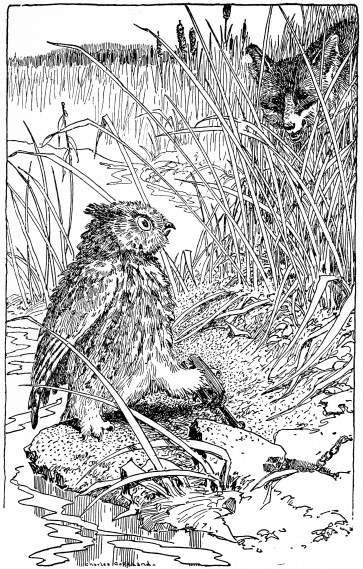
hungry, and perhaps when the big yellow sun ball actually came from behind the mountain, where it slept all night, then he would be able to find something quite different to eat, some new delicacy, for, with more light, he would certainly be able to see very much farther, instead of becoming blind like a stupid bat. He determined to stay awake and test it all for himself. Accordingly, back and forth he gaily flew over the gradually lightening marshes. And just as he was beginning to get fiercely hungry, he suddenly spied a choice morsel of fresh meat lying right in plain sight near the brook. Headlong, down swept Solomon, and grabbed the coveted bait greedily, so eagerly that he failed to see the trap beneath it, until it had nipped his leg and held him firmly, a prisoner.
Solomon soon found out that the more he flopped and struggled about to get free, the harder did the cruel teeth of the trap bite into his leg; so, finally, he had to lie with outstretched, helpless wings upon the trap. Meantime, higher and higher crept the daylight into the sky, and finally out burst the big, hot sun in a great blaze, and the higher it mounted into the sky the greater became poor, foolish Solomon’s blindness. To add to his misery, the choice morsel of bait which he coveted, lay just outside his reach, and the trap bit and bit into his leg hotly.
In spite of his torment, Solomon began to know that unusual, daytime things, were going on all around him. Muskrats were taking their morning swim, splashing about in the water, and slapping their tails; birds, of which he knew nothing, sang beautiful, unfamiliar songs over his head. Thousands of sleeping gnats awoke and swarmed in the air, humming shrilly, while huge, lace-winged dragon-flies whirred close to his ears, and Solomon clicked his beak angrily at them as they swept past him. Then, to add to his misery, a whole drove of impudent little brown birds spied him, and began to tease and torment him. They would settle upon a near-by twig, then dart down upon him with little hateful “cheep, cheep, cheeps” of derision, flaunting their free wings saucily close to his half-blind eyes. Solomon beat his wings frantically to scare them off, but always they came back again to torment him. Next, a colony of crows came to drink at the brook and “caw, caw, caw’d” jeeringly at him; and all the time the hot sun beat down upon him and scorched and blinded him, so that he had to cover his eyes with their filmy lids, and defend himself as best he might. All day long Solomon endured the dreadful torments of daylight; then, when he was almost ready to give up, something happened.
“Pad, pad, pad,” came the sound of stealthy footfalls, and then right through the tall cat-tails and sedges came slyly Red-Brush, the fox; jauntily he made his way toward the trap, for his keen, pointed snout had caught the fresh meat scent. Picking his way cautiously over the brook stones he came, lightly leaping across to the trap. Red-Brush saw Solomon and bared all his sharp, white teeth, in a grin of joy and anticipation. But first of all he would eat the bait, then finish off with the young owl later. With a great bound he was on the trap, and instantly, with this the eight teeth of the trap were sprung apart, and Solomon’s leg was free. Then, even before Red-Brush could drop the bait, with a swift uprushing of wings Solomon was far above his head, and quite safe.
Solomon flew swiftly to the top of a lofty pine, and there beneath a limb, screened by dark, thick tufts of needles he sat alone and pondered. His foot was lame and stiff, and as daylight still lingered he blinked and winked to keep out the light. At last the hateful sun slipped away somewhere out of sight, and Solomon’s blindness began to leave him, and he saw with joy the moon, pale and yellow, come creeping back to its place once more. He recognized the swift, shadowy forms of his neighbors, the bats, flitting about again. And then poor, lonely Solomon, unable to contain himself any longer, for sheer homesickness sent forth a wonderful call of misery and longing, out into the night.
“Who-ooo-o-o, who-ooo-o-o,” he quavered, over and over again, and then before the last long “who-ooo-o-o” had fairly died away, away off somewhere over the tops of the tall pines came back an answering call, another “who-ooo,” and Solomon heard and recognized it as it came nearer and nearer.
So, unfurling his soft, moth-like wings Solomon flew off in the direction of the familiar call, and was soon lost in the darkness of the forest. Thus did Solomon return to his home and kindred in the knot-hole of the sycamore tree, and never after that did he stay out all night, or until daylight, and thereafter he became known to all the little wild dwellers of the woods as a very wise owl.