THE LITTLE WATER-CARRIER; OR, THE REWARD OF INDUSTRY.
Reading edition
"Mamma," said little Sidney Fletcher, taking his mother's hand and leading her to the window, "do look at that little boy who is carrying those water-buckets on his shoulders through the rain."
"Well, Sydney, I see him; but why did you wish me to leave my work? was it only to look at the little water-carrier?" inquired Mrs. Fletcher.
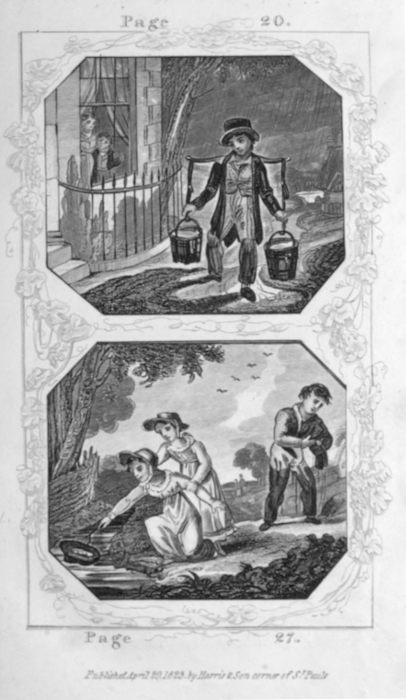
Page 20. Page 27.
Published April 20 1823 by Harris & Son corner of St. Pauls.
"I wanted, my dear mamma, to know what his name is; I thought you could tell me."
"And why did you want to know his name?" said his mother.
"Because," answered Sydney, "he seems so industrious. Charles and myself often sit and watch him from the school-room window. He comes from behind that opening in the street, going to work very early, and keeping on till it is almost dark; don't you think the poor fellow must be very much tired before night?"
Mrs. Fletcher was pleased to see the amiable disposition of her child, and said,
"My dear boy, I have myself often observed the industry of the little water-carrier. I dare say he is a good boy; for he never appears discontented at his burden, but carries it cheerfully along, though it is certainly too great a weight for one so small."
"Indeed, mamma," said Sidney, "I do not think I should be near so patient as he is, for I would walk slower, and not go so often."
"Then you would do very wrong, Sidney: for if you were forced to work, would it not render the labour lighter to do it willingly, and make haste? That little boy ought to be a pattern for you and Charles."
"You are right, mamma, I do think, in what you say," observed Sidney thoughtfully; "for I got my Latin lesson done much sooner (though it was very hard) this morning, because I learned it fast, and did not leave off to look out at the window, or to play; and papa gave me this nice pencil-case, and said I was a good boy."
"Then, Sydney," said his mother, "I hope you will not forfeit your good name; and if your father says to-morrow evening that you are still a good boy, and have not done any thing amiss, I will give you the silver pen you have wished for so long."
Sidney was sure that he should be good enough to merit the pen, which he had long desired to possess. He was so pleased already with the thought of the reward, that he began jumping about the room for joy, making rather more noise than his mother's head could bear.
"I fear, Sidney, you are in a fair way of losing the pen, if you go on making so much noise, for that is not being good: but I do not wish to alarm you (for Sidney began to look rather grave); see, here are your sisters and brother, with your papa,"
Who then entered the room. Marcella, the eldest girl, was a year younger than her brother Charles, who was nearly fourteen years old: Sidney was eleven, and little Juliet eight. The two boys were studying the Latin language, with the help of their father; and Marcella French with her mother: as to little Juliet, she was as yet but in the first rudiments of English grammar. Mr. Fletcher instructed the girls in writing and cyphering with their brothers.
The rain having left off, the children put on their hats, and went to take a walk with their father. Mrs. Fletcher preferred remaining at home, to the great disappointment of Sydney, who was very fond of his mother; besides, he thought he should be less likely to err if she were with him.
Their way lay through a beautiful green lane, by the side of a wood. Charles, who was of a more serious turn than the generality of children of his early age, walked with his father, conversing on the various objects that met their view as they proceeded; whilst the other children tripped gaily on before, sometimes running races, and at other times gathering the wild flowers that grew in the hedges. Little Juliet at length called them.
"Come, come," said she, "and see what I have found."
Sidney and Marcella soon came running to the spot where Juliet was plucking wild strawberries.
"I would not eat any till you came up," said little Juliet.
"That was a good girl," said her sister.
Sidney kissed her for remembering them, but said, "I will not take them from you, for I know where I can get plenty;" and away he ran, till he found a large gap in the hedge, through which he climbed up the bank into the wood. Marcella begged him to return; but Sidney was deaf to all intreaties, and invited them to follow his example. Marcella would not, and told him how wrong it was to trespass on forbidden grounds.
"Oh," said he, "but I am not doing any hurt. Only see what a quantity of nice strawberries I have got in my hat: if you will hold your frock, I will throw you some."
"No, Sidney," said she, "they do not belong to us: we have no right to any of them."
"Why, if I did not pluck them the birds would, and you know the owner of the wood cannot hinder them," answered Sidney.
"Well, then," said Juliet, "consider how you are robbing the pretty robin redbreasts and the blackbirds of their food. Come back, come back, Sydney, for papa is close by."
"Wait a minute," said he.
"Make haste, then."
"Here I am," said he, jumping across the ditch, which, unfortunately for him, was at that part half full of dirty water, and the opposite side high and slippery. Just as he had gained the edge of the bank his feet slipped, and he fell back into the water up to his middle, and his new trowsers were dirted all over. With some trouble he contrived to scramble out, by the assistance of his sisters; and whilst they were trying to fish out his hat, which unfortunately had fallen into the ditch, and was now sailing about with the unlucky strawberries in it, Mr. Fletcher and Charles came up to where Sidney stood, dripping with wet, and wringing the water from his jacket.
"How is this, Sidney?" inquired his father: "have you been learning to swim in this clear stream with your clothes on?"
Sidney felt very much ashamed, for he did not like to confess how foolishly he had acted, and happening at this moment to recollect the silver pen, he conceived it was certainly lost: he therefore hung down his head and began to cry bitterly.
"Come, Sidney," said his father, "do not be such a baby as to cry: if you did fall into the ditch it cannot be helped; I dare say it was accidental."
But Sidney, who well knew how naughty he had been, only wept the more.
Charles having, in the mean time, by the assistance of his father's walking-stick, brought the hat and all its cargo safe to land, a suspicion of somewhat like the truth struck the mind of Mr. Fletcher, who demanded an account of the whole transaction. Marcella knew that her brother would rather suffer any punishment than tell a falsehood to screen himself, she therefore gave her father a brief account of the unlucky affair.
Mr. Fletcher observed, that the fault had brought its own punishment; and bade the children hasten home, as Sidney's wet clothes might do him a serious injury, if they were not speedily changed.
Sidney ran into the parlour, and with tears of real penitence confessed the fault to his mother.
"Well, Sidney," said his good mamma, "I am not very angry with you, as you have candidly told me all. But I fear the pen is forfeited; and you must not mind having to appear in those dirtied clothes, for I cannot afford to buy you new ones yet. I think you will take more heed, and not be so naughty for the future."
Sidney kissed his dear, kind mamma, and declared that he deserved to lose the pen, and wear the spoiled clothes, as a warning for him never to act contrary to the good advice of his sisters.
His mother then bade him change his clothes and return again to her. In about ten minutes Sidney returned, looking very clean and neat in his everyday clothes. He found his father, and brother, and sisters in the room. When he came in Mrs. Fletcher said, "now, children, I have some news concerning your little favourite the water-carrier." The two boys got on each side of her, eagerly asking her what she had heard about him.
"If you will have patience I will tell you, said Mrs. Fletcher. As soon as you were all gone, I put on my hat, and went to pay my milkwoman, Mrs. Beals, who lives under the same roof as the little water-carrier. There I learnt that he is a French boy, who has neither father nor mother, but only a blind grandfather, whom he entirely supports by his industry. This was enough for me; I tapped at the door, which was opened by the little fellow himself. He had been drawing water from the well; but on perceiving me he left his pails, and came up, cap in hand, and having dusted a chair, begged me, in the best English he could speak, to be seated. At one end of the kitchen, which, though scantily furnished, was very clean, sat an old man, with white hair and a long silver beard, splitting straw."
"An old man, with a long white beard!" exclaimed all the little children; "how funny he must have looked!"
"Did you not burst out a laughing, mamma, when you saw him?" asked little Juliet.
"No, indeed: I did not commit so foolish and cruel an action, as to laugh at an old blind man," said Mrs. Fletcher. "But are you inclined to hear the rest, or I shall leave off?"
"Oh no, dear mamma, do not leave off—pray go on," cried all the children in a breath.
"Well, I did not burst out a laughing, as you supposed, Juliet, but I took a seat close by the old blind man, who rose and asked Louis in French whether he had given the lady a seat, for he knew me to be a female by my voice. Now, children, I must inform you that the conversation was carried on in French; but as you do not understand that language, I shall give it you, as near as I can remember, in English.
"I told him that I was a neighbour, and hearing that he was both blind and ill, had come to see if I could render him any assistance. He expressed his gratitude, and said that he had been very sadly, but, by the blessing of God, he was now much better, owing to the care and tenderness with which his little grandchild had nursed him.
"I then told him how interested you all were for the little water-carrier. The old man smiled with pleasure, and said, 'Louis is indeed a good boy, and God will take care of him, and bountifully reward him for all the dutiful kindness he has shown to me.'
"He told me that Louis was nearly fifteen years old.
"'How long have you, then, been in this country?' asked I.
"'Nearly four years,' said the old man, 'during which time my son Louis has supported me by his industry.'
"I then asked him why he came to England. He said, 'Oh, lady, when the wars and the troubles broke out in our own country, I was too fond of my king to fight against him, so with my son and daughter, and this little Louis, I embarked, with what money we had, for England; but a storm came on in the night—the packet was wrecked, and my two children perished in the waves. By some miracle, myself and my grandchild were saved: but we lost all our property. You may be sure, madam, that I sorrowed greatly for the loss of my dear children; I would much rather it had pleased God to have taken me instead, or all of us together: but it was not so, and His will be done. I was enabled to reach London by the charity of a worthy gentleman, who likewise put me in a way of earning my bread by straw-work.'
"I relate this to you, as near as I can, in the same way old Justin told it to me. But to go on: he lived in this manner some time, but at length he fell sick of a fever, which deprived him of that greatest of all earthly blessings, his sight. His friend, the good gentleman, died suddenly, and Justin had exhausted all his little savings in medicine. Being blind he was unable to work, therefore what was he to do? Louis indeed had learned the art of working in straw: but he was very young, and his time was fully taken up in attending on his sick grandfather.
"On Justin's recovery, his landlady, finding that her lodgers had no means of paying their rent, advised him to travel down to one of the large towns, where he would get a double price for his straw baskets; besides which, she assured him that Louis would die, shut up in the close air of London. Pleased by the hopes which the woman held out to him, Justin and his grandson set off to travel down into the country. He said he did indeed experience great kindness from the people. He did not like to beg—he had never in his life before asked for a piece of bread; but the silent pleading of his little Louis, and his own forlorn state, moved the charitable hearts of the English to pity and relieve them."
Here Mrs. Fletcher paused to take breath.
"Well, mamma, go on," said Sidney, impatient to know what became of poor Justin.
"Do, dear mother, tell us all," said Charles and Marcella both together.
"Well, my dears, at last they came to this city, and a good widow took them into her house till they could get some employment. It was at a time when water was very scarce, as it often is at this part of the city, and water-carriers being in great request, the good widow heard of a place where Louis might probably earn some money. Louis was very happy to hear of this, and being fitted out with pails, he commenced his new employment, and worked so hard, that at the end of the week he brought home to his grandfather seven shillings. The benevolent widow, though she was in very moderate circumstances herself, would not take any payment for the time they had been at her house, and, not content with this kindness, she engaged to dispose of any little trifle they could manufacture in straw, to the ladies at whose houses she went to work.
"'You may be sure, madam,' said old Justin, 'that we were very grateful for the benefits bestowed by this excellent woman; but we insisted on her sharing the profits of our little works. Louis gave great satisfaction wherever he went with his water pails. One lady took a great deal of notice of him, because of his beautiful curling hair, and presented him with a new cap; another lady gave him a trifle to hear him talk in his broken English. Louis continued to work so hard, that I was fearful he would ruin his health; he now always earned eight shillings every week by carrying of water, besides putting our little dwelling to rights, and settling me to my employment, which was only splitting and preparing straw for him against the evening, for then he fell to work himself, and soon made straw baskets and boxes much quicker and neater than I ever could." The well whence Louis drew the water was at some distance from their lodgings, and the kind-hearted widow procured the rooms they now inhabit at a low rate. Being now close to the water, Louis was able to carry a great deal more in a day; they went on for about a year very comfortably, but at length old Justin fell sick, and then it was, Sidney, you used to see Louis working so hard in the rain, and beginning so much earlier, and keeping on till dark in the evening, that he might earn enough to support his sick grandfather. A little after this, their good friend the widow was forced to go up to London, to attend a daughter who was taken ill. I have now told you, my children, all that old Justin communicated to me."
"Oh, thank you, dear mamma," said Sidney, "for telling us all this. But what did Louis say to you?"
"Why Louis took my hand, and said, 'May God bless sweet lady, for you much good and ver kind.'
"I asked him two or three questions in English, and, among others, if he could read. He considered a minute or two, and then said very quickly, 'Louis no book—me no read.'
"I then asked him who taught him English?' He said, 'Good lady widow teach Louis English; me know none before.'
"I now spoke to him in French, and asked 'if he were contented with his present situation.' You should have seen him then, Sidney, how his black eyes sparkled with joy when he heard me address him in his native language! He answered me with great animation and vivacity, 'Oh, yes, Madame, I am quite contented, for I can honestly earn my bread; but I should be happier if I had more time to attend to the wants of my poor blind grandfather; and this I should have, if it were possible for me to work entirely on the straw.'
"I told him that he was a good boy, and that I would come and see him again. This was all that passed between Louis and myself, only I found that he had taken great pains in endeavouring to teach his grandfather a few words of English; but, alas! poor Justin was too old to learn a strange tongue."
"Oh, dear mamma," exclaimed Charles, taking his mother's hand as he looked wistfully in her face, "cannot we do something for poor Louis and his blind grandfather, that he may not be obliged to work so hard?"
"That is exactly what I wished to consult you all about," replied Mrs. Fletcher. "What will be the best plan to pursue? Charles, you are the eldest, and shall speak first."
"I would get Justin into the blind hospital," said Charles, "and then you know, mamma, we could put Louis to school."
"That will not do," rejoined Mrs. Fletcher: "for, in the first place, I am pretty sure that Louis would not quit his grandfather; and besides I do not see what good would result from putting Louis to school."
"Oh," cried Sidney and Marcella at once, "let us put all our money together and buy Louis some new clothes."
"That is much better," said their father, "and you are very good children to offer it; but I think I can improve on your plan still more."
"Do, dear papa, let us hear what you think best," they all said.
"You said just now, Sidney," answered Mr. Fletcher, "that you would all put your money together and buy Louis a suit of new clothes; now, if you will agree to that, I will make a contract with my friend Newman, who keeps the great toyshop at the bottom of Queen Street, to take all the straw ornaments, baskets, and whatever Louis makes, at a reasonable price. This I think can be done; for I heard him the other day expressing a wish that he could meet with such articles ready made here, as sending for them from London made them come very expensive."
"And as Justin can split and prepare the straw, ready for Louis to work up," said Mrs. Fletcher, "I have no doubt but they will by this mean gain a very comfortable livelihood."
The children unanimously agreed that this was the best plan yet thought of, and were all eager to have it put in immediate execution; accordingly they all ran to fetch their stock of cash. Charles had six shillings, which he had been a long time saving up to buy a flute; and in addition to this he had a new crown piece, which his uncle Fielding had sent him at Christmas, when each of his sisters and his brother had received a similar present. "I am sure," said he, "my uncle will not be angry if I give this to clothe poor Louis, so here are eleven shillings of mine."
"And I have nine shillings and six-pence," said Marcella, emptying her little treasure-box into her mother's lap.
Sidney had, with the new crown-piece, in all eight shillings, and some halfpence; but poor little Juliet (who could never pass either a cake-shop or a beggar while she had a penny in her pocket), now slowly advanced with her mite, which consisted of the enormous sum of three halfpence.
Mrs. Fletcher smiled at this donation, but it was rather a wonder that Juliet was mistress of so large a sum.
"Well, my dears," said their mother, "as you have all so generously given up your money, you shall go with me after tea to chuse some clothes for Louis. Charles, you are nearly of his size, so you shall be fitted for him."
The children jumped for joy whilst anticipating the delight which Louis would feel when newly clothed by their liberality; and after tea they went with their mother to a large warehouse of ready-made clothes, where, after some consultation, they made choice of a suit of good gray mixed cloth, a pair of shoes, and two strong pair of stockings. In the mean time Mr. Fletcher called on his friend Newman, who agreed to take all Louis's straw work, provided it was neatly wrought, and he was very glad to find one who would serve his shop so near home; he promised to call on Louis and look at some of his baskets, and if they were well made, he said he would keep him in constant employ. This being happily settled, Mr. Fletcher and his benevolent family returned home, much pleased with the success of their scheme.
It was too late that night to mention any thing to Louis; but the next morning, after the children had finished their studies, Mrs. Fletcher took them all to Justin's cottage, and Marcella was permitted to carry the bundle. On their tapping at the door, Louis, who was cooking a morsel of dinner over a little fire, sprung forward; and taking Mrs. Fletcher's hand, exclaimed, while his dark eyes sparkled with animation, "Her come agen! her come agen!" Mrs. Fletcher smiled at his imperfect attempt to express his joy at seeing her. "Here, Louis," said she (addressing herself to him in French), "here is a reward for the dutiful care you have taken of your grandfather."
Marcella advanced, and Louis gazed in silent wonder as she unfolded the bundle, and displayed its contents; indeed he seemed almost struck speechless with astonishment, whilst he looked alternately at the clothes and at his kind visitors. Mrs. Fletcher, perceiving his emotion, took him by the hand, and said, "Compose yourself, my little fellow, and try whether this suit will fit you."
Louis retired into an inner room: but soon returned so much improved in appearance, that his young friends could scarcely recognize in him the little ragged water-carrier whom they had been accustomed to see.
Justin now advanced to thank them for their bounty; and his joy was much increased when he was informed that Louis would be no longer forced to carry water pails for his subsistence, but would pursue his straw-work, and remain always with him. Mrs. Fletcher perceiving a sudden gloom overspread the face of Louis, asked him in French what was the matter.
"Ah, Madame," replied he, "I was thinking what pleasure my poor grandfather would have had in seeing his little Louis in these beautiful new clothes; but, alas! he is blind, and cannot see any thing."
The aged Justin laid his withered hand on the shoulder of his grandson, and said impressively, "My child, do not repine at the will of the Almighty. It pleased God to deprive me of my sight; yet he has had great blessings in store for me. It was only for you, my Louis, that I feared; and it has pleased heaven to listen to my prayers, and to raise up these kind friends for you. God bless and reward them as they deserve!"
Mr. Fletcher now entered the cottage, with his friend Mr. Newman. With a trembling hand Louis produced the specimens of his work, which were in a manner to decide his fate; but the toy-man was so well pleased with them, and so deeply interested in the little manufacturer, that he assured Louis he should never want employment whilst he lived, nor a friend while he continued to deserve one.
Mr. and Mrs. Fletcher kindly invited Louis and his grandfather to spend the remainder of the day with them, to the great joy of the children, who liked Louis better than ever; and they have often looked back with delight upon this day, as one of the happiest in their lives. Sidney at night received the silver pen, and a kiss from his mother, who said he had well deserved it.
While Justin and his grandson were at the house of Mrs. Fletcher, she ordered a few light chairs and some plain furniture, with materials to assist Louis in his work, to be conveyed to their cottage; and little Juliet who had bitterly lamented the smallness of her subscription to the purchasing the clothes, now begged her mother to allow of her presenting something of her own.
Mrs. Fletcher gave her leave to carry to the cottage a pot with a beautiful geranium, which had been given to her some time before. She placed it on the window where old Justin usually sat, who had the pleasure (though he could not see its beauty) of inhaling its delightful perfume, as he sat splitting the straw for Louis's work.
Louis would never part with his water-pails, which were always placed in a conspicuous part of the cottage, "for these," he said, "first introduced me to the notice of my dear friends." And when, with a heart overflowing with joy, he has expressed his gratitude, Mrs. Fletcher would often answer, "remember, Louis, this was the reward of industry."
When Mrs. Dormer had finished the tale, she said to her son, "William, do you like this story? or do you prefer to hear about giants, and dwarfs, and fairies?"
William looked very thoughtful for some time: at last he said, "no, mamma, this is certainly the best; for it seems more like the truth, I dare say all these things really happened; while you know even little Louis would laugh at me if I really believed there ever were such creatures as fairies."
"Ah, William," said Mary, "but there are some very beautiful stories about fairies. Do not you remember the story in verse which mamma read to us some time ago? It began thus:
"In Britain's isle, and Arthur's days, When midnight fairies danced the maze."
"Oh yes, Mary, I remember, and I wish mamma would read us some more tales like that."
"I must find them first, Willy," said Mrs. Dormer, "for that tale stands alone in the English language: I do not remember another that equals it in beauty. But you must be content with hearing the adventures of children like yourselves, for my stock of fairy lore is almost exhausted."
"What is the name, dear aunt, of the next story you mean to read us," asked Kate, "for I peeped into your desk when you took the last out, and I saw that you had a good many more left."
"That will depend on circumstances, my love," replied Mrs. Dormer. "I do not know which I shall read first. But I will tell you what you will like better; and that is, our friends Mr. and Mrs. Matthews have sent an invitation for you all to spend to-morrow afternoon with them. We shall have a delightful walk across the heath; and you, William, will see your little friends—for George and Edward have come home for the holidays."
This news gave great delight to the little Dormers, and they spent the evening anticipating the pleasure of the morrow, and in hoping and wishing for a fine day.
William's eyes were opened by six the next morning; he ran to the chamber where his sister and cousin slept, and tapping at the door, asked them if they would get up, as it was a fine morning, and study their lessons in the garden before breakfast, and then they would be done very early when their mamma was teaching them. This proposal was perfectly agreeable to the little girls; who, after dressing themselves and saying their prayers, went into the garden, and with lively spirits enjoyed the delicious freshness of a lovely summer's morning. Here they walked up and down, studying very diligently till they had their lessons by heart, and already looked forward to the pleasure of their mamma's praise.
All this was very well, and they walked some time very soberly, till little Louis came into the garden, saying he had some very hard words to learn, and intreating his sister Mary to pronounce them for him. Mary very good-naturedly complied, and sat down on the seat under the fir tree to con them over with him.
Kate and William, though good children were sometimes inclined to be giddy, and this morning they were in such high spirits, that they were more careless than usual. Unfortunately, chance led their steps towards the poultry-yard, which was separated from the garden by some pales and a wicket. They opened the gate and passed through, to look at some nice broods of ducks that were just hatched. Kate stood several minutes admiring the soft yellow ducklings, and did not notice what William was doing, till he called her to partake in some sport which he thought very delightful. He had laid a plank (left there by accident) across a small dirty pond, dug for the convenience of the ducks, and was racing backwards and forwards so cheerfully on this board, that giddy little Kate thought she must follow his example. After they had amused themselves for some time with this diversion, William took it into his head to jump from the plank across the pond, and as it was a very little distance, he did it easily. Kate endeavoured to follow, but as she was not used to leaping, it is no great wonder that she plumped up to her waist in the dirty water. They both shrieked in concert for help; and the gardener being fortunately near the spot, soon pulled Miss Kate out of the mud, and carried her in his arms to the house. In their way they met Mary and Louis, who had been alarmed by the cries of Kate: Mary was terribly frightened at seeing the water stream from her cousin's clothes; she ran to her mother's door, crying, "pray, mamma, come quickly, for I fear that Kate is drowned."
Mrs. Dormer was much astonished, for she did not think Kate could get at any water sufficient to drown herself. However, she hastened to the children's room, where she beheld the weeping Kate, with the house-maid busily employed in taking off her wet clothes. Mrs. Dormer's first care was to hurry the imprudent child to bed, and cover her up warm, while her clean clothes were airing. She then demanded the particulars of the disaster; and, on hearing the whole affair, could hardly help laughing. However, she comforted the weeping girl by saying, if she had not taken cold there was no great harm done, and, promising to send her up some warm tea, she retired; whilst Kate was greatly troubled for fear she should be made to lay in bed all the day.
When Mrs. Dormer entered the parlour, she perceived William, looking much like a culprit.
"So, Sir," said his mother, "it was you who led your cousin into this mischief."
"It was, dear mamma, but I am very, very sorrow," answered William.
"Consider," said Mrs. Dormer, "the delicate state of your cousin's health, and how fatal such an accident might have been if her wet clothes had not been taken off directly. I do not think she will be ill as it is, but hope she will be able to go to Mrs. Matthews's this afternoon.
"I suppose, mamma," said William, "as I have been so bad a boy, I am not to go?"
"You well know," said his mother, "that I never punish an act of carelessness as I do any thing criminal, therefore I shall trust to your own good disposition, that you will not err in a like manner for the future."
William kissed the hand of his kind mamma, and said, "I did indeed think of Sidney's jumping into the ditch, just as Kate fell into the pond: but you know, mamma, that was too late. We should have thought on it before we played such a foolish trick."
After Mrs. Dormer had done breakfast she went up and dressed Kate, who had taken no hurt. The children finished their lessons very soon: and Mrs. Dormer told them there was time for a good deal of play before dinner. "I think," added she, "I can answer for Kate's keeping out of the duck-pond."
On hearing this remark Kate hung down her head, and looked very foolish—at last she said, "I would rather not go out, aunt. If you would read us a story I should like much better to sit still and hear it."
Mrs. Dormer smiled, and unlocking her writing-desk, selected from among her papers the tale of
THE MIDSUMMER HOLIDAYS.
"Mr. Howard and Mr. Russel were near neighbours; indeed their grounds were only parted by a clear stream, which flowed between the two gardens: they were both widowers, and each had one son.
Mr. Russel was an old captain retired from service, with a small fortune and his pay to live on.
His neighbour Mr. Howard had been a banker in London, and having amassed a large fortune, withdrew from the fatigues of business, to enjoy the remainder of his life in the quiet retirement of the country.
These gentlemen were much alike in all their pursuits: they were both fond of gardening, fishing, and smoking; yet they did not visit, though they often entered into conversation across the river, when they were fishing opposite each other.
Mr. Howard's son Philip, or Phil as he was generally called, was nearly of the same age as Captain Russel's Harry. Captain Russel would not send Harry to school, for he did not approve of that method of education; Mr. Howard, on the contrary, kept his son at a public seminary, and only suffered him to return for a short time during the Midsummer holidays. He allowed him, indeed, to pass the whole vacation with him at Christmas, when he thought that he could do the least mischief; and then Phil would much rather have been at school, for his father made him study as closely as he did there.
As to Harry Russel, he was the most unlucky boy that ever was born. He was always in mischief, robbing the farmers' orchards, or trespassing on their grounds, to deprive the poor innocent birds of their eggs and young. There always was some complaint being brought in from the maids, such as, "Sir, is Master Russel to steal the pipes? he has got away ever so many."
Then when Captain Russel went to shave, he found all his shaving soap gone: upon inquiry, it always was, "Why, Sir, Master Harry would take it; he said it was only to blow bubbles with." Poor Captain Russel was always in a passion: for before he was cool from one he was thrown into another. There was the gardener, with, "Sir, Master Harry will tread on the border, Master Harry will run in the high grass, Master Harry will pluck the fruit;" but, in general, it ended with, "Master Harry will take the boy away from his work, to play with him." Thus was the Captain constantly tormented.
Captain Russel would not permit his son to visit, or receive visits, from any of the young gentlemen in the neighbourhood, for fear of having his flowers gathered, and his garden injured.
Harry, who was of a very social disposition, rather than not have playfellows, made companions of his father's cow-boy and all his ragged brethren; for Mr. Russel kept a cow, and this boy tended her, and worked in the garden.
Another of Master Henry's bad tricks was taking a large stick, and dabbling in his father's favourite fishing place; whenever he was found so employed, he received a good thrashing from the captain, which you must acknowledge he richly deserved.
Now the Midsummer holidays approached, and Harry heard Mr. Howard tell his father that Phil was coming home to spend a week or two with him. This greatly rejoiced Master Hal, for he was very curious to see his neighbour's son, of whom he formed great hopes.
At length the wished-for day arrived, and Harry ran down to the river to watch for young Howard's appearing in the opposite garden. He did not wait long, for a loud shout made him run to the banks of the stream; and there stood the long expected Phil, throwing stones into the river to scare the fish.
Now it was very delightful to find a companion; but Harry thought it still better for him to be as mischievous a creature as he was himself. They soon greeted each other with great glee, and stood talking some time across the river. Phil invited Harry to come over to him.
"No," said Harry, "I cannot do that, for I do not choose to undress for a swim."
"Then come with your clothes on," said Phil; "look, here is a shallow place."
Harry sat down on the grass, and pulling off his shoes and stockings, threw them over to Phil; he then paddled across the river with great expedition, and was joyfully welcomed by young Howard. For a long time they walked about, keeping at a respectful distance from the house for fear of being seen by Phil's father; and, as they had many things to talk about, they did no great harm that day.
From this time the two boys became such friends, that, regardless of their fathers' express commands to the contrary, they were seldom or ever apart; and as they were commonly walking arm and arm in one or other of the gardens, nothing could remain undisturbed for them; the gardens were robbed of the best fruit, and the newly raked beds were completely covered with footmarks.
One day Mr. Russel, looking out of the chamber window, was not a little surprised at beholding his son perched in one of the great cherry-trees which grew on the grass-plot in front, and Master Phil in the other. In a tone of great displeasure, he demanded what they were doing there?
Phil replied, without leaving off eating, and with the greatest audacity, "we are keeping the birds off the cherry-tree, Sir."
Mr. Russel was greatly enraged at the cool impudence of this answer; and though he made no reply, he muttered to himself, as he turned from the window, "these are your Eton tricks, young gentleman; but your back shall pay for it." He then ordered the culprits to be seized as soon as they left the trees, and to be brought before him.
This was accordingly done; and the luckless pilferers, when they were preparing to escape, were caught and carried before Mr. Russel, in spite of all their kicking and struggling. The captain stood ready to receive them with a horsewhip, which he laid over their shoulders pretty smartly; and though they implored for mercy, and promised never to misbehave again, the captain knew that such promises could not be depended on. When he thought he had punished them sufficiently, he sent his own boy sobbing to bed, and followed Master Phil, with the horsewhip in his hand, threatening that the next time he caught him on his side of the stream that he would give him twice as much; when Phil, on reaching the stream, boldly plunged in, shoes and all, and splashed over to his own garden, and ran to the house, crying bitterly.
Though Mr. Howard knew that Phil had well deserved the stripes he had received, yet he did not choose that any one should chastise his son but himself, and he told Captain Russel so the next day. Captain Russel said he had borne with young Howard's lawless conduct long enough, and he would put up with it no longer, but whip him home whenever he caught him trespassing on his grounds, and Mr. Howard might do the same by his Hal, if he liked it. Mr. Howard declared, if he came plaguing him, he would; and then told Captain Russel it was his unbearable boy who had spoiled and corrupted the manners of Phil. This Captain Russel denied with some warmth, and retorted the charge; high words now arose between the fathers, and, though I am sure neither had any reason to defend their children, the two gentlemen parted in great wrath; but both agreed to horsewhip the first boy that entered the other's garden.
It was not long before Mr. Howard put his threat in execution, for in defiance of these prohibitions, Phil and Hal went into Mr. Howard's meadow, and were amusing themselves with swinging on the great gate. This made Mr. Howard very angry: he bestowed on them a good caning, and sent Hal Russel roaring home. One would have thought this might have cured them of their improper behaviour, but they would get over into the forbidden gardens now as often as ever. Mr. Howard was at length so completely wearied by his son's mischievous tricks, that he determined to shorten his holidays by three weeks: poor Phil was accordingly doomed to depart on the next Monday. But on the preceding Saturday he invited Harry to come over, and have one last gambol in the garden. He told him there was an early plum-tree loaded with delicious fruit, just ripe, and persuaded him to come and have the first taste. Harry needed no very pressing invitation, and having forded the river, he proceeded with his companion to the plum-tree. The fruit was indeed tempting, and Harry mounted with great expedition: but he had scarcely tasted one plum before Phil called,
"Come down, Harry; make haste—my father is coming towards us!"
Harry was so hurried, that he forgot his usual dexterity in descending; his foot slipped, and he fell with such violence on the ground that his right arm and leg were broken. Mr. Howard, who had not before observed that Hal was in the garden, was instantly drawn to the spot by the screams of the suffering boy, whom he tenderly raised, and saw his servants convey him carefully home. He returned to his own house, and conveyed his son to a room which was utterly divested of all furniture, except a bed to sleep on; he then gave him a supply of bread and water for the day, and locked him in.
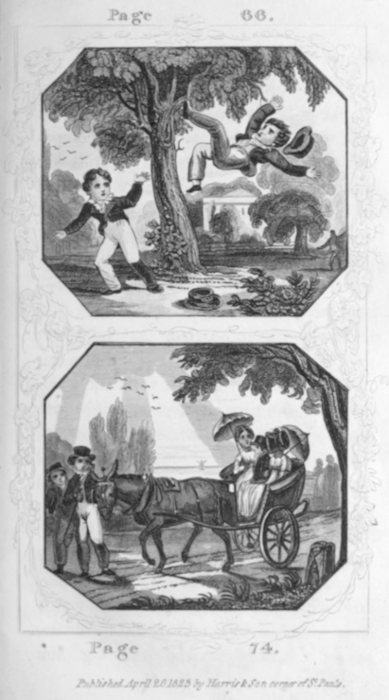
Page 66. Page 74.
Published April 20 1823 by Harris & Son corner of St. Pauls.
Phil, who had now leisure to repent of his folly and wilfulness, expected at least to be confined in this solitude till he was taken to school; and he grieved bitterly for the deplorable fate of his companion Harry, who might probably lose his life, or the use of his limbs. Many were the tears which he shed while eating his solitary meals, which were delivered to him in silence by a servant. Often did he wish for his father's presence, that he might ask his forgiveness; but three tedious days and nights passed on, and Mr. Howard did not appear. All the amusement Phil had, was looking out of a high and closely-barred window. He had not even a book to pass away the heavy hours, though he would have been thankful for the dullest that ever was written. On the fourth day, towards the evening, as he was sitting sighing in a corner, the door unlocked, and on raising his eyes, his father stood before him, looking very stern and severe. He took the culprit's hand in silence, and led him through the garden. Phil shuddered when he saw the fatal tree, the cause of so much sorrow, and felt thankful when he had passed it. Mr. Howard conducted him through their own meadow to a little bridge that crossed the river, and divided Captain Russel's field from theirs. The gate of this bridge was always before kept padlocked; but on this occasion Mr. Howard opened it, and proceeded to Captain Russel's house, and went up the stairs to Harry's bed-chamber. The curtains were closed round the bed, and Captain Russel sat there, reading the Bible aloud. When he saw Mr. Howard, he rose and gave him his hand. Mr. Howard asked if his patient were awake. "Yes," said Captain Russel, unclosing the curtains, and exhibiting to the weeping Phil his once healthy and blooming companion, reduced, comparatively, to a shadow. He was supported by a number of pillows, and looked like death. His hair, that used to curl in ringlets round his rosy, laughing face, now hung lank and straight over his sunken eyes and wan cheeks. This sad sight filled the heart of Phil with grief and remorse: he threw himself by the side of the bed, and hid his face in the bed-clothes to stifle his sobs. Harry stretched out his burning hand, and in a feeble voice desired him to be comforted.
"See, young man," said Captain Russel, "the fatal effects of disobedience: this might have been your fate: let this misfortune be a lesson to you for the future. I see I need say no more."
Phil was truly penitent: he sobbed as if his heart would break, and implored forgiveness with such unaffected sorrow, that the two gentlemen freely pardoned him. "From this time," he said, "I will be as dutiful as I was before disobedient, and if poor Hal does but recover, we will never be mischievous again."
"Think, Philip," said his father, "if Harry dies, you will have to answer for being the means of depriving Captain Russel of his only child."
Phil's grief now became so violent, that Mr. Howard thought that he had better take him away.
"Oh, Sir," said Phil (taking the hand of Captain Russel), "pray let me stay by Harry. I will sit quite still, and make no noise; indeed I cannot leave him."
The sick boy, in a low and feeble voice, begged that his friend might stay. Captain Russel kindly consented, and Philip took his station by the side of Harry's bed, and by every tender care endeavoured to soothe his pain and raise his spirits. When Captain Russel saw that Philip had naturally a noble disposition and a good heart, he would come and converse with him, and often praised him for the friendly attention he shewed his suffering friend. When Philip dared ask him questions, he inquired what had happened during the days he had passed in confinement.
"The first three days," said Captain Russel, "were passed by my suffering child in all the agony of pain and delirium; your father, very kindly, passed all his time with me, sharing my solicitude and grief. On the evening of the fourth day Harry recovered his senses, and earnestly begged to see you. Your father immediately went and fetched you, the rest you know."
Philip had a bed made up in his friend's room, and never left him but when the doctor was dressing poor Harry's leg and and arm: he then used to take a little air. At last Harry was able to sit up, but he was forced to hold his arm in a sling, and have his leg supported by pillows.
After some weeks Harry was sufficiently recovered to walk in the garden; and though he soon looked as rosy and handsome as before, still he always had a slight lameness, which served to remind him of his disobedience.
Philip staid at home till Harry was quite well, and then their fathers agreed that both the boys should go together to Eton school. This plan was carried into execution, and when they returned at Christmas they were so completely altered in their deportment, that their fathers beheld them with pride and pleasure.
You may be sure that the next Midsummer holidays were spent in a very different manner from those of the preceding year. Mr. Howard and Captain Russel had now become intimate friends, and often made a comfortable party by the river side, with their pipes and fishing tackle; and when the boys came, they would sit and play quietly at draughts, or chess, on a seat near them.
Hal was never heard to repine at this accident, but as he grew up he often declared that this misfortune had proved a blessing to him and Philip, and would warn any wayward children he saw in mischief to desist from evil, lest, like him, they should suffer from the bad effects of disobedience.
The cloth was laid for dinner by the time Mrs. Dormer had finished her story. The children all looked very grave at the end, and seemed much edified: particularly William, who said, as he seated himself at table, "I am afraid, mamma, you think that I behaved as bad as Harry or Phil this morning."
"No, Willy," said his mother, "what you did wrong was not the result of wilful mischief but was only for want of thought: for instance, if I had looked over the pales when you were dancing on the plants, and told you to come away, and never to do so again, I think I can answer for my William that he would not have disobeyed me."
"No, dear mamma," said William, "I hope I should not have been so wicked."
Just as dinner was finished, Edward Matthews drove up to the door in a donkey chaise, which he had brought, by the desire of his father, that the little girls might not be fatigued with walking in the heat of the day. Mrs. Dormer, with Kate and Mary, were soon ready; and Edward, having lifted the young ladies and little Lewis into the chaise, walked with William by the side of the donkey, leading him, and patting his neck. Mr. and Mrs. Dormer walked behind, and were greatly pleased with the attention and kindness of Edward: who, to say the truth, was a favourite with all the family. He was a fine manly youth of thirteen, but though he was by many years older than the little Dormers, he was so sweet tempered that they doated on him.
The little party proceeded joyously across the heath, exulting in the company of their dear Edward; who, poor fellow, had need of two or three pair of ears: for, in the joy of their hearts, the children all talked at once, telling him all the wonderful things that had happened to them since they saw him last.
The afternoon passed rapidly; and the children enjoyed themselves so much, that their indulgent parents, rejoicing to see them good and happy, delayed breaking up the party till the latest minute. When the hour of separation at length arrived, and they were preparing to depart, Mrs. Matthews asked Mrs. Dormer if she would permit her little family to join her sons in a party to Hampstead-fair, that day week. Now Mrs. Dormer had a dislike to fairs; but as Mr. Dormer seemed to wish it, and the children all looked up in her face with most anxious countenances, she would not withhold her consent.
The donkey chaise was again brought to the door, and the little Dormers had a charming ride home. Mary, in particular, was delighted at seeing the heath spangled with glow-worms.
"Oh, papa," she exclaimed, "do let me get out and catch some of the lovely creatures; I never saw any before."
"No, Mary," said her mother, "you must not run on the damp grass with your thin shoes. Look," continued she, holding up her handkerchief, which shone like a lamp, "see, Mary, I have collected a great many of the lovely creatures, as you call them, and will examine them when we get home."
Mary was highly pleased at this; but she could not help calling out, as she saw these beautiful insects shine brighter as the darkness increased: "Oh, mamma, there is another! do catch it."
All the little party were quite grieved when they turned down the lane that separated their house from the heath.
Sleep weighed too heavy on the eyes of all the children to allow them to look at the glow-worms that night, but in the morning Mary ran into her mother's dressing-room to look at the beautiful prisoners. She hastily took off the lid of a glass jar, in which her mother had placed them, and, lifting up some wet moss, gave almost a shriek of disappointment. "Oh, mamma," she said, "all the glow-worms have run away; here are nothing but some ugly brown beetles! I dare say they have eaten those pretty creatures."
"What a pity!" said Kate. "Dear aunt, let us empty the jar into the garden."
"No, my love," said her aunt, "let them alone; perhaps these beetles may bring us some tidings of the glow-worms." At that minute they heard Mr. Dormer below, talking to Edward, who had just arrived, with his little brother George. Mrs. Dormer, therefore, went down to ask them to dinner; which invitation they thankfully accepted.
In the cool of the evening, after the children and their guests had tired themselves with play, they all came up to Mrs. Dormer's dressing-room and begged for a story. Mrs. Dormer had prepared for them, there, a regale of cakes and fruit, and while they were enjoying it, she kindly read to them the story of
THE BLIND HIGHLAND PIPER.
"If you have finished writing those rules in your cyphering book in time, you shall go with me to the booksellers, to choose some books for your cousin Jane, and for yourself," said Mr. Percy to his nephew, Arthur Stanly, who was writing at a desk.
"Thank you, my dear uncle. What time shall you be ready?" asked Arthur, still continuing to write on.
"In about half an hour at farthest," said Mr. Percy.
"Shall you be ready by that time?"
Arthur cast his eyes over a long page of writing and figures which he had still to copy into his book, repeating, "Half an hour! I am afraid I cannot get it all done."
"I shall be sorry," observed his uncle, "to go without you; but I am engaged to dine with some friends precisely at two o'clock. It is now a few minutes past one: therefore we shall have but one quarter of an hour to walk there, and transact our business, and the other quarter to go home and dress in."
Arthur ardently wished that the time went slower.
"I think you have had plenty of time to finish this rule; it is now upwards of an hour since you began. What have you been doing all this while?" said Mr. Percy, looking over his nephew's shoulder.
Arthur felt much ashamed: he looked down at his feet, and began tying his shoe-strings without saying a word, for he did not know what excuse to offer to his uncle.
Mr. Percy still looked at him, as if expecting an answer; and at last he repeated the question.
"I was trying," said Arthur, "to catch a robin which flew into the room. I was very silly, and have lost a great deal of time by it."
"You was silly, indeed," replied his uncle; "but that is your concern, not mine. However, if you have finished by the time the hand of the hall clock points to half past one, you shall go with me. If your rule be written out neatly in that time, I shall give you great credit, if not you must remain at home. Here are two good pens for you."
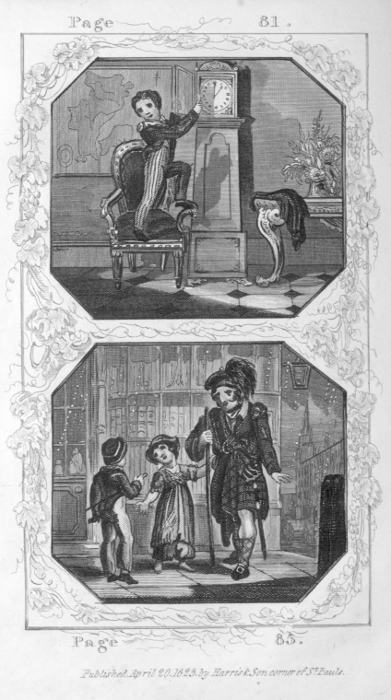
Page 81. Page 85.
Published April 20 1823 by Harris & Son corner of St. Pauls.
Arthur eagerly took the pens and began writing; but his uncle had hardly quitted the room, when the thought entered into his head that no one would be the wiser if he were to put back the clock a few minutes. Accordingly, without giving himself time to reflect on the gross impropriety of such an action, he opened the study door and looked out into the hall. No one was near; he listened a moment—; all was quite still. He then jumped upon a chair which stood near the clock, and, having carefully opened the door in front, put back the hand ten minutes. In doing this, however, he was under considerable alarm, for persons who are acting wrong are always in fear of being detected.
He now jumped from the chair, and ran back to his desk; but his hand trembled so much that he could hardly hold his pen. In a minute or two, however, he recovered himself, and just as he heard his uncle entering the hall, he finished his assigned task, happy for a moment in the success of his scheme.
His cousin Jane now came running into the room, and exclaimed:
"Arthur, papa is waiting for you; but he supposes you have not done yet."
"Yes, but I have, though," answered he, in a tone of exultation, and went into the hall with his book. Mr. Percy was standing with his watch in his hand, comparing it with the clock.
Arthur coloured like scarlet, for he feared to be detected in his guilt. He stood silent, and dared not raise his eyes to the face of his uncle.
But, far from having the least suspicion of what had been done, Mr. Percy only observed that he must get his watch regulated, for though he had set it by the clock that very morning, it was now ten minutes faster.
Arthur felt all the pain arising from conscious guilt. He hung his head in silence, whilst his uncle, glancing his eyes over the writing, exclaimed, "Very well, indeed! very prettily done! I give you a deal of credit for this; and so short a time as you had to do it in, too! Well, we shall see, if you improve so fast, what I shall do."
"Arthur, who had never deceived his good uncle before, felt more pain at this unmerited praise than if he had been punished as he deserved.
"Oh," thought he, "if my uncle did but know how wicked I have been, he would never forgive me."
Mr. Percy told him to put on his hat and great-coat, for they had no time to lose.
"Good bye, my little Jane," said Mr. Percy, as he shut the street door.
"Good bye, dear papa, and cousin Arthur," cried Jane Percy, going into the parlour.
"I never knew you so very silent before, Arthur: what is it you are thinking of?" said Mr. Percy, as they entered the shop of Mansel, the bookseller.
Arthur was spared the trouble of replying, for Mr. Mansel then came forward, and entered into conversation with Mr. Percy.
Arthur walked to the door: he scarcely knew what was going forward, his mind being too much occupied in reflecting upon his late transgression, and in considering what he had best do. At length he determined to tell his cousin, and ask her advice. He had not observed the people who were hurrying along to escape a heavy fall of snow, till his ear was attracted by the plaintive tones of a child's voice, asking charity. He looked up, and beheld a little girl without any shoes or stockings, leading by the hand a Highland soldier, who was very handsome, but quite blind. He appeared scarce thirty years of age: the tattered remnant of a plaid which was wrapt round him bespoke poverty and distress in the extreme, and scarcely sufficed to defend his body from the cold wind and snow. On his head he wore a sort of cap or bonnet, of various colours; through the many holes of which his yellow hair appeared, and waved to the breeze in long curls. By his side he wore an old sword, which made Arthur conclude that he was a soldier. The little girl had been asking relief of the passengers; but no one thought it worth while to stop, at the risk of getting wet, to inquire into the cause of their distress. One man rudely pushed the little suppliant away, calling her an impostor, and a little beggar brat. She then turned with a sorrowful look towards Arthur, who dropped into the plaid bonnet which she held in her hand all the halfpence he had about him, and inquired if her father were quite blind?
The tears stood in the little girl's eyes, as she turned them sorrowfully up to her father's face, and answered, "yes: he is quite blind, and very ill."
"Poor man!" said Arthur; "how much he is to be pitied! Is he a soldier?"
"He was once a soldier, but he cannot see now," replied the little girl.
"And what is your name?" asked Arthur.
"Flora Glengary?"
"And how came your father to lose his sight?"
As Flora did not immediately reply, the soldier, taking off his cap, said, "my good young gentleman, I was once a soldier, and served with the army in Egypt, but lost my sight by lightning. I then took my little girl, and came back to England, in hopes of being able to beg my way to Dunbar, my native town, in Scotland, where I had friends; but now I can get no farther, for I am very ill, and quite friendless. Before I lost my bagpipes I got on very well; but now they are gone, I believe my child and I must starve."
"And how came you to lose your pipes?" asked Arthur.
"I fell sick, master, and was forced to sell them for a mere trifle. Whilst I had them, I did not beg, exactly, for many people gave me money to hear me play."
"And how much would it cost you to buy them again?"
"I cannot get them back for less than half a guinea," answered the Highlander, sighing; "but we do not possess a sixpence in the world."
"Will half a guinea restore your pipes to you?" eagerly inquired young Stanly.
He half checked himself, however, as he put his hand into his pocket, and opened his purse; for he had no money, but one half guinea which his aunt had recently given him, with a strict charge never to part with it on any account. "My aunt will be very angry," said he, "if I give this money away; besides, it was in my dear father's possession for many years. I should like to keep it as long as he did." But when he saw the look of joy and hope which shone in the eyes of the anxious Flora, as she viewed the gold in his hand, he thought it would be cruel, indeed, to disappoint her.
"No, Flora," said he, "your father shall not starve while I have this, which I really do not want, only for its having belonged to my father." He then put the money into her bonnet, saying, "take this; buy the bagpipes, and some bread for your father: I have no more, or it should be yours."
He would now have retreated; but Flora forcibly detained him, eagerly seizing hold of his hand, and uttering a thousand thanks. At length, however, he disengaged himself, and returned to the shop with a feeling of happiness, which arises only from the knowledge of having performed an act of real benevolence.
"Arthur," said his uncle, "where have you been? I have been waiting for you some minutes. I have selected such books as I think will be the most proper for your cousin Jane. Now, what is it you wish to have?"
Arthur looked over several volumes which laid on the counter. "If you have no objection, Sir, I should prefer either Homer's Iliad, or Voltaire's History of Charles the Twelfth, or the Life of Gustavus Vasa."
"Any of these you can have," said his uncle; "it only remains for you to determine."
Arthur considered for a few minutes. "Homer I have read; we have it in the library. I have not read either of the others; but I admire Gustavus more than Charles, because I think he was the most amiable character. Well, then, if you please, Sir, I will take this," said he, choosing an elegantly bound pocket volume, containing the life of that excellent monarch, by Raymond. He wrote his name in it, and Mr. Mansel packed it up with the rest.
The fall of snow having ceased, Arthur returned home, and Mr. Percy proceeded to join his friends.
Arthur tried to read part of the life of Gustavus aloud, to his aunt and cousin: but, in spite of every thing, the misdeed of the morning would obtrude into his thoughts; he therefore made some excuse, and retired to the study, to consider what he should do.
As he passed through the hall, and raised his eyes to the clock, his conscience reproached him bitterly for his misconduct. He ran into the study, and throwing himself into a chair, covered his face with both his hands. It was the first fault of the kind he had ever committed, but that did not lessen it in his eyes.
Arthur bitterly lamented his idleness, when he first began writing. "If I had not tried to catch the poor little robin," said he, "this would not have happened; for I should have finished my writing in plenty of time."
Arthur actually shed tears of regret and sorrow at his own foolishness, in thus having been tempted to deceive his good and unsuspecting uncle.
While he was thus deploring his fault, Jane Percy softly stole into the room, and taking one of his hands from his face, said in a soothing voice,
"My dear cousin, what is it that affects you? Will you not tell your Jane?"
Arthur was moved by the gentle, persuasive voice of his amiable relative, and confided to her the cause of his sorrow. Jane was truly grieved that her dear cousin Arthur should have acted so extremely wrong; but she strove to console him in the best manner she could.
"Consider, Arthur," said she, "it is the first fault of the kind you ever were guilty of."
But this observation, far from comforting him, only added to his grief, as reminding him that he had now forfeited his good name. It was true, no one need know it but himself and Jane: but he was conscious of it, and therefore he could never again bear to be praised for being a good boy, when he knew he did not deserve that character.
"Dear Arthur," said Jane, "I think it will be the best to go to your uncle to-morrow morning, and tell him what you have done. He will not be so angry if you openly confess it to him; and I know you will never do so again."
Arthur tenderly embraced his little cousin, and thanked her for her good advice.
"Indeed, Jane," said he, "that will be the best plan: for I would rather my uncle should know it at once, and be angry, and punish me as I deserve; for then I might, by my future good conduct, atone for my transgression. But I never can look up in his face with pleasure again, knowing that I have deceived him."
Arthur now wished to tell his cousin about little Flora and her father; but a feeling of something like pride withheld him. He was afraid she might think he told her, only to lessen the crime he had committed in her eyes, he therefore remained silent on that subject; for Arthur knew well that a generous action, however excellent, did not obliterate the disgrace of deceit and falsehood.
The next morning, when Mr. Percy came into the study, to set Arthur and Jane their tasks, he offered to shake hands with his nephew, according to his usual custom; but Arthur, bursting into tears, exclaimed,
"Oh, Sir! I have been a very wicked boy, and am not worthy that you should shake hands with me."
Mr. Percy, much surprised, demanded an explanation; and Arthur, with great earnestness and simplicity, related what he had done.
Mr. Percy was sensibly touched by the sincerity of his nephew, though at the same time he was seriously displeased, for he did not like to be deceived by a child: he therefore finished setting the copies, and left the room, without saying a word; for though he would not punish Arthur, as he had so nobly revealed the truth; yet he thought, if he left him in doubt, it would operate on his mind as an adequate punishment. In this opinion he was perfectly correct: for poor Arthur, imagining that he had offended past all forgiveness, gave himself up to despair.
Jane herself knew not what to think, but she tried to comfort her disconsolate cousin; and whilst they were condoling together, they heard Mrs. Percy calling them.
"Come, make haste, children," said she, "come and hear the Scotch piper."
The sound of music was plainly heard in the street; and Arthur eagerly pressed forward to catch a glance at the musician. All the pain he had previously suffered was amply repaid at that moment, by the sight of the blind Highlander, and little Flora his daughter, who was looking, with the greatest delight, at her father as he played.
Arthur had the satisfaction of beholding many a handful of halfpence thrown into the plaid bonnet of the now happy Flora.
The Highlander came opposite the window. Mrs. Percy threw open the sash, in order to bestow a trifle on the piper.
Flora raised her eyes, and uttered almost a scream of joy, as she beheld their little benefactor: exclaiming, "There he is—there he is!—Oh, how glad I am to see him!"
Arthur hastily drew in his head; for he feared lest his aunt should be angry at his having parted with the half-guinea.
But Flora still continued jumping about, and calling for him to look out, and see how happy they were.
"What can the child mean?" said Mr. Percy, who stood with them at the window. "Let somebody call her in, and we will hear."
"No, no, dear uncle, do not have her in," cried Arthur, in a tone of entreaty.
But Mr. Percy, who was determined to know the reason, left the room, and hastened into the street; where he heard the whole account of his nephew's generosity from the lips of the grateful Flora.
At first he could scarcely credit it; but the truth was attested by the soldier, who, on hearing Arthur's voice, declared it to be that of his benefactor.
Arthur, with tears in his eyes, informed his aunt and cousin of the whole affair, saying, as he concluded,
"Indeed, my dear aunt, I could not help giving the money to them, though it had been my father's."
Mrs. Percy, far from blaming her nephew, applauded him as he deserved; as to Jane, she was, if possible, the happiest of the party.
Mr. Percy shortly after returned, and presenting his hand to Arthur, said: "I now give you my hand with the greatest pleasure I ever did in my life; your fault was trivial compared to your generous action, and I am at this moment prouder of my nephew than if he had been born a prince."
That very day Mr. Percy presented Arthur with the Life of Charles XII; and a beautiful edition of Homer, handsomely bound in purple morocco. He also raised a subscription among his friends, to enable the blind piper to return to the place of his nativity.
Arthur Stanly was often heard to declare, when he grew to man's estate, that these two days had been the most miserable as well as the happiest of his life.
All eyes were attentively fixed on Mrs. Dormer as she concluded, and the children agreed that this was the best story they had yet heard. When they had done commenting on it, Edward observed that it was getting dusk, and was time for him and his brother to be going. When he had taken his leave, the children sat talking with their mother till near dark, and Mrs. Dormer began to think it was almost bed-time. As Mary and Kate were bidding her good-night, the latter happened to look towards a flower-stand, on which Mrs. Dormer had placed the glass jar.
"Oh, Mary," cried she, "look, look! the dear little glow-worms have come back again!"
As she spoke all the children ran to the jar, which glittered among the plants, and every moment became an object of greater beauty, as the brilliant insects, one by one, unfolded their light, as if in emulation of each other, filling the vase wish lustre, and shewing every particle of the moss they laid on, as if it were transparent. The children gazed on it with the greatest admiration; at last Mary said,
"I can hardly help laughing, to think how silly I was in the morning; for I now see plainly the shape of the glow-worm is the same with the brown beetles I was so angry with."
"Oh, Mary," said Kate, "my aunt knew all about it, when she told us so gravely that the ugly beetles would bring us news of the glow-worms."
"I did, indeed," said her aunt, "for many summers ago I kept many of them in wet moss and grass till near autumn; at that time they laid some whitish eggs and died. These eggs, however, did not produce any thing; so I cannot tell you whether these insects assume any other form previous to that you now see them in; nor can I direct you to any book that will give you a satisfactory account."
"Dear mamma," said Mary, "they are far from being ugly now; for they are very brisk and lively, and constantly in motion, though in the morning they seemed half dead."
"It seems," said her mother, "that damp and dark places are necessary to to their existence; and yet they appear only in the warmest weather.
"But, Mary, there is another luminous insect, which some people mistake for the glow-worm: it is of a very disgusting shape, being a species of the centipede; it has, like that ugly insect, nearly fifty legs, on each side, and runs amazingly fast, leaving behind a long trail of greenish light."
"I should not like them at all," said William, "for I think the centipede is uglier than a snake."
"I have a great dislike to them, myself," said Mrs. Dormer; "but the luminous centipede is not so frightful as those black ones you see sometimes on cellar walls, and in old wood. I remember the first time I saw any of the bright centipedes: I was coming home with my brother in the evening, through a green lane; I saw something shine brightly in the hedge: I ran up to it, thinking it was one of my favourite glow-worms, but recoiled, with no little disgust, when I saw that I was going to lay my hand on a nest of these centipedes, all writhing and clinging together like serpents, shewing at the same time a brilliant light."
"Dear!" said William, "how horrid they must have looked! I suppose, mamma, you did not catch any?"
"No," said Mrs. Dormer, "I was then very young, not much older than Mary; and I could not conquer the antipathy I had to their hideous shape. But my brother took one, and brought it home, and when we looked at it by the light we found it was about two inches and a half long, of a pale brown, and certainly the best-looking of its species that I have seen."
The children would have been glad to have asked some more questions, but it grew so late, that their mother would not detain them from their beds, and they went away talking about the story and the glow-worms.
During the next week the children could think of nothing but the pleasure they were to enjoy at Hampstead fair; and all of them were continually wishing for a fine day. As the time drew near, Lewis and Kate were every minute running into the hall, and climbing one of the green chairs to consult the barometer; though I cannot say they understood much about it. However, the evening before the wished-for day Kate ventured boldly to predict beautiful weather for the morrow: they all retired to rest, therefore, in excellent spirits. But when they awoke in the morning the rain was descending in torrents, and the sky looked as dark and heavy as if the wet weather had set in for a week. The poor children passed the morning in great anxiety, frequently peeping out at different windows, in hopes of seeing a little bit of blue in the sky, and wishing in vain for the rain to clear off. When the afternoon came, and they were forced to give up all hopes of going, Mary retreated to a corner, and began to weep bitterly. Kate and her brothers came and tried to comfort her; but Mary had set her mind so much on going, that she only cried the more. Presently her mamma came in; and Mary, ashamed that her mother should see that she was such a baby as to cry for a little disappointment, hid her face in her frock: but still she could not suppress a sob or two. Mrs. Dormer came up to the corner where they all were assembled.
"What is the matter?" she said (putting Mary's frock from her eyes), "What ails my poor Mary? Is she ill, or has some one hurt her?"
Mary was much confused, and did not answer. Kate told her aunt that she believed her cousin cried because the rain had hindered her from going to the fair. Mrs. Dormer looked at Mary for some time, and then said,
"I dare say, Mary, you expect that I should ridicule you for being so weak as to cry; but I will not do so, for I see that you are ashamed of it already. Come out of your corner, and see whether I can convince you, that you might have gone to the fair, and it is possible you might have returned still more unhappy than you are now."
Mary dried her tears; and her mamma seated her on part of her own chair. The other children got their stools, and sat down by Mrs. Dormer.
"I remember the time, Mary, when I was as anxious to see the fair as you are now; and the day on which I was to go turned out quite fine, and yet I was very far from spending it happily."
"Pray, dear mamma," said William, "do tell us what happened; for I would as soon hear you tell a story, as go to the fair; only we should have liked to have spent another day with dear Edward."
"I had written down all that happened," said his mother; "I meant to have read it to you, one day or other, but I think this will be the best time; for however you may laugh at the comical distresses I got into, yet you would have found them very unpleasant, if they had befallen you to-day. Listen then, my children, and hear my account of
A DAY AT HAMPSTEAD FAIR.
It is now nearly nineteen years ago, since my uncle Richmond came to stay at this very house, with his two sons. You know, my dears, that your grandfather lived here before we did: I was then about eleven years old.
My uncle, Captain Richmond, was my father's brother, and the commander of a frigate in the navy; he had been on a long cruise, and was passing a few weeks with my father, previously to his going to sea again.
Captain Richmond had lost his wife: he had only two sons; one of whom went to sea as a midshipman, under his father, and the other to the naval academy at Portsmouth. This last was away from school for the vacation; so my uncle brought both of them to stay at my father's house. My poor mother had rather delicate nerves, and these rough sailor-boys discomposed her sadly: for they were as wild as tiger-cats, and as full of mischief as monkeys; they broke her china, insulted her lap-dog; stole her apples; ducked her hens in the pond (that very pond you are so well acquainted with, Kate); and above all, affronted my youngest brother Sam, who was my mother's pet. However, she bore with all these enormities, out of respect to my uncle Richmond, who was a brave, generous sailor, and sincerely attached to all his brother's family. This visit was agreeable enough to us children, only Frank and James Richmond were rather too rough in their play; and they sometimes fell out with my eldest brother, William, bestowing on him the epithets of "land-lubber," and "fresh water spark," when he displeased them. These disputes were generally settled by my uncle with a few strokes of a cat-o'-nine tails that he always carried in his coat-pocket, for the accommodation of his sons. I was always engaged in these quarrels, either on one side or the other; and as I never came in for a share of the blows, I was sometimes wicked enough to laugh at the speed with which my uncle chastised his boys, whether guilty or innocent; and at the coolness with which the stripes were received by the young sailors. My uncle always took it for granted his sons were in the wrong; but if the instrument chanced to glance on the back of either of my brothers, the house resounded with their lamentations.
They had been at our house about six weeks, and were going away in a few days, when the captain said to my mother one evening, "sister, to-morrow is Hampstead fair; and I should like all the young ones to go, and have a day of it."
My mother shook her head, and seemed to disapprove; but my uncle seemed determined to have his own way: besides, my brother Sam set up a loud fit of crying, for fear he should not go. This induced my mother to give her consent; and the nurse-maid, Ann, and our old nurse Hill, were ordered to hold themselves in readiness to attend us to the fair on the morrow. Now my father was in London, where he had to spend two days on business, or he might possibly have put a negative on this arrangement; but as it was, we were all greatly delighted with the plan, particularly uncle Richmond, who declared that he would go with us, and steer us safely along.
In the morning I was awoke by a loud shout under the window from midshipman Frank. I got up quickly, and found my cousins dressed in their uniforms, and looking very smart. Frank promised to be my beau, and to take great care of me. Well, it was past ten o'clock before we were all ready. At last, out we marched in the following order: the nurse-maid led my little sister Jane, and old nurse Hill the darling Sam, of whom my mother had given us all special charge; then came Frank, handing me along very politely, and Captain Richmond, with my brother William and cousin James, brought up the rear. In this manner we proceeded very sedately till we almost reached the town, and began to hear the noise and bustle of the fair. Just as we came to the houses we met a party of naval officers, who began shaking hands with Captain Richmond, and telling him about some recent victory at sea. Away went my uncle Richmond with them, without bestowing a thought on us poor children, whom he had under his care. Then my troubles began. Master James had behaved very peaceably while his father's eye was on him, for he stood in some awe of the cat-o'-nine-tails, which he saw the Captain put into his pocket before he set out; indeed his father said to him, "Jem, if you are not on your best behaviour, you will have a taste of it." But the moment his father was fairly out of sight he began his pranks; he twitched his hand from William, and scampered some way before us, until he met with a quiet old hen, clucking in the dusty road with a few dirty chicks: the moment James saw the hen, he stole softly up, and putting his foot under her, by a dexterous toss, sent her cackling and screaming up in the air, as high as the garret windows of the next house. After performing this exploit, he ran laughing back to us. Now the old woman who owned the hen was enraged to see the unusual flight of the poor creature, and running out, began to abuse James in a very shrill voice, not sparing us, to whom she saw he belonged; but we had certainly no share in the mischief. Mrs. Hill, our nurse, was a woman of too much spirit to put up with so much injustice; she began to scold in return, while the idle boy who had caused the quarrel stood laughing, and provoking the old woman to greater rage. Frank enjoyed the fray as much as his brother, but at last he attended to my intreaties, and persuaded Mrs. Hill to walk on, and leave the angry old woman: but he could not prevail on our good nurse to proceed, till she had quite exhausted her breath in scolding.
Master James seemed to think very highly of himself for this trick; he marched before the whole party with his arms a-kimbo, kicking up the dust, and on the look-out for another mischievous prank. Mrs. Hill, when she had recovered her voice, scolded James for raising the dust: he answered saucily; she retorted, and they entered the fair, wrangling as hard as they could.
When we got among the crowd, James and William escaped from us, and got into a merry-go-round. Frank very kindly staid with me, and handed me about the fair. Sometimes we stopped to look at the fire-eaters, and sometimes to view the Merry-Andrew. The sun shone very hot; and after we had been in the fair about an hour and a half, I became very faint and tired. The place got more and more crowded, and I could hardly move among a throng of people, most of whom were a foot taller than myself. Frank helped me through as well as he could, and we were making the best of our way towards a fruit-stall, when a saucy little drummer pushed me so rudely that I was nearly thrown on my face. Frank asked him how he dared act so? and the drummer answered by twirling Frank's hat round on his head, and calling him a powder-monkey. This was rather more than the little officer chose to bear, he therefore flew at the drummer, and gave him a violent blow; this was immediately returned, and a furious battle began. I escaped, half frighted to death, and luckily found Mrs. Hill and little Sam in a stall close by. In a little time Frank had well pummelled the drummer; but it was of no use waiting for him: he was off, and so were James and William. It was now one o'clock, and little Jane and Sam were very hungry. Nurse Hill proposed going out of the town, and eating the provisions we had brought for dinner in a green meadow at a little distance; but a new difficulty occurred: Master Sam, who had before been very tractable, now spied out a large gingerbread cocked-hat hung in front of a stall close by; this valuable article he insisted on buying; but it was the sign of the stall, and the man it belonged to was loth to sell it. However, after a great deal of bargaining, the man agreed to take three shillings for the hat; this was sixpence more than we had, and he would not take a farthing less, so poor Sam was disappointed; but he thought (as all spoiled children do) to manage matters abroad as he did at home, by a fit of crying: however, all his screaming was of no avail here; and nurse Hill, greatly scandalized at his bad behaviour, took him up in her arms, and carried him, kicking, out of the fair.
We had got to the field where we thought of dining before Sam was pacified; at last we all sat down on the grass, and Ann took out of the basket a nice damask napkin, with some cold roast chicken and ham packed in vine leaves, and a bottle of cyder. We had all drank some of the cyder, which much refreshed us, and just as we were preparing to eat our dinner, a big boy stepped over nurse Hill's shoulder, and seizing the napkin and all that was in it, ran off in an instant. Poor nurse Hill ran after him, scolding and threatening, but it was of no use. The hungry children cried bitterly for their lost dinner, and we had nothing but the cyder left. Ann put the bottle in her basket, thanking her stars that the thief had not taken that. Mrs. Hill thought it best for us to return to the fair, and lay out the money we had left in victuals for the children, and then try to collect the boys together and return home. My head ached with the noise of the fair, and I was loth to go back to it. We had nearly reached the town, when Frank met us; his face was adorned with two black eyes, otherwise he did not seem to have received much damage from the fight.
"Where have you been, you tiresome boy? always fighting and quarrelling, and scaring honest bodies out of their wits," screamed nurse Hill in a shrill voice, as soon as she saw him.
"There, mother Hill," said Frank, "hold your tongue. I have taken no hurt. I suppose you would have had me stood by, and see Mary pushed down and trampled on by that land-lubber? but I dressed his tawdry jacket for him. I say, cousin Mary," continued he, "I have been at the Bush, where my father and a party of officers are dining; and they tell me that Nelson has beaten the French soundly; and my father is appointed Captain of a ship in Nelson's squadron, and we are ordered to sail next week, and I am to go with them; huzza!"
Frank now shouted and capered as if he was wild. I was a little peevish, however, and did not like the noise he made. "I wish," said I, "you would be quiet, Frank, and come back with us to the fair, and help find those mad boys who have run away from us, and then we can go home."
"Well, I will," said Frank; "but I forgot to tell you that my father gave me a guinea when I was at the Bush, to be divided amongst you all for fairings; and if mother Hill and Ann are good-tempered, they shall come in for a share."
This put us all in good-humour. We entered the town in high spirits, and soon got some refreshment, and Sam directly went to the stall to buy the gingerbread hat; but alas, it had been sold while he was gone. This disappointment occasioned another fit of roaring; till, to appease him, Mrs. Hill permitted him to mount one of the horses in a merry-go-round. We stood a few minutes, seeing him spin round in great state, when my brother William came up to us, crying aloud. He had certainly been rolled in the dust, for his coat was covered with dirt. Before we could inquire what was the matter James followed him: he did not cry, but he was in a sad pickle; his nose was streaming with blood, the frill of his shirt hung in tatters, and one skirt of his coat was rent off. We really were not a little ashamed of this addition to our party: for a mob, attracted by the noise William made, began to gather round us. At this moment a hackney-coachman from London drove through the fair, calling, "Who rides? who rides? A ride for a penny a-head." Frank gave him a hail, as he called it. The man drew up, and Frank bustled James and William into the coach; he then packed in nurse Hill, and the maid with the children. As he was handing me up the steps I dropped my shoe among the crowd.
"Oh, my shoe!" I cried; "find my shoe!"
"Never mind your shoe," said Frank, "we cannot look for it among so many people." He then pushed me into the coach, jumped in himself, and the man shut the door.
How we all contrived to get into one coach I cannot think to this day; but when we were in, nurse asked the boys what had ailed them. William began to cry afresh, and James to laugh.
"How came you in such a plight, Jem?" asked Frank.
"Why," said Jem, "you must know that a little while ago William and I went up to a cake stall, and whilst I was bargaining, Master Will peeped through a hole in an oyster-woman's stall close by, and there he saw a little white pitcher standing on one of the tubs; so he stooped down and picked up a pebble, which he threw with such good aim through the hole, that the pitcher, which was full of spirits, broke in pieces, and all the liquor ran among the oysters. The stall-woman flew out like a fury; but she could not have told who had done it, you know, only a great thick-headed boy who stood by pointed at poor Will, and said, "That is the boy who threw the stone." The fish-woman at this began to cuff poor William, and knocked him into the dirt; whilst I, having nothing else to do, gave the boy who had told the tale a good banging; but I believe I came off the worst, for the boy was bigger and stronger than me, though Will has made such a piping for a few thumps."