CIVICS
Reading edition
THE CHILD WELFARE EXHIBIT THROUGH THE CHILDREN’S EYES
MAY AYRES
This spring, ten-year-old Ralph in one of the Rochester public schools wrote a letter to his teacher:
“Do you know what the Child’s Welfare Exhibit is for? Well, if you do not know what it is for, I will tell you. It is for the child to know better and try and keep the house clean, for a dirty house is a terrible house to live in. And most every disease comes from a dirty house—especially tuberculosis. Because we found out over at the armory that when you get tuberculosis it keeps eating at your lungs, and only fresh air will kill tuberculosis.”
Ralph had been to the Child Welfare Exhibit and come away with one important truth thoroughly impressed upon him. The exhibit was held during the second week in April. Everyone helped, and as their part the public and parochial schools offered their children as living demonstrations of Rochester school work. There were dances, drills, and games every afternoon and evening. Children sang together, and other children formed small classes of sewing, carpentry, electric wiring, cooking, rug weaving, drawing, etc., and worked steadily under the direction of teachers. The school children of Rochester were constantly in touch with the exhibit; they were given special holidays in which to see it; and their interest was keen. The following week those in the upper grades were asked to write letters telling about what they remembered.
Some 553 of these letters were examined for the purpose of ascertaining first, the most effective form of presentation for exhibit material, and second, the degree to which children understand and remember the lessons which different exhibits are designed to teach. In making the tabulation, only those letters were used which were written by the children themselves, without outside help. Several had to be discarded because they showed evidences of suggestions and corrections from the teacher. Every reference to an exhibit feature was counted, even where the child spoke of the same thing more than once.
The most popular feature among the children were the entertainments each afternoon and evening. These consisted of dances, drills, games, and chorus singing by the children themselves. Sarah, of the eighth grade, writes:
“Of all the good sights that I have seen and heard, I truly think the exhibit was one of the best. The one particular thing that interested me so much was the dancing which I don’t think could have been any better,”
while Charlotte ungrammatically adds,
“I think it was a splendid idea to have these entertainments, and I am sure it done the people good.”
The school children not only joined in dances and drills, but with the help of their teachers formed classes which worked and recited as living exhibits. All the children found the classes interesting. Says little Michael Ettiopia:
“I saw manual training. They were making desks to sell them. Many people bought them for their children to get learned to write and read. I saw some girls they were making candy, and I asked if they would sell the candy. They said ‘No, little boy, we don’t sell candy.’ So the people could see how to make candy.”
Particular attention was paid to the work of the boys from the “Shop School.” There was a class in electric wiring where the children loved to watch the work. Here is a paragraph from nine-year-old Raymond’s description:
“There was a boy with a electric light on the front of a box, to batteries in it, and a switch on the back. When I saw this I said to him, ‘I wired up a electric light down cellar and it turned on up by the cellar door.’ He said ‘Did you?’ and I said ‘Yes, sir.’”
The children were quick to recognize the ability of others, in such expressions as:
“The dresses they had were elegant, and everything they did was grand. Not one boy or girl made a mistake. It was perfect.”
One twelve-year-old reports:
“There was a booth where the children of the Industrial School had the things they sewed. There were dresses and sacks and not a girl over 13 years made them. It goes to show what some girls can do.”
The most impressive single exhibit seems to have been that of the tidy and untidy home, which received 8 per cent of the 3,123 references. The moving picture show and the library received 6 per cent each, and the dairy, playground, and market 3 per cent.
The moving pictures appealed strongly to children in the fourth, fifth and sixth grades; they are mentioned only half as frequently by those in the seventh and eighth. The other exhibit features received practically the same amount of attention from children in all different grades.
Many children devoted two pages or more to a description of the bedrooms and kitchens in the tidy and untidy home. Here is an account given by a ten-year-old girl in the fourth grade:
“Then in a corner opposite that it showed how dirty people keep their houses. The bedroom had dirty old clothes on the bed which was half made. The kitchen was all dirty and dusty, and there was a can of tomato emptied out in the dishpan with wet dripping greasy rags right above them and dripping into them. And the table cloth was all dirty and mussed up, and there was some sour sauerkraut and cabbage mixed together and cooked an hour or two too long. The coffee was the strongest I have ever seen in my life, and I don’t believe I shall ever see any more as strong as that as long as I live, and there was not any milk for it, and the pickles were mouldy enough to kill any child, and the sausage was terrible.”
The same child goes on to describe the clean and dirty dairy.
“It showed how your milkman’s dairy should be, and how dirty some of them were. The dirty dairy was all full of cobwebs and there was straw and mud in the pails and a cat was lapping the milk right out of the pails and the cows were all muddy and dirty. But the clean dairy was lovely and the barn was all pure white and the cows were the cleanest I have ever seen and the milk was all rich and creamy and clean because the pail was all covered over on the top and the yard was all covered with green grass and it all was just as clean and neat as it could be.”
Twelve-year-old Meta draws a lesson from the homes and the dairy. She says:
“The Child Welfare Exhibit is to show the fathers and mothers how to bring up their boys and girls so that they will make good citizens. If the citizens of a city or town are good citizens, the town will be a good city or town. You would hardly think a dirty house would have anything to do with the future citizens, but it has. If a boy or girl has a dirty home he also will be dirty not only in body but in mind also. (Dirty in mind means a mind with which you cannot think clear.) ... You must also have good food because if your food is food which does not nourish you right, your mind will not be good.”
The clean and dirty markets held a peculiar fascination for the children, and there are vivid accounts of the cat that was “walking over the meat and licking the meat” and the “cow’s head with a disease that made it all lumpy, lying in the corner, with the blood dripping out.” As Helen remarks:
“In the good store the store keeper was dressed in white, the food all looked clean and in a nice glass case. In the bad store the cat was on the counter and the celery and lettuce was all dried up, and the rest is too disgusting to tell about.”
Finally, we have this manly confession from an eleven-year-old boy:
“I think the child welfare exhibit was a very nice thing, for it teaches you something, at least it did me. The things that taught me the most was about the good and bad rooms, for I have a bad room; and so did the good and bad stores do me good.”
All the children saw the moving-picture show, which they take care to tell us was a free show. The film dealing with the care of the teeth, that telling the story of a boy’s camp, one vaguely described as “he knocked his wife down and he knocked his children down, and they all fought,” and the clean milk film received the most attention.
In the center of the armory a small playground was erected, and there the older children took their little brothers and sisters. One of them writes:
“One of the days when I was there a little girl was crying as though her heart was broken, because she had to go home, and her mother had to promise her she would bring her up there the next day, so she would stop her crying because she wanted to stay and play in the playground.”
The library proved a great attraction to the children. One after another tells of “reading most of the afternoon, and when I got out it was most night,” or of starting a book “which I came back the next afternoon to finish. It was a book of engineers.” The general feeling of the children is expressed by Sarah Sedita when she says:
“While looking around I could not express my joy, when I went to see the library department and saw on a sign what is to be in Rochester, which was no other than this—that there is to be a public library and fifty other branches of it at different places in the city. Although I have read ever so many books, I could not help then to be overjoyed.”
Near the library was a booth showing the guns, cards, jimmies, daggers, etc., taken away from small boys in the children’s court. There was also a lurid collection of dime novels from the same source. Of these Katherine writes:
“I was talking to Mr. Killip about the boys he had to handle, and he was telling how some of them acted. It was very interesting to see the things he had taken from boys under sixteen years—the revolvers, dice, knives, books, cartridges, and other things. Some little boys came along and saw the books and one said, ‘Didn’t I tell you those were good books? See, they got them here!’”
This booth and the explainers in charge—the explainers seem to have done effective work in the Rochester exhibit—impressed the boys very seriously. Moses states the case:
“When a child reads a novel he gets interested in them and likes to buy more of them. After a boy reads a great deal of these novels he gets so that he thinks he is the things that he is reading about. And soon after that he starts to murder.”
Tabulation was made showing the distribution of references among the four main types of exhibit material—entertainments, models, motion exhibits, and photographs, maps, diagrams, charts, etc. To reach conclusive results, it would be necessary to secure the exact number of exhibits shown in each of the four classes. We know, however, that there were more photographs, cartoons, charts, maps, etc., in the Rochester exhibit than numbers on the program, or different models, or motion exhibits. Donald tells us—“There was charts of the teeth, mind, nostrils, ears, throat, various organs, limbs, and feet.”
But most of the children who attended the exhibit have only a vague memory of the photographs which lined the walls, and every reference of this kind is capped by three references to the program numbers. Models and motion exhibits receive practically the same amount of attention in all the grades. The lower grades were more impressed by the entertainments than the higher, and the higher were more impressed by the photographs than the lower. The per cents for all the children run: entertainment 35, models 28, motion exhibits 26, and photos, maps, etc., 11.
There were 271 favorable comments and 44 unfavorable comments on the exhibit. The favorable run from one little girl’s reiterated exclamation of “Oh, it was grand!” to Ralph’s dignified statement:
“Thousands of people were taught by the clean and healthy attitude of the building a great number of things. It was probably the best move toward cleanness ever held in this city.”
With a few exceptions, the unfavorable comments have to do with the overcrowding, from which the children suffered greatly. As a natural result of such a throng, the halls became stuffy, and there seemed to be no adequate system of ventilation. One of the boys writes:
“There were imposing posters on the poor air system in the tenement houses, but right there, where thousands of people came daily, the air was so had that people who really wanted to see the things stayed away.”
A twelve-year-old girl makes this scathing comment:
“At different booths they had pictures showing how to prevent children from getting germs of disease. Then the mothers take their children to a place like that. Saturday night after I got in the Armory basement from dancing it was so full of dust I could hardly breathe. Then we went up stairs and mother said that the American mothers were going crazy. The Child’s Welfare Exhibit is very fine, but I think the Rochester mothers had better tone down and be more careful of where they take their children. For it was just full of germs down there, both up and down stairs.”
There were many general comments, and lessons drawn, such as “Many people will say ‘Oh, I can’t afford milk, it’s too expensive.’ But this is all foolish, as in the end milk is the cheapest and best of foods.” An eleven-year-old girl writes:
“The thing that took my interest was the different cares and diseases of the babies that they are apt to get when they are neglected. And it will help me very much during vacation, as I am going to take care of the baby.”
Finally comes this simple tribute to the success of the exhibit:
“When looking at the pictures of poor children and homes and the condition of the homes, it seems hardly possible that such conditions could exist in Rochester, but when you get out of doors again your eyes are opened and you see conditions that you never noticed before.”
The children speak frankly in their letters, often telling more about themselves than they realize. There is something pathetic in the following glimpse of home life which Maurice affords us:
“The good food and bad are almost what I take, but I don’t drink coffee any more, and will not take it. My brother used to have coffee every meal, but since my mother was there he drinks no coffee but all milk and bread. Bread is about the only good food there is, and I have had lately a good appetite for it.”
One feels a throb of sympathy for the boy who says:
“We need something to make us stronger mentally, and something to abolish the truant officer.”
Many of the children are quite sure that the exhibit was for the instruction of the “lower classes” only, and have a pleasant feeling of superiority as they speak of its influence. Says one with some indignation:
“The thing impressed me as if the Italians and Germans were having more done for them than the Americans and respectable people.”
And finally ends a mournful letter with the conclusion many other observers have reached before her:
“The impression of the whole exhibit on me was that it is slow work.”
It is of course impossible to draw any hard and fast rules as to the effect of exhibit material upon an adult audience from these letters of school children. Certain things, however, are of enough significance to warrant attention on the part of exhibitors. With the exception of the moving picture exhibit all these different features were about as interesting to the children in the seventh and eighth grades as to those in the fourth, fifth and sixth. Difference in age seems to have little to do with the strength of the impression received. The fact that children acted in the entertainments and motion exhibits probably accounts in part for their interest in these two forms of exhibit material, but it cannot account for the high per cent of attention paid to the tidy and untidy home, the moving pictures, the library, the clean and dirty dairy, or the clean and dirty market. Entertainments interested them most, models next, then motion exhibits, and photographs least of all. Difference in age becomes a factor when considering the type of material rather than the individual exhibit, and we find interest in entertainments lessening, and that in photographs and diagrams increasing towards the higher grades. Through all the grades, however, models and motion exhibits receive very nearly the same amount of attention, and together receive more than half of all the references made. Among adults, it seems safe to assume that the relative order of interest would be the same.
SOCIALIZING THE COUNTRYSIDE
MARY H. FISHER
A little over three years ago, in the spring of 1910, a newcomer to the little town of Amenia, Dutchess County, New York, inspired perhaps by the glorious sweep of the twenty-five acre field on his recently acquired possessions, summoned to his home a handful of his neighbors and laid before them the germ of an idea which a few weeks later was to blossom into the full-blown Amenia Field Day. At the start, the newcomer offered the community his field, his time, his assistance in every way possible, and asked and obtained of them that spirit of co-operation which has made Amenia Field Day stand for what it does today. In 1910 the attendance was 3,000; each succeeding year, it has increased; in 1913, it was 10,000, and 1914 will doubtless see it bigger yet.
The Amenia idea has been described as “an experiment in co-operative recreation”; a high-sounding phrase, which means simply that the people of Amenia get together, plan together, work together to the end that one day a year they may play together.
Simple though this idea is, it has not been an easy one to inspire in the hearts of New York and Connecticut farmers (for Amenia is less than three miles from the state line). The rural population is admittedly composed for the most part of conservatives, unimpressionable, and slow to arouse to anything which savors of innovation, and which does not bring in its train anything of palpable, material benefit. For generations past, they have had their county fairs, with concomitant cattle and poultry exhibits, horse-racing, fakers, and side-shows of rather more than a questionable nature. They have had farmers’ picnics, for the most part small affairs, of purely local interest. But the Amenia idea was conceived in a spirit bigger and broader, and, it is believed, more truly democratic and more representative of what public spirit in a rural community ought to be. To quote from the program of the fourth annual Amenia Field Day, “The Amenia Field Day offers, as a substitute for the commercialized fair, a free day of wholesome enjoyment, supported by the united efforts of a whole community. One day a year the people of Amenia invite the whole countryside to such a day of clean and simple recreation, without gamblers, fakers, intoxicating liquors, or vulgar sideshows. Admission to our festival is free to all.”
This year, the committee strained every nerve towards including in the day’s entertainment features that should take in everyone, young and old, of both sexes. For boys, they planned a series of athletic events, running and jumping contests, open to all comers, without limitation save as to age. Prizes were generously donated by a leading citizen of Amenia, but the committee is seriously considering doing away with all prizes next year, except the simplest of silk badges, commemorative of the event.
The scope of athletic sports, in which it is wise for girls to participate, is so limited that this year for the first time folk-dancing was instituted. The committee imported a teacher from the Bureau of Recreation, Department of Parks, New York City, and entrusted to her not merely the task of teaching the graceful and quaint dances, that have been imported from over the seas, to the maidens of Dutchess County, but the far more difficult task of organizing the classes, of getting the girls to join, of persuading the mothers to allow their daughters to join. Nowhere are social strata so well-defined, nowhere religious and racial lines so closely drawn as in the country community; nowhere are barriers of caste so hard to break down. To level the ranks of prosperous and poor, to bring about harmony between Catholic and Protestant elements, requires a very large measure of diplomacy and tact, combined with human sympathy.
For small children of both sexes, under mature leadership, were arranged the games which city children for generations past have known and loved, and in turn handed down to their smaller brothers and sisters; games such as “cat and rat,” “farmer-in-the-dell,” etc., which for some inexplicable reason seem never to have penetrated the school playgrounds of Dutchess County.
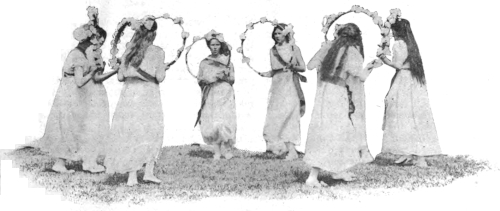
DANCING ON THE GREEN, FIELD DAY AT AMENIA, DUTCHESS COUNTY, NEW YORK.
On Field Day, August 19, for miles around Amenia, the holiday spirit was in the air. Everybody with his wife and family, in automobile, farm wagon, or on foot, took the road that led to Amenia Field; even those who professed no interest in the events of the day, came “just to see who was there!” Everybody brought lunchbaskets and spread the contents under the trees, in true picnic style, since nothing but soft drinks and sandwiches were sold on the grounds.
Throughout the day, a band of musicians played patriotic and popular airs. The old folks gathered together contentedly in groups, listening to the music, while keeping an admiring eye on the prowess of their athletic sons, the grace of their daughters dancing on the sward. Young and old participated in the grand march that took place immediately after lunch-hour.
Afterwards, in a tent-covered auditorium, men and women of national prominence addressed an attentive audience on subjects chosen for their interest to a rural population. Suffragists, from Poughkeepsie and New York, by way of propaganda, presented an open-air pageant portraying the advance of women’s education in modern times. Meanwhile, a demonstration of alfalfa-growing, under the supervision of the Dutchess County Farm Bureau, and the State Department of Agriculture, was given in a neighboring field. Enthusiastic “fans” of Dutchess County were given an opportunity to cheer at a baseball game between two local teams.
The day finished with a band concert held in the Post Office Square, of Amenia, which had been decked with hundreds of lighted Chinese lanterns, strung from adjoining buildings. The expense of this concert, as of all the other features of the day, was met by popular subscription. Everybody was invited, nobody solicited, to contribute, according to his means.
On every program of Amenia Field Day has been printed these principles:
“You have got to make the country as attractive socially as the city if you want to keep the young folks on the farms.
“There’s a good deal of work in the country, but most of our boys and girls have forgotten how to play.
“Baseball is a splendid game, but it isn’t the only one. Every healthy boy should be interested in at least half a dozen others. Don’t merely watch others play games; play them yourself.
“You can’t drink strong drink and be an athlete. Get your boys interested in honest and healthy sports, and save them from drink and dissipation.
“Contests and competitions are not the main thing. ‘The strong compete and grow stronger; the weak look on and grow weaker.’ The main thing is play. Learn the great lesson that play is just as necessary for your sons as work.
“The community should help to run its own recreations. Its festivals should be, not only for the people, but of and by the people.”
MODEL HOUSING AS A COLLEGE COURSE
Some of the concrete results of the Tuskegee experiment in reconstructing the interior of the Negro rural home, were told in The Survey of August 30. Paine College, Augusta, Ga., a school for Negroes, supported for thirty years by southern white people, who feel that the Negro question can only be solved when the white descendants of slave owners set their hearts and heads to the task, is endeavoring to experiment on the reconstruction of the Negro city home by change of material environment If a $50,000 endowment can be raised the college will put into effect a plan of housing designed to prove it profitable, not only morally but financially, to provide the Negro an exterior environment which shall make the task of educating him for life easier. The scheme and the demand for better housing on which it is based is described by Mrs. John D. Hammond, wife of and co-worker with the white president of Paine College.
The whole plan is based upon the belief that the Negro is himself eagerly striving for a decent living. The Negroes’ own fight, individually, for better homes is said to be little short of heroic. All through the South, in city and country, Negro-owned homes witness to the increasing prosperity of a large class, and to the effort and self-denial of thousands more, whose income would seem to many of us, to put house-owning utterly out of the question.
But most Negroes belong to that economic class which, the world over, pays the heaviest rent in proportion to its income and yields the landlord the largest return on his investment, yet which receives in return little which is compatible with health or decency.
This is the tragedy of the Negro slum. Nobody is trying to abolish it, because nobody believes it can be done. We believe the Negro breeds the slum—instead of the slum breeding many of the Negro’s defects. Everywhere else people are re-creating the slum-dweller by abolishing the slum. We make no effort, partly because, as yet, few of us know of the widespread struggle for better housing the Negro is himself making.
What is needed, Mrs. Hammond believes, is an experiment station in Negro housing in the South. When it is proven, as it surely can be, that Negro day laborers and washerwomen can be decently housed at a fair profit to the landlord, southern money will be invested in houses of the right kind. But somebody must prove it, and advertise the proof far and wide.
The plan by which Paine College hopes to prove it is, in brief, to buy a city block of about six acres in Augusta, Ga., and build on four acres little three-roomed houses, such as day-laborers and washerwomen rent. The houses are to have a sink in every kitchen (water in the house is to this class a luxury unknown), and a toilet, ample window space, closets, and the porch so necessary to family comfort in a warm climate. By building double houses, and four acres full of them at a time, they can be put up for $850 per double house.[1] The rent would be two dollars the room per month, the current rent for that district. The lot for each family would be 20 x 105, which would afford a little garden-space in the rear—a privilege highly esteemed by many of the poorer Negroes, and one which, under the plan proposed, would be a powerful aid in the upbuilding of home and family life.
Four acres of the six-acre block would give room for forty double houses. The other two acres Mrs. Hammond designs to use as a playground for the children, and a site for a community house. This house should contain a kindergarten room and a room for boys’ clubs which could be thrown together at night and used for the recreation and the instruction of the grown people. It should have a room for cooking classes, one for sewing classes, a few free baths for men and women; and a small laundry and drying room, like those in the East End of London, a small weekly payment for the use of which would relieve the mothers from the heaviest of their drudgery, and set free much of their time for home-making. It would also make possible a war of extermination against the accumulations of trash about the ordinary Negro home, where so many abominations are claimed to be necessary for the sake of the pot and fire in the yard “to boil de clo’es.”
Rent would be collected on the Octavia Hill plan, with its concomitant thrift clubs, mothers’, men’s, children’s, and home-improvement clubs, and these clubs would do for the tenants just what it does elsewhere for slum-dwellers of other races. They would, Mrs. Hammond believes, be built up in character, the houses would be saved from the usual degeneration of property rented to this economic class, a good return would be realized on the investment, and the children ultimately turned over to the community as self-respecting and law-abiding instead of furnishing, as is inevitable under present conditions, their full quota of paupers and criminals, to be carried by the taxpayers of the city.
Three rooms would be reserved for the Negro worker, who would not only keep them as a model home, but would use them to train the girls in housework. This would leave seventy-nine three-roomed homes for rent, at six dollars each monthly, a yearly total of $5,688.00. This sum would pay the salary of the social worker, who is a necessity to the success of the plan, and yet yield 10 per cent gross on the investment, though two acres of the land and the settlement house, representing one-fifth of the sum invested would he unproductive from a commercial point of view. This is on the basis of an expense of $9,000 for land, $34,000 for forty double houses and $7,500 for the settlement house, a total investment of $50,500.
Rentals from Negro property now yield a larger gross return than this, as do rentals from similar property elsewhere; but the houses deteriorate so rapidly from misuse that the landlord feels that only an extraordinary profit while they last can insure him against actual loss. A gross return of 10 per cent where the buildings suffered only the depreciation caused by rational use would be as attractive to the ordinary business man here as elsewhere.
Mrs. Hammond’s scheme would be considered part of the educational system of Paine College. Good housing and good living as taught in the settlement and practically applied in the model housing plan would become a part of the school curriculum. The raising of the endowment fund is the present problem of Paine College. The peculiarity of this, as of all other Negro schools, is that the more students it has the poorer it is. Few of the pupils can pay the full amount asked of them, which is itself less than the actual cost of their board and tuition. Some work is furnished them—in kitchen, laundry and household for the girls, in grounds and garden for the boys—by which they partly pay their way. The plan is to have the income from the model housing endowment used to pay poor students for work done and so provide with an education many whom the college is forced now to turn away.
The homes, playground and settlement would furnish a practical field where young Negro women could be trained as social workers in order to meet the growing demand from white people in several southern states for trained Negroes to work among the poor of their own race.
BOYS’ “PETITION FOR INDEPENDENCE”
A “Petition for Independence,” signed by representatives of the boys and girls of Ithaca, expresses the principles of the Junior Municipality organized in that city the latter part of June by William R. George, director of the National Association of Junior Republics. The object of the “municipality” is the practical training of younger citizens in their rights and responsibilities by the formation of a government of junior officials who shall act in matters of the public welfare in co-operation with the city officials. Already the mayors of Cortland, N. Y., and Jersey City have asked Mr. George to start like organizations.
“We, the undersigned, being the youth of Ithaca, N. Y., between the ages of sixteen and twenty-one, do respectfully call to the attention of our elders that, although not of age, we nevertheless feel we have reached the point where we could and should actively participate in the government of our city.
“We regard as merely a legal fiction the assumption that we are infants in all matters relating to the government of the community.
“We respectfully call attention to the fact that in time of war boys between the ages of sixteen and twenty-one are sent to the front to fight for their country and are frequently as officers placed in positions of peculiar responsibility and danger. Is it not self-evident that if youths can thus honorably acquit themselves in time of war, they could and should assume the less dangerous and onerous responsibilities of peace?
“We find in the annals of history that from time immemorial youths of our age have, when placed in positions of trust, acquitted themselves creditably. Before the age of twenty-one Alexander the Great was not only the ruler of Macedon, but the dominant power in all Greece; Charles James Fox became a member of the British Parliament before he was of age, and the younger Pitt became Prime Minister of Great Britain when he had scarcely passed his majority. In short, there is abundant evidence both in the past and the present that youth can and will rise to responsibility when it is placed upon them.
“Such being the case, we do hereby resolve to accept the suggestion of William R. George, the founder of the Junior Republics, and the invitations of Mayor Reamer and the Common Council and organize ourselves into a Junior Municipality in order that we may at once actively serve our city as junior citizens and thereby prepare ourselves for more efficient citizenship as adults.
“We hereby pledge ourselves to assist in the enforcement of all the laws and ordinances of the city, particularly those directly relating to boys and girls and their interests.
“We further pledge ourselves that when elected to any office in the Junior Municipality we will give our full and faithful co-operation to the adult official holding the corresponding office in the city government and will discharge our duties solely with reference to the welfare of the whole city.”
Advertisement
Spare the Slum and Spoil the Child.
The doctrine of
INFANT DAMNATION
is thoroughly modern
Go look at the children who need playgrounds and you’ll believe it.
How long will Cleveland, sixth city, keep this article in her city creed?
Give them Playgrounds Instead!
From the Cleveland Humane Society Bulletin
WHAT ONE SMALL TOWN IS DOING
Zona Gale in a pamphlet, Civic Improvement in the Little Towns, tells how first the women and then the men and women of one small community inaugurated an unusually successful campaign in the field of public social service. This town is described as one of 6,000 inhabitants, probably Portage, Wis., where Miss Gale lives.
In her opinion the civic problem of the small town is threefold: first to get into touch with the current of new understanding that the conservation of physical and moral life is largely economic; second, to find practical ways of applying this understanding to the present and future of the town; and third, to do all this with exceedingly little money.
The Women’s Club called a meeting at the City Hall of all women interested in town development. At this meeting the constitution of the Wichita, Kan., Improvement Association was adopted and work mapped out for five committees: sanitary, educational, art, children’s auxiliary, and streets and alleys.
Among the concrete results obtained through the work of these committees were the inauguration of a system of garbage disposal; the grading and planting of a small park at the end of a bridge at the turn in a river; the establishment of a rest room in the town for farmers’ wives from the surrounding country, although owing to a misunderstanding permission to use a small committee room in the City Hall was revoked by the Town Council; the establishment of a charity co-ordination committee; a town lecture course; public bath houses; a sane Fourth, and medical and dental inspection of school children.