THE SUNSHADE THE PARASOL —— THE UMBRELLA (continued 2)
Reading edition
We end this essay, therefore, with a sentiment of ridicule, in which we laugh at our own selves, that of having dreamed of making a perfect monograph, and of having produced nothing more than a little tumbled fantasy, which ironically steals away out of sight, like that minuscular mouse, of which the mountain was once upon a time delivered in much moaning.
What matter! We must end. Let us hide our melancholy retreat by humming this last lovely burden of a poet of the school of Clairville—
’Tis called a Pépin, a Riflard,
And other viler names there are;
Not one of all the Umbrella moves.
Wisely it counts them no disgrace;
Since—child of April’s art—the loves
Oft make their quivers of its case!

THE GLOVE The Mitten
To Mme. H. de N.
THE GLOVE The Mitten
To Mme. H. de N.
WELL, my dear friend, here I am, faithful as you see to my appointment; I am come deliberately to fulfil my promise, which I so imprudently gave on a certain day last season, upon a Breton strand, you remember, while contemplating one of your rosy little hands, which was whipping its sister with a long Swedish glove, in a sort of angry pet, and gave to you an appearance of wild and exquisite bluster?

How did you manage, O Enchantress, to induce me to give my loyal word that I would write for you the History of the Glove? How! . . . who can ever say? When a pair of pretty eyes envelop you, and bathe you with their radiance, when a smile puts honey into your heart, and a tiny little hand is stretched out with open palm, seeming to say, “Take me,” every kind of will melts quickly away, consent mounts delightedly to the lips, and we promise at once everything, before we know well what we are asked.
Ah, unhappy me! it is the Glove of Nessus which you have placed upon my hand! The History of the Glove! why, it is the history of the world; and I should be very ill-advised if I pretended avoir les Gants to be the first to tell that history, as ancient as it is universal.
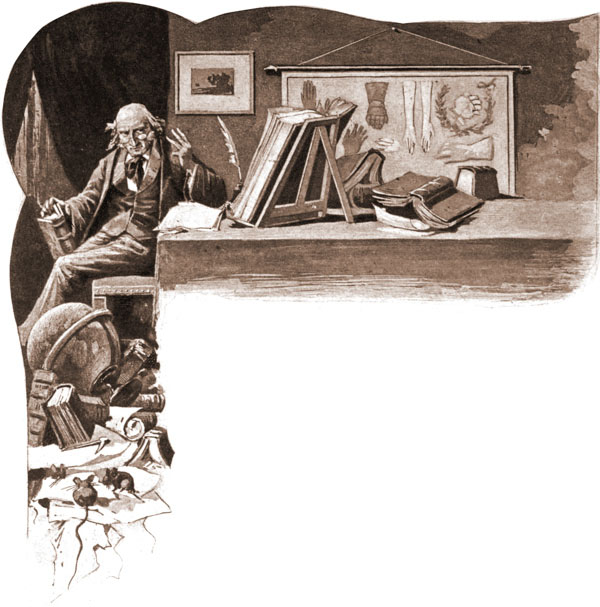
Haunted by this debt of honour, contracted to please you, I went lately to see a learned old friend of mine, a venerable Benedictine—better than a well of science; an ocean of indulgence—to whom I exposed my foolish enterprise of the Glove and the Mitten.
Ah, my friend, I only wish you could have seen him all at once leap from his seat, look at me with compassion, examine me profoundly with his eye, and murmur three times in a tone of ineffable astonishment and sadness, as though he believed me mad—
“The Glove!—the Glove!!—the Glove!!!—
“ . . . And so it is the Glove,” he went on, when he had become a little calmer, “it is the history of this offensive and defensive ornament, of this object so complex, of which the origin is so obscure and so troublesome, it is a monograph of the Glove that you desire to write! . . . My dear child, allow me to believe that you have not reflected on what you have engaged yourself to do, let me think that you have brought more lightness than reason to the conception of this enterprise. The Glove!—Why, with the history of the Shoe, it is the most formidable work that a learned man could dare to dream of executing. Look,” he sighed, dragging forth a voluminous manuscript, “in the Bibliography of Words, a colossal work, which I have commenced, but, alas! shall never end, I see at the word GLOVE more than fifteen hundred different works, Latin, Greek, Italian, German, Spanish, English, and French, which treat of this matter, and even this is but the rudest sketch. We must consider the use of the Glove amongst the ancient Hebrews, the Babylonians, the Armenians, the Syrians, the Phœnicians, the Sidonians, the Parthians, the Lydians, the Persians, the Greeks, the Romans, &c.
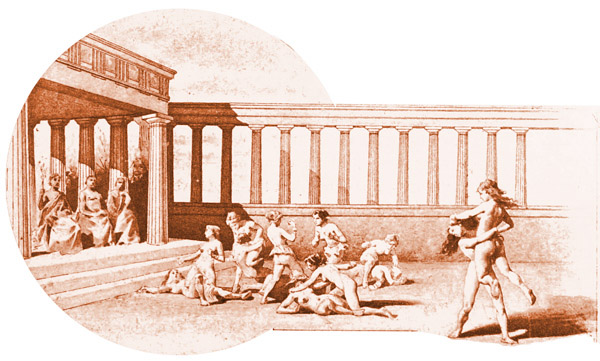
“It would be necessary to divide the work into different Books, subdivided into innumerable Chapters; thus for the etymology alone of the word Glove, in the different dialects, must be reserved a long notice of comparative philology; it would be necessary to determine if the Glove which was used by the young nude girls, who wrestled together in Lacedæmon, after Lycurgus had installed there his Lyceums and public games—if this Glove, I say, ought to be classed among the fighting mufflers or the leathern gauntlets—and how many matters besides!” And my dear old friend became still more and more excited, ever widening the question, as if, it seemed to me, it were a case of establishing a complete Encyclopedia. Diderot and d’Alembert would have grown pale before that imperturbable science, which showed mountains of folios to be cleared away, and unknown precipices to be sounded.
“But,” I hazarded in a little confusion, “I only think of writing a light treatise, a thin volume of a few pages, one of those nothings carried off by the wind, which pass for a second, like an anecdote or tale, into a pretty feminine cerebellum; I wish to give hardly a line to other countries than France, just to graze incidentally the Glove of challenge, to speak only from memory of the pontifical Gloves, to neglect the side of manufacture, the art of preparing the skins, of removing the outside skin, and so on. I only desire in one word to chat for a few instants, disconnectedly and in fits and starts, on that portion of clothing which the ancients called Chirothecæ, Gannus, Gantus, Guantus, Wanto, and Wantus, if I may trust the Glossary of Du Cange.”
“Alas, that is true,” cried my old friend, in a sadly modulated tone; “I am doting, eh? We, of the old school, it is we who are the wet blankets, the tedious savants. At the present day, when journalism is to literature what the piano is to music, an instrument upon which every one strums without any conviction, is it not necessary to cut matters short, and quickly create eternal à peu près (pretty much the sames), little light dissertations, notices made on the spur of the moment, and superficial passion? We were in our time egotists, fervent solitaries, unreadable and unread, if you will; what does it matter? When a work had fastened on our mind, we espoused it, after a legitimate love, with all the joys of generation and paternity. We wished to endow our labour with all the qualities which it seemed able to bear, to such an extent, that it became dry, rugged, and severe. But how many were the delights not to be forgotten, in those traces followed for whole days, before our utterance of the joyous Eureka!—how many inward intoxications in that slow-brooding season, in that patient labour!—how many minute investigations before resolving a historic doubt! We were the exclusives of national erudition, and thought one work sufficed for one man, when he had fed it with his life, with his watchings, with his very heart, with all the tenderness of the creative workman.
“I should like,” he continued, “to have twenty years to ride a hobby-horse, which would make me rest at stopping-places for ten, fifteen, twenty years, on a thorny work, and offer me splendid runs, full of adventure, across the highways and secret paths of science. I would commit the follies of Doctor Faustus, to return to the age of those first bibliographic loves, which have the future brilliant and open before them—and this Glove which you disdain, my dear young friend—this Glove which you dwarf to the ideal of a doll—this Glove, I would pick it up, hold it carefully, clear off with it like a cat, and ensconce myself with it in my savant’s den, to take a good long sniff at it, to study it, and to analyse it every day more and more, until at last I drew from it a serious and lasting work.
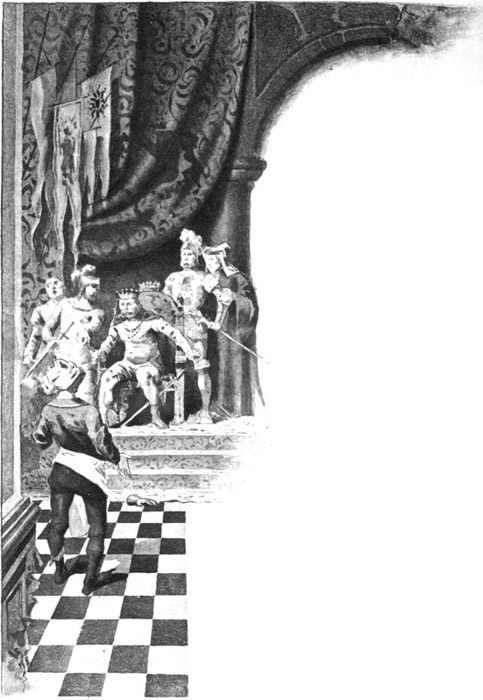
“This Glove should not be thrown at the public, like one of those challenges which recall too distinctly the celebrated Glove which Charles V. sent to Westminster by a mere scullion—an accentuation of the insult offered to the King of England—it should be cast more lovingly, as in our old romances of chivalry, the Romance of the Rose, of Rou, or of Perceforet. If I were but twenty years old, I would do with the reader as Petrarch did with Laura, in demanding of her nothing more than the favour of picking up her Glove; and I would say to him later on, after the fashion of Marot, poetically, in offering my work:—
“I should like,” he continued, “to have twenty years to ride a hobby-horse, which would make me rest at stopping-places for ten, fifteen, twenty years, on a thorny work, and offer me splendid runs, full of adventure, across the highways and secret paths of science. I would commit the follies of Doctor Faustus, to return to the age of those first bibliographic loves, which have the future brilliant and open before them—and this Glove which you disdain, my dear young friend—this Glove which you dwarf to the ideal of a doll—this Glove, I would pick it up, hold it carefully, clear off with it like a cat, and ensconce myself with it in my savant’s den, to take a good long sniff at it, to study it, and to analyse it every day more and more, until at last I drew from it a serious and lasting work.
“This Glove should not be thrown at the public, like one of those challenges which recall too distinctly the celebrated Glove which Charles V. sent to Westminster by a mere scullion—an accentuation of the insult offered to the King of England—it should be cast more lovingly, as in our old romances of chivalry, the Romance of the Rose, of Rou, or of Perceforet. If I were but twenty years old, I would do with the reader as Petrarch did with Laura, in demanding of her nothing more than the favour of picking up her Glove; and I would say to him later on, after the fashion of Marot, poetically, in offering my work:—
‘Deign to receive these Gloves with goodly cheer,
My true heart’s present of the coming year.’
“And then I would speak of those Mittens with which Xenophon reproaches the degenerate Persians, of those Roman finger-stalls employed in the olive crop, and even of that glutton named Pithyllus, who carried delicacy so far as to make a Glove of a sheath of skin for his tongue.”
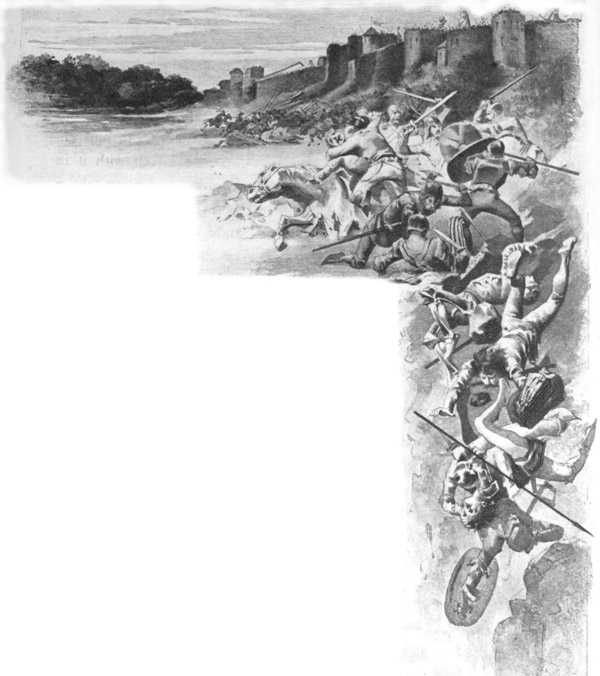
The good old man, kindled by his enthusiasm, became transformed; he seemed desirous to take upon himself the whole history of the Glove, which he embroidered at once with fancy and the most varied anecdote that his wonderful memory could supply. After having distinguished, in the Middle Ages, many sorts of Gloves, such as the usual Glove, the falconer’s Glove, the workman’s Glove, the feminine Glove, the military Glove, the seignorial Glove, and the liturgical Glove, he attacked with a zest bordering on frenzy the part of the Glove of the knights and men in armour of the heroic battles of the past, at a time when individual prowess could still display itself; he quoted the Chronicles of Du Guesclin and De Guigneville:—
“Rich basinets he ordered to be brought,
And Gloves with iron spikes with horror fraught.”
He showed me, without recourse to aught but his own erudition, the transformation of these iron gauntlets, first into mail, like the coat, then into movable plates of flat iron, adapted to the movements of the hand; he explained to me the lining, where the palm was of leather or stuff, and at last, exhuming the ordinances of 1311, he made me penetrate into the details of the manufacture:—
“That no one should make Gloves of plates, except the plates are tinned or varnished, or beaten, or covered with black leather, red leather, or samite, and that under the head of every nail should be set a rivet of gold.”
Ah, my fair friend, if you could have seen this strange man so suddenly taken by my subject, you would have regarded me with pity, for I could not help pouting a little at this old dean, and felt myself attacked by a sudden cowardice, at the mere announcement of the formidable researches which were to be undergone.
I took my humble leave of my most learned master, humiliated, floored by the extent of his knowledge, his laborious zeal, his powerful faith, his stubborn will. I saw that in giving you my word for a poor Glove, I had given it to a demon, who showed me a Glove of an immense shagreen skin, containing the world and its history—fantastic as a nightmare, which weighed me down. Then I swore to sacrifice a part for the rest, and not to build a cathedral when a simple cushion at your feet would suffice me for my heedless chatter. Accept then favourably this act of contrition, and let me be fully pardoned, if, à propos of the Glove, I bound along madly like a young kid, without pity for the history of costume and historic documents, which I trample under my feet, rather than see myself buried under their pyramidal bundles.
That which my old friend had probably neglected is the Legend, and to that I run.
A charming poet and a charmer, Jean Godard, a Parisian, the worthy rival of Ronsard, published towards 1580 a piece entitled The Glove. This witty nursling of the Muses pretends to show us the origin of the Glove in the burning passion which Venus cherished for Adonis. According to our poet—
“The young Adonis ever loved the field,
Now hunting the swift stag with branching head,
And now the tusked wild boar, just cause of dread.
Venus, fierce burning with his love alway,
Would never leave him neither night nor day,
But running after his sweet eyes and face,
Sought young Adonis, when he sought the chase:
Deep into forests full of gloomy fear,
The goddess followed him she held so dear.
One day, as she pursued him, bursting through
A bramble thicket, which by ill chance grew
Athwart her path, a cruel, hardy thorn
Pierced her white hand, and lo! the rose was born
From her red blood. But Venus, vexed with pain,
Lest any hurt should touch her hand again,
Bade all at once her unclad Graces sew
A leathern shelter for her hand of snow.
The lovely Graces, draped in floating hair,
No longer left their own hands free and bare,
But bound and covered them as Venus did.
And now the Glove’s true origin is hid
No longer. This is it. Fair girls alone
Wore on their hands what now is common grown.
Then came the Emperor, and then his court,
And then at last the folk of every sort.”
Charming in its naïveté, is it not, my dear friend, this fable which gives the Glove the same origin as the rose!
The use of Gloves was widely spread in the Middle Ages. They covered the wrist entirely, even with women. “The Gloves of the common people,” says M. Charles Louandre, “were of sheep-skin, of doe skin, or of fur; those of bishops were made in chain-stitch of silk with gold thread; those of simple priests were of black leather.” But what will surprise you is that, contrary to the present custom, it was absolutely forbidden to appear gloved before great personages.
In a manuscript lately published, The Sayings of the Merchants, a merchant cries, with an engaging air—
“I have pretty little bands,
And for damsels dainty Gloves,
Furred to warm their snowy hands,
These I sell to those sweet loves.”
But what were the furred Gloves of sweet loves or gentle ladies compared to those which the fair Venetians showed on the grand days of ceremonies, when the Doge prepared to mount the Bucentaur for the purpose of espousing the sea? These, according to M. Feuillet de Conches, were Gloves of silk marvellously embroidered, embossed with gold and pearls; some of them were of lace of an incomparable richness, well worthy to be offered as a present, and to figure in the budget of handsome acknowledgments. But the most wonderful were the Gloves of painted skin, like the water-colours on Fans.
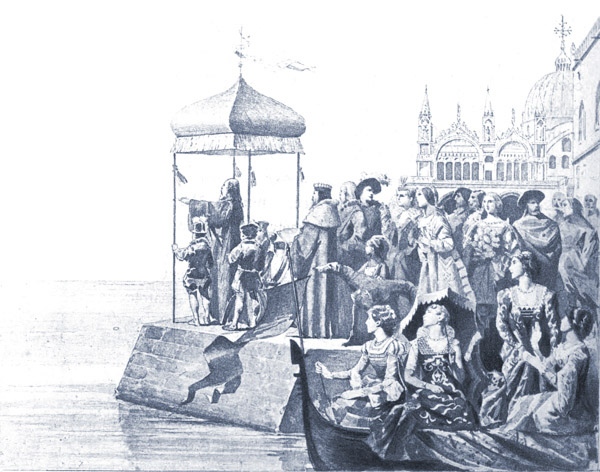
Here were country scenes, sheepfolds, pictures of ravishing gallantry, miniatures beyond price. “And even,” observes M. Feuillet de Conches, “the heels of the shoes of dandies were decorated by Watteau or by Parrocel.”
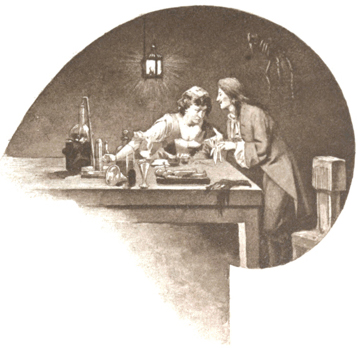
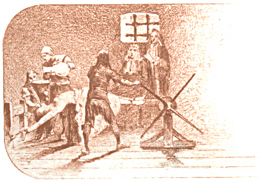
The Valois doted, you know, on perfumed Gloves; this taste was fatal to Jeanne d’Albret, who found her death in trying a pair of Gloves dexterously prepared by some Italian quack, a friend of the sombre Catherine. Consider, my friend, that with my romantic instinct, and my temperament full of love for the drama, I might find here an easy transition, and tell you, in long excited phrases, of the exploits of the Marchioness of Brinvilliers, and the grim Gaudin de Sainte-Croix; show you these sinister poisoners preparing by night their infamous Glove stock; then in a tale fantastic as the Olivier Brusson of Hoffmann, evoke the famous trial of the Marchioness, the torture, the various punishments, the burning chamber, up to the final stake. All this à propos of the Glove—who can say if such simple history would not be worth more than all the cock-and-bull stories which I am about to tell you, by compulsion, concerning the Glove and the Mittens? In very truth, I would prefer, as your vis-à-vis, to show myself a romancist, not an historian, for I should be sure of being less of a bore, more personal, and, above all—shall I avow it?—not in any degree common-place. But, as Miguel de Cervantes said, “Our desires are extremely seditious servants.” I will be then reactionary, and will close the door against these socialists of sentiment.
All this fine rigmarole has made me think of presenting you with a letter of Antonio Perez to Lady Rich, sister of Lord Essex, who had asked him for some dogskin Gloves:—
“I have experienced,” he writes, “so much affliction in not having by me the dogskin Gloves desired by your ladyship, that, waiting their arrival, I have resolved to flay a little skin on the most delicate part of my own body—if, indeed, any delicate part can be found upon my rude self. Love and devotion to a lady’s service may surely make a man flay himself for her, and cut her a pair of Gloves out of his own skin. But how can I pride myself on this with your ladyship, when it is my custom to flay even my very soul for those I love? Could mine be seen as clearly as my body, it would appear full of tatters, the most lamentable sort of soul in the world;—the Gloves are of dog’s skin, madam, and yet of my own, for I hold myself as a dog, and supplicate your ladyship to hold me in like regard, in requital of my faith and my passion in your service.”
What think you of this out-and-out gallant, of this “dying” passionate lover? Here it seems to me, à propos of scented Gloves, we have a Castilian gentleman exceedingly well skilled in the delicate art of offering them to ladies.
Spanish Gloves are reproached with too strong a smell; the French ladies suffer strangely from their too heady odour: Antonio Perez would certainly have been an excellent manufacturer of perfumed Gloves—discreet in his scents, distinguished in his form.
The Gloves most in vogue after the time of La Fronde were the Gloves of Rome, of Grenoble, of Blois, of Esla, and of Paris. M. de Chanteloup charged Poussin to buy him Roman Gloves, and the latter wrote back on 7th October, 1646: “Here are a dozen pairs of Gloves, half men’s, half women’s. They cost half-a-pistole a pair, which makes eighteen crowns for the whole.” The 18th October, 1649, another purchase; but this time they are Gloves scented with Frangipane, with which Poussin provided himself for M. de Chanteloup; and these he bought at la Signora Maddelena’s, “a woman famous for her perfumes.” In Paris, according to The Convenient Address Book of Nicolas de Blegny—the Bottin of 1692—there were a certain number of manufacturers of perfumed Gloves in the Rue de l’Arbre-Sec and the Rue Saint-Honoré. “There are,” says the editor of this commercial almanac, “Glove-merchants very well stocked; for instance, M. Remy, opposite Saint-Méderic, who is famous for his excellent buck-skin Gloves; Arsan, hard by the Abbey Saint-Germain; Richard, Rue Saint-Denis, at the little St. John, well known for his Gloves of Fowl-skin; and Richard, Rue Galande, at the Great King, whose commerce is in doeskin Gloves.”
The name of fowl-skin Glove doubtless astonishes you—another name was outer lamb skin; they were made for the use of ladies during the summer. The pretended fowl-skin was nothing but the epidermis of kid-skin, and the preparation of this epidermis was the real triumph of the Glove-merchants of Paris and Rome. Gloves of Canepin, or outer lamb’s-skin, were made, it is said, so delicate and thin, that a pair of them could be easily enclosed in a walnut shell.
The buck-skin or buffalo-skin Glove was specially made for falconers; it covered the right hand half up the arm, thus completely protecting it against the claws, or rather the talons, of the bird, falcon, gerfalcon, or sparrow-hawk, when it came to settle on their fist.
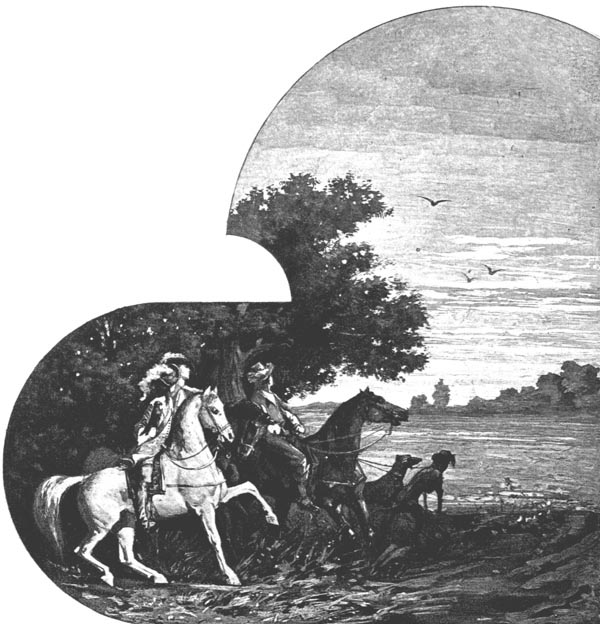
Hawking existed even under Louis XIII., but it was no longer the grand and splendid epoch of this aristocratic sport, so profoundly interesting. In one of his ancient legends, André le Chapelain, of whom Stendhal wrote a short biographical notice, speaks of a sparrow-hawk, to gain which the magic Glove was necessary. This Glove could only be obtained by a victory in the lists over two of the most formidable champions of Christendom. It was suspended to a golden column, and very carefully guarded. But when the knight had by his skill gained the Glove, he saw the beautiful sparrow-hawk so much desired swoop down immediately upon his fist.
Up to the age of Louis XIV., the skin Glove was destined rather for the use of men, and it was only under this Prince that Gloves mounting a long way up the arm, and long Mittens of silk netting to set off the hands of women, were generally adopted by them.
Gloves à l’occasion, à la Cadenet, à la Phyllis, à la Frangipane, à la Néroli, Gloves of the last cut worn awhile by the Précieuses, ceased to be fashionable about 1680. The custom, of which Tallemant speaks, of presenting ladies, after the banquet, with basins of Spanish Gloves, was only vulgarised in passing from the Court to the town.
Dangeau, in his Memoirs, has written a chapter on the Etiquette of Gloves and the Ceremonial of Mittens. I refer you to it without ceremony.
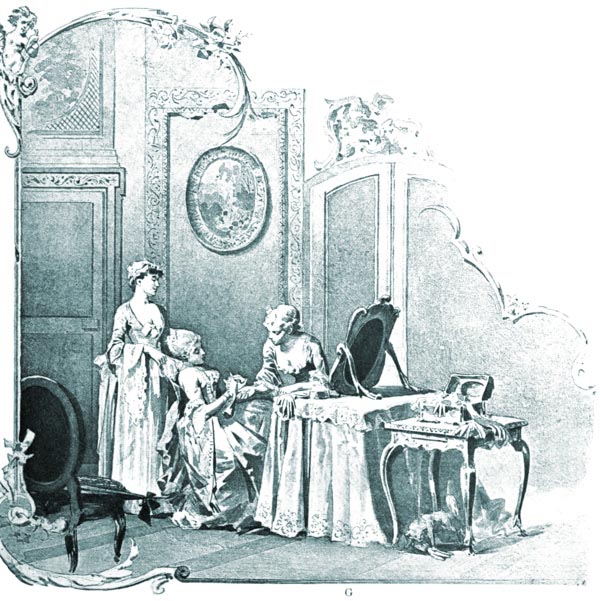
Under Louis XV., in the eighteenth century, so full of the rustle of silk, so enchanting that I fear to stop on it in your company, lest I should never leave it, the wearing of Gloves quickly became an enormous luxury. All those fair coquettes, whom you have seen at their toilets, or their petit lever, after Nattier, Pater, or Moreau, surrounded by their “filles de modes,” caused a greater massacre of Gloves at the time of trying them on, than our richest worldlings of to-day. These Gloves were of kid, of thread, and of silk; the most celebrated came from Vendôme, from Blois, from Grenoble, and from Paris; they were generally made of white skin, wretchedly sewn, but the cut was extremely graceful, with its cuff falling from the wrist over the hand, and small ribbons and fine rosettes of carnation interlaced on this cuff.
Gloves sewn after the English fashion were highly appreciated. It became a proverb, that for a Glove to be good, three realms must have contributed to it: “Spain to prepare the skin and make it supple, France to cut it, and England to sew it.”
Caraccioli maintains that a woman of fashion, about the middle of the eighteenth century, would not dispense with changing her Gloves four or five times a day. “The petits-maîtres,” he adds, “never fail to put on, in the morning, Gloves of rose or jonquil, perfumed by the celebrated Dulac.” As to Mittens, the same observer of the century notices them as specially belonging to women. “Nevertheless,” he says, “in winter the manufacturers make furred Mittens, and men now wear them when they travel.”
Madame de Genlis has this curious observation in her Dictionary of Etiquette: “If you have anything to present to a princess, and have your Glove on, you must needs take it off.”
How many anecdotes, how many literary souvenirs, the Glove of the eighteenth century summons to the thought!
You remember, I am quite sure, that pretty chapter consecrated by Sterne, in his Sentimental Journey, to the beautiful Grisette who sold Gloves, into whose shop he entered to ask his way. The pretty Glove-seller coquets with the stranger, shows herself extremely complaisant, and the sentimental traveller, to prove his gratitude for her kindness, asks for some Gloves, and tries on several pairs without finding one to suit him. But he takes two or three pairs all the same before he goes.
The story leaves a fresh feature in the mind: an English artist has fixed it with much delicacy on a remarkable canvas, which figures in the National Gallery. The authors of the Vie Parisienne were surely inspired by it a little later in their joyous libretto, when they wrote the well-known couplets of the lady who sold Gloves and the Brazilian.
Permit me also to relate to you an anecdote, rather slight in texture, of which Duclos is the hero, and which has all the flavour of his roguish age:—
The author of Manners was bathing on the flowery borders of the Seine, and giving himself up to skilled hand-over-hand, when he suddenly heard piercing cries of distress. He rushes out of the water, runs up the bank without taking time to slip on his “indispensables,” and finds a young and charming woman, whose carriage had just been overturned in a rut. He hastens to beauty in tears, lying on the ground, and making a gracious bow, in his academic nudity, “Madam,” says he, in offering her his hand to assist her to rise, “pardon my want of Gloves.”
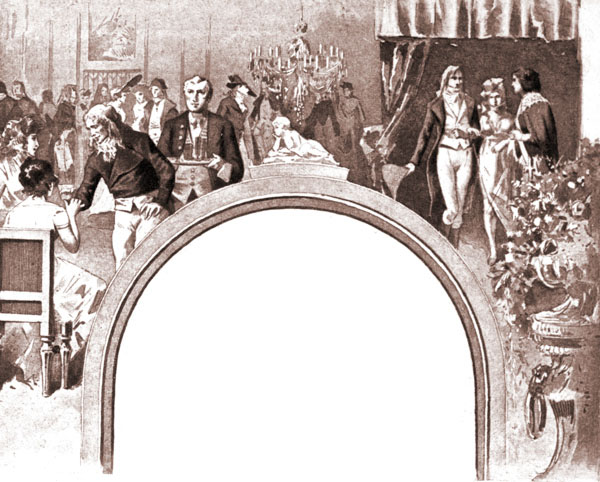
Here we have at once the expression of a scoffing sceptic, and a giddy philosopher, full of a particular charm. Do not believe, my gentle friend, that if I remain in your company so short a time in the beginning of the eighteenth century—the only one which has, you cannot deny it, all its perfumed quintessence—do not believe that I intend to linger in the Revolution, and conduct you to the house of Mademoiselle Lange, Madame Talien, Madame Récamier, and all the fashionable drawing-rooms of the First Republic, the Directory, the Consulate, and the Empire; to take ceremoniously the hand of the marvellous Beauties, the Nymphs, and Muses of those troubled times, in order the better to show you what extravagant Gloves, what prodigious Mittens, were then worn. The Ladies’ Journal, and all the small journals of fashion, will surely teach you more about the Gloves worn by these worldly Calypsos and Eucharises than six hundred monotonous pages of varied descriptions. There is no Museum, however, preserving the objects of art which the Revolution marked deeply with its seal; and this fact will make me insist on a model of a special Glove, destined for a representative of the people despatched to the army, of which an erudite archæologist of the Revolution, and at the same time a remarkable humourist, Champfleury, has been good enough to communicate to me a design. This Glove of doe-skin, manufactured according to order, and broidered with arabesques about the slopings of the thumb, bears on the back of the hand a vignette in the form of a seal, which represents Liberty holding in her hand the pike, the Phrygian cap, and the scales of justice—a Liberty, you will say, by no means at liberty . . . . in her movements:—on the right is crouched a lion, the sign of force; on the left a cat, a sign of independence.
I will not lose my time in paraphrasing for you this symbolic vignette; and, with a long historic stride, I will conduct you into the quietude of some chateau, under the Restoration, and, in the evening twilight, to the terrace before a great park. I will there show you two lovers warbling a serenade—the timid young girl touching a guitar, the young man deeply moved, putting a world of passion into his baritone voice. On the hands of the singer, behold, pearly grey gloves fastening with a single button; on the dainty little fingers supporting the guitar, examine those Mittens of black silk lace, open worked, like those which, according to tradition, are worn by the heroine of that charming comedy, the Marriageable Maid.
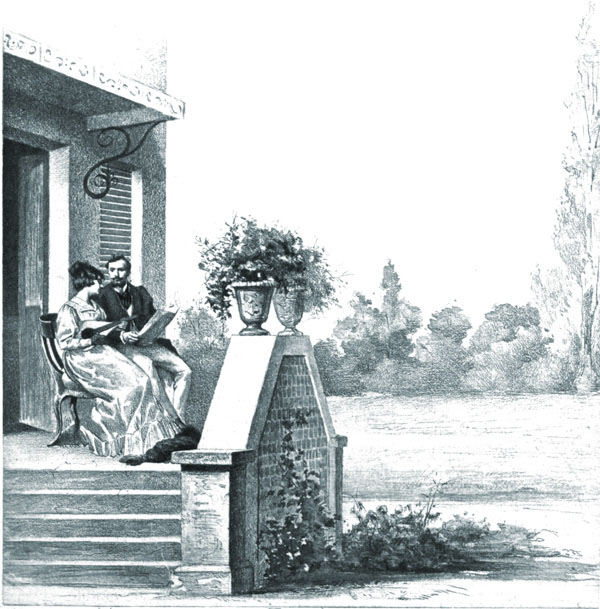
There rises on my lips a song of the time which the Almanac of the Muses has bequeathed us, to the air of The Little Sailor. It will perhaps add a spice of interest to my story. “Now, listen, my friend,” as they used to say in the noble ages of chivalry. Title of the song: The Gloves.
I love the Glove, that covers quite
The rounded arm it rests upon;
I take it off, with what delight,
With what delight I put it on!
If true it is through mystery,
A lover’s bliss will higher move,
How dear that little hand should be
Which hides itself beneath a Glove!
But there’s another Glove, whose use
Will every swaggerer displease;
A Glove correcting all abuse,
Which brings the braggart to his knees;
How many boasting folk I’ve known,
Who would, and wisely, rather prove
A flight from out the window thrown,
Than see before them that same Glove!
The Gloves are useful when we seek
The fair, the great ones, as we know;
When unto those with Gloves we speak,
Easy at once their favours grow.
They for intriguers wealth have won,
No fools their uses are above;
Of what another man has done
They boast, and give themselves the Glove.
One last couplet, I pray you, and the authoress, Madame Perrier, will bow herself out:—
The Gloveless man can ne’er afford
To dance, no step he makes with grace;
The servant wishes that his lord
Should put on Gloves in many a case.
When the police are wide awake,
To cheat those eyes they hardly love,
How many thieves will wisely take
The greatest care to wear the Glove?
The song is not so bad, truly; and if the Muse gloves the author a little tightly, the tone of his strophes is none the less strictly respectable and proper.
Under Louis XVIII. and Charles X. long Gloves were very costly; still, no coquette hesitated to change them every day, for it was necessary for them to be of extreme freshness of colour, which was either buff, gridelin, or white. Some years later, the fashion tended to maize, straw, or nut colour for the evening and morning toilet, and to palisander, burnt bread, cedar, fawn, for afternoon visits. Yellow Gloves had an infinite scale of tones, from a soft and delicate unbleached lawn colour to the glaring yellow of a stage-coach. White doe-skin was only used by men when riding.
It was about this epoch, if I mistake not, that the denunciation of Gant jaune (yellow glove) became synonymous with petit-maître (dandy). In London, the disciples of Brummel—of the most refined elegance—constituted a society, and formed the Club of the Fringed Glove. This club no longer existed doubtless in 1839, when d’Orsay established thus despotically the rules of the perfect gentleman:
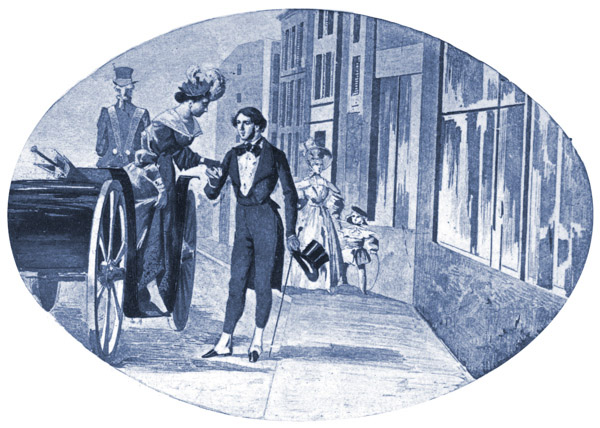
“An English gentleman of fashion,” said he, “ought to use six pair of Gloves a day:
“In the morning to drive a britzska to the hunt: Gloves of reindeer.
“At the hunt, to follow a fox: Gloves of shammy leather.
“To return to London in a Tilbury, after a drive at Richmond in the morning: Gloves of beaver.
“To go later for a walk in Hyde Park, or to conduct a lady to pay her visits or make her purchases in London, and to offer her your hand in descending from the carriage: coloured kid Gloves braided.
“To go to a dinner-party: yellow dog’s skin Gloves—and in the evening for a ball or rout: Gloves of white lamb-skin embroidered with silk.”
What odious tyranny is so exacting a fashion! And how sensible was Balzac when he wrote: “Dandyism is a heresy of fashion; in making himself a dandy, a man becomes a piece of furniture of the boudoir, an extremely ingenious puppet, which can pose on a horse, or on a sofa, which sucks habitually the end of a walking-stick, but a reasonable being—never!”
It is, however, with some dandy of the school of Rubempré and Rastignac, that often, on quitting the ball, an author shows us a romantic young lady in love, whose jealousy gnaws at her heart, who re-reads the letters of old times, and with wandering looks, like one overwhelmed, nervously tearing with her teeth a finger of her Glove, sadly dreams that the lover who is no longer all, is nothing, and that the moralist much deceived himself who wrote: “Woman is a charming creature, who puts off her love as easily as her Glove.”
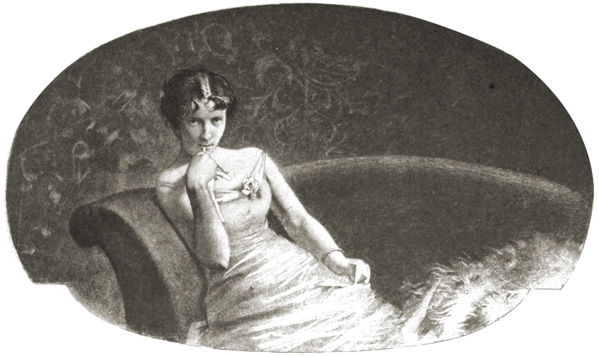
How many things are there, look you, in a Glove!
In the novel The Lion in Love of Frédéric Soulié, Léonce signs the register of marriages at the mayoralty with a gloved hand; and when Lise’s turn comes, the young girl stops, saying in a voice tinged with just a touch of mockery, “Pardon me, let me remove my Glove.”
“Léonce understood,” then says the author, “that he had signed with his gloved hand.” Sign an act of marriage with a Glove! Léonce meditated a little, and said to himself: “These people have certain delicacies. What difference makes a Glove more or less to the holiness of an oath, or the signature of a document? Nothing assuredly; and yet it seems that there is more sincerity in a naked hand, which affixes the signature of a man in testimony of the truth. It is one of those imperceptible sentiments of which we are unable to give an exact account, but which nevertheless exist.”
The fact is, that the Glove is not really, as has been said, a tyrant of which the hand is the slave, but quite the contrary—it is the hand’s servant; and with the hand, as Montaigne wrote, “We request, promise, call, dismiss, menace, pray, supplicate, deny, refuse, interrogate, admire, number, confess, repent, fear, shame, double, instruct, command, incite, encourage, swear, witness, accuse, condemn, absolve, injure, contemn, distrust, track, flatter, applaud, bless, humiliate, mock, reconcile, recommend, exalt, feast, rejoice, complain, sadden, discomfort, despair, astonish, write, suppress,” &c.
I stop out of breath: verbs of every kind may pass into the list.
With the Egyptians, the hand was a symbol of force; with the Romans, a symbol of fidelity. We please ourselves in clothing the occult powers, such as Time, Nature, Destiny, with a human hand: the hand of Time overthrows empires, and impresses wrinkles on our brows; the hand of Nature is prodigal to us of gifts, which are ravished from us by the hand of Death; the hand of Destiny or of Providence, in fine, conducts us across the paths of life.
Old stereotyped language, which we use, and shall use always. Are we not, as Saint Evremond said, in the hands of love, as the balls in the hands of tennis-players—and the first happiness which love can give, is it not, according to Stendhal—and all the truly sensitive—the first pressure of the hand of the woman we love?
Our ancestors swore by the hand, and read in the hand the mysteries of the future. On the day of coronation, the hand of justice was borne before the kings; the hand is used in salutation; we ask for the hand of the lady we wish to espouse in lawful marriage; we wash our hands, like Pontius Pilate, of faults which we could not help committing; and if I were to have to make for you the panegyric of this organ, I should have, like Scheherazade, to put off the end of my discourse every day till the morrow. Sir Charles Bell, in his book, The Hand: Its Mechanism, etc., has given a synthesis of all I could possibly add, and has proved that the human hand is so admirably formed, possesses a sensibility so exquisite, that sensibility governs with so much precision all its movements, it answers so instantaneously to the impulses of the will, that one might be tempted to believe that it is itself its seat. All its actions are so energetic, so free, and withal so delicate, that it appears to have an instinct apart; and neither its complication as an instrument is ever dreamt of, nor the relations which subject it to the mind. We avail ourselves of the service of the hand, as we perform the act of respiration, without thinking of it; and we have lost all remembrance of its first feeble efforts, as of the slow exercise which has brought it to perfection.
The hand, in a word, is the most perfect instrument given by God to man; but I ought not to forget, my fair friend, that poets seldom wear gloves, and philosophers never; and that, philosophising as I am, I remain outside the Glove, and, above all, appear to forget that axiom of Fontenelle: Had we our hand full of authenticated facts or truths, we should but half open it, and that after a feeble fashion.
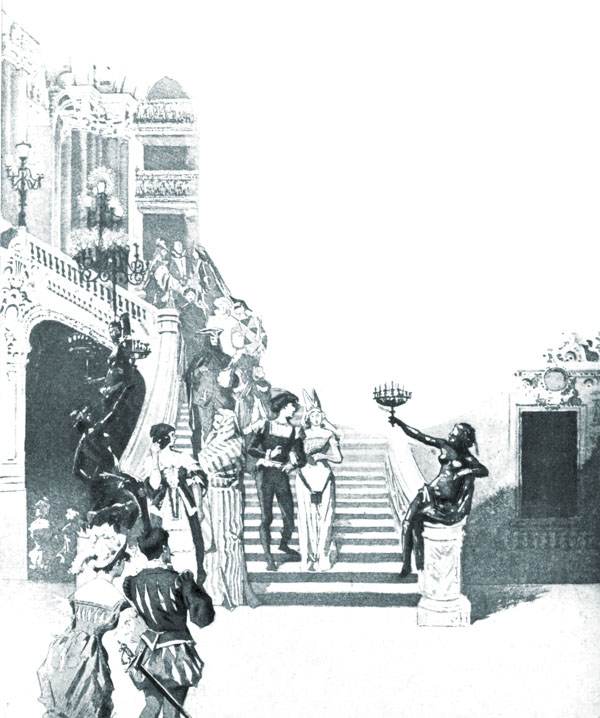
The Glove is worthy of entering into the legend of a fairy tale, and remaining there always, as the slipper has entered into the poetry even of fable, with the theme of Cinderella. An ancient King of France was indeed in love all his life with an unknown woman, only from having seen her Glove in the midst of a masked ball given to his court. Could it not easily be conceived according to the approximative aphorism, “Show me your Glove, I will tell you who you are.” At the opera ball, in the surge of masks and of dominoes, in the midst of the comings and goings on that staircase so exalted, it needs but a Glove imprisoning a little hand to allure at once the passion of a man of delicacy—a long white Glove lovingly glued to a hand divinely small, a fine delicate wrist, and the exquisite roundness of the forearm. This is enough to transport a lover of the fair sex. The Glove appears not only in all festivals where grace and beauty preside; it is found in all the rudeness and clumsiness of its origin at the Poles, among the Norwegians, the Laps, and the Fins, who wear huge Gloves of wool in summer, and thick Gloves of reindeer skin, with the hair outside, in winter.
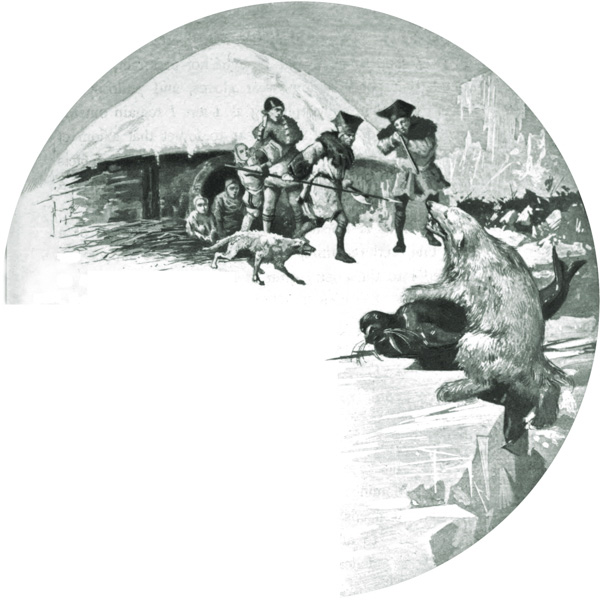
Defended by these Gloves, they sometimes sally bravely from their huts, in spite of the cruel frosts, to kill the white bear and the seal, just as the dramatic engravings which illustrate our stories of voyages to the North Pole represent them to us.
But methinks your eye is asking me in disquietude about two little bound books which I have in my reach. Reassure yourself, these are not recitals of tourists, which are for painting us the manners of the inhabitants of Karasjok or of the Lofoten Isles: I will read to you at once, without allowing you to languish any longer, their titles. Upon one of these works, see for yourself Collection of the Best Riddles of the Time, composed on divers serious and sprightly subjects by Colletet; on the other, Collection of Riddles of the Time, by the Abbé Cotin. You already divine that I intend to act no traitor’s part towards you, and that I am going to read you some old charades in verse upon Gloves:
The first riddle—énigme has been masculine in French at least since the seventeenth century, in despite of its profound femininity—the first riddle, in obscure and ambiguous terms, indicates that the Glove, after having been the natural covering of a rustic animal, serves to-day as an artificial covering for an animal more refined: man!
We’re two or ten, and to a body wed,
We once a thing of breathing life were over;
Like it we lived, and now, although we’re dead,
Another life more excellent we cover.
This quatrain riddle is by François Colletet, that poor poet up to his neck in mud. Listen now to Cotin—the Trissotin of Molière—in this singular sextain:—
With mortal flesh our five soft mouths we fill,
And in the winter to repletion feed;
If one of us be lost, the world’s agreed
To treat the rest of us exceeding ill;
But if we all remain together, then
We do almost all that is done by men.
Mediocre, isn’t it; tortured, bombastic, gross, all at once? There is nothing here to make us fall into an ecstasy, and repeat to satiety, as some highly refined courtiers used to do, “Ah, with what congruity of terms are these thoughts expressed!”
I shall abandon the riddles at once. These two specimens are enough. Another point:
Many physiologists affirm that great warriors have been remarkable for a beautiful hand, which they loved perhaps to adorn with the most delicate gloves. They instance Cyrus, Alexander, Cæsar, Charlemagne, and Napoleon.
According to an historian of the First Empire, some generals attending Bonaparte one day in his private room, found his big military Gloves and his little hat on a side-table. Actuated by curiosity, each one of them tried in turn the Glove and the hat; but it appears there was not a single hand which could force its entrance into those big Gloves, and upon those giants’ shoulders not a single head which could fill up the little hat.
Napoleon was, it is weil known, no less proud of his hand than Byron, who, his biographer tells us, had a hand so small, that it was out of all proportion with his face. Byron thought and wrote that nothing characterised birth more than the hand; it was, according to him, almost the sole index of aristocracy of blood.
Since the fifteenth century, we can trace in the museums of France, Holland, Italy, Spain, and Germany, the interest which painters of all schools have taken in the study of the hand, and, indeed, of the Glove. Van Dyck and Rubens were passed masters in this art, and Titian has left an admirable masterpiece in his Young Man with the Glove. Velasquez almost always makes his powerful models hold Gloves, nobly folded in their right hand. In Venetian paintings we see the Glove on the hands of the Doge, of his wife, of ambassadors, of senators, of residents, and even of merchants. The mere study of the Gloves in these portraits and these costumes would suffice for a long pamphlet, for we must consider the Glove in all classes of society and in all epochs, from the embroidered Gloves of the Doges to the special Gloves of the merchants, of the rectors of the university of Padua, and even of the monks of the brotherhood of the Cross, which were violet on a white ground, &c.
But it would be madness to endeavour to omit nothing in this monograph of the Glove, a tentative work, and an unpremeditated sketch of little pretension.
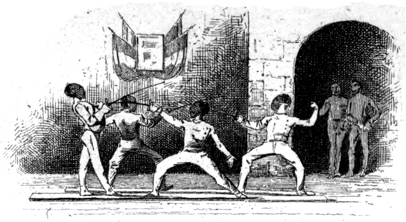
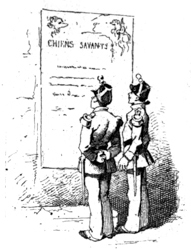
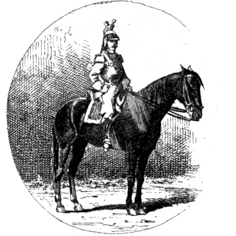
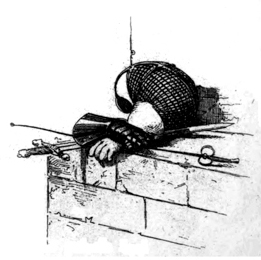
Have we not still to consider the stuffed fencing Glove, with the short shield of red leather, and the giant Glove which swells the fist of the boxers?—the ordinance Glove of the good Dumanet; that white cotton Glove which the brave trooper puts on so willingly on Sunday, coming out of barracks like a conquering hero? Is there not besides the Glove of the Cuirassier, with its large shield of buckskin, which this last man of iron places so gallantly on his hip when he is on express service?
The history of Gauntlets and of military Gloves from the time of the Middle Ages would make a mighty volume, like the ladies’ Glove and the work-people’s Mitten. The liturgical Glove, yet more important, is of three kinds: the pontifical Glove, which was worn by bishops and abbés; the Glove which simple priests had adopted for particular occasions; and lastly, the prelatic Glove. On pontifical Gloves alone Monseigneur X. Barbier de Montault has found means to write in the Bulletin Monumental, 1876-1877, nearly two hundred pages of closely packed text, in 8vo: Ab uno disce omnes. See, my amiable friend, I repeat it—see in what an inextricable archæological labyrinth I might have set you to wander, à propos of all these dear little Gloves, of which I had promised you a history, but about which it appears to me I am making only a lively chatter of whipped Glove. I should not have set on the table aught beyond that which lends grace to woman: Gloves on a champagne glass or in a shepherdess’s hat, roses and a love-letter half opened; such simple still life had assuredly better inspired my Muse than all the documents brought together and packed one on another, well calculated to frighten a mind which is by no means pleased with such barricades of notes and annotations. Ah, my fair friend, how right was Balzac, in his brilliant and profound Traité de la vie élégante, when he wrote the following lines, which I had not sufficiently considered before pledging my word in your society!
The history of Gauntlets and of military Gloves from the time of the Middle Ages would make a mighty volume, like the ladies’ Glove and the work-people’s Mitten. The liturgical Glove, yet more important, is of three kinds: the pontifical Glove, which was worn by bishops and abbés; the Glove which simple priests had adopted for particular occasions; and lastly, the prelatic Glove. On pontifical Gloves alone Monseigneur X. Barbier de Montault has found means to write in the Bulletin Monumental, 1876-1877, nearly two hundred pages of closely packed text, in 8vo: Ab uno disce omnes. See, my amiable friend, I repeat it—see in what an inextricable archæological labyrinth I might have set you to wander, à propos of all these dear little Gloves, of which I had promised you a history, but about which it appears to me I am making only a lively chatter of whipped Glove. I should not have set on the table aught beyond that which lends grace to woman: Gloves on a champagne glass or in a shepherdess’s hat, roses and a love-letter half opened; such simple still life had assuredly better inspired my Muse than all the documents brought together and packed one on another, well calculated to frighten a mind which is by no means pleased with such barricades of notes and annotations. Ah, my fair friend, how right was Balzac, in his brilliant and profound Traité de la vie élégante, when he wrote the following lines, which I had not sufficiently considered before pledging my word in your society!
“The learned man, or the elegant man of the world, who would search out in every epoch the costumes of a people, would compile the most interesting history and the most rationally true. . . . . To ask the origin of shoes, of alms-purses, of hoods, of the cockade, of hoop-petticoats, of farthingales, of Gloves, of masks, is to drag a modilogist into the frightful maze of sumptuary laws, and upon all the battlefields, where civilisation has triumphed over the gross manners imported into Europe by the barbarism of the Middle Ages.
“Things futile in appearance,” continues the author of the Théorie de la démarche, “represent either ideas or interests—whether it be bust, or foot, or head”—he might have said, above all, or hand—“you will ever see a social progress, a retrograde system, or some desperate struggle formulating itself by the assistance of some part or other of the dress. Now the shoe announces a privilege, now the hat signals a revolution—a piece of embroidery, a scarf, or some ornament of straw, is the sign of a party. Why should the toilet be then always the most eloquent of styles, if it was not really the whole man, the man with his political opinions, the man with the text of his existence, the hieroglyphic man? To-day Vestignomy has become almost a branch of the art created by Gall and Lavater.”
I am overwhelmed, O my indulgent friend! I feel that I have been far inferior to my task, and I fear I have not had that charming art of saying nothing which often says so many things. I have neglected to show you the Glove in princely Inventaires, in the old chronicles, and in the delightful tales of Boccaccio, of the Queen of Navarre, of Straparole, of Bonaventure Desperriers, and even in Brantôme, who has written a little story, full of old French esprit, on a Glove found in the bed of a fashionable lady. I had a good opportunity of showing you the anecdotic Glove of ever so many romances and memoirs from Le Petit Jehan de Saintre up to Casanova the Venetian, going through l’ Histoire amoureuse des Gaules.
But the natural and the unpremeditated is also a French quality, of which we must sometimes allow the grace, even in recognising its defects. I left the history of the Glove, I believe, in 1840; and I do not suppose that I have painted for you all the little cuffs, festoons, ruches, notchings, indentations, which adorned the fastenings of the town Gloves of our elegant ladies, nor the long black mittens which accompanied the blonde bodices, of which in those modest times people were madly fond. It is of little consequence for me to follow the fashions from 1840 to the present day: one cannot be a woman and remain ignorant of these different variations of a fashion of which all the specimens return periodically to reconquer a second of celebrity. Open-worked Gloves of Chinese silk, Spanish Gloves, Beaver Gloves, Swedish Gloves, glacé kid Gloves, musketeers’ Gloves, Colombine, with cuffs—what do I say?—the qualifications are innumerable; they change still more than the fashion, for the epithet gives a springtide and deceives the customer—a fortiori would it deceive the Gantuographer, if you will allow me this hideous neologism.
That which I have not been able to accomplish, that which you have not demanded of me, that which nevertheless would have interested you far more than this sleepy talk, is the Physiology of the Glove, with this epigraph taken from an anonymous but witty author—“The style is the man; the Glove is the woman; the style sometimes deceives, but the Glove never.”
I am launched, don’t you see, into theories historic, philosophic, and, above all, physiognomic, in a study altogether beside the mark?
Allow, my sweet and somnolent one, that if you had permitted me at first to take this part (which for my slight notice was assuredly better), I should have been less clumsily stiff, less dull above all, less pretentious besides; albeit I make no other pretension here than to do your pleasure. You have thrown me the Glove on the confines of history; it is thence that I have raised it with more effeminancy than swagger.
I could have wished that fancy might have dictated to history; but, in the present case, it is the most that has been done, if history has succeeded in warming the amiable fancy, which has not taken Gloves to make us villainously sulky with each other.
Pardon!—indulgent interlocutress!
Excuse also, amiable lady readers, ye who read this congealed babble, and who have yet less reason to be favourable to me, in this sense, that to you all, alas! I cannot say, as was once said in the polite world—Friendship allows the Glove.
THE MUFF THE FUR.
THE MUFF THE FUR.
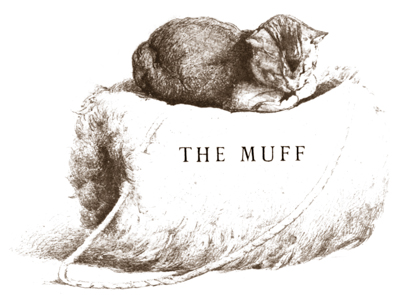
THE Muff! The very name has something about it delicate, downy, and voluptuous. From that little warm satin nest, where pretty chilly little hands ensconce themselves in silk, carrying with them a lace handkerchief, a box of lozenges, a bouquet of Parma violets, or a tender loving billet-doux, a thousand trifles spring up to please us, like a swarm of souvenirs and caressing thoughts of our first years passed at home, and of our first roving loves.

In childhood, we delight to play with the large maternal Muff, to pass our hands over it the wrong way to excite the electricity of the long hair, to plunge our faces in the pungent heady odour of its down, and to make use of this furred sack in inconceivable tricks, in playing at hide-and-seek with small objects, or in burying therein the familiar cat, who becomes lazy in its warmth.
Then, later on, at the hour of the first rendezvous, during one of those icy winters which Ronsard dreaded for his darling, when we see our so much desired mistress appear veiled and all imprisoned in furs, we become almost jealous of the pretty and coquettish Muff, in which she buries her roguish little nose, which the glacial breeze has lashed and reddened, and we plunge then with a sweet brutality our own hands into the silky cylinder, there to find, and there passionately to press the pretty idle fingers, which we are for so generously thawing, by covering them with long kisses like gloves.
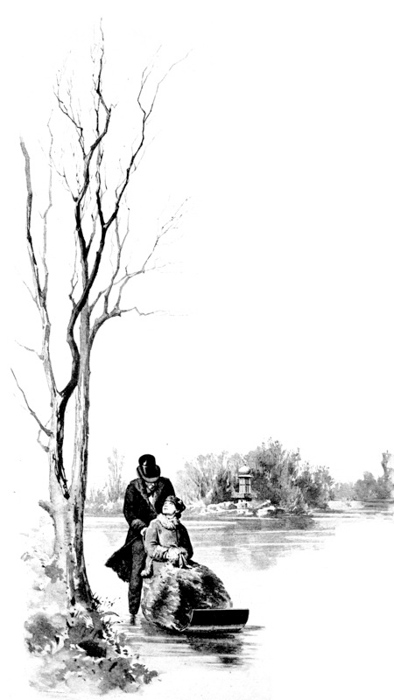
When the Muff returns from exile with the first hoar frosts of November, it causes, as soon as it appears on the boulevards, a sensation, intimate and delicious, to all true feminists, to the Dilettanti of woman—to all those who perceive in their most delicate shades the graces of which a naive or coquettish woman can avail herself, whether in handling the Fan or the Sunshade, or in tucking up a corner of a spring petticoat, or in passing along radiant in a long furry pelisse, or more passive in letting herself glide languishingly in a sledge over the ice of the lake, making eyes at her darling who skates by her side, and pushes forward her coquettish equipage. It seems that woman, that exquisite and delicate flower, blossoms in fur, as those white gardenias of the conservatory which half open and develop themselves in a nest of perfumed wadding.
In childhood, we delight to play with the large maternal Muff, to pass our hands over it the wrong way to excite the electricity of the long hair, to plunge our faces in the pungent heady odour of its down, and to make use of this furred sack in inconceivable tricks, in playing at hide-and-seek with small objects, or in burying therein the familiar cat, who becomes lazy in its warmth.
Then, later on, at the hour of the first rendezvous, during one of those icy winters which Ronsard dreaded for his darling, when we see our so much desired mistress appear veiled and all imprisoned in furs, we become almost jealous of the pretty and coquettish Muff, in which she buries her roguish little nose, which the glacial breeze has lashed and reddened, and we plunge then with a sweet brutality our own hands into the silky cylinder, there to find, and there passionately to press the pretty idle fingers, which we are for so generously thawing, by covering them with long kisses like gloves.
When the Muff returns from exile with the first hoar frosts of November, it causes, as soon as it appears on the boulevards, a sensation, intimate and delicious, to all true feminists, to the Dilettanti of woman—to all those who perceive in their most delicate shades the graces of which a naive or coquettish woman can avail herself, whether in handling the Fan or the Sunshade, or in tucking up a corner of a spring petticoat, or in passing along radiant in a long furry pelisse, or more passive in letting herself glide languishingly in a sledge over the ice of the lake, making eyes at her darling who skates by her side, and pushes forward her coquettish equipage. It seems that woman, that exquisite and delicate flower, blossoms in fur, as those white gardenias of the conservatory which half open and develop themselves in a nest of perfumed wadding.
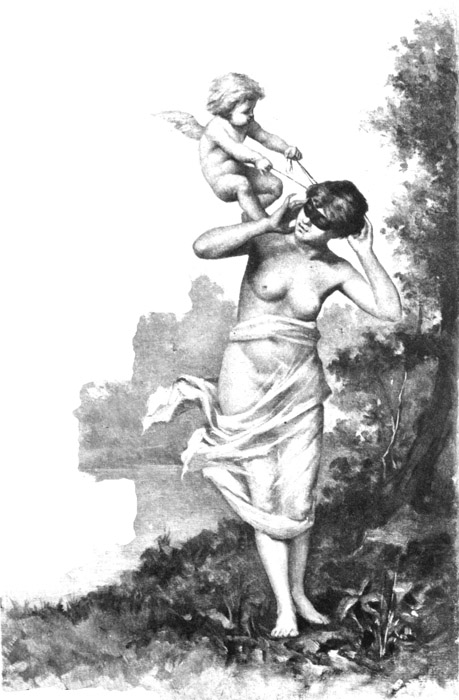
The more she hides, muffles up, deadens, so to speak, her beauty, the more woman—a creature of Hades who makes us dream of paradise—is bewitching in the diabolicity of her graces. When Love, who is represented blind, sets a mask on Venus-coquette, one might think the trickster boy was for burning the universe, for behind those yawning apertures of the black velvet mask, behind those murderous loopholes, two woman’s eyes are lying in ambush, pitiless, turn by turn laughing, burning, blazing, drowned in pleasure, charged, in a word, as with grape-shot, with all the shafts of the Cupidonian quiver.
Thus, out of the midst of furs, woman, that mignonette plant, that mimosa pudica, throws off beauty more mysterious, more warm, more full of promise, more enveloped and more enveloping, as if from the electricity of that peltry, there was spread in the ambient air of the provoking daughter of Eve an attractive sensuality, like a subtle caress, which rustles against our senses in its passage.
The ancients had perhaps great reason to attach, as they did, certain excellences and prerogatives to fur: a master furrier, Charrier, wrote on this subject, in 1634, remarks and moral considerations as naïve as curious: “Our kings, whether they are consecrated, crowned, or married, divest themselves of the splendour of embroideries and of diamonds, to take their royal mantle hedged about with lilies and lined with ermine.
Thus, out of the midst of furs, woman, that mignonette plant, that mimosa pudica, throws off beauty more mysterious, more warm, more full of promise, more enveloped and more enveloping, as if from the electricity of that peltry, there was spread in the ambient air of the provoking daughter of Eve an attractive sensuality, like a subtle caress, which rustles against our senses in its passage.
The ancients had perhaps great reason to attach, as they did, certain excellences and prerogatives to fur: a master furrier, Charrier, wrote on this subject, in 1634, remarks and moral considerations as naïve as curious: “Our kings, whether they are consecrated, crowned, or married, divest themselves of the splendour of embroideries and of diamonds, to take their royal mantle hedged about with lilies and lined with ermine.
“The mantles of the chevaliers, dukes, and peers of France are lined with lynx, marten, and ermine; the chancellors, keepers of the seals, who are the guardians of our laws, wear the most exquisite furs.
“Bachelors and doctors, emperors and physicians clothe themselves with furs which represent the mysteries of theology, the maxims of politics, the secrets of medicine. Furs cure people of headaches and disordered stomachs; attacks of gout which triumph over the most potent remedies, are vanquished by the skins of cats, lambs, and hares.”
In fine, the good Charrier proves with pride that of all the ornaments which luxury has invented there is none so glorious, so august, so precious, as furs, and that the privileges of peltry merchants rightly surpass those of all others.
The masters and wardens of the peltry merchandise had for their arms a paschal lamb on an azure field. Two ermines supported the shield crested with the ducal crown, with this device in exergue—very like that of Brittany—Malo mori quam fœdari.
The use of furs dates back to the origin of the world. Plutarch, in his Table Talk, relates that people dressed themselves in skins before they became acquainted with stuffs. Tacitus assures us it was the same with the Teutons, Propertius with the Romans.
Robed in rich silk, the Court you now behold
Was once a folk fur-clad against the cold,
says a poet of the sixteenth century. But without stopping at the conquest of the Golden Fleece, at Rebekah ordering Jacob to put on his hands and neck kids’ skins, at all the examples of the Bible and of history, we will only remark that the four noble furs consecrated by feudality were the ermine, the vair, the sable, and the miniver. The colours of furs admitted into coats of arms were those of the sable, the ermine, and the vair.
Charlemagne, who loved, they say, simplicity in his apparel, had, according to Eginhard, the habit of wearing in summer a mantle of otter’s skin; but in winter he covered himself with a mantle of which the sleeves were lined with vair and foxes’ fur. This is corroborated by the four following verses of Philippe Mousnes, the poet biographer of this Emperor:—
But in the days of fallen leaves,
He wore a new surcoat with sleeves
Of furs of foxes and of vair
To shield him from the nipping air.
At the epoch of the Crusades, the luxury of furs was carried to the highest degree in Western Europe; but to remain absolutely fixed to the Muff, we must register the first apparition of this little fur about the end of the sixteenth century. In the inventory of goods left by the widow of the President Nicolai we read: Item, a Muff of velvet lined with marten.
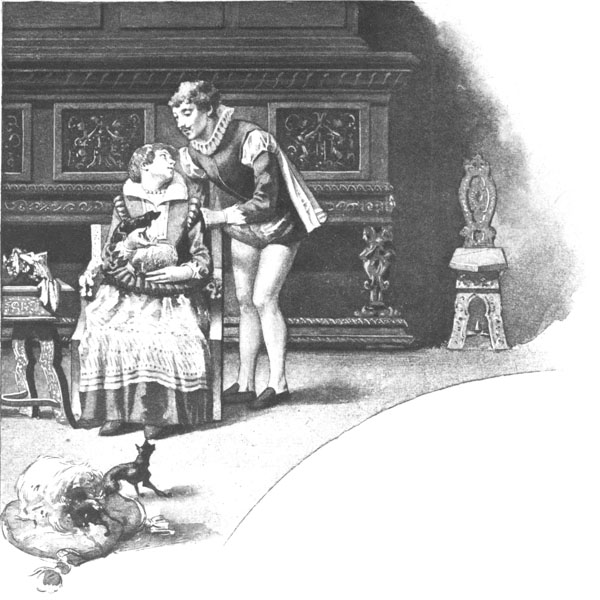
In Venice, however, we have in our researches found a vestige of the Muff at the end of the fifteenth century; celebrated courtezans and noble ladies at that time carried Muffs, which served for niches to minuscular dogs; and an engraving represents a scene of an interior, in which a fair Venetian seems to be showing her lover the infinite games of her lap-dogs in her Muff.
There were at that time in Venice delicious Muffs made after the primitive fashion of a single band of velvet, brocade, or silk, lined with fine fur, rounded in a cylinder, of which the extremities were closed in different widths by buttons of orient crystal, pearls or gold.
D’Aubigné, in his Universal History, says in the course of a story of a besieged town:—“The inhabitants descended thirty paces from the breach, and among the foremost was noticed a woman with Muffs, a halberd in her hand, who mixed with and distinguished herself in this combat.” Under the designation of Muffs we must understand here spare half-sleeves like those mentioned in the Library of Vauprivas à propos of Louise Labé. Under Charles IX. the simple citizen folk were only allowed to wear black Muffs; ladies of the highest condition had alone a right to sumptuous Muffs of various colours.
In a satiric print of 1634, signed Jaspar Isac, and entitled The Squire à la Mode, we see carried by a woman, who is accompanied on foot by a Gascon cavalier, the first French Muff having a direct relation with that which is still in use at the present day. It is a sheath of stuff or silk bordered on both sides by a thick white fur, which grows into an enormous roll at the ends.
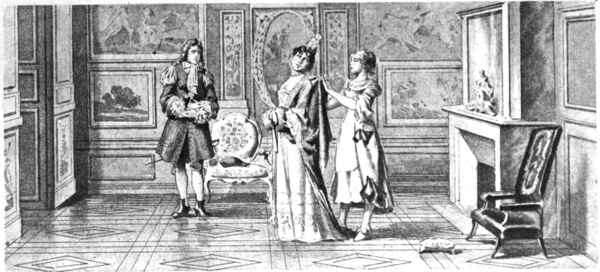
But it is amongst the precious engravings of Hollar, Abraham Bosse, Arnoult, Sandrart, Bonnard, and Trouvain that we see the authentic Muff really born, and find it in the hands of the Parisian matron, of the lady of quality in her winter dress, of the Précieuse, and the coquetting flirt. An engraving of Bonnard shows us a great lady with her head dressed à la Fontange, and in court dress, on the point of going out; a waiting-maid adjusts her mantle, and a gentleman attends the beauty’s good pleasure; the Muff she carries was then of a moderate size, with a bow in the middle. The Muff was worn for style, “for grace,” and was made of sable-marten for ladies of the Court, and simply of dogskin or catskin for the small citizens’ wives who could not devote more than fifteen to twenty francs to the acquisition of this light hand-warmer.
Antoine Furetière, in his Dictionary, has condensed in a few lines all the materials of a Dissertation on the Muff of the seventeenth century. At the word Muff we read:—
A fur worn in winter, in which to put the hands, to keep them warm. Muffs were formerly only for women: at the present day they are carried by men. The finest Muffs are made of marten, . . . . the common of miniver; . . . . the country Muffs of the cavaliers are made of otter and of tiger. A woman puts her nose in her Muff to hide herself. A little Muff-dog is a little dog which ladies can carry in their Muff.
Everything we see is summed up in this. Saint-Jean and Bonnard have preserved for us types of French gentlemen bearing the Muff under Louis XIV. One, in court dress, carries with much grace a small spotted Muff, which he holds in one hand, showing a glimpse at the unoccupied end of the cuff of a fur glove; another, in winter court-dress, holds with the languor of a petit-maître a pretty plump otter Muff falling to the hips, giving a gracious curve to the arm; in the middle of this Muff a vast bow of ribbons or Galants, something like the old trimming called petite oie, is displayed with an excellent effect. In 1680, nothing, according to the Mercure Galant, was to be seen but ribbons purfled with gold, laced, fringed, wreathed, purled, or embroidered, which were gathered in a bow in front, of the Muff.
La Fontaine alludes doubtless to the country Muff spoken of by Furetière when, in the fable of the Monkey and the Leopard, he makes the latter say:—
The king desires me at his Court,
And must have—if I die for’t—
A Muff, made of my skin, so full of blots
Of colour, and of lines, and dots,
And dappled stains, and chequered spots.
As to the Muff-dog—to finish the registration of the definition of Furetière—not only has Hollar left us an engraving of it, and presented it to us under the form of a small Spaniel, but Father du Cerceau makes his upholsterer poet say—Even the lady’s lapdog barked at me, that ingrate
Cadet, for whom I used to stuff
So many sweets inside my Muff.
The chief hall of the peltry merchants and furriers of the 17th century, in Paris, was in the Rue de la Tabletterie or Rue des Fourreurs, which led into the cross-way of the Place aux Chats. The shops of the retail peltry merchants were nearly all situated in the City, Rue Saint-Jacques de la Boucherie, and Rue de la Juiverie.
“In these places,” says Léger, “are to be found very beautiful Muffs for men and for women, and very fashionable ones . . . there are to be sold also very beautiful amices of miniver.” He adds a word about the Palatines properly got up, composed of skins of animals, foreign and native. The Livre commode des adresses de Paris contains some designations of peltry merchants and furriers towards the end of the seventeenth century.
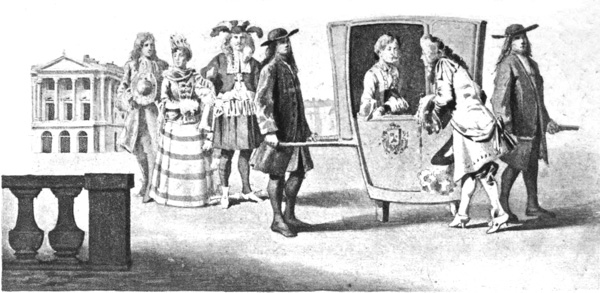
Fashion altered the shape of the Muff considerably under Louis XIV. From the rare documents which we have been able to catalogue, we have easily found numerous modifications in both form and volume. Sometimes narrow and long, sometimes broad and short, it would be impossible to assign to this little chattel an exact type for all that epoch.
The Muff triumphed already, under Louis XIII., in the empire of oglings and at the Place Royale, as it reigned later at Versailles, and showed itself in sedan chairs in the midst of the alleys of the park at the visiting hour, lending always to woman a charming countenance and exquisite graces.
Scarron, in his Poésies Diverses, has left us in four verses a pretty picture of manners for any one who could morally develop it. The poor cripple Scarron certainly had no need of a Muff in his arm-chair!—
My wife then leaves at once, though she
All perils should divide with me;
She takes her Muff and goes
To see some one she knows. . . .
But let us leave the age of big wigs and Fontange head-dresses, and penetrate into the age of powder and patches, into the age of Voltaire, who, à propos of one of his characters in Micromégas, wrote:
“Imagine a very small Muff-dog following a captain of the Guards of the King of Prussia.”
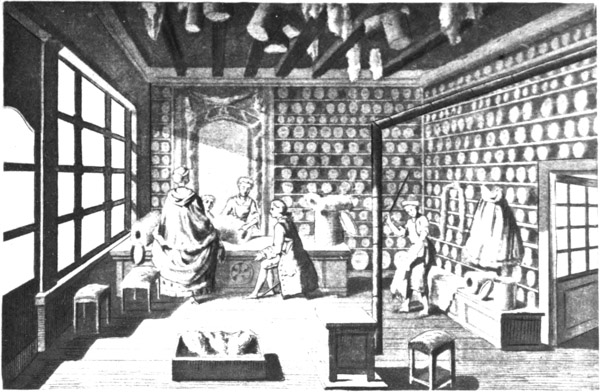
An engraving of the Encyclopédie presents us in the nick of time with a faithful reproduction of a shop of a furrier of the last century. Day penetrates through a large glass bow window; all round, on shelves, are ranged Muffs and different furs; two pleasing shopwomen offer their customers enormous Muffs of miniver, and a shop-boy beats with a rod one of those furred mantles which were sent “to be kept” during the summer, to preserve them from the mites. This engraving, a precious document which may be attributed to Cochin, recalls two charming little stories of Restif de la Bretonne in his Contemporaines du Commun: one entitled La Jolie Fourreuse, the other La Jolie Pelletière. Professions passed out of sight!
“Furs”—MM. de Goncourt wrote in a note of much study to their book La Femme au XVIIIe Siècle—“were a great luxury of Parisian ladies, at the time when the fashion was to arrive at the opera wrapt in the most superb and rarest, and to take them off little by little with coquettish art.” The reputation of the sable, the ermine, the miniver, the lynx, the otter, is indicated in the Étrennes Fourrées dédiées aux jolies Frileuses, Geneva, 1770. Muffs have quite a history, from those on which the furrier brought discredit, in causing one to be worn by the hangman on the execution day—these were probably Muffs à la Jésuite, muffs which were not of fur, and against which a pleasantry at the commencement of the century, A petition presented to the Pope by the master furriers, solicits excommunication—up to those of Angora goats’ hair, immense Muffs which reached to the ground, and to the little Muffs at the end of the century, baptized little barrels, as the Palatine was called cat. The fashion of sledges, then very widely spread, added to the fashion of furs. An etching of Caylus, after a drawing of Coypel, about the middle of the century, shows us in a sledge set on dolphins—one of those sledges which cost ten thousand crowns—a pretty woman dressed entirely in fur, her head-dress a small bonnet of fur with an egret, carried along in a sledge, which is driven by a coachman dressed like a Muscovite, and standing at the back. À propos of furs, the Palatine owes its fortune and its name to the Duchess of Orléans, mother of the Regent, known under the name of the Princess Palatine.
Palatines—which were made of fox, of marten, of miniver—were worn for a long time with Polonaises and Hongrelines. Roy, a French poet of the 18th century, who made acquaintance with the stick at different intervals—sent some bad verses to a lady on the subject of her blue palatine. The Almanach des Muses of 1772 has preserved them for us. Here they are:—
That charming colour wear,
The colour of the summer sky above,
The colour Venus sets on every Love,
Which makes the fairest faces yet more fair,
As Venus in her own sweet self can prove:
But the white place where falls the tufted bow
Is nought indeed but lovely nakedness;
Why hide it then? The beauty which men bless
Gains on the whole by losing, don’t you know?
Caraccioli remarks that people used Muffs in winter just as much for elegance as for need. “The form varies continually,” he says; “to-day (1768) men carry small Muffs lined with down, and trimmed with black or grey satin.”
In 1720, women’s Muffs were very narrow and long; the crossed hands filled it exactly; afterwards they became wider, like those we may see on the hands of the pretty skaters of Lancret. A typical Muff of the epoch was the ermine Muff, fearfully large, which we find carried by the Venetian masks of the delicious Pietro Longhi, who seems to have wished to illustrate by his pictures the Memoires of Jacques Casanova of Seingalt. In the small engravings of the century relating to travelling, which show us the stoppages at the inn, or the packings in the public vehicles, we see everywhere the feminine Muff delicately pressed against their waists by the pretty adventuresses. Boucher’s skater, who passes like a gracious Parisian little figure over a background of a Dutch landscape, doubled up but valiant, appears to make a prow of her Muff, the better to cleave the sharp cold air. But in the intimacy of private life, in the eighteenth century as now, the Muff could lend a charm to genre paintings, and the manufacturers of prints might have composed many Little posts and Nests for love-letters, interpreting by their drawing what the author of the Dictionnaire des Amoureux wished to express, when at the word Muff he gives this piquant definition: A Letter-box, lined with white satin.
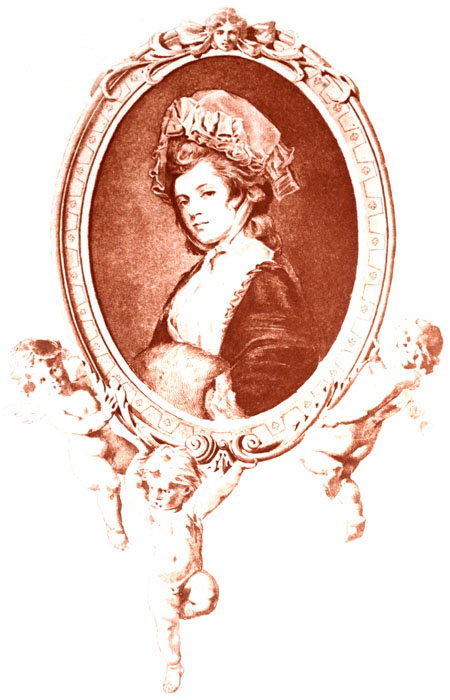
The most celebrated and the most delicious picture in which a Muff figures is assuredly that adorable painting known by the name of The Young Girl with the Muff, by Joshua Reynolds, which formed part of the beautiful collection of the Marquis of Hertford. Nothing is more delicate than this painting. That young English-woman seems rather to walk through the picture than remain fixed in it, so great, one might say, was the quickness with which the painter has caught that image in its passage with its movement of walking—the body is inclined a little forward, the head on one side; the woman’s bust, which stops at the Muff, is so fresh in its composition, so fine in its tonality, so radiant in its originality of design, that it would be enough almost by itself to establish the immortal reputation of Reynolds, who has put into his work a very quintessence of femininity, as an ideal of the most exquisite English loveliness, and also as a type, delicate and never to be forgotten, of a chilly beauty.
Nor must we forget the Portrait of Mrs. Siddons, painted by Gainsborough, in the charm of her twenty-ninth year, in 1784. This picture, which was exhibited at Manchester in 1857, is now in the National Gallery. The charming lady, dressed in a fresh striped blue and white robe, with a fawn-coloured shawl half falling from her shoulders, has on her head a large black felt hat, ornamented with feathers—one of those hats which have done more for the vulgarisation of the glory of Gainsborough than all his studies and portraits. Mrs. Siddons is seated, holding on her lap with her left hand a comfortable Muff of fox or Siberian wolf, of which she appears to caress the fur with her right hand, as if to show off the beauty and whiteness of her spindle-shaped fingers. The mistress of the works of a master who had, it is only right to say, the most ravishing face in the world to portray. But, without needing to have further recourse to the English school, have we not that luminous portrait of Madame Vigée Lebrun, in which the Muff, raised almost level with the head, spreads the shine of its hair of tawny gold like the head of a courtezan of Venice? That astonishing painting of the end of the eighteenth century appeared in its dazzling splendour, in the midst of the square saloon of the Museum of the Louvre, killing, by mere force of freshness and light, the magistral bituminous pictures of the beginning of the century, which are its near neighbours.
Under Louis XVI. the frenzy of the toilette reached its most acute crisis: fashions succeeded one another in a few years with so much rapidity that we can scarcely follow them; people sought to outstrip in everything rather than to refine, and the Muffs, carried by men and women alike, became enormous and exaggerated. Hurtaut, in his Dictionnaire de la Ville de Paris, article Modes, makes this strange remark in the year 1784, “A lady has been seen at the opera with a Muff of momentaneous agitation.”
The intellect loses itself in seeking the exact definition of this qualificative of momentaneous agitation!
In 1788 a fashion was Muffs of Siberian wolf. According to the Magasin des Modes Nouvelles Françaises et Anglaises, the young folks no longer carried their Muff after the peaceable and good citizen-like fashion à la papa level with the bottom of the waistcoat; they used it, on the contrary, like a plaything or an opera hat; they held it in their hand while gesticulating in their promenades, or carried it under their arms like a portfolio strangled and crumpled between the elbow and the chest.
The little dogs, the Muff-toy-terriers, which had continued in favour since the Regency, were more in request now than ever; every woman of fashion had her pug and her King Charles’ pet, like those small dogs that now come from Havanna.
In the celebrated coloured engraving of Debucourt, La Galerie de Bois au Palais-Royal, in 1787, we see circulating in the midst of that strange crowd which was called the medley of the Palais-Royal, extravagant types, among them women holding in their hand beside their furred cloak those incredible Muffs of an immense size, which figure also under the arms of the masked gallants of the time, with a small bow of satin attached to the fur.
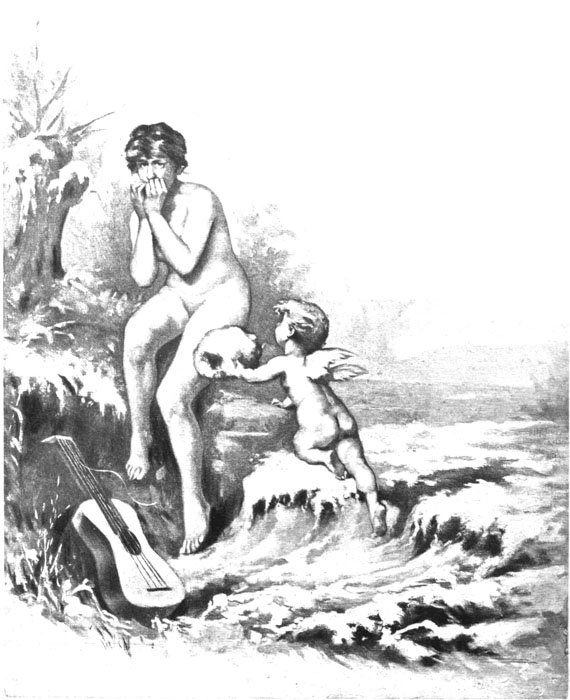
Under the Revolution and the Directory the fashion of Muffs was extremes, either broad as little barrels, or narrow and minuscular; in other respects the fashion varied infinitely, and we must come to the Restoration to find the first chinchilla Muffs which harmonised with the velvet witchouras. Absurd fashions to study! What Muff would the painter choose who wished, by way of allegory, to show a grasshopper shivering in the hoar frost and the snow, to whom charitable Love brings a downy Muff? A pretty subject for a concourse of an Academy which claimed to be précieuse and refined.
In 1835, Muffs, boas, palatines, cloaks lined with marten or fox, affected odious and indescribable forms: they used to make for a time Glove-Muffs, a sort of mittens of marten, which were soldered on to one another where the hands crossed. The Muff, that accessory of the toilet, ought to be in harmony with the general tonality and style of costume. Therefore, to undertake to describe it at that epoch would be only possible in sketching a complete history of Fashion.
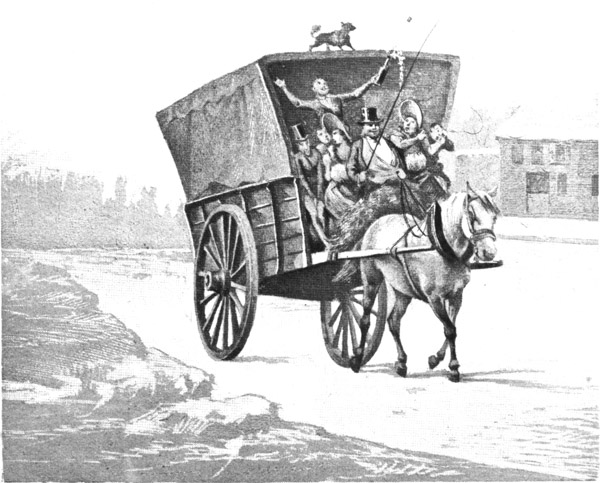
The picturesque Muff of 1830 to 1850, is assuredly the big Muff of the Parisian or provincial tradeswomen, those Muffs, larders and lumber-rooms, which we meet in the deobstruent tales of Paul de Kock, and see figuring in the primitive tilted spring-carts driven by the master, in which are packed the mistress and all the assistant clerks, with a view to exploring some suburban corner on Sunday, there to laugh with their muffs pressed before their mouths, and to act a thousand follies of a doubtful taste, and to banquet plentifully, and to sing during the dessert some free-and-easy ditty, very jovial, after the fashion of those pleasant couplets of Laujon on The Muff, which I will quote here, with the more confidence, since they figure in the Chansons de Parades collected by that boon companion, who was at the same time member of the Caveau and of the Institute:—
See what it is to be too good!
One morning, leaving the warm fold
Of home, Simon I saw, who stood
And shivered in the nipping cold;
He cried, “Come here, you little pearl,
I feel so very cold, my girl!”
Now warm yourself!
Simon, good sir, ensconce yourself!
I’ll lend you, sir, my bran-new Muff!
My dear!
I’ll lend you, sir, my bran-new Muff!
“I feel so very cold, my girl!”
Ay me! I had my new Muff on.
My head was surely in a whirl
To lend it to the good Simon.
That day my kindness cost me dear;
My Muff is spoilt for all the year!
Now warm yourself!
I’ll lend you, sir, my bran-new Muff!
My dear!
My Muff is spoilt for all the year,
For Simon’s ways are rather rough;
And he knows nought of doubt or fear,
He quite destroyed my poor new Muff!
Simon, you’ve ruffled all its fur,
Made it too large, you careless sir!
Now warm yourself!
I’ll lend you, sir, my bran-new Muff!
My dear!
Made it too large, you careless sir!
See: it has been entirely spoiled,
’Tis metamorphosed, I aver;
And seems all rumpled up and soiled.
’Tis like my aunt’s Muff, all agape,
Quite out of countenance and shape!
Now warm yourself!
Simon, good sir, ensconce yourself!
I’ll lend you, sir, my bran-new Muff!
My dear!
I’ll lend you, sir, my bran-new Muff!
What laughter, what shouts, what chokings, in those parties à la Paul de Kock, when an artless maiden—at the time when pleasant digestion had set its bloom on all faces—sang, one by one, these ancient couplets, with an air at once of a whimpering girl and of a woman full of coquettish intelligence.
The Muff has not always brought tears of laughter to the eyes, and a physiologist might draw from it many a curious deduction; only to cite a single instance, in the middle of the Scènes de la Vie de Bohème, in the episode of Francine’s Muff, which should remain in every reader’s memory—the tears come into all our eyes resultant from an emotion at once sincere and profound.
Francine has been condemned by her doctor, and hears with her eyes the terrible sentence of the physician.
“Don’t listen to him,” says she to her love, “don’t listen to him, Jacques, he is telling stories; we will go out to-morrow, it is All Hallows Day, it will be cold, . . . go and buy me a Muff, . . . mind it is a good one, . . . and will last a long while; I am afraid of having chilblains this winter.”
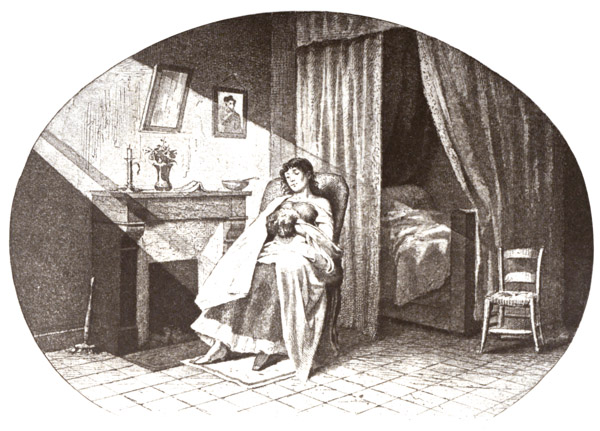
Then, when Jacques has brought the Muff: “It is very pretty,” said Francine; “I will carry it in our walk.”
The morrow, All Hallows Day, about the time of the Angelus of noon, she was seized with the death-struggle, and all her body began to tremble. “My hands are cold, cold,” she murmured, “give me my Muff, dear”—and she plunged her poor little fingers into the fur.
“It is over,” said the doctor to Jacques, “give her a last kiss;” and Jacques glued his lips to those of his darling. At the last moment, they wished to take away her Muff, but her hands still clung to it.
“No, no,” she cried, “let it be—we are in winter, it is cold. Ah my poor Jacques!”
And so Francine dies, without quitting her Muff. A poignant and lugubrious story, like the work of Murger in general; the Muff of Francine will perhaps be the most durable chapter in the Vie de Bohème. We have not been able to set this realistic scene upon the stage, but a painter, M. Haquette, has displayed it after an admirable manner in one of his best pictures exhibited in one of the Paris annual Salons.
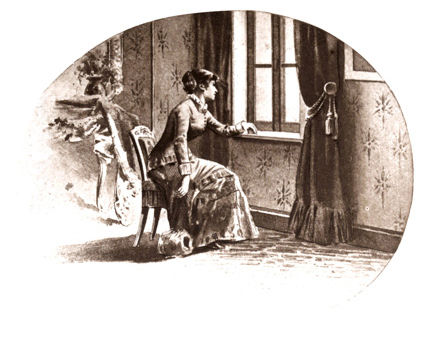
Truly the Muff calls up many sad thoughts for sentimental and charitable souls; this winter chattel reminds them of the sorrows of those who are without fire and home and comfortable clothing, and when the north wind blows without, and the snow falls softly in sombre silence, more than one dreaming girl, with her elbow leaning on the window-sill, lets her Muff fall while thinking of those unfortunates who suffer, of the careless grasshoppers and the laborious ants, of whom an adverse fortune has deceived the foresight.
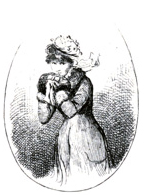
The Muff, the mysterious Muff, hides many distresses: we see it at the present day on the hands of all the working girls and milliners, who set out early in the winter mornings from their homes for the distant workshops; and it is a load upon one’s heart to see all these miserable little Muffs made of rabbit or black cat, out of which peeps often the golden point of a penny roll and a greasy paper which envelops a chlorotic piece of pork or an Arlequin (bits of broken meat) bought in the early market. The Muff which warms so many pretty hands brave and toiling, seems in winter to be the refuge of virtue, shivering but victorious.
How much luxury is there, on the other hand, in the Muffs of the fine world during the last twenty years! They have been made very small, of sable tails, and very expensive; but there have been also some more modest, made with that marten of Australia which took the place of the Astrakhan, which passed out of fashion in 1860. They have been manufactured also in velvet plush or in cloth, with borders of fur or feathers, and a large bow of ribbons in the centre. Some became veritable scent-bags, perfumed with heliotrope, rose, gardenia, verbena, violet, or they were powdered inside with orris root or poudre à la Maréchale.
An elegant and witty lady-correspondent of fashion, who signs with the word Étincelle the notes full of charming confusion in her Carnet d’un Mondain, lately gave the nomenclature of the Muffs of the day, painted in water-colours:
“The Nest-Muff, in satin coulissé, lined with black and white lace, with a whole company of little Indian birds and frightened paroquets hiding themselves in the satin folds.”
“The Flower-Muff, very small, of ivory plush, rouge cardinal or marine blue, with bunches of roses, marigolds, camellias, and violets blossoming in the midst of a great deal of lace.”
“The Watteau-Muff for the evening: a round of Loves painted on white satin. The Coppée-Muff: sparrows sunk in a sky of black satin. The Figaro-Muff, in black velvet, entirely covered with a net of black and gold chenille: three humming-birds in a nest of black lace. The Duchess Muff: all of Marabout, imitating fur, shaded with little bows of dead satin. The Castilian, in plush, covered with point noir: an orange parroquet in the middle standing out in relief on a fan of black lace. The Minerva, in skunk or sable, with a black satin bow and the head of a barn-door owl.”
All these fashions of to-day are already fashions of yesterday, so perpetual is the inconstancy of la Mode! To-day the monkey, blue fox, beaver, swan, and ermine are metamorphosed into Muffs; to-morrow will come the furs of sable, of otter, of chinchilla, of squirrel, of marten, of wolf, &c. Women and furs change, and will change, soon and often.
Fashion is the everlasting Fairy; whether she take the Sunshade as a rod at the end of her gloved hand, or the Muff as a surprise-box or a cornucopia, she is never short of inventions, of prodigies, of follies, and of ruins; she seems to avenge herself on the moderns because the ancients gave her not divine honours, nor placed her upon the summit of their Olympus. Let, then, the head of this new and great goddess be adorned with a weathercock helmet, of which Love will furnish the magnetic arrow, and let a statue be raised to that great first French citizeness, who from Paris governs the world with so formidable a despotism, against whom none ever dreams of raising a revolt.
For us, who, à propos of the Sunshade, the Glove, and the Muff, have just cast a glance upon the museum of this female ruler, we are in a state of dread from the inconceivable variety of objects which were for an hour a woman’s pleasure, and, if we have not conducted our readers before all the glass cases of this national museum, great as the universe, or “the vastest in the world,” as all large milliners’ shops entitle themselves, it is because around the ornaments of women the fickle Loves will always dance their frenzied round, which only a madman can ever hope and wish to stop. It has been said that Fashion is woman’s only literature; if, however, our elegant ladies were condemned to study the special archæology of this literature, very soon—as in love—would they desert History for Romance.