Natural History of the South and West of Ireland.
Reading edition
By R. Lloyd Praeger, B.A., B.E., &c.
The Natural History of the South and West of Ireland possesses a special and peculiar interest in the occurrence in this region of a number of plants and animals which are rare in or absent from Great Britain and the adjoining portions of Europe. Let us first consider the general geographical features of this area, and the geological characters which have produced those features. Ireland has often been likened to a saucer, consisting as it does of a great central plain, fringed with mountain groups disposed around the coast. The plain has a slightly undulating floor of Carboniferous limestone; the groups of hills are mostly formed of older rocks, which break through the level limestones. On our journey from Dublin to Athlone, or from Dublin to Mallow, we pass across typical portions of the central plain; and the brown ridges of Slieve Bloom and Devil's Bit, and the greener heights of the Galtees, furnish good examples of the masses of older rocks that rise out of the plain.
In considering the features and natural history of this wide area, it will be convenient to divide it into districts, which we shall treat of in the following order:—
1. Wicklow and Wexford. 2. Waterford and East Cork. 3. West Cork and Kerry. 4. Clare and East Galway. 5. West Galway and West Mayo. 6. Sligo. 7. The Central Plain and River Shannon.
1. WICKLOW AND WEXFORD.—Here we are on the East Coast, looking across St. George's Channel towards the shores of Wales. The lovely county of Wicklow is the most mountainous in Ireland, having 180 square miles over 1,000 feet elevation, and 25 square miles over 2,000. Wexford is lower and more fertile. The coasts of both counties are in great measure flat and sandy, and are the home of many rare plants. A number of species of light soils and of gravelly shores have here their Irish headquarters, such as the Round-headed Trefoil (Trifolium glomeratum) the Sea-Stock (Matthiola sinuata), the rare Sea-Cudweed (Diotis candidissima), and the Wild Asparagus (A. officinalis). The Murrough, a great gravel beach backed by salt marshes which extends from Greystones to Wicklow, and the marshes of the River Slaney, may be specially recommended to the naturalist. These coasts are the only Irish locality for the handsome ground-beetle, Nebria complanata, a typical South European animal. The Wicklow mountains, which reach in Lugnaquilla a height of 3,039 feet, are the main portion of the Leinster highlands, formed by a great mass of granite which stretches from Dublin into county Kilkenny. Considering their elevation this range is singularly devoid of alpine plants and animals, but many interesting species inhabit the lower grounds, famous on account of the beauty of the scenery.
Among the Lepidoptera several rare species are characteristic of the district, such as the "Bath White" butterfly (Pontia daplidice), and the "Four-spotted Footman" moth (Œnistis quadra).
2. WATERFORD AND EAST CORK.—This is a picturesque district, formed largely of slates and sandstones of Old Red Sandstone age. The coast is mostly of very bold character, with towering cliff ranges. The country is generally undulating and fertile, with occasional mountain ranges, of which the Comeraghs are rendered especially interesting and picturesque by the deep "cooms," embosoming tarns, which give them their name. The Comeraghs and the lovely valley of the Blackwater furnish particularly attractive ground for the naturalist. The flora and fauna of this area are intermediate in character between that of the district last considered and of the surpassingly interesting country that lies to the westward, and which will next claim attention. Thus, the coasts yield several of the rare plants mentioned in the last paragraph—for instance, Diotis and Asparagus grow at Tramore; while at the same time we first meet in this area with some of the most famous plants of the south-west—London Pride (Saxifraga umbrosa), Kidney-leaved Saxifrage (S. Geum), Great Butterwort (Pinguicula grandiflora), Irish Spurge (Euphorbia hiberna). Two rare butterflies of this district are Dianthæcia cæsia and D. luteago var. Barrettii; and the largest of the British leaf-beetles, Timarcha lævigata, has been taken near Waterford, and at Tipperary.
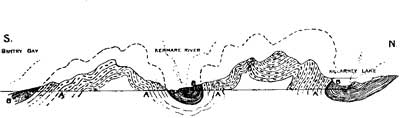
Drawing J. St. J. Phillips.
Geological Section from Bantry Bay to Killarney.
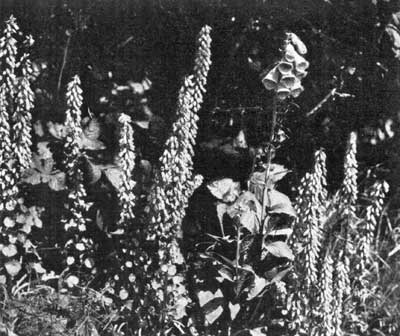
Photo—Welch, Belfast.
A Kerry ditchbank showing Pennywort two feet in height.
3. WEST CORK AND KERRY.—This is one of the most beautiful and interesting districts in the British Isles, and indeed in Europe. The ancient Devonian rocks which prevail have been folded into a grand series of simple arches and troughs, the axes running north-east and south-west. The arches form noble mountain ranges, which on the coast project far into the Atlantic in a series of grand promontories, and inland form picturesque highlands, of which Macgillicuddy's Reeks, which rise to 3,404, constitute the highest land in Ireland. The valleys in their lower portions are occupied by the sea, in the form of long island-studded fiords; their upper parts are often filled with Carboniferous limestone, and offer a pleasant contrast of tillage and green pasture between the gaunt brown mountain-ribs. Here we stand on the most western outpost of the European Continent, with the Atlantic on three sides. The effect of the encompassing ocean, and the western winds which constantly blow in from it, is to produce here and along the whole western coast the most uniform annual temperature to be found in Europe. Frosts are almost unknown, and great heat and drought likewise. These peculiar climatic conditions have resulted in the acquisition and preservation of a fauna and flora which spread here from more southern latitudes at some time now long gone by, and which in these favoured spots still remain to remind us of a period when a state of things prevailed very different from what obtains at present. For naturalists tell us that there can be no doubt that these southern plants and animals migrated to Ireland over land-surfaces now destroyed, having spread along the old-time coast line which long ago extended from the Pyrenean highlands to Ireland; and as a relic of their march, we find some of the species still surviving in the south-west of England, while all of them are absent from the rest of England and from the adjoining parts of continental Europe.
An enumeration of a few of the most remarkable of the plants, with a definition of their range, will make clearer this peculiar feature of the natural history of the West of Ireland:—
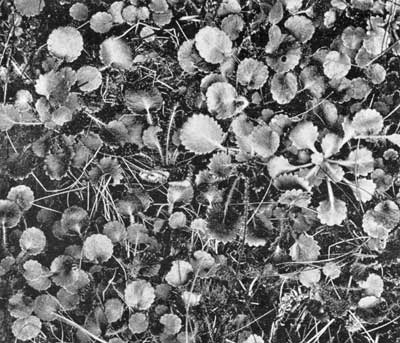
Saxifraga umbrosa.
London Pride (Saxifraga umbrosa). In Ireland along the west and south coasts. Absent from England. On the Continent it is found only in the south.
Kidney-leaved Saxifrage (S. Geum). In Ireland in the south-west. Unknown in England. On the Continent confined to the Pyrenean district
Strawberry-tree (Arbutus unedo). In Ireland in the south-west. Unknown in England. On the Continent it grows all along the Mediterranean.
Great Butter wort (Pinguicula grandiflora). In Ireland in the south-west. Unknown in England. On the Continent it grows on the Alps and in the south-west.
Irish Spurge (Euphorbia hiberna). In Ireland along the south and west coasts. In England it is confined to Devonshire. On the Continent it occurs only in the south-west.
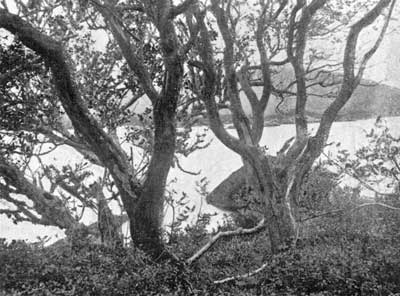
Photo—J. St. J. Phillips.
Among the Arbutus, Cloonee Lakes.
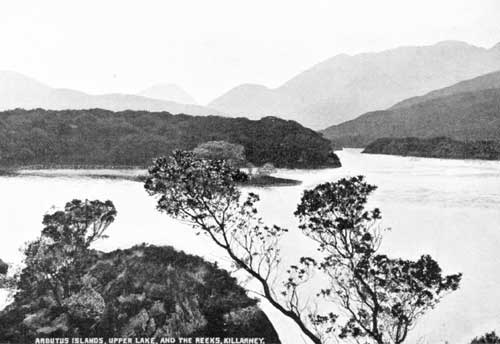
Photo—Welch, Belfast.
Arbutus Islands, Upper Lake, and the Reeks, Killarney.
Going for a moment further north, we find in Connemara, and there only, a group of three kinds of Heath with the same peculiar distribution:—
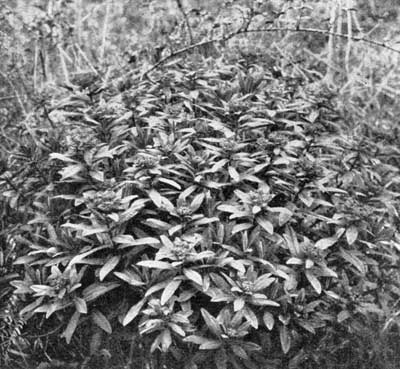
Photo—Welch, Belfast.
The Irish Spurge.
St. Dabeoc's Heath (Dabeocia polifolia). In Ireland in Connemara. Unknown in England. On the Continent confined to the south-west. Mediterranean Heath (Erica mediterranea). In Ireland in Connemara. Unknown in England. On the Continent confined to the south-west. Mackay's Heath (E. Mackaiana). In Ireland in Connemara. Unknown in England. On the Continent in Spain only.
Nor is it the plants alone that exhibit the peculiar relation existing between the Natural History of Ireland and of the Pyrenean region. Among the animals the same features may be observed, the most striking instance being the peculiar Kerry Slug (Geomalacus maculosus), which is abundant in many parts of the extreme south-west of Ireland, and is elsewhere found only in Portugal.
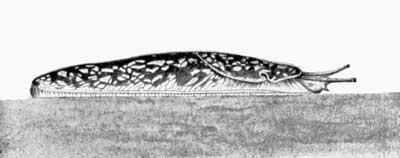
Drawing—Dr. R. F. Scharff.
The Kerry Slug.
Mixed with these southern forms in the West of Ireland we find another group of still stranger affinities. In pools and lakes from Kerry to Donegal grows the curious Pipe-wort (Eriocaulon septangulare). It may be also found in the Island of Skye, in the West of Scotland, but nowhere else in Europe; to see it again we must go to the northern regions of North America, where it flourishes under conditions much more rigorous than those which obtain in its mild Irish home. The deliciously fragrant orchid, Spiranthes Romanzoviana, grows in the counties of Cork, Armagh, Antrim, and Londonderry; elsewhere only in sub-arctic America and the portion of Asia which most nearly approaches the Alaskan shores. The "Blue-eyed Grass" of Canada (Sisyrinchium angustifolium) is likewise confined to the West of Ireland and to North America; and further instances might be quoted. In the animal kingdom, too, parallel cases have been noted, the most interesting being the discovery of no less than three American species of fresh-water sponge, which are unknown in the rest of Europe.
To account for the presence of this American group naturalists are driven, as in the case of the southern species, to the conclusion that these represent one of the very oldest components of our existing fauna and flora, and point to a period when the edge of Europe was prolonged far to the north-west, forming a continuous land area, presumably by way of Iceland and Greenland, to America. And here on the wild western coast of Ireland these last inhabitants of the lost lands of Europe still survive.
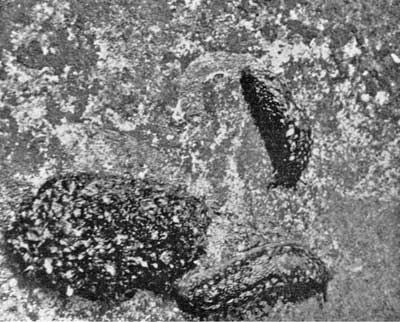
Drawing—Dr. R. F. Scharff.
The Kerry Slug, showing the manner in which its coloration mimics clusters of lichen among which it lives.
Photo—Welch, Belfast.
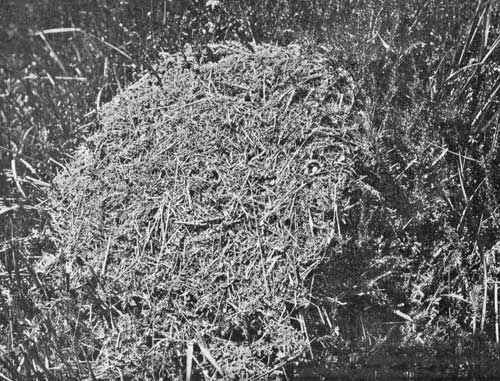
Nest of Wood Ant at Killarney.
4. CLARE AND EAST GALWAY.—Our last district—West Cork and Kerry—was characterised by great ribs of slate and sandstone, and by an absence of limestone and the numerous plants which follow in its train. The present district forms a marked contrast, being largely composed of Carboniferous limestone. And the remarkable thing about these limestones is that they are over many miles totally devoid of any covering of soil or clay; the grey gnarled rock, fantastically carved and crevassed by the action of rain and weather, lies naked and bare. But in the crevices of the rock a wonderful variety of rare and beautiful plants abound. One or two of these have their home in the far south, like the plants we have lately considered, notably the little Close-flowered Orchid, Neotinea intacta, whose nearest station is about Nice. But the majority of the interesting species of these limestones are alpine plants, usually found at high elevations on mountains, which here form sheets of verdure down to the very edge of the sea. The Mountain Dryas (D. octopetala), the Bearberry (Arctostaphylos Uva-ursi), the lovely Spring Gentian (G. verna), and the Blue Moor-grass (Sesleria cærulea) are good examples, all of them growing in great abundance from the hill-tops down to the shore. It is this strange mingling of plants from the far south, from the far north, and from the mountains, which renders the West of Ireland so fascinating a field for the botanist. In the barren district of Clare, and in the adjoining Isles of Arran and south-west portion of county Galway, this peculiar flora may be seen in its greatest perfection. Some very rare insects have been taken in eastern Galway, including the Lepidoptera Nallia ancilla and Lycæna artexerus.
Photo—Welch, Belfast.
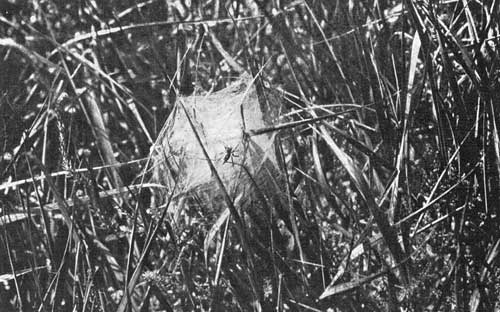
Wolf Spider (Pisaura mirabilis) spinning nest for young.
5. WEST GALWAY AND WEST MAYO.—In this district we have again a complete change of geology and of scenery. The grey limestones with rich grass and rare flowers filling every crevice are gone, and we are in a wild region of ancient metamorphic rocks—schists, quartzites, gneisses, and granites—which form wide moorlands, dotted with innumerable lakelets, with noble mountain groups rising over the wild boggy lowlands. To the student of metamorphism the geology of this area is of very high interest. The botanist finds himself once again, as in Kerry, in a focus of the southern flora already discussed. As stated above, Connemara contributes to the list of Pyrenean plants three Heaths, of which St. Dabeoc's Heath is the loveliest of the British representatives of the order. Here we may also meet again our old Kerry friends the London Pride, and on Inisbofin the Irish Spurge—plants which strictly avoid the limestone, as do the Heaths. The American element is represented by the Pipe-wort, which is common, and the little water plant, Naias flexilis, which grows near Roundstone. Of the three famous Heaths, St. Dabeoc's is abundant throughout Connemara, becoming rarer in Mayo. The Mediterranean Heath grows near Roundstone, and in immense abundance on the north side of Clew Bay, and again near the north-west corner of Mayo, extending inland as far as Lough Conn. Mackay's Heath is the rarest, being confined to the neighbourhood of Roundstone. As regards its fauna, Connemara and West Mayo yield fewer peculiar species than the south-west; but much remains to be done before it can be said that the zoology of this area is thoroughly known, and it offers a most promising field for the explorer.
6. SLIGO.—The visitor who makes Sligo his headquarters finds himself in a district of much variety and interest. This is a district that cannot be too highly recommended to the naturalist. To the geologist the fossiliferous limestones and the metamorphic rocks are alike of interest. The botanist naturally turns to the Ben Bulben Mountains, which harbour the richest group of alpine plants to be found in Ireland, including the pretty Arenaria ciliata, which does not grow elsewhere in the British Isles. To the zoologist a rich field lies waiting. A recent exploration of the limestone glens by a party of English and Irish conchologists has shown that in variety of land mollusca this district surpasses almost any other in these islands; and good results may be confidently expected in other invertebrate groups.
7. THE CENTRE.—The area comprised in the field of operations of the Great Southern and Western Railway Company include the southern half of the great Central Plain of Ireland and the lower course of the Shannon, the largest river in the British Isles. Towards the east the counties of Carlow and Kilkenny include much picturesque ground, especially along the courses of the rivers Nore and Barrow; and as picturesque ground implies the existence of hill and valley, wood and rock, the naturalist will find himself at home here. The flora is rich, though without any very marked features; the Nettle-leaved Bell-flower (Campanula Trachelium) being the most characteristic species. Regarding the fauna much has still to be learned. In Tipperary, Queen's County, and King's County we are in typical central plain country—great tracts of slightly undulating drift-covered Carboniferous limestone, the surface including wide pastures, cultivated ridges, and large areas of peat bog and marsh. The bogs, which form so peculiar a feature of the surface of Ireland, may be studied here over many miles of country. The noble Shannon, which winds slowly southward across the plain, widens at intervals into great lake-like expanses, of which Lough Derg is the largest, a place of much interest to the student of natural history. One plant which grows here, the Willow-leaved Inula (I. salicina), is found nowhere else in the British Isles; other characteristic Shannon plants are the Water Germander (Teucrium Scordium) and the rare Stone wort Chara tomentosa. Further west, in Limerick, a more varied surface prevails. Like Waterford and Cork, Limerick is a great centre for animals of the "Southern" distributional type, such as the Wood White Butterfly (Leptidia sinapis) the Brimstone Butterfly (Gonapteryx rhamm), and the Purple Hair-streak (Thecla quercus). The small but handsome Ground-beetle, Panogæus crux-major, is known in Ireland only from Finlough. This species has a typically "germanic" distribution in Great Britain. The Water-beetle Pelobius Hermanni, a very rare species, and the only British member of its family, occurs near Limerick and Cork. Cratloe Wood, by the Shannon near Limerick, may be specially recommended as a hunting-ground.