L. DE HEGERMANN-LINDENCRONE (continued 4)
Reading edition
"And yours?" he asked.
"Mine is about the same, equally mezzo-soprano."
This seemed to amuse him.
"Do you think the Queen would like to have me write something [quite jocosely] equally mezzo-soprano?"
"I am sure that the Queen," I answered, gushingly, "would be overjoyed."
"Bene," said the great maestro with a smile. "Then I win."
"How enchanting!" I cried, crimson with enthusiasm. "But may I beg one thing?"
"Beg! Je vous en prie."
"Fa dieze [F sharp] is a weak point in both our voices."
"Bene," he said, waving his hand toward his piano. "I will write a duet for you, and only put one G minor in it."
"G minor!" I exclaimed. "Why, that is—"
He interrupted, "Have you ever noticed that G minor is much easier to sing than P sharp?"
He did not wait for my assurance that I did not notice any difference, but said, suddenly, "When do you go to Monza?"
"We are waiting to hear. Perhaps to-morrow."
"Ah," he said, thoughtfully, as if turning over in his mind whether or not he could have the duet ready.
MONZA, October 19th.
Bonghi came yesterday. At the request of the Queen he read aloud my sketch of the Hamlet legend before the promenade en voiture. The Queen thanked me and said that she was going to keep the manuscript, but Bonghi cut my literary wings by pronouncing in his brusque way that, although it was interesting and he liked the contents, it was badly written.
"Chère madame," he said, "you write very well, but you do not know the art of punctuating. You write as the water runs, as the arrow flies; therefore, in reading what you have written I have no time to breathe. I cannot separate the different ideas. A comma means a point d'arrêt, a moment of repose. Every period should be an instant in which to digest a thought."
I felt crushed by this, but tried to defend myself by saying that I had only written it for one indulgent eye, and ended lamely by promising that the next time I wrote anything I would be more careful. "I will do as Mark Twain did—put the punctuations at the end, and one can take one's choice."
We had some music again this evening. The Duke played some solos on his violoncello. He has a beautiful instrument. If Amati made cellos (perhaps he did), he must have made this one.
At dinner I sat next to him.
He said, "I was very much interested in what you wrote about Hamlet."
"In spite of the lack of commas?" I asked.
"Yes, in spite of the lack of commas. But I wonder if all you wrote was true?"
"How can we ever find out?"
"I hate to think of him as a myth."
"Please don't think of him as a myth. Think of him as you always have; otherwise you will owe me a grudge."
Looking across the table to Signor Bonghi, he said: "He is a wonderful man. I like his name, too—Ruggiero Bonghi, tout court."
"It sounds," I said, "so full of strength and power and straight to the point, with no accessories, doesn't it?"
"You say that to me, who have twenty-four names."
"Twenty-four! Dear me! Do you know them all?"
"I must confess that I do not, but I will look them up in the Gotha and write them out for you."
"Twenty-four," I repeated. "How out of breath the priest who baptized you must have been!"
"Oh," cried the Prince, "he did not mind; he got a louis [twenty-franc piece] for each name."
ROME, PALAZZO SFORZA-CESARINI, January, 1887.
My dear Aunt,—After the reception of the Diplomats on the 1st of January we moved from Palazzo Tittoni to this, our new home.
We have in the largest salon an enormous and gorgeously sculptured chimneypiece which has a tiny fire-place that, when crammed full of wood, and after we have puffed our lungs out blowing on it and prodded it with tongs, etc., consents to smile and warm the chair nearest to it, but nothing else.
The ceiling (a work of art of some old master) is way up in the clouds; I am almost obliged to use an opera-glass to see which are angels' or cherubs' legs up there in the blue.
The figures in the corners, I suppose, represent Faith, Hope, and Charity; the fourth must be the Goddess of Plenty. She is emptying an enormous cornucopia over our heads of the most tempting fruit, which makes my mouth water and makes me wish she would drop some of it in my lap.
This palace used to belong to that nice hospitable family you've heard about—the Borgias. I dare say they did a good deal of their poisoning in these very salons.
We were rather agitated the other day when a hole was discovered in one of the walls. I put my hand way down in it as far as I could and pulled out a little bottle which contained some dark liquid. Poison, for sure! It looked very suspicious. Giuseppe, our Italian butler, who is as Italian as an Italian can be, was frightened out of his senses (the few he possesses) and held the bottle at arm's-length.
To test the contents of the vial he put half of it in some food he gave to a thin and forlorn cat who hovered about our kitchen, and for whom Giuseppe cherished no love. However, the cat survived with eight of its lives. Then a rabbit a friend of Giuseppe's wanted to get rid of was given the rest. He also lived and thrived. After these experiments we don't think much of Borgia poisons.
One of the rooms behind the salon (so large that it is divided into four) has the most beautiful frescoed ceiling. It is a pity that it is so dark there that one cannot see it properly. Perhaps originally it was a chapel and the frescoes were easier seen when the altar-candles were burning. But can one imagine a Borgia needing a chapel or a Borgia ever praying?
Just around the corner from us is the campo di fiori (field of flowers), where one might expect to buy flowers, but it is the one thing you do not find there. Everything else, from church ornaments to umbrellas, from silver candlesticks to old clothes, you can buy for a song not so musical as Mendelssohn's "without words"; on the contrary, the buying of the most insignificant object is accompanied by a volume of words screamed after the non-buyer in true Jewish style.
Then around another corner you come across the Torso, made famous by that witty tailor called Pasquino, where he placarded his satirical witticisms; his post-office for anonymous letters!
We have just come home from the Pantheon. There is held every year for the anniversary of King Victor Emmanuel's death a memorial service pour le repos de son âme. If it had been my soul it would never have reposed; it would have jumped up and clapped its wings to applaud the music, which, though always beautiful, to-day was divine.
I even forgot to freeze during the long two hours we stayed in the icy-cold building, open to wind and weather above and full of piercing draughts below. The marble pavement, which has collected damp and mold since 27 B.C., has long since become so wavy and uneven that you walk very unsteadily over it; the costly marbles of which the pavement is made in fine mosaic-work have sunken away from their contours centuries ago, so that now you only realize how beautiful it must have been in its prime.
The high and imposing catafalque, erected for this occasion, which filled the whole center of the large basilique, reaching almost to the dome, was surrounded by enormous candelabra containing wax candles as big as birch-trees.
The ministers of state and the diplomats had a loge reserved for them next to the orchestra, and, although there were carpets and rugs under our feet, the humidity and cold penetrated to the marrow of our stateful and diplomatic bones.
There were tiers of seats for people who were fortunate enough to procure tickets.
Gayarré, the wonderful Spanish tenor, sang several solos, each one more exquisite than the other. I have never heard a more beautiful voice, and certainly have never heard a more perfect artist. The way he phrases and manages his voice is a lesson in itself.
Tamagno, the famous Italian tenor, sings wonderfully also, but very differently. He gives out all the voice he has, and you are overcome with the strength and power and the compass of his unique voice. He is the tenor robusto par excellence of the world.
One cannot compare the two singers. Gayarré has the real quality of a tenor, exquisitely tender, suave, and still powerful. He has a way of keeping his voice bottled up until a grand climax; then he lets it swell out in a triumphal burst.
This funeral service is a very long and fatiguing affair. I pity the carabinieri (the soldiers) who are on service that day. Although they are men chosen for their powerful build, some of them cannot endure the fatigue of standing "at arms" the two hours that the service lasts. I suppose the poor things are put there from early dawn, and there they must stand, stiff and straight, with uplifted sword, without moving a muscle. We saw one (not this year, but last) faint dead away and drop in a heap on the marble steps of the altar. His sword and casque made a great clatter when they fell and rattled over the pavement. Four of his comrades rushed in, picked him up, and carried him out, staggering under his weight. He was replaced by another carabinier noiselessly and so quickly that you hardly knew that anything had happened.
The Argentina Theater attempted to give Wagner's Ring. It was a dismal performance. Wagner is not at his best in an Italian setting, with all the gas turned on and the scenery half tumbling down and the orchestra fiddling in full view.
In the first act of "Rheingold," where the three maidens are swimming, the poor girls, with hair of unequal lengths, sprawled about, their arms clutching at air, and held up to the roof by visible and shaky ropes, half the time forgetting to sing in their wild efforts to keep themselves from falling, separated from the audience only by a gauze curtain which was transparency itself.
DENMARK, July, 1887.
My dear Aunt,—Denmark in July is ideal. It is never too warm in the day and always cool at night.
I have been spending a few days with Howard on his farm.
On the Fourth of July Howard wished to give the peasants in the neighborhood an entertainment to celebrate his country's "glorious Fourth." He hoped to inspire them with due enthusiasm and give them a good day's sport.
The Danish peasant's idea of amusement is to walk leisurely to the place of rendezvous, to sit quietly and rest from his week's hard work, eat plenty of Smörrebrod (sandwiches), drink barrels of beer, have tobacco ad libitum, and finally to leave as lazily as he came.
This feast was going to be otherwise. Everything was to be done à l'Américaine. The Fourth fell on a Sunday, and the farmers all accepted and came on the stroke of the clock, dressed in their Sunday-best clothes, which are of heavy broadcloth, made in the fashion of Louis Philippe, voluminous over the hips, thick, heavy-soled boots, and with long snake-like pipes hanging from their mouths.
Howard had arranged all sorts of gymkhana sports, for which prizes were to be given. There were to be the long jump, the high jump, a running-race, catching the greased pig, pole-climbing, a race in a bag, and so forth.
"They shall have a high old time," said Howard.
Their dismay only equaled their astonishment when they were told what was expected of them. What! Jump, run, and be tied up in bags and climb poles? Was this the way that they were going to amuse themselves on this hot day? Were soiling their clothes, perspiring, and suffering tortures in their tight boots the delightful, reposeful feast they had been invited to? Their inborn politeness would not allow them to do otherwise than obey the wishes of their host. They tried their best to perform the feats put down on the program.
Their week's work of mowing, cutting trees, plowing, threshing, and the different things belonging to a farmer's life seemed child's play compared with this so-called enjoyment.
They did not understand why they got prizes for deeds they had not done, and received the box of cigars or silver mug with unperturbed serenity.
Consternation and resignation were the only expressions on their faces. Neither did they understand when they were told to cry "Hurrah!" and wave their hats after Howard should finish his oration. That he made standing on a table. He expatiated on the beauty of liberty and the soul-inspiring feeling of independence, and became quite eloquent. They cheered in a spiritless and cheerless manner. For them liberty was a high-sounding word which meant nothing. An enlightened government provided them with all they needed. Why have the bother to choose your doctor or your priest when all that is done for you? Only to pay taxes. Can anything be more simple?
The games H. tried to teach them were not successful. They stood in a circle and were told (Howard rubbed his hands in a dainty manner) that "this is the way we wash our clothes." This did not appeal to them; they knew too well how they washed theirs, and they saw no fun in imitating such every-day affairs as washing and ironing.
Every way "we did" things had to be explained at length and translated into Danish. And the most inexplicable of all the games was "Oranges and lemons." When they were asked if they wanted oranges or lemons; they all answered, truthfully and conscientiously, "Oranges." Who in his senses would prefer a sour lemon to a juicy orange? The result was that the battle was very one-sided—all oranges and only one lemon.
The dance was also rather dismal. The musicians played some national waltzes, and the guests shuffled about on the sanded floor, treading a slow measure and on one another's toes; the women held on to their partners by their shoulders, and the men clutched the women round their bulky waists. However, they all kept the measure, and some of the men really danced quite well.
The finale was the fireworks. It ought to have been a grand display, but the rockets were damp, the "wheels," which ought to have wheeled up in the air, merely whizzed on the ground and seemed to make for the nearest guest in an absolutely vicious manner. All the things that ought to have gone off stayed and sputtered.
As an entertainment it was a failure. The guests, however, had plenty to eat and drink, and carried away pockets full of tobacco and cigars, but it was rather pathetic to see the worn-out and weary farmers dragging their tired limbs slowly and ponderously down the avenue with a look of "Why all this?" depicted on their faces.
MONZA, October 17th.
After luncheon to-day we went out on the terrace to drink our coffee. The sun was warm and the air deliciously cool, a typical Italian autumn day. As we sat there we heard some mysterious noise which came from the side of the park where the avenue terminates and is divided from the deer-park by a large iron gate.
Looking down the avenue, we saw a man peering through the bars of the gate. He had a bear with him. Her Majesty was curious to see them and ordered the gate unlocked and the man and the bear permitted to enter. The man was quite young, with soft black eyes and dazzling teeth. He led the bear by a heavy iron chain passed through a ring in its nose. The Queen went down the steps and talked with him.
"Will he bite me if I pat him?" she asked.
"No, signora; he is very good" ("E molto buono"). He hesitated a moment, and then said, "Signora, will you tell me which of the ladies there is the Regina?" The Queen was immensely amused, and answered, "I am the Queen" ("Son io la Regina"). The young fellow was quite overcome, and threw himself on the ground and kissed the hem of her dress.
"How did you tame the bear?" inquired her Majesty.
He answered in a very agitated voice: "Maesta, it was very easy. Bears are not difficult to tame. One must only be kind and patient."
"You look," said the Queen, "as if you were very kind and patient."
The young Italian passed his hand lovingly over his companion's shaggy head, and as he looked up at the beautiful and smiling Queen his eyes filled with tears. "I love him," he said, simply; "he is my only friend." We, who stood near enough to hear, were trembling on the verge of weeping. He added, "We never leave each other; we eat and sleep together, and all I have I share with him."
I saw tears in the Queen's eyes, which she quickly wiped away; and, turning to the man, she asked, "Can he do any tricks?"
"Si, maesta, he can lie on his back and put his paws up in the air and hum."
This did not seem much of a trick, probably being a bear's customary attitude.
"Well," said the Queen, "let us see what he can do."
But, although the bear was addressed in terms of tenderest endearment and although we hoped that he would obey his master and do honor to the occasion, he did nothing of the kind. On the contrary, instead of lying down and humming he stood up his full height on his hind legs and began to waltz, swaying his long, plump body and shaking his thick, brown fur.
He opened his mouth wide, showing his white teeth and his great red tongue, and looked as if he were laughing and as if it was the funniest thing in the world that he was doing.
"He does not seem to be very obedient," smiled her Majesty.
"He is afraid," said the man, trying to make excuses for his pet.
"You must come again," said the Queen, "when your bear is better trained," and, turning to Signor Borea (her chamberlain), told him to give the man some money and direct him to the forester's lodge, where some food should be given to him.
The young Italian's face beamed with joy when he beheld the vast sum (twenty lire) he had received, and led his disobedient companion away in disgrace; but the bear, quite unconscious of being in disgrace, turned his head for a last friendly glance, walked on his hind legs in his clumsy and swaggering manner, but with a certain dignity, down the avenue.
The King, who was with us on the terrace, had been a silent witness of the whole scene, and, not being able to resist the promptings of his kind heart, followed the couple. We saw him put a gold piece in the brown palm of the poor fellow, whose "only friend" had failed him on this unique occasion. He seemed quite overcome by this Danaë-like shower of gold, and hesitated before taking the piece, thinking, perhaps, that on this occasion honesty might be the best policy, and said:
"The Queen has already given me much."
"That does not matter," said the King. "You must take what I give you. Do you know who I am?"
"No, signor. Are you Garibaldi?"
The King laughed. "No, I am not Garibaldi; I am the King."
This second surprise was too much for the little man, and he almost fell down in his emotion.
What his dreams were that night must have been like one of the Arabian Nights.
REGGIO, October 17th.
Dear ____,—Count Spaletti has a very fine château (a large park and a beautiful forest), where he and his family live in patriarchal style. It is the true Italian traditional home-life in every respect.
There is on the farm a large building in which the famous Parmesan cheese is made. We were shown the entire process from the milking of the cows down to the great wheels (which look like millstones) and the completed cheese. Milking is a process with which you are, perhaps, not familiar. It is done with the help of a maiden and a three-legged stool, while the cow goes on chewing the worn-out cud of her last meal, occasionally giving a Cenci-like glance of approbation.
But I won't tell you about that; I will let you in the secrets of Parmesan-cheese making, so that when you are eating it grated on macaroni you may know what an old stager you have to do with. The milk is put in great vats just as it comes from the mesdames les vaches; there it remains, occasionally turned around, not churned, with a wooden paddle, until it becomes a solid substance.
When it is hard enough to handle it is put into large round wooden forms and allowed to remain untouched—for how long do you think? One year! Then they put it under the oil régime—that is to say, olive-oil is poured through the cheese at regular intervals until the rind is as black and thick as leather. In four years it is ready to be sold. Each cheese weighs several hundred pounds, is a foot thick, and is as big as a cart-wheel. We eat it every day for luncheon and dinner. I like it so much better, fresh and straight from the farm (if anything four years old can be called fresh), than when stale and grated.
ROME, 1888.
My dear Aunt,—Leo XIII.'s jubilee has been the means of bringing the world to Rome. Every day during these last weeks we have watched the carts passing our house piled with huge cases which contained the presents destined for the Holy Father.
The streets are filled with pilgrims from everywhere. One cannot look in any direction without seeing processions of nuns, priests, and monks of all nations and denominations, from the dingy brown Franciscans, the Capucines with their white mantles displaying their bare legs, to the youthful disciples of the Propaganda in their brilliant scarlet cassocks, not to speak of the forestiere armed with their red Baedekers, who are doing Rome and at the same time doing the Pope's Jubilee.
Everything and every one on the way to the Vatican.
We went to see the gifts, which are exposed in many rooms on the ground floor of the Vatican. There was an enormous quantity of things of every description, useful, ornamental, and superfluous. The windmills, bells, every sort of vehicle, rowboats, sailboats, and every modern invention had been put out in the Vatican gardens.
You can have no idea of the incredible amount of slippers sent (thousands of them); church vêtements by the hundreds, embroidered by millions of women who must have worked themselves blind; the most exquisite articles of needlework, incrusted with pearls and precious stones which have probably cost a mint of money.
The Princess del Drago's gift was a large diamond cross with an enormous emerald in the center, an heirloom from her mother, the Queen of Spain. There were many other private gifts which were equally valuable. Almost a ship-load of canned fruits and vegetables sent from America; these were arranged in a gigantic pyramid. Just to look at them made my mouth water and me homesick.
Ridiculous objects from naïf donors, such as babies' socks and jackets, and silver things for a lady's toilet-table, and other equally inappropriate things, must have surprised the Pope when he saw them. I have not mentioned the millions of francs the Pope received in money; he can easily dispose of that; and he intends, I believe, to make presents to every church in Italy of the different objects which can be useful. But what can he do with the babies' socks?
On last Thursday the Pope said mass in St. Peter's. It was the great event of the year.
As we are accredited to the Quirinal, of course I never can have the opportunity to be received by his Holiness; therefore I was very glad when the monsignore who is still Dantefying us offered to give me a carte d'entrée.
I was obliged to be at St. Peter's at a very early hour, and succeeded, owing to having a "friend at court" (the Swedish chamberlain to the Pope, Marquis de Lagergren), in getting an excellent place where I had a good view of the Pope and the whole ceremony. Ladies are dressed entirely in black, with black veils instead of hats, on these occasions.
There was a great deal of noise in the church—much scraping of chairs, rather loud talking, people being shown to their seats, and, above all other noises, the organ.
I cannot honestly say that the music was beautiful. With the exception of the days when the best singers of the Pope's choir sing, the music in St. Peter's is not good. The organ is as antiquated as the organist, who plays with all the stops pulled out.
The center of the church was filled with wooden benches and chairs. The altar was brilliantly lighted with hundreds of wax candles; the columns around it were hung with tawdry red damask curtains, which, in my opinion, rather took from the dignity of this magnificent church.
The Swiss Guards ushered people to their seats. They looked very picturesque in their costumes of bright red and yellow, slashed sleeves, and brass helmets.
In due time the serious and somber chamberlains, in their black satin and velvet costumes, appeared; next came the bishops, in their purple robes; and directly preceding his Holiness the Pope were the cardinals, in red. Then came the twelve men carrying the gold pontifical chair in which the Pope was seated; they walked very solemnly and slowly.
Every one dropped on his knees, and the Pope raised his thin white hand to bless the kneeling crowd.
He mounted the steps of the high altar and began reading mass. His voice was very feeble and scarcely audible.
It was very impressive. It would be impossible to give you an idea of the intense solemnity of this scene, especially for me, as I have no talent for description. Women wept and waved their wet handkerchiefs; the sterner sex would have done the same, I dare say, if they had not been ashamed to show so much emotion.
March 10, 1888.
The Emperor Wilhelm of Germany died yesterday. Though he was so very old, the news of his death was unexpected and cast a gloom over Rome. Of course, all gaieties are ended, and court mourning ordered for three weeks. King Umberto left directly for Genoa to meet the new Emperor, who started from San Remo on his way to Berlin. The dinner for King Umberto's birthday, which was to have been on the 14th, has been décommandé.
The Prince of Naples has already left for Berlin to represent the King at the Emperor's funeral—his first official act since he has become of age.
May 1, 1888.
My dear Aunt,—My letters are very uninteresting. I cannot help it. There is nothing going on in society. In fact, many of the Italians have left Rome, and the colleagues are resting on their oars—those who have any to rest on. I am resting on my "Pinafore" oars. How lucky we had it when we did!
Taking advantage of this moment of inactivity, the Roman ladies arranged a charity performance, for which Marquise Del Grillo (Madame Ristori) promised to give her services. She chose the famous play "Marie Antoinette," which is supposed to be one of her best. The tickets were to be procured only from the ladies of the committee (of which I was one), and, though they cost a fabulous price, the theater was crammed to suffocation.
Madame Ristori's acting was, of course, perfect, her voice musical, her Italian delicious, and her gestures were faultless. If one might dare criticize such an artist, one could say that her movements might have been a little more queenly, but a queen's grace and dignity must be very difficult to acquire from sheer imagination. Also her dress was far from what it ought to have been. I am sure no French dressmaker had the making of that gown. In the first act Marie Antoinette, in the apothéose of her glory, wore voluminous skirts and crinoline, according to the famous picture. Madame Ristori wore a crinoline, to be sure; but her dress was too short in front and showed her low-heeled shoes of white satin, and when she moved about her gown of heavy brocade swayed from side to side like a pendulum.
One recognized the great artist in the scene in the prison, where she bade the king and her children adieu. This was very touching, and there was not a dry eye in the audience. I know that I sniffed and wept and blew my nose, and was quite ashamed of showing my feelings so explosively.
I went to see her on her reception-day (the next Friday) and found her in her every-day surroundings, her pretty daughter hovering about with teacups and cakes, everything looking very home-like and prosaic, and Marie Antoinette eating sandwiches with a healthy appetite and talking of the latest gossip. I could hardly believe that I had shed so many tears over her sad fate a few nights ago.
The sad news of the death of Emperor Frederick came day before yesterday from San Remo. Every one had been expecting his death for months. The Italians loved him, and mourn him as if he had been their own. There is court mourning for three weeks.
MONZA, October 1, 1888.
My dear Aunt,—You ought to have a map of Europe continually under your eyes, and little pins to stick in the places where we last were. Space and distance are nothing to your "wandering jew(el)s." Going from Italy to Denmark and back again twice a year, we are obliged to traverse the whole of Europe, and, as "all roads lead to Rome," we can choose the one we like best.
Wherever we go we are enigmas to our fellow-travelers, who can never decide what nation we belong to. Johan talks Danish to me; we talk French to the governess, German to the valet, Italian to my maid, and English alternately. I think we would have puzzled the builders of the tower of Babel at that confusing moment when they all burst forth in unknown tongues.
ROME, October 15, 1888.
My dear Aunt,—We are having a series of entertainments in honor of the new Kaiser. This is his first official visit since he has become Emperor. He arrived here on the 11th at four o'clock.
We were invited by M. and Mme. Huffer to see the entrée. They being Germans, their decorations surpassed all others. Carpets out of every window, flags flying, and the German coat of arms placed in every available spot on their beautiful palace in the Via Nazionale. The King, accompanied by the Prince of Naples, followed by the Duke of Genoa, Duc d'Aosta, M. Crispi, Marquis Gravina, and Marquis Guiccioli, and other notabilities, drove to the station through a double line of troops on both sides of the street.
The usually dirty waiting-room in the station was hung with tapestries taken from the Quirinal and the splendid Louis XV. furniture taken from the beautiful Palace of Caserta.
The train which preceded the Emperor's, decked out with garlands and flags, came in sight, the traditional red carpet was laid down, the final orders shouted, and the Imperial train appeared. The soldiers presented arms, and the military bands struck up the German national hymn. The King wore the uniform of a general. He advanced to meet his Imperial guest. They embraced and kissed each other on both cheeks, then they presented the princes and the different members of their suites.
The Emperor was in the red uniform of the Hussars and looked very young and handsome.
In the first berline (as they call the demi-gala blue landaus) were the Emperor and the King; in the second were the Prince of Naples and Prince Henry of Prussia (the Emperor's brother); in the third the Duc d'Aosta and the Duke of Genoa; in the fourth, Count Herbert Bismarck and the German Ambassador (Count Solms). The other carriages, of which there must have been ten, contained the military and civil members of both the sovereigns.
There was a great demonstration in front of the Quirinal Palace. The Emperor and the King came out on the balcony amid screams of "Eh! viva!" One old man—a German, I suppose—who was covered with medals shouted at the top of his lungs. "Hoch!" hoping to make a sensation, but the Emperor made no sign that he heard it.
The next day (Friday), as had been arranged long beforehand, the Emperor made his visit to the Pope; the carriage from the Quirinal brought him to the residence of Herr von Schlözer (the German Minister to the Vatican), where the Emperor lunched and changed his uniform.
Schlözer's account of the luncheon was very amusing. His household was apparently not arranged for the reception of emperors. He and his secretary were in great straits to provide the proper luxuries for their august guest. Schlözer possessed nothing so frivolous as a mirror, therefore he sent to borrow ours. We sent him the one we thought best suited to the occasion. It was so different from Schlözer's modest belongings that the Emperor's quick eye guessed instantly that it was a stranger, and said, "Where did this come from?"
I give you Herr von Schlözer's account in his own language.
"I had no extra toilet things to put into the Emperor's room, but, fortunately, I had bought a cake of soap in Berlin; this I put on a piece of marble I had picked up in the Forum, which I thought would do for a soap-dish. The Emperor went into the adjoining room to change his uniform, and suddenly appeared in the doorway, holding out his wet hands, and said, 'Mein liebe Schlözer, can't you give me a towel?' Donnerwetter! said Schlözer, that was the one thing that I had forgotten."
The luncheon was (excepting the famous wines on which he prides himself) of the simplest kind of Italian repasts, of which macaroni, frittura mista, and cutlets with saffron (à la Milanais) formed the chief feature. The Emperor was in the best of spirits and enjoyed it all, interlarded as it was with Schlözer's unique remarks.
The Emperor's own horses and carriages and piqueurs (brought expressly from Berlin for this one visit to the Pope) were waiting before the German Legation to convey his Majesty and Herr von Schlözer to the Vatican. The whole route through which they drove was lined with a double row of the national troops to the very steps of the Vatican. Every window was filled with people anxious to catch a glimpse of the handsome and youthful Emperor as he passed by in his open victoria; Prince Henry and Count Bismarck followed in another of the Emperor's carriages.
At the early hour of half past nine the haute société, the Ministers, the Senators and Deputies—in fact, all Rome—were summoned to meet the Emperor at the Campidoglia. It was to be lighted for the first time with electricity—a great event. People were to meet in the statue-gallery. After all were assembled, the King, the Queen, and the Emperor entered, followed by the princes and their different suites. The Emperor was dressed in the uniform of the garde de corps (all white) with a silver breastplate and silver helmet. He was an apparition! and did not look unlike one of the statues. Or was he a Lohengrin who had come in a swan-drawn skiff down the Tiber to save some Italian Elsa?
There were some presentations made. I, for one, was presented to his Imperial Majesty, and was charmed with his graciousness. We talked English, which I think rather pleased him, for he made some facetious remarks on things and people and actually laughed.
The next evening, the 18th, the fireworks and the illumination of the Forum, the Colosseum, and the Palatino, were the entertainment after a dîner de famille.
The Diplomatic Corps was bidden to the Villino. The place was rather too small to contain all the guests. Fortunately, it was a pleasant evening; there was a full moon which lent charm to the scene. Bengal lights, to my mind, are the cheapest form of illumination, but the fireworks—for which the Italians are so renowned—were splendid. Rockets of all colors, bursting in mid-air and sending down showers of lighted balls, were never-ending, and everything belonging to pyrotechnics was in profusion and perfection.
The bouquet (which is the French for the apothéose) surpassed everything I had ever seen before. It lasted several minutes. When everything has burned out, only the brilliant "W" with an Imperial crown remained, and faded gradually away.
ROME, March, 1889.
Dear Aunt,—Rome is placarded all over with blood-curdling pictures of "the Wild West Show" and portraits of our friend Buffalo Bill. I call him "our friend," although I can't say I know him very well. We traveled in the same car with him for a whole week on our way to California ten years ago. That is not enough, is it?
I had never seen a Wild West Show and was most eager to go; besides, I wanted to see "our friend" in his professional character. We made up a large party and went there en bande.
The tents were put up not far from the Vatican gardens, behind Castel St. Angelo. None of us had ever been to such a performance, and we were all delighted at the marvelous feats of lassoing by the cowboys and the rifle-shooting of the cowgirls, who looked so pretty in their short leather skirts and leggings. One of them threw pieces of silver in the air and shot them in two with her rifle. Everything was wonderful.
Duke Sermoneta, who went with us, having read on the posters that Buffalo Bill professed to tame any wild or vicious horse, wished to test Buffalo Bill's ability, and perhaps with a little maliciousness had ordered some of the wild horses from his estate to be brought to Rome.
These untamed horses are like those that used to run in the corsi dei Barberi during the carnival in Rome when Rome had carnivals. The Duke was very sure that no one could tame them, much less put a saddle on them; the audience, no doubt, thought the same. There was quite an excitement when the frightened things came rushing into the arena and stood looking about them with terrified eyes. But the cowboys knew very well what to do. They quickly lassoed them, and somehow, before we could see the whole process, they were forced to the ground, plunging about and making desperate efforts to get up. Finally, after many attempts, a saddle was placed on them, and lo and behold! the ferocious wild horses were conquered and, as meek as Mary's little lamb, were ridden around the arena to the accompaniment of great clapping, screaming, and applause. Every one was as enthusiastic as the Duke Sermoneta over the stubborn and agile young Wild-Westers. Then Buffalo Bill's herald came forward and proposed that the Italian campagna boys, who had brought the Duke's horses, should mount the American bucking horses. The Duke gave his consent readily. He was very willing that his men should show what they could do. Well, they showed what they could not do; they could not keep on the horses a minute, even if they managed to get on; they turned somersaults in every direction, fell off, and rolled about on the ground. The audience roared.
Buffalo Bill appeared on a beautiful horse, holding his gray sombrero in his hand, acknowledging the applause. He looks very handsome with his long, fair hair falling on his shoulders and his Charles-the-Second fine face.
The Duke said, "How I should like to speak to that man!"
We said that we knew him and that perhaps we could get him to come to us. I wrote on my card: "It would give M. de Hegermann and myself much pleasure to speak with you. We traveled in the same train with you to California some years ago, if you remember." I sent the card by a little page who was selling popcorn. At the first opportunity Buffalo Bill came, preceded by the boy. He said he "remembered us perfectly." I introduced him to the Duke, who, after having complimented him on his "show" and laughed over the awkward attempts of his boys, asked him if we might see the camp.
No gentleman from the court of Louis XV. could surpass Buffalo Bill's refined and courteous manners. He said if we would wait until the performance was over he would "show us about."
We did wait, and went all over the camp with him, and saw everything that was to be seen, and smelled the different fried things which lurked in every corner. Buffalo Bill beckoned to some of the cowboys to come forward and named them to us. I think they were delighted. They had such good, honest (and even handsome) faces. My heart warmed to them.
One said to me, "Why, you talk English as good as an American!"
"That is not wonderful," I answered; "I am an American."
"Is that so?" he asked. "Well, America's a pretty good place, ain't it? A good sight better than over here—that is what I think," and, pointing to the Duke Sermoneta said, "Is that gent American, too?"
"No," I answered. "He is an Italian. Those were his horses you tamed this afternoon."
"Is that so? Well, I would not like to tell him that them boys of his can't ride worth a cent and the horses ain't worth their hide."
I hoped that Duke Sermoneta had not overheard this conversation.
Buffalo Bill showed us a young Indian woman who had had a baby a few days ago.
"It was baptized this morning," he added. "What do you think it was called?"
"Is it a boy or a girl?" asked the Duke, looking at the brown, wizened face of the little thing, which was swaddled in an old shawl.
"A girl," answered the young mother, in English.
"Then I suppose you called it Roma," I said.
"No," said Buffalo Bill. "It is the custom among the Indians to give to the baby the name of the first thing the mother sees after its birth."
"Then they must have named it Tent," I said.
Buffalo Bill laughed. "No, you must guess again. It was called Saint Peter's."
"Poor little girl!" said the kind-hearted Duke, and put a gold piece in the ready and delighted hand of the mother.
ROME, 1890.
Dear ____,—Signor Sonsogni, the promoter of music and art, gave several librettos of operas to different composers in Italy, and promised a large reward to the victorious competitor.
Signor Crispi kindly offered me his loge, thinking that it would interest me to be present at one of the performances. There had been many of these before, but nothing remarkable had so far been produced.
We arrived in the theater while they were playing a short opera of two acts, which was unfavorably received and quickly condemned with contempt and hisses.
The judges looked bored to death and discouraged, and the audience seemed ready to growl and grumble at anything.
Mugnoni led the orchestra in his usual excitable manner. If any of the operas had been good for anything they would have shown at their best under his masterful baton.
Then came the "Cavalleria Rusticana."
Already when the overture was played the audience was enchanted, and as it progressed the enthusiasm became greater and greater, the excited audience called for the autore (author).
Mascagni, urged and pushed forward from the sidewings, evidently against his will, appeared, looking very shabby in an old gray suit with trousers turned up, as if he had just come in from the street. His hair was long and unkempt, his face haggard and thin—evidently he had been starved and unwashed for weeks. This really was the case.
He bowed modestly and with a naïf awkwardness which was very pathetic. The Italian public, just as wild in its enthusiasm as it is merciless in its disapproval, rose as one man with a bound and cheered vociferously. But when the Intermezzo was played there was a burst of thundering applause, clapping of hands, and shouts of enthusiasm. I never heard anything like it.
Mascagni was called at least twenty times before the curtain. Any other composer would have beamed all over with joy and pride at such an ovation, but Mascagni only looked shy and bewildered. The tears rolled down my cheeks as I looked at the poor young fellow (he is only twenty years old), who probably that very morning was wondering how he could provide food for his wife and baby. Fancy what his emotions must have been to wake up so unexpectedly to glory and success!
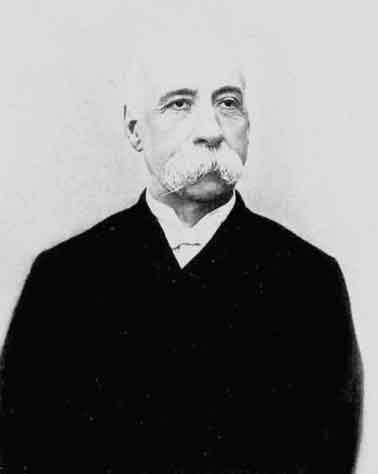
FRANCESCO CRISPI Prime Minister of Italy. From a photograph taken in 1887.
Mascagni, his wife, and his baby lived in a garret, and had not money enough to buy even a candle. The only instrument he had when he wrote the opera was an accordion. His little wife is nineteen, and the baby is one year old.
Italy thought it possessed another Verdi. The next day after his triumph Leghorn (his birthplace) gave him the citizenship of the town. Sonsogni handed him a large sum of money (the promised prize), and Mascagni had orders to begin on another opera. Will that be as good? One says that necessity is the mother of invention; it seems that in this case poverty was the father of "Cavalleria Rusticana."
1890.
Dear ____,—Johan is named to Stockholm, and we must leave Rome. Needless to say that I am broken-hearted to leave Italy and the Queen.
MILAN, September 16.
Dear ____,—We went yesterday to bid good-by to their Majesties, who are at Monza, and for J. to present his letters of rappel.
We arrived in time for luncheon; there were no other guests.
After luncheon we sat out under the trees by the side of the pretty lake; there was an awning put there, and we stayed all the afternoon in the shade of the large trees which bordered the lake. The King was very gay; he wanted every one to row out in the small boats that were there; then he and the Prince took another boat and tried to collide. The King pretended that he could not row, and made such hopeless attempts that all those in the other boats were splashed with water.
On taking leave of her Majesty, which was done with a great deal of weeping on my part, she handed me a beautiful sapphire-and-diamond brooch and a very large photograph signed by her dear hand en souvenir. The King gave Johan his photograph and the decoration of la couronne d'Italie. The day passed only too quickly. I cannot tell you how miserable I was to take leave of their Majesties, who had always been so kind and gracious to me.
But what use is it to mourn my fate. Nothing can change the fact that we are bidding good-by to Italy.
STOCKHOLM, 1890-1897
STOCKHOLM, October, 1890.
Dear L.,—We arrived here (our new post) at an early hour in the morning. We found the secretary and carriages waiting for us, and drove to the hotel, where we stayed until our apartment was quite ready. Our furniture from Rome has already arrived, so all we have to do now is, like coffee, to settle.
We have taken the same house that has been the Danish Legation for the last forty years, and where Johan used to live when he was secretary here twenty years ago.
The apartment is very large. It has twenty-four rooms, ten windows on Drottning Gatan, and thirteen on the side-street. The ballroom has five windows (three on one street and two on another); a large salon, two smaller salons, a library, and a spacious dining-room; and it has (quite rare in Stockholm) a porte-cochère. The Chancellery is in the courtyard, having its separate entrance and staircase.
The evening before we left Copenhagen we had the honor of dining with the King and Queen of Denmark, at Amalienborg. It was a family dinner, J. and I being the only guests. After dinner the Queen talked a long time with me and handed me the letter she had written to the Queen of Sweden.
"I told her," she said, "that I was very fond of you, and I knew that she would be equally so. And how the Duke of Nassau [her brother] admired you and your singing."
"If your Majesty hadn't said it, I never would have believed that the Duke liked my singing. I was under the impression that he would have liked me better without the singing."
"Yes," the Queen said, "I confess that he is not musical, and does not like all music, but he really did like to hear you sing. He told me so."
"Of course he knows," I answered, "but he is the last person from whom I expected to receive a compliment."
As their Majesties retired, the Queen held out her hand, and when I stooped to kiss it she kissed me affectionately on both cheeks. The King, on shaking hands with me, said, "God Reise" which is Danish for bon voyage.
The first days in a new post are always very busy ones. My first visit was to the doyenne of the Corps Diplomatique, Baroness Ph. She gave me a list of visits to be made, and a quantity of her own cards with pour présenter with mine.
Yesterday J. was received by the King, and presented his lettres de créance.
Although J. had been Secretary of Legation, and had been groomsman at the marriage in Stockholm of the Crown Prince of Denmark to Princess Louise (niece of King Oscar), and was very well known to the King, all the regular formalities had to be gone through with. J. made his traditional official speech to the King, both standing; and the King solemnly answered with an elaborate assurance that the relations between Sweden and Denmark had always been of the best and that they would remain so.
When the ceremonious utterances were ended, the King put his arm on J.'s shoulder and said: "Now let us sit down and have a good talk together of old times." The King "thee-and-thoued" Johan, and said, "Her, du. Naar kommer din husfru?" which in English means, "Listen thou. When is thy wife coming?" It is so strange that the Swedish language has no word for you. One must either address people by their title, which is sometimes very awkward, or else say thou.
I was dreadfully puzzled when I first came here. Right opposite my window was a sign, "Dam Bad Rum!" I said: "How queer! People generally cry up their wares, not down. Who ever heard of a seller saying that his rum was as bad as that?" I found out afterward that the sign was merely to let people know that a ladies' bath-room was to be found there.
The next excitement was my audience with the Queen, and thereby hangs, if not a tale, a teapot with a tempest in it. I must tell you all about it. I hope you will appreciate the tremendously complicated position in which I was placed.
It seems that in the time of Queen Christina of Sweden, one hundred and fifty years ago, the ladies of her court wore black silk or satin dresses and sleeves of a certain pattern. The court has seen no reason to make any change of dress since that time. To-day it wears the same style of dress and the same sleeves—the cause of the tempest!
In answer to my request for an audience I received a letter from the grande maîtresse, saying that the Queen would receive me on Thursday next; the doyenne of the Corps Diplomatique would present me. Then followed instructions: my dress was to be a black satin ball-dress, a train of four meters, lined with black silk, décolleté, white glacé gloves, et les manches de cour. I had no idea what les manches de cour were, and, naturally, I went to the doyenne to find out.
If I had announced that I intended to throw a bomb under the King's nose the effect could not have been more startling than when I said those fatal words, "Les manches de cour."
Madame la doyenne was so overcome that for a moment speech left her. She proceeded to tell me that in order to keep on the right side of the colleagues it would be advisable not to wear the sleeves.
"Why not?" I asked, perplexed. "My husband says it is only on this one occasion that a foreign minister's wife is required to wear the sleeves."
She acknowledged that this was true, but the diplomatic ladies had refused to wear them, and it was as much as peace and happiness were worth to displease the colleagues.
"How can they refuse?" I asked.
She explained that the idea of wearing the sleeves was disagreeable to them; therefore the court had passed over the point and made a compromise: the Queen received them at the summer palace, Drottningholm, en toilette de ville. In this way the difficulty had been temporarily overcome, but now it seemed they wished me to draw the chestnuts out of the fire.
"What am I to do?" I asked. "The only thing I can see is to leave Stockholm, my home, and my family, and come back in the summer when I can wear a bonnet."
I meant this as a tremendous satire, but she took it quite seriously and said, "That would be wiser."
I smiled and, handing her the letter I had in my hand, I said, "In this letter from the grande maîtresse she said you were to present me."
"Of course I am to present you, but I refuse to wear the sleeves."
"If such is the case," I said, "what would you advise me to do?"
She answered: "I would advise you to avoid wearing the sleeves. You will make a precedent which all the Corps Diplomatique will resent."
"Why should the ladies object to the sleeves?" I ventured to ask. "Are they so unbecoming?"
"It is not that they are unbecoming, but the Ministers' wives dislike being dictated to. They say that they represent their sovereigns, and object to be told what they shall wear and what they shall not wear."
I remarked that at the Court of St. James's no lady ever dreamt of objecting to wear the three plumes and the long tulle veil prescribed by that court, and I could not see any difference so long as it was their Majesties' wish.
To this she replied, "I think you will regret it if you offend the whole Corps Diplomatique."
On this I took my leave and drove straight to the grande maîtresse. My back was up, and even if the Corps Diplomatique's back was up, too, I was determined to do nothing to displease the Court of Sweden. I explained the situation to the Baroness Axerhjelm, who already knew it, of course, better than I did. I could see it was a sore point.
When I asked her to explain to me about the sleeves she offered to send for them that I might see them, and to lend me her sleeves that I might copy them.
When I looked at the offending sleeves I did not think they were so appalling—only two white satin puffs held in with straps of narrow black velvet ribbon. On a black corsage they could not be so dreadful, especially as the fashion now is sleeves puffed to exaggeration. How silly!
We received visit after visit and many letters from the now irate Corps—so many that we were quite bewildered. J. looked through the archives of the Legation to see if he could find anything bearing on this subject, but in vain. The mighty question does not seem to have troubled my predecessors. They seem to have worn the sleeves and gone on living.
J. remembered that the wife of his former Minister, on the occasion of the marriage of the Crown Prince, wore them. I decided to write to the Queen of Denmark to ask her advice, telling her of the threatened antagonism against me.
This is her letter in reply:
I advise you, dear Lillie, to do as their Majesties desire. The Crown Princess always wears the sleeves when in Stockholm, and I think it would be more polite and less awkward if you wore them also.
Therefore I had them made. Thursday came: my dress was ready and the obnoxious sleeves in their places, I quite admired them, and would not have minded wearing them every day. Still, I could not but think how a whole ballroom of ladies with them on must have appeared in Queen Christina's time.
Although it was the duty of the Baroness to accompany me, I was not surprised when I received a long letter explaining how a severe headache had suddenly swooped down on her and would deprive her of that pleasure.
That was her way of getting over this impasse.
The situation was awkward. This refusal at the eleventh hour was very annoying. I was not expected alone, but alone I should have to go. There was no alternative, and the absence of the doyenne must explain itself as best it could.
I arrived in solitary grandeur, and was conducted in state to the salon, where the grande maîtresse—with the sleeves, of course!—was ready to receive me. She did not seem in the least surprised at seeing me alone; possibly the doyenne had written her own account of the headache. I could see that she applauded the stand I had taken, so I felt that if I had lost favor with my colleagues I had gained it at court.
We went together to the salon, where we found the Queen. She rose and gave me her hand, and I bowed low over it. She was dressed all in black, with the white satin sleeves conspicuous under a long lace veil which hung from her head. She is very fine-looking, tall, and imposing, with a quiet and serious manner. She looks the personification of goodness.
I gave her the letter the Queen of Denmark had sent her. Then she talked of her brother (Duke of Nassau), and said he had written about me and my singing, when we were both guests at Château Furstenberg. The Queen added, "My brother is not musical" (indeed he was not), "but he said no singing had ever pleased him like yours." I bowed and tried not to look incredulous. "The King," she said, "is looking forward with great pleasure to seeing you again. He remembers a certain song you sang. Was it not 'Beware,' or something like that?"
I did not think it unlikely. I had sung it often enough, goodness knows.
I replied I did sing a song called that.
The dire step had been taken, and as far as sleeves were concerned the incident was closed.
When I reached home I changed my dress and drove to the house of the "suffering" doyenne. She had not expected such quick inquiries, for she looked the picture of health; and I met on the staircase a court lackey evidently bent on the same errand. She stammered a great many things about her headache, and how, when she had that particular kind of headache, she was incapacitated from any effort. I sympathized deeply with her.
Her first question was, "Did the Queen have on the sleeves?"
"Certainly," I answered, curtly.
January, 1891.
Dear L.,—King Oscar is a king after one's ideas of what a king ought to be. He looks the king every inch of him, and that is saying a good deal, because he is over six feet. He has a splendid physique, is handsome and of much talent. He is a writer and a poet, and speaks all languages. You must be told that some kings are kings; but King Oscar, there is no doubt about what he is!
At a concert the other evening he came and sat by me, and began talking of music, of his singing, and my singing, and so forth, and finished by saying, "Would you like to have me come to you some day and sing?"
"Of course, your Majesty," I said. "I should be delighted. When may we have the honor of expecting you?"
"How would next Thursday be?" he asked. "And would half past two be agreeable to you?"
I replied, "Any day or any hour will suit me," although it was in fact the only day which did not suit me, as it was my reception-day.
"I hope that we may be quite by ourselves," said the King. "Only you and the members of your Legation."
This I could easily promise, as I should have, in any case, closed my doors.
"Your Majesty will stay and have a cup of tea. I hope."
"With pleasure," he answered, "if that will not make my visit too long."
"Too long, your Majesty! How could it be too long?"
"Well, then, you may expect me."
How prepare for les détails? Madame de Sevigny writes somewhere, "que les détails sont aussi chers à ceux que nous aimons, qu'ils sont ennuyeux aux autres."
The servants laid the traditional red carpet on the staircase. Palms and plants were put in every possible place.
At two o'clock the servants were already on the watch. The porte-cochère was wide open and the concierge all in a flutter. The piano-tuner, who had just spent an hour tuning my Bechstein, had departed when a cart drew up in front of the door. What do you think it was? Nothing less than the King's own piano, an upright one, though it did connive at deception, as you will see. It was one of those pianos with which one could, by turning a key, lower the whole keyboard by half-tones, so that a barytone could masquerade as a tenor and spare the pianist the trouble of transposing the music, and no one would be the wiser.
This was emotion No. 1.
Emotion No. 2: a carriage which stood before the door brought Mr. Halstrum, the pianist.
Emotion No. 3 was another carriage full of things—a music-stand, a quantity of music-books, his Majesty's spectacles, and a mysterious basket.
Emotion No. 4: the servants, with all their heads out of the window, spied a carriage coming full tilt up the street. In it was M. Odman, the best tenor from the Opera.
Finally the royal equipage, of which there could be no doubt this time, was seen from way down the street. J. descended the stairs to receive his Majesty as his carriage entered the porte-cochère. I stood at the door of the apartment, and the King in his usual friendly manner said a hearty, "God dag, god dag, Fru Hegermann!"
He was attended by only one chamberlain. We went into the salon. After a little while the King said, "What shall I sing for you?" and handed me a list of songs.
"Anything your Majesty sings will be delightful," I answered, eagerly.
"Yes, but you must choose," the King said.
I chose one I wanted to hear, but the King had already decided beforehand what he wanted to sing. (I might have spared myself the trouble.) He went toward the piano, but before he sang he took out of the mysterious basket an egg, which he broke and swallowed raw, to clear his voice. He began at the first song on the list, "Adeleide" (Beethoven), and sang that and one after another of those on the list. It seemed queer to have the rôles reversed in this way. I generally sang for royalty, but here royalty was singing for me.
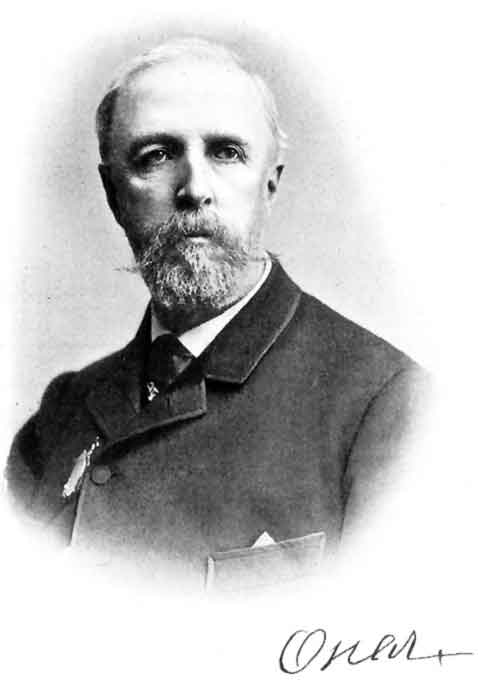
KING OSCAR From an autographed photograph taken in 1896.
The King and I sang the duet from "Romeo and Juliet" and his brother's romance, "I Rosens doft," which I had sung with the King in Paris many years ago. I sang some of my songs—"Beware," of course. I wondered when the tenor, whom I was longing to hear, would come on the program. He only came once, and that was when he sang a duet with his Majesty, a duet which the King had had arranged from the Jacobite song called "Charlie is my Darling."
The tenor, whose English was not his strong point, sang with great pathos "Cha-r-r-r-r-r-r-lie es my tarling," as if a love-sick maiden were calling her lover. When the King sings he throws his whole soul into the music. If Providence had bestowed a beautiful voice on him he would have done wonders, but one cannot expect a sovereign to give much time to cultivating his talents.
Our music finished, tea was served, and his Majesty, apparently pleased with his visit, left at five o'clock.
Here is something the King wrote in my, album which is very characteristic of him: "If you do anything, do it without delay and with your whole heart and mind."
January, 1891.
Dear L.,—I am going to give you a detailed account of the visit of the Crown Prince and Princess of Denmark, their annual visit for the King's birthday. Johan left the evening before to go to Kathrineholm, the last station before Stockholm, in order to meet their Highnesses, and from there to take the train and arrive here with them. Several of the King's household did the same.
I was at the station at eight o'clock. It is pitch-dark here at that hour. I pitied J. when I thought of his having to dress in full uniform in the little hotel at Kathrineholm.
The King and his four sons and gentlemen and ladies belonging to the court and society quite filled the room appropriated to royalty in Stockholm station.
The train steamed in, and steps were placed at the door of the car. The Crown Princess descended, followed by the Crown Prince, Prince Christian, Princess Louise (the eldest daughter), and Prince Hans (the King of Denmark's brother).
There was a great deal of kissing. The Princess was beaming with joy, and said a word to every one.
The dinner at court was at six. It was a family dinner, and as such the Queen was able to be present. As a rule, she is not present at large dinners, because of her health. The King gave his arm to our Princess, the Crown Prince took the Queen. Prince Carl gave me his arm and put me on the left of the King.
During the repast the King asked me if I had read his book of travels. I regretted to say that I had not. Then he called his chasseur, who always stands behind his chair, and told him to beg the adjutant to see that a copy of the book should be sent to me.
He talked a great deal of Paris, of his admiration for the Empress Eugénie, and how he had enjoyed his visit during the Exposition of 1867. He said, "Do you remember our excursion in my little boat when you, the Princess Mathilde, and Marquis Callifet did me the honor to come with me?"
"Yes, I remember very well, but I think the honor was on our side."
"Do you remember," he said, "the guitar, and those delightful songs you sang—'Beware?' Do you remember?"
I remembered, certainly, and wondered if I had ever sung anything else in my life.
"And our going to the Rothschilds' place near Boulogne," he continued, "where the porter refused to let us enter the park?"
"Yes," I replied. "But when he heard who you were all the doors were thrown wide open."
"Those were pleasant days," the King said with a sigh of recollection. "I was a good friend of yours, and never will I change."
"I hope you never will, your Majesty."
"Never," he said. "When once I am a friend, I am a friend for always, and I shall always be a good friend to you." And, taking up my hand from the table, he kissed it—a most embarrassing moment for me!
Our ball was a great success. Perhaps you don't know how festivities belonging to royal visits are managed. Entertainments are prearranged three or four weeks before the arrival of the royal guests.
I had never entertained royalty before, therefore I was naturally rather nervous. I sent to Nice for kilos of flowers, and to Rome for mosaic brooches and little fiaschettis, which I filled with perfume. I sent to Paris for canes and card-cases and silver pencils, and arranged a surprise for my guests. This was a fancy-dress quadrille, to be danced by sixteen young people at the beginning of the cotillon. Four couples were dressed as shepherds and shepherdesses in different-colored satins, with powdered hair and bright ribbons. The other four were dressed as incroyables.
The great problem was how to arrange the different suppers, of which there must be five or six. The royalties must have a room to themselves. There must be three separate suppers for the other guests, two for the dancers, and two buffets going on all the evening.
In the ballroom a dais was arranged with a red brocade for a background, on which were two red chairs for the King and the Crown Princess.
After giving the last orders J. and I stood at the doors to receive our guests, who soon began pouring in. People in Sweden are always very punctual, and arrive precisely at the time for which they are invited. Of course, when royalty is present one should be a little earlier.
Here the host always names the hour when the carriages are to be ordered. I think this is very wise, because if the poor horses had to stand out in the cold, waiting until their masters chose to go home, they would freeze to death. Fortunately, my dress, ordered from Paris, arrived just the day before.
At half past nine the servant announced the arrival of the royal carriages. J. and the secretaries flew downstairs, two servants raced after them, each carrying a candelabrum of six lighted candles. After J. had helped the King from the carriage he took the candelabra from the servants and preceded the King up the stairs to where I stood, according to custom, on the threshold of the door. I presented to the Crown Princess a large bouquet of red and white roses (the Danish colors), with long streaming ribbons to match, and a smaller bouquet to the Princess Louise.
The tambour, a curious name given to an antechamber in Sweden, seemed overflowing with dazzling uniforms and showy liveries. It was a very cold night, and all the guests were muffled up to the tips of their noses when they came in. The display of india-rubbers was stupendous. You can see how necessary were the twenty-two large porcelain stoves which, in Sweden, are built into the walls. For my ballroom I was obliged to add an American stove of the kind one fills once a day from the top.
The King gave me his arm, and as we entered the salon every one courtesied to the ground. Then the Crown Princess came in with J.
Tea was passed, and when the usual ceremonies like presentations and greetings were finished, the quadrille d'honneur commenced.
The King took his place on the dais and watched the dancing.
At eleven o'clock supper was announced. In entering the supper-room the King gave me his arm, the others following.
We were fifteen at our table, ten of whom were royalties.
J. did not sit down to supper with us, as it is not the custom in Sweden for the host to absent himself from the rest of his guests.
Now came the moment for the surprise!
When the royal guests were seated on the dais, sufficient space was made in front of them, the door opened from a side-room, and the dancers entered.
I think those sixteen young people showed much self-denial to be willing to forego the early pleasures of the ball, as they had to do, and give up the time when others were dancing to being dressed, wigged, powdered, and painted. I had to put four rooms at their disposal, two for the ladies with their maids, one for the gentlemen and their valets, and one for their refreshments and supper.
The shepherds and shepherdesses looked and danced their quadrille charmingly. The music for this was the mazurka from "Romeo and Juliet." When the incroyables came in there was a murmur of admiration. They were beautifully dressed. They wore black satin costumes, and the ladies had white ruffs round their necks. The gentlemen wore high collars and lace jabots. Each had a long stick in his hand and a monocle in his eye. The shepherds stood back while the incroyables danced their quadrille. The music of this was the "Gavotte Louis XIII." As I had chosen the eight prettiest girls in Stockholm, the effect was perfectly enchanting. After the second quadrille they joined forces and danced a ronde to the music of "Le Galop Infernal" of "Orphée aux Enfers" (Offenbach). It was a great success, and the King desired them to dance it over again.
The King thought it must have been a tremendous undertaking, but I told him that it was no trouble to me, as the ballet-master from the theater had taught them.
These young people stayed in their pretty costumes for the cotillon, which commenced directly after their dance.
In Sweden people are not blasé as to cotillon favors. They are not accustomed to receive anything more elaborate than flowers and little bows, so I think they all went home happy with their gifts.
There is such a queer custom here. During the cotillon, at the same time with the ices, beer is served, and something they call mandel-melck (milk mixed with almond essence). The young ladies also have to be sustained every little while by huge glasses of the blackest of porter.
The royal guests left at two o'clock; then we had a sit-down supper for those remaining. At five o'clock I found myself in my bed, tired out but happy that everything had gone off so well.
The next day the Crown Prince of Sweden had arranged a tobogganing party at Dyrsholm. We were a very gay company of twenty-four, meeting at the station to take the little local train to Dyrsholm, and arriving about twelve o'clock.
Here we found an excellent luncheon which his Royal Highness had ordered, and which was, oh, so acceptable to us hungry mortals! On excursions of this kind in this cold latitude one is obliged to be very careful not to eat and especially not to drink too much, as there is always danger of congestion.
It was a glorious day, the sun shining brilliantly in a clear sky, but bitterly cold. The thermometer, I was told, was eighteen below zero; I would have said thirty. We ladies were muffled up to our ears in fur, our feet buried in pomposhes, which are long, india-rubber boots lined with fur, and when we stood in the snow we had great shoes lined with straw.
Everything about us was white; the trees, were loaded with icicles and snow. The hill down which we toboganned was very steep, ending in a long slide over the frozen lake. The snow on both sides of our path was piled up four feet high at least. The fun of toboganning is the bunker. The sudden rise gives you such an impetus, and on the other side you get such a tremendous bump that generally one, if not both, of you fall off head first in the snow.
One must be an adept to manage these sleds. The Crown Prince toboganned, as he did everything else, to perfection. Of course, each prince had his own sled and invited some lady to go with him. The lady generally sits in front, with her legs stretched out, and holds on to everything she can, her clothes in particular. The gentleman sits behind, steering with his feet.
The Crown Prince went often alone, and then he would lie flat on his stomach and steer with his long legs, as if he were sculling a boat. I did not feel the least nervous when I went with him, but I confess I did feel a little shy when I had to put my arms round his neck and clutch him for dear life when we jumped the bunker. He preferred having his companion behind him.
The revers de la médaille was the toiling up the long slope in the intense cold. I wondered if the pleasure was worth the toil, but if one did not go down on the sleds one would have to stay on the top of the hill and freeze.
We enjoyed this sport till darkness put an end to it; then we returned, tired, cold, and hungry to town, to dine hurriedly and be ready for the theater at eight o'clock—a gala performance.
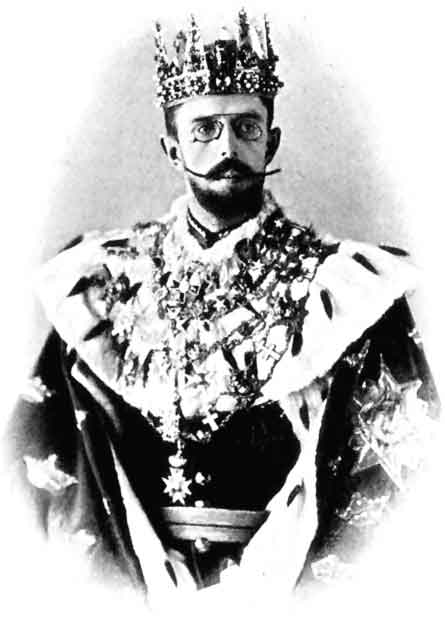
THE KING OF SWEDEN From a photograph taken when he was Crown Prince Gustav. The crown and robe were worn at the formal opening of the Riksdag by his father, King Oscar.
J. and I were invited to sit in the royal box. The opera was "Orphée," by Glück. The Crown Princess suffers agonies when she hears music (everything sounds false to her sensitive ears). Therefore, to spare her, they had chosen the shortest opera.
In the entr'actes refreshments were served in the small salon which is kept in reserve for the King. It is the same room where King Gustave III. retired when he attended the ball which proved so fatal to him on the night of his assassination. The libretto of "Ballo in Maschera" by Verdi, is made on this subject, and the scene laid in Boston.
STOCKHOLM, 1892.
Dear L.,—The opening of the Rigsdag is a great event in Stockholm. The Corps Diplomatique met in the room in the palace called Kronesal. The walls are covered with the three gold crowns of the Swedish coat of arms painted on a blue background. They passed on through the rooms of the Order of the Sword, which had just as many swords on its walls as the other had crowns. You can never make a mistake as to where you are! The ladies were told to wear toilette de ville, and the gentlemen to dress in gala uniform.
Just before the time the King was to come in we were ushered down a little narrow staircase which led into the Rigsdag, passed in front of the throne, and went up a still narrower staircase to the gallery reserved for the diplomats, which seemed very shaky. Some day when the Rigsdag is opening there will be a collapse of diplomats.
The body of the hall was filled with the gentlemen, all the members of the two Chambers in evening dress and the court officials in their uniforms.
When the Queen is present, which is not often, she sits opposite the Corps Diplomatique, surrounded by the ladies of the court, who wear little white fur capes over their shoulders.
The galleries on both sides were filled with the nobility and society. The throne on which King Oscar sat is on a raised platform filling the whole end of the hall. The throne is unique, made of silver, silver lions supporting it on both sides. Back of the throne was a long blue velvet curtain hanging from the canopy.
Everything was ready and every one in his place. A deep silence reigned throughout. There was a blast of trumpets; every one stood up, and the King came down the same little staircase we had. He looked very majestic in his splendid robes of ermine, over which hung the blue Order of the Seraphim, the highest order in Sweden, and of course all his other decorations. The crown he wears is magnificent, made of costly jewels, and, I should think, very heavy, causing the King to hold his head very straight and steady. He looked up at the loge of the diplomats, made a slight inclination of the head, then mounted the few steps of the throne and sat in his silver chair.
The Crown Prince came next, followed by Prince Carl and Prince Eugen. The three are as tall as the King. They wore blue velvet mantles trimmed with ermine, their uniforms showing underneath, and as if they had been handed down, but not let down, from former and shorter Princes.
They wore crowns which seemed difficult to balance on their heads.
The King took the Proclamation from the hands of his Rigskanzler and, standing up, read it in a loud and clear voice. He did not use his eye-glasses, because the letters were made so large that he could read without them. It was a fine and thrilling moment.
The Rigsdag being opened, the King left as he had come.
STOCKHOLM, 1892.
Dear L.,—Prince Chira, one of the sons of the King of Siam, came to see us to-day. He has just returned from St. Petersburg. We were very glad to see him again. We knew him so well in Copenhagen, where he has been living for some years. He has been in the Danish army, and, although only nineteen years old, has passed the most difficult examinations, and is now an officer. He talks English, French, and Danish with equal facility. When at Aalholm he entered into all our games and charades with enthusiasm.
He did not mind at all being dressed up as a Sambo, and favored particularly a yellow wig. He has very yellowish skin, almond eyes, and beautiful white teeth. He came to see us straight from the castle, where he had been to see the King. He was very enthusiastic about his Majesty (who is not?). He told us how the King had taken the grand cordon of the Seraphim Order off his own shoulders and hung it on his. The King being a giant, and Prince Chira about the size of a boy of ten, you can imagine how the cordon fitted him. Chira said, "I reached up to about the King's waist, and when the King put the cordon on me it trailed on the ground, and I kept tripping over it when I left the room. It is most awkward," he added, laughing, "and I must wear it to-night at the big dinner at court which the King gives me."
"Leave it with me, and I will have a tuck made in it and send it to you before dinner." This he did. We measured off how much of a tuck should be made, and sent it to him in time. He came the next day to thank me and bid us good-by. He said, "I looked splendid last night in my cordon."
In June and July it is never really dark in these latitudes. The sun shines till eleven o'clock, the birds sing and bustle about during the so-called night, and the cocks begin to crow at absurd hours. They must be perplexed as to what they are doing all these months. The early bird has to be very early to get off with the worm.
BAYREUTH, August, 1893.
Dear L.,—At last my dream of dreams has become a reality—under what enchanting conditions! Mrs. L., my beloved friend, invited me to stay three weeks with her in the apartment which she has taken, 28 Opernstrasse, which was the habitation of Wagner's special doctor. Mrs. L.'s other guests were her sister, her niece, and Mr. and Mrs. Brimmer from Boston. Johan promised to join us later. Mrs. L, had her own cook and servants, and we lived like princes of the blood. A walk about the streets in the morning, then a sumptuous lunch, and then a little siesta to fit us for the rest (or rather fatigue) of the day.
At a little before four the carriages were at the door and we drove up the hill to the Shrine, passing the foot-sore and weary pilgrims toiling on their way. The servant took our hats and coats, for no one must wear a hat in the audience, and no one needed a coat in this awful heat.
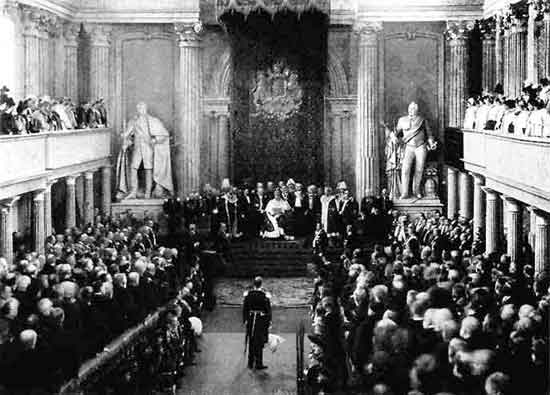
THE RIKSDAG OF SWEDEN From a photograph showing the opening of the Riksdag at Stockholm, January, 1897. The De Hegermann-Lindencrones were doyen and doyenne of the diplomatic corps; he stands in the gallery on the left, fourth from end.
The signal to enter the auditorium is given by a blast of trumpets, generally the four bars of the most well-known melody in the to-be-given opera. The only boxes in the theater are in the rear, and Madame Wagner sits with her family in the middle one. After the people have taken their seats the house becomes pitch-dark, and from the depths of the unknown one hears the first notes of the overture. Then the curtains are noiselessly drawn up. After this no one dares to breathe—woe to the unlucky one who gets a fit of sneezing or a tickling in the throat; better die at once than be the recipient of all the inward curses that are hurled at you! The first act generally lasts an hour, and the people emerge from the stifling auditorium into the fresh air with a sigh of relief. The Germans make dashes of kangaroo leaps toward the casks of beer, and then rush for the tents where they get something to eat at the price of blood.
The entr'acte lasts an hour; then we hear the blasts of the four heralds again, which is the signal for the second act to commence, and so on until ten o'clock at night. Then home, where we find a gorgeous diner-soupertoire which triumphantly ends a day of emotion.
Wagner's operas, which lay about on our tables, all seem to have been given by him to meinem lieben Freund, the doctor. How I regret that dishonesty did not get the upper hand! How easy it would have been for me to have purloined a book and its signature, but I am proud to say that I resisted, and my collection of autographs is to this day devoid of anything from Richard Wagner, showing that virtue is not always its own reward, since I regret having been virtuous.
The off days were also delightful. We drove to the Hermitage, lingered in the grounds belonging to the gentle and clever Margräfin, and wondered if her tiny little court was not a trifle ennuyenx! One could fancy her sitting under the shady trees of the charmille, sewing beads on some bags, specimens of which were exhibited to us by an officious menial, and were of the most hideous description. I say hideous because I hate beads and all their works. I have just finished reading her memoirs, and I can only think how small their talk must have been—how narrow their visions!
We drove to the other pretty resort, Bellevue, and meandered about the rococco gardens, and sat on the stone benches surrounding the lake, and watched the graceful movements of the swans as they tried to avoid the spray from the fountains. We tried not to see the native music-lovers who clustered in crowds about the tables, which were covered with red checker-board table-covers and drinking-mugs. They sit under these lovely shady groves for hours, in their thick coats, which they wear in any season and in any climate, their ponderous field-glasses slung over their fat shoulders and their pockets bulging with guide-books and postal cards, swallowing by barrelfuls the cool and beloved beer and eating Butterbrod by platefuls.
On Saturday evenings Madame Wagner—called familiarly Frau Cosima—opens her salon, and every one goes who can get an invitation. There is generally music, and the best-artists from the Opera-house are delighted to sing. Also the inevitable pianist who is "the finest interpreter of Chopin." (Did you ever know one who was not?)
Very interesting evenings, these, because one sees all the notabilities that flock to Bayreuth. Princes, plebeians, and artists meet here in the limitless brotherhood of music.
Madame Nordica has been singing throughout this season. Her Lohengrin is Van Dyke, and Gruning plays Tristan to her Isolde. Her voice is charming, and she acts very well, besides being very good to look at. She has a promising affaire de coeur with a tenor called Dohme, Hungarian by birth, and, I should say, anything by nature. He is handsome, bold, and conceited, and thinks he can sing "Parsifal." Madame Nordica has, I believe, sung for nothing, on the condition that her fiancé should make his début here previous to taking the world by storm, but Madame Cosima, with foresight and precaution, has been putting him off (and her on) until the last day of the season, which was yesterday. Then Frau Cosima allowed him to make his appearance, upon which he donned his tunic, put on the traditional blond wig, took his spear in hand, and set forth to conquer. His first phrase, "Das weiss ich nicht" which is about all he has to say in the first act, was coldly received. However, his bare legs and arms were admired from the rear as he stood his half-hour looking at the Holy Grail. In the second act, where he resists Kundry's questionable allurements, he did passably well, though he gave the impression that even for a reiner Thor—the German for a virtuous fool—she had no charms. She was a masterful, fat, and hideous German lady, and when she twisted a curl out of her yellow wig and sang, "Diese Loche" and cast her painted lips at him with the threat, "Diese Lippe" he remained hopelessly indifferent, with a not-if-I-know-it expression on his face. He was neither a singer nor an actor, and did not have a shadow of success. But he thought he had, and that was enough for him. It is not allowed in Bayreuth to show any sign of approval (or the contrary) until the curtain falls on the last act of the last performance. Then the public calls the artists out en masse. Parsifal came with the others, and looked more like an Arab beggar than anything resembling a Parsifal. Madame Nordica took her fiancé off the next day. She received from Madame Cosirna a lace fan, with thanks, for her exertions during the Bayreuth season, but she was repaid enough by the satisfaction of seeing her fiancé make his début, his first and last appearance, I fancy.
They went to Nuremberg the next day and had rooms near ours. We could hear her trilling with joy during their dinner duets, and when I went to see her in her apartment the Conquering Hero told stories about himself which I accepted at a fifty-per-cent. discount. Madame Nordica has certainly the loveliest of voices. What a pity the tenor of her life should not have a better chance to run smooth, for run smooth it will not with such a Thor in her possession.
STOCKHOLM, June, 1894.
Dear L.,—You will wonder why you have not heard from me for such a long time, but we have just returned from a trip to Norway. You know J. is accredited there as well as in Sweden, and he has to put in an occasional appearance, and we thought while he was putting that in we would put ours in with it. Our party included Nina and Frederick.
For five days we careened over mountains and dales, driving, sailing, riding Norwegian ponies, and always enjoying ourselves to the utmost. One who has not seen the Norwegian fjords does not know how beautiful and picturesque the scenery is. You must come some day and see it for yourself.
We reached Bergen the 24th of June, the longest day of the year. There is no question of its being really dark, only between 1 and 2 A.M. you cannot see to read. It is a lovely time to travel, because you can travel the whole twenty-four hours.
Bergen is a very pretty town, with clean streets and nice shops. The jewelry, silver, and fur shops are really quite wonderful, but—there is always a thorn to every rose—the smell of fish pervades the town. Go where you will, you cannot escape it. You don't wonder at this when you visit the fish-markets and see the monsters which are brought out of the deep every morning. They look like small whales.
Nina and I, with the energy of the American woman who knows what she wants and knows how to get it, were determined to see Grieg in his surroundings. We hired a carriage in Bergen and started on our pilgrimage. It needed not only the energy of an American, but the tongue of a Dane and the perserverance of Danaides. The Griegs live in the most unget-at-able place that you can imagine, because he does not want any one to get at him.
However, after driving for miles and worrying the life out of our driver by poking him in the back with our umbrellas and asking him if we had not arrived and when we should arrive, and such useless questions, our poor tired steed climbed a long hill where the road suddenly ended its course. We were obliged to leave the carriage and make the rest of the hill on foot, only to encounter, on arriving at a gate bearing these large and forbidding letters: "Her boer Edward Grieg, som önsker at vaere fri for folk." ("Here lives Edward Grieg, who wishes to be let alone.")
But Nina and I were not to be balked by such a trifle as Edward Grieg's wishes, and with some difficulty we managed to unfasten the hasp of the wooden gate. We expected to see a dragon or a ferocious bulldog fly at us, but all was peaceful within, and we walked into the lair without being molested, and marched boldly to the front door of the villa. There Mrs. Grieg opened the door to us and was (she said) delighted to see us. "And," she added, "how happy Grieg will be, too!" This, we thought, was doubtful, but Grieg pretended to be very "happy."