Front matter (continued 2)
Reading edition
But Tinyboy grew very lonely, for he had no one to play with. The bees and butterflies were always in such a hurry that they had no time for a game, and he had no one else to talk to. He was really a merry little fellow, but just now he was so lonely that he grew quite cross.
He sat on his doorstep and kicked his heels, and said: "Oh, dear! I wish I had somebody to play with. I'm tired of this big, lonely house, and those silly bees and butterflies that are always in such a hurry. I do wish somebody would come and play with me."
"How cross you are to-day," said a Red Butterfly who heard what he said. "If you are so rude we won't come to see you at all," she went on. "Fancy calling us silly!"
"Oh, well," said Tinyboy, "you know I didn't mean it. Only I'm so lonely, and you never will stop to play with me."
"I should think not," said the Butterfly. "I have my work to do, and I can't stop to play. Why don't you go out and look for a playmate?"
"How can I?" asked Tinyboy. "You know I can't get out of this house. It's so high up that I should fall and hurt myself if I stepped out. I can't fly like you, for I have no wings."
"No, neither you have! I forgot about that," said the Butterfly. "Well, I feel sorry for you, so I'll tell you what I shall do. I shall give you a ride round the garden on my back, and we'll look for a playmate for you."
"Oh, that will be grand," said Tinyboy. "I'm ready now."
"Jump on, then," said the Butterfly, "and hold tight."
Tinyboy jumped on and held tight, and off they started.
It was a wonderful ride. Tinyboy had never been out of his house before, so he knew nothing about the other flowers in the garden. When he saw the roses and lilies and pansies and bluebells he thought this must be the great world he had heard the bees talking about.
"Is this the world?" he asked.
The Butterfly laughed.
"No," she said; "this is only a garden. Over the hedge there is another garden, and past that there is another, and many more after that. It takes more gardens than one to make a world."
"Ah, well. I'm sure it is pretty enough to be a world," said Tinyboy; and so it was. The sun shone, the birds sang, the bees and butterflies flew gaily about their work, and the flowers laughed and nodded to one another across the garden. It was all lovely; Tinyboy would have liked to ride all day on the Butterfly's back. But he knew the Butterfly must soon go on with her work, so he began to look about for a playmate.
"Let us see if anyone is at home here," said the Butterfly, stopping at a large pink rose.
"Come out, Rose-lady!" she called, and out came the prettiest little lady you ever saw. She was dressed in soft pink silk, and her hair was yellow and fluffy. She came out smiling at the Butterfly, who was her friend, but as soon as she saw Tinyboy she hid her face shyly in her curls and ran back into her house. The Butterfly called and Tinyboy called, but she was too shy to come out again, so they had at last to fly away to another flower.
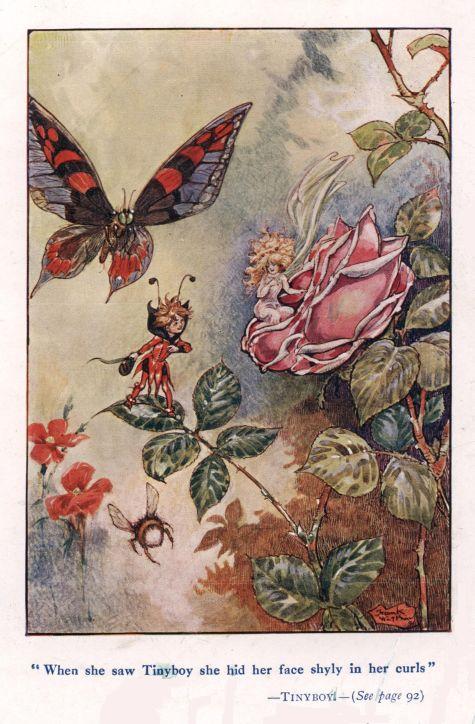
"When she saw Tinyboy she hid her face shyly in her curls"
The Butterfly stopped next at a bluebell's door. He had no need to call out there, for a little lady dressed all in blue sat on the doorstep.
"Good day, Red Butterfly," she called as they came near. "Who is this on your back?"
"This is Tinyboy," said the Butterfly. "He is looking for a playmate. Will you come?"
The blue lady looked at Tinyboy and shook her head. "I don't like red," she said, pointing to Tinyboy's red clothes. "I like boys in blue suits."
"That's right," called a merry voice from the next bluebell. Tinyboy looked and saw a little fellow in a bright blue suit laughing up at him. "The blue lady is my playmate," he said, "and you are not to take her away."
So Tinyboy and the Butterfly went on. By and by they came to a big red poppy with a black velvet floor. "Why, that is just like my house," Tinyboy said when he saw it. "Is it my house?"
"No," said the Butterfly. "Your house is at the other side of the garden. Tinygirl lives here."
The Butterfly stood on the edge of the poppy, and Tinyboy looked in. There sat a dear little Tinygirl on the doorstep, swinging her feet just as Tinyboy had done in his house, and looking just as lonely as he had been. She was dressed all in red silk, and her wee cap of black velvet was just like his.
She smiled at Tinyboy and Tinyboy smiled at her, and said: "Will you play with me?"
"Of course I will," she said at once. "Come into my house and play ball."
THE MOSQUITO BABIES
On the top of the pool floated a dainty raft of mosquito eggs, glued together by their careful mother to keep them from sinking. In a day or two tiny wrigglers came out of the eggs, and began to dart about in every direction to find their food.
They were the queerest little water-babies! Their bodies were long and jointed, and from every jointed bit little bundles of swimming hairs stuck out on both sides. They had feelers on their heads, and they breathed through their tails—of all strange places! When they wanted a fresh supply of air they stood head downwards in the water, with tails stuck up to breathe.
How those babies did wriggle about, to be sure! They seemed never to be still for a moment. They would take in air, then sink to the bottom of the pool and draw in tinier creatures than themselves with their mouth hairs, then, having made their meal, wriggle up again to the top. And every movement was so wonderfully quick! It had to be so, indeed, for young dragon-flies and water-spiders and many other enemies were always waiting to swallow them if the chance came.
After a few days the wrigglers changed their shapes in the strangest ways. Funny round shields grew over their heads, and two little tubes grew up from the top of each shield. These tubes stood above the water when the babies were at the top, and now the tail curled round, and was not used for breathing any more, for the babies breathed through the two little tubes.
Under the shield the babies were busily making their wings and growing into mother and father mosquitoes. But though they were so busy, they did not rest; they moved about almost as much as ever, but now their heads were so heavy that they tumbled and bobbed up and down instead of wriggling. So everybody in the pond called them tumblers.
Now came their last days in the pond. One by one they pushed themselves out of their old skins, and stood on top of them to dry their wings. Then they left their old home, flying off to the nearest bushes for their first rest, and from there seeking out their food. "We want only juices," said the father mosquitoes; "juices of fruit or sweet green things."
But the mother mosquitoes said: "We want blood. Nothing but blood. Where is it? Where is it?"
THE SCRAMBLER
He was a young blackberry plant; but he was so tiny that he could scarcely be seen. Indeed, there was such a crush of growing things round him that it was a wonder he was not choked. He had started life under a hedge where the tangled weeds grew so thickly that even air was scarce; it looked for a time as if the little Scrambler must die.
But his heart was bold; he did not give up. He pushed and pushed till he rose a little higher and could breathe a little more freely; then he grew a number of strong curved hooks on his arms.
"Kindly allow me to hold on to you," he said to the nearest weeds. He held on to them with his hooks and rose yet higher in the crowd.
"Take your hooks out. You are hurting us!" cried the weeds. They tried to grow above him and to crush him down, but he had the start now, and he made the most of it. Higher and higher he grew, holding on to the taller plants, and sending out new hooked branches on every side to help in his support. At last his head rose above all the surrounding plants. He could breathe freely in the sweet air. "Ah! this is delightful!" he cried. He grew fast, spreading himself out widely on both sides.
Next he turned his attention to the hedge. "I must climb to the top," he said, "so as to escape its shadow and get all the sunshine there is." Hook by hook and branch by branch he climbed up the side of the hedge until he could look over the top.
"Why don't you grow thick stems of your own instead of hanging on to other people?" grumbled the hedge. But the Scrambler took no notice; he was busy making his flowers. "Now that I have been so successful, I must do my duty and bear seeds," he said to himself.
When the buds opened he was starred with pretty white blossoms tinged here and there with pink. He put plenty of honey in the honey-cups, so the insects came in crowds and carried his pollen from flower to flower. "That is well," he said. "Now my seeds will set."
Soon the petals fell and the seeds set. "I must make a sweet berry, so that the birds will carry my seeds away to grow," he said. So he set his seeds in berries that turned black and sweet and juicy. The birds came and picked them, and carried the seeds away to grow.
"I wonder you like to see your children going so far away from you," said the Hedge.
"It is the best thing for them," replied the Scrambler. "There is no room for them here. They would be choked if they fell beneath my branches."
There was indeed no room for them there. The Scrambler had not only covered the top of the hedge, but had grown over the other side too, down to the ground.
WOOLLYMOOLLY
Woollymoolly blamed the sweet-peas and sunflowers and gold and purple pansies; but I blame Woollymoolly for not doing as he was told. He never would do what he was told, and that caused all the trouble. When he was only a few weeks old he jumped down from the railway truck, away from his mother; and though she called him and called him and called him, he just ran and ran and ran till he was lost. Then a big kind lady found him and took him home and fed him; and he became a Pet Lamb.
At first she gave him milk, but as soon as he could eat grass he was tethered to a peg in the back garden and allowed to nibble for yards and yards and yards all round. That should have been enough, for there was plenty of grass; and if he tired of grass there was clover; and if he tired of clover there were soft sow-thistles and milky chickweed. But after the first week he never was content with the back, for through a hole in the fence he could see in the front the sweet-peas and sunflowers and gold and purple pansies.
His peg was moved from day to day, to give him fresh choice of the grass and clover and soft sow-thistles and the milky chickweed, but he would not be content. He raced round and round and tugged at his rope, until one day the peg came out. Then with a rush he was on his way to the front garden, dragging rope and peg behind him. But his mistress heard the patter, patter, patter of his naughty little hoofs, and she ran fast and caught him, and hammered the peg in again. Then she told him plainly what to do. "Stay where you are tied," she said. "This is your garden, all amongst the grass and the clover and the soft sow-thistles and the milky chickweed. You must never, never go into the front to eat my sweet-peas and sunflowers and gold and purple pansies."
She was good to him. She brought him juicy turnips, and he grew big and fat and strong. One day she let him wander in the road, and at once he thought of the forbidden front. The little gate was shut and latched, but through the picket fence he could see the shining of the flowers, the sweet-peas and sunflowers and gold and purple pansies. So he waited and he waited and he waited, till at last that careless, lazy, good-for-nothing butcher boy forgot to shut and latch the little gate. Then in crept Woollymoolly, and all the sunny day, while his mistress forgot him in her household work, he gobbled up the sweet-peas and the sunflowers and the gold and purple pansies.
At last his mistress thought of him, and went to bring him in. She searched up the road and down the road and back and forth across the road, and at last she found him gobbling in her garden. "Oh, you wicked, wicked lamb!" she cried. "You have eaten all my flowers. You have pulled and smashed and trampled all my pretty garden. You have greedily gobbled up my sweet-peas and sunflowers and gold and purple pansies."
The next day came the careless, lazy, good-for-nothing butcher boy again, but this time when he went he carried with him in his cart the lamb who would not do as he was told. "I have done with him!" his mistress cried.
What happened to him afterwards I will not say, though maybe you can guess. At any rate, he never disobeyed again, nor walked amongst the sweet-peas and the sunflowers and the gold and purple pansies.
THISTLE-MOTHER
Thistle-mother looked up and saw that the winter was over, for the sun was creeping higher and higher in the sky, and the birds were practising their spring songs. So, unfolding her arms, she spread them over the ground, and began to push herself up into the warm air.
Her home was on the roadside, where grasses and weeds grew so closely together that it was hard to find room. As she grew, they began to complain. "Don't push so," they cried. "And oh! how horribly prickly you are! You are scratching us dreadfully."
"I am very sorry," she said, "but I really cannot help it. I seem to grow like this without knowing it."
"Well, you might at least go somewhere else to live, where you will not disturb so many people," they grumbled. But this was just what she could not do. She went on growing; as the others shrank back from her prickly arms she could look over their heads.
One day she saw a cow eating the grasses near her. She shuddered as its long tongue twisted itself round their poor helpless stems, and forced them into its great mouth. When it passed her by untouched she felt thankful that she had so many thorns on her arms. "At last I know why I grow like this," she thought. "The prickles are very useful, after all."
When the summer came she began to make her children's cots. She wove the overlapping sides of brightest cot-green, strong and fine. Then, remembering the cow, she put a sharp prickle at each point, and closed the points together. She made warm fluffy beds, and in them she placed her children.
They were tiny, helpless things, white and soft. They looked up at the shining walls as she gently put them in their cots, and asked: "Mother, must we always stay in here?"
"No, dear ones," said the mother; "when you are strong and brown you shall fly out over the world. But rest now while I make your wings."
Nothing daintier or more beautiful than their wings had ever been seen. They were snow-white and glistening, and long and fine, and softer than the softest silk. She tied them firmly to the little shoulders, and in the middle of each wing she placed a long lilac-coloured plume. Then she gently opened the cots a little, and the plume-ends floated out into the sunshine. The children sang for joy.
"We have the most beautiful wings in the world," they sang. "Now we can fly away."
"Not yet," said Thistle-Mother. "Wait a little longer. You must grow brown and strong first."
The lilac plumes glowed in the sunshine, and the cots swung in the summer winds. "Now your time is coming, for your plumes are turning brown," said Thistle-Mother; the children looked at one another, and saw that they themselves had turned from white to lilac.
"Shall we be brown next?" they asked.
"Yes," she answered, "when your plumes are curled and twisted. Rest again."
Soon the plumes were curled and twisted, and Thistle-Mother opened the cots widely at the top. Now the children were brown and strong. When they saw the blue sky they sprang to meet it; but, instead of flying up, they tumbled in a heap on their mother's arms.
Thistle-Mother laughed tenderly at them. "You were in too great a hurry," she said. "Lie here till the wind comes. He will lift your wings and give you a start, and then you can fly away. And, children, when you have seen the world, and feel ready to settle down, be sure to choose a good growing-place. Then in time you too will become Thistle-Mothers. Ah! here comes the wind. Good-bye, my little ones."
"Good-bye, mother dear," they called gaily, for the wind was lifting them and spreading their wings. They floated up into the air, and flew off, their beautiful white feathers glistening like silver in the sunlight. "What a glorious place the world is!" they called to one another as they flew over the land. They went everywhere and saw everything. Those who remembered Thistle-Mother's words chose a good growing-place and settled down and became Thistle-Mothers themselves; but the careless ones, who forgot—well, nobody knows what became of them.
Left alone, Thistle-Mother folded her tired arms and sank into the ground, to sleep till summer and cot-making time should come again.
SALLY SNAIL'S WANDERINGS
"I smell strawberries," said Sally Snail. "They are somewhere across the road. I shall go and find them."
"Nonsense!" said the others. "It is too dangerous a journey. There are always boys and carts and birds, and all sorts of monsters on the road. You will never reach the other side alive."
"I am going," said Sally. She started off on her strong, creeping foot, leaving a shining wet trail behind her.
Her curly shell covered her back, but her head was thrust well out, so that the eyes on her two long horns could see the roadway and give warning if danger were near. With her shorter horns she followed the scent of the strawberries.
Half-way across the road a starling saw her. He flew down at once, thinking he had found an easy tea. But Sally Snail was too quick for him. In an instant she drew her head and foot into her shell, and sat down so firmly on the ground that the starling could not move her. He pulled at the shell, but he could not pull it off the ground. He pecked at it, but he could not pierce it with his beak.
"I will wait till you come out," he cried. "You can't stay here always!" But a boy came running down the road, and threw a stone at the starling. The frightened bird flew off, and Sally Snail continued her journey. The boy did not notice her, so she reached the hedge in safety, crawled through, and found the strawberries.
What a feast she had! She cut pieces out of the sweet fruit with the files in her mouth, sucked them in, and swallowed them. "If the others knew how good these are, I am sure they would all come too," she thought.
She stayed there till all the strawberries were gone; then she had to go back to eating leaves again.
"There is a cabbage garden through that next fence, I am sure," she said one day. "I shall go and see." So she travelled next into the cabbage garden. Here she found her cousins, the Slug family.
"Dear me, how strange you all look!" she said. "Why don't you grow shells on your backs?"
"Don't give yourself airs. We have as blue blood as you," said the Slugs. They were touchy about their soft backs.
"How cross you are! I shall go and visit my cousins in the pond," said Sally.
However, the cabbages were very good, so she stayed till they were all cut and taken away. Then she crossed the garden, slipped through the fence, and came to the pond. Here her cousins, the Water Snails, were gliding across the top of the water, shell downwards, like a boat, and foot up like a sail.
"Oh! how lovely to be able to do that!" said Sally as she watched them.
"I have found you again!" said the Starling coming down with a swoop and a sharp peck.
Sally slipped into her shell, but this time she was not quite quick enough. The starling had caught one of her long horns, and now flew off with the eye from the end of it.
"It doesn't matter," said Sally. "I can easily grow another."
She crept under a bush and lived there for a time, and when she came out again another eye had grown at the end of the horn.
"I shall go home now," said Sally. She went home and told the others all about her travels. "We must certainly cross to the strawberry garden next year," said the Snails, "but now winter is coming fast—we must bury ourselves."
They crept into the ground, sealed up the mouths of their shells with lime so that no enemies could enter, and went to sleep for the winter.
MILLY MUSHROOM
She was very tiny at first, and quite brown. Her mother laid her gently on the ground and said: "Creep down into the warmth and grow." So Milly crept down into the warmth, and grew into a little white girl as thin as a thread. For a year she stayed under the ground with her brothers and sisters; then they all put on their best velvet hoods and puffed themselves out to go up into the world.
Billy Button sprang up first. He called down to Milly: "Come up, little sister. The sun is shining through a silver mist and everything is glorious."
"I am not quite ready," said Milly Mushroom. "I must grow bigger first."
She puffed herself out as fast as she could, and at last was ready to go up. She tied her hood over her face to keep the wind off her soft cheeks. Then she too sprang up.
"Oh, dear," she said, "how strange it feels up here!"
"You will soon grow used to it," said Billy Button. "Hurry up and grow, and turn pink like me."
Milly grew and grew and turned pink like Billy Button. Then she untied her hood and peeped out, showing her soft cheeks and pretty white collar.
"What a great world it is!" she said. "It is all so wide and high. I am a little afraid."
"This is only a bit of the world," said Billy Button. "I know, for the Flying Beetle told me. He has travelled far, and has seen wonderful sights. Ah! how I should like to travel!"
"I would rather stay at home," said Milly. She was trembling a little; everything seemed strange up here in the strong light.
"Grow close to me," said a friendly Thistle. "I will shelter you with my long arms." She stretched out one of her arms, and Milly nestled beneath it and was comforted.
All that day and night she and Billy Button grew so fast that when the next morning came they hardly knew one another.
"How big you are, Billy!" said Milly.
"So are you," said Billy. "You are quite a mushroom lady now. But goodness gracious! Whatever is that? What a monster! And how it shakes the ground!"
A boy was walking over the field with a basket in his hand. He was gathering mushrooms. He stooped and pulled Billy Button from the ground.
"Oh, the cruel monster! Oh, poor, poor Billy!" sobbed Milly Mushroom.
But Billy was not at all frightened. "Hurrah! I am going to travel at last!" he cried. "Good-bye, Milly. I shall see the world now."
He was popped into the basket and carried off, while Milly was left shivering under the thistle's arm.
She soon forgot her fright, however, though she often wondered what happened to Billy Button, and whether he enjoyed his travels. She grew taller and bigger every day, and changed her hood for a big flat hat so wide and shady that the little field-mouse could sit under it and talk to her. And the thistle covered her from sight with its friendly arms, so no monster ever found her to put her in his basket and carry her off.
WIGGLE-WAGGLE
Mrs. Earth-worm made a hole under the ground and put an egg in it. Round the egg she wrapped clear jelly to serve as food for the little one when it should hatch. Then she went back to her burrow.
Soon Wiggle-Waggle came out of the egg. He was the tiniest worm you could imagine, but he had a fine appetite; he ate all the jelly his mother had left for him. Then he began to nibble at the earth, and he liked it so much that he went on nibbling. There were all sorts of nice things in it—scraps of leaf and stalk and root and seed—just the things he liked best. The more he ate the bigger he grew; soon you would hardly have known him.
One day he thought: "I wonder what it is like above the ground? I will go up and see."
He began to burrow in an upward, slanting direction, breaking down the earth with his hard little mouth, and swallowing it out of the way. At last he reached the surface of the ground and poked his head through into the daylight. But he drew back quickly into his burrow again, for the strong light hurt him. He could not see it, for he had no eyes, but he could feel it on the skin of his head, and he did not like it. "It makes me feel quite ill," he said. He pulled some loose earth into the mouth of his burrow, and coiled himself round till night fell.
Then he came out once more. Ah! things were very different now! The air was cool and moist, and delightfully dark; hundreds of neighbour worms were crawling over the ground, feasting and talking and visiting one another.
"Oh! there you are at last," said his mother from the next-door burrow. "I have been listening for you. Fix your tail into the top of your burrow, and sway yourself round and feel for your food. Then you can slip back easily if an enemy comes near. There are many enemies about, so listen carefully. And never stay up till daylight comes, or a bird will catch you."
So Wiggle-Waggle entered into the busy night-life of the garden. At first he followed his mother's advice, keeping his tail in his hole while he felt for green leaves, dragging them into his burrow. Later, he grew more venturesome, and crawled out over the ground to make the acquaintance of his neighbours. He lined his burrow with soft leaves and gathered tiny stones together to hide the entrance from the eyes of his enemies. Life was busy and pleasant, and he grew big and strong.
But one night he stayed up too long; when the red light of morning sprang up in the eastern sky he was quite three feet from his home. He hurried, darting his head as far forward as he could reach, sticking his front bristles in the ground, drawing his body up in a loop, dropping it, and then darting his head forward again. He went swiftly, but not quite swiftly enough. An early blackbird saw him, and swooped down upon him. His head and half his body were already in his burrow, but the blackbird's beak closed on his tail.
He stuck all four rows of sharp bristles like tiny pins in the ground, and held on for his life, while the blackbird pulled hard for its breakfast. Snap! crunch! tear! It was dreadful. Poor Wiggle-Waggle parted in the middle, and the blackbird flew off with half of him.
Wiggle-Waggle was not dead, but he felt very unwell. He wriggled down to the bottom of his burrow, and kept very quiet for a long time. And a wonderful thing happened. New rings of body, and then a new tail, grew on the broken end, and soon he was a whole worm again, with only a join-mark to show that an accident had happened.
When he goes up at night now to feed and visit his neighbours, he is very careful not to stay too late. He is still living in his old home, unless the last heavy rain has flooded his burrow and washed him out.
THE LEAF FAIRIES
In the wood the Leaf Fairies were busy making their leaves. They made them of every shape and size, for each fairy had her own idea of what looked prettiest. Some made them long and narrow, like tall and graceful ladies; some made them round and dumpy, like fat little men; some made them heart-shaped, and some cut up the edges till they were all dainty points and curves. Some placed them sitting down on the branches, while others set them on slender stalks. There was no set rule for anything. Each fairy followed her own pretty fancy.
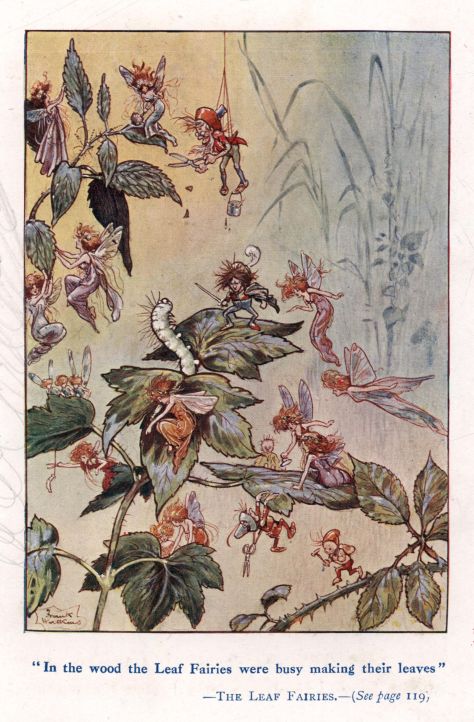
"In the wood the Leaf Fairies were busy making their leaves"
Most of the leaves were green, but a few were splashed with yellow or veined with red or lined with silver. Everywhere they covered trees and bushes and low-growing ground plants, growing here in clusters, and there singly or in pairs. The fairies swung themselves far out on the branches to admire their handiwork.
"Now you must be busy," they said to the leaves. "In the daytime you must help the roots to gather food for yourselves and all the family—roots and stems and flowers and seeds; and at night when we have swept the passages you must throw out the rubbish."
"Shall we never have time to play?" asked the leaves anxiously.
"Yes," said the fairies. "When the family is fed each day you may dance with the winds and play hide-and-seek with the sunbeams, and when the autumn is here and all your work is done, we ourselves will take you for a pleasure trip."
The leaves were content, and at once set to work. The fairies made tiny kitchens for them, and here they gathered the food for the family and prepared it for their use. The fairies carried it to roots and stems and flowers and seeds, so they all grew strong and well. At night the fairies swept the passages so clean that not a grain of dirt was left anywhere; the leaves threw out the rubbish from their kitchen doors.
Summer passed and autumn came. "You have worked well," said the fairies to the leaves. "Now you shall have your pleasure-trip."
They dressed the leaves in gay frocks, all gold and crimson and bright brown; they loosened them from the trees and set them floating on the wind. "Now follow us," they said; and the fluttering leaves followed them. First they whirled and danced on the ground beneath the trees, then they rose in the air and flew away, away—nobody knows where. You could not have seen the fairies leading if you had been there, for they are not visible to mortal eyes; but you would have seen the leaves following them. Where they went to I can't tell you. They never came back, though it is said that the fairies did.
BUNNY-BOY
"Now, Bunny-Boy," said his mother, "look after the house while I am away, and mind you do not go outside, for there are boys about to-day."
"What nonsense!" thought Bunny-Boy to himself. "As if I could not run faster than any boy. And I have been waiting for a chance to go and see the world, so I shall go to-day."
As soon as the Bunny-Mother was out of sight, he slipped out and ran away, this naughty Bunny-Boy, with his little white tail bobbing, and his eyes shining with delight. "Now, I shall see what the great world is like," he thought.
He came to a skylark sitting on her nest.
"Good-day, Lady Skylark!" he said. "I am going to see the world. Would you like to come with me?"
"Oh dear no, indeed," said the Skylark. "I have to sit on my eggs. Does your mother know you are going?" Bunny-Boy ran off at once. He did not want to answer that.
He came next to a little hill, where other Bunny-Boys and Bunny-Girls lived. They all came running out to see him, and said: "Stay and play with us."
"No," he said; "I am going to see the world."
"Where is that?" they asked.
"Somewhere over that big fence," said Bunny-Boy. "You may come with me if you like."
"We do not want to come," they said. "You stay here with us." But Bunny-Boy would not stay. He ran off again. The others called out: "We will tell your mother of you." But he only ran the faster.
He went through the big fence, and came into a field of oats. Here men were busy cutting the oats, and Bunny-Boy was so frightened by the noise they made that he scampered out of that field into the next. This was a field of grass, and Bunny-Boy thought: "Now I can begin to enjoy myself."
Just then he heard a bark, and a big dog rushed over the grass after him. A boy came with the dog, and now poor Bunny-Boy had to run for his life. How he did run! But the dog could run too, and he nearly caught Bunny-Boy. His mouth, with its sharp teeth, was just open ready to snap on Bunny-Boy's back, when Bunny-Boy saw a hole in front of him, jumped into it, and was saved.
At the bottom of the hold he found a Bunny-house, and some kind Bunnies, who let him stay there till the dog and its master had gone away. Then he crept out, and went sadly home.
"I will always do what you tell me," he said to his mother that night. "It was dreadful out in the world. I would much rather stay at home and mind the house."
LOVE-MOTHER
A potato and a rusty nail lay side by side in an old shed. Through the winter they found very little to say to one another, but when the spring came the potato grew restless and talkative.
"This is a poor life for us," she said. "Do you not feel that it is a waste of time lying here like this?"
"Not at all," said the rusty nail. "If you had been knocked about as much as I have you would be glad to lie still." He was bent in the back and had lost half his head, so he had a right to talk.
"But I want to grow!" cried the potato. "I want to go down into the dark warm earth, where it is so easy to grow. Then I should send up white stalks that turn green when they reach the sunlight, and bear broad leaves and beautiful flowers. My children would grow on my white, stalks under the ground. Ah! that would be life indeed!"
"You seem to me to be talking nonsense," said the nail. "I once lived in a kitchen, where a great many potatoes were cooked every day, but none of them had the beautiful leaves and flowers you talk about."
But the potato was not listening now, for something seemed to be moving inside her. "I feel so strange!" she cried. "I am sure something is going to happen."
The next moment something did happen. The skin was pushed open, and a little white shoot poked its head out. "I am growing!" cried the potato joyfully. "Oh, I wish somebody would put me in the ground." But, alas! nobody understood potato-language, so she lay there for several days longer. Then a little boy who was playing saw her and picked her up.
"Here is a potato growing without any ground," he said. "I shall plant it in my garden."
He carried her to his garden, made a hole, and planted her. She nestled thankfully down into the warm earth as he covered her up. "At last I am put into my right place and can really grow," she said. And grow she did. Shoot after shoot ran up from her sides, spreading out in the sunlight into broad green leaves and beautiful lavender coloured flowers. And the little potatoes came, all along the white underground stems. Bigger and bigger they grew, till they were as big and fine as their mother had been. How proud she was of them!
But as they grew she dwindled and lost her strength, for she was giving all the substance of her body to feed her children. "What is the matter, little Love-Mother?" they asked tenderly. "Why do you grow so weak and thin?" They did not understand where their food came from, but she knew and was well content. "It is my life, but they need it, and I am happy in giving it," she said softly to herself.
So day by day she grew less and less, till with a loving sigh she died. "I am happy," was her last thought, "for I have done my part in the world, and now, like the rusty nail, I am glad to rest."
THE HILL PRINCESS
It was when Roy and Charlie were out rabbiting that they met the Hill Princess. They had gone much farther than they usually did, and that is how they found her. It was in a long gully at the foot of the tallest hill of all, and she had come down the side of the hill to meet them. She was tall and beautiful, and her robes were as green as the grass in the gully, while her crown was all of starry white clematis flowers.
"Have you had a good time?" she asked. The boys were too shy to speak at first—she was so grand and wonderful. But they knew it was polite to answer when you are spoken to, so Charlie plucked up courage and said: "Yes, thank you."
"That is right," she said kindly. Then she stood and looked at them for quite a long time, while the boys grew shyer and shyer under her searching eyes. At last she spoke. "I am trying to feel your hearts," she said. "I can feel those of my own people at once, but yours are hard to understand."
The boys did not know what she meant, but they were too shy to ask. She went on: "I should like to show you my Palace, but I must first know whether it is safe to trust you. Can you keep your word?"
"I can!" cried both boys at once. The thought of seeing the Palace took away their shyness.
"Well," said the Princess, "if I take you to the Palace, you must first promise not to tell anybody about it—not even your mothers. No mortal has ever before seen it, and I do not wish others to come to look for it; so you must not tell them about it. Do you promise?" The boys promised at once, and the Princess said: "I shall always hold you to that. See that you keep your word. Now come."
They followed her a few steps up the side of the hill. Here she stopped, and tapped with her foot on the ground. Instantly a door flew open in the hillside, and they entered. The door swung to behind them, and they found themselves in the Princess's throne-room.
It was a magnificent room, wide and lofty. The walls and roof and floor were all of glittering limestone, lit up by magic star-shaped lights of brilliant colours. In the centre stood a throne of solid gold, with a rug made of crimson flower-petals thrown half over it. "Don't the petals fade?" asked Roy as they admired the beautiful rug.
"Nothing fades in my Palace," answered the Princess.
She led them from room to room, talking kindly to them, and showing them quite proudly all the beauties of her home. It was indeed a wonderful Palace. Each room was different from all the others. In one the walls were made of gold, in another of silver, in another of opal, and in others of emerald or ruby or diamond, until one's eyes almost tired of the brilliance.
The furniture was as beautiful as the walls, but the boys noticed that the chairs and tables and sofas and beds were all made very low, except those for the Princess herself. Indeed, so close to the ground were they that Charlie asked the Princess: "Are your people very little, Hill Princess?"
The Princess laughed. "Come and see them," she said, and she led the way out to the back of the hill. Here they found themselves in an open space covered with grass and flowers and little bushes. On every side rose a high straight bank, covered with bush creepers, and behind the bank rose tall bush trees to hide the place from view. "This is our playground," said the Princess, "and here are my people."
The boys looked round eagerly. All they could see were rabbits and hares and birds and insects—rabbits and hares and birds and insects everywhere—hundreds of them playing on the grass, amongst the flowers, in the bushes. The boys were puzzled.
"Where are the people?" asked Charlie.
The Princess laughed again. "The hill creatures are my people," she said. "There, the animals can talk and work and play just as you can. The hares and rabbits do the work of the Palace; the birds fly in with our food from the surrounding country; and the insects take our messages. So work is provided for all. For their play they come here, and here they are so much at peace with one another that everyone is safe. To hurt anything is impossible here."
Now all this time Charlie had been thinking: "What a grand place for rabbiting!" So he looked up with rather a red face at the Princess's words. She knew what he was thinking, for she said: "See if you can touch Little Hoppy." She pointed, as she spoke, to a wise-looking rabbit who sat close to her feet, looking up at her with loving eyes.
Roy and Charlie both bent down to catch Little Hoppy, but they found to their astonishment that, although he sat quite still, they could not touch him. Again and again they tried, but every time something seemed to push away their hands. It was not the rabbit—he never moved. Neither was it the Princess. She stood smiling beside them. "It's magic," said the Princess.
"Come and play marbles," said Little Hoppy. The boys jumped. So the rabbits could talk in this strange place, could they? And play marbles, too? Why, yes, there were several marble rings in the playground, with bunnies and birds all playing together and chattering as fast as any crowd of boys. And hares were playing leap-frog. And groups of bush-robins were nursing tiny dolls.
"Well, this is a comical place," said Roy. "May we go and have a game?" he asked the Princess.
The Princess shook her head. "It is too late to-day," she said. "You must leave us now, or it will be dark before you reach your homes. But keep your promise to me, and I will give you a stone that will guide you to the Palace another time. Then you may come earlier and so have time for a game."
The boys were overjoyed. "That will be first-rate," they said. "When may we come again?"
"The moon was full last night," answered the Princess. "Come always on the day after the full moon. See—these will guide you." She picked two small stones off the ground and gave them one each. As she touched them they gleamed and shone like opals; but when the boys took them they lost their light. "Do not lose these," she said. "If you keep your promise these stones will guide you to the Palace and open the door for you." She took them back through the Palace and out on to the hillside again. The boys thanked her and said good-bye, and she went in, shutting the door behind her with a word. When it was shut, you could not tell it was there, for the grass and tussocks grew over it.
Roy and Charlie went straight home, talking all the way about the wonderful things they had seen and heard. "We must watch carefully for the next full moon," said Roy at his gate, as they stood for a moment to say good-night. "Yes, indeed," said Charlie, "what a time we shall have!" Then he hurried home.
"Have you had a good time, Charlie?" asked his mother at tea-time.
"Rather!" said Charlie. "I don't believe anybody ever saw so many wonderful things as we saw to-day." And then he grew so excited at the thought of it all that he forgot about his promise, and told his mother and father about the Princess and the Palace. He knew before he had finished that he had done wrong, but that did not stop him. And the worst of it was that neither his father nor his mother believed him. His mother at first looked very grave, and asked him if he had been in the sun without his hat, but his father said: "Nonsense! the sun was not hot to-day. See that he doesn't read too much, Mary. We don't want him to learn to spin yarns like this." Then he was sent to bed.
Roy did not break his promise. He told his father and mother about his rabbiting, and about things he saw on the hills and in the gullies, but he said nothing at all about the Princess and the Palace. It was hard to keep silent when it was such a wonderful secret, but he remembered his promise.
And that is how Roy found the Palace again and Charlie did not. When the day after the full moon came, they both started out, but Roy's stone led him straight to the Palace, while Charlie's led him all the afternoon away from it. They were magic stones, and had power to punish and reward. So Roy was led to the Princess, and had all sorts of wonderful games with Little Hoppy, while Charlie, because he had not kept his word, was led astray and not allowed to follow Roy or find the Palace for himself. And he has never found it yet.
URCHINS IN THE SEA
Baby Urchin was vexed. "The grown-ups have all the fun," he said to his brothers and sisters. "Every day they play on the beach, while we are told to stay here amongst these stupid rocks and seaweeds. On the beach they have glorious times. I have often heard them talk about it. Why shouldn't we go?"
"Yes, indeed," said the others. "Let us all go."
They swam eagerly from their playground between the rocks—the queerest babies you ever saw. They looked as if they were made of chalk and glass; and each had about twelve long arms, sticking straight out in every direction from the funny white body.
They were fast swimmers; they went gaily on, never thinking of possible dangers. But a hungry fish saw them, and came straight at them with wide-open mouth. Snap! The cruel jaws closed together, and a hundred Baby Urchins fell down the great throat. Then those who were left turned and swam for home as fast as their terrified arms could take them.
"You were very disobedient, and you all deserved to be eaten up," said the grown-up Urchins when they heard what had happened. "And besides, it is no use coming to the beach yet. You can't possibly roll on the beach with those long arms of yours."
"It seems to take such a long time to grow up," said Baby Urchin.
"Eat plenty," said the grown-ups, "then you will soon be like us."
Time passed. The little Urchins did not again try to reach the beach, but they ate plenty and they grew big. Then they began to change. Their funny arms grew shorter and shorter till they disappeared altogether; their bodies grew thicker; and then at last their shells began to come.
"Now we are growing up!" cried Baby Urchin joyfully.
Their shells grew fast, and so did the babies inside, changing their shape altogether. Up and down the round shells ran rows of tiny holes, and in between the rows of holes scores of little white balls grew out. On the balls movable spines grew, and through each hole peeped a new leg ready to stretch far out when it was needed for swimming or walking. Under the shell was the mouth; from it five strong white teeth hung down to crush the seaweed and break it up for food. On top of the shell were tiny eye specks.
At last they were ready. "Come on," cried Baby Urchin. "Nobody can hurt us now." He led the way to the beach. They all followed, swimming with their legs and spines, and looking like hedgehogs in the sea.
What a time they had when they reached the beach! They swam in with a wave, rolled over and over on the beach, burrowed with their tiny spines in the soft sand, and then swam out with the next wave. "It is splendid to be grown up," they said.
WHERE WHITE WAVES PLAY
I.—RED-BILL
In a sand-strewn hollow of a rock ledge on a tiny island lay a seagull's egg, yellow and grey and brown, to match the yellow and grey and brown of the sand and rocks. White waves played beneath it, dancing each day to the foot of the ledge, and throwing handfuls of spray up its rocky side, but never breaking over the top. Sea winds whisked above it, but never blew it from its sandy bed. No hungry hawk spied it from his vigilant soaring place; no hunting dog found it. Safe from harm, and quickened by the genial sun and the warmth of the mother's tender breast, the speck of life inside the egg grew slowly to a seagull baby.
When the baby first peeped out from the soft darkness of his mother's sheltering wings the world looked very wide and dazzling. Overhead the big blue sky shone brightly, sunshine flooded all the air; nearer home gleaming points of light, like little stars, flashed on all sides amidst the sand. He drew in his head.
"The light is too bright, mother," he said. "It hurts my eyes. But what is that sweet sound I hear?"
"Dear one, those are the white waves at play. They are the kind friends who carry your meals to shore. See—here is your father with a sea-worm for your breakfast. Open your bill and swallow."
He was the fluffy darling of his parents, their sole care and joy. Day after day, week after week, they waited on him, by turns guarding him and fishing for him, bringing him soft delicious morsels of crab and pipi and tender fish. Under such faithful feeding he grew fast. Each day he looked over his ledge.
"The waves, mother!" he said. "The white, white waves! They are always calling. May I not go yet to the sea?"
"Not yet," his mother would reply. "Baby gulls must wait till feathers grow in place of down."
Feathers grew in place of down. Baby wings broadened and grew strong, and at last he could fly.
"The waves still call, mother," he pleaded.
"Come, then," said his mother at last, and down they all went to the sea, and the joy of life began.
He was as yet only a mottled brown baby, not nearly so handsome as his dove-backed parents with their breasts of snow. But his pink webbed toes oared their way gleefully through the clear water, and his little brown bill learned to snap the fleeing fish as cunningly as the crimson beaks of the older birds.
What a life that was! They soared over restless waves on scarcely-moving wings, swooping low and dropping where the flash of fins proclaimed a feast. They circled tiny bays whose seaweed carpets clothed the floors in rainbow hues; or rode like fairy craft upon the ever-rolling breakers on the shelving shores. When fierce winds blew, they wheeled and screamed like spirits of the storm, laughing to see the surface of the sea torn up and flung against the high coast rocks.
Slowly, as the months rolled by, the little Red-bill's feathers changed from mottled brown to pearly grey and shining white; scarlet flamed on bill and feet. The full bright beauty of his kind was on him.
Mating season came. "Little love," he said to his chosen one, "I know an island where our egg will be safe and our baby sheltered. There, where white waves sing and dance all day, he shall be loved and tended as I was loved and tended."
II.—THE SEA-SQUIRT WHO STOOD ON HIS HEAD
Far out into the waters of a quiet bay stretched a wooden jetty, old and rotting and scarcely ever used. The browned and blackened timbers that showed above the water-line were by no means beautiful, but at their feet was fairyland. Here, in pale green clearness, forests of delicate seaweeds bent their gold and amber beads to the gentle movement of the water; swift-finned fishes, gay in scarlet and silver and bronze, swam the forest pathways and chased each other in and out cool shaded bowers beneath the filmy branches; most beautiful of all, myriads of long-tubed sea-squirts waved their pink and crimson balls from the jetty piles, like great closed poppies in the sea.
How they waved! Up and down, backwards and forwards. Not moved by the water, but moving in the water, though never freed from the jetty piles. After all, these were not flowers, but animals.
Continually they opened their pink, round mouths to let the water pass through their bodies, in the hope that each fresh mouthful might contain a meal. Again and again, squirt! They were forced to throw out some fragment of shell or rock which had floated in and caused annoyance.
At the foot of one pile there was some excitement, for a baby sea-squirt was setting out to see the world. He was impatient to be off, but his mother was giving him a great deal of advice. If you had seen him lying in the water you would never have recognised him as the sea-squirt's son. No mother and son were ever more unlike. She was big, with a thick-skinned tube half a yard long, and a ball at the top shaped like a quince; he was tiny and soft, and looked like a baby tadpole. She was gaily coloured; he was colourless and jelly-like. She was fixed to the jetty pile; he could swim. Yet, in spite of these great differences, mother and son they were.
"Dear child," she said, "whatever you do, never stand on your head."
"Of course not," he replied; "I shall never wish to."
"But you will wish to," cried his mother. "You won't be able to help it. It runs in the family. Listen, son. Once I was like you; I could swim and move about to find my food. Before me, all our grandfathers and grandmothers for millions of years back were for a part of their lives like you. If they had never stood on their heads they might have grown eyes and backbones and fins, and become as great and clever as the fishes. But because those old grandparents became lazy and stood on their heads till they grew to the rocks, we in turn have all grown lazy, and we in turn have been punished by the loss of our swimming powers. If you could only break loose from the family's bad habit, you might start a glorious free race of sea-squirts. All the most successful creatures in the sea are those that have backbones and eyes. You have the beginnings of these two things in you, but if you stand on your head you will lose them, as I have done. You will become fixed and helpless like the seaweeds. Promise me never to stand on your head. Promise me that you will keep moving."
"Yes, mother. Oh, yes. Good-bye. Good-bye." The impatient little fellow could wait no longer.
"How grown-ups talk!" he thought. "As if I should ever wish to stand on my head!"
He swam about for several hours, enjoying himself exceedingly in this great wet world. At last he came to the end pile of the jetty. Here, to his great astonishment, there suddenly came upon him the most overpowering desire to stand on his head. To stand on his head! The very thing his mother had foretold. Well, she was right, after all, so perhaps she was right in advising him to keep moving. "I will swim on," he said.
He swam on bravely. But before him was the wide open sea, with no comfortable piles to rest against. And oh! how he longed to rest. Just to put that heavy head of his down against something firm—how delightful that would be! That was a splendid pile, that last one! So strong and wide. It could not matter if he rested just a few minutes. He really would not stay long.
So, forgetting his promise, this foolish baby swam back. Down went his head against the comfortable pile, and alas! there he has stayed ever since. His mother's wise words faded from his mind. He was too lazy to stir. From his head tiny tubes grew on to the wood, holding him there for life.
What a change has come over him! Tail and little growing eye and backbone, all have died away; in their place has grown the long tube with the gaily-coloured fleshy ball at its end, through which the water runs with every wave, bringing sometimes food, sometimes nothing but sand and stones. Gone are the old swimming powers, the old free life. Gone is all chance of growing into something strong and grand and successful. He is beautiful, but he is helpless.
I wonder does he ever think of what might have been? Does he ever say, sadly: "If I had but kept moving on!"
III.—BOBBY BARNACLE'S WANDERINGS
The Barnacles lived on the rocks with the Mussels and Limpets and red Anemones. There were hundreds and thousands and millions of little shell-houses, set so closely together that scarcely any room was left for pathways. Twice a day the friendly waves, like busy white-capped waiters, hurried up the shore with a feast of tiny sea creatures in their soft, wet hands. Then, one by one, doors were carefully opened while the waiting shell-people took in their food, but were soon shut again, for fear of lurking enemies.
It was a quiet life, but so safe that the rocks became overcrowded. When Bobby Barnacle and his brothers and sisters and cousins were hatched out of their little egg-cases and swam from their mother's acorn-shell houses, the old Barnacles were alarmed.
"Dear me!" said the very oldest. "What a swarm of you! For goodness sake don't come back here to settle after your swim. We are crowded already."
"Plenty of room in the sea!" laughed Bobby. "Come on everybody. We are not thinking of settling down yet. We are going to have a grand time first. I am sure I shall never wish to spend all my time in one place. A roving life for me!"
Headed by Bobby, the shoal of Barnacle babies set off on their travels. They certainly did not look in the least like settling down. They swam and dived and frolicked and tumbled and whisked about in the dancing waves as if possessed by the very spirit of movement. To such atoms of energy, sitting still on a rock was plainly an impossibility. They were queer, tiny, soft-bodied creatures. Thin, delicate shields on their backs were their only shells. They each had three pairs of legs, one eye, and a funny, spiky tail. As they went they ate hungrily, swallowing sea animals so tiny that scores of them would go into a small girl's thimble.
"Look out!" Bobby shouted suddenly. As he spoke he turned to the right and swam for dear life, hiding at last under a tangle of ferny seaweed. The others were too late to save themselves. A great fish had swallowed them all in three snaps of its cruel jaws, and Bobby was left alone in the wide sea. He was badly frightened, but presently he swam out from his hiding-place and continued his travels. It was somewhat lonely, but he soon grew accustomed to that. Indeed, he began to like it. He swam and ate and whisked about in the water as cheerfully as ever, keeping his one eye well opened for possible enemies. A shoal of cousins from a sea rock met him.
"Come and play with us," they said.
"No," said Bobby; "I'm going to travel."
Out to sea he went, amongst all the wonders of the white-crested water. Below him lay great colonies of bright corals and sponges and sea-anemones, living their simple quiet lives. Around him rushed and darted eager, busy fishes, keeping him ever on the move to evade their hungry jaws. Many a narrow escape he had, but he was so nimble that he never was caught.
As he grew, his skin and shield became too small for him. "This is most uncomfortable," he thought. Split! Skin and shield dropped off. New ones had been growing underneath, but these at first were soft, and he had to shelter under seaweed till they hardened. To his great comfort they were soon firmer than the old ones. Several times he moulted in this way, and each time the new skin and shield came harder and stronger, making him safer from his enemies.
One day a strange thing happened. He lost his appetite. "Whatever is the matter with me?" he wondered. He soon discovered. He was changing his shape. Another eye grew, and three more pairs of legs, and a shield on the front as well as the back.
"Well, I am a fine, strong fellow now," he thought. "I feel as if I could do wonders."
He swam on faster than ever. Indeed, his activity was marvellous. He seemed to shoot through the water. But, strangely enough, he still could not eat, so it is no wonder that at last he grew tired.
"I think I must settle down on something," he said. "This life is really most exhausting. And yet I don't want to sit down on a rock and stay in one place all my life. I wish I could find something moving."
Something moving came through the water, something so huge that to the tiny Barnacle its side was like the side of a world. It was a whale, but Bobby was not afraid. As it slowly lifted its great body through the waves he made his way to it and clung on with all his strength. The whale plunged on his mighty way to colder seas, bearing his little unfelt rider with him.
"Hurrah!" said Bobby. "Now I shall still travel on, without being obliged to do my own swimming."
A more wonderful change than ever before came over him. A tiny bag of cement opened from his head and glued him to the whale's skin. Six strong shells grew round him in an acorn ring, exactly like those of his mother's shell-house on the rock. Four more grew into a door. When he opened the door he could shoot out his twelve curled legs and kick his food down into his mouth in the shell-house. So there he was, living head down and toes up on the whale, and glued so tightly that he could never fall off.
He was grown-up now. All his changes were over. His appetite came back, and he went travelling easily and comfortably with the whale. For all you or I know to the contrary, his roving life may be still going on.
IV.—LITTLE STARFISH
He floated in the depths of the cool salt sea, an egg so small as to remain unnoticed and undevoured. Later, he hatched into a queer-shaped creature, not at all like a starfish, rather like a lump of jelly, with a thick end pushed out here and there. He swam and ate, and grew larger every day. From the sea-food he ate his wonderful little body had power to draw minute particles of lime and build them into a star-shaped framework within itself. Slowly the firm star grew, spreading its rays on every side, and absorbing into itself the soft walls of his earlier body, until at last he was a starfish.
He was strangely made. His mouth was underneath the middle of his body, a small red eye lay at the tip of each ray-arm. His legs, scores of them, were small and white, and could be pushed out or drawn in at will from his ray-arms. Drawing in sea water through narrow passages in his body, he could fill these legs and make them firm, and so crawl up the steepest rocks or creep slowly over the smooth sea-floor. When he did not wish to walk he drew the water from his legs and tucked them up inside his arms. The last foot of each ray-arm was at once his nose and finger, for by it he smelt and felt. On his back were spines, some of them snapping in the sea like scissor-blades, to keep his skin clean and free from parasites.
He roamed slowly here and there in search of food. Companies of brother starfishes went with him. They were a hungry crowd, and so numerous that soon there was very little left to eat in their valley of the sea.
"I shall travel," said Little Starfish. "Perhaps I shall find a better feeding-place."
He set off. Sometimes he swam, sometimes he floated with the waves, sometimes he dropped to the bottom and crawled over the sand or rocks. After several days he came to land. The tide was going in; the waves were dancing gaily up the stony beach.
"Carry me, please," said Little Starfish.
He laid himself in the arms of a wave and was carried merrily up the beach and left in a pool amongst the rocks.
"This is a good feeding-place," said the wave, as she set him down.
It was indeed a good feeding-place. All the rock creatures had opened their shells to feast on the myriads of tiny things brought in by the tide. The pool was awhirl with life. Shrimps darted to and fro, barnacles and limpets raised themselves from their rocks, furry-legged hermit crabs ran about under their borrowed shells. Best of all, tempting rock oysters, fat and juicy, sat with their shells agape, to catch their daily meal. Little Starfish's mouth fairly watered at the sweet smell of them. Pushing out his scores of white sucker-feet, he pulled himself up inch by inch to where the first one sat. As soon as the oyster felt him near, snap went the shell. But Little Starfish was too quick for him. One strong ray-arm was in the shell before the edges met, and hope was over for the oyster. Little Starfish swallowed him, and then crawled on to find another as delicious.
"So glad to find you at home," he joked, as he poked his arm into the next open shell.
"We'll see about that," remarked the oyster. He snapped his shell hard, hard. How it hurt! He was a powerful oyster, and the edges of the shell caught the arm in a tender spot. Crunch! went the oyster viciously, and off broke the arm in the middle. Little Starfish swam painfully away from that terrible oyster, leaving half an arm in the shell.
"How tiresome!" he said. "Now I shall have to give up travelling while I grow again."
He crept away into a safe hiding-place under the sea. There he grew a new half-arm, coming out again as strong as ever, but far more cautious. Many another feast he had on the oyster rocks, but never again did he hunt so recklessly.
V.—KELP
A tiny sea-weed spore loosened itself from its place in a forked branch of the mother sea-weed, whirled itself round and round in the water, and began to sink towards the sea-floor. A passing current caught it, lifted it, and carried it far past its old home to where a cluster of bare rocks guarded the shore. Here, broken up by the rocks, the current weakened. The spore, carried into the calmer waters of a sheltered pool, eddied, trembled, and slowly sank. From the spore sprang amber-coloured rootlets, fixing it firmly to a rock. A little amber-coloured stem grew upwards through the sea, growing ever thicker and stronger as the weeks went on, till at last it reached the top. Drawing its daily food from the nourishing sea, the plant went on from strength to strength. Amber branches grew; amber leaves, veined and thin and long, swayed with every movement of the water. Spores formed and loosed themselves, and whirled and slowly sank, to grow in turn to neighbour plants amongst the rocks.
Year after year passed by, through winter's rains and summer's gentle, sun-kissed days, till many years had flown. From the tiny spore, which in that earlier day was borne so helplessly, had grown a mighty forest. Great lifting, drifting trees of kelp, their roots like iron bands about the rocks, their heavy limbs upheld by rows of air-filled floats, swayed back and forth with every rolling wave. Hidden, protected by the giant boughs, what life was here! What a wonder-scene of beauty! Delicate sea-plants, red and purple and green, waved their slender fronds beneath the shelter of their stronger forest brothers. Bright-scaled fishes darted through the trees. Shell-fish, safe in spiral, fluted homes, climbed their trunks and cut with saw-edged tongues sweet daily meals of amber leaf and stem. Sea-urchins and starfishes crawled over their roots; anemones spread their lovely cruel arms to catch their prey; shell-less sea-snails, crystal clear, hid between the branches, peering out with bright black eyes at all that passed in this gay water-world. At night, a million tiny phosphorescent creatures shone and glowed from every leaf and branch and stone, as if a million fairy lanterns had been lit beneath the sea.
A great storm came. Far out to sea the black clouds lowered; they loosed their lightning sheets. The leaden rollers rose and fell and muttered to the thunder's crash. Sea-birds screamed and fled to land. From the line where sea met sky came the hoarse, roaring wind, lashing little waves into foaming billows, tearing them up and flinging them far through the maddened air. Below the surface of the sea the swimming, crawling creatures sank like startled shadows to the floor for safety till the storm was past. Only the great kelp trees were left to bear its brunt. Wave after wave crashed against the branches, tossed them this way and that, whipped off their floats and leaves, tore the slighter stems away and strewed them high upon the rocks.
When the storm was over, and sunny days had come again, and children played and paddled on the beach, the sand was strewn with little floats. The children stamped on them, and laughed to hear them pop as the pent-up air escaped. One toddler wondered loudly what they were and where they grew. Down among the rocks the wearied seaweed raised its torn and battered branches through the sea, and set to work again to grow its slender stems, its ridge-veined leaves, its scores of pointed amber floats. Slowly its full beauty returned, till once again the fairy lights shone on the old gay life of wonderland.
VI.—BLACK SHAG
Black Shag was a lonely bird, but she liked her loneliness, and drove away intruders. Her special haunt was a narrow inlet of the sea, winding between peaceful bush that overlooked the little lapping waves. Here she would swim for hours, her graceful head sometimes erect, sometimes bent beneath the sea to watch for prey. A silvery gleam, a movement of a fin, and like a hurled stone she would dive and pursue, hunting the fleeing fish until she overtook it. Seizing it in her long, hooked bill, she bore it up to the air, there to gulp it whole down her capacious throat. Then below she would go again to hunt for further feasts. Her appetite was marvellous; she was no delicate lady in her feeding. Fortunately, fish were plentiful and varied in her inlet of the sea.
Tired of swimming, she would fly up to her favourite perching place—a great bare rock that overhung the water. Here she spread her long black wings to dry them in the sun, and preened her bronzy back and white throat band and glossy breast. She could not, like a duck, shake herself but once and then be dry, for so little oil have her kind for their feathers that "as wet as a shag" has become a world-wide saying. But sun and winds helped in her drying, and time made no calls on her. For long hours she sat there at her ease, silent, solitary, satisfied.
Winter passed. With the first warm breath of early spring, when fresh life woke in bush and shore and sea, her last year's mate came up the inlet seeking her. "Come with me," he said. At the words mother-longings stirred in Black Shag's heart. Into her thoughts came memories of nest and shining eggs, of helpless babies, and her love for them. She left her rock. With her mate she flew along the coast to where her people built their rookery year by year. Here were friends and busy life. High cliffs faced the sea. On the top, where strong, coarse grasses grew, nests were built beside each other. Sticks were gathered and twisted in and out, grass blades were pulled and laid amongst the sticks; then the nest was ready for the eggs.
Three handsome green-white eggs soon lay in Black Shag's nest. Then followed the long sitting, the mother's patient sacrifice of food and freedom; till at last the eggs were hatched, and three half-fluffed, half-naked babies lay beneath the sheltering breast. They showed no beauty to a casual eye, but their mother thought them perfect. In her fond eyes no baby birds could be more sweet and lovable. Gone was now the old life for Black Shag, with its leisureliness and ease. With three children to feed and guard, the days became a rush of work. "You must help, father," she said to her mate. In turns they fished, swallowing enough for the babies as well as themselves, then returning to the nest and drawing up from their long food-bags the delicious oily fish that the children loved.
The babies grew fat. Fluffy down grew so thickly over them that they began to look like brown and white balls of wool. Nestling together, they kept one another warm; gradually Black Shag found herself able to leave them for longer and longer periods. They fished together now, she and the father Shag. As the children grew bigger still, and more and more able to take care of themselves, the parents stayed away all day. They flew off in the morning to their favourite fishing waters, satisfied their own hunger, and loaded themselves with extra fish, then returned at nightfall to feed the clamouring little ones.
The summer months passed by. In the nest the children grew full-sized and feathered. "Learn to swim and fish for yourselves," cried Black Shag, and she tumbled them one by one into the water below. There they floundered about till they learned to paddle with their black webbed feet. Then the mother left them, knowing that her work for them was done.
Back to her old haunt she went, to live again, till spring returned, her life of leisured ease. In her narrow inlet, where peaceful bush overlooks the little lapping waves, she hunts her daily feasts, or sits for hours upon her bare brown rock, silent, satisfied, alone.
VII.—THROUGH DAYS OF GROWTH
On a grassy tableland a pair of albatrosses made their nest. They dug a ring of earth and pushed it into a central mound, then hollowed out the top and lined it with grass. Here the mother laid her one white egg. Father and mother took turns in sitting on the egg. When the little one was hatched they again took turns in feeding him and sheltering him from cold sea winds. All through the summer days and nights they tended him with utmost love and care, until, when autumn came, they could safely leave him in the nest. Then back to their old sea life they went, skimming the rolling waves throughout the day, but winging their patient way at each fresh dawn to feed their little one.
Where they had left him, there the baby albatross sat in his nest, day after day, week after week, month after month. His thick brown coat of down kept him warm, his rich morning meals supplied his growth, his stillness fattened him. Motionless he sat, hour by hour. Above him sea birds wheeled against the bright blue sky and golden sun. Winds danced among the grasses; storms drove over the hills. Half a mile away the racing waves boomed loudly up the beach. At night the quiet stars looked down on his contented sleep.
A wild duck came and looked at him.
"How slow you are!" she cried. "Why don't you move? My babies learned to fly and swim long months ago, yet they are not so old as you."
He turned untroubled eyes towards the sea.
"Some day," he said, "I shall follow where the white waves lead. My time has not yet come."
The wild duck flapped impatiently.
"Slow!" she said. "If you were mine I'd turn you off that nest before another day had passed."
She flew away. The baby albatross still sat and watched the sky and sun, and listened to the waves.
Summer came again. One afternoon the parent birds returned. They stroked their little one and fondled him with loving beaks.
"Dear one, you must leave the nest," his mother said. "We need it for this season's egg."
The baby was dismayed. "But I do not wish to go! The nest is mine," he said.
"It is not good that you should stay too long in it," his mother said. "You are nearly twelve months old. It is time for you to learn to fly and swim. Come off, and exercise yourself."
But the baby was afraid. "I don't know where to go," he said. "I must stay here." He would not move.
Between the mother and the father passed an understanding look. With their strong bills they gently turned him off the nest and rolled him on the ground. "Pick yourself up and go down to the sea," laughed the mother. She sat on the nest to keep him off.
The baby picked himself up and looked at them. It was hard to understand this treatment, after all their loving care of him. However, he had rather liked his feelings when he flapped his wings to right himself, so he flapped them once again. He raised himself and tried to fly; he waddled several steps on his wide webbed feet. But he was fat and heavy, and his limbs were soft and quite unused to exercise; he was soon glad to rest.
"Keep at it," said his mother. "Power will come with use."
For several days he stayed about the nest, encouraged by the parent birds to exercise his wings till he could fly. Then very slowly he made his journey to the sea, walking, flying, resting, sleeping on the way, for many days and nights, till at last that long half-mile was passed, and the welcome beach was won.
Here he learned to swim and catch his food, the juicy cuttle-fish that floated on the sea. He grew and gathered strength, but his flights from land were short—his power was not yet at its full.
Another year passed by. Again with autumn days the parents left the nest to go to sea. From the waves a noble bird rose up to accompany them. His snowy plumage glistened in the sun, his wide-spread wings cut through the air with a majestic grace. It was the baby albatross, grown at last to his full strength. Sailing, gliding, rising high above the shining waves, dipping low on downward curve, he followed to the far-off shoreless tracts, there to live his life of tireless flight, the splendid marvel of the sea.
VIII.—FANNY FLATFACE
Where the waters of an estuary entered the sea were many wide and sunny shallows. Here the flounders fed, and here in early summer their little eggs, laid in the quiet water, rose up and floated at the top. Rocked on the gentle waves, warmed daily by the golden sun, the eggs hatched into flounder babies. Hundreds and thousands of them there were, crystal clear except for two black eyes, and so very small that they could only just be seen. The tide came in and swept them to and fro, and somehow Fanny lost the shoal and was carried out to sea. There the big waves jostled her about, the great sea creatures frightened her. She was lonely and sad and terrified. "Whatever will become of me?" she thought.
On the third day she fell in with a shoal of tiny whitebait, all about her own age and size. "I am lost; please let me swim with you," she begged.
"You poor little thing! Of course you may," they said. So for several days she swam with them towards the shore, playing and feeding in happy forgetfulness of all past misery. At this time she was so like the whitebait that no stranger could tell the difference. She had the same long slender body, the same round head and pointed tail. A week passed by. One day she said: "I must go down to the sand. Good-bye."
Before they had time to speak she had dropped from their midst. "How very extraordinary!" said the whitebait to each other. For a day or two they played about as usual, but by-and-by one said: "The thought of Fanny worries me. Suppose we go down to see what has happened to her?"
"A good idea," said the others.
They found her lying aslant near the bottom of the sea.
"Are you sick? Why don't you come up?" they asked. "You look very queer, lying on your side like that."
"I feel very queer," she said. "Can you see what is the matter with my left eye?"
The whitebait crowded round to look.
"Why, it has moved!" cried one. "It seems to be coming round the corner of your head."
"I thought it felt strange," said Fanny.
"What a comical shape you are!" said another little fish. "You seem to be growing flat."
"Oh, dear! I wonder whatever is the matter with me? I don't think I shall ever come up to the top again," sighed Fanny.
The others tried to cheer her. "Don't be downhearted," they said. "Perhaps you will feel better to-morrow. Maybe you have eaten something that disagrees with you."
"But what a pity! She is certainly losing her beautiful shape," they remarked to one another as they swam away. "And that eye is a most mysterious business."
They came back again a day or two later. Fanny—could it be Fanny?—was on the sand. She wriggled up to meet them, and they stared more and more. She was not now long and slim, but flat and wide. And her eye! It had gone quite round the corner, and was now on the same side of her head as her right eye. Strange to say, she looked perfectly happy.
"I am well again," she said. "See, my eye has gone round out of the way, and I am so flat that I can lie comfortably on this nice sea-floor. Isn't it splendid?"
"It is a very ugly change," said one.
"Oh, dear, do you think so?" asked poor Fanny. "At any rate, the change is most convenient," she went on, brightening. "See—one lies on the sand, so. One's flatness allows one to wriggle partly under the sand, so as to escape one's enemies; and one's eyes are both on top, where they are most needed. You had better come down and grow flat, too."
"Not for the world!" cried the others in chorus. "What a life, lying in the sand! And what an ugly shape! Are you going to stay here always?"
"Yes," said Fanny. "The food here suits me."
"Good-bye, then. We are off to the top," they said.
As they swam away one impudent little creature turned round and called: "Good-bye, Fanny Flatface!" That is how poor Fanny got the name.
"How are you to-day, Fanny Flatface?" the thoughtless little fishes would call as they swam over her head. They thought it a clever thing to say.
She would bury herself in the sand and pretend not to hear, but it made her most unhappy. She thought of all the other fishes she had seen. "None of them are flat," she said, "and none of them have two eyes on one side of the head. How dreadful I must look!" Lonely and miserable, she lay there for months, keeping herself well hidden from sight.
One day she left the spot, hardly knowing why, and floated with the tide into the estuary mouth. A sunny shallow seemed to draw her with the memory of early days. She swam boldly in. Yes, this was her old first home. What had become of her brothers and sisters? Would they receive her, now that she had changed so terribly?
The mud floor moved, and scores of flounders raised themselves and looked at her. Flat! As flat as herself! And each with two eyes on one side of the head. What comfort! She was no monstrosity, after all.
"Who are you?" they asked.
"Fanny," she replied.
They all came out to look at her.
"Why, it really is Fanny!" they exclaimed. "But how you have grown! How bright your red spots are! And how softly silvered is your under-side! How white and strong your teeth! You are certainly the beauty of the family. Have you come to live with us?"
"Yes, oh yes," she answered joyfully. What happiness was hers, after the long months of shame and loneliness!
It was a pleasant life they led. By day, while the warm sun shone, they basked below the mud. At night they feasted on the shoals of shrimps and jointed darting creatures that filled the water over them. As they slowly moved from bank to bank their upper skins changed colour with the colour of the floor on which they fed, and thus securely hid them from their enemies.
One day the whitebait, grown now to little herrings, came up the estuary. "Why, there is Fanny Flatface," said one.
Her sister flounders rose beside her. The herrings gaped in wonder. "So that was just your way of growing up!" they said at last.
"Just my way of growing up," said Fanny cheerfully.
IX.—THE OYSTER BABIES
The Oyster-Mother was talking to her babies. "You are leaving me to make your own way in the sea," she said. "Keep in mind what I have so often told you, that everybody bigger than yourself is an enemy to be avoided. Here is something else to remember. When you are tired of swimming about, and wish to settle down to grow your shells, choose a clean gravelly bank or a firm rock floor. Sand or mud, if you choose those, would sift into your shells with every tide, and you would soon be choked. And when your shells are made, never forget that an oyster's chief concern in life is to know when to shut up. A moment too late in that, and life is over for you."
The babies swam out of the shell. This was not their first expedition, but in former times they had stayed near their mother, ready to slip in at the first scent of danger. Now they were to take care of themselves. No babies could have looked less fitted to do it. So tiny were they that the whole three hundred of them, placed head to tail in a line, would not have measured longer than one's middle finger. Boneless, shell-less, weaponless, their only safeguard was their water-like transparency. It seemed impossible that creatures so tender could live in the savage sea, where hungry monsters roamed incessantly in search of prey. Yet they were not afraid. Perhaps they were too young to think. Up they went. Near the surface of the sea they met a shoal of cousin babies.
"We are going to travel before we settle down," said the cousins. "Will you join our party?"
"We shall be delighted," said the babies.
The shoal set off. There were millions now, darting here and there, their tiny round bodies flashing like crystal globules through the water, their belts of swimming hairs wafting the microscopic creatures of the sea into their ever-ready mouths. For days they travelled, growing every hour a little larger, but still defenceless in the savage sea. Sometimes lurking enemies dragged off stragglers from the edges of the shoal; sometimes a great fish drove through their millions with his mouth wide open, swallowing all that came within his path. Then the ranks closed up again and went onward as before; but the shoal was smaller than at first, and the babies grew more watchful. At last they were tired, and a little frightened too.
"Let us find a settling-place and grow our shells," said one.
They sank to the sea-floor. It was sand. That would not do. They drifted on. The sand gave place to mud. That would not do, either. They drifted on again. At last a stretch of gravel, clean and firm, lay beneath them. "A splendid place," said the babies, joyfully, remembering their mother's words. Down they dropped, each one settling on a stone and there fixing himself for life.
Now came the marvellous making of those strong shells which were to be their safe retreat from every enemy. Furnished by the rich seafood, a limy fluid formed in each soft baby's body, to ooze through tiny pores in his outer skin, and there to harden into shell. Day by day, week by week, the beautiful growth went on, till a two-walled house was made, with lustrous pearly lining and a powerful hinge to pull the edges of the walls together.
At first the shells were thin. Hungry whelks, finding them, could bore round holes in them with their sharp-pointed shells and so reach the juicy babies; wandering starfishes could clasp them in their long ray-arms and swallow shell and baby whole. But as the months and years passed by, and the surviving babies grew to greater size, layer after layer was added to the shells, until at last, rock-hard and strong, they kept out all intruders.
Now the oysters were secure. From helpless, shell-less, reckless babies they had grown to cautious, well-defended dwellers in the sea, living quiet lives in peace within their firm shell walls. When no enemy was near their shells lay open; their fringed, delicate gills were hung out and waved to and fro to catch their food. But at the first alarm there was a quick withdrawing of the gills, an instantaneous closing of the shelly walls. To the enemy all was firm-locked, silent, hidden. The babies had grown into full knowledge; they had learned when to shut up.
FANNY FLY
Rover the dog left a bone only half cleaned under the fence, and forgot to go for it again, so Mrs. Fly laid her eggs on it. In a day or two the eggs hatched out into tiny white creatures with no legs. They ate hard for a few days at the meat left on the bone, and then settled down and kept still while they changed into flies. When they broke their way out of their old skins you would hardly believe they had once been white and helpless, for now they were dark in colour, with wings that gleamed as they moved, and wonderful eyes and feelers and legs.
Fanny Fly was one of them. She was a beauty. Her eyes were big and red-brown in colour, and so wonderfully made that she could see behind her just as well as in front. From each side of her chest two fine wings sprang out, gleaming with green and red; under them were her two balancers. On her back she wore a shining purple cloak. She had six legs, all jointed so that she could bend them in any direction, and all furnished with the most wonderful things, claws and suckers for holding on to the roof, and tiny combs and brushes for keeping herself neat and clean.
She flew first to the garden and sucked honey with her short tongue from any flowers that were not too deep. Then through an open window she flew into the house. "Here I shall have a good time," she said; and a good time she certainly did have.