15
Reading edition
Start of Part 3 (May, 1928 Weird Tales magazine)
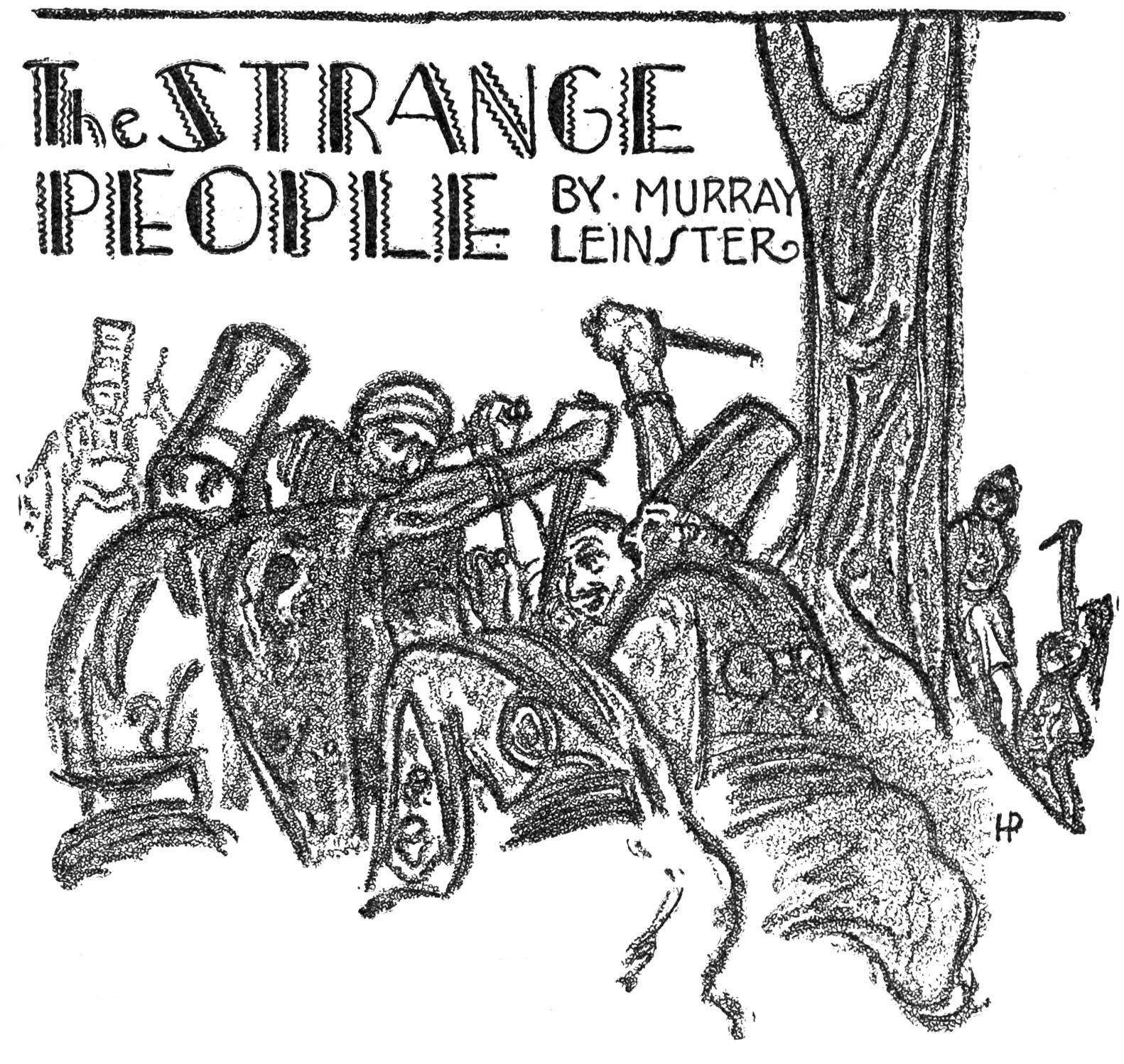
“He was hidden from view in a mass of stabbing figures.”
15
The sun sank thunderously behind the mountain-range and tinted the tips of all the peaks with gold. Little fleecy clouds floated overhead in contented indolence. The wind of the heights was still. The pine-clad hills seemed very soft and restful as the shadows deepened on the eastern slopes, and contrasted strangely with the still-bright golden fields of the valleys yet unshadowed by the mountains.
Stephan held out a weary hand, pointing. A sullen column of smoke rose from a point far distant. He pointed again, where a thin wisp of vapor grew steadily thicker and denser.
“Our houses,” he said bitterly. “They are being burned. Vladimir has spoken, and we die.”
Cunningham clenched his fists as the sullen gray clouds rose slowly upward in the still air. Once he saw figures moving about the base of the smoke. Once he thought he heard yelling.
“I don’t think he’s told your secret,” he said after an instant. “That’s the mob. Gray promised that help would come. He said it was coming by airplane. And Vladimir——”
He told Stephan swiftly what Vladimir had said to the sheriff: that the Strangers were to be surrounded by the mob, and that then he would speak to them; that they would submit, and that some would go away in chains to be hung for the murder of his brother, and that he would take the others away with him forever; that they would follow when he spoke to them and obey him in all things.
Stephan’s eyes flashed fire for a second.
“Is life so sweet or peace so dear,” he quoted bitterly, “as to be purchased at the price of chains and slavery?” He stopped short. “No,” he said quietly. “We will not obey him. No!”
Cunningham felt again that curious impotent bafflement. Stephan had just quoted Patrick Henry’s speech to the House of Burgesses, the famous “Give me liberty or give me death” speech. And Stephan had never seen a revolver until Cunningham showed him one, nor a shotgun save at a distance and in the hands of the farmers about him. None of the Strange People were better informed. Keeping passionately to themselves, it was possible that they would never have seen a pistol if they were ignorant of them before they came mysteriously to these hills. Revolvers are not common in country places, nor are those possessed displayed.
“You see,” said Stephan with a faint smile, “how I was able to spare you for a time. It is likely that we will all soon be dead. And then it does not matter if you know our secret or not.”
“Tell me now,” begged Cunningham. “It will make no difference to you, and it may mean everything——”
Stephan smiled slowly at Maria, who was clinging to Cunningham’s arm as if she feared that at any instant he might be torn away.
“You say you do not know,” he said with a wretched attempt at lightness. “Maria loves you. You would despise her if you knew. Let her be happy as long as may be.” He paused and surveyed the hillside with keen eyes, then added: “We trust you. We might have killed many of that mob already. They were careless. But we have fled before them. We will keep from killing them as long as we can, because you have asked it.”
“Gray will be here!” said Cunningham passionately. “He has promised! Help will come!”
Stephan shrugged his shoulders and gave a low-voiced order in the unknown tongue which the Strangers spoke among themselves.
“Help,” he said in a moment more, and smiled very wearily indeed. “The soldiers will come, no doubt. And then we die indeed. We move now, my son.”
Half a dozen Strangers hovered near Cunningham. They were guards, to prevent his escape at any cost. That they would kill him to keep him from getting away there was no doubt. That they hated him was totally improbable. The faces of all the Strangers wore a settled, fatalistic look. Every one was now clad in the barbaric costume they had worn about the fires the night before, as if they had abandoned all hope of pretending longer that they were of the same sort as the inhabitants of the valleys.
Cunningham followed as the Strangers moved on. Little bands of them were constantly appearing unexpectedly from the woods and joining the main body. There were quite two hundred in all when they passed over a hill-crest and settled themselves in the valley beyond.
The mob had appeared from Bendale. On horse-back, in motor-cars and in wagons drawn by teams, what seemed to be the whole population had come raging out to Coulters. The farmers of the valley had put their women-folk together and come armed with weapons, from shotguns to pitchforks. And they had surged into the hills in quest of the Strange People. All had forgotten that the only thing genuinely proved against the Strangers was the death of Valdimir’s brother. All were hysterically convinced that the Strangers made a practise of kidnaping children and sacrificing adults in devilish orgies by their fires.
The belief was not unparalleled. To be peculiar is to invite suspicion. The Strangers were peculiar. Suspicion is always based on fear. What fear is more terrible than that of harm to one’s children? Every unknown man or race of men has been accused of the one crime. Gipsies are not yet freed of the suspicion of kidnaping. A lurking tramp or wanderer is instantly and invariably suspected of intent to commit the same offense.
Was it odd, then, that the secretive folk of the hills had been classed as doubtful? The mysterious ceremony of the fires, as described by the ignorant and frightened constables, was capable of any interpretation. What had been doubts and vague surmises became certainties when coupled with the ceremony which was meaningless unless sinister.
Now the Strangers had withdrawn from the first of the mountain-slopes. They abandoned their homes to the mob without a struggle. The houses went up in flames. The Strangers had seen the columns of smoke rising to the sky.
Men and women wore a look of settled calm. A mob that vastly outnumbered them, and was vastly better armed, was seeking them in raging madness. They waited to die. Some of the younger men chafed at the delay in fighting. With their throwing-knives they might have picked off many of their persecutors, but Stephan had forbidden it.
They waited. Darkness fell. Through the stillness of early night came the sound of a shot, then another and another. Wild yells broke loose below.
After a long time a runner came panting to the bivouac. He had bound the embroidered sash that was part of his costume about his arm, but it was stained—a dark purple in the moonlight.
Stephan ordered another move. Uncomplainingly the Strangers rose and plodded farther into the hills. The children were weary. Fretful little cries rose from the long line. Women hushed them gently. There was little talk. Just a long line of barbarously clad people plodding with bowed heads onward, onward, onward, while a shouting, raving mob raged through the woods in quest of them.
Cunningham went with them. He had no choice, but it is doubtful if he would have done otherwise had he been able to.
Again the weary people settled for a little rest. Yells sounded faintly, far to the right. A red glow began and grew larger and became a house burning with a crackling noise in the wilderness. Cunningham saw an old man rise on one elbow and peer at the flames. His face was apathetic. Then he lay down again.
“That was my house,” he said quietly to the man nearest him, and was silent.
Again came runners, panting. One man was sobbing in rage and humiliation, begging leave to plunge into the mob and die fighting—alone, if need be.
Stephan refused him gently.
“I think we die,” he said grimly, “but he”—Stephan pointed at Cunningham—“has promised that help will come. I do not believe it, but we can miss no chance. We have women with us, and children. We must hold ourselves for them. While the least chance remains, we must live.”
Once more came the order to move. And once more the weary march began. It had no object and it had no hope. But beneath the full moon the Strangers plodded on and on, until the baying of dogs set up behind them.
“They’ve sent down in the valley and got dogs!” raged Cunningham in a blend of fury and sick horror.
Stephan stroked his chin and gazed at Cunningham.
“What now, my son?” he asked.
Cunningham shook his head in despair.
“This is the end,” said Stephan quietly. “I think—I think we may let you go on alone, if you wish. You may escape.”
“Maria?” demanded Cunningham, very white. He would feel like a coward and a scoundrel if he deserted these people, but if he could save Maria he would do it.
“No,” said Stephan. “She is my daughter and I would save her life. But if our secret is known it is best that she die quickly with the rest.”
Cunningham groaned and clenched his fists.
“I stay,” he said harshly. “And—I fight with you!”
Sunrise broke upon the Strangers huddled high up on a bare and windswept peak. Its first cold rays aroused them. Gradually it warmed them. And it showed them clearly to a ring of still-raging men who were made savage by the ruin they had wrought during the night. From fifty places in the hills thin columns of smoke still rose wanly to the sky, from as many heaps of ashes that had been the Strangers’ homes.
And shots began to be fired from the besiegers of the Strange People. Then Vladimir rode forward on a white horse and shouted to them in that unknown language.