Extracts from “The Admirable Adventures and Strange Fortunes of Master Antonie Knivet, which went with Master Thomas Candish in his Second Voyage to the South Sea, 1591,” published in Purchas His Pilgrimes, Part IV, lib. vi, c. 7. London, 1625. (continued 2)
Reading edition
Six months after his arrival, the Governor took the field against the powerful chief Kafuche. His force was the most formidable that had ever been at the disposal of a Governor, numbering no less than eight hundred Portuguese. It was joined at Songo by a portion of the garrison of Masanganu. Unhappily, the Governor died before coming in contact with the enemy, and appointed Manuel Cerveira Pereira as his successor. Battell calls this man an “upstart,” and he certainly had many enemies; but he is well spoken of by the Jesuits, and was an able soldier. On August 10th, 1603, he inflicted a crushing defeat upon Kafuche, at Agoakaiongo,444 on the very spot where, seven years before, the Portuguese had met with a great disaster. Overcoming the stout resistance of the chiefs of the Museke,445 he arrived at the head of the navigation of the Kwanza, and there, at Kambambe, he founded the Presidio da N.S. do Rozario (1604). Having punished several of the neighbouring chiefs, including Shila mbanza (Axilambanza), the father-in-law of King Ngola, and left João de Araujo e Azevedo446 in command of the new presidio, Pereira returned to the coast.
S. Paulo de Luandu had by that time grown into a fine town, where commerce flourished. Unfortunately for the lasting prosperity of the colony, human beings constituted the most valuable article of export, and the profits yielded by this slave trade attracted Dutch and French interlopers, notwithstanding a royal decree of 1605, which excluded all foreign vessels from the vast territories claimed by Portugal. In 1607 there were four “Presidios” or forts in the interior, namely Muchima, Agoakaiongo, Masanganu, and Kambambe.447
D. Manuel Pereira Forjaz and Bento Banha Cardoso, 1607-15.
We have already stated that Manuel Cerveira Pereira had many enemies, and when D. Manuel Pereira Forjaz, the new Governor, arrived towards the end of 1607, very serious accusations must have been brought against the former, for he was at once sent back to Lisbon. There, however, we are bound to assume that he refuted these accusations, for otherwise it is not likely that he would have been re-appointed Governor eight years afterwards: unless, indeed, he had friends at court who profited by his delinquencies. Forjaz himself showed to little advantage. He superseded the commandant of Kambambe by one of his own creatures, and the fort would certainly have been taken by the sobas who blockaded it, had not Roque de S. Miguel and Rebello de Aragão hastened to its relief. Forjaz, moreover, is accused of having imposed an annual tax upon the sobas, yielding from twelve to thirteen thousand cruzados, which seem to have found their way into his own pockets, and those of his favourites.448 When he suddenly died in his bed, on April 11th, 1611, the bishop and the leading men called upon the captain-major, Bento Banha Cardoso, to take charge of the government. Cardoso was a man of enterprise, and successful in his undertakings, but cruel. In 1611 he defeated King Ngola. The sobas Kilonga and Mbamba Tungu, who fell into his hands, were beheaded, as were also several of their makotas. To avenge these executions, fourteen sobas of Ngola and Matamba made an attack upon Kambambe in the following year; and although that place was valiantly defended until relieved, it took a year before order was restored in the surrounding district. To keep these sobas in check, a fort (Mbaka) was built on the river Lukala (1614), eight leagues from Masanganu.449 In Kisama, the territory of Nambua ngongo (Nabo angungo) was raided in the same year.
An Attempt to Cross Africa.
Before proceeding with our account, there remains to be noticed a serious attempt to cross the whole of Africa from the west coast to “Manomotapa,” on the Zambezi, which was made by Balthasar Rebello de Aragão, by order of D. Manuel Pereira Forjaz. Rebello de Aragão himself furnishes a very short account of this expedition,450 from which we learn that he discovered copper and iron, and was told that there was also silver. The natives bred cattle and cultivated the land, and they told him of a lake, in lat. 16° S., giving rise to many rivers, including the Nile. Unfortunately, when he had advanced one hundred and forty leagues from the sea, and eighty beyond the place he started from (Kambambe?), he was summoned back, as the fort just named was threatened by King Ngola.451
The Conquest of Benguella.
In 1615, Manuel Cerveira Pereira452 returned to the scene of his former labours, with special instructions to take possession of Benguella, which for a considerable time past had been visited by trading vessels. But before he started upon this enterprise, he ordered his old comrade, João (or Paio?) de Araujo e Azevedo, to deal with Kakulu Kabasa,453 Mbumba (Bumba) a ndala, Kilomba kia tubia, and other revolted chiefs in Angola, whilst he himself penetrated into the country of the Kakulu Kahenda,454 who had given offence by assisting fugitive slaves and interfering with traders.
Having entrusted Antonio Gonçalves Pitta with the government of S. Paulo, he left that place for the South, on April 11th, 1617, with four vessels, a patacho, and one hundred soldiers.455 Finding the site of the old fort near the Terra das duas Puntas unsuitable, he continued his voyage along the coast, until he came in sight of a “sombreiro,” overlooking the Bahia das Vaccas;456 and there he built the fort of S. Filippe de Benguella, which in course of time developed into a city of some importance. The sobas of Ndombe, of whose territory he had possessed himself, naturally objected to the presence of these uninvited strangers, but they were compelled to submit after five defeats. The Jaga on the river Murombo likewise gave in, after three months’ fighting, but soon afterwards broke the peace, and was executed. The chief Kalunga, at the mouth of the Koporolo (Kuporol), and the cattle-keeping Mukimba in the neighbouring hills, also submitted. It scarcely admits of doubt that Pereira, in the course of his many military excursions, discovered copper, sulphur and salt,457 but he was to benefit little by these discoveries. His harsh conduct and greed had estranged his people. Headed by a priest and by their officers, they mutinied, put their leader on board a patacho, and shipped him off to S. Paulo, where no notice was taken of his presence, the Governor being absent at that time, because of a native war (1618).458
Pereira once more returned to Madrid, and having explained matters to the satisfaction of the authorities, he was sent back, and again reached S. Felippe de Benguella on August 8th, 1620. He sailed north to Sumba mbela’s country, at the mouth of the river Kuvu. A couple of days inland he discovered more copper, three quintals of which he took to S. Paulo. He died in the midst of his labours. The Catalogo credits him with having gone inland as far as Kakonda.459
The Colonial Government.
We have already learned that the native sobas were handed over to the mercy of individual “conquistadores,” and Rebello de Aragão declares that these sobas were being “robbed and maltreated.” They were required by their masters to pay a tax in slaves, to furnish carriers, and render all kinds of services,460 without payment. In addition to this the Governor, D. M. P. Forjaz, imposed upon them a poll-tax, which produced from twelve to thirteen thousand cruzados (say £1,650461) a year. Rebello de Aragão maintains that the native wars were largely due to this pernicious system, which enriched the Governor and his officials, whilst traders were made to suffer, and ceased to visit the “feiras” because of the extortionate demands made upon them. At Mpinda nearly all the “honest” trade had passed into the hands of the Dutch, because of the monopoly conferred upon Portuguese slave-dealers. He declares that a tax of 20 per cent. on the salt mined at Ndemba would pay all the legitimate expenses of government; but that, although the export duty on slaves yielded from five to six thousand cruzados, there had not yet been built a decent house for the government offices.
Garcia Mendes Castellobranco, in a memoir462 addressed to the King in 1620, is equally outspoken with regard to the treatment of the native chiefs, who, he maintains, ought not to be taxed more heavily than at the time when they were still subjects of a native king. He, too, refers to the salt mines as a source of revenue, recommends the levying of a toll at river crossings, and the expropriation of the uncultivated territory around S. Paulo.463
Many of these abuses may, no doubt, be traced to the demoralising influence of the slave-trade and the insufficient pay of the officials. A slave costing £3 7s. in the interior (or nothing, if taken in the course of one of the frequent slave raids) was sold for more than double that sum on the coast; and whilst money could be made thus easily the great natural resources of the country were neglected and the population—which, on the arrival of the Portuguese, is said to have been very considerable—shrank from year to year.464
The export duties on slaves and ivory were farmed out in 1607 to one Duarte Dias Enriques for twenty million reis annually (about £6,600).465
S. Paulo and Masanganu enjoyed municipal institutions at that time, but all outside these cities was ruled by military adventurers. The Governor (in 1607) was paid a salary of £267, but the other officials were decidedly underpaid; and thus, almost of necessity, were driven to increase their incomes by illegitimate means.466
The War with Ngola nzinga mbandi.
Luiz Mendes de Vasconcellos, the new Governor, arrived in November, 1617, and almost immediately found himself involved in a war with the King of Ndongo. Nzinga mbandi ngola kiluanji,467 a great tyrant, had been “removed” by his indignant subjects shortly before the arrival of the new Governor. He left behind him three daughters, one of whom, born in 1582, became famous as Queen D. Anna de Souza Nzinga, and two sons, one by a legitimate wife, the other by a slave woman. It was the latter, Ngola nzinga mbandi,468 whom his partisans raised to the throne, which he reached through rivers of blood, among his victims being his own brother, a son of his sister, and many of the trusted councillors of his father. In 1618 the usurper took the field, intending to expel the Portuguese, who seem to have given provocation by shifting the old presidio of Mbaka (Ambaca) to a site much higher up the Lukala.469 The Governor, ably supported by his captain-major, Pedro de Souza Coelho, not only defeated the King, but also captured his queen and many other persons of consideration. The King sued for peace, but as he failed to surrender the Portuguese whom he had taken prisoner, the war was renewed in 1619. His allies fared no better than the King himself. His vice-king of lower Ndongo, Ngola ari,470 was compelled to pay a tribute of one hundred slaves annually (in 1620); and while the Governor raided the territories of Kahibalongo, Ndonga, and Kasa, his lieutenant, Lopo Soares Laço, destroyed the kilombos of the sobas Ngunza a ngombe and Bangu.
It had been recognised by this time that many of these punitive expeditions were provoked by the lawless conduct of white traders, mulattoes and negros calçados (that is, shoe-wearing negroes), who went inland on slaving expeditions; and only Pumbeiros descalços, that is, native agents or traders not yet sufficiently civilised to wear shoes, should be permitted to do so in future.471
When King Ngola nzinga mbandi heard of the arrival of João Corrêa de Souza, the new Governor, in September, 1621,472 he at once sent his sister to Luandu to arrange terms of peace. This woman, then about forty years of age, proved an excellent diplomatist. When the Governor alluded to the payment of tribute, she declared that tribute could only be demanded from a conquered people, and the treaty ultimately signed was one of reciprocity: fugitive slaves were to be surrendered, and assistance to be given against common enemies.
Before this able ambassadress left Luandu, she was received into the bosom of Holy Mother Church, being baptised as D. Anna de Souza (1622); and on her return home she persuaded her brother to apply for the services of a priest, or Mamaganga.473 A priest was sent, but he was a native, who had been ordained at Luandu, and one of the King’s own subjects. The King looked upon this as an insult; he treated the priest with great indignity, and once more invaded the Portuguese territory. Thrice beaten, and deserted by his vassals, he fled to the island of Ndangi,474 in the Kwanza river, where he died of poison administered by his own sister Nzinga, who thus avenged the murder of her son (1623).
Queen Nzinga, 1623-1636.
Nzinga at once renounced Christianity, and the bloody rites of the Jaga were celebrated when she ascended her throne. She inaugurated her reign by the murder of her brother’s son, of his adherents, and her supposed enemies. Having reduced her own people to subjection, with the aid of the Jaga, she declared war upon Portugal. D. Felippe de Souza Ngola ari, the King of Ndongo recognised by the Portuguese, was at once ordered to defend the frontier, and, if possible, to invade the territories of his kinswoman. On consideration, however, it was thought best, in the interest of trade, to avoid a serious conflict. An officer was sent to the court of the Queen, offering to restore the lost provinces (and thus sacrificing their vassal D. Felippe), on condition of her acknowledging herself a vassal, and paying tribute. These conditions were haughtily rejected, and the war began in earnest.
João de Araujo e Azevedo was placed at the head of the Portuguese invading force.475 He raided the country along the Lukala, and then turned back upon the Kwanza, occupied the islands of Ukole and Kitaka, and came up with the Queen’s camp at Ndangi Island. The Queen, having consulted the spirit of her brother Ngola mbandi,476 declined to risk a battle, and fled into Hako (Oacco). The Portuguese followed in pursuit, passing through Bemba, Malemba and Kipupa, and Little Ngangela (Ganguella); came up with the Queen’s forces in the territory of soba Matima (Mathemo), and inflicted a serious defeat upon them. Among the prisoners taken were the Queen’s sisters, Kambe and Funji, and many Makotas. The pursuit was continued as far as Kina grande in Ngangela, a deep and difficult gorge, into which some of the soldiers and the guerra preta descended by means of ropes. When the Queen fled to the kingdom of Songo, the Portuguese forces retired to the west (1627).477
The two princesses were taken to Luandu, where the Governor, Fernão de Souza, lodged them in his own house. In baptism (1628), they received the names of D. Barbara and D. Engracia.
The Portuguese had no sooner retired than Queen Nzinga returned to Ndangi Island, and having been reinforced by several Jaga, she undertook the conquest of Matamba. At Makaria ka matamba she took prisoner the dowager-queen478 Muongo Matamba, and her daughter. The mother was branded as a slave, and died of grief; but the daughter was taken into favour, and was baptised in 1667.
Having thus destroyed the ancient kingdom of Matamba, the Queen once more invaded Portuguese territory, but she turned back when she heard that the Jaga Kasanji was raiding her recent conquest, upon which he claimed to have prior rights.
At the same time she interfered continually with the commerce of the Portuguese with the interior; and it was only in 1636, when the Governor, Francisco de Vasconcellos da Cunha, sent D. Gaspar Borgia and Father Antonio Coelho on a mission to the Jaga in Little Ngangela, and to the Queen at her Kabasa, in Umba, that peaceable relations were established. The Queen, however, persistently refused to surrender her claims to the provinces of Ndongo which had been occupied by the Portuguese.
Minor Events, 1624-1641.
Punitive expeditions were frequent. In 1624 the Jaga Kasanji, who had taken advantage of the conflicts between the Portuguese and Queen Nzinga to rob Pumbeiros, was severely punished, and Captain Roque de Miguel returned from this expedition with a large number of captives, who as a matter of course, were sold into slavery. During the provisional governorship of the bishop D. Simão de Mascarenhas479 (1623-4), Lopo Soares Laço meted out punishment to the Jagas Nzenza a ngombe and Bangu-Bangu, and to the irrepressible Kafuche.480 A few years later, in 1631, the captain-major Antonio Bruto waged a successful war against rebellious sobas, and more especially impressed the natives by his victory over the dreaded Mbuila anduwa (Ambuila Dua), who held out for six months in a rocky stronghold deemed impregnable. The invasion of Kongo, in 1622, by order of Governor João Corrêa de Souza, who claimed the surrender of Luandu Island and of all the copper mines, has already been referred to (see p. 123).
Among the very few measures calculated to promote the material or moral interests of the colony may be mentioned the establishment of the three feiras, of Ndondo, Beja, and Lukamba, in 1625; the foundation of a Santa casa da misericordia (Poor-house and hospital) at S. Paulo de Luandu, by the bishop D. Simão de Mascarenhas; the compulsory cultivation of the banks of Mbengu (Bengo), when Luandu was threatened with famine owing to the non-arrival of provision ships from Brazil, in 1629;481 the reform of the administration of the Royal revenue, by Fernão de Souza, in the same year; and the creation of a board of revenue (Junta da fazenda), charged with the collection of the tithes and of the tribute payable by the native chiefs, by Francisco de Vasconcellos da Cunha, in 1638.
The affairs of the missions will be dealt with subsequently, in a comprehensive manner, but a difficulty which arose in 1623 between the Governor, João Corrêa de Souza, and the Jesuits, may be dealt mentioned at once. In 1619, Gaspar Alvares,482 a wealthy merchant of Luandu, placed 20,000 cruzados at the service of the Fathers, in order that they might found a seminary483 for the education of twelve natives. Subsequently he himself became a member of the Society of Loyola, and devoted the whole of his fortune, amounting to 400,000 cruzados, to its purposes. The Governor not unnaturally objected to this sudden enrichment of a Society which had always been a thorn in the side of the government. Alvares himself escaped to S. Salvador, but the Prefect of the Jesuits and three Fathers were sent as prisoners to Lisbon, where they were at once liberated; whilst the Governor himself, who arrived soon afterwards, perhaps with the intention of justifying his hasty proceedings, was thrown into prison, and died in the limoeiro in 1626.
The Dutch in Angola.
When Philip of Spain seized upon the crown of Portugal in 1580, that unfortunate country became at once involved in the troubles between Spain and the United Netherlands. No sooner had the destruction of the Armada, in 1588, enabled the Dutch to take the offensive on sea, than they began to compete for a share in the trade of the Portuguese possessions. The Dutch at first kept on the defensive, but in 1598 they and the Portuguese came into hostile collision near the Ilha do Principe; and all efforts to exclude these noxious heretics from sharing in the trade of the Kongo proved futile, more especially as the natives themselves preferred their Dutch visitors to the masterful Portuguese.484
An armistice concluded in 1609 expired in 1621. The Dutch West-India Company was founded in that very year, and thenceforth the Dutch proceeded aggressively. In 1623 they burnt several patachos off the mouth of the Kwanza; in 1629 a Dutch squadron cruised during three months off the coast of Benguella and captured four Portuguese merchantmen, but failed to force their way into the harbour of Luandu. In 1633 two Dutch vessels menaced S. Felippe de Benguella, but were driven off by Lopo Soares Laço, after a stout fight, on November 15th. In 1637, Bartholomeu de Vasconcellos da Cunha, the Governor’s brother, captured a Dutch man-of-war of 24 guns. At that time the coast was being regularly patrolled by Portuguese men-of-war,485 and in 1638 the foundations of the Fort S. Miguel were laid on the Morro de S. Paulo, the original site of the city of S. Paulo.
When Portugal recovered her independence, in December, 1640, D. João IV of Bragança at once sent Tristão de Mendoza Furtado to the Hague, with instructions to demand a suspension of hostilities. The West-India Company, which profited largely from a state of war, declared in favour of a definite treaty of peace, but objected to the conclusion of an armistice. The Portuguese envoy had no authority to sign such a treaty; but after protracted negotiations an armistice for ten years was signed on June 23rd, 1641, which was to take force outside Europe as soon as it became known there.
Meantime, the directors of the West-Indian Company had instructed Count John Moritz of Nassau to take advantage of the momentary weakness of Portugal, after her war of liberation, to seize all he could before the terms of the treaty became known.486 Count Moritz, being desirous to increase the supply of slaves for the plantations in Brazil, determined to seize upon Luandu. A fleet of twenty-one vessels was at once fitted out at Pernambuco, and placed under the command of Cornelis Cornelissen Jol, surnamed Houtebeen, or “Wooden leg.” It was manned by nine hundred sailors, and had on board two thousand troops, commanded by Jeems Hindersen. This formidable armament left Pernambuco in June 30th, 1641, sighted Cabo Negro on August 5th, and having captured the Jesus Maria, on a voyage from Madeira, was by her piloted into the harbour of Luandu. On August 24th the Dutch fleet unexpectedly appeared off S. Paulo, surprising its inhabitants in the midst of their rejoicings at the accession of the “liberator king.” S. Paulo, at that time, was a city of twenty thousand inhabitants, including three thousand Portuguese; but the Governor, Pedro Cezar de Menezes, though he was at the head of nine hundred white troops, offered only a feeble resistance; and, accompanied by many of the citizens, he withdrew to the river Mbengu, and subsequently to Masanganu. The booty which fell into the hands of the Dutch included thirty ships and ninety-eight cannon.
They lost no time in gaining the goodwill of the neighbouring sobas, sent an embassy to the King of Kongo (see p. 125), and entertained offers of alliance from Queen Nzinga. Aki musanu (Aca mochana) and Nambu a ngongo (Nabo a ngongo), who had risen upon the Portuguese, were joined by one hundred and fifty Dutchmen, and thus enabled to overcome their enemies, whose leaders, André da Costa and João Vieira, they killed (1642).
In the following year (1643) information was received that the truce had been signed, but the Dutch director very naturally declined to surrender the town. He agreed, however, to suspend hostilities. Pedro Cezar had been instructed by his government to avail himself of the first opportunity to recover the city,487 and it was evidently with a view to this eventuality that he established a camp on the river Mbengu. The Dutch suspected his treacherous design, and at dawn on May 26th, 1643, they surprised his force. Many Portuguese were killed (including Antonio Bruto), while Pedro Cezar himself, Bartholomeu de Vasconcellos da Cunha, and one hundred and eighty seven soldiers were taken prisoner. The remainder escaped to Masanganu. The forces assembled there under the captain-major, Antonio de Miranda, were unable to retrieve this disaster, but the Governor, aided by friends, managed soon afterwards to escape.
But though unequal to meeting the Dutch in the field, the Portuguese were still able to enforce their authority upon the natives; and in 1645 Diogo Gomes de Morales led an expedition into Lubolo and Mbalundu (Bailundo), and reduced the kolombos of thirty “Jagas” to obedience.
In 1645, the Portuguese of Brazil, under the leadership of João Fernandez Vieira, rose upon their Dutch oppressors, and in the same year the Dutch occupied S. Felippe de Benguella. The garrison under Antonio Teixeira de Mendonça, the captain-major, and Antonio Gomez de Gouvea, an experienced sertanejo, or backwoodsman, retired northward along the coast. On reaching Kikombo Bay, on July 27th, 1645, they met there Francisco de Sotto-maior, just arrived from Rio de Janeiro with reinforcements. By advice of Gomez, the troops and stores were landed in Suto Bay, near Cabo ledo, and conducted by him in three detachments to Masanganu, without the Dutch becoming aware of their arrival. The Governor, Pedro Cezar de Menezes, returned by the same route to Rio, taking with him a cargo of slaves.
These reinforcements arrived just in time to be employed against Queen Nzinga. That lady had set a black and a white cock to fight each other, and the defeat of the white cock was looked upon by her as a favourable augury for venturing an attack upon Masanganu. But Gaspar Borges de Madureira fell upon her before her forces had been concentrated (January, 1646). She suffered a severe defeat, notwithstanding the presence of Dutch auxiliaries. Her sisters once more fell into the hands of the Portuguese. D. Engracia was strangled soon afterwards for an act of treachery, whilst D. Barbara was kept in honourable captivity until 1657.488
Meanwhile the Dutch had made preparations for an advance up the Kwanza. They had built Fort Mols at the mouth of the river, and another fort higher up. The Governor, Francisco de Sotto-maior, having died of fever in May, 1646, measures for a spirited defence were taken by the three captains-major, Bartholomeu de Vasconcellos da Cunha, Antonio Teixeira de Mendonça, and João Juzarte de Andrada. Muchima, which had been furiously assaulted by the Dutch, was relieved by Diogo Gomes de Morales. But in the following year the Portuguese suffered a reverse at Kawala (Caoalla), and Masanganu itself was threatened by the combined forces of Queen Nzinga, Kongo, and the Dutch.
However a saviour was at hand in this extremity. On August 12th, 1648, Salvador Corrêa de Sá Benevides,489 with nineteen vessels, having on board nine hundred soldiers, cast anchor in the harbour of Luandu, and summoned the Dutch to surrender within forty-eight hours. On their refusal he landed his troops, and after a short bombardment of Fort S. Miguel, to which the Dutch had withdrawn, early on August 15th he delivered an assault, which cost him one hundred and sixty three men, but led to the surrender of a garrison numbering one thousand one hundred men, including French and German mercenaries. When these prisoners had been joined by the three hundred Dutchmen who were with Queen Nzinga, and the garrison of Benguella, which surrendered without a blow, they were shipped off to Europe. The city, in memory of the event, assumed the name of “S. Paulo da Assumpção de Loanda,” for it was on the Day of Ascension of the Virgin Mary that a seven years’ captivity ended. The anniversary of that event is celebrated to the present day by a religious procession.
Restoration of Portuguese Authority.
No time was lost in restoring the authority of Portugal throughout the colony. The King of Kongo was compelled to accept a treaty by which Luandu Island and the whole of the country to the south of the Dande river were unconditionally surrendered, and other advantages held out (p. 128). Queen Nzinga, although she declined the overtures of Captain Ruy Pegado490 for a formal treaty, retired inland, and gave no trouble for a number of years. As to the sobas of Lamba, Kisama, Lubolo, and the Modiku islands, they were visited by punitive expeditions commanded by Antonio Teixeira de Moraes, Diogo Mendes de Morales, Vicente Pegado de Pontes, and Francisco de Aguiar.
Order having been restored, the Governor, Salvador Corrêa de Sá, caused the ruined buildings to be repaired, and granted crownland to the inhabitants for houses and gardens. In a very short time prosperity returned, and the trade of Luandu was as flourishing as ever it had been.491
But although the Portuguese were masters on shore, the Dutch, and occasionally also French or English “pirates” frequented the coast. In 1650 Alvaro d’Aguiar defeated five of these interlopers, who had made prizes of two ships on a voyage from Brazil; in 1651 João Duque was killed in an action with Dutch men-of-war; in 1652 João de Araujo drove away the Dutch from Mpinda and Luangu; in 1658 the same officer made a prize of a English slaver off Benguella. A second English slaver was captured in 1659 by João Cardoso, who also captured a Dutch vessel off the Kongo in 1661. In 1662 the definite treaty of peace between Portugal and Holland was signed, and “pirates” are no longer heard of; although Dutch vessels provided with passes, or favoured by the Governors, seem to have been admitted to Portuguese ports.
Queen Nzinga and Her Successors.
Queen Nzinga, after the return of her General from a raid on the territory of Mbuila (Imbuille), in 1655, whence he brought a miraculous crucifix, felt troubled in her conscience; and on consulting the spirits of five of her ancestors (see p. 166), she learned, to her no small terror, that they were suffering eternal torments, which she could only escape by once more embracing the Christian faith, and seeking the friendship of the Portuguese.492 Upon this advice she acted. The negotiations for a treaty were conducted by Captain Manuel Freis Peixoto and the Capuchin friar Antonio of Gaeta, who came to her Court for that purpose in 1657. Her sister, D. Barbara, was restored to her on payment of a ransom of two hundred slaves,493 and the river Lukala was thenceforth to form the boundary between the Queen’s dominions and those of the Portuguese. No tribute was to be paid by her. Friar Antonio had the honour of once more baptising this ancient lady, then seventy-five years of age, and also of marrying her, legitimately, to a slave-youth, Don Salvatore; while her sister, D. Barbara, allied herself unto D. Antonio Carrasco Nzinga a mona, a foster-brother of the Queen, and the General-in-Chief of her armies. A church, S. Maria de Matamba, was specially built for these interesting ceremonies. This remarkable woman died on December 17th, 1663, after Father Cavazzi had administered to her the last consolations of religion, and was buried in the church of St. Anna, which had been built within the precincts of the Royal palace.
When D. Barbara died, on March 24th, 1666, her husband, D. Antonio Carrasco Nzinga a mona, killed the legitimate heir, D. João Guterres Ngola kanini, and usurped the throne, but was himself slain in a battle against D. Francisco Guterres Ngola kanini, in 1680. The conqueror then attacked the allies of the Portuguese, robbed the pumbeiros, and beheaded the Jaga Kasanji (1682).494 Luiz Lopez de Sequeira at once took the field against him with five hundred and thirty infantry, thirty-seven horse, and ten thousand empacaceiros, and defeated him at Katole, a place within three days of the Royal kabasa. The King himself lost his life, but so did the leader of the Portuguese495 and Vasco de Mello da Cunha. João Antonio de Brito, who took the command after his leader’s death, remained encamped for thirty days on the site of the battle; and finding that the enemies did not return, retired to Mbaka; from which we may judge that the Portuguese, too, suffered heavy losses. D. Veronica (or Victoria) Guterres, the sister of the late King, sued for peace, which was readily granted. Fresh complications threatened in 1689, when the Queen was charged—falsely, it appears—with having stirred up the soba Kahenda to rebel against his Portuguese masters; but matters were arranged through the intervention of bishop D. João Franco de Oliveira. No further trouble seems to have occurred with the successors of Queen Nzinga until 1744, when the Queen496 provoked a war by killing a white trader and robbing pumbeiros: the result of which was the capture of her capital by Bartholomeu Duarte de Sequeira, and the cession of the Kinalunga Islands to Portugal.497
The Last of the Kings of Ndongo, 1671.
We have seen that D. João de Souza Ngola ari had been installed as the first King of Ndongo, recognised by the Portuguese (see p. 164), about 1627, and had been succeeded by D. Filippe de Souza, who died in 1660, and by João II. The hope that this tributary would prove a staunch ally of the Portuguese was not to be realised, for immediately after the disastrous campaign against Sonyo (see p. 131), in 1670, D. João Ngola ari raised the standard of rebellion, and invaded the district of Mbaka. The Governor, Francisco de Tavora,498 a future Viceroy of India, who on account of his youth (he was only 23 years of age) and supposed prudence had been nick-named o menino prudente, despatched his captain-major, Luiz Lopes de Sequeira, to reduce the rebel to obedience. Ngola ari met with a defeat on the river Luchilu, close to the Pedras of Pungu a ndongo, which were considered impregnable. Yet, on a dark night, on November 18th, 1671, Manuel Cortes, the leader of the guerra preta, surprised this rocky stronghold. The King himself was taken, and beheaded as a traitor. Thenceforth there was no further need for punitive expeditions on a large scale.499
Relations with Kongo.
No sooner had the Portuguese regained possession of S. Paulo than the King of Kongo was called to account for having sided with the Dutch and favoured the operations of “foreign” Capuchins. A threatened invasion of his kingdom (1649) speedily led to the conclusion of a treaty of peace (see p. 126). But as the supposed gold and silver mines were not ceded, as promised, the Portuguese once more invaded the country, and in the bloody battle of Ulanga, in 1666, the King lost his life and crown (p. 129). From that time to the close of the century anarchy reigned in Kongo. The disastrous expedition against Sonyo in 1670 (see p. 131) was partly undertaken in order to support one of the many rival kings of that period.
Minor Punitive Expeditions, 1658-95.
João Fernandes Vieira, who had gained fame as the leader of the Portuguese patriots in Brazil, where the capture of Pernambuco had won him the surname of o hero de nossa edade, arrived as Governor on April 18th, 1658, and before the close of the year, a serious rebellion broke out in Upper Ngulungu. The captain-major, Bartholomeu de Vasconcellos, took the field, and compelled Ngolome a kayitu (Golome Acaita), to surrender his rocky stronghold after a siege of four months; Tanga a ngongo submitted quietly, but Kiluanji kia kanga (Quiloange Acango), faced the Portuguese four times, and then retired inland without yielding submission.
A second expedition, in the same year, traversed the districts to the south of the Kwanza.500 It started from Masanganu, and having crossed the Kwanza into Hako was joined by Ngunza mbambe;501 it entered the district of Kabeza, where the Jaga of Rimba brought further reinforcements. Jaga Ngonga ka anga, the chief of Nsela (Shella), on the river Kuvu, surrendered his capital, Kangunza, by the advice of his diviners, without striking a blow, and submitted to be baptised. The expedition then returned to Mbaka by way of the river Gango and Tamba; whilst Cavazzi, who accompanied it as chaplain, took a more direct road through Kabeza.
After the great victory over the King of Kongo in 1666 (see p. 130), a detachment under Antonio da Silva was sent into the territory of the Ndembu Mutemu Kingengo, whilst another, under Diogo Gomes Morales, raided the villages of Nambua nongo, these chiefs having aided the defeated King.
Kisama, at all times an unruly district, and even now virtually independent, though situated on the sea and within easy reach of Luandu, has repeatedly given trouble to the Portuguese. In 1672, the sobas of the district unsuccessfully assaulted the fort at Muchima. In 1686 they blockaded that fort, until relieved by João de Figueiredo e Souza. In 1689, the sobas Kimone kia sanga and Muchima interfered with the free navigation of the Kwanza, and were punished by the Portuguese leader just named; and in 1695, the rebellion of the soba Katala brought into the field the captain-major, Manuel de Magalhães Leitão.
A rebellion in Lubolo, in 1677, was suppressed by Luiz Lopez de Sequeira. The soba Ngunga mbambe was killed, and his allies, Sakeda, Ngola kitumba, and Ngola Kabuku, were severely punished.
Far more serious was an expedition which the Governor, Gonçalo da Costa de Alcaçova Carneiro de Menezes, despatched against the ndembu Mbuilu (Ambuilla), who had expelled the Portuguese residents, robbed the Pumbeiros, and burnt the church. João de Figueireda e Souza, a trusted officer, was given the command; and notwithstanding that the garrison of Masanganu mutinied and refused to join him, he mustered, on May 25th, 1682, a formidable force of six hundred musketeers, forty-two horse, and a guerra preta of forty thousand men, with two field guns. Unfortunately, he lost precious time by lingering two months at Kamolembe, where many of his people died; and when at last ready to start, he heard that Mbuila had been reinforced by two “armies” sent to his aid by King Manuel of Kongo502 and Queen Nzinga, and lost his head. Fortunately for the Portuguese a stroke of paralysis carried off this pusillanimous leader, and his place was taken by Pascoal Rodrigues, a man of much energy, who marched straight upon the mbanza of Mbuilu, and there achieved a great victory. Mbuilu fled to his neighbour and ally Ndamba (Dambe). The number of prisoners taken was so great that it was feared they might endanger the safety of their captors, and they were mercilessly beheaded, a nephew of Mbuilu alone being sent a prisoner to Luandu.503
When Pascaol Rodrigues fell ill, the Governor appointed João Baptista de Maia to succeed him. The troops passed the rainy season in barracks. On the return of fine weather, Mbuilu was pursued into the territory of Ndamba and killed. The mbanzas and over one hundred and fifty libatas were burnt. The Ndembu Kabanda, a partisan of Mbuilu, was pursued by the sergeant-major, Lourenço de Barros Morim, and the leader of the guerra preta, Gonçalo Borges de Barros, and killed with many of his people. Another ndembu having been installed, and sworn allegiance to the King of Portugal, the army returned to Mbaka, and thence to Lembo near Masanganu. The victorious troops were refused admission into the latter, the garrison of which had mutinied. It was only after the Governor had promised a pardon to the offenders, with the exception of the leaders, that order was restored (1693).
Benguella.
S. Filippe de Benguella was founded in 1617 by Manuel Cerveira Pereira, and in 1661 its fortifications were rebuilt by Gaspar de Almeida Silva, whilst Manuel de Tovar Froes fought the neighbouring sobas. A further step in advance was taken in 1682, when the sergeant-major, Pedro da Silva, founded the presidio of Kakonda a velha, in the territory of the soba Bongo. Two years later, in 1684, this presidio was surprised by Bongo, and Manuel da Rocha Soares, its commandant, was killed. Carlos de Lacerda, who was despatched to avenge this outrage, being compelled to fall back before superior forces, João Bráz de Goes, the captain-major of Benguella, himself took the field. The Jaga, deserted by his people, sought refuge with Ngola njimbu (Golla Gimbo), but was pursued and captured,504 and the present presidio was built eighty miles further inland (1685), in the territory of the soba Kitata. An attempt made by the soba of Huambo (Hiamba), in 1698, to expel the Portuguese was frustrated by Antonio de Faria, its commandant. A more formidable attack by the neighbouring sobas, in 1718, proved equally ineffectual. The Portuguese had thus gained an advanced post nearly one hundred and fifty miles from the coast, the possession of which opened up to them fresh sources for the supply of slaves, and contributed not a little to the growing prosperity of S. Filippe de Benguella.
Ecclesiastical Affairs.
The Jesuits were the earliest missionaries in Angola; but it would be in vain to look to them for any precise geographical or historical information, such as is furnished by members of the Society established in other parts of the world. They confined their activity to the seat of Government and its immediate vicinity, and Portuguese authors are severe upon their love of power and covetousness. Their relations with the Governors were on many occasions strained, but it cannot be asserted that the Jesuit Fathers were in every instance in the wrong.505 As an illustration of their masterfulness, the following incident may serve. In 1661, the Governor, João Fernandez Vieira, very properly ordered that pigs, should no longer be allowed to run about the streets of the capital. The Jesuits did not deign to take the slightest notice of this order; and when several of their slaves were arrested for disregarding it, they protested against this exercise of authority, and actually excommunicated the Governor. But the Governor was not to be frightened. He reported the case to his King, D. Affonso VI, and the King in a Royal rescript of December 9th, 1666, severely reproved the Jesuits for their insolence; and threatened, in case of similar conduct, to deprive them of the crown lands, and to take other legal measures against them.
Franciscans (Tertiaries of the Order of St. Joseph) followed the Jesuits in 1604. Then came the Capuchins, for the most part Italians and Castilians, in 1651; and lastly barefooted Carmelites (Religiozos de S. Thereza). Of all these friars the Italian Capuchins alone appear to have done good work; and to members of their Order, and especially to Giovanni Antonio Cavazzi, of Montecuccoli, Antonio Laudati, of Gaeta, and Antonio Zucchelli, of Gradisco, we are indebted for much useful information regarding the people among whom they laboured. Many of the other friars seem to have been men whom their superiors in Europe were glad to part with; and the same may be said with reference to the secular clergy.
A report of the ecclesiastical affairs of Angola and Kongo, drawn up in 1694 by Gonçalo de Alcaçova Carneiro Carvalho da Costa de Menezes, by order of the Governor, presents us with a deplorable picture of the state of affairs in that year. Throughout the country there were only thirty-six friars506 and twenty-nine secular clergy; and of these as many as twenty-nine had taken up their quarters in the capital. Of fifty churches and chapels, many were without priests, and had fallen into ruins. The village missions (missões das Sanzalas) had long been given up, and many baptised negroes had returned to the ancient superstitions. The author proposes the institution of a court of clerics, in order that all lapses of this kind might be punished in accordance with the “sacred canons.” A board of missions (Junta das missões), which had been created in 1693, and richly endowed,507 allowed things to drift. Lopes de Lima508 ascribes the failure of the Christian missions, first, to the small number of missionaries and priests; secondly, to the corruption of the clergy; and thirdly, to the slave-trade.
Measures of Administration.
João Fernandez Vieira must be credited with the first serious attempt to organise the military forces of the country (1660), by raising a regiment, or terço, of infantry, for Luandu, and a company for each presidio. These “regulars” were to be supported by the guerra preta, or empacaceiros. A company of cavalry was added to the regular troops in 1672; and the exemption from every kind of military service conferred upon the inhabitants of Luandu since 1660 was partly abolished in 1695, and orders given for the organisation of a terço of ordenanças (militia) for Luandu, and of seventeen companies for the districts and presidios. The fortifications of Luandu had been much improved since the expulsion of the Dutch. The fort of S. Miguel, at Luandu, which was begun in 1638, had been completed by D. João de Lencastre in 1689; and at the close of the century there existed forts, sufficiently strong to resist native attack, at Muchima, Masanganu, Kambambe, Pungu a ndonga, Mbaka, S. Filippe de Benguella, and Kakonda.
The only measure bearing upon the civil administration of the country seems to have been the publication of a Regimento for the guidance of officers of revenue and of justice, in 1675. At the same time, an extra export-duty of ten testões509 was ordered to be paid on every slave, the proceeds to go towards the dowry of Queen Catherine, the consort of Charles II of England.
The introduction of copper coins (makutas) into Luandu, in 1624, caused much dissatisfaction, and actually led to a mutiny of the troops, who not unnaturally felt agrieved at being expected to accept 200 reis in copper as an equivalent of a native cloth, up to that time valued at 700 reis.510 The mutiny was suppressed, and the five ringleaders were executed. In the interior of the country, the ancient currency remained in force, larger amounts being paid in merchandise (fazenda de lei), whilst smaller sums were paid in zimbos (njimbu) or cowries, libongos (mbongo, plural jimbongo), or square pieces of native cloth, or blocks of rock-salt.
The only attempt at geographical exploration was that of José de Roza, who left Masanganu in 1678, for the lower Zambezi, but turned back after only a few days’ journey, owing to the hostility of the natives.
At the end of the seventeenth century, Portugal held sway over a territory of over fifty thousand square miles; she maintained fortified posts far inland; her traders had penetrated as far as the upper Kwanza; and on the coast she held the prosperous cities of S. Paulo de Luandu and S. Filippe de Benguella. But this prosperity depended almost exclusively upon the slave trade. Scarcely any attempt had been made to develop the great natural resources of the country, and even the food of the inhabitants was still largely supplied by the Brazils. The colonists introduced included too large a criminal element; the Government officials were more intent upon realising large fortunes511 than permanently benefiting the country they had been sent to rule; and even among the preachers of the gospel were men quite unfit to hold the office which they filled. And this deplorable state of affairs continued long beyond the period with which we have dealt. Lopes de Lima512 calls D. Francisco Innocencio de Sousa Coutinho, who was appointed in 1764, the “first Governor who undertook to civilise this semi-barbarous colony; and who during his rule of eight years and a-half, did more in that sense than all his predecessors had ever thought of.” Up to his time, “Governors, captains, magistrates, men of the church and the cloister” were only intent upon dividing the spoils of office, and acted in the most scandalous manner.


APPENDIX V.
A LIST OF THE GOVERNORS OF ANGOLA, 1575-1702.
The date of arrival and departure are given, unless stated otherwise.
1. Paulo Dias de Novaes, February, 1575; October,1589.
2.513 Luiz Serrão, captain-major, 1589-91.
3.513 André Ferreira Pereira, 1591, to June, 1592.
4. D. Francisco d’Almeida, June 24th, 1592, to April 8th, 1593.
5.513 D. Jeronymo d’Almeida, 1593-4.
6. João Furtado de Mendonça, August 1st, 1594, to 1602.
7. João Rodrigues Coutinho, appointed January 23rd, 1601; arrived in 1602.
8. 513 Manuel Cerveira Pereira, 1603-7.
9. D. Manuel Pereira Forjaz, end of 1607; died April 11th, 1611.
10.513 Bento Banha Cardoso, captain-major, elected April 15th, 1611 to 1615.
11. Manuel Cerveira Pereira, second term of office, 1615 to 1617.
12. Luiz Mendes de Vasconcellos, November, 1617, to 1621.
13. João Corrêa de Souza, September, 1621; departed 1623.
14.513 Pedro de Souza Coelho, captain-major, during five months, 1623.
15.513 D. Simão de Mascarenhas, Bishop of Kongo and Angola, 1623 to 1624.
16. Fernão de Souza, appointed October 21st, 1623; in possession February, 1624, to 1630.
17. D. Manuel Pereira Coutinho, 1630 to 1634.
18. Francisco de Vasconcellos da Cunha, 1634 to 1639.
19. Pedro Cezar de Menezes, 1639 to 1645.
20. Francisco de Sotto-maior, September, 1645, to May, 1646.
21.513 Bartholomeu de Vasconcellos da Cunha, Antonio Texeira de Mendonça, and João Juzarte de Andrada, the captains-major, 1646 to 1648.
22. Salvador Corrêa de Sá Benevides, August, 1648 to 1651.
23. Rodrigo de Miranda Henriques, October, 1651; died 1653.
24.513 Bartholomeu de Vasconcellos da Cunha, captain-major, 1653 to 1655.
25. Luiz Martins de Souza Chichorro, October, 1655 to 1658.
He was killed in an engagement with a Dutch corsair, on the voyage to Brazil.
26. João Fernandez Vieira, 1658 to 1661.
27. André Vidal de Negreiros, May 10th 1661, to August, 1666.
28. Tristão da Cunha, August, 1666, to January, 1667; when the people compelled him to depart in the vessel in which he had come.
29.513 Antonio de Araujo e Azevedo, president of the Camara of Luandu, 1667 to 1669.
30. Francisco de Tavora, August 26th, 1669, to 1676.
31. Ayres de Saldanha de Menezes e Souza, August 25th, 1676, to 1680.
32. João da Silva e Souza, September 11th, 1680, to 1684.
33. Luiz Lobo da Silva, September 12th, 1684, to 1688.
34. D. João de Lencastre, September 8th, 1688, to 1691.
35. Gonçalo da Costa de Alcaçova Carneiro de Menezes, November 1st, 1691, to 1694.
36. Henrique Jaques de Magalhães, November 3rd, 1694, to 1697.
37. Luiz Cezar de Menezes, November 9th, 1697, to 1700.
38. Bernardo de Tavora Souza Tavares, September 5th, 1700, to 1702.
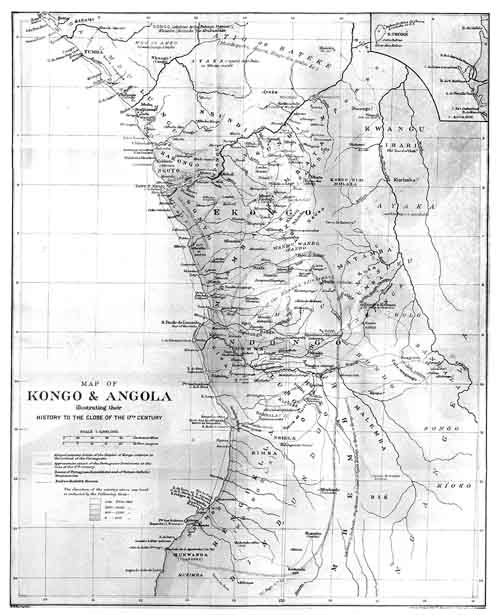
MAP OF KONGO & ANGOLA illustrating their HISTORY TO THE CLOSE OF THE 17TH CENTURY
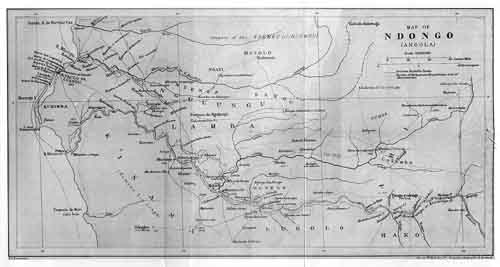
MAP OF NDONGO (ANGOLA)
FOOTNOTES:
INDEX AND GLOSSARY.
For information additional to that given in the body of this volume, consult Bramas, Margarita, Ostrich Eggs.
Included in this Index are all the geographical names mentioned by Duarte Lopes (Pigafetta’s Report of the Kingdom of Congo), as also many names referred to by Cavazzi, Paiva Manso, and others.
The approximate geographical position is given in degrees and tenths of degrees.
For names beginning with C, Ch, or Qu, see also K.
Abundu, pl. of mbundu, a slave. In Angola the natives generally are called Ambundu.
Aca mochana. See Aki musanu.
Acca, a corruption of Aki, followers.
Achelunda. See Aquilunda.
Adenda. See Ndemba.
Administration of natives, 161
Affonso VI, King of Portugal, 183
Affonso I, King of Kongo, 110, 136
Affonso II, King of Kongo, 119, 136
Affonso III, King of Kongo, 131, 137
Agag, are not Jaga, 150
Aghirimba, according to D. Lopez, the ancient name for Mbata, but called Agisymba on his map, and evidently Ptolemy’s region of that name, 112
Agoa Kaiongo (Augoy cayango), 9.8 S., 14.2 E., 37; battle of 1603, 156
Agoa rozada, King of Kongo (Pedro IV), 133, 137
Aguiar, Alvaro, 175
Aguiar, Francisco de, 175
Aguiar, Ruy d’, 113
Aiacca, See Ayaka.
Aki, followers.
Akimbolo (Aquibolo), about 9.3 S., 14.9 E., 149
Aki musanu (Acamochana), a soba, 8.9 S., 13.8 E., 172
Albinos, 48, 81
Alemquer, Pero d’, pilot, 108
Alguns documentos, quoted, 112, 139, 140
Almadias, Golfo das, undoubtedly Kabinda Bay (5.5 S.), but Battel’s B. da Almadias, 43, is identical with Black Point Bay, 4.8 S., 43
Almeida, D. Francisco, 153, 188
Almeida, D. Jeronymo, 153, 154, 188
Almeida, João Soares de, 132
Alvares, Gaspar (or Gonçales), 169
Alvaro I, King of Kongo, 119, 136
Alvaro II, King of Kongo, 121, 136
Alvaro III, King of Kongo, 122,137
Alvaro IV, King of Kongo, 124, 137
Alvaro V, King of Kongo, 124, 137
Alvaro VI, King of Kongo, 125, 137
Alvaro VII, King of Kongo, 130, 137
Alvaro VIII, King of Kongo, 131, 137
Alvaro IX, King of Kongo, 130, 133, 137
Alvaro, Frei, the assassin, 115
Alvaro Gonçales Bay, called Alvaro Martins’ Bay on map (D. Lopez); identical with Yumba Bay, 3.3 S., 10.5 E.
Ambaca. See Mbaka.
Ambasse, or Ambresa, a corruption of mbazi or mbaji. See S. Salvador.
Ambriz (Mbidiji or Mbiriji) river, 7.3 S., 12.9 E., 131, 132
Amboella. See Mbwela.
Ambrosio I, King of Kongo, 124, 137
Ambuilla. See Mbuila.
Ambuila dua. See Mbuila anduwa.
Ambandu, i.e., negroes (in Kongo abundu = slaves), 103, 112
Ambus (D. Lopez), tribe between coast and Anzica; perhaps the Balumbu. Mbu = ocean.
Ampango. See Mpangu.
Amulaza, Congo de, 6.0 S., 16.3 E.
Andala mbandos (Ndala mbandu), or Endalla nbondos, 17
Andrada, João-Juzarte, 174, 189
André mulaza, King of Kongo, 132, 137
Angazi, or Engazi (D. Lopez), Ingasia (Battell). See Ngazi.
Angeka, or Engeco (nsiku, Chimpanzee), 54
Angelo of Valenza, capuchin, 126
Angica of Knivet, are the Anzica.
Angoi. See Ngoya.
Angola, history, 139; Knivet’s account, 93
Angola. See Ngola.
Angoleme (Ngolome) of Jesuits was Ngola’s capital in 1565, 143
Anguolome aquitambo (Ngwalema a kitambu), 9. S., 15.8 E.; battle 143, 148
Angoy kayonga, a chief. See Agoa Kaiongo.
Antelopes, 40
Antonio I, King of Kongo, 129, 137
Antonio, Friar, a Franciscan, 110
Antonio, de Dénis, or Diogo de Vilhégas, 114
Antonio of Serravezza, Capuchin, 177
Antonio Laudati, of Gaeta, 148 n., 140, 146, 176, 184
Anville, B. d’, his maps, xv
Anzele (D. Lopez) (Kanzele), fort, in Lower Ngulungu, 9. S., 13.8 E., 147
Anzicana, Anzichi, Anziques, Mundiqueti, etc., the people of the Makoko (Anseke, “distant,” “remote”), are undoubtedly the Bateke about Stanley Pool. Knivet’s account, 10, 91; war with them, 112
Aquilunda, or Achelunda (D. Lopez), a supposed lake, 74; Douville (Voyage au Congo, ii, 173), suggests that the name meant “here (Aqui) is Lunda.”
Aquibolo. See Akimbolo.
Aquisyma (D. Lopez), misprint for Agisymba.
Aragão, Balth. Rebello de, xviii, 27, 153, 157, 158; attempt to cross Africa, 161; on Ouando, 206
Araujo, João, 175
Araujo e Azevedo, Antonio de, 190
Araujo e Azevedo, João, 157, 166
Argento, Monti dell (D. Lopez), supposed “Silver Mountains” (Serra da Prata) near Kambambe.
Ari, or Hary, a district, 9.0 S., 15.5 E. See Ngola Ari.
Armada, its destruction in 1588, xiv, 169
Armistice of 1609-21, 170; or 1641, 171
Augoykayango. See Agoa Kaiongo.
Austin Friars in Kongo, 114
Axila mbanza. See Shilambanza.
Ayaka (Aiacca), 7.5 S., 18.0 E., their invasion of Kongo, 120; are not identical with Jaga, 149
Bagamidri. D. Lopez calls it a river, separating Mataman and Monomotapa, but it is clearly Bege meder of Abyssinia gone astray.
Bahia das Vaccas, 12.9 S., 13.4E., 16, 29, 160
Bailundo (Mbalundu), 12.2 S., 19.7 E., 172
Bakkebakke (Mbakambaka), diminutive of Mbaka, dwarf, and according to Dennett, also the name of a fetish Shibingo which prevents growth. See Matimba.
Bamba. See Mbamba.
Bamba ampungo. See Mbamba a mpungu.
Bambala (Mbala, Mbambela), a district, 10.6 S., 14.5 E., 22
Bamba-tunga (Mbamba-tungu), soba, 9.6 S., 14.4 E., 147, 158
Bananas, 68
Bancare (D. Lopez), a tributary of the Kongo, east of Nsundi.
Bangala, the people of the Jaga, 9.5 S., 13.0 E., 84, 149
Bango aquitambo (Bangu a Kitambu), missionary station, 9.1 S., 14.9 E.
Bango-bango. See Bangu-bangu.
Bangono, mani, in hills north of Dande River, 8.5 S., 13.6 E., 12
Bangu, kingdom, “trunk” of Kongo, 24; perhaps Bangu on the river Mbengu. Bangu signifies an acclivity, and the name occurs frequently.
Bangu, a soba in Angola, 164
Bangu-bangu, soba near Nzenza a ngombe, 168
Banna (Banya), river, 3.5 S., 11.0 E., 53
Banyan-tree, 18, 76, 77
Baobab, 24, 68, 71
Baptista, João, bishop, 118
Baptista, Manuel, bishop, 118, 121, 122
Barama. See Bramas.
Barbara, Kambe, sister of Queen Nzinga, 166, 173, 176
Barbela (Berbela), river, a tributary of the Kongo, which flows through Mpangu. According to L. Magyar (Peterm. Mitt. 1857, p. 187); the south arm of the Kongo opposite Mboma, is known as Barbela.
Barkcloth, 18, 28, 77
Barros, Gonzalo Borges de, 181
Barros, João de, quoted, 108
Barreira, F. Balthasar, Jesuit, 144, 147
Barreiras, “cliffs.” Barreiras vermelhas, north of Zaire, 5.3 S.; Ponta das barreiras, 3.2 S.
Bastian, Dr. A., quoted, 51, 52, 72, 73, 78, 104, 204
Bateke, tribe are identical with the Mundequetes, Anziquetes, Anzicanas, etc., 109
Batta (Mbata), province, Mbanza, 5.8 S., 15.4 E., 39, 104, 120
Battell, Andrew, character of his narrative, x; chronology of his voyages, xiii; account of “adventures,” 1-70; notes on the religion and customs, 71-87
Batumba, in Kongoese, a dwarf. See Matimba.
Bavagul. See Bravagul (D. Lopez).
Beads, as ornaments, 9, 17, 32
Beehives, 68, 77
Beja, Feira de, 9.8 S., 15.3 E., 168
Bembe (Mbembe), according to Cavazzi, p. 13, etc., a vast district extending from the Kwanza to the Kunene (which separates it from Benguella), traversed by the river Kutato, and inhabited by the Binbundo. It included all Lubolo, and Kuengo (Kemgo), the residence of Ngola Kakanje (according to Cadornega, a chief of Hako) was its capital. I believe it to be the same as Chimbebe (q.v.), 166
Bembem (Mbembe), a village between Luandu and R. Mbengu, 8.8 S., 13.4 E.
Benevides. See Sá de Benevides.
Bengledi (D. Lopez), a river, almost certainly a misprint for Benguella.
Bengo, district of Angola, at mouth of R. Mbengu, or Nzenza, 8.7 S., 13.3 E.
Bengo, river (Mbengu), 39, 155, 168
Benguella (Mbangela), Battell’s visit, 16; conquest, 159; events since 1617, 182
Benguella a velha, 10.8 S., 13.8 E., 147
Benomotapa. See Mwana mtapa.
Bentley, Rev. W. H., quoted, xx, 7, 25, 33, 34, 42, 43, 45, 57, 59, 60, 66, 73, 95, 104, 111
Berbela, or Verbela (D. Lopez), is evidently identical with the Barbela river, q.v.
Bermudez, João, Abysinian missionary, 150
Bernardo I, King of Kongo, 119, 136
Bernardo II, King of Kongo, 122, 137
Bié (Bihe), 12.3 S., 16.8 E., 151, 152
Binbundo, or Va-nano, the hill tribes of Benguella, 13.0 S., 15.5 E., 151
Binger, Captain, xvii
Binguelle (Cavazzi, ii), a misprint for Benguella.
Bock (Mbuku), mani, 4.9 S., 12.3 E. There are many other Mbukus.
Boehr, Dr. M., quoted, 34, 73
Boenza, or Benza (Mbensa), about 4.6 S., 15.0 E.
Boma (Mboma) 5.8 S., 13.1 E.
Bonaventura, of Alessano, Capuchin, 126
Bonaventura, of Correglia, Capuchin, 126 n.
Bonaventura Sardo (the Sardinian), Capuchin, 127
Bonaventura, of Sorrento, a Capuchin, 128
Bondo, province, or rather a tribe, 10.0 S., 17.0 E.
Bongo, 32, the country of the Babongo dwarfs
Bongo soba, on site of Kakonda a velha, 182
Boreras rosas (D. Lopez), should be Barreiras vermelhas, 5.4 S., 12.2 E.
Borgia, D. Gaspar, 167
Bosso, a rock, perhaps Mpozo hills, opposite Vivi.
Bowdich, T. E., quoted, 149
Bozanga, kingdom in Kongo (Garcia Mendes, 8), identical either with Nsanga or Nsongo? (q.v.).
Bramas, 677 n. According to D. Lopez, the original inhabitants of all Luangu. According to A. Forét (Compte rendu of Paris Geog. Soc., 1894, p. 431), a trading tribe called Barama, or Ivarrama, still lives to N. E. of Nyange, 2.7 S., 10.5 E. See note, p. 77
Braun, Samuel, quoted, x, 122, 170
Bravaghul, or Bavagul (D. Lopez), a river; rises in Mountains of Moon, and flows to Magnice, i.e., to Delagoa Bay.
Brito, Domingos d’Abreu de, quoted, 121, 144, 145, 147, 153
Brito, João Antonio de, 179
Brito, Manuel Rebello de, 129
Broeck, Pieter van der, his journals, x
Brusciotto, P. Giacinto, of Vetralla, a Capuchin, 128
Bruto, Antonio, 168; his death, 172
Bruto, a “penedo” named after him, 9.1 S., 13.7 E., 146
Bula. See Mbula.
Bulhão, Fernão Rodrigues, 115
Bumbe (Mbumbi), mani S. of River Loje, 7.8 S., 13.6 E., 123
Bumbelungu (Mbumbu a lungu), a village near mouth of Kwanza, where Dias’ vessels awaited his return, 9.3 S., 13.2 E.
Bumba andalla, (Mbumbu a ndala), a soba in Lamba, 159
Bunda means family, kin: hence Binbundo (sing. Kibundo), kinsfolk (Nogueira, A raça negra, 255). See also Abundu.
Burial, 34, 73
Burton, Sir R. F., 24, 29, 54, 68
Cabech, (Kabeka), soba on the Kwanza, 9.5 S., 14.1 E., 10, 11
Cabango (Kabangu, or Chibanga), mani, in Luangu, 50
Cabazo, should be Kabasa, capital.
Cabenda (Kabinda), port, 5.5 S., 12.2 E., 42
Cabreira, Antonio Araujo, 129
Cachoeira (D. Lopez), is the Portuguese for cataract, and refers to the Falls of the lower Zaire.
Cacinga (Kasinga), river, a tributary of the Barbela, in Mbata (D. Lopez).
Cacongo river, or Chiluangu, 5.1 S., 12.1 E., 42
Cacongo, (Chikongo), aromatic wood, 16
Caçuto (Nsaku), Cão’s hostage, 106, 107, 108
Cadornega, quoted, 38, 72, 131, 140, 142, 163
Cafuche. See Kafuche.
Calabes Island (Ilha des Calabaças), 8. See Cavalli.
Calando (Kalandu), a Jaga, 31, should be Calandula. Cavazzi, however, (p. 656) mentions a Jaga Calenda.
Calicansamba (Katikasamba, or Kachisamba), a chief, 10.7 S., 14.5 E., 22, 24, 25
Calango (Kalungu), town in Lubolu, 10.30 S., 14.5 E., 26
Calongo (Chilunga), district north of river Kuilu, 4.1 S., 11.4 E., 52
Camara, Portuguese, a municipal council.
Camissa, flows out of Lake Gale (q.v.), and enters the sea as Rio doce at the Cape of Good Hope (D. Lopez).
Cango (Nkanga, Chinkanga), a district of Luengu, 3.9 S, 12.3 E., 52
Cannibalism, 31, 144, 162
Cão, Diogo, discovery of Kongo, 105; second voyage, 107
Cão, Gaspar, Bishop of S. Thomé, 118, 121, 145
Caoalla (Kawala), between Luandu and Masanganu; fight 1648, 174
Capello and Ivens, quoted, 17, 27, 28, 32, 34, 67, 73, 140, 141, 151
Capuchins in Kongo, 123, 126, 127, 128, 183; in Angola, 183
Cardoso, Bento de Banha, 158, 166, 188
Cardoso, João, 175
Cardoso, Domingos, Jesuit, 127
Carli, Dionigi, Capuchin, 132
Carmelites in Angola, 189
Carneiro, J. V., quoted, 14, 141, 167, 206
Carrasco, José, 176
Carvalho, H. B. de, quoted, 20, 32, 72, 84, 103, 150, 151, 202
Casama of Battell, 27, is Kisama.
Casanza (Kasanza), a chief, 8.9 S., 13.7 E., 11, 40, 41
Cashil (Kati, Kachi, or Kasila), chief, 10.8 S., 14.3 E., 23-25
Cashindcabar (Kashinda kabare), mountains, 10.6 S., 14.6 E., 26
Castellobranco. See Mendes.
Castello d’Alter pedroso, cliff, 13.3 S., 12.7 E., 106
Castro, Balthasar de, 116, 139, 152
Catalogo, quoted, xx, 145, 147, 159, 163, 166, 169, 172, 178, 181
Catharina, Cabo de S., 1.8 S., 9.3 E.
Catherine, Queen of England, 185
Catherine, Queen of Portugal, 119
Cauo, Cavao of Cadornega, 9. S., 14.2 E., 37
Cavalli, isola (D. Lopez). See Hippopotamus Island.
Cavangongo, Motemo, 8.4 S., 13.4 E.; a second Cavangongo, 8.2 S., 15.3 E.
Cavazzi, quoted, xix, 15, 29, 32, 38, 110, 111, 119, 123, 124, 126, 130, 140, 141, 148, 152, 153, 163, 165, 166, 167, 176, 179, 184, 193
Cavendish, Thomas, his voyage, 89
Cay, or Caye (Kaia), river and town, 4.8 S., 12.0 E., 42, 50
Cedars, 24
Chabonda (D. Lopez). See Kabanda.
Chatelein, Héli, quoted, 140
Chekoke, a fetish, 82
Chichorro. See Souza Chichorro.
Chiluangu, 5.2 S., 12.1 E., 42
Chilunga (Calongo), 4.1 S., 11.4 E., 52
Chimbebe. See Kimbebe.
Chimpanzee, 54
Chinchengo (Ki-nkenge) in Mbamba, on border of Angola (D. Lopez), 8.0 E., 15.0 E.
Church, Col. G. Earl, on Knivet’s adventures, 90
Circumcision, 57
Civet Cats, 32, 111
Climbebe (D. Lopez), a misprint for Qui mbebe.
Coandres, perhaps the Mukwanda, a tribe to S. of Benguella, 13.5 S., 13.0 E.
Coanga (Cavazzi, 440), a territory near Masanganu.
Coango. See Kwangu.
Coanza. See Kwanza.
Coari river (D. Lopez), perhaps Kùari, a river flowing towards Ari.
Coat-of-arms of Kongo, 112
Cocke, Abraham, his voyages, 1, 5; his identity, 6, 8, 9
Coelho, F. A., quoted, 10
Coelho, Pedro de Souza, 163, 168, 189
Coelho, F. Antonio, 167
Colos, Diogo Rodrigo das, 147
Combrecaianga (Kumba ria kaianga), village, about 8.9 S., 14.1 E., 14
Concobella (Konko a bele), on N. bank of the Zaire, below Stanley Pool.
Congere amulaza (Kongo dia mulaza), 6.0 S., 16.3 E.
Congre a molal (Kongo dia mulai?) name by which the Anzichi (Anzica), are known in Luangu (D. Lopez).
Consa, a misprint for Coanza (Kwanza).
Copper mines, 17, 18, 31, 43, 111, 115, 119, 123, 160
Copper coins, introduction of, 185
Cordeiro, Luciano, quoted, xvi, 37, 155
Corimba. See Kurimba.
Corn, native, 67
Cortes, Manuel, 178
Costa, André da, 172
Coste, Sebastien da, 122
Costa de Alcaçova Carneiro de Menezes, Gonçalo da, 190
Coua (Kuvu) river, 10.9 S., 13.9 E., 19, 20, 161
Coutinho, D. Francisco Innocencia de Souza, 187
Coutinho, João Rodrigues, 36, 156, 188
Coutinho, D. Manuel Pereira, 189
Cowrie fishery at Luandu, 96
Crocodiles, 11, 69, 75
Cross, Cape, 21.8 S., 107
Crystal mountain (D. Lopez) in Nsundi.
Cuigij (Cavazzi), perhaps = Muija or Muguije, “river,” 9.7 S., 16.0 E.
Cunha, Jacome da, companion of Dias, 147
Cunha, Tristão da, 189
Cunha, Vasconcellos da. See Vasconcellos.
Dambe (Ndambe), a territory near Mbuila, 7.8 S., 19.6 E., 181
Dande (Dandi), river, 8.5 S., 13.3 E., 11, 39, 117, 120, 123, 128, 144
Dangi (Ndangi), island in Kwanza, 9.8 S., 15.9 E. (?), 165, 166, 167
Daniel de Guzman, King of Kongo, 131, 137
Dapper, quoted, xix, 9, 19, 32, 45, 48, 105, 125, 168
Degrandpré, quoted, 72, 104
Demba (Ndemba), salt-mine, 9.9 S., 13.8 E., 36, 37, 154, 162
Dembo. See Ndembu.
Dennett, R. E., quoted, xvii, 17, 21, 31, 40, 44-51, 56, 60, 61, 66, 79, 80, 104, 192
Dias de Novaes, Bartholomeu, 107, 108
Dias de Novaes, Paulo, 120, 121, 142, 144, 148, 180
Dias, Jacome, priest, 118
Dickens, Charles, quoted, 25
Diniz, Antonio, quoted, 162
Diogo, King of Kongo, 117, 136
Diogo de Vilhégas, or Antonio de Dénis, Franciscan friar, 114
Divination, 33, 86, 129, 176
Dogs, 33, 86
Dolphins, 4
Dombe (Ndombe), in Benguella, 13.8 S., 13.3 E., 17, 160
Dominicans, 108, 114, 144
Dondo (Ndundu) of Battell, are Albinos, 48, 81
Dondo (Ndondo), feira, 9.7 S., 14.5 E., 168
Dongo, 20, 26, is Pungu a ndongo.
Dongy (Ndongazi?), a Jaga (Cavazzi, 86, 200), 152
Douville, quoted, 149, 192
Drinking customs, 32, 45
Drums, 33, 34
Duarte, V. J., quoted, 143, 205
Du Chaillu, quoted, 52, 54
Dumbe a Pepo, 8.63 S., 15.1 E.
Dumbe a Zocche (D. Lopez), a lake fed by streams rising in the Monti nevosi; most likely the Dembea lake of Abyssinia.
Dunda, or Dondo (Ndundu) are Albinos, 48, 81
Duque, João, 175
Dutch, embassy to Kongo, 125; traders in Kongo, 121, 123, 131, 161, 170; occupation of Angola, 169-174; piracies, 170
Ecclesiastical state of Angola, 183
Egyptians, or gypsies, 10 n.
Elambe. See Lamba.
Electric Fish, 40
Elembe, a Jaga, 185
Elephants, how trapped, 97; value of tails, 9, 58
Eleusine, 67
Elizabeth, Queen, 38
Embacca. See Mbaka.
Embo, or Huembo, a marquisate of Kongo (Paiva Manso, 175). See Wembo.
Emcus of Zucchelli = Nkusu.
Empacaceiros, from Pakasa, buffalo, originally buffalo-hunters, then native militia-men. Supposed secret society, 152, 185.
Encoge, should be Nkoshi, lion.
Endalla nbondo, or Andala mbundos, 17
Engase, or Angaze (D. Lopez), is Battell’s Ingasia See Ngazi.
Engeriay, a tree, 15
English pirates, 175
Engombe, or Ingombe. See Ngombe.
Engombia. See Ngombe.
Engoy (Ngoyo), 42, 104
Engracia Funji, sister of Queen Nzinga, a prisoner, 166; strangled, 173
Enriques, Duarte Dias, 162
Ensala. See Nsala.
Esiquilo (Esikilu), birthplace of D. Alvaro I., on the road from S. Salvador to Nsundi (Cavazzi, 105), 5.5 S., 14.5 E.(?)
Escovar, Pero d’, pilot, 108
Espiritu Santo, Serra do, 2.8 S., 10.2 E.
Eucher, F., quoted, 108, 111, 119, 127
Ezikongos, the people of Kongo, 130
Fajardo, A. Beserra, quoted, 158
Falcão, Luiz de Figueirido, quoted, 162
Falkenstein, quoted, 26, 52, 77, 104
Famine in Luandu, 168
Faria, Antonio de, 182
Feira (Portuguese), fair, market.
Ferreira, F. de Salles, quoted, 203
Ferreira, Jacome, 170 n.
Ferro, serra do (iron mountains) to S. of Kwanza, 10.6 S., 15.2 E.
Fetishes, 24, 41; underground, 49, 81; Maramba fetish, 56, 82; possessed of a fetish, 182; destruction by missionaries, 114
Ficalho, quoted, 7, 15, 16, 21, 24, 43, 67
Figueirido e Souza, João de, 180, 181
Finda. See Mfinda.
Fishing, 166
Flemish immigrants in Angola, 147
Flores, Fr. Antonio, quoted, 198
Fonseca, Luis Simplicio, quoted, 155
Fonseca, Pedro da, 144, 145
Forét, A., quoted, 193
Forjaz, D. Manuel Pereira, 157, 161, 188
Foster, Mr. W., xvii
Fragio, Francisco, capuchin, 126
Franciscans in Angola, 108, 114, 183
Francisco, King of Kongo, 117, 136
Francisco of Pavia, capuchin, 133
Francisco of Veas, 126 n.
Freddi, monti. See Fria.
French pirates, 175
Fria, serra (“Cold Mountains”), on Pigafetta’s map, in 17.5 S.; the Monti Freddi (“cold mountains”) of the text, stated to be known to the Portuguese as Monti nivosi (“snowy mountains”). Modern maps show a Serra da neve in 14.0 S.; but as I am not aware that snow ever fell in these mountains, neve may be an ancient misprint for nevoas (mists). The Serra Fria may possibly be connected with the Cabo Frio, thus named because of the cold current which washes it.
Froes, Manuel de Tovar, 182
Fumacongo, (mfumu ekongo), a village (Cavazzi, 416).
Funerals, 78
Funji. See Engracia.
Furtado, Tristão de Mendonça, 170
Gaga, 13, are the Jaga.
Gale, according to Pigafetta a lake giving rise to the river Camissa, rashly supposed to represent Lake Ngami, but copied from more ancient maps, upon which are to be read the names Gale (Galla), Adia, Vaby (Webi), etc. Hence a lake in the Galla country, south of Abyssinia.
Galla, are not Jaga, 150
Gangella. See Ngangela.
Gango, river, 9.8 S., 75.5 E., 180
Gangue (Gange), village near Masanganu, with church S. Antonio.
Garcia I., King of Kongo, 124, 137
Garcia II., King of Kongo, 125, 137
Garcia III., King of Kongo, 131, 137
Geographical explorers. See Aragão, Brito, Castro, Girolamo, of Montesarchio, Herder, Murça, Pacheco, Quadra and Roza: also pp. 119, 129
Germanus, Henricus Martellus, his map, 107
Giaghi, an Italian mode of spelling Jagas.
Giannuario of Nola, capuchin, 127
Gimbo Amburi. See Njimbu a mbuji.
Gimdarlach, a German miner, 115
Gindes (Njinda), a name by which the Jaga are known, 19, 150
Giovanni Francisco of Valença, a capuchin, 126
Gipsies in Angola, 2, 10
Giribuma, or Giringbomba, inland tribe. Perhaps the Buma, 3.0 S., 16.5 E.
Girolamo of Montesarchio, a capuchin, 125, 126
Glo-Amb Coambu, supposed name of the capital of Angola, 142 n. Rev. Tho. Lewis suggests Kwambu, or Kiambu.
Goats, 63
Goes, Damian de, quoted, 112, 113, 116
Goes, João Braz de, 182
Goiva, D. Antonio de, bishop, 122
Gola. See Ngola.
Gold, 20, 198, 131
Golungo. See Ngulungu.
Gomba. See Ngombe
Gomez, Luiz, 123
Gonçalves. See Alvares, 169
Gonga caanga (Ngonga kaanga), chief of Nsela, 180
Gongha (Ngonga), original name of Kasanje Kakinguri (Cavazzi, 773).
Gongo a mboa (Ngongo a mbwa), supposed old name of Pungu-a-Ndongo, 143 n.
Gongo (Ngongo), a double bell, 20
Gongon, 38, on road from S. Salvador to Mbata. Perhaps Gongo (Ngongo), on the Kongo railway, 5.3 S., 14.8 E. Rev. Tho. Lewis suggests Kongo dia Mbata, 38
Gonsa, or Gunza, river, of Battell, 26, is the Kwanza.
Gorilla, 54, 57.
Gouvea, Francisco de, 120, 143
Gouvea, Antonio Gomez de, 173
Ground-nuts, 67
Guerra preta, “black warriors,” i.e., the native militia.
Guerreira, a Jesuit, 150, 154, 159
Gulta, Ngulta, (D. Lopez), town S. W. of Masanganu.
Gumbiri, fetish. See Ngumbiri.
Gunga bamba (Ngunga mbamba), chief in Lubulo, 180
Gunza, (Ngunza), on Pigafetta’s map a town S. of the river Longa, is undoubtedly Kangunze of Nsela.
Gunza a gombe, (Ngunza a ngombe), a soba in Ndongo, 164
Güssfeld, quoted, 58, 104
Guzambamba (Ngunza a mbamba), soba in Hako, 10.3 S., 15.3 E., 180
Hako (Oacca), country, 10.4 S., 15.5 E., 166, 180
Hamba (Va-umba, or Umba) river, 8.0 S., 17.0 E., 141
Hambo. See Huambo.
Hary, a district. See Ari.
Henrique, the Cardinal-King of Portugal, 111, 114, 145
Henrique, King of Kongo, 119, 136
Henriques, Rodrigo de Miranda, 189
Herder, Johan, 126
Hiambo. See Huambo.
Hindersen, Jeems, 171
Hippopotami, 64
Hippopotamus Island, 120, the Ilha dos cavalhos marinhos of the Portuguese, wrongly translated Isola Cavalli, or “Horse Island,” by Pigafetta. Perhaps identical with Battell’s Calabes Island. A “Hippopotamus Island” figures in the charts, 12.9 E.
Hobley, quoted, 202, 206
Holy Ghost, a village, on Luandu Island, 94 (called Espiritu Santo by D. Lopez), 8.8 S., 13.2 E.
Hombia ngymbe (Hombia ngombe, equivalent to Wembo a ngombe in the S. Salvador dialect), a “prince” in Benguella, on the river Kuvu, 21
Horse Island (D. Lopez). See Hippopotamus Island.
Horses’ (zebras’) tails, 75
Huambo (Hambo, Hiambo), district or soba in Benguella, 13.1 S., 15.6 E.; gold found there, 29
Huembo, a province of Kongo (Paiva Manso, 50), perhaps Wembo.
Human sacrifices, 28, 33, 85, 86, 105
Iakonda, a tributary of the Kwanza (Cavazzi), probably to be looked for in the Kondo cataract, 9.9 S., 16.1 E.
Ibari (Ybari), a kingdom whither the Portuguese traded (Garcia Mendes, 8). Rev. Tho. Lewis suggests that it refers to a place where mbadi cloth is made (the letters r and d being interchangeable, and m coming naturally before b). Sir H. Stanley (Through the Dark Continent, ii, 283, 320, 323) heard Kongo called Ibari, and subsequently was told of an Ibari Nkubu, or river of Nkutu. A. Sims (Kiteke Vocabulary) knows of a tribe Bakutu towards the Kasai. We believe the Ybari of G. Mendes to refer to the country about the Kwangu, whither Portuguese traders actually did go for cloth.
Icau (Ikau), 8.5 S., 13.9 E., 123
Icolo (Ikolo), district on lower Mbengu, 8.8 S., 13.6 E.
Ilha grande, Brazil, 4
Ilamba (Lamba), Battell’s campaign in it, 13
Imbangola, identical with Bangala, 84 n.
Imbondos of Battell, 30 are the Mbundu of Angola.
Imbuella. See Mbuila.
Imbuilla, recta, Mbila, sepulture.
Incorimba. See Kurimba.
Incussu. See Nkusu.
Infanticide, 32, 84
Ingasia, 14, 155. See Ngazi.
Ingombe. See Ngombe.
Initiation of native priests, 56, 57, 82
Innocent X, Pope, 127
Insandeira (Nzanda), the tree planted by Ngola Kiluanji on Kwanza, 9.1 S., 13.4 E., 142
Insandie. See Nsande.
Iron, 52
Ivory, 7, 9, 42, 52, 58
Jagas, Battell’s account, 19, 83; origin, 83; infanticide among them, 32, 89; allies of the Portuguese, 123; history of the Jaga of Kasangi, 149; their invasion of Kongo in 1558, 117
Jesuits, in Angola, 143; in Kongo, 118; Jesuit college, 123; political intrigues, 153, 183; a legacy, 169
Jinga. See Nzinge.
João II, of Portugal, 106, 108
João IV, of Portugal, 127, 170
João I, King of Kongo, 109, 136
João II, King of Kongo, 136
João of Mbula, King of Kongo, 130, 131, 137
João, Manuel, 146
João de S. Maria, Franciscan, 109
João Maria, capuchin, 133
John. See João.
John Moritz of Nassau. See Nassau.
Jol, Cornelis Cornelisson, 171
José, Duarte, 147, 150
José, Vicente, 148
Kabanda, district in Motolo, on road to Mpemba mines (Garcia Mendes, 11, 12); the Chabonda of D. Lopez, 8.7 S., 146 E., 124, 181
Kabangu, (Cabengo), mani in Luangu, 50
Kabasa, capital, chief town, group of villages, 141 n.
Kabasa, Kakulu, 9.3 S., 14.9 E., 159; another chief Kakulu Kabasa, in 8.3 S., 15.3 E., in Banga mountains (map of Fr. Antonio Flores, 1867).
Kabeka (Cabech), soba on the Kwanza, 9.5 S., 14.1 E., 10, 11
Kabeza (Cabezzo) district, 10.2 S., 15.0 E., 180
Kabinda, seaport, 5.5 S., 12.2 E., 42
Kabuku (kia mbula), soba, 9.5 S., 15.0 E.
Kafuche (Kafuche Kabara), 10.0 S., 14.4 E., 27, 37, 156, 168
Kahenda, Kakulu, 8.9 S., 15 5 E., 159, 177
Kakonda a velha, 13.2 S., 14.0 E., 161, 182
Kakonda, 13.7 S., 15.1 E., 182
Kakongo, kingdom, N. of Zaire, 104, 112
Kakongo, (Kikongo), an aromatic wood, 16 n., 145
Kakulu, the first-born of twins, a title in Angola. See Kimone.
Kakulu kia Nkangu (Caculo quenacango), a soba in whose territory Kanzele was built (Garcia Mendes), 9.1 S., 13.8.
Kalandu, ancestor of Queen Nzinga, 166
Kalandula, name or title among the Jaga, 28, 33, 83, 86, 132
Kale, Jesuit farm in Kisama, 9.1 S., 13.4 E.
Kalemba. See Namba Calemba.
Kalumbu, presidio, on Kwanza, 9.1 S., 13.5 E., 146; Jaga in Little Ngangele, 175
Kalungu, soba at mouth of Koporolo, 12.9 S., 13.0 E., 160
Kalungu (Calongo), Jaga, near Kasanji, 9.8 S., 18.1 E., 151, 152, 175
Kalungu (Calango), 10.3 S., 14.6 E., 26
Kambambe, presidio, 9.7 S., 14.6 E., 17, 27, 36, 38, 147, 156, 158
Kambe. See Barbara.
Kambo, river in Matamba, enters the Kwangu, 7.6 S., 17.3 E.
Kambulu, a royal title in Matamba, 141
Kamolemba, village on road from Masanganu to Mbuila; perhaps Lembo, q.v.
Kamuegi, perhaps the Fumeji river of Capello and Ivens, 9.5 S., 15.5 E., 151
Kamundai, village of Bangala (Neves); perhaps named from “mundai,” a tree which is supposed to protect against lightning.
Kangunze, capital of Nsela, 11.2 S., 15.0 E., 180
Kanguri, or Kinguri, Jaga, 152
Kanguana, See Kinguana.
Kanzele (Anzela), stockade, 9.0 S., 13.8 E., 147
Kasa, Jaga, one of Queen Nzinga’s relations, 164, 166
Kasandama, battery at S. Paulo de Loanda, 8.7 S., 13.2 E.
Kasanji, Jagas, 151, 152, 166, 167, 175 n. Residence of the principal among them, about 9.6 S., 18.0 E.
Kasanji ka kínjuri, Jaga, 177
Kasanza (Cazzanza), mani, 8.9 S., 13.7 E., 11, 40, 41
Kasinga, river, tributary of the Barbela (D. Lopez).
Kasoko, Kilombo of Kasanji ka Kinjuri, 9.7 S., 18.0 E.
Kaswea, mani, 8.8 S., 13.6 E., 40
Katala, soba in Kisama, 9.6 E., 14.1 S., 180
Katole, three days from Mbanza or Matamba, 177. A village, Katala ka nzinga, on the river Kambo, 8.8 S., 16.6 E., was visited by Mechow (Zeitsch. f. Erdk., 1882).
Kawala (Caoalla), is Kisama, 74
Kayá, 4.8 S., 12.0 E.; 42, 50
Kazanga, island, 8.9 S., 13.0 E.
Kenga (Kinga), the port of Luangu, 4.6 S., 118 E., 48, 50
Kesock, mani, 2.8 S., 11.0 E., 58
Kibangu, temporary capital of Kongo, perhaps identical with an old “priests’” town (Kinganga), 6.9 S., 14.6 E., 131
Kífangondo, village on lower Mbengu, 8.6 S., 13.3 E.
Kíjila (Quixille), the laws or customs of the Jaga, 152
Kikombo, bay, 11.3 S., 13.9 E.
Kilolo, a warrior.
Kilombo, “dwelling-place.” Cavazzi, p. 893, applies it to the residence of the Jaga.
Kilomba kia tubia, chief in upper Ngulungu, 159
Kilonga, a soba, 158. A Kilonga kia Bango still live close to Kambambe, 9.6 S., 14.5 E.
Kiluanji kia Kanga (Quiloange Acango), soba of upper Ngulungu, 179
Kiluanji kia Kwangu, according to Garcia Mendes, the chief whom Dias defeated, 143. See Kwangu.
Kiluanji kia Samba, title of kings of Ndongo. A small chief of that title still resides near Duque de Bragança, 141 n.
Kimbadi (Quimbazi), a small piece of cloth.
Kimbaka, fort, stockade.
Kimbebe. See Quimbebe.
Kimbundu. See Binbundo.
Kimone kia Sanga, principal chief of Kisama, 180
Kina grande, the “great sepulture,” 9.5 S., 17.7 E. (?), 166
Kinalunga, or Kindonge (Quihindonga), islands in Kwanza river, 9.7 S., 15.8 E., 166, 177
Kinda, Jaga, 148 n., 166
Kindonga. See Kinalunga.
Kinganga, “priests’ town,” applied to old stations of the Roman Catholic missionaries.
Kinga (Kenga), port of Luengu, 4.6 S., 11.8 E., 48, 50
Kingengo (Chingengo or Quinguego). See Mutemu.
Kinguri (Kanguri), a Jaga, 151, 152
Kinzambe, ndembu at Koporolo mouth (Dapper), 12.9 S., 12.9 E.
Kioko, tribe, 12.0 S., 18.0 E., 151
Kiowa (Quiôa) duchy in Sonyo, 6.1 S., 13.0 E., 125
Kipaka, a kraal, entrenchment.
Kipupa, soba, 10.2 S., 18.7 E., 166
Kisala, a steep mountain in Lit. Ngangela (Cavazzi, 771), 9.8 S., 17.9 E.
Kisama, country S. of Kwanza, 9.3 S., 13.5 E., 27, 74, 146, 180. Another Kisama (Chizzema, Quesama on Pigafetta’s map) is said by D. Lopez to lie E. of Mpemba and Mbamba.
Kisamu (Quisomo), village with chapel two leagues above Masanganu.
Kisembo, 7.7 S., 13.1 E.
Kisembula (Kuzambulo), a soothsayer, 87
Kisengula, a war hatchet, 34, 81
Kisengengele (Quicequelle), soba in Masanganu district with church of S. Anna.
Kisutu (Quixoto) village with church (N.S. do Desterro), in Masanganu district.
Kitaka, island in the Kwanza, 9.8 S., 15.7 E., 166
Kitangombe, “cattle dealer,” soba in Kisama, 146
Kitata, soba near Kakonda, 13.4 S., 15.1 E., 182
Kizua, a soba in Kisama, 9.5 S., 14.1 E., 146
Knivet, Anthony, his credibility, x, travels, 6, 89-101
Kole (Cola, Icole), tributary of Lukala, 9.1 S., 16.1 E.
Kongo, kingdom, history, 102-135; list of kings, 136; Battell’s visit to Kongo, 38; Kongo, river, 7; Knivet’s visits, 89, 94
Kongo dia Mulaza, 6.0 S., 16.0 E.
Konko a bele (Concobella), town. The confused account given of Girolamo of Montesarchio’s visit to that town, merely enables us to locate it on the northern bank of the Zaire. The place was likewise visited by Luca of Caltanisetta (Zucchelli, xviii, 3).
Konzo, one of the four days of the week, and hence applied to places where a market is held on that day.
Koporolo, river, 12.9 S., 12.9 E., 160
Kuari. See Coary.
Kuilu (Quelle), river, 4.5 S., 11.7 E., 52
Kulachimba, a warrior, 152
Kulachinga, a woman, 151, 152
Kulambo, a Jaga, 152
Kumbu ria Kaianga. See Combre.
Kumba ria Kina, 9.8 S., 14.7 E.
Kundi. See Nkundi.
Kurimba, or Kwimba? (Corimba, Incorimba), a district on the Kwangu, 6.0 S., 17.0 E., 102; another Kwimba, 6.1 S., 14.8 E.
Kurimba, bar of, 8.9 S., 13.1 E., 144
Kuvu (Covo), river, 10.9 S., 13.9 E., 19, 20, 161
Kwangu, river, formerly looked upon as the principal source stream of the Zaire (Zari anene, the “big river”). It joins the Kasai 3.2 S., 17.3 E.
Kwangu (Ocango, Coango), kingdom, after which the river is named, 4.5 S., 17.0 E., 102
Kwangu, a minor district (Coanga) near Masanganu (Cavazzi, 440), 124. See Kiluanji kia Kwangu.
Kwanza (Coanza), the “river of Ngola,” 9.3 S., 13.2 E., 7, 10, 92, 106, 146, 149, 173
Lacerda, Carlos de, 182
Lacerda, Dr. J. M. de, 29, 69
Laço, Lopo Soares, 168, 169, 170
Laguos, Estevaõ de, 119
Lake, reported in Central Africa, 159
Lamba (Ilamba), district, 9.3 S., 14.3 E., 13, 146, 149
Longere, a chief in Kisama, 9.9 S., 14.4 E., 27
Lead, discovered, 115
Ledo, cabo, 9.8 S., 13.3 E.
Lefumi, river. See Lufune.
Leigh in Essex, xi
Leitão, Manuel de Magalhães, 180
Lelunda, river (D. Lopez), enters the sea 6.9 S., 12.8 E.
Lemba. See Malemba.
Lemba, name of several villages or chiefs in Kongo (Kongo di Lemba, 6.2 S., 14.2 E.; Lemba, on coast, 8.3 S.; Lemba Mbamba, 7.5 S., 17.1 E.)
Lembo, village near Masanganu, 9.5 S., 14.4 E., 181
Lencastre, D. João de, 185, 190
Lendi, province of Kongo. A village Lendi, S.S.E. of S. Salvador, in 6.6 S., 14.5 E.
Lewis, Rev. Tho, quoted, xvii, 104, 197, 198, 210
Libations, 58, 73
Libolo. See Lubolo.
Light-horse man, 2, 3, 5
Lima, Lopez de, quoted, xx, 74, 117, 119, 140, 142, 143, 145, 146, 154, 163, 168, 169, 177, 178, 184, 187
Limoeiro, a prison at Lisbon, 169
Linschoten, quoted, x, 94
Livingstone, quoted, 164
Loanda. See Luandu.
Loango. See Luangu.
Lobo, Cabo do, with Cão’s pillar, now C. St. Maria, 13.4 S., 106
Logwood, 43, 53
Loje, river, 7.8 S., 13.2 E., 28
Longa, river, 10.3 S., 13.6 E., 26
Longeri (Loangele, or Luanjili), the royal tombs of Luangu, 4.6 S., 11.9 E., 51, 86
Longo Leuys, river. See Luiza Luangu.
Lopez, Alvaro, 112
Lopez, Duarte, quoted, x, xix, 8, 9, 26, 47, 64, 68, 75, 97, 110, 111, 117, 119, 121, 122
Lopo Gonçalves, Cape, 0.6 S., 3
Loze, river. See Loje.
Luandu (Loanda), 8.7 S., 13.2 E., 115, 116, 121, 123, 140, 146; Dutch occupation, 171-4; fortifications, 185
Luangu (Loango) kingdom, 4.6 S., 11.8 E., 9, 43, 44, 49, 50, 86, 104; Battell in Luangu, 9
Luanjili. See Longeri.
Lubolo (Libolo), district, formerly of much wider extent, 10.0 S., 15.0 E., 151, 172, 180
Luca of Caltanisetta, visited Concobella (Zucchelli, xvii, 3)
Luchilu (Luxilu), river W. of Pungu a ndongo, 9.7 S., 15.5 E., 178
Ludolfus, his proposed map of Africa, xv
Lueji, princess of Lunda, 151
Lufune (Lefumi), river, entering sea in 8.3 S.
Lui, river, enters Kwangu in 8.3 S., 17.6 E., is the Luinene (“big Lui”), called Lunino by Cavazzi.
Luiza Luangu, river (Lovanga Luise, Longo Luys), the Masabi, 5.0 S., 12.0 E.
Lukala, river, tributary of Kwanza, 9.6 S., 14.2 E., 146, 166
Lukamba, district and feira, 9.4 S., 15.5 E., 151, 168
Lukanza, camp, W. of Ngwalema, 149
Lula, province of Kongo (Paiva Manso, 244); the mbanza, 5.3 S., 15.7 E.
Lumbo, or upper Ngulungu.
Lumbu. See Panzalunbu.
Lusum, river, crossed on road from Mpinda to S. Salvador. Perhaps the Luzu, a tributary of the Mpozo, 6.2 S., 14.0 E.
Lutatu, river of Bembe (Cavazzi, 13), probably misprint for Cutato.
Luxilu. See Luchilu.
Mabumbula (Mbumbula), mwana of Mpangala, 6.1 S., 14.6 E., 103
Machimba, 37, is probably identical with Muchima village.
Madureira, Gaspar Borges de, 173
Magalhães, Henrique Jaques, 190
Magyar, Ladislas, quoted, 22, 26, 29, 152, 192
Maia, Baptista de, 181
Maize, 67
Majinga, Mwixi, a “man of Majinga,” a term of contempt for “Bushman” (Bentley, Dictionary, 364).
Makaria kia matamba, village, 167
Makella colonge, chief, 9.8 S., 15.4 E., 26
Makoko, title of the King of the Bateke (Anzicana), perhaps more correctly given as Nkaka, a title of respect, lit. “grandfather,” 52, 124 n., 127, 132
Makota (plur. rikota), counsellor of a chief.
Makunde (Makumbe), 9.6 S., 14.2 E., 146
Makuta, perhaps 6.3 S., 13.0 E.; surrendered to Sonyo, 125. There are other localities of the same name.
Malemba (Lemba), a kingdom, 11.4 S., 17.0 E., 166
Malomba (D. Lopez), seems to be a misprint for Malumba.
Malombe, a “great lord” in Kisama, 9.8 S., 14.2 E., 37
Mamboma, an official in Luangu, 59 n.
Mambumba (D. Lopez), between river Loje and Onzo, the same as Mani Mbumbi.
Manuel, King of Portugal, 110, 111, 113, 133, 137, 139
Manuel, King of Kongo, 137, 181
Manuel, brother of Affonso I, of Kongo, 111, 113
Mangroves, 76
Manso, Paiva, quoted, xviii, 27, 72, 102, 108, 110, 111, 119, 121, 124, 125, 130, 169, 178, 181
Maopongo (Cavazzi), a corrupt spelling of Mpungu a ndongo.
Maps, illustrating this volume, xv.
Maramara, river, between S. Salvador and Kibangu (P. Manso), 351
Maramba, fetish in Yumba, 56, 82
Maravi, they are Zimbas and not Jagas, 150
Marcador dos esclaves, an officer charged with “branding” the slaves.
Margarita stone, 15. Garcia Simões, the Jesuit, in 1575, says that “provisions are bought for cloth and margaridit.” Rev. Tho. Lewis suggests Ngameta, a special kind of beads. It is just possible that these “stones” may be perforated quartz-pebbles, worn as beads, such as were recently discovered by Mr. Hobley in Kavirondo, where they are highly valued. They are found after thunder-storms, and of unknown antiquity.
Masanganu, presidio, 9.6 S., 14.3 E., 7, 10, 13, 91, 92, 99, 146, 155, 171, 173, 181
Mascarenhas, bishop Simão de, 124, 167, 189
Masicongo (Muizi Kongo), a Kongo man, 12
Masongo, a “kingdom,” the country of the Songo, 11.0 S., 13.0 E.
Masinga, a “kingdom;” perhaps Majinga (q.v.), hardly to be identified with the Chinge, beyond the Kwangu.
Matama, King of Quimbebe (D. Lopez). Perhaps identical with Matimu. See Quimbebe.
Matamba, kingdom, 7.5 S., 16.5 E., 113, 116, 121, 127, 141, 142, 167
Matamba Kalombo, King of Matamba, 167
Matambulas, the spirits of the King of Kongo’s ancestors, 116 n.
Matapa (D. Lopez), stands for Monomatapa, q. v.
Matari (Matadi). There are many villages of that name. Cavazzi’s Matari, on road to Nsundi, 5.8 S., 14.6 E.
Matimu, soba, in Ngangela, battle, 166
Matimbas (Batumba), or pygmies, 59
Matinga, a town 60 miles N. E. of Cabo do Palmar (D. Lopez).
Matos, Simão de, 129
Matta, Cordeira da, quoted, xx, 103, 141
Mattos, R. J. da Costa, quoted, 114
Maxilongos, the people of Sonyo (Paiva Manso, 350), should be Osolongo, or Musurongo.
Mayombe (Yumba), country, 3.3 S., 10.7 E., 53, 82
Mbaji, a “palaver place,” corrupted into Ambassi. See S. Salvador.
Mbaka (Ambaca), first fort, 9.4 S., 14.7 E., 158; new fort, 9.3 S., 15.4 E., 163
Mbakambaka. See Bakkebakke.
Mbale (Mombales), 6.5 S., 12.7 E., 42
Mbalundu (Bailundo), 12.2 S., 15.7 E., 172
Mbamba, province of Kongo, 12, 123. The chief Mbanza is probably identical with Kiballa, 7.5 S., 14.0 E.
Mbamba (Dapper, 577), district of Lamba, 9.1 S., 14.0 E.
Mbamba a mpungu, village on river Mbengu (Garcia Mendes, ii), 8.9 S., 14.1 E.
Mbamba Tunga, soba, 147, 158
Mbanza, residence of a chief or king.
Mbata, province of Kongo, capital, 5.8 S., 15.4 E., 39, 104, 120
Mbemba, same as Mpemba, or Mbamba, 42
Mbembe. See Bembe.
Mbengu (Bengo), river, 5.7 S., 13.3 E., 39, 155, 168
Mbila, sepulture, 165
Mbiriji (Ambriz), river, 7.3 S., 12.9 E., 131, 132
Mbuila (Ambuila), 8.0 S., 15.7 E., 120, 176, 181
Mbuila amduwa (Ambuila dua, 168)
Mbuku (Buck), 4.9 S., 12.3 E.; and many others of the same name.
Mbula, one of royal residences of Kongo, perhaps 5.2 S., 15.0 E., 134
Mbula matadi, D. Francisco, carried off by the Devil, 121. There are several villages named Matadi or Matari (“stones”), and a mbula matari lies beyond the Zaire in 5.5 S., 13.4 E.
Mbumba a ndala, soba in Angola, 159
Mbumbi, soba in Mbamba, 7.9 S., 13.6 E., 123
Mbundu, root of a species of strychnos, 59 n.
Mbwela (Amboelle), 7.8 S., 15.0 E., (F. de Salles Ferreira, An. do Cons. ultr., ii, 1859, p. 59), 126
Mechow, Major, quoted, 199, 210
Mello da Cunha, Vasco de, 177
Mello, Fernão de, 115
Mendes Castellobranco, Garcia, quoted xvii, 14, 63, 64, 65, 120, 143-147, 145, 146, 154, 155, 162
Mendes, Pedro, quoted, 130
Mendes, Ruy, 115
Mendonça, João Furtado de, 17, 93, 155, 188
Mendonça, Antonio Texeira de, 173, 174, 189
Menezes, Gonçalo de Alcaçova Carneiro Carvalho da Costa de, 181
Menezes, Luis Cesar de, 190
Menezes, Gonçalo da Costa de Alcaçova Carneiro de, 184, 190
Menezes, Pedro Cezar de, 171-173, 186, 189
Menezes e Souza, Ayres de Saldanha de, 190
Merolla, Girolamo, of Sorrento, 132
Messa (D. Lopez) is a town in Morocco.
Mfinda a ngulu, forest between Sonyo and S. Salvador, 6.2 S., 13.2 E., 125
Mfinda a nkongo (P. Manso, 355), perhaps E. of Lukunga, 5.2 S., 14.2 E.
Mfuma ngongo, 6.3 S., 13.5 E.
Miguel, Roque de, 167
Military organisation, 185
Millet, 17
Mimos, synonym of Bakkebakke (Dapper).
Miracles, 111, 121, 124 n., 124, 127, 129, 130
Miranda, Antonio de, 172, 117;
Missions in Kongo, 108, 110, 111, 114; destruction of fetishes, 114, 117; scandalous conduct, 122; small results, 123, 126; heretic Dutchmen, 126; troubles in Sonyo, 132; failure in Kongo, 133; mission in Angola, 139, 183, 187
Mo-. See Mu-.
Moanda, 5.9 S., 12.3 E., 49
Mocata. See Makuta.
Mocicongo (D. Lopez), should be mwizi-Kongo, a native of Kongo (plur. Ezikongo).
Mococke, 52, a corrupt spelling of Makoko.
Modiku, islands in upper Kwanza, 9.7 S., 15.9 E.
Moenemugi (Mwene muji), “Lord of villages” in the country of the Maravi, 150
Mofarigosat, a “lord” in Benguella, 10.9 S., 14.1 E., 22, 23
Moko a nguba, mani, in Kongo (Paiva Manso), 109
Mols, Fort, 9.3 S., 13.2 E., 173
Molua, frequently used as a synonym for Lunda, means “carrier of information” (Carvalho, Ethnographia), 66
Mombales (Mbale), 6.5 S., 12.7 E., 72
Monomatapa (Mwanamtapa), the famous empire to the E. of the Zambesi.
Monsobos (D. Lopez), elsewhere called Muzombi. They are the Zombo of Mbata.
Monsul, capital of the Makoko, a corruption of Monjol, “scratch-faces” (?)
Monte di Ferro. See Ferro.
Monteiro, quoted, 15, 17, 21, 24, 31, 47, 66, 68
Monte negro, with Cão’s pillar, 15.7 S., 107
Montes queimados, “burnt mountains” (D. Lopez), 6.9 S., 15.1 E.
Monti freddi, and Nevosi (D. Lopez). See Fria.
Moon, Mountains of the; these fabulous mountains, on Pigafetta’s map, rise in 25.0 S.
Moraes, Antonia Texeira de, 175
Morales, Diogo Gomez de, 128, 172, 174, 180
Morales, Diogo Mendez de, 175
Morim, Lourenço de Barros, 181
Moriscoes, or Moormen, 10
Morombes, 55, 59, a misprint for Mayumbas (?).
Morro de Benguella, 10.8 S., 13.7 E., 19
Morumba, 82, a town 30 leagues N. of Luangu; should be Mayumba (?).
Moseche. See Museke.
Mosombi. See Zombo.
Mosul. See Musulu.
Motemmo. See Mutemu.
Motolo, an inland district in Mbamba, N. of the Mbengu or Dande (D. Lopez); Kabanda is in Motolo (Garcia Mendes), 8.7 S., 14.6 E.
Mpangala, district in Kongo, 6.0 S., 14.6 E., 103, 104
Mpangu, or Ulolo, on road from Nsundi to Mbata, 5.4 S., 14.9 E. (?)
Mpangu (Panga), a lordship bestowed upon the bishop D. Henrique, in 1625 (Paiva Manso, 51), seems to be identical with Mpangu-lungu.
Mpangu-lungu, the Pango or Pangalungo of Cavazzi, S. 454, and D. Lopez, variously spelt Pangelungu or Pamzelungua in King Affonso’s letters (Paiva Manso, 29, 36, 41), is undoubtedly a district on the lower Kongo, bordering upon the country of the Musurongo. There are numerous villages called Mpangu, several of which are indicated upon our map, but the Mbanza of Mpangu, according to Lopez, was near the river Barbela, which is another name for the Kongo. See also Mpanzu alumbu, 115, 116.
Mpanzu-alumbu (Panzu or Pazoalumbu) a village or district on the lower Kongo, either in Mpangu-lungu or that district itself. King Affonso (Paiva Manso, 50) calls himself “Lord of the Conquest of Pazoallumbo,” and does not mention Pangalungu, which certainly was a district incorporated with Kongo in his day. Bastian (Exped. an der Loangoküste, i, 289), mentions a village Mpanzo, and another Mpanzo mfinda (“Mpanzo in the Wood”) as being near Sonyo. Mpangu and Mpanzu may possibly be interchangeable, just as Lopez gives the name of Mpango to the fourth king of Kongo, whom others call Mpanzu, 112, 113
Mpanzu anzinga, King of Kongo, 130, 131, 137
Mpemba, province of Kongo, capital, 7.1 S., 14.8 E.
Mpemba-kasi, district around S. Salvador, 103, 131
Mpinda, 6.1 S., 12.4 E., 42, 110, 115, 121, 161
Mpozo, river, enters Kongo at Matadi, 5.8 S., 13.5 E.
Mpunga, an ivory trumpet. See Ponge.
Mubela, village with chapel, in Bengo (Mbengu.)
Muchima, presidio and soba, 9.4 S., 13.9 E., 146, 155, 174, 186
Mucondo. See Nkondo.
Muene, in Angole, a title, lord, owner. Ngana (Nga-) is a synonym.
Mugi. See Muzi.
Mukimba, cattle-breeders in hills of Benguella, 14.0 S., 13.0 E., 160
Mulato children, born white, 49
Mulaza (Kongo dia Mulaza) 6.0 S., 16.3 E.
Mundequetes, derived from Nteke, plur. Manteke or Anazinteke, our Bateke.
Muongo Matamba, queen, 167
Murça, Francisco de, 132
Muromba, river N. of Felippe de Benguella, perhaps the Balombo, 11.0 S., 13.8 E., 160
Musasa, the wife of Dongy, a Jaga, 152
Museke, “farm,” or country-house, and hence used to denote the vicinity of a town. There is thus a Museke of Luandu, a Museke of Masanganu, etc., 156
Muswalu, province of Kougo, 112
Musuku, province of Kongo, 112. The Maungu, a tribe extending eastward across the Kwangu (8.0 S.), are also known as Musuku; a village Musuku lies on the lower Zaire.
Musulu (Mosul), 8.5 S., 13.3 E., 120
Musurongo, or Asolongo, the people of Sonyo, 130
Mutemu, Ndembu, at head of navigation of the Lufune, 8.2 S., 14.3 E.
Mutemu Kavongonge, 8.2 S., 15.3 E.
Mutemukingengo, ndembu, about 7.9 S., 15.0 E., 180
Mutiny at Luandu, 186; at Masanganu, 181
Muyilu, province of Kongo, 112
Muzombi (D. Lopez), are the Zombo in Mbatu, 5.8 S., 15.5 E.
Muzi zemba (Muge azemba), soba in Lamba, 149
Mwana, in Kongo, a title, son; mwana, a ntinu, prince; synonyms are Muene, Muata, Ngana. Mani is a corruption.
Mwana mtapa, famous empire on lower Zambezi, described as Benemotapa, 61
Nabo angungo. See Nambu a ngongo.
Nambu Calamba (Nambua kalambu), village, 14. Dapper, 397, mentions Namboa and Kalumba as two separate but contiguous districts east of Ikolo, about 8.9 S., 13.7 E.
Nambu a ngongo (Uambo ngongo?) 8.1 S., 14.3 E.; invaded by Portuguese, 123; rebellion, 172, 180. Another soba of that name lives in Kisama, 158
Nassau, John Moritz of, 171
Ndala. See Andala.
Native policy of the Portuguese, 65
Ndamba (Damba), district in Kongo, 6.7 S., 15.2 E.
Ndamba (Dambe) a ndembu, 7.8 S., 14.7 E., 181
Ndamba, a musical instrument, 47