Crimes and Criminals.
Reading edition
No. IV.—FORGERS AND BEGGING-LETTER WRITERS.
The doings of forgers, if properly chronicled, would fill sufficient volumes to stock the library of any average mansion with as sensational a series of works as could be found—indeed, so would the operations of begging-letter writers, for the matter of that. The previous papers under the heading of "Crimes and Criminals" have particularly dealt with the relics at New Scotland Yard, and although it must be admitted that the mementos here of this particular branch of punishable professions are not peculiarly extensive, yet they are unquestionably highly instructive and interesting, and it is not proposed to deviate from the pivot round which our previous observations have been made.
One glass case is practically given up to them. It is a "creepy" case. It contains the last clothes worn by a famous forger, whose action set the whole world talking for weeks—his silk hat, travelling cap with ear laps, pocket-handkerchief, collar, etc. It is not considered politic to mention his name. Close by is a poisoner's pill case, whose nefarious deeds in a neighbourhood "over the water," and in the immediate vicinity of Waterloo Bridge, made one shudder only a year or so ago. Then we come to the relics which call for more minute attention.
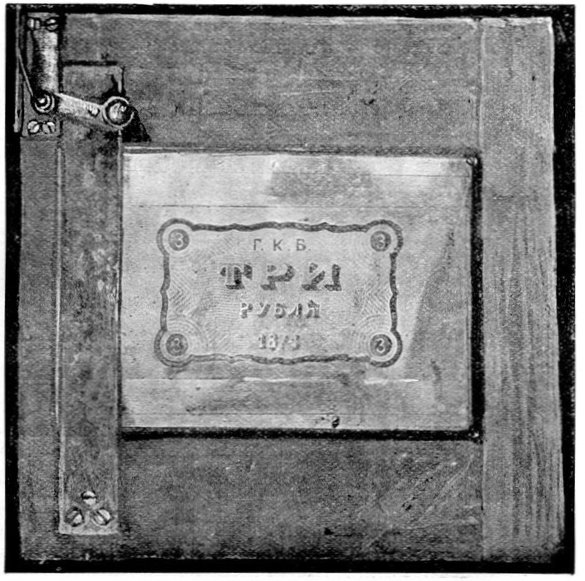
PLATE USED FOR PRINTING FORGED RUSSIAN ROUBLE NOTES.
Here are the plates for printing, gelatine moulds, and specimens of notes, which form the relics of the case known as the "Forged Russian Rouble Notes," which had a run between the years 1868 and 1876. A glance at a frame containing samples of notes purporting to be for one, three, ten, twenty-five roubles, etc., will at once convince the observer that the Russian Consulate spoke truly when, at the hearing of the persons arrested, at the police-court, he said: "They are really splendid specimens of forgeries of the actual legitimate notes." In company with these are treasures associated with what is known as the "Ti Kroner Case." They consist of a cigar-box converted into what is generally believed to be a photographic camera, a negative—broken fortunately—of a Ti Kroner note, a note photographed on a piece of substantial box-wood, several specimens of forged notes, and a note pasted on to a piece of paper with three circles cut out of it. This is peculiarly interesting, for "the operator" has pencilled in the centre disc, "£10 clock here," in the left-hand disc, "£10 watch here," and in the right-hand circular space, "watch here." The excuse of the person on whose premises these were found was that he intended to use the Ti Kroner notes as a novel form of advertisement for clock and watch makers!—to distribute these notes, drop one or two carelessly in the streets, or leave them on the cushions of railway carriages; and when the thinkingly lucky finder hastily picked one up, popped it in his pocket, and waited until he got home to examine it, he found it was only, after all, an advertisement for Brown, the watchmaker, or Tompkins, the clock manufacturer!
Strangely enough, these relics were never brought as silent witnesses against the person who at one time owned them. He was voted by a thoughtful judge a perfectly fit and proper individual to partake of Her Majesty's hospitality for the comfortable period of twenty years for quite a different offence. He used to send notes—not forged ones, but nice, delicate little note-paper notes—to old ladies, threatening them that if they did not send him money he would, at the earliest opportunity, place dynamite on their door-mats, so that the first time they rubbed their boots or goloshes on the cocoa-nut fibre, they would be—well, he wouldn't venture to say where they would be blown to! Our Ti Kroner forger must have been a very versatile genius.
The simplicity which is characteristic of not a few of the inhabitants of Britain and the readiness with which some people are taken in are well illustrated by New Scotland Yard's collection of flash notes. Flash notes are generally carried by the members of that fraternity who delight in showing you what is known as the three-card trick, or by persons who wish, for some particular reasons of their own, to inspire your confidence in them, and lead you to trust in their keeping for half an hour or so your money, watch, or what not.
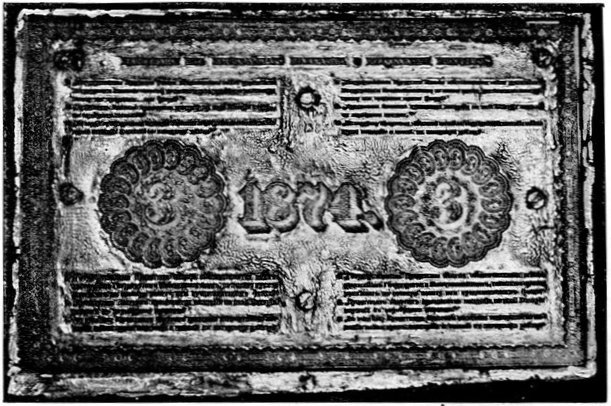
MOULD USED FOR FORGED RUSSIAN ROUBLE NOTES.
There are several hundreds of these notes at New Scotland Yard. It is not a punishable offence, by-the-bye, to have them in your possession, or even to print them, but it would go badly with you should you try to pass one as a real note. Now, it is a certain fact that in the case of many of these notes, they were never intended for any wrong purpose, but were merely brought out as a novel and attractive advertisement. It is to be hoped that the writer does not convey the smallest impression to the reader that these notes were in the first place originally issued for anything but a proper and legitimate cause. But your confidence-man, your cardsharper, should any perchance happen to fall in his hands, uses them to suit his own game. They are crisp—just like real bank-notes, and when rustled in the palm of the hand make that delicious sound which cheers the heart and wreathes the face in smiles: they are very nearly the same size, too, of a real "fiver." So they are used for a purpose for which they were never intended, and the confidence-man pulls out of his trousers pocket a handful of—what? Bank-notes? Nothing of the kind. But they look like them. Of course they do. But if you get hold of them yourself you would see that this crisp piece of paper with a big TEN in the left-hand corner was only: "Bank of Engraving. I Promise to Engrave and Print in Letter-press, etc., on Demand for the Sum of Ten Pounds in the First Style of the Art or forfeit the above sum. London, 29 April, 1840. For Self & Co., Bank of Engraving, J. Duck, Fitzroy Square. £ Ten."
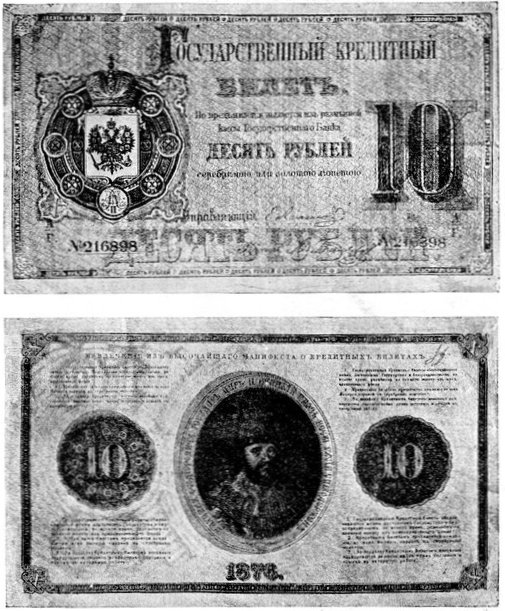
FORGED RUSSIAN ROUBLE NOTE—FRONT AND BACK.
Another of these is in reality a capital advertisement for a well-known circus, stating that it has been "Entirely redecorated and renovated at the cost of One Thousand Pounds"—a big One Thousand Pounds appearing in the left hand corner. Indeed, your cardsharper and confidence-man knows how easily gulled some folk are, that he has even included in his stock-in-trade a note-advertisement emanating from a Parisian firm of dentists, stating that they will gladly supply you with a new false tooth for the modest sum of five francs!
These and many more are in a frame at New Scotland Yard—a good supply of American notes being noticeable. Amongst them is one which, at the moment of writing, is peculiarly interesting. It has, at some time or the other, formed part of the "monetary" luggage of somebody engaged in the confidence trick. Kossuth, the great Hungarian patriot, gave orders to a firm of lithographic printers for the printing of several million notes, which he intended for circulation in Hungary. The Austrian Government, however, objected to this, went to law, and the case was decided in their favour. The notes were to be destroyed, and so great was their number that several waggons were loaded with them. One of these identical notes is to be found framed at New Scotland Yard!
Whilst on this subject, a good story may be told, which will well illustrate the ingenuity of some to take advantage and make profit of a "forgery" scare.
Some time ago considerable consternation was created in France owing to the circulation of forged 500 franc notes. An individual—always on the look-out for the adaptation of his genius to circumstances—exhibited one of these sham notes and netted a neat little sum by charging a franc a head.
"Beautiful imitation," said one, "but not good enough to take me in."
"Very clever," remarked another, "but not quite clever enough to catch me."
"Ha! Ha!" exclaimed a third, "I should have known it as a bad 'un at once!"
The exhibitor smiled and said nothing. They had been looking at a real note all the time!
The particular glass case at New Scotland Yard to which we have been devoting our attention also contains substantial mementos of a gentleman who was closely associated with the great forged will and next-of-kin swindle of 1885. Charles Howard was this worthy's name, and he died within the walls of Holloway Prison, on the 25th November, 1893, whilst under remand.
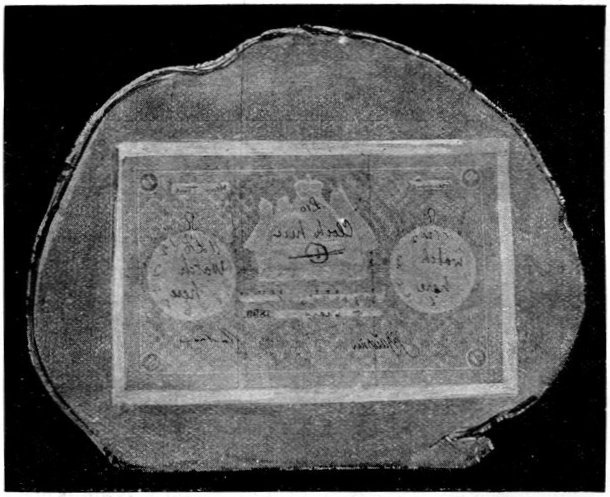
TI KRONER NOTE PHOTOGRAPHED ON WOOD BLOCK.
Old Howard—for he was over seventy years of age—was a colossal swindler. He played for high stakes in the highest quarters. No twopenny-halfpenny swindles would appease his criminal appetite—thousands, and nothing short, was his game, and more often than not he bagged them. His operations extended all over the civilized world. His portrait has followed him all round Europe. On the Continent he posed as the Count Von Howard and Count Hovardi. The writer has had an opportunity of looking at his picture—a more benevolent-looking old fellow never faced a camera. His plausibility was simply delicious—his impudence at facing a thing out, in spite of immense odds against him, was undeniably tremendous. He had received a good education—indeed, it is believed at an important public school—and furthermore, came of good family. In order to give some idea of his monumental "cheek," almost his last exploit was to pose as the friend of a mythical Australian heiress, to whom he was prepared—subject, of course, to some monetary consideration—to introduce such gentlemen as were matrimonially inclined. When one of these sought to expose him, Howard immediately wrote to a number of leading journals in a feigned name, stating that he was a retired Indian officer, and that he was prepared to vouch for the accuracy and bona fides of the whole affair. This letter was actually published.
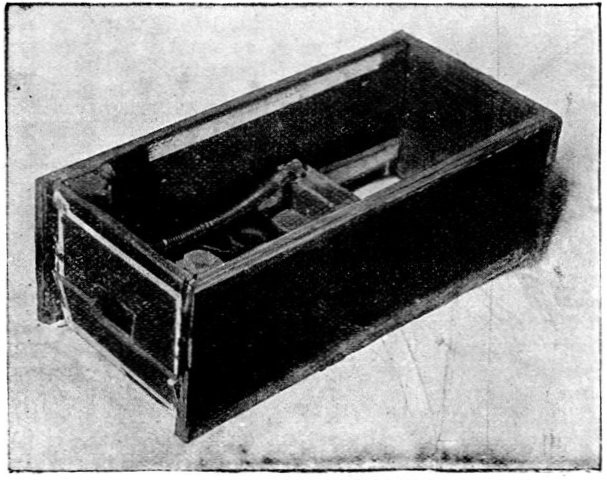
CAMERA MADE OUT OF A CIGAR-BOX.
His modus operandi in the forged will case was both simple and elaborate. Its simplicity lies in the fact that it merely took the form of an advertisement in the newspapers, stating that a Mr. Clark had died leaving many thousands. Applications from persons of that name were invited. It was a taking bait, and hundreds nibbled at it, as is proved by a perusal of the papers preserved as relics of this case at "The Yard." Howard was magnificently artful. He did not choose the name of Smith, Brown, or even Jones—but one almost as common. A person would write in answer to the advertisement. Howard would reply, asking for fifty shillings, prepaid, to cover inquiry fees, and holding out further bait by stating that only the first thirty-five "Clarks" would receive a share; that the money could not go to persons of affluence, but to people of small means; that he could only correspond with principals, and that "James Hill Cooper Clark" had left the highly respectable sum of £105,000. Who would not be one of the happy thirty-five for fifty shillings!
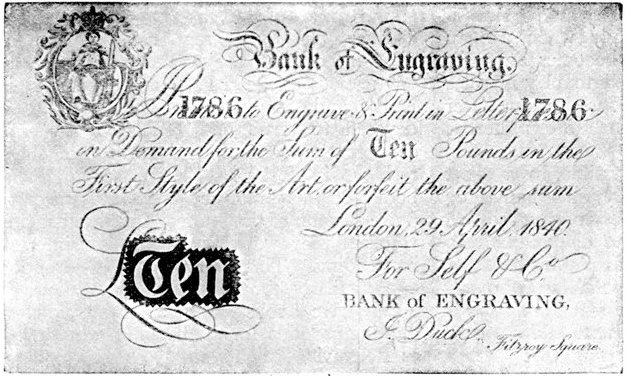
A "FLASH" NOTE.
Howard and his works might be dilated on from cover to cover of this Magazine, but to show how perfectly he played his "clients" we will give two extracts from the scores of documentary proofs we have examined. One is a death certificate, and it reads:—
"In memory of William Clark, of——, who departed this life, April——, 18——." Then follows: "I hereby declare that the above is a true copy from the tombstone of W. Clark, of——."
The suggestion to copy the tombstone could not have been evolved from any mind but that of the late Charles Howard. The other is from a confiding person who writes—Howard has evidently asked for a commission—"I am willing to have ten per cent. reducted," and the bad-spelling simpleton plaintively adds: "Please to get the thing through as soon as possible."
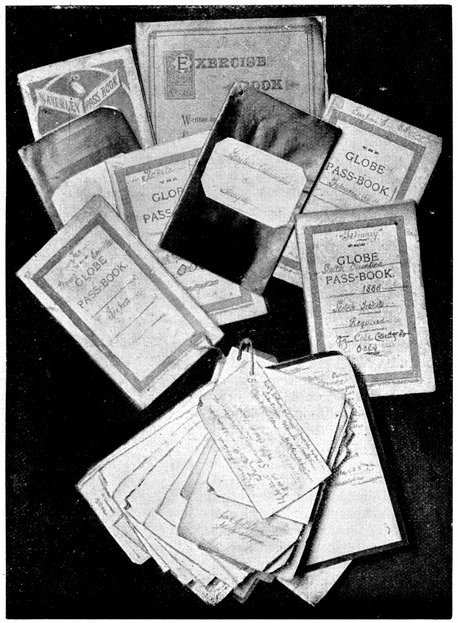
ADDRESS BOOKS, MEMORANDA, ETC., OF A PROFESSIONAL BEGGING-LETTER WRITER.
Your true begging-letter writer is certainly entitled to join the family circle of forgers, though in most cases only as a distant cousin. What a begging-letter writer Howard would have made! But there are men and women whose talents in this peculiar art are just as fine if not so varied. It is only when a man attains to position that he becomes aware of what a number of boys used to play marbles with him at school. Your begging-letter writer at once marks him for his own, he has "got him on the list."
It would be quite impossible, in a short paper such as this, to place on record anything more than a few of the methods of your modern begging-letter writer; of the old soldier who sends a line to some Army man at his club; of the ardent but hard-up politician who addresses some M.P.; of the real truth regarding that hurriedly pencilled note addressed to the City merchant and stating that "years ago" the applicant was once "on the market himself," etc., and would you oblige with five shillings, "which I faithfully promise, dear sir, to pay you back in a fortnight's time." Have you ever met the good woman—perhaps you have heard from her—who is a widow with two children, her husband is lying dangerously ill at home, and she wants a few shillings to purchase necessaries. As a proof of her honesty she incloses the receipt for her last month's rent. A certain society can show you a bundle of some forty of these letters, and every one of them contains a receipt for that same month's rent. The common lodging-house is the depôt for every fraud under the sun, and there are scores of men who frequent them who will write you the most touching appeal for threepence or fourpence, and find the note-paper into the bargain.
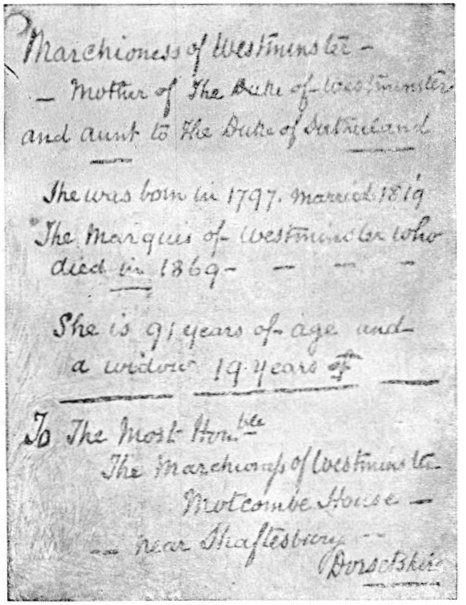
A PROFESSIONAL BEGGING-LETTER WRITER—SPECIMEN OF MEMORANDUM.
The memory of the greatest genius the begging-letter world has ever known is kept green at New Scotland Yard. He is believed to be dead—for if he were out of prison London would soon hear of him. We will hide his identity—for the sake of his friends and relations who may have survived him—under the unassuming name of Brown. Brown was an old fellow, with a glorious white head of hair, and always dressed in black cloth. His great forte was his ability to write in assumed hands—he could write in a hundred different ways, for which purpose he was aided by a variety of pen-nibs and various coloured inks. He was so systematic. Just examine some of his books—usually those familiar little red rent-books. Here is one—it contains the names and addresses of peers, etc., M.P.'s, and widows in North and South Wales. A second is devoted to peers and M.P.'s in England, another to Scotland, and a third to those resident in Ireland. There are a dozen books of this kind, and were the writer to publish some of the "notes" in these begging volumes they would provide some interesting reading. Then he would divide London—particularly the West-end—into districts. So we have books given up to such happy hunting grounds for the begging-letter writer as Belgravia, Knightsbridge, Onslow Square, Queen's Gate, Portman Square, Berkeley Square, Grosvenor Square, etc.
He never addressed anybody without acquainting himself with their history and particularly finding out their age, whether they have reached those years when they are generally supposed to be sympathetic, or if they were in the prime of life and inclined to be cynical. How much is conveyed on a small slip of paper, bearing the name of the Marchioness of Westminster and the words, "She is ninety-one years of age and a widow nineteen years"!
Brown used to supply beggars with letters, and several samples of them are preserved. His favourite theme was the poor widow, and the plea put forth was the same in nearly all cases save that the names were altered and the locality different. Here is one of these "appeals," accompanied by a letter on black-edged paper purporting to be from a clergyman in the same parish:—
"Parish of Streatham, "County of Surrey.
"These are to certify that Mrs. Anne Clarke (widow) carried on business as laundress in this parish for several years, and has hitherto supported a large family in respectability.
"On the afternoon of Saturday, the 14th day of December instant, while Mrs. Clarke was delivering clean linen with her horse and van near the Streatham Railway Station, the horse took fright at the whistle of a passing train and started off at a furious pace, and coming in contact with a coal-waggon the horse was killed, the van dashed to pieces, and her eldest son 16 years of age was thrown from the van, and received such injury as caused compound fracture of the right thigh, and now lies in St. Thomas's Hospital in a dangerous state, whereby Mrs. Clarke has sustained a severe loss, estimated at £45.
"Knowing Mrs. Clarke, a respectable and industrious widow with a family of five children depending on her for support, I beg to recommend her case to the notice of a few benevolent neighbours, to enable her to follow her occupation as heretofore, trusting it will come under their notice with that eye of sympathy it so much merits.
"Vestry Hall, Streatham. "This 17th day of December, 1889."
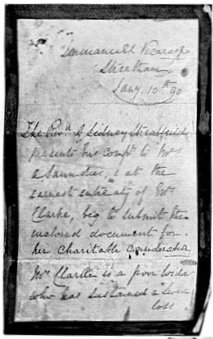
"BROWN'S" BEGGING-LETTERS.
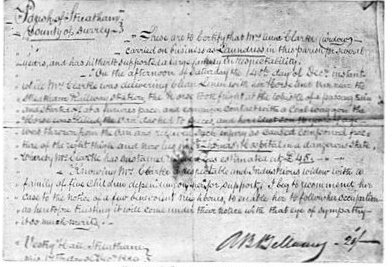
This would be presumably signed—of course in Brown's handwriting—by the Vestry Clerk with "20s." against his name. This in itself is a delightful composition—but it did not end here. Our estimable friend Brown would follow on with a few more signatures giving various sums of money, but one signature always headed the list—after that of the Vestry Clerk. It was a coal-waggon which upset poor Mrs. Clarke, killed her horse and dashed her van to pieces. Hence—written in red ink—there appears on all these appeals the name of a well-known firm of London coal merchants, who give Two Pounds.