How Composers Work.
Reading edition
II.
By Francis Arthur Jones.
Meyer Lutz.
Herr Meyer Lutz has the rather odd fancy of sitting in the dark for an hour or two at a time, and letting his fingers wander hither and thither over the keys, searching out those measures which set the fashion in the dancing world.
truly yours
Herr Meyer Lutz
He composes anywhere and everywhere, in the streets, on tops of 'buses, and even in church.
"I remember," says the popular Gaiety composer, "driving one Sunday evening to St. George's Cathedral, when the melody to an 'O Salutaris' struck me. I pencilled it down during the sermon, and my brother-in-law, Furneaux Cook, sang it after the sermon at Benediction the same evening."
Herr Lutz believes in taking up some verses and carefully studying them.
"This I often do," he says, "and soon seem to hear a fitting melody without trying it on the piano till finished."
Fugues and canons, in his opinion, want studying and mathematically experimentalizing. "Composers," he says in conclusion, "are musical poets, and 'Poëta nascitur, non fit.'"
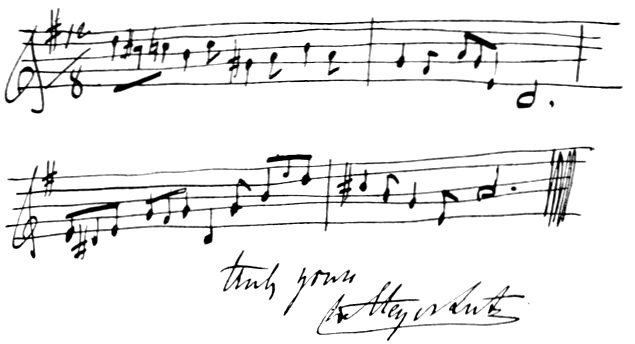
The music in his autograph will, I imagine, be familiar to not a few of my readers.
A. C. Mackenzie.
Most of Dr. Mackenzie's work is done in the morning from nine to one-thirty, and he never touches it in the afternoon. As a rule he leaves scoring for the orchestra or looking over the morning's work for the evening hours. "But," in his own words, "if I feel capable of inventing, why, I begin to work again about eight-thirty and continue until I am tired."
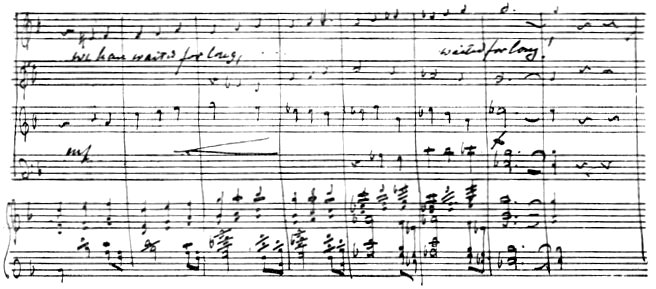
As a rule, the principal of the Royal Academy of Music sketches his music on two or three lines, as shown in the illustration.
"When I am engaged upon anything that absorbs my entire attention," he continues, "I carry a little musical note-book about with me and jot down roughly any idea which may occur to me, and I have found this plan useful. When I am composing I never lose the thread of it, morning, noon, or night; even at meals I am unconsciously occupied with it—this goes on until the work is finished."
We have waited for long ... waited for long!
Dr. Mackenzie decidedly disapproves of the manner in which composers in England are made to work—viz., to order.
"Such pressure," he says, emphatically, "is unproductive of the best work, and highly detrimental to one's general health and comfort."
For those reasons he objects to undertake commissions.
Tito Mattei.
Signor Tito Mattei composes most of his instrumental music at the piano, but songs are composed anywhere, wherever and whenever he feels so inspired.
One thing he considers absolutely indispensable to the success of a composer, viz., a thoroughly good musical education, without which no one, however gifted, can hope to make a name.
"As a whole," writes this composer, "the English people love music, but are not, strictly speaking, a musical nation, the reason being that they do not give sufficient time and care to the study."
The accompanying few bars of music are taken from his popular song "Beside Me."
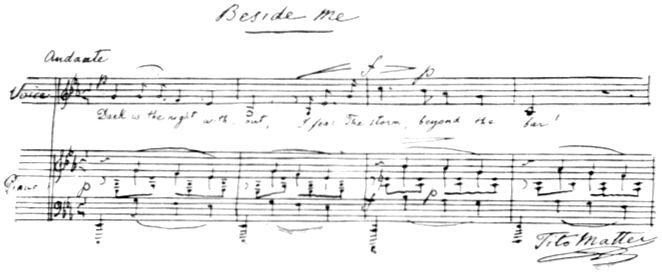
Beside Me.
Dark is the night with-out, I fear The storm, beyond the bar! Tito Mattei
Hubert Parry.
Professor C. Hubert Parry, whose last work, "Job," has been so enthusiastically received and criticised by the musical world, composes according to the nature of the composition on which he is engaged.
"There are a hundred and fifty different kinds of work to be done in composing," he says, "and they vary in accordance with its being a big work like a symphony or an oratorio, or an opera, or a little thing like a song or a pianoforte piece. Then, what one wants may come into one's head when walking or driving, or in bed—anywhere, indeed, but in front of the paper it has to be written on. Then there is the general scheme to be considered, which usually comes first, and has to be thought out in big, cloudy way, out of which the details emerge into distinctness by degrees, and often want doing over and over again."
Like many another composer, Mr. Parry prefers the morning for the mechanical part of the art, viz., the work of scoring and writing down and getting into order those ideas which have already been conceived.
"As far as new ideas and schemes are concerned," he adds, "I am glad enough to take them at any time of the day they are so obliging as to come."
It is wonderful how chary the English composers are of answering the question as to whether or no they consider their countrymen a musical race. It seems a subject on which they fear to express an opinion, and either treat the matter with silence or, like Sir Joseph Barnby, content themselves by saying "We're on the mend." Not so Mr. Parry, however.
"I consider," he says, "that the English are naturally the most musical race in the world, except the Germans. It would take a good many pages to explain my opinion, as it is obviously contrary to all the received and accredited traditions, so I will not attempt to justify it at present beyond saying that I don't mean that the race is gifted with any natural facility, but that taking it all round there is more appreciation of what is genuinely and wholesomely good—Beethoven, Bach, Haydn, Brahms, Handel (at his best), Mozart, and the great madrigalists and so forth—than in any other country except Germany. The fact that the English people have no great taste for opera is all in their favour."
Mr. Parry concludes with a few remarks on the merits and demerits of writing "to order." "Certainly no one could turn out anything worthy of the name of art," he says, "if he had it on his mind that he was writing under pressure; neither will any man do anything really good when he is thinking more of the money payment, or suiting managerial ideas, than of the thorough working out of his own devices. But this should not be confounded with a man's undertaking work that is thoroughly congenial to him when he has plenty of time to carry it out honourably. If the Philharmonic Society or Richter ask a composer to write them a symphony, they put at his disposal a magnificent orchestra for the interpretation of anything that he may have to say in that line; or if the committee of any great festival invite a composer to write them an oratorio several years before it is wanted, they put at his disposal a splendid chorus and soloists, and all the resources a man can desire. With such opportunities, I should have thought a man had a better chance of being inspired to some purpose than if he were pottering about just when the humour took him."
I am fortunate enough to be able to give here, in facsimile, a bar from the original first score of "Job."
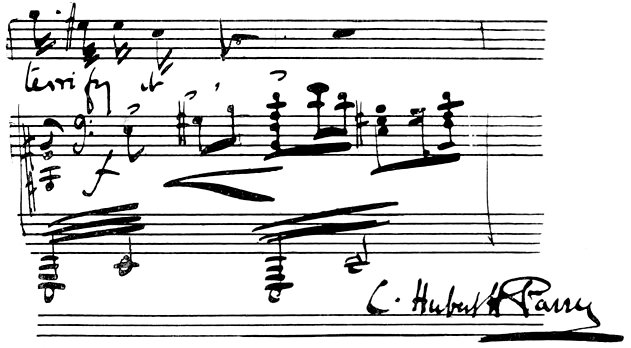
C. Hubert Parry
Ebenezer Prout.
Mr. Prout, when composing, makes first a very rapid sketch on two staves—with instrumental works generally only the upper part and a figured bass; with choruses, anthems, etc., usually the four-voice parts. For songs he writes only the melody, with just enough indication of the accompaniment to prevent his forgetting the idea.
"My first sketches," he says, "are always written as fast as the pen will go. I make it an invariable rule never to write unless I am in the humour, and if I find that ideas do not come as fast or faster than I can put them down, if I have to stop to think what should come next, I at once put the music-paper aside, knowing that I am not in the mood for composing. After completing my sketch I begin the fair copy, the full score, in the case of orchestral work, putting in the details and often making considerable improvements. My public works usually differ pretty widely from the original draft; but the first sketch, containing the fundamental idea, is invariably produced at what I may call a 'white heat.'"
Composition, in this composer's opinion, can be taught so far as the technique is concerned; but if a student has no ideas, these cannot be given by any instruction, though a latent talent may often be brought out and cultivated by proper training. By this he means that there may be a natural aptitude for composition of which its possessor is unaware till his teacher discovers and develops it.
Of his own works Mr. Prout thinks he is, perhaps, hardly an impartial judge, but his own favourites are among the instrumental work, his "3rd Symphony" and the two quartets in B flat and F; and among the vocal works, the cantatas the "Red Cross Knight" and "Damon and Phintias."
"It is difficult," continues Mr. Prout, "to give a definite opinion as to whether the English are a musical nation; it depends so much on the point of view. Judging by the number of concerts, etc., we are musical enough, but the want of general public appreciation of the best class of music, especially in the Metropolis, would incline me to a far less favourable opinion. In this respect I believe many parts of the provinces are far ahead of London.
"Do I believe in writing 'to order'? Well, I cannot speak for others, but for myself, when I receive a commission to write anything, I always accept, conditionally on the spirit moving me. If the work I am asked to undertake is sympathetic, the spirit generally moves pretty soon. Some of my best work has been commissioned, but to write merely for money is repugnant to me. I have never written a 'pot-boiler' in my life, and, please God, I never will."
Mr. Prout concludes by saying:—
"I usually compose in the evening, mostly between six and ten, seldom later. If I have a morning to spare, which does not often happen except during my holidays, I frequently find that a good time for composing. Recently I have composed very little, my time being too fully occupied with writing the series of theoretical works, which is still a long way from completion."
The MS. is taken from his well-known "Piano Quartet in F."
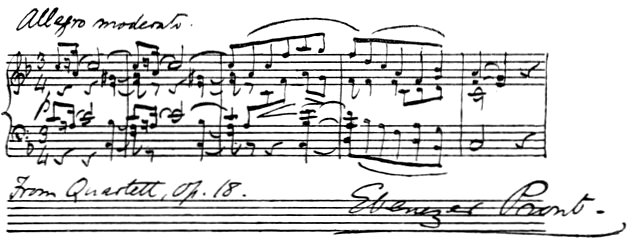
Ebenezer Prout.
Rubinstein.
From Herr Anton Rubinstein I have obtained no information whatever. He has, however, with the kindness which characterizes him, sent me the accompanying MS.:—
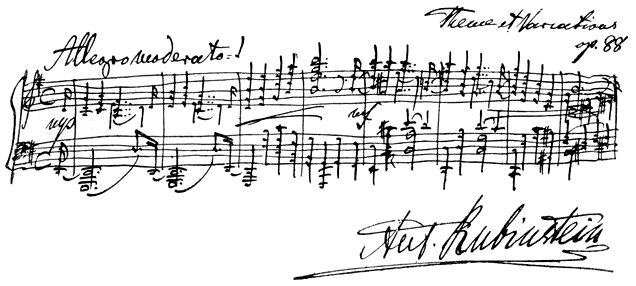
Theme et Variations op. 88
Ant. Rubinstein
Some time ago Rubinstein left the St. Petersburg Conservatoire, where he had been for so many years, and visited Dresden, in search of rest and quietness, and laid aside all business for the time. For any further information, I must refer my readers to his "Autobiography," a fragment published in America, and "A Conversation Upon Music," published by Augner.
C. Saint-Saëns.
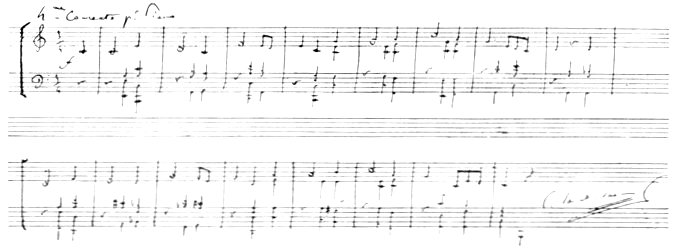
The French composer, Saint-Saëns, considers a piano a useless item in the art of composition, at all events in his case, for he rarely, if ever, makes use of one when composing, even to play over completed works.
Some MS. paper and a pencil are the only materials he works with, and he has composed whole operas without a musical instrument in the house.
This manner of composing M. Saint-Saëns finds a great saving of valuable time (and if composers' time is not important, whose is?), and he does not consider that ideas come any the more readily when seated before a piano; in fact, rather the reverse.
The portion of MS. will be familiar to those who have studied his works.
Stanford.
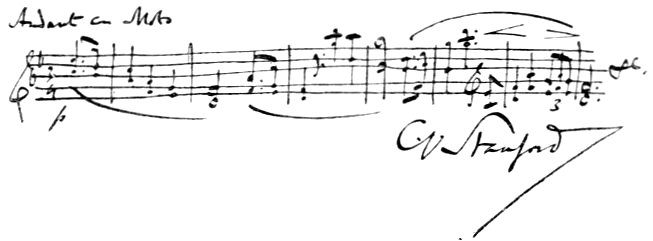
In Professor C. V. Stanford's opinion the art of composition can be cultivated, but never acquired. He composes according to the mood in which he happens to be, and never keeps to any fixed rule or time.
As to composers working under pressure, he imagines that must depend greatly upon the temperament of the composer. He expresses no opinion as to which he considers his best work, but says: "That is for the future to determine and individual tastes to decide."
The half-dozen bars of music are taken from his "Irish Symphony."
C. V. Stanford
Strauss.
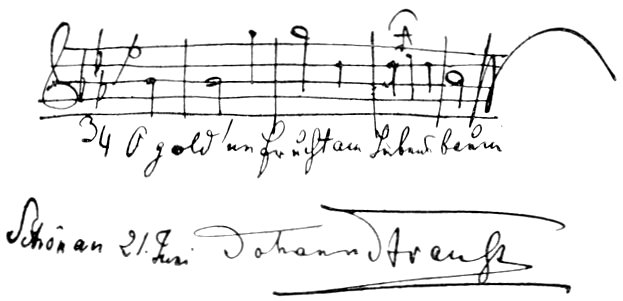
Herr Johann Strauss, with whose dreamy waltzes most of us are familiar, for his part says that he is far too modest to designate any composition as his best. When he finishes one he forgets it completely for a time in the interest caused by his next work. Method he has none—only inspiration, genius—for in his opinion composers can never be made. "One may compose," he says, "very easily, or—not at all." The divine art must be innate, and a composer—like his brother genius, the poet—must be born, and can never be made. The music is taken from one of his well-known waltzes.
Johann Strauss
Berthold Tours.
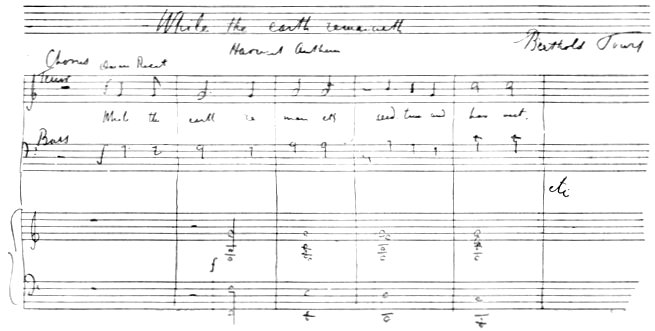
Mr. Berthold Tours, who has written some of the finest anthems and "Services" of the present day, besides numerous songs, prefers the morning for composition, and being an early riser, is generally to be found hard at work soon after 9 a.m., and seldom ceases his labours till two o'clock. He never composes at an instrument, and thinks that people who do are very apt to get their ideas from it and not out of their head; nor does he force himself to compose, preferring to wait till the inclination is upon him or the composition on which he is engaged has matured itself in his brain, when there only remains the mechanical part of writing it down, which very often takes up the most time. If engaged upon a song, he first of all reads his words over two or three times carefully and thoughtfully, so as to obtain a grasp of the style of the verses, and then the music begins and the composition proceeds smoothly to its close. Mr. Tours considers his "Service in F" the best work he has yet done. This composition is a universal favourite with lovers of Church music, and deservedly popular at festivals.
It is pleasant to hear that this composer considers England a musical nation. "Not quite so great as Germany, perhaps, but during the last twenty years there has been great talent shown in music. We are stronger now in clever composers than we have ever been, and no nation is so appreciative of good music as the English, or so quick to recognise and encourage true genius."
Like Dr. A. C. Mackenzie, Mr. Tours does not hold with the popular belief that composers produce as fine works when writing for commissions received as when left to follow their own inclinations, but acknowledges that many great works have been thus produced.
In conclusion, Mr. Tours says that the playing of good classical music, to those who know the rules of writing, might be a very great help, and would be an incentive to good composition.
The portion of MS. is taken from his well-known "Harvest Anthem."
While the earth remaineth
Harvest Anthem
Berthold Tours
P. Tschaïkowsky.
Klin, near Moscow, was the home of one of the busiest of men. It is here that the late Russian composer, Tschaïkowsky, lived and worked, devoting the greater part of the day to his art. Nine o'clock every morning found him hard at work, and it was one before he stopped for a light lunch. Two hours every afternoon were rigidly set aside for one of the few recreations in which he used to indulge, viz., walking; and it was during these daily strolls that most of the sketches of his pieces were conceived, and entered into a note-book which was always forthcoming. Home was reached soon after four, and from five to half-past eight was employed in arranging and setting in order the sketches jotted down during the walk.
A piano, he considered, is not absolutely necessary, and he composed much without the use of one. For instance, on a journey, or long voyage, or when rusticating in some primitive, far-away little hamlet, where the peacefulness and quietude are suggestive of composition, but where the running brook does duty for a piano and you fit your melodies to the sighing of the wind among the fir trees. Still, the instrument helped sometimes the development of his musical ideas, and generally when convenient he made use of one. "I believe," he said, "the creating power of music to be a precious gift of Nature, which cannot be obtained by work and study, but only improved and lighted by musical sciences, besides being purely empérique. With the belief that composers often work better and produce finer results when put under a certain amount of pressure the professor agrees, pinning his belief on history, which tells us of many masterpieces being done thus.
"I have never thought," he resumed, "of the reasons explaining why England, who produced such great poets, has had, comparatively speaking, but few musicians. It seems to me that the idea that the English are not gifted for music cannot be considered as 'definitive.' Who knows that a musical Shakespeare will not be produced? You have already men of much promise and whose work is very serious."
Of his own compositions, Tschaïkowsky considered his opera "La Dame de Pique" the best work he had ever done, an opinion which is shared by many of his admirers.
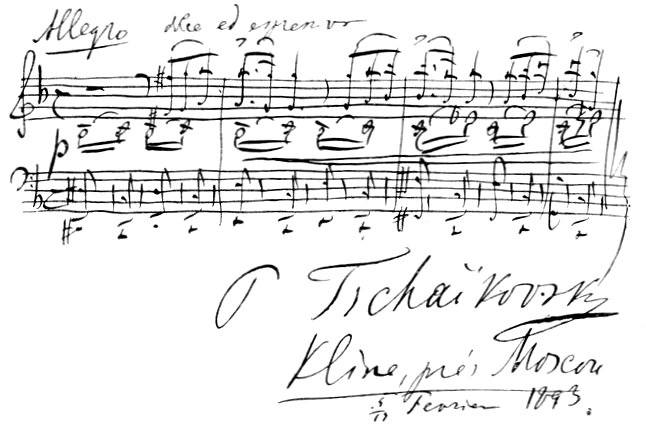
P Tschaïkowsky
Note.—Cowen's opera, referred to in our February number as "Sigrid," should have been "Signa," which had not been produced when this article was written.