The Queer Side of Things.
Reading edition
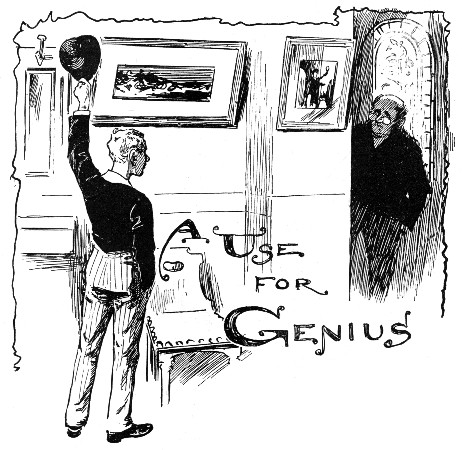
Young Bansted Downs had finally arrived home from school; the cabman had placed his box in the front hall, and young D. was in the act of hanging up his hat on the stand, when the elder Bansted Downs, his father, put his head out of the library, and said:—
"And now, young Bansted Downs, what sphere in life do you propose to fill?"
"I have been thinking, old Bansted Downs," replied the youth, respectfully, "since I left school seventy-five minutes ago, that I should prefer to be something prosperous."
The father nodded his head approvingly at this evidence of foresight in his child, and said:—
"I think you have come to a very wise decision, young Bansted Downs. No doubt you have, while at school, selected such studies as were best fitted to prepare you for the struggle of life?"
"I think so, old Bansted Downs," replied the son. "The head-master took in regularly for our use all the best prize-competition periodicals; in fact, he was of opinion that a complete selection of these rendered all other educational books superfluous. I myself have attained to such dexterity in guessing the right word, deciding on the best eight pictures and the two best stories, divining the correct number of pairs of boots made in London on a given day, and so forth, that Dr. Practiccle pronounced my education singularly complete."
"Good—very good! young Bansted Downs," said the father, thoughtfully; "and now as to a more specific choice of profession?"
"Well, old Bansted Downs," said the son, "I have been thinking that I should like to be apprenticed to a Genius, with a view to adopting his calling."
"Very well thought out," said the parent. "I must consider whether the necessary premium——"
"Pray do not trouble about that," said the son, "as my success at the word competitions has more than provided for the contingency." And young Bansted Downs drew from his pocket a large bag filled with a mixture of sovereigns, marbles, and peppermint-drops.
"Very good! Then the matter's settled; and perhaps you would like something to eat."
All the friends by whose opinion old Bansted Downs set any store heartily approved of young Bansted Downs's choice of a calling; and the matter was fully discussed that evening. The advertisement columns of the newspapers were consulted as to the most suitable genius to undertake the charge of the youth; and the following seemed promising:—
"To Parents and Guardians.—Young men of promise wishing to adopt the profession of genius will do well to apply to Brayne Power and Sons, of 3019a, George Street, Hanover Square, who have a vacancy for one apprentice. Telephone No. 7142863."
The very next day young Bansted Downs called at the address given, and was shown into the presence of Power senior, a man of venerable appearance, whose high broad forehead, far-away gaze, long hair, and abstraction sufficiently revealed his calling.
"It will be fifty pounds—twenty-five down, and the rest in monthly instalments of one pound after you have got your H.A.W.," said the Master Genius.
"If you please, what is my H.A.W.?" asked young Bansted Downs.
"Your final degree—your Head Above Water."
"That will not be just yet?" asked the youth.
"Oh, dear, no! Not for a very long while, if ever. There are two preliminary degrees to get before that. There are the F.I. and the E.P.—your Foot In and your Ear of the Public; and before you can obtain either of these you will have to Make your Mark."
"I can sign my name—will not that do as well?" asked the youth.
"THE MASTER GENIUS."
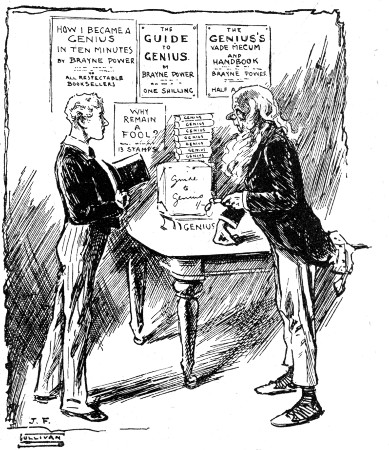
"That entirely depends upon the sort of name. If it's just a surname with a coronet over it, it entitles you to your F.I. and your E.P. without any examination. You have the same advantage if you can append to your signature either of the following affixes: P.P. (Pertinacious Pusher) or C.I. (Chum of the Influential).
"But if you can't sign these kinds of names, you will have to Make your Mark. It's a difficult mark, and requires a lot of learning.
"As the first instalment of twenty-five pounds down is all I am ever likely to get, I will take it now—no, that one won't do; it's a peppermint-drop, not a sovereign. That's not the way to get on, young man!"
"Isn't it?" asked young Bansted Downs thoughtfully. "I'm glad you told me. I thought perhaps it might be; but, of course, I've got to learn."
That very week young Bansted Downs commenced his studies under the Master Genius. He found he had a very great deal to learn.
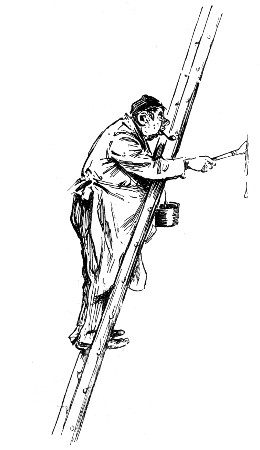
"The difference between talent and genius is that talent does what it can and genius does what it must—you will find that in the poets," said the Master Genius. "Consequently, to be a genius, you need not feel that you have the ability to do a thing, but only that it is necessary to do it. A house-painter is a specimen of genius: he has not the ability to do his work; but he is compelled to do it in order to obtain the means for his Saturday drinks. But, of course, that's only one kind of genius. What we have to teach you first is to feel that you must do something transcendent—and then all you've got to do is to do it—see?"
So, acting on his instructions, young Bansted Downs went to the office and sat quite still day after day for a month or two, with his eyes fixed on space; and one afternoon at the end of that time he got up and rushed at Power junior (who took charge of him in these preliminary studies), and announced that he felt the irresistible impulse to do something great and wonderful.
"What sort of thing?" asked the Junior Genius.
"I don't know—anything—something stupendous and transcendent—a master-piece!" said young Bansted Downs.
"Knock it off, then. Don't make a labour of it, mind; that would spoil all the genius of it. Just knock it off—shed it—see?"
The apprentice went back to his stool in the corner and knocked off that scintillation of genius.
"Very good for a beginner," said the Junior Genius; "you show much promise. I shall soon be able to hand you over to my father for the Higher Grades."
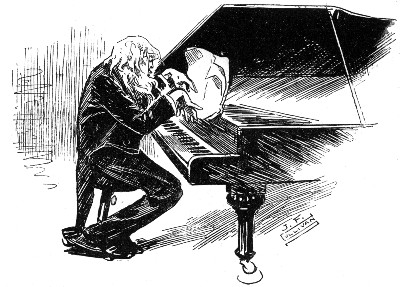
And some time after that young Bansted Downs moved into the room of the Master Genius to learn the higher attributes of genius—eccentricity and obscureness. These were the most important parts of the qualifications, and he worked hard at acquiring them. The eccentricity had infinite ramifications extending into language, manner, dress, habits, appearance, and opinions. The teacher communicated a thousand little touches of eccentricity invaluable to a genius—such as the bringing out of a book of poems with the title printed upside down and the capitals at the end of the lines instead of the beginning; the wearing of the back hair tied in a bow under the tip of the nose, and so forth. The pupil learned to hop backwards on to a public platform, wearing his dress-coat upside down, to paint his figures with their bones outside their skin, to sob audibly when performing on the piano; and many other things necessary to the obtaining of his degrees.
"A HOUSE-PAINTER IS A SPECIMEN OF GENIUS."
Having completed these studies, he was ready for the uphill work of trying to Make his Mark; and he found it a complicated bit of drawing too, far worse than the signature of a Chinese emperor—everything lay in the flourish.
The Master Genius said that no one could Make his Mark without a great flourish; and the best way to make the flourish was to blow it on his own trumpet; so there was the expense of a trumpet.
But he didn't seem able to get on; and after he had worn out a gross of pens in the attempt to Make his Mark he felt that he would never obtain his degrees, and took a back cistern-cupboard under the roof in a poor street, and fell into a low state.
One day, as he was eating his weekly sausage at the Three Melancholy Geniuses, off Fleet Street, there entered a party whom he knew slightly and who had Made his Mark and passed all his degrees some time before.
"TO SOB AUDIBLY WHEN PERFORMING ON THE PIANO."
"Haven't Made your Mark yet?" said this party. "Tell you what—why don't you get Boomed?"
"Does it hurt?" asked young Bansted Downs.
"Hurts your self-respect just a little and your respect for your fellow-creatures a little more—but it's nothing," replied the party.
"Where do you go?"
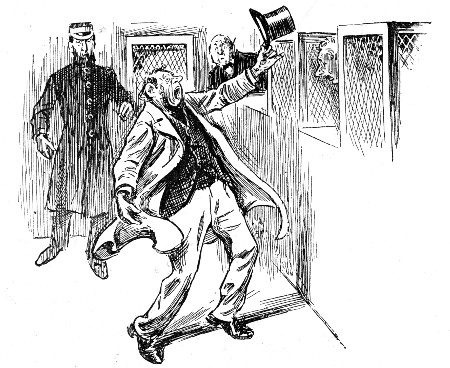
"To the Press Booming Department, of course. Just put your name down for Booming, and fill up a form, stating what you require said about you. You began all wrong: I never studied—I only went and put my name down the moment it occurred to me that I would be a genius. I called at the office every day, and shouted my name, and created disturbances, and got turned out; until at last they couldn't stand it any longer, and my turn came.
"I CALLED AT THE OFFICE EVERY DAY AND SHOUTED MY NAME."
"They put a long article about me in every newspaper, all the same day—mostly interviews—and quoted me as a classic. Some of 'em described me as a painter, and others as a novelist: I never was either; but it answered all right."
So young Bansted Downs went to the Booming office, and put his name down, and shouted; and the end of it was he got his Boom, and several editors wrote to him; and he began to be a little successful.
He hired halls, and went before the public in person; and painted on the platform; and sang and played his own compositions to them; and recited his own poems, and acted his own plays; and told them about his own scientific researches, and his military, exploratory, judicial, political, and athletic achievements.
But the thing dulled off, for one day a deputation of the public called at the Booming office to ask something about him; and the office had forgotten his name, and said that he wasn't being Boomed now, as Smith was up; and so the public got on an omnibus and went to Smith's hall, and Bansted Downs faded out.
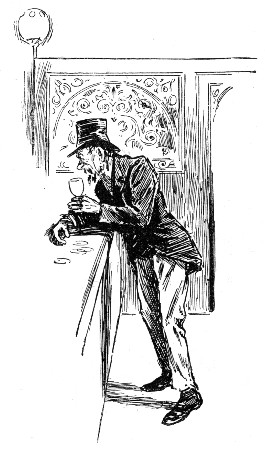
After that he was to be found all day at the Three Melancholy Geniuses, drooping over fours of Irish; and one day his late instructor happened to come in and find him thus, with his melancholy nose over the edge of his glass.
"Haven't got your Head Above Water, I see?" said the Master Genius. "Sorry you haven't Made your Mark."
"I've made a good many," said Downs, pointing to the wet rings on the counter.
"Ah, that sort of mark's no use—unless you make it in Company," said the Genius.
"HAVEN'T GOT YOUR HEAD ABOVE WATER, I SEE?"
One day, as young Bansted Downs sat in his cistern-cupboard biting his nails, a step was heard on the stair, and his late instructor entered.
"I've been all wrong," he said, sitting down on the cistern. "I put you all wrong—I've put all my pupils all wrong. I fell down stairs lately and knocked my head, and when I got up I saw everything—the light broke in upon me!"
"Why, you've cut your hair, and you're dressed quite neatly—I should hardly have known you for a Master Genius at all!" exclaimed young Bansted Downs.
"I am no longer a Genius—I am now the M.W.K.A.A.I.—the Man Who Knows All About It. I now know why genius fails to get the Ear of the Public, and is not appreciated——"
"Fault of the public—everybody knew that before," growled young Bansted Downs.
"Pardon me, it is not the fault of the poor public, but the fault of the system. We—the entertainers—have made the mistake of being geniuses; whereas we had no business to meddle with genius at all.
"It is the public who ought to have the genius; they should have the lively appreciation, the keen sense of humour, the afflatus, and all that; and then those who cater for them would not need to trouble about those things—they would only have to cater, and leave the public to perceive, by means of their genius, the excellences of the fare provided. If a plain person does something, and geniuses perceive greatness in it, that's a right state of affairs; but if a genius does something great, and plain persons fail to appreciate it, that's a wrong state of things, and a waste of material—-see?"
"And what do you propose to do?" asked young Bansted Downs.
"That's very simple—just make geniuses of the public. Of course the public, having their own affairs to attend to, will not wish to turn caterers and originate—their province is to appreciate, perceive, applaud, and pay at the doors—see? By this system any dullard is enabled, without effort, fatigue, or preliminary study, to Make his Mark and get his F.I., his E.P., and his H.A.W. A child could use it."
"But," objected young Bansted Downs, "under your system, dullardism paying so well, everybody would want to cater for the public, and there wouldn't be any audience—any public."
"Pooh! The system at present in vogue is all I require—compulsory education. Everybody will have to be educated as a genius, except a few who will be specially exempted from attendance at the Board schools to enable them to lie fallow and fit themselves for originators.
"Of course, you may say that it would not be necessary for the entertainer to be dull. Of course it would not; but, as it is not necessary for him to be a genius either, there would be a waste of public money in educating him as one. In fact, it might be a disadvantage for both originator and appreciator to be geniuses, and their conceptions might clash and create confusion. It's better for a conception to be lighted from one side only, as you get more contrast."
"But would not the genius of the spectator simply perceive the dulness of the originator?"
"Not in the least. It's just the sphere of genius to perceive, in a given production, excellences which the ordinary observer fails to detect; and it's only a question of degree of genius. I take it that perfect genius can detect perfect excellence in everything submitted to its discrimination. And now, will you be kind enough to come and vote for me, as for the furtherance of my scheme I am offering myself as Chairman of the School Board?"
In due course, the Man Who Knew All About It was elected to the School Board. He secured this by publishing handbills declaring his intention to squander the rate-payers' money like water, and provide free food, clothing, lodging, sweets, tobacco, drinks, theatres, and pianos to all the Board school children and their parents, relatives, and friends. The public judged by the proceedings of past candidates, all of whom had deliberately broken their promises on coming into office; and they concluded that this one would do so as well, and refuse to spend a penny. The Board were compelled to choose him as Chairman; and he at once commenced his work of reform.
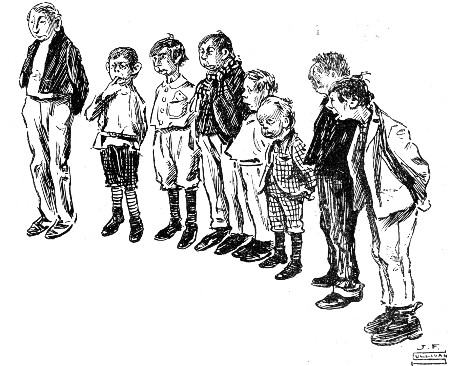
Genius took the place of all the former studies at the Board schools: no pupil was permitted to leave until he had passed the fifth standard, which turned him out a full-fledged genius; and he had to attend until he could pass it, even if he became old and decrepit. This was a wise step; for, had this rule been relaxed, those unable to pass the standard would have joined the ranks of the originators, and thus flooded the market.
"THE GENIUS CLASS AT THE BOARD SCHOOL."
Young Bansted Downs now set himself to steadily forgetting all the genius he had learned, feeling that it would be nothing but an incumbrance in his new career; and he succeeded so well that in the course of a few years he had become as dull as ditch-water.
Meanwhile a new public were growing up, a public of such brilliant perceptions—so great a faculty of appreciation—that they were quite bewildered with the excellences they perceived in everything around them.
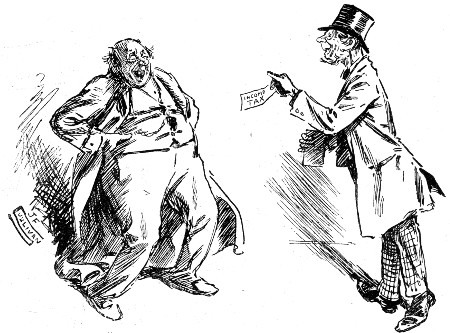
To take the sense of humour alone: they possessed it to so marvellous an extent that they could perceive a joke in the passing cloud, facetiousness in the growth of flowers, a choice witticism in the rates and taxes, an incentive to mirth in strikes. Not that they were incessantly giggling—that would have argued a something wanting; no, they drank in and appreciated and enjoyed the universal humour, and their eyes were bright.
So, when young Bansted Downs was middle-aged Bansted Downs he started all over again in quite a different way: he just wrote twaddle, and painted twaddle, and composed twaddle; and went on to a platform and twaddled about twaddle: and the public genius detected the brilliancy lurking in it all, and they were in ecstacies.
A terrible thing happened to the Boom Department of the Press. One day the public arose as one man and remarked that they were capable of finding out merit for themselves and no longer required the Department; and they took large stones, and bad eggs, and dead cats, and fagots of wood, and proceeded to the Boom Department; and it was in vain that the head of the Department came out on the balcony and pleaded that the Booming System, as practised by the Press, had nothing to do with the finding-out of merit; for the public smashed the windows and burned the offices, and abolished the Boom Department.
"A CHOICE WITTICISM IN THE RATES AND TAXES."
However, nobody required Booming now, as absence of ability was no longer a bar to fame; and things worked far more happily than they ever had under the old system. Authors and others no longer pined under want of appreciation; on the contrary, they were always wildly surprised at the wonderful things the public discovered in their work; and as for the public, they were vastly contented.
It's the true system—there's not a question about that.
J. F. Sullivan.
COMPLIMENTARY (A Fact).
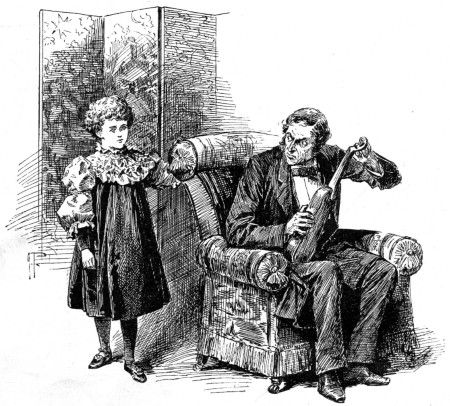
GLADYS: "GRANDPA, WHAT ARE THOSE STRINGS MADE OF?"
GRANDPA: "CAT-GUT, MY DEAR."
GLADYS: "WHAT'S THAT?"
GRANDPA (JOKINGLY): "OH, THE INSIDES OF PUSSIES DEAR."
GLADYS (AFTER A PAUSE): "I SUPPOSE THEY FOUND OUT THEY WERE GOOD FOR THAT ON ACCOUNT OF THE NOISE CATS MAKE!"
TURN THESE UPSIDE DOWN.