"Author! Author!"
Reading edition
By E. W. Hornung.
This story has to do with two men and a play, instead of a woman, and it is none of mine. I had it from an old gentleman I love: only he ought to have written it himself. This, however, he will never do; having known intimately in his young days one of the two men concerned. But I have his leave to repeat the story more or less as he told it—if I can. And I am going to him for my rebuke—when I dare.
"You want to hear the story of poor old Pharazyn and his play? I'm now going to tell it you.
"Ah, well! My recollection of the matter dates from one summer's night at my old rooms in the Adelphi, when he spoilt my night's work by coming in flushed with an idea of his own. I remember banging the drawer into which I threw my papers to lock them away for the night; but in a few minutes I had forgotten my unfinished article, and was glad that Pharazyn had come. We were young writers, both of us; and, let me tell you, my good fellow, young writing wasn't in those days what it is now. I am thinking less of merit than of high prices, and less of high prices than of cheap notoriety. Neither of us had ever had our names before the public—not even in the advertised contents of an unread and unreadable magazine. No one cared about names in my day, save for the half-dozen great ones that were then among us; so Pharazyn's and mine never used to appear in the newspapers, though some of them used our stuff.
"In a manner we were rivals, for we were writing the same sort of thing for the same sort of publications, and that was how we had come together; but never was rivalry friendlier, or mutually more helpful. Our parts were strangely complementary; if I could understand for the life of me the secret of collaboration, which has always been a mystery to me, I should say that I might have collaborated with Pharazyn almost ideally. I had the better of him in point of education, and would have turned single sentences against him for all he was worth; and I don't mind saying so, for there my superiority ended. When he had a story to tell, he told it with a swing and impetus which I coveted him, as well I might to this day; and if he was oftener without anything to write about, his ideas would pay twenty shillings in the pound, in strength and originality, where mine made some contemptible composition in pence. That is why I have been a failure at fiction—oh, yes, I have! That is why Pharazyn would have succeeded, if only he had stuck to plain ordinary narrative prose.
"HE SKETCHED THE NEW STORY."
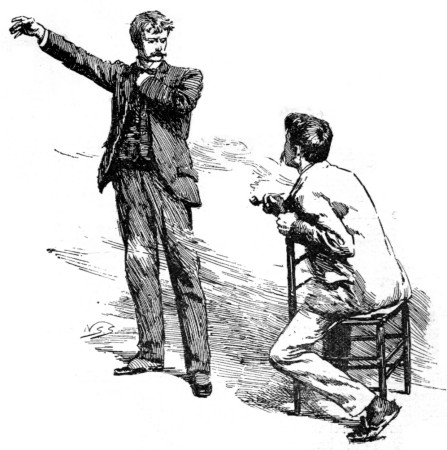
"The idea he was unable to keep within his own breast, on the evening of which I am telling you, was as new, and simple, and dramatic as any that ever intoxicated the soul of story-teller or made a brother author green with envy. I can see him now, as I watched him that night, flinging to and fro with his quick, nervous stride, while he sketched the new story—bit by bit, and often the wrong bit foremost; but all with his own flashing vividness, which makes me so sorry—so sorry whenever I think of it. At moments he would stand still before the chair on which I sat intent, and beat one hand upon the other, and look down at me with a grand, wondering smile, as though he himself could hardly believe what the gods had put into his head, or that the gift was real gold, it glittered so at first sight. On that point I could reassure him. My open jealousy made me admire soberly. But when he told me, quite suddenly, as though on an afterthought, that he meant to make a play of it and not a story, I had the solid satisfaction at that moment of calling him a fool.
"The ordinary author of my day, you see, had a certain timorous respect for the technique of the stage. It never occurred to us to make light of those literary conventions which it was not our business to understand. We were behind you fellows in every way. But Pharazyn was a sort of forerunner: he said that any intelligent person could write a play, if he wanted to, and provided he could write at all. He said his story was a born play; and it was, in a way; but I told him I doubted whether he could train it up with his own hand to be a good-acting one. I knew I was right. He had neither the experience nor the innate constructive faculty, one or other of which is absolutely necessary for the writing of possible plays. I implored him to turn the thing into a good dramatic novel, and so make his mark at one blow. But no; the fatal fit was on him, and I saw that it must run its course. Already he could see and hear his audience laughing and crying, so he said, and I daresay he could also feel the crinkle of crisp weekly receipts. I only know that we sat up all night over it, arguing and smoking and drinking whisky until my windows overlooking the river caught the rising sun at an angle. Then I gave in. For poor old Pharazyn was more obstinate than ever, though he thanked me with the greatest good temper for my well-meant advice.
"'And look here, my boy,' says he, as he puts on his hat, 'you shan't hear another word about this till the play's written; and you are to ask no questions. Is that a bargain? Very well, then. When I've finished it—down to the very last touches—you shall come and sit up all night with me, and I'll read you every word. And by gad, old chap, if they give me a call the first night, and want a speech—and I see you sitting in your stall, like a blessed old fool as you are—by gad, sir, I'll hold up you and your judgment to the ridicule of the house, so help me never!'
"I COULD SMELL HIS PIPE THROUGH THE KEYHOLE."
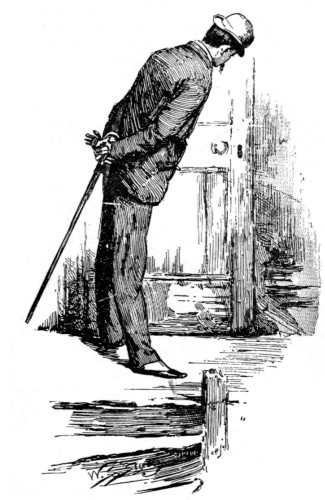
"Well, I am coming to that first night presently. Meanwhile, for the next six months, I saw very little of Pharazyn, and less still in the new year. He seldom came to my rooms now; when he did I could never get him to stay and sit up with me; and once when I climbed up to his garret (it was literally that), he would not answer me, though I could smell his pipe through the key-hole, in which he had turned the key. Yet he was perfectly friendly whenever we did meet. He said he was working very hard, and indeed I could imagine it; his personal appearance, which he had never cherished, being even untidier, and I am obliged to add seedier, than of old. He continued to send me odd magazines in which his stuff happened to appear, or occasionally a proof for one's opinion and suggestions; we had done this to each other all along; but either I did not think about it, or somehow he led me to suppose that his things were more or less hot from the pen, whereas many of mine had been written a twelvemonth before one saw them in type. One way or another, I gathered that he was at work in our common groove, and had shelved, for the present at all events, his proposed play, about which you will remember I had undertaken to ask no questions.
"I was quite mistaken. One night in the following March he came to me with a haggard face, a beaming eye, and a stout, clean manuscript, which he brought down with a thud on my desk. It was the play he had sketched out to me eight or nine months before. I was horrified to hear he had been at work upon it alone from that night to this. He had written, so he said, during all this time, not another line, only each line of his play some ten times over.
"I recollect looking curiously at his shabby clothes, and then reminding him that it was at his place, not mine, I was to have heard him read the play: and how he confessed that he had no chair for me there—that his room was, in fact, three parts dismantled—that he had sacrificed everything to the play, which was worth it. I was extremely angry. I could have helped him so easily, independent as I was of the calling I loved to follow. But there was about him always an accursed, unnecessary independence, which has since struck me—and I think I may say so after all these years—as the mark of a rather humble, very honest origin.
"He read me the play, and I cried over the third act, and so did he. I thought then, and still think, that there was genius in that third act—it took you off your feet. And to me, certainly, it seemed as if the piece must act as well as it read, though indeed, as I took care to say and to repeat, my opinion was well-nigh valueless on that point. I only knew that I could see the thing playing itself, as I walked about the room (for this time I was the person who was too excited to sit still), and that was enough to make one sanguine. I became as enthusiastic about it as though the work were mine (which it never, never would or could have been), yet I was unable to suggest a single improvement, or to have so much as a finger-tip in the pie. Nor could I afterwards account for its invariable reception at the hands of managers, whose ways were then unknown to me. That night we talked only of one kind of reception. We were still talking when the sun came slanting up the river to my windows; you could hardly see them for tobacco-smoke, and we had emptied a bottle of whisky to the success of Pharazyn's immortal play.
"HIS MANUSCRIPT RAGGED BUT UNREAD."
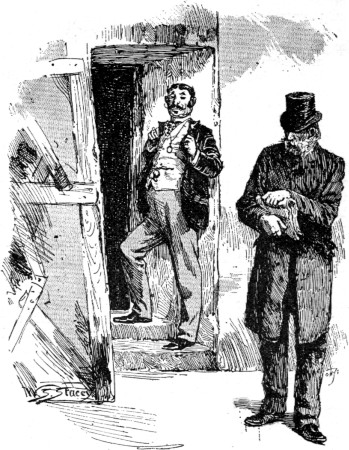
"Oh, those nights—those nights once in a way! God forgive me, but I'd sacrifice many things to be young again and feel clever, and to know the man who would sit up all night with me to rule the world over a bottle of honest grog. In the pale light of subsequent revelations I ought, perhaps, to recall such a night, with that particular companion, silently and in spiritual ashes. But it is ridiculous, in my opinion, to fit some sort of consequence to every little insulated act; nor will I ever admit that poor Pharazyn's ultimate failing was in any appreciable degree promoted or prepared for by those our youthful full-souled orgies. I know very well that afterwards, when his life was spent in waylaying those aforesaid managers, in cold passages, on stage doorsteps, or, in desperation, under the public portico on the street; and when a hundred snubs and subterfuges would culminate in the return of his manuscript, ragged but unread: I know, and I knew then, that the wreck who would dodge me in Fleet Street, or cut me in the Strand, had taken to his glass more seriously and more steadily than a man should. But I am not sure that it matters much—much, you understand me—when that man's heart is broken.
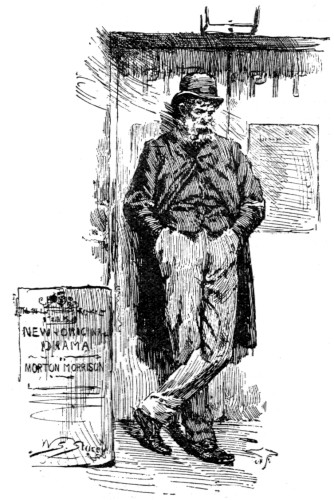
"The last words I was ever to exchange with my poor old friend keep ringing in my head to this day, whenever I think of him; and I can repeat them every one. It was some few years after our intimacy had ceased, and when I only knew that he had degenerated into a Fleet Street loafer of the most dilapidated type, that I caught sight of him one day outside a theatre. It was the theatre which was for some years a gold-mine to one Morton Morrison, of whom you may never have heard; but he was a public pet in his day, I can tell you, and his day was just then at its high noon. Well, there stood Pharazyn, with his hands in his pockets and a cutty-pipe sticking out between his ragged beard and moustache, and his shoulders against the pit door, so that for once he could not escape me. But he wouldn't take a hand out of his pocket to shake mine; and when I asked him how he was, without thinking, he laughed in my face, and it made me feel cruel. He was dreadfully emaciated, and almost in rags. And as I wondered what I ought to do, and what to say next, he gave a cough, and spat upon the pavement, and I could see the blood.
"THERE STOOD PHARAZYN."
"I don't know what you would have done for him—but for all I knew what had brought him to this, I could think of nothing but a drink. It was mid-winter, and I tell you the man was in rags. I felt that if I could get him to a bar he might eat something, too, and that I should get a hold of him this time which I would never again let go. Judge of my surprise when he flatly refused to come with me even for a drink.
"'Can't you see? he said in his hollow voice. 'There'll be a crowd here directly, and I want the best seat in the pit—the best in the house. I've been going dry for it these two days, and I'm going dry till I've seen the piece. No, I've been here an hour already, and there's three hours more, I know; but I'm not going to risk it, thanks all the same.'
"By this I had remembered that Morton Morrison was to re-open that night with a new piece. Indeed, I ought not to have forgotten that, seeing that I had my order about me somewhere, and it meant a column from my pen between twelve and one that night. But this sudden, sorry meeting had put all other thoughts out of my head.
"'My dear fellow,' I said, with a sort of laugh, 'are you a first-nighter, too?'
"'Only at this theatre.'
"He looked me queerly in the face.
"'You admire Morrison very much?'
"'I love him!'
"I suppose my eyes thawed him, though God knows how hard I was trying not to hurt him with pitying looks. At all events he began to explain himself of his own accord, very impetuously; indeed I rather think the outburst was purely involuntary.
"'Look here,' he said, with his hoarse voice lowered: 'I hoped never to see your face again. I hoped you'd never see mine. But now you are here, don't go this minute, and I'll tell you why I think so much of Morton Morrison. I don't know him, mind you—he doesn't know me from Adam—but once long ago I had something to do with him. And God bless him, but damn every other manager in London, for he was the only one of the lot that gave me a civil hearing and a kind word!'
"I knew what he was talking about, and he knew that I knew, for we had understood one another in the old days.
"'I took it to him last of all,' he went on, wiping his damp lips with his hand. 'When I began hawking it about he was an unknown man; when his turn came he was here. He let me read it to him. Then he asked me to leave it with him for a week; and when I went back to him, he said what they had all said—that it would never act! But Morton Morrison said it nicely. And when he saw how it cut me up, into little bits, he got me to tell him all about everything; and then he persuaded me to burn the play, instead of ruining my life for it; and I burnt it in his dressing-room fire, but the ruin was too far gone to mend. I wrote that thing with my heart's blood—old man, you know I did! And none of them would think of it! My God! But Morrison was good about it—he's a good soul—and that's why you'll see me at every first night of his until the drink finishes its work.'
"I had not followed him quite to the end. One thing had amazed me too much.
"'You burnt your play,' I could only murmur, 'when it would have turned into such a novel! Surely you have some draft of it still?'
"'I burnt the lot when I got home,' Pharazyn replied; 'and by-and-by I shall join 'em and burn too!'
"I had nothing to answer to that, and was, besides, tenacious of my point. 'I don't think much of the kindness that makes one man persuade another to burn his work and throw up the sponge,' said I, with a good deal of indignation, for I did feel wroth with that fellow Morrison—a bread-and-butter drawing-room actor, whose very vogue used to irritate me.
"WHAT DO YOU THINK OF THIS?"
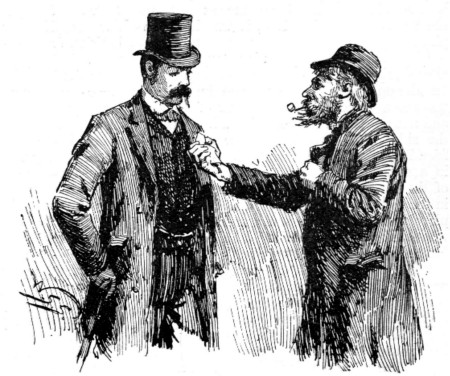
"'Then what do you think of this?' asked Pharazyn, as he dipped a hand within his shabby coat, and cautiously unclenched it under my nose.
"'Why, it's a five-pound note!'
"'I know; but wasn't that kind, then?'
"'So Morrison gave you this!' I exclaimed.
"Two or three persons had stopped to join us at the pit door, and Pharazyn hastily put the note back in his pocket. As he did so, his dreadfully shabby condition gave my heart a fresh cut.
"'Are you never going to spend that?' I asked in a whisper; and in a whisper he answered:—
"'Never! It is all my play has brought me—all. It was given me as a charity, but I took it as my earnings—my earnings for all the work and waiting, and blood and tears, that one thing cost me. Spend it? Not I! It will bury me as decently as I deserve.'
"We could converse no more. And the presence of other people prevented me from giving him my overcoat, though I spoke of it into his ear, begging and imploring him to come away and take it while there was still time for him to clip back and get a seat in the front row. But he would not hear of it, and the way he refused reminded me of his old stubborn independence; all I got was a promise that he would have a bite with me after the performance. And so I left him in the frosty dusk, ill-clad and unkempt, with the new-lit lamp over the pit door shining down upon the haggard mask that had once been the eager, memorable face of my cleverest friend.
"I saw him next the moment I entered the theatre that evening, and I nodded my head to him, which he rebuked with the slightest shake of his own. So I looked no more at him before the play began, comprehending that he desired me not to do so. The temptation, however, was too strong to go on resisting, for while Pharazyn was in the very centre of the front row in the pit, I was at one end of the last row of the stalls; and I was very anxious about him, wanting to make sure that he was there and not going to escape me again, and nervous of having him out of my sight for five minutes together.
"Thus I know more about the gradual change which came over Pharazyn's poor face, as scene followed scene, than of the developments and merits of those scenes themselves. My mind was in any case running more on my lost friend than on the piece; but it was not till near the end of the first act that the growing oddity of his look first struck me.
"His eyebrows were raised; it was a look of incredulity chiefly; yet I could see nothing to impale for improbability in the play as far as it had gone. I was but lightly attending, for my own purposes, as you youngsters skim your betters for review; but thus far the situation struck me as at once feasible and promising. Also it seemed not a little familiar to me; I could not say why, for watching Pharazyn's face. And it was his face that told me at last, in the second act. By God, it was his own play!
"It was Pharazyn's play, superficially altered all through, nowhere substantially; but the only play for me, when I knew that, was being acted in the front row of the pit, and not on the stage, to which I had turned the side of my head. I watched my old friend's face writhe and work until it stiffened in a savage calm; and watching, I thought of the 'first night' he had pictured jovially in the old days, when the bare idea of the piece was bursting his soul; and thinking, I wondered whether it could add a drop to his bitterness to remember that too.
"Yet, through all my thoughts, I was listening, intently enough, now. And in the third act I heard the very words my friend had written: they had not meddled with his lines in the great scene which had moved us both to tears long ago in my rooms. And this I swear to, whether you believe it or no—that at the crisis of that scene, which was just as Pharazyn made it, the calm ferocity transfiguring his face died away all at once, and I saw it shining with the sweetest tears our eyes can shed—the tears of an artist over his own work.
"And when the act was over he sat with his head on his hand for some minutes, drinking in the applause, as I well knew; then he left his seat and squeezed out on my side of the house, and I made sure he was coming to speak to me over the barrier; and I got up to speak to him; but he would not see me, but stood against the barrier with a mien as white and set as chiselled marble.
"What followed on the first fall of the curtain I shall relate as rapidly as it happened. Louder call for an author I never heard, and I turned my eyes to the stage in my intense curiosity to see who would come forward; for the piece had been brought out anonymously; and I divined that Morrison himself was about to father it. And so he did; but as the lie passed his lips, and in the interval before the applause—the tiny interval between flash and peal—the lie was given him in a roar of fury from my left; there fell a thud of feet at my side, and Pharazyn was over the barrier and bolting down the gangway towards the stage. I think he was near making a leap for the footlights and confronting Morrison on his own boards; but the orchestra came between, and the fiddlers rose in their places. Then he turned wildly to us pressmen, and I will say he had our ear, if not that of the whole house besides, for the few words he was allowed to utter.
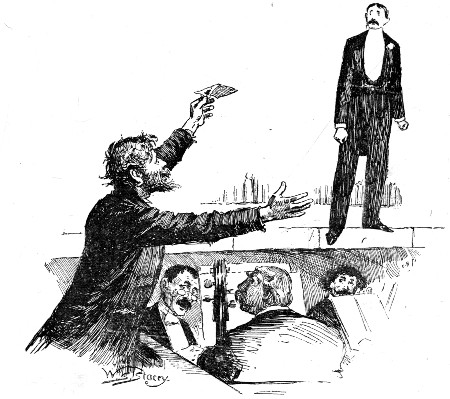
"'Gentlemen!' he cried at the top of his voice—'Gentlemen, I'm one of you! I'm a writing man like yourselves, and I wrote this play that you've seen. That man never wrote it at all—I wrote it myself! That man has only altered it. I read it to him two years ago—two years ago, gentlemen! He kept it for a week, and then got me to burn it as rubbish—when he had made a copy of it! And he gave me this, gentlemen—he gave me this that I give him back!'
"It was a matter of only a few seconds, but not till my own last hour shall I forget Morrison's painted face on the stage, or that sweating white one beneath the boxes; or the fluttering from Pharazyn's poor fingers of the five-pound note he had treasured for two years; or the hush all over the house until the first hand was laid upon his dirty collar.
"'What!' he screamed, 'do none of you believe me? Will none of you stand by me—isn't there a man—not one man among you——'
"And they threw him out with my name on his lips. And I followed, and floored a brute who was handling him roughly. And nothing happened to me—because of what happened to Pharazyn!"
The dear old boy sat silent, his grey head on his hand. Presently he went on, more to himself than to me: "What could I do? What proof had I? He had burnt them every one. And as long as the public would stand him, Morrison kept his good name at least. And that play was his great success!"
"HE GAVE ME THIS."
I ventured gently to inquire what had happened to Pharazyn.
"He died in my arms," my old friend cried, throwing up his head with an oath and a tear. "He died in a few minutes, outside the theatre. I could hear them clapping after he was dead—clapping his piece."
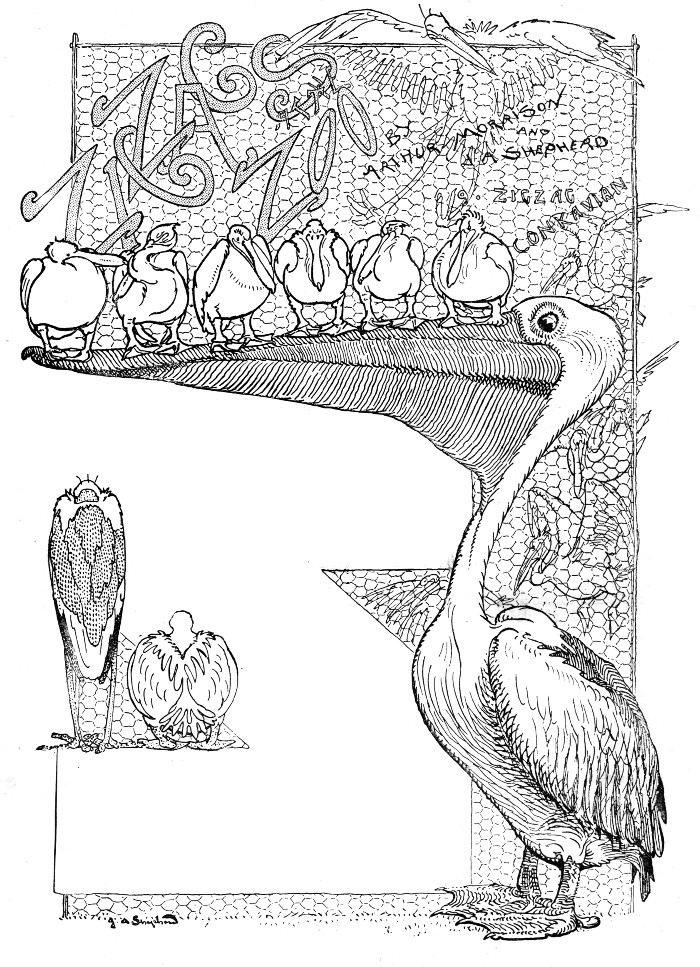
If the gentle reader, full of a general desire for knowledge and a particular enthusiasm for natural history, will refer to any one of the great standard works on birds, and, turning to the index, seek for the family title of the Conkaves, I have every hope and confidence that he will not find it; because, as a matter of fact, it is a little invention of my own, and, I may modestly urge, rather a neat thing in scientific nomenclature, on the whole. It has the advantage of including in one family the storks and the pelicans, which in all orthodox books on birds are planted far apart and out of sight of each other, with many orders, tribes, and families between. Under my title they are gathered amicably together in the common possession of very long bills, like two tailors on a man's doorstep. The word is derived, in the proper and regular manner, from ancient sources; from conk, a venerable Eastern word, signifying a nose or beak, and the Latin avis, a bird. And I offer the term freely as my humble, but I trust useful, contribution to science; my first contribution.
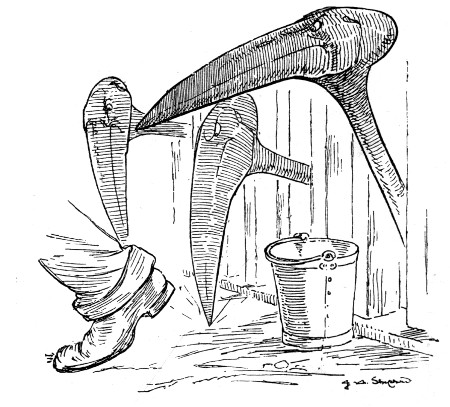
The stork is regarded, in many countries, with a certain semi-superstitious reverence and esteem. After many prolonged and serious attempts to saturate myself with a similar feeling, I regret to confess to a certain smallness of esteem for the stork. You can't esteem a bird that makes ugly digs at your feet and heels with such a very big beak. Out in their summer quarters the storks are kept in by close wire, and close wire will give an air of inoffensiveness to most things. But, away in a by-yard, with a gate marked "private," there stands a shed wherein the storks are kept warm in winter, behind wooden bars; and between these bars stork-heads have a way of dropping at the toes of the favoured passer-by, like to action of a row of roadmen's picks.
PICKS AND CHEWS.
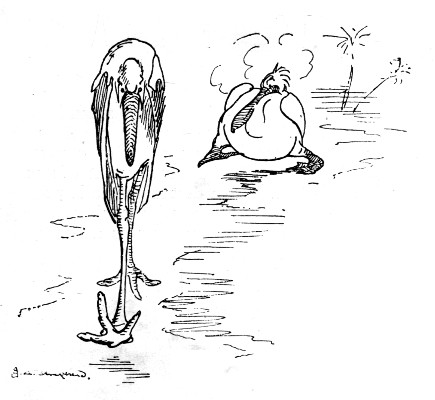
The stork has come off well in the matter of bodily endowment. The pelican has a tremendous beak—achieved, it would seem, by a skimping of material in the legs; but the stork has the tremendous beak and legs of surprising growth as well. His wings, too, are something more than respectable. At flying, at eating, at portentous solemnity of demeanour—in all these and in other things the pelican and the stork score fairly evenly; but at walking the pelican is left behind at once. This makes one suspect the stork's honesty. The pelican has a good beak and wings, and pays for them, like an honest bird, out of its legs, just as the ostrich pays for its neck and legs out of its wings. But the stork is abnormally lucky in beak, neck, legs, and wings together, and even then has material left to lay out in superfluous knobs and wens to hang round its neck, which leads to a suspicion that many of its personal fittings belong properly to some other bird. I've a notion that the unlucky kiwi might identify some of the property.
THE PELICAN LEFT.
ARMY.
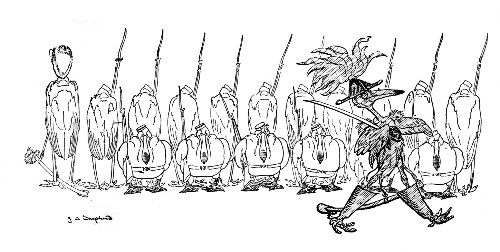
Perhaps the adjutant should be acknowledged king of the conkavians. Billy, the Zoo adjutant, has, I believe, no doubt on the subject at all. Billy is an ornament to the military profession—a very fine fellow, with a thing on the back of his neck like a Tangerine orange, and a wen on the front of it, which he can blow out whenever he wants to amuse himself, and everything else handsome about him. He is an old soldier, too, is Billy, having been Adjutant of the Regent's Park Conkavian Corps for seventeen years; but if you knew nothing of his age, still you would call Billy an old soldier—upon a little acquaintance with his habits.
LAW.
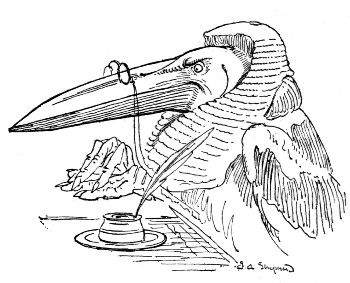
There seems no valid reason why the professional aspirations of the stork should be restricted to the army. If an adjutant, why not a dean? Why not a proctor? There is the making of a most presentable don about a stork; and I have caught a stork in an attitude of judicial meditation that might do honour to any bench. There is no reason why "sober as a judge" should not be made to read "sober as a stork," except that the stork is the more solemn creature of the two; and I think that some species of stork—say the marabou, for instance—might fairly claim brevet rank as judge, after the example of the adjutant. The elevation of a beak to the bench might be considered an irregular piece of legal procedure; but, bless you, it's nothing unusual with a stork. Put any bench with something to eat on it anywhere within reach of a stork's beak in this place, and you shall witness that same elevation, precedent or no precedent.
UNIVERSITIES.
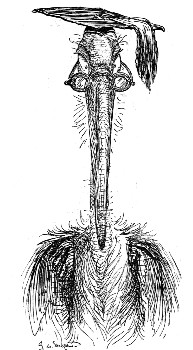
A common white stork hasn't half the solid gravity of an adjutant or a marabou. He has a feline habit of expressing his displeasure by blowing and swearing—a habit bad and immoral in a cat, but worse in a stork accustomed to Church. Church, by-the-bye, is the keeper of all the conkavians, as well as of the herons, the flamingoes, the ibises, the egrets, and a number of other birds with names more difficult to spell. It is impossible to treat disrespectfully a man with such widespread responsibilities as this, or there might be a temptation to mention that he is not an unusually high Church, although his services are not always simple, often involving a matter of doctorin'. But, then, some people will say anything, temptation or none. And after all, it is pleasant to know that, whatever a stork or a pelican wants, he always goes to Church.
SWEARING.
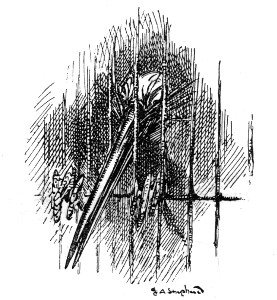
CHURCH.
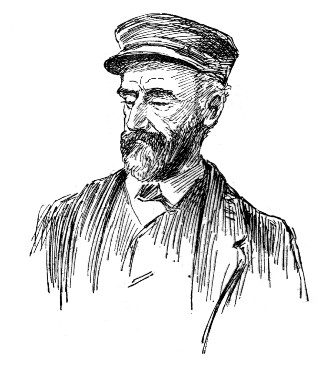
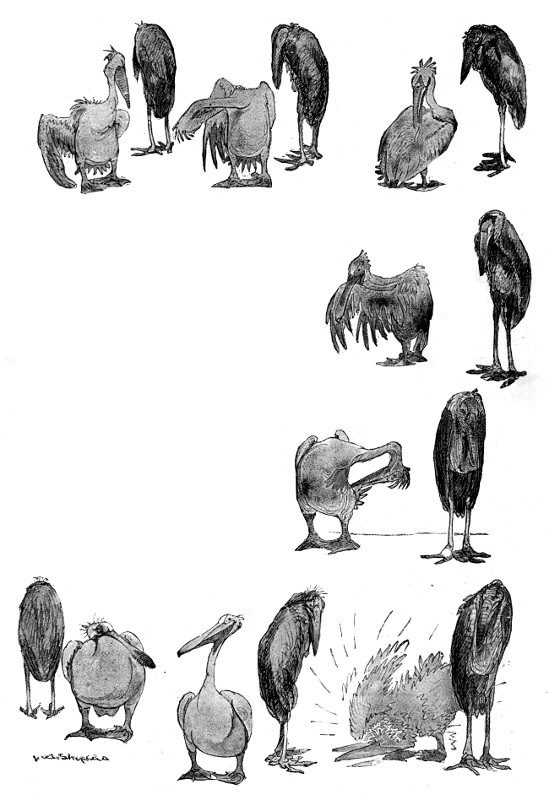
This being the case, there is a proverb about cleanliness that makes one wonder why the marabou stork doesn't wash himself. It isn't as though he never wanted it. I have a horrible suspicion about this philosophic old sloven. I believe his profession of philosophic contemplation is assumed, because it is the easiest excuse for indolence. Now, a pelican is not a bird of graceful outline, but he is careful about his feathers. The pelican is a scrupulous old Dutchman, and the stork is an uncleanly old Hindu. And uncleanly he must be left, for it takes a deal to shame a stork. You can't shame a bird that wraps itself in a convenient philosophy. "Look here—look at me!" you can imagine a pelican cleanliness-missionary saying to the stork. "See how white and clean I keep all my feathers!" "Um," says the stork, "it only makes 'em a different colour." "But observe! I just comb through my pinions with my beak, so, and they all lie neat and straight!" "Well, and what's the good of that?" grunts the stork. "And then you see," says the pelican, ignoring the question, "with a good long beak you can reach everywhere, over your back and under your wings; see, I'm as clean under my wings as anywhere else, although it's covered up!" "Beastly vanity," growls the old Hindu, getting bored. "Then," continues the Dutchman, "you give yourself a good shake, and there you are!" "And then," says the philosopher sarcastically, "to-morrow, I suppose, you'll have to do it all over again?" "Of course!" "Oh! I hate a fool!" says the stork, and closes the lecture.
Thus the marabou. The ordinary white stork is comparatively respectable, and so is the adjutant—or comparatively almost respectable, let us say; you can't be too cautious in giving a personal character to a stork. For long, long, the stork has enjoyed a reputation for solemn wisdom, for philosophical dignity. Now for the first time I venture to question this reputation—to impeach the stork as a humbug. It is easy to achieve a reputation for profound and ponderous wisdom, so long as one looks very solemn and says nothing. This is the stork's recipe. Go up to Billy here, or one of the marabous, as he stands with his shoulders humped up about his head, and make a joke. He won't see it. He will lift his eyebrows with a certain look of contempt, and continue to cogitate—about nothing. If the joke is a very bad pun—such a frightful pun that even a stork will see and resent it—perhaps he will chatter his beak savagely, with a noise like the clatter of the lid on an empty cigar-box; but he will continue his sham meditations. "Ah, my friend," he seems to say, "you are empty and frivolous—I cogitate the profounder immensities of esoteric cogibundity." The fact being that he is very seedy after his previous night's dissipation.
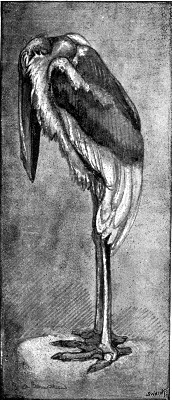
That is the chief secret of the stork's solemnity, I am convinced. He has a certain reputation to maintain before visitors, but after hours, when the gates are shut and the keepers are not there to see, the marabou stork is a sad dog. I haven't quite made up my mind what he drinks, but if he has brandies and sodas he leaves out too much soda. Look at that awful nose! It is long past the crimson and pimply stage—it is taking a decided tinge of blue. It looks worse than brandy and soda—almost like bad gin—but we will be as charitable as possible, and only call it brandy and soda.
I should like to see the marabou stork on his nightly ran-tan, if only to gloat over his lapse of dignity, just as one would give much to see Benjamin Franklin with his face blacked, drunk and disorderly and being locked up. But, as a shocking example, the marabou is quite bad enough with his awful head in the morning; his awful head and his disreputable nose, that looks to want a good scraping. I respect Billy, the adjutant, for his long service and the Tangerine at the back of his neck. The ordinary stork (although he swears and snaps) I also respect, because the goody books used to tell pious lies about him. The whale-headed stork, which is also called the shoe-bird, I respect as a sort of relative of the shoo-fly that didn't bother somebody. But the marabou has forfeited all respect—converted it into nose-tint. I must talk to Church seriously about the marabou.
THE RAN-TAN.
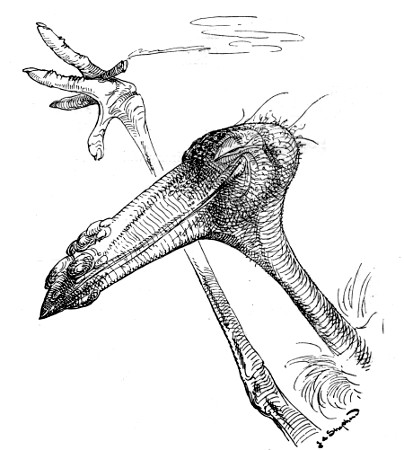
Now, the pelican is no humbug. There is nothing like concealment about his little dissipations; and he is perfectly sober. Any little irregularity at the pelican club just opposite the eastern aviary never goes beyond a quiet round or two for a little fish dinner. It is quite a select and a most proper club. Indeed, the first rule is, that if any loose fish be found on the club premises, he is got rid of at once by the first member who detects him. And the club spirit is such that disputes frequently occur among members for the honour of carrying out this salutary rule. The chairman of the club is an old crested pelican, who, by some oversight, has never been provided with a private name of his own. I think he should be called Peter, because he can take such a miraculous draught of fishes. It is a draught; you know—a pelican doesn't eat fishes—he drinks them down in bulk. For Peter, a dozen or so fresh herrings is a mere swill round of the mouth.
A QUIET ROUND OR TWO.
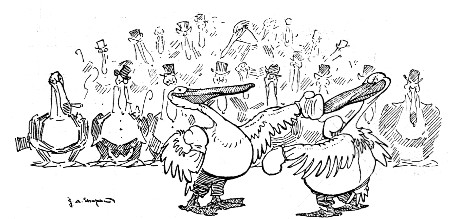
Peter walks about the club premises with much dignity, deferred to on all sides by the other members. His kingship is rarely disputed, having been achieved by the sort of conquest most familiar in the pelican club; and his divine right is as much respected as his tremendous left.
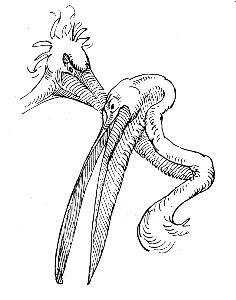
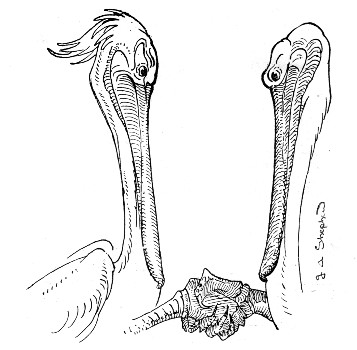
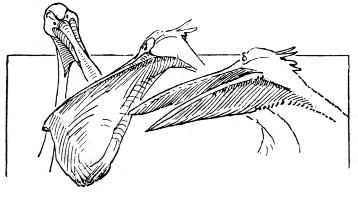
A pelican never bears malice; he hasn't time, especially now, with competition so keen in the fish business, and Church's fish pails only of the ordinary size. There is never any ill-feeling after a little spar, and each proceeds, in the most amicable way, to steal some other pelican's fish. A spar at this club, by-the-bye, is a joyous and hilarious sight. Two big birds with stumpy legs and top-heavy beaks, solemnly prancing and manœuvring before one another with an accompaniment of valiant gobbles and a punctuation of occasional pecks—a gleesome spectacle.
PETER.
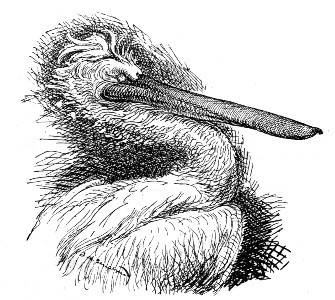
A SWILL ROUND.
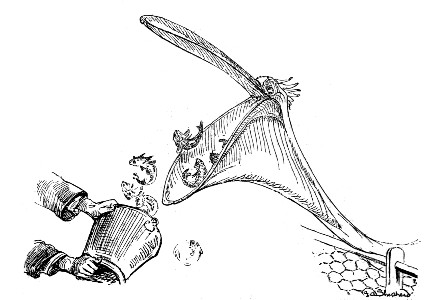
Another sport much exhibited at the pelican club is that of the broadsword. The school of fence is that of Mr. Vincent Crummies—one—two—three—four—over; one—two—three—four—under. You see, when a dozen or two birds with beaks a couple of feet long or so get together in a small area, and now and again rush all in the same direction for fish, fencing is certain to develop, sooner or later. So here you have it, secundum artem—one—two—three—four—over; one—two—three—four—under; and although none have yet attained the Crummleian degree of knocking out sparks, there is a deal of hollow noise, as of thumping on a wooden box. But there is never any after-malice, and in less than five minutes either combatant will swallow a fish rightfully belonging to the other, with perfect affability.
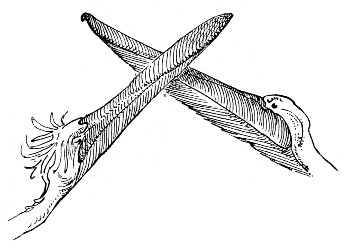
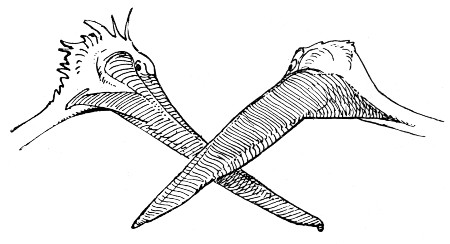
There is a good deal of the philosopher about the pelican, and of a more genuine sort than characterizes the stork. The pelican always makes the best of a bad job, without going into an unnecessary tantrum over it. If another member of the club snatches a fish first, the pelican doesn't bother, but devotes his attention to the next that Church throws; a fish in the pouch is worth a shoal in somebody else's. Now and again Peter loses his temper for a moment if the others catch the first snack, and lays about him with his bill—but then, when a fellow's chairman, and a lot of other fellows come snatching the lunch from under his nose—why, hang it all, you know.... But it is only for a moment, and Peter is soon in position for the next pouchful. He is artful about this position. When Church appears at the rails with a pailful of fish most of the members rush to those rails, jostle together and shove their beaks through them and over them—any way to get nearer the pail. But the chairman knows very well that Church doesn't throw the fish outside the rails, but into the inclosure, somewhere near the middle; and near the middle the sagacious Peter waits, to his early profit—unless Church is unusually slow about throwing the fish, in which case Peter is apt to let his excitement steal his sagacity, and to rush into the pell-mell, anxious to investigate the delay.
A LITTLE SOLEING AND HEELING.
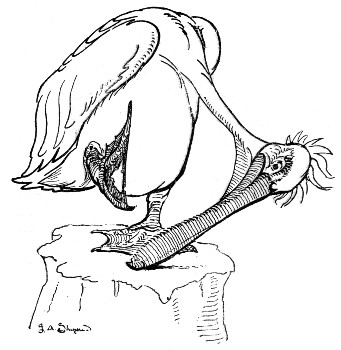
There is a deal of excellent wear in a pelican. One has been here about thirty years, and two more have been established on the same premises for a quarter of a century. All these three are in capital working repair and will probably last, with a patch or two, and a little soleing and heeling, for a century or two more; no respectable pelican is ever bowled out for less than three figures.
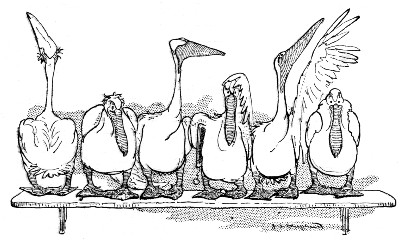
In the winter the club takes up its quarters in the shed behind the inclosure; a shed sumptuously furnished with certain benches and forms, whereon the club stands in rows, with a general appearance of a number of very solemn naughty boys in a Board school. In winter, too, Church will often put his bucketful of fish on the ground, so that the club may dine in a clubbier way. But whether you watch this club feeding together from the pail, each member doing his best to put away the whole pailful at a gulp, or whether you observe them playing a sort of greedy game of lacrosse with fish which Church throws them, you will be equally amazed that the pelican was used as a symbol of charity and brotherly love in early and middle Christian art.
SCHOOL.
CLUB DINNER.
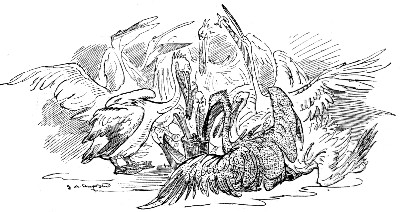
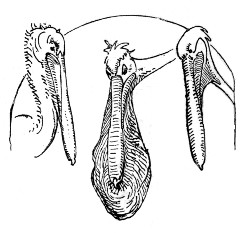
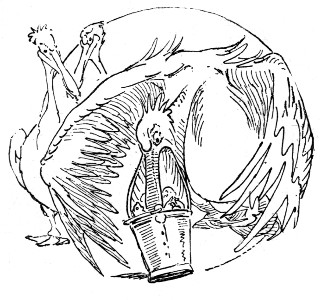
I have seen a pelican enact a most instructive moral lesson at a pail-dinner. Observe the bill and pouch of a pelican. The pouch is an elastic fishing-net, and the lower mandible is a mere flexible frame to carry it. Now, I have observed a pelican to make a bounce at the fish-pail, with outspread wings, and scoop the whole supply. But then his trouble began. The whole catch hung weightily low in the end of the pouch, and jerk and heave as he might, he could never lift the load at the end of that long beak sufficiently high to bolt it. Meanwhile, his friends collected about him and remonstrated, with many flops and gobbles, betting him all his fish to nothing that he would lose it after all; this way they chased that bag, and that way, while the bagger, in much trepidation and with many desperate heaves, wildly sought remote corners away from his persecutors. Now, by the corner of the club premises stands an appliance, the emblem of authority, the instrument of justice, and the terror of the evilly-disposed pelican—a birch-broom. This, brandished in the hands of Church, caused a sudden and awful collapse of the drag-nets, an opening, a shower of fish and many snaps; wherefrom walked away many pelicans with fish, and one with none, who had looked to take all. The moral is plain to the verge of ugliness.
.
.
.
.
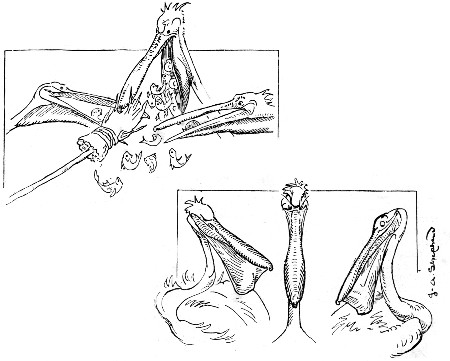
A pelican has no tongue—or none to speak of. It is a mere little knob scarcely the size of a cherry. The long, long meditations of the pelican (lasting between feeding times) are given up to consideration whether or not the disgrace of this deficiency is counter-balanced by the greater capacity for fish which it gives the pouch. After all, it is only another instance of that commercial honesty which makes the pelican pay for his beak out of his legs; he gives his tongue for a pouch. There should be a legend of the pelican applying honestly to Adam to buy a pouch, and the wily stork waiting and waiting on the chance of snatching one without paying for it, until all had been served out; afterwards living all its life on earth in covetous dudgeon, unconsoled by its wealth of beak, legs, wings, and neck, and pining hopelessly for the lost pouch. There are many legends of this sort which ought to exist, but don't, owing to the negligence of Indian solar myth merchants, or whoever it is has charge of that class of misrepresentation.
.
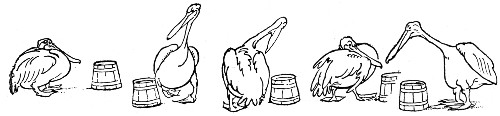
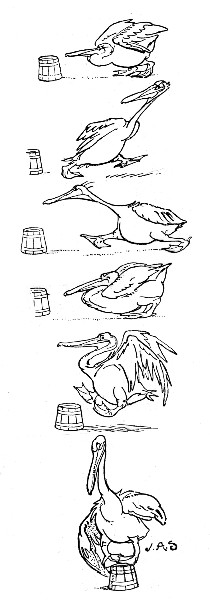
The pelican can fly, although you would never believe it, to look at the club members here. To a Zoo pelican a flight of two feet is an undertaking to be approached with much circumspection and preparation, and a summoning of resolution and screwing of courage proper to the magnitude of the feat. It takes a long time to learn to fly on to a bottom-up bucket. The Zoo pelican begins on a shadow—not a very dark one at first—and works his way up by jumping over, darker shadows to straws and pebbles, before he tries a bucket. The accomplished bucket-jumper makes a long preliminary survey and circumnavigation of his bucket before performing, and when he does begin it is with a number of wild rushes and irresolute stops. When at last he gets the proper length of run, and the right foot in front, and doesn't see anything to baulk him, he rises with a great effort, and all the lookers-on who don't know him stare up over the trees, and are astonished to find him, after all, only on the bucket. His pinions are cut, poor fellow! If they were not, what would become of the fishmongers' shops?