The Waltz in "Faust."
Reading edition
By Richard Dowling.
Y original name was John Fowler. I am known to the world by one much more high sounding. This is the first time since I came to man's estate that I have written the name of my boyhood, and I have never spoken it. The one I have gone by most of my life is hardly more removed in splendour from plain John Fowler than the life of variety and rich experiences I now enjoy compared with the experience of my early years. I follow one of the fine arts as a profession, and in the impetuous days of my youth I adopted a nom de guerre of fine sound and picturesque associations.
I have refused all requests that I would furnish an account of my youth. I would not speak of it now if I did not feel absolutely certain that the man well known in certain art circles in London can never be identified through the autobiographical sketch with John Fowler, the miller's youngest son.
Private reasons, of no interest to the public, prevent me localising my early home. I am neither a criminal nor a hero, that people should be interested in my private life, and my only romantic experience will be found in this narrative. Telling my story over here will beguile my heart of a troublesome unrest which came to be positive pain, pain springing from a flood of memories, when a few moments ago a piano-organ at the next house played the waltz in "Faust."
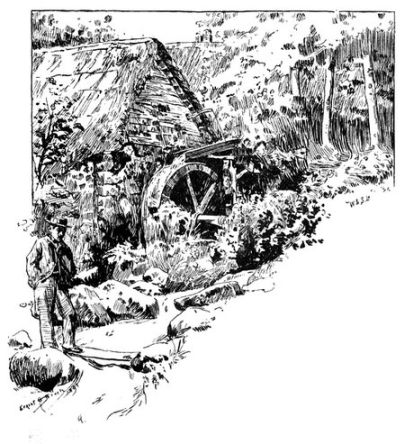
THE MILL AT BRACKEN GLEN.
I was born in the dwelling-house attached to a water-mill in a secluded glen far away in the north of England. My family held religious views shared by no sect I ever heard of, and lived lives of extraordinary austerity. No mirror, no musical instruments, no volumes of poetry, no novels, no games of any kind were permitted in our house. The furniture was the most simple, consistent with maintaining bodily efficiency for the performance of the day's work without hindrance or loss of time; our carpets were of the dullest colour, and were considered merely as a means of keeping out the cold and economising fuel. We had curtains on the windows, but they were only to exclude or divert the draughts. Our clothes were ample and warm, but they were of the hues of the earth in winter. We spoke few words and in low tones. We ate and drank in silence. We had no place of worship. The whole Sunday was spent in solemn walks and reading the Scriptures and a few pious books. We regarded Quakers as lax Christians.
The household consisted of my father, his wife and children, and my father's brother, his wife and children. We were so large a family that all the mill work was done without the aid of strangers, and we all lived under one roof, in the mill house of Bracken Glen. I was the youngest, the youngest of all.
Before I knew of any world beyond the mill and Bracken Glen, I thought it was a busy and cheerful place. Now that I come to look back on it I know it was one of the most desolate and lonely situations in all England. People talk of the woes of solitude in the forest, in an unpeopled island, in a crowd. But the most terrible and corroding solitude of all is that of a small group of human beings, a large family sunk deep among mountains far out of the reach of ordinary human intercourse, and living in such strict customs and observances as obtained at Bracken Glen. Of course we had the business always going on, and that prevented our people from going mad. But the mill was not in the main road. You had to turn up into the Glen to reach it, and no faces ever appeared in the yard but the faces of people coming on business to the mill.
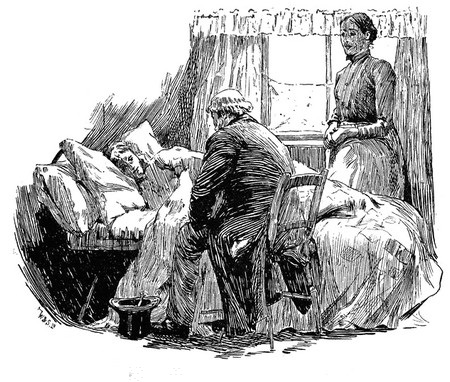
"I FELL GRIEVOUSLY ILL."
As I have said, I was the youngest of the whole Fowler family, brothers and sisters and cousins. The winter that I was twelve years of age I fell grievously ill, so ill that they thought I should never recover. Then, for the first time, I saw a doctor. Our people had no great faith in doctors, and this was the only occasion on which one had been in Bracken Glen for ten years.
My father and mother were assured that I was certain to die if I were not instantly sent to a milder climate, say the Isle of Wight or some genial part of the South Coast. There was a grave demur, a long debate, and finally I was despatched to the home of a married cousin whose name I had heard and of whom I knew little except that he was the son of my father's eldest sister, that he was not a miller, which was a reproach to him, and that he did not conform to the observances seen at Bracken Glen, or indeed hold the same form of religious belief.
I was too weak and wretched when I left home to care about anything, to care whether I was moved or not, whether I was to taste warmer air or not, whether I lived or not. If they would only let me alone I think I should have preferred to die.
I was taken from the cold, bleak, northern Glen where, although we ground corn never any grew, and carried hundreds of miles south; an interminable journey, it seemed to my young mind and feeble, sensitive body.
All through that winter I was delicate, and not allowed out of doors. My cousin's name was Harding. I had never met either him or his wife before. He was about thirty, and she twenty-five. They were simple people, with much of the hereditary aversion from frivolity, but they were not dogmatic or censorious, and they were beyond and above all the very kindest people I ever met in all my life. They lived a mile out of the little town of Bickerton, on the high road. They were childless. He traded in corn in Bickerton. The taste for grain seemed to run in the blood of our family.
In my old home my education had not been neglected. I could read and cypher, and I knew the heaviness of all the weights, and the dryness of all the dry measures. My father had taught me the elements of Euclid and Algebra, and I remember that the most awful terrors were in my mind of what these sciences could be in operation if their mere elements were so forbidding, and cold, and tyrannical. My father had a theory that any man able to "keep a set of books" could never be ship-wrecked in life. He had tried to instil a passion for book-keeping into my mind. So intense was my loathing of that black art that to this day the mere mention of it rouses me to fury. In fine, I may say that I had laid the foundation of what was called a commercial education, and upon this I had raised up my own sole and overwhelming horror of arithmetical figures, triangles, debtor and creditor, and unknown quantities.
Sufficient of the old leaven of the Fowlers worked in Harding, not only to draw him into the grain trade, but to make him still shy of "sweet sounds that give delight and hurt not." There was no musical instrument in the house, but books—
There were hundreds of books!
An inexhaustible mine of books, and such as I had never dreamed of before! Books that my cousins Nellie and George had had when they were young. Fairy tales and stories of adventure, novels and poetry!
In the cold grey times of that winter my soul took fire. My spirit sprang up from long drowsing in the husk of the chrysalis, and put forth golden and azure and purple wings, and soared into skies of endless glories beyond the sun. All day long I went enchanted through enchanted palaces, where moved stately princesses with gold brocaded robes and haughty eyes, and voices of mystic tones. I led armies against the Saracen, and spread terrors never dreamed on earth before, and exercised clemencies that made heaven envious. I headed cavalcades through winding streets where the air was thick with banners. I bore the Black Knight backward out of his saddle in the list, and clove the plumed helmet of the leaguer in the breach. I harangued my troops on the field of victory, and pardoned my foes in the shrines of their heathen gods.
But I did not know how the sound of a trumpet stirred, or what dancing was, or love. I had never heard a musical instrument in my life or seen a festival, and I was too young for love—and yet, perhaps, not all too young for noble love and chivalry, if the princess or the lady came my way.
With the spring of the next year health began to stir in my veins. I shook off all the lassitudes and languors of illness, and by April I felt better than ever in my young life before. With returning health, the romantic rapture which had come to me out of books grew and intensified. There was no talk of my going home, or more correctly, there had been talk of it, and my kind relatives, the Hardings, had declared that nothing but force should take me from them until I had been fully fortified by spending a whole summer in the more genial south.
In our own Glen, all the time I could steal from the detested weights and measures and triangles, and debit and credit side of the fabulous transactions of that creature, John Jones, Esq., I spent far afield among the hills. Here, near Bickerton, this spring I found all I cared for of Nature in the sky above me, and in the large, old-fashioned garden; and all I desired of enchantment in the magical books. I rarely went beyond the garden-gate, and never into the town. I became a youthful recluse in the boundless realms of fancy. I lorded it over empires and cities of men. Space, the space of the furthest wandering star, was not vast enough to accommodate the realms that rose in mist out of the pages of the poets and romancists.
I was a precocious boy. I knew nothing of boys' games and sports, and all at once I had come out of the cold, arid life at Bracken Glen into the rich and varied lights and colours of poetry. The change was overwhelming and intoxicating. My reading had, in a vague way, been progressive. I had begun with fairy tales. To these had succeeded stories of adventure and travel, and to them poetry and plays. Prose romances and novels came last, for I had fought shy of them at first, considering that they dealt too much with people and scenes like those in my own experience of life. When first I broke free among books I wished to forget the world.
Towards the end of April two things drove me to the novels. The supply of other books had been exhausted, and I began to yearn after a glimpse at what possibilities of poetry and wonder still existed in the world, as the world was going on outside the sphere of my experience. I wanted to see in books the things now visible to other eyes still on earth—things hidden from me by barriers of age and circumstances I could not understand.
From this desire arose the romance of my life.
One evening George Harding mentioned at tea that Mr. Seymour, a gentleman who owned an estate in the neighbourhood and had a fine house, Trafford Manor, a couple of miles further out from Bickerton, was going to give a ball the end of that month. The Hardings did not look on balls as exactly wicked, and said nothing for or against the approaching party. They did not, of course, know the Trafford Manor folk, who were county people, and quite inaccessible to traders in Bickerton.
If my cousins had conscientious scruples against going to balls, and if the social position of the Seymours forbade any chance whatever of an invitation, the husband and wife were willing to talk of the approaching festival. They discussed it in no measured terms. They said it would be the most distinguished and splendid event of the neighbourhood for the year. They enumerated the distinguished and rich and powerful people who would attend. They talked of the grounds being lighted up with lamps, and the house one vast illumination from roof to cellar. They spoke of the dancing and the bounteous table and the plenteous wine and the strings of carriages coming up the drive, of the brilliant costumes, and the jewels and lovely women, of the fountain spouting on the lawn, and the band—the band of famous musicians from London, who, though they came by night to places like Bickerton in sober black cloth coats and played with fiddles, were yet entitled to wear in London magnificent red coats all slashed and braided and piped and gathered with cords and knots of gold; musicians who not only could play with marvellous skill on stringed, brown wood instruments while they sat on chairs, but had, in their natural sphere in London, great brazen and silver instruments to play upon as they rode through the crowded streets of the marvellous capital on jet black prancing chargers, whose bridles were of steel shining like silver, and upon whose forehead blazed burnished, brazen stars.
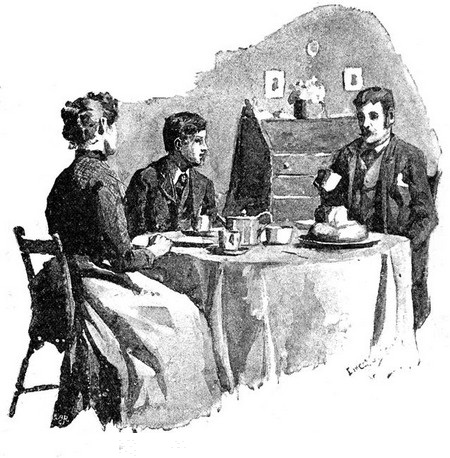
"THEY SPOKE OF THE FAMOUS MUSICIANS."
In the novels I had read there had been descriptions of balls. I had no more thought when reading that it could ever be my luck to see one than I had considered my chance good of fighting North American Indians, or cutting out French sloops, or riding from London to York on Black Bess.
Now, a ball had not only come within my ken, but had been brought to my very door. What could be easier than for me to slip out of my room when all the house was asleep, walk to Trafford Manor, enter the grounds, and behold the miraculous sight through a window or open door, and, when I had filled my soul with a scene of fairy-land realised, steal back to my room unnoticed by anyone in the house? The Hardings were, of course, much older than I. They were man and woman and I only a boy not yet in his teens, but they had no halo of parental awe, no parental authority or infallibility.
I had never in all my life heard a musical instrument. At the ball there would be a band. A band was several musical instruments playing all together. What could that be like? Would it resemble several people talking at once? That would be horribly confusing. But it could not be like several people talking together, for people spoke of a band as a source of fine pleasure. Would a band of several instruments playing at one time be like a parti-coloured card spun round? Hardly; for that only confused the colours, so long as they could be known to be separate colours, and only made a dull stain when they mingled in one tint.
My first care was to keep my intention to myself. My second was to survey the ground of future enterprise. There was no difficulty about either of these precautions. I had merely to hold my tongue and to walk to Trafford Manor along a beautiful, undulating, winding, wooded road which passed by our modest gate, and before the stately portal of the great house.
The beauty of Trafford Manor was renowned in all the south, and the owner was proud of his grounds and opened them to all who chose to see them.
One morning, to the astonishment of my cousin Nellie, I announced my intention of going for a long walk. She was delighted, crammed my pockets full of the best good things in the larder, and declared that she should resent seeing me before dinner.
That whole day I spent in the Trafford demesne. Surely nowhere was scene more fitted for a fairy fête. It was mid April, and clear and sunny weather. The air was full of fresh spices of the swelling buds and of the dainty, delicate, flat leaves already unsheathed and glittering moist and green in the flowing air. It was rapture to live and breathe, and heaven to know as much and no more of the world of things than books taught, no more than enough to set the spirit dreaming. All the senses brought fuel for poetry, if the sacred flame fluttered inside. As yet the trees were only misty with verdure. The depths in depth of vestal green in the woods took the eye into such enchanted bowers of the imagination, it was like praying, to stand and listen to the soft, ample murmurs of the multitudinous leaves as the broad air came by them out of the opening south.
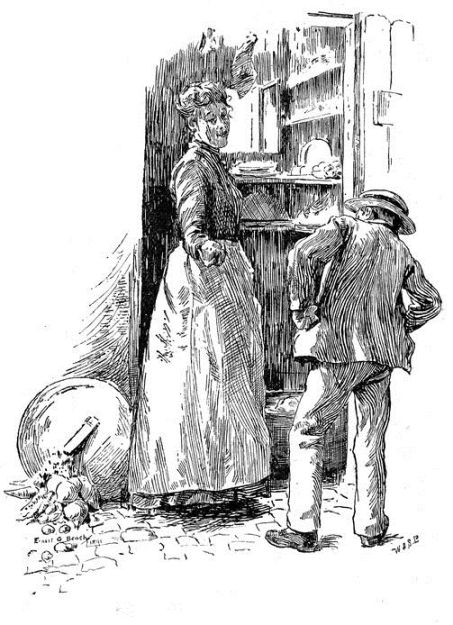
"CRAMMED MY POCKETS FULL."
In that far off Bracken Glen I often knew promptings towards the spirit of the heather and the glen and the skies. But then I felt Nature spoke a language I did not understand, which no one about me seemed to hear. In the midst of my most ecstatic trances I recalled myself by conceiving what a poor opinion John Jones, Esquire, of the soddened book-keeping, would hold of me if he knew that I was wasting time in hearkening to fancy instead of those pipes of wine which never knew rest in the day-book, journal, or ledger, or trying to remember thirteen times, or endeavouring at all events to trisect the angle at which the brown ground of the bluff bit through the verdure of the hill to the gash where the stream gushed forth through ragged rocks on its way to the pond above our overshot wheel.
But now I had met, in the modest library of the Hardings, men who would gag John Jones, Esquire, if he opened his mouth to speak in those sylvan dales of Trafford, men who would condescend to have no dealings whatever with pipes of wine, except to drink in them the ladies of their love, and who would not allow a triangle into their presence, except for the purpose of tricing up John Jones, Esquire, to it, and giving him five dozen with the cat!
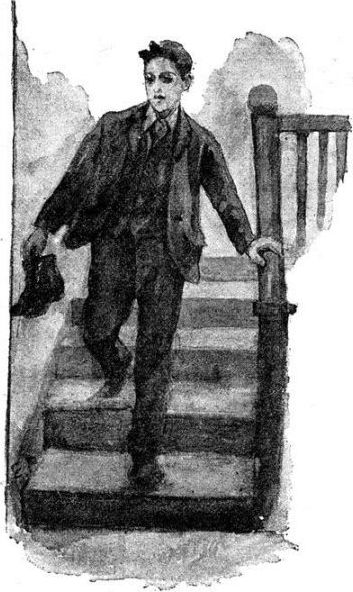
"SLIPPED DOWNSTAIRS."
The Hardings usually retired early, and in the first days of my visit, when I felt the first flush of freedom from the stricter rules of my own home, when I stirred under the inspiriting touch of the outer world, faint though it might be, through the intercourse of George Harding with it, I felt grieved that they would not sit later of nights and let me listen in awakening silence to their news of the great world beyond.
On the night of the ball I thought they would never rise to go. It would not do for me to betray the least anxiety. Other nights I had never shown any desire to go to bed. It would not do to challenge attention or excite suspicion by exhibiting any hurry this night. It was hard to sit and hear of all the preparations for the great ball, and feel that my cousins were standing between me and a sight of the glories about which they could only speculate.
I had heard that people would not begin to arrive at Trafford Manor until late, but I was consumed with impatience to be off. At last the blessed moment of release came. My cousins went to bed, and I found myself alone in my room at the back of the house.
No great strategy or caution was necessary to escape. I waited half an hour, then slipped downstairs, carrying my boots in my hand, and stole out by the back door.
When I found myself in the garden I had almost to grope my way, the night was so dark. I could not see the clouds over-head, but they must have been thick, for not a star shone in all heaven, and they must have been low, for the air was unusually warm considering the season. I sat down on a garden chair and put on my boots. Then rising, I drew a full breath, made quietly for the road, and, turning my back upon the town, set off at a good pace towards Trafford Manor.
I don't know what o'clock it was, but the low mutter of vehicles was behind me and before me in the darkness, and every now and then the lights of a carriage flashed into view in the rear, and the carriage dashed past, carrying before it into the blackness a shield of light raised up by its lamps.
Here was lonely I at last, the hero of a romance! Surely it was a romance to steal away in the dead of night and set out alone in search of adventure. For although I had but one intention clearly defined at starting, that of getting sight of the ball, now that I found myself on the way was I not fairly circumstanced to encounter adventures? Might not the horses under one of the carriages break away from control, placing in peril the precious and lovely inmates, until I dashed forward and rescued them, winning guerdon of lovely looks and loud-sounding fame? Might not thieves and highwaymen lurk in the impenetrable boscage, and, breaking forth, threaten the ladies with death, until I, bursting among the throng, scattered the marauders and entered the Manor in triumph with my peerless charge? A great general driving by might fall into some terrible danger from onslaught of enemies, or the breaking of a wheel, and I might chance upon his deliverance, and he, in gratitude, might make a general of me, and send me against the Indians or the Kaffirs. Or a high admiral, being unused to the land, might be met by me wandering about on foot and alone—lost, not knowing where to turn for food or shelter, and I might guide him to both, and he might order that henceforth I was to be Captain of the saucy Arethusa.
Any one of these adventures was likely to befall one in my position and circumstances, and it would be only prudent to keep oneself in a fit state of mind to deal with all of them. The fit state of mind was the enthusiastic and heroic; and in a very enthusiastic and heroic disposition I trod the road, and arrived at the lodge of Trafford Manor demesne.
Here no difficulty presented itself, for both the great iron portal and the two side gates stood wide, inviting all men to enter.
I had not in my old home at Bracken Glen been used to bars and bolts, and I had no awe of social superiors, because I had come in contact with none. But I had grave timidity towards strangers of any kind, and, although the rank of the folk at Trafford Manor had no fears for me, I stood in awe of people who could command the wonders of which the Hardings had spoken. Such people were of rather a different order of being, like the genii of Eastern tales, than merely richer and better born people of the same race as myself.
I walked into the grounds with as much confidence as I had travelled the high road.
All thoughts of the past and future left me in presence of the scene on the lawn before the house. I no longer wanted to take part in any enterprise of hazardous adventure. I no longer yearned to distinguish myself and win plaudits or enduring fame. I only wanted to be let alone. I only wanted to be. I only wanted to wander about this land of romance, and drink in all the loveliness at my wide young eyes.
In the centre of the lawn the fountain threw up a ghostly wavering pillar of water, soft as smooth, and tinted with light of various hues. Down the arcades of the tress swung lines of coloured lamps. Here and there, round the trunk of oak, or beech, or lime, clustered a group of blue, and green, and yellow lamps, like the flame of giant gems sparkling on the dark, tasselled, trailing robe of night.
People were walking about, not bidden guests at the Manor, but those who, like myself, had come to see the place by night. I took no notice of anyone. I took no notice of anything, but the intoxicating atmosphere of delight through which I moved. I did not think. I was content merely to feel the enthralling influence of the scene. This was my first experience of poetry realised, of dreams in tangible form, of visions of the day taking material form at night.
All at once I came upon a French window wide open, with, beyond it, a vast room lit by one huge chandelier. The floor shone like dark ice shadowed by brown rocks, and down the dark ice figures of men and women glided. The necks and shoulders and arms of the women were bare, and in their hair flashed incandescent points of shifting fire. Their robes were flowing, and of all colours, like the silent column of smoke rising up in the lawn, only the colours were richer and more varied. The long dresses of the women swept the floor as they moved to and fro, their white-gloved hands on the arms of their cavaliers.
I stood spell-bound. My eyes went on seeing, yet discovering nothing new, as when one looks at the lonely sea. Mere seeing was a delight inexpressible, a delight that held me fast, as though the air around me was adamant.
In front of me, by the window, stood a woman whose beauty was so splendid it did not seem human. It was a perfectly colourless face, of most exquisite profile, clear and sweet as a cameo. She did not strike me as of any age. As she seemed now she must always have been, for any change would not leave her perfect, and it was very plain she was designed for perfection. There was in her a settled decision of line that precluded the idea of her ever being otherwise than as she was now—beauty absolute.
Could ever man that lived be worthy to touch the hand of this ethereal princess standing tall and dark against the light of the chandelier in the doorway? Could any mere man be privileged to do her a service, to save her from fire or battle or the sea? To breathe the air she sanctified by her presence? To live in the garden through which she walked? To merit her smile? To die for her?
When poets spoke of goddesses they thought of her.
Then softly, and yet all at once, as my amazed and incredulous eyes were fixed upon this miracle, the air was stirred in a way I had never known it stirred before. Something subtler than light came through it and touched me, and stole into my veins, and made my blood richer and indescribably precious in my heart. The flames of the candles swayed in a strange, intelligible, inexplicable sympathy with this new sense in me. The essences of all perfumes were poured in upon my brain and made me giddy with a rapture I had never dreamed life could hold. All at once and by no effort of my own I came into possession of some property of joy beyond the glory of light and colour, beyond the reach of perfume. It came from beyond where this miracle of womanhood against the light stood. It beat by her like wind, and yet it stirred not one petal of the flowers in her hair. But the influence of it possessed her face, and she who had been Grecian goddess became an enraptured spirit. What could it be? Had the gate of Paradise opened, and was some large and subtle and fine rapture flowing towards me and around me, and possessing me with rhythmical joy?
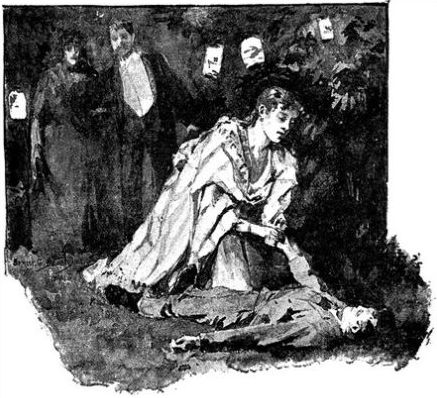
"THE POOR BOY HAS FAINTED."
What could this new thing, this mysterious agony of delight be?
Then, like a flash, I knew.
It was the band!
It was the band, and I was hearing music for the first time in my life!
After that with me all grew dark and blank.
I had fainted.
I was found lying on the grass, and when I came to myself that being whom I took for more than mortal was kneeling beside me and bending over me, chafing my hands, and saying:—
"Quick! quick! bring a light and water! The poor boy has fainted." Others were around me, and some hurried away.
"Poor boy!" I thought. "Poor boy, whom she has touched!"
"What caused it?" she asked me, pushing my hair back from my forehead. "What a pretty boy he is. Do you know, dear, what caused it?"
"I don't know," I said, as well as I could; "I think it must have been the band. I never heard music before."
"Never heard music before?" she cried in astonishment, "Are you sure? Where have you lived that you never heard music before?"
"In Bracken Glen—a glen in the north," I said. "We have a mill there. Our people do not have music, and I never heard music until I heard it now."
"And you fainted when you heard it first?" she asked, helping me to rise.
"I can think of nothing else to make me faint. This is the first time I ever fainted."
"You are better now?"
"I am quite well, thank you. I shall go away now."
"No, not yet. I am much interested in you. There must be something uncommon in the boy who fainted when he heard music for the first time. It was the waltz in 'Faust.' My husband will be most interested in this. He knows a great deal about music, but I think this will be new to him."
There may have been something uncommon in that boy who fainted on hearing music for the first time. People who know me by the name I now bear before the public say I have a faculty of producing melody that will satisfy. I have said that I follow one of the fine arts as a profession. I am a musician—a composer of music. That lady who twenty years ago saw me fall to the ground outside Trafford Manor, and came to my help, has aided my career in many ways. She spoke of me to her husband, who knows more about music than any other man I am acquainted with. She encouraged me in my hours of depression, of despair. She has done more kindnesses for me than any other woman—but one. I am now a successful man. I am proud to owe all I own of value in the world to her. The one woman I am more indebted to than to her, I owe, in a way, to the lady of the "Faust" waltz also, for her daughter is my wife. It was while I was a guest at a ball in Trafford Manor that I told my wife Gertrude of that memorable night long ago. It was while she was standing by the same window where her mother had stood nineteen years before, and looking as her mother looked then, that I found courage to speak. The band played again the waltz in "Faust." Then I lost control, and the overwhelming love for the girl at my side bore me away; and I cried out to her in my despair, and asked if there was any hope for me in her heart.
She did not understand me. I had not made my meaning plain. We went out upon the lawn, where many years ago I had watched the fountain mount through the rainbow-coloured lights. It was not now early spring, but deep summer. It was not now with me the admiration of a child for a statue, but the passion of a man for a woman. The first strain of melody had been a revelation to the boy. How poor and thin it seemed to the revelation that there was hope for me in the heart of the girl I loved. Before the band finished that waltz in "Faust," Gertrude understood what I had whispered in the doorway. That waltz in "Faust" had played in music to my soul, and my darling to my arms. I never hear it without experiencing incommunicable emotions. Who can wonder?
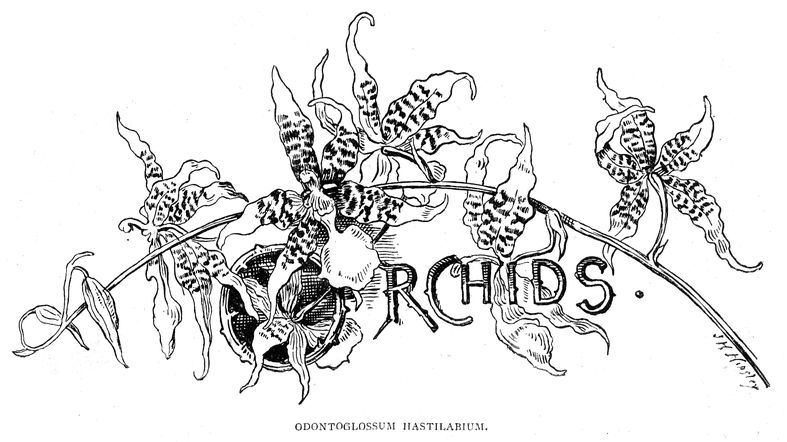
Orchids. ODONTOGLOSSUM HASTILABIUM.
HAKESPEARE'S words to the effect that the man who has no music in himself is fit only for treasons, stratagems, and spoils, might appropriately be adapted to flowers. Certainly the man or woman who finds it impossible to love the rose and the violet, the chrysanthemum, and even the simple little primrose which will be so much abroad during this month of April, is lamentably lacking in something. So much is indisputable of flowers in general, and of the subject of this paper in particular. The rose alone excepted, no plant has inspired the abiding love shown for the orchid, and, not even excepting the rose, none has been the object of such enthusiasm. The study of the orchidaceous family, as some one has said, is a liberal education, and it was once declared, with all the authority of print, that Mr. Joseph Chamberlain must be possessed of a fine character because he loves these extraordinary flowers. If the predilection for orchids is to be accepted as proof of any such possession, the English race is in no danger of deterioration.
Many of our readers will have heard of the tulip mania which raged so fiercely in Holland about the middle of the seventeenth century, when simply fabulous prices were given for a single bulb. There was little that was either reasonable or explicable in the desire to secure the tulip at all costs, but the popularity of the orchid is easily understood by anyone who cares to go into the subject. We venture to believe that by the time we have said all we have to say—and how small a portion that is of what we could say!—those who peruse this paper will find it somewhat difficult to resist running off to the nearest nurseryman and asking to be shown over his houses, or to the nearest bookseller and ordering one of the numerous popular manuals which will instruct them how to set about becoming orchid growers themselves. We have often heard the uninitiated wonder what there is to attract in the orchid, more than in any other beautiful flower. Well, to say nothing of its exquisite and unique charm as a mere spectacle, Darwin gave many reasons, and the Darwinian mind, we believe, has actually sought to show that the orchid is the missing link between animal and vegetable nature. The student will find lots to support this fascinating theory, and to induce him to think that if the other missing link—that between the man and the animal—is discoverable, we shall have completed the chain of nature starting with man and ending with the garden cabbage. But all this is another story, with which it is not our province now to deal.
Orchids have been really popular about twenty-five years. They were well known in the last century, but they were the possession of the privileged few, and were regarded as a mere floral curiosity. One day, however, some sixty years or more ago, the late Duke of Devonshire chanced to come across an orchid from Demerara, which bore an extraordinary resemblance to a butterfly. His delight was immense, and he proceeded forthwith to cultivate the plant, of which a variety is shown in our illustration of the Oncidium Kramerianum. A little later he purchased a "Moth Orchid," for which he paid 100 guineas; and to the interest taken in these floral mimics by the ancestor of Lord Hartington are traceable the developments which have been so remarkable during the last decade or two.
Almost the first thing that strikes the spectator at an orchid show for the first time, after he has recovered from a sort of shock at the overwhelming beauty of the display—a display out-rivalling the rainbow in its variety and blend of colour—is the quite ludicrous resemblance of many of the flowers to animals, birds, and insects. Bees, spiders, grasshoppers, flies, lizards, and toads are quite common forms of orchid mimicry. Our illustration of Cycnoches Warscewiczii shows a swan, with a curious-looking tuft upon its breast. Another species is very like a dove as it may be seen hovering for an instant near the branch of a tree before alighting. One group has a flower in which a resemblance to the monkey is found; but the most ludicrous of mimetic vagaries is surely that of the species known popularly as the "Man Orchid." "Dressed like an acrobat in skin tunic of green, it swings as if gibbeted, in company with some fifty other little felons." But the flower is not content to run animate nature close in outward appearance; it evinces a disposition to rival man in the manufacture of various kinds of appliances. It takes a hint from the boot-maker, and produces the "Lady's Slipper"; it provides for the wants of a young family, and turns out a "Cradle"; it even resolves itself into a sort of swimming bath, in which the bee sometimes finds himself involuntarily immersed, and from which he escapes by means of a side-door arrangement. Well might Darwin say that the orchid family seemed to have been modelled in the wildest caprice. Proteus himself was incapable of assuming so many shapes.
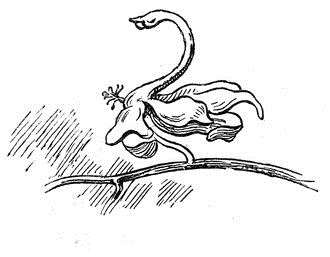
CYCNOCHES WARSCEWICZII.
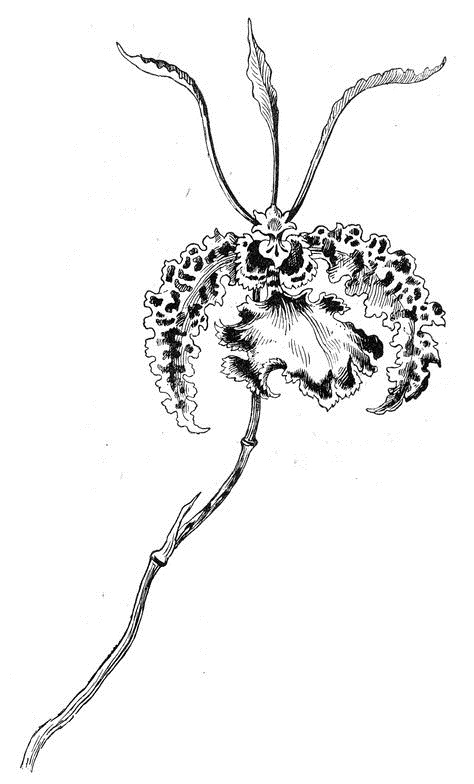
ONCIDIUM KRAMERIANUM.
The prevalent notion that these marvels are only for the owners of heavily-laden pockets dies hard. A pious wish that orchids were less expensive and could be grown at home is not uncommon. It will be a revelation to some people to learn that an orchid which shall be a source of endless amusement and of considerable instruction may be had for a few shillings. Whether, in short, you have a few odd hundred pounds or merely a few odd hundred farthings to spare, you may gratify your love for this particular flower. You cannot expect to walk into, say, Mr. Bull's establishment in the King's-road, Chelsea, some day when you are passing, and for the price of a couple of dozen cigars appropriate the beautiful Cœlogyne cristata alba, some idea of whose virgin purity is conveyed in our illustration. This plant originally cost Mr. Bull £200. Great as this price is, it is barely two-thirds of the record; £300 has been exceeded for a single plant. Mr. Bull possesses a variety of the "Lady's Slipper" for which he paid that very figure. In 1883 Sir Trevor Lawrence paid 235 guineas for an orchid, and Baron Schröder paid £165 and £160 respectively for two plants. Many firms have paid hundreds of pounds for the possession of a rare species, whilst, of course, one may often hear of a collection being sold for many thousands. At the same time, Mr. Bull or Messrs. Veitch, or any well-known cultivator will be happy to place orchids, which a few years ago were beyond the reach of even a large proportion of the middle classes, at your disposal for five or six shillings.
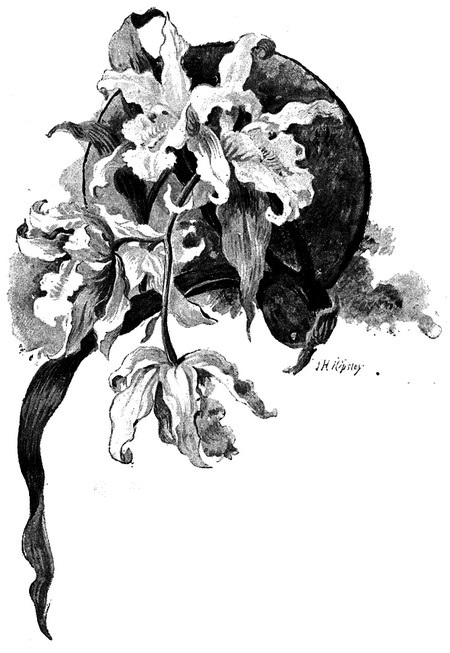
CŒLOGYNE CRISTATA ALBA.
And be it understood, in buying an orchid you can never be quite sure that you have not secured a veritable treasure. The speculative element enters into orchid-collection to a degree undreamt of by the outsider. As the value of the most valuable just purchased by a duke may disappear in an hour, so that of the most common just purchased by yourself may be augmented a hundred-fold by an eccentricity. Take an instance of depreciation recorded by Mr. F. W. Burbidge. A species of "Lady's Slipper" was imported and the single plant fetched £100 easily. But the home of the plant was discovered, and in the course of a week or two nurserymen were selling the same thing for five shillings. On the other hand, Pescatore's Odontoglot, we are told, had been imported for years, and plants might be picked up for a few shillings each, when "quite unexpectedly a lovely form heavily barred with purple appeared, and, had it been sold by auction when first it flowered, it would have brought from £50 to £100." Before it bloomed the plant would, in common with others of the same species, have been readily disposed of for a trifle.
A friend of Mr. Burbidge's chanced to buy cheap a number of plants which were "hanging fire." "They were shrivelled plants of Odontoglossums in paper bags, and they took a good deal of skill and attention to bring them into vigour and health again. But when they bloomed some of them turned out very distinct, and an offer of £500 made for the lot as they stood, after the first five or six had bloomed, was not accepted." The most interesting piece of luck of this sort, however, which we have come across is related by Mr. Frederick Boyle. A Mr. Spicer, a tea planter in Sylhet, knowing his mother in England was fond of orchids, sent her some plants. They were an ordinary "Lady's Slipper" variety. Mrs. Spicer brought them to flower, and noticed certain curious characteristics. She consulted an expert, with the result that he paid her seventy guineas down and carried off the plant. "For years," says Mr. Boyle, "this lovely species was a prize for dukes and millionaires," and its introduction was due to a son's desire to gratify his mother's tastes by sending her a few everyday orchids!
The mention of this discovery brings us to the more tragic side of orchid collecting. Mr. Sander, the famous orchid grower of St. Albans, despatched a representative to try to find the particular species which had proved so profitable to Mrs. Spicer. After many fruitless efforts, "Mr. Forsterman got on the track, but in the very moment of triumph a tiger barred the way, his coolies bolted, and nothing would persuade them to go further. Mr. Forsterman was no shikari, but he felt himself called upon to uphold the cause of science and the honour of England at this juncture. In great agitation he went for that feline, and, in short, its skin and its story were conspicuous attractions of his cottage in the after years."
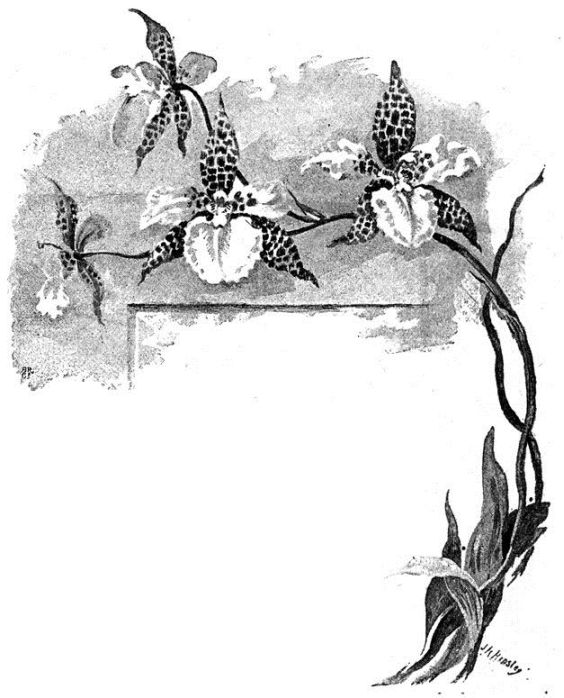
ODONTOGLOSSUM HUMEANUM.
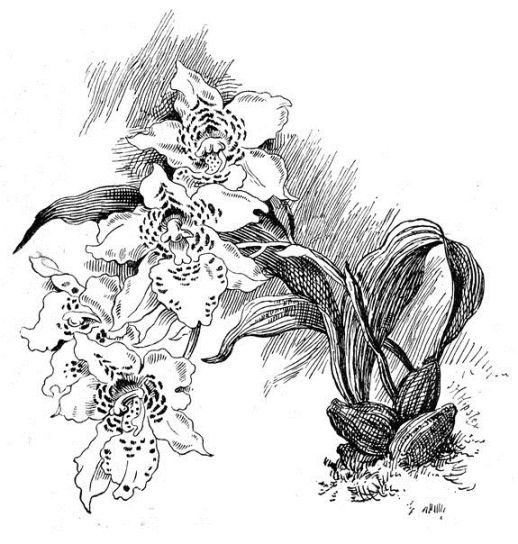
ODONTOGLOSSUM CERVANTESII DECORUM.
The perils which men face in the search for orchids are as great as those encountered by the prospector for precious stones and metal, or by the missionary who goes forth into the wild corners of the earth to preach God's Word. We know of one man who, by pluck and diplomacy, has managed to pass unscathed among the cannibals of New Guinea. When he first arrived, he was honoured by a careful overhauling on the part of the natives, who ultimately declared that he was too thin to eat. He has since made himself more or less at home with them, though he has only succeeded in winning their esteem by sitting down to the same dish and partaking of its contents, whatever they might be, and in compelling their respect by placing a few inches of cold steel at his side, and giving them an occasional object-lesson in the wonders of the revolver. He carries his life in his hands, and all for the sake of the chance of finding an orchid with some feature possessed by none other. The collector who would make his mark must be prepared for hazardous marches, for hanging like a sailor by his eyebrows over mighty precipices, or for wading for days in swamps. He must have self-reliance, resource, patience, knowledge, and endurance.
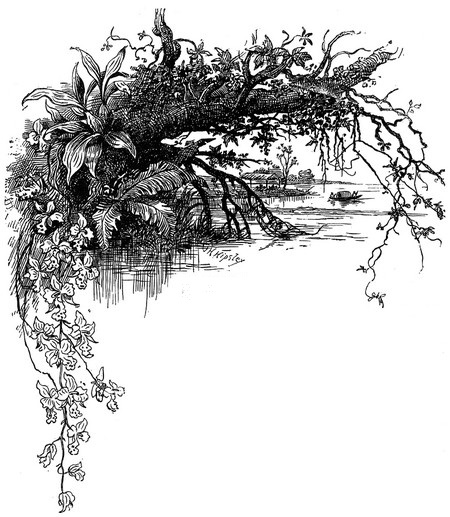
ODONTOGLOSSUM CRISPUM.
The orchid has not only its heroes, it has its martyrs as well. Any great grower will give one the names of a dozen men who have sacrificed all in their efforts to add to the list of species. Collectors have been lost in Panama, Rio Hacha, Ecuador, Sierra Leone, Orinoco, and probably other places. "I wonder," said a friend to Mr. Burbidge, "if orchid amateurs ever give a thought as to the real price their orchids cost," and he proceeded to enumerate the names of such men as Bruchmueller, Zahn, Hutton, Klaboch, Endres, Chesterton, and Freeman, who have died in the interests of the orchid lover. "On the roll of martyrs to orchidology," says Mr. Boyle, with enthusiasm, "Mr. Pearce stands high. To him we owe, among many fine things, the hybrid Begonias which are becoming such favourites for bedding and other purposes.... It was his great luck and great honour to find Masdevallia Veitchii, so long, so often, so laboriously searched for from that day to this, but never even heard of. To collect another shipment of this glorious orchid, Mr. Pearce sailed for Peru in the service, I think, of Mr. Bull. Unhappily—for us as well as for himself—he was detained at Panama. Somewhere in those parts there is a magnificent Cypripedium.[A] The poor fellow could not resist this temptation. They told him at Panama that no white man had returned from the spot, but he went on. The Indians brought him back some days or weeks later, without the prize; and he died on arrival."
Even when the precious plant is secured, and danger to life and limb is past, the difficulties to be overcome are enormous. To bring a million sterling in gold from Paris or New York under special and vigilant guard, is a process almost simple when compared with the jealous care which has to be expended on the transportation of orchids. It sometimes happens that on opening the cases on arrival in England, a valuable collection is found to have rotted en route, and the importer realises that hundreds of pounds have been spent and lives risked, to secure worthless roots! The orchid importer needs a stout heart and unlimited enterprise, and some of us may well wonder how he manages to make the business pay at all when we think of the ambassadors he employs in nearly every clime, of the funds which he has occasionally to place at their disposal, and of the fact that one loss may involve a sum equal to a fair annual income. On the other hand, if he is the lucky possessor of a variety of value, the plant creates the greatest enthusiasm in orchid circles, and is consequently a source of immense profit.
We have in these pages taken a rapid glance at the more popular, it may even be said the more romantic, side of the work of orchid collection. Enough has been said, we hope, to show why the study of orchidology is a liberal education. What a wealth of natural history of the most fascinating kind it opens up! Nothing more striking is recorded in nature than the manner in which the bee fertilises the orchid, to give the least adequate account of which would involve another half-dozen pages of this magazine. The majority of us probably would be surprised to learn that but few orchids grow in the ground. They are found often high up on the branches of some monarch of the primeval forest, and the proverbial needle in the bundle of hay might be discovered half a dozen times over whilst the collector is searching for a single plant. Others appear, however, quite low down. The tree-growing orchid is an epiphyte. That is to say, though it lives on the tree it makes the branch a resting-place only. It gets its nourishment from the atmosphere and not the tree, as does the mistletoe for instance. One orchid, a Diacrium, actually grows on rocks within reach of the spray from the salt sea waves.
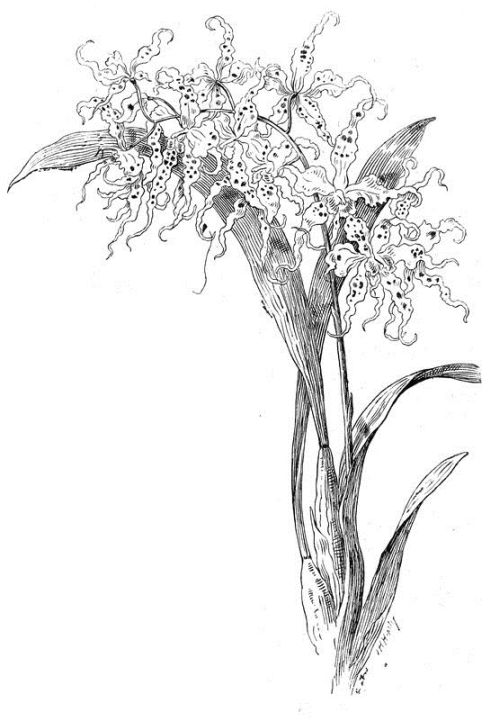
ODONTOGLOSSUM CIRROSUM.
To follow in the footsteps of the collector is to acquire a considerable knowledge of the countries of the earth. Orchids luxuriate in warm and humid places, thousands of feet above the level of the sea. They have outdistanced the Anglo-Saxon in the number of lands they have colonised. You may find them in Africa, in North, Central, and South America, in Australia and New Zealand, in Asia, in Madagascar, in Europe—everywhere except in very cold climates. One day the orchid hunter may be on the high road of civilisation, pursuing his quest like an ordinary tourist; another he will have plunged into regions dark as darkest Africa, as far removed from modern conditions as the dwarfs of Stanley's limitless forest. In the search for a single orchid he comes across many varieties of the human race, and on a thousand points connected with modes of life, of governments, of the relations of places one to another, far and near, he is better informed than many an arm-chair specialist.