XXXI. THE EAST RIDING ROLL OF HONOUR.
Reading edition
A brief record of the most famous lives in local history. Each of the persons named was born in the East Riding, and living persons are excluded.
Saint John of Beverley. Born at Harpham, and died in A.D. 721. Became Bishop of Hexham and of York. Was canonised by the Church in 1037, and afterwards became one of the most famous saints of the north of England. See pages 135–140.
Alured, or Alfred, of Beverley. Born at Beverley in 1109. Became Treasurer of the Church of St. John of Beverley, and Abbot of the Cistercian Abbey of Rievaulx. Wrote a history in Latin, entitled Annals of the Deeds of the Kings of Britain, and a Life of St. John of Beverley.
345Roger of Howden. Born at Howden, and died in 1201. Became a Clerk, or Secretary, to Henry II., and later a King’s Justice for Yorkshire. Was the author of a Latin history of England from A.D. 732 to A.D. 1201.
See pages 269–270.
William of Newburgh. Born at Bridlington in 1136. Was brought up at the Priory of Newburgh, and wrote in Latin a History of English Affairs, which takes rank as ‘the finest historical work left to us by an Englishman of the twelfth century.’ See page 269.
Peter of Langtoft. Born at Langtoft, and died in 1307. Was a Canon of Bridlington Priory, and author of a Chronicle of England, written in Anglo-Norman verse. See page 269.
John Hotham. Born at Scorborough, and died in 1336. Became Bishop of Ely, and twice Lord Chancellor of England.
John of Bridlington. Born at Thwing about 1324. Was successively Precentor, Almoner, Sub-Prior, and Prior of Bridlington Priory. Became so famed for his piety that after his death many miracles were believed to be wrought at his tomb.
Sir Michael de la Pole, first Earl of Suffolk. Born at Hull, and died in 1389. Became, successively, Mayor of Hull and Admiral of the King’s Fleets in the Northern Parts, a Knight of the Garter, Lord Chancellor of England, and the first Earl of Suffolk. His is the first example in British history of a prosperous merchant’s becoming a peer of the realm. See page 116.
Walter Skirlaw, LL.D., Born at South Skirlaugh, and died in 1406. Became Bishop, successively, of Lichfield, Bath, and Durham. Built the tower and chapter 346house of Howden, and Skirlaugh Chapel—now the parish church. Also built several bridges in the north of England, and helped to build the central tower of York Minster.
John Alcock, D.D. Born at Hull about 1428. Became Bishop, successively, of Rochester, Worcester, and Ely. Was a Privy Councillor and twice Lord Chancellor of England. Founded the Hull Grammar School and Jesus College, Cambridge. See pages 270–271.
John Fisher, D.D. Born at Beverley in 1459. Became Chancellor of the University of Cambridge, and Bishop of Rochester. Was famed for his ‘grete and singular virtue,’ and was beheaded on Tower Hill for refusing to acknowledge Henry VIII. as the ‘Supreme Head of the Church.’ Was largely instrumental in founding St. John’s College, Cambridge, and formed a library which was considered to be ‘the finest in Christendom.’ See pages 270–272.
Sir John Pickering, Kt. Born at Flamborough in 1544. Was the son of very poor parents, yet became a Privy Councillor and Lord Keeper of the Privy Seal. Was twice chosen Speaker of the House of Commons, and was knighted by Queen Elizabeth.
Sir John Lister, Kt. Born at Hull in 1585. Became twice Mayor of Hull, and was five times elected M.P. for his native city. Entertained King Charles I. on his visit to Hull in 1639. Founded in 1642 the ‘Lister Hospital’ for six poor men and six poor women.
Luke Fox. Born at Hull in 1586. Was a Younger Brother of the Trinity House, and revived the attempt to discover the North-West Passage, whence he gained the nickname ‘North-West Fox.’ Explored in 1631 the Channel west of Baffin Land which now bears his name.
347Thomas Lamplugh, D.D. Born at Octon, near Thwing, in 1615. Was a Fellow of Queen’s College, Oxford, and became successively Dean of Rochester, Bishop of Exeter, and Archbishop of York.
Sir Philip Monkton, Kt. Born at Cavil, near Howden, about 1620. Was a devoted supporter of King Charles I., for whom he fought bravely at the battles of Atherton Moor, Naseby, and Rowton Heath. Was knighted for his bravery in 1644.
Andrew Marvell. Born at Winestead in 1621. Was an ‘old boy’ of the Hull Grammar School, became Assistant Latin Secretary to the Council of State, and was M.P. for Hull for nineteen years. Also gained considerable reputation as a poet, but is best remembered as ‘a pure-minded patriot in the most corrupt times.’ See pages 272–275.
Christopher Nesse. Born at North Cave in 1621. Was the son of a husbandman, but became a notable Non-conformist preacher, and suffered much persecution after the Restoration.
Thomas Watson, D.D. Born at North Ferriby in 1637. Was the son of a seaman, and an ‘old boy’ of the Hull Grammar School. Became a Fellow of St. John’s College, Cambridge, and afterwards Bishop of St. David’s. Was a liberal benefactor to his old school, and rebuilt the alms-houses known as ‘Watson’s Hospital.’
Richard Boyle, K.G., third Earl of Burlington. Born at Londesborough in 1695. Was Lord Lieutenant of the West Riding of Yorkshire, and Lord High Treasurer of Ireland. Became famous as an amateur architect. Rebuilt Burlington House, London, and carried out large schemes of plantation at Londesborough Hall.
348Richard Osbaldeston, D.D. Born at Hunmanby, and died in 1764. Became successively Dean of York, Bishop of Carlisle, and Bishop of London.
John Green, D.D. Born at Beverley in 1706. Was an “old boy” of Beverley Grammar School, and became Dean of Lincoln and later Bishop of Lincoln. In 1772 was the only Bishop in the House of Lords ‘to vote in favour of the Bill for the relief of Protestant Dissenters.’
William Mason. Born at Hull in 1724. Was a son of the Vicar of Holy Trinity and became a Fellow of Pembroke College, Cambridge, and Chaplain to the King. Gained considerable renown as a poet, and would have been appointed Poet Laureate but for his political opinions.
Sir Samuel Standidge, Kt. Born at Bridlington Quay in 1725. Took a leading part in establishing the Greenland Fishery Trade, and fitted out a ship for the discovery of the North Pole. Was knighted when Mayor of Hull in 1795, and was four times elected Warden of the Hull Trinity House.
Sir Christopher Sykes, Bart. Born at Roos in 1749. Was distinguished as a mathematician, architect, banker, and M.P. for Beverley. Refused a baronetcy from Mr. Pitt, but asked that it should be given to his father, the rector of Roos.
Robert Thew. Born at Patrington in 1758. Was the son of an innkeeper, and became engraver to the Prince of Wales.
William Wilberforce. Born at Hull in 1759. Became M.P. for his native town at the age of twenty-one, and was for twenty-eight years one of the two M.P.’s for Yorkshire. Devoted his whole life and all his wealth to obtaining the Abolition of Slavery in the British Colonies, the Act for which was passed a few days after his death in 1833. See pages 275–279.
349Adrian Hardy Haworth. Born at Hull in 1767. Became a renowned botanist and entomologist, and formed a collection of 40,000 insects, the most important of which are now in the British Museum.
Sir Benjamin F. Outram, Kt., M.D. Born at Kilham about 1770. Entered the Medical Naval Service, and became Medical Inspector of Naval Hospitals. Was knighted in 1850.
Sir Mark Masterman Sykes, Bart. Born at Sledmere in 1771. Was M.P. for the city of York for thirteen years. RaisedRaised in 1802 two squadrons of Yeomanry, known as the ‘East Yorkshire Wold Yeomanry.’ Was a great lover of books, and formed at Sledmere ‘one of the finest private libraries in England,’ which in 1824 was sold for £20,000.
Sir Tatton Sykes, Bart. Born at Sledmere in 1772. Devoted himself to sheep-farming and the breeding of race-horses, and, by the introduction of bone manure, wrought great improvements in the cultivation of the Wolds. Was a fearless sportsman, and a true specimen of ‘The Fine Old English Gentleman.’ See pages 279–281.
Thomas Jackson. Born at Sancton in 1783. Was the son of a farm labourer, and became ‘in spite of the adverse circumstances of poverty and lack of education,’ a famous Wesleyan divine. Was twice elected President of the Wesleyan Conference.
William Spence, F.R.S. Born at Bishop Burton in 1783. Was an ‘old boy’ of Beverley Grammar School, and became one of the founders of Blundell, Spence, & Co., Ltd., Hull. Was deeply interested in Entomology, and was one of the authors of Kirby and Spence’s Introduction to Entomology, the most popular natural history book of its day.
350Sir James Alderson, Kt., M.D., F.R.S. Born at Hull in 1795. Succeeded his father as physician of the Hull Royal Infirmary, and became President of the Royal College of Physicians. Was knighted by Queen Victoria in 1869.
Frederick Huntingdon, M.D. Born at Hull in 1796. Was surgeon of the Hull Royal Infirmary for thirty-four years, and is recorded on his monument in Christ Church, Hull, as ‘one of Nature’s gentlemen, whose life was passed in doing good.’
James Hall. Born at Scorborough in 1801. Was a ‘model country squire ... and a devoted upholder of English field sports,’ and held the Mastership of the Holderness Hunt for thirty years.
Sir Henry Cooper, Kt., M.D. Born at Hull in 1807. Was physician of the Hull Royal Infirmary for twenty-seven years, and as Mayor of Hull was knighted when Queen Victoria visited the town in 1854. Was the first Chairman of the Hull School Board, and has his memory perpetuated in the ‘Sir Henry Cooper Schools.’
Thomas Earle. Born at Hull in 1810. Was a gold medallist of the Royal AcademyAcademy, and designed the statue of George the Fourth in Trafalgar Square, London, and that of Queen Victoria in Pearson Park, Hull, beside many others.
Sir James Hudson, K.C.B. Born at Bessingby in 1810. Entered the Government Service and held many important posts in the United States, South America and Italy. Was created a Knight Commander of the Bath in 1855.
Henry Dawson. Born at Hull in 1811. Was the son of poor parents, and became a self-taught artist. Struggled hard against adversity, and gained renown as a landscape painter only towards the end of his life.
351Hugh Edwin Strickland. Born at Reighton in 1811. Was a notable student of natural history, and became Reader in Geology at the Oxford University. Was accidentally killed in a railway tunnel.
Charles Henry Bromby. Born at Hull in 1814. Was a son of the Vicar of Holy Trinity, and an ‘old boy’ of the Hull Grammar School. Became the first Bishop of Tasmania.
Sir Joseph Henry Gilbert, LL.D. Born at Hull in 1817. Became a distinguished scientist, and was knighted by Queen Victoria for his discoveries in agricultural chemistry.
Humphry Sandwith, C.B., D.C.L. Born at Bridlington in 1822. Travelled widely, became Inspector-General of Hospitals in the Russo-Turkish War, and helped to defend the fortress of Kars. Was decorated by Queen Victoria as a Companion of the Order of the Bath.
John Bacchus Dykes, Mus. Doc. Born at Hull in 1823. Was a grandson of the Vicar of St. John’s, and became Minor Canon and Precentor of Durham Cathedral. Composed more than two hundred hymn tunes, and was joint editor of Hymns, Ancient and Modern. After his death, a public subscription of £10,000 was raised in his honour to found musical scholarships.
Charles Alfred Lee, M.D. Born at Hull in 1825. Took a large share in the support of the Hull Royal Infirmary and the Newland Orphan Homes, and, on his death in January 1912, bequeathed £150,000 for the foundation of ‘Rest Houses’ for the aged poor.
Sir William Christopher Leng. Born at Hull in 1825. Was an ‘old boy’ of the Hull Grammar School. 352Took up journalism after some years spent as a chemist, and became the editor of the Sheffield Daily Telegraph. Was knighted for his public services in 1887.
The Hon. Sir John Hall, K.C.M.G. Born at Hull in 1824. Emigrated to New Zealand, entered Parliament, and became Premier in 1879. Was decorated by Queen Victoria as a Knight Commander of the Order of St. Michael and St. George.
John Robert Mortimer. Born at Fimber in 1825. Devoted more than fifty years of a long life to the most thorough exploration of the earthworks and burial mounds around Driffield, and did more than anyone else to extend our knowledge of the early inhabitants of the East Yorkshire wolds.
Charles Henry Wilson, first Baron Nunburnholme. Born at Hull in 1833. Became, in 1867, senior partner in the shipping firm of Thomas Wilson, Sons & Co., and built up the largest privately-owned fleet of steamships in the world. Sat in Parliament as M.P. for his native town for thirty-two years, and was raised to the peerage in 1906. See pages 280–283.
Arthur Wilson. Born at Hull in 1836. Became a partner in the firm of Thomas Wilson, Sons & Co. in 1867. Was a great sportsman, and was M.F.H. to the Holderness Hunt for twenty-five years. See pages 280–283.
PRINTED AT BROWNS’ SAVILE PRESS,
SAVILE STREET AND GEORGE STREET, HULL.
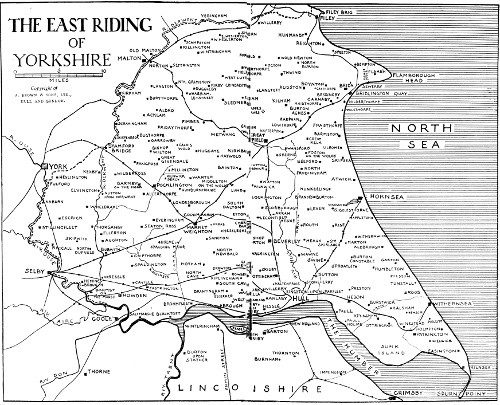
THE EAST RIDING OF YORKSHIRE Copyright of A. BROWN & SONS, LTD., HULL AND LONDON.
Transcription of Royal Mail Schedule on p. 241
HULL, July 1787.
HULL AND YORK
ROYAL MAIL-COACH,
WITH A GUARD,
WELL ARMED.
Sets out every Day about Half-past Three in the Afternoon, from Mr. BAKER’s, the Cross-Keys, in the Market-Place, HULL, and arrives at Mr. PULLEINE’s, the Tavern in YORK, in SIX HOURS; returns from thence about Half-past Twelve at Night, or immediately after the Receipt of the London Mail, and arrives at HULL early in the Morning.
No more than Four Inside and Two Outside Passengers will be taken.
Fare, 10s. 6d. INSIDE; OUTSIDE 5s. 3d.
Short Passengers Threepence-halfpenny per Mile.
Parcels from 3d. to 6d. if above a Stone Weight One Halfpenny per Pound.
For Places or Entry of Parcels, apply to Henry Cawood, at the Post-Office, Hull, Mr. Pulleine, York; Mr. Bland, Beverley, and to Mr. Gill, King’s Arms, Market-Weighton, from those Towns respectfully for Hull, York, London, or Edinburgh.
Conveyance may be secured for Passengers and Parcels from Hull to London (Fare 3l. 13s. 6d.) by the Mail Coach, the whole Way, except the Places be previously disposed of at York, in which Case Mr. Pulleine engages to send the Passengers forward in a Post-Chaise at the same Expence and accompanying the Mail Coach; the same from Hull to Edinburgh, 3l. 13s. 6d. or any intermediate Places at Fares in the Proportion of Distance.
⁂ The Proprietors give Notice, that they will not be accountable for any Parcel exceeding
the Value of Five Pounds.
Transcription of Document on p. 248
HULL AND SELBY, OR HULL AND LEEDS JUNCTION, RAILWAY.
OPENING OF THE LINE
FOR PASSENGERS AND PARCELS ONLY,
ON THURSDAY, JULY THE 2nd, 1840
The Public are respectfully informed that this RAILWAY will be OPENED THROUGHOUT from HULL to the JUNCTION with the LEEDS and SELBY RAILWAY, at Selby, on WEDNESDAY, the First Day of July next, and that PASSENGERS and PARCELS only will be conveyed on THURSDAY, July 2nd; thus presenting a direct Railway Conveyance from Hull to Selby, Leeds, and York without change of Carriage.
TRAINS WITH PASSENGERS WILL START FROM HULL AS UNDER
AT SEVEN O’CLOCK, A.M. AT THREE O’CLOCK, P.M.
AT TEN O’CLOCK, A.M. AT SIX O’CLOCK, P.M.
ON SUNDAYS, AT SEVEN O’CLOCK, A.M., AND SIX O’CLOCK, P.M.
The Trains from LEEDS and YORK, for HULL, will depart from those Places at the same Hours; and Passengers and Parcels may be Booked through at the Leeds, York, and Hull Stations. Arrangements are also in progress for Booking Passengers to Sheffield, Derby, Birmingham, and London.
THE FARES TO BE CHARGED ARE AS UNDER:
First Class. Second Class. Third Class.
Hull to Selby 4s. 6d. 4s. 0d. 2s. 6d.
Hull to York 8s. 0d. 6s. 6d. 4s. 6d.
Hull to Leeds 8s. 0d. 6s. 6d. 4s. 6d.
No Fees are allowed to be taken by the Guards, Porters, or any other Servants of the Company.
The Trains, both up and down, will call at the Stations on the Line, viz.:—Hessle, Ferriby, Brough, Staddlethorpe, Eastrington, Howden, and Cliff.
Arrangements for carrying Goods, Cattle, Sheep, &c., will be completed in a short time, of which due Notice will be given.
By Order,
GEORGE LOCKING, Secretary.
Railway Office, Hull, June 24th, 1840.
Transcriber’s Note
The table of illustrations has the wrong page (p. 116) for the image on p. 117, and has been corrected.
On pp. 206 and 207, a double-page view of Kingston-upon-Hull has been joined. A larger version of it can be viewed by clicking on the image..
Likewise, the map printed on the inside of the back cover, spanning two pages, has been joined, however imperfectly, given the original images. A larger version of it can be viewed by clicking on the image.
On pp. 241 and 248, there are facsimiles of documents. The caption of each serves as a link to a text transcription, which is included at the end of the text.
Errors deemed most likely to be the printer’s have been corrected, and are noted here.
52.5 we have no means of knowing[.] Added.
100.12 the records remain[s] to our day. Removed.
115.28 to hold this office[.] Thus Added.
116.2 Edward III[.], so his son Added.
118.16 Shakspeare’s [P/p]lay Replaced.
134.2 themselves in populous towns[.] Added.
148.30 your dewte in ryngyng....[’] Added.
187.31 of the building[.] They were a wealthy Added.
215.32 [s]ustained during the war. Added.
227.24 Let the best fashioned and apparrell[ /e]d Servants Replaced.
231.21 This was between the years 1703 and 1753[.] Added.
245.11 horses could not[,] contend against the wind. Removed.
296.1 and Strong Beer.[’] Added.
324.20 teche all [scholers] thither sic
330.14 to the inhabitants[’] Added.
331.24 at Paris in 1552[./,] one of Cicero printed Replaced.
332.33 Bridlington and Hull came into being[.] Added.
349.11 R[o/a]ised in 1802 two squadrons of Yeomanry Replaced.
350.22 Royal A[d/c]ademy Replaced.