Part 1 — The Story of Sir Tristram and the Lady Belle Isoult
Reading edition
Here followeth the story of Sir Tristram of Lyonesse, who, with Sir Launcelot of the Lake, was deemed to be one of the two most worthy and perfect knights champion of his day. Likewise herein shall be told the story of the Lady Belle Isoult, who next to Queen Guinevere, was reckoned to be the most fair, gentle lady in all of the world.
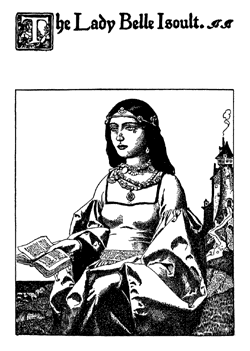
Chapter First
How the new Queen of Lyonesse sought Tristram's life; how he went to France, and how he returned again to Lyonesse and was received with love at that place.
So King Meliadus grieved very bitterly for the Lady Elizabeth for the space of seven years, and in that time he took but little pleasure in life, and still less pleasure in that son who had been born to him in that wise. Then one day a certain counsellor who was in great favor with the King came to him and said: "Lord, it is not fitting that you should live in this wise and without a mate; for you should have a queen, and you should have other children besides Tristram, else all the fate of this kingdom shall depend upon the life of that one small child."
King Meliadus taketh the Lady Moeya to second wife.
And King Meliadus took this counsel to heart, and after a while he said: "What you tell me is true, and so I shall take another Queen, even though it is not in me to love any other woman in all of the world but that dear one who is dead and gone." So a while after that he took to wife the Lady Moeya, who was the daughter of King Howell of Britain.
Now Queen Moeya had been married to an Earl of Britain, and by him she had a son who was about the age of Tristram. So she brought this son to Lyonesse with her, and he and Tristram were very good companions.
But the Lady Moeya took great hatred of Tristram, for she said in her heart: "Except for this Tristram, mayhap my son might be King and overlord of this land." And these thoughts brooded with her, so that after a while she began to meditate how she might make away with Tristram so that her own son might come into his inheritance.
Now at that time Tristram was about thirteen years of age and very large and robust of form and of extraordinary strength of body and beauty of countenance. But the son of Queen Moeya was not of such a sort, so the more beautiful and noble Tristram was the more the Queen hated him. So one day she called to her a very cunning chemist and she said to him: "Give me a drink of such and such a sort, so that he who drinks thereof shall certainly die, maugre help of any kind." And the chemist gave her what she desired, and it was in a phial and was of a golden color.
The Lady Moeya devises mischief against Tristram.
Now Tristram and the son of the Lady Moeya were wont to play ball in a certain court of the castle, and when they would play there they would wax all of a heat with their sport. This the Lady Moeya was well aware of; so one day she took that phial of poison and she poured a part of it into a chalice and she filled the chalice with clear water and she set the chalice upon a bench where those two would play at ball. For she said to herself: "When they grow warm with their play, Tristram will certainly drink of this water to quench his thirst, and then my son will maybe enter into his inheritance."
The son of the Queen drinks of the poison.
So the two youths played very fiercely at their game, and they waxed exceedingly hot and presently were both very violently athirst. Then Tristram said, "I would I had somewhat to drink," and his stepbrother said, "Look, yonder is a chalice of water; drink! and when thou hast quenched thy thirst, then I will drink also." But Tristram said: "Nay, brother, drink thou first, for thou art more athirst than I." Then at first the son of the Lady Moeya would not have it so, but would have Tristram drink; but afterward he did as Tristram bade him, and, taking the chalice in both hands, he drank freely of that poison which his own mother had prepared. Then when he had drunk his fill, Tristram took the chalice and would have drunk too; but the other said, "Stay, Tristram, there is great bitterness in that chalice"; and then he said, "Methinks I feel a very bitter pang within my vitals," and then he cried out, "Woe is me! I am in great pain!" Therewith he fell down upon the ground and lay there in a great passion of agony. Then Tristram cried aloud for help in a piercing voice; but when help came thither it was too late, for the son of the Lady Moeya was dead.
Then the Lady Moeva was in great torment of soul, and beat her breast and tore her hair and King Meliadus had much ado for to comfort her. And after this she hated Tristram worse than ever before, for she would say to herself: "Except for this Tristram, my own son would yet be alive!"
So she brooded upon these things until she could not rest, whether by day or night. Then one day she took the rest of the poison that was in the phial and poured it into a goblet of yellow wine. This goblet she gave to one of her pages, saying: "Take this to Tristram, and offer it to him when I shall tell you to do so!"
The Lady Moeya seeks Tristram's life a second time.
Therewith she went down to the hall where Tristram was, and she said, "Tristram, let there be peace betwixt us." And Tristram said: "Lady, that meets my wishes, for I have never had in my heart aught but loving-kindness toward you, and so I would have it in your heart toward me." With this the page came in the hall with that goblet of yellow wine. Then the Lady Moeya took the goblet and said: "Take this cup, and drink of the wine that is in it, and so there shall be peace betwixt us forever." And as she said that she looked very strangely upon Tristram, but Tristram was altogether innocent of any evil against him. So he reached out his hand to take the cup which the page brought to him.
Now at that moment King Meliadus came into the hall fresh from the chase, and he was much heated and greatly athirst, wherefore, when he saw that cup of wine he said: "Stay, Tristram, let me drink, for I am greatly athirst. After I have quenched my thirst, then thou shalt drink."
Therewith he took the goblet of wine and made to lift it to his lips. But at that the Lady Moeya cried out, in a very loud and piercing voice, "Do not drink of that wine!" The King said, "Why should I not drink of it?" "No matter," said the Lady Moeya, "thou shalt not drink of it, for there is death in it."
Therewith she ran to the King and catched him by the hand, and she plucked away the goblet so that the wine was spilled out of it upon the ground.
King Meliadus threatens to slay the Queen.
Then King Meliadus gazed at the Lady Moeya, and he thought of many things in very little time. Thereupon he seized her by the hair and dragged her forward, so that she fell down upon her hands and knees to the pavement of the hall. And King Meliadus drew his great sword so that it flashed like lightning, and he cried: "Tell me what thou hast done, and tell me quickly, or thou shalt not be able to tell me at all!" Then the Lady Moeya clutched King Meliadus about the thighs, and she cried out: "Do not slay me with thine own hand, or else my blood will stain thee with dishonor! I will tell thee all, and then thou mayst deal with me according to the law, for indeed I am not fit to live." So therewithal the Lady Moeya confessed everything to the King.
Then King Meliadus shouted aloud and called the attendants and said: "Take this woman and cast her into prison, and see that no harm befall her there; for the lords of this country shall adjudge her, and not I." And therewith he turned away and left her.
And thereafter, in due season, the Lady Moeya was brought to trial and was condemned to be burned at the stake.
Tristram begs mercy for the Queen.
Now when the day came that she was to be burnt, Tristram was very sorry for her. So when he beheld her tied fast to the stake he came to where King Meliadus was and he kneeled before him, and he said, "Father, I crave a boon of thee." Thereupon King Meliadus looked upon Tristram, and he loved him very tenderly and he said: "My son, ask what thou wilt, and it shall be thine." Then Tristram said: "Father, I pray thee, spare the life of this lady, for methinks she hath repented her of her evil, and surely God hath punished her very sorely for the wickedness she hath tried to do."
Then King Meliadus was very wroth that Tristram should interfere with the law; but yet he had granted that boon to his son and could not withdraw. So after a while of thought he said: "Well, I have promised, and so I will perform my promise. Her life is thine; go to the stake and take her. But when thou hast done so I bid thee go forth from this place and show thy face here no more. For thou hast interfered with the law, and hast done ill that thou, the son of the King, should save this murderess. So thou shalt leave this place, for I mistrust that between you two some murder will befall in this country."
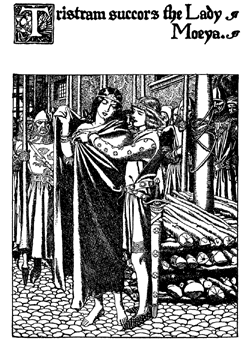
So Tristram went weeping to where the Queen was bound to the stake; and he cut her bonds with his dagger and set her free. And he said: "Lady, thou art free; now go thy way, and may God forgive thee as I do." Then the Queen wept also, and said, "Tristram, thou art very good to me." And because she was barefoot and in her shift, Tristram took his cloak and wrapped it about her.
Tristram departs from Lyonesse.
After that, Tristram straightway left Lyonesse, and King Meliadus appointed that a noble and honorable lord of the court, hight Gouvernail, should go with him. They two went to France, and there they were made very welcome at the court of the King. So Tristram dwelt in France till he was eighteen years old, and everyone at the court of the King of France loved him and honored him so that he dwelt there as though he were of the blood of France.
During the time that he was in France he became the greatest hunter in the world, and he wrote many books on venery that were read and studied long after he had ceased to live. Also he became so skilful with the harp that no minstrel in the world was his equal. And ever he waxed more sturdy of frame and more beautiful of countenance, and more well-taught in all the worship of knighthood. For during that time he became so wonderfully excellent in arms that there was no one in France who was his equal.
Thus Tristram dwelt at peace in that land for five years, but even he longed for his own home with all the might and main of his heart. So one day he said to Gouvernail: "Gouvernail, I cannot deny myself any longer from seeing my father and my own country, for I feel that I must see them or else my heart will certainly break because of its great longing." Nor would he listen to anything that Gouvernail might say contrary to this. So they two took their departure from France, and Tristram travelled as a harper and Gouvernail as his attendant. Thus they came to Lyonesse in that wise.
How Tristram returns to Lyonesse.
One day whilst King Meliadus sat at meat, they two came into the hall, and Gouvernail wore a long white beard which altogether disguised him so that no one knew him. But Tristram shone with such a great radiance of beauty and of youth that all who looked upon him marvelled at him. And the heart of King Meliadus went out to Tristram very strongly, and he said before all of his court, "Who art thou, fair youth? And whence comest thou?" To which Tristram made reply: "Lord, I am a harper, and this is my man, and we have come from France." Then King Meliadus said to Tristram: "Sir, have you seen a youth in France whom men call Tristram?" And Tristram replied, "Yea, I have seen him several times." King Meliadus said, "Doth he do well?" "Yea," said Tristram, "he doeth very well, though at times he is sore oppressed with a great desire for his own country." At this King Meliadus turned away his face, for his heart went very strongly out at the thought of his son. Then by and by he said to Tristram, "Wilt thou play upon thy harp?" And Tristram said, "Yea, if it will please thee to hear me." Therewith he took his harp and he set it before him, and he struck the strings and played upon it, and he sang in such a wise that no one who was there had ever heard the like thereof.
Then King Meliadus' heart was melted at Tristram's minstrelsy, and he said: "That is wonderful harping. Now ask what thou wilt of me, and it shall be thine, whatever it may be."
To this Tristram said, "Lord, that is a great thing that thou sayest." "Nevertheless," said King Meliadus, "it shall be as I say." Then Tristram left his harp and he came to where King Meliadus sat, and he kneeled down before him and he said: "Lord, if so be that is the case, then that which I ask of thee is this: that thou wilt forgive me and bring me back into thy favor again."
King Meliadus is reconciled to Tristram.
At that King Meliadus was filled with a great wonder, and he said: "Fair youth, who art thou, and what have I to forgive thee?" "Lord," said Tristram, "I am thy son, and ask thee to forgive me that I should have saved the life of that lady who is thy Queen."
At this King Meliadus cried out with joy, and he came down from where he sat and he took Tristram into his arms and kissed him upon the face, and Tristram wept and kissed his father upon the face.
So they were reconciled.
After that, Tristram abode in peace in Lyonesse for some while, and during that time he made peace betwixt King Meliadus and Queen Moeya, and the Queen loved him because he was so good to her.
Tristram refuses knighthood.
Now after the return of Tristram as aforesaid, King Meliadus would have made him a knight, but Tristram would not suffer the honor of knighthood to be bestowed upon him at that time, but always said: "Lord, think not ill of me if I do not accept knighthood at this time. For I would fain wait until the chance for some large adventure cometh; then I would be made a knight for to meet that adventure, so that I might immediately win renown. For what credit could there be to our house if I should be made knight, only that I might sit in hall and feast and drink and make merry?"
So spoke Sir Tristram, and his words sounded well to King Meliadus, wherefore from thenceforth King Meliadus refrained from urging knighthood upon him.
Now the way that Sir Tristram achieved knighthood shall be told in that which followeth, and also it shall then be told how he fought his first battle, which was one of the most famous that ever he fought in all of his life.

Chapter Second

How Sir Tristram was made knight by the King of Cornwall, and how he fought a battle with a famous champion.
Now first of all it is to be here said that at that time there was great trouble come to King Mark of Cornwall (who, as aforesaid, was uncle to Sir Tristram) and the trouble was this:
The King of Ireland claims truage of Cornwall.
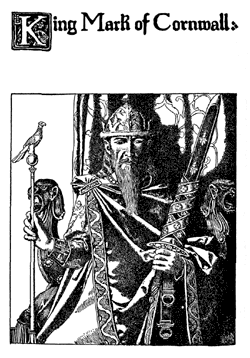
The King of Cornwall and the King of Ireland had great debate concerning an island that lay in the sea betwixt Cornwall and Ireland. For though that island was held by Cornwall, yet the King of Ireland laid claim to it and demanded that the King of Cornwall should pay him truage for the same. This King Mark refused to do, and there was great contention betwixt Cornwall and Ireland, so that each country made ready for war.
But the King of Ireland said: "Let there not be war betwixt Ireland and Cornwall concerning this disagreement, but let us settle this affair in some other way. Let us each choose a champion and let those two champions decide the rights of this case by a combat at arms. For so the truth shall be made manifest."
Now you are to know that at that time the knights of Cornwall were held in great disregard by all courts of chivalry; for there was not in those days any knight of repute in all the court of Cornwall. Wherefore King Mark knew not where he should find him a champion to meet that challenge from the King of Ireland. Yet he must needs meet it, for he was ashamed to refuse such a challenge as that, and so to acknowledge that Cornwall had no knight-champion to defend it. So he said it should be as the King of Ireland would have it, and that if the King of Ireland would choose a champion, he also would do the same.
The King of Ireland chooses Sir Marhaus for his champion.
Thereupon the King of Ireland chose for his champion Sir Marhaus of Ireland, who was one of the greatest knights in the world. For in the Book of King Arthur (which I wrote aforetime) you may there read in the story of Sir Pellias how great and puissant a champion Sir Marhaus was, and how he overthrew Sir Gawaine and others with the greatest ease. Wherefore at that time he was believed by many to be the greatest knight in the world (it being before the days of Sir Launcelot of the Lake), and even in the days of Sir Launcelot it was doubted whether he or Sir Launcelot were the greater champion.
So King Mark could not find any knight in Cornwall to stand against Sir Marhaus. Nor could he easily find any knight outside of Cornwall to do battle with him. For Sir Marhaus, being a knight of the Round Table, no other knight of the Round Table would fight against him--and there were no other knights so great as that famous brotherhood of the Table Round.
Accordingly, King Mark knew not where to turn to find him a champion to do battle in his behalf.
In this strait, King Mark sent a letter by a messenger to Lyonesse, asking if there was any knight at Lyonesse who would stand his champion against Sir Marhaus, and he offered great reward if such a champion would undertake his cause against Ireland.
Tristram asks leave to go to Cornwall.
Now when young Tristram heard this letter of his uncle King Mark, he straightway went to his father and said: "Sire, some whiles ago you desired that I should become a knight. Now I would that you would let me go to Cornwall upon this occasion. For when I come there I will beseech my uncle King Mark to make me a knight, and then I will go out against Sir Marhaus. For I have a great mind to undertake this adventure in behalf of King Mark, and to stand his champion against Sir Marhaus. For though Sir Marhaus is so great a knight and so famous a hero, yet if I should have the good fortune to overcome him in battle, there would, certes, be great glory to our house through my knighthood."
Then King Meliadus looked upon Tristram and loved him very dearly, and he said: "Tristram, thou hast assuredly a very great heart to undertake this adventure, which no one else will essay. So I bid thee go, in God's name, if so be thy heart bids thee to go. For maybe God will lend the strength necessary to carry this adventure through to a successful issue."
So that very day Tristram departed from Lyonesse for Cornwall, taking with him only Gouvernail as his companion. So, by ship, he reached Cornwall, and the castle of Tintagel, where King Mark was then holding court.
And it was at the sloping of the afternoon when he so came, and at that time King Mark was sitting in hall with many of his knights and lords about him. And the King was brooding in great trouble of spirit. Unto him came an attendant, saying: "Lord, there are two strangers who stand without, and crave to be admitted to your presence. One of them hath great dignity and sobriety of demeanor, and the other, who is a youth, is of so noble and stately an appearance that I do not believe his like is to be found in the entire world."
To this the King said, "Show them in."
Tristram and Gouvernail come to Cornwall.
So those two were immediately admitted into the hall and came and stood before King Mark; and the one of them was Gouvernail and the other was young Tristram. So Tristram stood forth before Gouvernail and Gouvernail bore the harp of Tristram, and the harp was of gold and shone most brightly and beautifully. Then King Mark looked upon Tristram, and marvelled at his size and beauty; for Tristram stood above any man in that place, so that he looked like a hero amongst them. His brow was as white as milk and his lips were red like to coral and his hair was as red as gold and as plentiful as the mane of a young lion, and his neck was thick and sturdy and straight like to a round pillar of white-stone, and he was clad in garments of blue silk embroidered very cunningly with threads of gold and set with a countless multitude of gems of divers colors. So because of all this he glistened with a singular radiance of richness and beauty.
So King Mark marvelled at the haughtiness of Tristram's appearance, and he felt his heart drawn toward Tristram with love and admiration. Then, after a little, he spoke, saying: "Fair youth, who are you, and whence come you, and what is it you would have of me?"
Tristram offers himself as champion for Cornwall.
"Lord," said Tristram, "my name is Tristram, and I come from the country of Lyonesse, where your own sister was one time Queen. Touching the purpose of my coming hither, it is this: having heard that you are in need of a champion to contend for your rights against the champion of Ireland, I come hither to say that if you will make me a knight with your own hand, I will take it upon me to stand your champion and to meet Sir Marhaus of Ireland upon your behalf."
Then King Mark was filled with wonder at the courage of Tristram, and he said: "Fair youth, are you not aware that Sir Marhaus of Ireland is a knight well set in years and of such great and accredited deeds of arms that it is supposed that, excepting Sir Launcelot of the Lake, there is not his peer in any court of chivalry in all of the world? How then can you, who are altogether new to the use of arms, hope to stand against so renowned a champion as he?"
"Lord," quoth Tristram, "I am well aware of what sort of knight Sir Marhaus is, and I am very well aware of the great danger of this undertaking. Yet if one who covets knighthood shall fear to face a danger, what virtue would there then be in the chivalry of knighthood? So, Messire, I put my trust in God, His mercies, and I have great hope that He will lend me both courage and strength in my time of need."
Then King Mark began to take great joy, for he said to himself: "Maybe this youth shall indeed bring me forth in safety out of these dangers that menace my honor." So he said: "Tristram, I do believe that you will stand a very excellent chance of success in this undertaking, wherefore it shall be as you desire; I will make you a knight, and besides that I will fit you with armor and accoutrements in all ways becoming to the estate of a knight-royal. Likewise I will provide you a Flemish horse of the best strain, so that you shall be both furnished and horsed as well as any knight in the world hath ever been."
Tristram is made knight-royal.
So that night Tristram watched his armor in the chapel of the castle, and the next day he was made knight with all the circumstances appertaining to a ceremony of such solemnity as that. And upon the afternoon of the day upon which he was thus made knight, King Mark purveyed a ship in all ways befitting the occasion, and in the ship Tristram and Gouvernail set sail for that island where Sir Marhaus was known to be abiding at that time.
Now upon the second day of their voyaging and about the middle of the day they came to a land which they knew must be the place which they were seeking, and there the sailors made a safe harbor. As soon as they were at anchor a gangway was set from the ship to the shore and Sir Tristram and Gouvernail drave their horses across the gangway and so to the dry land.
Thereafter they rode forward for a considerable distance, until about the first slanting of the afternoon they perceived in the distance three very fair ships drawn up close to the shore. And then they were aware of a knight, clad in full armor and seated upon a noble horse under the shadow of those ships, and they wist that that must be he whom Sir Tristram sought.
Then Gouvernail spake to Sir Tristram, saying: "Sir, that knight resting yonder beneath the shelter of the ships must be Sir Marhaus."
Sir Tristram goes forth to meet Sir Marhaus.
"Yea," said Sir Tristram, "that is assuredly he." So he gazed very steadily at the knight for a long while, and by and by he said: "Gouvernail, yonder seems to me to be a very great and haughty knight for a knight so young as I am to have to do with in his first battle; yet if God will lend me His strong aid in this affair, I shall assuredly win me great credit at his hands." Then after another short while he said: "Now go, Gouvernail, and leave me alone in this affair, for I do not choose for anyone to be by when I have to do with yonder knight. For either I shall overcome him in this combat or else I will lay down my life at this place. For the case is thus, Gouvernail; if Sir Marhaus should overcome me and if I should yield me to him as vanquished, then mine uncle must pay truage to the King of Ireland for the land of Cornwall; but if I died without yielding me to mine enemy, then he must yet do battle with another champion at another time, if my uncle the King can find such an one to do battle in his behalf. So I am determined either to win this battle or to die therein."
Now when Gouvernail heard this, he fell a-weeping in great measure; and he cried out: "Sir, let not this battle be of that sort!" To him Sir Tristram said very steadfastly: "Say no more, Gouvernail, but go as I bid thee." Whereupon Gouvernail turned and went away, as he was bidden to do, weeping very bitterly as he went.
Sir Tristram proclaims his degree.
Now by this Sir Marhaus had caught sight of Sir Tristram where he stood in that field, and so presently he came riding thitherward to meet Sir Tristram. When he had come nigh, Sir Marhaus said: "Who art thou, Sir Knight?" Unto these Sir Tristram made reply: "Sir, I am Sir Tristram of Lyonesse, son of King Meliadus of that land, and nephew of King Mark of Cornwall. I am come to do battle upon behalf of the King of Cornwall, to release him from the demands of truage made by the King of Ireland." Quoth Sir Marhaus: "Messire, are you a knight of approval and of battles?" "Nay," said Sir Tristram, "I have only been created knight these three days."
"Alas!" said Sir Marhaus, "I am very sorry for thee and for thy noble courage that hath brought thee hither to this place. Thou art not fit to have to do with me, for I am one who hath fought in more than twice twenty battles, each one of which was, I believe, greater than this is like to be. Also I have matched me with the very best knights in the world, and have never yet been overcome. So I advise thee, because of thy extreme youth, to return to King Mark and bid him send me another champion in thy stead, who shall be better seasoned than thou art."
"Sir," said Sir Tristram, "I give thee gramercy for thy advice. But I may tell thee that I was made knight for no other purpose than to do battle with thee; so I may not return without having fulfilled mine adventure. Moreover, because of thy great renown and thy courage and prowess, I feel all the more desirous to have to do with thee; for if I should die at thy hand, then there will be no shame to me, but if I should win this battle from thee, then I shall have very great renown in the courts of chivalry."
"Well," said Sir Marhaus, "it is not likely that thou shalt die at my hand. For because of thy youth I will not have it that this battle shall be so desperate as that." "Say not so," said Sir Tristram, "for either I shall die at thy hand, or else I shall overcome thee in this battle, for I make my vow to God that I will not yield myself to thee so long as there is life within my body."
"Alas!" said Sir Marhaus, "that is certes a great pity. But as thou hast foreordained it, so it must needs be." Therewith he saluted Sir Tristram and drew rein and rode aside to a little distance where he straightway made ready for that battle. Nor was Sir Tristram behind him in making preparation, albeit he was filled with doubts as to the outcome of that undertaking.
Sir Tristram is wounded.
Then when they were in all ways prepared, each gave shout and drave spurs into his horse and rushed toward the other with such fury that it was terrible to behold. And each smote the other with his spear in the centre of his shield, and in that encounter Sir Marhaus smote through Sir Tristram's shield and gave Sir Tristram a great wound in his side. Then Sir Tristram felt the blood gush out of that wound in such abundance that it filled his iron boots, so that they were sodden therewith, and he thought he had got his death-wound. But in spite of that grievous bitter stroke, he held his seat and was not overthrown. Then so soon as he had recovered himself he voided his horse and drew his sword and set his shield before him; and when Sir Marhaus saw his preparations, he likewise voided his horse and made ready for battle upon foot. So straightway they came together with terrible fury, lashing at each other with such fearful strength and evil will that it was dreadful to behold. And each gave the other many grievous strokes, so that whole pieces of armor were hewn off from their bodies; and each gave the other many deep wounds, so that that part of the armor that still hung to them became red as though it were painted with red. Likewise the ground was all besprinkled red where they stood, yet neither gave any thought to quitting that battle in which they were engaged.
Sir Tristram gives Sir Marhaus a death-wound.
Now for a while Sir Tristram feared because of the wound which he had at first received that he would die in that battle, but by and by he perceived that he was stouter than Sir Marhaus and better winded; wherefore great hope came to him and uplifted him with redoubled strength. Then presently Sir Marhaus fell back a little and when Sir Tristram perceived that he ran in upon him and smote him several times, such direful strokes that Sir Marhaus could not hold up his shield against that assault. Then Sir Tristram perceived that Sir Marhaus was no longer able to hold up his shield, and therewith he smote him a great blow with his sword upon the helmet. So direful was that blow that the sword of Sir Tristram pierced very deep through the helm of Sir Marhaus and into the brainpan. And Sir Tristram's sword stuck fast in the helm and the brain-pan of Sir Marhaus so that Sir Tristram could not pull it out again. Then Sir Marhaus, half a-swoon, fell down upon his knees, and therewith a part of the edge of the blade brake off from Sir Tristram's sword, and remained in the wound that he had given to Sir Marhaus.
Sir Marhaus leaves the field.
Then Sir Marhaus was aware that he had got his death-wound, wherefore a certain strength came to him so that he rose to his feet staggering like a drunken man. And at first he began going about in a circle and crying most dolorously. Then as he wist all that had happed he threw away his sword and his shield, and made away from that place, staggering and stumbling like one who had gone blind; for he was all bewildered with that mortal wound, and wist not very well what he was doing or whither he was going. Then Sir Tristram would have made after him to stop him, but he could not do so because he himself was so sorely wounded and so weak from the loss of blood. Yet he called after Sir Marhaus: "Stay, stay, Sir Knight! Let us finish this battle now we are about it!" But to this Sir Marhaus made no answer, but went on down to his ships, staggering and stumbling like a blind man as aforesaid, for the sore wound which he had received still lent him a false strength of body so that he was able to go his way. Then those who were aboard the ships, beholding him thus coming staggering toward them, came down and met him and lifted him up and bore him away to his own ship. Thereafter, as soon as might be they hoisted sail and lifted anchor and took their way from that place.
Then by and by came Gouvernail and several others of Sir Tristram's party to where Sir Tristram was; and there they found him leaning upon his sword and groaning very sorely because of the great wound in his side. So presently they perceived that he could not walk, wherefore they lifted him up upon his own shield and bore him thence to that ship that had brought him thither.
And when they had come to the ship they laid him down upon a couch and stripped him of his armor to search his wounds. Then they beheld what a great wound it was that Sir Marhaus had given him in the side, and they lifted up their voices in sorrow, for they all believed that he would die.
Sir tristram returns to Cornwall.
So they set sail, and in two days brought him back to King Mark, where he sat at Tintagel in Cornwall. And when King Mark saw how pale and wan and weak Sir Tristram was, he wept and grieved very sorely for sorrow of that sight, for he too thought that Sir Tristram was certainly about to die.
But Sir Tristram smiled upon King Mark, and he said: "Lord, have I done well for thy sake?" And King Mark said, "Yea," and fell to weeping again.
Sir Tristram proclaims himself to King Mark.
"Then," quoth Tristram, "it is time for me to tell thee who I am who have saved thy kingdom from the shame of having to pay truage to Ireland, and that I am thine own sister's son. For my father is King Meliadus of Lyonesse, and my mother was the Lady Elizabeth, who was thine own sister till God took her soul to Paradise to dwell there with His angels."
But when King Mark heard this he went forth from that place and into his own chamber. And when he had come there he fell down upon his knees and cried out aloud: "Alas, alas, that this should be! Rather, God, would I lose my entire kingdom than that my sister's son should come to his death in this wise!"
Now it remaineth to say of Sir Marhaus that those who were with him brought him back to Ireland and that there in a little while he died of the wound that Sir Tristram had given him upon the head. But ere he died, and whilst they were dressing that hurt, the Queen of Ireland, who was sister to Sir Marhaus, discovered the broken piece of the blade still in that grim wound. This she drew forth and set aside, and hid very carefully, saying to herself: "If ever I meet that knight to whose sword this piece of blade fitteth, then it will be an evil day for him."
Thus I have told you all the circumstances of that great battle betwixt Sir Tristram of Lyonesse and Sir Marhaus of Ireland. And now you shall hear how it befell Sir Tristram thereafter; so harken to what followeth.
Chapter Third

How Sir Tristram went to Ireland to be healed of his wound by the King's daughter of Ireland, and of how he came to love the Lady Belle Isoult. Also concerning Sir Palamydes and the Lady Belle Isoult.
Now that grievous hurt which Sir Tristram had received at the hands of Sir Marhaus did not heal, but instead grew even more rankled and sore, so that there were many who thought that there had been treachery practised and that the spearhead had been poisoned to cause such a malignant disease as that with which the wounded man suffered. So by and by Sir Tristram grew so grievously sick of his hurt that all those who were near him thought that he must certainly die.
Then King Mark sent everywhere and into all parts for the most wise and learned leeches and chirurgeons to come to Cornwall and search the wounds of Sir Tristram, but of all these no one could bring him any ease.
How Sir Tristram lieth sick in Cornwall.
Now one day there came to the court of King Mark a very wise lady, who had travelled much in the world and had great knowledge of wounds of all sorts. At the bidding of the King, she went to where Sir Tristram lay, and searched the wound as so many had already done. And when she had done that she came out of Sir Tristram's chamber and unto King Mark, where he was waiting for her. Then King Mark said to her: "Well, how will it be with yonder knight?" "Lord," quoth she, "it is thus; I can do nothing to save his life, nor do I know of any one who may save it unless it be the King's daughter of Ireland, who is known as the Belle Isoult because of her wonderful beauty. She is the most skilful leech in all of the world, and she alone may hope to bring Sir Tristram back to life and health again, for I believe that if she fail no one else can save him."
Then after the aforesaid lady had gone, King Mark went to where Sir Tristram lay, and he told him all that she had said concerning his condition; and King Mark said: "Tristram, wilt thou go to the King's daughter of Ireland and let her search thy wound?"
Then Sir Tristram groaned at the thought of the weariness and pain of moving, and he said: "Lord, this is a great undertaking for one who is so sick. Moreover, it is a great risk for me, for, if I go to Ireland, and if it be found that I am he who slew Sir Marhaus, then it is hardly likely that I shall ever escape from that country again with my life. Ne'theless, I am so sorely sick of this wound that I would rather die than live as I am living; wherefore I will go to Ireland for the sake of being healed, if such a thing is possible."
Accordingly, a little while after that, King Mark provided a ship to carry Sir Tristram to Ireland. This ship he furnished with sails of silk of divers colors, and he had it hung within with fine embroidered cloth, and fabrics woven with threads of silver and gold, so that in its appearance it was a worthy vessel even for a great king to sail in. Then, when all was ready, King Mark had a number of attendants carry Sir Tristram down to the ship in a litter, and he had them lay Sir Tristram upon a soft couch of crimson satin, which was set upon the deck beneath a canopy of crimson silk, embroidered with threads of silver and garnished with fringe of silver, and Sir Tristram lay there at ease where the breezes of the ocean came pleasantly to him, and breathed upon his face and his temples and his hair and his hands with coolness; and Gouvernail was with Sir Tristram all the while in attendance upon him.
Sir Tristram sails to Ireland to have his wound searched.
So they set sail for Ireland, the weather being very fair and pleasant, and on the third day, at about the time of sunset, they came to a part of the coast of Ireland where there was a castle built upon the rocks that rose out of the sea.
Now there were several fishermen fishing in boats near that castle, and of these the pilot of Sir Tristram's boat made inquiry what castle that was. To him the fisherman replied: "That castle is the castle of King Angus of Ireland." And the fisherman said: "It so happens that the King and Queen and their daughter, hight the Lady Belle Isoult, and all of their court are there at this very while."
This Sir Tristram heard and said: "This is good news, for indeed I am very sick and am right glad that my voyaging is ended." So he gave orders that the pilot should bring the ship close under the walls of that castle, and that he should there let go anchor; and the pilot did as Sir Tristram had commanded him.
How Sir Tristram came to Ireland.
Now, as aforesaid, that ship was of a very wonderful appearance, like to the ship of a king or a high prince, wherefore many people came down to the walls of the castle and stood there and gazed at the vessel as it sailed into the harbor. And by that time the sun had set and all the air was illuminated with a marvellous golden light; and in this sky of gold the moon hung like a shield of silver, very bright and steady above the roofs and towers of the castle. And there came from the land a pleasing perfume of blossoms; for it was then in the fulness of the spring-time, and all the fruit-bearing trees were luxuriant with bloom so that the soft air of evening was full of fragrance thereby.
Then there came a great content into the heart of Sir Tristram, wherefore he said to Gouvernail: "Gouvernail, either I shall soon be healed of this wound, or else I shall presently die and enter into Paradise free of pain, for I am become very full of content and of peace toward all men." And then he said: "Bring me hither my harp, that I may play upon it a little, for I have a desire to chant in this pleasant evening-time."
Sir Tristram sings.
So Gouvernail brought to Sir Tristram his shining harp, and when Sir Tristram had taken it into his hands he tuned it, and when he had tuned it he struck it and sang; and, because of the stillness of the evening, his voice sounded marvellously clear and sweet across the level water, so that those who stood upon the castle walls and heard it thought that maybe an angel was singing on board of that ship.
That time the Lady Belle Isoult sat at the window of her bower enjoying the pleasantness of the evening. She also heard Sir Tristram singing, and she said to those damsels who were with her, "Ha, what is that I hear?" Therewith she listened for a little while, and then she said: "Meseems that must be the voice of some angel that is singing." They say: "Nay, Lady, it is a wounded knight singing, and he came to this harbor in a wonderful ship some while ago." Then the Lady Belle Isoult said to a page who was in attendance: "Bid the King and Queen come hither, that they may hear this singing also, for never did I think to hear such singing beyond the walls of Paradise."
So the page ran with all speed, and in a little the King and Queen came to the bower of the Lady Belle Isoult; and she and they leaned upon the window-ledge and listened to Sir Tristram whilst he sang in the soft twilight. Then by and by King Angus said: "Now I will have yonder minstrel brought thither to this castle to do us pleasure, for I believe that he must be the greatest minstrel in all the world to sing in that wise." And the Lady Belle Isoult said: "I pray you, sir, do so, for it would be great joy to everybody to have such singing as that in this place."
So King Angus sent a barge to that ship, and besought that he who sang should be brought to the castle. At that Sir Tristram was very glad, for he said: "Now I shall be brought to the Lady the Belle Isoult and maybe she will heal me." So he had them bare him to the barge of the King of Ireland, and so they brought him to the castle of King Angus, where they laid him upon a bed in a fair room of the castle.
King Angus cometh to Tristram.
Then King Angus came to Sir Tristram where he lay, and he said: "Messire what can I do for you to put you more at your ease than you are?" "Lord," said Sir Tristram, "I pray you to permit the Lady Belle Isoult to search a great wound in my side that I received in battle. For I hear that she is the most skilful leech in all the world, and so I have come hither from a great distance, being in such pain and dole from my grievous hurt that I shall die in a little while unless it be healed."
"Messire," said King Angus, "I perceive that you are no ordinary knight, but somebody of high nobility and estate, so it shall be as you desire." And then King Angus said: "I pray you, tell me your name and whence you come."
Upon this, Sir Tristram communed within his own mind, saying: "An I say my name is Tristram, haply there may be someone here will know me and that I was the cause why the brother of the Queen of this place hath died." So he said: "Lord, my name is Sir Tramtris, and I am come from a country called Lyonesse, which is a great distance from this."
Quoth King Angus, "Well, Sir Tramtris, I am glad that you have come to this place. Now it shall be done to you as you desire, for to-morrow the Lady Belle Isoult shall search your wound to heal it if possible."
My Lady Belle Isoult searches the wound.
And so it was as King Angus said, for the next day the Lady Belle Isoult came with her attendants to where Sir Tristram lay, and one of the attendants bare a silver basin and another bare a silver ewer, and others bare napkins of fine linen. So the Lady Belle Isoult came close to Sir Tristram and kneeled beside the couch whereon he lay and said, "Let me see the wound." Therewith Sir Tristram laid bare his bosom and his side and she beheld it. Then she felt great pity for Sir Tristram because of that dolorous wound, and she said: "Alas, that so young and so fair and so noble a knight should suffer so sore a wound as this!" Therewith still kneeling beside Sir Tristram she searched the wound with very gentle, tender touch (for her fingers were like to rose leaves for softness) and lo! she found a part of the blade of a spear-head embedded very deep in the wound of Sir Tristram.
This she drew forth very deftly (albeit Sir Tristram groaned with a great passion of pain) and therewithafter came forth an issue of blood like a crimson fountain, whereupon Sir Tristram swooned away like one who had gone dead. But he did not die, for they quickly staunched the flow, set aromatic spices to his nostrils, so that in a little he revived in spirit to find himself at great ease and peace in his body (albeit it was for a while like to the peace of death).
Sir Tristram is healed.
Thus it was that the Lady Belle Isoult saved the life of Sir Tristram, for in a little while he was able to be about again, and presently waxed almost entirely hale and strong in limb and body.
And now it is to be told how Sir Tristram loved the Lady Belle Isoult and how she loved Sir Tristram. Also how a famous knight, hight Sir Palamydes the Saracen, loved Belle Isoult and of how she loved not him.
Sir Tristram loves the Lady Belle Isoult.
For, as was said, it came about that in a little while Sir Tristram was healed of that grievous wound aforetold of so that he was able to come and go whithersoever he chose. But always he would be with the Lady Belle Isoult, for Sir Tristram loved her with a wonderfully passionate regard. And so likewise the lady loved Sir Tristram. For if he loved her because she had saved his life, then she also loved him for the same reason. For she did not ever forget how she had drawn out the head of that spear from the wound at his side, and of how he had groaned when she brought it forth, and of how the blood had gushed out of that wound. Wherefore she loved him very aboundingly for the agony of pain she had one time caused him to suffer.
So they two fair and noble creatures were always together in bower or in hall, and no one in all that while wist that Sir Tramtris was Sir Tristram, and that it was his hand that had slain Sir Marhaus of Ireland.
So Sir Tristram was there in Ireland for a year, and in that time he grew to be altogether well and sturdy again.
Sir Palamydes cometh to Ireland.
Now it was in those days that there came Sir Palamydes the Saracen knight to that place, who was held to be one of the very foremost knights in the world. So great rejoicing was made over him because he had come thither, and great honor was shown to him by everyone.
But when Sir Palamydes beheld the Lady Belle Isoult and when he saw how fair she was, he came in a short while to love her with almost as passionate a regard as that with which Sir Tristram loved her, so that he also sought ever to be with her whenever the chance offered.
But Belle Isoult felt no regard for Sir Palamydes, but only fear of him, for all of her love was given to Sir Tristram. Nevertheless, because Sir Palamydes was so fierce and powerful a knight, she did not dare to offend him; wherefore she smiled upon him and treated him with all courtesy and kindness although she loved him not, dissembling her regard for him.
Sir Tristram is displeased.
All this Sir Tristram beheld from aside and it displeased him a very great deal to see how Sir Palamydes was always beside the lady. But Belle Isoult beheld how Sir Tristram was displeased, wherefore she took occasion to say to him: "Tramtris, be not displeased, for what am I to do? You know very well that I do not love this knight, but I am afraid of him because he is so fierce and so strong."
To this Sir Tristram said: "Lady, it would be a great shame to me if I, being by, should suffer any knight to come betwixt you and me and win your regard through fear of him."
She said: "Tramtris, what would you do? Would you give challenge to this knight? Lo, you are not yet entirely healed of your hurt, and Sir Palamydes is in perfect strength of body. For indeed it is for you I am most of all afraid lest you and Sir Palamydes should come to battle and lest he should do you a harm before you are entirely healed."
Sir Tristram desires to do battle.
"Lady," quoth Sir Tristram, "I thank God that I am not at all afraid of this knight, or of any other knight, and I have to thank you that I am now entirely recovered and am as strong as ever I was. Wherefore I have now a mind to deal with this knight in your behalf. So if you will provide me with armor I will deal with him so that maybe he will not trouble you again. Now I will devise it in this way:--tell your father, King Angus, to proclaim a great jousting. In that jousting I will seek out Sir Palamydes and will encounter him, and I hope with God's aid that I shall overcome him, so that you shall be free from him."
Belle Isoult said, "Tramtris, are you able for this?" He said, "Yea, I am as ready as ever I shall be in all of my life." Whereat Belle Isoult said, "It shall be as you will have it."
Then Sir Tristram charged Belle Isoult that she should keep secret all this that had been said betwixt them. And more especially she was to keep it secret that he was to take part in such a tournament as that which they had devised. And he said to her: "Lady, I lie here under a great peril to my life, though I cannot tell you what that peril is. But I may tell you that if my enemies should discover me at this place, it would go hard with me to preserve my life from them. Wherefore, if I take part in any such affair as this, it must be altogether a secret betwixt us."
So therewith they parted and Lady Belle Isoult went to her father and besought him to proclaim a great day of jousting in honor of Sir Palamydes, and the King said that he would do so. So the King sent forth proclamation to all the courts of that nation that a great tournament was to be held and that great rewards and great honors were to be given to the best knight thereat. And that tournament was talked about in all the courts of chivalry where there were knights who desired to win glory in such affairs at arms.
And now it shall be told concerning that tournament and how it befell with Sir Tristram thereat, and with Sir Palamydes thereat.
Chapter Fourth

How Sir Tristram encountered Sir Palamydes at the tournament and of what befell. Also how Sir Tristram was forced to leave the Kingdom of Ireland.
So came the time for the tournament that King Angus of Ireland had ordained; and that was a very famous affair at arms indeed. For it hath very rarely happened that so noble a gathering of knights hath ever come together as that company which there presented itself for that occasion at the court of the King of Ireland.
Of the court of chivalry at Ireland.
For you may know how excellent was the court of chivalry that fore gathered thereat when you shall hear that there came to that tournament, the King of an Hundred Knights and the King of the Scots, and that there came several knights of the Round Table, to wit: Sir Gawaine, Sir Gaheris and Sir Agravaine; and Sir Bagdemagus and Sir Kay and Sir Dodinas, and Sir Sagramore le Desirous, and Sir Gumret the Less, and Sir Griflet; and that there came besides these many other knights of great renown.
These and many others gathered at the court of King Angus of Ireland, so that all those meadows and fields coadjacent to the place of battle were gay as beds of flowers with the multitude of tents and pavilions of divers colors that were there emplanted.
And on the day of the tournament there came great crowds of people into the lists, so that all that place was alive with movement. For it was as though a sea of people had arisen to overflow the seats and stalls thereof.
Now that tournament was to last for three days, and upon the third day there was to be a grand mêlée in which all these knights contestant were to take stand upon this side or upon that.
But upon the first two of those three days Sir Tristram sat in the stall of the King and looked down upon the jousting, for, because of the illness from which he had recovered, he was minded to save his body until the right time should come, what time he should be called upon to do his uttermost.
Sir Palamydes performeth wonders.
And in those two days, Sir Tristram beheld that Sir Palamydes did more wonderfully in battle than he would have believed it possible for any knight to do. For Sir Palamydes was aware that the eyes of the Lady Belle Isoult were gazing upon him, wherefore he felt himself uplifted to battle as with the strength of ten. Wherefore he raged about that field like a lion of battle, seeking whom he might overthrow and destroy. And upon the first day he challenged Sir Gawaine to joust with him, and then he challenged Sir Gaheris, and the King of an Hundred Knights, and Sir Griflet, and Sir Sagramore le Desirous and fourteen other knights, and all of these he met and many he overcame, and that without any mishap to himself. And upon the second day he met with great success Sir Agravaine and Sir Griflet and Sir Kay and Sir Dodinas and twelve other knights. Wherefore those who beheld how he did gave great shouts and outcries of applause and acclaim, saying: "Certes, there was never knight in all of the world so great as this knight. Yea; even Sir Launcelot himself could not do more than that knight doeth."
Then Belle Isoult was troubled in her mind, and she said: "Tramtris, yonder in very truth is a most fierce and terrible knight. Now somewhiles I have fear that you may not be able to overcome him."
Thereat Sir Tristram smiled very grimly, and said: "Lady, already I have overcome in battle a bigger knight than ever Sir Palamydes has been or is like to be." But the Lady Belle Isoult wist not that that knight of whom Sir Tristram spake was Sir Marhaus of Ireland.
Sir Palamydes bespeaks the Lady Belle Isoult.
Now upon the evening of the second day of that tournament, Sir Palamydes came to where the Lady Belle Isoult was, and he said: "Lady, all these things I have done for your sake. For had it not been for my love for you, I would not have been able to do a third part of that which I did. Now I think you should have pity and regard for one who loves you so strongly as that; wherefore I beseech you to bestow some part of your good-will upon me."
"Sir," said the Lady Belle Isoult, "you are not to forget that there is still another day of this battle, and in it you may not happen to have the same fortune that favored you to-day; so I will wait until you have won that battle also before I answer you."
"Well," said Sir Palamydes, "you shall see that I shall do even more worthily to-morrow for your sake than I have done to-day."
But the Lady Belle Isoult was not very well pleased with that saying, for she began again to fear that maybe the will of Sir Palamydes was so strong that Sir Tristram would not have any success against him.
So came the third day of that very famous contest at arms, and when this morning was come there began to gather together in the two parties those who were to contest the one against the other. Of one of these parties, Sir Palamydes was the chiefest knight, and upon that side was also Sir Gawaine and several of the knights who were with him. For these said, "There shall certes be greater credit to be had with Sir Palamydes than against him," and so they joined them with his party. Of the other party the chiefest knights were the King of an Hundred Knights and the King of Scots, and both of these were very famous and well-approved champions, of high courage and remarkable achievements.
Belle Isoult arms Sir Tristram.
Now when the time was nigh ready for that tournament, Sir Tristram went to put on the armor that the Lady Belle Isoult had provided him, and when he was armed he mounted very lightly upon the horse which she had given him. And the armor of Sir Tristram was white, shining like to silver, and the horse was altogether white, and the furniture and trappings thereof were all white, so that Sir Tristram glistened with extraordinary splendor.
Now when he was armed and prepared in all ways, the Lady Belle Isoult came to where he was and she said, "Tramtris, are you ready?" And he answered "Yea." Therewith she took the horse of Sir Tristram by the bridle and she led him to the postern gate of the castle, and put him out that way into a fair field that lay beyond; and Sir Tristram abided in the fields for some while until the tournament should have begun.
But the Lady Belle Isoult went to the tournament with her father, the King, and her mother, the Queen, and took her station at that place assigned to her whence she might overlook the field.
How Sir Palamydes fought in the tournament.
So in a little while that friendly battle began. And again Sir Palamydes was filled with the vehement fury of contest, wherefore he raged about the field, spreading terror whithersoever he came. For first he made at the King of an Hundred Knights, and he struck that knight so direful a blow that both horse and man fell to the ground with the force thereof. Then in the same manner he struck the King of Scots with his sword, and smote him straightway out of the saddle also. Then he struck down one after another, seven other knights, all of well-proved strength and prowess, so that all those who looked thereon cried out, "Is he a man or is he a demon?" So, because of the terror of Sir Palamydes, all those in that contest bore away from him as they might do from a lion in anger.
At this time came Sir Tristram, riding at a free pace, shining like to a figure of silver. Then many saw him and observed him and said to one another: "Who is this knight, and what party will he join with to do battle?" These had not long to wait to know what side he would join, for immediately Sir Tristram took stand with that party which was the party of the King of an Hundred Knights and the King of Scots, and at that the one party was very glad, and the other party was sorry; for they deemed that Sir Tristram was certes some great champion.
Sir Tristram enters the tournament.
Then straightway there came against Sir Tristram four knights of the other party, and one of these was Sir Gaheris, and another was Sir Griflet and another was Sir Bagdemagus and another was Sir Kay. But Sir Tristram was possessed with a great joy of battle, so that in a very short time he had struck down or overthrown all those knights, beginning with Sir Gaheris, and ending with Sir Kay the seneschal.
This Sir Gawaine beheld, and said to Sir Sagramore: "Yonder is certes a knight of terrible strength; now let us go and see of what mettle he be."
Therewith Sir Gawaine pushed against Sir Tristram from the one side, and Sir Sagramore came against him on the other side, and so they met him both at once. Then first Sir Gawaine struck Sir Tristram such a buffet that the horse of Sir Tristram turned twice about with the force of that stroke; and therewith Sir Sagramore smote him a buffet upon the other side so that Sir Tristram wist not upon which side to defend himself.
Then, at those blows Sir Tristram waxed so exceedingly fierce that it was as though a fire of rage flamed up into his brains and set them into a blaze of rage. So with that he rose up in his stirrups and launched so dreadful a blow upon Sir Gawaine that I believe nothing could have withstood the force of that blow. For it clave through the shield of Sir Gawaine and it descended upon the crown of his helmet and it clave away a part of his helmet and a part of the épaulière of his shoulder; and with the force of that dreadful, terrible blow, Sir Gawaine fell down upon the ground and lay there as though he were dead.
Then Sir Tristram wheeled upon Sir Sagramore (who sat wonder-struck at that blow he had beheld) and thereafter he smote him too, so that he fell down and lay upon the ground in a swoon from which he did not recover for more than two hours.
Now Sir Palamydes also had beheld those two strokes that Sir Tristram had given, wherefore he said: "Hah! Yonder is a very wonderful knight. Now if I do not presently meet him, and that to my credit, he will have more honor in this battle than I."
Sir Palamydes rides against Sir Tristram.
So therewith Sir Palamydes pushed straight against Sir Tristram, and when Sir Tristram beheld that he was very glad, for he said: "Now it will either be Sir Palamydes his day, or else it will be mine." So he upon his part pushed against Sir Palamydes with good intent to engage him in battle, and then they two met in the midst of the field.
Then immediately Sir Palamydes smote Sir Tristram such a buffet that Sir Tristram thought a bolt of lightning had burst upon him, and for a little while he was altogether bemazed and wist not where he was. But when he came to himself he was so filled with fury that his heart was like to break therewith.
Sir Tristram smites Sir Palamydes.
Thereupon he rushed upon Sir Palamydes and smote him again and again and again with such fury and strength that Sir Palamydes was altogether stunned at the blows he received and bare back before them. Then Sir Tristram perceived how that Sir Palamydes bare his shield low because of the fierceness of that assault, and thereupon he rose up in his stirrups and struck Sir Palamydes upon the crown of the helmet so dreadful a buffet that the brains of Sir Palamydes swam like water, and he must needs catch the pommel of his saddle to save himself from falling. Then Sir Tristram smote him another buffet, and therewith darkness came upon the sight of Sir Palamydes and he rolled off from his horse into the dust beneath its feet.
Then all who beheld the encounter shouted very loud and with great vehemence, for it was the very best and most notable assault at arms that had been performed in all that battle. But most of those who beheld that assault cried out "The Silver Knight!" For at that time no one but the Lady Belle Isoult wist who that silver knight was. But she wist very well who he was, and was so filled with the glory of his prowess that she wept for joy thereof.
Belle Isoult declares Sir Tristram.
Then the King of Ireland said: "Who is yonder knight who hath so wonderfully overthrown Sir Palamydes? I had not thought there was any knight in the world so great as he; but this must be some great champion whom none of us know." Upon that the Lady Belle Isoult, still weeping for joy, could contain herself no longer, but cried out: "Sir, that is Tramtris, who came to us so nigh to death and who hath now done us so great honor being of our household! For I knew very well that he was no common knight but some mighty champion when I first beheld him."
At that the King of Ireland was very much astonished and overjoyed, and he said: "If that is indeed so, then it is a very great honor for us all."
Now after that assault Sir Tristram took no more part in that battle but withdrew to one side. But he perceived where the esquires attendant upon Sir Palamydes came to him and lifted him up and took him away. Then by and by he perceived that Sir Palamydes had mounted his horse again with intent to leave that meadow of battle, and in a little he saw Sir Palamydes ride away with his head bowed down like to one whose heart was broken.
All this Sir Tristram beheld and did not try to stay Sir Palamydes in his departure. But some while after Sir Palamydes had quitted that place, Sir Tristram also took his departure, going in that same direction that Sir Palamydes had gone. Then after he had come well away from the meadow of battle, Sir Tristram set spurs to his horse and rode at a hard gallop along that way that Sir Palamydes had taken.
So he rode at such a gait for a considerable pass until, by and by, he perceived Sir Palamydes upon the road before him; and Sir Palamydes was at that time come to the edge of a woods where there were several stone windmills with great sails swinging very slowly around before a strong wind that was blowing.
Sir Tristram overthrows Palamydes again.
Now this was a lonely place, and one very fit to do battle in, wherefore Sir Tristram cried out to Sir Palamydes in a loud voice: "Sir Palamydes! Sir Palamydes! Turn you about! For here is the chance for you to recover the honor that you have lost to me." Thereupon Sir Palamydes, hearing that loud voice, turned him about. But when he beheld that the knight who called was he who had just now wrought such shame upon him, he ground his teeth together with rage, and therewith drave his horse at Sir Tristram, drawing his sword so that it flashed like lightning in the bright sunlight. And when he came nigh to Sir Tristram, he stood up in his stirrups and lashed a blow at him with all his might and main; for he said to himself: "Maybe I shall now recover mine honor with one blow which I lost to this knight a while since." But Sir Tristram put aside that blow of Sir Palamydes with his shield with very great skill and dexterity, and thereupon, recovering himself, he lashed at Sir Palamydes upon his part. And at that first stroke Sir Tristram smote down the shield of Sir Palamydes, and gave him such a blow upon the head that Sir Palamydes fell down off his horse upon the earth. Then Sir Tristram voided his own horse very quickly, and running to Sir Palamydes where he lay he plucked off his helmet with great violence. Therewith he cried out very fiercely: "Sir Knight, yield thee to me, or I will slay thee." And therewithal he lifted up his sword as though to strike off the head of Sir Palamydes.
Then when Sir Palamydes saw Sir Tristram standing above him in that wise, he dreaded his buffets so that he said: "Sir Knight, I yield me to thee to do thy commands, if so be thou wilt spare my life."
Thereupon Sir Tristram said, "Arise," and at that Sir Palamydes got him up to his knees with some ado, and so remained kneeling before Sir Tristram.
"Well," said Sir Tristram, "I believe you have saved your life by thus yielding yourself to me. Now this shall be my commandment upon you. First of all, my commandment is that you forsake the Lady Belle Isoult, and that you do not come near her for the space of an entire year. And this is my second commandment; that from this day you do not assume the arms of knighthood for an entire year and a day."
"Alas!" said Sir Palamydes, "why do you not slay me instead of bringing me to such shame as this! Would that I had died instead of yielding myself to you as I did." And therewith he wept for shame and despite.
"Well," said Sir Tristram, "let that pass which was not done. For now you have yielded yourself to me and these are my commands." So with that Sir Tristram set his sword back again into its sheath, and he mounted his horse and rode away, leaving Sir Palamydes where he was.
Sir Palamydes disarms himself.
But after Sir Tristram had gone, Sir Palamydes arose, weeping aloud. And he said: "This is such shame to me that I think there can be no greater shame." Thereupon he drew his misericordia, and he cut the thongs of his harness and he tore the pieces of armor from off his body and flung them away very furiously, upon the right hand and upon the left. And when he had thus stripped himself of all of his armor, he mounted his horse and rode away into the forest, weeping like one altogether brokenhearted.
So Sir Tristram drave Sir Palamydes away from the Lady Belle Isoult as he had promised to do.
Now when Tristram came back to the castle of the King of Ireland once more, he thought to enter privily in by the postern-gate as he had gone out. But lo! instead of that he found a great party waiting for him before the castle and these gave him loud acclaim, crying, "Welcome, Sir Tramtris! Welcome, Sir Tramtris!" And King Angus came forward and took the hand of Sir Tristram, and he also said: "Welcome, Sir Tramtris, for you have brought us great honor this day!"
Sir Tristram chides Belle Isoult.
But Sir Tristram looked at the Lady the Belle Isoult with great reproach and by and by when they were together he said: "Lady, why did you betray me who I was when you had promised me not to do so?" "Sir," she said, "I meant not to betray you, but in the joy of your victory I know not very well what I said." "Well," said Sir Tristram, "God grant that no harm come of it." She said, "What harm can come of it, Messire?" Sir Tristram said: "I may not tell you, Lady, but I fear that harm will come of it."
Anon the Queen of Ireland came and said: "Tramtris, one so nigh to death as you have been should not so soon have done battle as you have done. Now I will have a bain prepared and you shall bathe therein, for you are not yet hale and strong."
"Lady," said Tristram, "I do not need any bain, for I believe I am now strong and well in all wise."
"Nay," said the Queen, "you must have that bain so that no ill may come to you hereafter from this battle which you have fought."
So she had that bain prepared of tepid water, and it was very strong and potent with spices and powerful herbs of divers sorts. And when that bain was prepared, Sir Tristram undressed and entered the bath, and the Queen and the Lady Belle Isoult were in the adjoining chamber which was his bed-chamber.
The Queen of Ireland beholds Sir Tristram's sword.
Now whilst Sir Tristram was in that bath, the Queen and Belle Isoult looked all about his chamber. And they beheld the sword of Sir Tristram where it lay, for he had laid it upon the bed when he had unlatched the belt to make himself ready for that bath. Then the Queen said to the Lady Belle Isoult, "See what a great huge sword this is," and thereupon she lifted it and drew the blade out of its sheath, and she beheld what a fair, bright, glistering sword it was. Then in a little she saw where, within about a foot and a half from the point, there was a great piece in the shape of a half-moon broken out of the edge of the sword; and she looked at that place for a long while. Then of a sudden she felt a great terror, for she remembered how even such a piece of sword as that which had been broken off from that blade, she had found in the wound of Sir Marhaus of which he had died. So she stood for a while holding that sword of Sir Tristram in her hand and looking as she had been turned into stone. At this the Lady Belle Isoult was filled with a sort of fear, wherefore she said, "Lady, what ails you?" The Queen said, "Nothing that matters," and therewith she laid aside the sword of Sir Tristram and went very quickly to her own chamber. There she opened her cabinet and took thence the piece of sword-blade which she had drawn from the wound of Sir Marhaus, and which she had kept ever since. With this she hurried back to the chamber of Sir Tristram, and fitted that piece of the blade to the blade; and lo! it fitted exactly, and without flaw.
The Queen assails Sir Tristram.
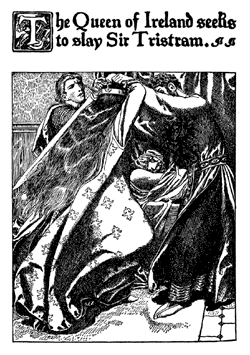
Upon that the Queen was seized as with a sudden madness; for she shrieked out in a very loud voice, "Traitor! Traitor! Traitor!" saying that word three times. Therewith she snatched up the sword of Sir Tristram and she ran with great fury into the room where he lay in his bath. And she beheld him where he was there all naked in his bath, and therewith she rushed at him and lashed at him with his sword. But Sir Tristram threw himself to one side and so that blow failed of its purpose. Then the Queen would have lashed at him again or have thrust him through with the weapon; but at that Gouvernail and Sir Helles ran to her and catched her and held her back, struggling and screaming very violently. So they took the sword away from her out of her hands, and all the while she shrieked like one gone entirely distracted.
Then as soon as Gouvernail and Sir Helles loosed her, she ran very violently out of that room with great outcry of screaming, and so to King Angus and flung herself upon her knees before him, crying out: "Justice! Justice! I have found that man who slew my brother! I beseech of you that you will deal justice upon him."
Then King Angus rose from where he sat, and he said: "Where is that man? Bring me to him." And the Queen said: "It is Tramtris, who hath come hither unknown unto this place."
King Angus said: "Lady, what is this you tell me? I cannot believe that what you say is true." Upon this the Queen cried out: "Go yourself, Lord, and inquire, and find out how true it is."
Then King Angus rose, and went forth from that place, and he went to the chamber of Sir Tristram. And there he found that Sir Tristram had very hastily dressed himself and had armed himself in such wise as he was able. Then King Angus came to Tristram, and he said: "How is this, that I find thee armed? Art thou an enemy to my house?" And Tristram wept, and said: "Nay, Lord, I am not your enemy, but your friend, for I have great love for you and for all that is yours, so that I would be very willing to do battle for you even unto death if so be I were called upon to do so."
Then King Angus said: "If that is so, how is it that I find thee here armed as if for battle, with thy sword in thy hand?" "Lord," said Sir Tristram, "although I be friends with you and yours, yet I know not whether you be friends or enemies unto me; wherefore I have prepared myself so that I may see what is your will with me, for I will not have you slay me without defence upon my part." Then King Angus said: "Thou speakest in a very foolish way, for how could a single knight hope to defend himself against my whole household? Now I bid thee tell me who thou art, and what is thy name, and why thou earnest hither knowing that thou hadst slain my brother?"
Sir Tristram confesses to King Angus.
Then Sir Tristram said, "Lord, I will tell thee all the truth." And therewith he confessed everything to King Angus, to wit: who was his father and his mother, and how he was born and reared; how he fought Sir Marhaus, and for what reason; and of how he came hither to be healed of his wound, from which else he must die in very grievous pain. And he said: "All this is truth, Lord, and it is truth that I had no ill-will against Sir Marhaus; for I only stood to do battle with him for the sake of mine uncle, King Mark of Cornwall, and to enhance mine own honor; and I took my fortune with him as he took his with me. Moreover, I fought with Sir Marhaus upon the same day that I was made knight, and that was the first battle which I fought, and in that battle I was wounded so sorely that I was like to die as you very well know. As for him, he was a knight well-tried and seasoned with many battles, and he suffered by no treachery but only with the fortune of war."
So King Angus listened to all that Sir Tristram said, and when he had ended, quoth he: "As God sees me, Tristram, I cannot deny that you did with Sir Marhaus as a true knight should. For it was certes your part to take the cause of your uncle upon you if you had the heart to do so, and it was truly a real knightly thing for you who were so young to seek honor at the hands of so famous a knight as Sir Marhaus. For I do not believe that until you came his way there was any knight in the world who was greater than he, unless it were Sir Launcelot of the Lake. Wherefore, from that, and from what I saw you do at the tournament, some time ago, I believe that you are one of the strongest knights in the world, and the peer of Sir Launcelot, or of anybody else.
"But though all this is true, nevertheless it will not be possible for me to maintain you in this country, for if I keep you here I shall greatly displease not only the Queen and her kin, but many of those lords and knights who were kin to Sir Marhaus or who were united to him in pledges of friendship. So you must even save yourself as you can and leave here straightway, for I may not help or aid you in any way."
Then Sir Tristram said: "Lord, I thank you for your great kindness unto me, and I know not how I shall repay the great goodness that my Lady Belle Isoult hath showed to me. For I swear to you upon the pommel of my sword which I now hold up before me that I would lay down my life for her sake. Yea, and my honor too! for she hath the entire love of my heart, so that I would willingly die for her, or give up for her all that I have in the world. Now as for my knighthood, I do believe that I shall in time become a knight of no small worship, for I feel within my heart that this shall be so. So if my life be spared, it may be that you will gain more having me for your friend and your true servant than you will by taking my life in this outland place. For whithersoever I go I give you my knightly word that I shall be your daughter's servant, and that I shall ever be her true knight in right or in wrong, and that I shall never fail her if I shall be called upon to do her service."
Then King Angus meditated upon this for a while, and he said: "Tristram, what thou sayest is very well said, but how shall I get you away from this place in safety?"
Sir Tristram said: "Lord, there is but one way to get me away with credit unto yourself. Now I beseech you of your grace that I may take leave of my lady your daughter, and that I may then take leave of all your knights and kinsmen as a right knight should. And if there be any among them who chooses to stop me or to challenge my going, then I must face that one at my peril, however great it may be."
"Well," said King Angus, "that is a very knightly way to behave, and so it shall be as you will have it."
So Sir Tristram went down stairs to a certain chamber where Belle Isoult was. And he went straight to her and took her by the hand; and he said: "Lady, I am to go away from this place, if I may do so with credit to my honor; but before I go I must tell you that I shall ever be your own true knight in all ways that a knight may serve a lady. For no other lady shall have my heart but you, so I shall ever be your true knight. Even though I shall haply never see your face again, yet I shall ever carry your face with me in my heart, and the thought of you shall always abide with me withersoever I go."
At this the Lady Belle Isoult fell to weeping in great measure, and thereat the countenance of Sir Tristram also was all writhed with passion, and he said, "Lady, do not weep so!" She said, "Alas I cannot help it!" Then he said: "Lady, you gave me my life when I thought I was to lose it, and you brought me back from pain unto ease, and from sorrow unto joy. Would God I were suffering all those pangs as aforetime, so that there might be no more tears upon your face."
Sir Tristram parts from Belle Isoult.
Then, King Angus being by, he took her face into his hands and kissed her upon the forehead, and the eyes, and the lips. Therewith he turned and went away, all bedazed with his sorrow, and feeling for the latch of the door ere he was able to find it and go out from that place.
After that Sir Tristram went straight unto the hall of the castle, and there he found a great many of the lords of the castle and knights attendant upon the King. For the news of these things had flown fast, and many of them were angry and some were doubtful. But Tristram came in very boldly, clad all in full armor, and when he stood in the midst of them he spoke loud and with great courage, saying: "If there be any man here whom I have offended in any way, let him speak, and I will give him entire satisfaction whoever he may be. But let such speech be now or never, for here is my body to make good my knighthood against the body of any man, whomsoever he may be."
At this all those knights who were there stood still and held their peace, and no man said anything against Sir Tristram (although there were several knights and lords who were kin to the Queen), for the boldness of Tristram overawed them, and no one had the heart to answer him.
So after a little while Sir Tristram left that place, without turning his head to see if any man followed him.
Sir Tristram departs from Ireland.
So he left that castle and Gouvernail went with him, and no one stopped him in his going. After that, he and Gouvernail came to the shore and took a boat and they came to the ship of Sir Tristram, and so they sailed away from Ireland. But the heart of Sir Tristram was so full of sorrow that he wished a great many times that he was dead.
So Sir Tristram, though as to his body he was very whole and sound, was, as to his spirit, very ill at ease; for though he was so well and suffered no pain, yet it appeared to him that all the joy of his life had been left behind him, so that he could nevermore have any more pleasure in this world which lieth outside of the walls of Paradise.
Chapter Fifth
How Sir Tristram was sent by command of King Mark to go to Ireland to bring the Lady the Belle Isoult from Ireland to Cornwall and how it fared with him.
So Sir Tristram came back again to Cornwall, and King Mark and all the knights and lords of the court of the King gave him great welcome and made much joy over him because he had returned safely.
But Sir Tristram took no joy in their joy because he was filled with such heavy melancholy that it was as though even the blue sky had turned to sackcloth to his eyes, so that he beheld nothing bright in all the world.
Sir Tristram tells of the Lady Bell Isoult.
But though he had no great pleasure in life, yet Sir Tristram made many very good songs about Belle Isoult; about her beauty and her graciousness; about how he was her sad, loving knight; about how he was pledged unto her to be true to her all of his life even though he might never hope to see her again.
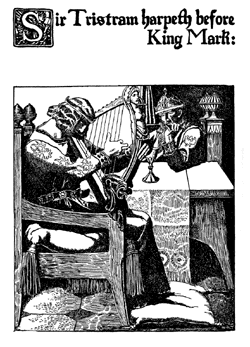
These like words he would sing to the music of his shining, golden harp, and King Mark loved to listen to him. And sometimes King Mark would sigh very deeply and maybe say: "Messire, that lady of thine must in sooth be a very wonderful, beautiful, gracious lady." And Sir Tristram would say, "Yea, she is all that."
So it was at that time that King Mark had great love for Sir Tristram; in a little while all that was very different, and his love was turned to bitter hate, as you shall presently hear tell.
Now in those days the knights of Cornwall were considered to be the least worthy of all knights in that part of the world, for they had so little skill and prowess at arms that they were a jest and a laughing-stock to many courts of chivalry. It was said of them that a knight-champion of Cornwall was maybe a knight, but certes was no champion at all; and this was great shame to all those of Cornwall, more especially as that saying was in a great measure true.
Sir Bleoberis comes to Cornwall.
One day there came to the court of Cornwall a very noble, haughty knight, hight Sir Bleoberis de Ganys, who was brother to Sir Blamor de Ganys and right cousin to Sir Launcelot of the Lake. This knight was a fellow of King Arthur's Round Table, and so he was received with great honor at Cornwall, and much joy was taken of his being there; for it was not often that knights of such repute as he came to those parts. At that time Sir Tristram was not present at the court, having gone hunting into the forest, but a messenger was sent to him with news that Sir Bleoberis was present at the court of the King and that King Mark wished him to be at court also.