Part 4 — CHAPTER XIX ATLANTIC CABLE SYSTEMS OF TO-DAY
Reading edition
Connecting Links—Tariff—Revenue
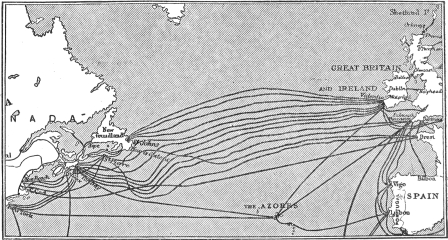
AS a part of the union between the old world and the new, there are altogether fifteen cables now working across the North Atlantic Ocean (see Fig. 45), such as are usually termed “Atlantic cables.” Some of the Atlantic companies have special cables of their own from the landing place on the coast of Ireland to points on the Continental coasts. The figure on page 221 suggests one of the difficulties any wireless system would have to contend with in attempting at transatlantic telegraphy on a commercial basis.[74] Some of{220} these cables at each end of the corresponding main section contain more than one insulated conductor.
Tariff.—In the early pioneer days of ocean telegraphy the Atlantic Telegraph Company started with a minimum tariff of £20 for twenty words, and £1 for each additional word. This was first reduced to £10 for twenty words, and was further altered later on to £5 for ten words. After this it stood for a long time at a minimum of 30s. for ten words of five letters each. Subsequently, in 1867, the Anglo-American Company tried a word-rate of £1 for the 1865 and 1866 Atlantic cables; but it was not until 1872 that Mr. Henry Weaver, their able manager, first instituted a regular word-rate system (without any minimum) of 4s. per word. At the present time (1903), thanks to competition, to technical improvements in the plant, and increased traffic—bringing in its train those economies in the working which are always possible in a larger scale of operation—the rate stands at 1s. a word with all the Atlantic companies. Some day we may, perhaps, see a sixpenny transatlantic tariff in permanent force.
Fig. 45.—Atlantic Cable Systems, 1903.

Revenue.—The fifteen Atlantic cables now in use represent a total capital of well over £20,000,000 sterling. A knowledge of the profits derived from each system is not readily arrived at; but{221} from a comparison of the traffic receipts or “money returns” of the oldest existing Atlantic company at different periods, we are bound to conclude that the “takings” are, roughly speaking, very much the same now as they were twenty-five years ago. This is explainable by the fact that, although the number of messages now passing is much greater, the reduction of the rate (with the ever-increasing competition of rival lines) just about cancels the advantage, so far as receipts are concerned. Roughly speaking, however, the annual gross traffic on transatlantic telegraphy stands at about £1,200,000, divided among two English companies, two American, one French, and one German company. Both the two latter are materially subsidized by their respective Governments, who now foresee the desirability of being independent of cables under English control.