PREFACE
Reading edition
IN the story of Seville I have endeavoured to interest the reader in the associations of the buildings and the thoroughfares of the city.
I do not claim to have written a full history of Seville, though I have sketched the salient events in its annals in the opening chapters of this book. The history of Seville is the history of Spain, and if I have omitted many matters of historical importance from my pages, it is because I wished to focus attention upon the city itself. I trust that I have succeeded in awaking here and there an echo of the past, and in bringing before the imagination the figures of Moorish potentate or sage, and of Spanish ruler, artist, priest and soldier.
Those who are acquainted with the history of Spain will appreciate the difficulty that besets the historian in the matter of chronological accuracy, and even in a narration of many of the main events. The chronicles of the Roman, Gothic and Moorish epochs are hardly accepted as reliable. Patriotic bias and religious enthusiasm are elements that frequently mislead in the making of history, though the Spaniard is not alone in the commission of error in this respect.
Seville abounds with human interest. The city may at the first glance slightly disappoint the visitor, but he cannot wander far without a growing sense of its fascination. Most of the noteworthy buildings are hidden amidst narrow alleys, for the designers of the city have shown great economy in utilising space. It is therefore difficult to gain large general views of Seville, unless one ascends the Giralda, while the obtrusion of modern dwelling-houses and stores often mars the view of fine public edifices. But the modernity of Seville seldom strikes one as wholly out of place and in sharp contrast to the ancient monuments. The plan is Morisco, and the impression conveyed is partly Moorish and partly mediæval. In a word, Seville brings us at every step closely in touch with antiquity.
For the chapters on the Artists of Seville I am indebted to C. Gasquoine Hartley (Mrs. Walter M. Gallichan), who has devoted much study to the art of Spain. The drawings by Miss Elizabeth Hartley were prepared while I was gathering material for the book in Seville, and the illustrations will be found to refer to the text. I have also to thank my brother, Mr. F. H. Gallichan, for his plan of the city.
The frontispiece photograph of Goya's picture of SS. Justa and Rufina was reproduced in the Art Journal as an illustration to an article on "Goya" by C. Gasquoine Hartley. My thanks are due to Messrs. Virtue & Company for permission to reproduce the picture in this book.
WALTER M. GALLICHAN.
THE CRIMBLES, YOULGREAVE, BAKEWELL, August 20, 1903.
CONTENTS
CHAPTER I
PAGE
Romans, Goths and Moors 1
CHAPTER II
The City Regained26
CHAPTER III
Seville under the Catholic Kings62
CHAPTER IV
The Remains of the Mosque73
CHAPTER V
The Cathedral85
CHAPTER VI
The Alcázar110
CHAPTER VII
The Literary Associations of the City 129
CHAPTER VIII
The Artists of Seville146
CHAPTER IX
Velazquez and Murillo165
CHAPTER X
The Pictures in the Museo176
CHAPTER XI
The Churches of the City187
CHAPTER XII
Some Other Buildings201
CHAPTER XIII
Seville of To-day213
CHAPTER XIV
The Alma Mater of Bull-fighters242
CHAPTER XV
Information for the Visitor262
Index269
Alterations made by the etext transcriber
ILLUSTRATIONS
PAGE
SS. Justa and Rufina, from the painting by Goya (photogravure) Frontispiece
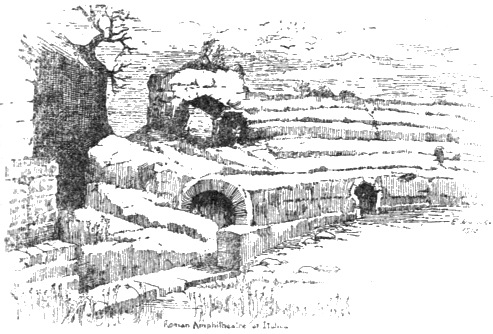
Roman Amphitheatre at Italica1
The Guadalquivir3
Roman Walls8
The Pillars of Hercules and Julius Cæsar11
Moorish Fountain in the Court of Oranges23
Roman Capital25
Old Walls of the Alcázar41
Sword of Isabella49
Plaza San Francisco55
Fountain in Bath, Alcázar66
Puerta del Perdón75
Stone Pulpit in Court of Oranges78
Cuerpo de Azucenas79
The Giralda84
Pinnacle of the Cathedral87
Puerta Mayor—The Central Door of the Cathedral89
Pinnacle of the Cathedral91
Interior of the Cathedral97
Patio de las Doncellas111
In the Garden of the Alcázar125
Cancela of the Casa Pilatos133
The Guardian Angel (Murillo)facing 172
The Conception (Murillo)facing 178
The Road to Calvary (Valdés Leal) facing 180
Saint Hugo in the Refectory (Zurbaran) facing 182
The Crucifixion (Montañes) facing 186
Minaret of San Marcus190
Puerta de Santa Maria195
Patio del Casa Murillo203
Amphora212
Patio del Colegio, San Miguel215
The Golden Tower223
A Roof Garden238
Arms of Seville241
Plan of City (not available) facing 268