THE STORY OF RUSTEM
Reading edition
AND OTHER PERSIAN HERO TALES
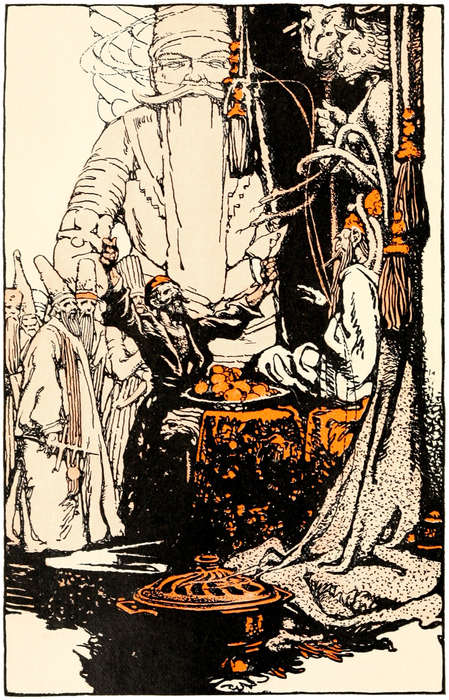
“But thy doom is fixed, thou Cruel One, and even now the avenger’s hand is at the door. Behold, and tremble!”
THE STORY OF RUSTEM
AND
OTHER PERSIAN HERO TALES
FROM FIRDUSI
BY
ELIZABETH D. RENNINGER
ILLUSTRATED BY J. L. S. WILLIAMS
NEW YORK
CHARLES SCRIBNER’S SONS
1909
Copyright, 1909, by
CHARLES SCRIBNER’S SONS
Published September, 1909
DEDICATION
Once upon a time, not so many years ago, a librarian in one of our large cities conceived the idea of forming a hero club for the boys of her neighborhood. So it came to pass that for two years, every Wednesday evening, between thirty and fifty young heroes assembled in the club-room of the library to listen to the story of some great hero, told either by the librarian or by some visiting story-teller.
Now, as the object of the club was not only amusement, helpful entertainment, and inspiration, but also to influence the boys’ reading, they were introduced first to the Greek heroes: Theseus, Perseus, Hercules, Jason, and the heroes of Troy. And after these came the heroes of chivalry: Charlemagne, Roland, Oliver, Ogier the Dane, and the four Aymon brothers. Then followed Siegfried, King Arthur, and the Red Cross Knight. Yea, and even that gay little fellow in green—brave Robin Hood. And sprinkled in with these more or less mythological heroes were those of a more practical type: Father Damien, Livingstone, Lincoln, Peter Cooper, and a number of every-day heroes who so well exemplify the growth in heroic ideals in our century as contrasted with those of primitive times. Boy Heroes were also presented, and finally, in her search for good story-hour material, the librarian decided to introduce the boys to some of the great Persian heroes—they being not so well known.
And, since the boys’ delight in this series of stories really inspired the thought of making it possible for other story-tellers and older boys and girls to enjoy them too, therefore this book is appropriately and affectionately dedicated to the Hero Boys of the Bushwick Branch of the Brooklyn Public Library—a more appreciative and promising set of youths than whom never resolved to do, and dare, and be—good, practical, every-day heroes.
FOREWORD
The aim of this series of stories which, through the medium of Firdusi, mirrors so fascinatingly the legendary history of Persia, has been, not only to provide for the story-teller a treasure-house wherein may be found pure gold, refined for ready use, every coin of which may be stamped with the narrator’s own individuality for the inspiration and entertainment of any group of children, but also, indirectly, to present to older boys and girls, in attractive form, the story of the Shah-Nameh in miniature.
When the material for the stories was originally collected, the author’s idea was simply to work out for her own use in story-telling to children a picture presentation of a delightful series of tales little known to the young. Accordingly, like the fabled busy bee, she scrupled not to enter the most exclusive Persian gardens, dipping into the cup of each bright posy containing the least mite of the sweets for which she was delving—her desire being to give to this particular jar of honey not the Atkinson, or the Mohl, or the Arnold flavor alone, but a composite which should be all of these, and yet distinctly individual and unique, the point of view being not the usual one of the translator, the paraphraser, or the raconteur working upon the lines of the epitomist, but rather that of the moving picture artist and the story-teller combined.
The debt of the author, consequently, is large, and acknowledgment difficult. For while original translators of the great epic, as Mohl, in French, and Atkinson and Helen Zimmern, in English—and Arnold in his noble poem “Sohrab and Rustem”—have contributed most liberally to this series of word-pictures, yet many additional treasures also have been discovered and secured, even from general works such as, for example, Benjamin’s “History of Persia,” and altogether from sources too varied and fugitive, and too thoroughly woven into the fibre of her own text, to be individually acknowledged. The debt, however, is none the less great.
It only remains to be said that if, when started upon their mission, these stories give to children at large as much pleasure as they gave to the particular group of “heroes” for whom they were worked out, they will not only justify their right of being, but also their method of preparation, which, though without scholarly pretensions, may yet serve to make better known and loved one of the masterpieces of literature, alas, too little familiar to-day even to grown-ups well versed in European classics.
E. D. R.
Northumberland, Pa., September, 1909.
CONTENTS
Introduction
Kavah the Blacksmith
Feridoun the Glorious
Irij, a Gentle Hero
Minuchir the Avenger
Zal of the White Hair
Rustem the Wonder Child
Rustem the Young Warrior
Rustem’s Seven Labors, or Adventures
Rustem the Pehliva
Rustem’s Romance
Sohrab the Youth
Sohrab and the Warrior Maiden
The Wrath of Rustem
Rustem the Spy
The Combat of Sohrab Against Rustem
Siawush the Persian Sir Galahad
Rustem the Avenger
How Gew Helped a Hero-prince Unto a Throne
Later Feats of Rustem
Isfendiyar’s Seven Labors, or Heft-Khan
The Combat of Isfendiyar Against Rustem
The Death of Rustem
ILLUSTRATIONS
“But thy doom is fixed, thou Cruel One, and even now the avenger’s hand is at the door. Behold, and tremble!”
Then pressing the golden casket unto his breast, he spake unto God in his grief
Then in graceful circles she swept slowly down unto the wondering father
The two rode side by side into Zabulistan
Mad with pain, he sprang at Rustem like a wild elephant
And finally, in his perplexity, he consulted his astrologers
The days passed for both like a happy dream
They drew their long Indian swords and fell to work again
At evening they came unto a vast wood, reaching many leagues
Seated beside it a youth like unto a royal cypress
He discovered the magician deeply engaged in incantation and witchcraft
Isfendiyar seized his bow, and whiz! whiz! went a shower of arrows