Chapter II · From the Reign of Charles IV. to the Executions at Prague in 1621 (continued 2)
Reading edition
It is a proof of the importance of the town of Prague that it was customary that the Bohemian King should give his hand to the magistrates of the city when they appeared before him. On this occasion, however, Ferdinand omitted to do this, and, indeed, turned his back on the citizens as a mark of displeasure. Some time elapsed before he ordered a paper that contained the grievances against the citizens of Prague, who were accused of being the principal instigators of the recent disturbances, to be read to the deputies. The townsmen attempted no defence, and, in their name, Sixt of Ottersdorf declared that the citizens surrendered unconditionally to their Sovereign. The King ordered Ludanic, Captain of Moravia, to inform the citizens that he would shortly convey his decision to them. He had meanwhile ordered Jacob Fikar, burgomaster of the old town, and one of the town councillors, who had both not appeared before him, to be arrested. Then only were the citizens informed of the conditions under which they would be pardoned. They were to abandon all confederacies, even those between the Prague cities, to surrender all papers dealing with their negotiations with the Elector of Saxony, to submit for revision all the papers containing the ancient privileges of the Prague cities, to give up all arms, and to return to the Crown all landed estates that belonged to it, but had been temporarily granted to the citizens. The last paragraph, in a somewhat veiled manner, stipulated the confiscation of considerable estates that had long belonged to the Prague cities. The citizens were, however, obliged to accept all the King’s demands.
The King then convoked the Estates for August 22, but he resolved that, as a deterrent example, the execution of the four most prominent national leaders should immediately precede this meeting of the Diet, which has ever since been known as the Krvavy Snem (i.e., bloody Diet). On August 20 two knights and two citizens, one of whom was Fikar, were decapitated on the market-place before the Hradcany Castle. Other less severe punishments were inflicted on some of the members of the nationalist leaders, particularly on those who were members of the community of the Bohemian Brethren, who were suspected of having strongly favoured an alliance with the German Protestants. The head of that community, John Augusta, was arrested at Litomysl, imprisoned in the ‘White Tower’ on the Hradcany, and cruelly tortured there.
The ‘bloody Diet’ accepted all the King’s proposals, though they largely limited its powers, and comparative quiet continued in Prague during the remaining years of Ferdinand’s rule.
Ferdinand died in 1564, and the news of his death reached Prague on July 28. His eldest son, Maximilian, who had already been crowned King of Bohemia, succeeded his father without any opposition. His well-known inclination to Protestantism rendered the Utraquist majority of the Estates favourable to him, while the Romanists were traditionally partisans of the House of Habsburg.
Little need in this sketch of the story of Prague be said of the twelve years (1564-1576) during which Maximilian reigned over Bohemia. He visited Prague and held Diets there in 1567, 1571 and 1575. On these occasions the proceedings were similar and, it may be added, monotonous. Maximilian invariably demanded grants of money to enable him to carry on war against the Turks, and the Estates, with equal regularity, claimed that further concessions should be made to the Utraquists, or rather Protestants as they should now be called. At the Diet of 1575 the Lutherans and Bohemian brethren jointly drew up a profession of faith which is known as the ‘Confessio Bohemica.’ The King did not indeed recognise it, but he granted the Protestants, now the great majority of the population, independence from the old Utraquist consistory. They were allowed to choose fifteen ‘defenders,’ five from each Estate, to whom the government of the Protestant Church was to be entrusted. No doubt, largely in consequence of this concession, the Estates accepted Maximilian’s eldest son, Rudolph, as heir to the throne, and consented to his coronation during the lifetime of his father. Some objections were raised with regard to Rudolph’s ignorance of the Bohemian language, and it was stipulated that he should, in the absence of his father, reside in Prague, that he might thoroughly learn the language and the laws of the country over which he was once to rule.
The Estates deputed seven nobles and seven knights, who proceeded to the Karlstyn on September 20, for the purpose of fetching the Royal insignia of Bohemia that were preserved there. On their return the coronation took place, with the same ceremonial as that of Maximilian, who had also been crowned during the lifetime of his father. According to the custom Rudolph was crowned in St. Vitus’s Cathedral. He first proceeded to the Chapel of St. Wenceslas, where the Romanist Archbishop and his clergy received him. He then entered the main church, and the burgrave, William of Rosenberg, then asked the assembled Estates whether they consented to the coronation of Rudolph as King. They all, with loud voices,
RUDOLPH II.

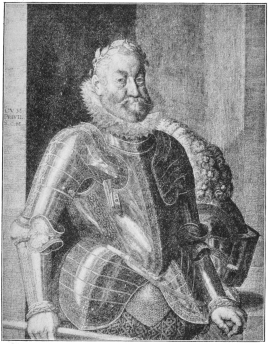
expressed their consent. Rudolph was then crowned by the Romanist Archbishop, with the assistance of William of Rosenberg.
The accession of Rudolph to the Bohemian throne followed very closely on his coronation. Maximilian died in 1576, and his son immediately proceeded to Prague, where he resided almost continually during his reign. His life is therefore in closer connection with Prague than that of almost any other Bohemian ruler, Charles IV. only excepted.
Rudolph’s character was a very singular one, and it is certain that he occasionally suffered from melancholia. With a thorough knowledge and a great love of art, he combined an intense dislike of the affairs of the State. No king did more for the embellishment of Prague. According to a contemporary epigram, Prague, that had been of wood at the time of Libussa, afterwards became marble, but golden under Rudolph. Rudolph was a great collector of paintings, sculpture, and even mere ‘curiosities.’ His agents travelled all over Europe; thus Albrecht Dürer’s ‘Madonna,’ one of the few picture’s from Rudolph’s collection that is still at Prague, was purchased at Venice and carried ‘by four stout men’ across the Alps to Prague.
Among the artists who, on Rudolph’s invitation, visited Prague, was the engraver Sadeler, a native of the Netherlands. His engravings of Prague—three of which are reproduced in this volume—are among the most interesting ancient records of the city.
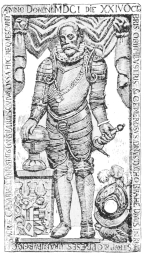
More questionable was Rudolph’s taste for chemistry and astronomy, or rather for alchemy and astrology. The astronomers Keppler, Tycho Brahe, and his assistant Tennagel, who afterwards fell in disgrace, were Rudolph’s guests on the Hradcany. His taste for alchemy attracted many to Prague who were supposed to be adepts in that science. It must, however, be stated in defence of Rudolph that alchemy was by no means, in his day, an utterly discredited science. Even a century later Spinoza considered it as worthy of consideration. Rudolph by no means hesitated to punish those alchemists whom he considered as impostors. It is interesting to note that among these alchemists there were two English adventurers—Dr. John Dee and Edward Kelley.[32]
TOMBSTONE OF TYCHO BRAHE IN TYN CHURCH
The earlier years of Rudolph’s reign were a period of peace and prosperity in Bohemia. His latter years were embittered by the treachery and perfidy of his ambitious younger brother Matthias. The real cause of the conflict was that Rudolph, who had no legitimate offspring, refused to make any arrangements as to the succession to the thrones of Bohemia and Hungary. It was as a mere pretext that Matthias brought forward the grievance that Rudolph had refused to sanction a treaty with Turkey that he had concluded in his brother’s name. Matthias occupied Moravia, and took possession of that country almost without resistance. He then entered Bohemia and advanced as far as Caslav. Rudolph, though reluctantly, summoned the Bohemian Estates to Prague on May 8, 1608. Though the usual ecclesiastical grievances were brought forward, it soon became evident that the Bohemians did not wish to abandon Rudolph in favour of his brother. The latter had meanwhile advanced as far as Liben,[33] where peace negotiations took place. A treaty was finally signed there by which Rudolph ceded Upper and Lower Austria and Moravia to his brother, but retained Bohemia for his lifetime. In the evening Matthias gave a large banquet in his camp; there were two tables, at each of which a hundred guests were seated. Many healths were drank, and a somewhat scandalous contemporary writer tells us that many of Rudolph’s envoys ‘only returned to Prague about midnight, and very intoxicated.’
Even the cession of almost all his possessions did not ensure Rudolph’s tranquillity during the remaining years of his life. Many nobles who had sided with him against his brother now again brought their demand of religious freedom before him. The leader of the Protestants was now Wenceslas of Budova, whose pious and somewhat Puritan character renders him one of the most interesting figures of the last years of Bohemian independence. When Rudolph had prorogued the Diet of 1609 the Estates continued their meetings in the town hall of the Nové Mesto. Budova, who presided, always began the deliberations by calling on all present to pray. All then knelt down and sang a hymn.
For a moment civil war seemed inevitable. Rudolph’s attitude, indeed, had at first been conciliatory. He has been credited by various historians with a religious fanaticism that was absolutely alien to his nature. Yet the Spanish ambassador, Zuniga, and Archduke Leopold, a kinsman of Rudolph’s and a brother of Archduke Ferdinand, afterwards King of Bohemia, succeeded in persuading the apathetic Sovereign to send a message to the Estates, in which he promised the Protestants the same amount of toleration which they had enjoyed under Ferdinand I.; he thus withdrew even the concessions that had been made to the Protestants by the more liberal-minded Maximilian. The Protestant Estates considered this message as a declaration of war; they decided to arm, and chose thirty ‘directors’—ten from each order—who established themselves at the town hall of the Staré Mesto, forming, as the historian Gindely says, a provisional government. Rudolph, however, finally gave way, and on July 9, 1609, signed the famed ‘Letter of Majesty.’ He recognised the ‘Confessio Bohemica,’[34] granted the Protestants the administration of the University, and empowered them to elect thirty ‘defenders’ from their number who were to act as guardians of the rights of the Protestants.
There is no doubt that Rudolph granted these extensive concessions reluctantly, and that he sought an opportunity for retracting them. He entered into negotiations with Archduke Leopold, who was then Bishop of Passau. Under the pretence of interfering in the religious troubles that had broken out in Germany, Leopold collected a considerable armed force, which in 1611 invaded Bohemia. Leopold, no doubt, wished to free Rudolph from the control of the Protestants, and probably hoped to obtain the Bohemian crown as a reward, to the exclusion of Matthias and of his own brother Ferdinand. The men of Passau soon occupied a large part of Southern Bohemia, marched rapidly on Prague, and encamped on the White Mountain, immediately outside the city walls. After scaling the walls of the Malá Strana they attacked the neighbouring Hradcany Castle, where Leopold was then residing as a guest of Rudolph. Desperate fighting in the Malá Strana took place between the men of Passau and a small force that the Bohemian Estates had hurriedly raised, and which was commanded by Count Thurn. The invaders succeeded in driving the Bohemians from the Malá Strana, but their attempt to obtain possession of the bridge, and thus to secure access to the old town, failed.
Leopold, who thought victory certain, now assumed the command of his troops, and summoned the old and new towns to surrender. This was declined, and as the army of the Estates received constant reinforcements, Leopold and his troops were obliged to leave Prague secretly on the night of March 11. Matthias had meanwhile arrived at Prague, and Rudolph was forced to abdicate in his favour. He did not long survive his deposition, but died on January 10, 1612.
During the brief reign of Matthias (1611-1619) the religious troubles in Bohemia continued and reached their climax in the famous defenestration of Prague. Matthias, like his brother, was childless, and the question of the succession to the Bohemian throne was therefore urgent. The Estates met at Prague in 1617, and through the influence of the Government officials, Archduke Ferdinand of Styria was accepted as heir to the throne. Only one of the officials, Count Thurn, burgrave of the Karlstyn, opposed the acceptation, and was therefore deprived of his office. The decision which assured the Bohemian crown to Ferdinand, a determined persecutor of the Protestants, necessarily hastened the progress of events. The Protestants knew that war to the knife awaited them; the only question was when hostilities should begin. The initiative finally, however, came from the Catholics. In direct violation of the agreements of 1609[35] the Romanist Archbishop of Prague caused the Protestant church at Hrob (or Klostergrab) to be destroyed, while the abbot of Broumov (Braunau) ordered the Protestant church in the town of that name, which was under his jurisdiction, to be closed.
The Protestant ‘defenders’ took immediate action. They summoned their Protestant Estates to a consultation, which began on March 6, 1618, in the Carolinum. Though King Matthias had forbidden the meeting, a large number of nobles and knights and a few townsmen were present.
Count Thurn now became the leader of the Protestant Estates, and there is little doubt that he from the first considered war inevitable. He spoke eloquently of the grievances of the Protestants, alluding particularly to the recent occurrences at Hrob and Broumov, and suggested that a remonstrance should be addressed to the Government officials at Prague. The Protestants agreed to this, and also resolved, should this step prove ineffective, to address their complaints directly to King Matthias, who then resided in Vienna. As an answer could not be immediately expected, it was decided that the Protestants should meet again on May 21. Before that date, however, the leaders of the movement issued a manifesto, that was read in all the Utraquist and Protestant churches of Prague, in which, though the Sovereign was not attacked, the Royal councillors, particularly the chief judge Slavata, and Martinic, the new burgrave of the Karlstyn, who had replaced Thurn, were directly accused of using their influence over the Sovereign in a manner hostile to the Bohemian people. On May 21, the Estates, as had been agreed, met again at the Carolinum. They were immediately summoned to the Hradcany Palace, where a Royal message prohibiting their meetings was read to them. They none the less met again on the 22nd, when Thurn suggested that the Estates should, on the following day, proceed to the Hradcany in a body and in full armour. He threw out dark hints that a small deputation would not be safe in the vast precincts of the Hradcany; if the gates were closed after their arrival, they would be separated from the town, and a general massacre of the envoys might ensue. A more secret meeting took place late in the evening, at the Smiricky Palace.[36] Besides Thurn, a few other leaders, Colonna of Fels, Budova, Ruppa, two nobles of the Kinsky and two of the Rican family were present. Ulrich of Kinsky proposed that the Royal councillors should be poniarded in the council chamber, but Thurn’s suggestion that they should be thrown from the windows of the Hradcany Palace prevailed. This was, in Bohemia, the traditional death penalty for traitors. As the Estates afterwards quaintly stated, ‘they followed the example of that which was done to Jezebel, the tormentor of the Israelite people, and also that of the Romans and other famed nations, who were in the habit of throwing from rocks and other elevated places those who disturbed the peace of the common-wealth.’
Early on the morning of the memorable 23rd of May the representatives of Protestantism in Bohemia proceeded to the Hradcany; all were in full armour, and most of them were followed by one or more retainers. They first proceeded to the hall, where the Estates usually met. The address to the King which the defenders had prepared was here read to them. All then entered the hall of the Royal councillors, where a very stormy discussion arose. Count Slik, Thurn, Kinsky and others violently accused Martinic and Slavata, the two principal councillors, of being traitors. Slik particularly accused Martinic of having deprived ‘that noble Bohemian hero, Count Thurn,’ of his office of burgrave of the Karlstyn. He added that, ‘as long as old men, honest and wise, had governed Bohemia the country had prospered, but since they (i.e., Martinic and Slavata), worthless disciples of the Jesuits, had pushed themselves forward, the ruin of the country had began.’
What now happened can be best given in the words of the contemporary historian, Skála ze Zhore:—‘No mercy was granted them, and first the Lord of Smecno (i.e., Martinic) was dragged to the window near which the secretaries generally worked; for Kinsky was quicker and had more aid than Count Thurn, who had seized Slavata. Then they were
THE ROYAL OFFICIALS ARE THROWN FROM THE WINDOWS ON MAY 23, 1618
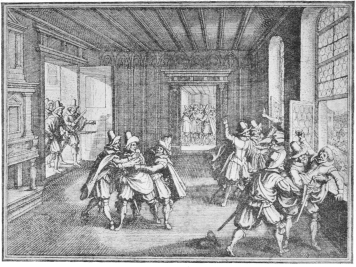
both thrown, dressed in their cloaks and with their rapiers and decorations, just as they had been found in the councillors’ office, one after the other, head foremost out of the western window into a moat beneath the palace, which by a wall was separated from the other deeper moat. They loudly screamed, “Ach, ach, Ouvé!” and attempted to hold on to the window-frame, but were at last obliged to let go, as they were struck on their hands.’ It remains to add that neither of the nobles nor Fabricius, their secretary, who was also thrown from the window, perished; a circumstance that the Catholics afterwards attributed to a miracle.
Immediately after the defenestration the Estates elected thirty ‘directors’—chosen in equal number from the three Estates—who were to constitute a provisional Government. Ruppa, one of the most gifted of the Bohemian nobles, became head of this Government, while Thurn assumed command of the army which the Estates hurriedly raised. On March 20, 1619, Matthias died, and though the Estates had recognised Ferdinand as his successor, the throne became practically vacant; for it was very unlikely that the Protestants who had risen in arms against Matthias would now accept a far more intransigent Romanist as their ruler.
On July 8 a general Diet, that is to say one consisting of deputies of Moravia and Silesia as well as Bohemia, met at Prague. On August 3 this assembly pronounced the deposition of Ferdinand as King of the Bohemian lands, and on the 26th the crown was offered to Frederick, Count Palatine. There were other candidates, but an eloquent speech of Ruppa decided in Frederick’s favour. He assured the Bohemians that they would obtain powerful allies if they elected Frederick, and specially referred to
Inscription on Picture.
The Bohemian leaders—Anhalt the Elder, Hohenlohe, Thurn the Elder and the Younger, Anhalt the Younger, John of Bubna, Henry Slik (of the Moravian allies), Stubenvoll (of the German allies), the Duke of Weimar. The Imperialist leaders—Maximilian of Bavaria, Buguoy, Tieffenbach (of the German league), Tilly, Pappenheim, Des Fours, Caralli and others.
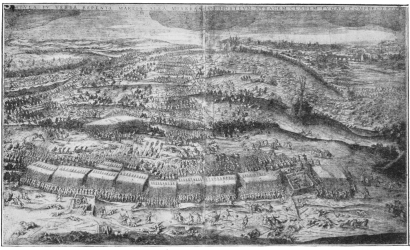
BATTLE OF THE WHITE MOUNTAIN, NOVEMBER 8, 1620
James I. of England, the father-in-law of their new Sovereign.
After some hesitation, Frederick accepted the crown and proceeded to Bohemia accompanied by his consort. They arrived at the ‘Star’ Palace, immediately outside Prague, early in the morning of October 31, and on the same day made their solemn entry into the town. Many Bohemian nobles who had awaited their new Sovereign at the ‘Star’ joined the procession to the Hradcany Castle. At the Strahov gate they were met by the guilds of Prague carrying their banners, and by numerous peasants ‘all clad in the old Bohemian dress and bearing arms that had been used during the Hussite Wars.’ On November 4 Frederick was crowned King of Bohemia in St. Vitus’s Cathedral, and the coronation of Queen Elizabeth took place there three days later.
The winning manners of Frederick at first obtained for him considerable popularity, and when Queen Elizabeth gave birth to a son—Prince Rupert—on December 26 the citizens of Prague greatly rejoiced. Difficulties, however, soon arose. The King was ignorant of the national language, and seems to have made no attempt to acquire it. When Frederick’s Calvinist divines persuaded him to have the altars and paintings removed from St. Vitus’s Cathedral, Lutherans, Utraquists and Romanists were equally indignant.
Queen Elizabeth never secured even that limited amount of popularity that her consort obtained. She was accompanied principally by English ladies, and was believed to have spoken to them in an unfavourable manner of her new country. She had hardly any intercourse with the Bohemian ladies, few of whom knew French, and none English. They strongly disapproved of their new Queen, who, they said, ‘had no settled hours either for her meals or for her prayers,’ and even of the low dresses which she and her English ladies wore.
Frederick remained at Prague up to September 28, 1620, and then only joined his army in Southern Bohemia that was opposing the advance of the Austrians. He found his soldiers already entirely disorganised, and was forced to retreat on Prague. His forces reached the White Mountain, immediately outside the town, on the evening of November 7. The enemies, who were in close pursuit, attacked the Bohemians on the following day. Frederick had meanwhile returned to Prague to join his consort. Neither this proof of conjugal affection, nor the fact that an immediate attack of the Catholic forces may not have appeared probable, can in any way excuse what was practically desertion.
It is certain that the Catholic commanders were not at first unanimous as to the policy of attacking the Bohemians at a moment when the Catholic army was exhausted by prolonged marches. Buguoy I., who commanded the Austrian forces, advised delay, but the opinion of the Duke of Bavaria and Tilly, who insisted on an immediate attack, prevailed. The numerous Jesuits and other friars who accompanied the army also declared that no delay should be granted to the heretics. It was also taken into consideration that Christian of Anhalt, Commander-in-Chief of the Protestant forces, was hastily throwing up earthworks on the plateau of the White Mountain, and endeavouring to re-establish discipline among his troops, which had been demoralised by their continuous retreat. A deferred attack might therefore be more hazardous than an immediate one.
Even before the council of war had decided on an immediate attack, a small Bavarian force—not yet supported by the mass of the Catholic army—attacked the right flank of the Bohemians. The younger Count Slik, who commanded some of the Moravian troops, hurriedly rode up to Christian of Anhalt, begging his permission to attack the Bavarians on their march. ‘It was a weighty and fateful moment in the history of the Bohemian people.’[37] Anhalt at first favoured the suggestion, but on the advice of Hohenlohe, who was second in command, he finally refused his consent. The whole Catholic army soon united, and advanced on the whole line. Though the younger Count Thurn’s infantry successfully beat back an attack of the Austrian infantry, and the son of Christian of Anhalt made a successful cavalry charge, the Catholics were soon victorious, and the earthworks were, after a short defence, carried by the troops of Austria, Bavaria and Spain. Of the Protestant forces the Hungarian horsemen, whom Gabriel Bethlen, Prince of Transsylvania, had sent to Bohemia, first took to flight. They attempted to cross the Vltava by a ford near the present suburb of Smichov, and many perished in the river. Flight soon became general, and the conduct of the Bohemians and their allies was most unworthy of the ancient glory of the country. There were some exceptions to the well-nigh general cowardice. A small Moravian force under Count Slik retreated to the wall of the ‘Star’ Park, where they defended themselves with desperate courage.[38] When almost all had been killed, those who remained surrendered. The battle, and with it the fate of Bohemia, was then decided. As proof of the heroism of the Moravians, contemporary writers tell us that along the ‘Star’ walls[39] the dead at some places lay ten or twelve high.
Inscription above Central Picture.
‘True representation of the executions at Prague. How by the most gracious order and command of his Roman Imperial Majesty the former Bohemian Directors, Counts, Lords, Knights and men of the Estate of the citizens were, on Saturday, the 9th of June of this year 1621, condemned in the royal castle of the Hradcany, and then, on Monday, June 21, punished and executed on the market-place of the old town.’
Inscription under Central Picture.
‘This design shows clearly how the 24 men were decapitated one after the other, and how three others were then hanged.’
Inscription under Upper Engraving Right Side.
‘Here you see the twelve heads exposed on the bridge tower of Prague.’
Inscription under Lower Engraving Right Side.
‘How three men are whipped with rods, while the tongue of one is nailed to the gallows.’
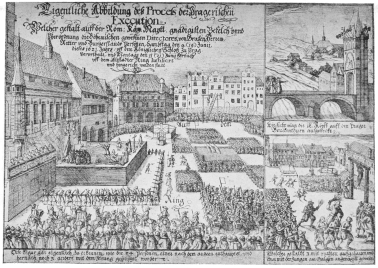
THE EXECUTIONS ON THE MARKET-PLACE OF THE OLD TOWN OF PRAGUE ON THE 21ST OF JUNE 1621
The news that the battle had begun reached Frederick in the banqueting hall of the Hradcany Castle, where he was entertaining the English ambassadors, whom his father-in-law James I. had sent to Prague. He mounted his horse and rode to the Strahov gate, only arriving there in time to witness the rout and flight of his army. The sight of the battlefield and even, as an eye-witness tells us, the terrible wailing of the women,[40] greatly impressed Frederick, and he hurriedly returned to the Hradcany. From here he proceeded with Queen Elizabeth to the old town, and the defeated army also crossed to the right bank of the river. A council of war was held late in the evening, at which most of Frederick’s generals spoke in favour of instant retreat. The King himself made some pretence of resolution. But when, on the following morning, Elizabeth left Prague, the King—a modern Antony, without Antony’s bravery—‘hastily mounted his horse, thus giving the signal for a general flight.’
The battle of the White Mountain is one of the greatest landmarks in the history of Bohemia, and of Prague in particular. I will not here refer to the complete change in the condition of Bohemia which it caused, the complete suppression of Protestantism, the complete annihilation of the ancient constitution of the land, the almost complete, though but temporary, extinction of the national language.
But before ending my account of Prague as the capital of an independent country, I must briefly refer to the executions on June 21, 1621. Immediately after the suppression of the national movement it appeared probable that the Austrian policy would be a lenient one. But sterner councils soon prevailed at Vienna. In February Slik, Budova, Divis Cernin, Kaplir, as well as Jessenius, the rector of the University, and some of the leading townsmen, were arrested. There was no pretence of conducting the trial according to the ancient legal institutions of the country, which granted great privileges to nobles. A special tribunal was constituted, and its members were instructed to judge with the greatest severity.
The judges arrived from Vienna on March 13, 1621, and the court sat for the first time at the Hradcany Castle on the 15th of that month. The judges did not fail to act according to their instructions. Their decision, which Ferdinand confirmed on May 23, the anniversary of the defenestration, pronounced the confiscation of the estates of all the accused. There were twenty-seven death sentences; of the condemned men twenty-four were to be decapitated, three hanged. In some cases torture was added to the death penalty. Thus Divis Cernin, captain of the Hradcany Castle, who had opened the gates of that castle to the Protestants, Count Slik, Bohuslav Michalovic and others were to have a hand cut off before execution, while the tongue of Jessenius, rector of the Prague University, whom the Bohemians had employed in their negotiations with Transsylvania, and whose eloquence the Imperialists dreaded, was to be cut out. Not many of these additional punishments were, however, actually carried out.
Besides these death sentences many Bohemians were condemned to prison for lengthy periods, while others were expelled from Prague, and it was ordered that they should be whipped with rods till they reached the city gates.
THE DUNGEON IN THE TOWN HALL
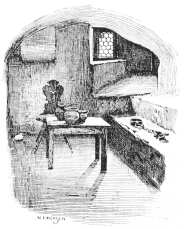
On June 19 the prisoners were informed of their fate, and on the following day their wives and children, as well as three Lutheran clergymen, were admitted to visit them. It is on the narrative of these clergymen that the great historian Skála has based his account of the last movements of the prisoners and their execution.[41] The day fixed for the executions was June 21, and on the previous day all prisoners who were not already confined in the dungeons of the town hall of Staré Mesto were conveyed there, as the executions were to take place in the immediately adjacent market-place. They met their fate with great fortitude, and spent their time mainly in singing hymns. They conversed freely with the Lutheran clergymen. Budova said, ‘I am weary of my days. May God deign to receive my soul, that I may not behold the disaster that, as I know, has overcome my country.’ Count Slik said, ‘I am before the tribunal of the world, and expect immediate death. But those who have judged me will have to appear before the awful tribunal of Him who will judge more justly.’
Early on the morning of June 21 a cannon-shot was fired as a signal that the executioners were to begin. One by one the prisoners were conducted to the market-place, ‘that mournful stage and slaughter-house of Antichrist,’ as Skála calls it. Each man when proceeding to his death took leave of his comrades in a pleasant manner, as if he were going to a banquet or some pastime. ‘I go before you,’ he said, ‘that I may first see the glory of God, the glory of our beloved Redeemer; but I await you directly after me; in this hour grief already vanishes, and a new heartfelt and eternal happiness begins.’ Full preparations had been made by the Imperial authorities to prevent disturbances. The whole market-place was lined with troops, and orders had been given that the drums should beat during the whole time that the executions lasted. A tribune had been erected, from which the Austrian authorities watched the executions. Slik was first led forth, and after him twenty-three others were decapitated. The tongue of Jessenius was cut out before his execution, and a hand of Michalovic was cut off. Three citizens of Prague then suffered death on the gallows. To further accentuate the reign of terror that had begun, the heads of twelve of the nobles who had been decapitated were exposed on the towers of the bridge of Prague, six on the bridge tower of the Malá Strana, six on that of the old town.
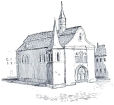
BETHLEHEM CHAPEL