Front matter (continued 2)
Reading edition
A significant incident occurred within the walls of the fort a few months preceding its destruction. It is related that two Indians from a northern tribe had been admitted to the fort as visitors. They noticed Mrs. Heald and Mrs. Helm playing at battledore on the parade ground opposite the officers' quarters. One of the Indians turned to the interpreter and said: "The white chiefs' wives are amusing themselves very much; it will not be long before they are hoeing in our cornfields!"
Not much importance was attached to the remark at the time but it was afterward bitterly remembered.
The following is a brief summary of the important national events which occurred during the years from 1803 to 1812, concurrent with and of especial interest to this narrative.
The Louisiana Purchase, consummated on April 30, 1803, added a vast extent of territory to the American possessions beyond the Mississippi, and greatly increased the responsibilities of the general Government. The public men of that day but faintly realized the consequences that would follow the immense addition to the territories of the United States thus brought about, though with characteristic energy and good sense they set about the task of developing the new domain.
"The winning of Louisiana," says Roosevelt, in his Winning of the West, "followed inevitably upon the great westward thrust of the settlerfolk, a thrust which was delivered blindly, but which no rival race could parry, until it was stopped by the ocean itself."
The entire area of what is now the State of Illinois was, in 1803, a part of Indiana Territory, which had been organized three years before, with William Henry Harrison, then a young man of twenty-seven, as first Governor. It was not until February, 1809, that Illinois Territory was organized, with Ninian Edwards as the first Governor. No civil government was in existence at Chicago; the first authority, as at all frontier posts, was military. The only people here during the period of which we are writing, besides the few traders we have mentioned and their helpers, were the officers and soldiers of Fort Dearborn, and they were of course under military authority and discipline. All orders came to the captain commanding at the fort through the commandant at Detroit, Colonel Jacob Kingsbury, until the breaking out of the war with England, when General William Hull, previously the Governor of Michigan Territory, was placed in command of the Northwestern army then assembling at Detroit. Orders thenceforth issued from the commanding general.
The southern portion of the territory now within the bounds of the State of Illinois had been settled in some few localities during the French period of domination, and the population of the towns of Kaskaskia, Prairie du Rocher and Cahokia were predominantly French, being composed of a few native born French, but mostly of French Canadians and Creoles.
Even under British domination (1763 to 1783) there were practically no English-speaking people among the inhabitants of the places mentioned except the garrisons in the forts at those points; and after the conquering march of Colonel George Rogers Clark and his Virginians in 1778 and 1779 the English authority ceased altogether, the forces forming the garrisons having become prisoners in the hands of the Americans. The result of the stream of emigration that set in from Kentucky and the States farther east, after the creation of the Northwest Territory in 1787, was that in a few years the Americans outnumbered the earlier inhabitants.
At the time Fort Dearborn was built almost the entire State of Illinois, as at present constituted, was included in a county called St. Clair County. It was not until long after Illinois had become a State in the Union that county government began to be effective in any way in the affairs of the little community at Chicago; and indeed, it did not matter in the least to the inhabitants what the name of the county might be in which the place was situated. It is quite likely that no one there even knew that he was living within the limits of St. Clair County, which in any case was merely a geographical expression carrying no exercise of jurisdiction whatever.
Thomas Jefferson was President of the United States from 1801 to 1809; in the latter year he was succeeded by James Madison, who was President for the ensuing eight years.
III The Tragedy
III THE TRAGEDY
T
THE echoes of the Napoleonic wars raging throughout Europe during the period before and after our war with Great Britain were heard even in this far-away region of the western frontier. England and her continental allies were engaged in a gigantic struggle with France under Napoleon, then at the height of his power. For the purpose of crippling her adversary England issued, in 1807, her famous Orders in Council, which declared that the vessels of neutral nations were liable to seizure if engaged in trade with the enemy. Napoleon retaliated by issuing the equally famous Decrees of Berlin and Milan, which declared Great Britain to be in a state of blockade, and that all vessels bound to or from British ports were liable to capture.
To enforce the Orders in Council was a comparatively easy task for the English navy, then as now the most powerful among the nations; and in consequence the ocean commerce of the Americans suffered severely, for at that time every ocean highway was thronged with the merchant ships of the United States. The interference with our commerce was greatly aggravated by the high-handed action of the English in forcibly taking away from our ships many of their seamen and pressing them into the service of the English navy. This grievance especially became so exasperating that the war spirit of the American people was aroused from one end of the land to the other.
But the protests of the Americans, though made to both England and France, were disregarded, and it was realized that war could not be avoided with one or the other of those nations. Indeed, the proposal was frequently made in the press and in Congress that the country ought to declare war against both powers in view of the outrages suffered by our people. "The insolence of the powerful belligerents toward the young republic of the United States was hard to endure," says Larned, though "the conduct of the French Government was more insulting, if possible, and more injurious, than that of Great Britain." But the American people, still inspired by the feelings inherited from the Revolutionary strife, seemed more incensed at the treatment they received from the English than from the French.
The sparse settlements of the West and the isolated posts on the frontier were confronted with a more serious and imminent menace to their safety than were the inhabitants of the older portions of the country on the Atlantic seaboard. They beheld the war cloud gathering, with a dreadful apprehension of the certainty that it would bring upon them a sanguinary conflict with the savages of the wilderness.
The increasingly hostile relations between the Americans and the Western tribes, extending over a period of some years previous to the time of which we are writing, was brought to a climax through the disturbing influence of Tecumseh; but at the battle of Tippecanoe in the fall of 1811, where the savages met with disastrous defeat, it was thought that at length an era of peace on the frontier was about to follow. And this, no doubt, would have been the case had it not been for the activity of British agents along the Canada border.
It soon became manifest that Indian hostility was once more increasing, and it was generally regarded as due to the machinations of the British at Maiden in Canada, where they gave welcome and shelter to the discontented chiefs and their followers who sought their protection. Forays and attacks, sporadic expeditions of the savages for purposes of plunder or the taking of the scalps of settlers, were continually reported throughout the years 1811 and 1812. One of the causes of war recited by President Madison in his message to Congress just previous to the declaration of war against England was the attacks of the savages upon the frontier settlements incited by British traders, "a warfare," said the President, "which is known to spare neither age nor sex, and distinguished by features peculiarly shocking to humanity."
When at length the Indian tribes became assured that war between the English and the Americans was about to follow, it was readily seen that they would act for their own interests, and that they would be found opposed to the Americans. The sympathies of the tribes were plainly with the English by reason of the fact that the latter were more liberal in making presents to them than the Americans were. Every year the Indians gathered at Maiden, opposite Detroit, to receive presents both useful and ornamental. Besides blankets and provisions, a large quantity of objects suitable for the adornment of their persons were distributed among them for the purpose, as it was alleged, of "stimulating trade."
Thus the Western Indians passed by the American trading posts at Chicago, St. Joseph and other stations, and traveled over the old Sauk Trail, which extended from the Mississippi at Rock Island around the southern shore of Lake Michigan, loaded with furs, which they sold to the English traders at Maiden. In addition to the goods received in barter by them, they were shown many favors by the English Government officials, and the friendship thus cultivated proved of immense value to the English when war broke out. In that war the Indians were generally found fighting on the side of their English friends.
Another cause of the hostility shown by the Indians toward the Americans was the constant irritation created in their minds after treaties had been concluded. These treaties, though formally agreed to by the chiefs representing their tribes, were often regarded by the Indians as without validity for one reason or another. Indeed, the Indians were not without grievances against the Americans, some real and others conjured up and distorted by wrong-headed leaders among them.
Added to this was the difficulty of restraining the squatter and the bushranger, who defied all treaties, trampled upon the rights of the Indians, and disregarded the treaty obligations of the Government. The frontiersman had scant consideration for the red man, whom he looked upon as his natural enemy and the principal obstacle to his safety and well-being. This feeling constituted a natural antagonism which was not allayed until the final removal of all the tribes to Government reservations many years later.
In the summer of the year 1812 the officers on duty at Fort Dearborn were Captain Nathan Heald, the commanding officer; Lieutenant Linai T. Helm, Ensign George Ronan and Surgeon Isaac Van Voorhis. Captain Heald was at that time thirty-seven years old and the other three officers were all well under thirty; Ronan was the youngest of them all, having graduated from West Point only the year before.
The force composing the garrison consisted, according to Captain Heald's own account written a couple of months afterward, of sixty-six enlisted men, fifty-four of whom were regulars, and twelve militia. In addition to these there were nine women and eighteen children. This makes a total, including the officers, of ninety-seven persons. Some accounts, however, give a different enumeration, but we shall make no attempt to reconcile them, as the variations are not many.
The news that the United States had declared war against Great Britain was received at Fort Dearborn on the seventh day of August, 1812. This was fifty days afterwards, and it had taken this long time for the news to reach the remote post on the frontier. The authorities at Detroit, however, had been informed some three or four weeks before the messenger was finally despatched to Fort Dearborn. If word had been sent as soon as received at Detroit, there is no reasonable doubt that timely measures might have been taken to prevent the terrible disaster which followed. The despatches containing this important announcement were brought by a chief of the Potawatami tribe named Winnemeg, also called Winamac, who was friendly to the Americans and sent by General Hull to Captain Heald.
General William Hull, then in command of the Northwestern army assembled at Detroit, had served with distinction in the Revolutionary War, and had rendered excellent service as Governor of the Territory during the previous seven years. Until he surrendered Detroit he was held in high esteem and possessed the confidence of the administration.
A letter of instructions to Captain Heald from General Hull was the most important among the despatches brought by the messenger. This letter gave specific directions to the officer commanding at Fort Dearborn, and was as follows:
It is with regret I order the evacuation of your post, owing to the want of provisions only, a neglect of the Commandant of Detroit. You will therefore destroy all arms and ammunition; but the goods of the Factory you may give to the friendly Indians who may be desirous of escorting you on to Fort Wayne, and to the poor and needy of your post. I am informed this day that Mackinac and the Island of St. Joseph's [in the St. Mary's River] will be evacuated on account of the scarcity of provisions, and I hope in my next to give you an account of the surrender of the British at Maiden, as I expect 600 men here by the beginning of Sept.
[Signed] Brigadier Gen. Hull.
The letter, the original of which is preserved in the Draper collection of manuscripts at Madison, Wisconsin, bears the marks of having been hastily written. Evidently Mrs. John H. Kinzie, when she wrote the first published accounts of the events here narrated, had never seen the letter in which is contained the order to evacuate. In her work entitled Wau-Bun she says that the order received by Captain Heald from General Hull was "to evacuate the fort, if practicable; and in that event, to distribute all the United States property contained in the fort and in the United States' Factory or agency among the Indians in the neighborhood."
Mrs. Kinzie's account of the order was doubtless gathered from those who were participants in the affairs of that time and who gave the contents of General Hull's letter from memory. For it must be remembered that the author of Wau-Bun, in which was printed the first authentic account of these events, was not a participant in them. She was the wife of John H. Kinzie, the son of John Kinzie the pioneer of 1804, and she did not come to Chicago until 1833, twenty-one years after the occurrences of which we are writing.
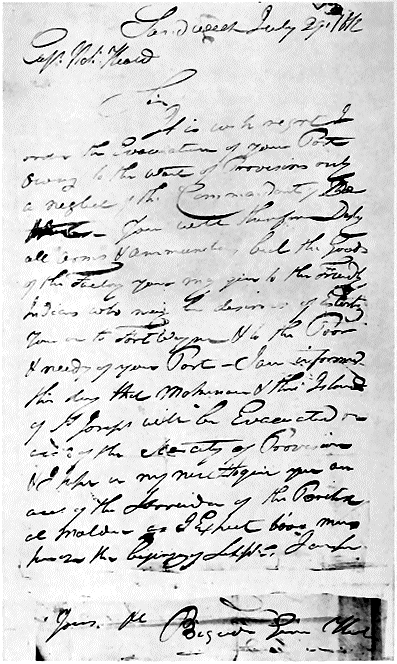
Click on letter to view larer sized.
FACSIMILE OF LETTER OF GENERAL HULL TO CAPTAIN HEALD.
By courtesy of the Wisconsin Historical Society.
The original letter has come to light only within the last few years; and upon making a comparison with the Wau-Bun account it is seen that General Hull ordered the evacuation, without leaving anything whatever to the discretion of the officer to whom the order is addressed, though discretionary permission is implied by the conditional clause "if practicable" in the Wau-Bun account. Just how far Captain Heald would have been justified in using his discretion and disregarding the order to evacuate in view of the great danger there was in obeying it, is a question upon which there were opposing views then, and regarding which there has since been much controversy. It is plain, however, that a strict construction of the order would have required that the post be evacuated, no matter how serious the consequences of doing so might be; and judging from what we know of Captain Heald's character, it is not at all strange that he interpreted his orders literally.
The difficulties with which Captain Heald was encompassed can be but dimly realized. Far removed, as he was, from the nearest post; surrounded by hordes of savages who, though professing friendship, were without doubt in sympathy with the enemy, he well knew that whatever course he might adopt would endanger the safety of the people under his care. His orders to evacuate were indeed positive; but if he could have been assured of safety by remaining and holding the post, he would have been justified without doubt in doing so; and it was the unanimous opinion of his advisers, including the officers of the garrison, that this should be done.
Captain Heald's problem, however, was a military one; he believed in obeying orders, on the theory that his superiors issued them as a part of a comprehensive plan. If he should remain at the post in defiance of his plain instructions he might embarrass a well-planned campaign and invite disaster in a larger field than he could be aware of. Thus, he decided (for though slow in his judgments, he was a man of much decision of character) that the evacuation must be made, and the many appalling risks of a retreat through the wilderness must be hazarded.
After his arrival with the despatches, the friendly Winnemeg sought out and conferred with John Kinzie, In whom the Indians generally placed much confidence. Kinzie was widely known as "the Indians' friend," and the regard felt by the savages of the neighborhood toward him and his family had heretofore been a powerful influence in protecting the post from their attacks. As it was, many of the young men of the tribes could scarcely be restrained in their desire to inaugurate hostilities in spite of their older men, who not only entertained a high regard for Kinzie and his family, but who also realized that the friendship of the Americans was of more value to them than that of the British. Mr. Kinzie had taken up his residence at the fort and was soon in possession of all the material facts contained in Winnemeg's despatches. Winnemeg, well knowing the temper of the tribes, advised Mr. Kinzie that it would be dangerous to evacuate the post and attempt to pass through a country infested with hostile Indians. The garrison, he said, was well supplied with provisions and means of defence, and the post could withstand a siege until reinforcements arrived. But should Captain Heald decide upon abandoning the post according to his instructions, it ought to be done immediately by all means, before the tribes had become aware of the actual condition of affairs.
All this was promptly communicated to the commandant, but it had little effect upon him, and he expressed his determination to carry out his instructions to the letter, distribute the supplies to the friendly Indians, and evacuate the post. Mr. Kinzie strongly reinforced the advice given by Winnemeg, but without effect, and on the following morning the order received from General Hull was read to the troops on parade.
Five days after the receipt of General Hull's order Captain Heald called a council of the Indians, who were then assembled in considerable numbers in the vicinity of the fort, to acquaint them with his Intentions and request of them an escort for the garrison on its march to Fort Wayne.
Rumors of the state of affairs at the fort had already been spread among the Indians, and there were evidences of considerable excitement in their actions and conduct. Some of the savages entered the fort in defiance of the guards and making their way to the officers' quarters strode rudely around the living apartments. On one occasion an Indian went into the parlor of the commanding officer and, seizing a rifle, fired it, as an expression of defiance—so it was thought, though some believed it was the signal for an attack. "The old chiefs passed backwards and forwards among the assembled groups," says the Wau-Bun account, "with the appearance of the most lively agitation, while the squaws rushed to and fro in great excitement, and evidently prepared for some fearful scene."
Notwithstanding these demonstrations, the commanding officer, in a perhaps mistaken endeavor to avoid any appearance of fear or hesitation, attended the council which he had called, though warned against doing so. This council was held on the esplanade adjoining the fort. He was accompanied only by Mr. Kinzie, the officers declining to participate. The officers had been secretly informed, they asserted, that the young men of the tribes intended to fall upon them when they attended the council and treacherously murder them, but Captain Heald was not convinced that there was any truth in the information.
After the two passed out of the fort gates, the portholes of the blockhouses were opened and the cannons were pointed so as to command the whole assembly. This precaution no doubt saved the lives of the two white men who attended the council. Captain Heald informed the assembled Indians that he proposed to evacuate the fort, but before doing so it was his intention "to distribute among them, the next day, not only the goods lodged in the United States' Factory, but also the ammunition and provisions, with which the garrison was well supplied."
Following this statement he asked the Potawatamis to furnish him an escort for his troops on their march to Fort Wayne, promising that a liberal reward would be paid to them on their arrival, in addition to the presents he was then about to distribute. This proposal, apparently, was well received, and, "with many professions of friendship and good will, the savages assented to all he proposed, and promised all he required."
But Mr. Kinzie, well knowing the disposition of the Indians, did not place reliance upon the assurance they had given. After the council he had an interview with Captain Heald and earnestly tried to convince him of the utter worthlessness of the promises made by the Indians. He reminded him of the many instances of hostility shown by them during the past year, especially by the Wabash Indians, with whom the Potawatamis were closely associated; and that it had become the settled policy of the Americans to withhold from the savages whatever would aid them in carrying on warfare against the scattered white inhabitants of the frontier; and that the distributions he was now making would directly assist them in their bloody purposes.
Owing to the representations thus made, Captain Heald at length became convinced that it would be dangerous to place in the hands of those who might at any moment become enemies the ammunition he had intended giving to them, and he determined to destroy all except what was necessary for the use of his own troops.
A letter written by Lieutenant Helm some two years afterwards has recently come to light. In this letter is given the amount of supplies and war material at the fort when the order to evacuate was received. "We had," says Helm, "two hundred stand of arms, four pieces of artillery, six thousand pounds of powder, and a sufficient quantity of shot, lead, etc. There was a supply of Indian corn and provisions to last three months, exclusive of a herd of two hundred head of horned cattle, and twenty-seven barrels of salt."
The next day after the council was held, the thirteenth, there was a general distribution of blankets, broadcloths, calicoes, paints, etc., among the Indians of the neighborhood; but in the evening the ammunition was thrown into a well and the liquors emptied into the river. The Indians, who were particularly eager for the ammunition and the liquors, had observed that neither of these articles was forthcoming in the distribution of the day, and under cover of darkness crept as near to the fort as possible in order to ascertain if any attempt was being made to destroy them, as they strongly suspected there would be. A guard had been placed, however, so that the Indians could not approach close to the scene. But though the prowling savages may not have actually witnessed the proceedings, the work of destruction was accomplished. The Indians were well convinced that all this had been done, especially as the river was so impregnated with the liquors that its waters had the taste of strong grog for some time afterward. All the weapons of warfare not necessary for the use of the soldiers were broken up and thrown into the well, along with quantities of powder, shot, flints and gunscrews.
The eight days intervening between the arrival of the order to evacuate the fort and the actual departure of the garrison were filled with forebodings and anxiety. The inmates of the fort, which now included not only the garrison but the civilian inhabitants of the neighborhood as well, believed that an appalling fate—death at the hands of a savage foe—inevitably awaited them. The one exception was Captain Heald, who still had faith that the Indians would be true to their promise and furnish an escort on the "march through." He was convinced that he had succeeded in creating an amicable feeling among the savages, and that the safely of all was assured. The officers of the garrison, finding that Captain Heald failed to call a council with them and that he had expressed an intention of abandoning the fort and proceeding to Fort Wayne with an Indian escort, drew up and presented a remonstrance to him in which it was recited that it was highly improbable that the command would be permitted to pass through the country in safety to Fort Wayne. For although it had been said that some of the chiefs had opposed an attack upon the fort, planned the preceding autumn, yet it was well known that they had been actuated in that matter by motives of private regard to one family, that of Mr. Kinzie, and not to any general friendly feeling toward the Americans; and that at any rate it was hardly to be expected that these few individuals would be able to control the whole tribe, who were thirsting for blood.
In another clause of the remonstrance it was added that the march of the troops must be necessarily slow, as their movements must be accommodated to the helplessness of the women and children, of whom there were a number with the detachment; and that their unanimous advice was to remain where they were and fortify themselves as strongly as possible.
The reply made by Captain Heald to the remonstrance was that his force was totally inadequate to an engagement with the Indians;—that is, in withstanding a siege;—that he should unquestionably be censured for remaining when there appeared a prospect of a safe march through; that, upon the whole, he deemed it expedient to assemble the Indians, distribute the property among them, and then ask of them an escort to Fort Wayne, with the promise of a considerable reward upon their safe arrival;—and that he had "full confidence in the friendly professions of the Indians."
The gathering perils that now environed the fort and its inmates were rapidly approaching a climax. A fatal mistake had been made in disregarding Winnemeg's advice to begin the retreat without delay if that course was determined upon. Winnemeg had advised that in such an event everything about the fort should be left standing as it was, and while the Indians were engaged in plundering the abandoned fort the troops might be well on their way to Fort Wayne, and perhaps escape attack altogether. John Kinzie likewise strongly urged the necessity of prompt action if the movement was to be made at all.
The officers held aloof from Captain Heald after the distribution of the supplies had taken place, convinced at length that further efforts to dissuade him from his course were useless. They denounced his purpose as "little short of madness." There were many evidences of insubordination observed among the soldiers, and an atmosphere of gloom pervaded the minds of all in the fort.
On the fourteenth, the day before that decided upon for the evacuation, the general despondency was relieved by the arrival of Captain William Wells from Fort Wayne at the head of a band of about thirty friendly Indians of the Miami tribe mounted on ponies. Captain Wells will always be classed among the heroic figures of the time. He was then in the prime of life, a man about forty years of age, and known throughout the frontier as a "perfect master of everything pertaining to Indian life both in peace and war, and withal a stranger to personal fear."
When General Hull had sent the order to Captain Heald to evacuate his post, he also sent an express to Major B. F. Stickney, Indian agent at Fort Wayne, advising him of the order and requesting him to render to Captain Heald all the information and assistance in his power to give. In accordance with this request. Major Stickney had promptly despatched Captain Wells with a party of Miami warriors. A warm attachment existed between Wells and Heald, and upon the arrival of Wells with his Miamis he was hailed with joy, and the hopes of the people at the fort were revived.
It was Wells's intention to prevent if possible the abandonment of the fort, aware as he was of the hostility of the Potawatamis, for he knew that certain destruction awaited the garrison if it should make the attempt. Possessing a perfect knowledge of the character and disposition of the Indians, derived from his long residence among them, Wells foresaw that the savages would take quick advantage of the whites should they leave the shelter of the fort walls and expose themselves in the open on their long slow march of a hundred and fifty miles to Fort Wayne.
When Wells reached the fort he found to his dismay that most of the ammunition had been destroyed, and that the provisions, blankets and other goods in the factory had been distributed to the Indians. He perceived at once that the means of defence having been so seriously reduced there was now no other course to pursue, and that the march must be attempted.
During the day another council with the Indians was held, and on this occasion the savages were found to be in an angry mood. They immediately reminded the commanding officer that they were aware of the destruction of the ammunition and the liquors and that they regarded it as an act of bad faith. It was with the utmost difficulty that the chiefs could restrain the young men of the tribe from carrying out their sanguinary designs at once. For although there were several of the chiefs who shared the generally hostile feeling of the tribe toward the whites, yet they entertained a regard for the men of the garrison and the traders of the neighborhood.
The evening of the last day at the fort, Black Partridge, a prominent chief of the Potawatamis, of whom further mention will be made, came to the officers' quarters and addressed Captain Heald as follows: "Father, I come to deliver up to you the medal I wear. It was given me by the Americans, and I have long worn it in token of our mutual friendship. But our young men are resolved to imbrue their hands in the blood of the whites. I cannot restrain them, and I will not wear a token of peace while I am compelled to act as an enemy."
The language of this speech cannot, of course, be accepted as the verbatim utterance of Black Partridge. He spoke in his own tongue, and the speech was translated by the interpreter, who at that time was John Kinzie. The utterance has, however, become a classic in all the historical accounts pertaining to the events of that time.
An observer taking a survey from the walls of the fort at this time would have beheld the river to the north flowing in a sluggish current toward the lake, then bending to the south until it reached its mouth over a shallow bottom nearly opposite the present Madison Street. On the bank of the river, near its mouth, stood the house of Charles Lee, the owner of "Lee's Place," the farm some four miles up the South Branch where two men were murdered by the Indians in the previous April. Toward the west was the Agency House, standing near the bank of the river, beyond which were the groups of Indian wigwams clustered along the creek that formerly flowed into the main stream at the present State Street. Opposite this point, on the north bank, was the house of John Burns; and further eastward was the most pretentious residence of the place, the house of John Kinzie. A little in the rear of it stood the cabin of Antoine Ouilmette.
Taking a more distant view toward the west, the observer might have seen the point where the North and South branches of the river met and formed the main body of the stream. The north banks of the river were wooded to the water's edge except where clearings had been made around the cabins mentioned.
Looking eastward, the broad expanse of Lake Michigan stretched away beyond the limits of vision. At the season of year in which the events of which we are writing took place the lake was usually devoid of storms and rough weather.
Lake Michigan at this point has a breadth of fifty miles between the mouth of the Chicago River and the opposite or Michigan shore; and there being no eminence of sufficient height to rise above the horizon, the prospect was like looking off to sea where there is an offing of thousands of miles.
Northward the shores were fringed with a white oak forest, with a line of sand-hills near the beach. Looking southward, the shore of the lake trended away in a curve toward the southeast, and on its margin could be traced the sand-hills characteristic of the shores as far as the eye could reach.
It is a remarkable fact that most of the details of the Chicago massacre are derived from the accounts furnished by the two women who were eye-witnesses of the scenes described. Neither of these accounts was directly written by the two women referred to, but are preserved through secondary reports.
The narrative of Mrs. Helm, who was only seventeen years old at the time, was taken down from dictation apparently by Mrs. John H. Kinzie and incorporated in Wau-Bun. While this account, as given in the work mentioned, is enclosed in quotation-marks as if in the language of the narrator, it was evidently rendered by Mrs. Kinzie in her own words. Mrs. Kinzie was not present at the massacre, not having come to Chicago until twenty years thereafter, but she was diligent in procuring all the information available at the time of writing her book. In her later years she no doubt talked the matter over at length with Mrs. Helm, who was a half-sister of her husband.
It is important, in obtaining a clear understanding of this narrative, that the names of Mrs. John Kinzie, the wife of the pioneer of 1804, and of Mrs. John H. Kinzie, the author, be not confused.
The narrative of Mrs. Heald reaches posterity through the story of her son, Darius Heald. A portion was given in John Wentworth's address at the unveiling of the memorial tablet on the site of old Fort Dearborn, delivered May 21, 1881; and another portion is quoted in Joseph Kirkland's book. The Chicago Massacre, published some years later.
Darius Heald was not born until ten years after the massacre, and his testimony, written from his dictation, was derived entirely from the oral account of his mother.
Comparing the account with that given by Mrs. Helm a number of discrepancies in details is observed, though the main events are related in both accounts in practically identical form.
The accounts of both Mrs. Helm and Mrs. Heald were written from dictation. Mrs. Helm's account appeared in print twenty-four years after the event which it describes, while Mrs. Heald's did not appear until seventy-five years thereafter, having in the meantime been preserved only in the form of a family tradition. It can therefore hardly have as much historical value as the older published narrative of Mrs. Helm.
The morning of the fifteenth of August, 1812, dawned clear and the day was oppressively warm. There was scarcely a breath of air stirring and the surface of the lake was unruffled, stretching away, as one expressed it, "like a sheet of burnished gold." The preparations for the departure went actively forward. At nine o'clock Captain Wells took a place at the head of the column on horseback, his face blackened, according to the Indian custom, "in token of his impending fate."
Wells was under no illusions. He knew that at any moment the crisis would be upon them, and he clearly realized how hopeless in the presence of hordes of savages in the neighborhood, bent on blood and plunder, any resistance would be, and how faint a chance there was for escape. But brave and resolute he calmly went forward with the fixed purpose of doing his duty in the face of inevitable destruction.
Following him rode half of his Miami band, and behind them the musicians came, and as the march began they played the Dead March. Then came the soldiers, each carrying twenty-five rounds of ammunition, all that had been reserved from the general destruction, though a totally inadequate supply for such a campaign as they might reasonably look forward to in these threatening circumstances.
Next came a train of wagons in which the camp equipage and provisions were carried, and in the wagons were also placed the women and children. The rear of the column was brought up by the remainder of the Miami escort. The wives of the married officers, Mrs. Heald and Mrs. Helm, accompanied the procession on horseback.
The escort promised by the Potawatamis in council was on hand and moved with the procession, a few hundred yards to the west, keeping a parallel course. There was a lingering hope among the whites that the Indians would be true to their promise and continue with them throughout their journey as a protecting force, and in this hope the movements of the Indians were watched with the greatest interest, though with painful forebodings and suspicions.
Among the people thus hoping against hope "there were not wanting gallant hearts who strove to encourage in their desponding companions the hopes of escape they were far from indulging themselves."
Early in the morning of the day of the departure of the garrison John Kinzie had received a message from Topenebe of St. Joseph's band informing him of what he already was well convinced of, that the Potawatamis who were to act as escort on the march had treacherous designs, and would without doubt attack the column. Topenebe was a chief in the Potawatami tribe, but a firm friend of the whites and especially of the Kinzie family. He warned Mr. Kinzie not to accompany the troops when they left the fort, but rather to take passage in a boat with his family and proceed directly to St. Joseph, where he might rejoin the troops if they were successful in passing through the country.
Mr. Kinzie, however, decided to place his family in the boat, while he himself accompanied the troops, in the hope and belief that his presence would operate as a restraint upon the fury of the savages in case of an attack. This brave action on the part of Mr. Kinzie, who thus cast in his lot with those who were going forth to almost certain destruction, must be regarded as an exhibition of rare personal courage notable even among many other instances of a similar kind seen on that fatal day.
The party in the boat which left the Kinzie house about the same time that the troops marched out of the fort consisted of Mrs. Kinzie and her four children, the eldest of whom by her second marriage was John Harris, then nine years old. The others were: Ellen Marion, six and a half years old; Maria Indiana, four years old, and Robert Allen, two and a half years old. In addition there were Josette La Framboise, a French-Ottawa half-breed, a nurse in the family; Chandonnais, a clerk in the employ of Mr. Kinzie; two servants, a boatman, and the two Indians who had brought the message from Topenebe. This made a party of twelve persons in the boat.
Upon Mrs. Kinzie now devolved the responsibility and direction of the party in the boat, since her husband had chosen to accompany the troops. Proceeding to the mouth of the river, the boat was detained for a time while the party beheld the passage of the column just beginning its march. Mrs. Kinzie "was a woman of uncommon energy and strength of character," says the author of Wau-Bun, "yet her heart died within her as she folded her arms around her helpless Infants, and gazed upon the march of her husband and eldest child to certain destruction." It will be recalled that Mrs. Kinzie's eldest child was Mrs. Margaret Helm, who was with her husband on the march.
Antoine Ouilmette and his family did not abandon their dwelling as did all the other residents of the village. A sister of his wife, known in the accounts as Mrs. Bisson, was a member of this same household. Ouilmette was regarded by the Potawatamis as belonging to their tribe, and he felt no apprehension of danger in remaining on the ground. Renegade whites living among the savages usually maintained their standing among them by offering no opposition to any atrocities committed by them, and sometimes even participating in the warfare against their own race.
The line of march lay along the shore of the lake toward the south. In the absence of roads through the country at that early period the traveling was difficult for wagons, and the margin of the lake was usually preferred for that kind of locomotion wherever it lay in the desired direction. For a considerable distance toward the southern end of the lake the route of the proposed march would be along the sandy beach, usually firm and smooth near the water's edge.
Boat navigation was the main reliance for transporting men and goods, though as yet there was not a sufficiently large number of boats of any description on Lake Michigan to have moved so large a body of men and women at one time as composed the procession leaving the fort. And even if there had been enough of such as were used by the traders, it is not likely that the people would have been permitted by the hostile Indians even to embark in them.
The fort was no sooner vacated than the Indians rushed in and began to plunder the place of everything that was movable. In an adjoining field there had been a herd of cattle kept for the use of soldiers, such as milch cows, oxen, etc., and these were allowed to run at large when the troops departed. The Indians gave chase and shot them all, seemingly for the satisfaction they found in the mere act of killing, and the deed was quite in keeping with their usual improvident habits. Mrs. Helm, in her account, said that she well-remembered a remark of Ensign Ronan as the shooting of the cattle went on. "Such," said he, "is to be our fate,—to be shot down like beasts."
In taking their departure from the fort there was little in the conduct of the savages to indicate the hostility which was so soon to manifest itself. Mrs. Heald gave an account of the scene many years later, and she said in her narrative that "the fort was vacated quietly, not a cross word being passed between soldiers and Indians, and good-byes were exchanged."
In fact, it was generally believed that those Indians who gathered about the entrance of the fort, prepared to rush in the moment the last men passed out, took no part in the later events of the day, being fully occupied in their work of plundering and cattle-killing. John Wentworth in one of his lectures on the subject went further, and declared that the Indians who had lived a long time in the immediate vicinity of the fort were friendly to the whites and "did their best to pacify the numerous warriors who flocked here from the more distant hunting grounds."
The column had not proceeded very far on its course before it was noticed that the Potawatami escort was diverging from the direction in which both columns started out and that at the distance of a mile from the fort there was a considerable distance between them.
A range of sand-hills and sand-banks of no great height skirted the shore dividing the sandy beach from the prairie beyond them. Among these sand-hills were a few trees and bushes supporting a precarious existence. Westward of this range of sand-hills which began to rise about a mile from the fort the Indians continued their course and were soon lost to view.
Suddenly, far in the advance, Captain Wells was seen to turn his horse and ride furiously back along the marching men, who quickly came to a halt. Wells was swinging his hat in a circle around his head, which meant in the sign language of the frontier, "We are surrounded by Indians!" As he approached the commanding officer he shouted, "They are about to attack us; form instantly and charge upon them." The Potawatami escort had in fact become the attacking party, choosing to murder the whites rather than join in looting the fort.
The Indians could now be seen in great numbers coming into view from behind the mounds of sand, their heads bobbing up and down "like turtles out of the water." The troops were promptly formed and they had no sooner taken position than the Indians began firing upon them with deadly effect, the first victim being a veteran of seventy years of age.
After firing one round the troops charged up the slopes of the sand-hills, driving the Indians from the position. However, they scattered in both directions and presently began to envelop the flanks of the line according to the usual practice in savage warfare. At this juncture the mounted Miamis would have been of the greatest service in preventing such a manœuvre, but they had all fled across the prairie after the first shot was fired, quickly disappeared in the distance, and were seen no more.
Captain Heald, in a letter written a few weeks after the event, said:
The situation of the country rendered it necessary for us to take the beach, with the lake on our left, and a high sand-bank on our right, at about one hundred yards' distance. We had proceeded about a mile and a half when it was discovered that the Indians were prepared to attack us from behind the bank. I immediately marched up with the company to the top of the bank when the action commenced; after firing one round we charged, and the Indians gave way in front and joined those on our flanks.
The horses upon which Mrs. Heald and Mrs. Helm were riding became almost unmanageable after the firing had begun. The explosion of a charge in an old flint lock musket was a terrific outburst of noise. It produced a volume of sound which we can scarcely realize when comparing it with the report of a service rifle in use at the present day. It was little wonder that the horses pranced and bounded when these thundering volleys were heard.
Mrs. Helm said that she drew off a little and gazing upon her husband (Lieutenant Helm) and her father (Mr. Kinzie), whom, although he was her step-father, she was always fond of calling father, she saw that they both were yet unharmed. But she felt that as for herself her hour had come, and she endeavored to forget those she loved, and to prepare herself for her approaching fate.
It was the endeavor of the savages to close upon their victims whenever they found an opportunity to bring their tomahawks and scalping knives into use. While some were firing upon the troops from cover, others were seeking to attack those who had become separated from their friends. These they could quickly overcome owing to their skill in the use of those murderous weapons.
One Sergeant Holt, who was accompanied by his wife, had received a ball in his neck in the early part of the engagement. He handed his sword to his wife, who was on horseback near him, and told her to defend herself. The Indians were desirous of obtaining possession of the horse and at the same time sparing her life, for generally they wished to take the women captives. Mrs. Holt resisted vigorously when the savages attempted to seize the horse; she broke away from them and dashed out on the open prairie. Still pursuing, they overtook her and succeeded in dragging her from her horse. She was then made a prisoner and later taken to the Illinois River country, where she received kind treatment. Ultimately she was ransomed and restored to her friends.
Mrs. Helm was attacked by a young Indian, who raised his tomahawk, intending to deal her a blow, but she avoided the murderous weapon and seized her assailant around the neck. This is the moment that the sculptor of the bronze group, now situated at the intersection of Eighteenth Street and Calumet Avenue, chose for his representation. Mrs. Helm tried to get possession of the scalping knife which hung in a scabbard over his breast, but another and an older Indian dragged her away with a strong grasp. Struggling and resisting, she was then borne toward the lake, plunged into the water and firmly held, as if it were the intention to drown her. She soon perceived, however, that the object of her captor was not to drown her, as he held her in such a position as to keep her head above water. She began to gather courage, and looking the savage full in the face, she saw at once, notwithstanding the paint with which he had disguised himself, that it was Black Partridge, the chief who had surrendered his medal to the commandant the evening before.
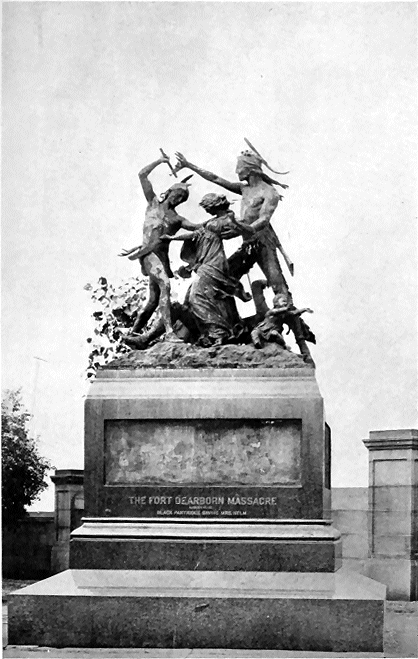
MEMORIAL MONUMENT TO THE MASSACRE
This monument marks the spot where the battle and massacre of the troops and others took place on the 15th of August 1812. The monument was designed by Mr. Carl Rohl-Smith. It consists of a bronze group placed on a pedestal of granite, upon the sides of which are panels depicting scenes in relief connected with the events of that day. It is situated at the foot of Eighteenth street, adjoining the tracks of the Illinois Central Railroad, and was the gift of Mr. George M. Pullman to the people of Chicago.
The scene represents Black Partridge rescuing Mrs. Helm from death at the hands of a frenzied savage, the prostrate figure being that of the unfortunate Dr. Van Voorhis, the post surgeon, who met his death on that occasion. The child stretching out its arms in an appeal for help recalls the fiendish massacre of infants which was the terrible feature of the day.
When the firing was nearly over, the chief brought her out of the water and placed her on a sand-bank. "It was a burning August morning," she said, "and walking through the sand in my drenched condition was inexpressibly painful and fatiguing. I stooped and took off my shoes to free them from the sand with which they were nearly filled, when a squaw seized them and carried them off, and I was obliged to proceed without them."
As she gained the prairie she was met by Mr. Kinzie, who informed her that her husband (Lieutenant Helm) was safe, and but slightly wounded. She was led back to the Indian encampment on the banks of the Chicago River. "At one time," she continues in her story, "I was placed upon a horse without a saddle, but finding the motion insupportable, I sprang off. Supported partly by my kind conductor, Black Partridge, and partly by another Indian, Pee-so-tum, who held dangling in his hand a scalp, which by the black ribbon around the queue I recognized as that of Captain Wells, I dragged my fainting steps to one of the wigwams."
Arrived at the entrance of a chief's wigwam, the wife of the chief, inspired by a sentiment of pity for her, an exhibition of feeling rare among Indian women, seeing her exhausted condition, took a kettle and, dipping up some water from the small creek near by, threw in a quantity of maple sugar, and, stirring it with her hand, gave the mixture to her to drink. She was greatly refreshed by the draught. This act of kindness touched the poor young woman deeply, occurring as it did in the midst of so many horrors.
In the meantime the men in the ranks fell rapidly under the withering fire of their savage foes, who were now on all sides of them in overwhelming numbers. Still they continued the struggle bravely, and the prairie was soon thickly scattered with dead and wounded. Captain Heald himself received a wound in his hip, from which he suffered for the remainder of his life, and which caused his death some years later. It may be stated in passing that the bodies of those who were killed in this bloody combat lay exposed to the elements and wild beasts for four years, until eventually their remains were gathered up and buried by United States soldiers arriving to rebuild the fort.
The troops behaved most gallantly while the battle lasted and seemed determined to make as brave a defence as possible. They were soon reduced to about one-half of their original number. After the action had continued about a quarter of an hour Captain Heald drew off the few men still remaining and took possession of a small elevation in the open prairie, beyond the range of the shots coming from the sand-hills which the Indians now held, thus having reversed the positions which the opposing forces occupied at the beginning of the battle.
There was nothing now to prevent the savages from attacking the wagons containing the women and children. The troops were isolated on the prairie and could not even defend themselves, much less could they do anything to protect the helpless people in the wagons.
Meantime Captain Wells was fighting, Indian fashion, and doing more execution than any other man on the field. Mounted on horseback, he freely exposed himself wherever the combat was most furious. He was armed with a rifle and carried two pistols. His powder and bullets were carried in belts slung over his shoulders, convenient for instant use. He usually had the bullet needed for the next load ready in his mouth. "He would pour in the powder," said an eye-witness, "wad it down, blow in the bullet, prime, and fire, more rapidly than one can tell the facts."
The savages had a wholesome fear of Wells, and they fled from his aim in all directions. They broke from him right and left. In the effort to protect the women and children he closely watched the movements of the Indians toward the wagons, and presently saw a young savage come up and enter one of them in which twelve of the children had been collected. Before he could prevent him, the savage ruthlessly tomahawked the entire group; and when Wells caught sight of this horrid deed, he shouted in rage: "Is that their game—butchering women and children?"
But his own end was near. He received a shot which passed through his lungs, and realizing that it was a mortal wound, he rode up to his niece, Mrs. Heald, still maintaining his position upon his horse. Seizing her hand, he exclaimed, "Farewell, my child." Mrs. Heald, who, though thus addressed, was nearly as old as her uncle, replied, "Why, uncle, I hope you will get over this." "No, my child," he said, "I cannot." She then saw that blood was coming from his nose and mouth, and he said that he could not last five minutes longer. He then gave his niece his last message in these words: "Tell my wife, if you live to get there,—but I think it doubtful if a single one gets there,—tell her I died at my post doing the best I could. There are seven red devils over there that I have killed."
Wells's horse had already been shot through the body, and at that moment fell exhausted, with his rider pinioned beneath him. Wells then saw several Indians coming toward him, bent on taking advantage of his apparent helplessness. He summoned his failing strength and from his prostrate position took aim and killed one of them on the spot. The others approached closer to the wounded lion, determined to strike a blow or fire a shot that would instantly end his life. Mrs. Heald saw the movement and cried out, "Uncle, there is an Indian pointing right at the back of your head." He put his hand back and held up his head, in spite of his failing strength, so that better aim might be taken, and then exclaimed, "Shoot away!"
The Indian fired and Captain Wells fell dead. Thus perished the man to whom in a greater degree than to any other person those who still remained alive upon the scene looked for help and guidance in this awful extremity. Without him, the thickening perils of the hour seemed the climax of despair.
Some time later the news of the death of Captain Wells reached his widow (the daughter of the chief Little Turtle), long before Mrs. Heald, who survived the massacre, was able to convey the message entrusted to her. One of the Indians present who witnessed the scene, though he took no part in the perpetration of that dark deed, was a friend of Wells, whom he had known in former years and whom he regarded as a brother. It was this Indian who went to Fort Wayne after the battle was over and gave Mrs. Wells the first intimation of her husband's death. After doing so he disappeared, and it was supposed that he returned to his tribe, as he was not seen again.
The two younger officers. Ensign George Ronan and Surgeon Isaac Van Voorhis, had been all this time gallantly bearing their part in the unequal struggle with the savage hordes that surrounded them, and both of them had received dangerous wounds. In her account of the battle, Mrs. Helm says that, overwrought by his fighting and pain, the surgeon came up and addressed her. He had been wounded, his horse had been shot under him, and he was in a state of terror. Aware of Mrs. Helm's lifelong experience with the Indians, though she was much younger than himself, he said to her: "Do you think they will take our lives? I am badly wounded, but I think not mortally. Perhaps we might purchase our lives by promising them a large reward. Do you think there is any chance?"
"Dr. Van Voorhis," said the seventeen-year-old girl, "do not let us waste the few moments that yet remain to us in such vain hopes. Our fate is inevitable. In a few moments we must appear before the bar of God. Let us make what preparation is yet in our power."
"Oh, I cannot die!" he exclaimed. "I am not fit to die. If I had but a short time to prepare! Death is awful!" Mrs. Helm pointed to Ensign Ronan, who, though even then mortally wounded, was down on one knee and was still fighting with desperate courage.
"Look at that man," she said. "At least he dies like a soldier." "Yes," replied the surgeon, "but he has no terrors of the future—he is an unbeliever!"
The wounded surgeon's fear, thus shown under these trying circumstances, was entirely natural. He was then only twenty-two years of age and had entered the service on the frontier but the year before. The bravest men have often passed through a similar experience in moments of danger. An unbeliever, in his view, would not concern himself with the hereafter; but he considered that he himself was unfit to appear before the bar of God. What more natural than that this young man's heart should fail him in that supreme moment?
There was no opportunity, however, even had he been able, to show his mettle by a renewed effort to stem the tide of disaster, for almost immediately afterwards he was tomahawked by one of the Indians, and was seen dead on the ground when Mrs. Helm passed that way a little time later as the captive of the chief Black Partridge, on their way to the river.
In an obituary notice, published in The Political Index, November 17, 1812, at Newburg, New York, there is the following notice of the unfortunate young surgeon: "Among the slain (at the Fort Dearborn Massacre) was Dr. Isaac Van Voorhis, of Fishkill, surgeon in the army. He was a young man of great merit, and received his early education at the academy in this village. He possessed an enterprising and cultivated mind, and was ardent in the support of the interest and honor of his country."
Ensign George Ronan, who was also only twenty-two, had entered the service on the frontier the previous year. He was a graduate of West Point, with the rank of ensign, corresponding to that of second lieutenant in the modern army regulations. He is always referred to as a brave and enterprising young officer. He won the admiration of all during the months previous to the events here narrated, and especially for the courage and devotion shown by him in the last scene, when he perished on the field of battle.
From his position on the battle-field, Captain Heald saw the Indians making signs to him to approach and consult with them. Heald advanced alone in response to this invitation. Through a half-breed interpreter, Peresh Leclerc, he was asked to surrender to them, the Indians at the same time promising to spare the lives of all the prisoners. A Potawatami chief, named Black Bird, was the spokesman for the Indians. Captain Heald in his report says that after a few moments' consideration he concluded it would be most prudent to comply with this request, although he did not put entire confidence in the promise. In fact, Heald was reduced to extremities, and a parley with the Indians was his only hope. They were surrounded by the savages. Lieutenant Helm was wounded and a prisoner in the hands of the enemy, who indeed had possession of all the horses, wagons, and property of every description, besides having killed or captured all the women and children. He was obliged to make the best terms possible, for though a surrender might be followed by treachery, there was really no other course for him to take.
The surrender was then agreed to and the fighting ceased. The air was filled with the shouts of the savages exulting over their victory, while from the wounded issued moans of pain, and from the distance could be heard the wailings of cruelly bereaved mothers.
After delivering up their arms, the survivors were taken back to the encampment of the Indians near the fort, and distributed among the different tribes. The number of their warriors, Heald said, was between four hundred and five hundred, mostly of the Potawatami nation, and the loss on their side was about fifteen. There were about sixty of the whites killed in the battle and the massacre which followed, but when the troops surrendered and the Indians promised that the lives of the survivors should be spared, it was found that the savages regarded the wounded as exempted from this condition. Accordingly, many of the wounded were ruthlessly tomahawked after the surrender, and in the same evening five of the soldiers were tortured to death. A number of others perished from the privations they suffered while in the hands of the Indians during the ensuing season.
The boat containing the Kinzie family and the servants accompanying them at first kept near the mouth of the river, the occupants watching the troops and the wagon train passing along the beach toward the south. They heard the discharge of the guns when the Indians attacked, and the boat's course was directed so as to approach as nearly as possible to the scene of the fighting. They saw a woman on horseback led by an Indian not far from the edge of the water.
"That is Mrs. Heald," cried Mrs. Kinzie. "That Indian will kill her. Run, Chandonnais, take the mule that is tied there and offer it to him to release her." The Indian was already attempting to take off her bonnet, with the evident intention of scalping her, and she was resisting vigorously.
The Indian paused long enough in the Struggle to listen to the offer made by Chandonnais, who added the promise of two bottles of whiskey as soon as they would reach their destination. "But," said the Indian, "she is badly wounded—she will die. Will you give me the whiskey at all events?" Chandonnais, who was well known to the Indians, promised that he would, and the bargain was concluded. Several squaws, keen for plunder, had followed the procession closely, and made an ineffectual attempt to rob Mrs. Heald of her shoes and stockings. The savage had succeeded in getting possession of her bonnet, and placed it on his own head. She was taken on board the boat, and lay moaning with pain from the wounds she had received.
As it was impossible to continue their journey under the circumstances, the boat and its passengers returned to the Kinzie house, trusting to the influence possessed by Mr. Kinzie to maintain their safety. They were joined there by Mr. Kinzie, who had escaped injury from the savages. Around them gathered a number of Indians still friendly to the Kinzie family, whose Intentions were to assist them in a renewed attempt to reach their proposed destination at St. Joseph.
Among the friendly Indians thus gathered was Black Partridge, who had rescued Mrs. Helm and had safely brought her to the Kinzie house, where she rejoined her family.
Thus were assembled the entire family of John Kinzie, except his son-in-law, Lieutenant Helm. Mrs. Heald and Mrs. Helm were both suffering from wounds. Both had been attacked by the savages while on horseback, the former having perhaps escaped death, through the ransom negotiated by Chandonnais, and the other having been rescued by Black Partridge.
John Burns, with his wife and infant child, had lived in the house west of the Kinzies', on the north bank of the river, and were with the troops at the time of the attack. It will be recalled that Mrs. Burns and her one-day-old infant had been brought to the fort for safety at the time of the Indian alarm in the previous April. Burns was killed while with the troops, but his wife and child were made captives by one of the chiefs and by him taken to his village and treated with great kindness; but his squaw wife, excited by feelings of jealousy of the favors shown to the captives, attempted to kill the child with a tomahawk thrown at it with great force. The blow narrowly missed being fatal, but it inflicted a wound the marks of which she carried through the remainder of her life. The chief prevented further attempts of the kind by removing the captives to a place of safety. Eventually the mother and child found their way back to civilization.
"Twenty-two years after this," writes the younger Mrs. Kinzie, in Wau-Bun, "as I was on a journey to Chicago in the steamer 'Uncle Sam,' a young woman, hearing my name, introduced herself to me, and raising the hair from her forehead, showed me the mark of the tomahawk which had so nearly been fatal to her."
A somewhat similar case was that of Mrs. Charles Lee, whose husband owned the farm on the South Branch where the two men were murdered by Indians in the previous April. His son, a lad of twelve years, who, with the discharged soldier, ran to the fort from the farm and gave the alarm on that occasion, was also with the troops in company with his father. Lee and his son were both killed in the battle, but Mrs. Lee and her young child were captured, and later came into the possession of Black Partridge. This "knightly rescuer of women" proved the worth of his friendship toward the whites in the case of Mrs. Lee and her child, as he had already done in the rescue of Mrs. Helm.
The story of John Cooper, surgeon's mate at Fort Dearborn, was similar in many of its details to that of others in the battle. Cooper was accompanied by his wife and two young daughters, the elder of whom was named Isabella. Cooper was among the killed, and when the Indians made a rush for the women and children in the wagons, a young Indian boy attempted to carry off Isabella, but encountered so lively a resistance that he was obliged to throw her down. He succeeded in scalping her, and would have killed her outright had not an old squaw prevented him. The squaw, who knew the Cooper family, took Mrs. Cooper and her children to her wigwam and cured the girl of her wound.
The family remained in captivity two years, when they were ransomed. They afterwards lived in Detroit. The mark of the wound on the girl's head caused by the young Indian's scalping knife was about the size of a silver dollar, and, of course, remained with her through her life.
An infant of six months was with its mother among the survivors of that dreadful day. Corporal Simmons had with him on the march his wife and two children, the eldest a boy of two years, and a little girl an infant in its mother's arms. The mother and her children were in the army wagon, which was entered by the Indian, who despatched the children as rapidly as he could reach them. Mrs. Simmons, while not able to save her boy, succeeded in concealing the baby in a shawl behind her, and the child survived the scenes of that day. The corporal himself was among those who were slain.
When the division of prisoners took place after the action Mrs. Simmons was carried off by the Indians to Green Bay, the whole distance to which she walked, carrying her child in her arms. On arriving at their destination the captives were required to "run the gauntlet," according to the brutal custom of the savages, but in doing so she was able to protect her precious charge by bending over it as she held it in her arms. She received many cruel blows and half dead she reached the goal where a friendly squaw gave her and her child a kind reception. In the following year, after many weary wanderings, Mrs. Simmons reached a frontier post in Ohio and was at length set at liberty.
This child grew up and became the wife of Moses Winans, and in later life she and her husband lived in California, but she never returned to Chicago again. She died in 1903, at the advanced age of ninety years.
Of the nine women who set out with the troops, two were killed; the others, except Mrs. Heald and Mrs. Helm, were carried off by the savages, and some did not survive the hardships of the life they were compelled to undergo. There were eighteen children, of whom twelve were killed outright, and but few of the others were ever heard of.
The following fall and winter the British, then in possession of Detroit, were urged by some of the American residents of that place to exert their influence among their Indian allies to return the captives to the custody of the British military authorities. Tardy efforts were made, and at length the agent who was appointed for that work reported that he had gathered at the St. Joseph River seventeen soldiers, four women, and some children. There were, however, several other survivors not included among those whom the British agent was able to find, as appears from some other accounts. The soldiers were taken to Detroit and became prisoners of war, but their condition was thus only slightly ameliorated. Young John Kinzie, then a lad ten years of age, recalled that while his father's family were living in their own house at Detroit during that winter, themselves practically prisoners of war, he saw the miserable captives suffering from exposure in the severe cold weather without adequate shelter, and but little could be done for them by their American friends.
The perils surrounding the Kinzie family when they were once more gathered under the family roof were of the most serious character. Here were assembled a company of the survivors after a day of excitement, bloodshed, and distress hardly to be paralleled in the lives of civilized people. Across the river from the Kinzie house could be seen the victorious savages indulging in wild antics, shouting and dancing exultantly, ransacking and plundering the buildings within the fort, and preparing to torture some of the prisoners to death. They had arrayed themselves in women's hats, shawls, and ribbons, and filled the air with their savage outcries.
Notwithstanding the fact that the house and its inmates were closely guarded by their Indian friends, and that Black Partridge and other friendly Indians had established themselves in the porch of the building as sentinels, to protect the family from any evil that the young men of the tribes might endeavor to commit, their peril was extreme. Everything remained tranquil, however, during the day, and the following night was passed in comparative freedom from alarms.
The next day the Indians set fire to the fort and the entire place was consumed. A party of Indians from the Wabash arrived at this time, having heard of the intended evacuation of the fort, and eager to share in the plunder. They were disappointed and enraged on finding that their arrival was too late, that the spoils had been divided, and the scalps all taken. These Indians had no particular regard for the Kinzies, and it at once became evident that their presence boded destruction to the devoted inmates of the house. They blackened their faces and proceeded to the Kinzie house as the most promising spot to carry out their plundering and bloodthirsty designs.
Black Partridge was especially anxious in behalf of Mrs. Helm, whose safety he wished to assure. By his directions she disguised herself and took refuge in the house of Ouilmette. Ouilmette, being a Frenchman, and living with an Indian wife, was never molested by the Indians at any time, being regarded as one of themselves.
The Indians approached this house first and entered without ceremony. Mrs. Bisson, sister of Ouilmette's wife, hastily concealed Mrs. Helm by covering her with a feather bed. She then took her seat in front of the bed and occupied herself with her sewing. The Indians looked into every part of the room, but did not raise the feather mattress under which Mrs. Helm was lying, half smothered. Mrs. Bisson was in terror for her own safety, but bravely maintained an air of indifference during this trying ordeal, and presently the Indians left the house.
They then went over to the Kinzie dwelling, entered the principal room, and seated themselves on the floor in ominous silence. Black Partridge then spoke in a low voice to Waubansee, who was with him as one of the guards, and said: "We have endeavored to save our friends, but it is in vain—nothing will save them now."
At that moment a friendly whoop, loud and clear, was heard from the bank of the river opposite to the house, and Black Partridge instantly arose and ran toward the landing, calling out, "Who are you?" "I am the Sauganash," came the reply. Black Partridge replied, "Then make all speed to the house; your friend is in danger, and you alone can save him."
Sauganash, also known as Billy Caldwell, was a half-breed and was a chief of the Potawatami tribe, and a man of great influence among the Indians. He was not present at the evacuation and massacre of the day before, but had come in time to save the lives of many of the prisoners. With him had come the chief Shabbona, who also used his influence in moderating the brutality of the younger members of the tribes.
The Sauganash hastened across the river, while the threatening savages waited in wonder for his appearance. He calmly entered the room, stood his rifle behind the door, and gazed about him at the silent savages squatting on the floor. He boldly asked them why they had blackened their faces. "Is it that you are mourning for the friends you have lost in battle?"—thus purposely misunderstanding their evil designs, which he easily penetrated. "Or is it," he continued, "that you are fasting? If so, ask our friend here, and he will give you to eat. He is the Indians' friend, and never yet refused them what they had need of."
The savages were taken by surprise at this speech, and none among them had the courage to say what the purpose was in their minds. One of them answered that they had come to ask for some white cotton cloth in which they might wrap the bodies of their dead friends before placing them in their graves. As soon as this was said they were provided with a quantity of cloth, and to the relief of everyone they took their departure peaceably.
Quartermaster Sergeant William Griffith escaped the general massacre by a series of remarkable strokes of good fortune. While the troops were leaving the fort it was discovered that the horses carrying the surgeon's apparatus and medicines had strayed off. Griffith went to search for them and bring them up, but being unsuccessful, he hastened to join the column on foot. Before he had proceeded very far he was met and made a prisoner by the chief Topenebe, who was friendly to the whites. The chief took him to the river and put him in a canoe, paddled it across the river and told him to hide himself in the thick woods on the north side.
The next day he cautiously appeared in the vicinity of Ouilmette's house, and the place seeming to be quiet, he entered the cabin at the rear. This was just after the Wabash Indians had left the house for that of Mr. Kinzie.
The family were greatly alarmed at his appearance, and he was at once stripped of his army uniform; he was arrayed in a suit of deerskin, with belt, moccasins, and pipe, like a French engagé. His dark complexion and black whiskers favored the disguise, and all were instructed to address him in French, although he was ignorant of the language. In this character he joined the Kinzie family and with them eventually reached a place of safety.
After the surrender Captain Heald was kept unmolested, quite fortunately being given into the custody of an Indian from the Kankakee, who, it seems, had known him previously, and who had formed an attachment for him. The Indian at once made plans for his escape, and soon Captain Heald was placed in a canoe and taken to St. Joseph. Here he was joined by Mrs. Heald, and they both pursued their journey up the east coast of Lake Michigan to Mackinac, where Captain Heald delivered himself up as a prisoner of war to the British commandant, by whom he was well treated and released on parole. Later in the season he found means to reach Louisville, where Mrs. Heald's father, Colonel Samuel Wells, resided. It had been supposed that both Heald and his wife had perished in the massacre, and their appearance was as if they had awakened from the dead.
In due course of time Heald was exchanged, and again entered the service with the rank of Major. He never got rid of the effects of his wound, and in 1817 he resigned his commission in the army and removed with his family to a small town in Missouri, where he died a few years later.
Lieutenant Helm, who was among the wounded at the time of the surrender, had the good fortune to fall into the hands of some friendly Indians, and was taken to Peoria. He was liberated through the intervention of Thomas Forsyth, the half-brother of Mr. Kinzie, who was the Indian agent at that place. Forsyth had great influence with the Potawatamis. "He had been raised with this nation," says Reynolds, "spoke their language well, and was well acquainted with their character." He advanced the amount demanded by the Indians for Helm's ransom, and had him sent to St. Louis in safety. In this important and dangerous service Forsyth risked his life every moment he was engaged in it, for the Indians at that time were in a highly inflamed condition.
Eventually Lieutenant Helm rejoined his wife at Detroit.
Click on map to view larer sized. Click on map to view larer sized.
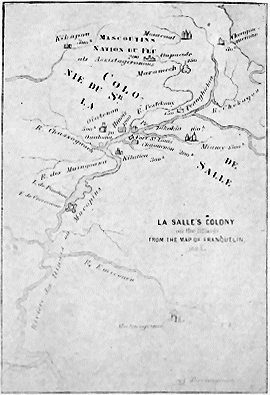
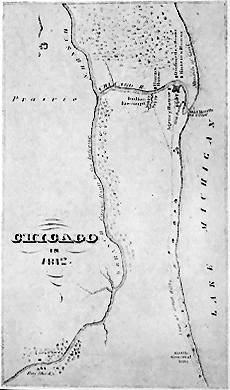
FRANQUELIN'S MAP OF 1684 This section of Franquelin's large map finished in 1684 shows the Illinois country and the Illinois river throughout its entire length, with the location of Fort St. Louis, the colony established by La Salle in 1682. This fort was built on that bold eminence on the southern bank of the Illinois river, nearly opposite the present town of Utica, known in later years as Starved Rock. The original map made by Franquelin was six feet in length by four and a half in width. Parkman said of it that it was "the most remarkable of all the early maps of the interior of North America." Franquelin was a young engineer in the service of the French King residing in Quebec. The information necessary for the drawing of the map was undoubtedly supplied the young engineer by La Salle himself, who had just returned from the Illinois country. It will be observed that the name Chekagou is applied to the river, which is shown as if it were an affluent of the Illinois. The proper location of Chicago on the lake is represented by a strange word Cheagoumeinan, which appears nowhere else on other maps or in the early records. The word Chcagou was known even before the site of Chicago was discovered by Joliet and Marquette in 1673. In a report quoted by Charlevoix, written in 1671, certain localities are mentioned, among others "Chicagou at the lower end of Lake Michigan." This is the first mention of the name in history. (See Shea's "Charlevoix," Vol. III, Page 166.) MAP OF CHICAGO IN 1812. On this map is shown the location of Fort Dearborn and the Agency house in the year 1812, the locations of the houses used as dwellings comprising the house of Charles Lee, opposite the mouth of the river, the Kinzie house, the Ouilmette house and the Burns house on the north side of the river; the Indian encampment along the creek which flowed into the river from the south (about where State street now runs), and Lee's Place, or Hardscrabble, on the South Branch. A dotted line shows the route taken by the troops and wagon trains along the lake shore to the south on the morning of August 15th, also the situation of the sand hills which began to rise about a mile from the fort. The attack upon the column began from the shelter of the sand hills, and the succeeding battle and massacre extended over a further space towards the south.
The final scene in the story of old Fort Dearborn was the departure of the Kinzie family and their retinue of servants on the third day after the battle and massacre. The fort and the agency house had been destroyed by fire on the second day, and there were now remaining only the Kinzie house, the Ouilmette cabin near it, the house lately occupied by John Burns and his wife and child on the north bank of the main river, and that lately occupied by Charles Lee and his family near the mouth of the river.
On the eighteenth the family of Mr. Kinzie, together with the servants and clerks in his trading establishment, were placed on board of a boat of sufficient capacity to accommodate them all, and they thus took their departure from the scene of so many calamities. There were left in the vicinity only Ouilmette and his family, who were the sole inhabitants of Chicago until the arrival, some time later, of a French trader named Du Pin, who took possession of the unoccupied Kinzie house and lived in it. The length of his stay is not recorded.
The Indians now began to realize the folly of breaking up a station which to them was an abundant source of supplies, where they could come and obtain ammunition, provisions and clothing in exchange for their furs. They would henceforth be obliged to depend upon the small resources of the St. Joseph trading post or travel to Detroit.
All this had been foreseen by the older and wiser men among them, but the hot-blooded young men of the tribes were intent on plunder and the ghastly trophies represented by the scalps of their victims, and they could not be restrained. There was now little inducement to visit the post at Chicago; consequently the great numbers that formerly assembled in the neighborhood scattered to remote places and eked out a precarious existence by fishing and hunting.
The Indians also found that the friendship of the British was a poor dependence as compared with that of the Americans, who were the only governmental authority with whom they could make treaties, and through whom they could obtain recognition and satisfaction for their claims of territorial ownership.
The following episode has been relegated to this late portion of the narrative, as belonging more to the echoes of the battle on the lake shore than to the battle itself.
Mrs. Lee was one of the women taken by the Indians when her husband and son had been killed at the massacre, as already narrated. She had with her a daughter twelve years old and an infant. These were claimed by our old friend Black Partridge under the following circumstances: The daughter had been placed on horseback for the march and tied fast for fear she would slip off the saddle. When the action was at its height she was severely wounded by a musket ball; and the horse, becoming frightened, set off at a gallop. The girl was partly thrown off, but was held fast by the bands, and hung dangling until she was met by Black Partridge, who caught the horse and disengaged her from the saddle. The chief had known the family and was greatly attached to this little girl, whom he recognized at once.
On finding that she was so seriously wounded that she could not recover, and that, besides, she was suffering great agony, he put the finishing stroke to her at once with his tomahawk. He said afterwards that this was one of the hardest things he ever attempted to do, but that he did it because he could not bear to see her suffer.
Black Partridge then took the mother and her infant to his village on the Au Sable, where he became warmly attached to the former; "so much so," relates the author of Wau-Bun, "that he wished to marry her; but as she very naturally objected, he treated her with the greatest respect and consideration." He was not disposed to liberate her from captivity, however, hoping that in time he could prevail upon her to become his wife.
During the following winter the child became ill, and was not restored by ordinary cures. Black Partridge then offered to take the child to Chicago, where the French trader named Du Pin, who had arrived after the massacre, was then living in the Kinzie house, and obtain medical aid from him. Accordingly the child was warmly wrapped, and the chief carried his precious charge all the way in his arms.
Arriving at the residence of M. du Pin, he carefully placed the child on the floor. "What have you there?" asked the trader. "A young raccoon, which I have brought you as a present," replied the chief. Then opening the pack, he displayed the little sick child. M. du Pin furnished some remedies for its complaint and when Black Partridge was about to return he told the trader of his proposal to Mrs. Lee to become his wife, and of the way it had been received.
M. du Pin, being a man of discernment, "entertained some fears," continues the Wau-Bun account, "that the chief's honorable resolution might not hold out, to leave it to the lady herself whether to accept his addresses or not, so he entered at once into a negotiation for her ransom, and so effectually wrought upon the good feelings of Black Partridge that he consented to bring his fair prisoner at once to Chicago, that she might be restored to her friends."
Mrs. Lee accordingly was brought to Chicago and had an opportunity of expressing her gratitude to the French trader who had, without having seen her or known her, rendered so important a service as paying a ransom for her return to civilization. In course of time this M. du Pin, who it seems was a man without a family when he came, proposed to Mrs. Lee himself, and, more fortunate than the dusky chieftain, he was accepted. "We only know," says the Wau-Bun account, "that in process of time Mrs. Lee became Madame du Pin, and that they lived together in great happiness for many years after."
It is a relief, after narrating the events connected with the evacuation of Fort Dearborn and the massacre which followed it, to invite the reader's attention to this picture, as a contrast with the havoc and dismay of that dreadful day in August, 1812, when Chicago was left with but one white inhabitant, and he a renegade.
At St. Joseph the Kinzie family remained under the protection of Chief Topenebe and his band until the following November. They were then conducted to Detroit under the escort of trusty Indian friends, and delivered up as prisoners of war to the British. Soon after John Kinzie was paroled, though afterwards again taken into custody. At the end of the war he was finally released, and in 1816 he again became a resident of Chicago, when the second Fort Dearborn was built and occupied by a garrison of United States troops.
After the destruction of Fort Dearborn, Chicago ceased for a time to be a fit dwelling-place for white men and their families. It continued in this condition with but little change for the following four years, and then the troops came back. Meanwhile peace had been concluded between the two warring nations, treaties of peace and friendship had been made with various tribes of Indians, and a new era began.
During the winter succeeding the battle and massacre the only two residents of Chicago who were householders were Ouilmette and Du Pin. A pretty fair estimate may be made of the total population of the place, including the half-breed children of Ouilmette and the engagés and helpers in the employ of Du Pin. It is safe to say that the total number was not more than ten or twelve persons.
Bloody retribution overtook at least one of those among the savages who on the day of the massacre showed no mercy to his victims. This was a chief known as a deadly enemy of the whites and who bore the expressive name of Shavehead, because of his peculiar manner of tying up his scanty hair. Years afterwards Chief Shavehead was in company with a band of hunters in the Michigan woods; in the party was a white man who had formerly been a soldier at Fort Dearborn, and was one of the survivors of the battle on the lake shore. At one of the campfires the chief, being of a boastful disposition related, while under the influence of liquor to those sitting about the camp-fire, the frightful tale concerning the events of that day, dwelling upon its horrors and boasting of his own deeds. He was not aware that one of the whites whom he had so fiercely assailed was at that moment listening to his braggart utterances. The old soldier, as he heard the tale, was maddened by the recall of the well-remembered scenes.
Toward nightfall the old savage departed alone in the direction of the forest. Silently the soldier with loaded rifle followed upon his steps. Others observed them as they passed out of sight into the shades of the forest. The soldier returned after a time to his companions, but Shavehead was never again seen. "He had paid the penalty of the crime," says Mason, "to one who could with some fitness exact it."
The War of 1812, between the United States and Great Britain, was actually begun some time before the date of the declaration of war issued by the United States, on June 12, 1812; and it was continued some time after the treaty of peace had been signed, December 24, 1814. Of this war, the Fort Dearborn massacre on August 15, 1812, was one of the disastrous events.
"The lives of thirty thousand Americans," says Larned, "were sacrificed during this war of two and a half years, and the national debt was increased one hundred millions of dollars."
Nine years cover the period of existence of Old Fort Dearborn. In that nine years of history it witnessed the efforts of three nations to subdue a continent, and played its part in the struggles between those nations. Established as a frontier post, it became an important link in the chain of western defenses, and one of those schools of military instruction in which lessons were learned by those who had the task of preserving by force of arms a young republic in the midst of powerful and unscrupulous foes. A rallying point for traders and settlers in the virgin fields of the west, it was representative of a phase of development of the great Northwest Territory, and indeed of the development of the United States. Its culminating disaster, which left it a heap of ruins, was one of those temporary setbacks which do not for long hold back the progress of such a growing nation. Within four years after the accident of war had made the fort and those in and about it the victims of a lingering barbarism, the foothold of the nation was secure in the west, the beginnings of its agricultural and commercial prosperity were laid, and upon the ruins of the old fort rose the walls of a new Fort Dearborn.