Chapter XXXVI
Reading edition
NORWAY RECOVERS HER INDEPENDENCE.
The indignation which the Peace of Kiel aroused in Norway was evidence that the Norsemen had awakened from their long hibernating torpor and meant to assert their rights. They were quite ready to give up their allegiance to Frederick VI., but contended that he had no right to dispose of it to any one else. Remembering how their country had without its own consent, contrary to law and treaties, become a dependency of Denmark, they held that the sovereignty, which Frederick renounced, reverted to the people who were thus in position to bestow it upon whom they chose. The viceroy, Christian Frederick, finding this sentiment very general, refused to abide by the decision of the powers and summoned several representative men to meet him at Eidsvold (1814). It had been his first intention to claim the crown of Norway by hereditary right and to govern as absolute monarch. But yielding to the advice of Professor Sverdrup and other patriotic men, he declared himself ready to accept the crown from the people and to govern in accordance with the constitution which the people should adopt. In order to explore the sentiment throughout the country, the prince had travelled in the middle of winter across the Dovre Mountain to Drontheim, and there were many who believed that it had been his intention to have himself crowned at once in the ancient city of kings. In Guldbrandsdale he stopped to read the inscription upon the monument, erected to commemorate the destruction of Sinclair and his Scottish mercenaries:
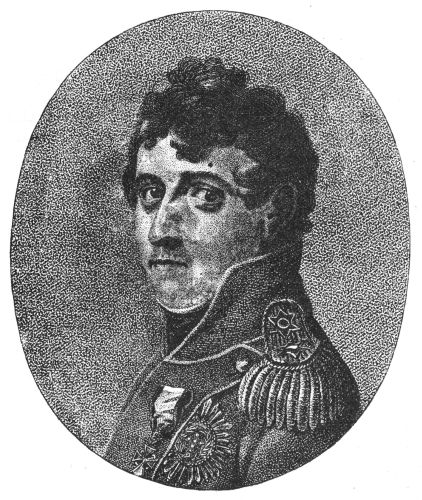
PRINCE CHRISTIAN FREDERICK, VICEROY OF NORWAY; LATER, KING OF DENMARK (CHRISTIAN VIII.).
"Woe to the Norseman whose blood does not course more warmly through his veins when he looks upon this stone."
"Are you, too," he asked the peasants who had come to see him, "like your forefathers, willing to sacrifice life and blood for your country?"
The result of the deliberations at Eidsvold was the summoning of a diet, consisting of representatives of the people from all parts of the country. The place of meeting was again Eidsvold, and the number of representatives was 112, most of whom were officials. A constitution, which was extremely liberal in its provisions, was adopted May 17, 1814, and Prince Christian Frederick was elected king. Norway was declared to be a free and independent country, but there was a division of opinion as to whether it should seek a union with Sweden or maintain a king of its own. The so-called party of independence, which was led by Judge Falsen, Professor Sverdrup, and Captain Motzfeldt, largely outnumbered the friends of Sweden, prominent among whom were Count Wedel-Jarlsberg, Chamberlain Peder Anker, Iron-master Jacob Aal, and the Rev. Nicolai Wergeland. The latter were not desirous of surrendering the liberty of the country, believing, on the contrary, that liberty was securer in a union with a stronger power. The smallness of Norway and the inability of the people to maintain an army adequate for its defence would, in their opinion, ultimately make the country the prey of any foreign power that chose to pick a quarrel with it. The Norwegian constitution, which, slightly amended, is yet in force, provides that:
1. Norway shall be a limited, hereditary, monarchy, independent and indivisible, whose ruler shall be called king.
2. The people shall exercise the legislative power through their representatives.
3. The people shall alone have the right to levy taxes through their representatives.
4. The king shall have the right to declare war and to make peace.
5. The king shall have the right of pardon.
6. The judicial authority shall be separated from the executive and the legislative power.
7. There shall be liberty of the press.
8. The evangelical Lutheran religion shall be the religion of the state and of the king.
9. No personal or hereditary privileges shall, in future, be granted to any one.
10. Every male citizen, irrespective of birth, station, or property, shall be required, for a certain length of time, to carry arms in defence of his country.
The representatives at Eidsvold were not unaware that the step which they had taken involved war with Sweden. For Bernadotte would scarcely regard the resolutions of a deliberative assembly as an obstacle to the possession of the prize, which he had earned by assisting in the overthrow of Napoleon. In the meanwhile, it was a happy circumstance to the Norsemen, that this overthrow had not yet taken place, and that the emperor for several months kept the army of the allies busy, thereby preventing Bernadotte from turning his immediate attention to Norway. It was a surprise to him to find the Norsemen determined to defend their rights, as he imagined that their long dependence upon Denmark had accustomed them to obedience and subordination. A letter which Charles XIII. had sent them, previous to the diet at Eidsvold, offering them a constitution and a Swedish viceroy, had been received with indignation, but after the surrender of Paris (March 31st) and the abdication of the emperor, the Napoleonic drama seemed preliminarily at an end, and there were no more foreign complications to prevent the Swedes from enforcing the paragraph in the treaty of Kiel, relating to Norway. The intelligence now arrived that the great powers had promised Bernadotte to compel Norway to accept the treaty, and envoys were sent from the various courts, commanding the Norsemen forthwith to submit themselves unconditionally to the king of Sweden. This the Norsemen refused to do, and soon after a Swedish army under Bernadotte crossed the frontier. The newly elected king now began to waver, and, being destitute of warlike spirit, he ordered the surrender of the fortress Fredericksteen to the Swedish fleet, without having fired a shot in its defence. The Norwegian army, ill-provided though it was with food and ammunition, was eager for fight, but the faint-spirited king showed his generalship chiefly in retreating. A second division of the Swedish army under Gahn was beaten in Lier by the Norwegians, under Colonel Krebs, and after a second assault at Matrand was forced to retire across the frontier. It became obvious that, without bloodshed, the conquest of the country was not to be accomplished, and as the Swedes, after their German campaign, were no less desirous of peace than the Norsemen, an armistice was concluded at Moss (August 14, 1814), in accordance with the terms of which the king should summon an extraordinary Storthing or Parliament, for the negotiation of a permanent peace. This Storthing, which met October 7th, accepted King Christian Frederick's renunciation of the Norwegian crown and elected Charles XIII. king, on condition of his recognizing the independence of Norway and governing it, in accordance with the constitution given at Eidsvold. These terms Bernadotte accepted, in behalf of the king of Sweden (November 4th), and swore allegiance to the constitution. The Swedish troops then evacuated the country, and Christian Frederick returned to Denmark, where, at the death of his cousin, he became king under the name of Christian VIII. The following year a convention was negotiated with Sweden, fixing the terms of the union (Rigsakten). The Bank of Norway was established in Drontheim, and a Supreme Court in Christiania.
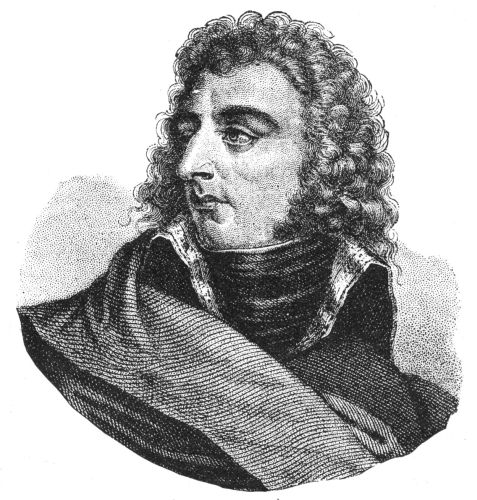
CHARLES XIV. JOHN. (BERNADOTTE.) KING OF NORWAY AND SWEDEN.
To all appearances Norway had now regained her independence. Considering the desperate position in which the country was placed in 1814, resisting single-handed the decree of the powers, there can be no doubt that the terms of the union were more favorable than there was reason to expect. For all that, there was one feature of it which was incompatible with the idea of independence, and that was the presence in the capital of a Swedish viceroy (Statholder), representing the authority of the king. Bernadotte, who, at the death of Charles XIII. (1818), succeeded to the throne under the name of Charles XIV. John (1818-1844), scarcely regarded, at first, the independence of Norway seriously, but rather allowed the Norsemen to deceive themselves with an illusion of liberty, as long as their illusion was harmless. But he showed plainly his irritation when he found that the Storthing began to oppose his measures, and to insist upon a stricter interpretation of the constitution. One of the first causes of contention was the question of the payment by Norway of a part of the Danish public debt which Charles John had guaranteed in the treaty of Kiel. The Storthing was of opinion that, as Norway had never accepted the treaty of Kiel, it could not be bound by any of its stipulations. A compromise was finally effected by which the king renounced his civil list from Norway for ten years for himself and his son, the crown prince, and the Storthing of 1821 agreed to pay about three million dollars. Simultaneously came the struggle about the abolition of the nobility. Three successive Storthings passed a law, abolishing noble titles and privileges, and the king, who feared a conflict with the powerful nobility of Sweden, in case he sanctioned it, made repeated efforts to induce the Storthing to abandon its position. He urged that Norway was watched by the powers of Europe, and that the democratic spirit which manifested itself in its legislative assembly would arouse suspicion and hostility abroad. The Storthing, however, remained inflexible, and finally the law was promulgated, though in a slightly modified form. Those of the privileges of the nobility which were in conflict with the constitution were forthwith abolished; their exemption from taxation and all personal privileges should cease on the demise of the nobles then living, and should not be inherited by their descendants. This postponed the final abolition of nobility for one generation.
A number of other laws and proposals for laws, concerning which the king and the Storthing differed, caused ill-feeling and excitement during the reign of Charles John. And it is indeed marvellous, considering the comparative inexperience of the representatives in political life, that they dared present so bold a front and insist so strenuously upon their rights. To these intrepid men Norway owes the position she occupies to-day. For, if they had been meek and conciliatory, accepting gratefully what the king was pleased to grant them, their country would inevitably have sunk into a provincial relation to Sweden, as it had formerly to Denmark. The manly ring and fearless self-assertion, which resound through the debates of those early Storthings, show that the ancient strength was still surviving, and could, indeed, never have been dead. No inert and degraded nation can draw such representatives from its midst; and the fact that Norway has continued to draw them, up to the present time, shows that she is truly represented by manliness and fearless vigor—that she is worthy of the liberty she gained.
The attitude which the Norwegian Storthings assumed toward the king is illustrated by the determination with which they resisted his efforts to extend the royal authority. Though he had been trained in the school of the French Revolution, Charles John was no believer in democracy or "the rights of man." He was an able ruler, a skilful diplomat, and a man of honorable intentions. But he had been too little in Norway to comprehend the spirit of the Norwegian people; and he was forced, in order to maintain his position among his brother monarchs, to sympathize with the reactionary tendencies which asserted themselves throughout Europe after the overthrow of Napoleon. In 1821 he proposed ten amendments to the constitution, which were unanimously rejected by the Storthing of 1824. Among these amendments was one giving the king an absolute instead of, as formerly, a suspensive veto; another, conferring upon him the right to appoint the presiding officer of the Storthing, and a third, authorizing him to dissolve the Storthing at pleasure. The former minister of state, Christian Krogh, gained great popularity by recommending the rejection of these propositions, and the king's persistence in bringing them up before several successive Storthings did not secure them a more favorable reception.
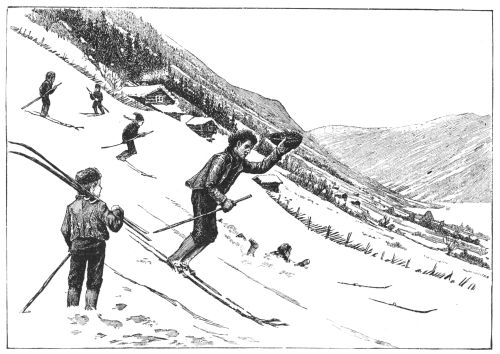
SKEE-RUNNING; AFTER A CARTOON BY H. N. GAUSTA.
An eminent figure in the political struggles of those days was the poet Henrik Wergeland, who, as the leader of the students, persisted in celebrating the anniversary of the constitution (May 17th) contrary to the king's command, instead of the anniversary of the union with Sweden (November 4th). The king exaggerated the importance of this demonstration and in 1829 called out troops, which dispersed, by force of arms, the multitude celebrating the national holiday. Wergeland, though he personally professed reverence for the king, did not evince the same reverence for his policy, and by his indefatigable activity in prose and verse nourished the defiant and aggressive patriotism of his countrymen. In an intoxication of patriotic pride he sang the praise of liberty and celebrated the beauties of forest, mountain, and fjord; and a chorus of minor poets declaimed about Norway's Lion, and the rocks of Norway which "defied the tooth of time." There was a good deal that was boyish and irrational in this enthusiasm; but it was wholesome and genuine and politically useful.
That Charles John did not only hold up the powers as a scarecrow, with which to frighten the Norsemen, but was himself restrained in his policy by a regard for their opinion, is obvious enough. The political ferment which, after the July Revolution (1830) in France, spread throughout Europe and also reached Norway, caused him much apprehension, and in order to intimidate the steadily progressing democracy, he suddenly dissolved the Storthing of 1836. The Storthing, regarding this dissolution as contrary to law, indicted the Minister of State, Löwenskjold, before the high court of the realm (Rigsret), and sentenced him to pay a fine for not having dissuaded the king from violating the constitution. This boldness, instead of impelling the king to further measures of repression, induced him to make a concession. He conciliated the Norsemen by appointing their countryman, Count Wedel-Jarlsberg, as viceroy. This was a great step toward real independence and made the king justly popular. During the last years of his life, after he had given up the hope of stemming the tide of democracy, Charles John won the hearts of the Norsemen and he was sincerely mourned at his death (1844).
The remnants of subordination in Norway's relation to Sweden were one by one removed during the reign of Charles John's son, Oscar I. (1844-1859). He gave to Norway a flag of her own, carrying, as a symbol of the union, the blended colors of both countries in the upper corner; and what was more, he practically abolished the viceroyalty, though permanently it was not abolished until 1873. Peace and prosperity reigned in the land; the population increased rapidly, and all industries were in a flourishing condition. It had, hitherto, been chiefly the official and the mercantile class which had participated in the public life, but now the peasants, too, began to assert themselves and to send representatives from their own midst to the Storthing. The political awakening penetrated to all strata of society; and many sturdy figures appeared in the halls of the legislative assembly, fresh from the plough and the harrow. Eminent among these were Ole Gabriel Ueland and Sören Jaabœk. A prudent moderation, coupled with a tough tenacity of purpose, is characteristic of these modern peasant chieftains. Good common-sense, incorruptibility, and a stern regard for the useful have enabled them to render valuable service to the nation. Eloquent they are not; nor are they, in the conventional sense, cultivated. But they have usually, by experience, accumulated a considerable store of facts, which in its application to the legislative business is more valuable than loosely acquired book-learning. Their struggles with a rough climate and a poor soil have made them economical; and they naturally apply their parsimonious habits to the business of state. Being the principal tax-payers of the country they have the right to influence its fiscal policy; and Norway has profited by their careful husbanding of her resources. They know, however, when to spend as well as when to save; and the many costly railroads, highways, schools, and other improvements, which have come into existence since the peasant party commanded a majority in the Storthing, give evidence of a prudent liberality and a well-balanced regard for the public weal, which one might scarcely have expected in people, whose chief experience is derived from the tilling of the soil. The majority of them, however, bring with them some practice in public life from home, as since the establishment of parish and municipal councils (Formandskaber), (1837), the management of local affairs is almost entirely in the hands of local tax-payers.
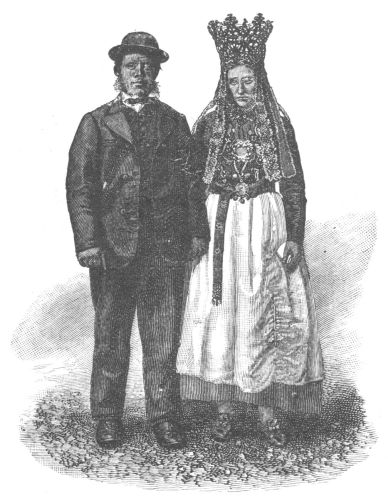
BRIDE AND GROOM.
The first Sleswick-Holstein war, between Germany and Denmark, occurred during King Oscar's reign (1848), and induced him to make a military demonstration in Skaane; and during the following year, when the war, after an armistice, broke out anew, to occupy North Sleswick with Swedish and Norwegian troops, pending the negotiations for peace. In the Crimean War, King Oscar sided with England and France, which, by a treaty of 1855, guaranteed their aid, in case of hostilities with Russia.
King Oscar died at the age of sixty (1859), and was succeeded by his oldest son, Charles XV. (1859-1872). He was a chivalrous character, and endowed with literary and artistic talents. The same good-will toward Norway which animated his father had been inherited by him, and all efforts, on the part of the Storthing, to further the welfare of the land, were readily seconded. The Norwegian merchant marine, which is one of the largest in the world, carried the flag of Norway to the remotest ports; the lumber trade increased, and the wealth obtainable in manufactures and commerce stimulated the energy of Norse merchants, and quickened everywhere the pulses of life. Religious liberty was increased by the law concerning dissenters (1845), although there is, in this respect, yet much to be accomplished. In 1851, the paragraph of the constitution excluding Jews from the country was repealed, owing largely to the agitation commenced, some years before, by the poet Wergeland. The telegraph was introduced, and soon extended from the North Cape to Lindesness. In 1869, a law was passed, making the Storthings annual, instead of, as hitherto, triennial.
Charles XV. died in the prime of life, and, having no sons, was succeeded (1872) by his brother, Oscar II., who is still reigning. The progress toward a more complete and consistent democracy, which had been going on, since the adoption of the constitution, has recently reached a crisis, which might have had disastrous consequences, if the king had not wisely made concessions to the parliamentary majority. There were really two points at issue, viz., the absolute veto in constitutional questions and the control of the government. As regards the former, the king held that the Norwegian constitution was a contract between him and the Norwegian people, prescribing the terms of the union. Accordingly, it could not be altered without the consent of both parties. He had, therefore, the right to insist upon the terms of the contract, and to forbid any alteration of it, that did not meet with his approval. There can be no doubt but that legally this point was well taken; and the faculty of law in the University sustained the king's position. Another question is, whether such a contract, if eternally enforced, would not cripple the nation's progress, and in time become as great a curse, as once it had been a blessing. If the framers of the constitution, when they submitted it to Charles John, failed to provide for its amendment, they committed a serious error, which may, perhaps, be binding upon their descendants, in point of law, but scarcely in point of equity. No constitution, however excellent, is fitting for all times; and the constitution of Eidsvold is no exception to the rule.
This struggle over the absolute veto was occasioned by the king's refusal to sanction a law, passed by three successive Storthings, admitting the cabinet ministers to participation in the debates of the house, so as to establish a closer rapport between the people and the government. This seemed especially desirable, as long as the king and a division of the cabinet were resident in Stockholm, and, accordingly, were in danger of losing sight of the needs of the people whom they were governing. The king declared himself ready to sign this law, if the ministers were given the right to vote, and the right was granted him to dissolve the Storthing at will. It seemed to him a disturbance of the balance of power to introduce one feature of English parliamentarism, giving an advantage to the legislature, without also granting the other, which enabled the executive to exert a restraining influence. The Storthing was, however, unwilling to grant this right, being of opinion that there was no need of governmental restraint, where elections were triennial. The ministry, Selmer, which maintained the attitude here ascribed to the king, was impeached by the Storthing before the high court of the realm, for having refused to promulgate the law concerning the participation of the ministers in the deliberations of the house, and for failing, in other points, to carry out the will of the Storthing.
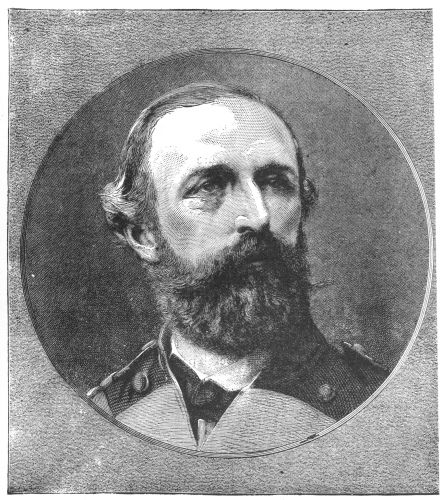
OSCAR II.
The other phase of the question was scarcely less important. A certain antagonism had early developed itself between the official class, which had been accustomed to take the lead in public affairs, and the peasantry, which became every year more conscious of its power. The king, who is naturally conservative, chose his advisers from those, whose political views accorded with his own, irrespective of parliamentary majorities. The constitution did not limit his liberty of choice, and the Storthing could scarcely do it, without passing an amendment, which he would be sure to veto. The conservative ministry, Stang, conducted the government for many years with a hostile majority in the Storthing, and the ministry, Selmer, which succeeded it (1880), had even less popular support. The result was a deadlock; legislative business threatened to come to a standstill. The impeachment and conviction of Mr. Selmer and his colleagues brought a fresh ministry of officials into power, which, after a few months, resigned. The king then sent for Mr. Sverdrup, the leader of the "left," or liberal party, and effected a compromise, in accordance with which he agreed to sanction the law in question, and to summon a ministry, representing the party of the majority, without, however, surrendering, in principle, his right to an absolute veto in constitutional questions. Since then the executive and the legislative power have worked together in harmony, and the former good relation between the king and the people has been in a measure re-established.
It will be seen from the above, that Norway has, through the conflicts of seventy years, gradually attained to perfect independence and equality with the brother kingdom. All attempts to amalgamate the two nations have failed, and have, long since, been abandoned. Politically, the person of the king expresses the union. He is king of Norway and he is king of Sweden, but he governs each country in accordance with its own laws and through distinct and separate ministries. Each country has its own parliament; no Swede holds office in Norway, and no Norseman in Sweden. The only offices which are open to citizens of both countries are those of the diplomatic and consular service. The general sentiment in Norway is opposed to a closer union. A stubborn insistence upon every feature of national distinctness has characterized the people, since the separation from Denmark.
Thus an effort has been made to get rid of the "union mark" in the Norwegian flag; because it seemed vaguely to hint at a provincial relation. A separate literature has sprung up in the Norse dialects (Maalsträv), because the Danish, which is yet spoken, with some modifications, by the cultivated classes, is a reminder of the period of degradation, and is not the language of the people. Popular high schools, aiming to build the intellectual life of the people upon a strictly national basis, have been started by devoted and patriotic men, in nearly all the provincial parishes, and have produced excellent results. The national literature, under the lead of men like Björnstjerne Björnson, and Henrik Ibsen, is moving in the same direction, its language being continually enriched from the dialects, and its themes largely drawn from the ancient sagas and the life of the people. The aggressive and declamatory patriotism of Wergeland, and the æsthetic and more cosmopolitan patriotism of his opponent, Welhaven, seem equally alien to the Norsemen of to-day. The frank national self-assertion of the present poets is that of a people, proud of its past, and secure in its national existence. The Norseman, having obtained what is his due, has cause for jealousy neither of Sweden nor of Denmark.
In an age when strength, bravery, and an adventurous spirit made a nation eminent, Norway played a great rôle upon the arena of the world, founding and destroying kingdoms, mingling her vigorous blood with that of other nations, and infusing her love of liberty, restrained by law, into their souls. Since powder and modern strategy have subordinated heroism to discipline and numbers, Norway must resign herself to the fate which her numerical weakness imposes upon her. A people of scarcely two millions can cut no very great figure in the world, as it is now constituted. It must either rest upon its laurels or win new ones in other fields. As the militant organization of society, with its needless bloodshed and oppression, slowly yields to the industrial, history will find another gauge of merit than that of Krupp guns and heavy battalions. Then, perhaps, there will again be a chance for small nations to assert themselves.
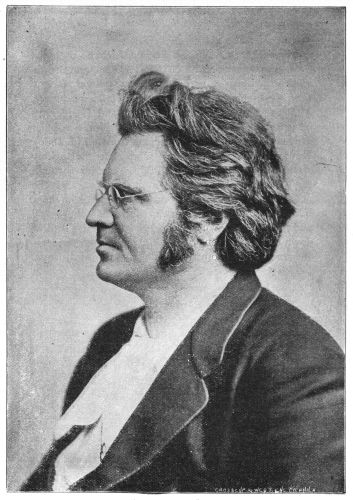
BJÖRNSTJERNE BJÖRNSON.
Norway has made a beginning in this direction by her contributions, during recent years, to science and literature. The astronomer Hansteen (d. 1873), the mathematicians Abel and Sophus Lie, the zoölogist Sars, the historians Munch, Keyser, Sars, and Storm, and the philologist Ivar Aason, have gained recognition, beyond the boundaries of their own country. The painters Tidemand (d. 1876) and Gude have interpreted in colors the poetry of Norse popular life and scenery. The musicians Ole Bull (d. 1880), Nordraak, and Grieg have made the melancholy strains of their native mountains resound through the concert-halls of Paris and London, and the poets Björnson, Ibsen, Jonas Lie, and Alexander Kielland have made Norway known to the world and the world known to Norway. They have broken down the wall which so long hedged in their country, and excluded it from the intellectual life of Europe.