Chapter VI · DEEP-SEA FAUNA.
Reading edition
Some of the most important conditions under which life at the bottom of the deep-sea occurs have been mentioned in the first chapter. We have pointed out that the pressure is enormous, that the temperature is only a few degrees above the freezing point, and that, except in those places where phosphorescent animals emit a faint light, it is absolutely dark, no rays of direct sunlight being able to penetrate such a mass of water as lies between the bottom of the ocean and its surface.
With such conditions to contend with it is not surprising that the naturalists at the beginning of the century believed that no animals could possibly live on the floor of the great oceans. Their beliefs, however, merely afford us an example of the danger of prophesying without knowing, for the great expeditions which have investigated the ocean-bed during the last thirty years have proved the existence of a rich and peculiar Fauna in all the great depths that have been dredged. The general results of these investigations have been recently summed up by Dr John Murray in the last volume of the Challenger Reports. He points out the extraordinary variety of life in the deep sea as shown by the contents of the dredge. “At Station 146 in the Southern Ocean, at a depth of 1375 fathoms, the 200 specimens captured belonged to 59 genera and 78 species.” He can find no record of species equal to this in depths of under 50 fathoms, and concludes that the evidence at present before us is sufficient to warrant the belief that the great depths of the ocean are as a general rule extremely rich in species.
From what has been already said, it may be gathered that nearly all the most important groups of marine animals have representatives in the deep-sea. There are Fish, Tunicates, Crustaceans, Molluscs, Echinoderms, Worms, Cœlenterates and Protozoa. Nearly all of these are so modified, either in form or colour, or the structure of their organs of sense, or in other particulars, that they could be recognised at once in a collection as deep-sea animals; but there is a small minority which seem to have undergone but little change in adapting themselves to their strange environment.
We may commence our study of this remarkable Fauna by a few remarks on their colour. The first and most striking feature is that the animals are almost invariably uniform in colour. If they are dark-brown they are dark-brown all over, if they are red they rarely exhibit bands of white or spots of blue. Moreover, they are not always in harmony with the colour of their surroundings.
In the shallow waters the animals that live among the green Sea-weeds are green, those that live on the sand are coloured like the sand, and many of those that live among the rocks are darkly pigmented with black and blue. In the abyss of the ocean, where there is any light at all, the colour is, in all probability, fairly uniform over wide tracts, and yet we may find in one haul of the dredge, black Fish, red Crustaceans, and purple Trepangs.
There seems to be no particularly predominant colour among the deep-sea animals. Most of the Fish are black or dark-brown, but many are light violet, some are pale rose and others bright red. Among the Crustaceans bright red seems to be the prevailing shade, just as the darker tints of black and brown are among the Fish.
Among the Echinoderms we find white, purple, yellow, red, and pink forms, and among the Jelly-fish and Corals, red, violet, and green. In fact it would be necessary to describe every class of animals in turn, and then almost every genus in each class, to give an adequate idea of the variety of colour met with in the Fauna of the deep-sea.
It is inconceivable that each of these animals can live amid surroundings of a colour similar to its own, and therefore we may without much hesitation believe, that the colour of deep-sea animals is not, as a general rule, of use as a protection.
Next to the peculiarities of colour, the most striking features of the more highly organised inhabitants of the bottom of the sea are the modifications of the organs of special sense. The Fish, the Crustaceans and the Molluscs almost invariably exhibit some remarkable modifications of the eyes. In their natural haunts there must be either absolute darkness, or the faint and usually intermittent light emitted by phosphorescent animals. How intense this light may be it is impossible to judge. The light that is emitted by animals on the deck of a ship can afford no criterion of the light they emit under a pressure of two tons to the square inch. However, the fact that the deep-sea animals have either very large eyes or no eyes at all, suggests forcibly that this light is not sufficient to cause a general illumination.
Some of the Fish are quite blind, and although most of these have a very small and rudimentary eye, in at least one Fish, Ipnops, which is peculiar to deep water, no trace of an eye is to be found.
In some genera with a very wide distribution, a very interesting series of stages may be found, indicating the changes that may have taken place in the history of the blind Fish of the abyss. In the genus of deep-sea Cods (Macrurus) for example, those species which live in water of less than a thousand fathoms depth have very large eyes, and those that are found in greater depths have much smaller ones.
The same in general is true of the Crustaceans. The deep-sea Cray-fish have lost not only their eyes, but also the stalks which supported them. In Bathynomus (a Crustacean belonging to the group Isopoda), however, there is a pair of enormous eyes. But as a rule the eyes of Crustaceans degenerate and disappear in shallower water than the eyes of Fishes. At depths of 500 fathoms or greater, the eyes of the Crustaceans usually show signs of reduction in size or other retrogressive changes, and in the greatest depths they are nearly always wanting altogether.
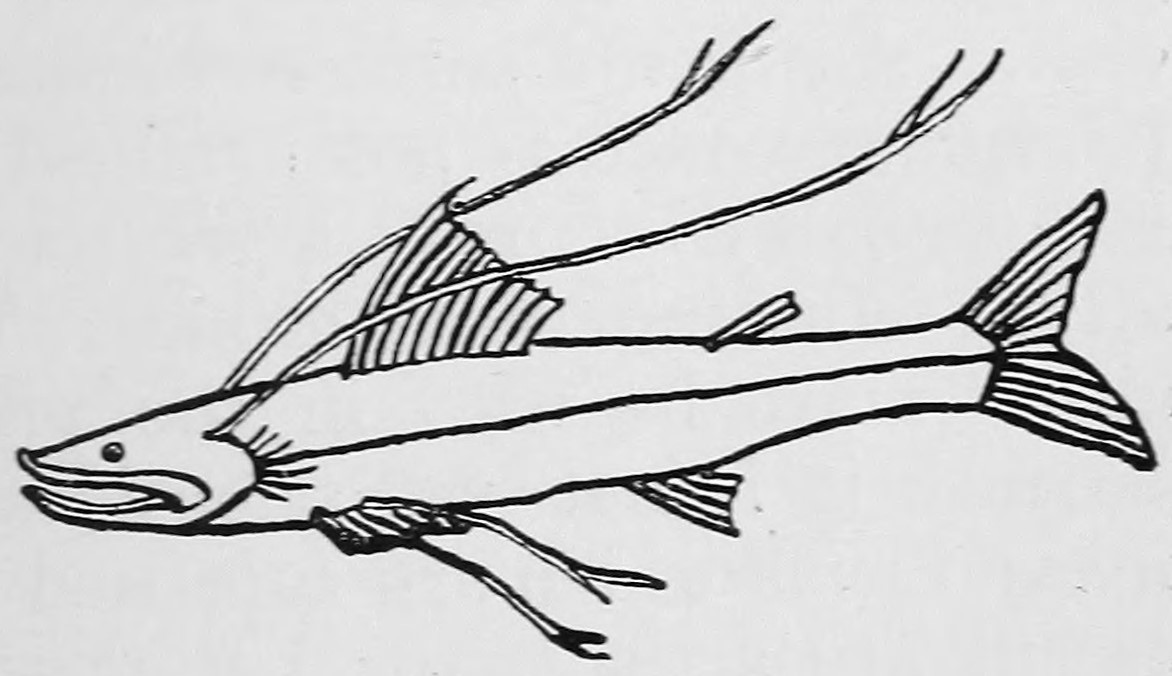
Fig. 36
A deep-sea Fish showing very elongated fins.
Accompanying the loss of eyesight in deep-sea animals we often find a very remarkable development of organs, which may be regarded as especially tactile in function.
Many of the deep-sea Fish, for example, with rudimentary eyes possess long barbels, and in some cases the paired fins are enormously elongated to form delicate pointed organs like the tentacles of a Polyp. Among the blind Crustaceans, too, we often find enormously long antennæ, and even the claws and legs are so long and delicate that they bring to mind the appendages of a Daddy-long-legs or a Harvest spider.
Just as a blind man acquires a remarkably acute sense of touch, so, it seems, in the course of generations, these blind animals of the abyss have acquired extremely delicate tactile organs.
The deep-sea Fauna is also remarkable for the great number of animals which are phosphorescent. As in the surface-swimming creatures the phosphorescence is not confined to a few classes, but probably occurs to a greater or less extent in all the more important groups. The word “probably” must be used in the previous sentence, because it is not yet scientifically proved that many forms which are supposed to be phosphorescent are actually so; but the evidence is conclusive that phosphorescence is a common and widespread character of most of the deep-sea Fauna.
The Fish exhibit, perhaps more than any other group, peculiar organs which are supposed, and in many cases proved to be, used for the purpose of generating light. In the Stomiatidæ, a family of Fish related to the Salmons, there are often numerous little organs, like minute bull’s-eye lanterns, arranged in rows on the sides of the body from the head to the tail, and in addition to these in some species one or more pairs of larger organs are seen on the upper lip just in front of or below the large eyes. It is not certain what the colour of the light is that is emitted by these organs, but it is very probable that if the Fish could be seen in their natural haunts they would have an extremely beautiful effect.
In describing the general characters of the shallow water Fauna in Chapter II. reference has been made to the remarkable lure at the end of the tentacle of the Angler-fish. In the Angler of the great depths this is also found, but in the obscurity of their surroundings a lure, such as that of the shore species, would be useless, and it is actually replaced by an organ which is supposed to be phosphorescent. The mouth is enormous and armed with ferocious-looking teeth, the body is rounded and adapted for burrowing in the ooze, and we can well frame in our minds a picture of the little Fishes and other creatures attracted by the “will-o’-the-wisp” light, meeting with a sudden death in the cavernous jaws of this voracious deep-sea Fish.
It is possible that in addition to the light given off by definite organs, the slime secreted by the skin either over the whole surface or certain circumscribed regions, may be phosphorescent, but how far this may serve as a means of illumination must remain a matter of conjecture. The Crustaceans are in some cases known to emit a phosphorescent fluid. The naturalists of H.M.S. Investigator found a brilliantly phosphorescent liquid in the glands at the base of the antennæ and elsewhere in certain deep-sea Shrimps, and one of the Cray-fish from great depths is said to have two definite spots on the body that emit a phosphorescent light.
Several of the Star-fish and Brittle-stars from the abyss are known to be brilliantly phosphorescent, and there are some vivid accounts of the light given off by Worms and various kinds of deep-sea Polyps found in the dredge.
It is possible that some of the more minute forms of life that occur on the mud at the bottom may also be phosphorescent. The Phæodaria, a family of Radiolarians peculiar to deep water, provided with thick heavy shells, have a curious organ in their bodies which may be capable of emitting light. If this is the case, it is not unreasonable to suppose that the vast tracts on the bed of the ocean may be faintly luminous like the surface of the sea on a calm night.
Among the other characters must be mentioned a very prevalent deficiency in the salts contained in the skeletons of these animals. The skin of the Fish is usually soft and velvety to the touch, the scales being either very thin and few in number or altogether missing; the bones are described as being so soft that it is easy to pass a needle through them. The shells of the Crustaceans, although frequently drawn out into numerous long and pointed spines, are usually deficient in carbonate of lime. The shells of the Molluscs are, when compared with those that live in shallower water, thin and brittle. The Corals do not seem in this respect to show much variation from their shallow water relations. Some of the solitary forms seem to have rather thinner shells, but the colonial genera have, as a rule, as good a support of carbonate of lime in the abyss as elsewhere.
Before proceeding to the next character, it is necessary to digress a little to consider the food of the animals in the abyss. In the absence of any direct sunlight there can be no vegetable growth, all of the animals must therefore be carnivorous. The food must be either the living bodies of the truly abysmal animals, or the dead bodies of those that fall from the surface waters.
It is probable that the bodies of Fish and the larger Invertebrates only rarely reach the bottom, as they have to run the gauntlet of many different forms of life living within 100 fathoms of the surface. When, therefore, such a prize does fall to the luck of a deep-sea Fish, it is important that it should have accommodation for it before the neighbours come to share the meal. This may be the cause of the fact that deep-sea Fish have, as a general rule, jaws and stomach that are extravagantly large, even for a carnivorous creature. The width of the gape and the extensibility of the stomach reach their highest grade in some of the deep-sea Eels, which have been found containing Fish actually larger than themselves. In these cases the stomach and the body wall hang down from the under side of the Eel’s body in the form of an enormous membranous sac containing the prey.
We have now considered very briefly some of the principal modifications of structure exhibited by the animals of the deep-sea, but before leaving the subject altogether it is necessary to refer to a few of the more characteristic and remarkable forms.
Although it may be considered to be one of the greatest scientific triumphs of the century to have discovered the existence of animal life in a region, which nearly all the distinguished men of science of the last generation believed to be as lifeless as the moon, the revelations of the dredge brought with them a certain amount of disappointment.
The study of the crust of the earth has revealed to us the fact that in times long since gone by, there existed not only the hairy Mammoths, the Iguanodons, and many other terrestrial monsters; but that the sea was peopled with certain Reptiles, Fish, Molluscs, Echinoderms and Crustaceans, which are now believed to be extinct.
When it was first discovered that some forms of animal life had attached themselves to a telegraph cable lying in 1200 fathoms, and that it was therefore a fact that life existed in very deep water, a successful application was made by scientific men to the British Government to assist them in a thorough survey of this hitherto unknown field of investigation.
The result of the voyages of H.M.S. Lightning and H.M.S. Porcupine was to prove the existence in water of 1000 fathoms in depth of a rich Fauna of rare and very remarkable animals. Among them were several new genera of Sea-lilies and a very curious Heart-urchin. The Sea-lilies that were then known to live in shallow water were very few in number, and nearly all of them were free and unattached. Now, in past times in the history of the earth different genera and species of stalked Crinoids or Sea-lilies were very plentiful, and from their abundance in certain geological deposits, it is believed that they lived in enormous numbers. The discovery of the new genera of stalked Crinoids in the abyss suggested that possibly there might be found several other families of extinct animals still surviving in the deep sea. This view was supported by the Heart-urchin, whose shell showed some striking peculiarities that were only known in fossil genera.
But the hopes that were felt, even if they were not always expressed, were doomed to disappointment. No living Ichthyosauruses or Plesiosauruses, none of the remarkable Ganoid fish of Devonian times, no Trilobites, no Cystoids nor Blastoids,—in fact none of the most interesting of the fossil types rewarded the investigators of the Challenger and subsequent expeditions.
It is perfectly clear to us now that, taken as a whole, the deep-sea Fauna is not more ancient in character than any other Fauna. It is true that a few genera, such as those just referred to, have survived, probably from very ancient times, without much modification; but the vast majority of forms are simply shallow water animals, which have been profoundly modified in structure, and adapted to the peculiar conditions of existence in the great depths of the ocean.