Volume 3 — CHAPTER IV. (continued 3)
Reading edition
But the Venetians seem to have had a morbid horror of arches which were not on a level. They could not endure the appearance of the roof of one arch bearing against the side of another; and rather than introduce the idea of obliquity into bearing curves, they abandoned the arch principle altogether; so that even in their richest Gothic staircases, where trefoiled arches, exquisitely decorated, are used on the landings, they ran the shafts on the sloping stair simply into the bar of stone above them, and used the excessively ugly and valueless arrangement of Fig. II., rather than sacrifice the sacred horizontality of their arch system.
Fig. IV.
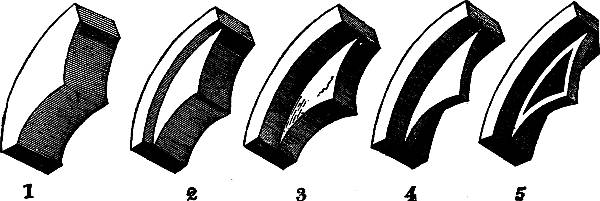
It will be noted, in Plate XI., that the form and character of the tracery bars themselves are independent of the position or projection of the cusps on their flat sides. In this respect, also, Venetian traceries are peculiar, the example 22 of the Porta della Carta being the only one in the plate which is subordinated according to the Northern system. In every other case the form of the aperture is determined, either by a flat and solid cusp as in 6, or by a pierced cusp as in 4. The effect of the pierced cusp is seen in the uppermost figure, Plate XVIII. Vol. II.; and its derivation from the solid cusp will be understood, at once, from the woodcut Fig. IV., which represents a series of the flanking stones of any arch of the fifth order, such as f in Plate III. Vol. I.
Fig. V.
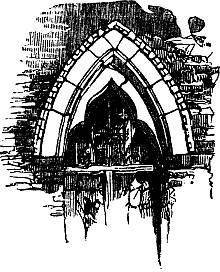
The first on the left shows the condition of cusp in a perfectly simple and early Gothic arch, 2 and 3 are those of common arches of the fifth order, 4 is the condition in more studied examples of the Gothic advanced guard, and 5 connects them all with the system of traceries. Introducing the common archivolt mouldings on the projecting edge of 2 and 3, we obtain the bold and deep fifth order window, used down to the close of the fourteenth century or even later, and always grand in its depth of cusp, and consequently of shadow; but the narrow cusp 4 occurs also in very early work, and is piquant when set beneath a bold flat archivolt, as in Fig. V., from the Corte del Forno at Santa Marina. The pierced cusp gives a peculiar lightness and brilliancy to the window, but is not so sublime. In the richer buildings the surface of the flat and solid cusp is decorated with a shallow trefoil (see Plate VIII. Vol. I.), or, when the cusp is small, with a triangular incision only, as seen in figs. 7 and 8, Plate XI. The recesses on the sides of the other cusps indicate their single or double lines of foliation. The cusp of the Ducal Palace has a fillet only round its edge, and a ball of red marble on its truncated point, and is perfect in its grand simplicity; but in general the cusps of Venice are far inferior to those of Verona and of the other cities of Italy, chiefly because there was always some confusion in the mind of the designer between true cusps and the mere bending inwards of the arch of the fourth order. The two series, 4 a to 4 e, and 5 a to 5 e, in Plate XIV. Vol. II., are arranged so as to show this connexion, as well as the varieties of curvature in the trefoiled arches of the fourth and fifth orders, which, though apparently slight on so small a scale, are of enormous importance in distant effect; a house in which the joints of the cusps project as much as in 5 c, being quite piquant and grotesque when compared with one in which the cusps are subdued to the form 5 b. 4 d and 4 e are Veronese forms, wonderfully effective and spirited; the latter occurs at Verona only, but the former at Venice also. 5 d occurs in Venice, but is very rare; and 5 e I found only once, on the narrow canal close to the entrance door of the Hotel Danieli. It was partly walled up, but I obtained leave to take down the brickwork and lay open one side of the arch, which may still be seen.
The above particulars are enough to enable the reader to judge of the distinctness of evidence which the details of Venetian architecture bear to its dates. Farther explanation of the plates would be vainly tedious: but the architect who uses these volumes in Venice will find them of value, in enabling him instantly to class the mouldings which may interest him; and for this reason I have given a larger number of examples than would otherwise have been sufficient for my purpose.
INDICES.
I. PERSONAL INDEX. II. LOCAL INDEX. III. TOPICAL INDEX. IV. VENETIAN INDEX.
The first of the following Indices contains the names of persons; the second those of places (not in Venice) alluded to in the body of the work. The third Index consists of references to the subjects touched upon. In the fourth, called the Venetian Index, I have named every building of importance in the city of Venice itself, or near it; supplying, for the convenience of the traveller, short notices of those to which I had no occasion to allude in the text of the work; and making the whole as complete a guide as I could, with such added directions as I should have given to any private friend visiting the city. As, however, in many cases, the opinions I have expressed differ widely from those usually received; and, in other instances, subjects which may be of much interest to the traveller have not come within the scope of my inquiry; the reader had better take Lazari’s small Guide in his hand also, as he will find in it both the information I have been unable to furnish, and the expression of most of the received opinions upon any subject of art.
Various inconsistencies will be noticed in the manner of indicating the buildings, some being named in Italian, some in English, and some half in one, and half in the other. But these inconsistencies are permitted in order to save trouble, and make the Index more practically useful. For instance, I believe the traveller will generally look for “Mark,” rather than for “Marco,” when he wishes to find the reference to St. Mark’s Church; but I think he will look for Rocco, rather than for Roch, when he is seeking for the account of the Scuola di San Rocco. So also I have altered the character in which the titles of the plates are printed, from the black letter in the first volume, to the plain Roman in the second and third; finding experimentally that the former character was not easily legible, and conceiving that the book would be none the worse for this practical illustration of its own principles, in a daring sacrifice of symmetry to convenience.
These alphabetical Indices will, however, be of little use, unless another, and a very different kind of Index, be arranged in the mind of the reader; an Index explanatory of the principal purposes and contents of the various parts of this essay. It is difficult to analyze the nature of the reluctance with which either a writer or painter takes it upon him to explain the meaning of his own work, even in cases where, without such explanation, it must in a measure remain always disputable: but I am persuaded that this reluctance is, in most instances, carried too far; and that, wherever there really is a serious purpose in a book or a picture, the author does wrong who, either in modesty or vanity (both feelings have their share in producing the dislike of personal interpretation), trusts entirely to the patience and intelligence of the readers or spectators to penetrate into their significance. At all events, I will, as far as possible, spare such trouble with respect to these volumes, by stating here, finally and clearly, both what they intend and what they contain; and this the rather because I have lately noticed, with some surprise, certain reviewers announcing as a discovery, what I thought had lain palpably on the surface of the book, namely, that “if Mr. Ruskin be right, all the architects, and all the architectural teaching of the last three hundred years, must have been wrong.” That is indeed precisely the fact; and the very thing I meant to say, which indeed I thought I had said over and over again. I believe the architects of the last three centuries to have been wrong; wrong without exception; wrong totally, and from the foundation. This is exactly the point I have been endeavoring to prove, from the beginning of this work to the end of it. But as it seems not yet to have been stated clearly enough, I will here try to put my entire theorem into an unmistakable form.
The various nations who attained eminence in the arts before the time of Christ, each of them, produced forms of architecture which in their various degrees of merit were almost exactly indicative of the degrees of intellectual and moral energy of the nations which originated them; and each reached its greatest perfection at the time when the true energy and prosperity of the people who had invented it were at their culminating point. Many of these various styles of architecture were good, considered in relation to the times and races which gave birth to them; but none were absolutely good or perfect, or fitted for the practice of all future time.
The advent of Christianity for the first time rendered possible the full development of the soul of man, and therefore the full development of the arts of man.
Christianity gave birth to a new architecture, not only immeasurably superior to all that had preceded it, but demonstrably the best architecture that can exist; perfect in construction and decoration, and fit for the practice of all time.
This architecture, commonly called “Gothic,” though in conception perfect, like the theory of a Christian character, never reached an actual perfection, having been retarded and corrupted by various adverse influences; but it reached its highest perfection, hitherto manifested, about the close of the thirteenth century, being then indicative of a peculiar energy in the Christian mind of Europe.
In the course of the fifteenth century, owing to various causes which I have endeavored to trace in the preceding pages, the Christianity of Europe was undermined; and a Pagan architecture was introduced, in imitation of that of the Greeks and Romans.
The architecture of the Greeks and Romans themselves was not good, but it was natural; and, as I said before, good in some respects, and for a particular time.
But the imitative architecture introduced first in the fifteenth century, and practised ever since, was neither good nor natural. It was good in no respect, and for no time. All the architects who have built in that style have built what was worthless; and therefore the greater part of the architecture which has been built for the last three hundred years, and which we are now building, is worthless. We must give up this style totally, despise it and forget it, and build henceforward only in that perfect and Christian style hitherto called Gothic, which is everlastingly the best.
This is the theorem of these volumes.
In support of this theorem, the first volume contains, in its first chapter, a sketch of the actual history of Christian architecture, up to the period of the Reformation; and, in the subsequent chapters, an analysis of the entire system of the laws of architectural construction and decoration, deducing from those laws positive conclusions as to the best forms and manners of building for all time.
The second volume contains, in its first five chapters, an account of one of the most important and least known forms of Christian architecture, as exhibited in Venice, together with an analysis of its nature in the fourth chapter; and, which is a peculiarly important part of this section, an account of the power of color over the human mind.
The sixth chapter of the second volume contains an analysis of the nature of Gothic architecture, properly so called, and shows that in its external form it complies precisely with the abstract laws of structure and beauty, investigated in the first volume. The seventh and eighth chapters of the second volume illustrate the nature of Gothic architecture by various Venetian examples. The third volume investigates, in its first chapter, the causes and manner of the corruption of Gothic architecture; in its second chapter, defines the nature of the Pagan architecture which superseded it; in the third chapter, shows the connexion of that Pagan architecture with the various characters of mind which brought about the destruction of the Venetian nation; and, in the fourth chapter, points out the dangerous tendencies in the modern mind which the practice of such an architecture indicates.
Such is the intention of the preceding pages, which I hope will no more be doubted or mistaken. As far as regards the manner of its fulfilment, though I hope, in the course of other inquiries, to add much to the elucidation of the points in dispute, I cannot feel it necessary to apologize for the imperfect handling of a subject which the labor of a long life, had I been able to bestow it, must still have left imperfectly treated.
I.
PERSONAL INDEX.
A
Alberti, Duccio degli, his tomb, iii. 74, 80.
Alexander III., his defence by Venetians, i. 7.
Ambrose, St., his verbal subtleties, ii. 320.
Angelico, Frà, artistical power of, i. 400; his influence on Protestants, ii. 105; his coloring, ii. 145.
Aristotle, his evil influence on the modern mind, ii. 319.
Averulinus, his book on architecture, iii. 63.
B
Barbaro, monuments of the family, iii. 125.
Barbarossa, Emperor, i. 7, 9.
Baseggio, Pietro, iii. 199.
Bellini, John, i. 11; his kindness to Albert Durer, i. 383; general power of, see Venetian Index, under head “Giovanni Grisostomo;” Gentile, his brother, iii. 21.
Berti, Bellincion, ii. 263.
Browning, Elizabeth B., her poetry, ii. 206.
Bunsen, Chevalier, his work on Romanesque Churches, ii. 381.
Bunyan, John, his portraiture of constancy, ii. 333; of patience, ii. 334; of vanity, ii. 346; of sin, iii. 147.
C
Calendario, Filippo, iii. 199.
Canaletto, i. 24; and see Venetian Index under head “Carità.”
Canova, i. 217; and see Venetian Index under head “Frari.”
Cappello, Vincenzo, his tomb, iii. 122.
Caracci, school of the, i. 24.
Cary, his translation of Dante, ii. 264.
Cavalli, Jacopo, his tomb, iii. 82.
Cicero, influence of his philosophy, ii. 317, 318.
Claude Lorraine, i. 24.
Comnenus, Manuel, ii. 263.
Cornaro, Marco, his tomb, iii. 79.
Correggio, ii. 192.
Crabbe, naturalism in his poetry, ii. 195.
D
Dandolo, Andrea, tomb of, ii. 70; Francesco, tomb of, iii. 74; character of, iii. 76; Simon, tomb of, iii. 79.
Dante, his central position, ii. 340, iii. 158; his system of virtue, ii. 323; his portraiture of sin, iii. 147.
Daru, his character as a historian, iii. 213.
Dolci, Carlo, ii. 105.
Dolfino, Giovanni, tomb of, iii. 78.
Durer, Albert, his rank as a landscape painter, i. 383; his power in grotesque, iii. 145.
E
Edwin, King, his conversion, iii. 62.
F
Faliero, Bertuccio, his tomb, iii. 94; Marino, his house, ii. 254; Vitale, miracle in his time, ii. 61.
Fergusson, James, his system of beauty, i. 388.
Foscari, Francesco, his reign, i. 4, iii. 165; his tomb, iii. 84; his countenance, iii. 86.
G
Garbett, answer to Mr., i. 403.
Ghiberti, his sculpture, i. 217.
Giotto, his system of the virtues, ii. 323, 329, 341; his rank as a painter, ii. 188, iii. 172.
Giulio Romano, i. 23.
Giustiniani, Marco, his tomb, i. 315; Sebastian, ambassador to England, iii. 224.
Godfrey of Bouillon, his piety, iii. 62.
Gozzoli, Benozzo, ii. 195.
Gradenigo, Pietro, ii. 290.
Grande, Can, della Scala, his tomb, i. 268 (the cornice g in Plate XVI. is taken from it), iii. 71.
Guariento, his Paradise, ii. 296.
Guercino, ii. 105.
H
Hamilton, Colonel, his paper on the Serapeum, ii. 220.
Hobbima, iii. 184.
Hunt, William, his painting of peasant boys, ii. 192; of still life, ii. 394.
Hunt, William Holman, relation of his works to modern and ancient art, iii. 185.
K
Knight, Gally, his work on Architecture, i. 378.
L
Leonardo da Vinci, ii. 171.
Louis XI., iii. 194.
M
Martin, John, ii. 104.
Mastino, Can, della Scala, his tomb, ii. 224, iii. 72.
Maynard, Miss, her poems, ii. 397.
Michael Angelo, ii. 134, 188, iii. 56, 90, 99, 158.
Millais, John E., relation of his works to older art, iii. 185; aerial perspective in his “Huguenot,” iii. 47.
Milton, how inferior to Dante, iii. 147.
Mocenigo, Tomaso, his character, i. 4; his speech on rebuilding the Ducal Palace, ii. 299; his tomb, i. 26, iii. 84.
Morosini, Carlo, Count, note on Daru’s History by, iii. 213.
Morosini, Marino, his tomb, iii. 93.
Morosini, Michael, his character, iii. 213; his tomb, iii. 80.
Murillo, his sensualism, ii. 192.
N
Napoleon, his genius in civil administration, i. 399.
Niccolo Pisano, i. 215.
O
Orcagna, his system of the virtues, ii. 329.
Orseolo, Pietro (Doge), iii. 120.
Otho the Great, his vow at Murano, ii. 32.
P
Palladio, i. 24, 146; and see Venetian Index, under head “Giorgio Maggiore.”
Participazio, Angelo, founds the Ducal Palace, ii. 287.
Pesaro, Giovanni, tomb of, iii. 92; Jacopo, tomb of, iii. 91.
Philippe de Commynes, i. 12.
Plato, influence of his philosophy, ii. 317, 338; his playfulness, iii. 127.
Poussin, Nicolo and Gaspar, i. 23.
Procaccini, Camillo, ii. 188.
Prout, Samuel, his style, i. 250, iii. 19, 134.
Pugin, Welby, his rank as an architect, i. 385.
Q
Querini, Marco, his palace, ii. 255.
R
Raffaelle, ii. 188, iii. 56, 108, 136.
Reynolds, Sir J., his painting at New College, ii. 323; his general manner, iii. 184.
Rogers, Samuel, his works, ii. 195, iii. 113.
Rubens, intellectual rank of, i. 400; coarseness of, ii. 145.
S
Salvator Rosa, i. 24, ii. 105, 145, 188.
Scaligeri, tombs of, at Verona; see “Grande,” “Mastino,” “Signorio;” palace of, ii. 257.
Scott, Sir W., his feelings of romance, iii. 191.
Shakspeare, his “Seven Ages,” whence derived, ii. 361.
Sharpe, Edmund, his works, i. 342, 408.
Signorio, Can, della Scala, his tomb, character, i. 268, iii. 73.
Simplicius, St., ii. 356.
Spenser, value of his philosophy, ii. 327, 341; his personifications of the months, ii. 272; his system of the virtues, ii. 326; scheme of the first book of the Faërie Queen, iii. 205.
Steno, Michael, ii. 306; his tomb, ii. 296.
Stothard (the painter), his works, ii. 187, 195.
Symmachus, St., ii. 357.
T
Teniers, David, ii. 188.
Tiepolo, Jacopo and Lorenzo, their tombs, iii. 69; Bajamonte, ii. 255.
Tintoret, i. 12; his genius and function, ii. 149; his Paradise, ii. 304, 372; his rank among the men of Italy, iii. 158.
Titian, i. 12; his function and fall, ii. 149, 187.
Turner, his rank as a landscape painter, i. 382, ii. 187.
U
Uguccione, Benedetto, destroys Giotto’s façade at Florence, i. 197.
V
Vendramin, Andrea (Doge), his tomb, i. 27, iii. 88.
Verocchio, Andrea, iii. 11, 13.
Veronese, Paul, artistical rank of, i. 400; his designs of balustrades, ii. 247; and see in Venetian Index, “Ducal Palace,” “Pisani,” “Sebastian,” “Redentore,” “Accademia.”
W
West, Benjamin, ii. 104.
Wordsworth, his observation of nature, i. 247 (note).
Z
Zeno, Carlo, i. 4, iii. 80.
Ziani, Sebastian (Doge), builds Ducal Palace, ii. 289.
II.
LOCAL INDEX.
A
Abbeville, door of church at, ii. 225; parapet at, ii. 245.
Alexandria, Church at, i. 381.
Alhambra, ornamentation of, i. 429.
Alps, how formed for distant effect, i. 247; how seen from Venice, ii. 2, 28.
Amiens, pillars of Cathedral at, i. 102.
Arqua, hills of, how seen from Venice, ii. 2.
Assisi, Giotto’s paintings at, ii. 323.
B
Beauvais, piers of Cathedral at, i. 93; grandeur of its buttress structure, i. 170.
Bergamo, Duomo at, i. 275.
Bologna, Palazzo Pepoli at, i. 275.
Bourges, Cathedral at, i. 43, 102, 228, 271, 299; ii. 92, 186; house of Jacques Cœur at, i. 346.
C
Chamouni, glacier forms at, i. 222.
Como, Broletto of, i. 141, 339.
D
Dijon, pillars in Church of Notre Dame at, i. 102; tombs of Dukes of Burgundy, iii. 68.
E
Edinburgh, college at, i. 207.
F
Falaise (St. Gervaise at), piers of, i. 103.
Florence, Cathedral of, i. 197, iii. 13.
G
Gloucester, Cathedral of, i. 192.
L
Lombardy, geology of, ii. 5.
London, Church in Margaret Street, Portland Place, iii. 196; Temple Church, i. 412; capitals in Belgrave and Grosvenor Squares, i. 330; Bank of England, base of, i. 283; wall of, typical of accounts, i. 295; statue in King William Street, i. 210; shops in Oxford Street, i. 202; Arthur Club-house, i. 295; Athenæum Club-house, i. 157, 283; Duke of York’s Pillar, i. 283; Treasury, i. 205; Whitehall, i. 205; Westminster, fall of houses at, ii. 268; Monument, i. 82, 283; Nelson Pillar, i. 216; Wellington Statue, i. 257.
Lucca, Cathedral of, ii. 275; San Michele at, i. 375.
Lyons, porch of cathedral at, i. 379.
M
Matterhorn (Mont Cervin), structure of, i. 58; lines of, applied to architecture, i. 308, 310, 332.
Mestre, scene in street of, i. 355.
Milan, St. Ambrogio, piers of, i. 102; capital of, i. 324; St. Eustachio, tomb of St. Peter Martyr, i. 218.
Moulins, brickwork at, i. 296.
Murano, general aspect of, ii. 29; Duomo of, ii. 32; balustrades of, ii. 247; inscriptions at, ii. 384.
N
Nineveh, style of its decorations, i. 234, 239; iii. 159.
O
Orange (South France), arch at, i. 250.
Orleans, Cathedral of, i. 95.
P
Padua, Arena chapel at, ii. 324; St. Antonio at, i. 135; St. Sofia at, i. 327; Eremitani, Church of, at, i. 135.
Paris, Hotel des Invalides, i. 214; Arc de l’Etoile, i. 291; Colonne Vendome, i. 212.
Pavia, St. Michele at, piers of, i. 102, 337; ornaments of, i. 376.
Pisa, Baptistery of, ii. 275.
Pistoja, San Pietro at, i. 295.
R
Ravenna, situation of, ii. 6.
Rouen, Cathedral, piers of, i. 103, 153; pinnacles of, ii. 213; St. Maclou at, sculptures of, ii. 197.
S
Salisbury Cathedral, piers of, i. 102; windows at, ii. 224.
Sens, Cathedral of, i. 135.
Switzerland, cottage architecture of, i. 156, 203, iii. 133.
V
Verona, San Fermo at, i. 136, ii. 259; Sta. Anastasia at, i. 142; Duomo of, i. 373; St. Zeno at, i. 373; balconies at, ii. 247; archivolt at, i. 335; tombs at, see in Personal Index, “Grande,” “Mastino,” “Signorio.”
Vevay, architecture of, i. 136.
Vienne (South France), Cathedral of, i. 274.
W
Warwick, Guy’s tower at, i. 168.
Wenlock (Shropshire), Abbey of, i. 270.
Winchester, Cathedral of, i. 192.
Y
York, Minster of, i. 205, 313.
III.
TOPICAL INDEX.
A
Abacus, defined, i. 107; law of its proportion, i. 111-115; its connection with cornices, i. 116; its various profiles, i. 319-323; iii. 243-248.
Acanthus, leaf of, its use in architecture, i. 233; how treated at Torcello, ii. 15.
Alabaster, use of, in incrustation, ii. 86.
Anachronism, necessity of, in the best art, ii. 198.
Anatomy, a disadvantageous study for artists, iii. 47.
Angels, use of their images in Venetian heraldry, ii. 278; statues of, on the Ducal Palace, ii. 311.
Anger, how symbolically represented, ii. 344.
Angles, decoration of, i. 260; ii. 305; of Gothic Palaces, ii. 238; of Ducal Palace, ii. 307.
Animal character in northern and southern climates, ii. 156; in grotesque art, iii. 149.
Apertures, analysis of their structure, i. 50; general forms of, i. 174.
Apse, forms of, in southern and northern churches compared, i. 170.
Arabesques of Raffaelle, their baseness, iii. 136.
Arabian architecture, i. 18, 234, 235, 429; ii. 135.
Arches, general structure of, i. 122; moral characters of, i. 126; lancet, round, and depressed, i. 129; four-centred, i. 130; ogee, i. 131; non-concentric, i. 133, 341; masonry of, i. 133, ii. 218; load of, i. 144; are not derived from vegetation, ii. 201.
Architects, modern, their unfortunate position, i. 404, 407.
Architecture, general view of its divisions, i. 47-51; how to judge of it, ii. 173; adaptation of, to requirements of human mind, iii. 192; richness of early domestic, ii. 100, iii. 2; manner of its debasement in general, iii. 3.
Archivolts, decoration of, i. 334; general families of, i. 335; of Murano, ii. 49; of St. Mark’s, ii. 95; in London, ii. 97; Byzantine, ii. 138; profiles of, iii. 244.
Arts, relative dignity of, i. 395; how represented in Venetian sculpture, ii. 355; what relation exists between them and their materials, ii. 394; art divided into the art of facts, of design, and of both, ii. 183; into purist, naturalist, and sensualist, ii. 187; art opposed to inspiration, iii. 151; defined, iii. 170; distinguished from science, iii. 35; how to enjoy that of the ancients, iii. 188.
Aspiration, not the primal motive of Gothic work, i. 151.
Astrology, judicial, representation of its doctrines in Venetian sculpture, ii. 352.
Austrian government in Italy, iii. 209.
Avarice, how represented figuratively, ii. 344.
B
Backgrounds, diapered, iii. 20.
Balconies, of Venice, ii. 243; general treatment of, iii. 254; of iron, ii. 247.
Ballflower, its use in ornamentation, i. 279.
Balustrades. See “Balconies.”
Bases, general account of, iii. 225; of walls, i. 55; of piers, i. 73; of shafts, i. 84; decoration of, i. 281; faults of Gothic profiles of, i. 285; spurs of, i. 286; beauty of, in St. Mark’s, i. 290; Lombardie, i. 292; ought not to be richly decorated, i. 292; general effect of, ii. 387.
Battlements, i. 162; abuse of, in ornamentation, i. 219.
Beauty and ornament, relation of the terms, i. 404.
Bellstones of capitals defined, i. 108.
Birds, use of in ornamentation, i. 234, ii. 140.
Bishops, their ancient authority, ii. 25.
Body, its relation to the soul, i. 41, 395.
Brackets, division of, i. 161; ridiculous forms of, i. 161.
Breadth in Byzantine design, ii. 133.
Brickwork, ornamental, i. 296; in general, ii. 241, 260, 261.
Brides of Venice, legend of the, iii. 113, 116.
Buttresses, general structure of, i. 166; flying, i. 192; supposed sanctity of, i. 173.
Bull, symbolical use of, in representing rivers, i. 418, 421, 424.
Byzantine style, analysis of, ii. 75; ecclesiastical fitness of, ii. 97; centralization in, ii. 236; palaces built in, ii. 118; sculptures in, ii. 137, 140.
C
Candlemas, ancient symbols of, ii. 272.
Capitals, general structure of, i. 105; bells of, i. 107; just proportions of, i. 114; various families of, i. 13, 65, 324, ii. 129, iii. 231; are necessary to shafts in good architecture, i. 119; Byzantine, ii. 131, iii. 231; Lily, of St. Mark’s, ii. 137; of Solomon’s temple, ii. 137.
Care, how symbolized, ii. 348. See “Sorrow.”
Caryatides, i. 302.
Castles, English, entrances of, i. 177.
Cathedrals, English, effect of, ii. 63.
Ceilings, old Venetian, ii. 280.
Centralization in design, ii. 237.
Chalet of Switzerland, its character, i. 203.
Chamfer defined, i. 263; varieties of, i. 262, 429.
Changefulness, an element of Gothic, ii. 172.
Charity, how symbolized, ii. 327, 339.
Chartreuse, Grande, morbid life in, iii. 190.
Chastity, how symbolized, ii. 328.
Cheerfulness, how symbolized, ii. 326, 348; virtue of, ii. 326.
Cherries, cultivation of, at Venice, ii. 361.
Christianity, how mingled with worldliness, iii. 109; how imperfectly understood, iii. 168; influence of, in liberating workmen, ii. 159, i. 243; influence of, on forms, i. 99.
Churches, wooden, of the North, i. 381; considered as ships, ii. 25; decoration of, how far allowable, ii. 102.
Civilization, progress of, iii. 168; twofold danger of, iii. 169.
Classical literature, its effect on the modern mind, iii. 12.
Climate, its influence on architecture, i. 151, ii. 155, 203.
Color, its importance in early work, ii. 38, 40, 78, 91; its spirituality, ii. 145, 396; its relation to music, iii. 186; quartering of, iii. 20; how excusing realization, iii. 186.
Commerce, how regarded by Venetians, i. 6.
Composition, definition of the term, ii. 182.
Constancy, how symbolized, ii. 333.
Construction, architectural, how admirable, i. 36.
Convenience, how consulted by Gothic architecture, ii. 179.
Cornices, general divisions of, i. 63, iii. 248; of walls, i. 60; of roofs, i. 149; ornamentation of, i. 305; curvatures of, i. 310; military, i. 160; Greek, i. 157.
Courses in walls, i. 60.
Crockets, their use in ornamentation, i. 346; their abuse at Venice, iii. 109.
Crosses, Byzantine, ii. 139.
Crusaders, character of the, ii. 263.
Crystals, architectural appliance of, i. 225.
Cupid, representation of, in early and later art, ii. 342.
Curvature, on what its beauty depends, i. 222, iii. 5.
Cusps, definition of, i. 135; groups of, i. 138; relation of, to vegetation, ii. 219; general treatment of, iii. 255; earliest occurrence of, ii. 220.
D
Daguerreotype, probable results of, iii. 169.
Darkness, a character of early churches, ii. 18; not an abstract evil, iii. 220.
Death, fear of, in Renaissance times, iii. 65, 90, 92; how anciently regarded, iii. 139, 156.
Decoration, true nature of, i. 405; how to judge of, i. 44, 45. See “Ornament.”
Demons, nature of, how illustrated by Milton and Dante, iii. 147.
Dentil, Venetian, defined, i. 273, 275.
Design, definition of the term, ii. 183; its relations to naturalism, ii. 184.
Despair, how symbolized, ii. 334.
Diaper patterns in brick, i. 296; in color, iii. 21, 22.
Discord, how symbolized, ii. 333.
Discs, decoration by means of, i. 240, 416; ii. 147, 264.
Division of labor, evils of, ii. 165.
Doge of Venice, his power, i. 3, 360.
Dogtooth moulding defined, i. 269.
Dolphins, moral disposition of, i. 230; use of, in symbolic representation of sea, i. 422, 423.
Domestic architecture, richness of, in middle ages, ii. 99.
Doors, general structure of, i. 174, 176; smallness of in English cathedrals, i. 176; ancient Venetian, ii. 277, iii. 227.
Doric architecture, i. 157, 301, 307; Christian Doric, i. 308, 315.
Dragon, conquered by St. Donatus, ii. 33; use of, in ornamentation, ii. 219.
Dreams, how resembled by the highest arts, iii. 153; prophetic, in relation to the Grotesque, iii. 156.
Dress, its use in ornamentation, i. 212; early Venetian, ii. 383; dignity of, iii. 191; changes in modern dress, iii. 192.
Duties of buildings, i. 47.
E
Earthquake of 1511, ii. 242.
Eastern races, their power over color, ii. 147.
Eaves, construction of, i. 156.
Ecclesiastical architecture in Venice, i. 20; no architecture exclusively ecclesiastical, ii. 99.
Edge decoration, i. 268.
Education, University, i. 391; iii. 110; evils of, with respect to architectural workmen, ii. 107; how to be successfully undertaken, ii. 165, 214; modern education in general, how mistaken, iii. 110, 234; system of, in Plato, ii. 318; of Persian kings, ii. 318; not to be mistaken for erudition, iii. 219; ought to be universal, iii. 220.
Egg and arrow mouldings, i. 314.
Egyptian architecture, i. 99, 239; ii. 203.
Elgin marbles, ii. 171.
Encrusted architecture, i. 271, 272; general analysis of, ii. 76.
Energy of Northern Gothic, i. 371; ii. 16, 204.
English (early) capitals, faults of, i. 100, 411; English mind, its mistaken demands of perfection, ii. 160.
Envy, how set forth, ii. 346.
Evangelists, types of, how explicable, iii. 155.
F
Faërie Queen, Spenser’s, value of, theologically, ii. 328.
Faith, influence of on art, ii. 104, 105; Titian’s picture of, i. 11; how symbolized, ii. 337.
Falsehood, how symbolized, ii. 349.
Fatalism, how expressed in Eastern architecture, ii. 205.
Fear, effect of, on human life, iii. 137; on Grotesque art, iii. 142.
Feudalism, healthy effects of, i. 184.
Fig-tree, sculpture of, on Ducal Palace, ii. 307.
Fillet, use of, in ornamentation, i. 267.
Finials, their use in ornamentation, i. 346; a sign of decline in Venetian architecture, iii. 109.
Finish in workmanship, when to be required, ii. 165; dangers of, iii. 170, ii. 162.
Fir, spruce, influence of, on architecture, i. 152.
Fire, forms of, in ornamentation, i. 228.
Fish, use of, in ornamentation, i. 229.
Flamboyant Gothic, i. 278, ii. 225.
Flattery, common in Renaissance times, iii. 64.
Flowers, representation of, how desirable, i. 340; how represented in mosaic, iii. 179.
Fluting of columns, a mistake, i. 301.
Foils, definition of, ii. 221.
Foliage, how carved in declining periods, iii. 8, 17. See “Vegetation.”
Foliation defined, ii. 219; essential to Gothic architecture, ii. 222.
Folly, how symbolized, ii. 325, 348.
Form of Gothic, defined, ii. 209.
Fortitude, how symbolized, ii. 337.
Fountains, symbolic representations of, i. 427.
French architecture, compared with Italian, ii. 226.
Frivolity, how exhibited in Grotesque art, iii. 143.
Fruit, its use in ornamentation, i. 232.
G
Gable, general structure of, i. 124; essential to Gothic, ii. 210, 217.
Gardens, Italian, iii. 136.
Generalization, abuses of, iii. 176.
Geology of Lombardy, ii. 5.
Glass, its capacities in architecture, i. 409; manufacture of, ii. 166; true principles of working in, ii. 168, 395.
Gluttony, how symbolized, ii. 343.
Goldsmiths’ work, a high form of art, ii. 166.
Gondola, management of, ii. 375.
Gothic architecture, analysis of, ii. 151; not derived from vegetable structure, i. 121; convenience of, ii. 178; divisions of, ii. 215; surface and linear, ii. 226; Italian and French, ii. 226; flamboyant, i. 278, ii. 225; perpendicular, i. 192, ii. 223, 227; early English, i. 109; how to judge of it, ii. 228; how fitted for domestic purposes, ii. 269, iii. 195; how first corrupted, iii. 3; how to be at present built, iii. 196; early Venetian, ii. 248; ecclesiastical Venetian, i. 21; central Venetian, ii. 231; how adorned by color in Venice, iii. 23.
Government of Venice, i. 2, ii. 366.
Grammar, results of too great study of it, iii. 55, 106.
Greek architecture, general character of, i. 240, ii. 215, iii. 159.
Grief. See “Sorrow.”
Griffins, Lombardic, i. 292, 387.
Grotesque, analysis of, iii. 132; in changes of form, i. 317; in Venetian painting, iii. 162; symbolical, iii. 155; its character in Renaissance work, iii. 113, 121, 136, 143.
Gutters of roofs, i. 151.
H
Heathenism, typified in ornament, i. 317. See “Paganism.”
Heaven and Hell, proofs of their existence in natural phenomena, iii. 138.
History, how to be written and read, iii. 224.
Hobbima, iii. 184.
Honesty, how symbolized, ii. 349.
Hope, how symbolized, ii. 341.
Horseshoe arches, i. 129, ii. 249, 250.
Humanity, spiritual nature of, i. 41; divisions of, with respect to art, i. 394.
Humility, how symbolized, ii. 339.
I
Idleness, how symbolized, ii. 345.
Idolatry, proper sense of the term, ii. 388; is no encourager of art, ii. 110. See “Popery.”
Imagination, its relation to art, iii. 182.
Imitation of precious stones, &c., how reprehensible, iii. 26, 30.
Imposts, continuous, i. 120.
Infidelity, how symbolized, ii. 335; an element of the Renaissance spirit, iii. 100.
Injustice, how symbolized, ii. 349.
Inlaid ornamentation, i. 369; perfection of, in early Renaissance, iii. 26.
Inscriptions at Murano, ii. 47, 54; use of, in early times, ii. 111.
Insects, use of, in ornamentation, i. 230.
Inspiration, how opposed to art, iii. 151, 171.
Instinct, its dignity, iii. 171.
Intellect, how variable in dignity, iii. 173.
Involution, delightfulness of, in ornament, ii. 136.
Iron, its use in architecture, i. 184, 410.
Italians, modern character of, iii. 209.
Italy, how ravaged by recent war, iii. 209.
J
Jambs, Gothic, iii. 137.
Jesting, evils of, iii. 129.
Jesuits, their restricted power in Venice, i. 366.
Jewels, their cutting, a bad employment, ii. 166.
Judgments, instinctive, i. 399.
Job, book of, its purpose, iii. 53.
K
Keystones, how mismanaged in Renaissance work. See Venetian Index, under head “Libreria.”
Knowledge, its evil consequences, iii. 40; how to be received, iii. 50, &c. See “Education.”
L
Labor, manual, ornamental value of, i. 407; evils of its division, ii. 165; is not a degradation, ii. 168.
Labyrinth, in Venetian streets, its clue, ii. 254.
Lagoons, Venetian, nature of, ii. 7, 8.
Landscape, lower schools of, i. 24; Venetian, ii. 149; modern love of, ii. 175, iii. 123.
Laws of right in architecture, i. 32; laws in general, how permissibly violated, i. 255, ii. 210; their position with respect to art, iii. 96; and to religion, iii. 205.
Leaves, use of, in ornamentation, i. 232 (see “Vegetation”); proportion of, ii. 128.
Liberality, how symbolized, ii. 333.
Life in Byzantine architecture, ii. 133.
Lilies, beautiful proportions of, ii. 128; used for parapet ornaments, ii. 242; lily capitals, ii. 137.
Limitation of ornament, i. 254.
Lines, abstract use of, in ornament, i. 221.
Lintel, its structure, i. 124, 126.
Lion, on piazzetta shafts, iii. 238.
Load, of arches, i. 133.
Logic, a contemptible science, iii. 105.
Lombardic architecture, i. 17.
Lotus leaf, its use in architecture, i. 233.
Love, its power over human life, iii. 137.
Lusts, their power over human nature, how symbolized by Spenser, ii. 328.
Luxury, how symbolized, ii. 342; how traceable in ornament, iii. 4; of Renaissance schools, iii. 61.
M
Madonna, Byzantine representations of, ii. 53.
Magnitude, vulgar admiration of, iii. 64.
Malmsey, use of, in Feast of the Maries, iii. 117.
Marble, its uses, iii. 27.
Maries, Feast of the, iii. 117.
Mariolatry, ancient and modern, ii. 55.
Marriages of Venetians, iii. 116.
Masonry, Mont-Cenisian, i. 132; of walls, i. 61; of arches, i. 133.
Materials, invention of new, how injurious to art, iii. 42.
Misery, how symbolized, ii. 347.
Modesty, how symbolized, ii. 335.
Monotony, its place in art, ii. 176.
Months, personifications of, in ancient art, ii. 272.
Moroseness, its guilt, iii. 130.
Mosaics at Torcello, ii. 18, 19; at St. Mark’s, ii. 70, 112; early character of, ii. 110, iii. 175, 178.
Music, its relation to color, iii. 186.
Mythology of Venetian painters, ii. 150; ancient, how injurious to the Christian mind, iii. 107.
N
Natural history, how necessary a study, iii. 54.
Naturalism, general analysis of it with respect to art, ii. 181, 190; its advance in Gothic art, iii. 6; not to be found in the encrusted style, ii. 89; its presence in the noble Grotesque, iii. 144.
Nature (in the sense of material universe) not improvable by art, i. 350; its relation to architecture, i. 351.
Niches, use of, in Northern Gothic, i. 278; in Venetian, ii. 240; in French and Veronese, ii. 227.
Norman hatchet-work, i. 297; zigzag, i. 339.
Novelty, its necessity to the human mind, ii. 176.
O
Oak-tree, how represented in symbolical art, iii. 185.
Obedience, how symbolized, ii. 334.
Oligarchical government, its effect on the Venetians, i. 5.
Olive-tree, neglect of, by artists, iii. 175; general expression of, iii. 176, 177; representations of, in mosaic, iii. 178.
Order, uses and disadvantages of, ii. 172.
Orders, Doric and Corinthian, i. 13; ridiculous divisions of, i. 157, 370; ii. 173, 249; iii. 99.
Ornament, material of, i. 211; the best, expresses man’s delight in God’s work, i. 220; not in his own, i. 211; general treatment of, i. 236; is necessarily imperfect, i. 237, 240; divided into servile, subordinate, and insubordinate, i. 242, ii. 158; distant effect of, i. 248; arborescent, i. 252; restrained within limits, i. 255; cannot be overcharged if good, i. 406.
Oxford, system of education at, i. 391.
P
Paganism, revival of its power in modern times, iii. 105, 107, 122.
Painters, their power of perception, iii. 37; influence of society on, iii. 41; what they should know, iii. 41; what is their business, iii. 187.
Palace, the Crystal, merits of, i. 409.
Palaces, Byzantine, ii. 118, 391; Gothic, ii. 231.
Papacy. See “Popery.”
Parapets, i. 162, ii. 240.
Parthenon, curves of, ii. 127.
Patience, how symbolized, ii. 334.
Pavements, ii. 52.
Peacocks, sculpture of, i. 240.
Pedestals of shafts, i. 82; and see Venetian Index under head “Giorgio Maggiore.”
Perception opposed to knowledge, iii. 37.
Perfection, inordinate desire of, destructive of art, i. 237; ii. 133, 158, 169.
Perpendicular style, i. 190, 253; ii. 223, 227.
Personification, evils of, ii. 322.
Perspective, aerial, ridiculous exaggerations of, iii. 45; ancient pride in, iii. 57; absence of, in many great works, see in Venetian Index the notice of Tintoret’s picture of the Pool of Bethesda, under head “Rocco.”
Phariseeism and Liberalism, how opposed, iii. 97.
Philology, a base science, iii. 54.
Piazzetta at Venice, plan of, ii. 283; shafts of, ii. 233.
Pictures, judgment of, how formed, ii. 371; neglect of, in Venice, ii. 372; how far an aid to religion, ii. 104, 110.
Picturesque, definition of term, iii. 134.
Piers, general structure of, i. 71, 98, 118.
Pilgrim’s Progress. See “Bunyan.”
Pine of Italy, its effect on architecture, i. 152; of Alps, effect in distance, i. 245. See “Fir.”
Pinnacles are of little practical service, i. 170; their effect on common roofs, i. 347.
Play, its relation to Grotesque art, iii. 126.
Pleasure, its kinds and true uses, iii. 189.
Popery, how degraded in contest with Protestantism, i. 34, iii. 103; its influence on art, i. 23, 34, 35, 384, 432, ii. 51; typified in ornament, i. 316; power of Pope in Venice, i. 362; arts used in support of Popery, ii. 74.
Porches, i. 195.
Portraiture, power of, in Venice, iii. 164.
Posture-making in Renaissance art, iii. 90.
Prayers, ancient and modern, difference between, ii. 315, 390.
Pre-Raphaelitism, iii. 90; present position of, iii. 168, 174, 188.
Pride, how symbolized, ii. 343, iii. 207; of knowledge, iii. 35; of state, iii. 59; of system, iii. 95.
Priests, restricted power of, in Venice, i. 366.
Proportions, subtlety of, in early work, ii. 38, 121, 127.
Protestantism, its influence on art, i. 23; typified in ornament, i. 316; influence of, on prosperity of nations, i. 368; expenditure in favor of, i. 434; is incapable of judging of art, ii. 105; how expressed in art, ii. 205; its errors in opposing Romanism, iii, 102, 103, 104; its shame of religious confession, ii. 278.
Prudence, how symbolized, ii. 340.
Pulpits, proper structure of, ii. 22, 380.
Purism in art, its nature and definition, ii. 189.
Purity, how symbolized, iii. 20.
Q
Quadrupeds, use of in ornamentation, i. 234.
Quantity of ornament, its regulation, i. 23.
R
Rationalism, its influence on art, i. 23.
Realization, how far allowable in noble art, iii. 182, 186.
Recesses, decoration of, i. 278.
Recumbent statues, iii. 72.
Redundance, an element of Gothic, ii. 206.
Religion, its influence on Venetian policy, i. 6; how far aided by pictorial art, ii. 104, 109; contempt of, in Renaissance times, iii. 122.
Renaissance architecture, nature of, iii. 33; early, iii. 1; Byzantine, iii. 15; Roman, iii. 32; Grotesque, iii. 112; inconsistencies of, iii. 42, etc.
Reptiles, how used in ornamentation, i. 230.
Resistance, line of, in arches, i. 126.
Restraint, ornamental, value of, i. 255.
Reverence, how ennobling to humanity, ii. 163.
Rhetoric, a base study, iii. 106.
Rigidity, an element of Gothic, ii. 203.
Rivers, symbolical representation of, i. 419, 420.
Rocks, use of, in ornamentation, i. 224; organization of, i. 246; curvatures of, i. 58, 224.
Roll-mouldings, decoration of, i. 276.
Romance, modern errors of, ii. 4; how connected with dress, iii. 192.
Romanesque style, i. 15, 19, 145; ii. 215. See “Byzantine,” and “Renaissance.”
Romanism. See “Popery.”
Roofs, analysis of, i. 46, 148; ii. 212, 216; domed, i. 149; Swiss, i. 149, 345; steepness of, conducive to Gothic character, i. 151, ii. 209; decoration of, i. 343.
Rustication, is ugly and foolish, i. 65; natural objects of which it produces a resemblance, i. 296.
S
Salvia, its leaf applied to architecture, i. 287, 306.
Sarcophagi, Renaissance treatment of, iii. 90; ancient, iii. 69, 93.
Satellitic shafts, i. 95.
Satire in Grotesque art, iii. 126, 145.
Savageness, the first element of Gothic, ii. 155; in Grotesque art, iii. 159.
Science opposed to art, iii. 36.
Sculpture, proper treatment of, i. 216, &c.
Sea, symbolical representations of, i. 352, 421; natural waves of, i. 351.
Sensualism in art, its nature and definition, ii. 189; how redeemed by color, ii. 145.
Serapeum at Memphis, cusps of, ii. 220.
Sermons, proper manner of regarding them, ii. 22; mode of their delivery in Scotch church, ii. 381.
Serrar del Consiglio, ii. 291.
Shafts, analysis of, i. 84; vaulting shafts, i. 145; ornamentation of, i. 300; twisted, by what laws regulated, i. 303; strength of, i. 402; laws by which they are regulated in encrusted style, ii. 82.
Shields, use of, on tombs, ii. 224, iii. 87.
Shipping, use of, in ornamentation, i. 215.
Shops in Venice, ii. 65.
Sight, how opposed to thought, iii. 39.
Simplicity of life in thirteenth century, ii. 263.
Sin, how symbolized in Grotesque art, iii. 141.
Slavery of Greeks and Egyptians, ii. 158; of English workmen, ii. 162, 163.
Society, unhealthy state of, in modern times, ii. 163.
Sorrow, how sinful, ii. 325; how symbolized, ii. 347.
Soul, its development in art, iii. 173, 188; its connection with the body, i. 41, 395.
Spandrils, structure of, i. 146; decoration of, i. 297.
Spirals, architectural value of, i. 222, ii. 16.
Spurs of bases, i. 79.
Staircases, i. 208; of Gothic palaces, ii. 280.
Stucco, when admissible, iii. 21.
Subordination of ornament, i. 240.
Superimposition of buildings, i. 200; ii. 386.
Surface-Gothic, explanation of term, ii. 225, 227.
Symbolism, i. 417; how opposed to personification, ii. 322.
System, pride of, how hurtful, iii. 95, 99.
T
Temperance, how symbolized, ii. 338; temperance in color and curvature, iii. 420.
Theology, opposed to religion, iii. 216; of Spencer, iii. 205.
Thirteenth century, its high position with respect to art, ii. 263.
Thought, opposed to sight, iii. 39.
Tombs at Verona, i. 142, 412; at Venice, ii. 69; early Christian, iii. 67; Gothic, iii. 71; Renaissance treatment of, iii. 84.
Towers, proper character of, i. 204; of St. Mark’s, i. 207.
Traceries, structure of, i. 184, 185; flamboyant, i. 189; stump, i. 189; English perpendicular, i 190, ii. 222; general character of, ii. 220; strength of, in Venetian Gothic, ii. 234, iii. 253; general forms of tracery bars, iii. 250.
Treason, how detested by Dante, ii. 327.
Trees, use of, in ornamentation, i. 231.
Trefoil, use of, in ornamentation, ii. 42.
Triangles, used for ornaments at Murano, ii. 43.
Tribune at Torcello, ii. 24.
Triglyphs, ugliness of, i, 43.
Trunkmakers, their share in recovery of Brides of Venice, iii. 117, 118.
Truth, relation of, to religion, in Spenser’s “Faërie Queen,” iii, 205; typified by stones, iii. 31.
Tympanum, decoration of, i. 299.
U
Unity of Venetian nobility, i. 10.
V
Vain glory, speedy punishment of, iii. 122.
Vanity, how symbolized, ii. 346.
Variety in ornamental design, importance of, ii. 43, 133, 142, 172.
Vegetation, use of, in ornamentation, i. 232; peculiar meaning of, in Gothic, ii. 199; how connected with cusps, ii. 219.
Veil (wall veil), construction of, i. 58; decoration of, i. 294.
Vine, Lombardic sculpture of, i. 375; at Torcello, ii. 15; use of, in ornamentation, ii. 141; in symbolism, ii. 143; sculpture of, on Ducal Palace, ii. 308.
Virtues, how symbolized in sepulchral monuments, iii. 82, 86; systems of, in Pagan and Christian philosophy, ii. 312; cardinal, ii. 317, 318, 320; of architecture, i. 36, 44.
Voussoirs defined, i. 125; contest between them and architraves, i. 336.
W
Walls, general analysis of their structure, i. 48; bases of, i. 52, 53; cornices of, i. 63; rustication of, i. 61, 338; decoration of, i. 294; courses in, i. 61, 295.
Water, its use in ornamentation, i. 226; ancient representations of, i. 417.
Weaving, importance of associations connected with, ii. 136.
Wells, old Venetian, ii. 279.
Windows, general forms of, i. 179; Arabian, i. 180, ii. 135; square-headed, ii. 211, 269; development of, in Venice, ii. 235; orders of, in Venice, ii. 248; advisable form of, in modern buildings, ii. 269.
Winds, how symbolized at Venice, ii. 367.
Wooden architecture, i. 381.
Womanhood, virtues of, as given by Spenser, ii. 326.
Z
Zigzag, Norman, i. 339.
IV.
VENETIAN INDEX.
I have endeavored to make the following index as useful as possible to the traveller, by indicating only the objects which are really worth his study. A traveller’s interest, stimulated as it is into strange vigor by the freshness of every impression, and deepened by the sacredness of the charm of association which long familiarity with any scene too fatally wears away,71 is too precious a thing to be heedlessly wasted; and as it is physically impossible to see and to understand more than a certain quantity of art in a given time, the attention bestowed on second-rate works, in such a city as Venice, is not merely lost, but actually harmful,—deadening the interest and confusing the memory with respect to those which it is a duty to enjoy, and a disgrace to forget. The reader need not fear being misled by any omissions; for I have conscientiously pointed out every characteristic example, even of the styles which I dislike, and have referred to Lazari in all instances in which my own information failed: but if he is in any wise willing to trust me, I should recommend him to devote his principal attention, if he is fond of paintings, to the works of Tintoret, Paul Veronese, and John Bellini; not of course neglecting Titian, yet remembering that Titian can be well and thoroughly studied in almost any great European gallery, while Tintoret and Bellini can be judged of only in Venice, and Paul Veronese, though gloriously represented by the two great pictures in the Louvre, and many others throughout Europe, is yet not to be fully estimated until he is seen at play among the fantastic chequers of the Venetian ceilings.
I have supplied somewhat copious notices of the pictures of Tintoret, because they are much injured, difficult to read, and entirely neglected by other writers on art. I cannot express the astonishment and indignation I felt on finding, in Kugler’s handbook, a paltry cenacolo, painted probably in a couple of hours for a couple of zecchins, for the monks of St. Trovaso, quoted as characteristic of this master; just as foolish readers quote separate stanzas of Peter Bell or the Idiot Boy, as characteristic of Wordsworth. Finally, the reader is requested to observe, that the dates assigned to the various buildings named in the following index, are almost without exception conjectural; that is to say, founded exclusively on the internal evidence of which a portion has been given in the Final Appendix. It is likely, therefore, that here and there, in particular instances, further inquiry may prove me to have been deceived; but such occasional errors are not of the smallest importance with respect to the general conclusions of the preceding pages, which will be found to rest on too broad a basis to be disturbed.
A
Accademia delle Belle Arti. Notice above the door the two bas-reliefs of St. Leonard and St. Christopher, chiefly remarkable for their rude cutting at so late a date as 1377; but the niches under which they stand are unusual in their bent gables, and in little crosses within circles which fill their cusps. The traveller is generally too much struck by Titian’s great picture of the “Assumption,” to be able to pay proper attention to the other works in this gallery. Let him, however, ask himself candidly, how much of his admiration is dependent merely upon the picture being larger than any other in the room, and having bright masses of red and blue in it: let him be assured that the picture is in reality not one whit the better for being either large, or gaudy in color; and he will then be better disposed to give the pains necessary to discover the merit of the more profound and solemn works of Bellini and Tintoret. One of the most wonderful works in the whole gallery is Tintoret’s “Death of Abel,” on the left of the “Assumption;” the “Adam and Eve,” on the right of it, is hardly inferior; and both are more characteristic examples of the master, and in many respects better pictures, than the much vaunted “Miracle of St. Mark.” All the works of Bellini in this room are of great beauty and interest. In the great room, that which contains Titian’s “Presentation of the Virgin,” the traveller should examine carefully all the pictures by Vittor Carpaccio and Gentile Bellini, which represent scenes in ancient Venice; they are full of interesting architecture and costume. Marco Basaiti’s “Agony in the Garden” is a lovely example of the religious school. The Tintorets in this room are all second rate, but most of the Veronese are good, and the large ones are magnificent.
Aliga. See Giorgio.
Alvise, Church of St. I have never been in this church, but Lazari dates its interior, with decision, as of the year 1388, and it may be worth a glance, if the traveller has time.
Andrea, Church of St. Well worth visiting for the sake of the peculiarly sweet and melancholy effect of its little grass-grown campo, opening to the lagoon and the Alps. The sculpture over the door, “St. Peter walking on the Water,” is a quaint piece of Renaissance work. Note the distant rocky landscape, and the oar of the existing gondola floating by St. Andrew’s boat. The church is of the later Gothic period, much defaced, but still picturesque. The lateral windows are bluntly trefoiled, and good of their time.
Angeli, Church Delgli, at Murano. The sculpture of the “Annunciation” over the entrance-gate is graceful. In exploring Murano, it is worth while to row up the great canal thus far for the sake of the opening to the lagoon.
Antonino, Church of St. Of no importance.
Apollinare, Church of St. Of no importance.
Apostoli, Church of the. The exterior is nothing. There is said to be a picture by Veronese in the interior, “The Fall of the Manna.” I have not seen it; but, if it be of importance, the traveller should compare it carefully with Tintoret’s, in the Scuola di San Rocco, and San Giorgio Maggiore.
Apostoli, Palace at, II. 253, on the Grand Canal, near the Rialto, opposite the fruit-market. A most important transitional palace. Its sculpture in the first story is peculiarly rich and curious; I think Venetian, in imitation of Byzantine. The sea story and first floor are of the first half of the thirteenth century, the rest modern. Observe that only one wing of the sea story is left, the other half having been modernized. The traveller should land to look at the capital drawn in Plate II. of Vol. III. fig. 7.
Arsenal. Its gateway is a curiously picturesque example of Renaissance workmanship, admirably sharp and expressive in its ornamental sculpture; it is in many parts like some of the best Byzantine work. The Greek lions in front of it appear to me to deserve more praise than they have received; though they are awkwardly balanced between conventional and imitative representation, having neither the severity proper to the one, nor the veracity necessary for the other.
B
Badoer, Palazzo, in the Campo San Giovanni in Bragola. A magnificent example of the fourteenth century Gothic, circa 1310-1320, anterior to the Ducal Palace, and showing beautiful ranges of the fifth order window, with fragments of the original balconies, and the usual lateral window larger than any of the rest. In the centre of its arcade on the first floor is the inlaid ornament drawn in Plate VIII. Vol. I. The fresco painting on the walls is of later date; and I believe the heads which form the finials have been inserted afterwards also, the original windows having been pure fifth order.
The building is now a ruin, inhabited by the lowest orders; the first floor, when I was last in Venice, by a laundress.
Baffo, Palazzo, in the Campo St. Maurizio. The commonest late Renaissance. A few olive leaves and vestiges of two figures still remain upon it, of the frescoes by Paul Veronese, with which it was once adorned.
Balbi, Palazzo, in Volta di Canal. Of no importance.
Barbarigo, Palazzo, on the Grand Canal, next the Casa Pisani. Late Renaissance; noticeable only as a house in which some of the best pictures of Titian were allowed to be ruined by damp, and out of which they were then sold to the Emperor of Russia.
Barbaro, Palazzo, on the Grand Canal, next the Palazzo Cavalli. These two buildings form the principal objects in the foreground of the view which almost every artist seizes on his first traverse of the Grand Canal, the Church of the Salute forming a most graceful distance. Neither is, however, of much value, except in general effect; but the Barbaro is the best, and the pointed arcade in its side wall, seen from the narrow canal between it and the Cavalli, is good Gothic, of the earliest fourteenth century type.
Barnaba, Church of St. Of no importance.
Bartolomeo, Church of St. I did not go to look at the works of Sebastian del Piombo which it contains, fully crediting M. Lazari’s statement, that they have been “Barbaramente sfigurati da mani imperite, che pretendevano ristaurarli.” Otherwise the church is of no importance.
Basso, Church of St. Of no importance.
Battagia, Palazzo, on the Grand Canal. Of no importance.
Beccherie. See Querini.
Bembo, Palazzo, on the Grand Canal, next the Casa Manin. A noble Gothic pile, circa 1350-1380, which, before it was painted by the modern Venetians with the two most valuable colors of Tintoret, Bianco e Nero, by being whitewashed above, and turned into a coal warehouse below, must have been among the most noble in effect on the whole Grand Canal. It still forms a beautiful group with the Rialto, some large shipping being generally anchored at its quay. Its sea story and entresol are of earlier date, I believe, than the rest; the doors of the former are Byzantine (see above, Final Appendix, under head “Jambs”); and above the entresol is a beautiful Byzantine cornice, built into the wall, and harmonizing well with the Gothic work.
Bembo, Palazzo, in the Calle Magno, at the Campo de’ due Pozzi, close to the Arsenal. Noticed by Lazari and Selvatico as having a very interesting staircase. It is early Gothic, circa 1330, but not a whit more interesting than many others of similar date and design. See “Contarini Porta de Ferro,” “Morosini,” “Sanudo,” and “Minelli.”
Benedetto, Campo of St. Do not fail to see the superb, though partially ruinous, Gothic palace fronting this little square. It is very late Gothic, just passing into Renaissance; unique in Venice, in masculine character, united with the delicacy of the incipient style. Observe especially the brackets of the balconies, the flower-work on the cornices, and the arabesques on the angles of the balconies themselves.
Benedetto, Church of St. Of no importance.
Bernardo, Palazzo, on the Grand Canal. A very noble pile of early fifteenth century Gothic, founded on the Ducal Palace. The traceries in its lateral windows are both rich and unusual.
Bernardo, Palazzo, at St. Polo. A glorious palace, on a narrow canal, in a part of Venice now inhabited by the lower orders only. It is rather late Central Gothic, circa 1380-1400, but of the finest kind, and superb in its effect of color when seen from the side. A capital in the interior court is much praised by Selvatico and Lazari, because its “foglie d’acanto” (anything by the by, but acanthus), “quasi agitate de vento si attorcigliano d’intorno alla campana, concetto non indegno della bell’epoca greca!” Does this mean “epoca Bisantina?” The capital is simply a translation into Gothic sculpture of the Byzantine ones of St. Mark’s and the Fondaco de’ Turchi (see Plate VIII. Vol. I. fig. 14), and is far inferior to either. But, taken as a whole, I think that, after the Ducal Palace, this is the noblest in effect of all in Venice.
Brenta, Banks of the, I. 354. Villas on the, I. 354.
Businello, Casa, II. 391.
Byzantine Palaces generally, II. 118.
C
Camerlenghi, Palace of the, beside the Rialto. A graceful work of the early Renaissance (1525) passing into Roman Renaissance. Its details are inferior to most of the work of the school. The “Camerlenghi,” properly “Camerlenghi di Comune,” were the three officers or ministers who had care of the administration of public expenses.
Cancellaria, II. 293.
Canciano, Church of St. Of no importance.
Cappello, Palazzo, at St. Aponal. Of no interest. Some say that Bianca Cappello fled from it; but the tradition seems to fluctuate between the various houses belonging to her family.
Carità, Church of the. Once an interesting Gothic church of the fourteenth century, lately defaced, and applied to some of the usual important purposes of the modern Italians. The effect of its ancient façade may partly be guessed at from the pictures of Canaletto, but only guessed at; Canaletto being less to be trusted for renderings of details, than the rudest and most ignorant painter of the thirteenth century.
Carmini, Church of the. A most interesting church of late thirteenth century work, but much altered and defaced. Its nave, in which the early shafts and capitals of the pure truncate form are unaltered, is very fine in effect; its lateral porch is quaint and beautiful, decorated with Byzantine circular sculptures (of which the central one is given in Vol. II. Plate XI. fig. 5), and supported on two shafts whose capitals are the most archaic examples of the pure Rose form that I know in Venice.
There is a glorious Tintoret over the first altar on the right in entering; the “Circumcision of Christ.” I do not know an aged head either more beautiful or more picturesque than that of the high priest. The cloister is full of notable tombs, nearly all dated; one, of the fifteenth century, to the left on entering, is interesting from the color still left on the leaves and flowers of its sculptured roses.
Cassano, Church of St. This church must on no account be missed, as it contains three Tintorets, of which one, the “Crucifixion,” is among the finest in Europe. There is nothing worth notice in the building itself, except the jamb of an ancient door (left in the Renaissance buildings, facing the canal), which has been given among the examples of Byzantine jambs; and the traveller may, therefore, devote his entire attention to the three pictures in the chancel.
1. The Crucifixion. (On the left of the high altar.) It is refreshing to find a picture taken care of, and in a bright though not a good light, so that such parts of it as are seen at all are seen well. It is also in a better state than most pictures in galleries, and most remarkable for its new and strange treatment of the subject. It seems to have been painted more for the artist’s own delight, than with any labored attempt at composition; the horizon is so low that the spectator must fancy himself lying at full length on the grass, or rather among the brambles and luxuriant weeds, of which the foreground is entirely composed. Among these, the seamless robe of Christ has fallen at the foot of the cross; the rambling briars and wild grasses thrown here and there over its folds of rich, but pale, crimson. Behind them, and seen through them, the heads of a troop of Roman soldiers are raised against the sky; and, above them, their spears and halberds form a thin forest against the horizontal clouds. The three crosses are put on the extreme right of the picture, and its centre is occupied by the executioners, one of whom, standing on a ladder, receives from the other at once the sponge and the tablet with the letters INRI. The Madonna and St. John are on the extreme left, superbly painted, like all the rest, but quite subordinate. In fact, the whole mind of the painter seems to have been set upon making the principals accessary, and the accessaries principal. We look first at the grass, and then at the scarlet robe; and then at the clump of distant spears, and then at the sky, and last of all at the cross. As a piece of color, the picture is notable for its extreme modesty. There is not a single very full or bright tint in any part, and yet the color is delighted in throughout; not the slightest touch of it but is delicious. It is worth notice also, and especially, because this picture being in a fresh state we are sure of one fact, that, like nearly all other great colorists, Tintoret was afraid of light greens in his vegetation. He often uses dark blue greens in his shadowed trees, but here where the grass is in full light, it is all painted with various hues of sober brown, more especially where it crosses the crimson robe. The handling of the whole is in his noblest manner; and I consider the picture generally quite beyond all price. It was cleaned, I believe, some years ago, but not injured, or at least as little injured as it is possible for a picture to be which has undergone any cleaning process whatsoever.
2. The Resurrection. (Over the high altar.) The lower part of this picture is entirely concealed by a miniature temple, about five feet high, on the top of the altar; certainly an insult little expected by Tintoret, as, by getting on steps, and looking over the said temple, one may see that the lower figures of the picture are the most labored. It is strange that the painter never seemed able to conceive this subject with any power, and in the present work he is marvellously hampered by various types and conventionalities. It is not a painting of the Resurrection, but of Roman Catholic saints, thinking about the Resurrection. On one side of the tomb is a bishop in full robes, on the other a female saint, I know not who; beneath it, an angel playing on an organ, and a cherub blowing it; and other cherubs flying about the sky, with flowers; the whole conception being a mass of Renaissance absurdities. It is, moreover, heavily painted, over-done, and over-finished; and the forms of the cherubs utterly heavy and vulgar. I cannot help fancying the picture has been restored in some way or another, but there is still great power in parts of it. If it be a really untouched Tintoret, it is a highly curious example of failure from over-labor on a subject into which his mind was not thrown: the color is hot and harsh, and felt to be so more painfully, from its opposition to the grand coolness and chastity of the “Crucifixion.” The face of the angel playing the organ is highly elaborated; so, also, the flying cherubs.
3. The Descent into Hades. (On the right-hand side of the high altar.) Much injured and little to be regretted. I never was more puzzled by any picture, the painting being throughout careless, and in some places utterly bad, and yet not like modern work; the principal figure, however, of Eve, has either been redone, or is scholar’s work altogether, as, I suspect, most of the rest of the picture. It looks as if Tintoret had sketched it when he was ill, left it to a bad scholar to work on with, and then finished it in a hurry; but he has assuredly had something to do with it; it is not likely that anybody else would have refused all aid from the usual spectral company with which common painters fill the scene. Bronzino, for instance, covers his canvas with every form of monster that his sluggish imagination could coin. Tintoret admits only a somewhat haggard Adam, a graceful Eve, two or three Venetians in court dress, seen amongst the smoke, and a Satan represented as a handsome youth, recognizable only by the claws on his feet. The picture is dark and spoiled, but I am pretty sure there are no demons or spectres in it. This is quite in accordance with the master’s caprice, but it considerably diminishes the interest of a work in other ways unsatisfactory. There may once have been something impressive in the shooting in of the rays at the top of the cavern, as well as in the strange grass that grows in the bottom, whose infernal character is indicated by its all being knotted together; but so little of these parts can be seen, that it is not worth spending time on a work certainly unworthy of the master, and in great part probably never seen by him.
Cattarina, Church of St., said to contain a chef-d’œuvre of Paul Veronese, the “Marriage of St. Catherine.” I have not seen it.
Cavalli, Palazzo, opposite the Academy of Arts. An imposing pile, on the Grand Canal, of Renaissance Gothic, but of little merit in the details; and the effect of its traceries has been of late destroyed by the fittings of modern external blinds. Its balconies are good, of the later Gothic type. See “Barbaro.”
Cavalli, Palazzo, next the Casa Grimani (or Post-Office), but on the other side of the narrow canal. Good Gothic, founded on the Ducal Palace, circa 1380. The capitals of the first story are remarkably rich in the deep fillets at the necks. The crests, heads of sea-horses, inserted between the windows, appear to be later, but are very fine of their kind.
Cicogna, Palazzo, at San Sebastiano, II. 265.
Clemente, Church of St. On an island to the south of Venice, from which the view of the city is peculiarly beautiful. See “Scalzi.”
Contarini Porta di Ferro, Palazzo, near the Church of St. John and Paul, so called from the beautiful ironwork on a door, which was some time ago taken down by the proprietor and sold. Mr. Rawdon Brown rescued some of the ornaments from the hands of the blacksmith, who had bought them for old iron. The head of the door is a very interesting stone arch of the early thirteenth century, already drawn in my folio work. In the interior court is a beautiful remnant of staircase, with a piece of balcony at the top, circa 1350, and one of the most richly and carefully wrought in Venice. The palace, judging by these remnants (all that are now left of it, except a single traceried window of the same date at the turn of the stair), must once have been among the most magnificent in Venice.
Contarini (delle Figure), Palazzo, on the Grand Canal, III. 17.
Contarini dai Scrigni, Palazzo, on the Grand Canal. A Gothic building, founded on the Ducal Palace. Two Renaissance statues in niches at the sides give it its name.
Contarini Fasan, Palazzo, on the Grand Canal, II. 244. The richest work of the fifteenth century domestic Gothic in Venice, but notable more for richness than excellence of design. In one respect, however, it deserves to be regarded with attention, as showing how much beauty and dignity may be bestowed on a very small and unimportant dwelling-house by Gothic sculpture. Foolish criticisms upon it have appeared in English accounts of foreign buildings, objecting to it on the ground of its being “ill-proportioned;” the simple fact being, that there was no room in this part of the canal for a wider house, and that its builder made its rooms as comfortable as he could, and its windows and balconies of a convenient size for those who were to see through them, and stand on them, and left the “proportions” outside to take care of themselves; which, indeed, they have very sufficiently done; for though the house thus honestly confesses its diminutiveness, it is nevertheless one of the principal ornaments of the very noblest reach of the Grand Canal, and would be nearly as great a loss, if it were destroyed, as the Church of La Salute itself.
Contarini, Palazzo, at St. Luca. Of no importance.
Corner della Ca’ grande, Palazzo, on the Grand Canal. One of the worst and coldest buildings of the central Renaissance, It is on a grand scale, and is a conspicuous object, rising over the roofs of the neighboring houses in the various aspects of the entrance of the Grand Canal, and in the general view of Venice from San Clemente.
Corner della Regina, Palazzo. A late Renaissance building of no merit or interest.
Corner Mocenigo, Palazzo, at St. Polo. Of no interest.
Corner Spinelli, Palazzo, on the Grand Canal. A graceful and interesting example of the early Renaissance, remarkable for its pretty circular balconies.
Corner, Raccolta. I must refer the reader to M. Lazari’s Guide for an account of this collection, which, however, ought only to be visited if the traveller is not pressed for time.
D
Dandolo, Palazzo, on the Grand Canal. Between the Casa Loredan and Casa Bembo is a range of modern buildings, some of which occupy, I believe, the site of the palace once inhabited by the Doge Henry Dandolo. Fragments of early architecture of the Byzantine school may still be traced in many places among their foundations, and two doors in the foundation of the Casa Bembo itself belong to the same group. There is only one existing palace, however, of any value, on this spot, a very small but rich Gothic one of about 1300, with two groups of fourth order windows in its second and third stories, and some Byzantine circular mouldings built into it above. This is still reported to have belonged to the family of Dandolo, and ought to be carefully preserved, as it is one of the most interesting and ancient Gothic palaces which yet remain.
Danieli, Albergo. See Nani.
Da Ponte, Palazzo. Of no interest.
Dario, Palazzo, I. 370; III. 211.
Dogana di Mare, at the separation of the Grand Canal from the Giudecca. A barbarous building of the time of the Grotesque Renaissance (1676), rendered interesting only by its position. The statue of Fortune, forming the weathercock, standing on the world, is alike characteristic of the conceits of the time, and of the hopes and principles of the last days of Venice.
Donato, Church of St., at Murano, II. 31.
Dona’, Palazzo, on the Grand Canal. I believe the palace described under this name as of the twelfth century, by M. Lazari, is that which I have called the Braided House, II. 132, 392.
D’Oro Casa. A noble pile of very quaint Gothic, once superb in general effect, but now destroyed by restorations. I saw the beautiful slabs of red marble, which formed the bases of its balconies, and were carved into noble spiral mouldings of strange sections, half a foot deep, dashed to pieces when I was last in Venice; its glorious interior staircase, by far the most interesting Gothic monument of the kind in Venice, had been carried away, piece by piece, and sold for waste marble, two years before. Of what remains, the most beautiful portions are, or were, when I last saw them, the capitals of the windows in the upper story, most glorious sculpture of the fourteenth century. The fantastic window traceries are, I think, later; but the rest of the architecture of this palace is anomalous, and I cannot venture to give any decided opinion respecting it. Parts of its mouldings are quite Byzantine in character, but look somewhat like imitations.
Ducal Palace, I. 29; history of, II. 282, etc.; III. 199; plan and section of, II. 282, 283; description of, II. 304, etc.; series of its capitals, II. 332, etc.; spandrils of, I. 299, 415; shafts of, I. 413; traceries of, derived from those of the Frari, II. 234; angles of, II. 239; main balcony of, II. 245; base of, III. 212; Rio Façade of, III. 25; paintings in, II. 372. The multitude of works by various masters, which cover the walls of this palace is so great, that the traveller is in general merely wearied and confused by them. He had better refuse all attention except to the following works:
1. Paradise, by Tintoret; at the extremity of the Great Council chamber. I found it impossible to count the number of figures in this picture, of which the grouping is so intricate, that at the upper part it is not easy to distinguish one figure from another; but I counted 150 important figures in one half of it alone; so that, as there are nearly as many in subordinate position, the total number cannot be under 500. I believe this is, on the whole, Tintoret’s chef-d’œuvre; though it is so vast that no one takes the trouble to read it, and therefore less wonderful pictures are preferred to it. I have not myself been able to study except a few fragments of it, all executed in his finest manner; but it may assist a hurried observer to point out to him that the whole composition is divided into concentric zones, represented one above another like the stories of a cupola, round the figures of Christ and the Madonna, at the central and highest point: both these figures are exceedingly dignified and beautiful. Between each zone or belt of the nearer figures, the white distances of heaven are seen filled with floating spirits. The picture is, on the whole, wonderfully preserved, and the most precious thing that Venice possesses. She will not possess it long; for the Venetian academicians, finding it exceedingly unlike their own works, declare it to want harmony, and are going to retouch it to their own ideas of perfection.
2. Siege of Zara; the first picture on the right on entering the Sala del Scrutinio. It is a mere battle piece, in which the figures, like the arrows, are put in by the score. There are high merits in the thing, and so much invention that it is possible Tintoret may have made the sketch for it; but, if executed by him at all, he has done it merely in the temper in which a sign-painter meets the wishes of an ambitious landlord. He seems to have been ordered to represent all the events of the battle at once; and to have felt that, provided he gave men, arrows, and ships enough, his employers would be perfectly satisfied. The picture is a vast one, some thirty feet by fifteen.
Various other pictures will be pointed out by the custode, in these two rooms, as worthy of attention, but they are only historically, not artistically, interesting. The works of Paul Veronese on the ceiling have been repainted; and the rest of the pictures on the walls are by second-rate men. The traveller must, once for all, be warned against mistaking the works of Domenico Robusti (Domenico Tintoretto), a very miserable painter, for those of his illustrious father, Jacopo.
3. The Doge Grimani kneeling before Faith, by Titian; in the Sala delle quattro Porte. To be observed with care, as one of the most striking examples of Titian’s want of feeling and coarseness of conception. (See above, Vol. I. p. 12.) As a work of mere art, it is, however, of great value. The traveller who has been accustomed to deride Turner’s indistinctness of touch, ought to examine carefully the mode of painting the Venice in the distance at the bottom of this picture.
4. Frescoes on the Roof of the Sala delle quattro Porte, by Tintoret. Once magnificent beyond description, now mere wrecks (the plaster crumbling away in large flakes), but yet deserving of the most earnest study.
5. Christ taken down from the Cross, by Tintoret; at the upper end of the Sala dei Pregadi. One of the most interesting mythic pictures of Venice, two doges being represented beside the body of Christ, and a most noble painting; executed, however, for distant effect, and seen best from the end of the room.
6. Venice, Queen of the Sea, by Tintoret. Central compartment of the ceiling, in the Sala dei Pregadi. Notable for the sweep of its vast green surges, and for the daring character of its entire conception, though it is wild and careless, and in many respects unworthy of the master. Note the way in which he has used the fantastic forms of the sea weeds, with respect to what was above stated (III. 158), as to his love of the grotesque.
7. The Doge Loredano in Prayer to the Virgin, by Tintoret; in the same room. Sickly and pale in color, yet a grand work; to be studied, however, more for the sake of seeing what a great man does “to order,” when he is wearied of what is required from him, than for its own merit.
8. St. George and the Princess. There are, besides the “Paradise,” only six pictures in the Ducal Palace, as far as I know, which Tintoret painted carefully, and those are all exceedingly fine: the most finished of these are in the Anti-Collegio; but those that are most majestic and characteristic of the master are two oblong ones, made to fill the panels of the walls in the Anti-Chiesetta; these two, each, I suppose, about eight feet by six, are in his most quiet and noble manner. There is excessively little color in them, their prevalent tone being a greyish brown opposed with grey, black, and a very warm russet. They are thinly painted, perfect in tone, and quite untouched. The first of them is “St. George and the Dragon,” the subject being treated in a new and curious way. The principal figure is the princess, who sits astride on the dragon’s neck, holding him by a bridle of silken riband; St. George stands above and behind her, holding his hands over her head as if to bless her, or to keep the dragon quiet by heavenly power; and a monk stands by on the right, looking gravely on. There is no expression or life in the dragon, though the white flashes in its eye are very ghastly: but the whole thing is entirely typical; and the princess is not so much represented riding on the dragon, as supposed to be placed by St. George in an attitude of perfect victory over her chief enemy. She has a full rich dress of dull red, but her figure is somewhat ungraceful. St. George is in grey armor and grey drapery, and has a beautiful face; his figure entirely dark against the distant sky. There is a study for this picture in the Manfrini Palace.
9. St. Andrew and St. Jerome. This, the companion picture, has even less color than its opposite. It is nearly all brown and grey; the fig-leaves and olive-leaves brown, the faces brown, the dresses brown, and St. Andrew holding a great brown cross. There is nothing that can be called color, except the grey of the sky, which approaches in some places a little to blue, and a single piece of dirty brick-red in St. Jerome’s dress; and yet Tintoret’s greatness hardly ever shows more than in the management of such sober tints. I would rather have these two small brown pictures, and two others in the Academy perfectly brown also in their general tone—the “Cain and Abel” and the “Adam and Eve,”—than all the other small pictures in Venice put together, which he painted in bright colors, for altar pieces; but I never saw two pictures which so nearly approached grisailles as these, and yet were delicious pieces of color. I do not know if I am right in calling one of the saints St. Andrew. He stands holding a great upright wooden cross against the sky. St. Jerome reclines at his feet, against a rock, over which some glorious fig leaves and olive branches are shooting; every line of them studied with the most exquisite care, and yet cast with perfect freedom.
10. Bacchus and Ariadne. The most beautiful of the four careful pictures by Tintoret, which occupy the angles of the Anti-Collegio. Once one of the noblest pictures in the world, but now miserably faded, the sun being allowed to fall on it all day long. The design of the forms of the leafage round the head of the Bacchus, and the floating grace of the female figure above, will, however, always give interest to this picture, unless it be repainted.
The other three Tintorets in this room are careful and fine, but far inferior to the “Bacchus;” and the “Vulcan and the Cyclops” is a singularly meagre and vulgar study of common models.
11. Europa, by Paul Veronese: in the same room. One of the very few pictures which both possess and deserve a high reputation.
12. Venice enthroned, by Paul Veronese; on the roof of the same room. One of the grandest pieces of frank color in the Ducal Palace.
13. Venice, and the Doge Sebastian Venier; at the upper end of the Sala del Collegio. An unrivalled Paul Veronese, far finer even than the “Europa.”
14. Marriage of St. Catherine, by Tintoret; in the same room. An inferior picture, but the figure of St. Catherine is quite exquisite. Note how her veil falls over her form, showing the sky through it, as an alpine cascade falls over a marble rock.
There are three other Tintorets on the walls of this room, but all inferior, though full of power. Note especially the painting of the lion’s wings, and of the colored carpet, in the one nearest the throne, the Doge Alvise Mocenigo adoring the Redeemer.
The roof is entirely by Paul Veronese, and the traveller who really loves painting, ought to get leave to come to this room whenever he chooses; and should pass the sunny summer mornings there again and again, wandering now and then into the Anti-Collegio and Sala dei Pregadi, and coming back to rest under the wings of the couched lion at the feet of the “Mocenigo.” He will no otherwise enter so deeply into the heart of Venice.
E
Emo, Palazzo, on the Grand Canal. Of no interest.
Erizzo, Palazzo, near the Arsenal, II. 262.
Erizzo, Palazzo, on the Grand Canal, nearly opposite the Fondaco de’ Turchi. A Gothic palace, with a single range of windows founded on the Ducal traceries, and bold capitals. It has been above referred to in the notice of tracery bars.
Eufemia, Church of St. A small and defaced, but very curious, early Gothic church on the Giudecca. Not worth visiting, unless the traveller is seriously interested in architecture.
Europa, Albergo, all’. Once a Giustiniani Palace. Good Gothic, circa 1400, but much altered.
Evangelisti, Casa degli, II. 265.
XII.
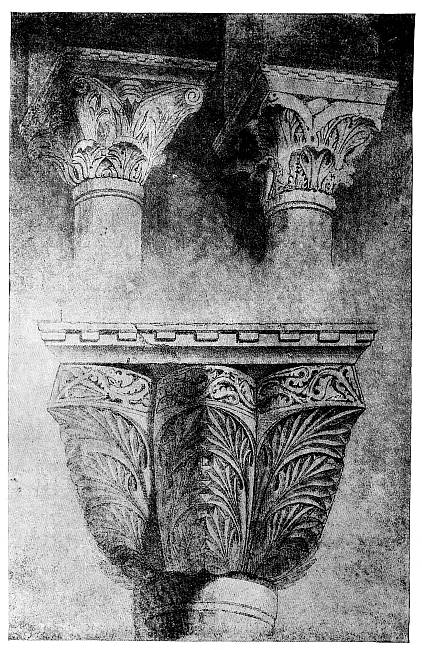
CAPITALS OF FONDACO DE’ TURCHI.
F
Facanon, Palazzo (alla Fava). A fair example of the fifteenth century Gothic, founded on Ducal Palace.
Falier, Palazzo, at the Apostoli. Above, II. 253.
Fantino, Church of St. Said to contain a John Bellini, otherwise of no importance.
Farsetti, Palazzo, on the Grand Canal, II. 124, 393.
Fava, Church of St. Of no importance.
Felice, Church of St. Said to contain a Tintoret, which, if untouched, I should conjecture, from Lazari’s statement of its subject, St. Demetrius armed, with one of the Ghisi family in prayer, must be very fine. Otherwise the church is of no importance.
Ferro, Palazzo, on the Grand Canal. Fifteenth century Gothic, very hard and bad.
Flangini, Palazzo, on the Grand Canal. Of no importance.
Fondaco de’ Turchi, I. 328; II. 120, 121, 236. The opposite plate, representing three of its capitals, has been several times referred to.
Fondaco de’ Tedeschi. A huge and ugly building near the Rialto, rendered, however, peculiarly interesting by remnants of the frescoes by Giorgione with which it was once covered. See Vol. II. 80, and III. 23.
Formosa, Church of Santa Maria, III. 113, 122,
Fosca, Church of St. Notable for its exceedingly picturesque campanile, of late Gothic, but uninjured by restorations, and peculiarly Venetian in being crowned by the cupola instead of the pyramid, which would have been employed at the same period in any other Italian city.
Foscari, Palazzo, on the Grand Canal. The noblest example in Venice of the fifteenth century Gothic, founded on the Ducal Palace, but lately restored and spoiled, all but the stone-work of the main windows. The restoration was necessary, however: for, when I was in Venice in 1845, this palace was a foul ruin; its great hall a mass of mud, used as a back receptacle of a stone-mason’s yard; and its rooms whitewashed, and scribbled over with indecent caricatures. It has since been partially strengthened and put in order; but as the Venetian municipality have now given it to the Austrians to be used as barracks, it will probably soon be reduced to its former condition. The lower palaces at the side of this building are said by some to have belonged to the younger Foscari. See “Giustiniani.”
Francesco della Vigna, Church of St. Base Renaissance, but must be visited in order to see the John Bellini in the Cappella Santa. The late sculpture, in the Cappella Giustiniani, appears from Lazari’s statement to be deserving of careful study. This church is said also to contain two pictures by Paul Veronese.
Frari, Church of the. Founded in 1250, and continued at various subsequent periods. The apse and adjoining chapels are the earliest portions, and their traceries have been above noticed (II. 234) as the origin of those of the Ducal Palace. The best view of the apse, which is a very noble example of Italian Gothic, is from the door of the Scuola di San Rocco. The doors of the church are all later than any other portion of it, very elaborate Renaissance Gothic. The interior is good Gothic, but not interesting, except in its monuments. Of these, the following are noticed in the text of this volume:
That of Duccio degli Alberti, at pages 74, 80; of the unknown Knight, opposite that of Duccio, III. 74; of Francesco Foscari, III. 84; of Giovanni Pesaro, 91; of Jacopo Pesaro, 92.
Besides these tombs, the traveller ought to notice carefully that of Pietro Bernardo, a first-rate example of Renaissance work; nothing can be more detestable or mindless in general design, or more beautiful in execution. Examine especially the griffins, fixed in admiration of bouquets, at the bottom. The fruit and flowers which arrest the attention of the griffins may well arrest the traveller’s also; nothing can be finer of their kind. The tomb of Canova, by Canova, cannot be missed; consummate in science, intolerable in affectation, ridiculous in conception, null and void to the uttermost in invention and feeling. The equestrian statue of Paolo Savelli is spirited; the monument of the Beato Pacifico, a curious example of Renaissance Gothic with wild crockets (all in terra cotta). There are several good Vivarini’s in the church, but its chief pictorial treasure is the John Bellini in the sacristy, the most finished and delicate example of the master in Venice.
G
Geremia, Church of St. Of no importance.
Gesuati, Church of The. Of no importance.
Giacomo de Lorio, Church of St., a most interesting church, of the early thirteenth century, but grievously restored. Its capitals have been already noticed as characteristic of the earliest Gothic; and it is said to contain four works of Paul Veronese, but I have not examined them. The pulpit is admired by the Italians, but is utterly worthless. The verdantique pillar, in the south transept, is a very noble example of the “Jewel Shaft.” See the note at p. 83, Vol. II.
Giacomo di Rialto, Church of St. A picturesque little church, on the Piazza di Rialto. It has been grievously restored, but the pillars and capitals of its nave are certainly of the eleventh century; those of its portico are of good central Gothic; and it will surely not be left unvisited, on this ground, if on no other, that it stands on the site, and still retains the name, of the first church ever built on that Rialto which formed the nucleus of future Venice, and became afterwards the mart of her merchants.
Giobbe, Church of St., near the Cana Reggio. Its principal entrance is a very fine example of early Renaissance sculpture. Note in it, especially, its beautiful use of the flower of the convolvulus. There are said to be still more beautiful examples of the same period, in the interior. The cloister, though much defaced, is of the Gothic period, and worth a glance.
Giorgio de’ Greci, Church of St. The Greek Church. It contains no valuable objects of art, but its service is worth attending by those who have never seen the Greek ritual.
Giorgio de’ Schiavoni, Church of St. Said to contain a very precious series of paintings by Victor Carpaccio. Otherwise of no interest.
Giorgio in Aliga (St. George in the seaweed), Church of St. Unimportant in itself, but the most beautiful view of Venice at sunset is from a point at about two thirds of the distance from the city to the island.
Giorgio Maggiore, Church of St. A building which owes its interesting effect chiefly to its isolated position, being seen over a great space of lagoon. The traveller should especially notice in its façade the manner in which the central Renaissance architects (of whose style this church is a renowned example) endeavored to fit the laws they had established to the requirements of their age. Churches were required with aisles and clerestories, that is to say, with a high central nave and lower wings; and the question was, how to face this form with pillars of one proportion. The noble Romanesque architects built story above story, as at Pisa and Lucca; but the base Palladian architects dared not do this. They must needs retain some image of the Greek temple; but the Greek temple was all of one height, a low gable roof being borne on ranges of equal pillars. So the Palladian builders raised first a Greek temple with pilasters for shafts; and, through the middle of its roof, or horizontal beam, that is to say, of the cornice which externally represented this beam, they lifted another temple on pedestals, adding these barbarous appendages to the shafts, which otherwise would not have been high enough; fragments of the divided cornice or tie-beam being left between the shafts, and the great door of the church thrust in between the pedestals. It is impossible to conceive a design more gross, more barbarous, more childish in conception, more servile in plagiarism, more insipid in result, more contemptible under every point of rational regard.
Observe, also, that when Palladio had got his pediment at the top of the church, he did not know what to do with it; he had no idea of decorating it except by a round hole in the middle. (The traveller should compare, both in construction and decoration, the Church of the Redentore with this of San Giorgio.) Now, a dark penetration is often a most precious assistance to a building dependent upon color for its effect; for a cavity is the only means in the architect’s power of obtaining certain and vigorous shadow; and for this purpose, a circular penetration, surrounded by a deep russet marble moulding, is beautifully used in the centre of the white field on the side of the portico of St. Mark’s. But Palladio had given up color, and pierced his pediment with a circular cavity, merely because he had not wit enough to fill it with sculpture. The interior of the church is like a large assembly room, and would have been undeserving of a moment’s attention, but that it contains some most precious pictures, namely:
1. Gathering the Manna. (On the left hand of the high altar.) One of Tintoret’s most remarkable landscapes. A brook flowing through a mountainous country, studded with thickets and palm trees; the congregation have been long in the Wilderness, and are employed in various manufactures much more than in gathering the manna. One group is forging, another grinding manna in a mill, another making shoes, one woman making a piece of dress, some washing; the main purpose of Tintoret being evidently to indicate the continuity of the supply of heavenly food. Another painter would have made the congregation hurrying to gather it, and wondering at it; Tintoret at once makes us remember that they have been fed with it “by the space of forty years.” It is a large picture, full of interest and power, but scattered in effect, and not striking except from its elaborate landscape.