Volume 2 — CHAPTER VIII. (continued 2)
Reading edition
§ LXVII. First Capital: i.e. of the pilaster at the Vine angle.
In front, towards the Sea. A child holding a bird before him, with its wings expanded, covering his breast.
On its eastern side. Children’s heads among leaves.
On its western side. A child carrying in one hand a comb; in the other, a pair of scissors.
It appears curious, that this, the principal pilaster of the façade, should have been decorated only by these graceful grotesques, for I can hardly suppose them anything more. There may be meaning in them, but I will not venture to conjecture any, except the very plain and practical meaning conveyed by the last figure to all Venetian children, which it would be well if they would act upon. For the rest, I have seen the comb introduced in grotesque work as early as the thirteenth century, but generally for the purpose of ridiculing too great care in dressing the hair, which assuredly is not its purpose here. The children’s heads are very sweet and full of life, but the eyes sharp and small.
§ LXVIII. Second Capital. Only three sides of the original work are left unburied by the mass of added wall. Each side has a bird, one web-footed, with a fish, one clawed, with a serpent, which opens its jaws, and darts its tongue at the bird’s breast; the third pluming itself, with a feather between the mandibles of its bill. It is by far the most beautiful of the three capitals decorated with birds.
Third Capital. Also has three sides only left. They have three heads, large, and very ill cut; one female, and crowned.
Fourth Capital. Has three children. The eastern one is defaced: the one in front holds a small bird, whose plumage is beautifully indicated, in its right hand; and with its left holds up half a walnut, showing the nut inside: the third holds a fresh fig, cut through, showing the seeds.
The hair of all the three children is differently worked: the first has luxuriant flowing hair, and a double chin; the second, light flowing hair falling in pointed locks on the forehead; the third, crisp curling hair, deep cut with drill holes.
This capital has been copied on the Renaissance side of the palace, only with such changes in the ideal of the children as the workman thought expedient and natural. It is highly interesting to compare the child of the fourteenth with the child of the fifteenth century. The early heads are full of youthful life, playful, humane, affectionate, beaming with sensation and vivacity, but with much manliness and firmness, also, not a little cunning, and some cruelty perhaps, beneath all; the features small and hard, and the eyes keen. There is the making of rough and great men in them. But the children of the fifteenth century are dull smooth-faced dunces, without a single meaning line in the fatness of their stolid cheeks; and, although, in the vulgar sense, as handsome as the other children are ugly, capable of becoming nothing but perfumed coxcombs.
Fifth Capital. Still three sides only left, bearing three half-length statues of kings; this is the first capital which bears any inscription. In front, a king with a sword in his right hand points to a handkerchief embroidered and fringed, with a head on it, carved on the cavetto of the abacus. His name is written above, “TITUS VESPASIAN IMPERATOR” (contracted .

On eastern side, “TRAJANUS IMPERATOR.” Crowned, a sword in right hand, and sceptre in left.
On western, “(OCT)AVIANUS AUGUSTUS IMPERATOR.” The “OCT” is broken away. He bears a globe in his right hand, with “MUNDUS PACIS” upon it; a sceptre in his left, which I think has terminated in a human figure. He has a flowing beard, and a singularly high crown; the face is much injured, but has once been very noble in expression.
Sixth Capital. Has large male and female heads, very coarsely cut, hard, and bad.
§ LXIX. Seventh Capital. This is the first of the series which is complete; the first open arch of the lower arcade being between it and the sixth. It begins the representation of the Virtues.
First side. Largitas, or Liberality: always distinguished from the higher Charity. A male figure, with his lap full of money, which he pours out of his hand. The coins are plain, circular, and smooth; there is no attempt to mark device upon them. The inscription above is, “LARGITAS ME ONORAT.”
In the copy of this design on the twenty-fifth capital, instead of showering out the gold from his open hand, the figure holds it in a plate or salver, introduced for the sake of disguising the direct imitation. The changes thus made in the Renaissance pillars are always injuries.
This virtue is the proper opponent of Avarice; though it does not occur in the systems of Orcagna or Giotto, being included in Charity. It was a leading virtue with Aristotle and the other ancients.
§ LXX. Second side. Constancy; not very characteristic. An armed man with a sword in his hand, inscribed, “CONSTANTIA SUM, NIL TIMENS.”
This virtue is one of the forms of fortitude, and Giotto therefore sets as the vice opponent to Fortitude, “Inconstantia,” represented as a woman in loose drapery, falling from a rolling globe. The vision seen in the interpreter’s house in the Pilgrim’s Progress, of the man with a very bold countenance, who says to him who has the writer’s ink-horn by his side, “Set down my name,” is the best personification of the Venetian “Constantia” of which I am aware in literature. It would be well for us all to consider whether we have yet given the order to the man with the ink-horn, “Set down my name.”
§ LXXI. Third side. Discord; holding up her finger, but needing the inscription above to assure us of her meaning, “DISCORDIA SUM, DISCORDANS.” In the Renaissance copy she is a meek and nun-like person with a veil.
She is the Atë of Spenser; “mother of debate,” thus described in the fourth book:
“Her face most fowle and filthy was to see, With squinted eyes contrarie wayes intended; And loathly mouth, unmeete a mouth to bee, That nought but gall and venim comprehended, And wicked wordes that God and man offended: Her lying tongue was in two parts divided, And both the parts did speake, and both contended; And as her tongue, so was her hart discided, That never thoght one thing, but doubly stil was guided.”
Note the fine old meaning of “discided,” cut in two; it is a great pity we have lost this powerful expression. We might keep “determined” for the other sense of the word.
§ LXXII. Fourth side. Patience. A female figure, very expressive and lovely, in a hood, with her right hand on her breast, the left extended, inscribed “PATIENTIA MANET MECUM.”
She is one of the principal virtues in all the Christian systems: a masculine virtue in Spenser, and beautifully placed as the Physician in the House of Holinesse. The opponent vice, Impatience, is one of the hags who attend the Captain of the Lusts of the Flesh; the other being Impotence. In like manner, in the “Pilgrim’s Progress,” the opposite of Patience is Passion; but Spenser’s thought is farther carried. His two hags, Impatience and Impotence, as attendant upon the evil spirit of Passion, embrace all the phenomena of human conduct, down even to the smallest matters, according to the adage, “More haste, worse speed.”
§ LXXIII. Fifth side. Despair. A female figure thrusting a dagger into her throat, and tearing her long hair, which flows down among the leaves of the capital below her knees. One of the finest figures of the series; inscribed “DESPERACIO MÔS (mortis?) CRUDELIS.” In the Renaissance copy she is totally devoid of expression, and appears, instead of tearing her hair, to be dividing it into long curls on each side.
This vice is the proper opposite of Hope. By Giotto she is represented as a woman hanging herself, a fiend coming for her soul. Spenser’s vision of Despair is well known, it being indeed currently reported that this part of the Faerie Queen was the first which drew to it the attention of Sir Philip Sidney.
§ LXXIV. Sixth side. Obedience: with her arms folded; meek, but rude and commonplace, looking at a little dog standing on its hind legs and begging, with a collar round its neck. Inscribed “OBEDIENTI * *;” the rest of the sentence is much defaced, but looks like I suppose the note of contraction above the final A has disappeared and that the inscription was “Obedientiam domino exhibeo.”

This virtue is, of course, a principal one in the monkish systems; represented by Giotto at Assisi as “an angel robed in black, placing the finger of his left hand on his mouth, and passing the yoke over the head of a Franciscan monk kneeling at his feet.”154
Obedience holds a less principal place in Spenser. We have seen her above associated with the other peculiar virtues of womanhood.
§ LXXV. Seventh side. Infidelity. A man in a turban, with a small image in his hand, or the image of a child. Of the inscription nothing but “INFIDELITATE * * *” and some fragmentary letters, “ILI, CERO,” remain.
By Giotto Infidelity is most nobly symbolized as a woman helmeted, the helmet having a broad rim which keeps the light from her eyes. She is covered with heavy drapery, stands infirmly as if about to fall, is bound by a cord round her neck to an image which she carries in her hand, and has flames bursting forth at her feet.
In Spenser, Infidelity is the Saracen knight Sans Foy,—
“Full large of limbe and every joint He was, and cared not for God or man a point.”
For the part which he sustains in the contest with Godly Fear, or the Red-cross knight, see Appendix 2, Vol. III.
§ LXXVI. Eighth side. Modesty; bearing a pitcher. (In the Renaissance copy, a vase like a coffee-pot.) Inscribed “MODESTIA
I do not find this virtue in any of the Italian series, except that of Venice. In Spenser she is of course one of those attendant on Womanhood, but occurs as one of the tenants of the Heart of Man, thus portrayed in the second book:
“Straunge was her tyre, and all her garment blew, Close rownd about her tuckt with many a plight: Upon her fist the bird which shonneth vew. ......... And ever and anone with rosy red The bashfull blood her snowy cheekes did dye, That her became, as polisht yvory Which cunning craftesman hand hath overlayd With fayre vermilion or pure castory.”
§ LXXVII. Eighth Capital. It has no inscriptions, and its subjects are not, by themselves, intelligible; but they appear to be typical of the degradation of human instincts.
First side. A caricature of Arion on his dolphin; he wears a cap ending in a long proboscis-like horn, and plays a violin with a curious twitch of the bow and wag of the head, very graphically expressed, but still without anything approaching to the power of Northern grotesque. His dolphin has a goodly row of teeth, and the waves beat over his back.
Second side. A human figure, with curly hair and the legs of a bear; the paws laid, with great sculptural skill, upon the foliage. It plays a violin, shaped like a guitar, with a bent double-stringed bow.
Third side. A figure with a serpent’s tail and a monstrous head, founded on a Negro type, hollow-cheeked, large-lipped, and wearing a cap made of a serpent’s skin, holding a fir-cone in its hand.
Fourth side. A monstrous figure, terminating below in a tortoise. It is devouring a gourd, which it grasps greedily with both hands; it wears a cap ending in a hoofed leg.
Fifth side. A centaur wearing a crested helmet, and holding a curved sword.
Sixth side. A knight, riding a headless horse, and wearing chain armor, with a triangular shield flung behind his back, and a two-edged sword.
Seventh side. A figure like that on the fifth, wearing a round helmet, and with the legs and tail of a horse. He bears a long mace with a top like a fir-cone.
Eighth side. A figure with curly hair, and an acorn in its hand, ending below in a fish.
§ LXXVIII. Ninth Capital. First side. Faith. She has her left hand on her breast, and the cross on her right. Inscribed “FIDES OPTIMA IN DEO.” The Faith of Giotto holds the cross in her right hand; in her left, a scroll with the Apostles’ Creed. She treads upon cabalistic books, and has a key suspended to her waist. Spenser’s Faith (Fidelia) is still more spiritual and noble:
“She was araied all in lilly white, And in her right hand bore a cup of gold, With wine and water fild up to the hight, In which a serpent did himselfe enfold, That horrour made to all that did behold; But she no whitt did chaunge her constant mood: And in her other hand she fast did hold A booke, that was both signd and seald with blood; Wherein darke things were writt, hard to be understood.”
§ LXXIX. Second side. Fortitude. A long-bearded man [Samson?] tearing open a lion’s jaw. The inscription is illegible, and the somewhat vulgar personification appears to belong rather to Courage than Fortitude. On the Renaissance copy it is inscribed “FORTITUDO SUM VIRILIS.” The Latin word has, perhaps, been received by the sculptor as merely signifying “Strength,” the rest of the perfect idea of this virtue having been given in “Constantia” previously. But both these Venetian symbols together do not at all approach the idea of Fortitude as given generally by Giotto and the Pisan sculptors; clothed with a lion’s skin, knotted about her neck, and falling to her feet in deep folds; drawing back her right hand, with the sword pointed towards her enemy; and slightly retired behind her immovable shield, which, with Giotto, is square, and rested on the ground like a tower, covering her up to above her shoulders; bearing on it a lion, and with broken heads of javelins deeply infixed.
Among the Greeks, this is, of course, one of the principal virtues; apt, however, in their ordinary conception of it to degenerate into mere manliness or courage.
§ LXXX. Third side. Temperance; bearing a pitcher of water and a cup. Inscription, illegible here, and on the Renaissance copy nearly so, “TEMPERANTIA SUM” (INOM’ Ls)? only left. In this somewhat vulgar and most frequent conception of this virtue (afterwards continually repeated, as by Sir Joshua in his window at New College) temperance is confused with mere abstinence, the opposite of Gula, or gluttony; whereas the Greek Temperance, a truly cardinal virtue, is the moderator of all the passions, and so represented by Giotto, who has placed a bridle upon her lips, and a sword in her hand, the hilt of which she is binding to the scabbard. In his system, she is opposed among the vices, not by Gula or Gluttony, but by Ira, Anger. So also the Temperance of Spenser, or Sir Guyon, but with mingling of much sternness:
“A goodly knight, all armd in harnesse meete, That from his head no place appeared to his feete, His carriage was full comely and upright; His countenance demure and temperate; But yett so sterne and terrible in sight, That cheard his friendes, and did his foes amate.”
The Temperance of the Greeks, σωφροσύνη, involves the idea of Prudence, and is a most noble virtue, yet properly marked by Plato as inferior to sacred enthusiasm, though necessary for its government. He opposes it, under the name “Mortal Temperance” or “the Temperance which is of men,” to divine madness, μανία, or inspiration; but he most justly and nobly expresses the general idea of it under the term ὓβρις, which, in the “Phædrus,” is divided into various intemperances with respect to various objects, and set forth under the image of a black, vicious, diseased and furious horse, yoked by the side of Prudence or Wisdom (set forth under the figure of a white horse with a crested and noble head, like that which we have among the Elgin Marbles) to the chariot of the Soul. The system of Aristotle, as above stated, is throughout a mere complicated blunder, supported by sophistry, the laboriously developed mistake of Temperance for the essence of the virtues which it guides. Temperance in the mediæval systems is generally opposed by Anger, or by Folly, or Gluttony: but her proper opposite is Spenser’s Acrasia, the principal enemy of Sir Guyon, at whose gates we find the subordinate vice “Excesse,” as the introduction to Intemperance; a graceful and feminine image, necessary to illustrate the more dangerous forms of subtle intemperance, as opposed to the brutal “Gluttony” in the first book. She presses grapes into a cup, because of the words of St. Paul, “Be not drunk with wine, wherein is excess;” but always delicately,
“Into her cup she scruzd with daintie breach Of her fine fingers, without fowle empeach, That so faire winepresse made the wine more sweet.”
The reader will, I trust, pardon these frequent extracts from Spenser, for it is nearly as necessary to point out the profound divinity and philosophy of our great English poet, as the beauty of the Ducal Palace.
§ LXXXI. Fourth side. Humility; with a veil upon her head, carrying a lamp in her lap. Inscribed in the copy, “HUMILITAS HABITAT IN ME.”
This virtue is of course a peculiarly Christian one, hardly recognized in the Pagan systems, though carefully impressed upon the Greeks in early life in a manner which at this day it would be well if we were to imitate, and, together with an almost feminine modesty, giving an exquisite grace to the conduct and bearing of the well-educated Greek youth. It is, of course, one of the leading virtues in all the monkish systems, but I have not any notes of the manner of its representation.
§ LXXXII. Fifth side. Charity. A woman with her lap full of loaves (?), giving one to a child, who stretches his arm out for it across a broad gap in the leafage of the capital.
Again very far inferior to the Giottesque rendering of this virtue. In the Arena Chapel she is distinguished from all the other virtues by having a circular glory round her head, and a cross of fire; she is crowned with flowers, presents with her right hand a vase of corn and fruit, and with her left receives treasure from Christ, who appears above her, to provide her with the means of continual offices of beneficence, while she tramples under foot the treasures of the earth.
The peculiar beauty of most of the Italian conceptions of Charity, is in the subjection of mere munificence to the glowing of her love, always represented by flames; here in the form of a cross round her head; in Oreagna’s shrine at Florence, issuing from a censer in her hand; and, with Dante, inflaming her whole form, so that, in a furnace of clear fire, she could not have been discerned.
Spenser represents her as a mother surrounded by happy children, an idea afterwards grievously hackneyed and vulgarized by English painters and sculptors.
§ LXXXIII. Sixth side. Justice. Crowned, and with sword. Inscribed in the copy, “REX SUM JUSTICIE.”
This idea was afterwards much amplified and adorned in the only good capital of the Renaissance series, under the Judgment angle. Giotto has also given his whole strength to the painting of this virtue, representing her as enthroned under a noble Gothic canopy, holding scales, not by the beam, but one in each hand; a beautiful idea, showing that the equality of the scales of Justice is not owing to natural laws, but to her own immediate weighing the opposed causes in her own hands. In one scale is an executioner beheading a criminal; in the other an angel crowning a man who seems (in Selvatico’s plate) to have been working at a desk or table.
Beneath her feet is a small predella, representing various persons riding securely in the woods, and others dancing to the sound of music.
Spenser’s Justice, Sir Artegall, is the hero of an entire book, and the betrothed knight of Britomart, or chastity.
§ LXXXIV. Seventh side. Prudence. A man with a book and a pair of compasses, wearing the noble cap, hanging down towards the shoulder, and bound in a fillet round the brow, which occurs so frequently during the fourteenth century in Italy in the portraits of men occupied in any civil capacity.
This virtue is, as we have seen, conceived under very different degrees of dignity, from mere worldly prudence up to heavenly wisdom, being opposed sometimes by Stultitia, sometimes by Ignorantia. I do not find, in any of the representations of her, that her truly distinctive character, namely, forethought, is enough insisted upon: Giotto expresses her vigilance and just measurement or estimate of all things by painting her as Janus-headed, and gazing into a convex mirror, with compasses in her right hand; the convex mirror showing her power of looking at many things in small compass. But forethought or anticipation, by which, independently of greater or less natural capacities, one man becomes more prudent than another, is never enough considered or symbolized.
The idea of this virtue oscillates, in the Greek systems, between Temperance and Heavenly Wisdom.
§ LXXXV. Eighth side. Hope. A figure full of devotional expression, holding up its hands as in prayer, and looking to a hand which is extended towards it out of sunbeams. In the Renaissance copy this hand does not appear.
Of all the virtues, this is the most distinctively Christian (it could not, of course, enter definitely into any Pagan scheme); and above all others, it seems to me the testing virtue,—that by the possession of which we may most certainly determine whether we are Christians or not; for many men have charity, that is to say, general kindness of heart, or even a kind of faith, who have not any habitual hope of, or longing for, heaven. The Hope of Giotto is represented as winged, rising in the air, while an angel holds a crown before her. I do not know if Spenser was the first to introduce our marine virtue, leaning on an anchor, a symbol as inaccurate as it is vulgar: for, in the first place, anchors are not for men, but for ships; and in the second, anchorage is the characteristic not of Hope, but of Faith. Faith is dependent, but Hope is aspirant. Spenser, however, introduces Hope twice,—the first time as the Virtue with the anchor; but afterwards fallacious Hope, far more beautifully, in the Masque of Cupid:
“She always smyld, and in her hand did hold An holy-water sprinckle, dipt in deowe.”
§ LXXXVI. Tenth Capital. First side. Luxury (the opposite of chastity, as above explained). A woman with a jewelled chain across her forehead, smiling as she looks into a mirror, exposing her breast by drawing down her dress with one hand. Inscribed “LUXURIA SUM IMENSA.”
These subordinate forms of vice are not met with so frequently in art as those of the opposite virtues, but in Spenser we find them all. His Luxury rides upon a goat:
“In a greene gowne he clothed was full faire, Which underneath did hide his filthinesse, And in his hand a burning hart he bare.”
But, in fact, the proper and comprehensive expression of this vice is the Cupid of the ancients; and there is not any minor circumstance more indicative of the intense difference between the mediæval and the Renaissance spirit, than the mode in which this god is represented.
I have above said, that all great European art is rooted in the thirteenth century; and it seems to me that there is a kind of central year about which we may consider the energy of the middle ages to be gathered; a kind of focus of time which, by what is to my mind a most touching and impressive Divine appointment, has been marked for us by the greatest writer of the middle ages, in the first words he utters; namely, the year 1300, the “mezzo del cammin” of the life of Dante. Now, therefore, to Giotto, the contemporary of Dante, and who drew Dante’s still existing portrait in this very year, 1300, we may always look for the central mediæval idea in any subject: and observe how he represents Cupid; as one of three, a terrible trinity, his companions being Satan and Death; and he himself “a lean scarecrow, with bow, quiver, and fillet, and feet ending in claws,”155 thrust down into Hell by Penance, from the presence of Purity and Fortitude. Spenser, who has been so often noticed as furnishing the exactly intermediate type of conception between the mediæval and the Renaissance, indeed represents Cupid under the form of a beautiful winged god, and riding on a lion, but still no plaything of the Graces, but full of terror:
“With that the darts which his right hand did straine Full dreadfully he shooke, that all did quake, And clapt on hye his coloured winges twaine, That all his many it afraide did make.”
His many, that is to say, his company; and observe what a company it is. Before him go Fancy, Desire, Doubt, Danger, Fear, Fallacious Hope, Dissemblance, Suspicion, Grief, Fury, Displeasure, Despite, and Cruelty. After him, Reproach, Repentance, Shame,
“Unquiet Care, and fond Unthriftyhead, Lewd Losse of Time, and Sorrow seeming dead, Inconstant Chaunge, and false Disloyalty, Consuming Riotise, and guilty Dread Of heavenly vengeaunce; faint Infirmity, Vile Poverty, and lastly Death with infamy.”
Compare these two pictures of Cupid with the Love-god of the Renaissance, as he is represented to this day, confused with angels, in every faded form of ornament and allegory, in our furniture, our literature, and our minds.
§ LXXXVII. Second side. Gluttony. A woman in a turban, with a jewelled cup in her right hand. In her left, the clawed limb of a bird, which she is gnawing. Inscribed “GULA SINE ORDINE SUM.”
Spenser’s Gluttony is more than usually fine:
“His belly was upblowne with luxury, And eke with fatnesse swollen were his eyne, And like a crane his necke was long and fyne, Wherewith he swallowed up excessive feast, For want whereof poore people oft did pyne.”
He rides upon a swine, and is clad in vine-leaves, with a garland of ivy. Compare the account of Excesse, above, as opposed to Temperance.
§ LXXXVIII. Third side. Pride. A knight, with a heavy and stupid face, holding a sword with three edges: his armor covered with ornaments in the form of roses, and with two ears attached to his helmet. The inscription indecipherable, all but “SUPERBIA.”
Spenser has analyzed this vice with great care. He first represents it as the Pride of life; that is to say, the pride which runs in a deep under current through all the thoughts and acts of men. As such, it is a feminine vice, directly opposed to Holiness, and mistress of a castle called the House of Pryde, and her chariot is driven by Satan, with a team of beasts, ridden by the mortal sins. In the throne chamber of her palace she is thus described:
“So proud she shyned in her princely state, Looking to Heaven, for Earth she did disdayne; And sitting high, for lowly she did hate: Lo, underneath her scornefull feete was layne A dreadfull dragon with an hideous trayne; And in her hand she held a mirrhour bright, Wherein her face she often vewed fayne”
The giant Orgoglio is a baser species of pride, born of the Earth and Eolus; that is to say, of sensual and vain conceits. His foster-father and the keeper of his castle is Ignorance. (Book I. canto VIII.)
Finally, Disdain is introduced, in other places, as the form of pride which vents itself in insult to others.
§ LXXXIX. Fourth side. Anger. A woman tearing her dress open at her breast. Inscription here undecipherable; but in the Renaissance copy it is “IRA CRUDELIS EST IN ME.”
Giotto represents this vice under the same symbol; but it is the weakest of all the figures in the Arena Chapel. The “Wrath” of Spenser rides upon a lion, brandishing a fire-brand, his garments stained with blood. Rage, or Furor, occurs subordinately in other places. It appears to me very strange that neither Giotto nor Spenser should have given any representation of the restrained Anger, which is infinitely the most terrible; both of them make him violent.
§ XC. Fifth side. Avarice. An old woman with a veil over her forehead, and a bag of money in each hand. A figure very marvellous for power of expression. The throat is all made up of sinews with skinny channels deep between them, strained as by anxiety, and wasted by famine; the features hunger-bitten, the eyes hollow, the look glaring and intense, yet without the slightest: caricature. Inscribed in the Renaissance copy, “avaritia impletor.”
Spenser’s Avarice (the vice) is much feebler than this; but the god Mammon and his kingdom have been described by him with his usual power. Note the position of the house of Richesse:
“Betwixt them both was but a little stride, That did the House of Richesse from Hell-mouth divide.”
It is curious that most moralists confuse avarice with covetousness, although they are vices totally different in their operation on the human heart, and on the frame of society. The love of money, the sin of Judas and Ananias, is indeed the root of all evil in the hardening of the heart; but “covetousness, which is idolatry,” the sin of Ahab, that is, the inordinate desire of some seen or recognized good,—thus destroying peace of mind,—is probably productive of much more misery in heart, and error in conduct, than avarice itself, only covetousness is not so inconsistent with Christianity: for covetousness may partly proceed from vividness of the affections and hopes, as in David, and be consistent with, much charity; not so avarice.
§ XCI. Sixth side. Idleness. Accidia. A figure much broken away, having had its arms round two branches of trees.
I do not know why Idleness should be represented as among trees, unless, in the Italy of the fourteenth century, forest country was considered as desert, and therefore the domain of Idleness. Spenser fastens this vice especially upon the clergy,—
“Upon a slouthfull asse he chose to ryde, Arayd in habit blacke, and amis thin, Like to an holy monck, the service to begin. And in his hand his portesse still he bare, That much was worne, but therein little redd.”
And he properly makes him the leader of the train of the vices:
“May seem the wayne was very evil ledd, When such an one had guiding of the way”
Observe that subtle touch of truth in the “wearing” of the portesse, indicating the abuse of books by idle readers, so thoroughly characteristic of unwilling studentship from the schoolboy upwards.
§ XCII. Seventh side. Vanity. She is smiling complacently as she looks into a mirror in her lap. Her robe is embroidered with roses, and roses form her crown. Undecipherable.
There is some confusion in the expression of this vice, between pride in the personal appearance and lightness of purpose. The word Vanitas generally, I think, bears, in the mediæval period, the sense given it in Scripture. “Let not him that is deceived trust in Vanity, for Vanity shall be his recompense.” “Vanity of Vanities.” “The Lord knoweth the thoughts of the wise, that they are vain.” It is difficult to find this sin,—which, after Pride, is the most universal, perhaps the most fatal, of all, fretting the whole depth of our humanity into storm “to waft a feather or to drown a fly,”—definitely expressed in art. Even Spenser, I think, has only partially expressed it under the figure of Phædria, more properly Idle Mirth, in the second book. The idea is, however, entirely worked out in the Vanity Fair of the “Pilgrim’s Progress.”
§ XCIII. Eighth side. Envy. One of the noblest pieces of expression in the series. She is pointing malignantly with her finger; a serpent is wreathed about her head like a cap, another forms the girdle of her waist, and a dragon rests in her lap.
Giotto has, however, represented her, with still greater subtlety, as having her fingers terminating in claws, and raising her right hand with an expression partly of impotent regret, partly of involuntary grasping; a serpent, issuing from her mouth, is about to bite her between the eyes; she has long membranous ears, horns on her head, and flames consuming her body. The Envy of Spenser is only inferior to that of Giotto, because the idea of folly and quickness of hearing is not suggested by the size of the ear: in other respects it is even finer, joining the idea of fury, in the wolf on which he rides, with that of corruption on his lips, and of discoloration or distortion in the whole mind:
“Malicious Envy rode Upon a ravenous wolfe, and still did chaw Between his cankred teeth a venemous tode, That all the poison ran about his jaw. All in a kirtle of discolourd say He clothed was, ypaynted full of eies, And in his bosome secretly there lay An hatefull snake, the which his taile uptyes In many folds, and mortall sting implyes.”
He has developed the idea in more detail, and still more loathsomely, in the twelfth canto of the fifth book.
§ XCIV. Eleventh Capital. Its decoration is composed of eight birds, arranged as shown in Plate V. of the “Seven Lamps,” which, however, was sketched from the Renaissance copy. These birds are all varied in form and action, but not so as to require special description.
§ XCV. Twelfth Capital. This has been very interesting, but is grievously defaced, four of its figures being entirely broken away, and the character of two others quite undecipherable. It is fortunate that it has been copied in the thirty-third capital of the Renaissance series, from which we are able to identify the lost figures.
First side. Misery. A man with a wan face, seemingly pleading with a child who has its hands crossed on its breast. There is a buckle at his own breast in the shape of a cloven heart. Inscribed “MISERIA.”
The intention of this figure is not altogether apparent, as it is by no means treated as a vice; the distress seeming real, and like that of a parent in poverty mourning over his child. Yet it seems placed here as in direct opposition to the virtue of Cheerfulness, which follows next in order; rather, however, I believe, with the intention of illustrating human life, than the character of the vice which, as we have seen, Dante placed in the circle of hell. The word in that case would, I think, have been “Tristitia,” the “unholy Griefe” of Spenser—
“All in sable sorrowfully clad, Downe hanging his dull head with heavy chere: ........ A pair of pincers in his hand he had, With which he pinched people to the heart.”
He has farther amplified the idea under another figure in the fifth canto of the fourth book:
“His name was Care; a blacksmith by his trade, That neither day nor night from working spared; But to small purpose yron wedges made: Those be unquiet thoughts that carefull minds invade. Rude was his garment, and to rags all rent, Ne better had he, ne for better cared; With blistered hands among the cinders brent.”
It is to be noticed, however, that in the Renaissance copy this figure is stated to be, not Miseria, but “Misericordia.” The contraction is a very moderate one, Misericordia being in old MS. written always as “Mia.” If this reading be right, the figure is placed here rather as the companion, than the opposite, of Cheerfulness; unless, indeed, it is intended to unite the idea of Mercy and Compassion with that of Sacred Sorrow.
§ XCVI. Second side. Cheerfulness. A woman with long flowing hair, crowned with roses, playing on a tambourine, and with open lips, as singing. Inscribed “alacritas.”
We have already met with this virtue among those especially set by Spenser to attend on Womanhood. It is inscribed in the Renaissance copy, “ALACHRITAS CHANIT MECUM.” Note the gutturals of the rich and fully developed Venetian dialect now affecting the Latin, which is free from them in the earlier capitals.
§ XCVII. Third side. Destroyed; but, from the copy, we find it has been Stultitia, Folly; and it is there represented simply as a man riding, a sculpture worth the consideration of the English residents who bring their horses to Venice. Giotto gives Stultitia a feather, cap, and club. In early manuscripts he is always eating with one hand, and striking with the other; in later ones he has a cap and bells, or cap crested with a cock’s head, whence the word “coxcomb.”
§ XCVIII. Fourth side. Destroyed, all but a book, which identifies it with the “Celestial Chastity” of the Renaissance copy; there represented as a woman pointing to a book (connecting the convent life with the pursuit of literature?).
Spenser’s Chastity, Britomart, is the most exquisitely wrought of all his characters; but, as before noticed, she is not the Chastity of the convent, but of wedded life.
§ XCIX. Fifth side. Only a scroll is left; but, from the copy, we find it has been Honesty or Truth. Inscribed “HONESTATEM DILIGO.” It is very curious, that among all the Christian systems of the virtues which we have examined, we should find this one in Venice only.
The Truth of Spenser, Una, is, after Chastity, the most exquisite character in the “Faerie Queen.”
§ C. Sixth side. Falsehood. An old woman leaning on a crutch; and inscribed in the copy, “FALSITAS IN ME SEMPER EST.” The Fidessa of Spenser, the great enemy of Una, or Truth, is far more subtly conceived, probably not without special reference to the Papal deceits. In her true form she is a loathsome hag, but in her outward aspect,
“A goodly lady, clad in scarlot red, Purfled with gold and pearle;... Her wanton palfrey all was overspred With tinsell trappings, woven like a wave, Whose bridle rung with golden bels and bosses brave.”
Dante’s Fraud, Geryon, is the finest personification of all, but the description (Inferno, canto XVII.) is too long to be quoted.
§ CI. Seventh side. Injustice. An armed figure holding a halbert; so also in the copy. The figure used by Giotto with the particular intention of representing unjust government, is represented at the gate of an embattled castle in a forest, between rocks, while various deeds of violence are committed at his feet. Spenser’s “Adicia” is a furious hag, at last transformed into a tiger.
Eighth side. A man with a dagger looking sorrowfully at a child, who turns its back to him. I cannot understand this figure. It is inscribed in the copy, “ASTINECIA (Abstinentia?) OPITIMA.”
§ CII. Thirteenth Capital. It has lions’ heads all round, coarsely cut.
Fourteenth Capital. It has various animals, each sitting on its haunches. Three dogs, one a greyhound, one long-haired, one short-haired with bells about its neck; two monkeys, one with fan-shaped hair projecting on each side of its face; a noble boar, with its tusks, hoofs, and bristles sharply cut; and a lion and lioness.
§ CIII. Fifteenth Capital. The pillar to which it belongs is thicker than the rest, as well as the one over it in the upper arcade.
The sculpture of this capital is also much coarser, and seems to me later than that of the rest; and it has no inscription, which is embarrassing, as its subjects have had much meaning; but I believe Selvatico is right in supposing it to have been intended for a general illustration of Idleness.
First side. A woman with a distaff; her girdle richly decorated, and fastened by a buckle.
Second side. A youth in a long mantle, with a rose in his hand.
Third side. A woman in a turban stroking a puppy which she holds by the haunches.
Fourth side. A man with a parrot.
Fifth side. A woman in very rich costume, with braided hair, and dress thrown into minute folds, holding a rosary(?) in her left hand, her right on her breast.
Sixth side. A man with a very thoughtful face, laying his hand upon the leaves of the capital.
Seventh side. A crowned lady, with a rose in her hand.
Eighth side. A boy with a ball in his left hand, and his right laid on his breast.
§ CIV. Sixteenth Capital. It is decorated with eight large heads, partly intended to be grotesque,156 and very coarse and bad, except only that in the sixth side, which is totally different from all the rest, and looks like a portrait. It is thin, thoughtful, and dignified; thoroughly fine in every way. It wears a cap surmounted by two winged lions; and, therefore, I think Selvatico must have inaccurately written the list given in the note, for this head is certainly meant to express the superiority of the Venetian character over that of other nations. Nothing is more remarkable in all early sculpture, than its appreciation of the signs of dignity of character in the features, and the way in which it can exalt the principal figure in any subject by a few touches.
§ CV. Seventeenth Capital. This has been so destroyed by the sea wind, which sweeps at this point of the arcade round the angle of the palace, that its inscriptions are no longer legible, and great part of its figures are gone. Selvatico states them as follows: Solomon, the wise; Priscian, the grammarian; Aristotle, the logician; Tully, the orator; Pythagoras, the philosopher; Archimedes, the mechanic; Orpheus, the musician; Ptolemy, the astronomer. The fragments actually remaining are the following:
First side. A figure with two books, in a robe richly decorated with circles of roses. Inscribed “SALOMON (SAP)IENS.”
Second side. A man with one book, poring over it: he has had a long stick or reed in his hand. Of inscription only the letters “GRAMMATIC” remain.
Third side. “ARISTOTLE:” so inscribed. He has a peaked double beard and a flat cap, from under which his long hair falls down his back.
Fourth side. Destroyed.
Fifth side. Destroyed, all but a board with three (counters?) on it.
Sixth side. A figure with compasses. Inscribed “GEOMET * *”
Seventh side. Nothing is left but a guitar with its handle wrought into a lion’s head.
Eighth side. Destroyed.
§ CVI. We have now arrived at the Eighteenth Capital, the most interesting and beautiful of the palace. It represents the planets, and the sun and moon, in those divisions of the zodiac known to astrologers as their “houses;” and perhaps indicates, by the position in which they are placed, the period of the year at which this great corner-stone was laid. The inscriptions above have been in quaint Latin rhyme, but are now decipherable only in fragments, and that with the more difficulty because the rusty iron bar that binds the abacus has broken away, in its expansion, nearly all the upper portions of the stone, and with them the signs of contraction, which are of great importance. I shall give the fragments of them that I could decipher; first as the letters actually stand (putting those of which I am doubtful in brackets, with a note of interrogation), and then as I would read them.
§ CVII. It should be premised that, in modern astrology, the houses of the planets are thus arranged:
The house of the Sun, is Leo.
" Moon, " Cancer.
" of Mars, " Aries and Scorpio.
" Venus, " Taurus and Libra.
" Mercury, " Gemini and Virgo.
" Jupiter, " Sagittarius and Pisces.
" Saturn, " Capricorn.
" Herschel, " Aquarius.
The Herschel planet being of course unknown to the old astrologers, we have only the other six planetary powers, together with the sun; and Aquarius is assigned to Saturn as his house. I could not find Capricorn at all; but this sign may have been broken away, as the whole capital is grievously defaced. The eighth side of the capital, which the Herschel planet would now have occupied, bears a sculpture of the Creation of Man: it is the most conspicuous side, the one set diagonally across the angle; or the eighth in our usual mode of reading the capitals, from which I shall not depart.
§ CVIII. The first side, then, or that towards the Sea, has Aquarius, as the house of Saturn, represented as a seated figure beautifully draped, pouring a stream of water out of an amphora over the leaves of the capital. His inscription is:
“ET SATURNE DOMUS (ECLOCERUNT?) 1s 7BRE.”
§ CIX. Second side. Jupiter, in his houses Sagittarius and Pisces, represented throned, with an upper dress disposed in radiating folds about his neck, and hanging down upon his breast, ornamented by small pendent trefoiled studs or bosses. He wears the drooping bonnet and long gloves; but the folds about the neck, shot forth to express the rays of the star, are the most remarkable characteristic of the figure. He raises his sceptre in his left hand over Sagittarius, represented as the centaur Chiron; and holds two thunnies in his right. Something rough, like a third fish, has been broken away below them; the more easily because this part of the group is entirely undercut, and the two fish glitter in the light, relieved on the deep gloom below the leaves. The inscription is:
“INDE JOVI’157 DONA PISES SIMUL ATQs CIRONA.”
Or,
“Inde Jovis dona Pisces simul atque Chirona.”
Domus is, I suppose, to be understood before Jovis: “Then the house of Jupiter gives (or governs?) the fishes and Chiron.”
§ CX. Third side. Mars, in his houses Aries and Scorpio. Represented as a very ugly knight in chain mail, seated sideways on the ram, whose horns are broken away, and having a large scorpion in his left hand, whose tail is broken also, to the infinite injury of the group, for it seems to have curled across to the angle leaf, and formed a bright line of light, like the fish in the hand of Jupiter. The knight carries a shield, on which fire and water are sculptured, and bears a banner upon his lance, with the word “DEFEROSUM,” which puzzled me for some time. It should be read, I believe, “De ferro sum;” which would be good Venetian Latin for “I am of iron.”
§ CXI. Fourth side. The Sun, in his house Leo. Represented under the figure of Apollo, sitting on the Lion, with rays shooting from his head, and the world in his hand. The inscription:
“TU ES DOMU’ SOLIS (QUO *?) SIGNE LEONI.”
I believe the first phrase is, “Tunc est Domus solis;” but there is a letter gone after the “quo,” and I have no idea what case of signum “signe” stands for.
§ CXII. Fifth side. Venus, in her houses Taurus and Libra. The most beautiful figure of the series. She sits upon the bull, who is deep in the dewlap, and better cut than most of the animals, holding a mirror in her right hand, and the scales in her left. Her breast is very nobly and tenderly indicated under the folds of her drapery, which is exquisitely studied in its fall. What is left of the inscription, runs:
“LIBRA CUM TAURO DOMUS * * * PURIOR AUR *.”
§ CXIII. Sixth side. Mercury, represented as wearing a pendent cap, and holding a book: he is supported by three children in reclining attitudes, representing his houses Gemini and Virgo. But I cannot understand the inscription, though more than usually legible.
“OCCUPAT ERIGONE STIBONS GEMINUQ’ LACONE.”
§ CXIV. Seventh side. The Moon, in her house Cancer. This sculpture, which is turned towards the Piazzetta, is the most picturesque of the series. The moon is represented as a woman in a boat, upon the sea, who raises the crescent in her right hand, and with her left draws a crab out of the waves, up the boat’s side. The moon was, I believe, represented in Egyptian sculptures as in a boat; but I rather think the Venetian was not aware of this, and that he meant to express the peculiar sweetness of the moonlight at Venice, as seen across the lagoons. Whether this was intended by putting the planet in the boat, may be questionable, but assuredly the idea was meant to be conveyed by the dress of the figure. For all the draperies of the other figures on this capital, as well as on the rest of the façade, are disposed in severe but full folds, showing little of the forms beneath them; but the moon’s drapery ripples down to her feet, so as exactly to suggest the trembling of the moonlight on the waves. This beautiful idea is highly characteristic of the thoughtfulness of the early sculptors: five hundred men may be now found who could have cut the drapery, as such, far better, for one who would have disposed its folds with this intention. The inscription is:
“LUNE CANCER DOMU T. PBET IORBE SIGNORU.”
§ CXV. Eighth side. God creating Man. Represented as a throned figure, with a glory round the head, laying his left hand on the head of a naked youth, and sustaining him with his right hand. The inscription puzzled me for a long time; but except the lost r and m of “formavit,” and a letter quite undefaced, but to me unintelligible, before the word Eva, in the shape of a figure of 7, I have safely ascertained the rest.
“DELIMO DSADA DECO STAFO * * AVIT7EVA.”
Or
“De limo Dominus Adam, de costa fo(rm) avit Evam;” From the dust the Lord made Adam, and from the rib Eve.
I imagine the whole of this capital, therefore—the principal one of the old palace,—to have been intended to signify, first, the formation of the planets for the service of man upon the earth; secondly, the entire subjection of the fates and fortune of man to the will of God, as determined from the time when the earth and stars were made, and, in fact, written in the volume of the stars themselves.
Thus interpreted, the doctrines of judicial astrology were not only consistent with, but an aid to, the most spiritual and humble Christianity.
In the workmanship and grouping of its foliage, this capital is, on the whole, the finest I know in Europe. The sculptor has put his whole strength into it. I trust that it will appear among the other Venetian casts lately taken for the Crystal Palace; but if not, I have myself cast all its figures, and two of its leaves, and I intend to give drawings of them on a large scale in my folio work.
§ CXVI. Nineteenth Capital. This is, of course, the second counting from the Sea, on the Piazzetta side of the palace, calling that of the Fig-tree angle the first.
It is the most important capital, as a piece of evidence in point of dates, in the whole palace. Great pains have been taken with it, and in some portion of the accompanying furniture or ornaments of each of its figures a small piece of colored marble has been inlaid, with peculiar significance: for the capital represents the arts of sculpture and architecture; and the inlaying of the colored stones (which are far too small to be effective at a distance, and are found in this one capital only of the whole series) is merely an expression of the architect’s feeling of the essential importance of this art of inlaying, and of the value of color generally in his own art.
§ CXVII. First side. “ST. SIMPLICIUS”: so inscribed. A figure working with a pointed chisel on a small oblong block of green serpentine, about four inches long by one wide, inlaid in the capital. The chisel is, of course, in the left hand, but the right is held up open, with the palm outwards.
Second side. A crowned figure, carving the image of a child on a small statue, with a ground of red marble. The sculptured figure is highly finished, and is in type of head much like the Ham or Japheth at the Vine angle. Inscription effaced.
Third side. An old man, uncrowned, but with curling hair, at work on a small column, with its capital complete, and a little shaft of dark red marble, spotted with paler red. The capital is precisely of the form of that found in the palace of the Tiepolos and the other thirteenth century work of Venice. This one figure would be quite enough, without any other evidence whatever, to determine the date of this flank of the Ducal Palace as not later, at all events, than the first half of the fourteenth century. Its inscription is broken away, all but “DISIPULO.”
Fourth side. A crowned figure; but the object on which it has been working is broken away, and all the inscription except “ST. E(N?)AS.”
Fifth side. A man with a turban, and a sharp chisel, at work on a kind of panel or niche, the back of which is of red marble.
Sixth side. A crowned figure, with hammer and chisel, employed on a little range of windows of the fifth order, having roses set, instead of orbicular ornaments, between the spandrils, with a rich cornice, and a band of marble inserted above. This sculpture assures us of the date of the fifth order window, which it shows to have been universal in the early fourteenth century.
There are also five arches in the block on which the sculptor is working, marking the frequency of the number five in the window groups of the time.
Seventh side. A figure at work on a pilaster, with Lombardic thirteenth century capital (for account of the series of forms in Venetian capitals, see the final Appendix of the next volume), the shaft of dark red spotted marble.
Eighth side. A figure with a rich open crown, working on a delicate recumbent statue, the head of which is laid on a pillow covered with a rich chequer pattern; the whole supported on a block of dark red marble. Inscription broken away, all but “ST. SYM. (Symmachus?) TV * * ANVS.” There appear, therefore, altogether to have been five saints, two of them popes, if Simplicius is the pope of that name (three in front, two on the fourth and sixth sides), alternating with the three uncrowned workmen in the manual labor of sculpture. I did not, therefore, insult our present architects in saying above that they “ought to work in the mason’s yard with their men.” It would be difficult to find a more interesting expression of the devotional spirit in which all great work was undertaken at this time.
§ CXVIII. Twentieth Capital. It is adorned with heads of animals, and is the finest of the whole series in the broad massiveness of its effect; so simply characteristic, indeed, of the grandeur of style in the entire building, that I chose it for the first Plate in my folio work. In spite of the sternness of its plan, however, it is wrought with great care in surface detail; and the ornamental value of the minute chasing obtained by the delicate plumage of the birds, and the clustered bees on the honeycomb in the bear’s mouth, opposed to the strong simplicity of its general form, cannot be too much admired. There are also more grace, life, and variety in the sprays of foliage on each side of it, and under the heads, than in any other capital of the series, though the earliness of the workmanship is marked by considerable hardness and coldness in the larger heads. A Northern Gothic workman, better acquainted with bears and wolves than it was possible to become in St. Mark’s Place, would have put far more life into these heads, but he could not have composed them more skilfully.
§ CXIX. First side. A lion with a stag’s haunch in his mouth. Those readers who have the folio plate, should observe the peculiar way in which the ear is cut into the shape of a ring, jagged or furrowed on the edge; an archaic mode of treatment peculiar, in the Ducal Palace, to the lions’ heads of the fourteenth century. The moment we reach the Renaissance work, the lions’ ears are smooth. Inscribed simply, “LEO.”
Second side. A wolf with a dead bird in his mouth, its body wonderfully true in expression of the passiveness of death. The feathers are each wrought with a central quill and radiating filaments. Inscribed “LUPUS.”
Third side. A fox, not at all like one, with a dead cock in his mouth, its comb and pendent neck admirably designed so as to fall across the great angle leaf of the capital, its tail hanging down on the other side, its long straight feathers exquisitely cut. Inscribed “(VULP?)is.”
Fourth side. Entirely broken away.
Fifth side. “APER.” Well tusked, with a head of maize in his mouth; at least I suppose it to be maize, though shaped like a pine-cone.
Sixth side. “CHANIS.” With a bone, very ill cut; and a bald-headed species of dog, with ugly flap ears.
Seventh side. “MUSCIPULUS.” With a rat (?) in his mouth.
Eighth side. “URSUS.” With a honeycomb, covered with large bees.
§ CXX. Twenty-first Capital. Represents the principal inferior professions.
First side. An old man, with his brow deeply wrinkled, and very expressive features, beating in a kind of mortar with a hammer. Inscribed “LAPICIDA SUM.”
Second side. I believe, a goldsmith; he is striking a small flat bowl or patera, on a pointed anvil, with a light hammer. The inscription is gone.
Third side. A shoemaker with a shoe in his hand, and an instrument for cutting leather suspended beside him. Inscription undecipherable.
Fourth side. Much broken. A carpenter planing a beam resting on two horizontal logs. Inscribed “CARPENTARIUS SUM.”
Fifth side. A figure shovelling fruit into a tub; the latter very carefully carved from what appears to have been an excellent piece of cooperage. Two thin laths cross each other over the top of it. The inscription, now lost, was, according to Selvatico, “MENSURATOR”?
Sixth side. A man, with a large hoe, breaking the ground, which lies in irregular furrows and clods before him. Now undecipherable, but according to Selvatico, “AGRICHOLA.”
Seventh side. A man, in a pendent cap, writing on a large scroll which falls over his knee. Inscribed “NOTARIUS SUM.”
Eighth side. A man forging a sword, or scythe-blade: he wears a large skull-cap; beats with a large hammer on a solid anvil; and is inscribed “FABER SUM.”
§ CXXI. Twenty-second Capital. The Ages of Man; and the influence of the planets on human life.
First side. The moon, governing infancy for four years, according to Selvatico. I have no note of this side, having, I suppose, been prevented from raising the ladder against it by some fruit-stall or other impediment in the regular course of my examination; and then forgotten to return to it.
Second side. A child with a tablet, and an alphabet inscribed on it. The legend above is
“MECUREUs DNT. PUERICIE PAN. X.”
Or, “Mercurius dominatur pueritiæ per annos X.” (Selvatico reads VII.) “Mercury governs boyhood for ten (or seven) years.”
Third side. An older youth, with another tablet, but broken. Inscribed
“ADOLOSCENCIE * * * P. AN. VII.”
Selvatico misses this side altogether, as I did the first, so that the lost planet is irrecoverable, as the inscription is now defaced. Note the o for e in adolescentia; so also we constantly find u for o; showing, together with much other incontestable evidence of the same kind, how full and deep the old pronunciation of Latin always remained, and how ridiculous our English mincing of the vowels would have sounded to a Roman ear.
Fourth side. A youth with a hawk on his fist.
“IUVENTUTI DNT SOL. P. AN. XIX.” The son governs youth for nineteen years.
Fifth side. A man sitting, helmed, with a sword over his shoulder. Inscribed
“SENECTUTI DNT MARS. P. AN. XV.” Mars governs manhood for fifteen years.
Sixth side. A very graceful and serene figure, in the pendent cap, reading.
“SENICIE DNT JUPITER, P. ANN. XII.” Jupiter governs age for twelve years.
Seventh side. An old man in a skull-cap, praying.
“DECREPITE DNT SATN UQs ADMOTE.” (Saturnus usque ad mortem.) Saturn governs decrepitude until death.
Eighth side. The dead body lying on a mattress.
“ULTIMA EST MORS PENA PECCATI.” Last comes death, the penalty of sin.
§ CXXII. Shakspeare’s Seven Ages are of course merely the expression of this early and well known system. He has deprived the dotage of its devotion; but I think wisely, as the Italian system would imply that devotion was, or should be, always delayed until dotage.
Twenty-third Capital. I agree with Selvatico in thinking this has been restored. It is decorated with large and vulgar heads.
§ CXXIII. Twenty-fourth Capital. This belongs to the large shaft which sustains the great party wall of the Sala del Gran Consiglio. The shaft is thicker than the rest; but the capital, though ancient, is coarse and somewhat inferior in design to the others of the series. It represents the history of marriage: the lover first seeing his mistress at a window, then addressing her, bringing her presents; then the bridal, the birth and the death of a child. But I have not been able to examine these sculptures properly, because the pillar is encumbered by the railing which surrounds the two guns set before the Austrian guard-house.
§ CXXIV. Twenty-fifth Capital. We have here the employments of the months, with which we are already tolerably acquainted. There are, however, one or two varieties worth noticing in this series.
First side. March. Sitting triumphantly in a rich dress, as the beginning of the year.
Second side. April and May. April with a lamb: May with a feather fan in her hand.
Third side. June. Carrying cherries in a basket.
I did not give this series with the others in the previous chapter, because this representation of June is peculiarly Venetian. It is called “the month of cherries,” mese delle ceriese, in the popular rhyme on the conspiracy of Tiepolo, quoted above, Vol. I.
The cherries principally grown near Venice are of a deep red color, and large, but not of high flavor, though refreshing. They are carved upon the pillar with great care, all their stalks undercut.
Fourth side. July and August. The first reaping; the leaves of the straw being given, shooting out from the tubular stalk. August, opposite, beats (the grain?) in a basket.
Fifth side. September. A woman standing in a wine-tub, and holding a branch of vine. Very beautiful.
Sixth side. October and November. I could not make out their occupation; they seem to be roasting or boiling some root over a fire.
Seventh side. December. Killing pigs, as usual.
Eighth side. January warming his feet, and February frying fish. This last employment is again as characteristic of the Venetian winter as the cherries are of the Venetian summer.
The inscriptions are undecipherable, except a few letters here and there, and the words MARCIUS, APRILIS, and FEBRUARIUS.
This is the last of the capitals of the early palace; the next, or twenty-sixth capital, is the first of those executed in the fifteenth century under Foscari; and hence to the Judgment angle the traveller has nothing to do but to compare the base copies of the earlier work with their originals, or to observe the total want of invention in the Renaissance sculptor, wherever he has depended on his own resources. This, however, always with the exception of the twenty-seventh and of the last capital, which are both fine.
I shall merely enumerate the subjects and point out the plagiarisms of these capitals, as they are not worth description.
§ CXXV. Twenty-sixth Capital. Copied from the fifteenth, merely changing the succession of the figures.
Twenty-seventh Capital. I think it possible that this may be part of the old work displaced in joining the new palace with the old; at all events, it is well designed, though a little coarse. It represents eight different kinds of fruit, each in a basket; the characters well given, and groups well arranged, but without much care or finish. The names are inscribed above, though somewhat unnecessarily, and with certainly as much disrespect to the beholder’s intelligence as the sculptor’s art, namely, ZEREXIS, PIRI, CHUCUMERIS, PERSICI, ZUCHE, MOLONI, FICI, HUVA. Zerexis (cherries) and Zuche (gourds) both begin with the same letter, whether meant for z, s, or c I am not sure. The Zuche are the common gourds, divided into two protuberances, one larger than the other, like a bottle compresed near the neck; and the Moloni are the long water-melons, which, roasted, form a staple food of the Venetians to this day.
§ CXXVI. Twenty-eighth Capital. Copied from the seventh.
Twenty-ninth Capital. Copied from the ninth.
Thirtieth Capital. Copied from the tenth. The “Accidia” is noticeable as having the inscription complete, “ACCIDIA ME STRINGIT;” and the “Luxuria” for its utter want of expression, having a severe and calm face, a robe up to the neck, and her hand upon her breast. The inscription is also different: “luxuria sum stercs (?) inferi” (?).
Thirty-first Capital. Copied from the eighth.
Thirty-second Capital. Has no inscription, only fully robed figures laying their hands, without any meaning, on their own shoulders, heads, or chins, or on the leaves around them.
Thirty-third Capital. Copied from the twelfth.
Thirty-fourth Capital. Copied from the eleventh.
Thirty-fifth Capital. Has children, with birds or fruit, pretty in features, and utterly inexpressive, like the cherubs of the eighteenth century.
§ CXXVII. Thirty-sixth Capital. This is the last of the Piazzetta façade, the elaborate one under the Judgment angle. Its foliage is copied from the eighteenth at the opposite side, with an endeavor on the part of the Renaissance sculptor to refine upon it, by which he has merely lost some of its truth and force. This capital will, however, be always thought, at first, the most beautiful of the whole series: and indeed it is very noble; its groups of figures most carefully studied, very graceful, and much more pleasing than those of the earlier work, though with less real power in them; and its foliage is only inferior to that of the magnificent Fig-tree angle. It represents, on its front or first side, Justice enthroned, seated on two lions; and on the seven other sides examples of acts of justice or good government, or figures of lawgivers, in the following order:
Second side. Aristotle, with two pupils, giving laws. Inscribed:
“ARISTOT * * CHE DIE LEGE.” Aristotle who declares laws.
Third side. I have mislaid my note of this side: Selvatico and Lazari call it “Isidore” (?).158
Fourth side. Solon with his pupils. Inscribed:
“SALO UNO DEI SETE SAVI DI GRECIA CHE DIE LEGE.” Solon, one of the seven sages of Greece, who declares laws.
Note, by the by, the pure Venetian dialect used in this capital, instead of the Latin in the more ancient ones. One of the seated pupils in this sculpture is remarkably beautiful in the sweep of his flowing drapery.
Fifth side. The chastity of Scipio. Inscribed:
“ISIPIONE A CHASTITA CH * * * E LA FIA (e la figlia?) * * ARE.”
A soldier in a plumed bonnet presents a kneeling maiden to the seated Scipio, who turns thoughtfully away.
Sixth side. Numa Pompilius building churches.
“NUMA POMPILIO IMPERADOR EDIFICHADOR DI TEMPI E CHIESE.”
Numa, in a kind of hat with a crown above it, directing a soldier in Roman armor (note this, as contrasted with the mail of the earlier capitals). They point to a tower of three stories filled with tracery.
Seventh side. Moses receiving the law. Inscribed:
“QUANDO MOSE RECEVE LA LEGE I SUL MONTE.”
Moses kneels on a rock, whence springs a beautifully fancied tree, with clusters of three berries in the centre of three leaves, sharp and quaint, like fine Northern Gothic. The half figure of the Deity comes out of the abacus, the arm meeting that of Moses, both at full stretch, with the stone tablets between.
Eighth side. Trajan doing justice to the Widow.
“TRAJANO IMPERADOR CHE FA JUSTITIA A LA VEDOVA.”
He is riding spiritedly, his mantle blown out behind: the widow kneeling before his horse.
§ CXXVIII. The reader will observe that this capital is of peculiar interest in its relation to the much disputed question of the character of the later government of Venice. It is the assertion by that government of its belief that Justice only could be the foundation of its stability; as these stones of Justice and Judgment are the foundation of its halls of council. And this profession of their faith may be interpreted in two ways. Most modern historians would call it, in common with the continual reference to the principles of justice in the political and judicial language of the period,159 nothing more than a cloak for consummate violence and guilt; and it may easily be proved to have been so in myriads of instances. But in the main, I believe the expression of feeling to be genuine. I do not believe, of the majority of the leading Venetians of this period whose portraits have come down to us, that they were deliberately and everlastingly hypocrites. I see no hypocrisy in their countenances. Much capacity of it, much subtlety, much natural and acquired reserve; but no meanness. On the contrary, infinite grandeur, repose, courage, and the peculiar unity and tranquillity of expression which come of sincerity or wholeness of heart, and which it would take much demonstration to make me believe could by any possibility be seen on the countenance of an insincere man. I trust, therefore, that these Venetian nobles of the fifteenth century did, in the main, desire to do judgment and justice to all men; but, as the whole system of morality had been by this time undermined by the teaching of the Romish Church, the idea of justice had become separated from that of truth, so that dissimulation in the interest of the state assumed the aspect of duty. We had, perhaps, better consider, with some carefulness, the mode in which our own government is carried on, and the occasional difference between parliamentary and private morality, before we judge mercilessly of the Venetians in this respect. The secrecy with which their political and criminal trials were conducted, appears to modern eyes like a confession of sinister intentions; but may it not also be considered, and with more probability, as the result of an endeavor to do justice in an age of violence?—the only means by which Law could establish its footing in the midst of feudalism. Might not Irish juries at this day justifiably desire to conduct their proceedings with some greater approximation to the judicial principles of the Council of Ten? Finally, if we examine, with critical accuracy, the evidence on which our present impressions of Venetian government are founded, we shall discover, in the first place, that two-thirds of the traditions of its cruelties are romantic fables: in the second, that the crimes of which it can be proved to have been guilty, differ only from those committed by the other Italian powers in being done less wantonly, and under profounder conviction of their political expediency: and lastly, that the final degradation of the Venetian power appears owing not so much to the principles of its government, as to their being forgotten in the pursuit of pleasure.
§ CXXIX. We have now examined the portions of the palace which contain the principal evidence of the feeling of its builders. The capitals of the upper arcade are exceedingly various in their character; their design is formed, as in the lower series, of eight leaves, thrown into volutes at the angles, and sustaining figures at the flanks; but these figures have no inscriptions, and though evidently not without meaning, cannot be interpreted without more knowledge than I possess of ancient symbolism. Many of the capitals toward the Sea appear to have been restored, and to be rude copies of the ancient ones; others, though apparently original, have been somewhat carelessly wrought; but those of them, which are both genuine and carefully treated, are even finer in composition than any, except the eighteenth, in the lower arcade. The traveller in Venice ought to ascend into the corridor, and examine with great care the series of capitals which extend on the Piazzetta side from the Fig-tree angle to the pilaster which carries the party wall of the Sala del Gran Consiglio. As examples of graceful composition in massy capitals meant for hard service and distant effect, these are among the finest things I know in Gothic art; and that above the fig-tree is remarkable for its sculptures of the four winds; each on the side turned towards the wind represented. Levante, the east wind; a figure with rays round its head, to show that it is always clear weather when that wind blows, raising the sun out of the sea: Hotro, the south wind; crowned, holding the sun in its right hand; Ponente, the west wind; plunging the sun into the sea: and Tramontana, the north wind; looking up at the north star. This capital should be carefully examined, if for no other reason than to attach greater distinctness of idea to the magnificent verbiage of Milton:
“Thwart of these, as fierce, Forth rush the Levant and the Ponent winds, Eurus, and Zephyr; with their lateral noise, Sirocco and Libecchio.”
I may also especially point out the bird feeding its three young ones on the seventh pillar on the Piazzetta side; but there is no end to the fantasy of these sculptures; and the traveller ought to observe them all carefully, until he comes to the great Pilaster or complicated pier which sustains the party wall of the Sala del Consiglio; that is to say, the forty-seventh capital of the whole series, counting from the pilaster of the Vine angle inclusive, as in the series of the lower arcade. The forty-eighth, forty-ninth, and fiftieth are bad work, but they are old; the fifty-first is the first Renaissance capital of the upper arcade: the first new lion’s head with smooth ears, cut in the time of Foscari, is over the fiftieth capital; and that capital, with its shaft, stands on the apex of the eighth arch from the Sea, on the Piazzetta side, of which one spandril is masonry of the fourteenth and the other of the fifteenth century.
§ CXXX. The reader who is not able to examine the building on the spot may be surprised at the definiteness with which the point of junction is ascertainable; but a glance at the lowest range of leaves in the opposite Plate (XX.) will enable him to judge of the grounds on which the above statement is made. Fig. 12 is a cluster of leaves from the capital of the Four Winds; early work of the finest time. Fig. 13 is a leaf from the great Renaissance capital at the Judgment angle, worked in imitation of the older leafage. Fig. 14 is a leaf from one of the Renaissance capitals of the upper arcade, which are all worked in the natural manner of the period. It will be seen that it requires no great ingenuity to distinguish between such design as that of fig. 12 and that of fig. 14.
XX.
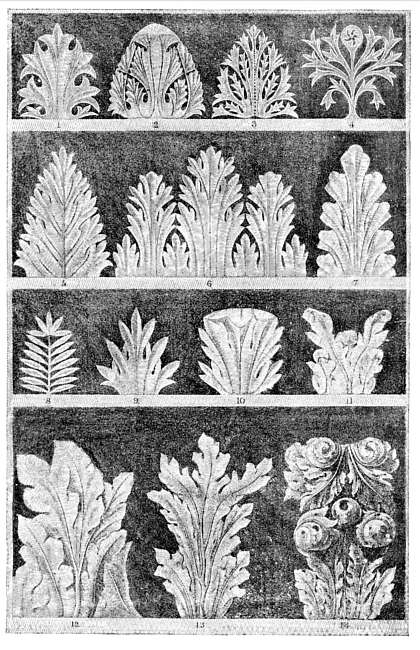
LEAFAGE OF THE VENETIAN CAPITALS.
§ CXXXI. It is very possible that the reader may at first like fig. 14 the best. I shall endeavor, in the next chapter, to show why he should not; but it must also be noted, that fig. 12 has lost, and fig. 14 gained, both largely, under the hands of the engraver. All the bluntness and coarseness of feeling in the workmanship of fig. 14 have disappeared on this small scale, and all the subtle refinements in the broad masses of fig. 12 have vanished. They could not, indeed, be rendered in line engraving, unless by the hand of Albert Durer; and I have, therefore, abandoned, for the present, all endeavor to represent any more important mass of the early sculpture of the Ducal Palace: but I trust that, in a few months, casts of many portions will be within the reach of the inhabitants of London, and that they will be able to judge for themselves of their perfect, pure, unlabored naturalism; the freshness, elasticity, and softness of their leafage, united with the most noble symmetry and severe reserve,—no running to waste, no loose or experimental lines, no extravagance, and no weakness. Their design is always sternly architectural; there is none of the wildness or redundance of natural vegetation, but there is all the strength, freedom, and tossing flow of the breathing leaves, and all the undulation of their surfaces, rippled, as they grew, by the summer winds, as the sands are by the sea.
§ CXXXII. This early sculpture of the Ducal Palace, then, represents the state of Gothic work in Venice at its central and proudest period, i.e. circa 1350. After this time, all is decline,—of what nature and by what steps, we shall inquire in the ensuing chapter; for as this investigation, though still referring to Gothic architecture, introduces us to the first symptoms of the Renaissance influence, I have considered it as properly belonging to the third division of our subject.
§ CXXXIII. And as, under the shadow of these nodding leaves, we bid farewell to the great Gothic spirit, here also we may cease our examination of the details of the Ducal Palace; for above its upper arcade there are only the four traceried windows,160 and one or two of the third order on the Rio Façade, which can be depended upon as exhibiting the original workmanship of the older palace. I examined the capitals of the four other windows on the façade, and of those on the Piazzetta, one by one, with great care, and I found them all to be of far inferior workmanship to those which retain their traceries: I believe the stone framework of these windows must have been so cracked and injured by the flames of the great fire, as to render it necessary to replace it by new traceries; and that the present mouldings and capitals are base imitations of the original ones. The traceries were at first, however, restored in their complete form, as the holes for the bolts which fastened the bases of their shafts are still to be seen in the window-sills, as well as the marks of the inner mouldings on the soffits. How much the stone facing of the façade, the parapets, and the shafts and niches of the angles, retain of their original masonry, it is also impossible to determine; but there is nothing in the workmanship of any of them demanding especial notice; still less in the large central windows on each façade, which are entirely of Renaissance execution. All that is admirable in these portions of the building is the disposition of their various parts and masses, which is without doubt the same as in the original fabric, and calculated, when seen from a distance, to produce the same impression.
§ CXXXIV. Not so in the interior. All vestige of the earlier modes of decoration was here, of course, destroyed by the fires; and the severe and religious work of Guariento and Bellini has been replaced by the wildness of Tintoret and the luxury of Veronese. But in this case, though widely different in temper, the art of the renewal was at least intellectually as great as that which had perished: and though the halls of the Ducal Palace are no more representative of the character of the men by whom it was built, each of them is still a colossal casket of priceless treasure; a treasure whose safety has till now depended on its being despised, and which at this moment, and as I write, is piece by piece being destroyed for ever.
§ CXXXV. The reader will forgive my quitting our more immediate subject, in order briefly to explain the causes and the nature of this destruction; for the matter is simply the most important of all that can be brought under our present consideration respecting the state of art in Europe.
The fact is, that the greater number of persons or societies throughout Europe, whom wealth, or chance, or inheritance has put in possession of valuable pictures, do not know a good picture from a bad one,161 and have no idea in what the value of a picture really consists. The reputation of certain works is raised, partly by accident, partly by the just testimony of artists, partly by the various and generally bad taste of the public (no picture, that I know of, has ever, in modern times, attained popularity, in the full sense of the term, without having some exceedingly bad qualities mingled with its good ones), and when this reputation has once been completely established, it little matters to what state the picture may be reduced: few minds are so completely devoid of imagination as to be unable to invest it with the beauties which they have heard attributed to it.
§ CXXXVI. This being so, the pictures that are most valued are for the most part those by masters of established renown, which are highly or neatly finished, and of a size small enough to admit of their being placed in galleries or saloons, so as to be made subjects of ostentation, and to be easily seen by a crowd. For the support of the fame and value of such pictures, little more is necessary than that they should be kept bright, partly by cleaning, which is incipient destruction, and partly by what is called “restoring,” that is, painting over, which is of course total destruction. Nearly all the gallery pictures in modern Europe have been more or less destroyed by one or other of these operations, generally exactly in proportion to the estimation in which they are held; and as, originally, the smaller and more highly finished works of any great master are usually his worst, the contents of many of our most celebrated galleries are by this time, in reality, of very small value indeed.
§ CXXXVII. On the other hand, the most precious works of any noble painter are usually those which have been done quickly, and in the heat of the first thought, on a large scale, for places where there was little likelihood of their being well seen, or for patrons from whom there was little prospect of rich remuneration. In general, the best things are done in this way, or else in the enthusiasm and pride of accomplishing some great purpose, such as painting a cathedral or a camposanto from one end to the other, especially when the time has been short, and circumstances disadvantageous.
§ CXXXVIII. Works thus executed are of course despised, on account of their quantity, as well as their frequent slightness, in the places where they exist; and they are too large to be portable, and too vast and comprehensive to be read on the spot, in the hasty temper of the present age. They are, therefore, almost universally neglected, whitewashed by custodes, shot at by soldiers, suffered to drop from the walls piecemeal in powder and rags by society in general; but, which is an advantage more than counterbalancing all this evil, they are not often “restored.” What is left of them, however fragmentary, however ruinous, however obscured and defiled, is almost always the real thing; there are no fresh readings: and therefore the greatest treasures of art which Europe at this moment possesses are pieces of old plaster on ruinous brick walls, where the lizards burrow and bask, and which few other living creatures ever approach; and torn sheets of dim canvas, in waste corners of churches; and mildewed stains, in the shape of human figures, on the walls of dark chambers, which now and then an exploring traveller causes to be unlocked by their tottering custode, looks hastily round, and retreats from in a weary satisfaction at his accomplished duty.
§ CXXXIX. Many of the pictures on the ceilings and walls of the Ducal Palace, by Paul Veronese and Tintoret, have been more or less reduced, by neglect, to this condition. Unfortunately they are not altogether without reputation, and their state has drawn the attention of the Venetian authorities and academicians. It constantly happens, that public bodies who will not pay five pounds to preserve a picture, will pay fifty to repaint it:162 and when I was at Venice in 1846, there were two remedial operations carrying on, at one and the same time, in the two buildings which contain the pictures of greatest value in the city (as pieces of color, of greatest value in the world), curiously illustrative of this peculiarity in human nature. Buckets were set on the floor of the Scuola di San Rocco, in every shower, to catch the rain which came through the pictures of Tintoret on the ceiling; while in the Ducal Palace, those of Paul Veronese were themselves laid on the floor to be repainted; and I was myself present at the re-illumination of the breast of a white horse, with a brush, at the end of a stick five feet long, luxuriously dipped in a common house-painter’s vessel of paint.
This was, of course, a large picture. The process has already been continued in an equally destructive, though somewhat more delicate manner, over the whole of the humbler canvases on the ceiling of the Sala del Gran Consiglio; and I heard it threatened when I was last in Venice (1851-2) to the “Paradise” at its extremity, which is yet in tolerable condition,—the largest work of Tintoret, and the most wonderful piece of pure, manly, and masterly oil-painting in the world.
§ CXL. I leave these facts to the consideration of the European patrons of art. Twenty years hence they will be acknowledged and regretted; at present, I am well aware, that it is of little use to bring them forward, except only to explain the present impossibility of stating what pictures are, and what were, in the interior of the Ducal Palace. I can only say, that in the winter of 1851, the “Paradise” of Tintoret was still comparatively uninjured, and that the Camera di Collegio, and its antechamber, and the Sala de’ Pregadi were full of pictures by Veronese and Tintoret, that made their walls as precious as so many kingdoms; so precious indeed, and so full of majesty, that sometimes when walking at evening on the Lido, whence the great chain of the Alps, crested with silver clouds, might be seen rising above the front of the Ducal Palace, I used to feel as much awe in gazing on the building as on the hills, and could believe that God had done a greater work in breathing into the narrowness of dust the mighty spirits by whom its haughty walls had been raised, and its burning legends written, than in lifting the rocks of granite higher than the clouds of heaven, and veiling them with their various mantle of purple flower and shadowy pine.
Sansovino. Venetia Descritta. 4to, Venice, 1663.
Sansovino. Lettera intorno al Palazzo Ducale. 8vo, Venice, 1829.
Temanza. Antica Pianta di Venezia, with text. Venice, 1780.
Cadorin. Pareri di XV. Architetti. 8vo, Venice, 1838.
Filiasi. Memorie storiche. 8vo, Padua, 1811.
Bettio. Lettera discorsiva del Palazzo Ducale. 8vo, Venice, 1837.
Selvatico. Architettura di Venezia. 8vo, Venice, 1847.
“Domine Jesu Christe, sancta cruce tua apud me sis, ut me defendas.
Domine Jesu Christe, pro veneranda cruce tua post me sis, ut me gubernes.
Domine Jesu Christe, pro benedicta cruce tua intra me sis, ut me reficeas.
Domine Jesu Christe, pro benedicta cruce tua circa me sis, ut me conserves.
Domine Jesu Christe, pro gloriosa cruce tua ante me sis, ut me deduces.
Domine Jesu Christe, pro laudanda cruce tua super me sis, ut benedicas.
Domine Jesu Christe, pro magnifica cruce tua in me sis, ut me ad regnum tuum perducas, per D. N. J. C. Amen.”
APPENDIX.
1. THE GONDOLIER’S CRY.
Most persons are now well acquainted with the general aspect of the Venetian gondola, but few have taken the pains to understand the cries of warning uttered by its boatmen, although those cries are peculiarly characteristic, and very impressive to a stranger, and have been even very sweetly introduced in poetry by Mr. Monckton Milnes. It may perhaps be interesting to the traveller in Venice to know the general method of management of the boat to which he owes so many happy hours.
A gondola is in general rowed only by one man, standing at the stern; those of the upper classes having two or more boatmen, for greater speed and magnificence. In order to raise the oar sufficiently, it rests, not on the side of the boat, but on a piece of crooked timber like the branch of a tree, rising about a foot from the boat’s side, and called a “fórcola.” The fórcola is of different forms, according to the size and uses of the boat, and it is always somewhat complicated in its parts and curvature, allowing the oar various kinds of rests and catches on both its sides, but perfectly free play in all cases; as the management of the boat depends on the gondolier’s being able in an instant to place his oar in any position. The fórcola is set on the right-hand side of the boat, some six feet from the stern: the gondolier stands on a little flat platform or deck behind it, and throws nearly the entire weight of his body upon the forward stroke. The effect of this stroke would be naturally to turn the boat’s head round to the left, as well as to send it forward; but this tendency is corrected by keeping the blade of the oar under the water on the return stroke, and raising it gradually, as a full spoon is raised out of any liquid, so that the blade emerges from the water only an instant before it again plunges. A downward and lateral pressure upon the fórcola is thus obtained, which entirely counteracts the tendency given by the forward stroke; and the effort, after a little practice, becomes hardly conscious, though, as it adds some labor to the back stroke, rowing a gondola at speed is hard and breathless work, though it appears easy and graceful to the looker-on.
If then the gondola is to be turned to the left, the forward impulse is given without the return stroke; if it is to be turned to the right, the plunged oar is brought forcibly up to the surface; in either case a single strong stroke being enough to turn the light and flat-bottomed boat. But as it has no keel, when the turn is made sharply, as out of one canal into another very narrow one, the impetus of the boat in its former direction gives it an enormous lee-way, and it drifts laterally up against the wall of the canal, and that so forcibly, that if it has turned at speed, no gondolier can arrest the motion merely by strength or rapidity of stroke of oar; but it is checked by a strong thrust of the foot against the wall itself, the head of the boat being of course turned for the moment almost completely round to the opposite wall, and greater exertion made to give it, as quickly as possible, impulse in the new direction.
The boat being thus guided, the cry “Premi” is the order from one gondolier to another that he should “press” or thrust forward his oar, without the back stroke, so as to send the boat’s head round to the left; and the cry “Stali” is the order that he should give the return or upward stroke which sends the boat’s head round to the right. Hence, if two gondoliers meet under any circumstances which render it a matter of question on which side they should pass each other, the gondolier who has at the moment the least power over his boat, cries to the other, “Premi,” if he wishes the boats to pass with their right-hand sides to each other, and “Stali,” if with their left. Now, in turning a corner, there is of course risk of collision between boats coming from opposite sides, and warning is always clearly and loudly given on approaching an angle of the canals. It is of course presumed that the boat which gives the warning will be nearer the turn than the one which receives and answers it; and therefore will not have so much time to check itself or alter its course. Hence the advantage of the turn, that is, the outside, which allows the fullest swing and greatest room for lee-way, is always yielded to the boat which gives warning. Therefore, if the warning boat is going to turn to the right, as it is to have the outside position, it will keep its own right-hand side to the boat which it meets, and the cry of warning is therefore “Premi,” twice given; first as soon as it can be heard round the angle, prolonged and loud, with the accent on the e, and another strongly accented e added, a kind of question, “Prémi-é,” followed at the instant of turning, with “Ah Premí,” with the accent sharp on the final i. If, on the other hand, the warning boat is going to turn to the left, it will pass with its left-hand side to the one it meets; and the warning cry is, “Stáli-é, Ah Stalí.” Hence the confused idea in the mind of the traveller that Stali means "to the left,” and “Premi” to the right; while they mean, in reality, the direct reverse; the Stali, for instance, being the order to the unseen gondolier who may be behind the corner, coming from the left-hand side, that he should hold as much as possible to his own right; this being the only safe order for him, whether he is going to turn the corner himself, or to go straight on; for as the warning gondola will always swing right across the canal in turning, a collision with it is only to be avoided by keeping well within it, and close up to the corner which it turns.
There are several other cries necessary in the management of the gondola, but less frequently, so that the reader will hardly care for their interpretation; except only the “sciar,” which is the order to the opposite gondolier to stop the boat as suddenly as possible by slipping his oar in front of the fórcola. The cry is never heard except when the boatmen have got into some unexpected position, involving a risk of collision; but the action is seen constantly, when the gondola is rowed by two or more men (for if performed by the single gondolier it only swings the boat’s head sharp round to the right), in bringing up at a landing-place, especially when there is any intent of display, the boat being first urged to its full speed and then stopped with as much foam about the oar-blades as possible, the effect being much like that of stopping a horse at speed by pulling him on his haunches.