MOLIÈRE AND HIS FRIENDS (continued 2)
Reading edition
Whether with Boileau in camp, or alone in the Luxembourg campaign of 1683—Boileau being too ill to go—or at Namur in 1692, or with the King and court at Fontainebleau, Marly, Versailles, in these royal residences where he had his own rooms, wherever he was, Racine never seemed to cease thinking of his home, that home in Rue des Maçons when he first went away, and for the last seven years of his life in Rue Visconti. When absent from home he wrote to his children frequently, and when here he corresponded constantly with his son, who was with the French Embassy at The Hague. To him he gave domestic details and "trivial fond records" of what his mother was doing, of the colds of the younger ones, and of the doings of the daughter in a convent at Melun. He sends to this son two new hats and eleven and a half louis d'or, and begs him to be careful of the hats and to spend the money slowly.
Yet he was fond of court life, and, an adroit courtier, he knew how to sing royal prowess in the field and royal splendor in the palace. He had a way of carrying himself that gave seeming height to his slight stature. His noble and open expression, his fine wit, his dexterous address, his notable gifts as a reader to the King at his bedside, made him a favorite in that resplendent circle. And he was all the more unduly dejected when the Roi Soleil cooled and no longer smiled on him; he was killed when Madame de Maintenon—"Goody Scarron," "Old Piety," "the hag," "the hussy," "that old woman," are the usual pet epithets for her of delicious Duchesse d'Orléans—who had liked and had befriended him, saw the policy of showing him her cold shoulder, as she had shown it to Fénelon. From this shock, Racine, being already broken physically by age and illness, seemed unable to rally. As he sank gradually to the grave he made sedulous provision for his family, dictating, toward the last, a letter begging for a continuance of his pension to his widow, which, it is gladly noted, was afterward done. He urged, also, the claim of Boileau to royal favor: "We must not be separated," he said to his amanuensis; "begin your letter again, and let Boileau know that I have been his friend to my death."
His death came on April 21, 1699. His body lay one night in the choir of Saint-Sulpice, his parish church, and then it was carried for burial to the Abbey of Port-Royal. On the destruction of that institution, his remains were brought back to Paris, in 1711, and placed near those of Pascal, at the entrance of the lady-chapel of Saint-Étienne-du-Mont. Racine's epitaph, in Latin, by Boileau, the friend of so many men who were not always friendly with one another, is cut in a stone set in the first pillar of the southern aisle of the choir.
Jean de la Fontaine began to come to Paris, making occasional excursions from his native Château-Thierry, in Champagne, toward 1654, he being then over thirty years of age. A little later, when under the protection and in the pay of the great Fouquet, his visits to the capital were more frequent and more prolonged. He commonly found lodgings on Quai des Grands-Augustins, just around the corner from young Racine, and the two men were much together during the years 1660 and 1661. La Fontaine made his home permanently in the capital after 1664, when he arrived there in the train of the Duchesse de Bouillon, born Anne Mancini, youngest and liveliest of Mazarin's many dashing nieces. Her marriage with the Duc de Bouillon had made her the feudal lady of Château-Thierry, and if she were not compelled to claim, in this case, her privilege as châtelaine over her appanage, it was because there was ampler mandate for the impressionable poet in the caprice of a wilful woman. Incidentally, in this flitting, he left behind his provincial wife. He had taken her to wife in 1647, mainly to please his father, and soon, to please her and himself, they had agreed on a separation. They met scarcely any more after his definite departure. There is a tradition that he chatted, once in a salon somewhere, with a bright young man by whom he found himself attracted, and concerning whom he made inquiry of the bystanders, who informed him that it was his son. Tradition does not record any attempt on his part to improve his acquaintance with the young stranger, or to show further interest in his welfare.
He did not entirely desert his country home, for the duchess carried him along on her autumnal visits to Château-Thierry. He took advantage of each chance thus given him to realize something upon his patrimony, that he might meet the always pressing claims on his always overspent income.
He writes to Racine during one of these visits, in 1686: "My affairs occupy me as much as they're worth it, and that's not at all; and the leisure I thus get is given to laziness." He almost anticipated in regard to himself the racy saying of the Oxford don of our day of another professor: "Such time as he can save from the adornment of his person he devotes to the neglect of his duties." But La Fontaine neglected not only his duties all through life, but, more than all else, did he neglect the care of his dress. A portion of the income he was always anticipating came from his salary at one time, as gentleman in the suite of the dowager Duchesse d'Orléans, that post giving him quarters in the Luxembourg. These quarters and his salary went from him with her death. For several years after coming to town with the Duchesse de Bouillon he had a home in the duke's town-house on Quai Malaquais.
This quay had been built upon the river-front soon after the death, in 1615, of Marguerite de Valois, Henri IV.'s divorced wife. The streets leading from Quais Malaquais and Voltaire, and those behind, parallel with the quays, were cut through her grounds and through the fields farther west. This was the beginning of the Faubourg Saint-Germain. To save the long detour, to and from the new suburb, around by way of Pont-Neuf, a wooden bridge was built in 1632 along the line of the ferry, that had hitherto served for traffic between the shore in front of the Louvre and the southern shore, at the end of the road that is now Rue du Bac. The Pont Royal has replaced that wooden bridge. One of the buildings that began this river-front remains unmutilated at the corner of Quai Malaquais and Rue de Seine, and is characteristic of the architecture of that period in its walls and roofs and windows clustering about the court. It was the many years' dwelling of the elder Visconti, and his death-place in 1818. The house at No. 3 was erected early in the nineteenth century, on the site of Buzot's residence, as shall be told in a later chapter. In it Humboldt lived from 1815 to 1818. The associations of No. 5 have already been suggested. The largest builder on the quay was Cardinal Mazarin, whose college, to which he gave his own name, and to which the public gave the name Collége des Quatre-Nations, is now the Palais de l'Institut. He paid for it with money wrung from wretched France, as he so paid for the grand hôtel he erected for another niece, Anne Marie Martinozzi, widow of that Prince de Conti who was Molière's school friend. On the ground that it covered was built, in 1860-62, the wing of the Beaux-Arts at Nos. 11 and 13 Quai Malaquais. That school has also taken possession of the Hôtel de Bouillon of the cardinal's other niece, almost alongside. It had been the property of the rich and vulgar money-king Bazinière, whom we shall meet again, and he had sold it to the Duc de Bouillon. The pretty wife of this very near-sighted husband had the house re-decorated, and filled it with a marvellous collection of furniture, paintings, bric-à-brac. She filled it, also, by her open table twice a day, with thick-coming guests, some of whom were worth knowing. The hôtel came by inheritance in 1823 to M. de Chimay, who stipulated, in making it over to the Beaux-Arts, in 1885, that its seventeenth-century façade should be preserved, and by this agreement we have here, at No. 17 Quai Malaquais, an admirable specimen of the competence of the elder, the great Mansart. It is higher than he left it, by reason of the wide, sloping roof, with many skylights toward the north, placed there for the studios within, but its two well-proportioned wings remain unchanged, and between them the court, where La Fontaine was wont to sit or stroll, has been laid out as a garden. While living here he brought out the first collection of his "Contes" in 1665, and of his "Fables" in 1668. His "Les Amours de Psyché," written in 1669, begins with a charming description of the meetings in Boileau's rooms of the famous group of comrades.
From this home he went to the home of Madame de la Sablière, with whom, about 1672, he had formed a friendship which lasted unbroken until her death. This tender and steadfast companionship made the truest happiness of La Fontaine's life. For twenty years an inmate of her household, a member of her family, he was petted and cared for as he craved. In her declining years she had to be away from home attending to her charitable work—for she followed the fashion of turning dévote as age advanced—and then he suffered in unaccustomed loneliness. His tongue spoke of her with the same constant admiration and gratitude that is left on record by his pen, and at her death he was completely crushed.
When he was invited by Madame de la Sablière and her poet-husband to share their home, they were living at their country-place, "La Folie Rambouillet," not to be mistaken for the Hôtel de Rambouillet. Sablière's hôtel, built by his father, a wealthy banker, was in the suburb of Reuilly, on the Bercy road, north of the Seine, not far from Picpus. The Reuilly station and the freight-houses of the Vincennes railway now cover the site of this splendid mansion and its extensive grounds. Here Monsieur de la Sablière died in 1680, and his widow, taking La Fontaine along, removed to her town-house. This stood on the ground now occupied by the buildings in Rue Saint-Honoré, nearly opposite Rue de la Sourdière. In the court of No. 203 are bits of carving that may have come down from the original mansion. Here they dwelt untroubled until death took her away in 1693. It is related that La Fontaine, leaving this house after the funeral, benumbed and bewildered by the blow, met Monsieur d'Hervart. "I was going," said that gentleman, "to offer you a home with me." "I was going to ask it," was the reply. And in this new abode he dwelt until his death, two years later.
Berthélemy d'Hervart, a man of great wealth, had purchased, in 1657, the Hôtel de l'Éperon, a mansion erected on the site of Burgundy's Hôtel de Flandre. M. d'Hervart had enlarged and decorated his new abode, employing for the interior frescoes the painter Mignard, Molière's friend. The actor and his troupe had played here, by invitation, nearly fifty years before La Fontaine's coming. It stood in old Rue Plâtrière, now widened out, entirely rebuilt, and renamed Rue Jean-Jacques-Rousseau; and on the wall of the Central Post-office that faces that street, you will find a tablet stating that on this site died Jean de la Fontaine on April 13, 1695.
Madame d'Hervart was a young and lovely woman, and as devoted to the old poet as had been Madame de la Sablière. She went so far as to try to regulate his dress, his expenditure, and his morals. Congratulated one day on the splendor of his coat, La Fontaine found to his surprise and delight that his hostess had substituted it—when, he had not noticed—for the shabby old garment that he had been wearing for years. She and her husband held sacred, always, the room in which La Fontaine died, showing it to their friends as a place worthy of reverence.
He was buried in the Cemetery of Saints-Innocents, now all built over except its very centre, which is kept as a small park about the attractive fountain of Saints-Innocents. The Patriots of the Revolution, slaying so briskly their men of birth, paused awhile to bring from their graves what was left of their men of brains. Misled by inaccurate rumor, they left La Fontaine's remains in their own burial-ground, and removed what they believed to be his bones from the graveyard of Saint-Joseph, where he had not been buried, along with the bones they believed to be those of Molière, who had been buried there. These casual and dubious remains were kept in safety in the convent of Petits-Augustins in present Rue Bonaparte, until, in the early years of the nineteenth century, they were removed for final sepulture to Père-Lachaise.
No literary man of his time—perhaps of any time—was so widely known and so well beloved as La Fontaine. He attracted men, not only the best in his own guild, but the highest in the State and in affairs. Men various in character, pursuits, station, were equally attached to him; the great Condé was glad to receive him as a frequent guest at Chantilly; the superfine sensualist, Saint-Évremond, in exile in England, urged him to come to visit him and to meet Waller. He nearly undertook the journey, less to see Saint-Évremond and to know Waller, than to follow his Duchesse de Bouillon, visiting her sister, the Duchess of Mazarin, in her Chelsea home. It was at this time that Ninon de Lenclos wrote to Saint-Évremond: "You wish La Fontaine in England. We have little of his company in Paris. His understanding is much impaired."
Racine, eighteen years his junior, looked up to La Fontaine as a critic, a counsellor, and a friend, from their early days together in 1660, through long years of intimacy, until he stood beside La Fontaine's bed in his last illness. He even took an odd pleasure in finding that he and La Fontaine's deserted country wife had sprung from the same provincial stock. Molière first met La Fontaine at Vaux, the more than royal residence of Fouquet, at the time of the royal visit in 1661. La Fontaine wrote a graceful bit of verse in praise of the author of "Les Fâcheux," played for the first time before King and court during these festivities, and the two men, absolutely opposed in essential qualities, were fast friends from that time on. "They make fun of the bonhomme," said the ungrudging player once, "and our clever fellows think they can efface him; but he'll efface us all yet."
It is needless to say that La Fontaine was beloved by Boileau, the all-loving. That kindly ascetic was moved to attempt the amendment of his friend's laxity of life, and to this blameless end dragged him to prayers sometimes, where La Fontaine was bored and would take up any book at hand to beguile the time. In this way he made acquaintance with the Apocrypha, and became intensely interested in Baruch, and asked Boileau if he knew Baruch, and urged him to read Baruch, as a hitherto undiscovered genius. During his last illness, he told the attendant priest that he had been reading the New Testament, and that he regarded it as a good, a very good book.
In truth, his soul was the soul of a child, and, childlike, he lived in a world of his own—a world peopled with the animals and the plants and the inanimate objects, made alive by him and almost human. He loved them all, and painted them with swift, telling strokes of his facile pen. The acute Taine points out that the brute creations of this poet are prototypes of every class and every profession of his country and his time. His dumb favorites attracted him especially by their unspoiled simplicity, for he loathed the artificial existence of his fellow-creatures. With "a sullen irony and a desperate resignation" he let himself be led into society, and he was bored beyond bearing by its high-heeled decorum. It is said that he cherished, all his life long, a speechless exasperation with the King, that incarnation of pomposity and pretence to his untamed Gallic spirit. Yet this malcontent had to put on the livery of his fellow-flunkies, and his dedication, to the Dauphin, of his "Fables," is as fulsome and servile as any specimen of sycophancy of that toad-eating age.
Yet, able to make trees and stones talk, he himself could not talk, La Bruyère tells us; coloring his portraiture strongly, as was his way, and rendering La Fontaine much too heavy and dull, with none of the skill in description with his tongue that he had with his pen. He may be likened to Goldsmith, who "wrote like an angel and talked like poor Poll." Madame de Sablière said to him: "Mon bon ami, que vous seriez bête, si vous n'aviez pas tant d'esprit!" Louis Racine, owning to the lovable nature of the man, has to own, too, that he gave poor account of himself in society, and adds that his sisters, who in their youth had seen the poet frequently at their father's table in Rue Visconti, recalled him only as a man untidy in dress and stupid in talk. He gave this impression mainly because he was forever dreaming, even in company, and so seemed distant and dull; but, when drawn out of his dreams, no man could be more animated and more delightful.
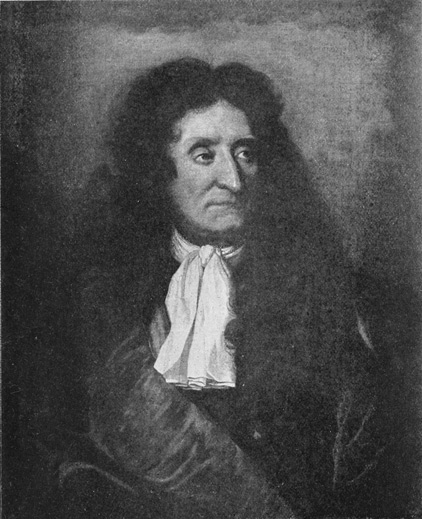
La Fontaine. (From the portrait by Rigaud-y-Ros.)
So he was found by congenial men, and so especially by approving women. These took to him on the spot, women of beauty and of wit, and women commonplace enough. To them all his prattle was captivating, devoid as it was of the grossness so conspicuous in his poems. He depended on women in every way all through his life; they catered to his daily needs, and they provided for his higher wants; they helped him in his money troubles, they helped him in all his troubles. And he requited each one's care with a genuine affection, not only at the time, but for all time, in the record he has left of his gratitude and his devotion to these ministering women. His verse is an unconscious chronicle of his loves, his caprices, his inconstancies, and his loyalties. Nor did a woman need to be clever and cultivated to be bewitched by his inborn, simple sweetness. A matter-of-fact nurse, hired to attend him during an illness which came near being fatal, said to the attending priest: "Surely, God could not have the courage to damn a man like that."
This memory he has left is brought pleasantly home to the passer-by in Rue de Grenelle by the sign of a hotel, a quiet clerical house, frequented by churchmen and church-loving provincials visiting Paris. The sign bears the name "Au bon La Fontaine," in striking proof of the permanent place in the common heart won by this lovable man.
He was content to drift through life, his days spent, as he put it in his epitaph on "Jean," one-half in doing nothing, the other half in sleeping. He had no library or study or workroom, like other pen-workers; he lived out of doors in the open air, and wandered vaguely, tasting blameless epicurean delights. Some of us seem to see, always in going along Cours la Reine, that quaint figure, comical and pathetic, as he was seen by the Duchesse de Bouillon on a rainy morning, when she drove to Versailles. He was standing under a tree on this wooded water-side, and on her return on that rainy evening he was standing under the same tree. He had dreamed away the long day there, not knowing or not caring that he was wet. He explained, once when he came late—inexcusably late—to a dinner, that he had been watching a procession of ants in a field, and had found that it was a funeral; he had accompanied the cortége to the grave in the garden, and had then escorted the bereaved family back to its home, as bound by courtesy.
This genuine poet, of dry, sly humor and of unequalled suppleness of phrase, was by nature a gentle, wild creature, and by habit a docile, domesticated pet, attaching himself to any amiable woman who was willing to give him a warm corner in her heart and her house. And how such women looked on him was prettily and wittily put by one of them: "He isn't a man, he is a fablier"—a natural product of her own sudden inspiration—"who blossoms out into fables as a tree blossoms out with leaves."
Nicolas Boileau began his acquaintance with Molière by his tribute of four dainty verses to the author of "L'École des Femmes," and the friendship thus formed was broken only by the death of Molière, to whose memory Boileau inserted his magnificent lines in the "Epître à Monsieur Racine." It was Boileau who criticised the early verse of young Racine, so justly and so gently, that the two men were drawn together in an amity that was never marred. It was Boileau who, after nearly forty years of finding him out by the distrustful Racine, was acknowledged to be "noble and full of friendship." It was Boileau who sang without cessation praises of Racine to Louis XIV., and who startled the nimble mediocrity of his majesty's mind by the assertion that Molière was the rarest genius of the Grand Monarch's reign and realm. It was Boileau who made, in his fondness for La Fontaine, the unhappy and hopeless attempt to reform his friend's loose living, and in so doing nearly led to the undoing of La Fontaine's goodwill for him. It was Boileau, prompted by compassion for Corneille's impoverished old age, who offered to surrender his own pension in favor of the distressed veteran of letters. It was Boileau who found Patru forced to sell his cherished books that he might get food, and it was Boileau who bought them, on condition that Patru should keep them and look after them for their new owner. It was Boileau who tried to work a miracle in his comrade Chapelle by weaning him from his wine-bibbing; and when Chapelle found the lecture dry, and would listen to it only over a bottle or two, it was Boileau who came out of the cabaret the tipsier of the pair. It was Boileau who was known to every man who knew him at all—and he was known to many men of merit and demerit—as a loyal, sincere, helpful, unselfish friend. It was of Boileau that a perplexed woman in the great throng at his burial said, in the hearing of young Louis Racine: "He seems to have lots of friends, and yet somebody told me that he wrote bad things about everybody."
Those friends could have explained the puzzle. They mourned the indulgent comrade who was doubled with the stern satirist. The man, so rigid in morals and austere of life, was tolerant to the foibles of his friends, tender in their troubles, open-handed for their needs. The writer, so exacting in his standard and severe in his judgment, was cruel only with his pen. Trained critic in verse, rather than inspired poet, Boileau had an enthusiasm for good work in others equal to his intolerance of bad. He loathed the powdered and perfumed minauderies of the drawing-room poetasters, and he loved the swift and sure stroke of Molière's "rare et fameux esprit." It was in frank admiration that he demanded of his friend: "Enseigne-moi où tu trouves la rime!" For this impeccable artist in words, who has left his profession of faith in the power of a word in its right place, had to reset and recast, file and polish, to get the perfection he craved. And so this bountiful admirer was easily an unsparing censor. Sincere in letters as in life, he insisted on equal sincerity from his fellow-workers, and would not let them spare their toil or scamp their stint. He watched and warned them; his reproof and his approval brought out better work from them; and he may well be entitled the Police President of Parnassus of his country and his day.
Boileau's sturdy uprightness of spine stood him in good stead in that great court where all men grew sleek and servile, and where no pen-worker seemed able to escape becoming a courtier. His caustic audacity salted his sycophancy and made him a man apart from the herd of flatterers. His thrust was so suave, as well as sharp, that the spoiled monarch himself accepted admonition from that courageous cleverness. "I am having search made in every direction for Monsieur Arnauld," said Louis, when eager in his pursuit of the Jansenists. "Your Majesty is always fortunate; you will not find him," was Boileau's quick retort, received with a smile by the King. When money was needed for Dr. Perrault's new eastern façade of the Louvre and for its other alterations, the King naturally economized in the incomes of other men. The pensions of literary men—in many instances the sole source of their livelihood—were allowed to lapse; that of Boileau was continued by an order that his name should be entered on the Louvre pay-roll as "an architect paid for mason's work." His mordant reply to the questioning pay-clerk was: "Yes, I am a mason." His masonry in the stately fabric of French literature stands unmarred to-day; coldly correct, it may be, yet elegant, faultless, consummate.
Nicolas Boileau-Despréaux was long believed to have been born in the country and to have played in the fields as a child, and so to have got his added name des préaux; but it is now made certain that the house of his birth, in 1636, was in Rue de Jérusalem, a street that led to the Sainte-Chapelle, from about the middle of the present Quai des Orfèvres. The only field he knew lay at the foot of his father's garden at Crosne, where the lad was sometimes taken. Fields and gardens had never anything to say to this born cockney, and there is not a sniff of real country air in all his verse. The street of his birth was one of the narrow, dark streets of oldest Paris, on Île de la Cité; and the house, tall and thin, had its gable end on the court of the old Palais de Justice. The earliest air breathed by this baby was charged with satire, it would seem. For the room of his birth had been occupied, nearly half a century earlier, by Jacques Gillot, the brilliant canon of Sainte-Chapelle. In this room assembled in secret that clever band of talkers and writers, who planned and wrote "La Ménippée"; the first really telling piece of French political satire, so telling, in its unbridled buffoonery, that it gave spirit to the arms that shattered the League, and helped to put Henry of Navarre on the throne of France.
After his father's death, young Nicolas kept his home with his elder brother Jérôme, who had succeeded to the paternal mansion, and who gave the boy a sort of watch-tower, built above the garrets, in which he could hardly stand upright. The house, the court, the old palace, were long since swept away, and with them went all the melodramatic stage-setting of Hugo's "Notre-Dame de Paris" and Sue's "Mystères de Paris." Only the Sainte-Chapelle is left of the scenes of Boileau's early years.
He was sent for a while to Collége d'Harcourt, where young Racine came a little later, and was then put to the study of law, the family trade; passing by way of Beauvais College to the Sorbonne. He is known to have pleaded in but one case, and then with credit to himself. Still the law did not please him, any more than did the dry theology and the pedantic philosophy that he listened to on the benches of the Sorbonne. He was enamoured early of poetry and romance, and soon affianced himself to the Muse. This was his only betrothal, and he made no other marriage. He was born an old bachelor, and he soon sought bachelor quarters, driven by the children's racket from his nephew's house—also in the Cour du Palais—where he had found a home. This nephew and this house were well known to Voltaire when a boy, as he tells us in his "Épître à Boileau":
"Chez ton neveu Dongois je passai mon enfance, Bon bourgeois, qui se crut un homme d'importance."
It is first in the year 1664 that we can place with certainty Boileau's residence in Rue du Vieux-Colombier, in that small apartment which fills a larger place in the annals of literary life than any domicile of that day, perhaps of any day. It was the gathering-place of that illustrious quartette—
"The goodliest fellowship of famous knights Whereof this world holds record."
Molière comes from his rooms in Rue Saint-Honoré, or from his theatre; crossing the Seine by the Pont-Neuf, and passing along Rues Dauphine and de Bucy, and through the Marché Saint-Germain; moody from domestic dissensions, heavy-hearted with the recent loss of his first-born. Once among his friends, he listens, as he always listened, talking but little. La Fontaine saunters from the Hôtel de Bouillon, by way of Rue des Petits-Augustins—now Rue Bonaparte—and of tortuous courts now straightened into streets. Sitting at table, he is yet in his own land of dreams, until, stirred from his musing, his fine eyes brighten, and he chatters with a curious blending of simplicity and finesse. Racine steps in from his lodging in Rue de Grenelle, hard by; the youngest of the four, he, unlike those other two, is seldom silent, and gives full play to his ironical raillery. Next above him in age is the host; shrewd, brusque, incisive of speech and manner. So he shows in Girardon's admirable bust in the Louvre. The enormous wig then worn cannot becloud the bright alertness of his expression, or over-weigh the full lips that could sneer and the square chin, so resolute. These comrades talked of all sorts of things, and read to one another what each had written since they last met; read it for the sake of honest criticism from the rest, and with no other thought. For never were four men so absolutely without pose, without any pretence of earnestness, while immensely in earnest all the time. In "Les Amours de Psyché," La Fontaine assures us that they did not absolutely banish all serious discourse, but that they took care not to have too much of it, and preferred the darts of fun and nonsense that were feathered with friendly counsel. Best of all, his fable makes plain that there were no cliques nor cabals, no envy nor malice, among the men that made this worshipful band.
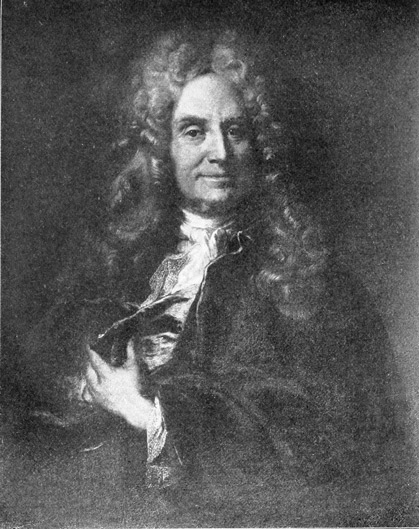
Boileau-Despréaux. (From the portrait by Largillière.)
Their table served rather to sit around than to eat from, for their suppers were simple, and the flowing bowl was passed only when boisterous Chapelle or other bon-vivant dropped in. For others were invited at times, men of the world, the court, and the camp. And Boileau was the common centre of these excentric stars, and when each, in his own special atmosphere of coolness, swayed from the others' vicinage, Boileau alone let no alienation come between him and any one of them. For each, he was what Racine had found him, "the best friend and the best man in the world."
The house was near a noted cabaret, to which they sometimes resorted, at the Saint-Sulpice end of the street. The cabaretier was the illustrious Cresnet, made immortal in Boileau's verse. For the poet was no prude, and enjoyed the pleasures of the table so far as his health permitted; and, a trained gastronomic artist, he knew how to order a choicely harmonized repast. His street is widened, his house is gone, and no one can fix the spot. Yet the turmoil of that crowded thoroughfare of to-day is deadened for us by the mute voices of these men.
We have noted Boileau's camp-following with Racine, in their rôles of royal historiographers—in 1678 and later—but he was not strong enough for these excursions, even though they were made a picnic for the court. He was never at home on a horse, and yet out of place in the mud, and he could not enjoy the laughter he caused in either attitude, before or after he was thrown; laughter that is recorded in the letters of Madame de Sévigné.
It was probably because of Molière's taking a country place at Auteuil that Boileau began to make frequent excursions to that quiet suburb about 1667, and went to live in his tiny cottage there in 1685. "He had acquired it," to use his biographer's words, "partly by his Majesty's munificence, and partly by his own careful economy," so that he was opulent, for a poet. His purchase papers were made out by the notary Arouet—Voltaire's father—who drew up Boileau's pension papers in 1692, and who did much notarial work for the Boileau family. The cottage stood exactly on the ground now covered by the rear wing of the Hydropathic Establishment, at No. 12 Rue Boileau, Auteuil. Here he spent the spring and summer months of many a year, always alone, but with a hand-shake and a smile for his many visitors, men of birth as well as men of brains. Hither Voltaire certainly came, when a lad living with Dongois, for he says, in his pleasant rhymed epistle to Boileau:
"Je vis le jardinier de ta maison d'Auteuil."
To this same "laborieux valet," to this same
"Antoine, gouverneur de mon jardin d'Auteuil,"
Boileau wrote his letter in verse in 1695. The widow Racine came, too, for frequent outings with her children, who loved the garden and adored Boileau, for the peaches he picked for them and the ninepins he played with them. Louis Racine, a sort of pupil of his, says that the old poet was nearly as skilful at this game as in versifying, and usually knocked over the entire nine with one ball. And when he went to town, no warmer welcome met the crusty old bachelor than in Rue des Marais-Saint-Germain, still the dwelling-place of Racine's family.
In great mansions, too, he had long been cordially received. He was a visitor at that of Madame de Guénégaud, which has given its site to the Hôtel de la Monnaie, and its name to the street alongside. He was fond of meeting kindred spirits and kindly hosts in the hôtel of the great Condé and his younger brother Conti. He was one of the select set that sat about the table of Lamoignon, every Monday, at his home in the Marais, to be visited by us later. And whenever old Cardinal Retz came to town, Boileau hastened to the Hôtel de Lesdiguières, of which no stone stands in the street of its name. Here the white-headed, worn-out old fighter, compelled to live in retirement, after the storms and scandals of his active life, was made at home by his admirable niece, Madame de Lesdiguières, and here he was encircled by admiring men and women. Here, writes Madame de Sévigné, his other niece, who came often to sit with him, Boileau presented to Retz early copies of "Le Lutrin," and of "L'Ars Poétique."
Boileau could not live in the country in winter, and even in summer he had to go often into town to get the care of his trusted physician. For he was an invalid from boyhood, and all his life an uncomplaining sufferer. But he hurried back, whenever permitted, to the pure air and the congenial solitude of his small cottage, where three faithful servants cared for him; not as would have cared the wife, whom he ought to have had, all his friends said, and so, too, he thought sometimes. He grew lonely as life lengthened, and as he saw his cronies passing away, fast and faster, old Corneille being the last of them to go.
His winters in the great city were spent in lodgings on the island, in the cloisters of Notre-Dame. Their quiet had always attracted him, as he avows in the verse that quivers with his nervous irritability, caused by the noises of the noisiest of towns. He cries, "Does one go to bed to be kept awake?" Indeed, he had rooms in the cloisters as early as 1683, keeping them for town quarters, in the official residence of l'Abbé de Dreux, his old friend, a canon of Notre-Dame. To this address Racine sent him a letter as late as 1687. The ecclesiastical settlement within the cathedral cloisters, and its only remaining cottage, have been spoken of in an earlier chapter. The cloisters themselves survive only in the name of the street that has been cut through their former site.
In 1699 we find Boileau living with his confessor, the Abbé Lenoir, also a canon of the cathedral, who had the privilege of residing within the cloisters. This house stood exactly where now is the southern edge of the fountain behind Notre-Dame, above Le Terrain and the Seine. His rooms were on the first floor, his bed in an alcove, and his windows looked out on the terrace over the river, as we learn by the amiable accuracy of the lawyer who drew up his will. Here Boileau lived through painful years of breaking bodily health, but with unbroken faculties. He yearned for his old home at Auteuil, and yet he was too feeble to go so far. He had sold his cottage to a friend, under the condition that a room should be reserved always for his use. That use never came. One day toward the end, he summoned up strength to drive to the beloved place; but all was changed, he changed most of all, and he hurried home to his lonely quarters, where death found him at ten o'clock in the morning of March 2, 1711.
His devoted servants were requited for years of faithful service by handsome legacies, then the relatives were provided for, and no friend was forgotten. The remainder of his fortune went to the "pauvres honteux" of six small parishes in the City. A vast and reverent concourse of mourners of every rank followed his coffin to its first resting-place. This was in the lower chapel of the Sainte-Chapelle, as he had ordered; the church of his baptism, and of the burial of his mother and father. By a strange chance, his grave had been dug under that very reading-desk which had suggested to him the subject of his most striking production, the heroic-comic poem "Le Lutrin." Early in the Revolution his remains were removed, to save them from fortuitous profanation by the "Patriots," to the Museum of French Monuments established in the convent of the Petits-Augustins, in the street of that name, now Rue Bonaparte. In 1819 his bones were finally placed in Saint-Germain-des-Prés, where, in the chapel of Saint-Peter and Saint-Paul, they are at rest behind a black marble tablet carved with a ponderous Latin inscription.