BOOK III WHICH OF US TWO?
Reading edition
XXXII
Solitude! How do we picture it?
A man alone on a raft in the midst of a boundless sea. A figure against a graying sky, with chasms beneath and ice peaks above. Such a derelict between life and death I felt myself to be, as on leaving the court-house, I stepped again into the street and faced my desperate future. I almost wished that I might feel a hand upon my shoulder and hear a voice in my ear saying: “Here is my warrant. I arrest you for murder in the name of the law;” for then I should know where my head would be laid for the night. Now I knew nothing.
Had Edgar joined me—But that would have been asking too much. I stood alone; I walked alone; and heads fell and eyes turned aside as I threaded my slow way down the street.
Where should I go? Suddenly it came to me that Orpha would expect me to return home. I had no reason for thinking so; but the impression once yielded to, I was sure of her expectancy and sure of the grave welcome I should receive. But how could I face them all with that brand between my eyes! To see Clarke’s accusing face and Wealthy’s attempt not to show her hatred of me too plainly! It would take a man with a heart of adamant to endure that. I had no such heart. Yet if I failed to go, it might look to some persons like an acknowledgment of guilt. And that would be worse. I would go, but for the night only. To-morrow should see me far on my way to other quarters—that is, if the police would allow it. The police! Well, why not see the Inspector! He had visited me; why should I not visit him?
An objective was found. I turned towards the Police Station. But before I reached it I met Mr. Jackson. He never admitted it, but I think he had been dogging me, having perhaps some inkling as to my mood. The straightforward way in which he held out his hand gave me the first gleam of comfort I had had that day.
Could it be that he was sincere in this show of confidence? That he had not been influenced by Wealthy’s story, or his judgment palsied by the fact patent to all, that with the exception of myself there was not a person among those admitted to my uncle’s room who had not lived in the house for years and given always and under all circumstances evidences of the most devoted attachment to him?
Or did he simply look upon me as the millionaire client who would yet come into his own and whose favor it would be well to secure in this hour of present trial?
A close study of his face satisfied me that he was really the friend he seemed, and, yielding to his guidance, I allowed him to lead me to his office where we sat down together and had our first serious talk.
He did believe me and would stand by me if I so desired it. Edgar Bartholomew was a favorite everywhere, but if his uncle who had loved him and reared him in the hope of uniting him with his daughter, could be moved from that position to the point of having a second will of an opposing nature drawn up and signed by another lawyer on the same day, it must have been because he felt he had found a better man to inherit his fortune and to marry his daughter. It was a fact well enough known that Edgar was beginning to show a streak of recklessness in his demeanor which could not have been pleasing to his staid and highly respectable uncle. There was another man near by of characteristics more trustworthy; and his conscience favored this man.
“A strong nature, that of our late friend. He had but one weakness—an inordinate partiality for this irresponsible, delightful nephew. That is how I see the matter. If you will put your affairs in my hands, I think I can make it lively for those who may oppose you.”
“But Wealthy’s testimony, linking my presence at the upper door of uncle’s room with the person she heard tampering with the glass believed by all to have held the draught which was the cause of his death?”
“Mr. Bartholomew, are you sure she saw your figure fleeing down the hall?”
I was on the point of saying, “Whose else? I did rush down the hall,” when he sharply interrupted me.
“What we want to know and must endeavor to find out is whether, under the conditions, she could see your shadow or that of any other person who might be passing from front to rear sufficiently well to identify it.”
Greatly excited, I stared at him.
“How can that be done?”
“Well, Mr. Bartholomew, fortunately for us we have a friend at court. If we had not, I judge that you would have been arrested on leaving the court-house.”
“Who? Who?” My heart beat to suffocation; I could hardly articulate. Did I hope to hear a name which would clear my sky of every cloud, and make the present, doubtful as it seemed, a joy instead of a menace? If I did, I was doomed to disappointment.
“The Inspector who was the first to examine you does not believe in your guilt.”
Disappointment! but a great—a hopeful surprise also! I rose to my feet in my elation, this unexpected news coming with such a shock on the heels of my despair. But sat again with a gesture of apology as I met his steady look.
“I know this, because he is a friend of mine,” he averred by way of explanation.
“And will help us?”
“He will see that the experiment I mention is made. Poison could not have got into that glass without hands. Those hands must be located. The Police will not cease their activities.”
“Mr. Jackson, I give you the case. Do what you can for me; but—”
I had risen again, and was walking restlessly away from him as I came to this quick halt in what I was about to say. He was watching me, carefully, thoughtfully, out of the corner of his eye. I was aware of this and, as I turned to face him again, I took pains to finish my sentence with quite a different ending from that which had almost slipped from my unwary tongue.
“But first, I want your advice. Shall I return to the house, or go to the hotel and send for my clothes?”
“Return to the house, by all means. You need not stay there more than the one night. You are innocent. You believe that the house and much more are yours by your uncle’s will. Why should you not return to your own? You are not the man to display any bravado; neither are you the man to accept the opinion of servants and underlings.”
“But—but—my cousin, Orpha? The real owner, as I look at it, of everything there?”
“Miss Bartholomew has a just mind. She will accept your point of view—for the present, at least.”
I dared not say more. I was never quite myself when I had to speak her name.
He seemed to respect my reticence and after some further talk, I left him and betook myself to the house which held for me everything I loved and everything I feared in the world I had made for myself.
XXXIII
During the first portion of this walk I forced my mind to dwell on the astonishing fact that the Inspector whom I had regarded as holding me in suspicion was the one man most convinced of my innocence. He had certainly shown no leaning that way in the memorable interview we had held together. What had changed him? Or had I simply misunderstood his attitude, natural enough to an amateur who finds himself for the first time in his life subject to the machinations of the police.
As I had no means of answering this query, I gradually allowed the matter, great as it was, to slip from my mind, and another and more present interest to fill it.
I was approaching the Bartholomew mansion, and its spell was already upon me. An embodiment of beauty and of mystery! A glorious pile of masonry, hiding a secret on the solution of which my honor as a man and my hope as a lover seemed absolutely to depend.
There was a mob at either gate, dispersing slowly under the efforts of the police. To force my way through a crowd of irritated, antagonistic men and women collected perhaps for the purpose of intercepting me, required not courage, but a fool’s bravado. Between me and it I saw an open door. It belonged to a small shop where I had sometimes traded. I ventured to look in. The woman who usually stood behind the counter was not there, but her husband was and gave me a sharp look as I entered.
“I want nothing but a refuge,” I hastily announced. “The crowd below there will soon be gone. Will it incommode you if I remain here till the street is clear?”
“Yes, it will,” he rejoined abruptly, but with a twinkle of interest in his eye showing that his feelings were kindlier than his manner. “The better part of the crowd, you see, are coming this way and some of them are in a mood far from Christian.”
By “some of them,” I gathered that he meant his wife, and I stepped back.
“People have such a way of making up their minds before they see a thing out,” he muttered, slipping from behind the counter and shutting the door she had probably left open. “If you will come with me,” he added more cheerfully, “I will show you the only thing you can do if you don’t want a dozen women’s hands in your hair.”
And, crossing to the rear, he opened another door leading into the yard, where he pointed out a small garage, empty, as it chanced, of his Ford. “Step in there and when all is quiet yonder, you can slip into the street without difficulty. I shall know nothing about it.”
And with this ignominious episode associated with my return, I finally approached the house I had entered so often under very different auspices.
I had a latch-key in my pocket, but I did not choose to use it. I rang, instead. When the door opened I took a look at the man who held the knob in hand. Though he occupied the position of butler in the great establishment, and was therefore continually to be seen at meals, I did not know him very well—did not know him at all; for he was one of the machine-made kind whose perfect service left nothing to be desired, but of whose thoughts and wishes he gave no intimation unless it was to those he had known much longer than he had me.
Would he reveal himself in face of my intrusion? I was fully as curious as I was anxious to see. No; he was still the perfect servant and opened the door wide, without a gleam of hostility in his eye or any change in his usual manner.
Passing him, I stepped into the court. The fountain was playing. The house was again a home, but would it be a home to me? I resolved to put the question to an immediate test upstairs. Hearing Haines’ steps passing behind me on his way to the rear, I turned and asked him if Mr. Bartholomew had returned. Then I saw a change in the man’s face—a flash of feeling gone as quickly as it came. It had always been, “Does Mr. Edgar want this or Mr. Edgar want that?” The use of his uncle’s name in designating him, seemed to seal that uncle forever in his tomb.
“You will find him in the library,” was Haines’ reply as he passed on; and looking up, I saw Edgar standing in the doorway awaiting me.
Without any hesitation I approached him, but stopped before I was too near. I was resolved to speak very plainly and I did.
“Edgar, I can understand why with this hideous doubt still unsettled as to the exact person who, through accident we hope, was unfortunate enough to be responsible for our uncle’s death, you should find it very unpleasant to see me here. I have not come to stay, though it might be better all around if I were to remain for this one night. I loved Uncle. I am innocent of doing him any harm. I believe him to have made me the heir to this estate in the will thus unhappily lost to sight, but I shall not press my claim and am willing to drop it if you will drop yours, leaving Orpha to inherit.”
“That would be all right if the loss of the will were all.”—Was this Edgar speaking?—“But you know and I know that the loss of the will is of small moment in comparison to the real question you mentioned first. The verdict was murder. There is no murder without an active hand. Whose hand? You say that it was not yours. I—I want to believe you, but—”
“You do not.”
His set expression gave way; it was an unnatural one for him; but in the quick play of feature which took its place I could not read his mind, one emotion blotting out another so rapidly that neither heart nor reason could seize satisfactorily upon any.
“You do not?” I repeated.
“I know nothing about it. It is all a damnable mystery.
“Edgar, shall I pack up my belongings and go?”
He controlled himself.
“Stay the night,” he said, and, turning on his heel, went back into the library.
Then it was that I became aware of the dim figure of a man sitting quietly in an inconspicuous corner near the stairway.
It needed no perspicacity on my part to recognize in him a police detective.
I found another on the second floor and my heart misgave me for Orpha. Verily, the police were in occupation! When I reached the third, I found two more stationed like sentinels at the two doors of my departed Uncle’s room. This I did not wonder at and I was able to ignore them as I hurried by to my own room where I locked myself in.
I was thankful to be allowed to do this. I had reached the point where I felt the necessity of absolute rest from questioning or any thought of the present trouble. I would amuse myself; I would smoke and gradually pack. The darkness ahead was not impenetrable. I had a friend in the Inspector. Edgar had not treated me ill—not positively ill. It would be possible for me to appear at the dinner-table; possibly to face Orpha if she found strength to come. Yet were it not well for her to be warned that I was in the house? Would Edgar think of this? Yes, I felt positive that he would and then if she did not come—
But nothing must keep her from the table. I would not go myself unless summoned. I stood in no need of a meal. In those days I was scarcely aware of what I ate. On this night it seemed simply unbelievable that I should ever again crave food.
But a smoke was different. Sitting down by the window, I opened my favorite box. It was nearly empty. Only a part of the lower layer remained. Taking out a cigar, I was about to reach for a match when I caught sight of a loose piece of paper protruding from under the few cigars which remained. It had an odd, out-of-the-way look and I hastened to pull it forth. Great Heaven! it appeared to be a note. The end of a sheet of paper taken from my own desk had been folded once and, on opening it, I saw this:
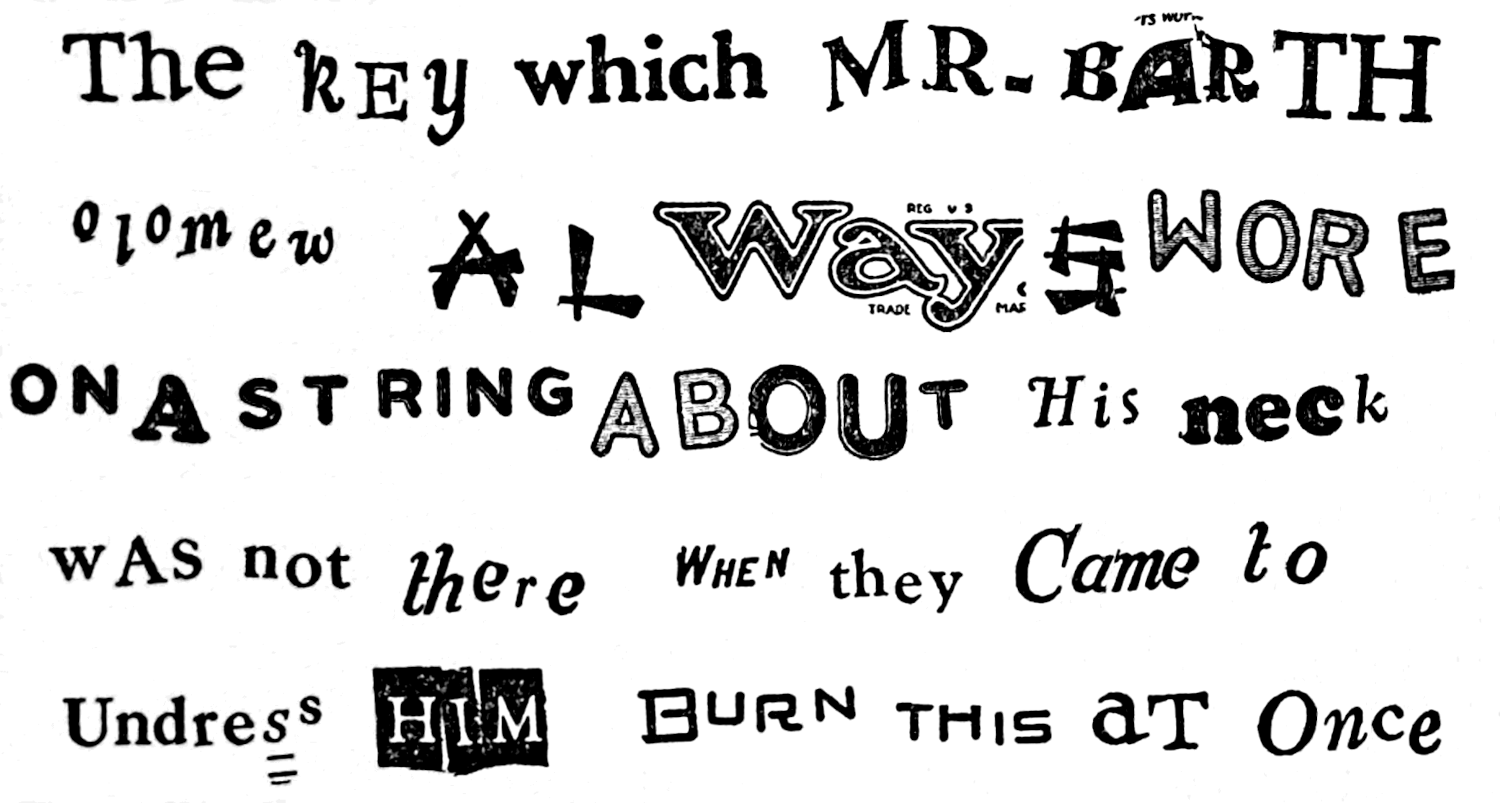
The kEy which MR. BARTH olomew ALWAYS WORE ON A STRING ABOUT His neck wAs not there WHEN they Came to Undress HIM BURN THIS aT Once
No signature; the letters, as shown above, had been cut carefully from some magazine or journal. Was it a trap laid by the police; or the well meant message of a friend? Alas! here was matter for fresh questioning and I was wearied to the last point of human endurance. I sat dazed, my brain in confusion, my faculties refusing to work. One thing only remained clear—that I was to burn this scrawl as soon as read. Well, I could do that. There was a fireplace in my room, sometimes used but oftener not. It had not been used that day, which had been a mild one. But that did not matter. The draught was good and would easily carry up and out of sight a shred of paper like this. But my hand shook as I set fire to it and watched it fly in one quick blaze up the chimney. As it disappeared and the last spark was lost in the blackness of the empty shaft, I seemed to have wakened from a dream in which I was myself a shadow amongst shadows, so remote was this incident and all the rest of this astounding drama from my natural self and the life I had hoped to live when I crossed the ocean to make my home in rich but commonplace America.
XXXIV
“Miss Bartholomew wishes me to say that she would be glad to see you at dinner.”
I stared stupidly from the open doorway at Haines standing respectfully before me. I was wondering if the note I had just burned had come from him. He had shown feeling and he had not shown me any antagonism. But the feeling was not for me, but for the master he had served almost as long as I was years old. So I ended in accepting his formality with an equal show of the same; and determined to be done with questions for this one night if no longer, I prepared myself for dinner and went down.
I found Orpha pacing slowly to and fro under the glow of the colored lamps which illuminated the fountain. Older but lovelier and nobler in the carriage of her body and in the steady look with which she met my advance.
Suddenly I stopped dead short. It was the first time I had entered her presence without a vivid sense of the barrier raised between us by the understanding under which we all met, that we were cousins and nothing more, till the word was given which should release us to be our natural selves again.
But the lift of one of her fingers, scarcely perceptible save to a lover’s eye, brought me back to reason. This was no time for breaking down that barrier, even if we were alone, which I now felt open to doubt, and my greeting had just that hesitation in it which one in my position would be likely to show to one in hers. Her attitude was kindly, nothing more, and Edgar presently relieved me of the embarrassment of further conversation by sauntering in from the conservatory side by side with Miss Colfax.
Remembering the scene between them to which I had been a witness on the night of the ball, I wondered at seeing them thus together; but perceiving by the bearing of all three that she was domiciled here as a permanent guest, this wonder was lost in another: why Orpha should not sense the secret with which, as I watched them, the whole air seemed to palpitate.
But then she had not had my opportunities for enlightenment.
A little old lady whom I had not seen before but who was evidently a much esteemed relative of the family made the fifth at the dinner table. Formality reigned. It was our only refuge from an embarrassment which would have made speech impossible. As it was, Miss Colfax was the only one who talked and what she said was of too little moment to be remembered. I was glad when the meal was at an end and I could with propriety withdraw.
Better the loneliest of rooms in the dreariest of hotels than this. Better a cell—Ah, no, no! my very soul recoiled. Not that! not that! I am afraid that I was just a little mad as I paused at the foot of the great staircase on my way up.
But I was sane enough the next moment. The front door had opened, admitting the Inspector. I immediately crossed the court to meet him. Accosting him, I said in explanation of my presence, “You see me here, Inspector; but if not detained, I shall seek other quarters to-morrow. I was very anxious to get back to my desk in New York, if the firm are willing to receive me. But whether there or here, I am always at your call till this dreadful matter is settled. Now if you have no questions to ask, I am going to my room, where I can be found at any minute.”
“Very good,” was his sole reply, uttered without any display of feeling; and, seeing that he wished nothing from me, I left him and went quickly upstairs.
I always dreaded the passage from the second floor to the third,—to-night more than ever. Not that I was affected by the superstitious idea connected by many with that especial flight of steps—certainly I was too sensible a man for that, though I had had my own experience too—but the dread of the acute memories associated with the doors I must pass was strong upon me, and it was with relief that I found myself at last in my own little hall, even if I had yet to hurry by the small winding staircase at the bottom of which was a listening ear acquainted with my every footfall.
Briskly as I had taken the turn from the main hall, I had had time to note the quiet figure of Wealthy seated in her old place—hands in lap—face turned my way—a figure of stone with all the wonted good humor and kindliness of former days stricken from it, making it to my eyes one of deliberate accusation. Was not this exactly what I had feared and dreaded to encounter? Yes, and the experience was not an agreeable one. But for all that it was not without its compensations. Any idea I may have had of her being the one to warn me that the key invariably carried by my uncle on his person was not to be found there at his death, was now definitely eliminated from my mind. She could not have shown this sympathy for me in my anomalous position and then eye me as she had just done with such implacable hostility.
My attention thus brought back to a subject which, if it had seemed to lie passive in my mind, had yet made its own atmosphere there during every distraction of the past hour, I decided to have it out with myself as to what this communication had meant and from whom it had come.
That it was no trap but an honest hint from some person, who, while not interested enough to show himself openly as my friend but who was nevertheless desirous of affording me what help he could in my present extremity, I was ready to accept as a self-evident truth. The difficulty—and it was no mean one, I assure you—was to settle upon the man or woman willing to take this secret stand.
Was it Clarke? I smiled grimly at the very thought.
Was it Orpha? I held my breath for a moment as I contemplated this possibility—the incredible possibility that this made-up, patched-up line of printed letters could have been the work of her hands. It was too difficult to believe this, and I passed on.
The undertaker’s man? That could easily be found out. But why such effort at concealment from an outsider? No, it was not the undertaker’s man. But who else was there in all the house who would have knowledge of the fact thus communicated to me in this mysterious fashion? Martha? Eliza? Haines? Bliss? The chef who never left his kitchen, all orders being conveyed to him by Wealthy or by telephone from the sick room?
No, no.
There was but one name left—the most unlikely of all—Edgar’s. Could it be possible—
I did not smile this time, grimly or otherwise, as I turned away from this supposition also. I laughed; and, startled by the sound which was such as had never left my lips before, I rose with a bound from my chair, resolved to drop the whole matter from my mind and calm myself by returning to my task of looking over and sorting out my effects. Otherwise I should get no sleep.
XXXV
What was it? It was hardly a noise, yet somebody was astir in the house and not very far from my door. Listening, I caught the sound of heavy breathing in the hall outside, and, slipping out of bed, crossed to the door and suddenly pulled it wide open.
A face confronted me, every feature distinct in the flood of moonlight pouring into the room from the opposite window. Alarm and repugnance made it almost unrecognizable, but it was the face of Edgar and no other, and, as in my astonishment I started backward, he spoke.
“I was told—they said—that you were ill—that groans were heard coming from this room. I—I am glad it is not so. Pardon me for waking you.” And he was gone, staggering slightly as he disappeared down the hall. A moment later I heard his voice raised further on, then a door slam and after that, quiet.
Confounded, for the man was shaken by emotion, I sat down on the edge of the bed and tried to compose my faculties sufficiently to understand the meaning of this surprising episode.
Automatically, I looked at my watch. It was just three. I had associations with that hour. What were they? Suddenly I remembered. It was the hour I visited my uncle’s door the night before his death, when Wealthy—
The name steadied the rush and counter-rush of swirling, not-to-be-controlled thoughts. Mr. Jackson had spoken of an experiment to be made by the police for the purpose of determining whether the shadow Wealthy professed to have seen about that time flitting by on the wall further down would be visible from the place where she stood.
Had they been trying this?
Had he been the one—
There was no thoroughfare in this direction. And wearied to death, I sank back on my pillow and after a few restless minutes fell into a heavy sleep.
XXXVI
Next day the thunderbolt fell. Entering Mr. Jackson’s office, I found him quite alone and waiting for me. Though the man was almost a stranger to me and I had very little knowledge of his face or its play of expression, I felt sure that the look with which he greeted me was not common to him and that so far as he was concerned, my cause had rather gained than lost in interest since our last meeting.
“You did not telephone me last night,” were his first words.
“No,” I said, “there was really no occasion.”
“Yet something very important happened in your house between three and four in the morning.”
“I thought so; I hoped so; but I knew so little what, that I dared not call you up for anything so indefinite. This morning life seems normal again, but in the night—”
“Go on, I want to hear.”
“My cousin, Edgar, came to my door in a state of extreme agitation. He had been told that I was ill. I was not; but say that I had been, I do not see why he should have been so affected by the news. I am a trial to him; an incubus; a rival whom he must hate. Why should he shiver at sight of me and whirl away to his room?”
“It was odd. You had heard nothing previously, then?”
“No, I was fortunate enough to be asleep.”
“And this being a silent drama you did not wake.”
“Not till the time I said.”
He was very slow, and I very eager, but I restrained myself. The peculiarity observable in his manner had increased rather than diminished. He seemed on fire to speak, yet unaccountably hesitated, turning away from my direct gaze and busying himself with some little thing on his desk. I began to feel hesitant also and inclined to shirk the interview.
And now for a confession. There was something in my own mind which I had refused to bare even to my own perceptions. Something from which I shrank and yet which would obtrude itself at moments like these. Could it be that I was about to hear, put in words, what I had never so much as whispered to myself?
It was several minutes later and after much had been said before I learned. He began with explanations.
“A woman is the victim of her own emotions. On that night Wealthy had been on the watch for hours either in the hall or in the sick room. She had seen you and another come and go under circumstances very agitating to one so devoted to the family. She was, therefore, not in a purely normal condition when she started up from her nap to settle a question upon which the life of a man might possibly hang.
“At least this was how the police reasoned. So they put off the experiment upon which they were resolved to an hour approximately the same in which the occurrence took place which they were planning to reproduce, keeping her, in the meantime, on watch for what interested her most. Pardon me, it was in connection with yourself,” he commented, flashing me a look from under his shaggy brows. “She has very strong beliefs on that point—strong enough to blind her or—” he broke off suddenly and as suddenly went on with his story. “Not till in apparent solitude she had worked herself up to a fine state of excitement did the Inspector show himself, and with a fine tale of the uselessness of expecting anything of a secret nature to take place in the house while her light was still burning and her figure guarded the hall, induced her to enter the room from which she might hope to see a repetition of what had happened on that fatal night. I honor the police. We could not do without them;—but their methods are sometimes—well, sometimes a little misleading.
“After another half hour of keen expectancy, during which she had not dozed, I warrant, there came the almost inaudible sound of the knob turning in the upper door. Had she been alone, she would have screamed, but the Inspector’s hand was on her arm and he made his presence felt to such a purpose that she simply shuddered, but that so violently that her teeth chattered. A fire had been lit on the hearth, for it was by the light thus given that she had seen what she said she had seen that night. Also, the curtains of the bed had been drawn back as they had not been then but must be now for her to see through to the shelf where the glass of medicine had been standing. Her face, as she waited for whomever might appear there, was one of bewilderment mingled with horror. But no one appeared. The door had been locked and all that answered that look was the impression she received of some one endeavoring to open it.
“As shaken by these terrors, she turned to face the Inspector, he pressed her arm again and drew her towards the door by which they had entered and from which she had seen the shadow she had testified to before the Coroner. Stepping the length of the passage-way intervening between the room and the door itself, he waited a moment, then threw the latter open just as the shadow of a man shot through the semi-darkness across the opposite wall.
“‘Do you recognize it?’ the Inspector whispered in her ear. ‘Is it the same?’
“She nodded wildly and drew back, suppressing the sob which gurgled in her throat.
“‘The Englishman?’ he asked again.
“Again she nodded.
“Carefully he closed the door; he was himself a trifle affected. The figure which had fled down the hall was that of the man who had just been told that you were ill in your room. I need not name him.”
XXXVII
Slowly I rose to my feet. The agitation caused by these words was uncontrollable. How much did he mean by them and why should I be so much more moved by hearing them spoken than by the suppressed thought?
He made no move to enlighten me, and, walking again to the window, I affected to look out. When I turned back it was to ask:
“What do you make of it, Mr. Jackson? This seems to place me on a very different footing; but—”
“The woman spoke at random. She saw no shadow. Her whole story was a fabrication.”
“A fabrication?”
“Yes, that is how we look at it. She may have heard some one in the room—she may even have heard the setting down of the glass on the shelf, but she did not see your shadow, or if she did, she did not recognize it as such; for the light was the same and so was every other condition as on the previous night, yet the Inspector standing at her side and knowing well who was passing, says there was nothing to be seen on the wall but a blur; no positive outline by which any true conclusion could be drawn.”
“Does she hate me so much as that? So honest a woman fabricate a story in order to involve me in anything so serious as crime?” I could not believe this myself.
“No, it was not through hate of you; rather through her great love for another. Don’t you see what lies at the bottom of her whole conduct? She thinks—”
“Don’t!” The word burst from me unawares. “Don’t put it into words. Let us leave some things to be understood, not said.” Then as his lips started to open and a cynical gleam came into his eyes, I hurriedly added: “I want to tell you something. On the night when the question of poison was first raised by the girl Martha’s ignorant outbreak over her master’s casket, I was standing with Miss Bartholomew in the balcony; Wealthy was on her other side. As that word rang up from the court, Miss Bartholomew fainted, and as I shrieked out some invective against the girl for speaking so in her mistress’ presence, I heard these words hissed into my ear. ‘Would you blame the girl for what you yourself have brought upon us?’ It was Wealthy speaking, and she certainly hated me then. And,” I added, perhaps with unnecessary candor, “with what she evidently thought very good reason.”
At this Mr. Jackson’s face broke into a smile half quizzical and half kindly:
“You believe in telling the truth,” said he. “So do I, but not all of it. You may feel yourself exonerated in the eyes of the police, but remember the public. It will be uphill work exonerating yourself with them.”
“I know it; and no man could feel the sting of his position more keenly. But you must admit that it is my duty to be as just to Edgar as to myself. Nay, more so. I know how much my uncle loved this last and dearest namesake of his. I know—no man better—that if what we do not say and must not say were true, and Uncle could rise from his grave to meet it, it would be with shielding hands and a forgiveness which would demand this and this only from the beloved ingrate, that he should not marry Orpha. Uncle was my benefactor and in honor to his memory I must hold the man he loved innocent unless forced to find him otherwise. Even for Orpha’s sake—”
“Does she love him?”
The question came too quickly and the hot flush would rise. But I answered him.
“He is loved by all who know him. It would be strange if his lifelong playmate should be the only one who did not.”
“Deuce take it!” burst from the irate lawyer’s lips, “I was speaking of a very different love from that.”
And I was thinking of a very different one.
The embarrassment this caused to both of us made a break in the conversation. But it was presently resumed by my asking what he thought the police were likely to do under the circumstances.
He shot out one word at me.
“Nothing.”
“Nothing?” My face brightened, but my heart sank.
“That is, as I feel bound to inform you, this is one of those cases where a premature move would be fatal to official prestige. The Bartholomews are held in much too high esteem in this town for thoughtless attack. The old gentleman was the czar of this community. No one more respected and no one more loved. Had his death been attributed to the carelessness or aggression of an outsider, no one but the Governor of the state could have held the people in check. But the story of the two wills having got about, suspicion took its natural course; the family itself became involved—an enormity which would have been inconceivable had it not been that the one suspected was the one least known and—you will pardon me if I speak plainly, even if I touch the raw—the one least liked: a foreigner, moreover, come, as all thought, from England on purpose to gather in this wealth. You felt their animosity at the inquest and you also must have felt their restraint; but had any one dared to say of Edgar what was said of you, either a great shout of derisive laughter would have gone up or hell would have broken loose in that court-room. With very few exceptions, no one there could have imagined him playing any such part. And they cannot to-day. They have known him too long, admired him too long, seen him too many times in loving companionship with the man now dead to weigh any testimony or be moved by any circumstance suggestive of anything so flagrant as guilt of this nature. The proof must be absolute before the bravest among us would dare assail his name to this extent. And the proof is not absolute. On the contrary, it is very defective; for so far as any of us can see, the crime, if perpetrated by him, lacks motive. Shall I explain?”
“Pray do. Since we have gone thus far, let us go the full length. Light is what I want; light on every angle of this affair. If it serves to clear him as it now seems it has served to clear me, I shall rejoice.”
Mr. Jackson, with a quick motion, held out his hand. I took it. We were friends from that hour.
“First, then,” continued the lawyer, “you must understand that Edgar has undergone a rigid examination at the hands of the police. This may not have appeared at the inquest but nevertheless what I say is true. Now taking his story as a basis, we have this much to go upon:
“He has always been led to believe that his future had been cut out for him according to the schedule universally understood and accepted. He was not only to marry Orpha, but to inherit personally the vast fortune which was to support her in the way to which she is entitled. No doubt as to this being his uncle’s intention—an intention already embodied in a will drawn up by Mr. Dunn—ever crossed his mind till you came upon the scene; and not then immediately. Even the misunderstanding with his uncle, occasioned, as I am told, by Mr. Bartholomew learning of some obligations he had entered into of which he was himself ashamed, failed to awaken the least fear in his mind of any change in his uncle’s testamentary intentions, or any real lessening of the affection which had prompted these intentions. Indeed, so much confidence did he have in his place in his uncle’s heart that he consented, almost with a smile, to defer the announcement of what he considered a definite engagement with Orpha, because he saw signs of illness in his uncle and could not think of crossing him. But he had no fear, as I have said, that all would not come right in time and the end be what it should be.
“Nor did his mind change with the sudden signs of favor shown by his uncle towards yourself. The odd scheme of sharing with you, by a definite arrangement, the care which your uncle’s invalid condition soon called for, he accepted without question, as he did every other whim of his autocratic relative. But when the servants began to talk to him of how much writing his uncle did while lying in his bed, and whispers of a new will, drawn up in your absence as well as in his began to circulate through the house, he grew sufficiently alarmed to call on Mr. Dunn at his office and propound a few inquiries. The result was a complete restoration of his tranquillity; for Mr. Dunn, having been kept in ignorance of another lawyer having visited Quenton Court immediately upon his departure, and supposing that the will he had prepared and seen attested was the last expression of Mr. Bartholomew’s wishes, gave Edgar such unqualified assurances of a secured future that he naturally was thrown completely off his balance when on the night which proved to be Mr. Bartholomew’s last, he was summoned to his uncle’s presence and was shown not only one new will but two, alike in all respects save in the essential point with which we are both acquainted. Now, as I am as anxious as you are to do justice to the young man, I will say that if your uncle was looking for any wonderful display of generosity from one who saw in a moment the hopes of a lifetime threatened with total disaster, then he was expecting too much. Of course, Edgar rebelled and said words which hurt the old gentleman. He would not have been normal otherwise. But what I want to impress upon you in connection with this interview is this. He left the room with these words ringing in his ears, ‘Now we will see what your cousin has to say. When he quits me, but one of these two wills will remain, and that one you must make up your mind to recognize.’ Therefore,” and here Mr. Jackson leaned towards me in his desire to hold my full attention, “he went from that room with every reason to fear that the will to be destroyed was the one favoring himself, and the one to be retained that which made you chief heir and the probable husband of Orpha. Have we heard of anything having occurred between then and early morning to reverse the conclusions of that moment? No. Then why should he resort to crime in order to shorten the few remaining days of his uncle’s life when he had every reason to believe that his death would only hasten the triumph of his rival?”
I was speechless, dazed by a fact that may have visited my mind, but which had never before been clearly formulated there! Seeing this, the lawyer went on to say:
“That is why our hands are held.”
Still I did not speak. I was thinking. What I had said we would not do had been done. The word crime had been used in connection with Edgar, and I had let it pass. The veil was torn aside. There was no use in asking to have it drawn to again. I would serve him better by looking the thing squarely in the face and meeting it as I had met the attack against myself, with honesty and high purpose. But first I must make some acknowledgment of the conclusion to which this all pointed, and I did it in these words.
“You see! The boy is innocent.”
“I have not said that.”
“But I have said it.”
“Very good, you have said it; now go on.”
This was not so easy. But the lawyer was waiting and watching me and I finally stammered forth:
“There is some small fact thus far successfully suppressed which when known will change the trend of public opinion and clarify the whole situation.”
“Exactly, and till it is, we will continue the search for the will which I honestly believe lies hidden somewhere in that mysterious house. Had he destroyed it during that interval in which he was left alone, there would have been some signs left in the ashes on the hearth; and Wealthy denies seeing anything of the sort when she stooped to replenish the fire that night, and so does Clarke, who, at Edgar’s instigation, took up the ashes after their first failure to find the will and carefully sifted them in the cellar.”
“I have been wondering if they did that.”
“Well, they did, or so I have been told. Besides, you must remember the look of consternation, if not of horror, which crossed your uncle’s face as he felt that death was upon him and he could no longer speak. If he had destroyed both wills, the one when alone, the other in the face of you all, he would have shown no such emotion. He had simply been eliminating every contestant save his daughter—something which should have given him peace.”
“You are right. And as for myself I propose to keep quiet, hoping that the mystery will soon end. Do you think that the police will allow me to leave town?”
“Where do you want to go?”
“Back to work; to my desk at Meadows & Waite in New York.”
“I don’t think that I would do that. You will meet with much unpleasantness.”
“I must learn to endure cold looks and hypocritical smiles.”
“But not unnecessarily. I would advise you to take a room at the Sheldon; live quietly and wait. If you wish to write a suitable explanation to your firm, do so. There can be no harm in that.”
My heart leaped. His advice was good. I should at least be in the same town as Orpha.
“There is just one thing more,” I observed, as we were standing near his office door preparatory to my departure. “Did Edgar say whether he saw the wills themselves or, like myself, only the two envelopes presumably holding them?”
He was shown them open. Mr. Bartholomew took them one after the other from their envelopes and, spreading them out on the desk, pointed out the name of Edgar Quenton, the son of my brother, Frederick, on the one, and Edgar Quenton, the son of my brother, James, on the other, and so stood with his finger pressed on the latter while they had their little scene. When that was over, he folded the two wills up again and put them back in their several envelopes, all without help, Edgar looking on, as I have no doubt, in a white heat of perfectly justifiable indignation. “Can’t you see the picture?”
I could and did, but I had no disposition to dwell on it. A question had risen in my mind to which I must have an answer.
“You speak of Edgar looking on. At what, may I ask? At Uncle’s handling of the wills or in a general way at Uncle himself?”
“He said that he kept his eye on the two wills.”
“Oh! and did he note into which envelope the one went in which he was most interested,—the one favoring himself?”
“Yes, but the envelopes were alike, neither being marked at that time, and as his uncle jumbled them together in his hands, this did not help him or us.”
“Ah, the red mark was put on later?”
“Yes. The pencil with which he did it was found on the floor.”
I tried to find a way through these shadows,—to spur my memory into recalling the one essential thing which would settle a very vexing question—but I was obliged to give it up with the acknowledgment:
“That mark was in the corner of one of the envelopes at the time I saw them; but I do not know which will it covered. God! what a complication!”
“Yes. No daylight yet, my boy. But it will come. Some trivial matter, unseen as yet, or if seen regarded as of no account, will provide us with a clew, leading straight to the very heart of this mystery. I believe this, and you must, too; otherwise you will find your life a little hard to bear.”
I braced myself. I shrank unaccountably from what I felt it to be my present duty to communicate. I always did when there was any possibility of Orpha’s name coming up.
“Some trivial matter? An unexpected clew?” I repeated. “Mr. Jackson, I have been keeping back a trivial matter which may yet prove to be a clew.”
And I told him of the note made up of printed letters which I had found in my box of cigars.
He was much interested in it and regretted exceedingly that I had obeyed the injunction to burn it.
“From whom did this communication come?”
That I could not answer. I had my own thoughts. Much thinking and perhaps much hoping had led me to believe that it was from Orpha; but I could not say this to him. Happily his own thoughts had turned to the servants and I foresaw that sooner or later they were likely to have a strenuous time with him. As his brows puckered and he seemed in imagination to have them already under examination, I took a sudden resolution.
“Mr. Jackson, I have heard—I have read—of a means now in use in police investigation which sometimes leads to astonishing results.” I spoke hesitatingly, for I felt the absurdity of my offering any suggestion to this able lawyer. “The phial which held the poison was handled—must have been handled. Wouldn’t it show finger-prints—”
The lawyer threw back his head with a good-natured snort and I stopped confused.
“I know that it is ridiculous for me,” I began—
But he cut me short very quickly.
“No, it’s not ridiculous. I was just pleased; that’s all. Of course the police made use of this new method of detection. Looked about for finger-prints and all that and found some, I have been told. But you must remember that two days at least elapsed between Mr. Bartholomew’s death and any suspicion of foul play. That such things as the glass and other small matters had all been removed and—here is the important point; the most important of all,—that the cabinet which held the medicines had been visited and the bottle labeled dangerous touched, if not lifted entirely out, and that by more than one person. Of course, they found finger-prints on it and on the woodwork of the cabinet, but they were those of Orpha, Edgar and Wealthy who rushed up to examine the same at the first intimation that your uncle’s death might have been due to the use of this deadly drug. And now you will see why I felt something like pleasure at your naïve mention of finger-prints. Of all the persons who knew of the location and harmful nature of this medicine, you only failed to leave upon the phial this irrefutable proof of having had it in your hand. Now you know the main reason why the police have had the courage to dare public opinion. Your finger-prints were not to be found on anything connected with that cabinet.”
“My finger-prints? What do they know of my finger-prints. I never had them taken.”
Again that characteristic snort.
“You have had a personal visit, I am told, from the Inspector. What do you think of him? Don’t you judge him to be quite capable of securing an impression of your finger-tips, if he so desired, during the course of an interview lasting over two hours?”
I remembered his holding out to me a cigarette case and urging me to smoke. Did I do so? Yes. Did I touch the case? Yes, I took it in hand. Well, as it had done me no harm, I could afford to smile and I did.
“Yes, he is quite capable of putting over a little thing like that. Bless him for it.”
“Yes, you are a fortunate lad to have won his good will.”
I thought of Edgar and of the power which, seemingly without effort, he exercised over every kind of person with whom he came in contact, and was grateful that in my extremity I had found one man, if not two, who trusted me.
Just a little buoyed up by my success in this venture, I attempted another.
“There is just one thing more, Mr. Jackson. There is a name which we have not mentioned—that is, in any serious connection,—but which, if we stop to think, may suggest something to our minds worthy of discussion. I mean—Clarke’s. Can it be that under his straightforward and devoted manner he has held concealed jealousies or animosities which demanded revenge?”
“I have no acquaintance with the man; but I heard the Inspector say that he wished every one he had talked to about this crime had the simple candor and quiet understanding of Luke Clarke. Though broken-hearted over his loss, he stands ready to answer any and all questions; declaring that life will be worth nothing to him till he knows who killed the man he has served for fifteen years. I don’t think there is anything further to be got out of Clarke. The Inspector is positive that there is not.”
But was I? By no means. I was not sure of anything but Orpha’s beauty and worth and the love I felt for her; and vented my dissatisfaction in the querulous cry:
“Why should I waste your time any longer? I have nothing to offer; nothing more to suggest. To tell the truth, Mr. Jackson, I am all at sea.”
And he, being, I suspect, somewhat at sea himself, accepted my “Good day,” and allowed me to go.
XXXVIII
“There is some small fact thus far successfully suppressed, which, when known, will alter the trend of public opinion and clarify the whole situation.”
A sentence almost fatuous in its expression of a self-evident truth. One, too, which had been uttered by myself. But foolish and fatuous as it was, it kept ringing on in my brain all that day and far into the night, until I formulated for myself another one less general and more likely to lead to a definite conclusion:
“Something occurred between the hour I left Uncle’s room and my visit to his door at three o’clock in the morning which from its nature was calculated to make Edgar indifferent to the destruction of the will marked with red and Wealthy so apprehensive of harm to him that to save him from the attention of the police she was willing to sacrifice me and perjure herself before the Coroner.” What was it?
You see from declining to connect Edgar with this crime, I had come to the point of not only admitting the possibility of his guilt, but of arguing for and against it in my own mind. I had almost rather have died than do this; but the word having once passed between me and Mr. Jackson, every instinct within me clamored for a confutation of my doubt or a confirmation of it so strong that my duty would be plain and the future of Orpha settled as her father would have it.
To repeat then: to understand this crime and to locate the guilty hand which dropped poison into the sick man’s soothing mixture it was necessary to discover what had happened somewhere in the house between the hours I have mentioned, of sufficient moment to account for Edgar’s attitude and that of the faithful Wealthy.
But one conjecture suggested itself after hours of thought. Was it not possible that while I was below, Clarke in his room, and Wealthy in Orpha’s, that Edgar had made his way for the second time into his uncle’s presence, persuaded him to revoke his decision and even gone so far as to obtain from him the will adverse to his own hopes?
Thus fortified, but still fearful of further vacillation on the part of one whose mind, once so strong, seemed now to veer this way or that with every influence brought to bear upon it, what more natural than, given a criminal’s heart, he should think of the one and only way of ending this indecision and making himself safe from this very hour.
A glass of water—a drop of medicine from the bottle labeled dangerous—a quick good-night—and a hasty departure!
It made the hair stir on my forehead to conceive of all this in connection with a man like Edgar. But my thoughts, once allowed to enter this groove, would run on.
The deed is done; now to regain his room. That room is near. He has but to cross the hall. A few steps and he is at the stair-head,—has passed it, when a noise from below startles him, and peering down, he sees Wealthy coming up from the lower floor.
Wealthy! ready to tell any story when confronted as she soon would be by the fact that death had followed his visit—death which in this case meant murder.
It was base beyond belief: hardly to be thought of, but did it not explain every fact?
I would see.
First, it accounted for the empty envelope and the disappearance of the will which it had held. Also for the fact that this will could not be found in any place accessible to a man too feeble to leave his own room. It had been given to Edgar and he had carried it away.
(Had they searched his room for it? They had searched mine and they had searched me. Had they been fair enough to search his room and to search him?)
Secondly: Edgar’s restlessness on that fatal night. The watch he kept on Uncle’s door. The interest he had shown at seeing me there and possibly his reluctance to incriminate me by any absolute assertion which would link me to a crime which he, above all others, knew that I had not committed.
Thirdly: the comparative calmness with which he saw his uncle, still undecided, or what was fully as probable, confused in mind by his sufferings and the near approach of death, order the destruction of the remaining will, to preserve which and make it operative he had risked the remorse of a lifetime. He knew that with both wills gone, the third and original one which at that time he believed to be still in existence would secure for him even more than the one he saw being consumed before his eyes, viz.: the undisputed possession of the Bartholomew estate.
So much for the time preceding the discovery that crime and not the hazard of disease had caused our uncle’s sudden death. How about Edgar’s conduct since? Was there anything in that to dispute this theory?
Not absolutely. Emotion, under circumstances so tragic, would be expected from him; and with his quick mind and knowledge of the worshipful affection felt for him by every member of the household, he must have had little fear of any unfortunate results to himself and a most lively recognition of where the blame would fall if he acted his part with the skill of which he was the undoubted master.
There was but one remote possibility which might turn the tables. Perhaps, it came across him like a flash; perhaps, he had thought of it before, but considered it of no consequence so long as it was the universally accepted belief that Uncle had died at natural death.
And this brings us to Fourthly:
Was it in accordance with my theory or the reverse, for him, immediately and before the doctor could appear, to rush upstairs in company with Orpha and Nurse Wealthy to inspect the cabinet where the medicines were kept?
In full accordance with my theory. Knowing that he must have left finger-marks there on bottle or shelf, he takes the one way to confound suspicion: adds more of his own, and passes the phial into the hands of the two who accompanied him on this very excusable errand.
Was there any other fact which I could remember which might tip the scale, so heavily weighted, even a trifle the other way?
Yes, one—a big one. The impossibility for me even now to attribute such deviltry to a man who had certainly loved the victim of this monstrous crime.
As I rose from this effort to sound the murky depths into which my thoughts had groveled in spite of myself and all the proprieties, I found by the strong feeling of revulsion which made the memory of the past hour hateful to me, that I could never pursue the road which I had thus carefully mapped out for myself. That, innocent or guilty, Edgar Quenton Bartholomew, beloved by our uncle, was sacred in my eyes because of that love, and that whatever might be done by others to fix this crime upon him, I could do nothing—would do nothing to help them even if I must continue to bear to the very end the opprobrium under which I now labored.
And Orpha? Had I forgotten my fears for her—the duty I had felt to preserve her from a step which might mean more than unhappiness—might mean shame?
No; but in that moment of decision made for me by my own nature, the conviction had come that I need not be apprehensive of Orpha marrying Edgar or marrying me while this question between us remained unsettled.
She would be neutral to the end, aye, even if her heart broke. I knew my darling.
In this mood and in this determination I remained for two weeks. I tried to divert myself by reading, and I think my love for books which presently grew into a passion had its inception in that monotonous succession of day after day without a break in the suspense which held me like a hand upon my throat.
I was not treated ill, I was simply boycotted. This made it unpleasant for me to walk the streets, though I never hesitated to do so when I had a purpose in view.
Of Orpha I heard little, though now and then some whiff of gossip from Quenton Court would reach me. She had filled the house with guests, but there was no gayety. The only young person among them was Lucy Colfax, who was preparing for her wedding. The rest were relatives of humble means and few pleasures to whom life amid the comforts and splendors of Quenton Court was like a visit to fairyland. Edgar had followed my example and taken up his abode in one of the hotels. But he spent most of his evenings at the house where he soon became the idol of the various aunts and cousins who possibly would never have honored me with anything beyond a certain civility.
Ere long I heard of his intention to leave town. With his position no better defined than it was, he found C—— intolerable.
I wondered if they would let him go! By they I meant the police. If they did, I meant to go too, or at least to make an effort to do so. I wanted to work. I wanted to feel my manhood once again active. I wrote to the firm in whose offices I had a desk.
This is my letter robbed of its heading and signature.
I am well aware in what light I have been held up to the public by the New York press. No one accuses me, yet there are many who think me capable of a great crime. If this were true I should be the most despicable of men. For my uncle was my good friend and made a man of me out of very indifferent material. I revered him and as my wish was to please him while he was living so it is my present desire to do as he would have me do now that he is gone.
If on the receipt of this you advise me not to come, I shall not take it as an expression of disbelief in what I have said but as a result of your kindly judgment that my place is in my home town so long as there is any doubt of the innocency of my relations towards my uncle.
This dispatched, I waited three days for a response. Then I received this telegram:
Come.
Going immediately to Headquarters, I sought out the Inspector and showed him this message.
“Shall I go or shall I not?” I asked.
He did not answer at once; seemed to hesitate and finally left the room for a few minutes. When he came back he smiled and said:
“My answer is yes. You are young. If you wait for full justification in this case, you may have to wait a lifetime. And then again you may not.”
I wrung his hand and for the next hour forgot everything but the manner in which I would make the attempt to see Orpha. I could not leave without a word of farewell to the one being for whose sake I kept my soul from despair.
I dared not call without permission. I feared a rebuff at the front door; Orpha would certainly be out. Again, I might write and she might get the letter, but I could not be sure. Bliss handled the mail and—and—Of course I was unreasonably suspicious, but it was so important for me to reach her very self, or to know that any refusal or inability to see me came from her very self, that I wished to take every precaution. In pursuance of this idea I ran over the list of servants to see if there was one who in my estimation could be trusted to hand her a note. From Wealthy down I named them one by one and shook my head over each. Discouraged, I rose and went out and almost at the first corner I ran upon Clarke.
What came over me at the sight of his uncompromising countenance I do not know, but I stopped him and threw myself upon his mercy. It was an act more in keeping with Edgar’s character than with mine, and I cannot account for it save by the certainty I possessed that if he did not want to do what I requested, he would say so. He might be blunt, even accusing, but he would not be insincere or play me false.
“Clarke, well met.” Thus I accosted him. “I am going to leave town. I may come back and I may not. Will you do me this favor? I am very anxious to have Miss Bartholomew know that I greatly desire to say good-by to her, but hardly feel at liberty to telephone. If she is willing to see me I shall feel honored.”
“I have left Quenton Court for the present,” he objected. “I hope to return when it has a master.”
If he noticed my emotion at this straightforward if crude statement, he gave no sign of having done so. He simply remained standing like a man awaiting orders, and I hastened to remark:
“But you will be going there to see your old friends, to-day possibly, to-night at latest if you have any good reason for it.”
“Yes, I have still a trunk or two there. I will call for them to-night, and I will give Miss Orpha your message. Where shall I bring the reply?”
I told him and he walked off, erect, unmoved, and to all appearance totally unconscious of the fact—or if conscious of it totally unaffected by it—that he had thrown a ray of light into a cavern of gloom, and helped a man to face life again who had almost preferred death.
Evening came and with it a telephone message.
“She will see you to-morrow morning at eleven.”
XXXIX
What should I say to her? How begin? How keep the poise due to her and due to myself, with her dear face turned up to mine and possibly her hand responding to my clasp?
Futile questions. When I entered her presence it was to find that my course was properly marked out. She was not alone. Lucy Colfax was with her and the greeting I received from the one was dutifully repeated by the other. I was caught as in a trap; but pride came to my rescue, coupled with a recognition of the real service she was doing me in restraining me to the formalities of a friendly call.
But I would not be restrained too far. What in my colder moments I had planned to say, I would say, even with Lucy Colfax standing by and listening. Lucy Colfax! whose story I knew much better than she did mine.
“Cousin Orpha,” I began, with a side glance at Miss Colfax which that brilliant brunette did not take amiss, “I am going almost immediately to New York to take up again the business in which I was occupied when all was well here and my duty seemed plain. Inspector Redding has my address and I will always be at his call. And at that of any one else who wants me for any service worth the journey. If you—” a little catch in my voice warned me to be brief. “If you have need of me, though it be but a question you want answered, I will come as readily as though it were a peremptory summons. I am your cousin and there is no reason in the world why I should not do a cousin’s duty by you.”
“None,” she answered. But she did not reach out her hand. Only stood there, a sweet, sane woman, bidding good-by to a friend.
I honored her for her attitude; but my heart bade me begone. Bowing to Miss Colfax whose eyes I felt positive had never left my face, I tried to show the same deference to Orpha. Perhaps I succeeded but somehow I think I failed, for when I was in the street again all I could remember was the surprised look in her eyes which yet were the sweetest it had ever been my good fortune to meet.
XL
It was a dream,—nothing else—but it made a very strong impression upon me. I could not forget it, though I was much occupied the next morning and for several days afterwards. It was so like life and the picture it left behind it was so vivid.
What was the picture? Just this; but as plain to my eye as if presented to it by a motion-picture film. Orpha, standing by herself alone, staring at some object lying in her open palm. She was dressed in white, not black. This I distinctly remember. Also that her hair which I had never seen save when dressed and fastened close to her head, lay in masses on her shoulders. A picture of loveliness but of great mental perplexity also. She was intrigued by what she was looking at. Astonishment was visible on her features and what I instinctively interpreted as alarm gave a rigidity to her figure far from natural to it.
Such was my dream; such the picture which would not leave me, nor explain itself for days.
I had got well into the swing of work and was able, strange as it may seem, to hold my own in all business matters, notwithstanding the personal anxieties which devoured my mind and heart the moment I was released from present duty. I had received one or two letters from Mr. Jackson, which while encouraging in a general way, added little to my knowledge of how matters in which I was so concerned were progressing in C——. Edgar was no longer there. In fact, he was in the same city as myself, but for what purpose or where located he could not tell me. The press had ceased covering the first page with unmeaning headlines concerning a tragedy which offered no new features; and although there was a large quota of interested persons who inveighed against the police for allowing me to leave town, there were others, the number of which was rapidly growing, who ventured to state that time and effort, however aided by an inexhaustible purse, would fail to bring to light any further explanation of their leading citizen’s sudden death, for the very good reason that there was nothing further to bring out,—the doctor’s report having been a mistaken one, and the death simply natural,—that is, the result of undue excitement.
“But there remain some few things of which the public is ignorant.”
In this manner Mr. Jackson ended his last letter.
XLI
There remain some few things of which the public is ignorant. This was equally true of the police, or some move would have been made by them before this.
The clew afforded by the disappearance simultaneously with that of the will of a key considered of enough importance by its owner to have been kept upon his person had evidently led to nothing. This surprised me, for I had laid great store by it; and it was after some hours of irritating thought on this subject that I had the dream with which I have opened this account of a fresh phase in my troubled life.
Perhaps, the dream was but a natural sequence of the thought which had preceded it. I was willing to believe so. But what help was there in that? What help was there for me in anything but work; and to my work I went.
But with evening came a fresh trial. I was walking up Broadway when I ran almost into the arms of Edgar. He recoiled and I recoiled, then, with a quick nod, he hurried past, leaving behind him an impression which brought up strange images. A blind prisoner groping in the dark. A marooned sailor searching the boundless waste for a ship which will never show itself above the horizon. A desert wanderer who sees the oasis which promises the one drop of water which will save him fade into ghastly mirage. Anything, everything which bespeaks the loss of hope and the approach of doom.
I was struck to the heart. I tried to follow him, when, plainly before me—as plainly as he had himself appeared a moment previous, I saw her standing in a light place looking down at something in her hand, and I stopped short.
When I was ready to move on again, he was gone, leaving me very unhappy. The gay youth, the darling of society, the beloved of the finest, of the biggest-natured, and, above all, of the tenderest heart I knew—come to this in a few short weeks! As God lives, during the days while the impression lay strongest upon me, I could have cursed the hour I left my own country to be the cause, however innocently, of such an overthrow.
That he had shown signs of dissipation added poignancy to my distress. Self-indulgence of any kind had never been one of his failings. The serpent coiled about his heart must be biting deep into its core to drive one so fastidious into excess.
Three days later I saw him again. Strange as this may seem in a city of over a million, it happened, and that is all there is to it. I was passing down Forty-second Street on my way to the restaurant I patronized when he turned the corner ahead of me and moved languidly on in the same direction. I had still a block to walk, so I kept my pace, wondering if he could possibly be bound for the same eating-place, which, by the way, was the one where we had first met. If so, would it be well for me to follow; and I was yet debating this point when I saw another man turn that same corner and move along in his wake some fifty feet behind him and some thirty in front of me.
This was a natural occurrence enough, and would not even have attracted my attention if there had not been something familiar in this man’s appearance—something which brought vividly to mind my former encounter with Edgar on Broadway. What was the connection? Then suddenly I remembered. As I shook myself free from the apathy following this startling vision of Orpha which, like the clutch of a detaining hand, had hindered my mad rush after Edgar, I found myself staring at the face of a man brushing by me with a lack of ceremony which showed that he was in a hurry if I was not. He was the same as the one now before me walking more and more slowly but still holding his own about midway between us two. No coincidence in this. He was here because Edgar was here, or—I had to acknowledge it to myself—because I was here, always here at this time in the late afternoon.
I did not stop to decide on which of us two his mind was most set—on both perhaps—but pursued my course, entering the restaurant soon after the plain clothes man who appeared to be shadowing us.
Edgar was already seated when I stepped in, but in such a remote and inconspicuous corner that the man who had preceded me had to look covertly in all directions before he espied him. When he did, he took a seat near the door and in a moment was lost to sight behind the newspaper which he had taken from his pocket. There being but one empty seat, I took it. It, too, was near the door.
It seemed a farce to order a meal under these circumstances. But necessity knows no law; it would not do to appear singular. And when my dinner was served, I ate it, happy that I was so placed that I could neither see Edgar nor he me.
The man behind the newspaper, after a considerable wait, turned his attention to the chafing-dish which had been set down before him. Fifteen minutes went by; and then I saw from a sudden movement made by this man that Edgar had risen and was coming my way. Though there was some little disturbance at the time, owing to the breaking up of a party of women all seeking egress through the same narrow passage, it seemed to me that I could hear his footsteps amid all the rest, and waited and watched till I saw our man rise and carelessly add himself to the merry throng.
As he went by me, I was sure that he gave me one quick look which did not hinder me from rising, money in hand, for the waiter who fortunately stood within call.
My back was to the passage through which Edgar must approach, but I was sure that I knew the very instant he went by, and was still more certain that I should not leave the place without another encounter with him, eye to eye.
But this was the time when my foresight failed me. He did not linger as usual to buy a cigar, and so was out of the door a minute or two before me. When I felt the pavement under my feet and paused to look for him in the direction from which he had come, it was to see him going the other way, nonchalantly followed by the man I had set down in my mind as an agent of police.
That he really was such became a surety when they both vanished together around the next corner. Edgar was being shadowed. Was I? I judged not; for on looking back I found the street to be quite clear.
XLII
That night, the vision came for the third time of Orpha gazing intently down at her open palm. It held me; it gripped me till, bathed in sweat, I started up, assured at last of its actual meaning. It was the key, the missing key that was offered to my view in my darling’s grasp. She had been made the repositor of it—or she had found it—and did not know what to do with it. I saw it all, I was practical; above all else, practical.
However, I sent this letter to Mr. Jackson the next morning: “What have the police done about the key? Have they questioned Miss Bartholomew?” and was more restless than ever till I got the reply.
Nothing doing. Clarke acknowledges that Mr. Bartholomew carried a key around with him attached to a long chain about his neck. He had done so when Clarke first entered his service and had continued to do so ever since. But he never alluded to it but once when he said: “This is my secret, Clarke. You will never speak of it, I know.”
Asked when he saw it last, he responded in his blunt honest way, “The night he died. It was there when I prepared him for bed.” “And not when you helped the undertaker’s men to lay him out?” “No, I think I would have seen it or they would have mentioned it if it had been.”
Urged to tell whether he had since informed any one of the existence and consequent disappearance of this key, his reply was characteristic. “No, why should I? Did I not say that Mr. Bartholomew spoke of it to me as his secret?” “Then you did not send the letter received in regard to it?” His eyes opened wide, his surprise appeared to be genuine. “Who—” he began; then slowly and repeatedly shook his head. “I wrote no letter,” he asserted, “and I didn’t know that any one else knew anything about this chain and key.” “It was not written,” was the retort; at which his eyes opened wider yet and he shook his head all the more vigorously. “Ask some one else,” he begged; “that is, if you must know what Mr. Bartholomew was so anxious to have kept secret.” Still loyal, you see, to a mere wish expressed by Mr. Bartholomew.
I have given in detail this unofficial examination of the man who from his position as body servant must know better than any one else the facts about this key. But I can in a few words give you the result of questioning Miss Bartholomew and the woman Wealthy,—the only other two persons likely to share his knowledge. Miss Bartholomew was astonished beyond measure to hear that there was any such key and especially by the fact that he had carried it in this secret way about with him. Wealthy was astonished also, but not in the same way. She had seen the chain many times in her attendance upon him as nurse, but had always supposed that it supported some trinket of his dead wife, for whom he seemed to have cherished an almost idolatrous affection. She knew nothing about any key.
You may rely on the above as I was the unofficial examiner; also why I say “Nothing doing” to your inquiries about the key. But the police might have a different story to tell if one could overcome their reticence. Of this be sure; they are working as they never have worked yet to get at the core of this mystery and lift the ban which has settled over your once highly reputed family.
XLIII
So! the hopes I had founded upon my dream and its consequent visions had all vanished in mist. The clew was in other hands than Orpha’s. She was as ignorant now as ever of the existence of the key, concerning which I had from time to time imagined that she had had some special knowledge. I suppose I should have been thankful to see her thus removed from direct connection with what might involve her in unknown difficulties. Perhaps I was. Certainly there was nothing more that I could do for her or for any one; least of all for myself. I could but add one more to the many persons waiting, some in patience, some in indignant protest for developments which would end all wild guessing and fix the blame where it rightfully belonged.
But when it became a common thing for me to run upon Edgar at the restaurant in Forty-second Street, sometimes getting his short nod, sometimes nothing but a stare, I began to think that his frequent appearance there had a meaning I could safely associate with myself. For under the obvious crustiness of this new nature of his I observed a quickly checked impulse to accost me—a desire almost passionate to speak, held back by scorn or fear. What if I should accost him! Force the words from his lips which I always saw hovering there? It might precipitate matters. The man whom I had regarded as his shadow was no longer in evidence. To be sure his place might have been taken by some one else whom I had not yet identified. But that must be risked. Accordingly the next time Edgar showed himself at the restaurant, I followed him into his corner and, ignoring the startled frown by which I was met, sat down in front of him, saying with blunt directness which left him no opportunity for protest.
“Let us talk. We are both suffering. I cannot live this way nor can you. Let us have it out. If not here, then in some other place. I will go anywhere you say. But first before we take a step you must understand this. I am an honest man, Edgar, and my feeling for you is one from which you need not shrink. If you will be as honest with me—”
He laughed, but in a tone totally different from the merry peal which had once brought a smile from lips now buried out of sight.
“Honest with you?” He muttered; but rose as he said this and reached for his overcoat, to the astonishment of the waiter advancing to serve us.
Laying a coin on the table, I rose to my feet and in a few minutes we were both in the street, walking I knew not where, for I was not so well acquainted with the city as he, and was quite willing to follow where he led.
Meantime we were silent, his breath coming quickly and mine far from equable. I was glad when we paused, but surprised that it was in the middle of a quiet block with a high boarded fence running half its length, against which he took his stand, as he said:
“Why go further? You have seen my misery and you want to talk. Talk about what? Our uncle’s death? You know more about that than I do; and more about the will, too, I am ready to take my oath. And you want to talk! talk! You—”
“No names, Edgar. You heard what I said at the inquest. I can but repeat every word of denial which I uttered then. You may find it hard to believe me or you may be just amusing yourself with me for some purpose which I find it hard to comprehend. I am willing it should be either, if you will be plain with me and say your say. For I am quite aware, however you may seek to hide it, that there is something you wish me to know; something that would clear the road between us; something which it would be better for you to speak and for me to hear than this fruitless interchange of meaningless words which lead nowhere and bring small comfort.”
“What do you mean?” He was ghastly white or the pale gleam from the opposite lamp-post was very deceptive. “I don’t know what you mean,” he repeated, stepping forward from the closely boarded fence that I might not see how he was shaking.
“I am very sorry,” I began; then abruptly, “I am sure that you do know what I mean, but if you prefer silence,—prefer things to go on as they are, I will try and bear it, hoping that some of these mysteries may be cleared up and confidence restored again between us, if only for Orpha’s sake. You must wish that too.”
“Orpha!” He spoke the word strangely, almost mechanically. There was no thought behind the utterance. Then as he looked up and met my eye, the color came into his cheeks and he cried:
“Do not remind me of all that I have lost. Uncle, fortune, love. I am poorer than a beggar, for he—”
He pulled himself up with a jerk, drew a deep breath and cast an uneasy look up and down the street.
“Do you know,” he half whispered, “I sometimes think I am followed. I cannot seem to get away all by myself. There is always some one around. Do you think that pure fancy? Am I getting to be a little batty? Are they afraid that I will destroy myself? I have been tempted to do so, but I am not yet ready to meet my uncle’s eye.”
I heard this though it was rather muttered than said and my cold heart seemed to turn over in my bosom, for despair was in the tone and the vision which came with it was not that of Orpha but of another woman—the woman he had lost as he had lost his fortune and lost the man whose gaze he dared not cross death’s river to meet.
I tried to take his hand—to bridge the fathomless gulf between us; but he fixed me with his eye, and, laughing with an echo which caused the two or three passers-by to turn their heads as they hurried on, he said in measured tones:
“You are the cause of it all.” And turned away and passed quickly down the street, leaving me both exhausted and unenlightened.
XLIV
Next day I received a telegram from Mr. Jackson. It was to the effect that he would like some information concerning a man named John E. Miller, who had his office somewhere on Thirty-fifth Street. He was an attorney and in some way connected with the business in which we were interested.
This, as you will see, brings us to the incident related in the first chapter of this story. Having obtained Mr. Miller’s address from the telephone book, I was searching the block for his number when the gentleman himself, anxious to be off to his injured child and, observing how I looked this way and that, rushed up to me and making sure that I answered to the name of Edgar Quenton Bartholomew, thrust into my hands a letter and after that a package containing, as he said, a key of much importance, both of which were obviously meant for Edgar and not for me.
Why, in the confusion of the moment, I let him go, leaving the key and letter in my hand, and why, after taking them to my hotel, I had the struggle of my life deciding what I should do with them, should now be plain to you. For I felt as sure then as later, that the key which had thus, by a stroke of Providence, come into my possession was the key found by some one and forwarded by some one, without the knowledge of the police, to this Mr. Miller who in turn supposed he had placed it in Edgar’s hands.
Believing this, I also believed that it was the only Open sesame to some hitherto undiscovered drawer or cupboard in which the will might be found. If passed on to Edgar what surety had I that if this will should prove to be inimical to his interests it would ever see the light.
There is a devil in every man’s soul and mine was not silent that night. I wanted to be the first to lay hands on that will and learn its contents. Would I be to blame if I kept this key and made use of it to find what was my own? I would never, never treat Edgar as I felt sure that he would treat me, if this advantage should be his. The house and everything in it had been bequeathed to me. Morally it was all mine and soon would be legally so if I profited by this chance. So I reasoned, hating myself all the while, but keeping up the struggle hour in and hour out.
Perhaps the real cause of my trouble, the furtive sting which kept me on the offensive, was the fear—shall I not say the belief—that the unknown person who had thus betrayed her love and sympathy for Edgar was Orpha. Had I not seen her in my dream with a key lying in her hand? That key was now in mine, but not by her intention. She had meant it for him;—to give him whatever advantage might accrue from its possession—she, whom I had believed to be so just that she would decline to favor him at my expense.
Jealousy! the gnawing fiend that will not let our hearts rest. I might have gathered comfort from the thought that dreams were not be relied upon; that I had no real foundation for my conclusions. The hand-writing was not hers either on packet or letter; and yet the human heart is so constituted that despite all this; despite my faith, my love, the conviction remained, clouding my judgment and thwarting my better instincts.
But morning brought me counsel, and I saw my duty more clearly. To some it may seem that there was but one thing to do, viz: to hand over packet and letter to the police. But I had not the heart to place Orpha in so compromising a position, without making an effort to save her from their reprobation and it might be from their suspicion. I recognized a better course. Edgar must be allowed to open his own mail, but in my presence. I would seek him out as soon as I could hope to find him and, together, we would form some plan by which the truth might be made known without injuring Orpha. If it meant destruction to him, I would help him face it. She must be protected at all hazards. He was man enough still to see that. He had not lost all sense of chivalry in the débâcle which had sapped his courage and made him the wreck I had seen him the night before. But where should I go? Where reach him?