Volume 3 / Part 2 — THE PARTY FIGHT AND FUNERAL.
Reading edition
We ought, perhaps, to inform our readers that the connection between a party fight and funeral is sufficiently strong to justify the author in classing them under the title which is prefixed to this story. The one being usually the natural result of the other, is made to proceed from it, as is, unhappily, too often the custom in real life among the Irish.
It has been long laid down as a universal principle, that self-preservation is the first law of nature. An Irishman, however, has nothing to do with this; he disposes of it as he does with the other laws, and washes his hands out of it altogether. But commend him to a fair, dance, funeral, or wedding, or to any other sport where there is a likelihood of getting his head or his bones broken, and if he survive, he will remember you with a kindness peculiar to himself to the last day of his life—will drub you from head to heel if he finds that any misfortune has kept you out of a row beyond the usual period of three months—will render the same service to any of your friends that stand in need of it; or, in short, will go to the world's end, or fifty miles farther, as he himself would say, to serve you, provided you can procure him a bit of decent fighting. Now, in truth and soberness, it is difficult to account for this propensity; especially when the task of ascertaining it is assigned to those of another country, or even to those Irishmen whose rank in life places them too far from the customs, prejudices, and domestic opinions of their native peasantry, none of which can be properly known without mingling with them. To my own knowledge, however, it proceeds in a great measure from education. And here I would beg leave to point out an omission of which the several boards of education have been guilty, and which, I believe, no one but myself has yet been sufficiently acute and philosophical to ascertain, as forming a sine qua non in the national instruction of the lower orders of Irishmen.
The cream of the matter is this:—a species of ambition prevails in the Green Isle, not known in any other country. It is an ambition of about three miles by four in extent; or, in other words, is bounded by the limits of the parish in which the subject of it may reside. It puts itself forth early in the character, and a hardy perennial it is. In my own case, its first development was noticed in the hedge-school which I attended. I had not been long there, till I was forced to declare myself either for the Caseys or the Murphys, two tiny factions, that had split the school between them. The day on which the ceremony of my declaration took place was a solemn one. After school, we all went to the bottom of a deep valley, a short distance from the school-house; up to the moment of our assembling there, I had not taken my stand under either banner: that of the Caseys was a sod of turf, stuck on the end of a broken fishing-rod—the eagle of the Murphy's was a Cork red potato, hoisted in the same manner. The turf was borne by an urchin, who afterwards distinguished himself in fairs and markets as a builla batthah (* cudgel player) of the first grade, and from this circumstance he was nicknamed Parrah Rackhan. (* Paddy the Rioter) The potato was borne by little Mickle M'Phauden Murphy, who afterwards took away Katty Bane Sheridan, without asking either her own consent or her father's. They were all then boys, it is true, but they gave a tolerable promise of that eminence which they subsequently attained.
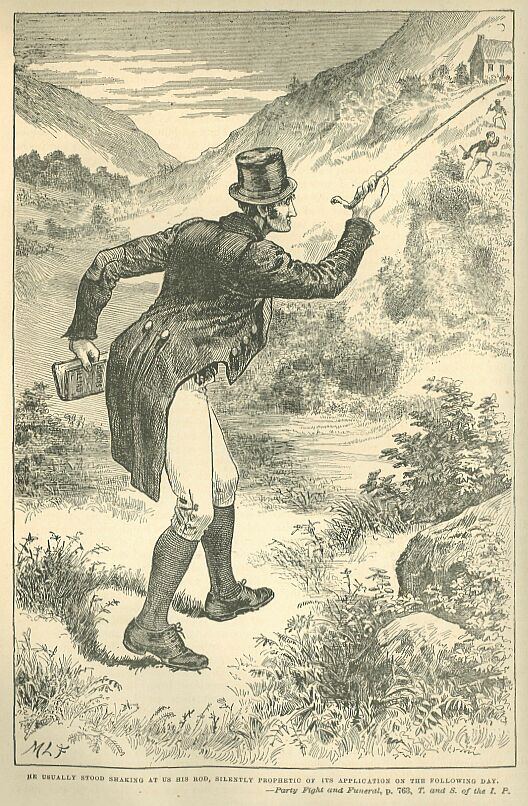
When we arrived at the bottom of the glen, the Murphys and the Caseys, including their respective followers, ranged themselves on either side of a long line, which was drawn between the belligerent powers with the but-end of one of the standards. Exactly on this line was I placed. The word was then put to me in full form—“Whether will you side with the dacent Caseys, or the blackguard Murphys?” “Whether will you side with the dacent Murphys, or the blackguard Caseys?” “The potato for ever!” said I, throwing up my caubeen, and running over to the Murphy standard. In the twinkling of an eye we were at it; and in a short time the deuce an eye some of us had to twinkle. A battle royal succeeded, that lasted near half an hour, and it would probably have lasted above double the time, were it not for the appearance of the “master,” who was seen by a little shrivelled vidette, who wanted an arm, and could take no part in the engagement. This was enough—we instantly radiated in all possible directions, so that by the time he had descended through the intricacies of the glen to the field of battle, neither victor nor vanquished was visible, except, perhaps, a straggler or two as they topped the brow of the declivity, looking back over their shoulders, to put themselves out of doubt as to their visibility by the master. They seldom looked in vain, however, for there he usually stood, shaking at us his rod, silently prophetic of its application on the following day. This threat, for the most part, ended in smoke; for except he horsed about forty or fifty of us, the infliction of impartial justice was utterly out of his power.
But besides this, there never was a realm in which the evils of a divided cabinet were more visible: the truth is, the monarch himself was under the influence of female government—an influence which he felt it either contrary to his inclination or beyond his power to throw off. “Poor Norah, long may you reign!” we often used to exclaim, to the visible mortification of the “master,” who felt the benevolence of the wish bottomed upon an indirect want of allegiance to himself. Well, it was a touching scene!—how we used to stand with the waistbands of our small-clothes cautiously grasped in our hands, with a timid show of resistance, our brave red faces slobbered over with tears, as we stood marked for execution! Never was there a finer specimen of deprecation in eloquence than we then exhibited—the supplicating look right up into the master's face—the touching modulation of the whine—the additional tightness and caution with which we grasped the waistbands with one hand, when it was necessary to use the other in wiping our eyes and noses with the polished sleeve-cuff—the sincerity and vehemence with which we promised never to be guilty again, still shrewdly including the condition of present impunity for our offence:—“this—one—time— master, if ye plaise, sir;” and the utter hopelessness and despair which were legible in the last groan, as we grasp the “master's” leg in utter recklessness of judgment, were all perfect in their way. Reader, have you ever got a reprieve from the gallows? I beg pardon, my dear sir; I only meant to ask, are you capable of entering into what a personage of that description might be supposed to feel, on being informed, after the knot had been neatly tied under the left ear, and the cap drawn over his eyes, that her majesty had granted him a full pardon? But you remember your own schoolboy days, and that's enough.
The nice discrimination with which Norah used to time her interference was indeed surprising. God help us! limited was our experience, and shallow our little judgments, or we might have known what the master meant, when with upraised arm hung over us, his eye was fixed upon the door of the kitchen, waiting for Norah's appearance.
Long, my fair and virtuous countrywomen, I repeat it to you all, as I did to Norah—may you reign in the hearts and affections of your husbands (but nowhere else), the grace, ornaments, and happiness of their hearths and lives, you jewels, you! You are paragons of all that's good, and your feelings are highly creditable to yourselves and to humanity.
When Norah advanced, with her brawny, uplifted arm (for she was a powerful woman) and forbidding aspect, to interpose between us and the avenging, terrors of the birch, do you think that she did not reflect honor on her sex and the national character! I sink the base allusion to the miscaun* of fresh butter, which we had placed in her hands that morning, or the dish of eggs, or of meal, which we had either begged or stolen at home, as a present for her; disclaiming, at the same time, the rascally idea of giving it as a bribe, or from any motive beneath the most lofty minded and disinterested generosity on our part.
* A portion of butter, weighing from one pound to six or eight, made in the shape of a prism.
Then again, never did a forbidding face shine with so winning and amicable an expression as did hers on that merciful occasion. The sun dancing a hornpipe on Easter Sunday morning, or the full moon sailing as proud as a peacock in a new halo head-dress, was a very disrespectable sight, compared to Norah's red beaming face, shrouded in her dowd cap with long ears, that descended to her masculine and substantial neck. Owing to her influence, the whole economy of the school was good; for we were permitted to cuff one another, and do whatever we pleased, with impunity, if we brought the meal, eggs, or butter; except some scapegoat who was not able to accomplish this, and he generally received on his own miserable carcase what was due to us all.
Poor Jack Murray! His last words on the scaffold, for being concerned in the murder of Pierce the gauger, were, that he got the first of his bad habits under Pat Mulligan and Norah—that he learned to steal by secreting at home, butter and meal to paste up the master's eyes to his bad conduct—and that his fondness for quarrelling arose from being permitted to head a faction at school; a most ungrateful return for the many acts of grace which the indulgence of Norah caused; to be issued in his favor.
I was but a short time under Pat, when, after the general example, I had my cudgel, which I used to carry regularly to a certain furze bush within fifty perches of the “seminary,” where I hid it till after “dismiss.*”! I grant it does not look well in me to become I my own panegyrist; but I can at least declare, that there were few among the Gaseys able to, resist the prowess of this right arm, puny as it was at the period in question. Our battles were obstinate and frequent; but as the quarrels of the two families and their relations on each side, were as bitter and pugnacious in fairs and markets as ours were in school, we hit upon the plan of holding our Lilliputian engagements upon the same days on which our fathers and brothers contested. According to this plan, it very often happened that the corresponding parties were successful, and as frequently, that whilst the Caseys were well drubbed in the fair, their sons were victorious at school, and vice versa.
For my part, I was early trained in cudgelling, and before I reached my fourteenth year, could pronounce as sage and accurate an opinion upon the merits of a shillelagh, as it is called, or cudgel, as a veteran of sixty could at first sight. Our plan of preparing them was this: we sallied out to any place where there was an underwood of blackthorn or oak, and, having surveyed the premises with the eye of a connoisseur, we selected the straightest root-growing piece which we could find: for if not root-growing we did not consider it worth cutting, knowing from experience that a mere branch, how straight and fair soever it might look, would be apt to snap in the twist and tug of war. Having cut it as close to the root as possible, we then lopped off the branches, and put it up the chimney to season. When seasoned, we took it down, and wrapping it in brown paper, well steeped in hog's lard or oil, we buried it in a horse dunghill, paying it a daily visit for the purpose of making it straight by doubling back the bends or angles across the knee, in a direction contrary to their natural tendency. Having daily repeated this until we had made it straight, and renewed the oil wrapping paper until the staff was perfectly saturated, we then rubbed it well with a woollen cloth, containing a little black-lead and grease, to give it a polish. This was the last process, except that if we thought it too light at the top, we used to bore a hole in the lower end with a red-hot iron spindle, into which we poured melted lead, for the purpose of giving it the knock-down weight.
There were very few of Paddy Mulligan's scholars without a choice collection of such cudgels, and scarcely one who had not, before his fifteenth year, a just claim to be called the hero of a hundred fights, and the heritor of as many bumps on the cranium as would strike both Gall and Spurzheim speechless.
Now this, be it known, was, and in some districts yet is, an integral part of an Irish peasant's education. In the northern parts of Ireland, where the population of the Catholics on the one side, and of Protestant and Dissenters on the other, is nearly equal, I have known the respective scholars of Catholic and Protestant schools to challenge each other and meet half-way to do battle, in vindication of their respective creeds; or for the purpose of establishing the character of their respective masters as the more learned man; for if we were to judge by the nature of the education then received, we would be led to conclude that a more commercial nation than Ireland was not on the face of the earth, it being the indispensable part of every scholar's business to become acquainted with the three sets of Bookkeeping.
The boy who was the handiest and the most daring with the cudgel at Paddy Mulligan's school was Denis Kelly, the son of a wealthy farmer in the neighborhood. He was a rash, hot-tempered, good-natured lad, possessing a more than common share of this blackthorn ambition; on which account he was cherished by his relations as a boy that was likely at a future period to be able to walk over the course of the parish, in fair, market, or patron. He certainly grew up a stout, able young fellow; and before he reached nineteen years, was unrivalled at the popular exercises of the peasantry. Shortly after that time he made his debut in a party-quarrel, which took place in one of the Christmas Margamores, (* Big Markets) and fully sustained the anticipations which were formed of him by his relations. For a year or two afterwards no quarrel was fought without him; and his prowess rose until he had gained the very pinnacle of that ambition which he had determined to reach. About this time I was separated from him, having found it necessity, in order to accomplish my objects in life, to reside with a relation in another part of the country.
The period of my absence, I believe, was about fifteen years, during which space I heard no account of him whatsoever. At length, however, that inextinguishable attachment which turns the affections and memory to the friends of our early days—to those scenes which we traversed when the heart was light and the spirits buoyant—determined me to make a visit to my native place, that I might witness the progress of time and care upon those faces that were once so familiar to me; that I might again look upon the meadows, and valleys, and groves, and mountains, where I had so often played, and to which I still found myself bound by a tie that a more enlightened view of life and nature only made stronger and more enduring. I accordingly set off, and arrived late in the evening of a December day, at a little town within a few miles of my native home. On alighting from the coach and dining, I determined to walk home, as it was a fine frosty night. The full moon hung in the blue unclouded firmament in all her lustre, and the stars shone out with that tremulous twinkling motion so peculiarly remarkable in frost. I had been absent, I said, about fifteen years, and felt that the enjoyment of this night would form an era in the records of my memory and my feelings. I find myself indeed utterly incapable of expressing what I experienced; but those who have ever been in similar circumstances will understand what I mean. A strong spirit of practical poetry and romance was upon me; and I thought that a commonplace approach in the open day would have rendered my return to the scenes of my early life a very stale and unedifying matter. I left the inn at seven o'clock, and as I had only five miles to walk, I would just arrive about nine, allowing myself to saunter on at the rate of two miles and half per hour. My sensations, indeed, as I went along, were singular; and as I took a solitary road that went across the mountains, the loneliness of the walk, the deep gloom of the valleys, the towering height of the dark hills, and the pale silvery-light of a sleeping lake, shining dimly in the distance below, gave me such a distinct notion of the sublime and beautiful, as I have seldom since experienced. I recommend every man who has been fifteen years absent from his native fields to return by moonlight.
Well, there is a mystery yet undiscovered in our being, for no man can know the full extent of his feelings or his capacities. Many a slumbering thought, and sentiment, and association reposes within him, of which he is utterly ignorant, and which, except he come in contact with those objects whose influence over his mind can alone call them into being, may never be awakened, or give him one moment of either pleasure or pain. There is, therefore, a great deal in the position which we hold in society, and simply in situation. I felt this on that night: for the tenor of my reflections was new and original, and my feelings had a warmth and freshness in them, which nothing but the situation in which I then found myself could give them. The force of association, too, was powerful; for, as I advanced nearer home, the names of hills, and lakes, and mountains, that I had utterly forgotten, as I thought, were distinctly revived in my memory, and a crowd of youthful thoughts and feelings, that I imagined my intercourse with the world and the finger of time had blotted out of my being, began to crowd afresh on my fancy. The name of, a townland would instantly return with its appearance; and I could now remember the history of families and individuals that had long been effaced from my recollection.
But what is even more singular is, that the superstitious terrors of my boyhood began to come over me as formerly, whenever a spot noted for supernatural appearances met my eye. It was in vain that I exerted myself to expel them, by throwing the barrier of philosophic reasoning in their way; they still clung to me, in spite of every effort to the contrary. But the fact is, that I was, for the moment, the slave of a morbid and feverish sentiment, that left me completely at the mercy of the dark and fleeting images that passed over my fancy. I now came to a turn where the road began to slope down into the depths of a valley that ran across it. When I looked forward into the bottom of it, all was darkness impenetrable, for the moon-beams were thrown off by the height of the mountains that rose on each side of it. I felt an indefinite sensation of fear, because at that moment I recollected that it had been, in my younger days, notorious as the scene of an apparition, where the spirit of a murdered pedlar had never been known to permit a solitary traveler to pass without appearing to him, and walking cheek-by-jowl along with him to the next house on the way, at which spot he usually vanished. The influence of my feelings, or, I should rather say, the physical excitement of my nerves, was by no means slight, as these old traditions recurred to me; although, at the same time, my moral courage was perfectly unimpaired, so that, notwithstanding this involuntary apprehension, I felt a degree of novelty and curiosity in descending the valley: “If it appear,” said I, “I shall at least satisfy myself as to the truth of apparitions.” My dress consisted of a long, dark surtout, the collar of which, as the night was keen, I had turned up about my ears, and the corners of it met round my face. In addition to this I had a black silk handkerchief tied across my mouth to keep out the night air, so that, as my dark fur traveling cap came down over my face, there was very little of my countenance visible. I now had advanced half way into the valley, and all about me was dark and still: the moonlight was not nearer than the top of the hill which I was descending; and I often turned round to look upon it, so silvery and beautiful it appeared in the distance. Sometimes I stopped for a few moments, admiring' its effect, and, contemplating the dark mountains as they stood out against the firmament, then kindled into magnificent grandeur by the myriads of stars that glowed in its expanse. There was perfect silence and solitude around me; and, as I stood alone in the dark chamber of the mountains, I felt the impressiveness of the situation gradually supersede my terrors. A sublime sense of religious awe descended on me; my soul kindled into a glow of solemn and elevated devotion, which gave me a more intense perception of the presence of God than I had ever before experienced. “How sacred—how awful,” thought I, “is this place!—how impressive is this hour!—surely I feel myself at the footstool of God! The voice of worship is in this deep, soul-thrilling silence, and the tongue of praise speaks, as it were, from the very solitude of the mountains!” I then thought of Him who went up into the mountain-top to pray, and felt the majesty of those admirable descriptions of the Almighty, given in the Old Testament, blend in delightful harmony with the beauty and fitness of the Christian dispensation, that brought light and immortality to light. “Here,” said I, “do I feel that I am indeed immortal, and destined for scenes of a more exalted and comprehensive existence!”
I then proceeded further into the valley, completely freed from the influence of old and superstitious associations. A few porches below me a small river crossed the road, over which was thrown a little stone bridge of rude workmanship. This bridge was the spot on which the apparition was said to appear; and as I approached it, I felt the folly of those terrors which had only a few minutes before beset me so strongly. I found my moral energies recruited, and the dark phantasms of my imagination dispelled by the light of religion, which had refreshed me with a deep sense of the Almighty presence. I accordingly walked forward, scarcely bestowing a thought upon the history of the place, and had got within a few yards of the bridge, when on resting my eye accidentally upon the little elevation formed by its rude arch, I perceived a black coffin placed at the edge of the road, exactly upon the bridge itself!
It may be evident to the reader, that, however satisfactory the force of philosophical reasoning might have been upon the subject of the solitude, I was too much the creature of sensation for an hour before, to look on such a startling object with firm nerves. For the first two or three minutes, therefore, T exhibited as finished a specimen of the dastardly as could be imagined. My hair absolutely raised my cap some inches off my head; my mouth opened to an extent which I did not conceive it could possibly reach; I thought my eyes shot out from their sockets, and my fingers spread out and became stiff, though powerless. The “obstupui” was perfectly realized in me, for, with the exception of a single groan, which I gave on first seeing the object, I found that if one word would save my life, or transport me to my own fireside, I could not utter it. I was also rooted to the earth, as if by magic; and although instant tergiversation and flight had my most hearty concurrence, I could not move a limb, nor even raise my eyes off the sepulchral-looking object which lay before me. I now felt the perspiration fall from my face in torrents, and the strokes of my heart fell audibly on my ear. I even attempted to say, “God preserve me!” but my tongue was dumb and powerless, and could not move. My eye was still upon the coffin, when I perceived that, from being motionless, it instantly began to swing,—first in a lateral, then in a longitudinal direction, although it was perfectly evident that no human hand was nearer it than my own. At length I raised my eyes off it, for my vision was strained to an aching intensity, which I thought must have occasioned my eye-strings to crack. I looked instinctively about me for assistance—but all was dismal, silent, and solitary: even the moon had disappeared among a few clouds that I had not noticed in the sky.
As I stood in this state of indescribable horror, I saw the light gradually fade away from the tops of the mountains, giving the scene around me a dim and spectral ghastliness, which, to those who were never in such a situation, is altogether inconceivable.
At length I thought I heard a noise as it Were of a rushing tempest, sweeping from the hills down into the valley; but on looking up, I could perceive nothing but the dusky desolation that brooded over the place. Still the noise continued; again I saw the coffin move; I then felt the motion communicated to myself, and found my body borne and swung backwards and forwards, precisely according to the motion of the coffin. I again attempted to utter a cry for assistance, but could not: the motion in my body still continued, as did the approaching noise in the hills. I looked up a second time in the direction in which the valley wound off between them, but judge of what I must have suffered, when I beheld one of the mountains moving, as it were, from its base, and tumbling down towards the spot on which I stood! In the twinkling of an eye the whole scene, hills and all, began to tremble, to vibrate, and to fly round me, with a rapid, delirious motion; the stars shot back into the depths of heaven, and disappeared; the ground on which I stood began to pass from beneath my feet; a noise like the breaking of a thousand gigantic billows again burst from every direction, and I found myself instantly overwhelmed by some deadly weight, which prostrated me on the earth, and deprived me of sense and motion.
I know not how long I continued in this state; but I remember that, on opening my eyes the first object that presented itself to me, was the sky glowing as before with ten thousand stars, and the moon walking in her unclouded brightness through the heavens. The whole circumstance then rushed back upon my mind, but with a sense of horror very much diminished; I arose, and on looking towards the spot, perceived the coffin in the same place. I then stood, and endeavoring to collect myself, viewed it as calmly as possible; it was, however, as motionless and distinct as when I first saw it. I now began to reason upon the matter, and to consider that it was pusillanimous in me to give way to such boyish terrors. The confidence, also, which my heart, only a short time before this, had experienced in the presence and protection of the Almighty, again returned, and, along with it, a degree of religious fortitude, which invigorated my whole system. “Well,” thought I, “in the name of God I shall ascertain what you are, let the consequence be what it may.” I then advanced until I stood exactly over it, and raising my foot gave it a slight kick. “Now,” said I, “nothing remains but to ascertain whether it contains a dead body or not;” but on raising the end of it, I perceived by its lightness, that it was empty. To investigate the cause of its being left in this solitary spot was, however, not within the compass of my philosophy, so I gave that up. On looking at it more closely, I noticed a plate, marked with the name and age of the person for whom it was intended, and on bringing my eyes near the letters, I was able, between fingering and reading, to make out the name of my old cudgel-fighting school-fellow, Denis Kelly.
This discovery threw a partial light upon the business; but I now remembered to have heard of individuals who had seen black, unearthly coffins, inscribed with the names of certain living persons; and that these were considered as ominous of the death of those persons. I accordingly determined to be certain that this was a real coffin; and as Denis's house was not more than a mile before me, I decided on carrying it that far, “If he be dead,” thought I, “it will be all light, and if not, we will see more about it.” My mind, in fact, was diseased by terror. I instantly raised the coffin, and as I found a rope lying on the ground under it, I strapped it about my shoulders and proceeded: nor could I help smiling when I reflected upon the singular transition which the man of sentiment and sensation so strangely underwent;—from the sublime contemplation of the silent mountain solitude and the spangled heavens to the task of carrying a coffin! It was an adventure, however, and I was resolved to see how it would terminate.
There was from the bridge an ascent in the road, not so gradual as that by which I descended on the other side; and as the coffin was rather heavy, I began to repent of having anything to do with it; for I was by no means experienced in carrying coffins. The carriage of it was, indeed, altogether an irksome and unpleasant concern; for owing to my ignorance of using the rope that tied it skilfully, it was every moment sliding down my back, dragging along the stones, or bumping against my heels: besides, I saw no sufficient grounds I had for entering upon the ludicrous and odd employment of carrying another man's coffin, and was several; times upon the point of washing my hands out of it altogether. But the novelty of the incident, and the mystery in which it was involved, decided me in bringing it as far as Kelly's house, which was exactly on my way home.
I had yet half a mile to go; but I thought it would be best to strap it more firmly about my body before I could start again: I therefore set it standing on its end, just at the turn of the road, until I should breathe a little, for I was rather exhausted by a trudge under it of half a mile and upwards. Whilst the coffin was in this position, I standing exactly behind it (Kelly had been a tall man, consequently it was somewhat higher than I was), a crowd of people, bearing lights, advanced round the corner; and the first object which presented itself to their vision, was the coffin in, that position, whilst I was totally invisible behind it. As soon as they saw it, there was an involuntary cry of consternation from the whole crowd; at this time I had the coffin once more strapped firmly by a running knot to my shoulders, so that I could loose it whenever I pleased. On seeing the party, and hearing certain expressions which dropped from them, I knew at once that there had been some unlucky blunder in the business on their part; and I would have given a good deal to be out of the circumstances in which I then stood. I felt that I could not possibly have accounted for my situation, without bringing myself in for as respectable a portion of rank cowardice as those who ran away from the coffin; for that it was left behind in a fit of terror, I now entertained no doubt whatever, particularly when I remembered the traditions connected with the spot in which I found it.
“Manim a Yea agus a wurrah!”* exclaimed one of them, “if the black man hasn't brought it up from the bridge! Dher a larna heena**, he did; for it was above the bridge we first seen him: jist for all the world—the Lord be about us—as Antony and me war coming out on the road at the bridge, there he was standing—a headless man, all black, without face or eyes upon him—and then we left the coffin and cut acrass the fields home.”
* My soul to God and the Virgin. ** By the very book—meaning the Bible, which, in the Irish, is not simply called the book, but the very book, or the book itself.
“But where is he now, Eman?” said one of them, “are you sure you seen him?”
“Seen him!” both exclaimed, “do you think we'd take to our scrapers like two hares, only we did; arrah, bad manners to you, do you think the coffin could walk up wid itself from the bridge to this, only he brought it?—isn't that enough?”
“Thrue for yez,” the rest exclaimed, “but what's to be done?”
“Why to bring the coffin home, now that we're all together,” another observed; “they say he never appears to more than two at wanst, so he won't be apt to show himself now, when we're together.”
“Well, boys, let two of you go down to it,” said one of them, “and we'll wait here till yez bring it up.”
“Yes,” said Eman Dhu, “do you go down, Owen, as you have the Scapular* on you, and the jug of holy water in your hand, and let Billy M'Shane, here repate the confeethurs (* The Confiteor) along wid you.”
* The scapular is one of the highest religious orders, and is worn by both priest and layman. It is considered by the people a safeguard against evil both spiritual and physical.
“Isn't it the same thing, Eman,” replied Owen, “if I shake the holy water on you, and whoever goes wid you? sure you know that if only one dhrop of it touched you, the devil himself couldn't harm you!”
“And what needs yourself be afraid, then,” retorted Eman; “and you has the Scapular on you to the back of that? Didn't you say, you war coming out, that if it was the devil, you'd disparse him?”
“You had betther not be mintioning his name, you omadhaun,” replied the other; “if I was your age, and hadn't a wife and childre on my hands, it's myself that would trust in God, and go down manfully; but the people are hen-hearted now, besides what they used to be in my time.”
During this conversation, I had resolved, if possible, to keep up the delusion, until I could get myself extricated with due secrecy out of this ridiculous situation; and I was glad to find that, owing to their cowardice, there was some likelihood of effecting my design.
“Ned,” said one of them to a little man, “go down and speak to it, as it can't harm you.”
“Why sure,” said Ned, with a tremor in his voice, “I can speak to it where I am, widout going within rache of it. Boys, stand close to me: hem—In the name of—but don't you think I had betther spake to it in the Latin I sarve mass* wid; it can't but answer that, for the sowl of it, seeing it's a blest language?”
* The person who serves mass, as it is called, is he who makes the responses to the priest during that ceremony. As the mass is said in Latin the serving of it must necessarily fall upon many who are ignorant of that language, and whose pronunciation of it is, of course, extremely ludicrous.
“Very well,” the rest replied; “try that Ned; give it the best and ginteelest grammar you have, and maybe it may thrate us dacent.”
Now it so happened that, in my schoolboy days, I had joined a class of young fellows who were learning what is called the “Sarvin' of Mass” and had impressed it so accurately on a pretty retentive memory, that I never forgot it. At length, Ned pulled, out his beads, and bedewed himself most copiously with the holy water. He then shouted out, with a voice which resembled that of a man in an ague fit, “Dom-i-n-us vo-bis-cum?” “Et cum spiritu tuo,” I replied, in a husky sepulchral tone, from behind the coffin. As soon as I uttered these words, the whole crowd ran back instinctively with fright; and Ned got so weak, that they were obliged to support him.
“Lord have marcy on us!” said Ned; “hoys, isn't it an awful thing to speak to a spirit? my hair is like I dunna what, it's sticking up so stiff upon my head.”
“Spake to it in English, Ned,” said they, till we hear what it will say. Ax it does anything trouble it; or whether its sowl's in Purgatory.”
“Wouldn't it be betther,” observed another, “to ax it who murthered it; maybe it wants to discover that?”
“In the—na-me of Go-o-d-ness,” said Ned, down to me, “what are you?”
“I'm the soul,” I replied in the same voice, “of the pedlar that was murdered on the bridge below.”
“And—who—was—-it, sur, wid—submission, that—murdhered—you?”
To this I made no reply.
“I say,” continued Ned, “in—the—name—of—G-o-o-d-ness—who was it—that took the liberty of murdhering you, dacent man?”
“Ned Corrigan,” I answered, giving his own name.
“Hem! God presarve us! Ned Corrigan!” he exclaimed. “What Ned, for there's two of them—is it myself or the other vagabone?”
“Yourself, you murderer!” I replied.
“Ho!” said Ned, getting quite stout, “is that you, neighbor? Come, now, walk out wid yourself out of that coffin, you vagabone you, whoever you are.”
“What do you mane, Ned, by spaking to it that-a-way?” the rest inquired.
“Hut,” said Ned, “it's some fellow or other that's playing a thrick upon us. Sure I never knew either act nor part of the murdher, nor of the murdherers; and you know, if it was anything of that nature, it couldn't tell me a lie, and me a Scapularian along wid axing it in God's name, with Father Feasthalagh's Latin.”
“Big tare-an'-ouns;” said the rest; “if we thought it was any man making fun of us, but we'd crop the ears off his head, to tache him to be joking!”
To tell the truth, when I heard this suggestion, I began to repent of my frolic; but I was determined to make another effort to finish the adventure creditably.
“Ned,” said they, “throw some of the holy water on us all, and in the name of St. Pether and the Blessed Virgin, we'll go down and examine it in a body.”
This they considered a good thought, and Ned was sprinkling the water about him in all directions, whilst he repeated some jargon which was completely unintelligible. They then began to approach the coffin at dead-march time, and I felt that this was the only moment in which my plan could succeed; for had I waited until they came down all would have been discovered. As soon, therefore, as they began to move towards me, I also began, with equal solemnity, to retrograde towards them; so that, as the coffin was between us, it seemed to move without human means.
“Stop, for God's sake, stop,”—shouted Ned; “it's movin'! It has made the coffin alive; don't you see it thravelling this way widout hand or foot, barring the boords?”
There was now a halt to ascertain the fact: but I still retrograded. This was sufficient; a cry of terror broke from the whole group, and, without waiting for further evidence, they set off in the direction they came from, at full speed, Ned flinging the jug of holy water at the coffin, lest the latter should follow, or the former encumber him in his flight. Never was there so complete a discomfiture; and so eager were they to escape, that several of them came down on the stones; and I could hear them shouting with desperation, and imploring the more advanced not to leave them behind. I instantly disentangled myself from the coffin, and left it standing exactly in the middle of the road, for the next passenger to give it a lift as far as Denis Kelly's, if he felt so disposed. I lost no time in making the best of my way home; and on passing poor Denis's house I perceived, by the bustle and noise within, that he was dead.
I had given my friends no notice of this visit; my reception was consequently the warmer, as I was not expected. That evening was a happy one, which I shall long remember. At supper I alluded to Kelly, and received from my brother a full account, as given in the following narrative, of the circumstances which caused his death.
“I need not remind you, Toby, of our schoolboy days, nor of the principles usually imbibed at such schools as that in which the two tiny factions of the Caseys and the Murphys qualified themselves, among the latter of whom you cut so distinguished a figure. You will not, therefore, be surprised to hear that these two factions are as bitter as ever, and that the boys who at Pat Mulligan's school belabored each other, in imitation of their brothers and fathers, continue to set the same iniquitous example to their children; so that this groundless and hereditary enmity is likely to descend to future generations; unless, indeed, the influence of a more enlightened system of education may check it. But, unhappily, there is a strong suspicion of the object proposed by such a system; so that the advantages likely to result from it to the lower orders of the people will be slow and distant.”
“But, John,” said I, “now that we are upon that subject, let me ask what really is the bone of contention between Irish factions?”
“I assure you,” he replied, “I am almost as much at a loss, Toby, to give you a satisfactory answer, as if you asked me the elevation of the highest mountain on the moon; and I believe you would find equal difficulty in ascertaining the cause of their feuds from the factions themselves. I really am convinced they know not, nor, if I rightly understand them, do they much care. Their object is to fight, and the turning of a straw will at any time furnish them with sufficient grounds for that. I do not think, after all, that the enmity between them is purery personal: they do not hate each other individually; but having originally had one quarrel upon some trifling occasion, the beaten party cannot bear the stigma of defeat without another trial of strength. Then, if they succeed, the onus of retrieving lost credit is thrown upon the party that was formerly victorious. If they fail a second time, the double triumph of their conquerors excites them to a greater determination to throw off the additional disgrace; and this species of alternation perpetuates the evil.
“These habits, however, familiarize our peasantry to acts of outrage and violence—the bad passions are cultivated and nourished, until crimes, which peaceable men look upon with fear and horror, lose their real magnitude and deformity in the eyes of Irishmen. I believe this kind of undefined hatred between either parties or nations, is the most dangerous and fatal spirit which can pervade any portion of society. If you hate a man for an obvious and palpable injury, it is likely that when he cancels that injury by an act of subsequent kindness, accompanied by an exhibition of sincere sorrow, you will cease to look upon him as your enemy; but where the hatred is such that, while feeling you cannot, on a sober examination of your heart, account for it, there is little hope that you will ever be able to stifle the enmity that you entertain against him. This, however, in politics and religion, is what is frequently designated as principle—a word on which men, possessing higher and greater advantages than the poor ignorant peasantry of Ireland, pride themselves. In sects and parties, we may mark its effects among all ranks and nations. I therefore, seldom wish, Toby, to hear a man assert that he is of this party or that, from principle; for I am usually inclined to suspect that he is not, in this case, influenced by conviction.
“Kelly was a man who, but for these scandalous proceedings among us, might have been now alive and happy. Although his temperament was warm, yet that warmth communicated itself to his good as well as to his evil qualities. In the beginning his family were not attached to any faction—and when I use the word faction, it is in contradistinction to the word party—for faction, you know, is applied to a feud or grudge between Roman Catholics exclusively. But when he was young, he ardently attached himself to the Murphys; and, having continued among them until manhood, he could not abandon them, consistently with that sense of mistaken honor which forms so prominent a feature in the character of the Irish peasantry. But although the Kellys were not faction-men, they were bitter party-men, being the ringleaders of every quarrel Which took place between the Catholics and Protestants, or, I should rather say, between the Orangemen and Whiteboys.
“From the moment Denis attached himself to the Murphys, until the day he received the beating which subsequently occasioned his death, he never withdrew from them. He was in all their battles; and in course of time, induced his relations to follow his example; so that, by general consent, they were nicknamed 'the Errigle Slashers.' Soon after you left the country, and went to reside with my uncle, Denis married a daughter of little Dick Magrath's, from the Race-road, with whom he got a little money. She proved a kind, affectionate wife; and, to do him justice, I believe he was an excellent husband. Shortly after his marriage his father died, and Denis succeeded him in his farm; for you know that, among the peasantry, the youngest generally gets the landed property—the elder children being obliged to provide for themselves according to their ability, as otherwise a population would multiply upon a portion of land inadequate to its support.
“It was supposed that Kelly's marriage would have been the means of producing a change in him for the better, but it did not. He was, in fact, the slave of a low, vain ambition, which constantly occasioned him to have some quarrel or other on his hands; and, as he possessed great physical courage and strength, he became the champion of the parish. It was in vain that his wife used every argument to induce him to relinquish such practices; the only reply he was in the habit of making, was a good-humored slap on the back and a laugh, saying,
“'That's it, Honor; sure and isn't that the Magraths, all over, that would let the manest spalpeen that ever chewed cheese thramp upon them, without raising a hand in their own defence; and I don't blame you for being a coward, seeing that you have their blood in your veins—not but that there ought to be something betther in you, afther all; for it's the M'Karrons, by your mother's side, that had the good dhrop of their own in them, anyhow—but you're a Magrath out and out.'
“'And, Denis,' Honor would reply, 'it would be a blessed day for the parish, if all in it were as peaceable as the same Magraths. There would be no sore heads, nor broken bones, nor fighting, nor slashing of one another in fairs and markets, when people ought to be minding their business. You're ever and always at the Magraths, bekase they don't join you agin the Caseys or the Orangemen, and more fools they'd be to make or meddle between you, having no spite agin either of them; and it would be wiser for you to be sed by the Magraths, and red your hands out of sich ways altogether. What did ever the Murphys do to sarve you or any of your family, that you'd go to make a great man of yourself fighting for them? Or what did the poor Caseys do to make you go agin the honest people? Arrah, bad manners to me, if you know what you're about, or if sonse (* Good Luck) or grace can ever come of it; and mind my words, Denis, if God hasn't said it, you'll live to rue your folly for the same work.'
“At this Denis would laugh heartily. 'Well said, Honor Magrath, but not Kelly, Well, it's one comfort that our childher aren't likely to follow your side of the house, any way. Come here, Lanty; come over, acushla, to your father! Lanty, ma bouchal, what 'ill you do when you grow a man?”
“'I'll buy a horse of my own to ride on, daddy.'
“'A horse, Lanty! and so you will, ma bouchal; but that's not it—sure that's not what I mane, Lanty. What 'ill you do to the Caseys?”
“'Ho, ho! the Caseys! I'll bate the blackguards wid your blackthorn, daddy!'
“'Ha, ha, ha! that's my stout man, my brave little soger! Wus dha lamh avick!—give me your hand, my son! Here, Nelly,' he would say to the child's eldest sister, 'give him a brave whang of bread, to make him able to bate the Caseys. Well, Lanty, who more will you leather, ahagur?'
“'All the Orangemen; I'll kill all the Orangemen!'
“This would produce another laugh from the father, who would again kiss and shake hands with his son, for these early manifestations of his own spirit.
“'Lanty, ma bouchal,' he would say, 'thank God, you're not a Magrath; 'tis you that's a Kelly, every blessed inch of you! and if you turn out as good a buillagh balthah as your father afore you, I'll be contint, avour-neen!'
“'God forgive you, Denis,' the-wife would reply, 'it's long before you'd think of larning him his prayers, or his cateehiz, or anything that's good! Lanty, agra, come over to myself, and never heed what that man says; for, except you have some poor body's blessing, he'll bring you to no good.'
“Sometimes, however, Kelly's own natural good sense, joined with the remonstrances of his wife, prevailed for a short time, and he would withdraw himself from the connection altogether; but the force of habit and of circumstances was too strong in him, to hope that he could ever overcome it by his own firmness, for he was totally destitute of religion. The peaceable intervals of his life were therefore very short.
“One summer evening I was standing in my own garden, when I saw a man galloping up towards me at full speed. When he approached, I recognized him as one of the Murphy faction, and perceived that he was cut and bleeding.
“'Murphy,' said I, 'What's the matter!'
“'Hard fighting, sir,' said he, 'is the matter. The Caseys gathered all their faction, bekase they heard that Denis Kelly has given us up, and they're sweeping the street wid us. I'm going hot foot for Kelly, sir, for even the very name of him will turn the tide in our favor. Along wid that, I have sent in a score of the Duggans, and, if I get in Denis, plase God we'll clear the town of them!'
“He then set off, but pulled up abruptly, and said,
“'Arrah, Mr. Darcy, maybe you'd be civil enough to lind me the loan of a sword, or bagnet, or gun, or anything that way, that would be sarviceable to a body on a pinch?'
“'Yes!' said I, 'and enable you to commit murder? No, no, Murphy; I'm sorry it's not in my power to put a final stop to such dangerous quarrels!'
“He then dashed off, and in the course of a short time I saw him and Kelly, both on horseback, hurrying into the town in all possible haste, armed with their cudgels. The following day, I got my dog and gun, and sauntered about the hills, making a point to call upon Kelly. I found him with his head tied up, and his arm in a sling.
“'Well, Denis,' said I, 'I find you have kept your promise of giving up quarrels!'
“And so I did, sir,' said Denis; 'but, sure you wouldn't have me for to go desart them, when the Caseys war three to one over them? No; God be thanked, I'm not so mane as that, anyhow. Besides, they welted both my brothers within an inch of their lives.'
“'I think they didn't miss yourself,' said I.
“'You may well say they did not, sir,' he replied: 'and, to tell God's truth, they thrashed us right and left out of the town, although we rallied three times, and came in agin. At any rate, it's the first time for the last five years that they dare go up and down the street, calling out for the face of a Murphy, or a Kelly; for they're as bitter now agin us as agin the Murphys themselves.'
“'Well, I hope, Denis,' I observed, 'that what occurred yesterday will prevent you from entering into their quarrels in future. Indeed, I shall not give over, until I prevail on you to lead a quiet and peaceable life, as the father of a rising family ought to do.'
“'Denis,' said the wife, when I alluded to the children, looking at him with a reproachful and significant expression—'Denis, do you hear that!—the father of a family, Denis! Oh, then, God look down on that family; but it's—Musha, God bless you and yours, sir,' said she to me, dropping that part of the subject abruptly; 'it's kind of you to trouble yourself about him, at all at all: it's what them that has a better right to do it, doesn't do.'
“'I hope,' said I, 'that Denis's own good sense will show him the folly and guilt of his conduct, and that he will not, under any circumstances, enter into their battles in future. Come, Denis, will you promise me this?'
“'If any man,' replied Denis, 'could make me do it, it's yourself, sir, or any one of your family; but if the priest of the parish was to go down on his knees before me, I wouldn't give it up till we give them vagabone Caseys one glorious battherin,' which, plase God, we'll do, and are well able to do, before a month of Sundays goes over us. Now, sir, you needn't say another word,' said he, seeing me about to speak; 'for by Him that made me we'll do it! If any man, I say, could persuade me agin it, you could; but, if we don't pay them full interest for what we got, why my name's not Denis Kelly—ay, sweep them like varmint out of the town, body and sleeves!'
“I saw argument would be lost on him, so I only observed, that I feared it would eventually end badly.
“'Och, many and many's the time, Mr. Darcy,' said Honor, 'I prophesied the same thing; and, if God hasn't said it, he'll be coming home a corpse to me some day or other; for he got as much bating, sir, as would be enough to kill a horse; and, to tell you God's truth, sir, he's breeding up his childher—'
“'Honor,' said Kelly, irritated, 'whatever I do, do I lave it in your power to say that I'm a bad husband? so don't rise me by your talk, for I don't like to be provoked. I know it's wrong, but what can I do? Would you have me for to show the Garran-bane,* and lave them like a cowardly thraitor, now that the other faction is coming up to be their match? No; let what will come of it, I'll never do the mane thing—death before dishonor!'
* The white horse, i.e., be wanting in mettle. Tradition affirms that James the Second escaped on a white horse from the battle of the Boyne; and from this circumstance a white horse has become the emblem of cowardice.
“In this manner Kelly went on for years; sometimes, indeed, keeping quiet for a short period, but eventually drawn in, from the apprehension of being reproached with want of honor and truth, to his connection. This, truly, is an imputation which no peasant could endure; nor, were he thought capable of treachery, would he be safe from the vengeance of his own party. Many a time have I seen Kelly reeling home, his head and face sadly cut, the blood streaming from him, and his wife and some neighbor on each side of him—the poor woman weeping and deploring the senseless and sanguinary feuds in which her husband took so active a part.
“About three miles from this, down at the Long Ridge, where the Shannons live, dwelt a family of the Grogans, cousins to Denis. They were anything but industrious, although they might have lived very independently, having held a farm on what they called an old take, which means a long lease taken out when lands were cheap. It so happened, however, that, like too many of their countrymen, they paid little attention to the cultivation of their farm; the consequence of which neglect was, that they became embarrassed, and overburdened with arrears. Their landlord was old Sam Simmons, whose only fault to his tenants was an excess of indulgence, and a generous disposition wherever he could possibly get an opportunity to scatter his money about him, upon the spur of a benevolence which, it would seem, never ceased goading him to acts of the most Christian liberality and kindness. Along with these excellent qualities, he was remarkable for a most rooted aversion to law and lawyers; for he would lose one hundred pounds rather than recover that sum by legal proceedings, even when certain that five Pounds would effect it; but he seldom or never was known to pardon a breach of the peace.
“I have always found that an excess of indulgence in a landlord never fails ultimately to injure and relax the industry of the tenant; at least, this was the effect which his forbearance produced on them. But the most extraordinary good-nature has its limits, and so had his; after repeated warning, and the most unparalleled patience on his part, he was at length compelled to determine on at once removing them from his estate, and letting his land to some more efficient and deserving tenant. He accordingly desired them to remove their property from the premises, as he did not wish, he said, to leave them without the means of entering upon another farm, if they felt so disposed. This they refused to do; adding, that they would, at least, put him to the expense of ejecting them. He then gave orders to his agent to seize; but they, in the mean time, had secreted their effects by night among their friends and relations, sending a cow to this one, and a horse to that; so that, when the bailiff came to levy his execution, he found very little, except the empty walls. They were, however, ejected without ceremony, and driven altogether off the farm, for which they had actually paid nothing for the three preceding years. In the mean time the farm was advertised to be let, and several persons had offered themselves as tenants; but what appeared very remarkable was, that the Roman Catholics seldom came a second time to make any further inquiry about it; or, if they did, Simmons observed that they were sure to withdraw their proposals, and ultimately decline having anything to do with it.
“This was a circumstance which he could not properly understand; but the fact was, that the peasantry were almost to a man members of a widely-extending system of agrarian combination, the secret influence of which intimidated such of their own religion as intended to take it, and prevented them from exposing themselves to the penalty which they knew those who should dare to occupy it must pay. In a short time, however, the matter began to be whispered about, until it spread gradually, day after day, through the parish, that those who already had proposed, or intended to propose, were afraid to enter upon the land on any terms. Hitherto, it is true, these threats floated about only in the vague form of rumor.
“The farm had been now unoccupied for about a year; party spirit ran very high among the peasantry, and no proposals came in, or were at all likely to come. Simmons then got advertisements printed, and had them posted up in the most conspicuous parts of this and the neighboring parishes. It was expected, however, that they would be torn down; but, instead of that, there was a written notice posted up immediately under each, which ran in the following words:—
“'Take Notess. “'Any man that'll dare to take the farm belonging to smooth Sam Simmons, and sitivated at the long ridge, will be flayed alive. “' Mat Midnight. “'B. N.—It's it that was latterrally occupied by the Grogans.'
“This occasioned Simmons and the other magistrates of the barony to hold a meeting, at which they subscribed to the amount of fifty pounds as a reward for discovering the author or authors of the threatening notice; but the advertisement containing the reward, which was posted in the usual places through the parish, was torn down on the first night after it was put up. In the meantime, a man, nicknamed Vengeance—Vesey Vengeance, in consequence of his daring and fearless spirit, and his bitterness in retaliating injury—came to Simmons, and proposed for the farm. The latter candidly mentioned the circumstances of the notice, and fairly told him that he was running a personal risk in taking it.
“'Leave that to me, sir,' said Vengeance; 'if you will set me the farm at the terms I offer, I am willing to become your tenant; and let them that posted up the notices go to old Nick, or, if they annoy me, let them take care I don't send them there. I am a true blue, sir—a purple man*—have lots of fire-arms, and plenty of stout fellows in the parish ready and willing to back me; and, by the light of day if they make or meddle with me or mine, we will hunt them in the face of the world, like so many mad dogs, out of the country: what are they but a pack of ribles, that would cut our throats, if they dared?'
* These terms denote certain stages of initiation in the Orange system
“'I have no objection,' said Simmons, 'that you should express a firm determination to defend your life and protect your property; but I utterly condemn the spirit with which you seem to be animated. Be temperate and sober, but be firm. I will afford you every assistance and protection in my power, both as a magistrate and a landlord; but if you speak so incautiously, the result may be serious, if not fatal, to yourself.'
“Instead of that,' said Vengeance, 'the more a man appears to be afeard, the more danger he is in, as I know by what I have seen; but, at any rate, if they injure me, I wouldn't ask better sport than taking down the ribles—the bloody-minded villains! Isn't it a purty thing that a man darn't put one foat past the other only as they wish. By the light o' day, I'll pepper them!'
“Shortly after this, Vengeance, braving all their threats, removed to the farm, and set about its cultivation with skill and vigor. He had not been long there, however, when, a notice was posted one night on his door, giving him ten days to clear off from this interdicted spot, threatening, in case of non-compliance, to make a bonfire of the house and offices, inmates included. The reply, which Vengeance made to this was fearless and characteristic. He wrote another notice, which he posted on the chapel-door, stating that he would not budge an inch—recommending, at the same time, such as intended paying him a nightly visit to be careful that they might not chance to go home with their heels foremost. This, indeed, was setting them completely at defiance, and would, no doubt have been fatal to Vesey, were it not for a circumstance which I will now relate:—In a little dell, below Vesey's house, lived a poor woman, called Doran, a widow; she inhabited a small hut, and was principally supported by her two sons, who were servants, one to a neighboring farmer, a Roman Catholic, and the other to Dr. Ableson, rector of the parish. He who had been with the rector lost his health shortly before Vengeance succeeded the Grogans as occupier of the land in question, and was obliged to come home to his mother. He was then confined to his bed, from which, indeed, he never rose.
“This boy had been his mother's principal support—for the other was unsettled, and paid her but little attention, being like most of those in his situation, fond of drinking, dancing, and attending fairs. In short, he became a Ribbonman, and consequently was obliged to attend their nightly meetings. Now it so happened that for a considerable time after the threatening notice had been posted on Vengeance's door, he received no annoyance, although the period allowed for his departure had been long past, and the purport of the paper uncomplied with. Whether this proceeded from an apprehension on the part of the Ribbonmen of receiving a warmer welcome than they might wish, or whether they deferred the execution of their threat until Vengeance might be off his guard, I cannot determine; but the fact is, that some months had elapsed and Vengeance remained hitherto unmolested.
“During this interval the distress of Widow Doran had become known to the inmates of his family, and his mother—for she lived with him—used to bring down each day some nourishing food to the sick boy. In these kind offices she was very punctual; and so great was the poverty of the poor widow, and so destitute the situation of her sick son, that, in fact, the burden of their support lay principally upon Vengeance's family.
“Vengeance was a small, thin man, with fair hair, and fiery eyes; his voice was loud and shrill, his utterance rapid, and the general expression of his countenance irritable. His motions were so quick, that he rather seemed to run than walk. He was a civil, obliging neighbor, but performed his best actions with a bad grace; a firm, unflinching friend, but a bitter and implacable enemy. Upon the whole he was generally esteemed and respected—though considered as an eccentric character, for such indeed he was. On hearing of Widow Doran's distress, he gave orders that a portion of each meal should be regularly sent down to her and her son; and from that period forward they were both supported principally from his table.
“In this way some months had passed, and still Vengeance was undisturbed in his farm. It often happened, however, that Doran's other son came to see his brother; and during these visits it was but natural that his mother and brother should allude to the kindness which they daily experienced from Vesey.
“One night, about twelve o'clock, a tap came to Widow Doran's door, who happened to be attending the invalid, as he was then nearly in the last stage of his illness. When she opened it, the other son entered, in an evident hurry, having the appearance of a man who felt deep and serious anxiety.
“'Mother,' said he, 'I was very uneasy entirely about Mick, and just started over to see him, although they don't know at home that I'm out, so I can't stay a crack; but I wish you would go to the door for two or three minutes, as I have something to say to him.'
“'Why, thin, Holy Mother!—Jack, a-hagur, is there anything the matther, for you look as if you had seen something?' *
* This phrase means—you look as if you had seen a ghost; it is a very common one.
“'Nothing worse than myself, mother,' he replied; 'nor there's nothing the matther at all—only I have a few words to say to Mick here, that's all.'
“The mother accordingly removed herself out of hearing.
“'Mick,' says the boy, 'this is a bad business—I wish to God I was clear and clane out of it.'
“'What is it?' said Mick, alarmed. “' Murther, I'm afeard, if God doesn't turn it off of them, somehow.
“'What do you mane, man, at all?' said the invalid, raising himself, in deep emotion, on his elbow, from his poor straw bed.
“'Vengeance,' said he—'Vengeance, man—he's going to get it. I was out with the boys on Sunday evening, and at last it's agreed on to visit him to-morrow night. I'm sure and sartin he'll never escape, for there's more in for him than taking the farm, and daring them so often as he did—he shot two fingers off of a brother-in-law of Jem Reilly's one night that they war on for threshing him, and that's coming home to him along with the rest.'
“'In the name of God, Jack,' inquired Mick, 'what do they intend to do to him?'
“' Why,' replied Jack, 'it's agreed to put a coal in the thatch, in the first place; and although they were afeared to name what he's to get besides, I doubt they'll make a spatchcock of himself. They won't meddle with any other of the family, though—but he's down for it.'
“'Are you to be one of them?' asked Mick.
“'I was the third man named,' replied the other, 'bekase, they said, I knew the place.'
“'Jack,' said his emaciated brother, with much solemnity, raising himself up in the bed—'Jack, if you have act or part in that bloody business, God in his glory you'll never see. Fly the country—cut off a finger or toe—break your arm—or do something that may prevent you from being there. Oh, my God!' he exclaimed, whilst the tears fell fast down his pale cheeks—'to go to murder the man, and lave his little family widout a head or a father over them, and his wife a widow! To burn his place, widout rhime, or rason, or offince! Jack, if you go, I'll die cursing you. I'll appear to you—I'll let you rest neither night nor day, sleeping nor waking, in bed or out of bed. I'll haunt you, till you'll curse the very hour you war born.'
“'Whist, Micky,' said Jack, 'you're frightening me: I'll not go—will that satisfy you?'
“'Well, dhrop down on your two knees, there,' said Micky, 'and swear before the God that has his eye upon you this minute, that you'll have no hand in injuring him or his, while you live. If you don't do this, I'll not rest in my grave and maybe I'll be a corpse before mornin.'
“'Well Micky, said Jack, who though wild and unthinking, was a lad whose heart and affections were good, 'it would be hard for me to refuse you that much, and you! not likely to be long wid me—I will;' and he accordingly knelt down and swore solemnly, in words which his brother dictated to him, that he would not be concerned in the intended murder.
“'Now, give me your hand, Jack,' said the invalid; 'God bless you—and so He will. Jack, if I depart before I see you again, I'll die happy. That man has supported me and my mother for near the last three months, bad as you all think him. Why, Jack, we would both be dead of hunger long ago, only for his family; and, my God! to think, of such a murdhering intention makes my blood run cowld'—
“'You had better give him a hint, then,' said Jack, 'some way, or he'll be done for, as sure as you're stretched on that bed; but don't mintion names, if you wish to keep me from being murdhered for what I did. I must be off now, for I stole out of the barn:* and only that Atty Laghy's gone along wid the master to the —— fair, to help him to sell the two coults, I couldn't get over at all.'
* Laboring servants in Ireland usually sleep in barns.
“'Well, go home, Jack, and God bless you, and so He will, for what you did this night.'
“Jack accordingly departed, after bidding his mother and brother farewell.
“When the old woman came in, she asked her son if there was anything wrong with his brother, but he replied that there was not.
“'Nothing at all,' said he—'but will you get up airly in the morning, plase God, and tell Vesey Johnston that I want to see him; and—that—I have a great dale to say to him?'
“' To be sure I will, Micky; but, Lord guard us, what ails you, avourneen, you look so frightened?'
“'Nothing at all, at all, mother; but will you go where I say airly to-morrow, for me?'
“'It's the first thing I'll do, God willin',' replied the mother. And the next morning Vesey was down with the invalid very early, for the old woman kept her word and paid him a timely visit.
“'Well, Micky, my boy,' said Vengeance, as he entered the hut, 'I hope you're no worse this morning.'
“'Not worse, sir,' replied Mick; 'nor, indeed, am I anything better either, but much the same way. Sure it's I that knows very well that my time here is but short.'
“'Well, Mick, my boy,' said Vengeance, 'I hope you're prepared for death—and that you expect forgiveness, like a Christian. Look up, my boy, to God at once, and pitch the priests and their craft to ould Nick, where they'll all go at the long-run.'
“'I b'lieve,' said Mick, with a faint smile, 'that you're not very fond of the priests, Mr. Johnston; but if you knew the power they possess as well as I do, you wouldn't spake of them so bad, anyhow.'
“'Me fond of them!' replied the other;' 'why, man, they're a set of the most gluttonous, black-looking hypocrites that ever walked on neat's leather; and ought to be hunted out of the country—hunted out of the country, by the light of day! every one of them; for they do nothing but egg up the people against the Protestants.'
“'God help you, Mr. Johnston,' replied the invalid, 'I pity you from my heart for the opinion you hould about them. I suppose if you were sthruck dead on the spot wid a blast from the fairies, that you think a priest couldn't cure you by one word's spaking?'
“'Cure me!' said Vengeance, with a laugh of disdain; 'by the light of day! if I caught one of them curing me, I'd give him the purtiest chase you ever saw in your life, across the hills.'
“'Don't you know,' said Mick, 'that priest Dannelly cured Bob Beaty of the falling sickness—until he broke the vow that was laid upon him, of not going into a church, and the minute he crossed the church-door, didn't he dhrop down as bad as ever—and what could the minister do for him?'
“'And don't you know,' rejoined Vengeance, 'that that's all a parcel of the most lying stuff possible; lies—lies—all lies—and vagabondism? Why, Mick, you Papishes worship the priests; you think they can bring you to heaven at a word. By the light of day, they must have good sport laughing at you, when they get among one another. Why don't they teach you and give you the Bible to read, the ribelly rascals? but they're afraid you'd know too much then.'
“'Well, Mr. Johnston,' said Mick, 'I b'lieve you'll never have a good opinion of them, at any rate.'
“'Ay, when the sky falls,' replied Vengeance; 'but you're now on your death bed, and why don't you pitch them to ould Nick, and get a Bible? Get a Bible, man; there's a pair of them in my house, that's never used at all—except my mother's, and she's at it night and day. I'll send one of them down to you: turn yourself to God—to your Redeemer, that died on the mount of Jehosha-phat, or somewhere about Jerusalem, for your sins—and don't go out of the world from the hand of a rascally priest, with a band about your eyes, as if you were at blind-man's-buff, for, by the light of day, you're as blind as a bat in a religious way.'
“'There's no use in sending me a Bible,' replied the invalid, 'for I can't read it: but, whatever you may think, I'm very willing to lave my salvation with my priest.'
“'Why, man,' observed Vengeance, 'I thought you were going to have sense at last, and that you sent for me to give you some spiritual consolation.'
“'No, sir,' replied Mick; 'I have two or three words to spake to you.'
“'Come, come, Mick, now that we're on a spiritual subject, I'll hear nothing from you till I try whether it's possible to give you a trute insight into religion. Stop, now, and let us lay our heads together, that we may make out something of a dacenter creed for you to believe in than the one you profess. Tell me the truth, do you believe in the priests?'
“'How?' replied Mick; 'I believe that they're holy men—but I know they can't save me widout the Redeemer and His blessed mother,'
“'By the light above us, you're shuffling, Mick—I say you do believe in them—now, don't tell me to the contrary—I say you're shuffling as fast as possible.'
“'I tould you truth, sir,' replied Mick; 'and if you don't believe me, I can't help it.'
“'Don't trust in the priests, Mick; that's the main point to secure your salvation.'
“Mick, who knew his prejudices against the priests, smiled faintly, and replied—
“'Why, sir, I trust in them as bein' able to make inthercession wid God for me, that's all'
“'They make intercession! By the stool I'm sitting on, a single word from one of them would ruin you. They, a set of ribles, to make interest for you in heaven! Didn't they rise the rebellion in Ireland?—answer me that.'
“'This is a subject, sir, we would never agree on,' replied Mick.
“'Have you the Ten Commandments?' inquired Vesey.
“'I doubt my mimory's not clear enough to have them in my mind,' said the lad, feeling keenly the imputation of ignorance, which he apprehended from Vesey's blunt observations.
“Vesey, however, had penetration enough to perceive his feelings, and, with more delicacy than could be expected from him, immediately moved the question.
“'No matter, Mick,' said he, 'if you would give up the priests, we would get over that point: as it is, I will give you a lift in the Commandments; and, as I said a while ago,' if you take my advice, I'll work up a creed for you that you may depend upon. But now, for the Commandments—let me see.
“'First: Thou shalt have no other gods but me. Don't you see, man how that peppers the priests?'
“'Second: Remember that thou keep holy the Sabbath-day.'
“'Third: That shalt not make to thyself—no, hang it no!—I'm out—that's the Second—very right. Third: Honor thy father and thy mother—you understand that, Mick? It means that you are bound to—to—just so—to honor your father and your mother, poor woman.'
“'My father—God be good to him!—is dead near fourteen years, sir,' replied Mick.
“'Well, in that case, Mick, you see all that's left for you is to honor your mother—although I'm not certain of that either; the Commandments make no allowance at all for death, and in that case why, living or dead, the surest way is to respect and obey them—that is, if the thing were'nt impossible. I wish we had blind George M'Girr here, Mick; although he's as great a rogue as ever escaped hemp, yet he'd beat the devil himself at a knotty point.'
“'His breath would be bad about a dying man,' observed Mick.
“'Ay, or a living one,' said Vesey; 'however, let us get on—we were at the Third. Fourth: Thou shalt do no murder.'
“At the word murder, Mick started, and gave a deep groan, whilst his eyes and features assumed a gaunt and hollow expression, resembling that of a man struck with an immediate sense of horror and affright.
“'Oh! for heaven's sake, sir, stop there,' said Doran, 'that brings to my mind the business I had with you, Mr. Johnston.'
“'What is it about?' inquired Vengeance, in his usual eager manner.
“'Do you mind,' said Mick, 'that a paper was stuck one night upon your door, threatening you, if you wouldn't lave that farm you're in?'.
“'I do, the blood-thirsty villains! but they knew a trick worth two of coming near me.'
“'Well,' said Mick, 'a strange man, that I never seen before, came into me last night, and tould me, if I'd see you, to say that you would get a visit from the boys this night, and to take care of yourself.'
“'Give me the hand, Mick,' said Vengeance,—'give me the hand; in spite of the priests, by the light of day you're an honest fellow. This night you say, they're to come? And what are the bloody wretches to do, Mick. But I needn't ask that, for I suppose it's to murder myself, and to burn my place.
“'I'm afeard, sir, you're not far from the truth,' replied Mick; 'but, Mr. Johnston, for God's sake don't mintion my name; for, if you do, I'll get myself what they were laying out for you, be bumed in my bed maybe.'
“'Never fear, Mick,' replied Vengeance; 'your name will never cross my lips.'
“'It's a great thing,' said Mick, 'that would make me turn informer: but sure, only for your kindness and the goodness of your family, the Lord spare you to one another! mightn't I be dead long ago? I couldn't have one minute's peace if you or yours came to any harm when I could prevint it.'
“'Say no more, Mick,' said Vengeance, taking his hand again; 'I know that, leave the rest to me; but how do you find yourself, my poor fellow? You look weaker than you did, a good deal.'
“'Indeed I'm going very fast, sir,' replied Mick; 'I know it'll soon be over with me.'
“'Hut, no, man,' said Vengeance, drawing his hand rapidly across his eyes, and clearing his voice, 'not at all—don't say so; would a little broth serve you? or a bit of fresh meat?—or would you have a fancy for anything that I could make out for you? I'll get you wine, if you think it would do you good.”
“'God reward you,' said Mick feebly—'God reward you, and open your eyes to the truth. Is my mother likely to come in, do you think?'
“'She must be here in a few minutes,' the other replied; 'she was waiting till they'd churn, that she might bring you down a little fresh milk and butter.'
“'I wish she was wid me,' said the poor lad, 'for I'm lonely wantin' her—her voice and the very touch of her hands goes to my heart. Mother, come home, and let me lay my head upon your breast, agra machree, for I think it will be for the last time: we lived lonely, avourneen, wid none but ourselves—sometimes in happiness, when the nabors 'ud be kind to us—and sometimes in sorrow, when there 'ud be none to help us. It's over now, mother, and I'm lavin' you for ever!'
“Vengeance wiped his eyes—'Rouse yourself, Mick,' said he, 'rouse yourself.'
“'Who is that sitting along with you on the stool?' said Mick.
“'No one,' replied his neighbor; 'but what's the matter with you, Mick?—your face is changed.'
“Mick, however, made no reply; but after a few slight struggles, in which he attempted to call upon his mother's name, he breathed his last. When Vengeance saw that he was dead—looked upon the cold, miserable hut in which this grateful and affectionate young man was stretched—and then reflected on the important service he had just rendered he could not suppress his tears.
“After sending down some of the females to assist his poor mother in laying him out, Vengeance went among his friends and acquaintances, informing them of the intelligence he had received, without mentioning the source from which he had it. After dusk that evening, they all flocked, as privately as possible, to his house, to the number of thirty or forty, well provided with arms and ammunition. Some of them stationed themselves in the out-houses, some behind the garden edge, and others in the dwelling-house.”
When my brother had got thus far in his narrative, a tap came to the parlor-door, and immediately a stout-looking man, having the appearance of a laborer, entered the room. “Well, Lachlin,” said my brother, “what's the matter?”
“Why, sir,” said Lachlin, scratching his head, “I had a bit of a favor to ax, if it would be plaisin' to you to grant it to me.”
“What is that,” said my brother. “Do you know, sir,” said he, “I haven't been at a wake—let us see—this two or three years, anyhow; and, if you'd have no objection, why, I'd slip up awhile to Denis Kelly's; he's a distant relation of my own, sir; and blood's thicker than wather you know.”
“I'm just glad you came in, Lachlin,” said my brother, “I didn't think of you; take a chair here, and never heed the wake to-night, but sit down and tell us about the attack on Vesey Vengeance, long ago. I'll get you a tumbler of punch; and, instead of going to the wake to night, I will allow you to go to the funeral to-morrow.”
“Ah, sir,” said Lachlin, “you know whenever the punch is consarned, I'm aisily persuaded; but not making little of your tumbler, sir,” said the shrewd fellow, “I would get two or three of them if I went to the wake.”
“Well, sit down,” said my brother, handing him one, “and we won't permit you to get thirsty while you're talking, at all events.”
“In troth, you haven't your heart in the likes of it,” said Lachlin.
“Gintlemen, your healths—your health, sir, and we're happy to see you wanst more. Why, thin, I remember you, sir, when you were a gorsoon, passing to school wid your satchel on your back; but, I'll be bound you're by no means as soople now as you were thin. Why, sir,” turning to my brother “he could fly or kick football with the rabbits.—Well, this is raal stuff!”
“Now, Lachlin,” said my brother, “give us an account of the attack you made on Vesey Vengeance's house, at the Long Ridge, when all his party were chased out of the town.”
“Why, thin, sir, I ought to be ashamed to mintion it; but you see, gintleman, there was no getting over being connected wid them; but I hope your brother's safe, sir!”
“Oh, perfectly safe, Lachlin; you may rest assured he'll never mention it.”
“Well, sir,” said Lachlin, addressing himself to me, “Vesey Vengeance was—.”
“Lachlin,” said my brother, “he knows all about Vesey; just give an account of the attack.”
“The attack, sir! no, but the chivey we got over the mountains. Why, sir, we met in, an ould empty house, you see, that belonged to the Farrells of Ballyboulteen, that went over to America that spring. There war none wid us, you may be sure, but them that war up;* and in all we might be about sixty or seventy. The Grogans, one way or another, got it up first among them, bekase they expected Mr. Simmons would take them back when he'd find that no one else dare venther upon their land. There war at that time two fellows down from the county Longford, in their neighborhood, of the name of Collier—although that wasn't their right name—they were here upon their keeping, for the murder of a proctor in their own part of the country. One of them was a tall, powerful fellow, with sandy hair, and red brows; the other was a slender chap, that must have been drawn into it by his brother—for he was very mild and innocent, and always persuaded us agin evil. The Grogans brought lashings of whiskey, and made them that war to go foremost amost drunk—these war the two Colliers, some of the strangers from behind the mountains, and a son of Widdy Doran's, that knew every inch about the place, for he was bred and born jist below the house a bit. He wasn't wid us, however, in regard of his brother being under board that night; but, instid of him, Tim Grogan went to show the way up the little glin to the house, though, for that matther, the most of us knew it as well as he did; but we didn't like to be the first to put a hand to it, if we could help it.
* That is, had been made members of a secret society.
“At any rate, we sot in Farrell's empty house, drinking whiskey, till they war all gathered, when about two dozen of them got the damp soot from the chimley, and rubbed it over their faces, making them so black, that their own relations couldn't know them. We then went across the country in little lots, of about six or ten, or a score, and we war glad that the wake was in Widdy Koran's, seeing that if any one would meet we war going to it you know, and the blackening of the faces would pass for a frolic; but there was no great danger of being met for it was now long beyant midnight.
“Well, gintlemen, it puts me into a tremble, even at this time, to think of how little we cared about doing what we were bent upon. Them that had to manage the business war more than half drunk; and, hard fortune to me! but you would think it was to a wedding they went—some of them singing songs against the law—some of them quite merry, and laughing as if they had found a mare's nest. The big fellow, Collier, had a dark lanthern wid a half-burned turf in it to light the bonfire, as they said; others had guns and pistols—some of them charged and some of them not; some had bagnets, and ould rusty swords, pitchforks, and go on. Myself had nothing in my hand but the flail I was thrashing wid that day; and to tell the thruth, the divil a step I would have gone with them, only for fraid of my health; for, as I said awhile agone, if any discovery was made afterwards, them that promised to go, and turned tail, would be marked as the informers. Neither was I so blind, but I could see that there war plenty there that would stay away if they durst.
“Well, we went on till we came to a little dark corner below the house, where we met and held a council of war upon what we should do. Collier and the other strangers from behind the mountains war to go first, and the rest were to stand round the house at a distance—he carried the lanthern, a bagnet, and a horse-pistol; and half a dozen more war to bring over bottles of straw from Vengeance's own haggard, to hould up to the thatch. It's all past and gone now—but three of the Reillys were desperate against Vesey that night, particularly one of them that he had shot about a year and a half before—that is, peppered two of the right-hand fingers of him, one night in a scuffle, as Vesey came home from an Orange lodge. Well, all went on purty fair; we had got as far as the out-houses,where we stopped, to see if we could hear any noise; but all was quiet as you plase.
“'Now, Vengeance,' says Reilly, swearing a terrible oath out of him—'you murdering Orange villain, you're going to get your pay,' says he.
“'Ay,' says Grogan, 'what he often threatened to others he'll soon meet himself, plase God—come, boys,' says he, 'bring the straw and light it, and just lay it up, my darlings, nicely to the thatch here, and ye'll see what a glorious bonfire we'll have of the black Orange villain's blankets in less than no time.'
“Some of us could hardly stand this: 'Stop, boys,' cried one of Dan Slevin's sons—'stop, Vengeance is bad enough, but his wife and children never offinded us—we'll not burn the place.'
“'No,' said others, spaking out when they heard any body at all having courage to do so—'it's too bad, boys, to burn the place; for if we do,' says they, 'some of the innocent may be burned before they get from the house, or even before they waken out of their sleep.'
“'Knock at the door first,' says Slevin, 'and bring Vengeance out; let us cut the ears off of his head and lave him.'
“'Damn him!' says another, 'let us not take the vagabone's life; it's enough to take the ears from him, and to give him a prod or two of a bagnet on the ribs; but don't kill him.'
“'Well, well,' says Reilly, 'let us knock at the door, and get himself and the family out,' says he, 'and then we'll see what can be done wid him.'