THE STARLING (continued 2)
Reading edition
To his astonishment he found one girl only in attendance. This was Mary Semple, or "Wee Mary", as she was generally called; a fatherless and motherless orphan, without a known relation on earth, and who was boarded by the Session, as being the only poor-law guardians in the parish, with a widow in the immediate neighbourhood, to whom two shillings weekly were paid for her. Adam and his wife had taken a great fancy to Mary. She was nervous and timid from constitutional temperament, which was aggravated by her poor upbringing as an infant, and by the unkind usage, to say the least of it, she often received from Mrs. Craigie, with whom she lived. Adam had more than once expostulated with the Kirk Session for boarding Mary with this woman; but as Mrs. Craigie was patronised by Mr. Smellie, and as no direct charge against her could be "substantiated on sufficient evidence", such as Mr. Smellie demanded, Mary was not removed. But she often crept into the Sergeant's house to warm herself and get a "piece" with Charlie; for she was so meek, so kind, so playful, as to have been always welcomed as a fit companion for the boy. This was, perhaps, the secret of the attachment of Adam and his wife to her after their boy's death.
But where were the other children of the class? Mrs. Mercer could not conjecture. Could Mary? She hung her head, looked at her fingers, and "couldna say", but yet seemed to have something to say, until at last she confessed, saying: "Mrs. Craigie flyted on me for wantin' to come to the Sabbath-nicht skule, and said she wad gie me a thrashing if I left the house when she gaed to the evenin' sermon; but I ran awa' to the class, and I'm feared to gang hame."
"What for are ye feared, Mary?" asked the Sergeant.
"Jist because----" replied Mary, with her head down.
"Because o' what, bairn?" persistently asked the Sergeant.
"Because o' the bird," said Mary, driven to a corner. And being further urged, she went on to tell in her own way how "a' the weans had been ordered by their folk no' to come to the class, as----"
But Mary hung down her head again, and was silent.
"As what, Mary?"
"As----" And she wept as if her heart would break.
"As what, Mary?"
"As the Sergeant was an awfu' bad man," she added, in her sobs.
"Don't cry, Mary--be calm," said Adam.
"But I've com'd, as I kent it was a lee," the child said, looking up to Adam's face.
Mary had faith! But if the Sergeant had any doubt as to Mary's story, it was soon dispelled by the sudden appearance of Mrs. Craigie, demanding the child in a very decided tone of voice, and without making any apology for the sudden intrusion, or offering any explanation. "Did I no' tell ye to bide at hame, ye guid-for-nothing lassie? Come awa' wi' me this minute!" she said, advancing to take hold of Mary.
Mary sprang to the Sergeant and hid herself behind his back.
"Not so hasty, Mrs. Craigie," said the Sergeant, protecting her; "not so hasty, if you please. What's wrong?"
"Dinna let her tak' me! Oh, dinna let her tak' me!" cried Mary, from behind the Sergeant, and holding fast by his coat-tails. "She struck me black and blue; look at my arm," she continued, and she showed him her little thin arm, coloured by Mrs. Craigie.
"Ye leein' cuttie!" exclaimed Mrs. Craigie; "I'll mak' ye that ye'll no clipe fibs on me!" shaking her clenched fist at the unseen Mary. Then, looking the Sergeant in the face, with arms akimbo, she said, "I'll mak' you answer for this, ye hypocrite! that hae tried, as I ken, mony a time to beguile Mary frae me. But I hae freens, ay, hae I, freens that wull see justice dune to me, and to you too--that wull they, faix! Black and blue! She fell running frae your ain wicked bird, whan ye were corrupting the young on this verra Sabbath morning. And I said to Mr. Smellie at the kirk-door in the afternoon, when the Session was by, 'Mr. Smellie,' says I, 'ye gied me a bairn to keep,' says I, 'and to be brocht up in the fear o' religion,' says I; 'but it's ill to do that,' says I, 'beside yon Sergeant,' says I. I did that, that did I; and Mr. Smellie telt me he wad see justice dune me, and dune you, and that ye war afore the Session, and I'm thankfu' to a kind Providence that's what I never was. Gie me my bairn, I say!" and she made another pounce at Mary, followed by another cry from the child for protection.
Katie had retired to the bedroom and shut the door.
The Sergeant said, "I'll keep Mary. Gang hame, Mrs. Craigie. I'll answer to the Session for you. Nae mair scauldin' here." And he pressed forward with outstretched arms, gently compelling Mrs. Craigie to retreat towards the door, until she finally vanished with exclamations, and protestations, and vows of vengeance, which need not be here repeated.
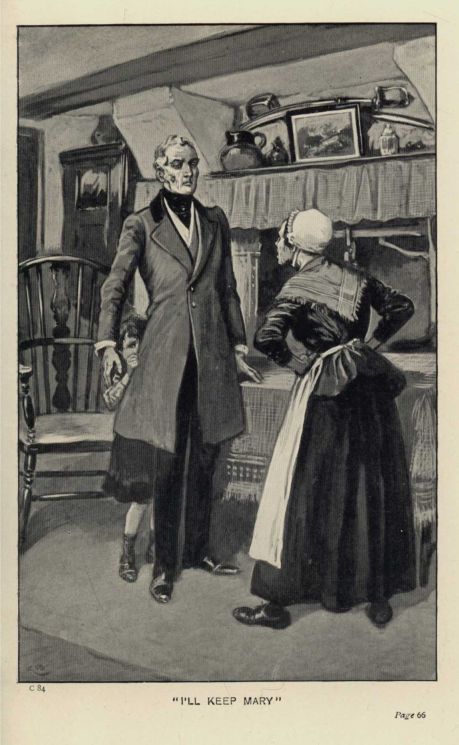
'I'LL KEEP MARY' Page 66
"Sirs, me!" ejaculated Katie, as she came out of her retreat; "that's awfu'!"
"Dinna be frichtened, my wee woman," said the Sergeant, as he led Mary to the fireside. "Warm yer bit feet, and get yer supper, and I'll gie ye a lesson afore ye gang to yer bed."
Mary blew her nose, dried her eyes, and did as she was bid.
The Sergeant motioned to his wife to come to the bedroom. He shut the door, and said, "I'll never pairt wi' Mary, come what may. My heart tells me this. Get Charlie's bed ready for her; she'll lie there, and be our bairn. God has sent her."
"I was thinking that mysel'," said Katie; "I aye liked the wee thing, and sae did Charlie."
The Sergeant's lesson was a very simple one, as, indeed, most of his were. He took the child on his knee, and putting on his spectacles, made her read one or two simple verses of Scripture. This night he selected, from some inner connexion, the verse from the Sermon on the Mount:--"Behold the fowls of the air: for they sow not, neither do they reap, nor gather into barns; yet your heavenly Father feedeth them. Are ye not much better than they?"
And he said, "Mary, dear, did you come and hear my bird whistle?"
"Oo, ay," replied Mary. "It was real bonnie; and I thocht a' the time o' wee Charlie."
"But why did ye run awa' and mak' a noise on the Sabbath morning? Ye shouldna hae been sporting on the Lord's day."
"I was frichtened for the minister," replied Mary.
"Why were ye frichtened for the good man?"
"I dinna ken," said Mary; "but the boys ran, and I ran, and Archy Walker fell ower me and hurled me. I wasna meaning ony ill;" and Mary threatened to give way again.
"Whisht, Mary," said the Sergeant. "I wasna blaming you; but ye ken I didna hang Charlie's bird oot to harm you, or mak' sport, but only because he wasna weel."
"What was wrang wi' him?" asked Mary. "There's an awfu' heap o' measles gaun aboot."
"Not that," said the Sergeant, smiling; "but it was to mak' him weel, no' to mak' you play, that I pit him oot. But ye see God kens aboot the bird, and it was Him that made him, and that feeds him; and see hoo he sleeps ower your new bed,--for that's whaur Charlie used to sleep; and ye'll sleep there, dear, and bide wi' me; and God, that takes care o' the wee birds, will tak' care o' you."
Mary said nothing, but turned her face and hid it in the Sergeant's bosom, next his heart; and he was more than ever persuaded that his heart was not wrong in wishing the orphan to lie there.
"Mary," the Sergeant whispered to her after a while, "ye maun aye ca' me faither."
Mary lay closer to his heart.
Katie, who had been sitting in the same arm-chair which she had occupied in the morning, heard her husband's words, and rising, bent over the child, and added, "And, Mary, ye maun aye ca' me mither."
The starling, who was asleep, suddenly awoke, as if startled, shook himself, elevated his yellow bill above the round ball of feathers, turned his head and looked at the group with his full bright eye, and although too drowsy to say "I'm Charlie's bairn," he evidently remembered the relationship, and would have expressed it too--partly from jealousy, partly from love--had he not been again overpowered by sleep.
"We'll hae worship," said the Sergeant, as he put Mary down, and placed her in a little chair which had never been occupied since his boy died. After reading the Scriptures--the portion chosen was the 23rd Psalm--the Sergeant prayed, Mary concluding at his request by repeating the Lord's Prayer aloud. They then retired to rest--Charlie's cot once more occupied; and the quiet stars never shone on a more peaceful home.
CHAPTER X
THE SERGEANT ALONE WITH THE STARLING
Mr. Smellie called upon the Sergeant next forenoon. His manner was cold and formal, as that of one who had power, if not right, on his side, and whose pride was flattered by the conviction that his real or supposed opponent was in the wrong. His reception was equally cold, for although Adam had respect for his minister, and also for Mr. Menzies, he had, as we have already said, none whatever for Mr. Smellie.
"Mr. Mercer," said Smellie, "I have called on you, in order first of all to correct a grave error you have committed in regard to Mary Semple, the child boarded by the Kirk Session with Mrs. Craigie."
"I'm not aware, Mr. Smellie," replied the Sergeant, "that you are the Kirk Session, or have any richt whatsomever to correct my error, as ye ca't, in this matter."
Smellie smiled sarcastically, and added, "In a friendly way, at least, Mr. Mercer. You, of course, ken that the whole expense of the bairn must be borne by yersel', for I don't believe that the Session will pay one farthing to you--not a farthing!--as you have ta'en her from Mrs. Craigie on your ain responsibility."
"I ken a' that; and I ken also that I mean to keep her frae Mrs. Craigie, unless the Session and the law hinder me, and compel me to gie her up; which is no' likely; but if they do, on them be the curse of injuring the orphan. Understan' then that I mean to keep her at my ain expense, even should the Session offer to pay for her. Anything else, Mr. Smellie?"
"Weel then, Mr. Mercer," said Smellie, "see til't, see til't; for there will be determined opposition to you."
"I have had worse in my day, Mr. Smellie," drily replied the Sergeant, "and I'm no' feared. In the meantime Mary remains here, and I'm determined she'll never return to Mrs. Craigie--that's settled. An' if the Session kent the woman as I do, and maybe as ye do, they wad be thankfu', as I am, that Mary is wi' me and no' wi' her. Onything mair to complain o' in what ye ca' a freendly way?"
"Oh, naething, naething!" said Mr. Smellie, with pent-up annoyance, "except that the committee which the Session appointed--that's me and Mr. Menzies--to deal with you about this scandal--a most unpleasant business--mean to ca' upo' you this evening at six, if that hour will suit."
"As weel, or as ill, as ony other hour, Mr. Smellie," replied Adam, "for I dinna mean to be dealt wi', either by you or by Mr. Menzies."
"No' to be dealt with, Mr. Mercer! Do ye mean to say that ye won't even receive the committee?" he asked with amazement.
"That's jist exactly what I mean, Mr. Smellie!" replied Adam; "I don't mean to receive your committee, that's plain, and you may tak' a minute o't. If ye wish to ken why, ye had better speer at Mr. Porteous. But ye needna trouble yoursel' wi' me. What I have said I'll stan' to like a man; what I have promised I'll perform like a Christian; and what I canna do, I winna do! If ye need mair explanation, this maybe will suffice:--that I'll no' kill my bird for you, nor for the Session, nor yet for the minister, nor for the hail parish; and that ye may as well try tae kill me wi' blank cartridge, as try yer han' in persuading me to kill the starling. Sae, Mr. Smellie, as far as that business is concerned, ye may gang hame, and no wat yer shoon to come my gait ony mair."
"Sae be't, sae be't!" replied Smellie, with a cackle of a laugh, as much as to say, "I have him!" He then bowed and departed, walking silently like a cat along the street, but not purring. Yet he seemed to be feeling for something with the long hairs which projected from his whiskers like bristles.
Poor Adam! Now began such a week in his history as he never had experienced before. Oh! it was cold, dark, and dreary! He had to drink the cup of loneliness in the midst of his fellowmen--the bitterest cup which can be tasted by anyone who loves his brother. But all his suffering was kept within his own heart, and found "no relief in word, or sigh, or tear".
What a sinner he had become in the opinion of many of the respectable inhabitants of Drumsylie! What a double distilled spirit of evil!--far over proof, for no proofs are ever applied to such evil spirits. Drumsylie was all agog about him. He was as interesting as a shipwreck to a seaport town; as a great swindle to a stock exchange; or as a murder to a quiet neighbourhood! What had he done! What had he been guilty of! Some said, or at least heard that some one else had said, that he had insulted the minister and the Kirk Session; others, that he had secretly supported himself as a poacher; others that he had been heard to declare, that rather than kill the bird, he would, out of mere spite and obstinacy, give up the eldership, the Church, ay, even Christianity itself; others, that he had stolen a child from Mrs. Craigie, whom, though a woman, he, a soldier, had threatened to strike in his own house. He was a terror even to evil doers!
Most marvellous is this birth and upbringing of lies! Who lays the first egg? How does it multiply so rapidly? And how singular is the development of each of the many eggs--through all the stages of evil thoughts, suspicious hints, wondering if's and maybe's, perversions, exaggerations, fibs, white lies--until it is fully hatched into out-and-out lies repeated with diligence, malice, and hate! We can give no account of this social phenomenon except the old one, of the devil being first the parent of the whole family, and his then distributing and boarding out each to trustworthy friends to be hatched and trained up in the way it should go in order to please him, its parent.
In Drumsylie, as in other towns, there were some who so indulged the self-pleasing habit of confessing and mourning over the sins and shortcomings of their neighbours, that they had little time or inclination to confess their own. Some of these confessors might be heard during this week in Adam's history lamenting:--"Oh! it's a dreadfu' place this! Eh! it's eneuch to keep ane sleepless to think o't! Whan a man like Adam Mercer, wi' a' his knowledge and profession, becomes a scoffer, and despises ordinances, and," &c. &c.
But it would be unjust to Drumsylie and the Sergeant to affirm that this state of public feeling had not very many marked exceptions. Some, chiefly among the poor, truly loved him and sympathized with him, and openly confessed this. Many protested, in private at least, against his treatment. But such is, alas! the moral cowardice, or maybe the thoughtlessness only, of even good men, that few expressed to Adam himself their goodwill towards him, or their confidence in his righteousness. It is indeed remarkable, in a free country of brave men, how very many there are who, before taking any decided part in questions which distract communities, small or great, attentively consider on which side the hangman is, or seems likely to be. The executioner's cord seen in the possession of this or that party has a wonderful influence on the number of its adherents. As far as appearances went, this sign of authority and power was supposed for the time being to be in the possession of the Rev. Daniel Porteous. And so the cautious and prudent consoled themselves by saying: "It is not our business", or "Least said soonest mended", or "Why quarrel with the minister?" or "Why displease my aunt, or my uncle, who are so bigoted and narrow?" or "Mr. Porteous and the majority of Session may be wrong, but that is their affair, not ours". Such were some of the characteristic sayings of the men who were doubtful as to the side which possessed Calcraft and his cord of office.
Mr. Smellie had communicated Adam Mercer's resolution to Mr. Menzies, and this had deterred him from attempting to follow in the track of expostulation with Adam, which it was evident would lead to nothing. Smellie had failed--who could succeed? Mr. Menzies ought to have tried. Some success by one good man in dealing with another good man, is certain.
The Session met on the next Sunday after Adam's quarrel with his minister, or rather of his minister with him. The court was, as usual, "constituted by prayer". But whether the spirit of prayer constitutes the spirit of every meeting opened by it, may, without offence, be questioned. It is unnecessary to condense the debates--for debates there were at this meeting. Adam, with a soldier's gentlemanly feeling, did not attend, lest it might be supposed that he wished to influence the court. Smellie, in spite of some opposing murmurs of dissent, ascribed his absence to "contumacious pride", and the minister did not contradict him.
Mr. Porteous addressed the court. He asked whether it was possible for them to stop proceedings in the case of Mr. Mercer without stultifying themselves? Had they not taken the very mildest and most judicious course, and considered both what was due to themselves and also to their erring brother? Yet they had not only failed to obtain the slightest concession from him, but he had gone so far as even to refuse to receive or confer with their own committee! The case was no doubt most distressing to them all, but, as far as he could see, it would bring well-merited ridicule on all Church discipline if they dropped it at this stage. To appoint another deputation would be disrespectful to the dignity of the court; and as for himself, he had done all he could since their last meeting to bring about an amicable settlement: for, on the previous Sabbath evening, he had had a private interview in the manse with Mr. Mercer, which had terminated, he grieved to say, in a most unsatisfactory manner.
Such was the general tenor of the minister's harangue. It was in vain that Mr. Gordon, backed by William Simpson, farmer, of Greenfield, and Andrew Grainger, watchmaker, argued against the minister--the latter declaring that the Session were putting back the hands of the clock, and falling behind time.
But all in vain! Adam, by the casting vote of the Moderator, was "suspended" from the eldership; that is, deprived for a time of his official position. Mr. Gordon and the two elders who supported him, vehemently protested against what they called the "tyrannical proceeding of the majority". Most fortunately for the cause of justice, the Rev. Daniel was not a bishop who could rule his parish presbyters as his own "principles", whims, or--pardon the irreverent insinuation--his indigestion, might dictate. There was a higher court, and there was the law of the land, higher than the court, to curb the minister's will, or as he always called it when in a passion--his conscience. The sentence of the Session might be, as was confidently anticipated, reversed by the Presbytery, though the district was notoriously narrow and prejudiced, and some of the clergy fancied that moving straws showed how the winds of heaven blew, when they were only stirred by their own breath.
When Adam returned on that Sunday afternoon from church, he fortunately did not know, though he more than suspected, what the decision of the Kirk Session had been. He knew certainly that his case must not only have come before the court, but must also, from its nature, have caused such a division of opinion as would make his position as an elder one of remark, of suspicion, and, to him, of personal pain. It was a temporary comfort, however, that he had no certain bad news to communicate to Katie, and that he could say, as he did with truth, "It wasna for me to be present, or to interfere. They have done their duty nae doot, an' I have done mine as far as I could."
When his humble Sunday meal was over, and before sunset, Adam went to visit one or two of the sick, infirm, or bedridden, who were on his list to attend to as an elder. Not until he was on his way to their homes did he realise the fact that, for the present at least, he was probably no longer an elder. But as he never had formed the habit of visiting the sick as a mere official, but had made his office only a better means, given him in God's providence, for gratifying his benevolent and Christian feelings, he went, as he was wont to do, with a peaceful spirit and loving heart. The poor and suffering whom he visited received him with their usual kindness and gratitude. They felt that Adam could not be a bad or false man; that in him was love--love in its meekness, calmness, self-possession, sympathy, and forgiveness of others. They could not, perhaps, explain the grounds of their perfect and unreserved confidence in him, yet they could not--it was impossible--entertain any doubts of his Christian character which could hinder their hearts from feeling what they in many cases expressed with their lips, that "A real guid man is Adam Mercer! It's me that should say't, for he has been aye kind and guid to me. I'm no saying wha's richt or wrang; I ken this only, that I'll stan' by Adam! I wish we had mair like him!"
CHAPTER XI
THE OLD SOLDIER AND HIS YOUNG PUPIL ON SUNDAY EVENING
On his return home after these visits, he placed Mary on Charlie's chair, beside himself, resolving, although the other members of the class were still absent, that he would nevertheless teach Mary as their representative, as well as for her own sake. There had come into his possession one of those small books of guidance and instruction which many intellectual people--so called by men, but probably not so recognized by the angels, who minister even to children--affect to despise, just as they would despise any "still small voice" when compared with the loud storm, the brilliant fire, and the powerful, rock-moving earthquake. This book was but a number of texts wisely arranged by a bedridden Christian, for each day of the year, with one of special and deeper import for its Sabbaths. The text for this Lord's Day was--"They who know thy name will put their trust in thee"; and Adam said to Mary, when she had repeated it as the lesson for the day, "Do ye understan' what is meant, my dearie, by trusting God?"
"I'm no sure," she replied.
"But ye surely ken what it wad be to trust me, Mary?" continued the Sergeant.
Mary looked up and smiled. She made no reply, but was evidently puzzled by an attempt she was unconsciously making to understand the possibility of want of trust in the Sergeant. So, finding no response, he again asked, "Wad ye trust me, my wee woman?"
Mary seemed vexed, and said, "What wrang hae I dune? Ye telt me aye to ca' you faither; I canna help; sae ye maunna be angry, for I hae nae faither but you."
"Richt! verra richt!" said the Sergeant; "but, Mary dear, wad ye trust God as weel as me?"
"No!" said Mary, very decidedly.
"What for no'?" asked the Sergeant, kindly.
"I'm awfu' frichtened for him," said Mary.
"Why are ye frichtened for Him?" asked Adam.
Mary seemed to be counting the buttons on his coat.
"Tell me, bairn!" he continued.
"Because," said Mary, sorrowfully, yet encouraged by his tone, "Mrs. Craigie aye telt me He wad sen' me to the bad place; and when I got my fit burned she said that I wad be a' burnt thegither some day, as I was a bad lassie; and I'm sure I wasna' doing her ony ill to mak' her say that."
"God will never," remarked the Sergeant, reverently, "send ye to the bad place, unless ye gang yersel'."
"I'll never do that!" exclaimed Mary.
"I hope no', my lassie," said Adam, "for I wish you no' to be bad, but to be good; and to trust God is the way to be good. Noo tell me, Mary, why wad ye trust me?"
"Because--jist because," said Mary, looking up to his face, "ye're faither."
"Weel dune, Mary!" continued the Sergeant. "Noo tell me what's the beginning o' the Lord's Prayer?"
"Our Faither which art in heaven, Hallowed be Thy name. Thy----"
"That'll do, Mary," interrupted Adam. "But can ye tell me noo wha's yer Faither as weel as me?"
After a pause, Mary said, as if she had made a discovery, "Our Faither in heaven!"
"That's a clever woman! Faither! that's God's Name. And noo that ye ken his Name, ye maun trust Him faur mair than me: for He lo'es ye mair than I can do, and is aye wi' ye; and never will forsake ye, and can aye help ye; and He has said that when faither and mither forsake you, he will tak' ye up. That will He, my lassie!"
"But," said Mary, "my mither and faither, they tell me, dee'd wi' fever, but didna forsake me."
"That's true; but I mean, my bairn," said Adam, "that ye can never be an orphan lassie wi' God as yer Faither."
"But," said Mary, "for a' that, ye maun aye be my faither as weel. Oh! dinna sen' me back to Mrs. Craigie."
"Dinna fear, Mary," replied Adam; "but maybe I maun hae to leave you. God may tak' me awa', and tak' yer mither there awa' too; and then when ye're alane in the world, ye maun trust God."
"I'll no' trust Him," replied Mary; "if you and mither dees, I'll dee tae, and gang wi' ye." And she fairly broke down, and clung to him as if he was about to leave her.
The Sergeant took Mary on his knee. "Be cheerie, Mary--be cheerie!" he said. "If ye kent God, ye wad aye be cheerie, my lassie. Mrs. Craigie has frichted ye."
"Ay, awfu'!" said Mary.
The Sergeant felt as if Mary had not quite learned her lesson, and he continued:--"D'ye mind what I telt ye ae nicht aboot mithers bringing their bairns to Christ?--and hoo some folk that didna ken Him were for keeping them awa'?--and hoo Jesus was angry at them?--and hoo the bairns gaed till Him----"
"And did they no' squeel wi' fricht?" asked Mary.
"Did ye squeel, Mary," asked the Sergeant, with a smile, "when I took ye into my arms?"
"No. What for should I?" replied Mary.
"Aweel, my lassie," argued Adam, "why do ye think that bairns like yersel' should be frichted to trust that same Jesus wha was Himsel' a bairn and kens a bairn's heart? He wad be unco sorry, Mary, if ye didna trust Him, when He dee'd, as ye ken, on the cross to save you and me and ilka body, and aye thinks aboot us and prays for us."
Mary sighed, and crept closer to the Sergeant.
Adam, taking her little hand in his, said, "Mind what I tell ye, my bairn. Learn ye to speak aye to God and tell Him yer heart in yer ain prayer, and never gang ony road He wadna like; and stick till Him as ye wad to me if we were gaun ower the muir thegither at nicht, or through a burn in a spate; and never, Mary, in the hour o' distress think that He doesna care for you or has forgotten you. For nae doot whan ye grow up to be big ye'll hae mony a distress, like ither folk, ye dinna ken aboot yet."
Mary turned her face to his bosom as if to sleep, but never was she less inclined to sleep.
The Sergeant added, with a sigh, "Think, my wee dearie, on what I tell ye noo, after I'm dead and gane."
Katie, seated on the opposite side of the fire, had been reading Boston's Crook in the Lot. She seemed not to have heard a word of her husband's lesson; but her ears drank in the whole of it. The Sergeant had evidently forgotten her presence, so quiet was she, and so absorbed was he with Mary, who was to him a new life--his own child restored. But as Katie caught his last words, she put down her book, and looking almost in anger at her husband--could she have felt jealous of Mary?--said, "Tuts, Adam! what's the use o' pitting me and Mary aboot wi' discoorsin' in that way! It's really no' fair. I declare ane wad think that Andra Wilkie, the bederal, was diggin' yer grave! What pits deein' in yer head e'enoo? An' you an auld sodger! Be cheerie yersel', man!"
"I daursay ye're richt, gudewife," said Adam, with a smile, and rather a sheepish look, as if he had been caught playing the woman with an unmanly expression of his feelings and dim forebodings. "Gie Mary her piece," he added, "and sen' her to her bed. She has dune unco weel." He passed into the bedroom, closing the door while Katie was putting Mary to rest.
It was a peaceful night. He sat down near the small window of the bedroom, from which was a pleasant peep of trees, their underwood now hid in darkness, but their higher branches, with every leafy twig, mingling with the blue of the starry sky, partially illumined by a new moon. He had felt during these last days an increasing dulness of spirits. But this evening he had been comforting himself while comforting Mary; and remembering the lesson he had given her, he said to himself, "Blessed are all they who put their trust in Thee". And somehow there came into his mind pictures of the old war--times in which, amidst the trampling of armed men and words of command, the sudden rush to the charge or up the scaling-ladder, the roar and cries of combat, the volcano of shot and shell bursting and filling the heavens with flame and smoke and deadly missile, he had trusted God, and felt calm at his heart, like a child in the arms of a loving parent. These pictures flashed on him but for a second, yet they were sufficient to remind him of what God had ever been to him, and to strengthen his faith in what He would ever be.
CHAPTER XII
ADAM MERCER, SERGEANT, BUT NOT ELDER
Next morning the announcement of the Sergeant's suspension from the eldership was conveyed to him by an official document from Mr. Mackintosh, the Session clerk and parish schoolmaster;--a good, discreet man, who did his duty faithfully, loyally voted always with the minister from an earnest belief that it was right to do so, and who made it his endeavour as a member of society to meddle with nobody, in the good hope that nobody would meddle with him. Every man can find his own place in this wide world.
Katie heard the news, but, strange to say, was not so disconcerted as Adam anticipated. In proportion as difficulties gathered round her husband, she became more resolute, and more disposed to fight for him. She was like many women on their first voyage, who in calm weather are afraid of a slight breeze and the uneasy motion of the ship, yet who, when actual danger threatens, rise up in the power and dignity of their nature, and become the bravest of the brave--their very feeling and fancy, which shrank from danger while it was unseen, coming to their aid as angels of hope when danger alone is visible.
"Aweel, aweel," remarked Katie; "it's their ain loss, Adam, no' yours; ye hae naething to charge yersel' wi'."
But she would sometimes relapse into a meditative mood, as the more painful side of the case revealed itself. "Ay noo--ay--and they hae suspended ye?--that's hanged ye, as I suppose, like a dog or cat! Bonnie-like Session!--my word!--and for what? Because ye wadna kill the bird! Teuch! It micht pit a body daft tae think o't!" And so on.
But this did little good to Adam, who felt his character, his honour, at stake. Things were daily getting worse to bear. The news had spread over the town, "Adam Mercer has been rebuked and suspended by the Kirk Session!" From that moment he became a marked man. Old customers fell away from him; not that any openly declared that they would not employ him as a shoemaker merely because the minister and Kirk Session were opposed to him:--Oh no! Not a hint was given of that, or anything approaching to it; but, somehow, new shoes seemed to have gone out of fashion in Drumsylie.
The cold unfeeling snowball increased as it rolled along the street in which Adam lived, until it blocked up his door, so that he could hardly get out. If he did go, it was to be subjected to constant annoyance. The boys and girls of the lowest class in his neighbourhood, influenced by all they heard discussed and asserted in their respective homes, where reserve was not the characteristic of the inmates, were wont to gather round his window, and to peer into the interior with an eager gaze, as if anxious to discover some fitting fuel to enlighten their domestic hearths at night. It was as impossible to seize them as to catch a flock of sparrows settled down upon a seed plot in a garden. When the Sergeant therefore ventured to go abroad, the nickname of "The Starling" was shouted after him by the boys, who adopted all the various modes of concealing their ringleaders which evidence such singular dexterity and cunning. The result was that Adam was compelled, as we have said, to keep within doors. He thus began to feel as if he was alone in the world. Everyone seemed changed. Those on whom he had hitherto relied failed him. He or the world was worse than he had ever imagined either to be, and it was little comfort to him to know which of the two was wrong.
The Sergeant, however, enjoyed much inward peace though little happiness. For how different is peace from happiness! Happiness is the result of harmony between our wants as creatures and the world without: peace is the harmony between us as spiritual beings and the Father of our spirits. The one is as changeable as the objects or circumstances on which it for the moment relies; the other is as unchangeable as the God on whom it eternally rests. We may thus possess at once real happiness and real peace; yet either may exist without the other. Nay more, happiness may be destroyed by God in order that the higher blessing of peace may be possessed; but never will He take away peace to give happiness! Happiness without peace is temporal, but peace along with happiness is eternal.
Adam, as we have said, enjoyed little happiness in the conflict in which he was engaged, but he was kept in "perfect peace".
When another Sunday came round, the old sense of duty induced him to go, as usual, to church. His absence might be supposed to indicate that he feared the face of man, because fearing the face of God. Katie accompanied him. Her courage rose to the occasion. Let not the reader who, moving in a larger sphere of life, has learned to measure his annoyances by a larger standard, smile at these simple souls, or think it an exaggeration thus to picture their burden as having been so heavy.
Adam and Katie walked along the street, knowing all the time that they did so under the gaze of the cold and criticising eyes of some who were disposed to say to them, "Stand back, I am holier than thou!" Yet more persons than they themselves were aware of felt towards them kindness, pity, and respect, mingled with very opposite feelings to those of the minister and the members of Kirk Session who had made so much ado about so small an affair. Others forgot the sympathy due to a suffering, good man, apart from its immediate cause. Many of his worthy friends said afterwards that they "did not think of it!" Alas! this not thinking is often the worst form of thought.
Adam and Katie passed Smellie, as he stood at "the plate", without the slightest recognition on either side. They occupied their accustomed seat, but sat alone. Those who ordinarily filled the pew suffered from cold or conscience, and so were either absent or seated elsewhere. One may guess what sort of sermon Mr. Porteous preached from the text, "Beware of evil doers". The personal reference to the Sergeant was like a theme pervading his overture; or as an idea not so much directly expressed as indirectly insinuated from first to last. The argument was a huge soap-bubble of what he called "principle" blown from his pipe until he could blow no longer, and which when fully developed he contemplated with admiration, as if it were a glorious globe of thought that must necessarily be heavenly because reflecting to his eyes the colours of the rainbow. His picture of the danger of the times in which he lived was very vivid, and his hopes of any improvement very small. The history of society seemed but a record of degeneracy since the first century of the Christian era. But whoever proved a traitor, he himself, he said, would still earnestly contend for the faith once delivered to the saints; and his trumpet, at least, should never give an uncertain sound; and he would hold fast the form of sound words:--and so on he went until his forty-five minutes were ended.
That the preacher was perfectly sincere, no one could doubt. He was no coward, or make-believe, but was thoroughly convinced. He would at any time have given up his "all" for his "principles", and given his body even to be burned for them without fear--yet possibly "without charity".
We do not condemn Mr. Porteous's "principles". They were, most of them, what might be called Christian truisms, which no one believing in the supreme authority of the Bible, far less any parish minister, could dispute. But the practical application of his principles by the minister on certain occasions, as on this one, might be questioned. He might also have considered whether there were not many other Bible and Christian principles of wider import and deeper spiritual meaning, than those he contended for, and gave such prominence to, not excluding but including his special favourites, which he required to know before he could really understand or truly apply those even which he so tenaciously held and so frequently expounded. Half truths are untruths. A man who always tried to stand on his head might be as well without one.
Adam accepted the heavy fire from the pulpit with calm submission. He knew that very many in the congregation while listening to the minister were looking at himself; but, knowing also how much depends in every battle on the steadiness and self-possession of the non-commissioned officers, he looked the enemy in the face and never winced. Katie seemed inspired by his example--so far, at least, that she neither fled nor fainted; and though not daring to gaze on the foe, she braved his charge as if kneeling in the rear rank, with a calm countenance, but with eyes cast down to the ground.
Poor Katie! What would Waterloo have been to her in comparison with that day's mental battle in the kirk! The one was an honourable conflict; but this was reckoned by those whom she respected as one of dishonour. In the one was danger of wounds and of death; but in this were deeper wounds, and danger possibly beyond the grave! How often did the form of her old "faither" come before her--though she thought it strange that he did not seem to frown. But she never communicated her fears or feelings to her husband. "He has eneuch to carry wi'oot me," she said.
As they left the church, more than one person took an opportunity of addressing the Sergeant, and, to the credit of all, not one uttered an unkindly word. Some shook him warmly by the hand, but said nothing. Others added, "God bless ye! Dinna heed, Mr. Mercer. It'll come a' richt yet." Mr. Gordon and one or two of the elders were marked in their kindness. It would not have conduced to the comfort of the minister, though it might have made him doubt how far his people really sympathised with him or his "principles", had he heard some of the remarks made after the sermon by the more intelligent and independent of his congregation. But his ignorance was to him a kind of bliss; and whatever tended or threatened to disturb his self-satisfaction would have been recognised by him as folly, not wisdom.
Adam could not shut his ears, but he could hold his tongue; and he did so.
The worthy couple walked home in silence, and arm-in-arm too! for the first time probably in their lives. Mary, whom we forgot to mention, followed them in new shoes, a new bonnet, a new shawl, with her Bible wrapped up in a clean pocket-handkerchief. As they entered their home, the starling received them with quite a flutter of excitement. Shaking his feathers, hopping violently about his cage, or thrusting his bill, as if for a kiss, between the bars, he welcomed Mary, as she approached him with some food, and made the room ring with various declarations as to his being Charlie's bairn, his hopes of being yet a king, and his belief in genuine manhood.
"I think," quoth the Sergeant, "he is ane o' the happiest and maist contented bit craturs in the parish."
Mary, as if feeling that it was right to say something good on Sunday, archly put in, "I mind what ye telt me aboot the bird."
"What was't, my bairn?" asked Adam.
"It was aboot the fowls--I dinna mind a' the verse, but a bit o't was, 'Are not ye better than the fowls?'"
"Thank ye for the comfort, Mary dear," said Adam, gravely.
From some common instinct of their hearts, Mr. Porteous's sermon was not spoken of. Was it because Mary was present? or only because Katie was so anxious to see the cheese well toasted for their tea? or because----yet why go on conjecturing! But at evening worship, which closed the day, Adam, as usual, prayed for his minister, and for God's blessing on the preached word; and he prayed to be delivered from evil-doing, and from fretting at evil-doers, and to be enabled to put his trust in God and do good. Katie on rising from her knees did what she never did before--kissed her husband, saying, "God bless you, my best o' men!"
"Gae awa', gae awa'!" said the Sergeant; "ye want to gaur me greet like yersel', do ye? But na, lass, I'm ower auld a sodger for that!" With all his boasting, however, he was very nearly betrayed into the weakness which he professed to despise. But he seemed greatly pleased with his good wife's kindness, and he added, "Bless you, my braw leddy, a' the same. And," in a whisper, "ye needna let on to Mary that I'm fashed. It micht vex the lassie."
CHAPTER XIII
JOCK HALL, THE NE'ER-DO-WEEL
We must go back for a few days in our story. During the lonely week which we have but very partially and inadequately described--for how few would believe that a man with a good conscience and good sense could suffer so much in such circumstances!--the Sergeant received a visit from Jock Hall, who has been already mentioned, and whom Katie described as "a ne'er-do-weel".
Katie's estimate of Jock's character was that of Drumsylie. Most parishes, indeed, have their quota of weaklings in intellect and weaklings in morals. Jock belonged to the latter class. He was a thin, sallow-faced man, of a nervous temperament, and with lank black hair, and sharp piercing unrestful eyes. He might be aged thirty, although he looked liker forty. His jacket was made of fustian, which might have been clean some years before; his corduroy trousers had ragged endings, beneath which were revealed old boots and worn-out stockings; while a tattered bonnet covered his capacious head--a head that, phrenologically, was of a superior type. How Hall lived no one knew, nor cared to know. His lodging, when under a roof, varied with the means at his disposal for paying rent. If any unknown householder in the unknown recesses of the small towns which Jock visited, permitted him to sleep gratis on the floor near the fire, it was a secret known and appreciated by himself only.
Jock had never presumed to enter so aristocratic a house as Adam's. But now that public report had brought the Sergeant down somewhat nearer to his own level, and that he had a pair of boots to mend, without having any credit with even the most drunken cobbler in Drumsylie, Jock thought that, under the whole circumstances of the case, moral and commercial, he might visit the Sergeant without any offence. He did so, to the astonishment of Adam, and much more to that of his wife. "What do ye want wi' Mr. Mercer?" was her question, as she opened the door to Jock's knock.
"Business!" was his short and decided reply. When he entered the small but cleanly kitchen, his only remark was, "Like a new preen!" Looking round with a half-vacant, half-curious gaze, he fixed his eyes on the Sergeant for a moment, then walking up to the starling's cage, he muttered, "Deevils!"
This brief exclamation arrested the attention of Adam, who asked, "What do ye mean, my man? D'ye ken what ye're saying?"
"Fine!" replied Jock. "Deevils! again say I!"
The Sergeant rose, tapped him on the shoulder, and pointed to the door.
"I understan'," said Jock; "ye wad hae me gang oot. Ye're no' the first that has sent Jock Hall that gait! Maist folk like to see his back a hantle better than his face. But I'm no' gaun oot at present, Sergeant. That stirlin' o' yours 'll no' let me. I'm fond o' birds--in fac, they're the only leevin' things I care for. I never liked canaries, they're ower genteel and ower particklar about bein' coodled, to please a tramp like me that never was in that way mysel'. But our ain birds--that's maavies, linties, and laverocks, or even gooldies, that can stan' a' wathers, and sing for a' folk, specially for them that's obleeged to lie oot in wuds, or on the heather--them's the singers for Jock Hall! But I'm no weel acquaint wi' thae stirlin's. I'm telt that yours is no canny, an' that it speaks like an auld-farrant bairn. Eh?" And Jock turned to the cage from which his attention had for a moment been diverted; and while the Sergeant was earnestly studying his strange guest, the guest was as earnestly studying the strange bird. The starling was singularly still, and seemed to sympathise with his master in his study of Hall. He then leaped up to his perch, turned his back to Jock, shook his feathers, turned round and again looked at his visitor with a steady gaze.
"That's a fearsome bird!" said Hall, without moving. "As sure as I'm leevin, I see'd his ee gettin' bigger and bigger, till it was like a saxpence as it glowered at me. I was frichtened it kent a'things I was doing or thinking aboot!"
"Let the bird alane!" said the Sergeant, "and come here to the window if ye hae ony business wi' me, Hall."
Jock obeyed; but twice, between the cage and the window, he looked over his shoulder at the starling, as if he was afraid of him.
"What do ye want wi' me?" inquired the Sergeant.
"Hoo lang," asked Hall, in a low voice, "hae ye had that bird? Hoo auld is he? Whaur did ye get him? What does he say when----"
"Never heed the bird," interrupted the Sergeant: "he's doin' ye nae ill."
"I'm no sae sure but he could do't if he took a thraw at me," said Jock; "I'll wager he has seen me afore, an' kens me--for he's no canny."
"Nonsense!" said Adam.
"If it's nonsense," replied Jock, "what way has he brocht you into this habble? What for do ye loe him sae weel? Why wad ye gie up, as I hear ye wad, yer verra saul and body for this world and the neist, for the sake o' the bird? What way do they say he's a witch?"
"Haud yer tongue, Hall," said the Sergeant, "and speak aboot yer ain business, no' mine."
"My business!" exclaimed Jock; "at yer service, Mr. Mercer, at yer service!"
"Oot wi't, then, and be done wi't," said Adam.
"It's my business, then," said Hall, "to come here an' abuse a' thae deevils,--Porteous, Smellie, and the lave--that abused that bird! that's my business---the chief part o't," continued Hall, in rather an excited manner; "an' the bird kens that, I'm certain,--just see hoo he's glowerin' at me! I'se warrant he has watched me in the woods afore he was catched; an' if he if a witch, and kens aboot me, then----"
"Haud yer tongue, Hall, this moment," said the Sergeant, with a loud voice of command, "or I'll pit ye oot like a doug! If ye hae a message to deliver, say it and be aff."
Jock was suddenly quiet, as if arrested by some strong power. Then in a more natural tone of voice he said, "It's no' worth the while o' an auld sodger to kick a man like me. But let sleepin' dougs lie! Dougs hae teeth, and their bite is bad when mad--when mad!" Then, after a pause, he went on, in a laughing mood, "But I hae business, important business wi' ye, Sergeant; an' afore we proceed to consider it, ye'll tak' a snuff! It pits brains into a bodie's head;" and Jock produced a small tin snuff-box, and opening the lid he looked into it with an expression of anxiety. "There's twa, I'm sure,--twa snuffs; an' I consider a man is no' poor wha has ae snuff for himsel' and anither for a neebor. Sae tak' a snuff!" and he handed the box to the Sergeant, as he himself leant back in his chair, crossed one leg over another, and pointing to his boots said, "That's some business, since ye insist on it! I want to gie ye a job, Mr. Mercer, for I hear ye're idle." Then turning up the soles of his wretched boots, which looked like a kind of leather vegetable about to rot into earth mould, he said, "They'll be ill to patch, or to fit new soles on, but I ken ye're a gude tradesman. Try."
Adam only smiled.
"Ye'll be like the lave," Jock continued, "ower prood to work for a man like me. I wadna wunner if ye're no sure o' payment. Sae maybe it's as weel to tell ye, that as far as I ken, ye'll never get a bawbee frae me! For Jock Hall is a braw customer to them that'll ser' him--though, faix, there's no mony o' that kind noo!--but he's a bad payer. In fac, he has clean forgot hoo to pay an account."
Sorrow softens the hearts of good men; and if it is in any degree occasioned by unjust treatment, it prompts charitable sympathies towards others who are condemned as wicked by society without a fair hearing ever having been afforded them. When the streams of their affection have been frozen by the cold reception given where a warm welcome was anticipated, it is a relief to let them flow into other and dried-up cisterns where, in despair, from a long drought, such blessings were never expected, and are joyfully appreciated.
So Adam felt kindly towards Jock, though he only said, "I'll men' your boots for that fine pinch o' snuff, and they'll cost ye nae mair, except guidwill, and that's cheap."
Jock Hall looked rather perplexed, and cleared out his box with his long finger, pressing his last snuff vehemently into his nostril. Then resuming, as if with difficulty, his careless manner, he said, "Hae the boots ready by Friday nicht, as I maun fish the East Muir water on Saturday."
"Ye may depend on them, Jock! And noo, as yer business is done, ye may gang." The Sergeant did not wish him to resume his wild talk, as he had threatened to do.
Jock crossed his arms, and gazed on the Sergeant as if he would look him through. Then grasping his own throat, and looking wildly, he said: "It's come! it's come! The evil speerit is chokin' me! He is here like a cannon ball! I maun speak, or my head will rive! I maun curse Porteous, and the kirk, and religion, and elders, and Sabbath days, and a' thing guid!" and his eyes flashed fire.
The Sergeant could not make him out, as they say. He was disposed to think him insane, though he had never heard Jock's name associated with anything save recklessness of character. He therefore did nothing but return the gaze of the excited man. Katie, unwilling to sit in the same room with him, had retired to her bedroom. Mary sat at the fireside with her book in evident alarm.
"I hate them!" repeated Jock, almost grinding his teeth.
"What do ye mean, Jock?" asked Adam, quietly but firmly. "Do you want to quarrel wi' me?"
"I mean," said Jock, bending towards the Sergeant, "that noo the fingers o' religion are grippin' yer windpipe and chokin' ye, as the evil speerit is grippin' and chokin' me--that noo ye hae ministers an' elders o' religion kicking ye in the glaur, lauchin at ye, bizzin at ye as a blackguard--that noo when e'en Luckie Craigie an' Smellie ca' ye bad, as a' folks hae ca'ed me a' my days--I thocht," he continued, with a sarcastic grin, "that ye wad like ane waur than yersel' to speak wi' ye, and, if ye liked, to curse wi' ye! Aha, lad! I'm ready! Say the word, and Jock Hall's yer man. I ha'e poower noo in me for ony deevilry. Begin!"
The Sergeant experienced what is called in Scotland a grew--the sort of shiver one feels in a nightmare--as if a real demoniac was in his presence. Fascinated as by a serpent, he said, "Say awa', Jock, for I dinna understan' ye."
On this Jock became apparently more composed. But when with a suppressed vehemence he was again beginning to speak, it struck the Sergeant to interrupt the current of his passionate thoughts, on the plea that he wished to hear Mary her lesson. His object was, not only to calm Jock, but also to get the child out of the room.
"Mary," he said, after having assured her there was no cause of fear, and placing her between his knees, "wha should we trust?"
"God!" replied Mary.
"Why?" asked the Sergeant.
"Because his name is Love, and He is our Faither."
"Richt, Mary; and we ought a' to love our Faither, for He loves us, and to love our neebour as ourselves. Gang awa' ben to your mither noo. Ye hae done weel."
When the door of the bedroom was shut, Jock Hall said, "That's Luckie Craigie's lassie? Fine woman, Luckie! Kindly bodie! A gude hoose is hers to sen' a puir orphan to. Ha! ha! ha! Keep us a'!--it's a warld this, far ower guid for me! But Luckie is like the lave, and Smellie, to do him justice, as he has mony a time done tae me, is no waur than Luckie:
'When hungry gledds are screichin',
An' huntin' for their meat,
If they grip a bonnie birdie,
What needs the birdie greet?'
An' ye're to pay yersel' for the lassie, Smellie says; an' ye're to teach her! A fine lesson yon! Ha! ha! ha! Jock Hall lauchs at baith o' ye!"
The Sergeant was getting angry. Hall seemed now to be rather a free-and-easy blackguard, although there was a weird gleam in his eye which Adam did not understand; and in spite of his self-respect, he felt a desire to hear more from Jock. So he only remarked, looking steadily at him, "Jock! tak' care what ye say--tak' care!"
"Oo ay," said Hall. "I'm lang eneuch in the warld to ken that advice! But what care I for the advice o' you or ony man? It was for me, nae doot, ye intended that lesson? I'm as gleg as a fish rising to a flee! The lassock said we should love our faither! Hoo daur you or ony man say that tae me?" Then, leaning forward with staring eyes and clenched fist, he said, "I hated my faither! I hated my mither! They hated me. My faither was a Gospel man; he gaed to the kirk on Sabbath--wha but him!--and he drank when he could get it the rest o' the week; an' he threshed my mither and us time aboot--me warst o' a', as I was the youngest. I focht mony a laddie for lauchin' at him and for ca'in him names when he was fou, and mony a bluidy nose I got; but he threshed me the mair. My mither, tae, gaed to the kirk, and begged claes for me and my brithers and sisters frae guid folk, and said that my faither wasna weel and couldna work. Oh, mony a lee I telt for them baith! And she drank, as weel, and focht wi' my faither and us time aboot. And syne they selt a' their claes and a' their blankets, and left us wi' toom stomachs and toom hearts, cowerin' aboot a toom grate wi' cauld cinders. I never was at skule, but was cuffed and kickit like a doug; and my wee brithers and sisters a' dee'd--I dinna ken hoo: but they were starved and threshed, puir things! But they were waik, and I was strang. Sae I leeved--waes me! I leeved! I hae sat oot in the plantin' mony a nicht greetin' for my brither Jamie, for he had a sair cough and dwined awa', naked and starved. He aye gied me his bit bread that he stealt or beggit"--and Jock cleared his throat and wiped his forehead with a scrap of a ragged handkerchief. "But my faither and mither dee'd, thank God! I hate them noo, and they hated me--they hated me, they did"--and he fell into a sort of dream. His vehemence sank into a whisper; and he spoke as one in sleep--"An' a' folks hate me--hate me. An' what for no'? I hate them!--God forgive me! Na, na! I'll no' say that. There's nae God! But I believe in the Deevil--that I do, firmly."
Jock sank back in his chair, as if wearied, and closed his eyes, his chest heaving. Then opening his eyes, he said in a low tone, "The bird kens that! Wha' telt him?" and his eyes were again closed.
"Jock, my man," said the Sergeant, perplexed, yet kindly, "I dinna hate ye."
But Jock went on as in a dream. "I hae led an awfu' life o't! I hae starved and stealt; I hae poached and robbed; I hae cursed and drank; I hae 'listed and deserted; I hae lain oot on muirs and in mosses. I'm Jock Hall! a'body kens me, and a' hate me as I do them! And what guid did yer ministers and elders, yer Sabbath days and yer preachings, do for me? Curse them a', I say! what's Jock Hall's saul worth! It's no' worth the burnin'! What care I?
'Cock-a-Bendy's lying sick,
Guess what'll mend him?
Hang the blackguard by the throat,
And that'll soon end him!"
"Be quiet, my puir fellow," said the Sergeant, "and listen to me. I never harmed you, Jock; I couldna harm you! I never wull harm you. I'll feed ye noo; I'll gie ye shoon; I'll stan' yer frien'."
Jock looked up, and in a calm tone said, "My head is spinnin' and my heart is sick! I havena eaten a bit since yesterday. Dinna flyte on me e'enoo, I'm no mysel'; wait a wee, Mr. Mercer, and then ye can abuse me, or kick me." With still greater calm he added in a few seconds, and looking round like one waking up more and more into life, "I hae been dreaming or raving! Man, Mercer, I think I tak' fits sometimes--especially when I'm lang wi'oot meat. What was I saying e'enoo?"
"Naething particular," said Adam, wishing not to rouse him, but to feed him; "never heed, Jock. But bide a wee, I'll gie ye a nice cup of tea and a smoke after it, and we'll hae a crack, and ye'll comfort me in yer ain way, and I'll comfort you in mine."
Jock, like a man worn out with some great exertion, sat with his head bent down between his hands--the veins of his forehead swollen. The Sergeant, after some private explanation with Katie, got tea and wholesome food ready for Jock; and that he might take it in peace, Adam said that he had to give Mary another lesson in the bedroom.
Hall was thus left alone with his food, of which he ate sparingly. When Adam again entered the kitchen, Jock was calm. The Sergeant soon engaged him in conversation after his own method, beginning by telling some of his soldier stories, and then bit by bit unfolding the Gospel of Peace to the poor man, and seeking to drop a few loving words from his own softened heart to soften the heart of the Prodigal.
The only remark Jock made was, "I wish I'd been in a battle, and been shot, or dee'd wi' oor Jamie! But what for did I tell you a' this? I never spak' this way to mortal man! It's that bird, I tell ye. What's wrang wi't?"
"Naething!" replied the Sergeant; "it's a' nonsense ye're talking. I'll let ye see the cratur, to convince ye that he is jist as natural and nice as a mavis or laverock."
"Stop!" said Jock, "I dinna like him. He is ower guid for me! I tell ye I'm a deevil! But bad as I am--and I'll never be better, nor ever do ae haun's turn o' guid in this world--never, never, never!----"
The Sergeant rose and took down the cage, placing it before Hall, saying, "Jist look at his speckled breest and bonnie ee! Gie him this bit bread yersel', and he'll be cheerie, and mak' us a' cheerie."
Jock took the bread and offered it to Charlie, who, seeing the gift, declared "A man's a man for a' that!" "Guid be aboot us!" said Hall, starting back; "hear what he says to me! If that's no' a witch, there's nane on yirth! I said I was a deevil, he says I'm a man!"
"And sae ye are a man for a' that, and no sic a bad ane as ye think. Cheer up, Jock!" said Adam, extending his hand to him.
Jock took the proffered hand, and said, "I dinna understan' a' this--but--but--I was gaun to say, God bless ye! But it's no' for me to say that; for I never was in a decent hoose afore--but only in jails, and amang tramps and ne'er-do-weels like mysel'. I'm no' up tae menners, Sergeant--ye maun excuse me."
Jock rose to depart. Before doing so he looked again round the comfortable clean room--at the nice fire and polished grate--at Charlie's bed with its white curtains--and at the bird, so happy in its cage--then, as if struck by his own ragged clothes and old boots, he exclaimed, "It wasna for me to hae been in a hoose like this." Passing the bedroom door, he waved his hand, saying, "Fareweel, mistress; fareweel, Mary," and turning to the Sergeant, he added, "and as for you, Sergeant----" There he stopped--but ending with a special farewell to the starling, he went to the door.
"Come back soon and see me," said the Sergeant. "I'll be yer freen', Jock. I hae 'listed ye this day, and I'll mak' a sodger o' ye yet, an' a better ane, I hope, than mysel'."
"Whisht, whisht!" said Jock. "I have mair respec' for ye than to let ye be my freen'. But for a' that, mind, I'm no gaun to pay ye for my boots--and ye'll hae them ready 'gin Friday nicht, for Saturday's fishin'--fareweel!"
"A' richt, Jock," said Adam.
No sooner had Hall left the house than the Sergeant said to himself, "God have mercy on me! I to be unhappy after that! I wi' Katie and Mary! I wi' mercies temporal and spiritual mair than can be numbered! Waes me! what have I done! Starling, indeed! that's surely no' the question--but starvation, ignorance, cruelty, hate, despair, hell, at our verra doors! God help puir Jock Hall, and may He forgive Adam Mercer!"
Jock got his boots on Friday night, well repaired. He said nothing but "Thank ye," and "Ye'll get naething frae me." But on Saturday evening a fine basket of trout was brought by him to the Sergeant's door. Jock said, "There's beauties! Never saw better trout! splendid day!" But when the Sergeant thanked him, and offered him a sixpence, Jock looked with wonder, saying, "Dinna insult a bodie!"
CHAPTER XIV
JOCK HALL'S CONSPIRACY
On the Sunday, when the Sergeant went to church, as we have already described, Jock Hall was quartered for the day with Mrs. Craigie. To do Smellie justice, he did not probably know how very worthless this woman was, far less did the Kirk Session. She was cunning and plausible enough to deceive both. Her occasional attendance at church was sufficient to keep up appearances. The custom of boarding out pauper children with widows, except when these are not respectable, has on the whole worked well, and is infinitely superior to the workhouse system. Mrs. Craigie belonged to the exceptional cases. She accommodated any lodger who might turn up.
Jock and Mrs. Craigie were at the window, a second story one, criticising the passers-by to church, as one has seen the loungers at a club window do the ordinary passers-by on week-days. The Sergeant and his wife, with Mary following them, suddenly attracted their attention.
"The auld hypocrite!" exclaimed Mrs. Craigie; "there he gangs, as prood as a peacock, haudin' his head up when it should be bowed doon wi' shame to the dust! An' his wife, tae!--eh! what a ban net! sic a goon! Sirs me! Baith are the waur o' the wear. Ha! ha! ha! And Mary! as I declare, wi' new shoon, a new bannet, and new shawl! The impudent hizzy that she is! It's a' to spite me, for I see'd her keekin' up to the window. But stealt bairns can come to nae guid; confoond them a'!--though I shouldna say't on the Sabbath day."
Hall stood behind her, and watched the group over her shoulder. "Ye're richt, Luckie," he said, "he is an auld hypocrite. But they are a' that--like minister, like man. 'Confoond them,' ye say; 'Amen', I say; but what d'ye mean by stealt bairns?"
Ah, Jock, art thou not also a hypocrite!
Mrs. Craigie had left the window, and sat down beside the fire, the church-goers having passed, and the church bell having ceased to ring. Jock then lighted his pipe opposite Mrs. Craigie. "What d'ye mean," he asked again, "by stealt bairns?"
"I mean this," replied she, "that yon auld hypocrite, sodger, and poacher, Adam Mercer, stealt Mary Semple frae me!" and she looked at Hall with an expression which said, "What do ye think of that?" Then having been invited by Hall to tell him all about the theft, she did so, continuing her narrative up to the moment when she was ordered out of the house by Adam; saying now as on that occasion, "But I hae freen's, and I'll pit Smellie to smash him yet! I'll get my revenge oot o' him, the auld bitin' brock that he is. Smellie is my freen, and he has mair power, far, than Adam wi' the minister." So thought Mrs. Craigie.
"Is Smellie yer freen'?" asked Hall, without taking his pipe out of his mouth, "and does he hate Adam? and does he want Mary back tae you?"
"That does he," replied Mrs. Craigie; "and he wad gie onything to get Mary back tae me?"
"Then, my certes, Smellie has pooer! nae doot o' that," remarked Hall, with a grim smile; "for he has helpit to pit me mony a time into the jail. Wad it obleege him muckle tae get Mary back frae the Sergeant? Wad he befreen' me if I helped him?" asked Jock confidentially.
"It wad be a real treat till him!" exclaimed Mrs. Craigie; "and he wad befreen' ye a' yer life! An', Hall----"
"But," asked Jock, interrupting her, "what did ye say aboot poachin'? Was Adam in that line?"
"Him!" exclaimed Mrs. Craigie; "I'se warrant he was--notorious!"
"Hoo d'ye ken?" inquired Jock.
"Smellie telt me! but mind ye, he said I was to keep it quait till he gied me the wink, ye ken;" and Mrs. Craigie gave a knowing wink. She did not know that Smellie had already peached. "For hoo Smellie kent was this, that he had some sort o' business in the place whaur Mercer leeved--that's north in Bennock parish, afore he was a sodger; and Smellie picked up a' the story o' his poachin', for Smellie is awfu' shairp; but he wad never tell't till he could pit it like a gag into the prood mouth o' Adam; and Smellie says he'll pit it in noo, and let Adam crunch his teeth on't," said Mrs. Craigie, gnashing the few she had herself.
Hall manifested a singular inquisitiveness to know as much as possible about those poaching days, and their locality, until at last being satisfied, and having learned that the old keeper of Lord Bennock was still alive, though, as Mrs. Craigie said, "clean superannuat", and that he was, moreover, Adam's cousin, Jock said, "What an awfu' blackguard Adam maun be! If I had kent what I ken noo, I never wad hae gi'en him my boots to men'."
"Yer boots to men'!" exclaimed Mrs. Craigie, with astonishment; "what for did ye do that?"
"He had nae wark."
"Ser' him richt!" said Mrs. Craigie.
"And I patroneesed him," continued Jock.
"Ha! ha! It was far ower guid o' ye, Jock, tae patroneese him," said Mrs. Craigie. "Ye'll no pay him, I houp? But he's sic a greedy fallow, that he micht expec' even a puir sowl like you tae pay."
"Me pay him!" said Jock, with a laugh, "maybe--when I hae paid the debt o' natur'; no till then."
"But, Jock," asked Mrs. Craigie, almost in a whisper, "did ye see Mary, the wee slut?"
"I did that," replied Jock, "an' it wad hae broken yer feelin' heart, Luckie, had ye seen her!--no lying as a puir orphan paid for by the Session ocht to lie, on a shake-doon, wi' a blanket ower her,--my certes, guid eneuch for the like o' her, and for the bawbees paid for her----"
"Guid?--ower guid!" interpolated Mrs. Craigie.
"But," continued Hall, with a leer, "she was mair like a leddy, wi' a bed till hersel', an' curtains on't; and sitting in a chair, wi' stockin's and shoon, afore the fire--learning her lesson, too, and coddled and coddled by Adam and his wife. What say ye to that, Luckie? what say ye to that?"
"Dinna mak' me daft!" exclaimed Mrs. Craigie; "it's eneuch to mak' a bodie swear e'en on the Sabbath day!"
"Swear awa'!" said Hall; "the day maks nae difference to me. Sae ca' awa', woman, if it wull dae ye ony guid, or gie ye ony comfort."
Mrs. Craigie, instead of accepting the advice of her "ne'er-do-weel" lodger, fell into a meditative mood. What could she be thinking about? Her Sabbath thoughts came to this, in their practical results--a proposal to Jock Hall to seize Mary as she was returning from church, and to bring her again under the protection of her dear old motherly friend. She could not, indeed, as yet take her from under the Sergeant's roof by force, but could the Sergeant retake her if by any means she were brought back under her roof?
Jock, after some consideration, entertained the proposal, discussed it, and then came to terms. "What wull ye gie me?" he at last asked.
"A glass o' whuskey and a saxpence!" said Mrs. Craigie.
"Ba! ba!" said Jock; "I'm nae bairn, but gleg and cannie, like a moudiewart! Saxpence! Ye ken as weel as I do, that if the Shirra--for, losh me! I ken baith him an' the law ower weel!--if he heard ye were plottin' an' plannin' to grip a bairn that way on the Sabbath, and paying me for helpin' ye--my word! you and me wad be pit in jail; and though this micht be a comfort tae me--lodgings and vittals for naething, ye ken, and a visit to an auld hame--it wadna dae for a Christian woman like you, Luckie! Eh, lass? it wad never dae! What wad the minister and Smellie say? no' to speak o' the Sergeant?--hoo he wad craw! Sae unless ye keep it as quait as death, an' gie me half-a-crown, I'll no pit my han' on the bairn."
"The bargain's made!" said Mrs. Craigie. "But ye maun wait till I get a shilling mair frae Mrs. D'rymple, as I've nae change."
"Tell her to come ben," said Jock. "Can ye trust her wi' the secret? Ye should get her tae help ye, and tae swear, if it comes tae a trial, that the bairn cam' tae ye o' her ain free consent, mind. I'm ready, for half-a-crown mair, to gie my aith to the same effec'."
"Ye're no far wrang; that's the plan!" said Mrs. Craigie. "I can trust Peggy like steel. An' I'm sure Mary does want to come tae me. That's the truth and nae lee. Sae you and Peggy D'rymple may sweer a' that wi' a guid conscience."
"But my conscience," said Jock, "is no sae guid as yours or Peggy's, an' it'll be the better o' anither half-crown, in case I hae to sweer, to keep it frae botherin' me. But I'll gie ye credit for the money, an' ye'll gie me credit for what I awe ye for my meat and lodgin' sin' Monday."
"A' richt, a' richt, Jock; sae be't," replied Mrs. Craigie, as she went to fetch her neighbour, who lived on the same flat.
Mrs. Dalrymple was made a member of the privy council which met in a few minutes in Mrs. Craigie's room, the door being bolted.
"I'm nae hypocrite," confessed Jock. "I scorn to be ane, as ye do; for ye dinna preten' to be unco guid, and better than ither folk, like Adam Mercer, or that godly man Smellie. I tell ye, then, I'm up to onything for money or drink. I'll steal, I'll rob, I'll murder, I'll----"
"Whisht, whisht, Jock! Dinna speak that wild way an' frichten folk!--Be canny, man, be canny, or the neebours 'll hear ye," said the prudent Mrs. Craigie, who forthwith explained her plan to her confidential and trustworthy friend, who highly approved of it as an act of justice to Mrs. Craigie, to Mary, and the Kirk Session. Half-a-crown was to be Mrs. Dalrymple's pay for her valued aid. Hall arranged that the moment the women saw the Sergeant coming from church, they were to give him a sign; and then they--leaving the window, and retiring behind the door--were to be ready to receive Mary and hold her fast when brought to the house. To enable Hall to execute the plot more easily, Mrs. Craigie gave him, at his own suggestion, in order to entice Mary, a few spring flowers she had got the evening before from a neighbour's garden, as a "posey" for the church--which she had not, however attended, being deprived of the privilege, as she meant to assure Smellie, by illness. Jock had already accepted of a glass of whisky. But as the exciting moment approached, and as the two women had helped themselves to a cheerer, as they called it, he got a second glass to strengthen his courage. His courage, however, did not seem to fail him, for he once or twice whistled and hummed some song--to the great horror of his good friends; and, strange to say, he also fell into a fit of uncontrollable laughter--at the thought, so he said, of how the old hypocrite and his wife would look when Mary was missed and found to be with Mrs. Craigie! Much hearty sympathy was expressed with his strange humour.
The service in the "auld kirk", as the parish church is called, being over, the congregation were walking home. One or two of its members had already passed the window where sat the eager and expectant conspirators. Jock Hall, with a bunch of flowers, was ready to run down-stairs, to the close mouth, the moment the appointed signal was given. Very soon the Sergeant and his wife made their appearance a little way off, while Mary--how fortunate for the plotters!--followed at some distance. No sooner were they discovered, than the two women retired from the window, and gave the signal to Hall to "be off!" They then ensconced themselves, as previously arranged, at the back of the door, with eager and palpitating hearts.
Jock sprang out, shutting the door after him, and rattling down-stairs reached the street just as Mary was within a few yards. When she was passing the close, he stepped out, and with a kind voice, said: "I hae a message for your faither, Mary dear! Jist speak to me aff the street." Mary, no longer associating Hall with the thought of a wild man, but of one who had been a guest of the Sergeant's, entered the close. Jock Hall gave her the flowers and said: "Gie this posey to your mither, for the gran' tea she made for me; and gie this half-croon to yer faither for the braw boots he patched for me. Noo run awa', my bonnie lassie, and be guid, and do whatever yer faither and mither bid ye, or Jock Hall wull be angry wi' ye--run!"
Mrs. Craigie, in her excitement and curiosity, could not resist the temptation of going again to the window, and no sooner had she seen Mary enter the close than she ran to her retreat behind the door, whispering joyfully to Mrs. Dalrymple, "The wee deevil is catched, and coming!"
In a moment Jock was at the door, and while he firmly held the key outside, he opened it so far as to let in his head. Then addressing the women, he said in an under-breath, or rather hiss: "Whisht! dinna speak! I catched her! I gied her the posey for Mrs. Mercer--I gied her the half-croon to pay Mr. Mercer for my boots!--and she's hame!--an' ye'll never get her!--You twa limmers are cheated! If ye cheep, I'll tell the Shirra. Jock Hall is nae hypocrite! Deil tak' ye baith, and Smellie likewise! I'm aff!" and before a word could be spoken by the astonished conspirators, Jock locked the door upon them, and flinging the key along the passage he sprang down-stairs and fled no one knew whither!
Mary gave the bouquet of flowers to Mrs. Mercer, whose only remark was: "Wha wad hae thocht it!" and she gave the half-crown to Adam, who said: "I never hae been as thankfu' for a day's wage! Pit it in the drawer, and keep it for Jock. I'm no feared but wi' God's help I'll mak' a sodger o' him yet! For as Charlie's bairn weel remarks: 'A man's a man for a' that'."
CHAPTER XV
JOCK HALL'S JOURNEY
John Spence, who, as we have seen, was connected with the early history of Adam Mercer, had now reached an extreme old age, somewhere between eighty and ninety years. As he himself for a considerable time had stuck to the ambiguous epoch of "aboon fourscore", it was concluded by his friends that his ninth decade had nearly ended. He was hale and hearty, however,--"in possession of all his faculties", as we say--with no complaint but "the rheumatics", which had soldered his joints so as to keep him generally a prisoner in the large chair "ayont the fire", or compel him to use crutches, when he "hirpled" across the floor. He was able, however, in genial weather, to occupy the bench at his cottage door, there to fondle the young dogs, and to cultivate the acquaintance of the old ones. He had long ago given up all active work, and was a pensioner on his Lordship; but he still tenaciously clung to the title of "Senior Keeper". The vermin even which he had killed, and nailed, as a warning to evil-doers, over the gable-ends and walls of outhouses, had, with the exception of a few fragments of bleached fossils, long since passed away, giving place to later remains.
John was a great favourite with his master; and his advice was asked in all matters connected with the game on the estate of Castle Bennock. His anecdotes and reminiscences of old sporting days which he had spent with three generations of the family, and with generations of their friends and relations, were inexhaustible. And when the great annual festival of "the 12th" came round, and the Castle was crowded, and the very dogs seemed to snuff the game in the air and became excited, then John's cottage, with its kennels and all its belongings, was a constant scene of attraction to the sportsmen; and there he held a sort of court, with the dignity and gravity of an old Nimrod.
The cottage was beautifully situated in a retired nook at the entrance of a glen, beside a fresh mountain stream, and surrounded by a scattered wood of wild birches, mountain ash, and alder. The first ridge of Benturk rose beyond the tree tops, with an almost perpendicular ascent of loose stones, ribbed by wintry floods, and dotted by tufts of heather and dots of emerald-green pasture, up to the range of rocks which ramparted the higher peaks, around which in every direction descended and swept far away the endless moorland of hill and glen.
John had long been a widower, and now resided with his eldest son Hugh, whose hair was already mingled with white, like brown heather sprinkled with snow.
Although the distance which separated John Spence from Adam Mercer was only about thirty miles, there had been little intercourse between the cousins. A ridge of hills and a wild district intervened without any direct communication. The mail coach which passed through Drumsylie did not come within miles of Castle Bennock. Letters, except on business, were rare between the districts, and were very expensive at that time to all but M.P.'s, who could frank them for themselves or their friends. And so it was that while John and Adam occasionally heard of each other, and exchanged messages by mutual friends, or even met after intervals of years, they nevertheless lived as in different kingdoms.
It was late on the Tuesday after his flight that Jock Hall, for reasons known only to himself, entered the cottage of John Spence and walked up to the blazing fire, beside which the old keeper was seated alone.
"Wat day, Mr. Spence!" said Jock, as his clothes began to smoke almost as violently as the fire which shone on his wet and tattered garments.
John Spence was evidently astonished by the sudden appearance and blunt familiarity of a total stranger, whose miserable and woebegone condition was by no means prepossessing. Keeping his eye fixed on him, John slowly drew a crutch between his knees, as if anxious to be assured of present help.
"Wha the mis-chief are ye?" asked Spence in an angry voice.
"A freen', Mr. Spence--a freen'!" replied Jock, quietly. "But let me heat mysel' awee--for I hae travelled far through moss and mire, and sleepit last nicht in a roofless biggin, an' a' to see you--and syne I'll gie ye my cracks."
Spence, more puzzled than ever, only gave a growl, and said, slowly and firmly, "A freen' in need is nae doot a freen' indeed, and I suppose ye'll be the freen' in need, and ye tak' me for the freen' indeed, but maybe ye're mista'en!"
Hall remaining silent longer than was agreeable, Spence at last said impatiently, "Nane o' yer nonsense wi' me! I'll ca' in the keepers. Ye're ane o' thae beggin' ne'er-do-weel tramps that we hae ower mony o'. Gang to the door and cry lood for Hugh. He's up in the plantin'; the guidwife and bairns are doon at the Castle. Be quick, or be aff aboot yer business."
Jock very coolly replied, "My business is wi' you, an' I'm glad I hae gotten ye by yersel' an' naebody near. I'll no ca' Hugh, an' I ken ye canna do't. Sae I'll jist wait till he comes, an' tell ye my business in the meantime. Wi' your leave, Mr. Spence, I'll tak' a seat;" on which he drew a chair to the side of the fire opposite old John, who partly from fear and partly from a sense of his own weakness, and also from curiosity, said nothing, but watched Hall with a look of childish astonishment, his under lip hanging helplessly down, and his hand firmly grasping the crutch. His only remark was--"My certes, ye're a cool ane! I hae seen the day----" but what he had seen vanished in another growl, ended by a groan.
"Tak' a snuff, Mr. Spence," said Hall, as he rose and offered his tin box to the keeper. "Snuff is meat and music; it's better than a bite o' bread when hungry, and maist as gude as a dram when cauld, and at a' times it is pleasant tae sowl and body. Dinna spare't!"
There was not, as usual, much to spare of the luxury, but Spence refused it on the ground that he had never snuffed, and "didna like to get a habit o't".
"I think," said Jock, "ye might trust yersel' at fourscore for no' doing that."
The keeper made no reply, but kept his small grey eyes under his bushy eyebrows fixed on his strange visitor.
When Jock had resumed his seat, he said, "Ye'll ken weel, I'se warrant, Mr. Spence, a' the best shootin' grun' about Benturk? Ye'll nae doot ken the best bits for fillin' yer bag when the win' is east or wast, north or south? And ye'll ken the Lang Slap? and the Craigdarroch brae? and the short cut by the peat moss, past the Big Stane, and doon by the whins to the Cairntupple muir? And ye'll ken----"
Old Spence could stand this no longer, and he interrupted Jock by exclaiming, "Confoond yer gab and yer impudence! dauring to sit afore me there as if ye were maister and I servant! What do ye mean?"
"I was but axin' a ceevil question, Mr. Spence; and I suppose ye'll no' deny that ye ken thae places?"
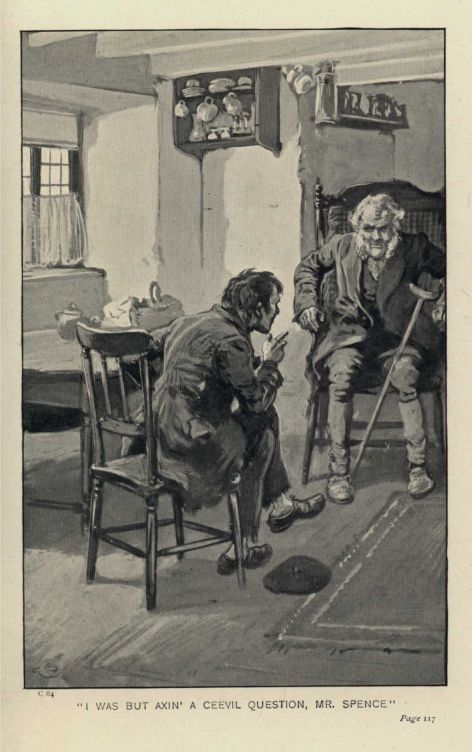
"I WAS BUT AXIN' A CEEVIL QUESTION, MR. SPENCE" Page 117
"An' what if I do? what if I do?" retorted the keeper.
"Jist this," said Jock, without a movement in the muscles of his countenance, "that I ken them tae for mony a year; and sae baith o' us hae common freens amang the hills."
"What do ye ken aboot them?" asked Spence, not more pacified, nor less puzzled.
"Because," said Jock, "I hae shot ower them a' as a poacher--my name is Jock Hall, parish o' Drumsylie--and I hae had the best o' sport on them."
This was too much for the Senior Keeper. With an exclamation that need not be recorded, Spence made an attempt to rise with the help of his crutches, but was gently laid back in his chair by Jock, who said--
"Muckle ye'll mak' o't! as the auld wife said to the guse waumlin' in the glaur. Sit doon--sit doon, Mr. Spence; I'll be as guid to you as Hugh; an' I'll ca' in Hugh ony time ye like: sae be easy. For I wish atween oorsels to tell ye aboot an auld poacher and an auld acquaintance o' yours and mine, Sergeant Adam Mercer; for it's aboot him I've come." This announcement induced John to resume his seat without further trouble, on which Jock said, "Noo, I'll ca' Hugh to ye, gin ye bid me, as ye seem feared for me;" and he motioned as if to go to the door.
"I'm no feared for you nor for mortal man!" replied Spence, asserting his dignity in spite of his fears; "but, my fac! ye might be feared, pittin' yer fit into a trap like this! and if Hugh grips ye!----" He left the rest to be inferred.
"Pfuff!" said Jock. "As to that, gudeman, I hae been in every jail roon' aboot! A jail wad be comfort tae me compared wi' the hole I sleepit in the nicht I left Drumsylie, and the road I hae travelled sinsyne! But wull ye no' hear me about Adam Mercer?"
Spence could not comprehend the character he had to deal with, but beginning to think him probably "a natural", he told him to "say awa', as the titlin' remarked tae the gowk".
Jock now gathered all his wits about him, so as to be able to give a long and tolerably lucid history of the events which were then agitating the little world of Drumsylie, and of which the Sergeant was the centre. He particularly described the part that Mr. Smellie had taken in the affair, and, perhaps, from more than one grudge he bore to the said gentleman, he made him the chief if not the only real enemy of the Sergeant.
The only point which Jock failed to make intelligible to the keeper was his account of the starling. It may have been the confusion of ideas incident to old age when dealing with subjects which do not link themselves to the past; but so it was that there got jumbled up in the keeper's mind such a number of things connected with a bird which was the bairn of the Sergeant's bairn, and whistled songs, and told Jock he was a man, and disturbed the peace of the parish, and broke the Sabbath, and deposed the Sergeant, that he could not solve the mystery for himself, nor could Jock make it clear. He therefore accepted Spence's confusion as the natural result of a true estimate of the facts of the case, which few but the Kirk Session could understand, and accordingly he declared that "the bird was a kin' o' witch, a maist extraordinar' cratur, that seemed to ken a' things, and unless he was mista'en wad pit a' things richt gin the hinner en'". The keeper declared "his detestation o' a' speaking birds"; and his opinion that "birds were made for shootin', or for ha'ein' their necks thrawn for eatin'--unless when layin' or hatchin'".
But what practical object, it may be asked, had Hall in view in this volunteer mission of his? It was, as he told the keeper, to get him to ask his Lordship, as being the greatest man in the district, to interfere in the matter and by all possible means to get Smellie, if not Mr. Porteous, muzzled. "Ye're Adam's coosin, I hear," said Jock, "and the head man wi' his Lordship, and ye hae but tae speak the word and deliver the Sergeant an' his bird frae the grips o' these deevils."
Jock had, however, touched a far sorer point than he was aware of when he described Smellie as the propagator of the early history of the Sergeant as a poacher. This, along with all that had been narrated, so roused the indignation of Spence, who had the warmest regard for the Sergeant, apart from his being his cousin and from the fact of his having connived in some degree at his poaching, that, forgetting for a moment the polluted presence of a confessed poacher like Hall, he told him to call Hugh; adding, however, "What wull he do if he kens what ye are, my man? It's easy to get oot o' the teeth o' an auld doug like me, wha's a guid bit aboon fourscore. But Hugh!--faix he wad pit baith o' us ower his head! What wad he say if he kent a poacher was sitting at his fireside?"
"I didna say, Mr. Spence, that I am a poacher, but that I was ane; nor did I say that I wad ever be ane again; nor could Hugh or ony ane else pruve mair than has been pruved a'ready against me, and paid for by sowl and body to jails and judges: sae let that flee stick to the wa'!" answered Jock; and having done so, he went to the door, and, with stentorian lungs, called the younger keeper so as to wake up all the dogs with howl and bark as if they had been aware of the poaching habits of the shouter.
As Hugh came to the door, at which Jock calmly stood, he said to him in a careless tone, like one who had known him all his life: "Yer faither wants ye;" and, entering the kitchen, he resumed his former seat, folding his arms and looking at the fire.
"Wha the sorrow hae ye gotten here, faither, cheek by jowl wi' ye?" asked the tall and powerful keeper, scanning Jock with a most critical eye.
"A freen' o' my cousin's, Adam Mercer," replied old Spence. "But speer ye nae questions, Hugh, and ye'll get nae lees. He has come on business that I'll tell ye aboot. But tak' him ben in the meantime, and gie him some bread and cheese, wi' a drap milk, till his supper's ready. He'll stay here till morning. Mak' a bed ready for him in the laft."