OTHER ANIMALS; (continued 2)
Reading edition
One morning, wishing to see a little of the world, I set off by myself across the meadow, intending to visit a pleasant little wood we could just see from the bank above our house. But I had hardly reached the middle of the field, when a tremendous hail-storm came on. Oh! what a dreadful predicament I was in! The sheep had eaten down the grass so close that it gave me no shelter whatever, neither could I find any hole or crack to creep into, till the storm was over. So I made the best of my way back again, though dreadfully bruised by the hail-stones, and at last a very heavy one struck me such a blow on the top of my head, that I was quite stunned; and I can remember nothing more, till I found myself in the hands of your papa's stable-boy, Tom. He had picked me up, when looking for mushrooms in the meadow, and thought perhaps that I should make a nice breakfast for his kitten. But when he found me come to life again, he said he would tame me, and make me draw a little pasteboard cart to amuse his sister Jenny. You cannot think how cruelly he used me, and how he made my lips bleed by forcing an iron bit into my mouth. And then he almost killed me by trying to make me swallow raw meat, which is a sort of food none of our species can abide. Truly, I should never have lived to have related this history, if you had not come into the stable-yard to see the young rabbits. Most fortunately for me, you were singing your favourite song. I remembered the words and the sweet clear voice instantly, and I said to myself, "Perhaps the young lady that was so kind to the little gleaner, may have compassion on a poor harvest-mouse." You know the rest: I squeaked with all my might; you heard me, and soon persuaded Tom to give up his prize in exchange for a dozen fine apples from your own little tree.
And now, my dear kind mistress, will you not fulfil your promise, and give me my liberty? I have been very happy with you, but I long exceedingly to return to the beautiful green bank again, and to see dear mamma, who must be dreadfully anxious about me, for it is now six days since I left the nest. Hold me up to your face, and let me read my fate in your beautiful eyes, which I declare are almost as bright and dark as my mother's. Bring me closer, quite close, for I am rather near-sighted. That will do. Oh joy! I see by those sweet sparklers, that my petition is granted, and that I shall sleep to-night by my mother's side in the downy nest on the thistle.
When this history was finished, Leatherwing said, that the little girl pressed her captive to her lips, and then, putting on her straw hat, she immediately walked out into the fields, with Minimus perched upon her hand.
9 When this was written, I was not aware that there existed in other countries a quadruped still more diminutive than our little harvest-mouse. However, as "Minimus" declares that he was much smaller than others of his species, the title of his history may still be correct.
CHAPTER VII.
It was now the season for collecting nuts, acorns, and beech-mast; and it was time that the squirrels attended to the important business of filling their several storehouses with a supply of provisions for the winter.
Now their own oak would furnish acorns for hundreds of squirrels, and some beech-trees, laden with mast, were close at hand; but in order to procure hazle-nuts, their favourite food, it was necessary to go rather further from home. The nearest spot where the business of nutting could be carried on with much success, was a large hazel-copse, on the side of a hill, at the upper end of the valley. But the great difficulty was, how to obtain these nuts without risking their lives. For since the appearance of the wild-cat in the neighbourhood the squirrels had always avoided the thick bushes and underwood, knowing that she could more easily surprise them there, than among the open branches of large trees. Even in the trees they were very careful to look well about them, as they fully believed that the enemy was still in the neighbourhood, for Leatherwing, who had promised to give them early information, could hear no account of her having been killed. Indeed, he had very lately overheard a farmer complaining to a neighbour, that the night before, he had had three fine lambs killed, and several others sadly mangled by this destructive wild beast.
But to pass the tedious winter without a supply of nuts appeared as great a hardship to the squirrels as it would be to us to live for several months upon bread and water. Therefore, after several consultations on the subject, it was at length agreed, that nuts they would have, at all hazards; for said Brush, "Better to be eaten up by the wild-cat than starved." So one fine morning the whole party set off to the hazel-copse.
Now this reminds me of the happy hours I have myself passed in the woods, when I have joined a merry party of my young friends on one of those most joyful occasions, a nutting expedition. How can a day be passed more pleasantly? Oh! the delight of gathering the lovely brown clusters of five or six, or even sometimes seven or eight together! Then the dinner by the side of the clear stream, whose pure waters furnish not the least grateful part of the repast! and the notes of unrestrained merriment and joy, filling the woods with the echoes of sweet young voices! Even the torn frocks, and scratched hands and arms, are disregarded; and they are such common attendants upon these joyous expeditions, that to return from them with perfectly whole garments and skins, would imply that the bag of nuts might have been heavier, if the party had been less fearful of the brambles and thorns. Now for the squirrels again.
The nuts were exactly in that state in which I like to find them—quite full and brown, and almost ready to fall out of their husks. But not quite ripe enough to do this, for then a great many are shaken out upon the ground, and lost. But the nuts were in perfection, and our party were employed the whole day in journeying backwards and forwards, between the hazel-copse and their storehouses in the old oak. No wild-cat or other enemy appeared, and the young squirrels began to think that their parents' continual cautions to be on the look out for this animal were unnecessary.
The next day the party were again hard at work, and even the old squirrels were so busily employed in filling their own mouths, and in teaching their children how to select the ripest and soundest nuts, that they seemed almost to have forgotten that they had a single enemy in the world. They had already made several journeys, and were now eagerly engaged in some large old hazel-trees, close to a wide pathway, which had been cut through the wood for the convenience of the sportsmen. Suddenly Brush perceived, partly concealed among the thick underwood, a dark, fearful-looking object, which—could it be the dreaded foe, or was it only the brown trunk of a tree? He was not long in doubt, for now the head of the monster appeared from among the leaves, and then those savage eyes! having once seen them how could he possibly mistake their terrible glances? Brush was so frightened, that he absolutely allowed three remarkably fine nuts to fall out of his mouth upon the ground, and at last he gave the note of alarm. "Fly all of you," cried he, "the enemy is close at hand!" Then he recovered sufficient presence of mind to remember how he had himself escaped from his pursuer in the oak, and he desired his family to retreat to the small outer branches of the trees, where they would but just support their weight, for he knew that the young ones were too small and weak to make their escape by flight.
But this clever plan did not succeed so well in these low nut-trees as among the lofty branches of the oak, where a tumble to the ground would most likely have broken some of the adversary's bones. The cunning beast appeared to understand the difference between the two situations, but for a minute or two she remained motionless, as if she were planning the best way of making her attack. At last, with a single bound she was in the tree. She fearlessly dashed at one of the young squirrels, who sat trembling at the farther end of a branch, overhanging the pathway; it gave way beneath her weight, and both animals fell to the ground below. But while the poor little squirrel was so shaken by the fall that he could only crawl slowly away, the cat, like all animals of her kind, pitched unhurt upon her feet, 10 and was just upon the point of seizing her prey in her terrible hooked claws, when bang!—the report of a gun from the adjoining thicket.
Here I must inform you, that Harvey, the gamekeeper, who had long been looking out for the destroyer, had this morning been informed by some boys who were nutting in the copse, that they had seen her running across an open space, with a fine cock pheasant in her mouth. Now the keeper had found, from his experience on two former occasions, that it was useless to fire small shot at an animal who had such a defence in her thick close fur, and who was too wary to allow him to approach very near. Therefore, giving his double-barrelled fowling-piece into the hands of his son, a lad of about fourteen, who accompanied him, he armed himself with a rifle, which is a gun made on purpose for throwing bullets very accurately, to a long distance. He left all his dogs at home, thinking they would be of more harm than use.
Harvey and his boy had already been some hours in the wood, and were beginning to think that they had received false information, when young Dick, who was a remarkably sagacious, intelligent fellow, suddenly stopped his father, and pointed to some trees at a little distance.
"Well, lad," whispered Harvey, "what dost see now?"
"Look at those squirrels, father!"
"I see 'em plain enough, but it won't do. Though if it wasn't for master's orders, I should like to try the rifle upon one of 'em, I must say."
"No, no, father," replied Dick, "that isn't what I mean. But only look at them! They aint eating, nor doing nothing, but they have all got their heads one way, and they stick themselves up as if they were frightened at something. Depend upon it, father, the wild-cat isn't far from those squirrels, if she is in the wood at all."
"I see!" replied his father: "that's as bright a thought as ever came into thy head, son Dick! But we have no chance among these plaguy thick bushes. We must creep quietly out into the path, and then perhaps we may get a shot at the varmint."
So the two cat-hunters concealed themselves behind a tree, by the side of the path, and just as the wild-cat was pouncing upon her prey, a ball from the keeper's well-directed rifle laid her howling upon the ground, with the bone of her hind-leg smashed to atoms.
But he who supposes that one of these ferocious animals is conquered merely because her leg is broken, will find himself very much mistaken. A wild-cat conquered! no, indeed! You may kill her, but she never yields, so long as she has any life remaining. And so Harvey found to his cost. For when he saw the animal rolling upon the ground, supposing her to be mortally wounded, he ran up towards her, intending to finish the affair with a blow from the butt end of his rifle. Now this imprudent conduct proved that he had never encountered a wounded wild-cat before. No sooner had he approached within a few yards of her, than, regardless of her broken leg, she sprang upon him like a fury, and before he could aim a blow at her, she was at his throat, with her fore-legs clasped round his neck.
Frightful! only imagine the horrors of such an embrace! In vain poor Harvey strove with all his might to cast off the savage creature from him, and I cannot tell how the affair might have ended, if Dick had not been at hand to render assistance. Waiting for a favourable opportunity, he put the muzzle of his gun close to the creature's body, and firing both barrels at once, in his eagerness to do the business effectually, he made such a terrible hole in her side, that, if she had had nine hundred lives, instead of the usual moderate number of nine, they would all have taken flight through the wound in an instant. She fell to the ground, a mangled, blackened corpse.
And how did poor Harvey escape? Better than could have been expected, considering the powerful teeth and claws of his adversary. To be sure, he was pretty severely bitten and scratched, but his wounds were not dangerous; and when he had recovered his breath, and wiped the blood from his face, the first thing he did was to stretch his vanquished foe at her full length upon the ground. Then laying his rifle by her side, he said to Dick, "She's full four feet long, if she's an inch, and I have gained my wager! I laid a bet of a guinea, with Lord What's-his-name's keeper, that she would turn out to be four feet long, and so she is, and more, as I can tell by the length of this barrel. But only look at her teeth, Dick, and her terrible claws!"
"And what a great bushy tail!" said Dick, rubbing it through his hands; "and see, father, 'tis the same size from end to end, and quite black at the tip, just as that learned stranger gentleman up at the hall said that all real wild-cats were."
"A learned gentleman! Let me tell thee, son Dick, if thee hadst had thy face and hands clawed to pieces like mine are, thee wouldst have said the varmint was wild enough, in all conscience, without waiting for any learned gentleman to tell thee so. How my face do smart to be sure! And look at my new jacket! All burnt and torn to pieces! 'T was a wonder my arm wasn't blown off too. Well, boy, 't was a bold shot, and I can't tell what I should have done if somebody hadn't been by. But come, throw the beast over thy shoulder. I must go home and get mother to put some plaister on these bites and scratches."
At the very beginning of this fierce conflict, all the squirrels, except the father of the family, fled from the scene of action, and in five minutes they were safe in the nest. But Brush was so determined to see the end of the affair, that he remained concealed in the hazel-tree, till Dick had fired the finishing shot; and then, being convinced that he had nothing more to fear from his old enemy, he scampered off to his home, to relate what he had seen.
10 It is well known that cats have the power of turning themselves over in the air, so as to bring their legs undermost, when they fall, or are thrown, from a height; but how this desirable change of position is brought about or maintained, it is not very easy to explain. One would have supposed that the centre of gravity would have brought the back undermost. To prove that these animals do possess the power of turning over in the air, take a cat, or a kitten, and hold her by her four feet, two in each of your hands, with her back downwards, at about the height of the table from the ground. Now if you open both your hands suddenly, your assistant in the experiment will change her position almost as quickly as a shuttlecock turns round when struck by the battledore, and will alight safely on her feet. But if you hold her at a very short distance from the ground, poor puss will not have time to execute her clever feat, and will fall on her back. Therefore, for her sake, practise this experiment over a bed.
CHAPTER VIII.
I have not much more to tell you about "Squirrels and other Animals," for by the time the tenants of the oak-tree had collected a good stock of provisions, the weather had become rather cold and dismal, and it seemed likely that the winter would set in very early that year. But the time for their long sleep was not yet quite arrived, and on fine days they were still to be seen abroad, roaming about from tree to tree, and sometimes bringing home a few more nuts and acorns. But to find these they were now obliged to search on the ground, for the wind had shaken the ripe fruit from the trees. Now they were relieved from the dread of being seized by their terrible enemy, they could ramble about where they pleased.
One day as they were rummaging about among the dry leaves, under the hazel-bushes, the squirrels fell in with the very oddest creature they had ever seen. They had heard from Leatherwing that such an animal lived in the woods, but they did not think they should ever meet with him, as the bat had told them that he never came abroad till it was dark. But the old fellow was mistaken a little for once in his life, for here this most extraordinary looking creature certainly was, in the middle of the day. 11 From the description Brush had received of this animal, he knew at once that he was one Touchmenot, a hedgehog; and that though he was considered to be rather a queer-tempered fellow, he was not likely to do him any harm. But the young squirrels and their mother were so frightened at his very warlike appearance, that they leaped up into the bushes overhead.
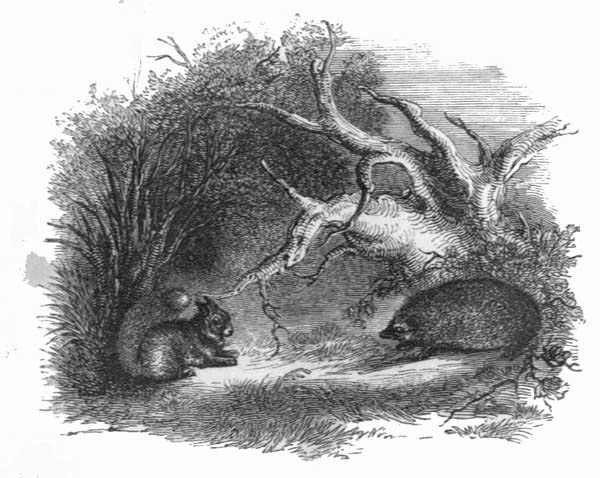
THE SQUIRREL AND THE HEDGEHOG.
Page 189.
Brush remained on the ground, but his family observed that he took care to keep close to the stem of a small tree, for he thought that if his new acquaintance should become uncivil, he could not possibly climb up after him. After the two animals had looked at each other for some time in silence, Touchmenot began the conversation.
TOUCHMENOT.
Well! what d'ye stare at? What d'ye want? Never saw me before, eh? Hope you will remember me when we meet again, for you have looked at me long enough, I am sure, with those great black eyes of yours.
Oh! don't be frightened! You may stare at me till you are blind for all I care. I'm not ashamed of myself. Oh dear no! Well, now you have examined me pretty well, who d'ye think I am, eh?
BRUSH.
(Rather frightened at the surly address of the stranger).
I believe you are called Mr. Touchmenot, are you not, Sir?
TOUCHMENOT.
Touchmenot, indeed! What fool told you that? Well, I don't care, they may call me so if they please. Ha! ha! no bad name neither! Touch me not, I advise you, or you will smart for it! So that's the name they give me, is it? Oh, with all my heart! And what else have you heard about me, Mr. Greateyes?
BRUSH.
Oh, nothing very particular. Yes, now I recollect, I have heard that you have got a very odd way of defending yourself, by rolling up into a ball, when you see any animal coming that you think is an enemy.
TOUCHMENOT.
That I think is an enemy? I consider all animals my enemies. Except my own family, I don't believe I have a friend in the world. My comfort is, that I am very well able to take care of myself; and yet I can neither fly like a bird, nor run like a hare, nor swim like a fish, nor leap like yourself. No, I can do none of these; but I can roll up, and so set all my enemies at defiance; and I had half a mind to have done so when I first saw you, but it was hardly worth while, for you are much smaller than I am, and, besides, to tell you the truth, you look rather like a good-tempered fellow. Now what other tales have you heard about my doings?
BRUSH.
Why if you wont be angry, I was going to say, though I didn't believe it at the time, but I have heard it said that you are rather fond of milk, and don't mind sucking the farmers' cows sometimes.
TOUCHMENOT.
So you have heard that ridiculous story, have you? Well, you say you don't believe it, so I sha'n't take the trouble to prove what a monstrous fib it is. Now then, I'll tell you what I have heard about you. I have heard that you are rather fond of nuts, and that, not content with eating as many as you can possibly cram, you are such a glutton that you carry a great many home with you, on purpose to stuff yourself with in the winter.
BRUSH.
Well, and what harm? Nuts are very wholesome food, I am sure. And don't you lay up any store of provisions for the winter, then?
TOUCHMENOT.
Not I, indeed! I am better employed in the winter than in eating. I sleep all the winter, Mr. Nutcracker! When the weather gets a little colder, perhaps in a few days, I shall creep into my snug nest which I have made under the roots of a great tree. There I shall roll myself up, in my bed of dry leaves, and when once fairly asleep, I am safe till next spring. Nothing can make me wake up. What a fool I should be to trouble myself about collecting a quantity of food for the winter, when I am sound asleep all the time!
BRUSH.
And what do you live upon, when you are awake, if it isn't an unfair question?
TOUCHMENOT.
Oh, I am not very particular. Almost anything will do at a pinch. I often make a meal upon roots and vegetables, when I can find nothing else. But I like animal food much better, such as insects, worms, snails, bird's eggs, frogs, mice, and now and then I dine upon a snake when I can contrive to catch him. Well! what's the matter now? What do you jump up into the tree for?
BRUSH.
Oh, shocking! I never heard anything so dreadful in my life! I beg your pardon. I mean, I should not like to dine upon snake at all.
TOUCHMENOT.
Very likely not. Tastes differ, you know. But here comes a gentleman who will most certainly dine upon you, if you don't get up a little higher into the tree; for though he can't climb, he is a pretty good leaper. For my part, I scorn to run away from any animal, large or small. Stay where you are, and you will see some fun.
The animal that now approached was a hungry young fox, who would certainly have made a meal of the squirrel if he could have caught him. But after trying to reach him, by jumping till he was tired, he gave it up at last for a bad job; and then, spying the hedgehog, he dashed at him, as if he had intended to have swallowed him at a single mouthful. But Touchmenot was quite prepared for the attack, for he had rolled himself up into a round ball, with nothing but sharp spines sticking out on every side; and when the fox attempted to seize his prey, you would have laughed to have seen how very much surprised and disappointed he looked. As he was but young, though he appeared more than half-grown, I suppose he had never seen a hedgehog before, or he would not have acted so imprudently, for he pounced upon this ball of spines as he would upon a rabbit, or a pheasant, but he soon found out his mistake, and retreated to a little distance, howling dismally, and licking his bleeding lips and nose.
When he recovered a little from his surprise, he made another attempt. But now he proceeded more cautiously, and rolled old Touchmenot over and over with his paws, hoping to find some part of him that was not protected by this spiny coat of armour. He could make nothing of it! This strange-looking ball was spines above, spines below—strong, sharp spines on every side. It was really very provoking, for it contained a nice meal inside, no doubt, if he could but get at it.
After watching his vain attempts for some time, the squirrels saw that the fox had no chance of succeeding, and they made the best of their way home, keeping on the trees for fear he should leave Touchmenot, and follow them instead. However, they had nothing to fear from this silly young fellow, for he seemed fully occupied in rolling this tiresome ball about, but how long he continued his amusement, I cannot tell. However, I must inform you, that the hedgehog boasted rather too much, when he said he could set all his enemies at defiance, by his strange plan of defence; for though very few animals will venture to attack him when rolled up, it sometimes happens that a thoroughly game and courageous terrier-dog will seize him, and kill him too, in spite of his prickly armour. Of course, his own lips and mouth must suffer severely from the animal's sharp spines.
A week or two after the interview with the hedgehog, one very cold dismal afternoon, all the squirrels were in the nest, except the father of the family, and he was gone abroad for a short time, just to stretch his legs a little. Suddenly he darted into the hole, as if he had been pursued by another wild-cat, and when he was asked what was the matter, he exclaimed, "Snow! cold, dismal snow! Flakes of snow as large as white butterflies, and falling so thickly that I could hardly see my way back to the nest! Here I am, however, and here I mean to stay till fine weather comes again. It will be a long while before that happens though, I fancy."
Brush was a true prophet. The weather became colder and colder every day, till at last, after a sharp frosty night, the squirrels quite forgot to wake up in the morning, and then their first long nap of several weeks began. If you could have looked in upon them in their comfortable nest, you could hardly have believed that the little curled up squirrels, with their blankets over their heads, were the same active, playful creatures, whose summer gambols among the branches had afforded you so much amusement.
Well, then, there can be nothing more to say about these sleeping squirrels, and now I must inform you what effect the cold weather had upon the other animals, whose summer habits have been imperfectly described in this history. The dormice, in their nests at the bottom of the oak-tree, and the water-rats, in their holes in the bank of the pond, were sound asleep also; but all these animals had taken the precaution to provide a store of provisions for the early part of the spring, and in case they should wake up for a few days in the winter. Now, with respect to the curious little water-shrew-mouse, Velvet-coat, I am not quite so certain about his winter habits. But no doubt he slept comfortably in his hole till the spring; and as he was an insect-feeder, we may conclude that he followed the example of Touchmenot, in not laying up any food for the winter.
If we could have questioned old Leatherwing, I think he would have told us that the harvest-mice, whose history he overheard related by Minimus, abandoned their nest on the thistle, and made themselves a warmer house, deep under the ground, where they passed the cold weather in sleeping, and now and then nibbling the grains of wheat which they had buried with them. The bat has already related how he passed the winter himself, and how he was obliged to waste some part of it in sleep, not altogether from the effects of cold, but also from the want of food.
11 I can bear witness, that hedgehogs are not always nocturnal animals, having more than once seen them running about in the daytime, and I remember capturing one that was trotting across the corner of a field when the mid-day sun was shining brightly. And if the hedgehog occasionally kills snakes, as Mr. Bell informs us, how can he meet with these animals by night, when they are invariably safe in their holes?
CHAPTER IX.
Though the history of the squirrels and their companions was finished in the last chapter, I still feel unwilling to part from my young friends, who have kindly taken some interest in the events I related for their amusement. It is true, that in the following tale no mention will be made of any of those "smaller British quadrupeds" of whose "habits and instincts" the title-page has engaged to communicate some information. But it is always better to do more than less than we have promised. Therefore, perhaps you will not be displeased if this little book should contain something that you did not expect to find there, and I hope you will think this additional chapter not less entertaining than those you have already read.
You may remember, that Leatherwing related to the squirrel the History of Minimus, or "Some Passages in the Life of the smallest Quadruped in the World." In the following pages, you will find a companion to the bat's story, and the title shall be,
SOME PASSAGES IN THE LIFE OF THE LARGEST QUADRUPED IN THE WORLD!
As inquisitive readers may perhaps wish to be informed by what means the following little history came into my possession, I will endeavour to satisfy them as to its authenticity, by telling them that it was related to me by an old man, a native of Sumatra, in which island, "the largest quadrupeds in the world" are, or were, abundant in a wild state. This old fellow was cook on board the ship, "All's Well," in which (fifty-three years ago,) I first went to sea as an apprentice, and he was called "Jolly," but what his real name was no one on board knew nor cared. He was a merry-hearted old man, and had made himself a great favourite, especially with us boys, by his extraordinary abilities in "spinning a good yarn," as the sea-phrase goes, meaning neither more nor less than telling a good story. The following strange history was a favourite "yarn" of old Jolly's; and though it is now more than half a century since I first heard it, it is still fresh in my memory, having so often related it to my little brothers, who, on my return home, were always very eager in their inquiries about "the doings of the dreadful wild-beasts of foreign countries."
But I must mention, that our old friend Jolly boasted of other accomplishments more extraordinary than story-telling, such as the art of foretelling future events, of understanding the language of birds and beasts, and he sometimes hinted, that he had the dangerous power of killing an enemy who might be five hundred leagues distant, by the performance of certain magical ceremonies. Perhaps you are not disposed to believe that Jolly was such a clever old fellow. Well, I cannot help it. I have no time now to endeavour to convince you, but here is his story, though not in his own words, for if I had not corrected his bad English, the narrative would be almost unintelligible to those who were not accustomed to his extraordinary mixture of languages.
(Jolly begins his Story.)
Tell you about the elephants again? Why, I have given you a dozen stories at least about them this voyage! Well, if you must have it, here goes.
You must know, then, that about two years before, (like a great fool that I was,) I left my dear native island: I accompanied my father, and twenty or thirty of our tribe, on an elephant-catching expedition, to the banks of a large river more than fifty miles from our village. We were five days on our journey, for we had to pass through deep and tangled forests. As our object was merely to procure the valuable tusks, which we bartered at the Dutch settlement, for linen cloth, and other European articles, we did not attempt to take our game alive, but contented ourselves with digging deep pit-falls in the forest-paths made by the elephants in their visits to the river-side; for you must know that elephants are very fond of bathing and splashing about in the water. These pits of ours were slightly covered over with branches of trees and grass, and at the bottom we fixed a strong, sharp-pointed stake, on which, when they tumbled down headlong, the unwieldy animals were impaled and killed. We always took care to bait our traps with green boughs and tempting fruits. When we were so fortunate as to entrap an elephant in this manner, some of our party would descend to cut out the valuable tusks with a hatchet; and as we were quite unable to raise the immense carcass out of the pit, we were obliged to fill it up and dig another.
This method of catching elephants was generally adopted by our nation, for at that time fire-arms were not in use among us. But I have heard that in some countries, when the hunters wish to take the animals alive, they make large enclosures of very strong stakes, and employ tame elephants to entice the wild ones inside, when the door is shut, and they are immediately bound fast with ropes, and kept without food for several days, till they are partly tamed. But I must return to our expedition.
At this time we were very unfortunate indeed. Though the herd of elephants was numerous, and we had dug a great number of pit-falls, more than a week had passed, and we had made only one capture, a very young animal whose tusks were hardly worth taking home. This bad luck was not occasioned by our want of skill, for some of our party, my father and elder brother in particular, were the most experienced hunters of our nation, and our traps were covered over and baited with the greatest care. It was of no use; after the little fellow who met with his fate on the second day of our falling in with the herd, not a single elephant would venture his life for the most tempting baits we could select; and in some places where the path was so narrow that there was no room to pass the trap, these provoking animals would either return, or make another track by the side of it, by tearing up the trees with their trunks, and trampling down the bushes and underwood.
"This will never do!" said my father; "these rascals are too cunning for us. We must find another herd. If we do not get some ivory soon, the Dutch ships will have left the port, and then we shall not be able to sell our tusks for a pretty while."
So it was agreed, that the next day we would move further up the river, in hopes of falling in with a less sagacious herd. But the same afternoon a circumstance occurred which explained the cause of our want of success in a very satisfactory manner, to me at least, though some of our company were so stupid as to say that what I am now going to relate was all nonsense, and that I had been dreaming.
I was stationed in the upper part of a lofty tree within view of one of our pit-falls, when I perceived three elephants approaching. Two were of moderate size, but the third was by far the largest animal I had ever seen or heard of. He seemed almost decrepit with age, and had a very remarkable appearance, from one of his immense tusks being broken off, leaving a ragged stump of about a foot in length. He and his companions had been enjoying a cool bathe in the river, as I could perceive from the light-coloured mud on their legs and sides, and their way lay directly by the trap I was appointed to watch. But this peril they took especial care to avoid. However, I observed the old elephant point at it with his trunk, whereupon they all three tossed up their heads with an indignant snort. So they paced leisurely along till they reached my tree, at the foot of which, the old gentleman, apparently exhausted with fatigue, threw himself down on his side so suddenly, that he occasioned a partial earthquake. The others kept watch by him.
After lying perfectly still for about an hour, during which time, we may safely conclude that he was refreshed by a comfortable nap, the venerable patriarch raised his immense bulk till he was in a sort of squatting posture, and began to converse with his companions; but I was at such a great height above him, that I could only catch a word or two here and there. But what are you laughing at, Bill Stacey? Do you think everybody is as deaf and as stupid as yourself? You had better say at once that you don't believe I could understand the elephant's language, and then I'll leave off and turn in for the rest of the watch. Well, then, behave yourself, my boy, and don't interrupt me any more, or I won't say another word to-night.
Let me see, where was I? Oh, I told you that I was too high up in the tree to make out what the elephants were saying, but no doubt their conversation related to the pitfall, as the old fellow grumbled out the words, "stupid idiots!" "shallow contrivance!" and "whoever saw fruit growing on a beaten path?" Hoping to gain some useful information, I now, with extreme caution, descended from the top of the tree till I reached a branch about twenty feet from the ground, and concealed myself among the thick leaves. For some time after I had been in this situation there was a dead silence below, and I almost feared that the elephants had heard or smelt me, and were meditating some mischief. But there was a strong breeze blowing, and this prevented them from hearing me. In a few minutes, the patriarch, after casting a very affectionate glance on his companions, and giving utterance to a tremendous grunt, which I suppose he meant for a sigh, though you might have heard it at the distance of a mile, began a sort of history of his life, which I will repeat, if Bill Stacey will be quiet.
(The old Elephant speaks for himself at last.)
True, my dear children, I have often promised to relate to you as much as I can remember of my long life and experience, and as my increasing bodily infirmities warn me that my days are drawing to a close, I cannot do better than embrace this opportunity when we are not likely to be interrupted by our companions.
I am now going to put you in possession of a secret, which I should be very unwilling to make public. It is universally believed by our company, that I have spent many years in the service of man, and that at this period of my life, I acquired that knowledge of his ways which has been so useful in enabling me to detect and avoid his wicked devices for the destruction of our noble race. To this belief I am indebted for the influence I possess in our councils, and though my years and experience might still be respected, I am certain, that the ungrateful herd, ever fond of change, would immediately choose a new leader, if they had the least suspicion of what I am going to communicate to you.
Know, then, my children, that I have never been a slave to the tyrant! that I have never been that most abject of creatures, "a tame elephant." No! my last days are not embittered by the consideration, that I have ever in the smallest degree contributed to the happiness of the two-legged monster. On the contrary, I am cheered by the recollection, that a great part of my life has been spent in detecting his tricks, and in thwarting his wicked designs. If our laws did not forbid us to take the life of any creature except in self-defence, with my knowledge of our enemies' weakness, we might easily take such terrible vengeance, as would induce him at least to confine himself to the neighbourhood of his own towns and settlements. But he cannot do us much injury. So successful have I been in detecting his ridiculous traps and pit-falls, that, for the last fifty years, not one of our herd has fallen a victim to his vile designs, except the poor young creature who threw his life away a few days ago, when, foolishly confident in his own knowledge, he persisted in rambling about by himself. Even in this melancholy affair, we may comfort ourselves that we could better spare him than any other of his companions, and that our enemies have gained little or nothing by his capture.
But you will ask, if I have never been the companion of man, by what means have I obtained that superior intelligence and knowledge of his arts, for which our tribe are pleased to give me credit? I answer, simply by keeping my eyes and my ears open, and by remembering what I have seen and heard. Follow my example, my dear children, and if you ever arrive at my age, you will no longer wonder at the extent of my information.
Now let me endeavour to remember some of the most remarkable incidents of my life. I have but a confused recollection of my very early childhood, or of anything that happened before my thirteenth year, but about that time I well remember I was in terrible distress at the loss of my first tusks, and that my mother could hardly make me believe that they would ever be replaced by others. But when these long-looked-for second tusks really made their appearance, and had reached about the length of my present miserable stump, I used to plague all my acquaintance, by asking them whether they thought my tusks had grown lately, or whether they would ever be as large and strong as our leader's. At last I met with a cutting reproof from a surly old fellow, who had often been pestered by me in this manner.
"You impertinent young scamp," said he, "what do I care about your tusks, or whether they grow or not? One thing I know, and will tell you for your comfort. If, when you grow up, your head should be as deficient in ivory as it is in sense, you need have no fear whatever of the hunters, for I am sure you would not repay them for the trouble of killing you."
This was very severe; but I must tell you that the old brute was particularly cross on this occasion, for the day before he had been terribly disappointed by not being chosen leader of the herd, and he had found out, as I was afterwards informed, that he had lost his election by the influence of my mother and some others of our family.
Well, my children, if I was once proud of my tusks, I have no cause for such foolish vanity now with this hideous stump, though the other is still nearly half as long again as any in the herd.
I will now relate to you how I first became acquainted with that contemptible little animal, who has the vanity to call himself "the lord of the creation." I think it was in my twentieth year, just at the end of the rainy season, that our herd had approached within less than fifty miles of the Dutch settlement, for the purpose of visiting a tract of marshy land overrun with high canes, the tender tops of which, you well know, are such delicious food. I was busily employed in a cane-brake, close to the banks of the river, in company with my mother and two of my younger brothers, when one of the latter, who had left us for a few minutes to wash the clammy juice of the canes from his mouth and trunk, returned in such haste and agitation, that for some time not a sound could he utter, except unintelligible gruntings and sputterings. At last, he stammered out, "Mother! mother! dreadful! I have seen such a thing! Great monstrous monkeys, with long poles in their paws, and sitting upright on the backs of immense deer, or some such creatures, only they have got no horns on their heads!"
Upon this, my mother, raising her trunk high in the air, immediately sounded the well-known signal of alarm, and saying to us, "Follow, boys, follow!" she darted through the cane-brake like a mad thing, only stopping now and then to see how we kept up with her. We did our best; but it was very laborious work, forcing our way at our utmost speed through the thick canes, which were much higher than our heads, and in some places; the ground was so soft, that we sunk in up to our bellies. What a tremendous crash and splash we made, and how we did grunt and snort! However, at last we reached the open country, two or three miles from the bank of the river. Here we found more than half of the herd, (we were seventy-five in number at that time,) and others were every minute making their appearance from the canes. And now my mother, when she had a little recovered her breath, turning to my brother who had first given the alarm, explained to us the cause of this sudden retreat. "My son," said she, "not monkeys sitting upon deer have you seen, but men upon horses, and the long poles are cruel spears intended for your destruction."
Our careful leader now called over the names of his company, and finding that two were missing, he ordered us to retreat to a thick wood at a short distance, while himself and his brother, a steady sedate old fellow, entered the cane-brake again, in hopes of falling in with the lost ones. Being now collected together, we did not fear the enemy, who is too cowardly to attack any but stragglers from the main body; but we were very anxious about the fate of our missing friends, especially as they were both rather young and giddy.
In about an hour we perceived the leader and his brother issuing from the cane-brake, supporting between them one of the stragglers, who appeared quite unable to walk by himself, and as they came near, we could see that he was bleeding from several wounds in his body, and that he had lost the use of one of his hind-legs.
But what a dreadful account he gave us! He said that he and his brother, whose name was Brisk, were feeding in an open space close to the river, when they heard my mother's alarm-call, which Brisk said was nothing more than her usual voice when she was scolding her children. So he refused to retreat, and persuaded his brother to remain with him, when suddenly they found themselves surrounded by ten or twelve hunters mounted on horse-back, and armed with long spears. They made the best resistance they could, and killed one of the hunters; but at length our wounded friend, finding himself weak from his wounds, rolled down the steep bank into the river, where he was concealed by the overhanging trees, and as the cold water refreshed and strengthened him, he swam gently down the stream, keeping close under the bank till he came to a good landing-place. Here, he with difficulty managed to scramble on shore, and was proceeding slowly and in great pain through the canes, when he was found by the leader and his brother, without whose assistance he said he should never have reached the herd, for he was bleeding fast, and a deep spear-wound in the upper joint of his hind-leg was becoming more and more painful at every step.
After his wounds had been examined, and the bleeding had been stopped by the application of the proper herbs, our poor friend was questioned as to the fate of his brother, when he immediately swooned from excess of agitation. Recovering a little, in a low voice and in broken words he endeavoured to communicate the sad tidings.
"Brother," said he, "brother Brisk—brother Brisk barbarously"—then suddenly, to our amazement, jumping up on his three legs, he bellowed forth with tremendous energy, "Brother Brisk barbarously butchered!" Whereupon the whole herd, old and young, with quivering trunks high raised in air, continued for some minutes to thunder forth in their loudest tones, "Brother Brisk barbarously butchered! Brother Brisk barbarously butchered!"
Did that wild cry of despair reach the ears of the hunters? If so, I envy them not their feelings.
We continued in a close body all night with watchful sentinels on the look-out. The next morning a council was held, from which my youth excluded me; but we were soon informed, that our elders had determined that we should retreat fifty or a hundred miles up the river, not (as they were very particular in declaring) that they had any fear of the enemy themselves, but on account of the number of young ones in the herd, who, by wandering to a distance from the rest, would run great risk of sharing the fate of poor Brisk. So, after waiting three or four days for our wounded companion to recover a little, we set off on our journey, keeping near the banks of the river, for the sake of the canes and the opportunity of bathing. On the second day, coming to a narrow part of the river, we determined to cross it as a greater security. It was so shallow, that most of us could walk on the bottom with our trunks raised above the surface of the water to breathe through, but the very young ones either swam or were helped over by their mothers.
When we were all collected together, we heard a loud shout from the opposite bank of the river, and lo! there were our enemies again, eight in number, mounted on horses, and with their long steel lances glittering in the sun. They had no doubt been following us closely all day, looking out for stragglers. Some of our company who had complained bitterly of our leader's strict discipline in obliging us to march in a close body, now began to look rather silly. In a few minutes, another horseman who appeared more heavily laden than his companions rode up to them, and, oh! sight of horror! from his saddle were hanging a pair of tusks, which no doubt a few days before had adorned the head of the unfortunate Brisk!
After looking at us for some time, one of the hunters, more courageous or more foolish than his companions, rode into the river as far as his horse could go without swimming, till he was nearly half-way across, and then, for the first time in my life, I had a fall view of the human form and countenance.
Never before had I seen such a ridiculous object as this hunter, who was pronounced to be an Englishman by some knowing ones in our company. He was larger, certainly, than our amusing friends the monkeys, but his pale face was not half so agreeable and intelligent, and as he sat on his horse with his long thin legs dangling in the water, he looked so disappointed and miserable, that, forgetting for a moment his villanous cruelty, I almost pitied him. And so much for "the majesty of the human countenance" which I have heard spoken of, but could never yet perceive. It has been said that a bold man can subdue the rage even of the ferocious tiger, merely by fixing his eye upon him. Very likely, for the tiger is as cowardly as he is cruel; but did anybody ever hear of an elephant, old or young, being frightened at a couple of little twinkling eyes? Oh! most absurd!
After a little while the monkey—I mean the man in the river—joined his companions on the bank, and when they had consulted together, they seemed to give it up as a bad job. So they rode back down the river, and we proceeded quietly on our journey.
It was more than fifty years after this adventure before I again encountered any of these savage disturbers of the peace of the wilderness, though we often heard of them from herds who had lost some of their number by the treacherous devices of the enemy. During this long period of tranquillity, so little occurred worth noticing, that I shall leave the relation of this part of my life till another opportunity, and hasten to give you an account of my next interview with man, on which occasion it was that I began those observations on his manner of making pit-falls, and other contrivances for our destruction, which have been of such service in enabling us to avoid these dangers. At this time, instead of losing one of our companions, we had the pleasure of rescuing a member of another community from a lingering and dreadful death.
We were quite on the other side of the island, several hundred miles from the scene of the last tragedy. For some days we had been aware of the neighbourhood of man from the smell of his watch-fires, and accordingly we had doubled the number of our sentinels, and had taken care not to wander far from each other. But we neither saw nor heard anything of the enemy until about noon of a burning hot day, when, as we were sheltering ourselves from the sun in a thick wood, we were suddenly startled by loud shouts and yells, so discordant and hideous, that we were sure they could be produced by no other animal but man. To these cries we paid little attention, but presently was heard in the same direction another sound—a sound which caused our very hearts to burn within us, as we recognised the peculiar cry which a female of our own species utters when in terrible distress and danger. A hasty council was immediately called, when it was determined to rescue the sufferer at all hazards, and twenty strong fellows, myself having the command of the party, set off at full speed through the wood in the direction of the cries,—every one of us bellowing as loud as we were able.
A very short time sufficed to bring us within sight of the enemy. In an open part of the forest was a troop of twenty or thirty hunters, but very different in their appearance from those I have before described; for these were nearly naked savages, on foot, and armed only with those ridiculous things, bows and arrows—weapons which our good stout skins enable us to laugh at. These wretches, as soon as they caught sight of our formidable band, took to their heels in great confusion, flying in every direction, like a herd of antelopes before the cruel tiger; we did not deign to follow them, but hastened at once to the spot they had left. Here we found a deep pit-fall, and at the bottom was an exceedingly beautiful and very black female elephant unhurt by the fall, for the pit being large, she had fortunately escaped the murderous sharp-pointed stake, and her cry of distress was soon exchanged for one of joyful recognition, as she saw so many of her friends looking down upon her, and assuring her that they would leave no means untried to rescue her from her prison. But this was a much more difficult matter than we had supposed; for the pit was so deep, that, when the captive stood up on her hind-legs, her eyes were but just level with the ground, and though we made many efforts to lift her out with our trunks, our attempts were always ended by our poor friend's tumbling back again with great violence into the pit, and nearly pulling three or four of us down with her. I now sent off a messenger for our leader, who soon arrived, bringing the whole herd with him; but numbers could not help us out of the difficulty.
At length, when we were beginning almost to despair, I chanced to remember a plan, which I had heard was sometimes adopted by the hunters, when they wished to take an elephant alive out of a pitfall. Here, my children, was an instance of the advantage of remembering what we have heard; and of remembering it at the right time too, for our knowledge and experience are doubly useful to us when they enable us to decide not only wisely, but quickly, in affairs of difficulty.
The method, which, at my suggestion, we now adopted, was this;—with our tusks we dug up the earth around the pit, and then shovelled it in with our feet, while our friend below trampled it down hard as fast as it came in. This was very laborious, tedious work for both parties, but we were amply rewarded for our toil; for at length the pit was so far filled up, that, with the assistance of our trunks, the poor captive managed to scramble out of her dungeon. She was dreadfully exhausted with fatigue and hunger, for she told us that she had been in captivity for three days, and she had no doubt that the hunters intended to starve her to death, for they had made no attempts either to release her, or to put an end to her sufferings. I need not tell you that our unfortunate friend received the hearty congratulations of our community, and that she was supplied with abundance of the most nourishing food we could collect, having first been conducted by two of our females to the river to wash and refresh herself after her sufferings.
So, when she was a little recovered, she informed us that she had strayed away from her herd nearly a moon before, and that she was in search of her companions when she met with her grievous disaster. Then she begged permission to join our community, and the question being put to the vote, was decided unanimously in her favour.
Who was this adopted stranger? My children, she was your mother! the faithful friend, who for seventy years has rewarded me, by her affectionate companionship, for my exertions in rescuing her from the cruel grasp of her enemies.
At this part of his story, said Jolly, the old elephant became so prosy and tiresome, talking of his family affairs, and praising his great fat black wife, that I have almost forgotten the rest of his adventures. But I remember that he was chosen leader of the herd soon after his marriage, partly on account of his cleverness in getting the old lady out of the pit, but chiefly because, as he has already told us, his companions believed that he had formerly been a tame elephant. He also reminded his sons, that, though so old and infirm, he had lately broken his tusk by fighting with and killing a very fierce rhinoceros.
So when the old fellow had finished his history, he and his sons moved off slowly towards the thickest part of the forest, and as soon as they were out of sight I slid down from the tree and ran home to our encampment.
We set off next day in pursuit of another herd, which we soon fell in with, and had good luck with our traps, so that we quickly loaded ourselves with ivory. I persuaded my companions not to put any bait on the pit-falls, for sure enough, as the elephant observed, it does look very unnatural to see fruit and green branches growing on a beaten path. But whether our success was occasioned by this alteration in our plans, or to the elephants being less cunning than the others, I cannot pretend to tell you; but I say, boys, how angry the old leader would have been, if he had thought, that, by letting out this secret, he had lent a helping hand to "the contemptible little animals," as he had the impertinence to call us!
But I have talked myself hoarse, and it is high time to turn in. So good night, youngsters, all!
Now all my tales are finished, and I am going to add what an Irishman might call a Preface, at the end of the book. I have a reason for this. If my preface had been placed at the beginning, perhaps you would never have read it at all, but would have skipped over it, in hopes of finding something more entertaining. For I was a stranger to you when you first took this little book into your hand, but now you have finished it, I hope you will consider the author as a friend, who will be very much grieved if you refuse to listen to his parting words. And a very few words they shall be.
Do you think this book has been written for your amusement only? That was my principal object, certainly; but I also intended slyly to convey a little instruction also. Therefore, in the descriptions of the forms and habits of animals, some of which, though not uncommon in this country, were perhaps almost unknown to you before, the greatest care has been taken to insert no information which had not been proved to be correct, either from consulting the best authors on the subject, 12 or from my own observation. This may be called a true story, then, except in one respect, that the characters have been endowed with the gifts of speech and reason. How could I write a tale about animals that could neither speak to each other, nor understand what was spoken to them? And how can we be sure that "dumb creatures," as they are often called, are not improperly named so, and that they do not possess a sort of language of their own? That they have the power of expressing some of their sentiments to each other is certain.
In studying the natural history of animals, we might at first suppose, that some were less fitted for enjoyment than others, and we might say that the mole, for instance, has had a hard lot assigned him, because he is nearly deprived of sight, and is condemned to labour all his days in searching for his food under the earth. But a more perfect knowledge of the form and structure of this and other animals will convince us, that they are all so beautifully fitted for the situations for which they were designed, that each may be said to pass its life in the enjoyment of almost perfect happiness and abundance. For the Great Spirit who called them into existence loves all his creatures, even the meanest and smallest.
Do you believe this? You cannot doubt it, if you have made even a small progress in the study of Natural history. The Creator's love for every breathing thing, and provident care for its happiness, must be evident to all those who pay attention to the works of his hands. What a great crime, then, shall we be guilty of, if we inflict unnecessary suffering on any of those creatures he has placed in our power! Creatures beloved and cared for by God, but so frequently despised and ill-used by us! Let us think of this, when we are treating any animal unkindly, and beware lest we "be found even to fight against God," by thwarting his benevolent designs for the happiness of every creature he has sent forth upon the earth.
12 Especially "Bell's History of British Quadrupeds," a work abounding in valuable and most interesting matter, and adorned with beautiful wood-cuts, many of which are complete portraits of the animals they represent.
THE END.
J. Rickerby, Printer, Sherbourn Lane.
New and Interesting Works for Young People, PUBLISHED BY HARVEY AND DARTON, GRACECHURCH-STREET.
Fourth Edition, revised and enlarged, HISTORICAL PRINTS.
REPRESENTING SOME OF THE MOST MEMORABLE EVENTS IN ENGLISH HISTORY, IN WHICH THE COSTUMES OF THE TIMES ARE CAREFULLY PRESERVED.
WITH DESCRIPTIONS BY EMILY TAYLOR, Author of "Tales of the Saxons," &c. TO WHICH IS ADDED, A BRIEF CHRONOLOGY OF THE KINGS OF ENGLAND.
Foolscap 8vo., cloth, gilt edges. Price 6s.
A VOYAGE TO INDIA; OR, THREE MONTHS ON THE OCEAN.
SHOWING HOW PHILIP GREY IMPROVED AND BEGUILED HIS TIME AT SEA. By the Author of "Charlie's Discoveries."
With Cuts. 16mo. Price 4s.
THE SQUIRRELS AND OTHER ANIMALS; OR, ILLUSTRATIONS OF THE HABITS AND INSTINCTS OF MANY OF THE SMALLER BRITISH QUADRUPEDS.
BY GEORGE WARING.
With Cuts. Square 16mo. Price 3s. 6d.
NAOMI: OR, THE LAST DAYS OF JERUSALEM. BY MRS. J. B. WEBB, AUTHOR OF "THE CHILD'S COMMENTARY ON ST. LUKE," "TRAVELS OF DURAND," &c.
"Behold, your house is left unto you desolate."
Foolscap 8vo. cloth lettered. Price 7s. 6d.
HYMNS AND SKETCHES IN VERSE. BY THE AUTHOR OF "TALES OF THE GREAT AND BRAVE," "TALES OF MANY LANDS," &c.
With fine Wood-cut Illustrations. 16mo. cloth lettered. Price 4s. 6d.
Also, by the same Author, MY BOY'S FIRST BOOK.
Price 3s. 6d.
THE ORATORY; OR, THE TESTIMONY OF SCRIPTURE ON THE SUBJECT OF PRAYER. BY LUCY BARTON.
Royal 32mo. cloth gilt. Price 2s. 6d.
CHILDHOOD, ILLUSTRATED IN A SELECTION FROM THE POETS. BY H. M. R.
"Oh children they are holy things Beloved of earth and heaven, And angels shield with guardian wings The home where they are given." BLACKWOOD'S MAG.
Foolscap 8vo. cloth lettered. Price 5s.
Published by Harvey and Darton.
THE OLD OAK-CHEST; OR, A BOOK A GREAT TREASURE.
BY THE AUTHOR OF "CHARLIE'S DISCOVERIES," "LITTLE FRANK," AND "WALTER O'NEIL."
16mo. cloth, with many Cuts. Price 3s. 6d.
TALES OF TRAVEL THROUGH SOME OF THE MOST INTERESTING PARTS OF THE WORLD. BY F. B. MILLER.
18mo. cloth lettered. Price 2s. 6d.
RURAL SCENES; OR, A PEEP INTO THE COUNTRY.
A NEW AND REVISED EDITION, WITH EIGHTY-EIGHT CUTS.
Foolscap 8vo. cloth lettered. Price 2s. 6d.
JUVENILE ANECDOTES. BY PRISCILLA WAKEFIELD.
18mo. cloth lettered, with Coloured Frontispiece. Price 2s. 6d.
A NEW DERIVATIVE AND ETYMOLOGICAL DICTIONARY OF SUCH ENGLISH WORDS AS HAVE THEIR ORIGIN IN THE GREEK AND LATIN LANGUAGES, ARRANGED ACCORDING TO THE NUMBER OF SYLLABLES, WITH THE WORDS ACCENTED:
Intended as a Guide to a thorough Knowledge of Scientific, Technical, and other Terms in common use.
BY J. ROWBOTHAM, F.R.A.S. Foolscap, cloth lettered Price 7s.
Harvey and Darton's New and Interesting Works.
GRECIAN STORIES. BY MARIA HACK. AUTHOR OF "ENGLISH STORIES OF THE OLDEN TIMES," "WINTER EVENINGS," "GEOLOGICAL SKETCHES," "HARRY BEAUFOY," &c.
"I find that men as high as trees will write Dialogue-wise, yet no man doth them slight For writing so."—BUNYAN.
With Thirty-eight fine Illustrations by GILBERT, engraved by WRIGHT and FOLKARD. 12mo. cloth lettered. Price 8s.
EARLY DAYS IN THE SOCIETY OF FRIENDS. EXEMPLIFYING THE OBEDIENCE OF FAITH IN SOME OF ITS FIRST MEMBERS.
BY MARY ANN KELTY, AUTHOR OF "STRAIGHTFORWARDNESS," "INDIVIDUAL INFLUENCE," &c.
12mo. cloth. Price 7s. 6d.
"I would recommend you," says Charles Lamb, whose relish for all that was individual and unworldly was strong to the last hour of his life, "above all church narratives, to read Sewell's History of the Quakers; here is nothing to stagger you, nothing to make you mistrust, no suspicion of alloy, no drop or dreg of the worldly or ambitious spirit." Mary Ann Kelty's book is abridged from Sewell, and may, we think, be perused with interest, as a record of the early struggles of a body of conscientious men, apart from the peculiar doctrines it is intended to enforce and illustrate.—Athenæum.
Also, by the same Author,
FACTS AND FEELINGS, ILLUSTRATIVE OF INTERIOR RELIGION; ACCOMPANIED BY MEMORIALS OF MADAME GUYON, FENELON, AND OTHER SPIRITUAL PERSONS, WITH EXTRACTS FROM THEIR WORKS.
8vo. cloth lettered. Price 4s.
CHARLIE'S DISCOVERIES; OR, A GOOD USE FOR EYES AND EARS.
BY THE AUTHOR OF "THE OLD OAK CHEST," "WALTER O'NEIL," &c. WITH MANY CUTS, BY T. WILLIAMS.
16mo. Cloth. Gilt edges. Price 4s. 6d.
"Charlie's Discoveries, being set forth in a lively and attractive manner, and illustrated with beautiful wood-cuts, are calculated to make more juvenile discoveries of the wonders that are everywhere about us, though but little known."—Spectator.