Chapter IV · OHIO—HER BEASTS, BIRDS, AND TREES: AIDS TO HIGHER CIVILIZATION. (continued 2)
Reading edition
Governor J. J. Stevens, in his final report of surveys for a railroad across the Rocky Mountains, called the attention of the government, in 1855, to the arid lands west of the Missouri river, between parallels forty degrees and forty-nine north latitude. He compared it in extent, climate, rain-fall, and other features, to the Steppes, which occupies about one-fifth of the Russian Empire, and quotes the “Commentaries of the Productive Sources of Russia” to sustain his statements:
“Among other peculiarities of the Steppes a very prominent and distinctive one is the absence of timber, ... and opinions differ greatly as to the possibility of wooding it anew.”
Since 1855, the Russian Government has arrived at one conclusion, and adopted a policy of reforesting this two hundred and forty thousand square miles worthy of imitation.
Let the Government of the United States do as Russia has been doing, and the steppes from the Missouri river to the mountains will be reclaimed and made to “blossom as the rose.” According to geological surveys there are seven hundred and fifty million acres of arid, treeless lands, incapable of successful cultivation without irrigation—but where trees can be grown—for experiments have shown that trees will grow where the rain-fall is insufficient for grain or grass.
According to J. W. Powell, director of the United States Geological Survey, on the water supply in the arid regions, it would seem if all the water run off could be impounded and appropriated to irrigation it would be insufficient to supply one-tenth of the arid districts. And it might be asked if the arid land in the Dakotas, Montana, Washington, Oregon, Idaho, Utah, Nevada, California, New Mexico, Texas, Kansas, Colorado, Wyoming, Nebraska, and Indian Territory, only about “one hundred million acres” can be irrigated and made productive, what is to be done with the remaining six hundred and fifty million acres?
Could the area entire, or any part of the arid lands be made productive on the most economic plan yet devised by irrigation enterprise in this country, the cost of such lands and their products could never become profitably utilized in commerce so long as the vast area of cheap productive soil of the United States, or even that of the North-west lies out doors, ready to receive the showers of Heaven.
When we recount the miseries and misfortunes of the eight hundred million people that meagerly subsist on the products of irrigated, treeless lands, it makes an irresistible hope that the government of this nation may never be induced by ingenious descriptions of co-operative systems of economics, nor less perceptible but more powerful influences of speculators in western water-ways, to adopt a policy that will make any part of this country and nation, a Spain, a China, an India, or an Egypt, for want of forests.
Every country should have a just proportion of the total area in timber to make it healthful and productive. It is far better to have a portion in timber than to have all the country clothed with herds or covered with corn. It is the order of nature, the necessity of civilization, and the only true basis for a happy, powerful and independent population.
As the source for national revenue, it is an interest ranking first in importance, even in dollars and cents; and certainly, if for no other reason than for the wealth there is in it, the subject demands the attention of the government sufficiently to enforce protection and perpetuation. Every year it comes—“Once more the forests of the far west are aflame,” and it is not only the loss in money, but such sections of country are ruined for all purposes beyond the power of generations to repair.
It may seem expensive to maintain an army of officers and employes to protect and perpetuate the forests of the public domain. But notwithstanding it would require large appropriations, it would repay the outlay many thousand times in national wealth, for this great army would not be idlers. Nothing short of an organized department of forestry can protect and maintain this source of national wealth. The appropriation for this department in France has been five million dollars, and is returned with good interest.
Austria, not larger in extent of territory than the States of Illinois and Iowa combined, maintains thirty-two thousand forestry officers or employees and receives a large net income from this source; and reports show that Germany has an annual income of fifty-seven million dollars from an area of thirty-three million acres of timber, and it is estimated that no more is harvested each year than is compensated by growth and reoccupation of wasted ground. For, forest preservation does not mean that trees shall not be cut down, but that they shall be used, while all the conditions for their reproduction are steadily maintained from year to year, using if necessary, an amount equal to the production by growth. This requires planting, and tree-planting and forestry mean labor in this country as it does in Europe. The United States without Alaska, is, I believe, about nineteen times larger in area than Germany, and to be proportionately equal with this foreign power, the United States should have under control of the government an area of six hundred million acres as a reservation for timber to supply the public necessities of the near future. And it should be done without delay; the arid lands and forests along the streams and lakes that make the sources of the Mississippi and other navigable streams, should be dedicated forever to the cultivation of timber.
And here the labor question is solved. Every government that is able to sustain itself, must have something for idle hands to do. The increasing supply of labor has alarmed many thinking people. Labor is wealth, but how can all find employment? Which means bread. And various suggestions have been made simply to furnish subsistence. But in forestry there is something better—a necessity, a demand for labor, giving profitable employment to a vastly greater number than any other public necessity; for the labors of a department or bureau of this kind would be as immense as indispensable; and could end only with the end of the race.
A forest of six hundred million acres, thoroughly organized and officered under the Secretary of Agriculture, would sink the post-office department and its patronage into insignificance, and would be the brightest star in the civil service solar system to those who elect a life in the service of the country. But this is not all—it would make the climate more healthful, the rain-fall more regular and abundant, the soil more productive, and in due time would exceed all other sources of revenue combined.
The immensity of the consumption of forest supplies can not be measured accurately; but some idea can be formed of its vastness, when it is known that the one hundred and eighty-seven thousand miles of railroads and one hundred and thirty-seven thousand miles of telegraph lines in this country consume each year the annual growth or a forest equal to one hundred and fifty million acres. And nothing short of a large area of well-managed forest will prove adequate to future demands. What else can the nation expect when at present statistics show the annual consumption, or crop, exceeds in value seven hundred million dollars?
This is more than the yield of all the gold-mines and silver-mines, coal, iron, copper, lead, and zinc combined; and if these are added to the value of all the steamboats, sailing vessels, canal-boats, flat-boats, and barges in American waters, the sum would be still less than the value of the forest crop by an amount sufficient to purchase at cost of construction all the canals, all the telegraph and telephone lines in the United States. The value of the forest income exceeds the gross income of all the railroads and transportation lines, and is an interest ranking in importance far above all others in the United States.
If this country ever becomes a Dalmatia—changed from a healthful, fruitful and salubrious habitation to a sterile, sickly waste, with decayed cities and crumbling greatness, history will not say “the Romans did it.”
Man should ever remember prevention is better than cure. The worst of evils is prevented by the removal of the cause. And when the apathy and improvidence which now threaten the destiny of a rich and prosperous nation are removed, then, and not till then, can it truly be said that the lost Paradise of the Eastern Continent has been regained in the New World of the West. The people should understand, also, the inspired influences of living forests—trees—those musical mutes, upon those who breathe their sweet ennobling influence.
The finest agricultural climate, perhaps, in the world, fell to the lot of Ohio. But this state will soon be obliged to do something to offset the destruction that is still going on with the little groves. When it came into the Union, it presented the grandest unbroken forest of forty-one thousand square miles that was ever beheld on this continent. A forest interspersed with hills and valleys, springs, brooks, and rivers; with a soil most inviting to the aspirations of agriculture.
The natural conditions of things were such that the possessors of this inheritance soon desired occupation of the soil, and looked upon its trees with less favor than they did upon those who disputed their titles with the tomahawk. Indians could be induced to move out of the way, but trees were all disposed to stand their ground and take the consequences. Both were considered too numerous for easy advancement of civilization, and in the contest both got the worst of it.
Forests may flourish independent of agriculture, but the latter can not prosper without the former. This was not so evident, however, to the early inhabitant, who felt he had thrust upon him more than his share of perpetual shade, and every owner and occupant of the soil combined with his neighbor in a warfare of destruction upon trees, and millions, the best of their kind ever produced were killed by cutting a circle around the trunk and left to decay. These deadenings were to be seen all over the country, as fast and as far as settlements were made or contemplated. And now, in less than a hundred years, more than eighty per cent. of this great forest has disappeared, and only small clumps in agricultural sections can be seen in any part of the state.
The older trees that occupied their places in these remnants of woods have nearly all fallen by the hand of the axman, and the younger growths are being appropriated for various purposes, greatly in excess of possible reproduction to the remaining stock; and the time is not far distant, if things continue without change for the better, when the salubrious climate, with summer showers and productive soil, will become changed to one of uncertainty. The entire North-west is now on the very border of forest limit. Still thousands of portable saw-mills are moving over the states, destroying the remaining needful trees, and the rural districts will discover, when too late, that private interest is insufficient to protect forest lands in quantity enough to maintain climatic and sanitary influences without the aid of state government.
Some years ago the legislature of Ohio passed a law, now in force, which lost the state many millions of growing forest trees that stood on the public grounds. The act reads: “Supervisors shall cut down all bushes growing within any county or township highway, the same to be done within the months of July and August of each year.” Thus a clean sweep was made of every tree, bush and plant, as the word “bushes” was legally defined to mean places “abounding in trees and shrubs.” Trees of all kinds, sizes and ages, bordering and within the legal limits of the highways, met their doom under this act. And every growing scion that dared since to raise its head along the border lines of Ohio roads has met a similar fate in the months of July and August of each year.
If laws can be enforced to destroy trees along the borders of public highways, it is reasonable to suppose laws may be made and enforced to restore and protect them in such locations. Ohio has approximately forty thousand miles of good public highways and ways that could well subserve the use of trees along their borders, at sufficient distances to give them room and opportunity to grow. A tree on either side at thirty feet distant would make in the aggregate a forest of ordinary distribution of several million trees, that could be owned, cultivated and protected by law. At the same time, an act of this kind would maintain the lawful width of roads and prevent encroachments by adjoining land-owners, and make all highways and byways avenues of beauty, health and pleasure.
A fraction of a mill added to the tax assessment as a “forestry fund,” and expended in planting and protecting trees, would soon accomplish the work. Trees similarly arranged along railroads, canals and water-courses, and around district school-houses, with a law exempting from taxation all lands devoted exclusively to woods, would, in the combination, form an important factor in preserving the true ratio of timber to farming lands, the humidity of the atmosphere, and the healthful condition of the country.
Trees are to be prized for many reasons, and admired for their longevity. There is, perhaps, no limit to the life of a tree. No inquest has ever rendered a verdict “caused by old age.” They are not dependent upon the heart for their systemic vitality. The potency of the living principle lies near the periphery and most distant roots and branches from the surface of the ground; and grow on and on, subject only to accidents that may end life. The expression may have seemed extravagant for even an enthusiast, when that slip from a cypress tree of Ceylon was planted, to say it would “flourish and be green forever.” It is now the historical and sacred Bo-tree of two thousand one hundred and eighty-three years, and still green and growing.
While the Bo-tree is perhaps the oldest tree found in human records, it is not likely by any means, that it stands at the head in longevity. For trees keep their own books, and write their own history, in which may be found an account of passing years, from the beginning to the ending of life—a true autobiography—the eucalyptus of Senegal, the chestnuts at Mount Ætna, the oaks of Windsor, the yews at Fountain Abbey, the olives in the Garden of Gethsemane, or the mammoth trees in California are much older, making it quite probable that some of the first seedlings that grew after the last remodeling of the earth took place, are still green and growing.
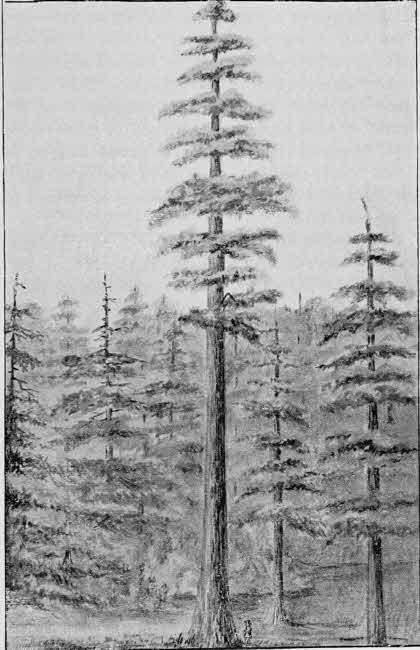
Sequoia Park.
It is stated on good authority that one of those ancient Jumbos blown down at Sequoia Park, California, was forty-one feet in diameter and showed six thousand, one hundred and twenty-six annual rings, or yearly growths.
In the explorations and surveys, under act of Congress, 1853 and 1854, Dr. J. M. Bigelow, in his report says: “It required five men twenty-two days,” with pump augers, to get one of these Sequoia Gigantea down—costing for labor at California prices, $550. “A short distance from this tree was another of larger dimensions, which, apparently, had been overthrown by an accident some forty or fifty years ago.... The trunk was three hundred feet in length; the top broken off, and by some agency (probably fire) was destroyed. At the distance of three hundred feet from the butt, the trunk was forty feet in circumference, or more than twelve feet in diameter, ... proving to a degree of moral certainty that the tree, when standing alive, must have attained the height of four hundred and fifty or five hundred feet!
“At the butt it is one hundred and ten feet in circumference, or about thirty-six feet in diameter. On the bark, quite a soil had accumulated, on which considerable-sized shrubs were growing. Of these I collected specimens of currants and gooseberries on its body, from bushes elevated twenty-two feet from the ground.”
Ohio abounded in large forest trees of many varieties—the sycamore, oak, poplars, chestnut, black walnut, etc. The writer made partial notes at the time, of a large yellow poplar that was cut down in 1844, and taken to a saw mill, receiving from it over eleven thousand feet of lumber, which was sold at the mill for one hundred and two dollars. The tree was large at the base, measuring three feet above the ground, forty feet in circumference. The axemen built a scaffold twelve feet in height to stand upon, and by means of the axe and saw, they made a stump fifteen feet in height. Some distance above this point the center was decayed and when down, ten feet was discovered as unsuitable for boards. Four sound logs of ten feet each were cut below the two branches, and each branch made also a good saw-log. The four logs cut from the trunk of the tree were, on the average over seven feet in diameter, and were obliged to be quartered in order to handle them, and consequently there was more than ordinary waste at the mill, as well as where the tree stood. The outside appearance of the tree bore no evidence of decay and those who had taken the contract to cut it down were greatly rejoiced to find over four feet of the diameter useless as support.
Many coon-hunters had followed tracks in snow for miles to bring up at this tree, which was selected for safety or other instinctive reason; probably from its long standing it became a favorite resort or stopping place for traveling raccoons. A portion of both main branches of the tree was hollow. One was occupied by coons and the other by “the little busy bee.” But neither the bee-hunters nor hunter for coons could be induced to cut the tree for what it contained, and for forty years it defied the axemen of the surrounding settlement.
Another of the first crop of trees that has passed away without mention is a sycamore that stood on the banks of the Scioto, in Pickaway county. It became quite noted and familiar to generations of hunters, who used the interior for camping purposes on hunting excursions for nearly half a century. It was also known and visited by others, from the fact, in 1872, a newly married couple commenced housekeeping in its spacious quarters, and enjoyed the seclusion amidst a forest of other mammoth trees. July 4, 1855, the dimensions of this sycamore were taken, which showed—Circumference three feet above ground, forty-five feet, and diameter of the hollow chamber, fourteen feet; door-way, three feet wide at base, terminating in a point seven feet above.
The large trees existed in abundance in many portions of the state, showing ages of four to five hundred years. Trees sometimes are found in such close proximity as to be termed “wedded,” as those shown in the following page, which are near the line of the towing path of the canal in Miami county—an elm and sycamore—girt six feet from the ground measures twenty-four feet.
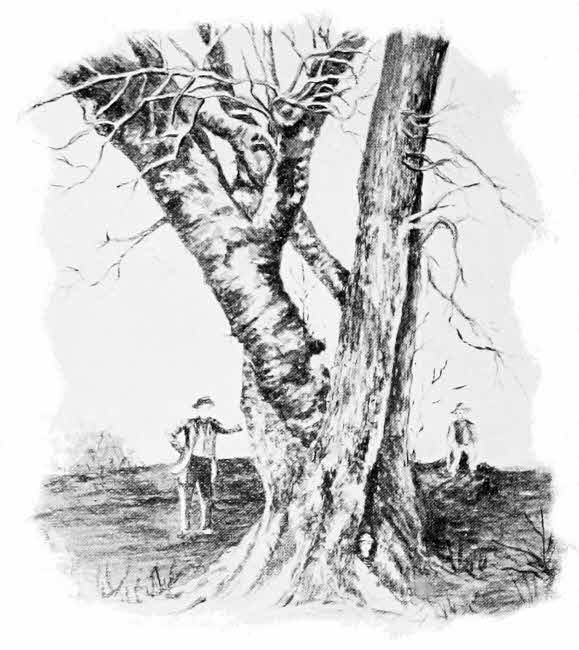
Conflict in Pre-Emption Claims.
One of the surveys of the Military District, in Pickaway county, is known as the “Seven Oaks.” In 1793, while Nathaniel Massie was making surveying tours in the country yet covered by hostile Indians, his assistant, Duncan McArthur, ran around a tract located in Pickaway county, covered it with warrants, and named it, “The Seven Oaks.” The trees were said to be large one hundred years ago and still growing. From measurements made June 21, 1895, the circumference of the main undivided trunk, three feet from the ground measured twenty-five feet ten inches; height of common trunk, three feet six inches. At the top of the common trunk is an opening eighteen inches wide into a circular inclosure, with a floor thirty-six inches in diameter, formed by main trunk and surrounding trees. The four trees, forming the west and north portions of the circle, remain united for ten feet, while those forming the south and eastern portion separate at six feet from the ground. Each of the seven trees is one hundred feet in height, and measures a little over eight feet in circumference at bisections.
“Grandeur, strength, and grace, Are to speak of thee. This mighty oak— By whose immovable stem I stand and seem Almost annihilated—not a prince, In all that proud old world beyond the deep, E’er wore his crown as loftily as he Wears the green coronal of leaves with which Thy hand has graced him.”
Great trees and great men and women are too numerous to obtain more than a mention. Every thing in Ohio has shown a tendency to superiority. It may seem almost fabulous, though true, a grape-vine near Frankfort, in Ross county, was cut down in 1853 that measured sixteen feet in circumference, ten feet from the ground; twenty feet up it divided into three branches, each measuring eight feet in circumference; height, seventy-five feet, and spread one hundred and fifty feet; and when cut up made eight cords of fire-wood.
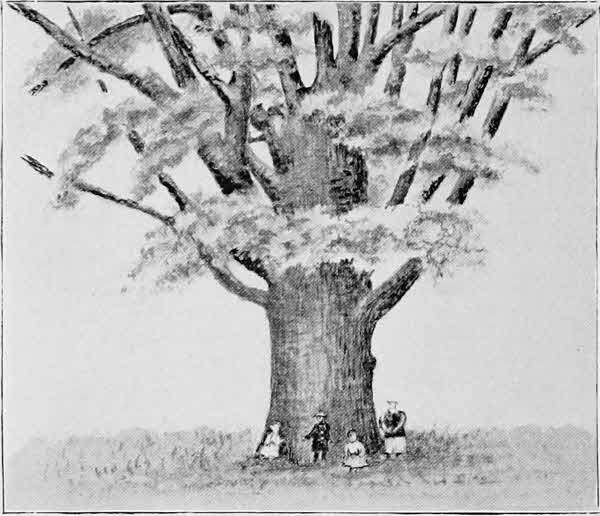
Chillicothe Elm.
It has been shown by actual measurements that the “big elm” of Walnut street, Chillicothe, Ohio, is much larger than the famous Boston elm, or any one at Cambridge, New Haven, or the great tree at Wethersfield. The Chillicothe elm measures twenty-eight feet six inches in circumference three feet above ground, with boughs covering an area of fifty-five square rods. As late as 1840 the remnants of this olden forest crop could be numbered by the dozen on an area of almost any square mile of woods. They were left because it meant work to get them off their pre-emption claim. But an advance in lumber and improvements soon diminished the number having a lumber value, leaving those unfitted for boards to the destruction of campfires and girdling, or to be utilized as houses of various kinds and purposes. A large, hollow sycamore in Pike county, near Waverly, made a commodious blacksmith shop and horse-shoeing establishment for many years.
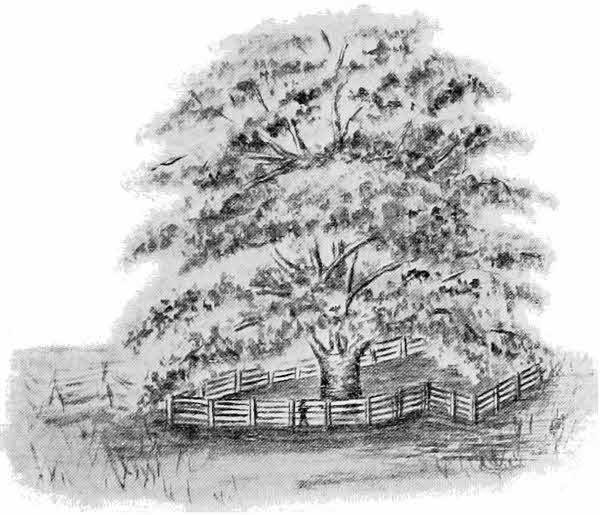
The Logan Elm.
“The Logan Elm” is the most interesting historic tree in Ohio, testifying of thrilling incidents in colonial times—military achievements of Lord Dunmore, unsurpassed ability of the red man, and the trying period of the earliest pioneers—each giving great interest to the spot where stands this living monument.
During the fall of 1774 Lord Dunmore fitted out an expedition of three thousand men, hoping to destroy the Indians and their numerous towns along the Scioto valley. His army moved westward in two sections. The larger division, commanded by Dunmore in person, crossed the mountains by way of the Cumberland Gap, and arrived at the Ohio river near where Wheeling now stands, and the smaller corps, under command of Colonel Andrew Lewis, followed the Kanawha to its confluence. Before reaching the villages of the plains and along the borders of the Scioto river, in Pickaway county, the divisions had planned to form a junction.
Colonel Lewis arrived on the Ohio river at the point designated October 6th, and encamped on the grounds now occupied by the town of Point Pleasant, awaiting dispatches from Lord Dunmore. After remaining three days without intrenchments or other works of defense, he was, on the 10th, attacked early in the morning by one thousand chosen braves of the tribes belonging to the confederacy, under the great chieftain, “Cornstalk,” hoping to destroy his enemies before they should have an opportunity to unite their forces. The battle lasted all day and ended with the cover of night. The Indians felt they received the greater disaster, having two hundred and thirty-three killed and severely wounded. Here Colonel Charles Lewis lost his life, with the lives of half of the commissioned officers.
Chief Cornstalk felt the failure, and to save the towns and people of the Scioto valley, something must be done immediately, and hurried to Lord Dunmore with petitions for peace. Previous to this, and in ignorance of the bloody battle, Dunmore had transmitted orders to Lewis to move on and enter the borders of the enemy’s country on the Scioto.
Elated with the idea of slaughtering the “redskins” in their camps and country, the enraged Virginians marched eighty miles through a rough, trackless wilderness, without bread or tents, and on the 24th day of October encamped on the banks of Congo, under the spreading boughs of the historic tree, and within less than four miles of the great town of the Shawnees, located on the west bank of the Scioto river, now known as “Westfall.” Chief Cornstalk had been scouting Colonel Lewis’s movements, and he, with the chiefs of other tribes, were beseeching Lord Dunmore to stop Colonel Lewis and save their towns and women and children.
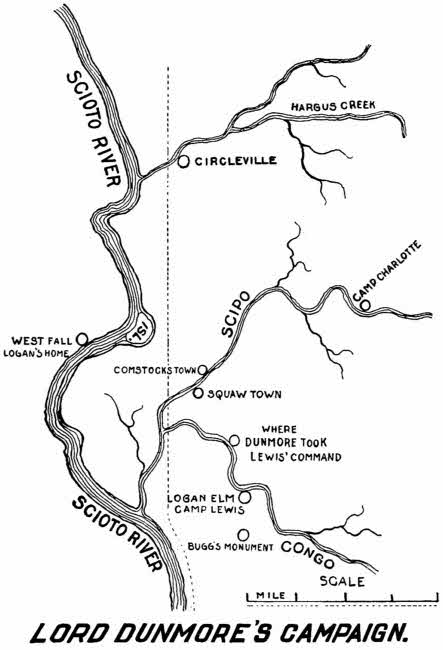
LORD DUNMORE’S CAMPAIGN.
Thrice had Lewis received orders to halt, but on he went; and when near the Indian town, he was intercepted by Dunmore, who drew his sword upon Lewis and threatened him with instant death if he persisted in any further disobedience, and marched the army back to Camp Lewis, where the treaty went on to a satisfactory conclusion, in the presence of two thousand five hundred troops and all the confederate chiefs and their warriors.
There was one chief absent whom Dunmore much desired present—Logan, the great warrior of the Mingoes—who felt his people had been very unfortunate in their attempts at peaceful relations with the whites; and in order to secure his presence, John Gibson, an interpreter and friend of Logan’s, was detailed as messenger with dispatches to the chief, who resided at Old Chillicothe (Westfall), about four miles distant from Camp Lewis.
Of this matter Captain Gibson says, under oath, he found Logan at his home, but refused to attend the council, and that at the chief’s request they walked out some distance into the woods and sat down. Logan appeared much affected, and after shedding many tears and showing other manifestations of sorrow, told his pathetic story in reply to the request from Lord Dunmore, and which Gibson translated into English and delivered to Dunmore in the council assembled under the boughs of this noble tree on the banks of the Congo—and was read as follows, to wit:
“I appeal to any white man to say if ever he entered Logan’s cabin hungry and I gave him not meat; if ever he came cold or naked and I gave him not clothing.
“During the course of the last long and bloody war Logan remained in his tent, an advocate for peace. Nay, such was my love for the whites that those of my countrymen pointed at me as they passed by and said, ‘Logan is the friend of the white man.’ I had even thought to have lived among them, but for the injuries of one man—Colonel Cresap—who last spring, in cold blood and unprovoked, cut off all the relations of Logan, not sparing even my women and children. There runs not a drop of my blood in the veins of any human creature. This called on me for revenge—I have sought it. I have killed many. I have fully glutted my vengeance. For my country I rejoice at the beams of peace. Yet do not harbor the thought that mine is the joy of fear. Logan never felt fear. He will not turn on his heel to save his life. Who is there to mourn for Logan? Not one.”
The authorship of this message has been doubted and disputed by reason of its greatness. But it is well known that many of the native men of America have shown an ability for expression of thoughts surpassed by no people or nation in the world. Who could have thought it—who could have said it so effectively, by every gesture and living fiber—as it was expressed by Tecumseh, after finishing a speech at Vincennes holding, contrary to the United States Government, that no one or two tribes could make treaties conveying away lands without the consent of others equally interested? When done speaking, an aide of Governor Harrison, pointing to a vacant chair, said to Tecumseh, “Your father requests you to take a seat by his side.” Drawing his mantle around him, the chief proudly exclaimed: “My father! The sun (pointing upward) is my father, and the earth my mother; on her bosom I will repose,” and seated himself on the ground where he had been standing. And it is unusual, at least, that one with learning and general acquaintance with the high standard of natural ability of the Indian, and after so many years, should enter into a voluminous correspondence to prove that he (Jefferson) did not write “Logan’s reply.”
Some years since, a partial investigation of the papers of Lord Dunmore was made. While the original Gibson translation was not discovered, there was much to confirm the statements here given.
The expedition of Dunmore with an army of three thousand men into the heart of an Indian country, with mountains and wilderness hundreds of miles between him and supplies, at that early date, with that existing animosity between the Indians and his Virginia soldiery, makes it appear now, as it did at the time to many of his soldiers, of singular significance. When the military expedition reached the point of destination it found the enemy praying for peace. And while the chiefs were entertained in council, and the braves and soldiers were listening to Virginia oratory, small bands of maddened and vicious troops stole away and murdered Indian women and children, fired their towns, and with stolen horses discharged themselves from the army and fled the country.
The Indians were helpless, and the treaty fixing the Ohio river the boundary line went on, while the soldiers put in the time making speeches and passing resolutions. The following should be ever preserved as the thoughts of men in a far country, by a captain:
“Gentlemen—Having now concluded the campaign, by the assistance of Providence, with honor and advantage to the colony and ourselves, it only remains that we should give our country the stronger assurance that we are ready at all times, to the utmost of our power, to maintain and defend her just rights and privileges.
“We have lived about three months in the woods, without any intelligence from Boston, or from the delegates at Philadelphia. It is possible, from the groundless reports of designing men, that our countrymen may be jealous of the use such a body would make of arms in their hands at this critical juncture. That we are a respectable body is certain, when it is considered that we can live weeks without bread or salt; that we can sleep in the open air without any covering but that of the canopy of heaven; and that we can march and shoot with any in the known world. Blessed with these talents, let us solemnly engage to one another, and our country in particular, that we will use them for no purpose but for the honor and advantage of America, and of Virginia in particular. It behooves us, then, for the satisfaction of our country, that we should give them our real sentiments by way of resolves at this very alarming crisis.”
Thereupon the committee presented the following resolutions, which carried, and ordered printed in the Virginia Gazette:
“Resolved, That we will bear the most faithful allegiance to His Majesty, King George the Third, while His Majesty delights to reign over a brave and free people; that we will, at the expense of life and every thing dear and valuable, exert ourselves in the support of the honor of his crown and the dignity of the British Empire. But as the love of liberty and attachment to the real interests and just rights of America outweigh every other consideration, we resolve we will exert every power within us for the defense of American liberty, and for the support of her just rights and privileges—not in any precipitous, riotous or tumultuous manner, but when regularly called forth by the unanimous voice of our countrymen.
“Resolved, That we entertain the greatest respect for his excellency, the Rt. Hon. Lord Dunmore, who commanded the expedition against the Shawanese, and who we are confident underwent the great fatigue of this singular campaign from no other motive than the true interests of the country.
“Signed by order and in behalf of the whole corps.
“Benjamin Ashby, Clerk.”
All of which shows political and personal resolutions have maintained a due degree of hypocrisy to the present, without material change.
Captain John Boggs and family located on this place in 1798, before the lands were surveyed or in market. And from Captain Williamson, an officer under Lord Dunmore, Captain Boggs procured many important facts in regard to Camp Lewis, Logan, and the noted tree. This large and valuable tract of land, on which the tree stands passed from the United States into the hands of Captain John Boggs, and is still owned by his descendants.
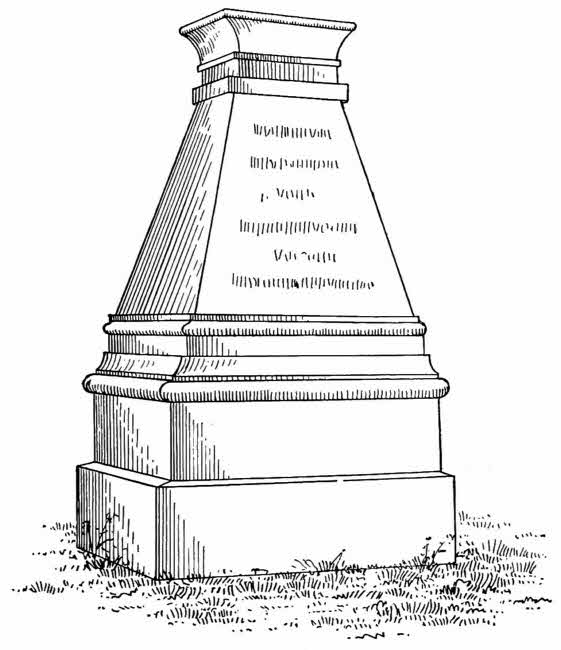
Monument of the Boggs Family.
In memory of the family settlement and historic events of the spot, John Boggs the third erected a handsome monument where stood the cabin in which three generations were born. The monument is within one hundred and fifty feet of the Logan Elm, is of pure granite, twelve feet square, base six feet, shaft fifteen feet, tapering. On each side are cut letters in commemoration of events connected with that spot. On one side is firmly set in the granite a bronze tablet, thirty by fifteen inches, bearing the picture of the capture of Captain Boggs’ son, William, in bas-relief. The figures depicted represent a thrilling and vivid scene which on that spot actually once occurred in view of the agonized family.
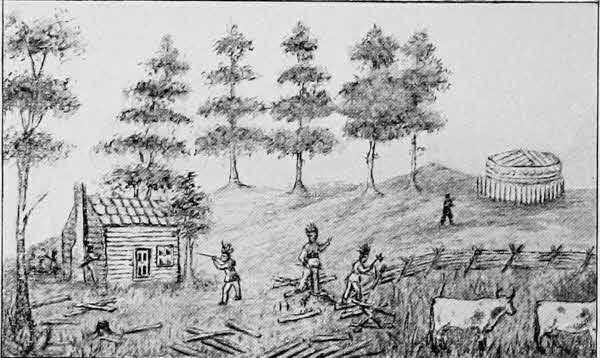
Indian Raid.
The landscape is an exact representation of the surroundings. In the left-hand corner is a log cabin, at the corner of which is the figure of an Indian with a gun to his shoulder; to the left, and fronting the cabin door stands an Indian. At the right of this is a field of wheat surrounded by a rail-fence. Several panels have been thrown down in the night, and the cattle are in the field eating the grain. Near the fence is seen a boy running up a slight ascent, making his way to a palisade on the elevation beyond—after him are two Indians in hot pursuit.
The Indians, under cover of darkness, had torn down the fence and turned the cattle upon the growing grain; then secreted themselves for events that might occur in the morning. The decoy was successful. The boy, awakening early, found the destructive scene, and, unsuspecting the authors of the mischief, proceeded at once to drive out the herd and to restore the fence. Suddenly an apparition of a hostile foe rises before him. He at once retreats toward the cabin, but there too he sees a redskin awaiting his approach. He turns, and, with the speed of dying fright, vainly endeavors to make the palisade on the elevation; but his course is beset with increasing pursuers on all sides, and at length, exhausted, is overcome and made captive to Indian cunning.
All this time, Captain Boggs stood sentinel at the cabin’s corner, guarding the family, while the son is relentlessly pursued by the hostile enemy. The whole is depicted and for the time preserved in bronze and granite; and as generations of the future stand before this consecrated record, it will extort thoughts of the pioneer—his pleasures and his sufferings—with venerated admiration for those whose lives marked out the pathway of our civilization.
Every nation, every country, and every town has historic trees. They are not without influence on the destiny of individuals, societies, and nations. They are objects of reverence—works of time—homes of generations—and the manifest wisdom of creation. In the tree is beheld in perfection an enduring living principle, exceeding all other forms of life—beginning in the morning of creation and ending only with the end of time. When moth and rust have corroded memorial in bronze, and years of the unseen future have crumbled the granite to dust, there will still be standing noble, historic trees, with all their lessons fresh and green.