BOOK II VICTIM OF FATE
Reading edition
XII
All Florence—social, literary, and artistic—was at the Londi reception. The ancient villa, once the possession of the great Dante, fell into gentle hands when the present owner, thirty years before, entered into an appreciative enjoyment of his newly acquired property. The structure itself was preserved and restored without destroying the original beauty of its architecture; the walls were renovated and hung with rich tapestries and rare paintings; priceless statuary found a place in the courts and corridors, but with such perfect taste that one felt instinctively that each piece belonged exactly where it stood as a part of the complete harmony.
Florentine society possesses two strong characteristics—hospitality and sincerity. No people in the world so cordially welcome strangers who come properly introduced to settle temporarily in their midst; no people so plainly manifest their estimates of their adopted aliens. There is no half-way, there is no compromise. They are courteous always, they are considerate even when they disapprove; but when once they accept the stranger into their circle they make him feel that he is and always has been a part of themselves.
Uncle Peabody had won this place long since. His genial disposition and quiet philosophy appealed to them from the first by its very contrast to their own impulsive Latin temperament. It was an easy matter, therefore, for him to introduce his niece to those whom he counted among his friends, and this he made it a point to do when he discovered how much she would otherwise have been alone. Helen had ceased to urge Jack to accompany her, and he seemed quite content to be omitted. Their first weeks in Florence had been devoted to getting settled in their villa and in rambling over the surrounding hills, entirely satisfied with their own society. The house-party had taken up another week, and even before the guests had departed Armstrong began his researches at the library, which required a larger portion of each day as time went on. The moment when Helen and Jack would naturally have jointly assumed their social pleasures and responsibilities had passed, and the necessity for diversion of some kind prompted Helen gratefully to accept her uncle as a substitute.
“There is a countrywoman of ours—the Contessa Morelli,” Uncle Peabody remarked, as he skilfully piloted Helen and Emory away from the crush in the reception-hall, indicating a strikingly attractive woman surrounded by a group of Italian gallants. “She came from Milwaukee, I believe, and married the title, with the husband thrown in as a gratuity for good measure.”
“She looks far too refined and agreeable to answer to your description,” Helen replied, after regarding the object of his comments.
“She is refined and agreeable,” assented Uncle Peabody, “and—worldly. When you have once seen the count you will understand. She is a neighbor of yours, so you must meet her—the Villa Morelli is scarcely a quarter of a mile beyond the Villa Godilombra.”
“Don’t overlook me in the introduction, will you?” urged Emory, eagerly.
“Still as fond as ever of a pretty face, Phil?” queried Helen, laughing.
“Of course,” he acquiesced, cheerfully; “but this is a case of national pride. You and she—the two American Beauties present—would make any American proud of his country.”
Helen smiled and held up a finger warningly as she followed Uncle Peabody’s lead. The contessa acknowledged the introductions with much cordiality, but to Emory’s disappointment devoted herself at once to Helen.
“So you are from dear, old, chilly Boston,” she said, breezily. “The last time I passed through was on a July day, and I was so glad I had my furs with me.”
“Boston is celebrated for its east winds,” volunteered Emory, calmly.
The contessa glanced at him for a moment to make sure that his misunderstanding was wilful.
“Yes,” she replied, meaningly; “and I understand that in Boston the revised adage reads, ‘God tempers the east wind to the blue-bloods.’”
“And I was just going to say some nice things about Milwaukee!” Emory continued.
“Then it is just as well that I discouraged you,” the contessa interrupted. “No one who has not lived there can ever think of anything complimentary to say about Milwaukee except to expatiate upon its beer. That seems to mark the limitations of his acquaintance with our city.”
The contessa turned to Helen. “Mr. Cartwright tells me that you and your husband are my mysterious neighbors, about whom we have had so much curiosity. You must let me call on you very soon.”
Helen was studying her new acquaintance with much interest. Her features were as clearly cut as if the work of a master-sculptor, yet nature had improved upon human skill by adding a color to the cheeks and a vivacity to the eye which made their owner irresistible to all who met her; while the simple elegance of her lingerie gown, in striking contrast to the dress of the Italian women near her, set off to advantage the lines of her graceful figure. She was a few years older than Helen, yet evidently a younger woman in years than in experience. Uncle Peabody’s comments had naturally prejudiced Helen to an extent, yet she could not resist a certain appeal which unconsciously attracted her.
“I hope we may see much of each other,” the contessa continued, cordially, scarcely giving Helen an opportunity even for perfunctory replies. “Morelli is housed by the gout at least half of the time, and he bores me to death with his description of the various symptoms. I will run over to Villa Godilombra and let you rehearse your troubles for a change. But, of course, you have no troubles—Mr. Cartwright said you were a bride, did he not?”
The contessa noticed the color which came in Helen’s face, and her experience, tempered by her intuition, told her that it was not a blush of pleasure.
“Where is your husband?” she asked, pointedly. “You must present him to me.”
“He is engaged upon some literary work at the library,” Helen replied.
“Oh, a learned man! That is almost as bad as the gout!” The contessa held up her hands in mock horror. “Then you will need my sympathy, after all,” she said, with finality. “Oh, these husbands!—these husbands!”
It was a relief to Helen when other guests claimed the contessa’s attention. Uncle Peabody had mingled with friends in the drawing-room, so she and Emory moved on in the same direction. Here she found many whom she had previously met, and for half an hour held a court as large and as admiring as the contessa’s. Emory was quite unprepared to find his companion so much at home in this different atmosphere.
“By Jove, Helen,” he whispered, as he finally discovered an opportunity to converse with her again, “one would think you had always lived in Florence. If it were not for the gold lace of the army officers and the white heads of the ancient gallants who flock about you, I should almost imagine we were at the Assemblies again.”
“Every one is cordiality itself,” replied Helen. “See Uncle Peabody over there! Is he not having a good time? He told me Professor Tesso, of the University of Turin, was to be here, and I presume that is he.”
Following the example of the other guests, Helen and Emory strolled out into the main court, in one corner of which is the old well dating back to the time when the Divine Poet slaked his thirst at its stony brim. The sun streamed in through the narrow windows and lighted the terra-cotta flagstones where its rays struck, making the extreme corners of the court seem even dimmer. With rare restraint, the only decoration consisted of long festoons, made of lemons, pomegranates, eucalyptus, oranges, and laurel, fashioned to resemble the majolicas of Della Robbia and hung gracefully along the stone balcony, between which was an occasional rare old rug or costly tapestry. Passing slowly up the spacious stairway, stopped now and again by one or more of Helen’s newly acquired friends, they reached the library, where some of the more valuable manuscripts and early printed volumes were exposed to view. A group of book-lovers were eagerly examining an edition of Dante resting upon a graceful thirteenth-century leggio, printed by Lorenzo Della Magna, and illustrated with Botticelli’s remarkable engravings. From the balcony, leading out from the library, they gained a view of the carefully laid-out garden, brilliant in its color display and redolent with the mingled fragrance of myriads of blossoms.
Here Uncle Peabody rejoined them, bringing with him the scholarly looking professor from Turin.
“Helen, I want you to meet Professor Tesso. He was among the first who saw in my theories and experiments any signs of merit.”
The professor held up his hand deprecatingly. “You give me too much credit, Mr. Cartwright. Judicially, we men of science are all hidebound and look upon every innovation as erroneous until proved otherwise. We could not believe that your theories of body requirements of food were sound because they differed so radically from what we had come to regard as standard. But when you proved yourself right by actual experiment we had no choice in the matter.”
“Uncle Peabody has been very persistent,” said Helen, smiling. “His own conviction in time becomes contagious, does it not?”
“That is just it,” assented Professor Tesso. “What he had told us is something which we really should have known all the time, but we failed to recognize its importance. Now he has forced us to accept it, and the credit is properly his.”
“I have invited Professor Tesso to take tea with us to-morrow afternoon, Helen, at the villa,” said Uncle Peabody.
“By all means,” Helen urged, cordially. “We shall be so glad to welcome you there.”
The sudden exodus of the guests gave notice that something unusual was occurring below.
“It must be the arrival of the Count of Turin,” explained Uncle Peabody. “Let us descend and take a look at Italian royalty.”
With the others they entered the magnificent ball-room—a modern addition to the original villa made by Napoleon for his sister Pauline when she became Grand-Duchess of Tuscany. In the centre of the room, surrounded by his suite, stood the count, graciously receiving the guests presented to him by his host. Hither and thither among the crowd ran little flower-maidens bestowing favors upon the ladies and boutonnières upon their escorts. A few pieces of music played quietly behind a bank of palms, the low strains blending pleasantly with the hum of conversation.
As Helen and Emory stood with a few Italian friends, a little apart from the others, watching the brilliant throng, Cerini suddenly joined them. Helen had never thought of him outside the library, and it seemed to her as if one of the chained volumes had broken away from its anchorage. The old man saw the surprise in her face and smiled genially.
“I seldom come to gatherings such as this,” he explained, even before the question was put to him; “but his Highness commanded me to meet him here.” Cerini smiled again and looked into Helen’s face with undisguised admiration. “This is where you belong,” he assured her, quietly but enthusiastically—“this is your element. Do you not see that I was right that day at the library? You are even more beautiful than when I saw you before. There is a new strength in your face. You are a creation of the master-artist, like a marvellous painting which intoxicates the senses.”
Helen had no answer, but the old man continued:
“I have just left your husband and his sister-worker. They are not beautiful—they represent the wisdom which one finds in books. The world needs both, my daughter. Be content.”
And without waiting for a reply Cerini disappeared in the crowd of guests as suddenly as he had come.
XIII
Emory was the only one near enough to Helen to observe the interview with Cerini. The old man’s words were uttered in too low a tone to reach his ears, but Emory saw Helen close her eyes for a fraction of a second and heard her draw a quick breath. Then she turned to him with a smile so natural that he nearly believed himself deceived, and found himself almost convinced that he must have been mistaken in what he thought he had discovered.
“Whose little old man is that?” Emory queried.
Helen laughed. Emory had a way of putting questions in a form least expected.
“Monsignor Cerini,” she answered, “and he belongs to Jack.”
“Oh, he is the librarian!” Phil recognized the descriptions he had heard at the villa. “Interesting-looking old chap; I don’t wonder Jack likes him.”
“He is a wonderful man,” assented Helen; “but his knowledge almost frightens one. I feel like an ignorant child every time I meet him.”
They strolled slowly through the brilliant throng out into the court, up the stairs, and into the library again. The room was wholly deserted, the other guests preferring to watch the spectacle below. No word was spoken until Helen threw herself into a great chair near the balcony.
“What an awful thing it is to have so little knowledge!” she exclaimed.
Emory looked at her in surprise. At first he could not believe her serious, but the expression on her face was convincing.
“Compared to Cerini?” he asked.
“Compared to any one who has brains—like Jack or Inez.”
Emory studied his companion carefully. The impression made upon him a few moments before, then, was no hallucination.
“What did Cerini say which upset you, Helen?”
“Cerini?” Helen repeated. “Why, nothing. As a matter of fact, he was very complimentary—even gallant. Some of you younger men could take lessons from Cerini in the gentle art of flattery.”
“I beg your pardon, Helen,” Emory apologized; “I had no intention of intruding.”
“Dear old Phil,” cried Helen, holding out her hand impulsively, “of course you had not, and you could not intrude, anyhow.”
Emory held the proffered hand a moment before it was withdrawn. “I can’t help feeling concerned when I see something disturb you,” he said, quietly—“now, any more than I could before.”
Helen saw that she had not succeeded in deceiving him, but was determined that he should discover as little as possible. “I don’t believe Florence is just the right atmosphere for me,” she began. “I did not notice at first how much more every one here knows about everything than I do, and it makes me feel uncomfortable. That is what I meant. Of course one expects this supreme knowledge in a man like Cerini, but even those Florentines whom one meets casually at receptions such as this are as well informed on literature and art and music as those whom we consider experts at home.”
“This lack of knowledge on your part does not seem to interfere any with their admiration for you,” insisted Emory. “If Jack took the trouble to see how much attention you received he might have a little less interest in that precious work of his.”
“You must not speak like that, Phil,” Helen protested. “Jack is doing something which neither you nor I can appreciate, but that is our own fault and not his. I only wish I could understand it. Every one says that his book will make him famous, and then we all shall be proud of him—even prouder than we are now.”
Emory rose impatiently. “You are quite right, Helen,—I certainly don’t appreciate it, under the circumstances; but I shall put my foot in this even worse than I did yesterday with Miss Thayer, so I suggest that we change the subject. Come, let us see what is going on down-stairs.”
Uncle Peabody met them in the court. “I was coming after you,” he said by way of explanation. “Tesso has just left, and we also must make our adieux. Would you mind taking Mr. Emory and me to the Florence Club, Helen, on the way home? He might like to see it.”
Their appearance in the hall was a signal for the unattached men again to surround Helen with protestations of regret that she had absented herself from the reception-room, and Emory watched the episode with grim satisfaction. Uncle Peabody appeared to take no notice of anything except his responsibility, and gradually guided the party to where their host and hostess were standing, and then out to the automobile. An invigorating run down the hill, past the walls which shut out all but the luxuriant verdure of the high cypresses, alternating with the olive and lemon trees, and through the town, brought them to the Piazza Vittorio Emanuele, where the car paused for a moment to allow the men to alight. Then, after brief farewells, Helen continued her ride alone to Settignano.
Uncle Peabody led the way up the stairs to a small room leading off from the main parlor of the club. Producing some cigars, he motioned to Emory to make himself comfortable at one end of a great leather-covered divan, while he drew up a chair for himself.
“I brought you here for a definite purpose,” he announced as soon as the preliminaries were arranged.
“I think I can divine the purpose,” replied Emory, striking a match and lighting his cigar.
Uncle Peabody looked at his companion inquiringly.
“It is about Helen, is it not?” continued Emory, without waiting for Mr. Cartwright to question him.
“It is,” assented Uncle Peabody; “and your intuition makes my task the easier.”
“It is not intuition,” corrected Emory; “it is observation.”
“Well, call it what you like—the necessity is the same. Perhaps I have no right to discuss this matter with you, but I understand you have known Helen for a good while and pretty well.”
“So well that I would have married her if she had ever given me the chance,” asserted Emory, calmly.
“What do you make out of the case?”
“The girl is desperately unhappy.”
“She is. But how are we going to help her without making things a thousand times worse?”
Emory smoked his cigar meditatively. “I have been thinking of that, too,” he replied at length, “but with no more success, apparently, than yourself. It is a rather delicate matter.”
“There is no question about that.” Uncle Peabody spoke decisively. “And this is all the more reason why we should talk things over together. We are the only ones who can possibly straighten matters out, and I am not at all certain that we can accomplish anything.”
“Do you think Armstrong himself realizes the situation?”
“Not in the slightest. He is absolutely absorbed.”
“How about Miss Thayer?”
Uncle Peabody looked at Emory interrogatively. “What have you observed about Miss Thayer?” he asked.
“That she is exceedingly sensitive upon the subject of her engagement,” replied Emory, with feeling.
“Have you come to any conclusion as to the reason?”
Emory was surprised by the implied meaning in Mr. Cartwright’s words. “Why, no,” he said, slowly.
“I was here when De Peyster proposed to her,” Uncle Peabody continued.
“Then she was the girl!”
“She was the girl,” repeated his companion. “When she threw him over, she did not tell him that she was engaged, as he repeated to you, but that she loved some one else.”
A wave of understanding passed over Emory.
“And the some one else was—Armstrong! What a stupid fool I’ve been!” Emory rose and walked to the window. Suddenly he turned. “Does Helen know this?”
“Without a doubt.”
“Then why does she not put a stop to it?”
“Now you have at length arrived at my standpoint,” replied Uncle Peabody, with satisfaction. “Helen knows it, I am convinced. Miss Thayer, of course, knows her own feelings. Armstrong is head over heels in this alleged masterpiece of his, and I give him credit for appreciating Miss Thayer’s sentiments toward him as little as he does Helen’s sufferings. Except for this I should not think of interfering, but under the circumstances I feel that between us we may have a chance to straighten things out before the principals know that there is anything which needs straightening.”
“That is a fair statement of the basis of the conspiracy,” said Emory, returning to his seat; “but have you worked out the details as carefully?”
“No,” admitted Uncle Peabody, frankly. “That is a more difficult proposition, and I doubt if we can formulate any definite plan. It occurred to me that if we joined forces we would stand a better chance of hitting upon some expedient when the opportunity offered.”
“Helen seems more or less reconciled, in spite of what we know she feels,” said Emory, reflectively; “you heard what she said to Armstrong last evening about helping his work to a glorious success?”
“She is trying desperately to be reconciled, and she thinks she has concealed her real feelings,” replied Uncle Peabody; “but she is eating her heart out all the time.”
“Well, I wish I thought I could help her some way.” Emory rose and extended his hand. “I have never looked upon myself as much of a success in matters like this, Mr. Cartwright, but there is nothing I would not do for Helen—even to helping her to get a divorce!”
Uncle Peabody smiled as he took Emory’s hand and held it firmly. “I suspect you will have to eliminate yourself if you hope to accomplish anything. If I know Helen at all, she will never take another chance if this first venture turns out unfortunately. But let us hope that all will right itself, and that we may be the direct or indirect means of its so doing.”
“Amen to that,” assented Emory, warmly. “I have wanted Helen always, but I should be a brute if I did not want her happiness first of all.”
“I thought I had made no mistake,” replied Uncle Peabody. “I rather pride myself on my skill in reading human nature, and I should have been disappointed in you had you failed me.”
Uncle Peabody was late in returning to the villa, and the family had already seated themselves at dinner.
“We are all going for a moonlight ride,” announced Armstrong as Mr. Cartwright apologized for his tardy appearance, “and we felt sure you would soon be here. Did you ever see such a perfect evening?”
Uncle Peabody resolved to try an experiment. “May I venture to suggest an amendment?” he asked.
“What improvement can you possibly make on my plan?” Armstrong was incredulous.
“Simply that Miss Thayer and I give you and Helen a chance to enjoy the ride by yourselves, after the style of true honeymooners.”
Helen’s face flushed with pleasure, but Armstrong resented any change in his original arrangement.
“Nonsense!” he exclaimed. “Helen and I are not so sentimental, I trust, as to wish to keep you and Miss Thayer from enjoying the ride with us on such a night as this.”
“I think Mr. Cartwright’s amendment an excellent one,” said Inez. “It will be much better for you and Helen to go by yourselves.”
“Now you have broken up the whole party!” Armstrong turned petulantly on Uncle Peabody. “Miss Thayer has been working all the afternoon in the library, and needs the refreshment of the air even more than Helen.”
“If Miss Thayer will permit,” replied Uncle Peabody, maintaining his ground stoutly, “I will do my best to make her evening an agreeable one.”
Armstrong was not appeased, but could hardly do other than accept the situation. After seeing the car depart from the court-yard, Uncle Peabody and Miss Thayer strolled out to the garden, where he arranged their chairs so that they might gain the choicest view of the moon-illumined city and the winding river, silver in the soft, pale light.
“I have kept you from an interesting experience,” Uncle Peabody began, “but I know how much it will mean to Helen to have her husband all to herself. You understand, I am sure.”
“I do understand, perfectly,” replied Inez, heartily. “I am only ashamed that I did not think of it myself; but it is difficult to oppose Mr. Armstrong in anything he has his heart set on, and I confess that I do not possess your courage.”
“I doubt if I should have been so courageous had I realized how disagreeable he would be. Armstrong has changed much in the few weeks I have known him.”
Uncle Peabody made his assertion boldly, and then waited for a response. Inez looked up quickly.
“I think it is hard for any one to understand Mr. Armstrong without seeing him at his work. He has changed, as you say, but it is a change which no one—least of all himself—could prevent.”
Uncle Peabody expected a defence—that was but natural.
“I don’t think I quite follow you,” he said, wishing to draw her out. “Would you mind telling me more about the work, and what there is in it to affect him in this way?”
“I wish I could make it clear to you, for unless you understand it you will do him a great injustice.” Inez again keyed herself up to her self-appointed task. “Helen asked me the same question last evening, and I realized while talking with her how poorly fitted I myself am to attempt any explanation.”
The girl paused. She knew that her companion would analyze what she said much more thoroughly than Helen had done.
“Were you ever under an hypnotic influence?” she asked, suddenly.
“Yes,” replied Uncle Peabody, calmly. “But you don’t mean to say that this has happened to Jack?”
“Yes and no,” Inez continued. “If I believed in reincarnation I should say without hesitation that Mr. Armstrong was living over again, here in Florence, an existence which he had previously experienced centuries ago. As I don’t believe in this, I can simply say that there is a something which comes from an intimate contact with these master-spirits of the past which is so compelling that it takes one out of the present and assumes complete control over him. While we are at the library all else is forgotten. I work there beside him hour after hour, yet he seems entirely unconscious of my presence except to the extent to which it assists his own efforts. All personality is absolutely obliterated. I understand it, because to a lesser degree I have felt it myself. When we leave the library he becomes more like himself again; but as he gets deeper into his work, his absorption is greater, and for that reason alone, I believe, he is less mindful of the usual every-day conventions. I wish I could make it clear to you.”
Uncle Peabody did not reply at once. What Inez had said gave him a new viewpoint both of Armstrong and of her.
“How long do you think this will continue?” he asked at length.
“Until his work is finished.”
“And when will that be?”
“Another month, at least.”
Uncle Peabody was again silent, weighing the situation from the present standpoint. “What is to become of Helen in the mean time?” he asked, abruptly.
Miss Thayer had anticipated this question. “Helen understands the situation perfectly,” she said, confidently. “She has talked it over with him and with me. It is a sacrifice on her part to be separated from her husband, especially at this time, but it is one which she is willing to accept for her husband’s sake.”
“Would you be willing to accept it were the conditions reversed?”
Inez flushed, but stood her ground bravely. “Perhaps not,” she admitted; “but Helen is a stronger woman than I.”
“She does not think so.”
“Helen is a much stronger woman than she herself realizes.”
Uncle Peabody was thoughtful. “Let me ask you one more question. Do you think that this spell, or influence, or whatever you may call it, in any way affects Armstrong’s affection for his wife?”
“I am sure that it does not,” replied Inez, with decision. “His devotion to Helen must be even stronger, because he can but appreciate the splendid generosity she is showing.”
“He certainly adopts curious methods of demonstrating it.”
“But consider the influences he is under!” Inez urged.
Uncle Peabody admired the girl’s handling of the catechising he had given her. He looked steadily into her face before replying.
“You are a noble champion, Miss Thayer,” he said, at length.
“That is because I have faith in the cause,” responded Inez, smiling. “I have been brought up to believe that every married woman must at some time in her life make a supreme sacrifice for her husband. I only hope that when my turn comes the sacrifice may be made for so good a cause.”
“This is another version of the chastening of the spirit,” added Uncle Peabody; “but I am thinking of a certain spirit which received so much chastening that it never revived. I sincerely trust that history may not repeat itself.”
XIV
Uncle Peabody was entirely right when he stated that Armstrong had become a changed man since he first came to Florence; Miss Thayer was right when she attributed this change to the associations into which he had thrown himself—yet both were wrong in thinking him unconscious of his own altered condition. As he told Helen, he had ever felt some irresistible influence drawing him back to Florence, even while engrossed in the duties of his profession. Just what the craving was he could not have explained even to himself. What he should find in Florence had taken no definite form in his mind, yet the longing possessed him in spite of all he could do to reason with himself against it.
After his arrival in Florence, even, it was not until Cerini suggested the Michelangelo letters that he formulated any plan to gratify his long-anticipated expectations. His arguments with himself had prepared him for a disappointment. It had been a boyish fancy, he said, inwardly; he had felt the influences of his environment simply because he had been young and impressionable, and it was quite impossible that he should now, man-grown, prove susceptible to anything so inexplicable as what he had felt in his earlier days.
Then came the experience with Cerini and Miss Thayer. She was a woman, truly, and subject to a woman’s physical frailties, yet she was intellectually strong, and could not so have yielded to anything but a controlling power. Here, then, was a second personality affected in a like manner as himself by the same influences. He did not try to explain it; he accepted it as an evidence that this influence, whatever it was, existed and made itself manifest. From that moment he merged his own individuality into those to whom Cerini with gentle suasion introduced him. The librarian incited him by his own enthusiasm, and then directed him along the paths which he himself so loved to tread.
But Cerini did not foresee the extremes to which his pupil’s devotion would carry him. Day by day Armstrong felt himself becoming more and more separated from all about him, and more and more amalgamated with those forces which had preceded him. The society of any save those who acted and thought as he did failed to appeal to him. His affection for Helen suffered no change, except that she became less necessary to him. As the work progressed the intervals away from the library seemed longer, and he found it more difficult to enter into the life about him. Then came an irritability, entirely foreign to his nature, which he could not curb.
Yet through it all he was entirely conscious of what was happening. He compared himself more than once to a man in a trance, painfully alive to all the preparations going on about him for his own entombment, yet unable to cry out and put a stop to it all. He wished that Helen would object to his absences and force him to become a part of her life again. He wished that Miss Thayer would tire of the work and leave him alone in it. In contemplating either event he suffered at the mere thought of what such an interruption would mean to him, he knew that he would interpose strenuous objections—yet in a way he longed for the break to come.
Armstrong had been in one of these inexplicably irritable moods when Uncle Peabody crossed him in his plan for the moonlight ride to San Miniato. As a matter of fact, it was only because Miss Thayer had complained of a headache as they left the library that the idea of a ride had occurred to him at all; and to have Mr. Cartwright calmly propose that she drop out of the planned excursion struck him as a distinct intrusion upon his own prerogatives. The automobile fever was out of his blood now; the motor-car had become to him merely a convenience, and no longer an exhilaration. It was quite inevitable that Miss Thayer should acquiesce in Uncle Peabody’s suggestion—in fact, she could do nothing else; yet at the library she accepted even his slightest suggestion without question, and Armstrong preferred this latter responsive attitude. All in all, he would have been glad to find some excuse for giving up the ride altogether; but none offered itself, so, with every movement an obvious protest, he had helped Helen into the tonneau and stepped in after her.
Helen was hardly in a happier frame of mind, yet she found herself so eager for this time alone with her husband that she raised none of the obstacles which she would have done a month earlier. It was a perfect June evening, with the air cooled enough by the light wind to make the breeze raised by the speed of the car agreeable to the face. The moon was just high enough to cause deep shadows to fall across the roadway and merge into fantastic shapes as the machine approached and passed over them. The peasants were out-of-doors, and expressed their contentment by snatches of song, rendered in the rich, melodious voices which are the natural heritage of this light-hearted people. The toil of the day was over, and they were entering into a well-earned riposo before the duties of the next sunrise claimed their strength.
“How peaceful this is!” Helen exclaimed, turning to her husband. The breeze had blown back the lace scarf from her head, and the moon fell full upon her luxuriant hair, lighting her upturned face. “All nature is at rest and peace, and the people reflect the contentment of the land.”
“Your uncle is becoming very dictatorial,” replied Armstrong, quite at variance with her mood.
“Why, Jack!”
Helen was mildly reproachful, yet she instinctively felt the necessity of being cautious. Perhaps she could make him forget his resentment.
“Uncle Peabody only meant to give us an opportunity to be by ourselves. We have had so few.”
“He should have understood that I had some good reason for planning matters just as I did or I should not have done it.”
“Do you regret being alone with me?”
Helen struggled to keep the tears out of her voice.
“Don’t be absurd, Helen,” replied Armstrong, impatiently. “That is not the point at all. Miss Thayer is tired and needed this relaxation. Mr. Cartwright had no right to interfere.”
There was a long silence, during which Armstrong relapsed into a profound taciturnity, while Helen found it hard to know what tack to take. She glanced occasionally at her husband, but could gain no inspiration from his grim, set features.
“Tell me, Jack,” she said, at length, “is it not possible for you to pursue your work at the library without having it make you so indifferent to everything else?”
He shifted his position uneasily. “I am not indifferent to everything else. The fact that I proposed this ride is an evidence of that.”
“Has something happened to make my companionship distasteful to you?”
Armstrong became more and more irritated. “I don’t see why you are so possessed to make me uncomfortable, Helen. But I understand what you are driving at.”
“What am I driving at?” she asked, quietly.
“You are taking this method to force me to put an end to my work.”
Helen winced. “Is that fair, Jack? What have I said to you every time the subject has been mentioned?”
“You have told me to go ahead, and then you have shown quite plainly by every action that you did not mean it.”
“Jack Armstrong!” She was indignant at his gross injustice.
“What have I said each time the subject has come up?” continued Armstrong. “You have had every opportunity to have your own way in this as in all other matters. I repeat it now—is it your wish that I stop my work? Say but the word and I will never enter that library again.”
Helen was hurt through and through. To what avail was her sacrifice if it be so little understood, so little appreciated?
“I don’t wish to be misunderstood in this,” added Armstrong, as if in answer to her thoughts. “I quite realize that I have asked much of you who can understand so little of what my book means to me. I have been entirely frank, and have accepted from you the time which rightfully belongs to you in the spirit, as I supposed, in which you gave it to me. If you did not mean what you said, you have but to tell me so and it shall be exactly as you wish.”
“I have meant every word I have said, Jack,” replied Helen, in a low, strained voice. “I have been glad to contribute in the only way I could to anything which means so much to you. I simply ask you now whether it is necessary for this absorption to include all of yourself even when you are away from it. I did not suppose that this was essential.”
“You are exaggerating the situation out of all proportion.”
“I wish I were, Jack.”
Helen’s voice had a tired note in it which Armstrong could not fail to perceive. He was amazed by his own apathy. Why did it mean so little to him? Why did he sit there beside her as if he had not noticed it when in reality he felt the pain as keenly as she did? He turned and looked at her for the first time since they had started. Helen gave no sign that she was conscious of his scrutiny, lying back with her cheek resting upon her hand, her eyes closed, her lips quivering now and then in spite of her supreme effort to control herself. Always, before, Armstrong would have folded her in his arms and brushed away the heart-pains, real or imaginary as they might have been. Now he sat watching her suffer without making any effort to relieve her.
He despised himself for his attitude. What wretched thing had come between him and this girl whom he had idolized, and prevented him from extending even the common sympathy which belonged to any one who needed it? What malevolent power forced him to be the cause of this sorrow and yet forbade him the privilege of assuaging it? This was not the lesson learned from the humanists. Why should not he be able to give out to those around him the reflection of that true happiness which their work first taught the world?
Helen opened her eyes suddenly and looked full into his. Startled at the expression on his face, she sat upright, keenly anxious and forgetful of her own troubles.
“Jack dear,” she cried, “you are not well! You are unhappy, too! Tell me what it all means, and let us understand it together!”
Her voice brought back the old condition. His eyes lowered and he withdrew his hand from Helen’s impulsive grasp. With a heart heavy for the explanation which lay close at hand, his voice refused to obey.
“I am perfectly well, Helen,” he replied. “Why should you think me otherwise?”
The reaction was great, yet Helen succeeded in retaining her control. While conscious, during the weeks past, of the change in her husband’s bearing toward her, she was unprepared for his present attitude. Yet the look in his face when she had surprised him by opening her eyes was the old expression by which in the past she had known that something had touched him deeply—but it was intensified beyond anything she had ever seen. It had always been her privilege to comfort him under these conditions, and instinctively her heart sprang forward to meet his. Then she saw the expression change and she grew cold with apprehension.
“Ask Alfonse to turn back, please,” she begged. “The air is getting chilly and I think I would rather be home.”
In response to her desire the chauffeur turned the car, and the ride back to the villa was accomplished in silence. Helen’s thoughts ran rampant, but further conversation was impossible. Her pain was now tempered by her anxiety. Jack was not well, in spite of his disclaimers. His close application to his work in the poorly ventilated library had undoubtedly affected him, and this was the explanation of his otherwise inexplicable attitude toward her. It was with positive relief that she discovered any explanation, and as she thought things over this relief lightened the burden she had been carrying all these weeks more than anything which had happened since the cloud began to gather. In some way she must plan to relieve the pressure and bring her husband back to her and to himself again.
Inez and Uncle Peabody met them at the doorway.
“The ride has done you good,” said the latter, giving his hand to Helen and noting the light in the girl’s eyes as they walked toward the hall.
“I have left my scarf in the car,” said Helen, turning back so quickly that Mr. Cartwright had no opportunity to offer his services.
Armstrong and Inez were standing together on the step, and as Helen approached she could not help overhearing her husband’s reply to Miss Thayer’s inquiring looks.
“You are the only one who understands me,” Armstrong was saying—“you are the only one!”
XV
The next afternoon was a warm one, and Annetta searched for some little time before she discovered Uncle Peabody half concealed within a natural arbor formed by the falling branches of an ancient tree. Here, in the cooling shade, he was reading over a budget of letters just received from America. Emory followed close behind the maid, and laughed heartily at Mr. Cartwright’s jump of startled surprise when Annetta broke into his absorption with the announcement of “Signor Emori.”
“Hello, Emory!” he cried, looking up genially from the letter in his hand. “I was thousands of miles away, and two words from the lips of the gentle serving-maid brought me back to Florence. Marconigrams are nothing compared with the marvellous exhibition you have just witnessed.”
“It is a shame to interrupt you,” Emory apologized. “I came up early hoping to have a little chat with you before Professor Tesso and tea-time arrived.”
“Don’t apologize, I beg of you,” protested Uncle Peabody, gathering up his letters and making room for Emory to sit beside him. “I was just on the point of returning, anyway, and you have saved me the necessity of packing up. In fact, you are very welcome.”
“I judge your news is of an agreeable nature?”
Emory saw that Uncle Peabody was eager to be questioned.
“Things are advancing famously,” replied Mr. Cartwright, enthusiastically. “These letters are from America, and report the fullest success attending the experiments there with which I am so vitally concerned. But what are you carrying so carefully at arm’s-length?”
Uncle Peabody peered into the little wicker cage Emory was holding.
“Ah, a grillo!” he said. “Then to-day must be Ascension Day and the Festa dei Grilli. I had forgotten the date.”
“So that explains why they are selling these little cages with crickets inside of them all over the city. The old woman I bought this of told me it was a token of good luck, so I brought it to Helen.”
“She will be interested in it,” replied Uncle Peabody. “The little grillo brought luck once upon a time, if the legend be true, and it may do so again.”
“Is this Festa dei Grilli, as you call it, an annual festival?”
“Yes; and as firmly established as the Feast of the Dove on Easter eve. The story goes that an attempt was once made upon the life of Lorenzo de’ Medici in his own garden by the familiar means of a goblet of poisoned wine. As the would-be assassin handed the goblet to Lorenzo a cricket alighted on the surface of the wine and immediately expired. Thus, as in modern melodrama, the villain was foiled. Since then, a Florentine would harm a human being as soon as he would a grillo. Each year these cages are taken into the homes, and as long as the little crickets can be kept alive good luck attends the household.”
“Speaking of conspiracies,” remarked Emory, who lost no time in finding an opening, “how advances our present one? I have been thinking of nothing else since our talk about Helen.”
Uncle Peabody rose and glanced around the garden from his point of vantage. “Careful!” he said, drawing back. “Helen is coming, and I can only say that we must move very cautiously—even more so than I supposed. I will tell you more later.”
“Here we are, Helen,” he answered, in response to his niece’s call, and both men advanced to meet her.
“Oh, you have found my ‘snuggery’!” cried Helen, seeing them emerge from the arbor. “I intended to keep that entirely for myself, but I will be generous and share it with you.”
“Mr. Emory has brought you a talisman,” said Uncle Peabody, pointing to the wicker cage. “Perhaps you will permit this to appease your displeasure.”
Helen examined with interest the cage Emory placed in her hand.
“Why, it is a cricket!” she exclaimed, as she discovered the occupant beneath the green leaves.
The story of the origin of the festa was retold and the grillo placed under her special protection.
“It is an emblem of good luck, Helen,” added Emory—“like the swastika, only a great deal less commonplace.”
“Thank you, Phil,” replied Helen. Then she looked up at him suddenly. “Why did you bring it to me?” she asked, suspiciously. “Do you think I need it?”
“I think we all need all the good luck we can get,” replied Emory, guardedly.
“Tesso is late,” remarked Uncle Peabody, opportunely, looking at his watch. “He will be greatly interested in the reports of these American experiments.”
Another half-hour passed by before the professor from Turin arrived. Helen strolled about the garden with Emory, pointing out the unusual flowers and shrubs, while Uncle Peabody collected his letters and arranged them in proper sequence. Annetta brought out the tea-table and laid everything in readiness, returning to the house just in time to usher the dignified figure into the hall.
“I hope I have not disarranged your plans,” apologized the professor, pleased with the cordiality of his reception. “I had a little experience which delayed me.”
“My uncle is so anxious to tell you of some good tidings, professor, that he has almost become impatient,” replied Helen, smiling. “You observe that I say ‘almost,’ do you not?”
“It would never do for him to become impatient, would it?” replied Tesso, turning to his friend—“you the disciple of Cornaro and the example to us all! But I myself am weaker—I admit my impatience.”
Uncle Peabody and Emory drew up the chairs, and Tesso seated himself next to Mr. Cartwright with obvious expectancy.
“You recall the results of my own experiments in attempting to show increased muscular and mental endurance as a result of eating in right manner what the appetite selects instead of eating in wrong manner what the doctors advise?” began Uncle Peabody.
“And incidentally demonstrating that the existing standard of minimum nutrition for man was three times too large?” queried Tesso.
“Yes. You all were very generous, but I know you attributed the results in a measure to my own personal peculiarities.”
“You are right to a certain extent,” admitted Tesso, “yet, so far as the experiment went, it proved that your theory was correct.”
“Now I have further evidence to add which is overwhelming,” continued Uncle Peabody, triumphantly. “For the last six months experiments have been in progress in America, taking as subjects groups of men in different walks of life—college professors, athletes, and soldiers. To-day I have received a report of the results. In every instance, on an intake of less than the recognized minimum standard, the subjects improved in physical condition and increased their strength efficiency from twenty-five to one hundred per cent. Think of that, Tesso—from twenty-five to one hundred per cent.!”
“I congratulate you heartily, my dear friend,” replied the professor, warmly. “The effects of this will be most far-reaching. I foresaw that you might demonstrate a new minimum, but I had not expected that an increased efficiency would accompany it.”
“I wish you would introduce this discovery of yours to the Harvard football team,” remarked Emory, feelingly. “Perhaps it would result in a few more victories on the right side.”
“It certainly would help matters,” assented Uncle Peabody, with confidence. “All this so-called training is necessary only because of the abuse which the average man’s stomach suffers from its owner. My theory is that any man, college athlete or otherwise, can keep in perfect condition all the time, simply by following a few easy rules and by knowing how to take care of himself. It is just as important to be in training for his every-day life as for an athletic contest.”
“How did the experiments result with the athletes?” Emory inquired.
“These records are the most interesting of all,” replied Uncle Peabody, referring to his letter. “This group included track athletes, football players, the intercollegiate all-around champion, and several others—all at full training. They had already increased their strength and endurance efficiency at least twenty-five per cent during the training period before taking up the new system. In four months, eating whatever they craved, but using only the amount demanded by their appetites and giving it careful treatment in the mouth, these athletes reduced the amount of their food from one-third to one-half, and increased their strength and endurance records from twenty-five to one hundred per cent.”
“You ought to feel pretty well satisfied with that,” said Emory.
“I am satisfied,” replied Uncle Peabody, “as far as it goes, but I hope for far more important results than these.”
“Indeed?” queried Professor Tesso. “I shared the thought expressed by Mr. Emory that your ambition ought now to be satisfied.”
Uncle Peabody was silent for a moment. “I wonder if I dare tell you what my whole scheme really is,” he said, at length.
“You can’t startle me any more than you did with your original proposition three years ago,” encouraged the professor, smiling. “At that time I could but consider you a physiological heretic.”
“Tesso,” said Uncle Peabody, deliberately, “the results of these experiments confirm me absolutely that I am on the right track. These revelations on the subject of nutrition are but the spokes of the great movement I have at heart—or perhaps, more properly speaking, they are the hub into which the spokes are being fitted. What I really hope and expect to do is to put education on a physiological basis, and to demonstrate that it is possible to cultivate progressive efficiency—that a man of sixty ought to be more powerful, physically and intellectually, than a man of forty. I can see no reason, logically, for one to retrograde as rapidly as men do now, but this depends upon his knowing how to run the human engine intelligently and economically and thus keeping it always in repair.”
“You astonish me, truly,” said Tesso, thoughtfully, “yet I can advance no argument except faulty human experience to refute your theory. In fact, you yourself are a living demonstration of its truth.”
“Then there would be no old age?” queried Helen.
“There would be age just the same,” replied Uncle Peabody, “but it would be ripe and natural age, with only such infirmities as come from accident; and less of these, since disease would find fewer opportunities to fasten itself upon its victims. If all the world knew what some know the death-rate could be cut in two, the average of human efficiency doubled, and the cost of necessary sustenance halved.”
“Mr. Cartwright,” said Professor Tesso, impressively, “if you succeed in carrying through this great reform of yours, even in part, you will be the greatest benefactor of mankind the world has known.”
“It is too large a contract to be carried through by any single one, but my confidence in the final outcome is based on the intelligent interest which others are taking in my work. I am glad you do not think the idea chimerical. It encourages me to keep at it with tireless application.”
“Dare I interrupt with so prosaic a suggestion as a cup of tea?” asked Helen, as there came a lull in the conversation.
“Mr. Cartwright has given me so much to think about that a little relaxation will be grateful,” replied the professor. “Perhaps you would be interested if I gave you an account of the experience which delayed me this afternoon?”
“By all means,” said Helen, as she prepared the tea. “I am sure it was an interesting one.”
“You may not know that I have a great love for the romantic,” confessed Professor Tesso. “It seems a far cry from my every-day life, but sometime I mean to prepare an essay upon the subject of the relation between science and romance. In fact, I believe them to be very closely allied.”
“What a clever idea!” cried Helen. “If you ever prove that to be true it will explain a lot of things.”
“Perhaps I can do it sometime,” continued the scientist, complacently, “and in the mean time I gratify my whim by taking observations whenever the opportunity offers. To-day I had a most charming illustration, and I became so much interested that it made me late in coming to you.”
“You certainly have an admirable excuse,” assented his hostess.
“I suspect that the objects of my observation are fellow-patriots of yours, but I am not certain. The man was a strong, fine-looking fellow with ability and determination written clearly in his face. He was evidently a deep student—perhaps a professor in some one of your American colleges. His companion, the heroine of my story, was a small woman, but so intense! I think it was her intensity which first attracted my attention.”
“I am sure they could not have been Americans, professor,” interrupted Helen. “No American woman would display her emotion like that, I am sure.—Do you take cream, and how many lumps of sugar, please?”
“You may be right, of course,” continued Tesso, giving her the necessary information. “In fact, my whole story is based upon supposition. However, as they sat there together, first he would say something to her, and they would look into each other’s faces, and then she would say something to him, and the operation would be repeated. They spoke little, but the silent communion of their hearts as they looked at each other spoke more eloquently than words. It was beautiful to behold. ‘There,’ I said to myself, ‘is a perfect union of well-mated souls. What a pity that they must ever go out into the world and run the risk of having something commonplace come between them and their devotion!’”
“Splendid!” cried Helen. “How I wish I might have been with you!”
“The whole episode could not have failed to interest you as it did me.” The professor was ingenuously sincere in his narrative. “In these days one so seldom sees husbands and wives properly matched up. Of course, it is quite possible that when this pair I speak of are actually married they will quarrel like cats and dogs. But for the present their devotion was so natural, so untainted by the world’s actualities, that I confess myself guilty of having deliberately watched them far beyond the bounds of common decency.”
“You should certainly pursue your investigations further,” said Uncle Peabody. “After having discovered psychological subjects in a man and a woman perfectly adapted to each other, it would be a pity not to continue your researches that their perfections might be recorded for the benefit of others less fortunate.”
“Have you no idea who they were?” asked Emory.
“Not the slightest. I might have found out, as my friend, whom I went to see, must know them; but I was aghast when I discovered the hour, and ran away without so much as leaving my name.”
“Where did all this happen?” asked Helen.
“At the Laurenziana,” replied Tesso. “I went to call on my old friend Cerini.” The professor laughed guiltily. “I hope he never learns the reason why I failed to keep my appointment!”
Helen placed her cup abruptly upon the table and stared stonily at Tesso. Uncle Peabody and Emory glanced quickly at each other in absolute helplessness. The professor, however, failed to notice the effect of his words upon his auditors; he was too much amused by the mental picture of Cerini waiting for him while he, only a few feet away from the librarian’s study, was gratifying his love for the romantic.
“May I join you?” cried a voice behind Helen, as Inez Thayer approached unnoticed in the dim light. “Mr. Armstrong went down to the station to send a cable, so I came back alone.”
“Inez—Miss Thayer, let me present Professor Tesso,” said Helen, mechanically.
The professor held out his hand and stepped toward her. As the features of her face became clear a great joy overwhelmed him.
“My heroine!” he cried, turning to the others. “This is the heroine of my story! Now, my dear Mr. Cartwright, I can record these perfections for the benefit of others less fortunate!”
XVI
What happened after Inez arrived, how she herself had acted, and how Professor Tesso’s departure had been accomplished remained a blank to Helen. All that was clear to her was the pain—the sharp, aching pain—which came to her with a realization of the true significance of the story Tesso told. The crisis was coming fast, Helen was conscious of that; she even wondered if it was not at hand already.
Throughout the long, sleepless night Helen reviewed the events of the brief months of her married life. She even began earlier than that, and recalled those days in Boston when Jack Armstrong had appeared before her first as an acquaintance, then as a friend—sympathetic, helpful, congenial—and finally as a suitor for her hand. As she looked back now the period of friendship was recalled with the greatest happiness. Perhaps this was because he had then been more thoughtful of her and less masterful, perhaps it was because the friendship entailed less responsibility—she could not tell. Even during their engagement she had laughed at those moods which she had not understood, and he had accepted her attitude good-naturedly and become himself again. Now she wondered how she had dared to laugh at him!
Then her mind dwelt upon the ocean voyage—those days of cloudless happiness, of unalloyed joy. The visit in Paris, where the sights, although not new, seemed so different because of the companionship of her husband. The trip to Florence, the first glimpse of the Villa Godilombra—which was to be their earliest home together—all came back to her with vivid distinctness. And the day at Fiesole—that day when her husband had become a boy again, and had shown her a side of his nature so unreserved, so natural that she had felt a new world opening before her, a new happiness, the like of which she had never known.
“Oh, Jack!” she cried, aloud, “why could not that day at Fiesole have lasted forever!”
Still the panorama of reminiscence continued. That evening when De Peyster, all unconsciously, repeated to her those words of Inez’ which first altered the aspect of her entire world was clearly recalled. Perhaps she might have prevented the present crisis had she recognized the danger then and acted upon the information she had unintentionally received. Perhaps if she had in some way interfered with the work at the library, and thus prevented the constant companionship of her husband and Inez, the trouble might have been averted. But she would have despised herself had she done that. If she could hold her husband’s love only by preventing him from meeting other women her happiness had indeed never been secure.
And she had tried to enter into his life, to understand this phase of his nature which, after all her efforts, had baffled her intentions. She had gone to the library with him, expecting to apply herself to her self-appointed task until she succeeded in satisfying even so exacting a master as she knew her husband to be. He would have been patient with her; he would have appreciated the love which prompted her efforts, and all would have been well. But Cerini had interfered. She could hear his voice now; she could see the expression on his face as he spoke the words, “By not interfering with this character-building, you, his wife, will later reap rich returns.” Helen laughed bitterly to herself. She was reaping the rich returns now—rich in sorrow and pain and suffering.
Perhaps she could have forced the crisis to come when Inez’ confession to De Peyster had been disclosed by Emory. Jack’s conduct at that time had almost brought Helen’s resentment to the breaking-point; but what Inez had told her afterward had made her feel more in sympathy with him, even though she understood him no better than before. “Your husband is a god among them all,” Inez had said; “you will be so proud of him—so proud that he belongs to you.” She was proud of him, but her pride could in no way make up to her for the loss of his affection. In her mind’s eye she could see him, with his masterpiece completed, receiving the world’s plaudits, but entirely unmindful of her, his wife, who had stood aside and made it possible for him to accomplish it all. Oh, it was too cruel, too unfair! Helen buried her head in the pillows and moaned piteously.
She lived over again that one moment in the automobile, that one look in her husband’s face which had given her relief. It had, indeed, been a brief respite! At that moment she felt that Jack’s love for her still existed, strong and deathless, in the face of temporary abstraction. With this certainty she could endure in patience whatever sacrifices were necessary to win him back to herself. But Jack’s words to Inez on the steps, “You are the only one who understands me”—there could be no mistake there. It was to Inez and not to her that he turned for understanding and for comfort.
All through the day she had tried to deceive herself into believing that even this was the result of some mental illness from which Jack was suffering, but Tesso had added just the necessary detail to destroy even the semblance of comfort to which she had so tenaciously clung. “A perfect union of well-mated souls,” the professor had called them. “What a pity to have something commonplace come between them and their devotion!” And she was that “commonplace something”!
At all events, the main point had been definitely settled. For weeks she had known that Inez loved Jack; now she felt sure that this affection must be reciprocated. She should have known it sooner, she told herself. “I have been such a coward,” she said, inwardly—“I could not bear to know for a certainty what I feared to be true.” Now the worst that could happen had happened. Jack would in all probability be the last one to suggest any break. He would keep on as at present with his book—perhaps he might extend the work somewhat, in order to be with Inez a little longer; but when this was completed he would come back to her again, his obsession would disappear, and outwardly there would be no change. They would return to Boston and be received by their friends with glad acclaim, and with congratulations upon the happy months of the honey-moon passed under such congenial conditions! Jack would be an exemplary husband, she knew that. With the book completed and away from the overpowering influences which had controlled him in Florence he would again be to her, perhaps, all he had ever been. But what an irony it would be!
Not for a moment did she accuse him of having married her without believing that he loved her. Armstrong’s sincerity was a characteristic which could never be denied. He had not known Inez then. Any one could see that he and Inez were meant for each other; Cerini saw it and said so; Tesso saw it and said so; she herself felt it without a question. Her marriage to Jack had been a mistake, an awful mistake. If only he and Inez had met earlier! Her own life was ruined, but was there any reason why the tragedy should include the others? If it would help matters Helen might be selfish enough to let them share the pain, but as there was nothing to be gained it would be worse than selfish. Jack had no idea that she was aware of the true conditions. He would oppose her if she attempted to take it all into her own life, yet this was the only course to pursue which could minimize the suffering.
Helen shut her eyes, but sleep was still far distant. The first agony had not run its course, and it would have been a misdirected mercy to stem its flow. There was no resentment in Helen’s heart, and at this she herself wondered. Inez was not to blame for loving Jack—it was the most natural thing in the world. She had tried her best to keep the knowledge of her affection to herself, and but for the double accident she might have succeeded. Jack was not to blame. He himself had not known the strength of the power which drew him back to Florence, nor could he have foreseen how wholly it would possess him when once he yielded himself to it. He had not sought Inez; Helen herself had brought them together. He had found her useful to him in his work; he had found her agreeable as a friend; all beyond that had been a natural growth which could not and perhaps should not have been checked. The more the pity of it!
At first Helen felt that if Jack could return to his old self inwardly it would be worth the struggle. Then she realized that this could never be. The intellectual strength of her husband had won Helen’s profoundest admiration, even though it was beyond her understanding. She longed to be able to enter into it and respond to it as Inez did, yet she felt her limitations. But her love had increased in its intensity by passing through the fire. The man she knew now was infinitely stronger and grander than ever before, and in the light of this new development of character she questioned whether her affection would not suffer a shock if Jack were to become again the man she had known in Boston. This new self was his real self, and the self which he must be in order to express his own individuality. It was even as Cerini had said—character-building had been in process, bringing to the surface qualities which had lain dormant perhaps for centuries; but—and here was where Cerini’s wisdom had been at fault—this development had not been for her but for another.
The faint rays of dawn crept in through the lattice windows of Helen’s room before she sank into a restless sleep. A few hours later Armstrong softly entered the room before leaving for the library and stood for several moments looking at his wife’s face, in which the lines of her struggle still left their mark. When he returned to the hall he met Uncle Peabody.
“May I have a word with you?” Armstrong asked, leading the way to the library.
Uncle Peabody acquiesced.
“Helen is still asleep,” said Armstrong by way of preliminaries. “The girl is overdoing somehow, and she acts very tired. As I looked at her just now she seemed ten years older than when we left Boston. Don’t you think she is taking on too many of these social functions?”
Uncle Peabody glanced at Armstrong to make sure that he was quite sincere. “I am glad that you have noticed it at last,” he replied, quietly. “I have wondered that you did not perceive the change.”
“I must speak to her about it.”
“But you have not hit on the cause of the change yet,” continued Uncle Peabody, suggestively.
“What else can it be?”
“I wish I knew you well enough to talk frankly with you, Jack.”
Uncle Peabody was bidding for an opening.
“I suppose that means that I have done something which has not met with your approval.”
“That answers my question, Jack. I don’t know you well enough, so I will refrain.”
“Has it to do with Helen?” insisted Armstrong.
“It has,” replied Uncle Peabody. “But what I have to say is not intended as a reproach. I simply feel that if you have not already discovered that Helen is a very unhappy girl it is time some one called your attention to it.”
Armstrong was thoughtful. “Do you mean that Helen is really unhappy, or simply upset over some specific thing?”
“I mean that she is suffering, day after day, without relief.”
“You must be wrong,” replied Armstrong, decisively. “She was a little hurt over something I said to her night before last, and I mean to straighten that out; but if there was anything beyond that, I should surely have known of it.”
“You are the last one she would speak to about it,” Uncle Peabody said, gravely.
“Why are you so mysterious? Perhaps you are referring to my work at the library. Has Helen been talking to you about that?” Armstrong demanded, suspiciously.
“Helen has said nothing to me, and does not even know that I have noticed anything,” said Uncle Peabody, emphatically.
“Which shows you how little there is to your fears,” retorted Armstrong, relieved.
“I have no wish to prove anything, Jack,” continued Uncle Peabody. “The fact remains, whatever the cause, that Helen is fast getting herself into a condition where she will be an easy victim for this accursed Italian malarial fever. I sound the warning note; I can do no more.”
Armstrong was unconvinced. “I never looked upon you as an alarmist before,” he replied, glancing at his watch. “I am late for my work this morning, but when I return I will question Helen carefully and arrive at the root of the difficulty.”
“I hope you succeed,” replied Uncle Peabody, feelingly.
Helen came down-stairs in the afternoon and found the villa deserted. Instinctively she sought the garden, walking out upon the terrace, where she leaned against one of the ancient pillars, her gaze extending to the familiar view of the river and the city beyond. She thought of the dramas which had been enacted within the walls of the weather-stained palaces whose roofs identified their location. These had been more spectacular, and had won their place in history, but she questioned whether they could have been more tragical than the one she was now passing through. Surely it was as easy, she told herself, to meet intrigue and opposition, as to be confronted with the necessity of decreeing one’s own sentence and then carrying it into execution.
“Oh, Jack!—my husband!” her heart again cried out in its pain. “Why did you come into my life, since I never belonged in yours, only to give me a taste of what might have been!”
Her reveries were interrupted by Annetta’s announcement that the Contessa Morelli was at the door, in her motor-car. Glad of any diversion, Helen hastened to welcome her, and returned with her to the garden.
“I am so glad to find you in,” the contessa remarked, with evident sincerity, as they seated themselves in the shade. “In the first place, I really wanted to see you, and, in the second, my dear Morelli is in his most aggravating mood to-day, and we should have come to blows if I had not run away.”
“How unfortunate that your husband suffers so!” Helen replied, sympathetically.
“It certainly is unfortunate for me.”
“And for him, too, I imagine,” insisted Helen, smiling.
The contessa was unwilling to yield the point. “I claim all the sympathy,” she said, with finality. “When a man has had sixty years of fun in getting the gout, he has no right to complain.”
“Sixty years—” began Helen, in surprise.
“Yes, my dear,” replied the contessa, complacently. “I belong to the second crop. He was a widower with a title and position, and I had money; but I must admit that we were both moderately disappointed. However, marriage is always a disappointment, and I consider myself fortunate that things are no worse.”
Helen felt the color come to her face as the contessa’s words recalled her own sorrow, which for the moment she had forgotten. The freedom with which her guest spoke of her personal affairs repelled her, yet there was a subtle attraction which Helen could not help feeling.
“You are very pessimistic on the subject of marriage,” she ventured.
“Not at all,” the contessa insisted, calmly. “Husbands are selfish brutes, all of them; but they are absolutely necessary to give one respectability. Perhaps your husband is an exception, but I doubt it. Where is he now?”
“He is at the library,” Helen faltered, resenting the contessa’s question, but forced to an answer by the suddenness with which it was put.
“At the library?” repeated the contessa, interrogatively. “That is where he was on the afternoon of the Londi reception. Is he there all the time?”
“A good deal of the time,” admitted Helen. “He is engaged upon an important literary work.”
“In which he takes a great interest and you none at all. There you have it—selfishness, the chief attribute of man!”
“It does look like it,” Helen answered, concluding that she had better move in the line of the least resistance. “But in this particular case I am very much interested in my husband’s work, even though I am unable to enter into it.”
“That is not interest,” corrected the contessa—“it is sacrifice; and that is woman’s chief attribute.”
“I see you are determined to include my husband in your general category.”
“I must, because he is a man. But my reason for doing this is to convince you that it is the thing to be expected. Unless you learn that lesson early in your married life, my dear, you will be miserably unhappy. I am certain that the old Persian proverb, ‘Blessed is he who expecteth nothing, for he shall not be disappointed,’ was written by a woman—and a married woman at that.”
Helen’s duties at the tea-table aided her to preserve her composure, but the contessa’s matter-of-fact expressions were not reassuring in the present crisis she was passing through. She felt herself in no position to combat her theories, yet not to do so seemed a tacit admission of all which she strove to conceal.
“I could not live with a man such as you describe,” she said, quietly.
“Oh yes, you could!” The contessa laughed at Helen’s innocence and inexperience. “That is the way we all feel when we are first married; but we soon get over it—unless there is another woman in the case; then it is different.”
“What do we do in that case?” asked Helen, looking up at her guest with a smile. “You may as well prepare me for any emergency.”
“In that case,” the contessa replied, seriously, resting her elbow upon the little table and returning Helen’s glance—“in that case we try to arouse our husband’s jealousy; but we must do it discreetly, as they are not so long-suffering as we.”
“Why not leave one’s husband?”
“You dear, simple little bride!” cried the contessa, indulgently—“and let him have a clear field? What an original idea! But how our conversation has run on!” The contessa rose and held out her hand graciously. “I really must be going now; but I wish you and Mr. Armstrong would take tea with me—say day after to-morrow. I want to see this exceptional husband of yours, and if my dear Morelli is not too impossible I will show him off to you.”
“I doubt if Mr. Armstrong will feel that he can spare the time away from his book—” began Helen.
“In that case, then, come alone. Perhaps we can have all the better visit by ourselves. I shall expect you. Good-bye!”
Before Helen could make any further remonstrance the contessa had vanished through the hall-door, and a moment later the car could be heard moving out of the court-yard. She again leaned against her favorite pillar, trying to comprehend this new phase of life. Uncle Peabody found her standing there a few moments later when he returned from the city. Helen pulled herself together when she saw him coming, even though she made no attempt to change her position. Mr. Cartwright longed to comfort her, but something in the girl’s face told him that the time had not yet come. So he took his place beside her, and, passing his arm about her waist, gently drew her toward him. Helen accepted the caress with the smile which she had learned to use to conceal the ruffled surface of her heart.
“The Contessa Morelli has just been here,” she observed.
“Ah! Did you find her entertaining?”
“Yes; I think that just expresses it.”
“And—worldly?”
Helen laughed. “She is certainly worldly. Yet there is something beneath it all which attracts me.”
“She is a splendid example of a woman who takes the world as she finds it,” Uncle Peabody continued, seriously. “Most women consider their husbands as material for idealizing. Then they rub their Aladdin’s lamp, set a train of wishing in operation, and expect their selected material to live up to the ideals. When the material proves unworthy, they lose faith in everything instead of letting their experience educate their ideals. The contessa has risen above this.”
“Yet, I judge, her husband has given her plenty of opportunity to lose her faith,” Helen added.
“Yes,” Uncle Peabody acquiesced. He looked affectionately at her, and fastened behind her ear a little strand of hair which had become loose. Then he continued, half-jocosely, “The men I know whom I would marry if I were a woman are so precious few that I would certainly be a bachelor maid.”
Helen smiled at the expression on Uncle Peabody’s face. “Is it not good to be here together?” she said, simply. “Your visit has meant so much to me, and now I have been considering a lot of plans which you must help me to work out. I have been waiting for just the right time, and now I believe it has come.”
Uncle Peabody was genuinely surprised by Helen’s manner as well as by her words.
“How much longer are you going to stay in Florence, Helen?” he asked, pointedly.
“I don’t really know,” she replied, frankly. “Our original plan was to leave early in July; but that is only about a month from now, and I presume Jack will require a longer time to complete his work.”
“He has not made any definite plans, then?”
“No, and I hope we shall stay at least as long as that. The things which I have in mind may require even more time than I suspect.”
“And these things are—”
“You inquisitive old Uncle Peabody!” Helen took his face between her hands as she kissed him affectionately. “I will tell you all in good time, and you shall be the first to know!”
XVII
Helen debated with herself long and seriously regarding the contessa’s invitation. As she had said to Uncle Peabody, her new acquaintance both repelled and attracted her. Here was a woman who had undoubtedly passed through far more bitter experiences than she herself would ever be called upon to endure, yet was able to rise supremely above them and force from the world that which she still considered to be her just due. Helen could not help admiring her for this quality, and she tried to draw from her example some lessons which might be applicable to the present situation. At first she thought of insisting that her husband accompany her. She felt certain that he would not refuse her if he really understood that she expected and wished it, yet she knew without his telling her how distasteful it would be to him. If they were planning to live in Florence, it would, of course, be necessary for him to place himself in evidence, as the contessa had said, for the “respectability” of it; but as their life in Italy was so nearly ended—as their life together was so nearly ended—she felt that there was nothing to be gained in asking him to make this sacrifice. So Helen decided to return the contessa’s call alone.
Alfonse was waiting for her in the motor-car when Emory drove into the court-yard. Seeing the machine, he alighted and stepped through the open door into the hall, where he intercepted her a few moments later when she came down-stairs.
“So you are just going out?” he said, by way of greeting.
“Why, Phil—where did you come from?”
“Out of that old picture there,” he replied, pointing to the wall. “Don’t I look funny without my ruffles and knee-breeches?”
“Do be serious, Phil,” Helen laughed.
“I am serious. How could I be otherwise when I see you just going out when I have come all the way up here to have a quiet little chat?”
Helen was clearly disturbed. “This is really too bad,” she said, trying to think of some plan out of it. “I promised the Contessa Morelli to take tea with her this afternoon, or I would stay home.”
“The Contessa Morelli!” exclaimed Emory. “That simplifies everything.”
“I don’t see how,” Helen remarked, frankly.
“Why, you can take me with you. What could be easier?”
“That is true,” admitted Helen, meditatively. “Why not?”
“I don’t see any ‘why not,’” Emory asserted.
The contessa welcomed Helen with open arms. “But this is not your husband!” she exclaimed, turning to Emory before Helen had an opportunity to explain. “I had the pleasure of meeting you at the Londi reception, did I not?”
“Mr. Emory came to call just as I was starting out,” Helen hastened to say, “and he begged so hard to be allowed to see you again that I could not refuse him.”
“So you could not pull your learned husband away from his books?” the contessa queried, after smilingly accepting Emory’s presence.
“I did not try, contessa,” Helen answered, promptly. “He has reached a crisis in his work, and I was unwilling to suggest anything which might divert his mind.”
“What an exemplary wife you are! If we all treated our husbands with such consideration they would become even more uncontrollable than at present. Don’t you think so, Mr. Emory?”
“The suggestion is so impossible that I can think of no reply,” Emory answered. “Mrs. Armstrong is such an unusual wife as to warrant considering her as an isolated exception.”
Emory spoke with such sincerity that the contessa looked at him with renewed interest.
“I knew that to be the case,” she said at length, “but I am glad to hear you say it. One so seldom hears a married woman championed so freely by a friend of the opposite sex.”
“Mrs. Armstrong needs no champion,” Emory hastened to add, feeling somewhat uncomfortable, for Helen’s sake, over the turn the conversation had taken. “But why should I not be permitted to express my admiration for you or for her just as I would for a beautiful painting or any other creation of a lesser artist?”
“Because ‘beautiful paintings’ do not have husbands,” replied the contessa, sagely, smiling at Emory’s compliment.
“BECAUSE ‘BEAUTIFUL PAINTINGS’ DO NOT POSSESS HUSBANDS,” REPLIED THE CONTESSA, SAGELY
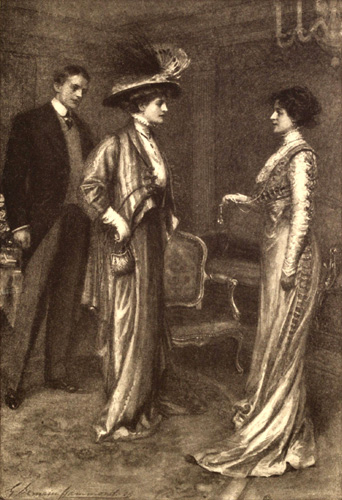
“Since we are speaking of husbands,” Helen interrupted, thinking it time to make her hostess exchange places with her, “you promised me that I should meet yours this afternoon.”
“Oh no, my dear,” the contessa corrected. “I said ‘unless he was impossible,’ and that is just what he is to-day. Be thankful that your husband’s infirmity takes the form it does rather than the gout.”
“Tell me something about your villa,” suggested Helen, glancing around her. “All these places have romantic histories, and I am sure that this is no exception.”
“All one has to do in order to forget the romance with which old Italian houses are invested is to live in one,” the contessa replied. “As a matter of fact, they contain more rheumatism than romance. This one is fairly livable now, but I wish you could have seen it when Morelli first brought me here as a bride! Words can’t express it. An old-fashioned house-cleaning and some good American dollars make the best antidote I know. The first point of interest I was shown here was the room in which the previous Contessa Morelli died. My ambitions were along different lines, so I added some modern improvements, much to the consternation of my husband and the servants. And the present Contessa Morelli, you may have observed, is still very much alive.”
By the time the call came to an end Helen and Emory had learned much regarding Italian life from an American woman’s standpoint, but in the mean time the contessa’s active brain had not been idle. The situation in which she found her new friends puzzled her somewhat and interested her more. She had discovered the indifferent husband and the passive wife—two necessary elements in every domestic drama. Emory answered well enough for the admiring friend of the wife, so all that was necessary was to find the second woman and the dramatis personæ would be complete. This would explain the husband’s indifference and the wife’s passivity. It was an interesting problem, and the contessa saw definite possibilities in it.
As Emory and Helen took their leave Phil suggested that they run down to the library in the motor-car to pick up Armstrong and Miss Thayer.
“Miss Thayer?” queried the contessa.
“My friend, whom you must meet,” Helen explained. “She has been with us almost since our arrival, and is assisting Mr. Armstrong in his literary work.”
“Ah!” exclaimed the contessa, beaming as the completeness of her intuition came to her. “How very interesting! I shall look forward to meeting these two other members of your family.”
The machine reached the foot of the hill and slowed down to pass through the city streets before either Emory or Helen broke the silence, yet it was evident that their minds found full employment. The call upon the contessa left them both with an intangibly unpleasant sensation.
“I am sorry I went with you, Helen,” Emory remarked, after the long pause.
“I am sorry you did,” admitted Helen, frankly, his words fitting in exactly with her own thoughts.
“It is too bad that one can’t do or say the natural thing without having it misunderstood. The contessa is determined to find something upon which she may seize as material for gossip.”
“That is usually not difficult when one tries hard enough,” Helen agreed; “especially when one is living in such an atmosphere as she is.”
“Jack will have to sacrifice himself temporarily or he will leave you in an uncomfortable position.”
Emory spoke guardedly and watched the effect of his words.
“He would have come this afternoon if I had asked him,” Helen asserted, confidently, “but his book is nearly finished and he is not in a mood to be interrupted. I don’t want anything to interfere with its completion.”
“It will be a relief, though, to have it finished, won’t it?”
Helen looked up quickly at Emory’s question and as quickly dropped her eyes as they met his. “Why—yes,” she admitted, slowly. “I shall be glad to have him take a little rest. I am sure he has been overdoing.”
The girl felt Emory’s questioning glance upon her, and it added to her discomfiture.
“Don’t you think it is time to let me help you, Helen?” he asked, pointedly. “You know perfectly well that I feel toward you just as I always have. No”—he stopped the restraining words upon her lips—“I am going to say nothing which I ought not to say, nothing which you ought not to hear. But I want you to be happy, Helen, and sometimes a man can help. Don’t be afraid to ask me; don’t let your pride stand between us. You know that I shall take no advantage of anything you tell me.”
Helen’s lips quivered slightly as she listened, but her voice was natural though restrained. “Something is misleading you, Phil,” she answered, calmly. “Nothing has happened to make it necessary for me to ask help from any one. If there had I should be glad to have so good a friend to fall back upon.”
“You are deceiving no one but yourself, Helen.”
“What do you mean?”
She turned quickly toward him.
“Every one knows how much you are suffering in spite of your brave attempt to keep it to yourself. Why won’t you let me help you, Helen?”
“Who is ‘every one’?” she demanded.
“Why—your uncle Peabody and I and—the contessa,” stammered Emory.
“You and Uncle Peabody think I am suffering?”
“We know it!”
Helen held her head very high in the air, and spoke in a superior tone so obviously assumed as a cloak to disguise her real feelings, that Emory regretted that he had forced the subject upon her; but now it had gone too far to draw back.
“If you know that, perhaps you know the cause of it as well?”
“We do. Jack—”
“Stop!” Helen commanded. The motor-car turned into the Piazza San Lorenzo. “If you have anything to say about my husband,” she continued, “you had better say it direct to him.”
“May I?” cried Emory, leaning forward eagerly. He looked at Helen steadily for a moment, like a runner waiting for the pistol-shot to release him from his strained position at “set.” The girl returned his look with equal steadiness for only an instant before she read what was in his mind. Armstrong and Inez were just coming out through the cloister gates.
“May I?” Emory repeated.
“No!” Helen replied, quickly, sinking back against the cushions.
XVIII
Armstrong was most enthusiastic when he returned late the next afternoon, and Miss Thayer’s face reflected his own great satisfaction. The book was beginning to round into completeness, Cerini had placed upon it the stamp of his unqualified approval, and the author himself had reason to feel well pleased with the results of his tireless application. Helen watched the two as they came out into the garden where she and Uncle Peabody had been visiting. Yes, they were meant for each other. Helen could see this more plainly now even than before. Her husband had lost in weight and in color since he began his work at the library, but the slighter frame and paler face seemed more in keeping with the man whom she now knew. Inez had also changed. The individuality which Helen had always considered a striking characteristic of her friend while at school and later was now completely merged into that of the man beside her. They thought alike, talked alike, acted alike. That was what Jack preferred and what he needed, Helen admitted, and she felt a certain satisfaction that she was at least strong enough to see and to admit it.
“You seem to be very happy to-night, Jack.” Helen tried hard to be natural. “What pleasant thing has happened to you to-day?”
Armstrong drew up a chair for Inez and seated himself beside Helen. “Nothing in particular,” he replied, “except that I begin to see the end of my book in sight.”
“I am very glad,” Helen answered, simply.
“Yes, I suppose you are.” Armstrong spoke pointedly, looking at Helen with a curious expression on his face. “Yes, I suppose you are.”
Helen flushed. “I don’t mean it as you have taken it, Jack,” she replied, quietly. “It has been a hard strain on you, and I am glad to know that you can soon get a change. I think you need it.”
Armstrong still looked at Helen intently. “It has been a strain,” he admitted, at length—“a strain on all of us.” Then his face lighted up as of old. “Cerini says the book is a masterpiece, Helen—do you understand, a masterpiece. He says it is better than he believed it possible for me to do; in fact, the best work on the period which has ever been written. Can you wonder that I am happy?” He turned from Helen to Inez. “And I could never have accomplished it except for the help of our friend here, who has so unselfishly changed her plans at my request. You must thank her for me—for both of us.”
“Does it mean that your visit to Florence is about at an end, Jack?” asked Uncle Peabody.
“Oh, there is much to be done yet,” replied Armstrong. “The first draft is nearly finished, and the material has all been sifted through; but I must go over the manuscript once more at least, here in this atmosphere, before returning to Boston.”
“Even the Old South Church and Bunker Hill Monument will seem very modern when you get back home, won’t they?”
“Everything will seem modern,” Armstrong assented. “I hate to think of leaving Florence, but there is one thought which makes it easier. Miss Thayer will, of course, visit us in Boston next winter, and she and I will then have a chance to do some other work like this together.”
“Why, Mr. Armstrong!” cried Inez, aghast. “I should not think of that for a moment. Believe me, Helen, this is the first I have heard of it. It could not be, of course.”
“Why could it not be?” insisted Armstrong, stoutly.
“You will understand when you take time to think it over,” said Inez, picking up her gloves and starting for the hall. “He does not mean it, Helen—truly he does not!”
“I do mean it,” urged Armstrong, as Inez disappeared. “I mean every word of it. She is your most intimate friend, and what could be more natural than for her to visit us? Why could it not be?”
Uncle Peabody answered:
“There are some things in Boston which are as old as anything you will find in Florence, Jack.”
Armstrong failed to catch the drift of Mr. Cartwright’s remarks.
“You are trying to avoid answering my question,” he replied. “To what do you refer that bears at all upon the present discussion?”