Chapter X · JOURNEY'S END
Reading edition

he little coral island of Bancoran lies in the middle of the Sulu Sea, quite outside the usual routes of travel. It is inhabited only by birds, and people seldom or never go there. But we wanted to obtain, if we could, some new species of gulls or terns for the Bureau of Science at Manila, and also to enjoy the mysterious sea gardens which are found among the southern reefs. Just after tiffin the island was sighted, lying quite alone by itself in milky green water. The ship stopped and launches were dropped overboard, and a glass-bottomed boat which had been brought along for our use.
The afternoon was ideal—the sky blue and fleeced with snowy clouds piled high, while the intense sun shining on the water flashed back a hundred shades of blue and green and mauve. On one side of the island, which floated like an emerald among sapphires, outstanding rocks chafed the seas into foaming surf, while on the other a long, narrow beach lay shimmering, pale yellow in the sunlight. The island itself was covered with a thick jungle of trees, which were dotted with thousands of resting birds. As we drew nearer they saw us and were afraid, rising and soaring and circling in the clear, pure air, and crying out at us. Flock after flock of sea fowl flew wonderingly over our small craft, their white breasts tinted green with the light reflected from the water.
It was like a Robinson Crusoe island, lost out there in the lonely sea. But there were shells of huge turtles, and bones of birds, which suggested that sometime a feast must have been held there, so it was not wholly undiscovered and unexplored. Among the great roots of the trees the birds had built their nests from leaves. The eggs in some of them were white and about the size of hens' eggs. Several varieties of boobies and terns were found, some brown with green-blue eyes, others ivory-white. A few specimens were shot, and one or two were taken back alive to the Rizal for the museum. Previous to this visit the ornithologists had never known to what islands the boobies and frigate birds came to nest, although the scientists had long been searching for the place, so the expedition was well worth while.
But the sea gardens interested me more than the birds or even the island. If Alice could have had her choice in entering Wonderland, she would surely have selected a doorway leading through a glass-bottomed boat, instead of dropping down a rabbit's hole. Beneath the water, which was crystal clear, we could see a strange country with new flowers and peculiar creatures. Where it was sandy and shallow we saw below us fields of green sea grass, on which the fairies must surely have used lawn-mowers, it was so neatly kept.
Interspersed among the fields were beds of feathery, lace-like vegetation unnamed in the language of our party. Passing one expanse after another of this submarine pasturage, we saw depressions in the coral, where tiny fishes played or unknown water creatures had established a little world for themselves and were living in its narrow confines quite unconscious of what went on in the surrounding vastness.
Drifting on into deeper water, we came to a ghost-like gray world of curls and feathers, trembling with life, a forest of pale trees and swaying brown ones, of high hills and dark valleys, made by coral reefs. Pretty rock gardens came into view, where there were cabbages with blue edges, sea anemones and purple fans, a huge toadstool, a giant fungus, and a cactus plant—at least, that is what they looked like to us. There were rainbow shells, too, half hidden, and great blue starfish clinging to the rocks. In and out among the sponges and the brown coral branches, which were so much like antlers, swam curious fishes. Such gorgeous colours—so vivid and in such brilliant combinations! Some were big green fellows, with needle noses; others were electric blue and silver; there were black and yellow ones, too, and striped fishes that looked like sly prisoners dodging their keepers.[27]
ONE DAY'S CATCH OF FISH.
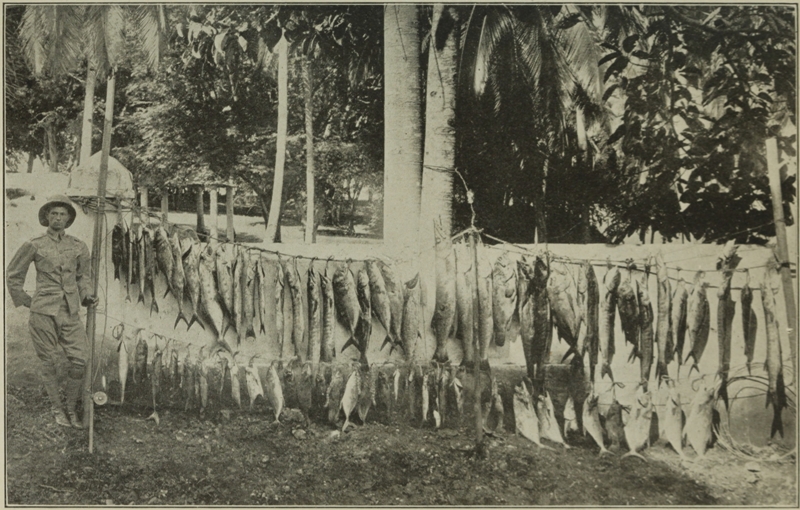
We passed the greater part of the afternoon marooned on this far-away island, some of us going bathing off the shallow, sandy beaches in the clear water. As evening came on we regretfully left the fairy island of Bancoran, and sailed away by the rising moon.
The Penal Colony on Palawan, which I have described in another chapter, was our next point of interest. We left there behind schedule and met a stronger current than we had expected, sweeping down the coast of Panay, so that it was no wonder that we were late in approaching Iloilo. This was especially unfortunate, for very generous preparations had been made there for the Secretary's reception and an interesting series of events arranged, all of which was upset by the delay.
It was sunset when we finally sighted the town. As we cruised up the steeply palisaded coast, with the low-lying foreground of Panay on the other side, backed by its fine ranges of mountains, the effects were most beautiful. The old Spanish fort on its point looked mysterious in the afterglow, and the skies were magnificently alight. A fleet of much beflagged launches and steamers came out to meet the Secretary, whistling a welcome, and turning, escorted the Rizal.
Next to Manila, Iloilo is the most important port in the Islands, and has a better climate than its rival. The people here are supposed to be wealthier and more aristocratic than elsewhere. The Payne bill, which had been in operation only a short time, had brought such a return of prosperity to the land, and especially to the planters of this fertile province, that they were all very enthusiastic about Americans, and did all they could to express their gratitude.
VIEW IN ILOILO, ILOILO, SHOWING HIGH SCHOOL GROUNDS.
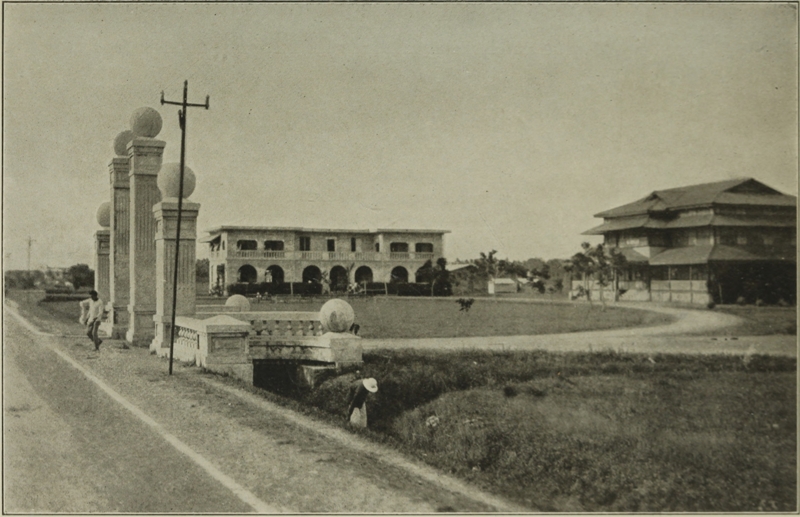
We were invited for dinner at half after seven, but it was an hour later before we sat down to the long table in the large and rather empty room, with its handsome Venetian mirrors at either end, and its sliding shutters wide open to the night. There were no ladies present except those of our party. We could never tell how things would be arranged,—sometimes there would be Filipina ladies, and sometimes there would not; sometimes the ladies would all be placed together at one side of the table, and again they would be seated next to the men. While waiting for dinner to be announced, we sat about in an airy room, with half-dressed servants peeping in at us, and a phonograph playing Caruso records.
After dinner we had a long drive out through the town, which seemed quite business-like and prosperous. They had rebuilt some of the fine, large, wide-open houses, most of which had been destroyed by the insurrectos. (On the nearby island of Negros, we were told, there were many fine haciendas with great houses full of carved work which I was sorry not to see.) Passing through suburbs of nipa houses standing up on their stilts in the moonlight, we came to a plaza gaily illuminated, and to our destination, a mansion approached by a triumphal arch. In the best houses the living rooms are on the second floor, just as in the poorer ones they are raised above the ground on stilts. So here we went upstairs to a great room hung with festoons of flags, where the little women in their bright and varied dresses passing and repassing made a gay scene. It was here, indeed, that we saw some of the prettiest and best dressed women whom we met on our trip.
Most of the following day was spent cruising along the coast of Panay, passing between its fine outlying islands, which reminded us of the Inland Sea of Japan. In the afternoon we came to the entrance of the river on which Capiz is located. The Secretary crossed overland on the first train to run on the new railway, in order to drive in the silver spikes that completed the line.
No dinners had been planned there for those of us who had come by ship, so we did not start up river until half after eight. Capiz is only four miles from the mouth, but they were the longest miles we had ever experienced, for by some mistake the pilot did not arrive, so we went in a Rizal launch without one. We just struggled along as well as we could in the dark till the moon came up, which only mystified us the more with its deceptive shadows. Half a dozen times we ran deep into mud banks, and the sailormen were forced to jump overboard and shove us off. They did not appear to enjoy doing this, and no wonder, for it was a crocodile river.
Swarms of fireflies, which gathered on favourite trees, made a very Christmas-like effect with their throbbing lights. They were lovely, too, in the dark shore shadows, and made sparkling reflections in the black river stream. Watching them we could almost forget our troubles.
Finally, after much winding round and backing off, we turned a bend and saw a line of little twinkling lights strung along the shore and on floating barges, giving quite a Venetian effect and showing us the town by their reflection. Landing, we walked across the grassy square to the provincial building, with its open courtyards, where there was to be a ball. We danced a rigodon as usual, and stopped late with the Governor General, who liked to show his interest in these functions, of which the Filipinos think so much. There were three bands, which vied with each other for applause.
THE OLD AUGUSTINIAN CHURCH, MANILA.
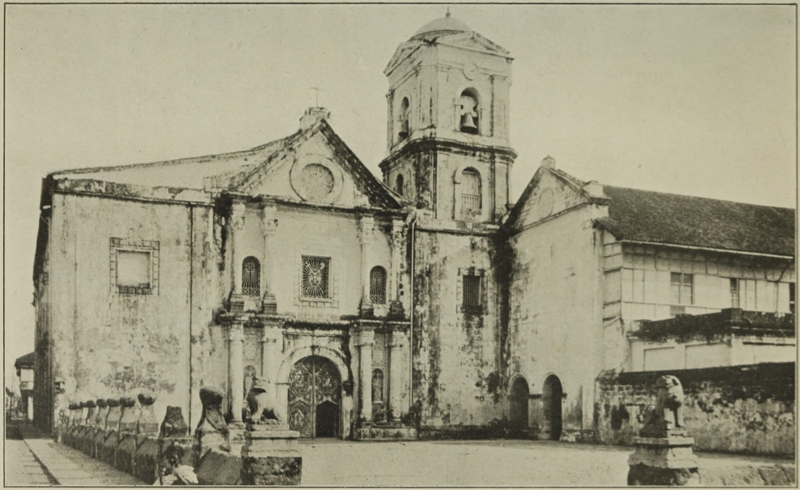
Next morning we got away early on our last leg for Manila and the end of our never-to-be-forgotten journey in the Land of Pine and Palm—that far-away, unfamiliar country where your head gets full of strange thoughts, your body of queer feelings, and your heart has great longings.
We crowded everything we could into those few last days in Manila, for we were loath to think of leaving anything undone. Besides packing and shopping, there were teas and dinners, and the army and navy reception. This was lovely, for it was held in the courtyard filled with trees which were hung with dim lanterns. The good looking officers with their white duck uniforms and brass buttons added to the attractiveness of the scene. The men of our party were even busier than we, for they had several banquets to which we were not invited. In my husband's journal I find the chronicle of a typical day. After describing the events of a busy morning, he says: "In the afternoon, there was a reception to meet the constabulary, at four; the opening of the new hospital, a most complete and wonderful one, at half after four; the laying of the corner stone at five for the new hotel, which is a very ambitious project and will make all the difference in the world as far as touring in the Philippines is concerned; in the evening, a dinner, and after that a reception, and a dance."
Manila seemed more picturesque, and to have even more atmosphere, as I came to know it better. The old walls and churches and plazas and corners and quarters; the Pasig with its cascos and bancas plying about; the narrow streets winding through the suburbs, with old moss-covered walls, and peeps of tangled gardens within, and balustraded terraces, and the bowers of the pink blossoming "chain of love." It is indeed well-named the Pearl of the Orient.