CHAPTER FIFTH.
Reading edition
SOME NEW ACQUAINTANCES.
"I am as sorry as I can be that you are going away, I shall miss you so much;" said Mrs. Gray to Frances and her mother when they came in to tell her about their plans for the winter.
Their rooms were across the hall from hers, and the acquaintance had begun in the elevator, where they often met on the way to the dining room. The old lady was somewhat crippled with rheumatism and moved about with difficulty, so her life was rather a lonely one; and it had given her a great deal of pleasure to have Mrs. Morrison and her little girl drop in every now and then to chat with her and bring her books and papers. Then she could never sufficiently express her gratitude to Frances for taking her glasses to be mended.
"If I hadn't, I might never have known the Spectacle Man, and we shouldn't have found our flat, so I am much obliged to you," Frances said, laughing, when Mrs. Gray went over it all for the tenth time, more or less.
"Then perhaps you would have stayed here for the winter. I am sorry I let you go," was her answer.
"We'll often run in to see you, Mrs. Gray, and sometime you may be able to come to see us," said Mrs. Morrison; adding, "we haven't many friends, you know."
Mrs. Gray shook her head. "I can't get out any more; but as for friends, you'll find them wherever you go."
Gladys did not approve of the move, and frankly expressed her opinion. "It is such a funny old house, in between the stores. I shouldn't think you would want to live there," she said.
"But you don't know how nice it is inside," Frances urged. "It is going to be such fun; and Mr. Clark has some lovely things and the dearest cat!"
"It seems to me you like very funny things," Gladys remarked. She announced, however, that she intended to call.
What with getting the traveller ready to start and moving into their new quarters, those were busy days. They were all three very cheerful indeed, making a great many jokes and talking about next summer, when they should be together again, saying nothing of the long winter that stretched between.
It was a mistake to think of Hawaii as so far away. Had it not been annexed? Two thousand miles from California was simply no distance at all in these days. When it came to saying good-by it was hard indeed to remember all this, but it was gone through with somehow, and one bright October day Frances and her mother found themselves alone in their new sitting room.
"Oh, mother, I wish you wouldn't cry!" sobbed Frances.
"But you are crying yourself," said Mrs. Morrison, half laughing. At this tearful moment there came a knock at the door, and a long heavy package was handed in.
"There must be some mistake," Mrs. Morrison said, drying her eyes and reading the address, which was, however, unmistakable.
They made haste to cut the twine, and behold, a beautiful rug! "Isn't this like that dear, extravagant Jack?" she cried. "Isn't it pretty, Wink? He thought we'd need cheering up!"
Chairs and tables must be pushed aside at once and the rug put in place. Frances had just sat down in the middle of it with great satisfaction, when through the half-open door walked the fattest, rosiest baby imaginable, wearing a very clean blue check apron and an affable smile.
"Why, where did you come from?" they both exclaimed.
This was evidently something he did not care to reveal, for, although he continued to smile and gaze about him with interest, he made no reply.
"'What is your name, baby?'"
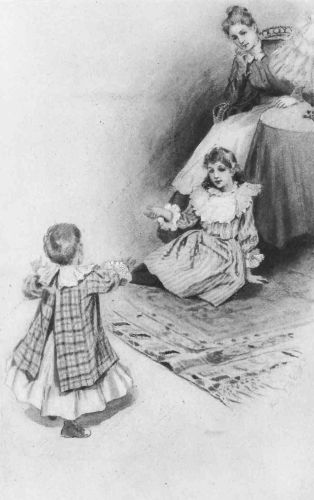
"What is your name, baby?" Frances asked, holding out her hands. "Dennyleebon,"—or so it sounded.
"Do you suppose that is intended for English?" said Mrs. Morrison.
"I don't know. Make him say something else. Baby, can you talk?"
"Tock," repeated the infant, pointing to the mantel.
"Yes," cried Frances, delighted, "it is a clock. You see, mother, he thought I said clock. That is English."
"You don't mean it! But let him alone, Wink, and see what he will do."
The visitor showed plainly that he had a mind of his own. He did not wish to be petted and kissed, but preferred to walk around the room on a tour of investigation. Presently he paused before a table and remarked earnestly, "Book."
"Can't you find a picture-book for him?" asked Mrs. Morrison.
There happened to be an old animal book in the box they were unpacking, and, getting it out, Frances and the baby sat together on the new rug and turned the leaves, the latter never failing to say, "ion," "effunt," "tiger," as the case might be, with unvarying correctness and great enthusiasm.
In the midst of this there came a modest little tap at the door, and when Mrs. Morrison opened it, there stood a girl of about Frances' age. Her red calico dress was very fresh, her cheeks as rosy as the infant's, and her flaxen hair was drawn tightly back and braided in a long tail.
"Is the baby here?" she asked.
"No, no," came in decided tones from the visitor.
This made them all laugh, even the baby himself seeming to think it a good joke.
"Can't he stay for a while? He is good, and we like to have him," said Mrs. Morrison.
The girl hesitated; plainly the baby had no thought of leaving. "The lady who used to have these rooms made a pet of him, and he is always running off up here," she explained.
"I am glad he came, for my daughter and I were feeling lonely. Won't you come in and sit down? Do you live in the house?"
The newcomer accepted Mrs. Morrison's invitation rather shyly, looking as if she had a mind to carry the baby off by main force. Her name, she said, was Emma Bond, and she and her two-year-old brother lived in the back part of the house with their mother, who took care of Mr. Clark's rooms. The baby's name was Robert Lee, but he was commonly known as the General, a nickname given him by the Spectacle Man, and evidently well bestowed.
After the picture-book had been examined from beginning to end twice over, the General was, with the aid of some candy and much diplomacy, induced to accompany his sister downstairs, calling "By-by," and kissing his hand with great affability to Frances.
"Aren't they the cleanest looking children you ever saw?" said the latter, coming back from the hall, where she had gone with their guests.
"Aren't they! I think I shall like Emma, she is a nice, sensible, old-fashioned little girl, and the General is great fun. I hope they will come again," replied Mrs. Morrison.
In the course of the next few days they began to feel at home in their new quarters, and they also made the acquaintance of Mrs. Bond, a small woman with a pleasant but firm face, and such an air of energy that no lazy person could exist comfortably in her presence.
She was never known to waste any time. With the assistance of a colored boy,—a theological student,—who came in twice a day and in the time he could spare from his Latin and Greek cleaned for her, she kept Mr. Clark's rooms and the halls in beautiful order. Her children were always as neat as wax, and her busy fingers found time for a little fine sewing occasionally, which, as a girl, she had learned in the convent school where she was educated.
Mrs. Bond was trying to train her daughter in the same industrious ways, and one Saturday morning Frances discovered Emma dusting the show-cases in the shop. Stopping to speak to her, she learned that this was her daily task, and that on Saturdays she dusted the study also. It must be very interesting work, Frances thought, and the two children found so much to talk about that Mrs. Bond presently came in search of Emma and reproved her for idling. She did not positively object to play after lessons were learned and other duties attended to, but she conveyed the impression to Frances that in her opinion a really exemplary little girl would care more for her tasks than for amusement.
"I am so sorry, but I have to go," Emma whispered, as her mother left the room.
"Won't your mother let you come to see me some time?" Frances asked.
"I guess so, when I haven't anything to do," answered Emma, who thought Frances the most charming little girl she had ever seen.